Key Points per DO 35 s. 2016
15.2 Content and Pedagogy of the K to
12 Basic Education Program
A confident teacher can
implement developmentally-
appropriate teaching methods
that respect the individual
differences of learners.
Teachers can jointly
craft learning goals in
collaboration with
their students.
Content and performance standards
and learning competencies must be
mastered by teachers so that they
can plan lessons, deliver instruction
effectively, and assess the learning
that results from their teaching.
Student learning will improve
because the teacher will be
more systematic and better
contextualized to the
learning needs of students.
Pedagogical
Background of
Loma de Gato
Elementary School
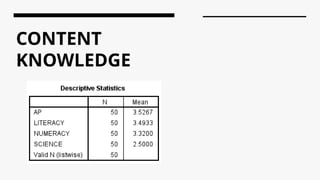
CONTENT
KNOWLEDGE
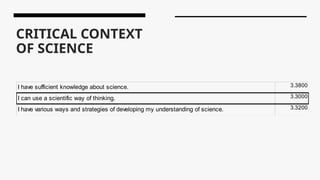
CRITICAL CONTEXT
OF SCIENCE
I have sufficient knowledge about science. 3.3800
I can use a scientific way of thinking. 3.3000
I have various ways and strategies of developing my understanding of science. 3.3200
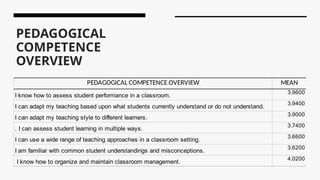
PEDAGOGICAL
COMPETENCE
OVERVIEW
PEDAGOGICAL COMPETENCE OVERVIEW MEAN
I know how to assess student performance in a classroom.
3.9600
I can adapt my teaching based upon what students currently understand or do not understand.
3.9400
I can adapt my teaching style to different learners.
3.9000
. I can assess student learning in multiple ways.
3.7400
I can use a wide range of teaching approaches in a classroom setting.
3.6600
I am familiar with common student understandings and misconceptions.
3.6200
I know how to organize and maintain classroom management.
4.0200
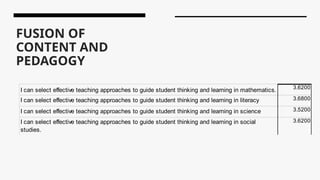
FUSION OF
CONTENT AND
PEDAGOGY
I can select effective teaching approaches to guide student thinking and learning in mathematics. 3.6200
I can select effective teaching approaches to guide student thinking and learning in literacy 3.6800
I can select effective teaching approaches to guide student thinking and learning in science 3.5200
I can select effective teaching approaches to guide student thinking and learning in social
studies.
3.6200
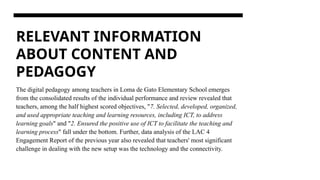
RELEVANT INFORMATION
ABOUT CONTENT AND
PEDAGOGY
The digital pedagogy among teachers in Loma de Gato Elementary School emerges
from the consolidated results of the individual performance and review revealed that
teachers, among the half highest scored objectives, "7. Selected, developed, organized,
and used appropriate teaching and learning resources, including ICT, to address
learning goals" and "2. Ensured the positive use of ICT to facilitate the teaching and
learning process" fall under the bottom. Further, data analysis of the LAC 4
Engagement Report of the previous year also revealed that teachers' most significant
challenge in dealing with the new setup was the technology and the connectivity.
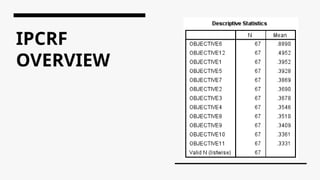
IPCRF
OVERVIEW
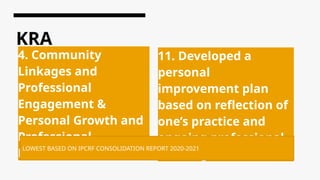
KRA
4. Community
Linkages and
Professional
Engagement &
Personal Growth and
Professional
Development
11. Developed a
personal
improvement plan
based on reflection of
one’s practice and
ongoing professional
learning
LOWEST BASED ON IPCRF CONSOLIDATION REPORT 2020-2021
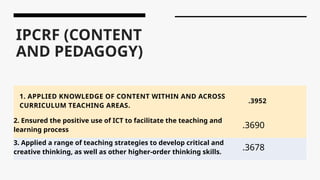
IPCRF (CONTENT
AND PEDAGOGY)
1. APPLIED KNOWLEDGE OF CONTENT WITHIN AND ACROSS
CURRICULUM TEACHING AREAS.
.3952
2. Ensured the positive use of ICT to facilitate the teaching and
learning process
.3690
3. Applied a range of teaching strategies to develop critical and
creative thinking, as well as other higher-order thinking skills.
.3678
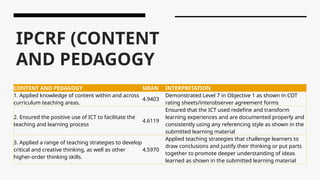
IPCRF (CONTENT
AND PEDAGOGY
CONTENT AND PEDAGOGY MEAN INTERPRETATION
1. Applied knowledge of content within and across
curriculum teaching areas.
4.9403
Demonstrated Level 7 in Objective 1 as shown in COT
rating sheets/interobserver agreement forms
2. Ensured the positive use of ICT to facilitate the
teaching and learning process
4.6119
Ensured that the ICT used redefine and transform
learning experiences and are documented properly and
consistently using any referencing style as shown in the
submitted learning material
3. Applied a range of teaching strategies to develop
critical and creative thinking, as well as other
higher-order thinking skills.
4.5970
Applied teaching strategies that challenge learners to
draw conclusions and justify their thinking or put parts
together to promote deeper understanding of ideas
learned as shown in the submitted learning material
EFFECTIVE TEACHING
APPROACHES TO GUIDE TEACHING
AND LEARNING TO DEVELOP
CRITICAL, CREATIVE, AND HIGHER
ORDER THINKING SKILLS
Teaching and learning
should be inseparable.
Someone has not taught
unless someone else has
learned. Teaching is part of a
whole that comprises the
teacher, learner, disciplinary
content, teaching/learning
process, and evaluation of
both the teacher and
learner. In essence, learning
is the goal of teaching.
Characteristics
of good
teaching
• a teacher’s enthusiasm and passion for
the subject,
• rapport between a teacher and a student
or group of students during discussions in
and out of class,
• intellectual challenges from a teacher,
• clarity and organization in presenting an
analytical and conceptual understanding
of ideas, and
• a teacher’s scholarship.
Research indicates that teachers
teach consistently with their way of
learning (Shulman, 1990; Tobin et al.,
1994). However, it is not necessarily true
that student learning can be understood
from the teachers’ learning history.
Studies of teaching and learning have
led to the classification of teaching
styles into three general categories:
discipline-centered, instructor'
centered, and student-centered
(Dressel and Marcus, 1982; Woods,
1995).
DISCIPLINE-
CENTERED
In discipline-centered teaching, the
course has a fixed structure. The needs,
concerns, and requirements of teacher
and student are not considered because
the course is driven by and depends
mainly on the disciplinary content that
must be presented. The teacher
transmits information, but the content
is dictated by some independent
authority, such as a department syllabus
committee or textbook author.
INSTRUCTOR-
CENTERED
The teacher acts as a model of the
educated person in instructor-centered
teaching. He or she is regarded as the
authoritative expert, the primary source
of knowledge, and the focal point of all
activity. The student is the passive
recipient of the information already
acquired by the teacher. The teacher
selects the information to be taught,
studied, and learned from the discipline.
STUDENT-
CENTERED
Student-centered teaching focuses on the
student and, in particular, on the student's
cognitive development. The teacher's goal is to
help students grasp knowledge development
as a process rather than a product. The focus
of classroom activities and assignments is on
the student-centered process of inquiry, not
on the products of inquiry. Students create
their own conceptual or cognitive models.
Content, teaching style, and methods are
adapted to aid students' cognitive and
intellectual growth. Student-centered teaching
combines an understanding of how humans
process information with other factors that
affect learning, such as attitudes, values,
beliefs, and motivation.
Although there are many ways to teach effectively, all require that the
teacher have knowledge of three things: 1) the material being taught; 2)
the best instructional strategies to teach the material, and 3) how
students learn. Teachers typically know far more about the content of
their discipline than they do about instructional strategies and therefore
tend to use teaching styles similar to those used by their own teachers
(Shulman, 1990). In most cases, they use elements of all three available
teaching styles. As the teacher gains experience, his or her teaching style
is likely to change.
DEVELOPING A
TEACHING STYLE
The first step in preparing to teach a
particular course is to decide on a particular
style of teaching that is compatible with and
appropriate for the students and the goals.
Teachers likely use a combination of the three
teaching styles, depending on the learning
circumstances. While developing their
teaching style, teachers must answer a
fundamental question: Is the primary goal of
my course for each student to gain specific
information, or for each student to master
how to organize and apply new information
independently to new situations? The
primary goal may not be the same for each
student, especially when the students come
from diverse backgrounds.
Factors influencing choic
e of teaching style
• student needs (future course and career requirements,
preparation for participatory citizenship, and preparation for
careers in science, engineering, technology, or education),
• student background (preconceptions and misconceptions.
• familiarity with various teaching methods,
• course enrollment (size, students with special needs, the
logistics of managing small group activities),
• student learning styles,
• teaching load (number of contact hours, office hours, time
for preparation and grading),
• other responsibilities (research, committee work,
administrative duties),
• support structures (equipment cost, teaching and
demonstration assistants),
• facilities (laboratory equipment and computers, classroom
and laboratory space, and demonstration equipment), and
• parallel sections that require some uniformity of coverage
and ex[1]amination
reference
National Research Council 1997. Science
Teaching Reconsidered: A Handbook.
Washington, DC: The National
Academies Press.
https://doi.org/10.17226/5287.
Digital
Pedagogy
As education moves towards digitalization, technology has influenced
much learning and resulted in the development of digital pedagogy,
which has become a vital part of the learning process. Digital media and
learning tools enable learning according to own pace, understanding, and
instantaneous feedback and evaluation. The emerging philosophy of
technology in education prevails cultural milieu and draws a conception of
technological change in education. Digital pedagogy integration has a
vital role in student-teacher enthusiasm in building productive connections
to simulated conditions. Navarro et al. (2021) probed that teachers need to
harmonize content, pedagogy, and technology rather than learn how to
use technology in teaching. Educators' attitudes towards technology
integration are the key to understanding digital Pedagogy.
Innovation has impacted a ton
of learning and improved
advanced teaching methods.
Teaching and learning have
become more sophisticated.
The digital era provides an avenue for innovative and intelligent
education. Learners can access massive resources using various
mobile applications through a wireless network. Informatization
allows taking advantage of the possibilities of new technologies
in teaching students.
Digital pedagogy consists of content-based, environmental,
technological, and competency-based components. The
teaching-learning process's mode continually changes from
input-output-based to outcome-based education. Teachers
can make the teaching-learning process more effective and
interactive by using various strategies to make students'
academic performance more meaningful and intrinsically
motivating. Digital pedagogies need to consider integrating
technology in education as more than just a tool for
learning but as an active part of the pedagogy.
Teaching and learning have become more
sophisticated, requiring new pedagogy. Problem-
based learning with ICTs has emerged to improve
learning outcomes. The pandemic has heightened
interest in digital pedagogies to help students learn. It
includes technology access and social support among
disadvantaged students from low-income families.
HOW TO DETERMINE
THE EXTENT OF
DIGITAL PEDAGOGY?
1. Identify one's
digital pedagogy
orientation.
Digital pedagogy orientation is the
perceived orientation of the teachers on the
relative position of information and
communication technology in the teaching-
learning process.
Key
Questions:
DOES USING INFORMATION AND
COMMUNICATION TECHNOLOGIES
(ICTS) IN THE CLASSROOM MAKE
THE TEACHING-LEARNING PROCESS
MORE ENJOYABLE, FUNCTIONAL,
AND SAVES ENERGY?
DOES THE USE OF ICTS HELP
STUDENTS UNDERSTAND ABSTRACT
CONTENT AND HELP THEM DESIGN
THEIR LEARNING?
2. Determine the
level of digital
pedagogy practice.
The digital pedagogy practice
is the capacity of teachers to
implement teaching-learning
standards by assessing the
extent of alignment of their
professional teaching practice.
Key Questions:
Can digital literacy be examined critically
and curiously, and students must know
when and how to cite others in digital
sources?
Does every student have equitable access
to digital tools, and should all lessons be
designed with learner-driven activities in
mind?
Does technology foster authentic learning
by designing activities with content area
standards?
3. Evaluate
digital pedagogy
competence.
The digital pedagogy
competence measures
teachers' information,
communication, and
technology skills in the
teaching-learning process.
Teachers' orientation,
practice, and
competencies provide an
overview of how digital
pedagogy is present and
relevant in the learning
process.
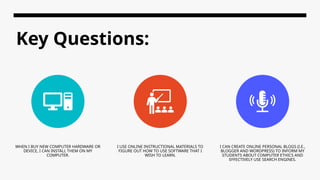
Key Questions:
WHEN I BUY NEW COMPUTER HARDWARE OR
DEVICE, I CAN INSTALL THEM ON MY
COMPUTER.
I USE ONLINE INSTRUCTIONAL MATERIALS TO
FIGURE OUT HOW TO USE SOFTWARE THAT I
WISH TO LEARN.
I CAN CREATE ONLINE PERSONAL BLOGS (I.E.,
BLOGGER AND WORDPRESS) TO INFORM MY
STUDENTS ABOUT COMPUTER ETHICS AND
EFFECTIVELY USE SEARCH ENGINES.
Reference:
Cabanero, J., Caro, R., & Granil, C. (2022).
Exploring the Digital Pedagogy among
Teachers in Loma de Gato Elementary
School: Basis for Upskilling and
Reskilling Program. [Applied Research
Proposal, SDO Bulacan].
Speak by the language of
your heart, and I will listen
by the power of my mind.-

LACSessionPresentation.pptxxxxxxxxxxxxxx

  • 1.
    Key Points perDO 35 s. 2016 15.2 Content and Pedagogy of the K to 12 Basic Education Program
  • 2.
    A confident teachercan implement developmentally- appropriate teaching methods that respect the individual differences of learners.
  • 3.
    Teachers can jointly craftlearning goals in collaboration with their students.
  • 4.
    Content and performancestandards and learning competencies must be mastered by teachers so that they can plan lessons, deliver instruction effectively, and assess the learning that results from their teaching.
  • 5.
    Student learning willimprove because the teacher will be more systematic and better contextualized to the learning needs of students.
  • 6.
    Pedagogical Background of Loma deGato Elementary School
  • 7.
  • 8.
    CRITICAL CONTEXT OF SCIENCE Ihave sufficient knowledge about science. 3.3800 I can use a scientific way of thinking. 3.3000 I have various ways and strategies of developing my understanding of science. 3.3200
  • 9.
    PEDAGOGICAL COMPETENCE OVERVIEW PEDAGOGICAL COMPETENCE OVERVIEWMEAN I know how to assess student performance in a classroom. 3.9600 I can adapt my teaching based upon what students currently understand or do not understand. 3.9400 I can adapt my teaching style to different learners. 3.9000 . I can assess student learning in multiple ways. 3.7400 I can use a wide range of teaching approaches in a classroom setting. 3.6600 I am familiar with common student understandings and misconceptions. 3.6200 I know how to organize and maintain classroom management. 4.0200
  • 10.
    FUSION OF CONTENT AND PEDAGOGY Ican select effective teaching approaches to guide student thinking and learning in mathematics. 3.6200 I can select effective teaching approaches to guide student thinking and learning in literacy 3.6800 I can select effective teaching approaches to guide student thinking and learning in science 3.5200 I can select effective teaching approaches to guide student thinking and learning in social studies. 3.6200
  • 11.
    RELEVANT INFORMATION ABOUT CONTENTAND PEDAGOGY The digital pedagogy among teachers in Loma de Gato Elementary School emerges from the consolidated results of the individual performance and review revealed that teachers, among the half highest scored objectives, "7. Selected, developed, organized, and used appropriate teaching and learning resources, including ICT, to address learning goals" and "2. Ensured the positive use of ICT to facilitate the teaching and learning process" fall under the bottom. Further, data analysis of the LAC 4 Engagement Report of the previous year also revealed that teachers' most significant challenge in dealing with the new setup was the technology and the connectivity.
  • 12.
  • 13.
    KRA 4. Community Linkages and Professional Engagement& Personal Growth and Professional Development 11. Developed a personal improvement plan based on reflection of one’s practice and ongoing professional learning LOWEST BASED ON IPCRF CONSOLIDATION REPORT 2020-2021
  • 14.
    IPCRF (CONTENT AND PEDAGOGY) 1.APPLIED KNOWLEDGE OF CONTENT WITHIN AND ACROSS CURRICULUM TEACHING AREAS. .3952 2. Ensured the positive use of ICT to facilitate the teaching and learning process .3690 3. Applied a range of teaching strategies to develop critical and creative thinking, as well as other higher-order thinking skills. .3678
  • 15.
    IPCRF (CONTENT AND PEDAGOGY CONTENTAND PEDAGOGY MEAN INTERPRETATION 1. Applied knowledge of content within and across curriculum teaching areas. 4.9403 Demonstrated Level 7 in Objective 1 as shown in COT rating sheets/interobserver agreement forms 2. Ensured the positive use of ICT to facilitate the teaching and learning process 4.6119 Ensured that the ICT used redefine and transform learning experiences and are documented properly and consistently using any referencing style as shown in the submitted learning material 3. Applied a range of teaching strategies to develop critical and creative thinking, as well as other higher-order thinking skills. 4.5970 Applied teaching strategies that challenge learners to draw conclusions and justify their thinking or put parts together to promote deeper understanding of ideas learned as shown in the submitted learning material
  • 16.
    EFFECTIVE TEACHING APPROACHES TOGUIDE TEACHING AND LEARNING TO DEVELOP CRITICAL, CREATIVE, AND HIGHER ORDER THINKING SKILLS
  • 17.
    Teaching and learning shouldbe inseparable. Someone has not taught unless someone else has learned. Teaching is part of a whole that comprises the teacher, learner, disciplinary content, teaching/learning process, and evaluation of both the teacher and learner. In essence, learning is the goal of teaching.
  • 18.
    Characteristics of good teaching • ateacher’s enthusiasm and passion for the subject, • rapport between a teacher and a student or group of students during discussions in and out of class, • intellectual challenges from a teacher, • clarity and organization in presenting an analytical and conceptual understanding of ideas, and • a teacher’s scholarship.
  • 19.
    Research indicates thatteachers teach consistently with their way of learning (Shulman, 1990; Tobin et al., 1994). However, it is not necessarily true that student learning can be understood from the teachers’ learning history.
  • 20.
    Studies of teachingand learning have led to the classification of teaching styles into three general categories: discipline-centered, instructor' centered, and student-centered (Dressel and Marcus, 1982; Woods, 1995).
  • 21.
    DISCIPLINE- CENTERED In discipline-centered teaching,the course has a fixed structure. The needs, concerns, and requirements of teacher and student are not considered because the course is driven by and depends mainly on the disciplinary content that must be presented. The teacher transmits information, but the content is dictated by some independent authority, such as a department syllabus committee or textbook author.
  • 22.
    INSTRUCTOR- CENTERED The teacher actsas a model of the educated person in instructor-centered teaching. He or she is regarded as the authoritative expert, the primary source of knowledge, and the focal point of all activity. The student is the passive recipient of the information already acquired by the teacher. The teacher selects the information to be taught, studied, and learned from the discipline.
  • 23.
    STUDENT- CENTERED Student-centered teaching focuseson the student and, in particular, on the student's cognitive development. The teacher's goal is to help students grasp knowledge development as a process rather than a product. The focus of classroom activities and assignments is on the student-centered process of inquiry, not on the products of inquiry. Students create their own conceptual or cognitive models. Content, teaching style, and methods are adapted to aid students' cognitive and intellectual growth. Student-centered teaching combines an understanding of how humans process information with other factors that affect learning, such as attitudes, values, beliefs, and motivation.
  • 24.
    Although there aremany ways to teach effectively, all require that the teacher have knowledge of three things: 1) the material being taught; 2) the best instructional strategies to teach the material, and 3) how students learn. Teachers typically know far more about the content of their discipline than they do about instructional strategies and therefore tend to use teaching styles similar to those used by their own teachers (Shulman, 1990). In most cases, they use elements of all three available teaching styles. As the teacher gains experience, his or her teaching style is likely to change.
  • 25.
  • 26.
    The first stepin preparing to teach a particular course is to decide on a particular style of teaching that is compatible with and appropriate for the students and the goals. Teachers likely use a combination of the three teaching styles, depending on the learning circumstances. While developing their teaching style, teachers must answer a fundamental question: Is the primary goal of my course for each student to gain specific information, or for each student to master how to organize and apply new information independently to new situations? The primary goal may not be the same for each student, especially when the students come from diverse backgrounds.
  • 27.
    Factors influencing choic eof teaching style
  • 28.
    • student needs(future course and career requirements, preparation for participatory citizenship, and preparation for careers in science, engineering, technology, or education), • student background (preconceptions and misconceptions. • familiarity with various teaching methods, • course enrollment (size, students with special needs, the logistics of managing small group activities), • student learning styles, • teaching load (number of contact hours, office hours, time for preparation and grading), • other responsibilities (research, committee work, administrative duties), • support structures (equipment cost, teaching and demonstration assistants), • facilities (laboratory equipment and computers, classroom and laboratory space, and demonstration equipment), and • parallel sections that require some uniformity of coverage and ex[1]amination
  • 29.
    reference National Research Council1997. Science Teaching Reconsidered: A Handbook. Washington, DC: The National Academies Press. https://doi.org/10.17226/5287.
  • 30.
  • 31.
    As education movestowards digitalization, technology has influenced much learning and resulted in the development of digital pedagogy, which has become a vital part of the learning process. Digital media and learning tools enable learning according to own pace, understanding, and instantaneous feedback and evaluation. The emerging philosophy of technology in education prevails cultural milieu and draws a conception of technological change in education. Digital pedagogy integration has a vital role in student-teacher enthusiasm in building productive connections to simulated conditions. Navarro et al. (2021) probed that teachers need to harmonize content, pedagogy, and technology rather than learn how to use technology in teaching. Educators' attitudes towards technology integration are the key to understanding digital Pedagogy.
  • 32.
    Innovation has impacteda ton of learning and improved advanced teaching methods. Teaching and learning have become more sophisticated.
  • 33.
    The digital eraprovides an avenue for innovative and intelligent education. Learners can access massive resources using various mobile applications through a wireless network. Informatization allows taking advantage of the possibilities of new technologies in teaching students.
  • 34.
    Digital pedagogy consistsof content-based, environmental, technological, and competency-based components. The teaching-learning process's mode continually changes from input-output-based to outcome-based education. Teachers can make the teaching-learning process more effective and interactive by using various strategies to make students' academic performance more meaningful and intrinsically motivating. Digital pedagogies need to consider integrating technology in education as more than just a tool for learning but as an active part of the pedagogy.
  • 35.
    Teaching and learninghave become more sophisticated, requiring new pedagogy. Problem- based learning with ICTs has emerged to improve learning outcomes. The pandemic has heightened interest in digital pedagogies to help students learn. It includes technology access and social support among disadvantaged students from low-income families.
  • 36.
    HOW TO DETERMINE THEEXTENT OF DIGITAL PEDAGOGY?
  • 37.
    1. Identify one's digitalpedagogy orientation.
  • 38.
    Digital pedagogy orientationis the perceived orientation of the teachers on the relative position of information and communication technology in the teaching- learning process.
  • 39.
    Key Questions: DOES USING INFORMATIONAND COMMUNICATION TECHNOLOGIES (ICTS) IN THE CLASSROOM MAKE THE TEACHING-LEARNING PROCESS MORE ENJOYABLE, FUNCTIONAL, AND SAVES ENERGY? DOES THE USE OF ICTS HELP STUDENTS UNDERSTAND ABSTRACT CONTENT AND HELP THEM DESIGN THEIR LEARNING?
  • 40.
    2. Determine the levelof digital pedagogy practice.
  • 41.
    The digital pedagogypractice is the capacity of teachers to implement teaching-learning standards by assessing the extent of alignment of their professional teaching practice.
  • 42.
    Key Questions: Can digitalliteracy be examined critically and curiously, and students must know when and how to cite others in digital sources? Does every student have equitable access to digital tools, and should all lessons be designed with learner-driven activities in mind? Does technology foster authentic learning by designing activities with content area standards?
  • 43.
  • 44.
    The digital pedagogy competencemeasures teachers' information, communication, and technology skills in the teaching-learning process. Teachers' orientation, practice, and competencies provide an overview of how digital pedagogy is present and relevant in the learning process.
  • 45.
    Key Questions: WHEN IBUY NEW COMPUTER HARDWARE OR DEVICE, I CAN INSTALL THEM ON MY COMPUTER. I USE ONLINE INSTRUCTIONAL MATERIALS TO FIGURE OUT HOW TO USE SOFTWARE THAT I WISH TO LEARN. I CAN CREATE ONLINE PERSONAL BLOGS (I.E., BLOGGER AND WORDPRESS) TO INFORM MY STUDENTS ABOUT COMPUTER ETHICS AND EFFECTIVELY USE SEARCH ENGINES.
  • 46.
    Reference: Cabanero, J., Caro,R., & Granil, C. (2022). Exploring the Digital Pedagogy among Teachers in Loma de Gato Elementary School: Basis for Upskilling and Reskilling Program. [Applied Research Proposal, SDO Bulacan].
  • 47.
    Speak by thelanguage of your heart, and I will listen by the power of my mind.-