CHAPTER 5
LOCATION DECISION
Learning Objectives
1. Able to define facility location.
2. Identify objectives and importance of location
decision.
3. Describe factors Influencing Location Decisions:
- Tangible Factors
- Intangible Factors
4. Understand Plant Location Models:
- Factor Rating Technique
- Break-Even Point Analysis
- Location Break-Even Point Analysis
Introduction
 Location has a major impact on the overall risk and profit of the
company. Firms throughout the world are using the concepts and
techniques of this chapter to address the location decision because
location greatly affects both fixed and variable costs.
 Company need location that can provide abundant, skills, productive
and low cost labors.
The location decision often depends on the type of business
The objective of location strategy is to maximize the benefit of location
to the firm.
Definition of facility location
Facility location is the process of determining
a geographic site for a firm’s operation.
@
Facility location is a place where a factory,
warehouse , office or any other business
enterprise is built.
Importance of facility location
1. Profitability & Long-term Survival
- Location decision involves large amounts of capital. Once decision is
made and implemented, it cannot be changed without substantial
cost. The cost is large and difficult to be reduced.
2. Impact on operating costs
- Location decisions often to have an impact on operating costs(fixed
cost and variable cost) and revenues.
3. Competition
- A firm’s location affect its ability to compete and many other aspects
of its operation.
4. Hidden Effects
- The effects of location can be risky since they are not directly
observable. The management should always be alert to the need to
evaluate location effectively.
Importance of facility location
5. Improve customer service by locating near customers
- service providers like fast food restaurants locate near one another
to draw customers to one location, while retail stores to attract a
higher volume of customer.
6. Better working environment for workers
- management should consider employees’ interest as well. Location
of the factories or outlets should have an access to all amenities such
as housing, education, shopping and other service.
7. To balance costs through choosing the best location
8. Reduce investment costs & maximize the benefit of location.
Factors Influencing Location Decision
1. Tangible/Quantitative/Economic
Factors.
2. Intangible/Qualitative Factors.
Tangible/Quantitative/Economic Factors
1. Facility costs (Land/Building/Office).
2. Proximity to Suppliers & Resources.
3. Labour Costs.
4. Distribution Costs.
5. Utilities and Taxes Costs.
Intangible/Qualitative Factors
1. Worker education, skills & attitude.
2. Local & government policies.
3. Attractiveness of location.
4. Quality of life issues.
5. Economic/Political sentiment.
6. Community acceptance/feelings.
Methods of evaluating Location Analysis
1. Factor rating technique
2. Break-Even Point Analysis
3. Location Break-Even Analysis
4. The Center of Gravity Method
5. The Load Distance Model
6. The Transportation Method
Our syllabus concentrates on the first three
methods
1. Factor rating technique
March 2004 (QA1)
A company is planning on expanding and building a
new plant in one of the three Southeast Asian
countries. Harris Baker, the manager in charge of
the decision making,has determined that five
factors can be used to evaluate the prospective
countries. Baker used a rating system of 1 (least
desirable country) to 5 (most desirable) to evaluate
each factor
1. Factor rating technique
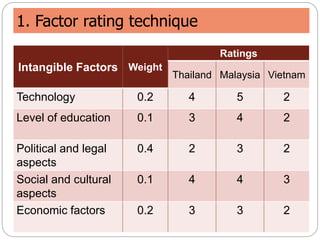
Intangible Factors Weight
Ratings
Thailand Malaysia Vietnam
Technology 0.2 4 5 2
Level of education 0.1 3 4 2
Political and legal
aspects
0.4 2 3 2
Social and cultural
aspects
0.1 4 4 3
Economic factors 0.2 3 3 2
1. Factor rating technique
Intangible
Factors Weight
Weighted Scores (WS)
Thailand Malaysia Vietnam
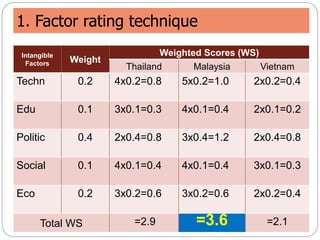
Techn 0.2 4x0.2=0.8 5x0.2=1.0 2x0.2=0.4
Edu 0.1 3x0.1=0.3 4x0.1=0.4 2x0.1=0.2
Politic 0.4 2x0.4=0.8 3x0.4=1.2 2x0.4=0.8
Social 0.1 4x0.1=0.4 4x0.1=0.4 3x0.1=0.3
Eco 0.2 3x0.2=0.6 3x0.2=0.6 2x0.2=0.4
Total WS =2.9 =2.1=3.6
1. Factor rating – Intangible Factors
Weighted Scores
Thailand Malaysia Vietnam
Total WS 2.9 3.6 2.1
Based on the total weighted scores,
Malaysia is chosen as the prefered
location because of its highest score.
Ranking 2 3 1
1. Factor rating – Tangible/Costs
Cost Factors
RM
Thailand Malaysia Vietnam
Fixed Costs 30,000 60,000 110,000
Variable Costs 150,000 90,000 50,000
Ranking 1 3 2
Total Costs 180,000 150,000 160,000
1. Factor rating – Integrated Table
Factors
Weigh
t
Weighted Scores (WS)
Thailand Malaysia Vietnam
Tangible 2 1x2=2 3x2=6 2x2=4
Intangible 1 2x1=2 3x1=3 1x1=1
Total WS = 4 = 9 = 5
Ranking 1 3 2
2.Break-Even Point Analysis (Contribution
Margin (CM) Concept)
CM = Selling Price (SP) – Variable Cost (VC)/unit
(This amount is used to cover Fixed Costs)
It is important to achieve break-even (BE)
BE Point (BEP) in unit = Total Fixed Costs
CM
BEP in RM = BEP(unit) x SP
2.Break-Even Point Analysis (Contribution
Margin (CM) Concept)
Oktober 2004 (QA1)
A manufacturing firm is operating with a fixed cost
of RM40,000 per month and a variable cost made
up of raw materials of RM 4 per unit, direct labor
cost of RM12 per unit and overhead cost of RM4
per unit. The firm sells its product at RM40 per unit.
FC = RM40K/mth
SP = RM40/unit
VC = (RM4 + RM12 + RM4)= RM20/unit
2.Break-Even Point Analysis (Contribution
Margin (CM) Concept)
FC = RM40K/mth; SP = RM40; VC = RM20/unit
a) Calculate the breakeven point.
BEP (unit) = RM40,000 ÷ (RM40 – RM20)
= 2,000 units
b) Determine the total revenue required to
breakeven.
BEP(RM) = 2,000 units x RM40 = RM80,000
2. Break-Even Point Analysis (Contribution
Margin (CM) Concept)
FC = RM40K/mth; SP = RM40; VC = RM20/unit
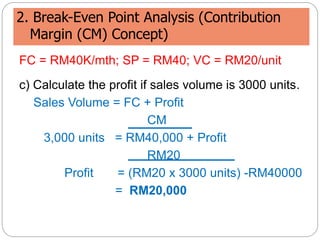
c) Calculate the profit if sales volume is 3000 units.
Sales Volume = FC + Profit
CM
3,000 units = RM40,000 + Profit
RM20
Profit = (RM20 x 3000 units) -RM40000
= RM20,000
2. Break-Even Point Analysis (Contribution
Margin (CM) Concept)
FC = RM40K/mth; SP = RM40; VC = RM20/unit
d) Determine the production volume if the firm's
target profit is RM40,000 per month.
Sales Volume = FC + Profit
CM
Sales Volume = RM40,000 + RM40,000
RM20
Sales Volume = RM80,000
RM20
= 4,000 units
2. Break-Even Point Analysis (Contribution
Margin (CM) Concept)
FC = RM40K/mth; SP = RM40; VC = RM20/unit
e) If the contribution margin increased by 5%, calculate the new
breakeven point assuming the price remains the same.
CM (new) = RM20 x 1.05 = RM21
BEP (unit) = RM40,000 ÷ RM21
= 1,904.76 @ 1,905 units
BEP(RM) = 1,905 units x RM40 = RM76,200
2.Break-Even Point Analysis (Contribution
Margin (CM) Concept)
FC = RM40K/mth; SP = RM40; VC = RM20/unit
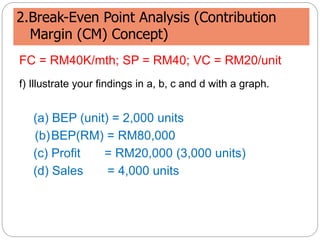
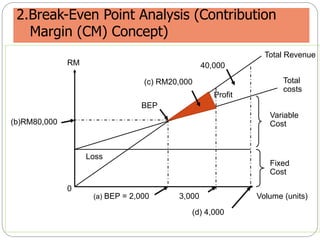
f) Illustrate your findings in a, b, c and d with a graph.
(a) BEP (unit) = 2,000 units
(b)BEP(RM) = RM80,000
(c) Profit = RM20,000 (3,000 units)
(d) Sales = 4,000 units
2.Break-Even Point Analysis (Contribution
Margin (CM) Concept)
Profit
(b)RM80,000
(c) RM20,000
(a) BEP = 2,000
(d) 4,000
3,000 Volume (units)
Fixed
Cost
Variable
Cost
Total
costs
Total Revenue
BEP
40,000RM
0
Loss
Past Year Exam Question
April 2010 (QA1)
Okt 2009 (QA1)
April 2009 (QA5)
April 2008 (QA1)
April 2007 (QA1)
Okt 2006 (QA1)
April 2006 (QA1)
Nov 2005 (QA1)
Okt 2004 (QA1)

Chapter 5 location - 1st

  • 1.
  • 2.
    Learning Objectives 1. Ableto define facility location. 2. Identify objectives and importance of location decision. 3. Describe factors Influencing Location Decisions: - Tangible Factors - Intangible Factors 4. Understand Plant Location Models: - Factor Rating Technique - Break-Even Point Analysis - Location Break-Even Point Analysis
  • 3.
    Introduction  Location hasa major impact on the overall risk and profit of the company. Firms throughout the world are using the concepts and techniques of this chapter to address the location decision because location greatly affects both fixed and variable costs.  Company need location that can provide abundant, skills, productive and low cost labors. The location decision often depends on the type of business The objective of location strategy is to maximize the benefit of location to the firm.
  • 4.
    Definition of facilitylocation Facility location is the process of determining a geographic site for a firm’s operation. @ Facility location is a place where a factory, warehouse , office or any other business enterprise is built.
  • 5.
    Importance of facilitylocation 1. Profitability & Long-term Survival - Location decision involves large amounts of capital. Once decision is made and implemented, it cannot be changed without substantial cost. The cost is large and difficult to be reduced. 2. Impact on operating costs - Location decisions often to have an impact on operating costs(fixed cost and variable cost) and revenues. 3. Competition - A firm’s location affect its ability to compete and many other aspects of its operation. 4. Hidden Effects - The effects of location can be risky since they are not directly observable. The management should always be alert to the need to evaluate location effectively.
  • 6.
    Importance of facilitylocation 5. Improve customer service by locating near customers - service providers like fast food restaurants locate near one another to draw customers to one location, while retail stores to attract a higher volume of customer. 6. Better working environment for workers - management should consider employees’ interest as well. Location of the factories or outlets should have an access to all amenities such as housing, education, shopping and other service. 7. To balance costs through choosing the best location 8. Reduce investment costs & maximize the benefit of location.
  • 7.
    Factors Influencing LocationDecision 1. Tangible/Quantitative/Economic Factors. 2. Intangible/Qualitative Factors.
  • 8.
    Tangible/Quantitative/Economic Factors 1. Facilitycosts (Land/Building/Office). 2. Proximity to Suppliers & Resources. 3. Labour Costs. 4. Distribution Costs. 5. Utilities and Taxes Costs.
  • 9.
    Intangible/Qualitative Factors 1. Workereducation, skills & attitude. 2. Local & government policies. 3. Attractiveness of location. 4. Quality of life issues. 5. Economic/Political sentiment. 6. Community acceptance/feelings.
  • 10.
    Methods of evaluatingLocation Analysis 1. Factor rating technique 2. Break-Even Point Analysis 3. Location Break-Even Analysis 4. The Center of Gravity Method 5. The Load Distance Model 6. The Transportation Method Our syllabus concentrates on the first three methods
  • 11.
    1. Factor ratingtechnique March 2004 (QA1) A company is planning on expanding and building a new plant in one of the three Southeast Asian countries. Harris Baker, the manager in charge of the decision making,has determined that five factors can be used to evaluate the prospective countries. Baker used a rating system of 1 (least desirable country) to 5 (most desirable) to evaluate each factor
  • 12.
    1. Factor ratingtechnique Intangible Factors Weight Ratings Thailand Malaysia Vietnam Technology 0.2 4 5 2 Level of education 0.1 3 4 2 Political and legal aspects 0.4 2 3 2 Social and cultural aspects 0.1 4 4 3 Economic factors 0.2 3 3 2
  • 13.
    1. Factor ratingtechnique Intangible Factors Weight Weighted Scores (WS) Thailand Malaysia Vietnam Techn 0.2 4x0.2=0.8 5x0.2=1.0 2x0.2=0.4 Edu 0.1 3x0.1=0.3 4x0.1=0.4 2x0.1=0.2 Politic 0.4 2x0.4=0.8 3x0.4=1.2 2x0.4=0.8 Social 0.1 4x0.1=0.4 4x0.1=0.4 3x0.1=0.3 Eco 0.2 3x0.2=0.6 3x0.2=0.6 2x0.2=0.4 Total WS =2.9 =2.1=3.6
  • 14.
    1. Factor rating– Intangible Factors Weighted Scores Thailand Malaysia Vietnam Total WS 2.9 3.6 2.1 Based on the total weighted scores, Malaysia is chosen as the prefered location because of its highest score. Ranking 2 3 1
  • 15.
    1. Factor rating– Tangible/Costs Cost Factors RM Thailand Malaysia Vietnam Fixed Costs 30,000 60,000 110,000 Variable Costs 150,000 90,000 50,000 Ranking 1 3 2 Total Costs 180,000 150,000 160,000
  • 16.
    1. Factor rating– Integrated Table Factors Weigh t Weighted Scores (WS) Thailand Malaysia Vietnam Tangible 2 1x2=2 3x2=6 2x2=4 Intangible 1 2x1=2 3x1=3 1x1=1 Total WS = 4 = 9 = 5 Ranking 1 3 2
  • 17.
    2.Break-Even Point Analysis(Contribution Margin (CM) Concept) CM = Selling Price (SP) – Variable Cost (VC)/unit (This amount is used to cover Fixed Costs) It is important to achieve break-even (BE) BE Point (BEP) in unit = Total Fixed Costs CM BEP in RM = BEP(unit) x SP
  • 18.
    2.Break-Even Point Analysis(Contribution Margin (CM) Concept) Oktober 2004 (QA1) A manufacturing firm is operating with a fixed cost of RM40,000 per month and a variable cost made up of raw materials of RM 4 per unit, direct labor cost of RM12 per unit and overhead cost of RM4 per unit. The firm sells its product at RM40 per unit. FC = RM40K/mth SP = RM40/unit VC = (RM4 + RM12 + RM4)= RM20/unit
  • 19.
    2.Break-Even Point Analysis(Contribution Margin (CM) Concept) FC = RM40K/mth; SP = RM40; VC = RM20/unit a) Calculate the breakeven point. BEP (unit) = RM40,000 ÷ (RM40 – RM20) = 2,000 units b) Determine the total revenue required to breakeven. BEP(RM) = 2,000 units x RM40 = RM80,000
  • 20.
    2. Break-Even PointAnalysis (Contribution Margin (CM) Concept) FC = RM40K/mth; SP = RM40; VC = RM20/unit c) Calculate the profit if sales volume is 3000 units. Sales Volume = FC + Profit CM 3,000 units = RM40,000 + Profit RM20 Profit = (RM20 x 3000 units) -RM40000 = RM20,000
  • 21.
    2. Break-Even PointAnalysis (Contribution Margin (CM) Concept) FC = RM40K/mth; SP = RM40; VC = RM20/unit d) Determine the production volume if the firm's target profit is RM40,000 per month. Sales Volume = FC + Profit CM Sales Volume = RM40,000 + RM40,000 RM20 Sales Volume = RM80,000 RM20 = 4,000 units
  • 22.
    2. Break-Even PointAnalysis (Contribution Margin (CM) Concept) FC = RM40K/mth; SP = RM40; VC = RM20/unit e) If the contribution margin increased by 5%, calculate the new breakeven point assuming the price remains the same. CM (new) = RM20 x 1.05 = RM21 BEP (unit) = RM40,000 ÷ RM21 = 1,904.76 @ 1,905 units BEP(RM) = 1,905 units x RM40 = RM76,200
  • 23.
    2.Break-Even Point Analysis(Contribution Margin (CM) Concept) FC = RM40K/mth; SP = RM40; VC = RM20/unit f) Illustrate your findings in a, b, c and d with a graph. (a) BEP (unit) = 2,000 units (b)BEP(RM) = RM80,000 (c) Profit = RM20,000 (3,000 units) (d) Sales = 4,000 units
  • 24.
    2.Break-Even Point Analysis(Contribution Margin (CM) Concept) Profit (b)RM80,000 (c) RM20,000 (a) BEP = 2,000 (d) 4,000 3,000 Volume (units) Fixed Cost Variable Cost Total costs Total Revenue BEP 40,000RM 0 Loss
  • 25.
    Past Year ExamQuestion April 2010 (QA1) Okt 2009 (QA1) April 2009 (QA5) April 2008 (QA1) April 2007 (QA1) Okt 2006 (QA1) April 2006 (QA1) Nov 2005 (QA1) Okt 2004 (QA1)