Chef Devashish Pandey
Certified Culinary Instructor and
Master Culinary Trainer
SOUPS
DEFINITION
Soup is a liquid food, which is made by simmering many food
ingredients together in a flavored liquid.
Soup is a popular menu choice served as first course before
beginning of a meal.
Soup is generally served at lunch & dinner than breakfast.
Soup is generally served hot, but it can also be served cold.
Most chefs prepare soup using fresh or leftover ingredients,
but today many canned or powdered soup is also available.
THIN SOUP
Thin soups are based on clear meat or vegetable stock; these
soups are not thickened & kept semi transparent.
Thin soups are subdivided into 2 categories, based on method
of production & service techniques, they are as follows:
1.NOT PASSED / NOT STRAINED
This category indicates to semi clear thin soups, are served to
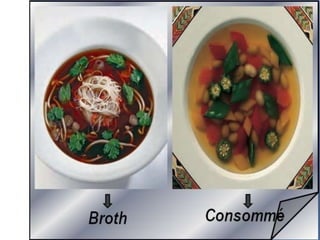
the guests without straining as soon as they are made e.g. broth.
2. PASSED / STRAINED
This category indicates to absolute clear thin soups, strained &
clear golden liquid garnished & served to guests e.g. consommé
BROTH
The broths are prepared similar like stocks, with little changes
A broth is made by simmering meat & vegetables, garnished &
served as soup, hence the food items has to be cut neatly.
While a stock is made by simmering bones & vegetables &
used for preparing other dishes, hence the cuts remain roughly.
Meat based broth is mostly used as a soup e.g. Beef Scotch
Broth
Vegetable based broth is Minestrone.
CONSOMMÉ (con jo may)
In the soup classification part we saw, consommé comes
under absolute clear thin soups, strained, garnished & served.
But above is not a definition, we can simply say, consommé
is a clarified & concentrated clear stock.
Though the stock is made carefully, still it may contain
particles, that can be removed only by clarification.
Absolute clarity & concentrated rich flavor in consommé
comes from clarifying the stock.
In the next slides we will see, how a stock is clarified.
CLARIFICATION PROCESS OR MAKING OF CONSOMMÉ
To clarify a stock or broth, that said stock has to be very cold.
Then the stock is combined with a mixture of minced meat,
egg whites, mirepoix, herbs & an acidic product e.g. vinegar.
Often many chefs add, an onion brûlée (bruli) – a burnt whole
onion to the mixture, to improve flavor & color of consommé.
After mixing, stock pot is placed on top of burner & brought to
simmer on very slow heat.
The egg & meat proteins begins to coagulate due to heat &
the mixture traps all impurities present in the liquid.
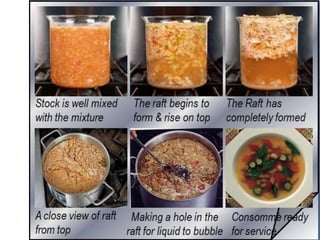
As the coagulation process continues, the mixture rise to
surface taking all impurities & form a layer, known as raft.
Never allow to boil the consommé or stir it after the raft has
been completely formed, which may create a cloudy consommé
Traditionally, consommé is simmered for 16 hours to get rich
flavor, but today’s modern chefs finishes it within 1-2 hours.
After specified time, pour the stock with a ladle through a
conical strainer lined with muslin cloth into a new pot.
Refrigerate & degrease the consommé by removing the
solidified fat & the result is rich flavorful, crystal clear consommé
TYPES OF CONSOMMÉ
VARIATIONS OF CONSOMMÉ
1.Double consommé – use double qty of beef in the recipe.
2.Chicken consommé – use minced chicken & chicken stock
instead of beef.
3.Consommé Madrilène – a tomato flavored consommé served
chilled & jellied.
CONSOMMÉ GETS THE NAME BASED ON CUTS OR TYPE OF
INGREDIENTS ARE USED AS GARNISHES
1.Consommé Brunoise – served with brunoise of vegetables
2.Consommé Julienne - served with julienne of vegetables
3.Consommé royale – served with dices of savory egg custard
THICK SOUP
Thick soups are not clear or transparent like thin soups, as
thick soups contain thickening agents e.g. roux, cream or puree.
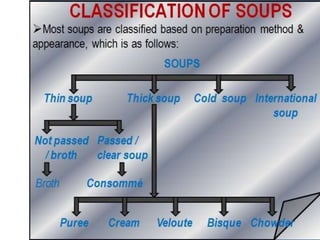
Thick soups are subdivided into 5 categories, based on
method of production, they are as follows:
1.PUREE
2.CREAM
3.VELOUTE (vay loo tay)
4.BISQUE (biskk)
5.CHOWDER (shau dar)
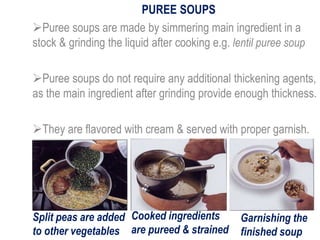
PUREE SOUPS
Puree soups are made by simmering main ingredient in a
stock & grinding the liquid after cooking e.g. lentil puree soup
Puree soups do not require any additional thickening agents,
as the main ingredient after grinding provide enough thickness.
They are flavored with cream & served with proper garnish.
Split peas are added
to other vegetables
Cooked ingredients
are pureed & strained
Garnishing the
finished soup
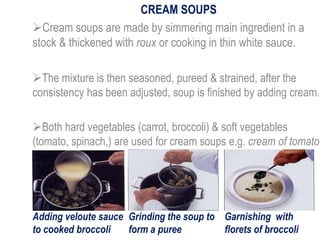
CREAM SOUPS
Cream soups are made by simmering main ingredient in a
stock & thickened with roux or cooking in thin white sauce.
The mixture is then seasoned, pureed & strained, after the
consistency has been adjusted, soup is finished by adding cream.
Both hard vegetables (carrot, broccoli) & soft vegetables
(tomato, spinach,) are used for cream soups e.g. cream of tomato
Adding veloute sauce
to cooked broccoli
Grinding the soup to
form a puree
Garnishing with
florets of broccoli
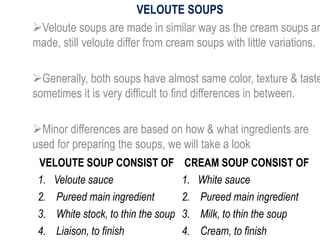
VELOUTE SOUPS
Veloute soups are made in similar way as the cream soups ar
made, still veloute differ from cream soups with little variations.
Generally, both soups have almost same color, texture & taste
sometimes it is very difficult to find differences in between.
Minor differences are based on how & what ingredients are
used for preparing the soups, we will take a look
VELOUTE SOUP CONSIST OF CREAM SOUP CONSIST OF
1. Veloute sauce 1. White sauce
2. Pureed main ingredient 2. Pureed main ingredient
3. White stock, to thin the soup 3. Milk, to thin the soup
4. Liaison, to finish 4. Cream, to finish
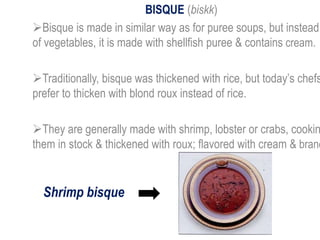
BISQUE (biskk)
Bisque is made in similar way as for puree soups, but instead
of vegetables, it is made with shellfish puree & contains cream.
Traditionally, bisque was thickened with rice, but today’s chefs
prefer to thicken with blond roux instead of rice.
They are generally made with shrimp, lobster or crabs, cookin
them in stock & thickened with roux; flavored with cream & brand
Shrimp bisque
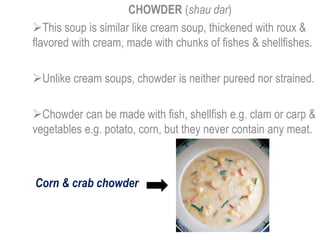
CHOWDER (shau dar)
This soup is similar like cream soup, thickened with roux &
flavored with cream, made with chunks of fishes & shellfishes.
Unlike cream soups, chowder is neither pureed nor strained.
Chowder can be made with fish, shellfish e.g. clam or carp &
vegetables e.g. potato, corn, but they never contain any meat.
Corn & crab chowder
COLD SOUP
These soups may be cooked or uncooked, never kept thin,
chilled & served to the customer cold only.
It can be a chilled version of thick cream soup or a specialty
soup of any country or chilled consommé.
What kind of cooking methods should used, that depends on
ingredients; yoghurt, cream, fruit puree & vegetables.
Based on method, cold soups are classified into 2 types:
1.THEY ARE COOKED, CHILLED & SERVED
2.THEY ARE NOT COOKED, CHILLED & SERVED.
COOKED COLD SOUPS
These soups are generally cooked first, then chilled & served
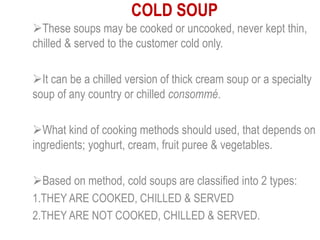
cold e.g. consommé madrilène & vichyssoise (vi she swaz).
UNCOOKED COLD SOUPS
Some cold soups are not cooked at all, most of these soups
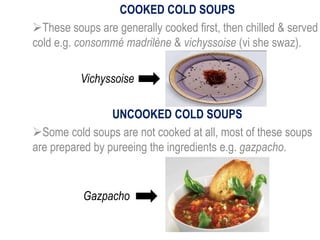
are prepared by pureeing the ingredients e.g. gazpacho.
Vichyssoise
Gazpacho
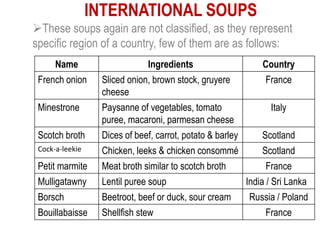
INTERNATIONAL SOUPS
These soups again are not classified, as they represent
specific region of a country, few of them are as follows:
Name Ingredients Country
French onion Sliced onion, brown stock, gruyere
cheese
France
Minestrone Paysanne of vegetables, tomato
puree, macaroni, parmesan cheese
Italy
Scotch broth Dices of beef, carrot, potato & barley Scotland
Cock-a-leekie Chicken, leeks & chicken consommé Scotland
Petit marmite Meat broth similar to scotch broth France
Mulligatawny Lentil puree soup India / Sri Lanka
Borsch Beetroot, beef or duck, sour cream Russia / Poland
Bouillabaisse Shellfish stew France
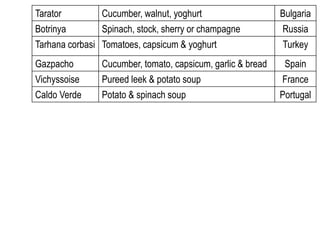
Tarator Cucumber, walnut, yoghurt Bulgaria
Botrinya Spinach, stock, sherry or champagne Russia
Tarhana corbasi Tomatoes, capsicum & yoghurt Turkey
Gazpacho Cucumber, tomato, capsicum, garlic & bread Spain
Vichyssoise Pureed leek & potato soup France
Caldo Verde Potato & spinach soup Portugal
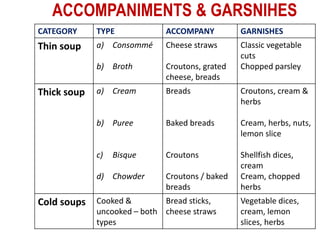
ACCOMPANIMENTS & GARSNIHES
CATEGORY TYPE ACCOMPANY GARNISHES
Thin soup a) Consommé
b) Broth
Cheese straws
Croutons, grated
cheese, breads
Classic vegetable
cuts
Chopped parsley
Thick soup a) Cream
b) Puree
c) Bisque
d) Chowder
Breads
Baked breads
Croutons
Croutons / baked
breads
Croutons, cream &
herbs
Cream, herbs, nuts,
lemon slice
Shellfish dices,
cream
Cream, chopped
herbs
Cold soups Cooked &
uncooked – both
types
Bread sticks,
cheese straws
Vegetable dices,
cream, lemon
slices, herbs
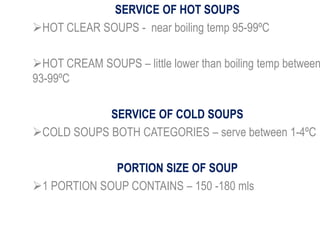
SERVICE OF HOT SOUPS
HOT CLEAR SOUPS - near boiling temp 95-99ºC
HOT CREAM SOUPS – little lower than boiling temp between
93-99ºC
SERVICE OF COLD SOUPS
COLD SOUPS BOTH CATEGORIES – serve between 1-4ºC
PORTION SIZE OF SOUP
1 PORTION SOUP CONTAINS – 150 -180 mls

Soup

  • 1.
    Chef Devashish Pandey CertifiedCulinary Instructor and Master Culinary Trainer
  • 2.
    SOUPS DEFINITION Soup is aliquid food, which is made by simmering many food ingredients together in a flavored liquid. Soup is a popular menu choice served as first course before beginning of a meal. Soup is generally served at lunch & dinner than breakfast. Soup is generally served hot, but it can also be served cold. Most chefs prepare soup using fresh or leftover ingredients, but today many canned or powdered soup is also available.
  • 4.
    THIN SOUP Thin soupsare based on clear meat or vegetable stock; these soups are not thickened & kept semi transparent. Thin soups are subdivided into 2 categories, based on method of production & service techniques, they are as follows: 1.NOT PASSED / NOT STRAINED This category indicates to semi clear thin soups, are served to the guests without straining as soon as they are made e.g. broth. 2. PASSED / STRAINED This category indicates to absolute clear thin soups, strained & clear golden liquid garnished & served to guests e.g. consommé
  • 6.
    BROTH The broths areprepared similar like stocks, with little changes A broth is made by simmering meat & vegetables, garnished & served as soup, hence the food items has to be cut neatly. While a stock is made by simmering bones & vegetables & used for preparing other dishes, hence the cuts remain roughly. Meat based broth is mostly used as a soup e.g. Beef Scotch Broth Vegetable based broth is Minestrone.
  • 7.
    CONSOMMÉ (con jomay) In the soup classification part we saw, consommé comes under absolute clear thin soups, strained, garnished & served. But above is not a definition, we can simply say, consommé is a clarified & concentrated clear stock. Though the stock is made carefully, still it may contain particles, that can be removed only by clarification. Absolute clarity & concentrated rich flavor in consommé comes from clarifying the stock. In the next slides we will see, how a stock is clarified.
  • 8.
    CLARIFICATION PROCESS ORMAKING OF CONSOMMÉ To clarify a stock or broth, that said stock has to be very cold. Then the stock is combined with a mixture of minced meat, egg whites, mirepoix, herbs & an acidic product e.g. vinegar. Often many chefs add, an onion brûlée (bruli) – a burnt whole onion to the mixture, to improve flavor & color of consommé. After mixing, stock pot is placed on top of burner & brought to simmer on very slow heat. The egg & meat proteins begins to coagulate due to heat & the mixture traps all impurities present in the liquid.
  • 9.
    As the coagulationprocess continues, the mixture rise to surface taking all impurities & form a layer, known as raft. Never allow to boil the consommé or stir it after the raft has been completely formed, which may create a cloudy consommé Traditionally, consommé is simmered for 16 hours to get rich flavor, but today’s modern chefs finishes it within 1-2 hours. After specified time, pour the stock with a ladle through a conical strainer lined with muslin cloth into a new pot. Refrigerate & degrease the consommé by removing the solidified fat & the result is rich flavorful, crystal clear consommé
  • 11.
    TYPES OF CONSOMMÉ VARIATIONSOF CONSOMMÉ 1.Double consommé – use double qty of beef in the recipe. 2.Chicken consommé – use minced chicken & chicken stock instead of beef. 3.Consommé Madrilène – a tomato flavored consommé served chilled & jellied. CONSOMMÉ GETS THE NAME BASED ON CUTS OR TYPE OF INGREDIENTS ARE USED AS GARNISHES 1.Consommé Brunoise – served with brunoise of vegetables 2.Consommé Julienne - served with julienne of vegetables 3.Consommé royale – served with dices of savory egg custard
  • 12.
    THICK SOUP Thick soupsare not clear or transparent like thin soups, as thick soups contain thickening agents e.g. roux, cream or puree. Thick soups are subdivided into 5 categories, based on method of production, they are as follows: 1.PUREE 2.CREAM 3.VELOUTE (vay loo tay) 4.BISQUE (biskk) 5.CHOWDER (shau dar)
  • 13.
    PUREE SOUPS Puree soupsare made by simmering main ingredient in a stock & grinding the liquid after cooking e.g. lentil puree soup Puree soups do not require any additional thickening agents, as the main ingredient after grinding provide enough thickness. They are flavored with cream & served with proper garnish. Split peas are added to other vegetables Cooked ingredients are pureed & strained Garnishing the finished soup
  • 14.
    CREAM SOUPS Cream soupsare made by simmering main ingredient in a stock & thickened with roux or cooking in thin white sauce. The mixture is then seasoned, pureed & strained, after the consistency has been adjusted, soup is finished by adding cream. Both hard vegetables (carrot, broccoli) & soft vegetables (tomato, spinach,) are used for cream soups e.g. cream of tomato Adding veloute sauce to cooked broccoli Grinding the soup to form a puree Garnishing with florets of broccoli
  • 15.
    VELOUTE SOUPS Veloute soupsare made in similar way as the cream soups ar made, still veloute differ from cream soups with little variations. Generally, both soups have almost same color, texture & taste sometimes it is very difficult to find differences in between. Minor differences are based on how & what ingredients are used for preparing the soups, we will take a look VELOUTE SOUP CONSIST OF CREAM SOUP CONSIST OF 1. Veloute sauce 1. White sauce 2. Pureed main ingredient 2. Pureed main ingredient 3. White stock, to thin the soup 3. Milk, to thin the soup 4. Liaison, to finish 4. Cream, to finish
  • 16.
    BISQUE (biskk) Bisque ismade in similar way as for puree soups, but instead of vegetables, it is made with shellfish puree & contains cream. Traditionally, bisque was thickened with rice, but today’s chefs prefer to thicken with blond roux instead of rice. They are generally made with shrimp, lobster or crabs, cookin them in stock & thickened with roux; flavored with cream & brand Shrimp bisque
  • 17.
    CHOWDER (shau dar) Thissoup is similar like cream soup, thickened with roux & flavored with cream, made with chunks of fishes & shellfishes. Unlike cream soups, chowder is neither pureed nor strained. Chowder can be made with fish, shellfish e.g. clam or carp & vegetables e.g. potato, corn, but they never contain any meat. Corn & crab chowder
  • 18.
    COLD SOUP These soupsmay be cooked or uncooked, never kept thin, chilled & served to the customer cold only. It can be a chilled version of thick cream soup or a specialty soup of any country or chilled consommé. What kind of cooking methods should used, that depends on ingredients; yoghurt, cream, fruit puree & vegetables. Based on method, cold soups are classified into 2 types: 1.THEY ARE COOKED, CHILLED & SERVED 2.THEY ARE NOT COOKED, CHILLED & SERVED.
  • 19.
    COOKED COLD SOUPS Thesesoups are generally cooked first, then chilled & served cold e.g. consommé madrilène & vichyssoise (vi she swaz). UNCOOKED COLD SOUPS Some cold soups are not cooked at all, most of these soups are prepared by pureeing the ingredients e.g. gazpacho. Vichyssoise Gazpacho
  • 20.
    INTERNATIONAL SOUPS These soupsagain are not classified, as they represent specific region of a country, few of them are as follows: Name Ingredients Country French onion Sliced onion, brown stock, gruyere cheese France Minestrone Paysanne of vegetables, tomato puree, macaroni, parmesan cheese Italy Scotch broth Dices of beef, carrot, potato & barley Scotland Cock-a-leekie Chicken, leeks & chicken consommé Scotland Petit marmite Meat broth similar to scotch broth France Mulligatawny Lentil puree soup India / Sri Lanka Borsch Beetroot, beef or duck, sour cream Russia / Poland Bouillabaisse Shellfish stew France
  • 21.
    Tarator Cucumber, walnut,yoghurt Bulgaria Botrinya Spinach, stock, sherry or champagne Russia Tarhana corbasi Tomatoes, capsicum & yoghurt Turkey Gazpacho Cucumber, tomato, capsicum, garlic & bread Spain Vichyssoise Pureed leek & potato soup France Caldo Verde Potato & spinach soup Portugal
  • 22.
    ACCOMPANIMENTS & GARSNIHES CATEGORYTYPE ACCOMPANY GARNISHES Thin soup a) Consommé b) Broth Cheese straws Croutons, grated cheese, breads Classic vegetable cuts Chopped parsley Thick soup a) Cream b) Puree c) Bisque d) Chowder Breads Baked breads Croutons Croutons / baked breads Croutons, cream & herbs Cream, herbs, nuts, lemon slice Shellfish dices, cream Cream, chopped herbs Cold soups Cooked & uncooked – both types Bread sticks, cheese straws Vegetable dices, cream, lemon slices, herbs
  • 23.
    SERVICE OF HOTSOUPS HOT CLEAR SOUPS - near boiling temp 95-99ºC HOT CREAM SOUPS – little lower than boiling temp between 93-99ºC SERVICE OF COLD SOUPS COLD SOUPS BOTH CATEGORIES – serve between 1-4ºC PORTION SIZE OF SOUP 1 PORTION SOUP CONTAINS – 150 -180 mls