PREPARE APPETIZERS
OBJECTIVES:
1. Identify the origin of appetizer;
2. Perform Mise en place;
3. Prepare a range of appetizers;
4. Present a range of appetizers; and
5. Store appetizers.
HISTORY
Appetizers were originally introduced by the Athenians as a
buffet in the early third century B.C. They would serve sea urchins,
cockles, sturgeon, and garlic. However they were unpopular to start
as these tiny meals weren't followed up with a main course, leaving
everyone hungry and wanting more. It wasn't until the nineteenth
century that appetizers truly caught on, as meals evolved into more
of a structured ordeal
Aperitifs came about by the Romans and were classified as a
liquid appetizer that typically contained alcohol. In addition to
inciting hunger like food appetizers, the purposes for aperitifs were
also meant to help with the imminent digestion process. These
drinks would be shared from a single glass and passed around the
table to all members of the eating party. Aperitifs are still utilized
today, typically with the company of food appetizers.
HISTORY
The word itself, "appetizer," as being used in America and England
in the1860s, is more of a local flavor than "hors d'oeuvres." For a time,
appetizers are served between the main course and dessert as a
refresher, but by the twentieth century they had taken their place as a
precursor to the main course.
On the other hand it is said that appetizers are the dishes that
can truly be considered Filipino because we are best known for
using our hands to eat the small finger foods that come with the
first course. Appetizers can include anything from fish to meat,
nuts and chips. They are often served before dinner or at large
family lunches.
-is a French term which means “set in
place” that is you have everything ready
to cook and in its place. You should be
able to identify and prepare all the
needed tools and equipment as well as all
the ingredients to make the preparation
and cooking easily.
Mise’ En Place
Kitchen Tools and Equipment
Classification of Appetizers
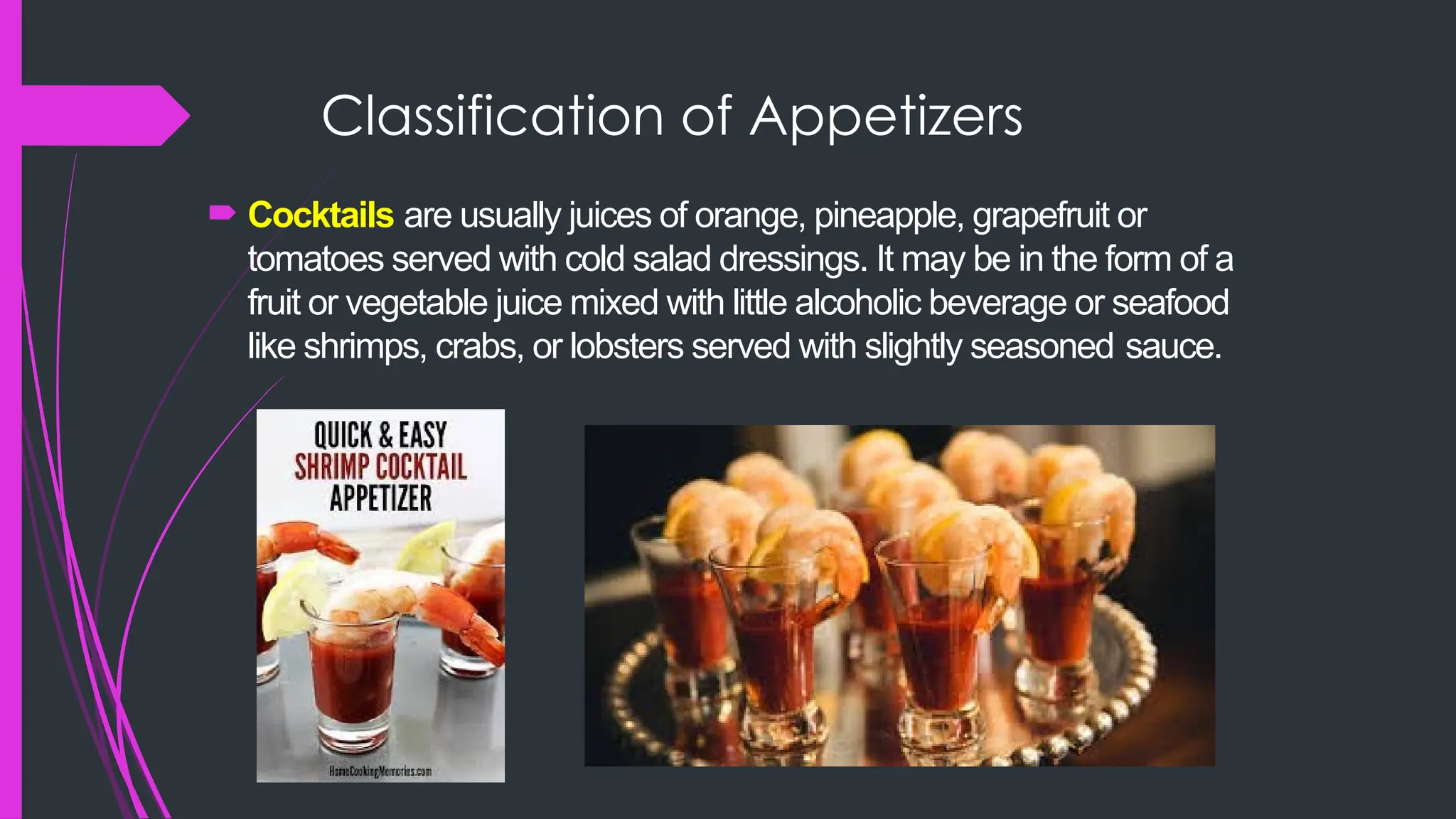
 Cocktails are usually juices of orange, pineapple, grapefruit or
tomatoes served with cold salad dressings. It may be in the form of a
fruit or vegetable juice mixed with little alcoholic beverage or seafood
like shrimps, crabs, or lobsters served with slightly seasoned sauce.
Cocktails
Kinds of Cocktail Appetizers
1. Relishes
Relishes are raw or pickled vegetables cut into attractive shapes served as appetizer.
TWO CATEGORIES
1. Raw vegetables with dips - These are known as crudités (croo dee tays). Cru in French
means “raw”. Common bite size, cut raw vegetables served with dips are:
Celery
Radish
Green and Red Pepper
Cucumber
Cauliflower
Broccoli Florets
Broccoli Stems
2. Dips
– accompaniment to raw vegetables, and sometime potato chips and crackers.
Any mixture of spreads can be used as dips. Proper consistency is important to
any dip. It must not be so thick that it cannot be scooped up without breaking the
cracker. It must be thick enough to stick to the items used as dippers. Thin or
soften them by adding mayonnaise, cream or other appropriate liquid. Sauces
and salad dressings can be used as dips.
3. Pickled items
Includes variety of items like cucumber pickles, olives, watermelon pickles, pickled
peppers, spiced beets, and other preserved fruits and vegetables.
Hors D’Oeuvres refers to small portions of highly seasoned foods. It is a
combination of canapés, olives, stuffed celery, pickled radishes, and fish. It is
served on individual plate when guests are seated. Sometimes this is simply
placed on a platter and passed around. Hors d’oeuvres are served cold or
hot.
Canapés are made out of thin slices of bread in different shapes. The bread
may be toasted, sautéed in butter or dipped in a well-seasoned mixture of egg,
cheese, fish, or meat then deep-fat fried. It is a finger food consisting of three
parts: a base, a spread or topping and garnish. They could be served hot or
cold. There are no set recipes for the making of canapés. You may create your
own combination of several different colored items on the cut pieces of bread,
toasted or fried and biscuits etc. The larger canapés are termed as
ZAKUSKIS after the Chef Zakuski.
Egg & Bacon Canape Smoked Tuna Spread Canape
Canapés – bite-size open faced sandwiches consist of tiny
portions of food presented on bases of bread, toast, or pastry
easily handled and eaten
THREE PARTS
1.Base – holds the spread and garnish. Crackers and
toasts are firmer and give a pleasing texture and
crispness to the canapé.
2. Spread - placed on top of the base so the garnish
sticks to it without falling off.
THREE TYPES OF SPREADS
1. Flavored butter – made from softened butters with flavorings.
2. Flavored Cream Cheese -made from flavored butters, except cream
cheese is substituted for the butter. Mixture of cream and butter can be
used.
3. Meat or Fish salad spreads – made from finely chopped meat or fish
that are spreadable. Seasons should be checked carefully to make the
spread more stimulating to the appetite.
3. Garnish – any food item or combination of items placed on top of
the spread which usually gives color, design, and texture or flavor
accent to the canapé.
Relishes/Crudités are pickled item which are raw, crisp
vegetables such as julienne carrots or celery sticks. Relishes are
generally placed before the guest in a slightly, deep, boat shape
dish.
Vegetable Crudites with Greek
Yougurt Deep
Crudites Platter
Petite Salads are small portions of salads and usually
display the characteristics found in most salads.
Petite Tea Tomato Salad Greek Salad
Chips and Dips are popular accompaniments to potato chips, crackers, and
raw vegetables. Proper consistency in the preparation is important for many dip.
It must not be so thick that it cannot be scooped up without breaking the chip or
crackers, but it must be thick enough to stick to the items used as dippers.
Fresh Fruits and Vegetables are the simplest appetizers. Fruits are good
appetizers because they give an attractive appearance, fragrance,
appealing taste and delicious flavor. For example, you could serve a platter
of thinly sliced cucumbers, chunks of red bell pepper and baby carrots. For
a fruit tray, consider serving red and green grapes, as well as chunks of
mango with toothpicks inserted in them. Since appetizers are always easy
to pick up with the fingers, they should never be drippy or messy
Finger foods are variety of appetizers wherein the only requirement is
that you keep everything small enough to be picked up with the fingers
and eaten with little mess. If you want to serve your favorite homemade
sausages, cut them into small pieces, wrap them with a small piece of
pastry shell and bake. Or, serve your favorite baked sweet potato fries
with a mayonnaise-based dipping sauce. Individual quiches filled with
ham and cheese is another good option
Hot and Cold Appetizers
Hors d’oeuvres are often served preceding a meal; they are served as the food at
cocktail parties involving alcoholic beverages.
a. Hot Hors d’oeuvres are served between the soup and fish course. In today’s
shortened menus, they are often served instead of hot entrée. The size and richness
depend upon the composition of menu. Many hot hors d’oeuvres are suited for
servingasmallalacartedishes,andusuallydescribedashot dish.
2. Cold hors d’oeuvres
-should stimulate appetite, and therefore should always be served at
the first course in the menu. be served at the side
FIVE TYPES OF COLD HORS D’OEUVRES
• Plate of Hors d’oeuvres may consist of shrimps, smoked beef, poached egg, Spanish
sardines and lettuce, sauce can be served at the side.
 Grison Platter may consist of two kinds of cold meat, such as ham, smoked beef,
peppered ham. Sauce can be served at the side.
 Hors d’oeuvres Platter. A well-presented platter with a limited choice of simple or
more expensive foods. The basic rules is “small quantity, but big in quality” and at the
same time attractively served. It may consists of shrimps with jelly, asparagus tip with
mushrooms, sardines with onion rings, tomatoes stuffed with salad and chicken loaf.
 Assorted hors d’oeuvres can be served in special portioned platters with dishes or
even from a serving cart.
 Rich hors d’oeuvres - still a classical form of presentation. Lobster should always be
included. The hors d’oeuvres dish system in conjunction with a silver platter can be
used, but it is also possible to arrange the center pieces on a silver platter covered
with meat jelly and served with accompaniments in a small separate bowls or
container.
PRESENT A RANGE OF APPETIZERS
Fundamentals of Plating
1. BALANCE
The rules of good menu balance also apply to plating. Select foods and
garnishes that offer variety and contrast.
 Color. Two or more colors on a plate are usually more interesting than
one. Garnish is also important.
 Shapes. Plan for variety of shapes and forms. Cutting
vegetables into different shapes gives you great flexibility.
 Texture. Not strictly visual consideration, but important in plating in
menu planning.
 Flavors. One of the factors to consider when balancing colors,
shapes, and texture on the plate.
2. PORTION SIZE. This is important for presentation as well as for costing.
A. Match portion sizes and plates. Too small a plate makes an overcrowded,
jumbled, messy appearance. Too large a plate makes the portions look skimpy.
B. Balance the portion sizes of the various items on the plate. Apply logical balance
of portions.
3. ARRANGEMENT ON THE PLATE
BASIC PRINCIPLES OF PLATTER PRESENTATION
1. The three elements of a buffet platter.
 Centerpiece or Grosse piece (gross pyess). This may be an uncut portion of the main food
item, such as a pate or a cold roast, decorated and displayed whole. It may be a separate but
related item, such as molded salmon mousse
 The slices or serving portions should be arranged artistically.
 The garnish should be artistically done in proportion to the cut slices.
2. The food should be easy to handle and serve, so that one portion can be removed without ruining
the arrangement.
3. A simple design is best. Simple arrangement is easier to serve, more appetizing, and still attractive
when are half consumed by the guest.
4. Attractive platter presentation may be made on silver or other metals, on mirrors, chinaware, plastic
ware, wood, or any other materials provided they are presentable and suitable for food.
5. Once a piece of food has touched the tray, do not remove it. Shiny silver or mirror trays are easily
smudged, and you’ll have to wash the tray and start over again. Good pre-planning should be
considered.
6. Think of the platter as part of the whole. It must be attractive and appropriate to the other
presentation in the table.
DESIGNING THE PLATTER
1. Plan ahead. Make a sketch by dividing the tray into six or eight sections. This will
help you lay out a balance and symmetrical design. The sketch should indicate the
centerpiece, slices of foods and garnishes.
2. Get movement into your design. Good design makes your eyes move across the
platter following the lines you have set up. It could be arranged in rows or lines.
3. Give the design a focal point. Use centerpiece to emphasize and strengthen the
design by giving it direction and height. Note that centerpiece is not always in the
center.
4. Keep items in proportion.
5. Make the garnish count. Use garnish to balance out a plate by providing additional
element. Two items on a plate often look unbalanced, but adding a garnish
completes the picture. On the other hand do not add unnecessary garnishes.
6. Don’t drown every plate in sauce or gravy. It may hides colors and shapes. You
may cover a part of it or a band of sauce across the center.
7. Keep it simple. Simplicity is more attractive than complicated designs.
8. Let the guest see the best side of everything. Angle overlapping slices and
wedged-shaped pieces toward the customer and the best side of each slice is
face up.
Prepare an appetizer. Used any available ingredients in your kitchen or in your place.
Record a video while preparing an appetizer. You may fast forward your video. You will
be observed and rated from the preparation of materials and ingredients, actual
preparation, presentation and storing of your products using the scoring rubric below.
October 28, 2021
Dimension P E R F O R M A N C E L E V E L
Excellent (4
pts.)
Very Satisfactory
(3 pts.)
Satisfactory (2
pts.)
Needs
Improvement (1
pt.)
No
attempt
(0 pt.)
Points
Earned
1. Use of tools and
equipment
Uses tools and
equipment
correctly and
confidently at all
times
Uses tools and
equipment
correctly and
confidently
most of the
times
Uses tools and
equipment
correctly and but
less confidently
sometimes
Uses tools and
equipment
incorrectly and
less confidently
most of the time
No
attempt
2.
Application of
procedures
Manifests very clear
understanding of
the step- by-step
procedure
Manifests clear
understand
ding of the
step- by- step
procedure
Manifests
understanding of
the step-by- step
procedure
but sometimes
seeks
clarification
Manifests less
understanding of
the step- by- step
procedure
seeking
clarification most
of the time
No
attempt
Works
independently with
ease and
confidence at all
times
Works
independent ly
with ease and
confidence
most of the time
Works
independently
with ease and
confidence
sometimes
Works
independently but
with assistance
from others most
of the time
No
attempt
Excellent (4
pts.)
Very
Satisfactory
(3 pts.)
Satisfactory (2
pts.)
Needs
Improvement
(1 pt.)
No
attempt
(0 pt.)
Points
Earned
3. Safety work
habits
Observes safety
precautions at all
times
Observes safety
precautions
most of the
time
Observes safety
precautions
sometimes
Most of the time
not observing
safety precautions
No
attempt
4.Complete ness of
Task
Task is completed
following the
procedures in the
activity
improvement/inno
vations
Task is
completed
following the
procedures
in the project
plan
Task is nearly
completed
following the
procedures in the
project plan
Task is started but
not completed
following the
procedures in the
project plan
No
attempt
5. Time manage
ment
Work completed
ahead of time
Work completed
within allotted
time
Work
completed
(mins./
hours/days)
beyond
Work completed
(mins./hours
/days) beyond
No
attempt
TOTAL POINTS
625270351-Prepare-Appetizers.powerpointx

625270351-Prepare-Appetizers.powerpointx

  • 1.
  • 2.
    OBJECTIVES: 1. Identify theorigin of appetizer; 2. Perform Mise en place; 3. Prepare a range of appetizers; 4. Present a range of appetizers; and 5. Store appetizers.
  • 3.
    HISTORY Appetizers were originallyintroduced by the Athenians as a buffet in the early third century B.C. They would serve sea urchins, cockles, sturgeon, and garlic. However they were unpopular to start as these tiny meals weren't followed up with a main course, leaving everyone hungry and wanting more. It wasn't until the nineteenth century that appetizers truly caught on, as meals evolved into more of a structured ordeal Aperitifs came about by the Romans and were classified as a liquid appetizer that typically contained alcohol. In addition to inciting hunger like food appetizers, the purposes for aperitifs were also meant to help with the imminent digestion process. These drinks would be shared from a single glass and passed around the table to all members of the eating party. Aperitifs are still utilized today, typically with the company of food appetizers.
  • 4.
    HISTORY The word itself,"appetizer," as being used in America and England in the1860s, is more of a local flavor than "hors d'oeuvres." For a time, appetizers are served between the main course and dessert as a refresher, but by the twentieth century they had taken their place as a precursor to the main course. On the other hand it is said that appetizers are the dishes that can truly be considered Filipino because we are best known for using our hands to eat the small finger foods that come with the first course. Appetizers can include anything from fish to meat, nuts and chips. They are often served before dinner or at large family lunches.
  • 5.
    -is a Frenchterm which means “set in place” that is you have everything ready to cook and in its place. You should be able to identify and prepare all the needed tools and equipment as well as all the ingredients to make the preparation and cooking easily. Mise’ En Place
  • 6.
  • 7.
  • 8.
    Classification of Appetizers Cocktails are usually juices of orange, pineapple, grapefruit or tomatoes served with cold salad dressings. It may be in the form of a fruit or vegetable juice mixed with little alcoholic beverage or seafood like shrimps, crabs, or lobsters served with slightly seasoned sauce.
  • 9.
    Cocktails Kinds of CocktailAppetizers 1. Relishes Relishes are raw or pickled vegetables cut into attractive shapes served as appetizer. TWO CATEGORIES 1. Raw vegetables with dips - These are known as crudités (croo dee tays). Cru in French means “raw”. Common bite size, cut raw vegetables served with dips are: Celery Radish Green and Red Pepper Cucumber Cauliflower Broccoli Florets Broccoli Stems
  • 10.
    2. Dips – accompanimentto raw vegetables, and sometime potato chips and crackers. Any mixture of spreads can be used as dips. Proper consistency is important to any dip. It must not be so thick that it cannot be scooped up without breaking the cracker. It must be thick enough to stick to the items used as dippers. Thin or soften them by adding mayonnaise, cream or other appropriate liquid. Sauces and salad dressings can be used as dips.
  • 11.
    3. Pickled items Includesvariety of items like cucumber pickles, olives, watermelon pickles, pickled peppers, spiced beets, and other preserved fruits and vegetables.
  • 12.
    Hors D’Oeuvres refersto small portions of highly seasoned foods. It is a combination of canapés, olives, stuffed celery, pickled radishes, and fish. It is served on individual plate when guests are seated. Sometimes this is simply placed on a platter and passed around. Hors d’oeuvres are served cold or hot.
  • 13.
    Canapés are madeout of thin slices of bread in different shapes. The bread may be toasted, sautéed in butter or dipped in a well-seasoned mixture of egg, cheese, fish, or meat then deep-fat fried. It is a finger food consisting of three parts: a base, a spread or topping and garnish. They could be served hot or cold. There are no set recipes for the making of canapés. You may create your own combination of several different colored items on the cut pieces of bread, toasted or fried and biscuits etc. The larger canapés are termed as ZAKUSKIS after the Chef Zakuski. Egg & Bacon Canape Smoked Tuna Spread Canape
  • 14.
    Canapés – bite-sizeopen faced sandwiches consist of tiny portions of food presented on bases of bread, toast, or pastry easily handled and eaten THREE PARTS
  • 15.
    1.Base – holdsthe spread and garnish. Crackers and toasts are firmer and give a pleasing texture and crispness to the canapé.
  • 16.
    2. Spread -placed on top of the base so the garnish sticks to it without falling off. THREE TYPES OF SPREADS 1. Flavored butter – made from softened butters with flavorings. 2. Flavored Cream Cheese -made from flavored butters, except cream cheese is substituted for the butter. Mixture of cream and butter can be used. 3. Meat or Fish salad spreads – made from finely chopped meat or fish that are spreadable. Seasons should be checked carefully to make the spread more stimulating to the appetite.
  • 17.
    3. Garnish –any food item or combination of items placed on top of the spread which usually gives color, design, and texture or flavor accent to the canapé.
  • 18.
    Relishes/Crudités are pickleditem which are raw, crisp vegetables such as julienne carrots or celery sticks. Relishes are generally placed before the guest in a slightly, deep, boat shape dish. Vegetable Crudites with Greek Yougurt Deep Crudites Platter
  • 19.
    Petite Salads aresmall portions of salads and usually display the characteristics found in most salads. Petite Tea Tomato Salad Greek Salad
  • 20.
    Chips and Dipsare popular accompaniments to potato chips, crackers, and raw vegetables. Proper consistency in the preparation is important for many dip. It must not be so thick that it cannot be scooped up without breaking the chip or crackers, but it must be thick enough to stick to the items used as dippers.
  • 21.
    Fresh Fruits andVegetables are the simplest appetizers. Fruits are good appetizers because they give an attractive appearance, fragrance, appealing taste and delicious flavor. For example, you could serve a platter of thinly sliced cucumbers, chunks of red bell pepper and baby carrots. For a fruit tray, consider serving red and green grapes, as well as chunks of mango with toothpicks inserted in them. Since appetizers are always easy to pick up with the fingers, they should never be drippy or messy
  • 22.
    Finger foods arevariety of appetizers wherein the only requirement is that you keep everything small enough to be picked up with the fingers and eaten with little mess. If you want to serve your favorite homemade sausages, cut them into small pieces, wrap them with a small piece of pastry shell and bake. Or, serve your favorite baked sweet potato fries with a mayonnaise-based dipping sauce. Individual quiches filled with ham and cheese is another good option
  • 23.
    Hot and ColdAppetizers Hors d’oeuvres are often served preceding a meal; they are served as the food at cocktail parties involving alcoholic beverages. a. Hot Hors d’oeuvres are served between the soup and fish course. In today’s shortened menus, they are often served instead of hot entrée. The size and richness depend upon the composition of menu. Many hot hors d’oeuvres are suited for servingasmallalacartedishes,andusuallydescribedashot dish.
  • 24.
    2. Cold horsd’oeuvres -should stimulate appetite, and therefore should always be served at the first course in the menu. be served at the side FIVE TYPES OF COLD HORS D’OEUVRES • Plate of Hors d’oeuvres may consist of shrimps, smoked beef, poached egg, Spanish sardines and lettuce, sauce can be served at the side.  Grison Platter may consist of two kinds of cold meat, such as ham, smoked beef, peppered ham. Sauce can be served at the side.  Hors d’oeuvres Platter. A well-presented platter with a limited choice of simple or more expensive foods. The basic rules is “small quantity, but big in quality” and at the same time attractively served. It may consists of shrimps with jelly, asparagus tip with mushrooms, sardines with onion rings, tomatoes stuffed with salad and chicken loaf.  Assorted hors d’oeuvres can be served in special portioned platters with dishes or even from a serving cart.  Rich hors d’oeuvres - still a classical form of presentation. Lobster should always be included. The hors d’oeuvres dish system in conjunction with a silver platter can be used, but it is also possible to arrange the center pieces on a silver platter covered with meat jelly and served with accompaniments in a small separate bowls or container.
  • 25.
    PRESENT A RANGEOF APPETIZERS Fundamentals of Plating 1. BALANCE The rules of good menu balance also apply to plating. Select foods and garnishes that offer variety and contrast.  Color. Two or more colors on a plate are usually more interesting than one. Garnish is also important.  Shapes. Plan for variety of shapes and forms. Cutting vegetables into different shapes gives you great flexibility.  Texture. Not strictly visual consideration, but important in plating in menu planning.  Flavors. One of the factors to consider when balancing colors, shapes, and texture on the plate.
  • 26.
    2. PORTION SIZE.This is important for presentation as well as for costing. A. Match portion sizes and plates. Too small a plate makes an overcrowded, jumbled, messy appearance. Too large a plate makes the portions look skimpy. B. Balance the portion sizes of the various items on the plate. Apply logical balance of portions. 3. ARRANGEMENT ON THE PLATE
  • 27.
    BASIC PRINCIPLES OFPLATTER PRESENTATION 1. The three elements of a buffet platter.  Centerpiece or Grosse piece (gross pyess). This may be an uncut portion of the main food item, such as a pate or a cold roast, decorated and displayed whole. It may be a separate but related item, such as molded salmon mousse  The slices or serving portions should be arranged artistically.  The garnish should be artistically done in proportion to the cut slices. 2. The food should be easy to handle and serve, so that one portion can be removed without ruining the arrangement. 3. A simple design is best. Simple arrangement is easier to serve, more appetizing, and still attractive when are half consumed by the guest. 4. Attractive platter presentation may be made on silver or other metals, on mirrors, chinaware, plastic ware, wood, or any other materials provided they are presentable and suitable for food. 5. Once a piece of food has touched the tray, do not remove it. Shiny silver or mirror trays are easily smudged, and you’ll have to wash the tray and start over again. Good pre-planning should be considered. 6. Think of the platter as part of the whole. It must be attractive and appropriate to the other presentation in the table.
  • 28.
    DESIGNING THE PLATTER 1.Plan ahead. Make a sketch by dividing the tray into six or eight sections. This will help you lay out a balance and symmetrical design. The sketch should indicate the centerpiece, slices of foods and garnishes. 2. Get movement into your design. Good design makes your eyes move across the platter following the lines you have set up. It could be arranged in rows or lines. 3. Give the design a focal point. Use centerpiece to emphasize and strengthen the design by giving it direction and height. Note that centerpiece is not always in the center. 4. Keep items in proportion. 5. Make the garnish count. Use garnish to balance out a plate by providing additional element. Two items on a plate often look unbalanced, but adding a garnish completes the picture. On the other hand do not add unnecessary garnishes. 6. Don’t drown every plate in sauce or gravy. It may hides colors and shapes. You may cover a part of it or a band of sauce across the center. 7. Keep it simple. Simplicity is more attractive than complicated designs. 8. Let the guest see the best side of everything. Angle overlapping slices and wedged-shaped pieces toward the customer and the best side of each slice is face up.
  • 29.
    Prepare an appetizer.Used any available ingredients in your kitchen or in your place. Record a video while preparing an appetizer. You may fast forward your video. You will be observed and rated from the preparation of materials and ingredients, actual preparation, presentation and storing of your products using the scoring rubric below. October 28, 2021
  • 30.
    Dimension P ER F O R M A N C E L E V E L Excellent (4 pts.) Very Satisfactory (3 pts.) Satisfactory (2 pts.) Needs Improvement (1 pt.) No attempt (0 pt.) Points Earned 1. Use of tools and equipment Uses tools and equipment correctly and confidently at all times Uses tools and equipment correctly and confidently most of the times Uses tools and equipment correctly and but less confidently sometimes Uses tools and equipment incorrectly and less confidently most of the time No attempt 2. Application of procedures Manifests very clear understanding of the step- by-step procedure Manifests clear understand ding of the step- by- step procedure Manifests understanding of the step-by- step procedure but sometimes seeks clarification Manifests less understanding of the step- by- step procedure seeking clarification most of the time No attempt Works independently with ease and confidence at all times Works independent ly with ease and confidence most of the time Works independently with ease and confidence sometimes Works independently but with assistance from others most of the time No attempt Excellent (4 pts.) Very Satisfactory (3 pts.) Satisfactory (2 pts.) Needs Improvement (1 pt.) No attempt (0 pt.) Points Earned 3. Safety work habits Observes safety precautions at all times Observes safety precautions most of the time Observes safety precautions sometimes Most of the time not observing safety precautions No attempt 4.Complete ness of Task Task is completed following the procedures in the activity improvement/inno vations Task is completed following the procedures in the project plan Task is nearly completed following the procedures in the project plan Task is started but not completed following the procedures in the project plan No attempt 5. Time manage ment Work completed ahead of time Work completed within allotted time Work completed (mins./ hours/days) beyond Work completed (mins./hours /days) beyond No attempt TOTAL POINTS