Working
Capital
• Working Capital is the Capital
required to run the day to day
operations of a business
enterprise.
• It is also known as Current
Capital or Running Capital or
Short Term Capital.
• W.C.M. is Balancing between
Holding Cost and Carrying
Cost.
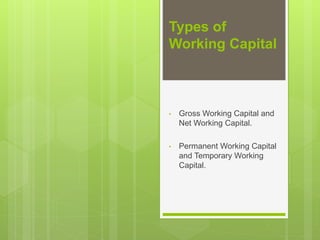
Types of
Working Capital
• Gross Working Capital and
Net Working Capital.
• Permanent Working Capital
and Temporary Working
Capital.
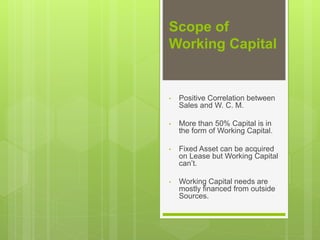
Scope of
Working Capital
• Positive Correlation between
Sales and W. C. M.
• More than 50% Capital is in
the form of Working Capital.
• Fixed Asset can be acquired
on Lease but Working Capital
can’t.
• Working Capital needs are
mostly financed from outside
Sources.
Working Capital
Financing
Trade
Credit
Non Cash
Financing
Bank
Financing
Bank OD
Cash Credit
Bills
Discounting
Letter of
Credit
Working
Capital
Loans
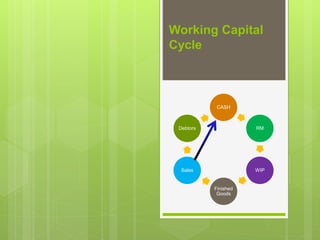
Working Capital
Cycle
CASH
RM
WIP
Finished
Goods
Sales
Debtors
Factors Affecting
Working Capital
• Nature of Business,
• Production Policy,
• Market Conditions,
• Seasonal Fluctuations,
• Growth and Expansion
Strategy,
• Operating Efficiency,
• Credit Policy,
• Growth Rate,
• Dividend Policy.
Current Asset
(CA)
• Current Asset is the asset of an
Organization which is already in
the form of Cash or will readily
get converted in the form of Cash
within One Year.
Examples of CA:
• Stock of R.M.
• Stock of WIP
• Stock of Finished Goods
• Cash in Hand,
• Cash at Bank,
• Debtors,
• Bills Receivables,
• Prepaid Expenses
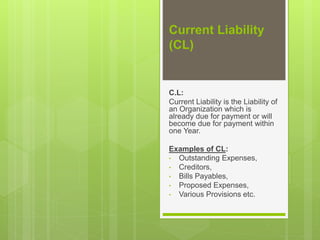
Current Liability
(CL)
C.L:
Current Liability is the Liability of
an Organization which is
already due for payment or will
become due for payment within
one Year.
Examples of CL:
• Outstanding Expenses,
• Creditors,
• Bills Payables,
• Proposed Expenses,
• Various Provisions etc.
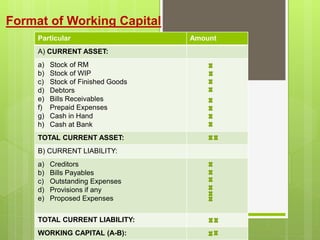
Format of Working Capital
Particular Amount
A) CURRENT ASSET:
a) Stock of RM
b) Stock of WIP
c) Stock of Finished Goods
d) Debtors
e) Bills Receivables
f) Prepaid Expenses
g) Cash in Hand
h) Cash at Bank
TOTAL CURRENT ASSET:
B) CURRENT LIABILITY:
a) Creditors
b) Bills Payables
c) Outstanding Expenses
d) Provisions if any
e) Proposed Expenses
TOTAL CURRENT LIABILITY:
WORKING CAPITAL (A-B):

Chapter 4 working capital management

  • 1.
    Working Capital • Working Capitalis the Capital required to run the day to day operations of a business enterprise. • It is also known as Current Capital or Running Capital or Short Term Capital. • W.C.M. is Balancing between Holding Cost and Carrying Cost.
  • 2.
    Types of Working Capital •Gross Working Capital and Net Working Capital. • Permanent Working Capital and Temporary Working Capital.
  • 3.
    Scope of Working Capital •Positive Correlation between Sales and W. C. M. • More than 50% Capital is in the form of Working Capital. • Fixed Asset can be acquired on Lease but Working Capital can’t. • Working Capital needs are mostly financed from outside Sources.
  • 4.
    Working Capital Financing Trade Credit Non Cash Financing Bank Financing BankOD Cash Credit Bills Discounting Letter of Credit Working Capital Loans
  • 5.
  • 6.
    Factors Affecting Working Capital •Nature of Business, • Production Policy, • Market Conditions, • Seasonal Fluctuations, • Growth and Expansion Strategy, • Operating Efficiency, • Credit Policy, • Growth Rate, • Dividend Policy.
  • 7.
    Current Asset (CA) • CurrentAsset is the asset of an Organization which is already in the form of Cash or will readily get converted in the form of Cash within One Year. Examples of CA: • Stock of R.M. • Stock of WIP • Stock of Finished Goods • Cash in Hand, • Cash at Bank, • Debtors, • Bills Receivables, • Prepaid Expenses
  • 8.
    Current Liability (CL) C.L: Current Liabilityis the Liability of an Organization which is already due for payment or will become due for payment within one Year. Examples of CL: • Outstanding Expenses, • Creditors, • Bills Payables, • Proposed Expenses, • Various Provisions etc.
  • 9.
    Format of WorkingCapital Particular Amount A) CURRENT ASSET: a) Stock of RM b) Stock of WIP c) Stock of Finished Goods d) Debtors e) Bills Receivables f) Prepaid Expenses g) Cash in Hand h) Cash at Bank TOTAL CURRENT ASSET: B) CURRENT LIABILITY: a) Creditors b) Bills Payables c) Outstanding Expenses d) Provisions if any e) Proposed Expenses TOTAL CURRENT LIABILITY: WORKING CAPITAL (A-B):