Chapter 4
Stanley Rodrick
 Brand knowledge structures depend on:
 The initial choices for the brand elements
 The supporting marketing program and the
manner by which the brand is integrated into it
 Other associations indirectly transferred to the
brand by linking it to some other entities
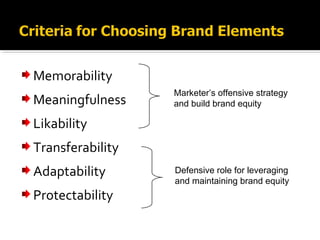
Memorability
Meaningfulness
Likability
Transferability
Adaptability
Protectability
Marketer’s offensive strategy
and build brand equity
Defensive role for leveraging
and maintaining brand equity
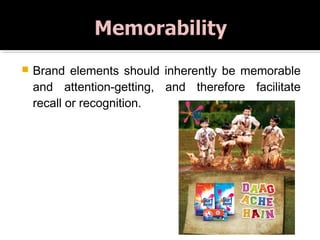
 Brand elements should inherently be memorable
and attention-getting, and therefore facilitate
recall or recognition.
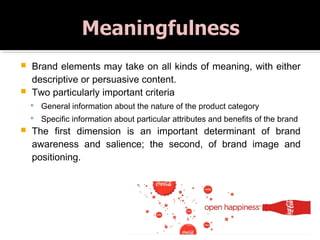
 Brand elements may take on all kinds of meaning, with either
descriptive or persuasive content.
 Two particularly important criteria
 General information about the nature of the product category
 Specific information about particular attributes and benefits of the brand
 The first dimension is an important determinant of brand
awareness and salience; the second, of brand image and
positioning.
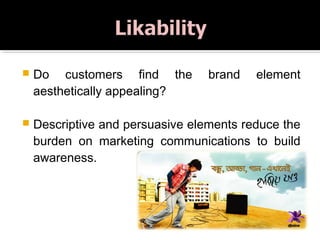
 Do customers find the brand element
aesthetically appealing?
 Descriptive and persuasive elements reduce the
burden on marketing communications to build
awareness.
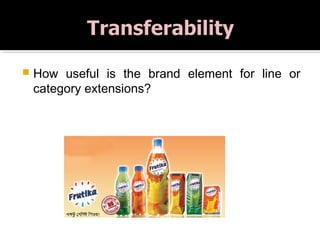
 How useful is the brand element for line or
category extensions?
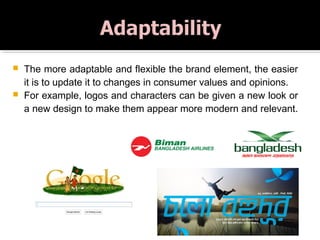
 The more adaptable and flexible the brand element, the easier
it is to update it to changes in consumer values and opinions.
 For example, logos and characters can be given a new look or
a new design to make them appear more modern and relevant.
 Marketers should:
1. Choose brand elements that can be legally protected
internationally.
2. Formally register chosen brand elements with the
appropriate legal bodies.
3. Vigorously defend trademarks from unauthorized
competitive infringement.
 A variety of brand elements can be chosen that inherently
enhance brand awareness or facilitate the formation of
strong, favorable, and unique brand associations.
 Brand Names
 URLs
 Logos and Symbols
 Characters
 Slogans
 Jingles
 Packaging & Labeling
 Like any brand element, brand names must
be chosen with the six general criteria of
memorability, meaningfulness, likability,
transferability, adaptability, and protectability
in mind.
 Brand Awareness 
 Simplicity and ease of pronunciation and spelling
 Familiarity and meaningfulness
 Differentiated, distinctive, and uniqueness
 Brand Associations
 The explicit and implicit meanings consumers extract
from it are important. In particular, the brand name
can reinforce an important attribute or benefit
association that makes up its product positioning.
 Define Objectives
 Generate Names
 Screen Initial Candidates
 Study Candidate Names
 Research the Final Candidates
 Select the Final Name
 URLs (uniform resource locators) specify
locations of pages on the web and are also
commonly referred to as domain names.
 A company can either sue the current owner of
the URL for copyright infringement, buy the
name from the current owner, or register all
conceivable variations of its brand as domain
names ahead of time.
 Play a critical role in building brand equity and
especially brand awareness
 Logos range from corporate names or
trademarks (word marks with text only) written in
a distinctive form, to entirely abstract designs
that may be completely unrelated to the word
mark, corporate name, or corporate activities
 A special type of brand symbol—one that takes on
human or real-life characteristics
 Some are animated like Pillsbury’s Poppin’ Fresh
Doughboy, Peter Pan peanut butter’s character, and
numerous cereal characters such as Tony the Tiger,
Cap’n Crunch, and Snap, Crackle & Pop.
 Others are live-action figures like Juan Valdez
(Colombian coffee), the Maytag repairman, and Ronald
McDonald. Notable newcomers include the AOL running
man, the Budweiser frogs, and the AFLAC duck.
 Slogans are short phrases that communicate
descriptive or persuasive information about the
brand.
 Slogans are powerful branding devices
because, like brand names, they are an
extremely efficient, shorthand means to build
brand equity
 “Melts in your mouth, not in your hands”
(M&M’s)
 “Sometimes you feel like a nut, sometimes
you don’t” (Almond Joy/Mounds)
 “Where’s the beef?” (Wendy’s)
 “A mind is a terrible thing to waste” (United
Negro College Fund)
 “Can you hear me now?” (Verizon)
 Jingles are musical messages written around
the brand. Typically composed by professional
songwriters, they often have enough catchy
hooks and choruses to become almost
permanently registered in the minds of listeners
—sometimes whether they want them to or not!
 Jingles are perhaps most valuable in enhancing
brand awareness.
 From the perspective of both the firm and
consumers, packaging must achieve a number
of objectives:
 Identify the brand
 Convey descriptive and persuasive information
 Facilitate product transportation and protection
 Assist at-home storage
 Aid product consumption
Chapter 4   choosing brand elements to build brand equity

Chapter 4 choosing brand elements to build brand equity

  • 1.
  • 2.
     Brand knowledgestructures depend on:  The initial choices for the brand elements  The supporting marketing program and the manner by which the brand is integrated into it  Other associations indirectly transferred to the brand by linking it to some other entities
  • 3.
  • 4.
     Brand elementsshould inherently be memorable and attention-getting, and therefore facilitate recall or recognition.
  • 5.
     Brand elementsmay take on all kinds of meaning, with either descriptive or persuasive content.  Two particularly important criteria  General information about the nature of the product category  Specific information about particular attributes and benefits of the brand  The first dimension is an important determinant of brand awareness and salience; the second, of brand image and positioning.
  • 6.
     Do customersfind the brand element aesthetically appealing?  Descriptive and persuasive elements reduce the burden on marketing communications to build awareness.
  • 7.
     How usefulis the brand element for line or category extensions?
  • 8.
     The moreadaptable and flexible the brand element, the easier it is to update it to changes in consumer values and opinions.  For example, logos and characters can be given a new look or a new design to make them appear more modern and relevant.
  • 9.
     Marketers should: 1.Choose brand elements that can be legally protected internationally. 2. Formally register chosen brand elements with the appropriate legal bodies. 3. Vigorously defend trademarks from unauthorized competitive infringement.
  • 10.
     A varietyof brand elements can be chosen that inherently enhance brand awareness or facilitate the formation of strong, favorable, and unique brand associations.  Brand Names  URLs  Logos and Symbols  Characters  Slogans  Jingles  Packaging & Labeling
  • 11.
     Like anybrand element, brand names must be chosen with the six general criteria of memorability, meaningfulness, likability, transferability, adaptability, and protectability in mind.
  • 12.
     Brand Awareness  Simplicity and ease of pronunciation and spelling  Familiarity and meaningfulness  Differentiated, distinctive, and uniqueness  Brand Associations  The explicit and implicit meanings consumers extract from it are important. In particular, the brand name can reinforce an important attribute or benefit association that makes up its product positioning.
  • 13.
     Define Objectives Generate Names  Screen Initial Candidates  Study Candidate Names  Research the Final Candidates  Select the Final Name
  • 14.
     URLs (uniformresource locators) specify locations of pages on the web and are also commonly referred to as domain names.  A company can either sue the current owner of the URL for copyright infringement, buy the name from the current owner, or register all conceivable variations of its brand as domain names ahead of time.
  • 15.
     Play acritical role in building brand equity and especially brand awareness  Logos range from corporate names or trademarks (word marks with text only) written in a distinctive form, to entirely abstract designs that may be completely unrelated to the word mark, corporate name, or corporate activities
  • 16.
     A specialtype of brand symbol—one that takes on human or real-life characteristics  Some are animated like Pillsbury’s Poppin’ Fresh Doughboy, Peter Pan peanut butter’s character, and numerous cereal characters such as Tony the Tiger, Cap’n Crunch, and Snap, Crackle & Pop.  Others are live-action figures like Juan Valdez (Colombian coffee), the Maytag repairman, and Ronald McDonald. Notable newcomers include the AOL running man, the Budweiser frogs, and the AFLAC duck.
  • 17.
     Slogans areshort phrases that communicate descriptive or persuasive information about the brand.  Slogans are powerful branding devices because, like brand names, they are an extremely efficient, shorthand means to build brand equity
  • 18.
     “Melts inyour mouth, not in your hands” (M&M’s)  “Sometimes you feel like a nut, sometimes you don’t” (Almond Joy/Mounds)  “Where’s the beef?” (Wendy’s)  “A mind is a terrible thing to waste” (United Negro College Fund)  “Can you hear me now?” (Verizon)
  • 19.
     Jingles aremusical messages written around the brand. Typically composed by professional songwriters, they often have enough catchy hooks and choruses to become almost permanently registered in the minds of listeners —sometimes whether they want them to or not!  Jingles are perhaps most valuable in enhancing brand awareness.
  • 20.
     From theperspective of both the firm and consumers, packaging must achieve a number of objectives:  Identify the brand  Convey descriptive and persuasive information  Facilitate product transportation and protection  Assist at-home storage  Aid product consumption