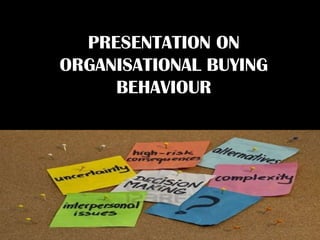

PRESENTATION ON
ORGANISATIONAL BUYING
     BEHAVIOUR
MBA 3rd Semester
   To know the meaning of Organisational Buying
    Behaviour.
   Characteristics of Organisational Buying Behaviour.
   A comparative analysis of Organisational Buying vs
    Consumer Buying.
   To know the actual process of Buying System and the
    factors that they take into consideration for placing an
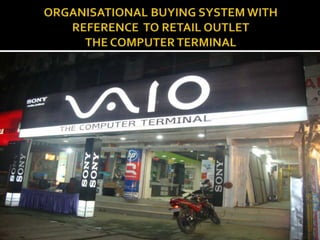
    order with reference to the Retail outlet “The Computer
    Terminal” Guwahati.
   May be defined as
     “The decision making process by which formal
     organisations establish the need for purchased
     products and services and identify , evaluate and
     choose among alternatives brands and suppliers.”
   Organisational buyers buy goods and services to
    reprocess a product or service and sell it to the next
    buyer.
   Organisation buyers consists of following Organisation:

     Manufacturers and industrial markets.

     Wholesalers and retailers

     Government agencies.

     Non-governmental organisations.
 It is a rational process.
 It is done in large
  quantities.
 More individuals are
  involved      in     buying
  process.
 Purchase criteria is well
  defined.
 Extensive           contact
  between Buyers and
  Sellers.
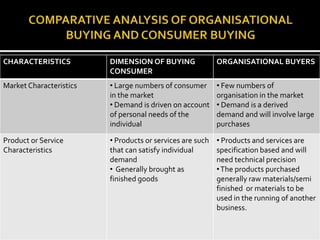
CHARACTERISTICS          DIMENSION OF BUYING               ORGANISATIONAL BUYERS
                         CONSUMER
Market Characteristics   • Large numbers of consumer       • Few numbers of
                         in the market                     organisation in the market
                         • Demand is driven on account     • Demand is a derived
                         of personal needs of the          demand and will involve large
                         individual                        purchases

Product or Service       • Products or services are such   • Products and services are
Characteristics          that can satisfy individual       specification based and will
                         demand                            need technical precision
                         • Generally brought as            • The products purchased
                         finished goods                    generally raw materials/semi
                                                           finished or materials to be
                                                           used in the running of another
                                                           business.
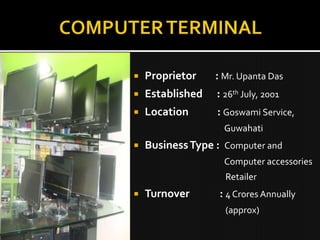
   Proprietor    : Mr. Upanta Das
   Established   : 26th July, 2001
   Location      : Goswami Service,
                    Guwahati
   Business Type : Computer and
                    Computer accessories
                    Retailer
   Turnover       : 4 Crores Annually
                    (approx)
CENTRALISE
 D BUYING
  SYSTEM
   Centralized purchasing is a method of procurement of all
    types of materials, supplies, equipment etc. through a
    single department (not necessarily centrally located)
    under the direct control and superintendence of one
    responsible person.
   He is directly accountable to the top management for all
    duties falling within the broad area of purchase function.
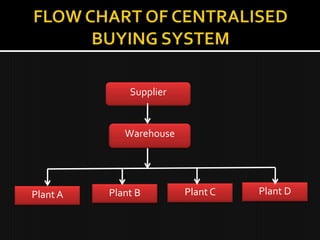
Supplier


             Warehouse


Plant A   Plant B        Plant C   Plant D
   Bulk buying strengthens the bargaining position of the buyer
   Advantage of the quantity discount can be tapped
   It will reduce the inventory carrying costs
   Lower transportation cost per unit
   Duplication of efforts in buying function is eliminated
   Skill development of purchase head
   No competition within units
   Easy to procure from foreign supplier
   Problem when specific requirement needed
   Delay in receiving the materials
   Problems to use local resources in small quantity
   Helps for autocratic management style
   Central purchasing staff may not be expert in buying various
    types of items
   Loss of local control
   Creates another level of hierarchy
   Suitable more for small organization
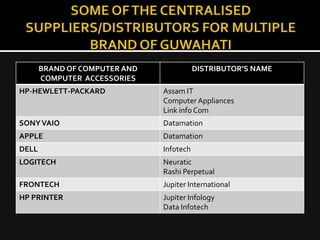
BRAND OF COMPUTER AND              DISTRIBUTOR’S NAME
       COMPUTER ACCESSORIES
HP-HEWLETT-PACKARD             Assam IT
                               Computer Appliances
                               Link info Com
SONY VAIO                      Datamation
APPLE                          Datamation
DELL                           Infotech
LOGITECH                       Neuratic
                               Rashi Perpetual
FRONTECH                       Jupiter International
HP PRINTER                     Jupiter Infology
                               Data Infotech
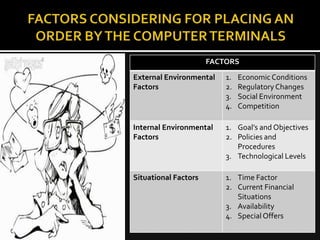
FACTORS
External Environmental    1.   Economic Conditions
Factors                   2.   Regulatory Changes
                          3.   Social Environment
                          4.   Competition

Internal Environmental    1. Goal’s and Objectives
Factors                   2. Policies and
                             Procedures
                          3. Technological Levels

Situational Factors       1. Time Factor
                          2. Current Financial
                             Situations
                          3. Availability
                          4. Special Offers
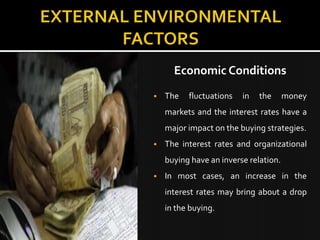
Economic Conditions
   The   fluctuations   in   the      money
    markets and the interest rates have a
    major impact on the buying strategies.
   The interest rates and organizational
    buying have an inverse relation.
   In most cases, an increase in the
    interest rates may bring about a drop
    in the buying.
Regulatory Changes
   Any changes in the corporate
    laws, rules and regulations will
    also influence how, when and
    what the organizations buy.
   There   are   also   regulatory
    changes that may change their
    buying patterns to stay in-line
    with the new regulations.
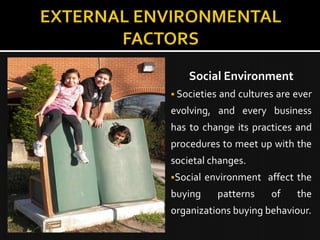
Social Environment
 Societies   and cultures are ever
evolving, and every business
has to change its practices and
procedures to meet up with the
societal changes.
Social   environment affect the
buying        patterns   of    the
organizations buying behaviour.
Competition
 Today’s    business is all about
beating competition and staying
ahead.
 When        an     organization's
competitors move on to a newer
product or service it's very likely
for the organization to change its
trends too and thus its buying
pattern will change accordingly.
Organisation Goals and
                Objectives
   The goals and objectives of an
    organization are major determinants
    as to how and what the organization
    will purchase.
   Company whose goal is to deliver
    quality products may have a very
    contrasting buying pattern, and they
    will focus more on the quality issues
    than on the price advantage.
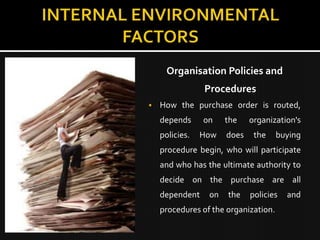
Organisation Policies and
                Procedures
   How the purchase order is routed,
    depends     on    the    organization's
    policies.   How   does    the     buying
    procedure begin, who will participate
    and who has the ultimate authority to
    decide on the purchase are all
    dependent    on   the    policies   and
    procedures of the organization.
Technological Levels
   Whenever making new purchases, organizations take into consideration
    their current technology.
   Purchases are meant to replace the current technology with a newer
    version, so their buying decision will be influenced by what level of
    technology they currently own.
   organizations try to ensure that all new purchases being made are
    technologically compatible with their existing technology.
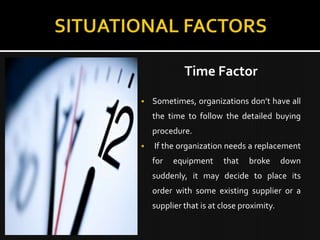
Time Factor
   Sometimes, organizations don’t have all
    the time to follow the detailed buying
    procedure.
   If the organization needs a replacement
    for   equipment     that    broke      down
    suddenly, it may decide to place its
    order with some existing supplier or a
    supplier that is at close proximity.
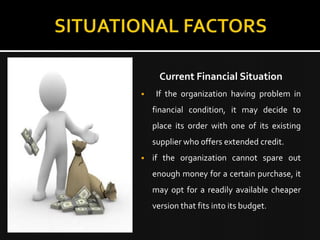
Current Financial Situation
    If the organization having problem in
    financial condition, it may decide to
    place its order with one of its existing
    supplier who offers extended credit.
   if the organization cannot spare out
    enough money for a certain purchase, it
    may opt for a readily available cheaper
    version that fits into its budget.
Availability
   Some buying decisions can wait
    while others cannot, thus if the
    supplier cannot make available the
    exact product by the desired date,
    the organizational buyers may shift
    to a new supplier or to a more
    readily available alternative.
Special Offers
   Special offers being given
    by a supplier may also be
    one of the situational
    factors affecting the
    buying decision.
   Organizational buying behaviour is a very complex area.
   However, an understanding of the key factors are fundamental to
    marketing strategy.
   In large industrial, commercial and retail organisations, use
    “Centralized Buying system”
   The buyer in an organisation is a part of the system and he has to
    operate within the parameters set forth by the organisation.
   The organizational buying behaviour gets affected by the industry
    customs and traditions, and the culture that prevails in the
    commercial and business circles.
ANY QUERIES

Marketing Buying system

  • 1.
  • 2.
  • 3.
    To know the meaning of Organisational Buying Behaviour.  Characteristics of Organisational Buying Behaviour.  A comparative analysis of Organisational Buying vs Consumer Buying.  To know the actual process of Buying System and the factors that they take into consideration for placing an order with reference to the Retail outlet “The Computer Terminal” Guwahati.
  • 4.
    May be defined as “The decision making process by which formal organisations establish the need for purchased products and services and identify , evaluate and choose among alternatives brands and suppliers.”
  • 5.
    Organisational buyers buy goods and services to reprocess a product or service and sell it to the next buyer.  Organisation buyers consists of following Organisation:  Manufacturers and industrial markets.  Wholesalers and retailers  Government agencies.  Non-governmental organisations.
  • 6.
     It isa rational process.  It is done in large quantities.  More individuals are involved in buying process.  Purchase criteria is well defined.  Extensive contact between Buyers and Sellers.
  • 7.
    CHARACTERISTICS DIMENSION OF BUYING ORGANISATIONAL BUYERS CONSUMER Market Characteristics • Large numbers of consumer • Few numbers of in the market organisation in the market • Demand is driven on account • Demand is a derived of personal needs of the demand and will involve large individual purchases Product or Service • Products or services are such • Products and services are Characteristics that can satisfy individual specification based and will demand need technical precision • Generally brought as • The products purchased finished goods generally raw materials/semi finished or materials to be used in the running of another business.
  • 9.
    Proprietor : Mr. Upanta Das  Established : 26th July, 2001  Location : Goswami Service, Guwahati  Business Type : Computer and Computer accessories Retailer  Turnover : 4 Crores Annually (approx)
  • 10.
  • 11.
    Centralized purchasing is a method of procurement of all types of materials, supplies, equipment etc. through a single department (not necessarily centrally located) under the direct control and superintendence of one responsible person.  He is directly accountable to the top management for all duties falling within the broad area of purchase function.
  • 12.
    Supplier Warehouse Plant A Plant B Plant C Plant D
  • 13.
    Bulk buying strengthens the bargaining position of the buyer  Advantage of the quantity discount can be tapped  It will reduce the inventory carrying costs  Lower transportation cost per unit  Duplication of efforts in buying function is eliminated  Skill development of purchase head  No competition within units  Easy to procure from foreign supplier
  • 14.
    Problem when specific requirement needed  Delay in receiving the materials  Problems to use local resources in small quantity  Helps for autocratic management style  Central purchasing staff may not be expert in buying various types of items  Loss of local control  Creates another level of hierarchy  Suitable more for small organization
  • 15.
    BRAND OF COMPUTERAND DISTRIBUTOR’S NAME COMPUTER ACCESSORIES HP-HEWLETT-PACKARD Assam IT Computer Appliances Link info Com SONY VAIO Datamation APPLE Datamation DELL Infotech LOGITECH Neuratic Rashi Perpetual FRONTECH Jupiter International HP PRINTER Jupiter Infology Data Infotech
  • 16.
    FACTORS External Environmental 1. Economic Conditions Factors 2. Regulatory Changes 3. Social Environment 4. Competition Internal Environmental 1. Goal’s and Objectives Factors 2. Policies and Procedures 3. Technological Levels Situational Factors 1. Time Factor 2. Current Financial Situations 3. Availability 4. Special Offers
  • 17.
    Economic Conditions  The fluctuations in the money markets and the interest rates have a major impact on the buying strategies.  The interest rates and organizational buying have an inverse relation.  In most cases, an increase in the interest rates may bring about a drop in the buying.
  • 18.
    Regulatory Changes  Any changes in the corporate laws, rules and regulations will also influence how, when and what the organizations buy.  There are also regulatory changes that may change their buying patterns to stay in-line with the new regulations.
  • 19.
    Social Environment  Societies and cultures are ever evolving, and every business has to change its practices and procedures to meet up with the societal changes. Social environment affect the buying patterns of the organizations buying behaviour.
  • 20.
    Competition  Today’s business is all about beating competition and staying ahead.  When an organization's competitors move on to a newer product or service it's very likely for the organization to change its trends too and thus its buying pattern will change accordingly.
  • 21.
    Organisation Goals and Objectives  The goals and objectives of an organization are major determinants as to how and what the organization will purchase.  Company whose goal is to deliver quality products may have a very contrasting buying pattern, and they will focus more on the quality issues than on the price advantage.
  • 22.
    Organisation Policies and Procedures  How the purchase order is routed, depends on the organization's policies. How does the buying procedure begin, who will participate and who has the ultimate authority to decide on the purchase are all dependent on the policies and procedures of the organization.
  • 23.
    Technological Levels  Whenever making new purchases, organizations take into consideration their current technology.  Purchases are meant to replace the current technology with a newer version, so their buying decision will be influenced by what level of technology they currently own.  organizations try to ensure that all new purchases being made are technologically compatible with their existing technology.
  • 24.
    Time Factor  Sometimes, organizations don’t have all the time to follow the detailed buying procedure.  If the organization needs a replacement for equipment that broke down suddenly, it may decide to place its order with some existing supplier or a supplier that is at close proximity.
  • 25.
    Current Financial Situation  If the organization having problem in financial condition, it may decide to place its order with one of its existing supplier who offers extended credit.  if the organization cannot spare out enough money for a certain purchase, it may opt for a readily available cheaper version that fits into its budget.
  • 26.
    Availability  Some buying decisions can wait while others cannot, thus if the supplier cannot make available the exact product by the desired date, the organizational buyers may shift to a new supplier or to a more readily available alternative.
  • 27.
    Special Offers  Special offers being given by a supplier may also be one of the situational factors affecting the buying decision.
  • 28.
    Organizational buying behaviour is a very complex area.  However, an understanding of the key factors are fundamental to marketing strategy.  In large industrial, commercial and retail organisations, use “Centralized Buying system”  The buyer in an organisation is a part of the system and he has to operate within the parameters set forth by the organisation.  The organizational buying behaviour gets affected by the industry customs and traditions, and the culture that prevails in the commercial and business circles.
  • 29.