CHAPTER 2
Teaching the Ethical Use of
Information as an MIL Skill
B. Schultz-Jones
University of North Texas, Denton, TX, United States
2.1 INTRODUCTION
What do educators need to know about teaching the ethical use
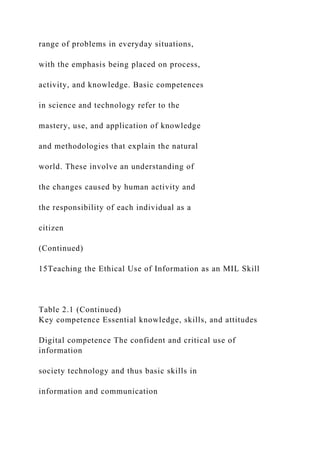
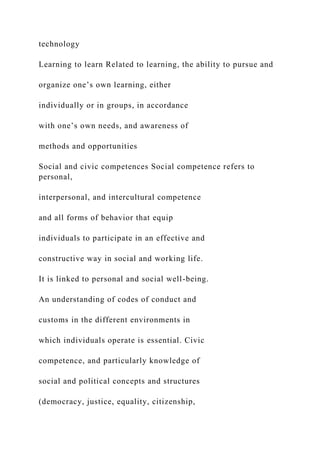
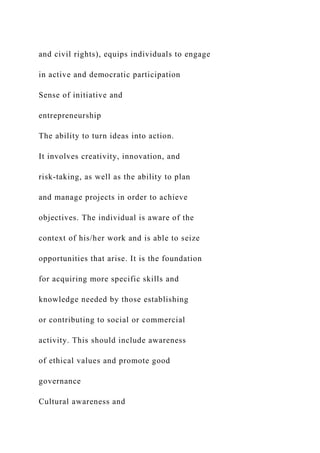
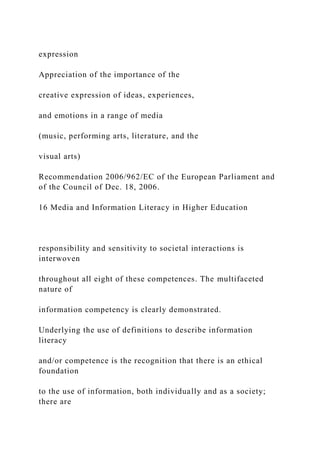
of
information? This chapter deals with teaching the ethical use of
information
as a media and information literacy (MIL) skill. To be able to
use informa-
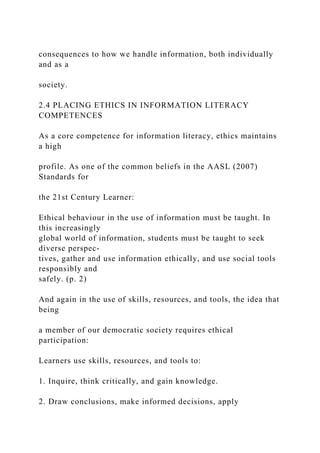
tion ethically, educators and students must equip themselves
with principles
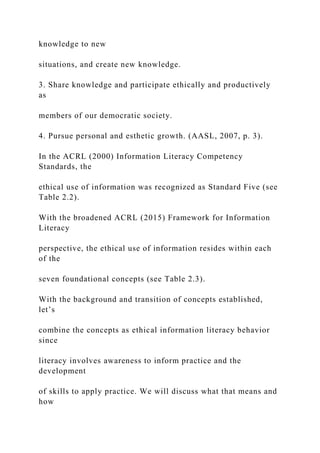
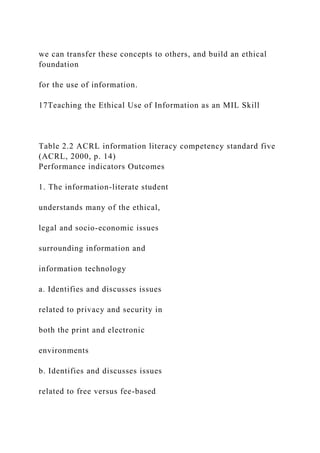
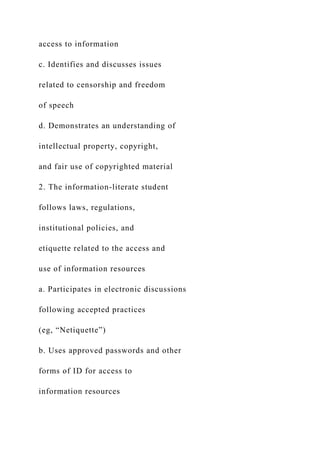
that can be applied as information literacy skills to our
information land-
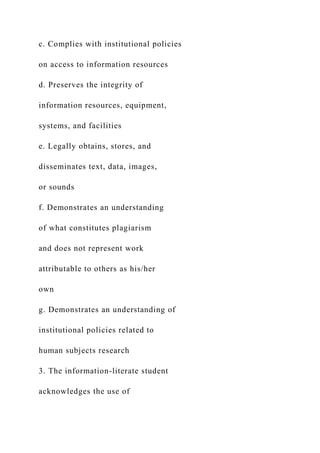
scape. The concepts of ethics and information literacy are
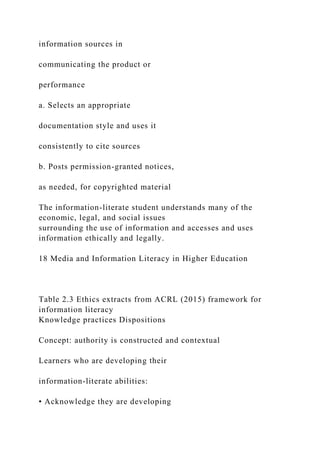
examined and
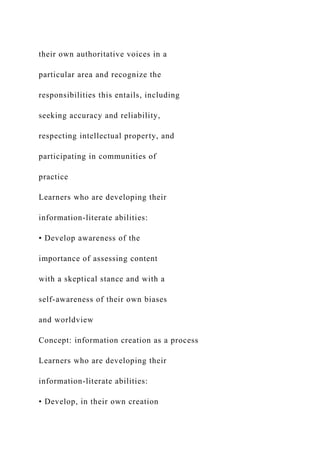
the connection between the learning environment and the
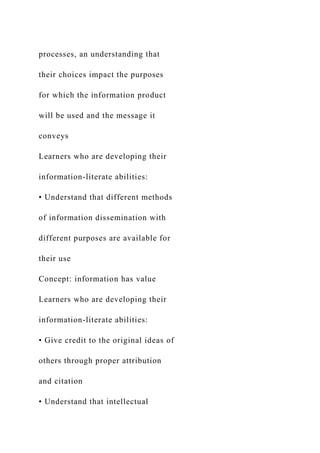
adoption of ethi-
cal information literacy skills is discussed. The teaching
frameworks of
informed learning (Bruce, 2008) and guided inquiry (Kuhlthau,
Maniotes, &
Caspari, 2012) are explored, along with learning scenarios, as a
means
of orchestrating the adoption of ethical information literacy
behavior.
2.2 ETHICS
The term ethics occurs in many examples of standards and
guidelines that
address the acquisition, use, dissemination, and impact of
information. The
term is used as a simple way to highlight the recognition of
right and
wrong conduct in relation to handling information and as a more
complex
concept that identifies a principled approach to dealing with
increasingly
sophisticated information technology and its ever-changing
global environ-
ment. As educators we have the opportunity to address the
principles and
standards needed to make wise decisions when dealing with the
complexity
of information issues of our 21st century. We recognize that the
values of a
community may vary across cultures. However, in a complex
information
environment, there are principles and values that we need to
establish and
reinforce. The educational community fosters engagement with
these
values in our learning environment and provides the means to
learn and
understand ethical information literacy behavior.
13
Media and Information Literacy in Higher Education. DOI:
http://dx.doi.org/10.1016/B978-0-08-100630-6.00002-3
Copyright © 2017 Barbara Schultz-Jones. Published by Elsevier
Ltd. All rights reserved.
http://dx.doi.org/10.1016/B978-0-08-100630-6.00002-3
2.3 INFORMATION LITERACY
An appreciation of teaching the ethical use of information as a
literacy
skill begins with an appreciation of the evolution of information
literacy.
In the United States, the concept of information literacy has
evolved
from a simple definition that referred to the approach of using
reference
resources to find information, through a recognition by the
Association
of College and Research Libraries (ACRL) of the American
Library
Association (ALA, 1989) definition that being information-
literate meant
being equipped with a set of abilities requiring individuals to
“recognize
when information is needed and have the ability to locate,
evaluate,
and effectively use the needed information” (ACRL, 2000, p. 2),
to a
grouping of “threshold concepts” and “foundational ideas” that
are
intended to address the “dynamic and often uncertain
information
ecosystem in which all of us work and live” (ACRL, 2015, p. 2).
With the 2007 publication of Standards for the 21st Century
Learner the
American Association of School Librarians (AASL) recognized
that the
“definition of information literacy has become more complex as
resources
and technologies have changed” (p. 3) and highlighted that
“multiple
literacies, including digital, visual, textual, and technological,
have now
joined information as crucial skills for this century” (p. 3). An
expanded
definition of information literacy seeks to address a wider, more
encom-
passing reach throughout a path of lifelong learning:
Information literacy is the set of integrated abilities
encompassing the reflective
discovery of information, the understanding of how information
is produced
and valued, and the use of information in creating new
knowledge and
participating ethically in communities of learning.
ACRL (2015, p. 3)
The Canadian Library Association (CLA, 2014) adopted
Standards of
Practice for School Library Learning Commons in Canada that
articulate five
core standards of practice to “drive best teaching and learning
through
the Library Learning Commons” (p. 8). The fourth standard,
Fostering
Literacies to Empower Life-Long Learners, applies an expanded
“notion
of literacy” that includes “digital literacy and citizenship” (pp.
17�18),
recognizing that students must develop a range of literacy skills
that
includes personal responsibility. Accompanying the range of
literacy skills
is a continuum of growth indicators that identify the various
competen-
cies students would achieve throughout the various stages of
exploring,
emerging, evolving, and established.
14 Media and Information Literacy in Higher Education
The International Federation of Library Associations (IFLA,
2006)
notes that there is a difference among languages in handling the
concept
of information literacy and the use of information competency
is more eas-
ily recognized outside the English-speaking nations (p. 9). A
recommen-
dation by the European Council (2006) of the European Union
identified
eight key competences for lifelong learning (see Table 2.1).
These competences are recognized as “a combination of
knowledge,
skills and attitudes appropriate to the context. They are
particularly
necessary for personal fulfilment and development, social
inclusion,
active citizenship and employment” (European Council, 2006,
Summary). Of the eight competences, competences four, five,
six, and
seven relate to the use of information. The acknowledgment of
personal
Table 2.1 Key competences for lifelong learning
Key competence Essential knowledge, skills, and attitudes
Communication in the
mother tongue
The ability to express and interpret concepts,
thoughts, feelings, facts, and opinions in
both oral and written form (listening,
speaking, reading, and writing) and to
interact linguistically in an appropriate and
creative way in a full range of societal and
cultural contexts
Communication in foreign
languages
Involves, in addition to the main skill
dimensions of communication in the
mother tongue, mediation and intercultural
understanding. The level of proficiency
depends on several factors and the capacity
for listening, speaking, reading, and writing
Mathematical competence and
basic competences in
science and technology
The ability to develop and apply
mathematical thinking in order to solve a
range of problems in everyday situations,
with the emphasis being placed on process,
activity, and knowledge. Basic competences
in science and technology refer to the
mastery, use, and application of knowledge
and methodologies that explain the natural
world. These involve an understanding of
the changes caused by human activity and
the responsibility of each individual as a
citizen
(Continued)
15Teaching the Ethical Use of Information as an MIL Skill
Table 2.1 (Continued)
Key competence Essential knowledge, skills, and attitudes
Digital competence The confident and critical use of
information
society technology and thus basic skills in
information and communication
technology
Learning to learn Related to learning, the ability to pursue and
organize one’s own learning, either
individually or in groups, in accordance
with one’s own needs, and awareness of
methods and opportunities
Social and civic competences Social competence refers to
personal,
interpersonal, and intercultural competence
and all forms of behavior that equip
individuals to participate in an effective and
constructive way in social and working life.
It is linked to personal and social well-being.
An understanding of codes of conduct and
customs in the different environments in
which individuals operate is essential. Civic
competence, and particularly knowledge of
social and political concepts and structures
(democracy, justice, equality, citizenship,
and civil rights), equips individuals to engage
in active and democratic participation
Sense of initiative and
entrepreneurship
The ability to turn ideas into action.
It involves creativity, innovation, and
risk-taking, as well as the ability to plan
and manage projects in order to achieve
objectives. The individual is aware of the
context of his/her work and is able to seize
opportunities that arise. It is the foundation
for acquiring more specific skills and
knowledge needed by those establishing
or contributing to social or commercial
activity. This should include awareness
of ethical values and promote good
governance
Cultural awareness and
expression
Appreciation of the importance of the
creative expression of ideas, experiences,
and emotions in a range of media
(music, performing arts, literature, and the
visual arts)
Recommendation 2006/962/EC of the European Parliament and
of the Council of Dec. 18, 2006.
16 Media and Information Literacy in Higher Education
responsibility and sensitivity to societal interactions is
interwoven
throughout all eight of these competences. The multifaceted
nature of
information competency is clearly demonstrated.
Underlying the use of definitions to describe information
literacy
and/or competence is the recognition that there is an ethical
foundation
to the use of information, both individually and as a society;
there are
consequences to how we handle information, both individually
and as a
society.
2.4 PLACING ETHICS IN INFORMATION LITERACY
COMPETENCES
As a core competence for information literacy, ethics maintains
a high
profile. As one of the common beliefs in the AASL (2007)
Standards for
the 21st Century Learner:
Ethical behaviour in the use of information must be taught. In
this increasingly
global world of information, students must be taught to seek
diverse perspec-
tives, gather and use information ethically, and use social tools
responsibly and
safely. (p. 2)
And again in the use of skills, resources, and tools, the idea that
being
a member of our democratic society requires ethical
participation:
Learners use skills, resources, and tools to:
1. Inquire, think critically, and gain knowledge.
2. Draw conclusions, make informed decisions, apply
knowledge to new
situations, and create new knowledge.
3. Share knowledge and participate ethically and productively
as
members of our democratic society.
4. Pursue personal and esthetic growth. (AASL, 2007, p. 3).
In the ACRL (2000) Information Literacy Competency
Standards, the
ethical use of information was recognized as Standard Five (see
Table 2.2).
With the broadened ACRL (2015) Framework for Information
Literacy
perspective, the ethical use of information resides within each
of the
seven foundational concepts (see Table 2.3).
With the background and transition of concepts established,
let’s
combine the concepts as ethical information literacy behavior
since
literacy involves awareness to inform practice and the
development
of skills to apply practice. We will discuss what that means and
how
we can transfer these concepts to others, and build an ethical
foundation
for the use of information.
17Teaching the Ethical Use of Information as an MIL Skill
Table 2.2 ACRL information literacy competency standard five
(ACRL, 2000, p. 14)
Performance indicators Outcomes
1. The information-literate student
understands many of the ethical,
legal and socio-economic issues
surrounding information and
information technology
a. Identifies and discusses issues
related to privacy and security in
both the print and electronic
environments
b. Identifies and discusses issues
related to free versus fee-based
access to information
c. Identifies and discusses issues
related to censorship and freedom
of speech
d. Demonstrates an understanding of
intellectual property, copyright,
and fair use of copyrighted material
2. The information-literate student
follows laws, regulations,
institutional policies, and
etiquette related to the access and
use of information resources
a. Participates in electronic discussions
following accepted practices
(eg, “Netiquette”)
b. Uses approved passwords and other
forms of ID for access to
information resources
c. Complies with institutional policies
on access to information resources
d. Preserves the integrity of
information resources, equipment,
systems, and facilities
e. Legally obtains, stores, and
disseminates text, data, images,
or sounds
f. Demonstrates an understanding
of what constitutes plagiarism
and does not represent work
attributable to others as his/her
own
g. Demonstrates an understanding of
institutional policies related to
human subjects research
3. The information-literate student
acknowledges the use of
information sources in
communicating the product or
performance
a. Selects an appropriate
documentation style and uses it
consistently to cite sources
b. Posts permission-granted notices,
as needed, for copyrighted material
The information-literate student understands many of the
economic, legal, and social issues
surrounding the use of information and accesses and uses
information ethically and legally.
18 Media and Information Literacy in Higher Education
Table 2.3 Ethics extracts from ACRL (2015) framework for
information literacy
Knowledge practices Dispositions
Concept: authority is constructed and contextual
Learners who are developing their
information-literate abilities:
• Acknowledge they are developing
their own authoritative voices in a
particular area and recognize the
responsibilities this entails, including
seeking accuracy and reliability,
respecting intellectual property, and
participating in communities of
practice
Learners who are developing their
information-literate abilities:
• Develop awareness of the
importance of assessing content
with a skeptical stance and with a
self-awareness of their own biases
and worldview
Concept: information creation as a process
Learners who are developing their
information-literate abilities:
• Develop, in their own creation
processes, an understanding that
their choices impact the purposes
for which the information product
will be used and the message it
conveys
Learners who are developing their
information-literate abilities:
• Understand that different methods
of information dissemination with
different purposes are available for
their use
Concept: information has value
Learners who are developing their
information-literate abilities:
• Give credit to the original ideas of
others through proper attribution
and citation
• Understand that intellectual
property is a legal and social
construct that varies by culture
• Articulate the purpose and
distinguishing characteristics of
copyright, fair use, open access, and
the public domain
• Make informed choices regarding
their online actions in full awareness
of issues related to privacy and the
commodification of personal
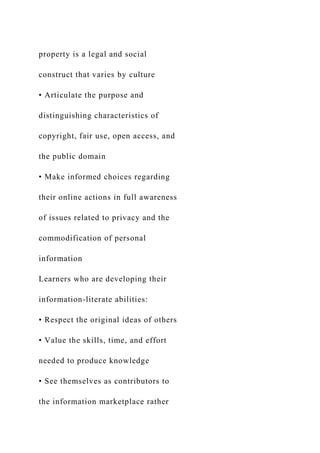
information
Learners who are developing their
information-literate abilities:
• Respect the original ideas of others
• Value the skills, time, and effort
needed to produce knowledge
• See themselves as contributors to
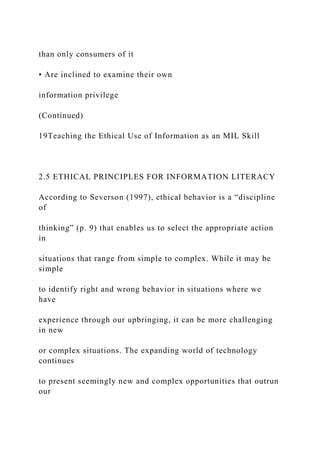
the information marketplace rather
than only consumers of it
• Are inclined to examine their own
information privilege
(Continued)
19Teaching the Ethical Use of Information as an MIL Skill
2.5 ETHICAL PRINCIPLES FOR INFORMATION LITERACY
According to Severson (1997), ethical behavior is a “discipline
of
thinking” (p. 9) that enables us to select the appropriate action
in
situations that range from simple to complex. While it may be
simple
to identify right and wrong behavior in situations where we
have
experience through our upbringing, it can be more challenging
in new
or complex situations. The expanding world of technology
continues
to present seemingly new and complex opportunities that outrun
our
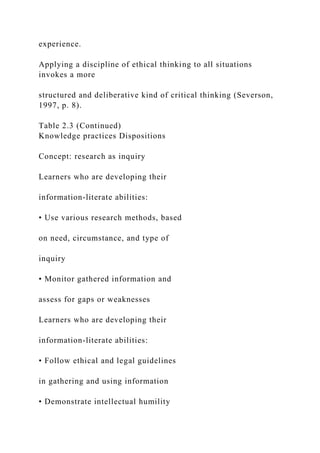
experience.
Applying a discipline of ethical thinking to all situations
invokes a more
structured and deliberative kind of critical thinking (Severson,
1997, p. 8).
Table 2.3 (Continued)
Knowledge practices Dispositions
Concept: research as inquiry
Learners who are developing their
information-literate abilities:
• Use various research methods, based
on need, circumstance, and type of
inquiry
• Monitor gathered information and
assess for gaps or weaknesses
Learners who are developing their
information-literate abilities:
• Follow ethical and legal guidelines
in gathering and using information
• Demonstrate intellectual humility
(ie, recognize their own intellectual
or experiential limitations)
Concept: scholarship as conversation
Learners who are developing their
information-literate abilities:
• Cite the contributing work of
others in their own information
production
Learners who are developing their
information-literate abilities:
• Understand the responsibility that
comes with entering the
conversation through participatory
channels
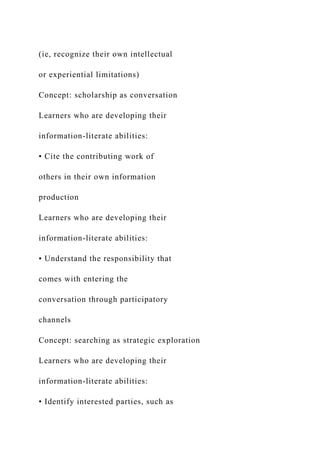
Concept: searching as strategic exploration
Learners who are developing their
information-literate abilities:
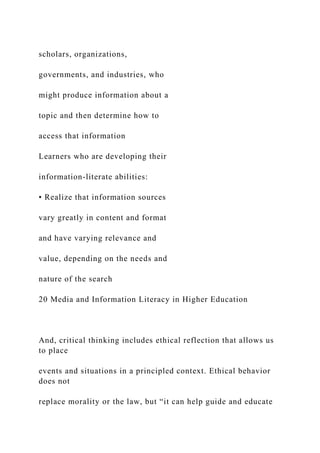
• Identify interested parties, such as
scholars, organizations,
governments, and industries, who
might produce information about a
topic and then determine how to
access that information
Learners who are developing their
information-literate abilities:
• Realize that information sources
vary greatly in content and format
and have varying relevance and
value, depending on the needs and
nature of the search
20 Media and Information Literacy in Higher Education
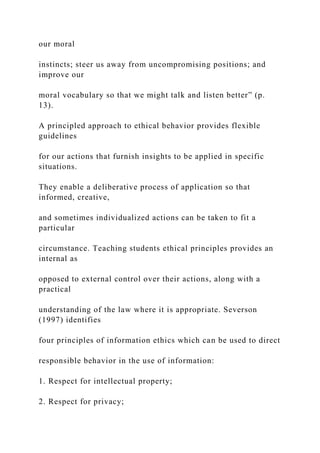
And, critical thinking includes ethical reflection that allows us
to place
events and situations in a principled context. Ethical behavior
does not
replace morality or the law, but “it can help guide and educate
our moral
instincts; steer us away from uncompromising positions; and
improve our
moral vocabulary so that we might talk and listen better” (p.
13).
A principled approach to ethical behavior provides flexible
guidelines
for our actions that furnish insights to be applied in specific
situations.
They enable a deliberative process of application so that
informed, creative,
and sometimes individualized actions can be taken to fit a
particular
circumstance. Teaching students ethical principles provides an
internal as
opposed to external control over their actions, along with a
practical
understanding of the law where it is appropriate. Severson
(1997) identifies
four principles of information ethics which can be used to direct
responsible behavior in the use of information:
1. Respect for intellectual property;
2. Respect for privacy;
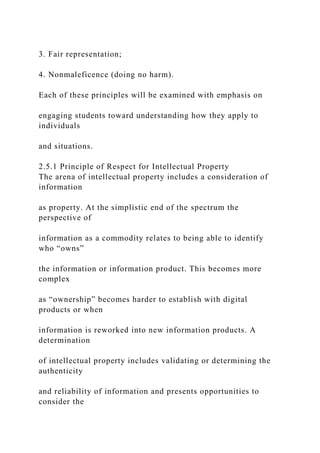
3. Fair representation;
4. Nonmaleficence (doing no harm).
Each of these principles will be examined with emphasis on
engaging students toward understanding how they apply to
individuals
and situations.
2.5.1 Principle of Respect for Intellectual Property
The arena of intellectual property includes a consideration of
information
as property. At the simplistic end of the spectrum the
perspective of
information as a commodity relates to being able to identify
who “owns”
the information or information product. This becomes more
complex
as “ownership” becomes harder to establish with digital
products or when
information is reworked into new information products. A
determination
of intellectual property includes validating or determining the
authenticity
and reliability of information and presents opportunities to
consider the
purpose of creating information products and the associated
value.
According to Warlick (2009) “the ultimate value [of
information] is based
on its accuracy, validity, and reliability—on its authority” (p.
145).
Rapidly expanding technological developments may make it
challenging to determine the authority of information. Where
print
publications provide hardcopy editions with static publication
data, the
digital environment makes information more accessible and
more
21Teaching the Ethical Use of Information as an MIL Skill
susceptible to manipulation. In the digital environment users
can easily
operate individually or within groups as information creators,
produ-
cers, or consumers. Information can be plagiarized more easily
and
disseminated instantly.
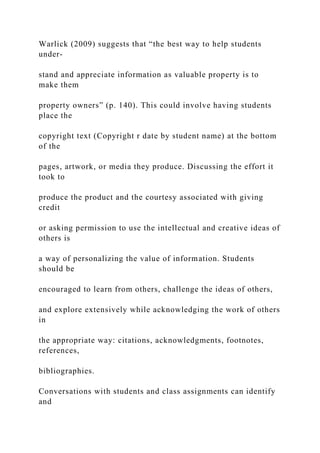
Warlick (2009) suggests that “the best way to help students
under-
stand and appreciate information as valuable property is to
make them
property owners” (p. 140). This could involve having students
place the
copyright text (Copyright r date by student name) at the bottom
of the
pages, artwork, or media they produce. Discussing the effort it
took to
produce the product and the courtesy associated with giving
credit
or asking permission to use the intellectual and creative ideas of
others is
a way of personalizing the value of information. Students
should be
encouraged to learn from others, challenge the ideas of others,
and explore extensively while acknowledging the work of others
in
the appropriate way: citations, acknowledgments, footnotes,
references,
bibliographies.
Conversations with students and class assignments can identify
and
include specific intellectual property laws such as copyright,
fair use,
trademarks, and patents along with the value of providing open
access to
information and the options available under Creative Commons
licensing.
Consequences associated with unacceptable behaviors such as
fraud,
theft, deceit, plagiarism, and withholding the results of research
can be
discussed under the principle of respect for intellectual
property.
2.5.2 Principle of Respect for Privacy
Related to the principle of respect for intellectual property is
the
principle of respect for privacy. As Bodi (1998) notes “the
individual
decides who has the right or freedom to share in his or her
activities or
deliberations” (p. 461). Controlling those rights is challenging
in a digital
environment, and students must learn how to protect their
personal
information and respect the privacy of others.
Libraries defend the right to privacy through protection of
student’s
circulation records, and a discussion of how personal data
profiles are
stored in databases for use by other agencies is an important
aspect of
the respect for privacy. Respect infers personal responsibility
and that
responsibility extends to being aware and cautious about what
we share,
how we share, and where that information is located. Privacy
policies
are distributed regularly by credit card companies, banking
institutions,
22 Media and Information Literacy in Higher Education
and online vendors. The consequences of inappropriate sharing
of what
should be considered private information can be seen with
examples
of organizations firing employees for inappropriate online
displays of
personal information, educators being chastised for posting
unprofes-
sional photos of themselves in online public spaces, and identity
theft of
personal data from supposedly encrypted databases. Efforts to
protect
information integrity, confidentiality, and availability can often
conflict
with the desire for the benefits of information sharing. Respect
for
privacy is also a respect for self.
2.5.3 Principle of Fair Representation
Trusting that the product you purchase will function as
advertised is an
example of the principle of fair representation. We should be
able to rely
on the information that is presented and trust that if products,
such as
downloadable software, do not behave as advertised, the vendor
will
accept responsibility and be accountable. Liability standards
should ensure
that product risks are mitigated and warranties should provide a
form of
insurance against product failures. This implies that vendors are
honest
in their efforts to deliver quality products and accept the
consequences
for any mistakes. Discussions of client�vendor relationships
and, by
extension, student�student relationships, place the
responsibility for
honest transactions in the personal realm.
Presenting opportunities for students to understand the
implication of
manipulating information, even under the guise of creative
misrepresenta-
tion, ensures that the principle of fair representation is
understood and
endorsed.
2.5.4 Principle of Nonmaleficence (Doing no Harm)
Adopting the principle of nonmaleficence means, at a minimum,
that
“we must never do anything that might contribute to the decline
of
another person’s life or affairs” (Severson, 1997, p. 108). This
implies
taking responsibility for our actions and understanding the
impact of our
information interactions, regardless of the environment in which
they
occur. For example, some people may find it easy to rant and
rave via
email but wouldn’t consider such behavior in person.
Cyberbullying becomes a convenient method of intimidation
because
of the distance between persons and the presumed anonymity of
the insti-
gator. The impact of violating another person’s privacy and
causing harm
23Teaching the Ethical Use of Information as an MIL Skill
must be placed in the personal arena where students have an
opportunity
to reflect on the purpose and consequences of malevolent acts.
The principle of doing no harm extends to an understanding of
the
impact on society. The unethical abuse of information, through
computer
viruses, hacking, malware, and phishing, is pervasive and
expensive.
The impact of these actions can be discussed in the context of
adopting
the principle of nonmaleficence, and appropriate actions should
manifest
themselves in the realm of digital citizenship. As Warlick
(2009) states:
Information is power, and 21st century literacy equips children
and adults, learners
and teachers with powerful tools. We have at our disposal a
global electronic
library of information, much of it coming out of our own
communities. We are
increasingly gaining access to potent digital tools that can
access, alter,
and communicate that information in infinite and persuasive
ways. (p. 148)
Abusing the ideas of others, tampering with or distorting the
ideas of
others, or using information to cause harm violates an
individual’s place
in the community of learners and can be harmful to society as a
whole.
Our place in the larger context of society and our civic
responsibilities
begin with an acceptance and understanding of self and self-
respect.
Providing assignments, activities, and discussions that enable
perception,
processing, and comprehension takes time. But the benefit of
becoming
reflective thinkers who can tackle issues and synthesize
information is
paramount. Ethical decisions require rational decision making.
2.6 LEARNING ENVIRONMENT
To openly discuss, confront, and address the ethical challenges
in the
global world of information, it is important to create a learning
environ-
ment that models and honors ethical principles while guiding
inquiry and
encouraging creativity. Much of this depends on the skills,
behaviors and
attitudes of educators and the culture of the learning
environment.
Importance should be placed on establishing a learning
environment that:
• Encourages the exchange of ideas and concepts;
• Offers a safe place for the debate of ideas;
• Instructs students on the principles underlying the ethical use
of
information;
• Equips students with the skills and abilities to be information
literate;
• Reinforces the need for reflection and synthesis;
• Respects the privacy of individuals;
• Encourages creativity, ingenuity, and lifelong learning.
24 Media and Information Literacy in Higher Education
The learning environment for a community of learners can be
established in face-to-face contact or online. Certainly there is a
differ-
ence in those environments in terms of physical proximity, but a
learning
environment that nurtures lifelong learning can develop a sense
of
community that enables open discussion and teaches the ethical
use
of information.
The difference in environments and potential difference in the
sense
of “community” is an important discussion point: our social
software
“spaces” can create communities of practice that enable
productive
exchanges of information and inspire creativity. Points of
netiquette
within these spaces are worth debating and, in some
communities of
practice, a code of behavior will be established to ensure that
everyone is
treated respectfully. In that way, the likelihood of a dual world
where
behavior in one does not necessarily reflect behavior in another
is dimin-
ished. The speed of communication can also alter the
relationship among
community members. People may not take the time to reflect on
the
possibility or implications of the unethical use of information.
Sensitivity
to personal behavior in these various circumstances can be
taught.
2.7 TEACHING ETHICS AS A MIL SKILL
Teaching ethical information literacy skills involves
considering how to
construct our instruction to meet our understanding of how
students
learn. Two practical models that enable a deep personalization
of ethics
as an information literacy skill are: informed learning (Bruce,
2008) and
guided inquiry (Kuhlthau et al., 2012), based on the information
search
process (Kuhlthau, 1985, 2004).
Informed learning “proposes that teaching and learning must (a)
bring
about new ways of experiencing and using information, and (b)
engage
students with the information practices that are relevant to their
discipline
or profession” (Bruce, 2008, p. ix). The broad theoretical
framework for
informed learning consists of six frames that present lenses to
focus on
how students experience learning in various contexts (see Table
2.4).
This emphasis on experience resonates with the constructivist
theory
of learning that posits we construct meaning and knowledge
through
interaction between experiences and ideas. Providing learning
experi-
ences and providing opportunities to reflect on those
experiences deepens
student understanding and enables a stronger, more personal
conceptual
knowledge of the world.
25Teaching the Ethical Use of Information as an MIL Skill
Table 2.4 Six frames for informed learning of the ethical use of
information (Bruce, 2008)
Content What should learners know about the subject?
Objective: Students will understand ethics related to the use of
information and know the resources available for learning and
applying the ethical use of information
Activities: Lessons dealing with key content in ethics, including
relevant information sources and search techniques
Competency What should learners be able to do?
Objective: Students will be able to make ethical decisions in the
context of their information world
Activities: Build ethical competence by working with a series of
ethics cases, determining the key aspects of each case and
making
decisions about what action would be appropriate
Learning to
learn
What does it mean to think like an informed learner?
Objective: Use a range of resources to engage with ethical cases
and
reflect on how your use of information has influenced
engagement with the cases
Activities: Students work with a series of ethical cases and
conduct
their own research. Encourage them to work with a range of
types of information, people, blogs, research articles, and their
own experiences. Ask them to think regularly about what they
are learning and how they are using information to learn
Personal
relevance
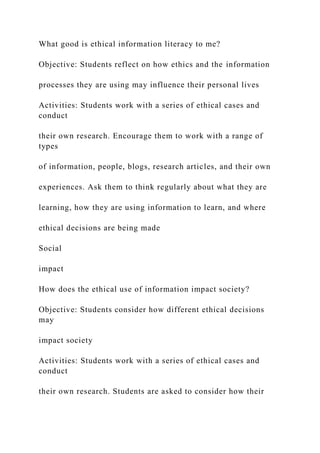
What good is ethical information literacy to me?
Objective: Students reflect on how ethics and the information
processes they are using may influence their personal lives
Activities: Students work with a series of ethical cases and
conduct
their own research. Encourage them to work with a range of
types
of information, people, blogs, research articles, and their own
experiences. Ask them to think regularly about what they are
learning, how they are using information to learn, and where
ethical decisions are being made
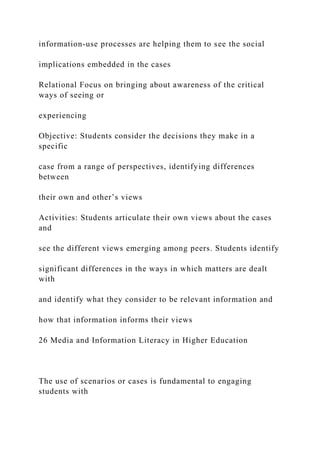
Social
impact
How does the ethical use of information impact society?
Objective: Students consider how different ethical decisions
may
impact society
Activities: Students work with a series of ethical cases and
conduct
their own research. Students are asked to consider how their
information-use processes are helping them to see the social
implications embedded in the cases
Relational Focus on bringing about awareness of the critical
ways of seeing or
experiencing
Objective: Students consider the decisions they make in a
specific
case from a range of perspectives, identifying differences
between
their own and other’s views
Activities: Students articulate their own views about the cases
and
see the different views emerging among peers. Students identify
significant differences in the ways in which matters are dealt
with
and identify what they consider to be relevant information and
how that information informs their views
26 Media and Information Literacy in Higher Education
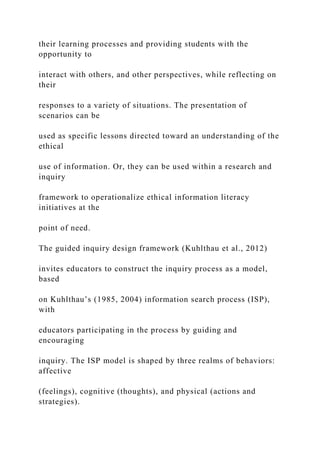
The use of scenarios or cases is fundamental to engaging
students with
their learning processes and providing students with the
opportunity to
interact with others, and other perspectives, while reflecting on
their
responses to a variety of situations. The presentation of
scenarios can be
used as specific lessons directed toward an understanding of the
ethical
use of information. Or, they can be used within a research and
inquiry
framework to operationalize ethical information literacy
initiatives at the
point of need.
The guided inquiry design framework (Kuhlthau et al., 2012)
invites educators to construct the inquiry process as a model,
based
on Kuhlthau’s (1985, 2004) information search process (ISP),
with
educators participating in the process by guiding and
encouraging
inquiry. The ISP model is shaped by three realms of behaviors:
affective
(feelings), cognitive (thoughts), and physical (actions and
strategies).
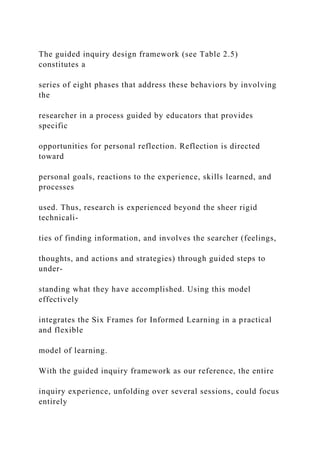
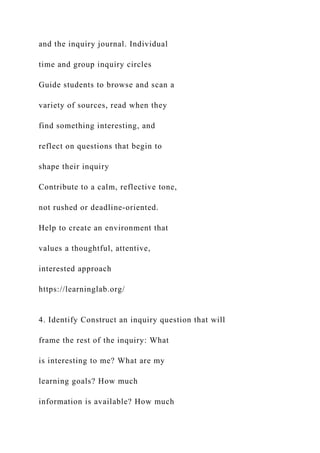
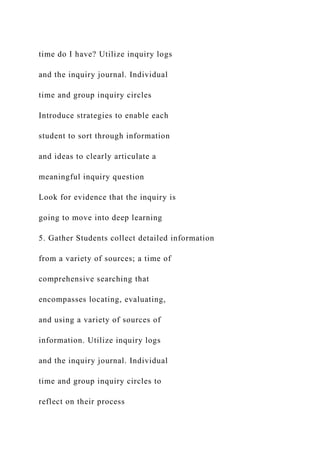
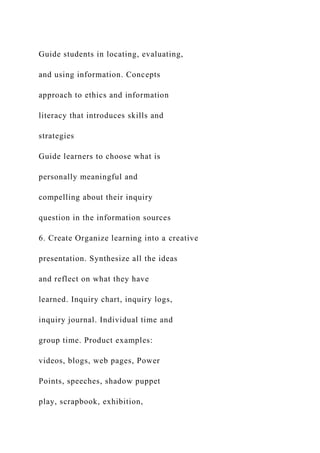
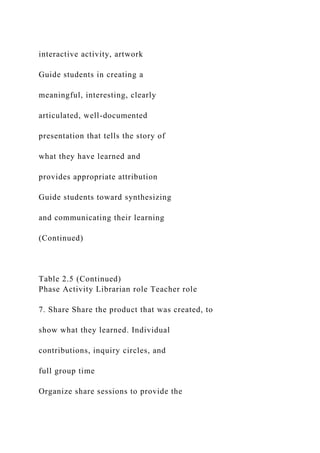
The guided inquiry design framework (see Table 2.5)
constitutes a
series of eight phases that address these behaviors by involving
the
researcher in a process guided by educators that provides
specific
opportunities for personal reflection. Reflection is directed
toward
personal goals, reactions to the experience, skills learned, and
processes
used. Thus, research is experienced beyond the sheer rigid
technicali-
ties of finding information, and involves the searcher (feelings,
thoughts, and actions and strategies) through guided steps to
under-
standing what they have accomplished. Using this model
effectively
integrates the Six Frames for Informed Learning in a practical
and flexible
model of learning.
With the guided inquiry framework as our reference, the entire
inquiry experience, unfolding over several sessions, could focus
entirely
on understanding ethics and build knowledge of ethical
principles.
Or, specific phases could offer opportunities to present learning
through
various lenses (informed learning frame):
• Content that builds knowledge of ethical principles could be
woven
into the immerse phase;
• Competency can be built with search and evaluation strategies
to locate
reliable information about a topic and included in the explore,
identify, and gather phases;
• Learning to learn can be emphasized in the gather and evaluate
phases
through use of the inquiry logs, inquiry journals, reflection, and
self-assessment;
• Personal relevance can be the focus of the enquiry phase;
27Teaching the Ethical Use of Information as an MIL Skill
Table 2.5 Guided inquiry design summary (Kuhlthau et al.,
2012)
Phase Activity Librarian role Teacher role
1. Open Set an invitational tone with a short
but powerful learning event to spark
student interest and elicit prior
knowledge. Examples: dramatic
video, object, photograph, art
image. Full group activity
Lead and participate. Carefully
consider what will engage this
particular group of students at this
point in time
Each inquiry community and each
inquiry is different so contribute
knowledge of this inquiry
community to build the opener.
Lead and participate
2. Immerse Guide students to connect with the
content and to discover interesting
ideas to explore further. Don’t
overwhelm students with too many
facts. Examples: Consider
stimulating experiences, such as an
episode of https://learninglab.org/
or a television show, reading a
stimulating text or a scenario.
Combine full group activity with
smaller group inquiry circles so
students can discuss further.
Individually, students begin an
inquiry journal
Facilitate the organization and
delivery of the experiences. Model
the inquiry stance by accepting
different perspectives, incomplete
ideas, and speculations. Listen for
personal connections and
interesting ideas. Encourage all
voices and provide a supportive and
safe environment
Facilitate the organization and
delivery of the experiences. Model
the inquiry stance by accepting
different perspectives, incomplete
ideas, and speculations. Listen for
personal connections and
interesting ideas. Encourage all
voices and provide a supportive
and safe environment
3. Explore Students browse various sources of
information to explore interesting
ideas and prepare to develop their
inquiry questions. Explore ideas
rather than accumulate facts. Relax,
read, and reflect. Utilize inquiry logs
and the inquiry journal. Individual
time and group inquiry circles
Guide students to browse and scan a
variety of sources, read when they
find something interesting, and
reflect on questions that begin to
shape their inquiry
Contribute to a calm, reflective tone,
not rushed or deadline-oriented.
Help to create an environment that
values a thoughtful, attentive,
interested approach
https://learninglab.org/
4. Identify Construct an inquiry question that will
frame the rest of the inquiry: What
is interesting to me? What are my
learning goals? How much
information is available? How much
time do I have? Utilize inquiry logs
and the inquiry journal. Individual
time and group inquiry circles
Introduce strategies to enable each
student to sort through information
and ideas to clearly articulate a
meaningful inquiry question
Look for evidence that the inquiry is
going to move into deep learning
5. Gather Students collect detailed information
from a variety of sources; a time of
comprehensive searching that
encompasses locating, evaluating,
and using a variety of sources of
information. Utilize inquiry logs
and the inquiry journal. Individual
time and group inquiry circles to
reflect on their process
Guide students in locating, evaluating,
and using information. Concepts
approach to ethics and information
literacy that introduces skills and
strategies
Guide learners to choose what is
personally meaningful and
compelling about their inquiry
question in the information sources
6. Create Organize learning into a creative
presentation. Synthesize all the ideas
and reflect on what they have
learned. Inquiry chart, inquiry logs,
inquiry journal. Individual time and
group time. Product examples:
videos, blogs, web pages, Power
Points, speeches, shadow puppet
play, scrapbook, exhibition,
interactive activity, artwork
Guide students in creating a
meaningful, interesting, clearly
articulated, well-documented
presentation that tells the story of
what they have learned and
provides appropriate attribution
Guide students toward synthesizing
and communicating their learning
(Continued)
Table 2.5 (Continued)
Phase Activity Librarian role Teacher role
7. Share Share the product that was created, to
show what they learned. Individual
contributions, inquiry circles, and
full group time
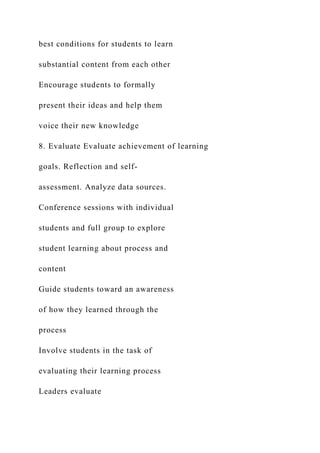
Organize share sessions to provide the
best conditions for students to learn
substantial content from each other
Encourage students to formally
present their ideas and help them
voice their new knowledge
8. Evaluate Evaluate achievement of learning
goals. Reflection and self-
assessment. Analyze data sources.
Conference sessions with individual
students and full group to explore
student learning about process and
content
Guide students toward an awareness
of how they learned through the
process
Involve students in the task of
evaluating their learning process
Leaders evaluate
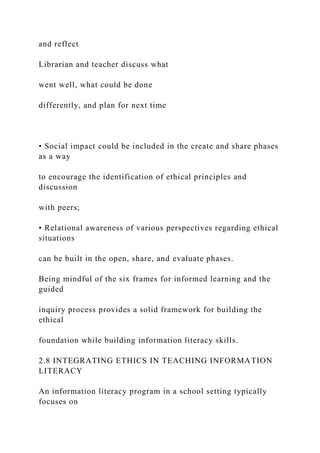
and reflect
Librarian and teacher discuss what
went well, what could be done
differently, and plan for next time
• Social impact could be included in the create and share phases
as a way
to encourage the identification of ethical principles and
discussion
with peers;
• Relational awareness of various perspectives regarding ethical
situations
can be built in the open, share, and evaluate phases.
Being mindful of the six frames for informed learning and the
guided
inquiry process provides a solid framework for building the
ethical
foundation while building information literacy skills.
2.8 INTEGRATING ETHICS IN TEACHING INFORMATION
LITERACY
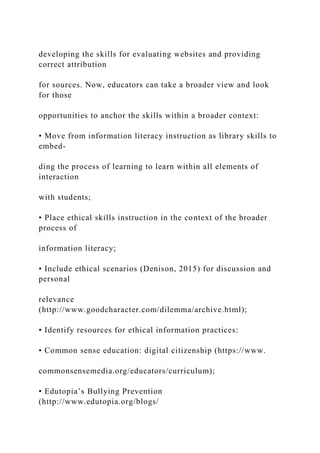
An information literacy program in a school setting typically
focuses on
developing the skills for evaluating websites and providing
correct attribution
for sources. Now, educators can take a broader view and look
for those
opportunities to anchor the skills within a broader context:
• Move from information literacy instruction as library skills to
embed-
ding the process of learning to learn within all elements of
interaction
with students;
• Place ethical skills instruction in the context of the broader
process of
information literacy;
• Include ethical scenarios (Denison, 2015) for discussion and
personal
relevance
(http://www.goodcharacter.com/dilemma/archive.html);
• Identify resources for ethical information practices:
• Common sense education: digital citizenship (https://www.
commonsensemedia.org/educators/curriculum);
• Edutopia’s Bullying Prevention
(http://www.edutopia.org/blogs/
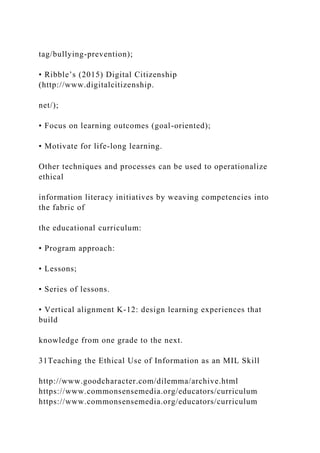
tag/bullying-prevention);
• Ribble’s (2015) Digital Citizenship
(http://www.digitalcitizenship.
net/);
• Focus on learning outcomes (goal-oriented);
• Motivate for life-long learning.
Other techniques and processes can be used to operationalize
ethical
information literacy initiatives by weaving competencies into
the fabric of
the educational curriculum:
• Program approach:
• Lessons;
• Series of lessons.
• Vertical alignment K-12: design learning experiences that
build
knowledge from one grade to the next.
31Teaching the Ethical Use of Information as an MIL Skill
http://www.goodcharacter.com/dilemma/archive.html
https://www.commonsensemedia.org/educators/curriculum
http://www.edutopia.org/blogs/tag/bullying-prevention
http://www.digitalcitizenship.net/
• Integrated reinforcement by integrating learning across the
curriculum
and across grade levels; iterative approach.
• Reflective learning by encouraging group discussion and
personal
reflection.
• An inquiry approach that encourages questioning, seeking, and
curiosity.
• An inquiry stance that is modeled by displaying the
construction of
inquiries, exhibiting curiosity, and demonstrating search
strategies.
• Presenting useful questions that evoke ethics as an
information literacy
skill.
An ethical approach to the use of information can be taught
within the
context of a specific information need, whether it is a research
project for
a college level or high school assignment, or a simple inquiry of
interest
from a student in a primary grade. While methods of instruction
vary, to
be truly effective they depend on three elements: integration
(within
and across the curriculum), reflection (personally and
interactively), and
reinforcement (repeated exposure to ethical principles).
As each inquiry opportunity develops and unfolds, educators
can
encourage an orientation toward ethical principles. As we guide
students
to understand the ethical foundation underpinning information
literacy,
the following questions are useful for consideration:
• Is it illegal? (then it probably is unethical);
• Does it violate ethical principles (which ones)?
• Does it bother your conscience or violate your personal values
and
principles or those of others around you?
• Does it look as though someone is likely to be harmed? (the
someone
could be you);
• If something terrible happens, could you defend your actions?
• Would this practice continue if it were publicized, for example
in the
local or college newspaper?
By repeatedly opening the discussion of ethical principles,
engaging
students through various scenarios, providing the skills to
effectively
search, evaluate, and determine reliability, encouraging
personal reflec-
tion, and illuminating the consequences personally and as a
society,
we can build competency for the ethical use of information.
If we are able to build competency within the K-12
environment,
the stage should be set for responsible action beyond high
school.
Equipped with the necessary skills and an ethical orientation to
the use of
information the next phases of student growth can include
increasingly
complex situations where students feel competent in their
ability to
32 Media and Information Literacy in Higher Education
understand and respond responsibly. Realistically, this
foundation is not
always firmly established and the next phase of student
learning, at college
or university, requires that students understand the research
process and
appreciate the requirements for and consequences of ethical
decision
making.
At the college level, faculty rely on academic librarians to
provide an
orientation to conducting research, obtaining materials, and
documenting
sources appropriately. Academic integrity policies explicitly
define the
expectations and consequences for not following these policies.
As Sciammarella (2009) observes: “The librarian can function
as an inter-
mediary in terms of introducing the student to scholarly
information and
the practice of acceptable documentation” (p. 24). The librarian
can also
function as a collaborator with the teaching faculty to develop
proactive
strategies to address ethical issues that correlate to the
educational goals of
each academic subject and the respective assignments.
2.9 CONCLUSION
Where does this leave educators throughout the K-20 learning
environment? First, it implies that we must be knowledgeable:
• Understand the developmental stages of young people, along
with
their evolving ability to deal with increasingly more complex
ethical
issues;
• Accept that providing the socially correct answer to a dilemma
does
not imply understanding of the underlying ethical issues;
• Be prepared to assist students move from an egocentric
perspective to
an understanding of different perspectives by investing the time
in
preparing and sharing decision-making situations that engage
students
and provide the opportunity to select an appropriate course of
action;
• Apply a variety of teaching methods that respond to the
variety of
student needs and comfort levels: for example, brainstorming,
debates,
discussions, role-playing, simulations;
• Stay informed about legislative issues related to technology
access;
• Stay knowledgeable about the burgeoning technology
applications
and their use and potential misuse.
Second, be proactive:
• Advocate for regulations and laws that encourage student
learning;
• Engage other educators in conversations about teaching
strategies,
potential areas of ethical concern, and educational resources;
33Teaching the Ethical Use of Information as an MIL Skill
• Educate yourself on the appropriate use of social media and
ways to
demonstrate a responsible digital footprint;
• Maintain professional development through professional
organizations,
conferences, print and online publications, and educators blogs,
and
Twitter posts;
• Seek collaborators within your educational community to
coordinate
approaches to developing ethical information literacy practices.
Ultimately, as we guide students to develop information
competences
and become lifelong learners, we are reinforcing skills and
attitudes that
encourage responsible action; placing ethical principles within
the context
of information literacy skills may be an effective way of
guiding student
behavior toward ethical information literacy practices. This
becomes an
ongoing journey, for ourselves and for our students.
REFERENCES
American Association of School Librarians [AASL]. (2007).
Standards for the 21st-century
learner. Chicago, IL: ALA.
American Library Association [ALA]. (1989). Presidential
committee on information literacy
final report. Chicago, IL: ALA. Retrieved from:
http://www.ala.org/acrl/publications/
whitepapers/presidential.
Association of College and Research Libraries [ACRL]. (2000).
Information literacy compe-
tency standards. Chicago, IL: ACRL. Retrieved from:
https://arizona.openrepository.
com/arizona/bitstream/10150/105645/1/standards.pdf.
Association of College and Research Libraries [ACRL]. (2015).
Framework for information
literacy for higher education. Chicago, IL: ACRL. Retrieved
from: http://www.ala.org/
acrl/sites/ala.org.acrl/files/content/issues/infolit/Framework_IL
HE.pdf.
Bodi, S. (1998). Ethics and information technology: Some
principles to guide students.
The Journal of Academic Librarianship, 24(6), 459�463.
Bruce, C. S. (2008). Informed learning. Chicago, IL: ACRL.
Canadian Library Association [CLA]. (2014). Standards of
practice for school library learning commons
in Canada. Ottawa, ON: CLA. Retrieved from:
http://apsds.org/wp-content/uploads/
Standards-of-Practice-for-SchoolLibrary-Learning-Commons-
in-Canada-2014.pdf.
Denison, C. (2015). goodcharacter.com. Ethical dilemmas for
classroom discussion:
The daily dilemma archive. Retrieved from:
http://www.goodcharacter.com/
dilemma/archive.html.
European Council. (2006). Key competences for lifelong
learning. EUR-Lex Access to
European Union Law. Retrieved from http://eur-
lex.europa.eu/legal-content/EN/
TXT/?uri5URISERV:c11090.
International Federation of Library Associations (IFLA).
(2006). Guidelines on information
literacy for lifelong learning. The Hague: IFLA. Retrieved
from: http://www.ifla.org/
files/assets/information-literacy/publications/ifla-guidelines-
en.pdf.
Kuhlthau, C. C. (1985). Teaching the library research process
(2nd ed.). Metuchen, NJ:
Scarecrow Press.
Kuhlthau, C. C. (2004). Seeking meaning: A process approach
to library and information services
(2nd ed.). Westport, CT: Libraries Unlimited.
34 Media and Information Literacy in Higher Education
http://refhub.elsevier.com/B978-0-08-100630-6.00002-3/sbref1
http://www.ala.org/acrl/publications/whitepapers/presidential
https://arizona.openrepository.com/arizona/bitstream/10150/105
645/1/standards.pdf
https://arizona.openrepository.com/arizona/bitstream/10150/105
645/1/standards.pdf
http://www.ala.org/acrl/sites/ala.org.acrl/files/content/issues/inf
olit/Framework_ILHE.pdf
http://www.ala.org/acrl/sites/ala.org.acrl/files/content/issues/inf
olit/Framework_ILHE.pdf
http://refhub.elsevier.com/B978-0-08-100630-6.00002-3/sbref5
http://refhub.elsevier.com/B978-0-08-100630-6.00002-3/sbref6
http://apsds.org/wp-content/uploads/Standards-of-Practice-for-
SchoolLibrary-Learning-Commons-in-Canada-2014.pdf
http://apsds.org/wp-content/uploads/Standards-of-Practice-for-
SchoolLibrary-Learning-Commons-in-Canada-2014.pdf
http://goodcharacter.com
http://www.goodcharacter.com/dilemma/archive.html
http://eur-lex.europa.eu/legal-
content/EN/TXT/?uri=URISERV:c11090
http://eur-lex.europa.eu/legal-
content/EN/TXT/?uri=URISERV:c11090
http://eur-lex.europa.eu/legal-
content/EN/TXT/?uri=URISERV:c11090
http://eur-lex.europa.eu/legal-
content/EN/TXT/?uri=URISERV:c11090
http://eur-lex.europa.eu/legal-
content/EN/TXT/?uri=URISERV:c11090
http://www.ifla.org/files/assets/information-
literacy/publications/ifla-guidelines-en.pdf
http://www.ifla.org/files/assets/information-
literacy/publications/ifla-guidelines-en.pdf
http://refhub.elsevier.com/B978-0-08-100630-6.00002-3/sbref9
http://refhub.elsevier.com/B978-0-08-100630-6.00002-3/sbref10
Kuhlthau, C. C., Maniotes, L. K., & Caspari, A. K. (2012).
Guided inquiry design: A framework
for inquiry in your school. Santa Barbara, CA: Libraries
Unlimited.
Ribble, M. (2015). Digital citizenship: Using technology
appropriately. Retrieved from:
http://www.digitalcitizenship.net/.
Sciammarella, S. (2009). Making a difference: Library and
teaching faculty working
together to develop strategies in dealing with student
plagiarism. Community & Junior
College Libraries, 15, 23�34.
Severson, R. J. (1997). The principles of information ethics.
Armonk, NJ: M. E. Sharpe.
Warlick, D. F. (2009). Redefining literacy 2.0. Columbus, OH:
Linworth Books.
35Teaching the Ethical Use of Information as an MIL Skill
http://refhub.elsevier.com/B978-0-08-100630-6.00002-3/sbref11
http://www.digitalcitizenship.net/
http://refhub.elsevier.com/B978-0-08-100630-6.00002-3/sbref12
http://refhub.elsevier.com/B978-0-08-100630-6.00002-3/sbref13
http://refhub.elsevier.com/B978-0-08-100630-6.00002-
3/sbref142 Teaching the Ethical Use of Information as an MIL
Skill2.1 Introduction2.2 Ethics2.3 Information Literacy2.4
Placing Ethics in Information Literacy Competences2.5 Ethical
Principles for Information Literacy2.5.1 Principle of Respect
for Intellectual Property2.5.2 Principle of Respect for
Privacy2.5.3 Principle of Fair Representation2.5.4 Principle of
Nonmaleficence (Doing no Harm)2.6 Learning Environment2.7
Teaching Ethics as a MIL Skill2.8 Integrating Ethics in
Teaching Information Literacy2.9 ConclusionReferences

CHAPTER 2Teaching the Ethical Use ofInformation as an MI.docx

  • 1.
    CHAPTER 2 Teaching theEthical Use of Information as an MIL Skill B. Schultz-Jones University of North Texas, Denton, TX, United States 2.1 INTRODUCTION What do educators need to know about teaching the ethical use of information? This chapter deals with teaching the ethical use of information as a media and information literacy (MIL) skill. To be able to use informa- tion ethically, educators and students must equip themselves with principles that can be applied as information literacy skills to our information land- scape. The concepts of ethics and information literacy are examined and the connection between the learning environment and the adoption of ethi- cal information literacy skills is discussed. The teaching frameworks of
  • 2.
    informed learning (Bruce,2008) and guided inquiry (Kuhlthau, Maniotes, & Caspari, 2012) are explored, along with learning scenarios, as a means of orchestrating the adoption of ethical information literacy behavior. 2.2 ETHICS The term ethics occurs in many examples of standards and guidelines that address the acquisition, use, dissemination, and impact of information. The term is used as a simple way to highlight the recognition of right and wrong conduct in relation to handling information and as a more complex concept that identifies a principled approach to dealing with increasingly sophisticated information technology and its ever-changing global environ- ment. As educators we have the opportunity to address the principles and standards needed to make wise decisions when dealing with the complexity
  • 3.
    of information issuesof our 21st century. We recognize that the values of a community may vary across cultures. However, in a complex information environment, there are principles and values that we need to establish and reinforce. The educational community fosters engagement with these values in our learning environment and provides the means to learn and understand ethical information literacy behavior. 13 Media and Information Literacy in Higher Education. DOI: http://dx.doi.org/10.1016/B978-0-08-100630-6.00002-3 Copyright © 2017 Barbara Schultz-Jones. Published by Elsevier Ltd. All rights reserved. http://dx.doi.org/10.1016/B978-0-08-100630-6.00002-3 2.3 INFORMATION LITERACY An appreciation of teaching the ethical use of information as a literacy skill begins with an appreciation of the evolution of information literacy. In the United States, the concept of information literacy has
  • 4.
    evolved from a simpledefinition that referred to the approach of using reference resources to find information, through a recognition by the Association of College and Research Libraries (ACRL) of the American Library Association (ALA, 1989) definition that being information- literate meant being equipped with a set of abilities requiring individuals to “recognize when information is needed and have the ability to locate, evaluate, and effectively use the needed information” (ACRL, 2000, p. 2), to a grouping of “threshold concepts” and “foundational ideas” that are intended to address the “dynamic and often uncertain information ecosystem in which all of us work and live” (ACRL, 2015, p. 2). With the 2007 publication of Standards for the 21st Century Learner the American Association of School Librarians (AASL) recognized that the
  • 5.
    “definition of informationliteracy has become more complex as resources and technologies have changed” (p. 3) and highlighted that “multiple literacies, including digital, visual, textual, and technological, have now joined information as crucial skills for this century” (p. 3). An expanded definition of information literacy seeks to address a wider, more encom- passing reach throughout a path of lifelong learning: Information literacy is the set of integrated abilities encompassing the reflective discovery of information, the understanding of how information is produced and valued, and the use of information in creating new knowledge and participating ethically in communities of learning. ACRL (2015, p. 3) The Canadian Library Association (CLA, 2014) adopted Standards of Practice for School Library Learning Commons in Canada that articulate five core standards of practice to “drive best teaching and learning through
  • 6.
    the Library LearningCommons” (p. 8). The fourth standard, Fostering Literacies to Empower Life-Long Learners, applies an expanded “notion of literacy” that includes “digital literacy and citizenship” (pp. 17�18), recognizing that students must develop a range of literacy skills that includes personal responsibility. Accompanying the range of literacy skills is a continuum of growth indicators that identify the various competen- cies students would achieve throughout the various stages of exploring, emerging, evolving, and established. 14 Media and Information Literacy in Higher Education The International Federation of Library Associations (IFLA, 2006) notes that there is a difference among languages in handling the concept of information literacy and the use of information competency is more eas-
  • 7.
    ily recognized outsidethe English-speaking nations (p. 9). A recommen- dation by the European Council (2006) of the European Union identified eight key competences for lifelong learning (see Table 2.1). These competences are recognized as “a combination of knowledge, skills and attitudes appropriate to the context. They are particularly necessary for personal fulfilment and development, social inclusion, active citizenship and employment” (European Council, 2006, Summary). Of the eight competences, competences four, five, six, and seven relate to the use of information. The acknowledgment of personal Table 2.1 Key competences for lifelong learning Key competence Essential knowledge, skills, and attitudes Communication in the mother tongue The ability to express and interpret concepts, thoughts, feelings, facts, and opinions in
  • 8.
    both oral andwritten form (listening, speaking, reading, and writing) and to interact linguistically in an appropriate and creative way in a full range of societal and cultural contexts Communication in foreign languages Involves, in addition to the main skill dimensions of communication in the mother tongue, mediation and intercultural understanding. The level of proficiency depends on several factors and the capacity for listening, speaking, reading, and writing Mathematical competence and basic competences in science and technology The ability to develop and apply mathematical thinking in order to solve a
  • 9.
    range of problemsin everyday situations, with the emphasis being placed on process, activity, and knowledge. Basic competences in science and technology refer to the mastery, use, and application of knowledge and methodologies that explain the natural world. These involve an understanding of the changes caused by human activity and the responsibility of each individual as a citizen (Continued) 15Teaching the Ethical Use of Information as an MIL Skill Table 2.1 (Continued) Key competence Essential knowledge, skills, and attitudes Digital competence The confident and critical use of information society technology and thus basic skills in information and communication
  • 10.
    technology Learning to learnRelated to learning, the ability to pursue and organize one’s own learning, either individually or in groups, in accordance with one’s own needs, and awareness of methods and opportunities Social and civic competences Social competence refers to personal, interpersonal, and intercultural competence and all forms of behavior that equip individuals to participate in an effective and constructive way in social and working life. It is linked to personal and social well-being. An understanding of codes of conduct and customs in the different environments in which individuals operate is essential. Civic competence, and particularly knowledge of social and political concepts and structures (democracy, justice, equality, citizenship,
  • 11.
    and civil rights),equips individuals to engage in active and democratic participation Sense of initiative and entrepreneurship The ability to turn ideas into action. It involves creativity, innovation, and risk-taking, as well as the ability to plan and manage projects in order to achieve objectives. The individual is aware of the context of his/her work and is able to seize opportunities that arise. It is the foundation for acquiring more specific skills and knowledge needed by those establishing or contributing to social or commercial activity. This should include awareness of ethical values and promote good governance Cultural awareness and
  • 12.
    expression Appreciation of theimportance of the creative expression of ideas, experiences, and emotions in a range of media (music, performing arts, literature, and the visual arts) Recommendation 2006/962/EC of the European Parliament and of the Council of Dec. 18, 2006. 16 Media and Information Literacy in Higher Education responsibility and sensitivity to societal interactions is interwoven throughout all eight of these competences. The multifaceted nature of information competency is clearly demonstrated. Underlying the use of definitions to describe information literacy and/or competence is the recognition that there is an ethical foundation to the use of information, both individually and as a society; there are
  • 13.
    consequences to howwe handle information, both individually and as a society. 2.4 PLACING ETHICS IN INFORMATION LITERACY COMPETENCES As a core competence for information literacy, ethics maintains a high profile. As one of the common beliefs in the AASL (2007) Standards for the 21st Century Learner: Ethical behaviour in the use of information must be taught. In this increasingly global world of information, students must be taught to seek diverse perspec- tives, gather and use information ethically, and use social tools responsibly and safely. (p. 2) And again in the use of skills, resources, and tools, the idea that being a member of our democratic society requires ethical participation: Learners use skills, resources, and tools to: 1. Inquire, think critically, and gain knowledge. 2. Draw conclusions, make informed decisions, apply
  • 14.
    knowledge to new situations,and create new knowledge. 3. Share knowledge and participate ethically and productively as members of our democratic society. 4. Pursue personal and esthetic growth. (AASL, 2007, p. 3). In the ACRL (2000) Information Literacy Competency Standards, the ethical use of information was recognized as Standard Five (see Table 2.2). With the broadened ACRL (2015) Framework for Information Literacy perspective, the ethical use of information resides within each of the seven foundational concepts (see Table 2.3). With the background and transition of concepts established, let’s combine the concepts as ethical information literacy behavior since literacy involves awareness to inform practice and the development of skills to apply practice. We will discuss what that means and how
  • 15.
    we can transferthese concepts to others, and build an ethical foundation for the use of information. 17Teaching the Ethical Use of Information as an MIL Skill Table 2.2 ACRL information literacy competency standard five (ACRL, 2000, p. 14) Performance indicators Outcomes 1. The information-literate student understands many of the ethical, legal and socio-economic issues surrounding information and information technology a. Identifies and discusses issues related to privacy and security in both the print and electronic environments b. Identifies and discusses issues related to free versus fee-based
  • 16.
    access to information c.Identifies and discusses issues related to censorship and freedom of speech d. Demonstrates an understanding of intellectual property, copyright, and fair use of copyrighted material 2. The information-literate student follows laws, regulations, institutional policies, and etiquette related to the access and use of information resources a. Participates in electronic discussions following accepted practices (eg, “Netiquette”) b. Uses approved passwords and other forms of ID for access to information resources
  • 17.
    c. Complies withinstitutional policies on access to information resources d. Preserves the integrity of information resources, equipment, systems, and facilities e. Legally obtains, stores, and disseminates text, data, images, or sounds f. Demonstrates an understanding of what constitutes plagiarism and does not represent work attributable to others as his/her own g. Demonstrates an understanding of institutional policies related to human subjects research 3. The information-literate student acknowledges the use of
  • 18.
    information sources in communicatingthe product or performance a. Selects an appropriate documentation style and uses it consistently to cite sources b. Posts permission-granted notices, as needed, for copyrighted material The information-literate student understands many of the economic, legal, and social issues surrounding the use of information and accesses and uses information ethically and legally. 18 Media and Information Literacy in Higher Education Table 2.3 Ethics extracts from ACRL (2015) framework for information literacy Knowledge practices Dispositions Concept: authority is constructed and contextual Learners who are developing their information-literate abilities: • Acknowledge they are developing
  • 19.
    their own authoritativevoices in a particular area and recognize the responsibilities this entails, including seeking accuracy and reliability, respecting intellectual property, and participating in communities of practice Learners who are developing their information-literate abilities: • Develop awareness of the importance of assessing content with a skeptical stance and with a self-awareness of their own biases and worldview Concept: information creation as a process Learners who are developing their information-literate abilities: • Develop, in their own creation
  • 20.
    processes, an understandingthat their choices impact the purposes for which the information product will be used and the message it conveys Learners who are developing their information-literate abilities: • Understand that different methods of information dissemination with different purposes are available for their use Concept: information has value Learners who are developing their information-literate abilities: • Give credit to the original ideas of others through proper attribution and citation • Understand that intellectual
  • 21.
    property is alegal and social construct that varies by culture • Articulate the purpose and distinguishing characteristics of copyright, fair use, open access, and the public domain • Make informed choices regarding their online actions in full awareness of issues related to privacy and the commodification of personal information Learners who are developing their information-literate abilities: • Respect the original ideas of others • Value the skills, time, and effort needed to produce knowledge • See themselves as contributors to the information marketplace rather
  • 22.
    than only consumersof it • Are inclined to examine their own information privilege (Continued) 19Teaching the Ethical Use of Information as an MIL Skill 2.5 ETHICAL PRINCIPLES FOR INFORMATION LITERACY According to Severson (1997), ethical behavior is a “discipline of thinking” (p. 9) that enables us to select the appropriate action in situations that range from simple to complex. While it may be simple to identify right and wrong behavior in situations where we have experience through our upbringing, it can be more challenging in new or complex situations. The expanding world of technology continues to present seemingly new and complex opportunities that outrun our
  • 23.
    experience. Applying a disciplineof ethical thinking to all situations invokes a more structured and deliberative kind of critical thinking (Severson, 1997, p. 8). Table 2.3 (Continued) Knowledge practices Dispositions Concept: research as inquiry Learners who are developing their information-literate abilities: • Use various research methods, based on need, circumstance, and type of inquiry • Monitor gathered information and assess for gaps or weaknesses Learners who are developing their information-literate abilities: • Follow ethical and legal guidelines in gathering and using information • Demonstrate intellectual humility
  • 24.
    (ie, recognize theirown intellectual or experiential limitations) Concept: scholarship as conversation Learners who are developing their information-literate abilities: • Cite the contributing work of others in their own information production Learners who are developing their information-literate abilities: • Understand the responsibility that comes with entering the conversation through participatory channels Concept: searching as strategic exploration Learners who are developing their information-literate abilities: • Identify interested parties, such as
  • 25.
    scholars, organizations, governments, andindustries, who might produce information about a topic and then determine how to access that information Learners who are developing their information-literate abilities: • Realize that information sources vary greatly in content and format and have varying relevance and value, depending on the needs and nature of the search 20 Media and Information Literacy in Higher Education And, critical thinking includes ethical reflection that allows us to place events and situations in a principled context. Ethical behavior does not replace morality or the law, but “it can help guide and educate
  • 26.
    our moral instincts; steerus away from uncompromising positions; and improve our moral vocabulary so that we might talk and listen better” (p. 13). A principled approach to ethical behavior provides flexible guidelines for our actions that furnish insights to be applied in specific situations. They enable a deliberative process of application so that informed, creative, and sometimes individualized actions can be taken to fit a particular circumstance. Teaching students ethical principles provides an internal as opposed to external control over their actions, along with a practical understanding of the law where it is appropriate. Severson (1997) identifies four principles of information ethics which can be used to direct responsible behavior in the use of information: 1. Respect for intellectual property; 2. Respect for privacy;
  • 27.
    3. Fair representation; 4.Nonmaleficence (doing no harm). Each of these principles will be examined with emphasis on engaging students toward understanding how they apply to individuals and situations. 2.5.1 Principle of Respect for Intellectual Property The arena of intellectual property includes a consideration of information as property. At the simplistic end of the spectrum the perspective of information as a commodity relates to being able to identify who “owns” the information or information product. This becomes more complex as “ownership” becomes harder to establish with digital products or when information is reworked into new information products. A determination of intellectual property includes validating or determining the authenticity and reliability of information and presents opportunities to consider the
  • 28.
    purpose of creatinginformation products and the associated value. According to Warlick (2009) “the ultimate value [of information] is based on its accuracy, validity, and reliability—on its authority” (p. 145). Rapidly expanding technological developments may make it challenging to determine the authority of information. Where print publications provide hardcopy editions with static publication data, the digital environment makes information more accessible and more 21Teaching the Ethical Use of Information as an MIL Skill susceptible to manipulation. In the digital environment users can easily operate individually or within groups as information creators, produ- cers, or consumers. Information can be plagiarized more easily and disseminated instantly.
  • 29.
    Warlick (2009) suggeststhat “the best way to help students under- stand and appreciate information as valuable property is to make them property owners” (p. 140). This could involve having students place the copyright text (Copyright r date by student name) at the bottom of the pages, artwork, or media they produce. Discussing the effort it took to produce the product and the courtesy associated with giving credit or asking permission to use the intellectual and creative ideas of others is a way of personalizing the value of information. Students should be encouraged to learn from others, challenge the ideas of others, and explore extensively while acknowledging the work of others in the appropriate way: citations, acknowledgments, footnotes, references, bibliographies. Conversations with students and class assignments can identify and
  • 30.
    include specific intellectualproperty laws such as copyright, fair use, trademarks, and patents along with the value of providing open access to information and the options available under Creative Commons licensing. Consequences associated with unacceptable behaviors such as fraud, theft, deceit, plagiarism, and withholding the results of research can be discussed under the principle of respect for intellectual property. 2.5.2 Principle of Respect for Privacy Related to the principle of respect for intellectual property is the principle of respect for privacy. As Bodi (1998) notes “the individual decides who has the right or freedom to share in his or her activities or deliberations” (p. 461). Controlling those rights is challenging in a digital environment, and students must learn how to protect their personal information and respect the privacy of others.
  • 31.
    Libraries defend theright to privacy through protection of student’s circulation records, and a discussion of how personal data profiles are stored in databases for use by other agencies is an important aspect of the respect for privacy. Respect infers personal responsibility and that responsibility extends to being aware and cautious about what we share, how we share, and where that information is located. Privacy policies are distributed regularly by credit card companies, banking institutions, 22 Media and Information Literacy in Higher Education and online vendors. The consequences of inappropriate sharing of what should be considered private information can be seen with examples of organizations firing employees for inappropriate online displays of personal information, educators being chastised for posting
  • 32.
    unprofes- sional photos ofthemselves in online public spaces, and identity theft of personal data from supposedly encrypted databases. Efforts to protect information integrity, confidentiality, and availability can often conflict with the desire for the benefits of information sharing. Respect for privacy is also a respect for self. 2.5.3 Principle of Fair Representation Trusting that the product you purchase will function as advertised is an example of the principle of fair representation. We should be able to rely on the information that is presented and trust that if products, such as downloadable software, do not behave as advertised, the vendor will accept responsibility and be accountable. Liability standards should ensure that product risks are mitigated and warranties should provide a form of insurance against product failures. This implies that vendors are
  • 33.
    honest in their effortsto deliver quality products and accept the consequences for any mistakes. Discussions of client�vendor relationships and, by extension, student�student relationships, place the responsibility for honest transactions in the personal realm. Presenting opportunities for students to understand the implication of manipulating information, even under the guise of creative misrepresenta- tion, ensures that the principle of fair representation is understood and endorsed. 2.5.4 Principle of Nonmaleficence (Doing no Harm) Adopting the principle of nonmaleficence means, at a minimum, that “we must never do anything that might contribute to the decline of another person’s life or affairs” (Severson, 1997, p. 108). This implies taking responsibility for our actions and understanding the impact of our information interactions, regardless of the environment in which
  • 34.
    they occur. For example,some people may find it easy to rant and rave via email but wouldn’t consider such behavior in person. Cyberbullying becomes a convenient method of intimidation because of the distance between persons and the presumed anonymity of the insti- gator. The impact of violating another person’s privacy and causing harm 23Teaching the Ethical Use of Information as an MIL Skill must be placed in the personal arena where students have an opportunity to reflect on the purpose and consequences of malevolent acts. The principle of doing no harm extends to an understanding of the impact on society. The unethical abuse of information, through computer viruses, hacking, malware, and phishing, is pervasive and expensive. The impact of these actions can be discussed in the context of adopting
  • 35.
    the principle ofnonmaleficence, and appropriate actions should manifest themselves in the realm of digital citizenship. As Warlick (2009) states: Information is power, and 21st century literacy equips children and adults, learners and teachers with powerful tools. We have at our disposal a global electronic library of information, much of it coming out of our own communities. We are increasingly gaining access to potent digital tools that can access, alter, and communicate that information in infinite and persuasive ways. (p. 148) Abusing the ideas of others, tampering with or distorting the ideas of others, or using information to cause harm violates an individual’s place in the community of learners and can be harmful to society as a whole. Our place in the larger context of society and our civic responsibilities begin with an acceptance and understanding of self and self- respect. Providing assignments, activities, and discussions that enable perception,
  • 36.
    processing, and comprehensiontakes time. But the benefit of becoming reflective thinkers who can tackle issues and synthesize information is paramount. Ethical decisions require rational decision making. 2.6 LEARNING ENVIRONMENT To openly discuss, confront, and address the ethical challenges in the global world of information, it is important to create a learning environ- ment that models and honors ethical principles while guiding inquiry and encouraging creativity. Much of this depends on the skills, behaviors and attitudes of educators and the culture of the learning environment. Importance should be placed on establishing a learning environment that: • Encourages the exchange of ideas and concepts; • Offers a safe place for the debate of ideas; • Instructs students on the principles underlying the ethical use of information;
  • 37.
    • Equips studentswith the skills and abilities to be information literate; • Reinforces the need for reflection and synthesis; • Respects the privacy of individuals; • Encourages creativity, ingenuity, and lifelong learning. 24 Media and Information Literacy in Higher Education The learning environment for a community of learners can be established in face-to-face contact or online. Certainly there is a differ- ence in those environments in terms of physical proximity, but a learning environment that nurtures lifelong learning can develop a sense of community that enables open discussion and teaches the ethical use of information. The difference in environments and potential difference in the sense of “community” is an important discussion point: our social software
  • 38.
    “spaces” can createcommunities of practice that enable productive exchanges of information and inspire creativity. Points of netiquette within these spaces are worth debating and, in some communities of practice, a code of behavior will be established to ensure that everyone is treated respectfully. In that way, the likelihood of a dual world where behavior in one does not necessarily reflect behavior in another is dimin- ished. The speed of communication can also alter the relationship among community members. People may not take the time to reflect on the possibility or implications of the unethical use of information. Sensitivity to personal behavior in these various circumstances can be taught. 2.7 TEACHING ETHICS AS A MIL SKILL Teaching ethical information literacy skills involves considering how to construct our instruction to meet our understanding of how
  • 39.
    students learn. Two practicalmodels that enable a deep personalization of ethics as an information literacy skill are: informed learning (Bruce, 2008) and guided inquiry (Kuhlthau et al., 2012), based on the information search process (Kuhlthau, 1985, 2004). Informed learning “proposes that teaching and learning must (a) bring about new ways of experiencing and using information, and (b) engage students with the information practices that are relevant to their discipline or profession” (Bruce, 2008, p. ix). The broad theoretical framework for informed learning consists of six frames that present lenses to focus on how students experience learning in various contexts (see Table 2.4). This emphasis on experience resonates with the constructivist theory of learning that posits we construct meaning and knowledge through
  • 40.
    interaction between experiencesand ideas. Providing learning experi- ences and providing opportunities to reflect on those experiences deepens student understanding and enables a stronger, more personal conceptual knowledge of the world. 25Teaching the Ethical Use of Information as an MIL Skill Table 2.4 Six frames for informed learning of the ethical use of information (Bruce, 2008) Content What should learners know about the subject? Objective: Students will understand ethics related to the use of information and know the resources available for learning and applying the ethical use of information Activities: Lessons dealing with key content in ethics, including relevant information sources and search techniques Competency What should learners be able to do? Objective: Students will be able to make ethical decisions in the context of their information world
  • 41.
    Activities: Build ethicalcompetence by working with a series of ethics cases, determining the key aspects of each case and making decisions about what action would be appropriate Learning to learn What does it mean to think like an informed learner? Objective: Use a range of resources to engage with ethical cases and reflect on how your use of information has influenced engagement with the cases Activities: Students work with a series of ethical cases and conduct their own research. Encourage them to work with a range of types of information, people, blogs, research articles, and their own experiences. Ask them to think regularly about what they are learning and how they are using information to learn Personal relevance
  • 42.
    What good isethical information literacy to me? Objective: Students reflect on how ethics and the information processes they are using may influence their personal lives Activities: Students work with a series of ethical cases and conduct their own research. Encourage them to work with a range of types of information, people, blogs, research articles, and their own experiences. Ask them to think regularly about what they are learning, how they are using information to learn, and where ethical decisions are being made Social impact How does the ethical use of information impact society? Objective: Students consider how different ethical decisions may impact society Activities: Students work with a series of ethical cases and conduct their own research. Students are asked to consider how their
  • 43.
    information-use processes arehelping them to see the social implications embedded in the cases Relational Focus on bringing about awareness of the critical ways of seeing or experiencing Objective: Students consider the decisions they make in a specific case from a range of perspectives, identifying differences between their own and other’s views Activities: Students articulate their own views about the cases and see the different views emerging among peers. Students identify significant differences in the ways in which matters are dealt with and identify what they consider to be relevant information and how that information informs their views 26 Media and Information Literacy in Higher Education The use of scenarios or cases is fundamental to engaging students with
  • 44.
    their learning processesand providing students with the opportunity to interact with others, and other perspectives, while reflecting on their responses to a variety of situations. The presentation of scenarios can be used as specific lessons directed toward an understanding of the ethical use of information. Or, they can be used within a research and inquiry framework to operationalize ethical information literacy initiatives at the point of need. The guided inquiry design framework (Kuhlthau et al., 2012) invites educators to construct the inquiry process as a model, based on Kuhlthau’s (1985, 2004) information search process (ISP), with educators participating in the process by guiding and encouraging inquiry. The ISP model is shaped by three realms of behaviors: affective (feelings), cognitive (thoughts), and physical (actions and strategies).
  • 45.
    The guided inquirydesign framework (see Table 2.5) constitutes a series of eight phases that address these behaviors by involving the researcher in a process guided by educators that provides specific opportunities for personal reflection. Reflection is directed toward personal goals, reactions to the experience, skills learned, and processes used. Thus, research is experienced beyond the sheer rigid technicali- ties of finding information, and involves the searcher (feelings, thoughts, and actions and strategies) through guided steps to under- standing what they have accomplished. Using this model effectively integrates the Six Frames for Informed Learning in a practical and flexible model of learning. With the guided inquiry framework as our reference, the entire inquiry experience, unfolding over several sessions, could focus entirely
  • 46.
    on understanding ethicsand build knowledge of ethical principles. Or, specific phases could offer opportunities to present learning through various lenses (informed learning frame): • Content that builds knowledge of ethical principles could be woven into the immerse phase; • Competency can be built with search and evaluation strategies to locate reliable information about a topic and included in the explore, identify, and gather phases; • Learning to learn can be emphasized in the gather and evaluate phases through use of the inquiry logs, inquiry journals, reflection, and self-assessment; • Personal relevance can be the focus of the enquiry phase; 27Teaching the Ethical Use of Information as an MIL Skill Table 2.5 Guided inquiry design summary (Kuhlthau et al., 2012)
  • 47.
    Phase Activity Librarianrole Teacher role 1. Open Set an invitational tone with a short but powerful learning event to spark student interest and elicit prior knowledge. Examples: dramatic video, object, photograph, art image. Full group activity Lead and participate. Carefully consider what will engage this particular group of students at this point in time Each inquiry community and each inquiry is different so contribute knowledge of this inquiry community to build the opener. Lead and participate 2. Immerse Guide students to connect with the content and to discover interesting
  • 48.
    ideas to explorefurther. Don’t overwhelm students with too many facts. Examples: Consider stimulating experiences, such as an episode of https://learninglab.org/ or a television show, reading a stimulating text or a scenario. Combine full group activity with smaller group inquiry circles so students can discuss further. Individually, students begin an inquiry journal Facilitate the organization and delivery of the experiences. Model the inquiry stance by accepting different perspectives, incomplete ideas, and speculations. Listen for personal connections and
  • 49.
    interesting ideas. Encourageall voices and provide a supportive and safe environment Facilitate the organization and delivery of the experiences. Model the inquiry stance by accepting different perspectives, incomplete ideas, and speculations. Listen for personal connections and interesting ideas. Encourage all voices and provide a supportive and safe environment 3. Explore Students browse various sources of information to explore interesting ideas and prepare to develop their inquiry questions. Explore ideas rather than accumulate facts. Relax, read, and reflect. Utilize inquiry logs
  • 50.
    and the inquiryjournal. Individual time and group inquiry circles Guide students to browse and scan a variety of sources, read when they find something interesting, and reflect on questions that begin to shape their inquiry Contribute to a calm, reflective tone, not rushed or deadline-oriented. Help to create an environment that values a thoughtful, attentive, interested approach https://learninglab.org/ 4. Identify Construct an inquiry question that will frame the rest of the inquiry: What is interesting to me? What are my learning goals? How much information is available? How much
  • 51.
    time do Ihave? Utilize inquiry logs and the inquiry journal. Individual time and group inquiry circles Introduce strategies to enable each student to sort through information and ideas to clearly articulate a meaningful inquiry question Look for evidence that the inquiry is going to move into deep learning 5. Gather Students collect detailed information from a variety of sources; a time of comprehensive searching that encompasses locating, evaluating, and using a variety of sources of information. Utilize inquiry logs and the inquiry journal. Individual time and group inquiry circles to reflect on their process
  • 52.
    Guide students inlocating, evaluating, and using information. Concepts approach to ethics and information literacy that introduces skills and strategies Guide learners to choose what is personally meaningful and compelling about their inquiry question in the information sources 6. Create Organize learning into a creative presentation. Synthesize all the ideas and reflect on what they have learned. Inquiry chart, inquiry logs, inquiry journal. Individual time and group time. Product examples: videos, blogs, web pages, Power Points, speeches, shadow puppet play, scrapbook, exhibition,
  • 53.
    interactive activity, artwork Guidestudents in creating a meaningful, interesting, clearly articulated, well-documented presentation that tells the story of what they have learned and provides appropriate attribution Guide students toward synthesizing and communicating their learning (Continued) Table 2.5 (Continued) Phase Activity Librarian role Teacher role 7. Share Share the product that was created, to show what they learned. Individual contributions, inquiry circles, and full group time Organize share sessions to provide the
  • 54.
    best conditions forstudents to learn substantial content from each other Encourage students to formally present their ideas and help them voice their new knowledge 8. Evaluate Evaluate achievement of learning goals. Reflection and self- assessment. Analyze data sources. Conference sessions with individual students and full group to explore student learning about process and content Guide students toward an awareness of how they learned through the process Involve students in the task of evaluating their learning process Leaders evaluate
  • 55.
    and reflect Librarian andteacher discuss what went well, what could be done differently, and plan for next time • Social impact could be included in the create and share phases as a way to encourage the identification of ethical principles and discussion with peers; • Relational awareness of various perspectives regarding ethical situations can be built in the open, share, and evaluate phases. Being mindful of the six frames for informed learning and the guided inquiry process provides a solid framework for building the ethical foundation while building information literacy skills. 2.8 INTEGRATING ETHICS IN TEACHING INFORMATION LITERACY An information literacy program in a school setting typically focuses on
  • 56.
    developing the skillsfor evaluating websites and providing correct attribution for sources. Now, educators can take a broader view and look for those opportunities to anchor the skills within a broader context: • Move from information literacy instruction as library skills to embed- ding the process of learning to learn within all elements of interaction with students; • Place ethical skills instruction in the context of the broader process of information literacy; • Include ethical scenarios (Denison, 2015) for discussion and personal relevance (http://www.goodcharacter.com/dilemma/archive.html); • Identify resources for ethical information practices: • Common sense education: digital citizenship (https://www. commonsensemedia.org/educators/curriculum); • Edutopia’s Bullying Prevention (http://www.edutopia.org/blogs/
  • 57.
    tag/bullying-prevention); • Ribble’s (2015)Digital Citizenship (http://www.digitalcitizenship. net/); • Focus on learning outcomes (goal-oriented); • Motivate for life-long learning. Other techniques and processes can be used to operationalize ethical information literacy initiatives by weaving competencies into the fabric of the educational curriculum: • Program approach: • Lessons; • Series of lessons. • Vertical alignment K-12: design learning experiences that build knowledge from one grade to the next. 31Teaching the Ethical Use of Information as an MIL Skill http://www.goodcharacter.com/dilemma/archive.html https://www.commonsensemedia.org/educators/curriculum https://www.commonsensemedia.org/educators/curriculum
  • 58.
    http://www.edutopia.org/blogs/tag/bullying-prevention http://www.edutopia.org/blogs/tag/bullying-prevention http://www.digitalcitizenship.net/ http://www.digitalcitizenship.net/ • Integrated reinforcementby integrating learning across the curriculum and across grade levels; iterative approach. • Reflective learning by encouraging group discussion and personal reflection. • An inquiry approach that encourages questioning, seeking, and curiosity. • An inquiry stance that is modeled by displaying the construction of inquiries, exhibiting curiosity, and demonstrating search strategies. • Presenting useful questions that evoke ethics as an information literacy skill. An ethical approach to the use of information can be taught within the context of a specific information need, whether it is a research project for
  • 59.
    a college levelor high school assignment, or a simple inquiry of interest from a student in a primary grade. While methods of instruction vary, to be truly effective they depend on three elements: integration (within and across the curriculum), reflection (personally and interactively), and reinforcement (repeated exposure to ethical principles). As each inquiry opportunity develops and unfolds, educators can encourage an orientation toward ethical principles. As we guide students to understand the ethical foundation underpinning information literacy, the following questions are useful for consideration: • Is it illegal? (then it probably is unethical); • Does it violate ethical principles (which ones)? • Does it bother your conscience or violate your personal values and principles or those of others around you? • Does it look as though someone is likely to be harmed? (the someone
  • 60.
    could be you); •If something terrible happens, could you defend your actions? • Would this practice continue if it were publicized, for example in the local or college newspaper? By repeatedly opening the discussion of ethical principles, engaging students through various scenarios, providing the skills to effectively search, evaluate, and determine reliability, encouraging personal reflec- tion, and illuminating the consequences personally and as a society, we can build competency for the ethical use of information. If we are able to build competency within the K-12 environment, the stage should be set for responsible action beyond high school. Equipped with the necessary skills and an ethical orientation to the use of information the next phases of student growth can include increasingly
  • 61.
    complex situations wherestudents feel competent in their ability to 32 Media and Information Literacy in Higher Education understand and respond responsibly. Realistically, this foundation is not always firmly established and the next phase of student learning, at college or university, requires that students understand the research process and appreciate the requirements for and consequences of ethical decision making. At the college level, faculty rely on academic librarians to provide an orientation to conducting research, obtaining materials, and documenting sources appropriately. Academic integrity policies explicitly define the expectations and consequences for not following these policies. As Sciammarella (2009) observes: “The librarian can function as an inter- mediary in terms of introducing the student to scholarly
  • 62.
    information and the practiceof acceptable documentation” (p. 24). The librarian can also function as a collaborator with the teaching faculty to develop proactive strategies to address ethical issues that correlate to the educational goals of each academic subject and the respective assignments. 2.9 CONCLUSION Where does this leave educators throughout the K-20 learning environment? First, it implies that we must be knowledgeable: • Understand the developmental stages of young people, along with their evolving ability to deal with increasingly more complex ethical issues; • Accept that providing the socially correct answer to a dilemma does not imply understanding of the underlying ethical issues; • Be prepared to assist students move from an egocentric perspective to an understanding of different perspectives by investing the time
  • 63.
    in preparing and sharingdecision-making situations that engage students and provide the opportunity to select an appropriate course of action; • Apply a variety of teaching methods that respond to the variety of student needs and comfort levels: for example, brainstorming, debates, discussions, role-playing, simulations; • Stay informed about legislative issues related to technology access; • Stay knowledgeable about the burgeoning technology applications and their use and potential misuse. Second, be proactive: • Advocate for regulations and laws that encourage student learning; • Engage other educators in conversations about teaching strategies, potential areas of ethical concern, and educational resources; 33Teaching the Ethical Use of Information as an MIL Skill
  • 64.
    • Educate yourselfon the appropriate use of social media and ways to demonstrate a responsible digital footprint; • Maintain professional development through professional organizations, conferences, print and online publications, and educators blogs, and Twitter posts; • Seek collaborators within your educational community to coordinate approaches to developing ethical information literacy practices. Ultimately, as we guide students to develop information competences and become lifelong learners, we are reinforcing skills and attitudes that encourage responsible action; placing ethical principles within the context of information literacy skills may be an effective way of guiding student behavior toward ethical information literacy practices. This becomes an ongoing journey, for ourselves and for our students.
  • 65.
    REFERENCES American Association ofSchool Librarians [AASL]. (2007). Standards for the 21st-century learner. Chicago, IL: ALA. American Library Association [ALA]. (1989). Presidential committee on information literacy final report. Chicago, IL: ALA. Retrieved from: http://www.ala.org/acrl/publications/ whitepapers/presidential. Association of College and Research Libraries [ACRL]. (2000). Information literacy compe- tency standards. Chicago, IL: ACRL. Retrieved from: https://arizona.openrepository. com/arizona/bitstream/10150/105645/1/standards.pdf. Association of College and Research Libraries [ACRL]. (2015). Framework for information literacy for higher education. Chicago, IL: ACRL. Retrieved from: http://www.ala.org/ acrl/sites/ala.org.acrl/files/content/issues/infolit/Framework_IL HE.pdf. Bodi, S. (1998). Ethics and information technology: Some principles to guide students. The Journal of Academic Librarianship, 24(6), 459�463. Bruce, C. S. (2008). Informed learning. Chicago, IL: ACRL. Canadian Library Association [CLA]. (2014). Standards of practice for school library learning commons in Canada. Ottawa, ON: CLA. Retrieved from: http://apsds.org/wp-content/uploads/
  • 66.
    Standards-of-Practice-for-SchoolLibrary-Learning-Commons- in-Canada-2014.pdf. Denison, C. (2015).goodcharacter.com. Ethical dilemmas for classroom discussion: The daily dilemma archive. Retrieved from: http://www.goodcharacter.com/ dilemma/archive.html. European Council. (2006). Key competences for lifelong learning. EUR-Lex Access to European Union Law. Retrieved from http://eur- lex.europa.eu/legal-content/EN/ TXT/?uri5URISERV:c11090. International Federation of Library Associations (IFLA). (2006). Guidelines on information literacy for lifelong learning. The Hague: IFLA. Retrieved from: http://www.ifla.org/ files/assets/information-literacy/publications/ifla-guidelines- en.pdf. Kuhlthau, C. C. (1985). Teaching the library research process (2nd ed.). Metuchen, NJ: Scarecrow Press. Kuhlthau, C. C. (2004). Seeking meaning: A process approach to library and information services (2nd ed.). Westport, CT: Libraries Unlimited. 34 Media and Information Literacy in Higher Education http://refhub.elsevier.com/B978-0-08-100630-6.00002-3/sbref1 http://refhub.elsevier.com/B978-0-08-100630-6.00002-3/sbref1 http://www.ala.org/acrl/publications/whitepapers/presidential http://www.ala.org/acrl/publications/whitepapers/presidential
  • 67.
    https://arizona.openrepository.com/arizona/bitstream/10150/105 645/1/standards.pdf https://arizona.openrepository.com/arizona/bitstream/10150/105 645/1/standards.pdf http://www.ala.org/acrl/sites/ala.org.acrl/files/content/issues/inf olit/Framework_ILHE.pdf http://www.ala.org/acrl/sites/ala.org.acrl/files/content/issues/inf olit/Framework_ILHE.pdf http://refhub.elsevier.com/B978-0-08-100630-6.00002-3/sbref5 http://refhub.elsevier.com/B978-0-08-100630-6.00002-3/sbref5 http://refhub.elsevier.com/B978-0-08-100630-6.00002-3/sbref5 http://refhub.elsevier.com/B978-0-08-100630-6.00002-3/sbref6 http://apsds.org/wp-content/uploads/Standards-of-Practice-for- SchoolLibrary-Learning-Commons-in-Canada-2014.pdf http://apsds.org/wp-content/uploads/Standards-of-Practice-for- SchoolLibrary-Learning-Commons-in-Canada-2014.pdf http://goodcharacter.com http://www.goodcharacter.com/dilemma/archive.html http://www.goodcharacter.com/dilemma/archive.html http://eur-lex.europa.eu/legal- content/EN/TXT/?uri=URISERV:c11090 http://eur-lex.europa.eu/legal- content/EN/TXT/?uri=URISERV:c11090 http://eur-lex.europa.eu/legal- content/EN/TXT/?uri=URISERV:c11090 http://eur-lex.europa.eu/legal- content/EN/TXT/?uri=URISERV:c11090 http://eur-lex.europa.eu/legal- content/EN/TXT/?uri=URISERV:c11090 http://www.ifla.org/files/assets/information- literacy/publications/ifla-guidelines-en.pdf http://www.ifla.org/files/assets/information- literacy/publications/ifla-guidelines-en.pdf http://refhub.elsevier.com/B978-0-08-100630-6.00002-3/sbref9 http://refhub.elsevier.com/B978-0-08-100630-6.00002-3/sbref9 http://refhub.elsevier.com/B978-0-08-100630-6.00002-3/sbref10
  • 68.
    http://refhub.elsevier.com/B978-0-08-100630-6.00002-3/sbref10 Kuhlthau, C. C.,Maniotes, L. K., & Caspari, A. K. (2012). Guided inquiry design: A framework for inquiry in your school. Santa Barbara, CA: Libraries Unlimited. Ribble, M. (2015). Digital citizenship: Using technology appropriately. Retrieved from: http://www.digitalcitizenship.net/. Sciammarella, S. (2009). Making a difference: Library and teaching faculty working together to develop strategies in dealing with student plagiarism. Community & Junior College Libraries, 15, 23�34. Severson, R. J. (1997). The principles of information ethics. Armonk, NJ: M. E. Sharpe. Warlick, D. F. (2009). Redefining literacy 2.0. Columbus, OH: Linworth Books. 35Teaching the Ethical Use of Information as an MIL Skill http://refhub.elsevier.com/B978-0-08-100630-6.00002-3/sbref11 http://refhub.elsevier.com/B978-0-08-100630-6.00002-3/sbref11 http://www.digitalcitizenship.net/ http://refhub.elsevier.com/B978-0-08-100630-6.00002-3/sbref12 http://refhub.elsevier.com/B978-0-08-100630-6.00002-3/sbref12 http://refhub.elsevier.com/B978-0-08-100630-6.00002-3/sbref12 http://refhub.elsevier.com/B978-0-08-100630-6.00002-3/sbref12 http://refhub.elsevier.com/B978-0-08-100630-6.00002-3/sbref13 http://refhub.elsevier.com/B978-0-08-100630-6.00002- 3/sbref142 Teaching the Ethical Use of Information as an MIL Skill2.1 Introduction2.2 Ethics2.3 Information Literacy2.4
  • 69.
    Placing Ethics inInformation Literacy Competences2.5 Ethical Principles for Information Literacy2.5.1 Principle of Respect for Intellectual Property2.5.2 Principle of Respect for Privacy2.5.3 Principle of Fair Representation2.5.4 Principle of Nonmaleficence (Doing no Harm)2.6 Learning Environment2.7 Teaching Ethics as a MIL Skill2.8 Integrating Ethics in Teaching Information Literacy2.9 ConclusionReferences