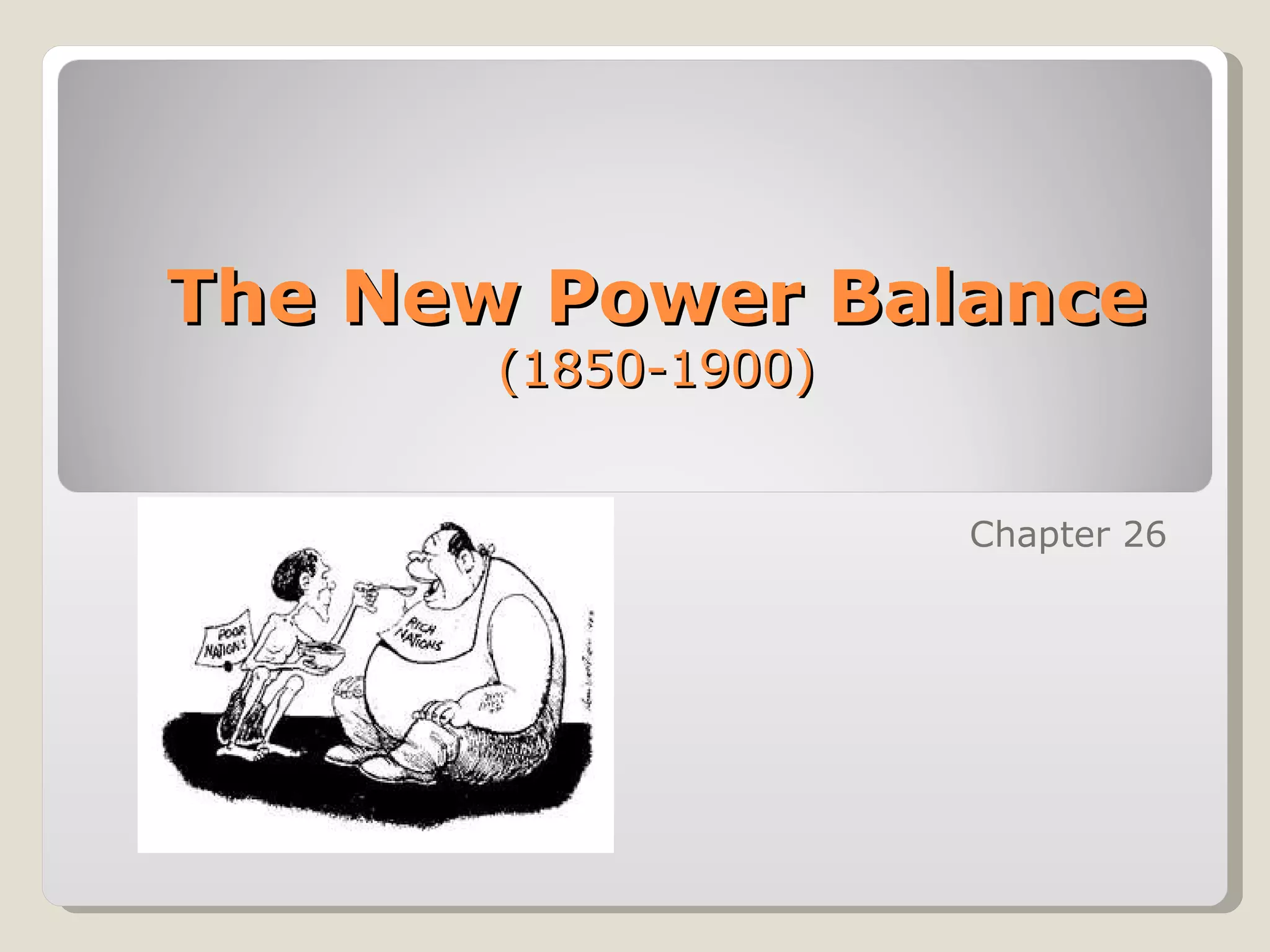







The New Power Balance
       (1850-1900)


                     Chapter 26
 From the 17th century to mid 19th century Europeans
  had come to regard their continent as the only great
  powers and the center of the universe. The rest of the
  world was either ignored or used.
 The world economy, international politics, even
  cultural and social issues revolved around a handful of
  countries, the “great powers” that believed they
  controlled the destiny of the world…and they did just
  that.
 However, in defense of Western imperialism and the
  force of nationalism, some countries began to not
  only strengthen, but go on the offensive and join the
  ranks of the great powers.


Intro
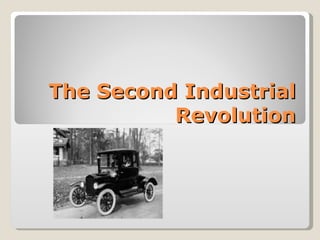
The Second Industrial
          Revolution
   While the first Industrial Revolution gave
    rise to textiles, railroads, iron, and coal,
    the second Industrial Revolution
    introduced steel, electricity, chemicals,
    and petroleum.
    Why would each be important?
   These new technologies revolutionized
    everyday life and transformed the world
    economy.
   By 1890, Germany and the U.S. surpass
    Britain as the worlds leading industrial
    powers.
The Second Industrial Revolution
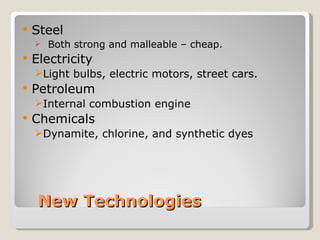
   Steel
       Both strong and malleable – cheap.
   Electricity
    Light bulbs, electric motors, street cars.
   Petroleum
    Internal combustion engine
   Chemicals
    Dynamite, chlorine, and synthetic dyes


     New Technologies
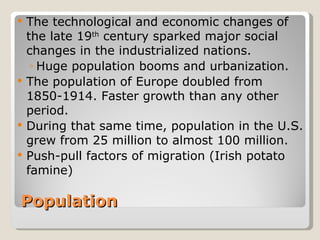
 The technological and economic changes of
  the late 19th century sparked major social
  changes in the industrialized nations.
   ◦ Huge population booms and urbanization.
 The population of Europe doubled from
  1850-1914. Faster growth than any other
  period.
 During that same time, population in the U.S.
  grew from 25 million to almost 100 million.
 Push-pull factors of migration (Irish potato
  famine)

Population
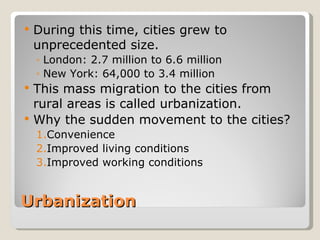
   During this time, cities grew to
    unprecedented size.
    ◦ London: 2.7 million to 6.6 million
    ◦ New York: 64,000 to 3.4 million
   This mass migration to the cities from
    rural areas is called urbanization.
   Why the sudden movement to the cities?
    1.Convenience
    2.Improved living conditions
    3.Improved working conditions


Urbanization
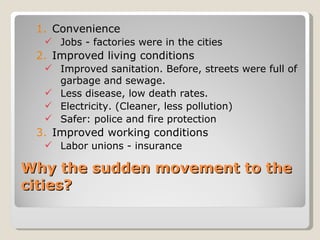
1. Convenience
   Jobs - factories were in the cities
 2. Improved living conditions
   Improved sanitation. Before, streets were full of
    garbage and sewage.
   Less disease, low death rates.
   Electricity. (Cleaner, less pollution)
   Safer: police and fire protection
 3. Improved working conditions
   Labor unions - insurance

Why the sudden movement to the
cities?
   Typical male vs. female relationship
    ◦ Males: working outside the home, relaxing in
              men’s clubs
    ◦ Females: raise children, run household

   Second I.R. opened the door to new jobs
    for women.
    ◦ Shortage of male workers
    ◦ Demand for low paying jobs (secretaries,
      teachers)


Women and Victorian Age
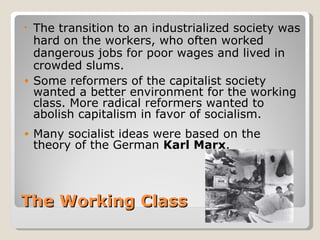
• The transition to an industrialized society was
  hard on the workers, who often worked
  dangerous jobs for poor wages and lived in
  crowded slums.
• Some reformers of the capitalist society
  wanted a better environment for the working
  class. More radical reformers wanted to
  abolish capitalism in favor of socialism.
•   Many socialist ideas were based on the
    theory of the German Karl Marx.


The Working Class
   The Communist Manifesto outlined Karl
    Marx’s beliefs that industrial capitalism
    was to blame for the problems besetting
    society.
   Marx believed that there has always been
    two classes in the world. The oppressed
    (working class) he called the proletariat
    and the oppressor (property owner) or
    bourgeoisie. Marx believed that it was
    only a matter of time before the
    oppressed rose up against the oppressor.
Karl Marx
   The most influential idea of the 19th century
    was nationalism, a feeling of national
    identity.
   Language was usually the critical element
    in creating this feeling, but could be
    anything that political rulers could use to
    unite the people of a nation. (Imperialism)
   Propaganda became more popular as
    leaders used nationalism to justify changes.


Nationalism
   Japan
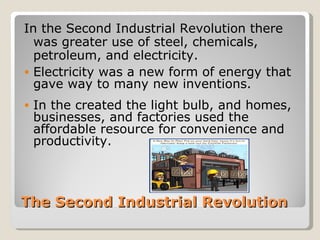
In the Second Industrial Revolution there
  was greater use of steel, chemicals,
  petroleum, and electricity.
• Electricity was a new form of energy that
  gave way to many new inventions.
•   In the created the light bulb, and homes,
    businesses, and factories used the
    affordable resource for convenience and
    productivity.


The Second Industrial Revolution
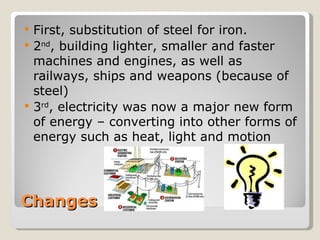
   First, substitution of steel for iron.
   2nd, building lighter, smaller and faster
    machines and engines, as well as
    railways, ships and weapons (because of
    steel)
   3rd, electricity was now a major new form
    of energy – converting into other forms of
    energy such as heat, light and motion


Changes
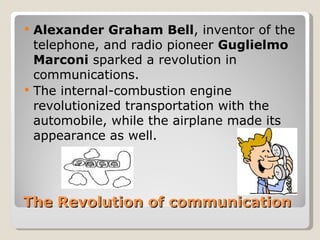
   Alexander Graham Bell, inventor of the
    telephone, and radio pioneer Guglielmo
    Marconi sparked a revolution in
    communications.
   The internal-combustion engine
    revolutionized transportation with the
    automobile, while the airplane made its
    appearance as well.


The Revolution of communication
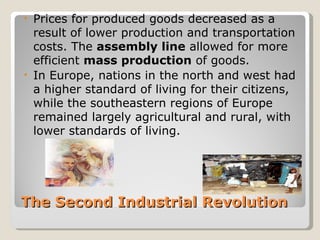
• Prices for produced goods decreased as a
  result of lower production and transportation
  costs. The assembly line allowed for more
  efficient mass production of goods.
• In Europe, nations in the north and west had
  a higher standard of living for their citizens,
  while the southeastern regions of Europe
  remained largely agricultural and rural, with
  lower standards of living.


The Second Industrial Revolution
   By 1900, a true world economy was
    occurring. Europe dominated this global
    economy by the beginning of the
    twentieth century.


The Second Industrial Revolution
   Industrialization gave some a higher
    standard of living, but struggling
    workers turned to trade unions or
    socialism to improve their lives.


The Working Class
• In many European nations, working-class
  leaders formed socialist parties based on
  Marx’s ideas, but were divided on their goals.
• Pure Marxists wanted revolution to defeat
  capitalism, while revisionists argued that
  political gains were the key to change.
•   To improve their conditions, workers
    organized into unions for better working
    conditions and used strikes as their
    bargaining tool.


The Working Class
The New Urban
Environment or The
Emergency of Mass
           Society
                20.2
   As workers migrated to cities, local
    governments had to solve urgent
    public health problems; and their
    solutions allowed cities to grow even
    more.


The New Urban Environment
•   As more people moved to cities in search
    of economic opportunities, European
    society became more urban.
•   Reformers were able to urge local
    governments to improve conditions in
    cities.
•   Improved housing, water, and sewage
    systems led to a safer living environment.


The New Urban Environment
   Improved living conditions enabled people
    to live in close quarters, and cities such as
    London and Frankfurt were able to
    accommodate large populations.


The New Urban Environment
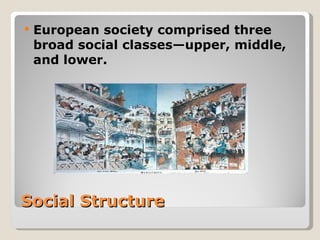
   European society comprised three
    broad social classes—upper, middle,
    and lower.


Social Structure
   The Elite Class:
    - Made up of wealthy bankers,
    industrialists, and merchants, this
    minority became leaders in the
    government and military.


Social Structure
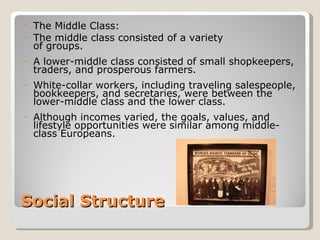
• The Middle Class:
– The middle class consisted of a variety
  of groups.
–   A lower-middle class consisted of small shopkeepers,
    traders, and prosperous farmers.
–   White-collar workers, including traveling salespeople,
    bookkeepers, and secretaries, were between the
    lower-middle class and the lower class.
–   Although incomes varied, the goals, values, and
    lifestyle opportunities were similar among middle-
    class Europeans.


Social Structure
•   The Working Class:
–   The majority of Europeans were
    considered the working class of society
    and included landholding peasants,
    laborers, and domestic servants.
–   Improved working environments
    facilitated more buying power and better
    social conditions.


Social Structure
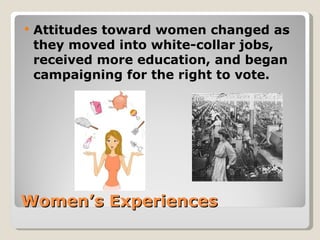
   Attitudes toward women changed as
    they moved into white-collar jobs,
    received more education, and began
    campaigning for the right to vote.


Women’s Experiences
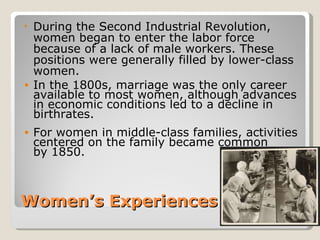
• During the Second Industrial Revolution,
  women began to enter the labor force
  because of a lack of male workers. These
  positions were generally filled by lower-class
  women.
• In the 1800s, marriage was the only career
  available to most women, although advances
  in economic conditions led to a decline in
  birthrates.
•   For women in middle-class families, activities
    centered on the family became common
    by 1850.


Women’s Experiences
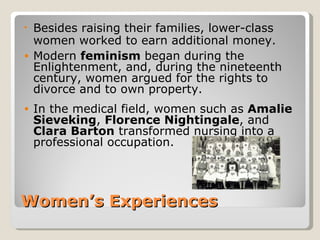
• Besides raising their families, lower-class
  women worked to earn additional money.
• Modern feminism began during the
  Enlightenment, and, during the nineteenth
  century, women argued for the rights to
  divorce and to own property.
•   In the medical field, women such as Amalie
    Sieveking, Florence Nightingale, and
    Clara Barton transformed nursing into a
    professional occupation.


Women’s Experiences
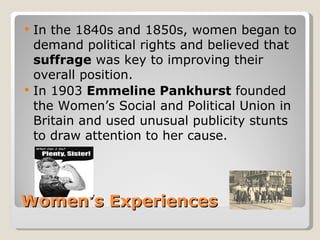
   In the 1840s and 1850s, women began to
    demand political rights and believed that
    suffrage was key to improving their
    overall position.
   In 1903 Emmeline Pankhurst founded
    the Women’s Social and Political Union in
    Britain and used unusual publicity stunts
    to draw attention to her cause.


Women’s Experiences
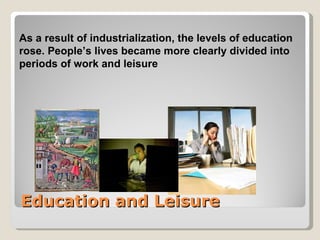
As a result of industrialization, the levels of education
rose. People’s lives became more clearly divided into
periods of work and leisure


Education and Leisure
•   Between 1870 and 1914, Western nations
    began to finance a system of primary
    education for children ages 6 to 12.
•   Education was considered important for a
    viable labor force and better-educated
    voters.
•   The immediate result of public education
    was a jump in literacy.


Education and Leisure
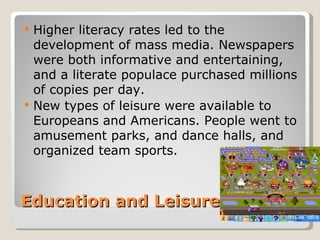
   Higher literacy rates led to the
    development of mass media. Newspapers
    were both informative and entertaining,
    and a literate populace purchased millions
    of copies per day.
   New types of leisure were available to
    Europeans and Americans. People went to
    amusement parks, and dance halls, and
    organized team sports.


Education and Leisure
   Leisure time was now clearly defined as
    separate from work. Leisure time was also
    more passive in nature, and people paid
    to attend leisure activities.


Education and Leisure
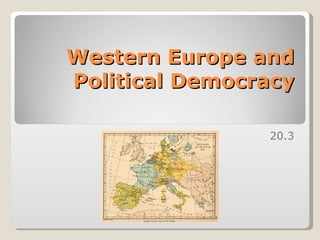
Western Europe and
Political Democracy

                20.3
Western Europe & Democracy
•   By the late 19th century (late 1800s),
    progress had been made toward
    establishing constitutions, parliaments,
    and individual liberties in the major
    European states.
   Political democracy was spreading in
    Western Europe and the United States, as
    universal male suffrage laws were passed.
The United States
   Aftermath of the Civil War

    ◦ In the United States, the Civil War had
      destroyed the Southern way of life.
    ◦ One-fifth of the adult male population had
      been killed and 4 million slaves were freed
      by the passing of the 13th Amendment to
      the Constitution in 1865.
U.S. Economy
   Between 1860 and 1914, the United
    States switched from an agrarian (farm-
    based) economy to an industrial economy
   Massive migrations to U.S. influenced
    economy.
    ◦ 11 million Europeans migrated to the United
      States between 1870-1900.
      Push-Pull factors of migration
       ◦ Some came to escape conditions of Europe (Push)
       ◦ Others came for job opportunities (Pull)
International Rivalries
   Germany emerged as the most powerful state in
    Europe and threatened the balance of power.
   France was determined to re-balance power and
    threatened an anti-German alliance.
   However, Germany acted first and created a
    defensive alliance with Austria-Hungary and Italy
    known as the Triple Alliance.
   France would later form an alliance with Great
    Britain and Russia known as the Triple Entente.

   These aggressive foreign policies divided Europe
    into two hostile alliance systems.
•   Great Britain:
–   A two-party parliamentary system
    emerged as the Liberal and Conservative
    parties vied for political power.
–   The Liberals voted for social reforms, such
    as unemployment benefits and pensions.


Western Europe and Political
Democracy
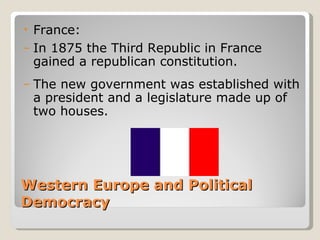
•   France:
–   In 1875 the Third Republic in France
    gained a republican constitution.
–   The new government was established with
    a president and a legislature made up of
    two houses.


Western Europe and Political
Democracy
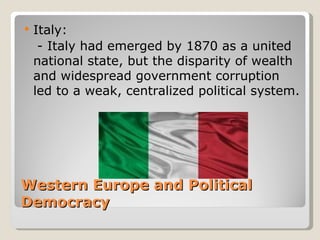
   Italy:
     - Italy had emerged by 1870 as a united
    national state, but the disparity of wealth
    and widespread government corruption
    led to a weak, centralized political system.


Western Europe and Political
Democracy
   Although Germany, Austria-Hungary,
    and later Russia instituted elections
    and parliaments, real power
    remained in the hands of emperors
    and elites.


Central and Eastern Europe: The
Old Order
   In Germany, the government established
    by Otto von Bismarck set up a two-
    house legislature.
   Although the Reichstag was elected by
    male voters, the emperor still maintained
    political power by controlling the military
    and foreign policy.


Central and Eastern Europe: The
Old Order
•   By the reign of William II (1888 to
    1918), Germany was the strongest
    military and industrial power in Europe.
    Conservative forces thwarted the rise of
    democracy in Germany.
•   In the Austro-Hungarian Empire, the
    emperor Francis Joseph largely ignored
    the Austrian parliament and governed by
    imperial decree. Ethnic problems
    threatened the stability of Austria.

Central and Eastern Europe: The
Old Order
   In Hungary, the parliamentary system
    worked, although it was dominated by the
    nation’s landholding class.
   Nicholas II became the czar of Russia in
    1894, and was committed to autocratic
    rule of the large nation.


Central and Eastern Europe: The
Old Order
• Russia was becoming an industrialized
  nation, and the rising working class
  demanded more political power. In 1905 the
  bloody breakup of a peaceful demonstration
  in St. Petersburg left hundreds dead.
• Czar Nicholas relented and permitted the
  establishment of the Duma, although he had
  limited the power of the legislative body
  by 1907.


Central and Eastern Europe: The
Old Order
   In the United States, the Second
    Industrial Revolution produced
    wealth that was more concentrated
    than it was in Europe.


The United States
• The populations of urban centers soared, and
  by 1900, three American cities had over 1
  million inhabitants.
• Around the turn of the century, America
  became imperialistic and acquired territories
  abroad.
•   American forces deposed Queen
    Liliuokalani in Hawaii and acquired
    territories from the vanquished Spanish in
    the Spanish-American War.


The United States
• To prevent France from limiting its power,
  Germany entered into a defensive alliance
  with Austria-Hungary and Italy by 1882. This
  coalition was known as the Triple Alliance.
• In 1890 Emperor William II fired Bismarck
  and took control of Germany’s foreign policy.
  In 1894 William II ended the treaty Germany
  had with Russia.
•   By 1907, France, Great Britain, and Russia
    had drawn into an alliance known as the
    Triple Entente.


International Rivalries
• The two opposing alliances of the Triple
  Alliance and the Triple Entente had become
  more divided and less willing to compromise
  at the beginning of the twentieth century.
• As the Ottoman Empire began to lose power,
  the provinces of Greece, Serbia, Romania,
  and Montenegro in the Balkans began to
  gain their freedom. Austria and Russia vied
  for influence in the region.


International Rivalries
• In 1908 Austria-Hungary annexed the Slavic
  territories of Bosnia and Herzegovina. This
  outraged Serbia, which wanted to establish a
  Slavic kingdom.
• Serbia and its ally Russia prepared for war
  against Austria-Hungary. Germany
  demanded that Russia accept the Austrian
  annexation or face war; Russia, weakened by
  war with Japan, backed down.
•   By the beginning of 1914, the crisis in the
    Balkans threatened the security of Europe.


International Rivalries
The Culture of
    Modernity
            20.4
Toward the Modern Consciousness
   People continued to believe in the values
    that had been put forth by the Scientific
    Revolution and Enlightenment.
   Reason, science, and progress continued
    to be important words to Europeans.

   A couple of new theories developed:
New Theories
   Albert Einstein – Theory of relativity
    eventually led to a new Atomic Age.
   Sigmund Freud – psychoanalysis –
    coined the terms unconscious and
    repressed.
    ◦ Freud believed some feeling were repressed
      from a person’s conscious awareness, but
      these hidden feelings continued to influence
      behavior, however, because they were a part of
      the unconscious.
Social Darwinism and Racism
   In the early 20th century, some scientific
    theories were applied inappropriately to
    achieve desired results. For example,
    Darwin’s theories were applied to human
    society in a racial way. These ideas are
    known as Social Dawinism.

   In their pursuit of national greatness,
    extreme nationalists often insisted that
    nations too are engaged in a “struggle for
    existence” where only the strongest
    survive.
Anti-Semitism and Zionism
   Anti-Semitism - hostility toward Jews.
   During the late 19th century, Germany and
    Austria-Hungary’s new political parties
    used anti-Semitism to win votes of people
    who felt threatened by the changes of the
    times.
   Persecutions and pogroms (organized
    mass acres) were widespread.
   Many Jews decided to leave and migrated
    to the U.S. and Palestine in a Jewish
    national movement known as Zionism.
The Culture of Modernity
   In the late 19th and early 20th centuries,
    many writers and artists rebelled against
    the traditional literary and artistic styles
    that had dominated European cultural life
    since the Renaissance.
   This movement became known as
    Modernism.
Painting - Impressionism
   By the late 19th century, artists were
    seeking new forms of expression to reflect
    their changing views of the world.
   By the beginning of the 20th century, the
    belief that the goal of art was to represent
    reality had lost much of its meaning.
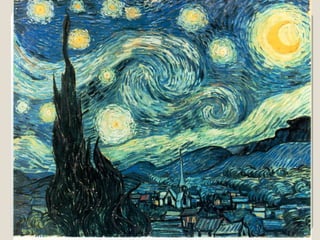
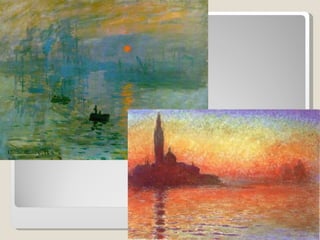
   Impressionism
    ◦ Monet
    ◦ Van Gogh
•   Between 1870 and 1914, many writers
    and artists produced works known as
    modernism.
•   The naturalist writers addressed social
    problems such as alcoholism, women in
    society, and urban slums.
•   Symbolist writers produced work that
    functioned for its own sake, and did not
    attempt to criticize or understand society.


The Culture of Modernity
• In France, artists such as Claude Monet
  embraced a painting style known as
  impressionism. Impressionists rejected
  indoor studios and went into nature, where
  they captured the interplay of light, sky,
  and water.
• Vincent van Gogh and Paul Cezanne used
  color and structure to express mood in a
  form known as postimpressionism. These
  artists wanted to represent reality, not mirror
  it, as did the camera, which had been
  invented in 1888.


The Culture of Modernity
   The Spaniard Pablo Picasso painted in a
    new style, using geometric designs to re-
    create reality. This modern style of art is
    called cubism.
   Modernism influenced architecture as well,
    and skilled builders Louis H. Sullivan and
    Frank Lloyd Wright created buildings
    that were clean-lined and functional.


The Culture of Modernity
   In music, the ‘modern’ sounds of
    Stravinsky’s The Rite of Spring caused a
    near-riot by Parisians, who were upset by
    the new sounds and rhythms of the
    performance.


The Culture of Modernity
   Scientific discoveries in this period
    had a profound impact on how people
    saw themselves and their world.


Uncertainty Grows
• At the end of the nineteenth century, Marie
  Curie challenged the accepted view that the
  universe existed independent of its
  observers, with her discovery that the
  element radium gave off energy.
• The German-born scientist Albert Einstein
  provided a new view of the universe with his
  theory of relativity, which stated that space
  and time are not absolute, but are relative to
  the observer.


Uncertainty Grows
   A doctor from Vienna named Sigmund
    Freud asserted that human behavior was
    strongly determined by past experiences
    and internal urges.
   Freud used a method known as
    psychoanalysis, in which he and a
    patient probed deeply into the patient’s
    memory for healing purposes.


Uncertainty Grows
   In the late 1800s, extreme
    nationalism was reflected in the
    movements of Social Darwinism and
    anti-Semitism.


Extreme Nationalism
   In the 1800s, many Europeans became
    fiercely nationalistic. They used Social
    Darwinism to justify the strength and
    wealth of nations.
   In Europe, anti-Semitism had been
    around for centuries, but became more
    intense during the late 1800s. So as to
    win voters, political groups blamed Jews
    for many problems.


Extreme Nationalism
   The worst treatment of Jews occurred in
    Russia, where persecutions and pogroms
    were widespread.
   A Jewish nationalist movement called
    Zionism helped many Jews to emigrate
    from Europe to the United States and
    Palestine.


Extreme Nationalism
   Quiz
   In the 2nd Industrial Revolution, _____,
    _____, _____, and _____ le the way to
    new industrial frontiers.
   h

Ch. 26 - "The New Power Balance"

  • 1.
    The New PowerBalance (1850-1900) Chapter 26
  • 2.
     From the17th century to mid 19th century Europeans had come to regard their continent as the only great powers and the center of the universe. The rest of the world was either ignored or used.  The world economy, international politics, even cultural and social issues revolved around a handful of countries, the “great powers” that believed they controlled the destiny of the world…and they did just that.  However, in defense of Western imperialism and the force of nationalism, some countries began to not only strengthen, but go on the offensive and join the ranks of the great powers. Intro
  • 3.
  • 4.
    While the first Industrial Revolution gave rise to textiles, railroads, iron, and coal, the second Industrial Revolution introduced steel, electricity, chemicals, and petroleum. Why would each be important?  These new technologies revolutionized everyday life and transformed the world economy.  By 1890, Germany and the U.S. surpass Britain as the worlds leading industrial powers. The Second Industrial Revolution
  • 5.
    Steel  Both strong and malleable – cheap.  Electricity Light bulbs, electric motors, street cars.  Petroleum Internal combustion engine  Chemicals Dynamite, chlorine, and synthetic dyes New Technologies
  • 6.
     The technologicaland economic changes of the late 19th century sparked major social changes in the industrialized nations. ◦ Huge population booms and urbanization.  The population of Europe doubled from 1850-1914. Faster growth than any other period.  During that same time, population in the U.S. grew from 25 million to almost 100 million.  Push-pull factors of migration (Irish potato famine) Population
  • 7.
    During this time, cities grew to unprecedented size. ◦ London: 2.7 million to 6.6 million ◦ New York: 64,000 to 3.4 million  This mass migration to the cities from rural areas is called urbanization.  Why the sudden movement to the cities? 1.Convenience 2.Improved living conditions 3.Improved working conditions Urbanization
  • 8.
    1. Convenience  Jobs - factories were in the cities 2. Improved living conditions  Improved sanitation. Before, streets were full of garbage and sewage.  Less disease, low death rates.  Electricity. (Cleaner, less pollution)  Safer: police and fire protection 3. Improved working conditions  Labor unions - insurance Why the sudden movement to the cities?
  • 9.
    Typical male vs. female relationship ◦ Males: working outside the home, relaxing in men’s clubs ◦ Females: raise children, run household  Second I.R. opened the door to new jobs for women. ◦ Shortage of male workers ◦ Demand for low paying jobs (secretaries, teachers) Women and Victorian Age
  • 10.
    • The transitionto an industrialized society was hard on the workers, who often worked dangerous jobs for poor wages and lived in crowded slums. • Some reformers of the capitalist society wanted a better environment for the working class. More radical reformers wanted to abolish capitalism in favor of socialism. • Many socialist ideas were based on the theory of the German Karl Marx. The Working Class
  • 11.
    The Communist Manifesto outlined Karl Marx’s beliefs that industrial capitalism was to blame for the problems besetting society.  Marx believed that there has always been two classes in the world. The oppressed (working class) he called the proletariat and the oppressor (property owner) or bourgeoisie. Marx believed that it was only a matter of time before the oppressed rose up against the oppressor. Karl Marx
  • 12.
    The most influential idea of the 19th century was nationalism, a feeling of national identity.  Language was usually the critical element in creating this feeling, but could be anything that political rulers could use to unite the people of a nation. (Imperialism)  Propaganda became more popular as leaders used nationalism to justify changes. Nationalism
  • 13.
    Japan
  • 14.
    In the SecondIndustrial Revolution there was greater use of steel, chemicals, petroleum, and electricity. • Electricity was a new form of energy that gave way to many new inventions. • In the created the light bulb, and homes, businesses, and factories used the affordable resource for convenience and productivity. The Second Industrial Revolution
  • 15.
    First, substitution of steel for iron.  2nd, building lighter, smaller and faster machines and engines, as well as railways, ships and weapons (because of steel)  3rd, electricity was now a major new form of energy – converting into other forms of energy such as heat, light and motion Changes
  • 16.
    Alexander Graham Bell, inventor of the telephone, and radio pioneer Guglielmo Marconi sparked a revolution in communications.  The internal-combustion engine revolutionized transportation with the automobile, while the airplane made its appearance as well. The Revolution of communication
  • 17.
    • Prices forproduced goods decreased as a result of lower production and transportation costs. The assembly line allowed for more efficient mass production of goods. • In Europe, nations in the north and west had a higher standard of living for their citizens, while the southeastern regions of Europe remained largely agricultural and rural, with lower standards of living. The Second Industrial Revolution
  • 18.
    By 1900, a true world economy was occurring. Europe dominated this global economy by the beginning of the twentieth century. The Second Industrial Revolution
  • 19.
    Industrialization gave some a higher standard of living, but struggling workers turned to trade unions or socialism to improve their lives. The Working Class
  • 20.
    • In manyEuropean nations, working-class leaders formed socialist parties based on Marx’s ideas, but were divided on their goals. • Pure Marxists wanted revolution to defeat capitalism, while revisionists argued that political gains were the key to change. • To improve their conditions, workers organized into unions for better working conditions and used strikes as their bargaining tool. The Working Class
  • 21.
    The New Urban Environmentor The Emergency of Mass Society 20.2
  • 22.
    As workers migrated to cities, local governments had to solve urgent public health problems; and their solutions allowed cities to grow even more. The New Urban Environment
  • 23.
    As more people moved to cities in search of economic opportunities, European society became more urban. • Reformers were able to urge local governments to improve conditions in cities. • Improved housing, water, and sewage systems led to a safer living environment. The New Urban Environment
  • 24.
    Improved living conditions enabled people to live in close quarters, and cities such as London and Frankfurt were able to accommodate large populations. The New Urban Environment
  • 25.
    European society comprised three broad social classes—upper, middle, and lower. Social Structure
  • 26.
    The Elite Class: - Made up of wealthy bankers, industrialists, and merchants, this minority became leaders in the government and military. Social Structure
  • 27.
    • The MiddleClass: – The middle class consisted of a variety of groups. – A lower-middle class consisted of small shopkeepers, traders, and prosperous farmers. – White-collar workers, including traveling salespeople, bookkeepers, and secretaries, were between the lower-middle class and the lower class. – Although incomes varied, the goals, values, and lifestyle opportunities were similar among middle- class Europeans. Social Structure
  • 28.
    The Working Class: – The majority of Europeans were considered the working class of society and included landholding peasants, laborers, and domestic servants. – Improved working environments facilitated more buying power and better social conditions. Social Structure
  • 29.
    Attitudes toward women changed as they moved into white-collar jobs, received more education, and began campaigning for the right to vote. Women’s Experiences
  • 30.
    • During theSecond Industrial Revolution, women began to enter the labor force because of a lack of male workers. These positions were generally filled by lower-class women. • In the 1800s, marriage was the only career available to most women, although advances in economic conditions led to a decline in birthrates. • For women in middle-class families, activities centered on the family became common by 1850. Women’s Experiences
  • 31.
    • Besides raisingtheir families, lower-class women worked to earn additional money. • Modern feminism began during the Enlightenment, and, during the nineteenth century, women argued for the rights to divorce and to own property. • In the medical field, women such as Amalie Sieveking, Florence Nightingale, and Clara Barton transformed nursing into a professional occupation. Women’s Experiences
  • 32.
    In the 1840s and 1850s, women began to demand political rights and believed that suffrage was key to improving their overall position.  In 1903 Emmeline Pankhurst founded the Women’s Social and Political Union in Britain and used unusual publicity stunts to draw attention to her cause. Women’s Experiences
  • 33.
    As a resultof industrialization, the levels of education rose. People’s lives became more clearly divided into periods of work and leisure Education and Leisure
  • 34.
    Between 1870 and 1914, Western nations began to finance a system of primary education for children ages 6 to 12. • Education was considered important for a viable labor force and better-educated voters. • The immediate result of public education was a jump in literacy. Education and Leisure
  • 35.
    Higher literacy rates led to the development of mass media. Newspapers were both informative and entertaining, and a literate populace purchased millions of copies per day.  New types of leisure were available to Europeans and Americans. People went to amusement parks, and dance halls, and organized team sports. Education and Leisure
  • 36.
    Leisure time was now clearly defined as separate from work. Leisure time was also more passive in nature, and people paid to attend leisure activities. Education and Leisure
  • 37.
  • 38.
    Western Europe &Democracy • By the late 19th century (late 1800s), progress had been made toward establishing constitutions, parliaments, and individual liberties in the major European states.  Political democracy was spreading in Western Europe and the United States, as universal male suffrage laws were passed.
  • 39.
    The United States  Aftermath of the Civil War ◦ In the United States, the Civil War had destroyed the Southern way of life. ◦ One-fifth of the adult male population had been killed and 4 million slaves were freed by the passing of the 13th Amendment to the Constitution in 1865.
  • 40.
    U.S. Economy  Between 1860 and 1914, the United States switched from an agrarian (farm- based) economy to an industrial economy  Massive migrations to U.S. influenced economy. ◦ 11 million Europeans migrated to the United States between 1870-1900.  Push-Pull factors of migration ◦ Some came to escape conditions of Europe (Push) ◦ Others came for job opportunities (Pull)
  • 41.
    International Rivalries  Germany emerged as the most powerful state in Europe and threatened the balance of power.  France was determined to re-balance power and threatened an anti-German alliance.  However, Germany acted first and created a defensive alliance with Austria-Hungary and Italy known as the Triple Alliance.  France would later form an alliance with Great Britain and Russia known as the Triple Entente.  These aggressive foreign policies divided Europe into two hostile alliance systems.
  • 42.
    Great Britain: – A two-party parliamentary system emerged as the Liberal and Conservative parties vied for political power. – The Liberals voted for social reforms, such as unemployment benefits and pensions. Western Europe and Political Democracy
  • 43.
    France: – In 1875 the Third Republic in France gained a republican constitution. – The new government was established with a president and a legislature made up of two houses. Western Europe and Political Democracy
  • 44.
    Italy: - Italy had emerged by 1870 as a united national state, but the disparity of wealth and widespread government corruption led to a weak, centralized political system. Western Europe and Political Democracy
  • 45.
    Although Germany, Austria-Hungary, and later Russia instituted elections and parliaments, real power remained in the hands of emperors and elites. Central and Eastern Europe: The Old Order
  • 46.
    In Germany, the government established by Otto von Bismarck set up a two- house legislature.  Although the Reichstag was elected by male voters, the emperor still maintained political power by controlling the military and foreign policy. Central and Eastern Europe: The Old Order
  • 47.
    By the reign of William II (1888 to 1918), Germany was the strongest military and industrial power in Europe. Conservative forces thwarted the rise of democracy in Germany. • In the Austro-Hungarian Empire, the emperor Francis Joseph largely ignored the Austrian parliament and governed by imperial decree. Ethnic problems threatened the stability of Austria. Central and Eastern Europe: The Old Order
  • 48.
    In Hungary, the parliamentary system worked, although it was dominated by the nation’s landholding class.  Nicholas II became the czar of Russia in 1894, and was committed to autocratic rule of the large nation. Central and Eastern Europe: The Old Order
  • 49.
    • Russia wasbecoming an industrialized nation, and the rising working class demanded more political power. In 1905 the bloody breakup of a peaceful demonstration in St. Petersburg left hundreds dead. • Czar Nicholas relented and permitted the establishment of the Duma, although he had limited the power of the legislative body by 1907. Central and Eastern Europe: The Old Order
  • 50.
    In the United States, the Second Industrial Revolution produced wealth that was more concentrated than it was in Europe. The United States
  • 51.
    • The populationsof urban centers soared, and by 1900, three American cities had over 1 million inhabitants. • Around the turn of the century, America became imperialistic and acquired territories abroad. • American forces deposed Queen Liliuokalani in Hawaii and acquired territories from the vanquished Spanish in the Spanish-American War. The United States
  • 52.
    • To preventFrance from limiting its power, Germany entered into a defensive alliance with Austria-Hungary and Italy by 1882. This coalition was known as the Triple Alliance. • In 1890 Emperor William II fired Bismarck and took control of Germany’s foreign policy. In 1894 William II ended the treaty Germany had with Russia. • By 1907, France, Great Britain, and Russia had drawn into an alliance known as the Triple Entente. International Rivalries
  • 53.
    • The twoopposing alliances of the Triple Alliance and the Triple Entente had become more divided and less willing to compromise at the beginning of the twentieth century. • As the Ottoman Empire began to lose power, the provinces of Greece, Serbia, Romania, and Montenegro in the Balkans began to gain their freedom. Austria and Russia vied for influence in the region. International Rivalries
  • 54.
    • In 1908Austria-Hungary annexed the Slavic territories of Bosnia and Herzegovina. This outraged Serbia, which wanted to establish a Slavic kingdom. • Serbia and its ally Russia prepared for war against Austria-Hungary. Germany demanded that Russia accept the Austrian annexation or face war; Russia, weakened by war with Japan, backed down. • By the beginning of 1914, the crisis in the Balkans threatened the security of Europe. International Rivalries
  • 55.
    The Culture of Modernity 20.4
  • 56.
    Toward the ModernConsciousness  People continued to believe in the values that had been put forth by the Scientific Revolution and Enlightenment.  Reason, science, and progress continued to be important words to Europeans.  A couple of new theories developed:
  • 57.
    New Theories  Albert Einstein – Theory of relativity eventually led to a new Atomic Age.  Sigmund Freud – psychoanalysis – coined the terms unconscious and repressed. ◦ Freud believed some feeling were repressed from a person’s conscious awareness, but these hidden feelings continued to influence behavior, however, because they were a part of the unconscious.
  • 58.
    Social Darwinism andRacism  In the early 20th century, some scientific theories were applied inappropriately to achieve desired results. For example, Darwin’s theories were applied to human society in a racial way. These ideas are known as Social Dawinism.  In their pursuit of national greatness, extreme nationalists often insisted that nations too are engaged in a “struggle for existence” where only the strongest survive.
  • 59.
    Anti-Semitism and Zionism  Anti-Semitism - hostility toward Jews.  During the late 19th century, Germany and Austria-Hungary’s new political parties used anti-Semitism to win votes of people who felt threatened by the changes of the times.  Persecutions and pogroms (organized mass acres) were widespread.  Many Jews decided to leave and migrated to the U.S. and Palestine in a Jewish national movement known as Zionism.
  • 60.
    The Culture ofModernity  In the late 19th and early 20th centuries, many writers and artists rebelled against the traditional literary and artistic styles that had dominated European cultural life since the Renaissance.  This movement became known as Modernism.
  • 61.
    Painting - Impressionism  By the late 19th century, artists were seeking new forms of expression to reflect their changing views of the world.  By the beginning of the 20th century, the belief that the goal of art was to represent reality had lost much of its meaning.  Impressionism ◦ Monet ◦ Van Gogh
  • 65.
    Between 1870 and 1914, many writers and artists produced works known as modernism. • The naturalist writers addressed social problems such as alcoholism, women in society, and urban slums. • Symbolist writers produced work that functioned for its own sake, and did not attempt to criticize or understand society. The Culture of Modernity
  • 66.
    • In France,artists such as Claude Monet embraced a painting style known as impressionism. Impressionists rejected indoor studios and went into nature, where they captured the interplay of light, sky, and water. • Vincent van Gogh and Paul Cezanne used color and structure to express mood in a form known as postimpressionism. These artists wanted to represent reality, not mirror it, as did the camera, which had been invented in 1888. The Culture of Modernity
  • 67.
    The Spaniard Pablo Picasso painted in a new style, using geometric designs to re- create reality. This modern style of art is called cubism.  Modernism influenced architecture as well, and skilled builders Louis H. Sullivan and Frank Lloyd Wright created buildings that were clean-lined and functional. The Culture of Modernity
  • 68.
    In music, the ‘modern’ sounds of Stravinsky’s The Rite of Spring caused a near-riot by Parisians, who were upset by the new sounds and rhythms of the performance. The Culture of Modernity
  • 69.
    Scientific discoveries in this period had a profound impact on how people saw themselves and their world. Uncertainty Grows
  • 70.
    • At theend of the nineteenth century, Marie Curie challenged the accepted view that the universe existed independent of its observers, with her discovery that the element radium gave off energy. • The German-born scientist Albert Einstein provided a new view of the universe with his theory of relativity, which stated that space and time are not absolute, but are relative to the observer. Uncertainty Grows
  • 71.
    A doctor from Vienna named Sigmund Freud asserted that human behavior was strongly determined by past experiences and internal urges.  Freud used a method known as psychoanalysis, in which he and a patient probed deeply into the patient’s memory for healing purposes. Uncertainty Grows
  • 72.
    In the late 1800s, extreme nationalism was reflected in the movements of Social Darwinism and anti-Semitism. Extreme Nationalism
  • 73.
    In the 1800s, many Europeans became fiercely nationalistic. They used Social Darwinism to justify the strength and wealth of nations.  In Europe, anti-Semitism had been around for centuries, but became more intense during the late 1800s. So as to win voters, political groups blamed Jews for many problems. Extreme Nationalism
  • 74.
    The worst treatment of Jews occurred in Russia, where persecutions and pogroms were widespread.  A Jewish nationalist movement called Zionism helped many Jews to emigrate from Europe to the United States and Palestine. Extreme Nationalism
  • 75.
    Quiz  In the 2nd Industrial Revolution, _____, _____, _____, and _____ le the way to new industrial frontiers.  h