CHAPTER 2
SOFTWARE PROCESSES
Presented by:
Dyanara Pritz H. Menia
SOFTWARE PROCESS MODELS
 simplified representation of a software process.
The process model that covers here are:
 The waterfall model
 The incremental development
 Reuse-oriented software engineering
WATERFALL MODEL
 Software life cycle
 Takes the fundamental process activities of specification,
development, validation, and evolution and represents them as
separate process phases such as requirements specifications,
software design, implementation, testing, and so on.
 Formal system development is an important variant of the waterfall
model.
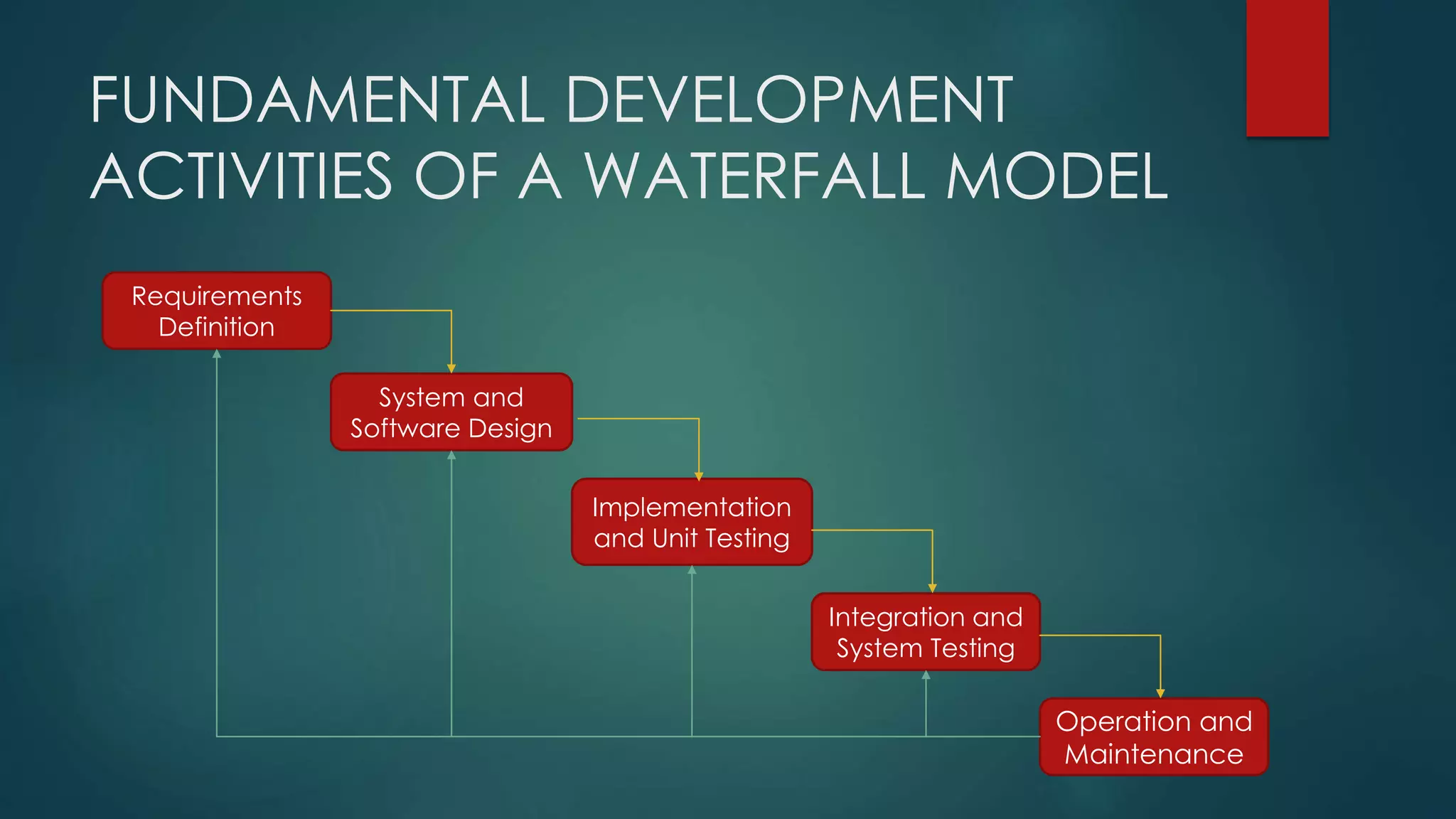
FUNDAMENTAL DEVELOPMENT
ACTIVITIES OF A WATERFALL MODEL
Requirements
Definition
System and
Software Design
Implementation
and Unit Testing
Integration and
System Testing
Operation and
Maintenance
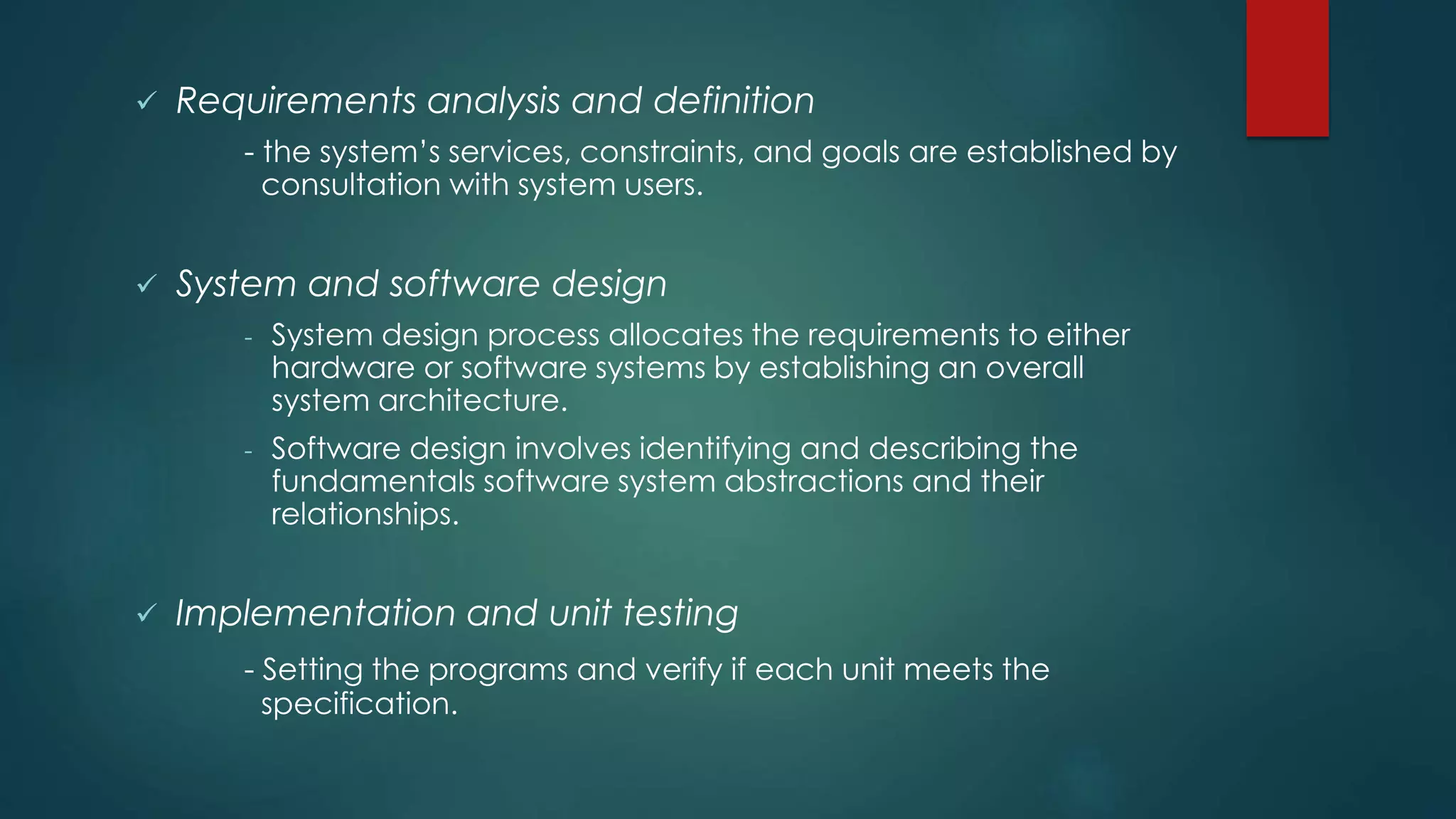
 Requirements analysis and definition
- the system’s services, constraints, and goals are established by
consultation with system users.
 System and software design
- System design process allocates the requirements to either
hardware or software systems by establishing an overall
system architecture.
- Software design involves identifying and describing the
fundamentals software system abstractions and their
relationships.
 Implementation and unit testing
- Setting the programs and verify if each unit meets the
specification.
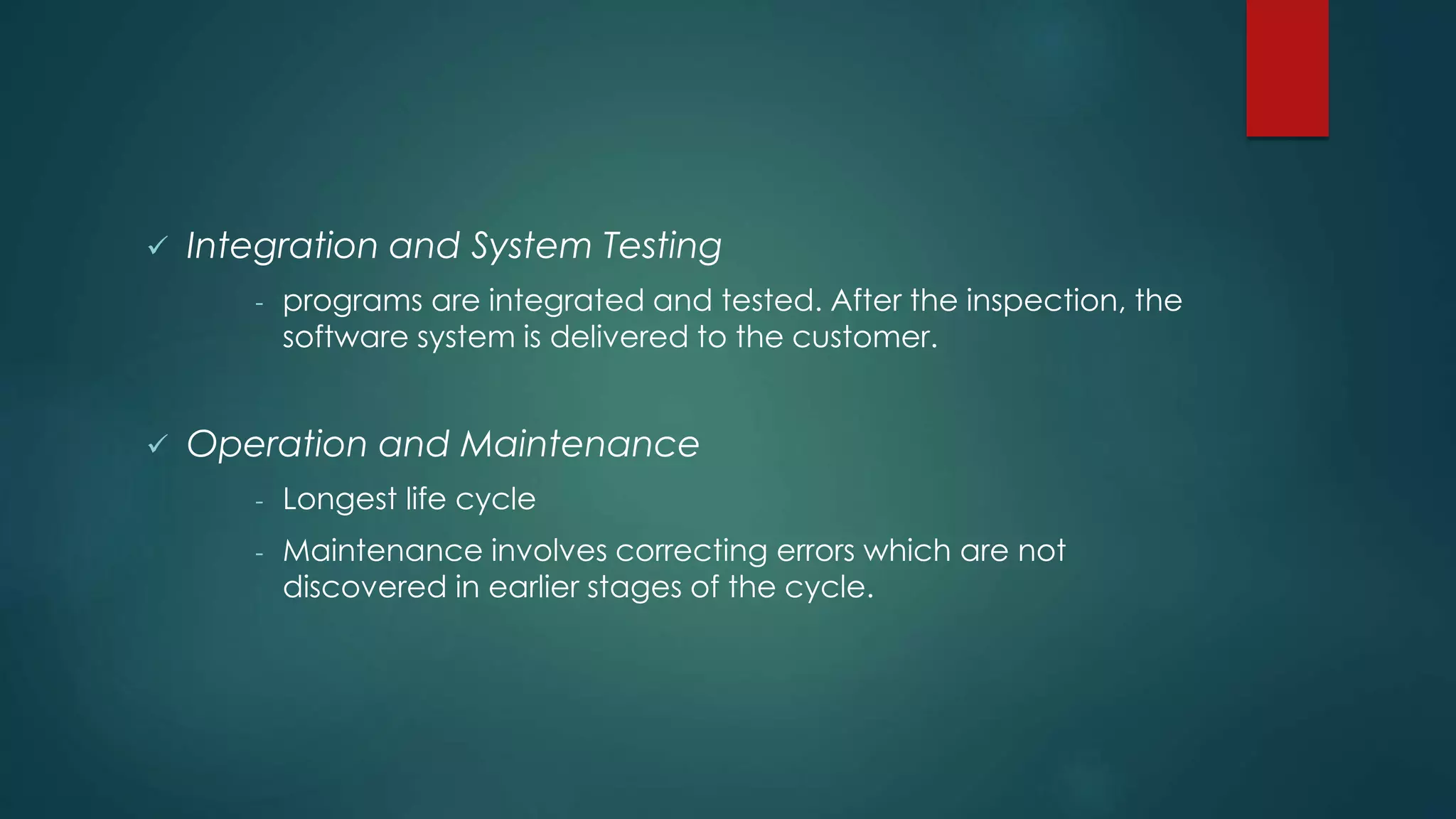
 Integration and System Testing
- programs are integrated and tested. After the inspection, the
software system is delivered to the customer.
 Operation and Maintenance
- Longest life cycle
- Maintenance involves correcting errors which are not
discovered in earlier stages of the cycle.
INCREMENTAL DEVELOPMENT
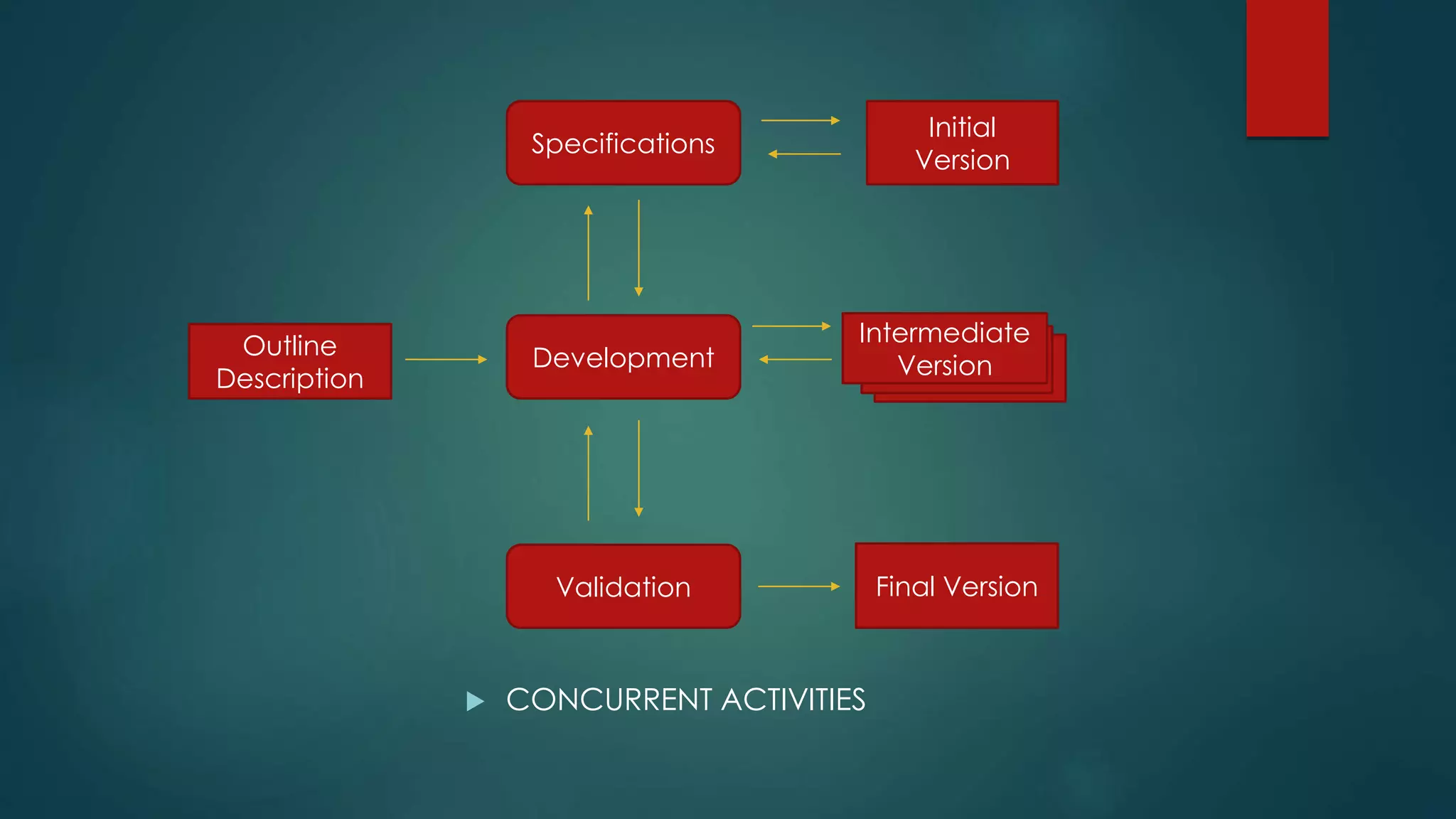
 This approach interleaves the activities of specification,
development, and validation. The system is developed as a series of
versions (increments), with each version adding functionality to the
previous version.
 CONCURRENT ACTIVITIES
Outline
Description
Specifications
Development
Validation
Initial
Version
Intermediate
Version
Final Version
BENEFITS OF INCREMENTAL
DEVELOPMENT
1. The cost of accommodating changing customer requirements is
reduced.
2. It is easier to get customer feedback on the development work
that has been done.
3. More rapid delivery and deployment of useful software to the
customer is possible, even if all of the functionality has not been
included.
Problems in Incremental approach
1. The process is not visible
2. Systems structure tends to degrade as new increments are added.
REUSE - ORIENTED SOFTWARE
ENGINEERING
 This approach is based on the existence of a significant number of
reusable components. The system development process focuses on
integrating these components into a system rather than developing
them from a scratch.
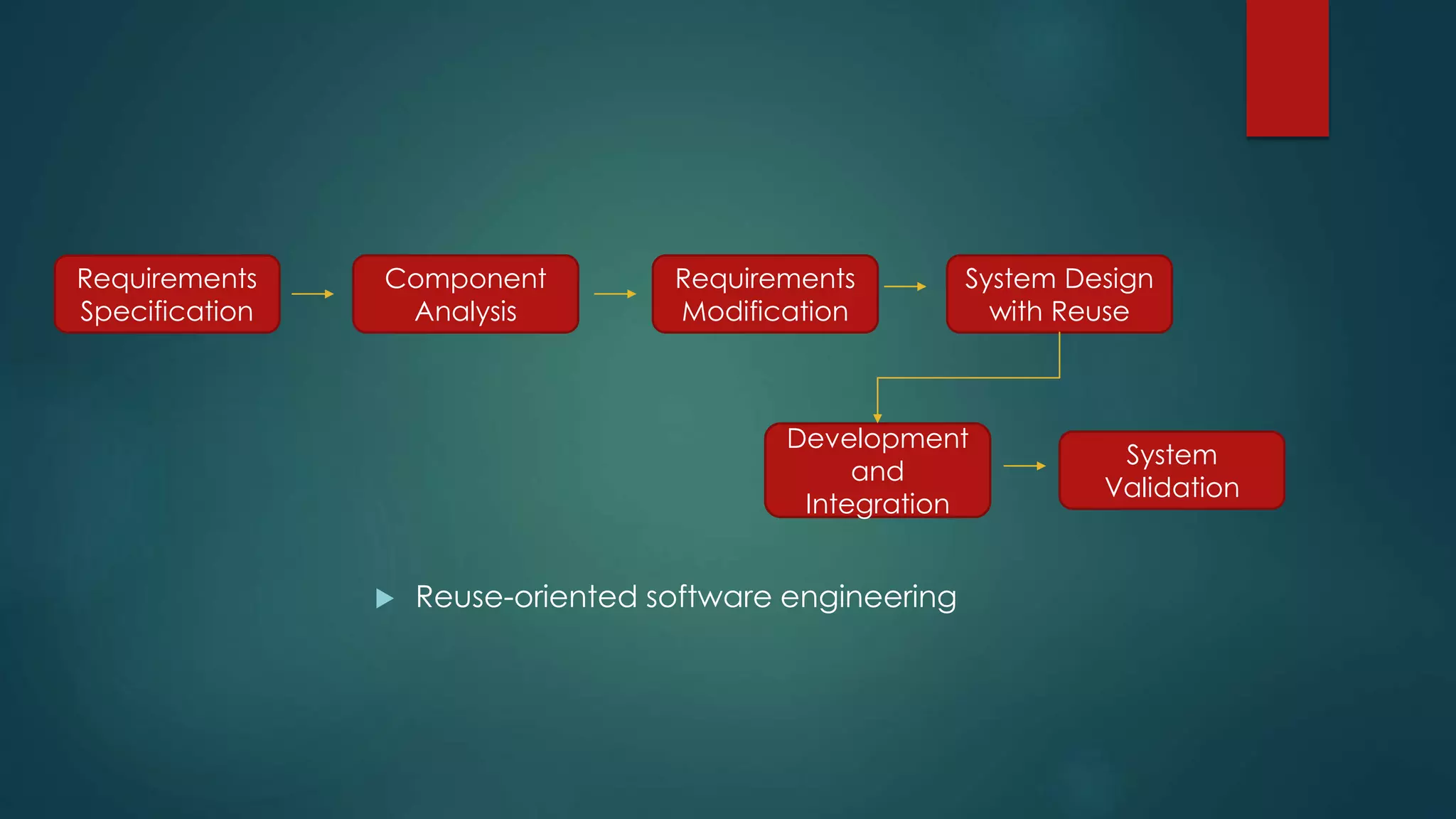
 Reuse-oriented software engineering
Requirements
Specification
Component
Analysis
Requirements
Modification
System Design
with Reuse
Development
and
Integration
System
Validation
Types of Software Component
1. Web services that are developed according to service standards
and which are available for remote invocation.
2. Collections of objects that are developed as a package to be
integrated with a component framework such as .NET or J2EE
3. Stand-alone software systems that are configure for use in a
particular environment.

Software Process Model

  • 1.
    CHAPTER 2 SOFTWARE PROCESSES Presentedby: Dyanara Pritz H. Menia
  • 2.
    SOFTWARE PROCESS MODELS simplified representation of a software process. The process model that covers here are:  The waterfall model  The incremental development  Reuse-oriented software engineering
  • 3.
    WATERFALL MODEL  Softwarelife cycle  Takes the fundamental process activities of specification, development, validation, and evolution and represents them as separate process phases such as requirements specifications, software design, implementation, testing, and so on.  Formal system development is an important variant of the waterfall model.
  • 4.
    FUNDAMENTAL DEVELOPMENT ACTIVITIES OFA WATERFALL MODEL Requirements Definition System and Software Design Implementation and Unit Testing Integration and System Testing Operation and Maintenance
  • 5.
     Requirements analysisand definition - the system’s services, constraints, and goals are established by consultation with system users.  System and software design - System design process allocates the requirements to either hardware or software systems by establishing an overall system architecture. - Software design involves identifying and describing the fundamentals software system abstractions and their relationships.  Implementation and unit testing - Setting the programs and verify if each unit meets the specification.
  • 6.
     Integration andSystem Testing - programs are integrated and tested. After the inspection, the software system is delivered to the customer.  Operation and Maintenance - Longest life cycle - Maintenance involves correcting errors which are not discovered in earlier stages of the cycle.
  • 7.
    INCREMENTAL DEVELOPMENT  Thisapproach interleaves the activities of specification, development, and validation. The system is developed as a series of versions (increments), with each version adding functionality to the previous version.
  • 8.
  • 9.
    BENEFITS OF INCREMENTAL DEVELOPMENT 1.The cost of accommodating changing customer requirements is reduced. 2. It is easier to get customer feedback on the development work that has been done. 3. More rapid delivery and deployment of useful software to the customer is possible, even if all of the functionality has not been included.
  • 10.
    Problems in Incrementalapproach 1. The process is not visible 2. Systems structure tends to degrade as new increments are added.
  • 11.
    REUSE - ORIENTEDSOFTWARE ENGINEERING  This approach is based on the existence of a significant number of reusable components. The system development process focuses on integrating these components into a system rather than developing them from a scratch.
  • 12.
     Reuse-oriented softwareengineering Requirements Specification Component Analysis Requirements Modification System Design with Reuse Development and Integration System Validation
  • 13.
    Types of SoftwareComponent 1. Web services that are developed according to service standards and which are available for remote invocation. 2. Collections of objects that are developed as a package to be integrated with a component framework such as .NET or J2EE 3. Stand-alone software systems that are configure for use in a particular environment.

Editor's Notes

  • #3 Abstraction – general concept
  • #4 Plan-driven processes = processes where all of the process activities are planned in advance and progress is measured against this plan
  • #8 Developing an initial implementation, exposing this to user comment and evolving it through several versions until an adequate system has been developed. it is better than waterfall approach for most business, e-commerce, and personal systems. It is cheaper and easier to make changes in the software as it is being developed
  • #12 These components are systems in their own right (COTS or commercial off-the-shelf systems) that may provide specific functionality such as word processing or a spreadsheet