Software Processes 2-1
Chapter 2
Software processes
By: Tekalign B.
Adapted from Ian Sommerville 2006, Software
Engineering, 8th edition. Chapter 4
Software Processes
Chapter 2: Objectives
 To introduce software process models
 To describe three generic process models and when they
maybe used
 To describe outline process models for requirements
engineering, software development, testing and evolution
2-2
Software Processes
Chapter 2: roadmap
2.1 Software process and process models
2.2 Process iteration
2.3 Process activities
2.4 The Rational Unified Process
2.5 Computer-aided software engineering
2.6 Process assessment model and process metrics
2-3
Software Processes
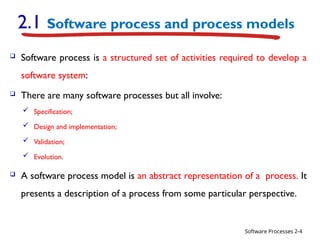
2.1 Software process and process models
 Software process is a structured set of activities required to develop a
software system:
 There are many software processes but all involve:
 Specification;
 Design and implementation;
 Validation;
 Evolution.
 A software process model is an abstract representation of a process. It
presents a description of a process from some particular perspective.
2-4
Software Processes
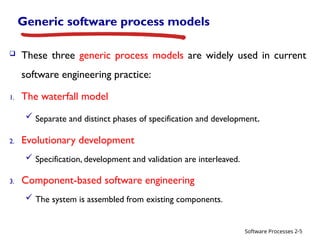
Generic software process models
 These three generic process models are widely used in current
software engineering practice:
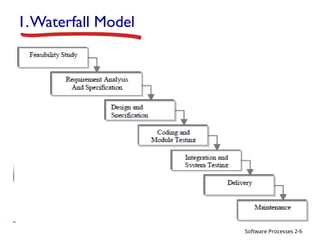
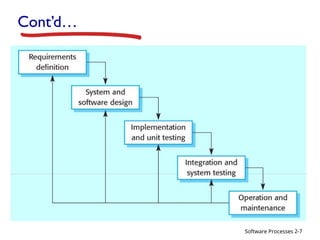
1. The waterfall model
 Separate and distinct phases of specification and development.
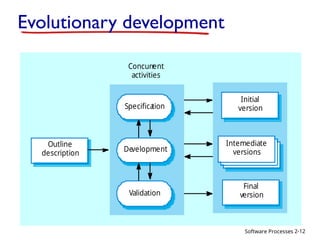
2. Evolutionary development
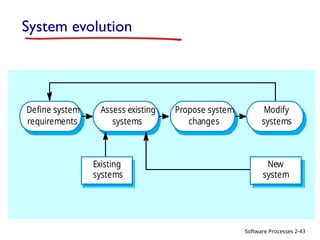
 Specification, development and validation are interleaved.
3. Component-based software engineering
 The system is assembled from existing components.
2-5
Software Processes
1.Waterfall Model
2-6
Software Processes
Cont’d…
2-7
Software Processes
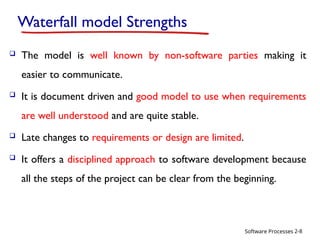
Waterfall model Strengths
 The model is well known by non-software parties making it
easier to communicate.
 It is document driven and good model to use when requirements
are well understood and are quite stable.
 Late changes to requirements or design are limited.
 It offers a disciplined approach to software development because
all the steps of the project can be clear from the beginning.
2-8
Software Processes
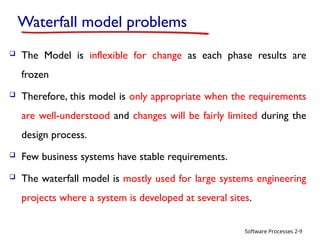
Waterfall model problems
 The Model is inflexible for change as each phase results are
frozen
 Therefore, this model is only appropriate when the requirements
are well-understood and changes will be fairly limited during the
design process.
 Few business systems have stable requirements.
 The waterfall model is mostly used for large systems engineering
projects where a system is developed at several sites.
2-9
Software Processes
When to use Waterfall model
 It works well for products that are well understood and
whose technical methodologies are also clear.
 It also works well for projects that are repeats of earlier
work such as migration, updates, new releases.
 When developing HRMS having had the experience of
similar reporting in the Payroll Systems.
2-10
Software Processes
2. Evolutionary(prototyping) development
 What is a Prototype?
It is a quickly developed,
easily modifiable and
extendible working model of the required application.
A prototype does not necessarily represent the complete
system.
2-11
Software Processes
Evolutionary development
2-12
Concurr
ent
activities
Validation
Final
version
Development
Inter
mediate
versions
Specifica
tion
Initial
version
Outline
description
Software Processes
Evolutionary development
 Problems
Lack of process visibility;
Systems are often poorly structured;
Special skills (e.g. in languages for rapid prototyping) may be
required.
 Applicability (when to use)
When requirement are not known at the beginning and unstable.
When quick demonstration required
For small or medium-size interactive systems;
For parts of large systems (e.g. the user interface);
For short-lifetime systems.
2-13
Software Processes
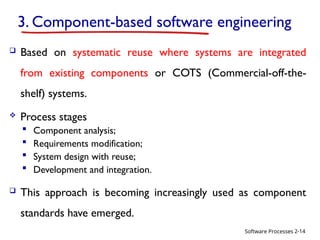
3. Component-based software engineering
 Based on systematic reuse where systems are integrated
from existing components or COTS (Commercial-off-the-
shelf) systems.
 Process stages
 Component analysis;
 Requirements modification;
 System design with reuse;
 Development and integration.
 This approach is becoming increasingly used as component
standards have emerged.
2-14
Software Processes 2-15
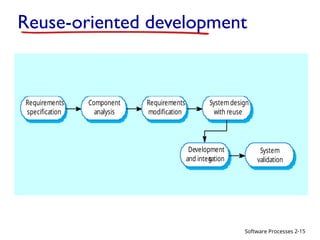
Reuse-oriented development
Requirements
specification
Component
analysis
Development
and integ
ration
System design
with reuse
Requirements
modification
System
validation
Software Processes
Chapter 2: roadmap
2.1 Software process and process models
2.2 Process iteration
2.3 Process activities
2.4 The Rational Unified Process
2.5 Computer-aided software engineering
2.6 Process assessment model and process metrics
2-16
Software Processes
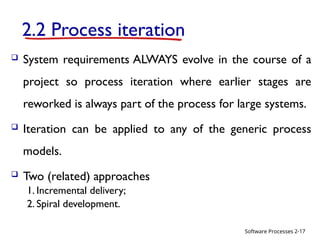
2.2 Process iteration
 System requirements ALWAYS evolve in the course of a
project so process iteration where earlier stages are
reworked is always part of the process for large systems.
 Iteration can be applied to any of the generic process
models.
 Two (related) approaches
1. Incremental delivery;
2. Spiral development.
2-17
Software Processes
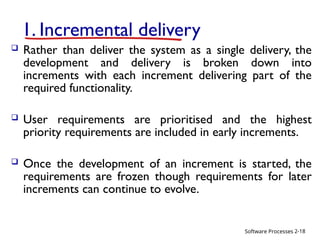
1. Incremental delivery
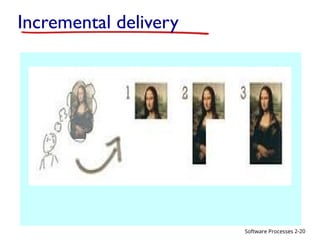
 Rather than deliver the system as a single delivery, the
development and delivery is broken down into
increments with each increment delivering part of the
required functionality.
 User requirements are prioritised and the highest
priority requirements are included in early increments.
 Once the development of an increment is started, the
requirements are frozen though requirements for later
increments can continue to evolve.
2-18
Software Processes
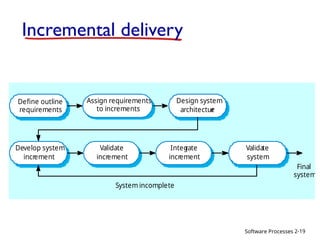
Incremental delivery
2-19
Validate
increment
Develop system
increment
Design system
architectur
e
Integ
rate
increment
Validate
system
Define outline
requirements
Assign requirements
to increments
System incomplete
Final
system
Software Processes
Incremental delivery
2-20
Software Processes
Incremental development advantages
 Customer value can be delivered with each increment so
system functionality is available earlier.
 Early increments act as a prototype to help elicit
requirements for later increments.
 Lower risk of overall project failure.
 The highest priority system services tend to receive the
most testing.
2-21
Software Processes
Incremental development Weakness
 Use of the Incremental Model requires careful
partitioning of the system.
 Total cost is higher than waterfall.
 Lack of early planning may cause project management
problems: unknown schedules, budgets and deliverables.
2-22
Software Processes
When to use Incremental development
 When requirements are understood in the early stages
but can change during the project‘s life cycle.
 With lengthy projects.
 When new technology is being used.
 When it is too risky to develop the overall system as
one block.
2-23
Software Processes
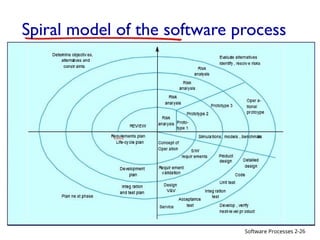
2. Spiral development
 Process is represented as a spiral rather than as a
sequence of activities with backtracking.
 Each loop in the spiral represents a phase in the process.
 No fixed phases such as specification or design - loops in
the spiral are chosen depending on what is required.
 Risks are explicitly assessed and resolved throughout the
process.
2-24
Software Processes
Spiral model sector
 Objective setting
 Specific objectives for the phase are identified.
 Risk assessment and reduction
 Risks are assessed and activities put in place to reduce the key risks.
 Development and validation
 A development model for the system is chosen which can be any
of the generic models.
 Planning
 The project is reviewed and the next phase of the spiral is planned.
2-25
Software Processes
Spiral model of the software process
2-26
Software Processes
Spiral development
 Weakness
It requires excellent project management skills.
It demands expert knowledge of risk analysis and management.
 When to use
Projects that would benefit the most are those that would be
built on untested assumptions.
2-27
Software Processes
Chapter 2: roadmap
2.1 Software process and process models
2.2 Process iteration
2.3 Process activities
2.4 The Rational Unified Process
2.5 Computer-aided software engineering
2.6 Process assessment model and process metrics
2-28
Software Processes
2.3 Process activities
2.3.1. Software specification
2.3.2. Software design and implementation
2.3.3. Software validation
2.3.4. Software evolution
2-29
Software Processes
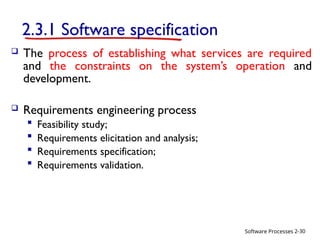
2.3.1 Software specification
 The process of establishing what services are required
and the constraints on the system’s operation and
development.
 Requirements engineering process
 Feasibility study;
 Requirements elicitation and analysis;
 Requirements specification;
 Requirements validation.
2-30
Software Processes
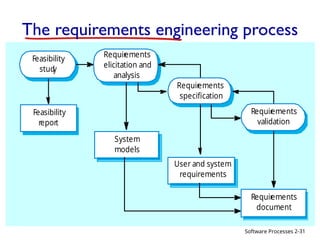
The requirements engineering process
2-31
Feasibility
stud
y
Requir
ements
elicitation and
analysis
Requir
ements
specification
Requir
ements
validation
Feasibility
report
System
models
User and system
requirements
Requir
ements
document
Software Processes
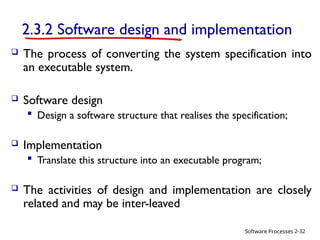
2.3.2 Software design and implementation
 The process of converting the system specification into
an executable system.
 Software design
 Design a software structure that realises the specification;
 Implementation
 Translate this structure into an executable program;
 The activities of design and implementation are closely
related and may be inter-leaved
2-32
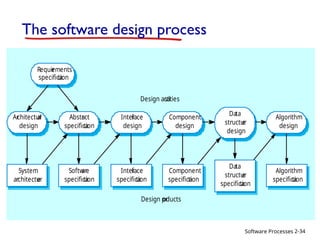
Software Processes
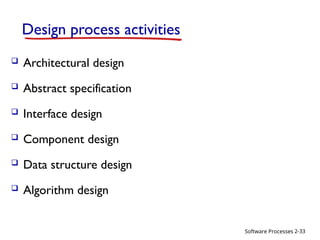
Design process activities
 Architectural design
 Abstract specification
 Interface design
 Component design
 Data structure design
 Algorithm design
2-33
Software Processes
The software design process
2-34
Ar
chitectur
al
design
Abstr
act
specifica
tion
Inter
face
design
Component
design
Data
structur
e
design
Algorithm
design
System
architectur
e
Softw
are
specifica
tion
Inter
face
specifica
tion
Component
specifica
tion
Data
structur
e
specifica
tion
Algorithm
specifica
tion
Requir
ements
specifica
tion
Design acti
vities
Design pr
oducts
Software Processes
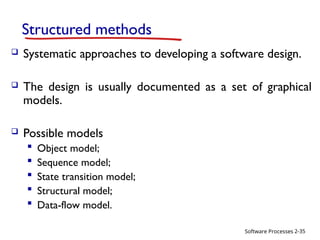
Structured methods
 Systematic approaches to developing a software design.
 The design is usually documented as a set of graphical
models.
 Possible models
 Object model;
 Sequence model;
 State transition model;
 Structural model;
 Data-flow model.
2-35
Software Processes
Programming and debugging
 Translating a design into a program and removing errors
from that program.
 Programming is a personal activity - there is no generic
programming process.
 Programmers carry out some program testing to
discover faults in the program and remove these faults in
the debugging process.
2-36
Software Processes
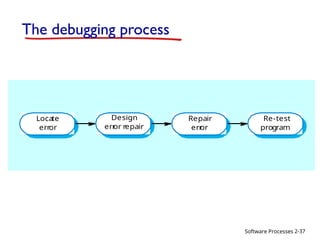
The debugging process
2-37
Loca
te
error
Design
err
or repair
Repair
err
or
Re-test
program
Software Processes
2.3.3 Software validation
 Verification and validation (V & V) is intended to show
that a system conforms to its specification and meets the
requirements of the system customer.
 Involves checking and review processes and system
testing.
 System testing involves executing the system with test
cases that are derived from the specification of the real
data to be processed by the system.
2-38
Software Processes
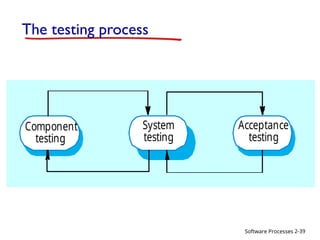
The testing process
2-39
Component
testing
System
testing
Acceptance
testing
Software Processes
Testing stages
 Component or unit testing
 Individual components are tested independently;
 Components may be functions or objects or coherent
groupings of these entities.
 System testing
 Testing of the system as a whole. Testing of emergent
properties is particularly important.
 Acceptance testing (alpha testing)
 Testing with customer data to check that the system meets the
customer’s needs.
2-40
Software Processes
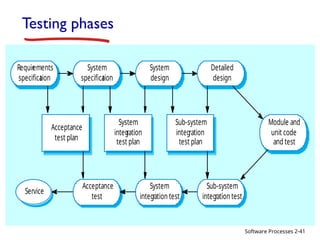
Testing phases
2-41
Requirements
specifica
tion
System
specifica
tion
System
design
Detailed
design
Module and
unit code
and test
Sub-system
integration
test plan
System
integ
ration
test plan
Acceptance
test plan
Service
Acceptance
test
System
integration test
Sub-system
integration test
Software Processes
2.3.4 Software evolution
 Software is inherently flexible and can change.
 As requirements change through changing business
circumstances, the software that supports the business
must also evolve and change.
 Although there has been a distinction between
development and evolution (maintenance) this is
increasingly irrelevant as fewer and fewer systems are
completely new.
2-42
Software Processes
System evolution
2-43
Assess existing
systems
Define system
requirements
Propose system
changes
Modify
systems
New
system
Existing
systems
Software Processes
Chapter 2: roadmap
2.1 Software process and process models
2.2 Process iteration
2.3 Process activities
2.4 The Rational Unified Process
2.5 Computer-aided software engineering
2.6 Process assessment model and process metrics
2-44
Software Processes
2.4 The Rational Unified Process
Reading Assignment
2-45
Software Processes
Chapter 2: roadmap
2.1 Software process and process models
2.2 Process iteration
2.3 Process activities
2.4 The Rational Unified Process
2.5 Computer-aided software engineering
2.6 Process assessment model and process metrics
2-46
Software Processes
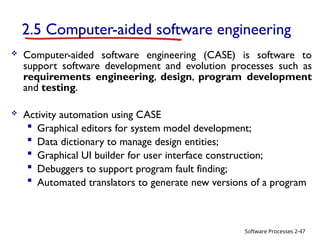
2.5 Computer-aided software engineering
 Computer-aided software engineering (CASE) is software to
support software development and evolution processes such as
requirements engineering, design, program development
and testing.
 Activity automation using CASE
 Graphical editors for system model development;
 Data dictionary to manage design entities;
 Graphical UI builder for user interface construction;
 Debuggers to support program fault finding;
 Automated translators to generate new versions of a program
2-47
Software Processes
Chapter 2: roadmap
2.1 Software process and process models
2.2 Process iteration
2.3 Process activities
2.4 The Rational Unified Process
2.5 Computer-aided software engineering
2.6 Process assessment model and process metrics
2-48
Software Processes
2.6 Process assessment model and process metrics
 A software process assessment is an appraisal, or review,
performed by a trained team of software professionals.
 Its purpose is፡
 to determine the current state of an organization's software
process,
 to identify the highest priority process issues, and
 to facilitate improvement actions.
 A good assessment requires a competent team, sound
leadership, and a cooperative organization.
2-49
Software Processes
Software Metrics
 Software metric relates the individual measures in some
way (e.g., the average number of errors found per review.
 A software engineer collects measures and develops
metrics so that indicators will be obtained.
 An indicator is a metric or combination of metrics that
provide insight into the software process, a software
project, or the product itself.
2-50
Software Processes
Why Measure Software
 Software projects are famous for running over schedule
and budget, yet still having quality problems.
 Software measurement lets one to quantify schedule,
work effort, product size, project status, and quality
performance.
 If one don‘t measure the current performance and use
the data to improve the future work estimates, those
estimates will just be guesses.
2-51
Software Processes
What to Measure
 One can measure many aspects of the software
products, projects, and processes.
 The trick is to select a small and balanced set of metrics
that will help the organization track progress toward its
goals.
2-52
software engineering lecture note two .ppt

  • 1.
    Software Processes 2-1 Chapter2 Software processes By: Tekalign B. Adapted from Ian Sommerville 2006, Software Engineering, 8th edition. Chapter 4
  • 2.
    Software Processes Chapter 2:Objectives  To introduce software process models  To describe three generic process models and when they maybe used  To describe outline process models for requirements engineering, software development, testing and evolution 2-2
  • 3.
    Software Processes Chapter 2:roadmap 2.1 Software process and process models 2.2 Process iteration 2.3 Process activities 2.4 The Rational Unified Process 2.5 Computer-aided software engineering 2.6 Process assessment model and process metrics 2-3
  • 4.
    Software Processes 2.1 Softwareprocess and process models  Software process is a structured set of activities required to develop a software system:  There are many software processes but all involve:  Specification;  Design and implementation;  Validation;  Evolution.  A software process model is an abstract representation of a process. It presents a description of a process from some particular perspective. 2-4
  • 5.
    Software Processes Generic softwareprocess models  These three generic process models are widely used in current software engineering practice: 1. The waterfall model  Separate and distinct phases of specification and development. 2. Evolutionary development  Specification, development and validation are interleaved. 3. Component-based software engineering  The system is assembled from existing components. 2-5
  • 6.
  • 7.
  • 8.
    Software Processes Waterfall modelStrengths  The model is well known by non-software parties making it easier to communicate.  It is document driven and good model to use when requirements are well understood and are quite stable.  Late changes to requirements or design are limited.  It offers a disciplined approach to software development because all the steps of the project can be clear from the beginning. 2-8
  • 9.
    Software Processes Waterfall modelproblems  The Model is inflexible for change as each phase results are frozen  Therefore, this model is only appropriate when the requirements are well-understood and changes will be fairly limited during the design process.  Few business systems have stable requirements.  The waterfall model is mostly used for large systems engineering projects where a system is developed at several sites. 2-9
  • 10.
    Software Processes When touse Waterfall model  It works well for products that are well understood and whose technical methodologies are also clear.  It also works well for projects that are repeats of earlier work such as migration, updates, new releases.  When developing HRMS having had the experience of similar reporting in the Payroll Systems. 2-10
  • 11.
    Software Processes 2. Evolutionary(prototyping)development  What is a Prototype? It is a quickly developed, easily modifiable and extendible working model of the required application. A prototype does not necessarily represent the complete system. 2-11
  • 12.
  • 13.
    Software Processes Evolutionary development Problems Lack of process visibility; Systems are often poorly structured; Special skills (e.g. in languages for rapid prototyping) may be required.  Applicability (when to use) When requirement are not known at the beginning and unstable. When quick demonstration required For small or medium-size interactive systems; For parts of large systems (e.g. the user interface); For short-lifetime systems. 2-13
  • 14.
    Software Processes 3. Component-basedsoftware engineering  Based on systematic reuse where systems are integrated from existing components or COTS (Commercial-off-the- shelf) systems.  Process stages  Component analysis;  Requirements modification;  System design with reuse;  Development and integration.  This approach is becoming increasingly used as component standards have emerged. 2-14
  • 15.
    Software Processes 2-15 Reuse-orienteddevelopment Requirements specification Component analysis Development and integ ration System design with reuse Requirements modification System validation
  • 16.
    Software Processes Chapter 2:roadmap 2.1 Software process and process models 2.2 Process iteration 2.3 Process activities 2.4 The Rational Unified Process 2.5 Computer-aided software engineering 2.6 Process assessment model and process metrics 2-16
  • 17.
    Software Processes 2.2 Processiteration  System requirements ALWAYS evolve in the course of a project so process iteration where earlier stages are reworked is always part of the process for large systems.  Iteration can be applied to any of the generic process models.  Two (related) approaches 1. Incremental delivery; 2. Spiral development. 2-17
  • 18.
    Software Processes 1. Incrementaldelivery  Rather than deliver the system as a single delivery, the development and delivery is broken down into increments with each increment delivering part of the required functionality.  User requirements are prioritised and the highest priority requirements are included in early increments.  Once the development of an increment is started, the requirements are frozen though requirements for later increments can continue to evolve. 2-18
  • 19.
    Software Processes Incremental delivery 2-19 Validate increment Developsystem increment Design system architectur e Integ rate increment Validate system Define outline requirements Assign requirements to increments System incomplete Final system
  • 20.
  • 21.
    Software Processes Incremental developmentadvantages  Customer value can be delivered with each increment so system functionality is available earlier.  Early increments act as a prototype to help elicit requirements for later increments.  Lower risk of overall project failure.  The highest priority system services tend to receive the most testing. 2-21
  • 22.
    Software Processes Incremental developmentWeakness  Use of the Incremental Model requires careful partitioning of the system.  Total cost is higher than waterfall.  Lack of early planning may cause project management problems: unknown schedules, budgets and deliverables. 2-22
  • 23.
    Software Processes When touse Incremental development  When requirements are understood in the early stages but can change during the project‘s life cycle.  With lengthy projects.  When new technology is being used.  When it is too risky to develop the overall system as one block. 2-23
  • 24.
    Software Processes 2. Spiraldevelopment  Process is represented as a spiral rather than as a sequence of activities with backtracking.  Each loop in the spiral represents a phase in the process.  No fixed phases such as specification or design - loops in the spiral are chosen depending on what is required.  Risks are explicitly assessed and resolved throughout the process. 2-24
  • 25.
    Software Processes Spiral modelsector  Objective setting  Specific objectives for the phase are identified.  Risk assessment and reduction  Risks are assessed and activities put in place to reduce the key risks.  Development and validation  A development model for the system is chosen which can be any of the generic models.  Planning  The project is reviewed and the next phase of the spiral is planned. 2-25
  • 26.
    Software Processes Spiral modelof the software process 2-26
  • 27.
    Software Processes Spiral development Weakness It requires excellent project management skills. It demands expert knowledge of risk analysis and management.  When to use Projects that would benefit the most are those that would be built on untested assumptions. 2-27
  • 28.
    Software Processes Chapter 2:roadmap 2.1 Software process and process models 2.2 Process iteration 2.3 Process activities 2.4 The Rational Unified Process 2.5 Computer-aided software engineering 2.6 Process assessment model and process metrics 2-28
  • 29.
    Software Processes 2.3 Processactivities 2.3.1. Software specification 2.3.2. Software design and implementation 2.3.3. Software validation 2.3.4. Software evolution 2-29
  • 30.
    Software Processes 2.3.1 Softwarespecification  The process of establishing what services are required and the constraints on the system’s operation and development.  Requirements engineering process  Feasibility study;  Requirements elicitation and analysis;  Requirements specification;  Requirements validation. 2-30
  • 31.
    Software Processes The requirementsengineering process 2-31 Feasibility stud y Requir ements elicitation and analysis Requir ements specification Requir ements validation Feasibility report System models User and system requirements Requir ements document
  • 32.
    Software Processes 2.3.2 Softwaredesign and implementation  The process of converting the system specification into an executable system.  Software design  Design a software structure that realises the specification;  Implementation  Translate this structure into an executable program;  The activities of design and implementation are closely related and may be inter-leaved 2-32
  • 33.
    Software Processes Design processactivities  Architectural design  Abstract specification  Interface design  Component design  Data structure design  Algorithm design 2-33
  • 34.
    Software Processes The softwaredesign process 2-34 Ar chitectur al design Abstr act specifica tion Inter face design Component design Data structur e design Algorithm design System architectur e Softw are specifica tion Inter face specifica tion Component specifica tion Data structur e specifica tion Algorithm specifica tion Requir ements specifica tion Design acti vities Design pr oducts
  • 35.
    Software Processes Structured methods Systematic approaches to developing a software design.  The design is usually documented as a set of graphical models.  Possible models  Object model;  Sequence model;  State transition model;  Structural model;  Data-flow model. 2-35
  • 36.
    Software Processes Programming anddebugging  Translating a design into a program and removing errors from that program.  Programming is a personal activity - there is no generic programming process.  Programmers carry out some program testing to discover faults in the program and remove these faults in the debugging process. 2-36
  • 37.
    Software Processes The debuggingprocess 2-37 Loca te error Design err or repair Repair err or Re-test program
  • 38.
    Software Processes 2.3.3 Softwarevalidation  Verification and validation (V & V) is intended to show that a system conforms to its specification and meets the requirements of the system customer.  Involves checking and review processes and system testing.  System testing involves executing the system with test cases that are derived from the specification of the real data to be processed by the system. 2-38
  • 39.
    Software Processes The testingprocess 2-39 Component testing System testing Acceptance testing
  • 40.
    Software Processes Testing stages Component or unit testing  Individual components are tested independently;  Components may be functions or objects or coherent groupings of these entities.  System testing  Testing of the system as a whole. Testing of emergent properties is particularly important.  Acceptance testing (alpha testing)  Testing with customer data to check that the system meets the customer’s needs. 2-40
  • 41.
    Software Processes Testing phases 2-41 Requirements specifica tion System specifica tion System design Detailed design Moduleand unit code and test Sub-system integration test plan System integ ration test plan Acceptance test plan Service Acceptance test System integration test Sub-system integration test
  • 42.
    Software Processes 2.3.4 Softwareevolution  Software is inherently flexible and can change.  As requirements change through changing business circumstances, the software that supports the business must also evolve and change.  Although there has been a distinction between development and evolution (maintenance) this is increasingly irrelevant as fewer and fewer systems are completely new. 2-42
  • 43.
    Software Processes System evolution 2-43 Assessexisting systems Define system requirements Propose system changes Modify systems New system Existing systems
  • 44.
    Software Processes Chapter 2:roadmap 2.1 Software process and process models 2.2 Process iteration 2.3 Process activities 2.4 The Rational Unified Process 2.5 Computer-aided software engineering 2.6 Process assessment model and process metrics 2-44
  • 45.
    Software Processes 2.4 TheRational Unified Process Reading Assignment 2-45
  • 46.
    Software Processes Chapter 2:roadmap 2.1 Software process and process models 2.2 Process iteration 2.3 Process activities 2.4 The Rational Unified Process 2.5 Computer-aided software engineering 2.6 Process assessment model and process metrics 2-46
  • 47.
    Software Processes 2.5 Computer-aidedsoftware engineering  Computer-aided software engineering (CASE) is software to support software development and evolution processes such as requirements engineering, design, program development and testing.  Activity automation using CASE  Graphical editors for system model development;  Data dictionary to manage design entities;  Graphical UI builder for user interface construction;  Debuggers to support program fault finding;  Automated translators to generate new versions of a program 2-47
  • 48.
    Software Processes Chapter 2:roadmap 2.1 Software process and process models 2.2 Process iteration 2.3 Process activities 2.4 The Rational Unified Process 2.5 Computer-aided software engineering 2.6 Process assessment model and process metrics 2-48
  • 49.
    Software Processes 2.6 Processassessment model and process metrics  A software process assessment is an appraisal, or review, performed by a trained team of software professionals.  Its purpose is፡  to determine the current state of an organization's software process,  to identify the highest priority process issues, and  to facilitate improvement actions.  A good assessment requires a competent team, sound leadership, and a cooperative organization. 2-49
  • 50.
    Software Processes Software Metrics Software metric relates the individual measures in some way (e.g., the average number of errors found per review.  A software engineer collects measures and develops metrics so that indicators will be obtained.  An indicator is a metric or combination of metrics that provide insight into the software process, a software project, or the product itself. 2-50
  • 51.
    Software Processes Why MeasureSoftware  Software projects are famous for running over schedule and budget, yet still having quality problems.  Software measurement lets one to quantify schedule, work effort, product size, project status, and quality performance.  If one don‘t measure the current performance and use the data to improve the future work estimates, those estimates will just be guesses. 2-51
  • 52.
    Software Processes What toMeasure  One can measure many aspects of the software products, projects, and processes.  The trick is to select a small and balanced set of metrics that will help the organization track progress toward its goals. 2-52