Chapter 15
The Renaissance
© 2018 Cengage Learning. All Rights Reserved. May not be scanned, copied or duplicated, or posted to a publicly accessible website, in whole or in part.
Three General Categories of Theatre
 Popular Theatre
 Simple comedies and dramas for the common
people
 Humanist Theatre
 Based on imitating the ancient Greek and
Roman drama
 Liturgical Drama
 Based on Biblical stories and church traditions
© 2018 Cengage Learning. All Rights Reserved. May not be scanned, copied or duplicated, or posted to a publicly accessible website, in whole or in part.
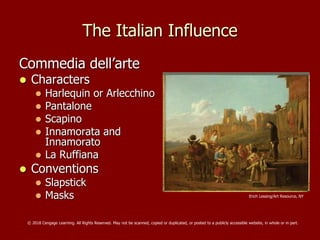
The Italian Influence
Commedia dell’arte
 Characters
 Harlequin or Arlecchino
 Pantalone
 Scapino
 Innamorata and
Innamorato
 La Ruffiana
 Conventions
 Slapstick
 Masks Erich Lessing/Art Resource, NY
© 2018 Cengage Learning. All Rights Reserved. May not be scanned, copied or duplicated, or posted to a publicly accessible website, in whole or in part.
Classical Correctness
(Slide 1 of 2)
 Aristotle (Rediscovered)
 First complete edition of his writings was
published in 1531
 The Poetics
 The Three Unities
 Unity of time—Action of the play takes place within 24
hours
 Unity of place—Settings of the play can be reached
within 24 hours
 Unity of action—Comedy and tragedy should not take
place within the same play
© 2018 Cengage Learning. All Rights Reserved. May not be scanned, copied or duplicated, or posted to a publicly accessible website, in whole or in part.
Classical Correctness
(Slide 2 of 2)
 Declamatory Acting Style
 Based on their interpretation of how they
think the Greeks performed their plays
 Delivered lines directly to the audience in a
presentational style
 Other scholars believed that ancient Greek
plays were entirely sung, which led to a new
type of theatre at the end of the sixteenth
century called opera
© 2018 Cengage Learning. All Rights Reserved. May not be scanned, copied or duplicated, or posted to a publicly accessible website, in whole or in part.
Italian Perspective Scenery
(Slide 1 of 2)
 In 1414 De Architectura, an encyclopedic
text by Roman architect Vitruvius, was
rediscovered
 Filippo Brunelleschi (1377-1446) is credited
with inventing perspective painting
 Proscenium arch
 Raked stage
 Upstage
 Downstage
© 2018 Cengage Learning. All Rights Reserved. May not be scanned, copied or duplicated, or posted to a publicly accessible website, in whole or in part.
Italian Perspective Scenery
(Slide 2 of 2)
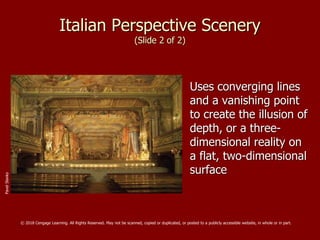
Uses converging lines
and a vanishing point
to create the illusion of
depth, or a three-
dimensional reality on
a flat, two-dimensional
surface
PavelSlavko
© 2018 Cengage Learning. All Rights Reserved. May not be scanned, copied or duplicated, or posted to a publicly accessible website, in whole or in part.
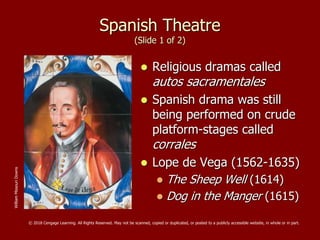
Spanish Theatre
(Slide 1 of 2)
 Religious dramas called
autos sacramentales
 Spanish drama was still
being performed on crude
platform-stages called
corrales
 Lope de Vega (1562-1635)
 The Sheep Well (1614)
 Dog in the Manger (1615)
WilliamMissouriDowns
© 2018 Cengage Learning. All Rights Reserved. May not be scanned, copied or duplicated, or posted to a publicly accessible website, in whole or in part.
Spanish Theatre
(Slide 2 of 2)
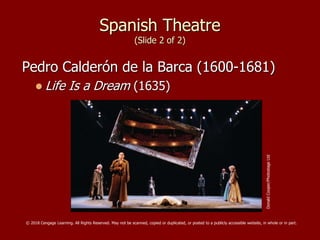
Pedro Calderón de la Barca (1600-1681)
 Life Is a Dream (1635)
DonaldCooper/PhotostageLtd
© 2018 Cengage Learning. All Rights Reserved. May not be scanned, copied or duplicated, or posted to a publicly accessible website, in whole or in part.
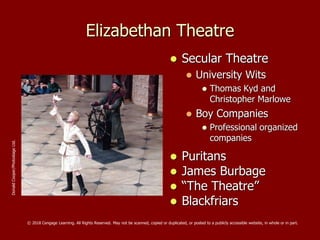
Elizabethan Theatre
 Secular Theatre
 University Wits
 Thomas Kyd and
Christopher Marlowe
 Boy Companies
 Professional organized
companies
 Puritans
 James Burbage
 “The Theatre”
 Blackfriars
DonaldCooper/PhotostageLtd.
© 2018 Cengage Learning. All Rights Reserved. May not be scanned, copied or duplicated, or posted to a publicly accessible website, in whole or in part.
The Rose Theatre
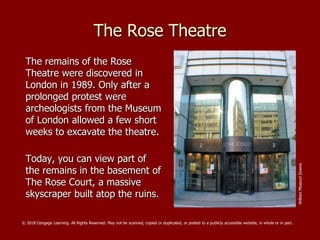
The remains of the Rose
Theatre were discovered in
London in 1989. Only after a
prolonged protest were
archeologists from the Museum
of London allowed a few short
weeks to excavate the theatre.
Today, you can view part of
the remains in the basement of
The Rose Court, a massive
skyscraper built atop the ruins.
WilliamMissouriDowns
© 2018 Cengage Learning. All Rights Reserved. May not be scanned, copied or duplicated, or posted to a publicly accessible website, in whole or in part.
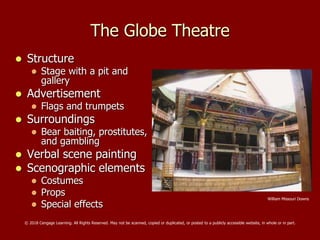
The Globe Theatre
 Structure
 Stage with a pit and
gallery
 Advertisement
 Flags and trumpets
 Surroundings
 Bear baiting, prostitutes,
and gambling
 Verbal scene painting
 Scenographic elements
 Costumes
 Props
 Special effects
William Missouri Downs
© 2018 Cengage Learning. All Rights Reserved. May not be scanned, copied or duplicated, or posted to a publicly accessible website, in whole or in part.
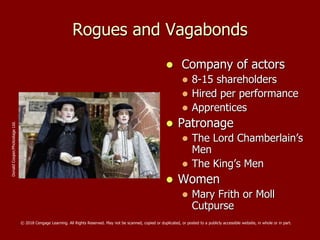
Rogues and Vagabonds
 Company of actors
 8-15 shareholders
 Hired per performance
 Apprentices
 Patronage
 The Lord Chamberlain’s
Men
 The King’s Men
 Women
 Mary Frith or Moll
Cutpurse
DonaldCooper/PhotostageLtd.
© 2018 Cengage Learning. All Rights Reserved. May not be scanned, copied or duplicated, or posted to a publicly accessible website, in whole or in part.
Shakespeare’s Contemporaries
(Slide 1 of 2)
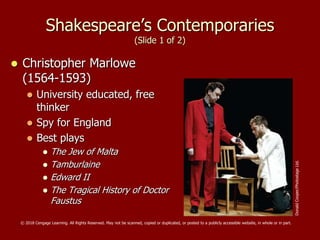
 Christopher Marlowe
(1564-1593)
 University educated, free
thinker
 Spy for England
 Best plays
 The Jew of Malta
 Tamburlaine
 Edward II
 The Tragical History of Doctor
Faustus
DonaldCooper/PhotostageLtd.
© 2018 Cengage Learning. All Rights Reserved. May not be scanned, copied or duplicated, or posted to a publicly accessible website, in whole or in part.
Shakespeare’s Contemporaries
(Slide 2 of 2)
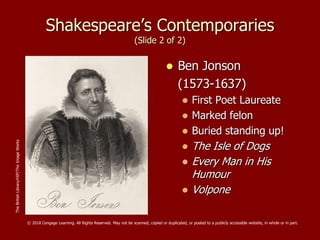
 Ben Jonson
(1573-1637)
 First Poet Laureate
 Marked felon
 Buried standing up!
 The Isle of Dogs
 Every Man in His
Humour
 Volpone
TheBritishLibrary/HIP/TheImageWorks
© 2018 Cengage Learning. All Rights Reserved. May not be scanned, copied or duplicated, or posted to a publicly accessible website, in whole or in part.
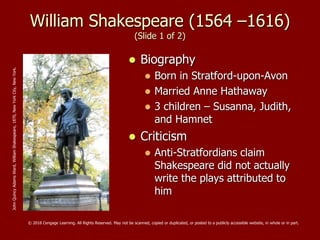
William Shakespeare (1564 –1616)
(Slide 1 of 2)
 Biography
 Born in Stratford-upon-Avon
 Married Anne Hathaway
 3 children – Susanna, Judith,
and Hamnet
 Criticism
 Anti-Stratfordians claim
Shakespeare did not actually
write the plays attributed to
him
JohnQuincyAdamsWard,WilliamShakespeare,1870,NewYorkCity,NewYork.
© 2018 Cengage Learning. All Rights Reserved. May not be scanned, copied or duplicated, or posted to a publicly accessible website, in whole or in part.
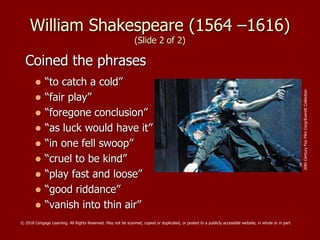
William Shakespeare (1564 –1616)
(Slide 2 of 2)
Coined the phrases
 “to catch a cold”
 “fair play”
 “foregone conclusion”
 “as luck would have it”
 “in one fell swoop”
 “cruel to be kind”
 “play fast and loose”
 “good riddance”
 “vanish into thin air”
20thCenturyFoxFilmCorp/EverettCollection
© 2018 Cengage Learning. All Rights Reserved. May not be scanned, copied or duplicated, or posted to a publicly accessible website, in whole or in part.
Masques to Puritans
 Masques were the most popular form of theatre
at court
 Grand dances, extravagant costumes, lavish spectacle
 William Prynne (1600-1669)
 The Players Scourge
 Oliver Cromwell (1599-1658)
 Puritan leader who took over government
 Puritans ordered all theatres in London demolished in
1648; they would stay dark for the next 18 years
© 2018 Cengage Learning. All Rights Reserved. May not be scanned, copied or duplicated, or posted to a publicly accessible website, in whole or in part.
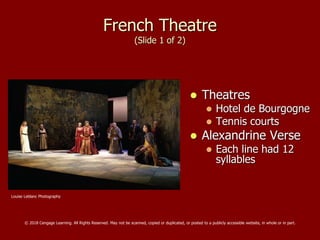
French Theatre
(Slide 1 of 2)
 Theatres
 Hotel de Bourgogne
 Tennis courts
 Alexandrine Verse
 Each line had 12
syllables
Louise Leblanc Photography
© 2018 Cengage Learning. All Rights Reserved. May not be scanned, copied or duplicated, or posted to a publicly accessible website, in whole or in part.
French Theatre
(Slide 2 of 2)
 Pierre Corneille (1606-1684)
 “The rule breaker”
 Le Cid
 Jean Racine (1639-1699)
 “The rule advocate”
 Phaedra
 Molière (1622-1673)
 “The risk taker”
 Tartuffe, The Doctor in Spite of Himself, The
Imaginary Invalid, Don Juan
© 2018 Cengage Learning. All Rights Reserved. May not be scanned, copied or duplicated, or posted to a publicly accessible website, in whole or in part.
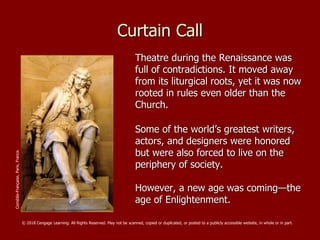
Curtain Call
Theatre during the Renaissance was
full of contradictions. It moved away
from its liturgical roots, yet it was now
rooted in rules even older than the
Church.
Some of the world’s greatest writers,
actors, and designers were honored
but were also forced to live on the
periphery of society.
However, a new age was coming—the
age of Enlightenment.
Comédie-Française,Paris,France.
© 2018 Cengage Learning. All Rights Reserved. May not be scanned, copied or duplicated, or posted to a publicly accessible website, in whole or in part.

Chapter 15 Renaissance

  • 1.
    Chapter 15 The Renaissance ©2018 Cengage Learning. All Rights Reserved. May not be scanned, copied or duplicated, or posted to a publicly accessible website, in whole or in part.
  • 2.
    Three General Categoriesof Theatre  Popular Theatre  Simple comedies and dramas for the common people  Humanist Theatre  Based on imitating the ancient Greek and Roman drama  Liturgical Drama  Based on Biblical stories and church traditions © 2018 Cengage Learning. All Rights Reserved. May not be scanned, copied or duplicated, or posted to a publicly accessible website, in whole or in part.
  • 3.
    The Italian Influence Commediadell’arte  Characters  Harlequin or Arlecchino  Pantalone  Scapino  Innamorata and Innamorato  La Ruffiana  Conventions  Slapstick  Masks Erich Lessing/Art Resource, NY © 2018 Cengage Learning. All Rights Reserved. May not be scanned, copied or duplicated, or posted to a publicly accessible website, in whole or in part.
  • 4.
    Classical Correctness (Slide 1of 2)  Aristotle (Rediscovered)  First complete edition of his writings was published in 1531  The Poetics  The Three Unities  Unity of time—Action of the play takes place within 24 hours  Unity of place—Settings of the play can be reached within 24 hours  Unity of action—Comedy and tragedy should not take place within the same play © 2018 Cengage Learning. All Rights Reserved. May not be scanned, copied or duplicated, or posted to a publicly accessible website, in whole or in part.
  • 5.
    Classical Correctness (Slide 2of 2)  Declamatory Acting Style  Based on their interpretation of how they think the Greeks performed their plays  Delivered lines directly to the audience in a presentational style  Other scholars believed that ancient Greek plays were entirely sung, which led to a new type of theatre at the end of the sixteenth century called opera © 2018 Cengage Learning. All Rights Reserved. May not be scanned, copied or duplicated, or posted to a publicly accessible website, in whole or in part.
  • 6.
    Italian Perspective Scenery (Slide1 of 2)  In 1414 De Architectura, an encyclopedic text by Roman architect Vitruvius, was rediscovered  Filippo Brunelleschi (1377-1446) is credited with inventing perspective painting  Proscenium arch  Raked stage  Upstage  Downstage © 2018 Cengage Learning. All Rights Reserved. May not be scanned, copied or duplicated, or posted to a publicly accessible website, in whole or in part.
  • 7.
    Italian Perspective Scenery (Slide2 of 2) Uses converging lines and a vanishing point to create the illusion of depth, or a three- dimensional reality on a flat, two-dimensional surface PavelSlavko © 2018 Cengage Learning. All Rights Reserved. May not be scanned, copied or duplicated, or posted to a publicly accessible website, in whole or in part.
  • 8.
    Spanish Theatre (Slide 1of 2)  Religious dramas called autos sacramentales  Spanish drama was still being performed on crude platform-stages called corrales  Lope de Vega (1562-1635)  The Sheep Well (1614)  Dog in the Manger (1615) WilliamMissouriDowns © 2018 Cengage Learning. All Rights Reserved. May not be scanned, copied or duplicated, or posted to a publicly accessible website, in whole or in part.
  • 9.
    Spanish Theatre (Slide 2of 2) Pedro Calderón de la Barca (1600-1681)  Life Is a Dream (1635) DonaldCooper/PhotostageLtd © 2018 Cengage Learning. All Rights Reserved. May not be scanned, copied or duplicated, or posted to a publicly accessible website, in whole or in part.
  • 10.
    Elizabethan Theatre  SecularTheatre  University Wits  Thomas Kyd and Christopher Marlowe  Boy Companies  Professional organized companies  Puritans  James Burbage  “The Theatre”  Blackfriars DonaldCooper/PhotostageLtd. © 2018 Cengage Learning. All Rights Reserved. May not be scanned, copied or duplicated, or posted to a publicly accessible website, in whole or in part.
  • 11.
    The Rose Theatre Theremains of the Rose Theatre were discovered in London in 1989. Only after a prolonged protest were archeologists from the Museum of London allowed a few short weeks to excavate the theatre. Today, you can view part of the remains in the basement of The Rose Court, a massive skyscraper built atop the ruins. WilliamMissouriDowns © 2018 Cengage Learning. All Rights Reserved. May not be scanned, copied or duplicated, or posted to a publicly accessible website, in whole or in part.
  • 12.
    The Globe Theatre Structure  Stage with a pit and gallery  Advertisement  Flags and trumpets  Surroundings  Bear baiting, prostitutes, and gambling  Verbal scene painting  Scenographic elements  Costumes  Props  Special effects William Missouri Downs © 2018 Cengage Learning. All Rights Reserved. May not be scanned, copied or duplicated, or posted to a publicly accessible website, in whole or in part.
  • 13.
    Rogues and Vagabonds Company of actors  8-15 shareholders  Hired per performance  Apprentices  Patronage  The Lord Chamberlain’s Men  The King’s Men  Women  Mary Frith or Moll Cutpurse DonaldCooper/PhotostageLtd. © 2018 Cengage Learning. All Rights Reserved. May not be scanned, copied or duplicated, or posted to a publicly accessible website, in whole or in part.
  • 14.
    Shakespeare’s Contemporaries (Slide 1of 2)  Christopher Marlowe (1564-1593)  University educated, free thinker  Spy for England  Best plays  The Jew of Malta  Tamburlaine  Edward II  The Tragical History of Doctor Faustus DonaldCooper/PhotostageLtd. © 2018 Cengage Learning. All Rights Reserved. May not be scanned, copied or duplicated, or posted to a publicly accessible website, in whole or in part.
  • 15.
    Shakespeare’s Contemporaries (Slide 2of 2)  Ben Jonson (1573-1637)  First Poet Laureate  Marked felon  Buried standing up!  The Isle of Dogs  Every Man in His Humour  Volpone TheBritishLibrary/HIP/TheImageWorks © 2018 Cengage Learning. All Rights Reserved. May not be scanned, copied or duplicated, or posted to a publicly accessible website, in whole or in part.
  • 16.
    William Shakespeare (1564–1616) (Slide 1 of 2)  Biography  Born in Stratford-upon-Avon  Married Anne Hathaway  3 children – Susanna, Judith, and Hamnet  Criticism  Anti-Stratfordians claim Shakespeare did not actually write the plays attributed to him JohnQuincyAdamsWard,WilliamShakespeare,1870,NewYorkCity,NewYork. © 2018 Cengage Learning. All Rights Reserved. May not be scanned, copied or duplicated, or posted to a publicly accessible website, in whole or in part.
  • 17.
    William Shakespeare (1564–1616) (Slide 2 of 2) Coined the phrases  “to catch a cold”  “fair play”  “foregone conclusion”  “as luck would have it”  “in one fell swoop”  “cruel to be kind”  “play fast and loose”  “good riddance”  “vanish into thin air” 20thCenturyFoxFilmCorp/EverettCollection © 2018 Cengage Learning. All Rights Reserved. May not be scanned, copied or duplicated, or posted to a publicly accessible website, in whole or in part.
  • 18.
    Masques to Puritans Masques were the most popular form of theatre at court  Grand dances, extravagant costumes, lavish spectacle  William Prynne (1600-1669)  The Players Scourge  Oliver Cromwell (1599-1658)  Puritan leader who took over government  Puritans ordered all theatres in London demolished in 1648; they would stay dark for the next 18 years © 2018 Cengage Learning. All Rights Reserved. May not be scanned, copied or duplicated, or posted to a publicly accessible website, in whole or in part.
  • 19.
    French Theatre (Slide 1of 2)  Theatres  Hotel de Bourgogne  Tennis courts  Alexandrine Verse  Each line had 12 syllables Louise Leblanc Photography © 2018 Cengage Learning. All Rights Reserved. May not be scanned, copied or duplicated, or posted to a publicly accessible website, in whole or in part.
  • 20.
    French Theatre (Slide 2of 2)  Pierre Corneille (1606-1684)  “The rule breaker”  Le Cid  Jean Racine (1639-1699)  “The rule advocate”  Phaedra  Molière (1622-1673)  “The risk taker”  Tartuffe, The Doctor in Spite of Himself, The Imaginary Invalid, Don Juan © 2018 Cengage Learning. All Rights Reserved. May not be scanned, copied or duplicated, or posted to a publicly accessible website, in whole or in part.
  • 21.
    Curtain Call Theatre duringthe Renaissance was full of contradictions. It moved away from its liturgical roots, yet it was now rooted in rules even older than the Church. Some of the world’s greatest writers, actors, and designers were honored but were also forced to live on the periphery of society. However, a new age was coming—the age of Enlightenment. Comédie-Française,Paris,France. © 2018 Cengage Learning. All Rights Reserved. May not be scanned, copied or duplicated, or posted to a publicly accessible website, in whole or in part.