Chinese Peking
Opera
A C T I V I T Y
VIDEOCLIP PRESENTATION
Peking Opera
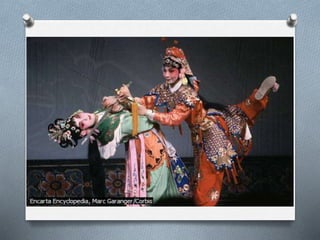
Peking Opera, in Beijing, China, combines
music, acrobatic dance, and spectacular
costumes to tell stories from Chinese history
and folklore. Using abstract, symbolic gestures
rich in dramatic meaning, actors represent
personages from the heroic, divine, and animal
worlds, often in martial exploits. The traditional
features of the masklike makeup and elaborate
costumes immediately identify the characters to
a knowing audience.
Marc Garanger/Corbis
Microsoft ® Encarta ® 2009. © 1993-2008 Microsoft Corporation. All rights
reserved.
China is known for their
traditional theater art form, the
Peking opera or Beijing opera
which combines music, vocal
performance, pantomime, dance,
and acrobatics. It started in the late
18th century and became fully
developed and recognized by the
mid-19th century. During the Qing
Dynasty court it became extremely
popular and came to be regarded
as one of the cultural treasures of
China.
Roles and Characters
SHENG – the main
male role.
1. Xiaosheng
2. Wusheng
3. Laosheng
DAN – refers to any
female role.
1. Laodan
2. Wudan
3. Daomadan
4. Qingyi
5. Huadan
JING is a painted face male role
who plays either primary or
secondary roles. This type of role
entails a forceful character, which
means that a Jing actor must have
a strong voice and be able to
exaggerate gestures. The red color
denotes loyalty and goodness,
white denotes evil, and black
denotes integrity.
CHOU is a male clown role. The
Chou usually plays secondary
roles whose name also means
“ugly.” It reflects the traditional
belief that the clown’s
combination of ugliness and
laughter could drive away evil
spirits.
Visual Performance Elements
Performers utilize the four main skills:
1. Song
2. Speech
3. Dance-acting (includes pure dance,
pantomime, and all other types of dance)
4. Combat (includes both acrobatics and
fighting with all manner of weaponry)
Masks/Makeup Colors
O Red
O Black
O Yellow
O Purple
O Reddish purple
O Blue
O White
O Green
O Xiaohualian
Aesthetic Aims and Principles
of Movement
The highest aim of
performers in Peking opera is to
put beauty into every motion. The
art forms, gestures, settings,
music, and character types are
determined by long held
conventions.
Aesthetic Aims and Principles
of Movement
Conventions of movement include
the following:
1. Walking in a large circle always
symbolizes travelling a long distance.
2. A character straightening his or her
costume and headdress symbolizes
that an important character is about to
speak.
3. Pantomimic is the opening and closing
of doors and mounting and descending
stairs.
Staging and Costumes
OStage: square platforms, the action
on stage is usually visible from at
least three sides; the stages were
built above the line of sight of the
viewers, but some modern stages
have been constructed with higher
audience seating divided into two
parts by an embroidered curtain
called a shoujiu.
Staging and Costumes
O Costume: Xingtou, popularly known as
Xifu, in Chinese origins of Peking opera.
They enable the audience to distinguish a
character’s sex and status at first glance –
if noble or humble, civilian or military,
officials or private citizens, give
expression to sharp distinctions between
good and evil or loyal and wicked
characters. Oblong wings (chizi) attached
to a gauze hat indicate a loyal official. In
contrast, a corrupt official is made to wear
a gauze hat with rhomboidal wing.
Staging and Costumes
OProps: utilizes very few props, will
almost always have a table and at
least one chair, which can be turned
through convention into such
diverse objects as a city wall, a
mountain, or a bed. A whip is used
to indicate a horse, and an oar
symbolizes a boat.
Staging and Costumes
OMusicians: are visible to the
audience on the front part of the
stage.
OViewers: always seated south of
the stage, therefore, north is the
most important direction.
OPerformers: immediately move to
the center north upon entering the
stage. All characters enter from the
east and exit from the west.
Check-up Test
1. The Peking opera costume is called ______.
2. The performance element that includes both
acrobatics and fighting with all manner of
weaponry in Peking opera is _____.
3. ______ is the main male role in Peking
opera.
4. Red color on makeup in Peking opera
means _____.
5. These are the props always seen on stage
in Peking opera.
Check-up Test
1. The Peking opera costume is called
xingtou.
2. The performance element that includes both
acrobatics and fighting with all manner of
weaponry in Peking opera is combat.
3. Sheng is the main male role in Peking
opera.
4. Red color on makeup in Peking opera
means courage, bravery, & uprightness.
5. These are the props always seen on stage
in Peking opera. Chairs and tables

Chinese peking opera

  • 1.
  • 3.
    A C TI V I T Y VIDEOCLIP PRESENTATION
  • 4.
    Peking Opera Peking Opera,in Beijing, China, combines music, acrobatic dance, and spectacular costumes to tell stories from Chinese history and folklore. Using abstract, symbolic gestures rich in dramatic meaning, actors represent personages from the heroic, divine, and animal worlds, often in martial exploits. The traditional features of the masklike makeup and elaborate costumes immediately identify the characters to a knowing audience. Marc Garanger/Corbis Microsoft ® Encarta ® 2009. © 1993-2008 Microsoft Corporation. All rights reserved.
  • 5.
    China is knownfor their traditional theater art form, the Peking opera or Beijing opera which combines music, vocal performance, pantomime, dance, and acrobatics. It started in the late 18th century and became fully developed and recognized by the mid-19th century. During the Qing Dynasty court it became extremely popular and came to be regarded as one of the cultural treasures of China.
  • 6.
    Roles and Characters SHENG– the main male role. 1. Xiaosheng 2. Wusheng 3. Laosheng DAN – refers to any female role. 1. Laodan 2. Wudan 3. Daomadan 4. Qingyi 5. Huadan
  • 7.
    JING is apainted face male role who plays either primary or secondary roles. This type of role entails a forceful character, which means that a Jing actor must have a strong voice and be able to exaggerate gestures. The red color denotes loyalty and goodness, white denotes evil, and black denotes integrity.
  • 8.
    CHOU is amale clown role. The Chou usually plays secondary roles whose name also means “ugly.” It reflects the traditional belief that the clown’s combination of ugliness and laughter could drive away evil spirits.
  • 9.
    Visual Performance Elements Performersutilize the four main skills: 1. Song 2. Speech 3. Dance-acting (includes pure dance, pantomime, and all other types of dance) 4. Combat (includes both acrobatics and fighting with all manner of weaponry)
  • 10.
    Masks/Makeup Colors O Red OBlack O Yellow O Purple O Reddish purple O Blue O White O Green O Xiaohualian
  • 11.
    Aesthetic Aims andPrinciples of Movement The highest aim of performers in Peking opera is to put beauty into every motion. The art forms, gestures, settings, music, and character types are determined by long held conventions.
  • 12.
    Aesthetic Aims andPrinciples of Movement Conventions of movement include the following: 1. Walking in a large circle always symbolizes travelling a long distance. 2. A character straightening his or her costume and headdress symbolizes that an important character is about to speak. 3. Pantomimic is the opening and closing of doors and mounting and descending stairs.
  • 13.
    Staging and Costumes OStage:square platforms, the action on stage is usually visible from at least three sides; the stages were built above the line of sight of the viewers, but some modern stages have been constructed with higher audience seating divided into two parts by an embroidered curtain called a shoujiu.
  • 14.
    Staging and Costumes OCostume: Xingtou, popularly known as Xifu, in Chinese origins of Peking opera. They enable the audience to distinguish a character’s sex and status at first glance – if noble or humble, civilian or military, officials or private citizens, give expression to sharp distinctions between good and evil or loyal and wicked characters. Oblong wings (chizi) attached to a gauze hat indicate a loyal official. In contrast, a corrupt official is made to wear a gauze hat with rhomboidal wing.
  • 15.
    Staging and Costumes OProps:utilizes very few props, will almost always have a table and at least one chair, which can be turned through convention into such diverse objects as a city wall, a mountain, or a bed. A whip is used to indicate a horse, and an oar symbolizes a boat.
  • 16.
    Staging and Costumes OMusicians:are visible to the audience on the front part of the stage. OViewers: always seated south of the stage, therefore, north is the most important direction. OPerformers: immediately move to the center north upon entering the stage. All characters enter from the east and exit from the west.
  • 17.
    Check-up Test 1. ThePeking opera costume is called ______. 2. The performance element that includes both acrobatics and fighting with all manner of weaponry in Peking opera is _____. 3. ______ is the main male role in Peking opera. 4. Red color on makeup in Peking opera means _____. 5. These are the props always seen on stage in Peking opera.
  • 18.
    Check-up Test 1. ThePeking opera costume is called xingtou. 2. The performance element that includes both acrobatics and fighting with all manner of weaponry in Peking opera is combat. 3. Sheng is the main male role in Peking opera. 4. Red color on makeup in Peking opera means courage, bravery, & uprightness. 5. These are the props always seen on stage in Peking opera. Chairs and tables