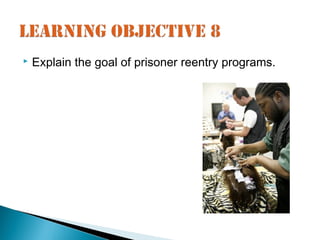
The goal of prisoner reentry programs is to reduce recidivism by helping inmates transition successfully back into the community through programs, services, and support that address barriers to reentry.
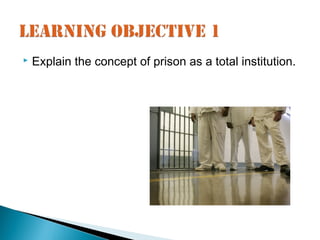
Explain the concept of prison as a total institution.
3.
Total institution – an institution that provides all of
the necessities for existence to those who live
within its boundaries.
Who is in Prison?
◦ An Aging Inmate Population
◦ An Ailing Inmate Population
4.
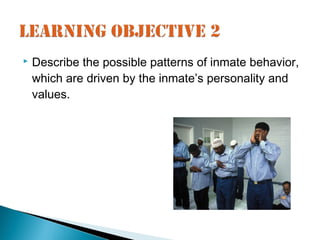
Describe the possible patterns of inmate behavior,
which are driven by the inmate’s personality and
values.
5.
Prisonization
– the socialization process through
which a new inmate leans the accepted norms
and values of the prison population
Adapting to Prison Culture:
◦ Doing time
◦ Jailing
◦ Gleaning
◦ Disorganized criminals
6.
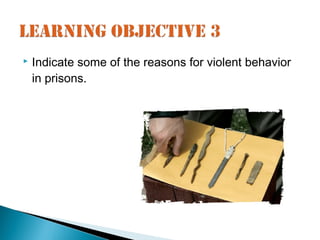
Indicate some of the reasons for violent behavior
in prisons.
7.
Violence in prison exists because:
◦ It establishes the prison hierarchy
◦ It provides a deterrent against being victimized
◦ It enhances self-image
◦ In the case of rape, it gives sexual relief
◦ It is a means of acquiring material goods
8.
Prison Rape:
Due to the nature of the inmate victimization, accurate
data is difficult to gather
Prison rape, like all rape, is an act of violence rather than
sex
Victims of prison rape are often at the bottom of the social
hierarchy in prisons, and suffer both physical and mental
trauma from their victimization
9.
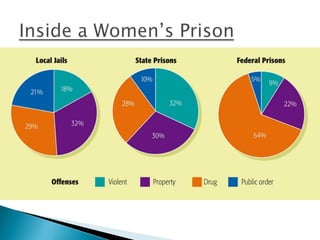
Characteristics of Female Inmates
◦ Most are racial or ethnic minorities between the ages of
30 and 39
◦ Most are incarcerated for nonviolent drug or property
offenses
◦ Distinguishing characteristic of female inmates is a
history of abuse
◦ Female inmates have an increased likelihood of health
problems when they are incarcerated
11.
A History of Abuse
The Motherhood Problem
◦ An estimated 7 out of every 10 female prisoners have at
least one minor child
Violence in Women’s Prisons
◦ Compared to men’s prisons, women exhibit low levels of
physical violence
The Pseudo Family
12.
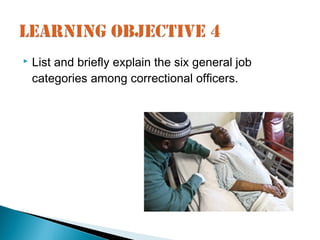
List and briefly explain the six general job
categories among correctional officers.
13.
Job categories amongcorrectional officers:
Block officers
Work detail supervisors
Industrial shop and school officers
Yard officers
Tower guards
Administrative building assignments
15.
Questions:
◦ Would you be interested in pursuing a career as a
correctional officer? Why or why not?
◦ What do you think would be the most challenging aspect
of this career?
16.
Discipline
•Sanctioning Prisoners
• Use of Force
Whitley vs. Albers (1986)
Hudson vs. McMillan (1992)
Protecting Prisoners’ Rights – “Hands-Off” Doctrine
The “Deliberate Indifference” Standard
“Identifiable Human Needs”
The First Amendment in Prison
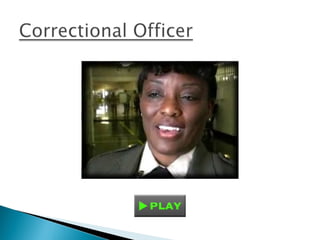
18.
Questions:
◦ Do you agree with the reforms suggested in the video?
Why or why not?
◦ What was your reaction to learn that often individuals
employed by Walmart earn more than those employed
as correctional officers? Does this have any impact on
the criminal justice system?
19.
Contrast probation, parole, mandatory release,
pardon, and furlough.
21.
Mandatory Release – Release from prison that occurs
when an offender has served the full length of his/her
sentence, minus an adjustments for good time
Pardon – An act of executive clemency that overturns a
conviction and erases mention of the crime from the
person’s criminal record
Furlough – Temporary release from a prison for
purposes of vocational or educational training, to ease
the shock of release, or for personal reasons
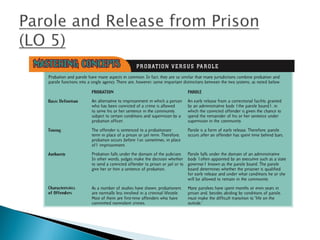
22.
Discretionary Release – the release of an inmate into
a community supervision program
◦ Eligibility for Parole
Under indeterminate sentencing, parole is not a right, but a
privilege
◦ Life Without Parole
24.
Questions:
◦ Discuss the importance of the role of a parole officer.
◦ What would be the most challenging aspect of this
career?
25.
Basic Roles ofthe Parole Board:
To decide which inmates should be given parole
To determine the conditions of parole
To discharge the offender when the conditions of parole
have been met
To determine whether or not parole privileges should be
revoked when a violation occurs.
26.
The Parole Hearing
Hearings are relatively short
Participants include the judge, attorneys, the
offender, law enforcement officers, and the victim
Parole guidelines attempt to measure risk of
recidivism
27.
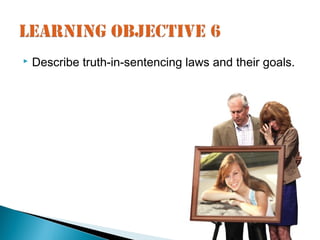
Describe truth-in-sentencing laws and their goals.
28.
The Goals ofTruth-in-Sentencing:
To restore “truth” to the sentencing process
To increase the percentage of the sentence that is
actually served
To better control the use of prison space
Prisoner reentry is a corrections strategy designed
to prepare inmates for a successful return to the
community and to reduce their criminal activity
after release.
Specifically focus on the transition from prison to
the community
Involve a treatment curriculum that continues after
release
31.
Parole is an agreement between the offender
and the state that establishes conditions by
which the offender will be released.
When a parolee breaks the conditions of parole,
the process of withdrawing parole and returning
the person to prison is called parole revocation.
Barriers to Reentry
◦ Challenges of Release
◦ The Threat of Relapse
Promoting Desistance
Preparation for Reentry Behind Bars
◦ Positive Reinforcement on Parole
◦ Work Release and Halfway Houses
The Special Case of Sex Offenders
◦ Sex Offender Notification Laws
◦ Active and Passive Notification
◦ Conditions of Release