UNU-EGOV and
Knowledge Societies Policy
Handbook Project
Tomasz Janowski
UNU-EGOV, Guimarães, Portugal
janowski@unu.edu
BUENOS AIRES, ARGENTINA, 7 MARCH 2016, 2UNU-EGOV AND KNOWLEDGE SOCIETIES POLICY HANDBOOK PROJECT
UNITED NATIONS UNIVERSITY (UNU)
IDENTITY
Global think tank and postgraduate teaching organization,
part of United Nations system
MISSION
To contribute, through collaborative research and education,
to efforts to resolve the pressing global problems of human
survival, development and welfare that are the concern of
the United Nations, its Peoples and Member States
GOALS
1. Advancement of knowledge relevant to the role and work of the United Nations
2. Formulating sound principles, policies, strategies and programs for action
3. A bridge between the international academic community and the UN system
4. Contributing to capacity building, particularly in developing countries.
BUENOS AIRES, ARGENTINA, 7 MARCH 2016, 3UNU-EGOV AND KNOWLEDGE SOCIETIES POLICY HANDBOOK PROJECT
UNU SYSTEM
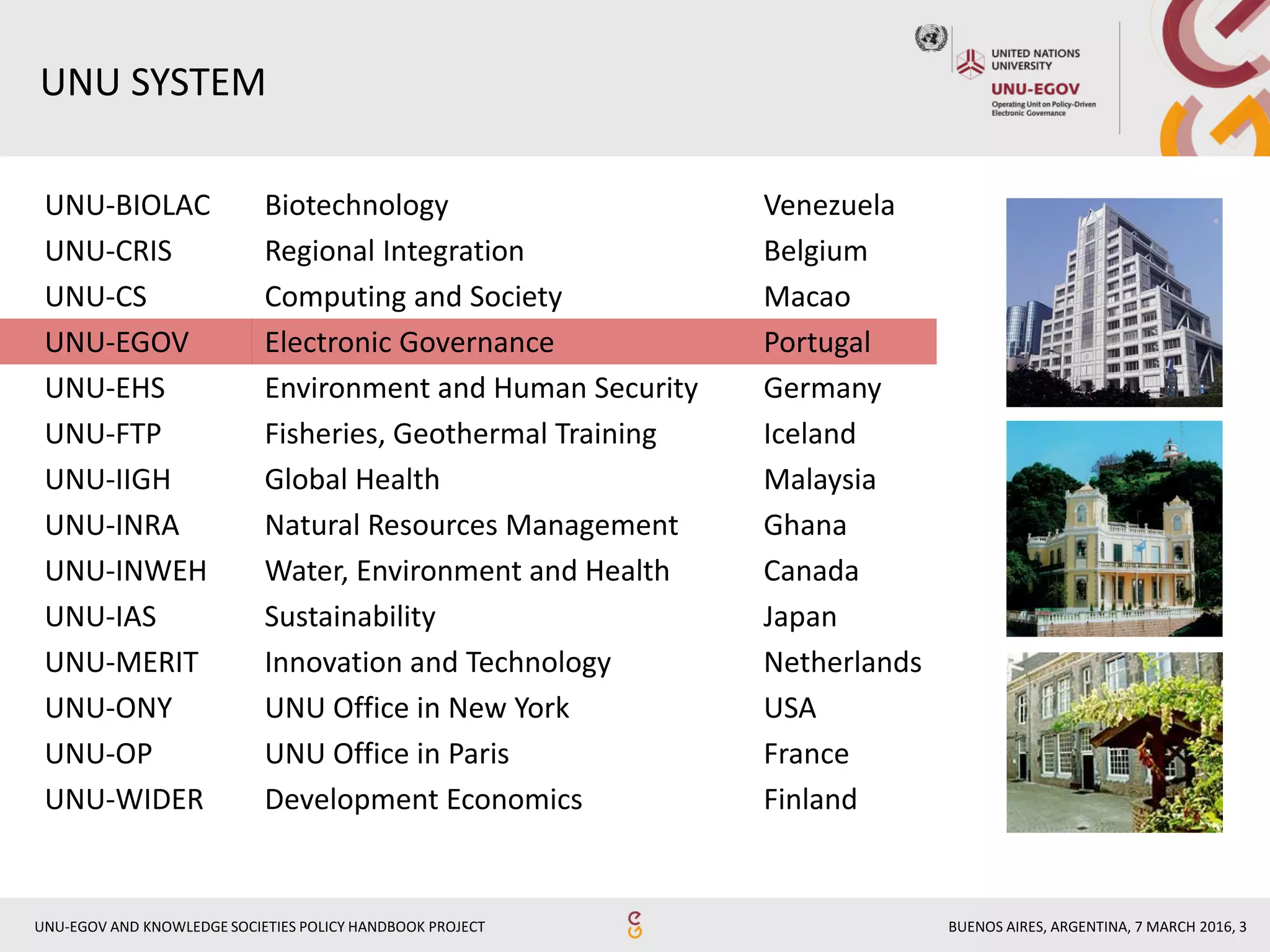
UNU-BIOLAC Biotechnology Venezuela
UNU-CRIS Regional Integration Belgium
UNU-CS Computing and Society Macao
UNU-EGOV Electronic Governance Portugal
UNU-EHS Environment and Human Security Germany
UNU-FTP Fisheries, Geothermal Training Iceland
UNU-IIGH Global Health Malaysia
UNU-INRA Natural Resources Management Ghana
UNU-INWEH Water, Environment and Health Canada
UNU-IAS Sustainability Japan
UNU-MERIT Innovation and Technology Netherlands
UNU-ONY UNU Office in New York USA
UNU-OP UNU Office in Paris France
UNU-WIDER Development Economics Finland
BUENOS AIRES, ARGENTINA, 7 MARCH 2016, 4UNU-EGOV AND KNOWLEDGE SOCIETIES POLICY HANDBOOK PROJECT
UNU-EGOV
NAME UNU Operating Unit on
Policy-Driven Electronic Governance
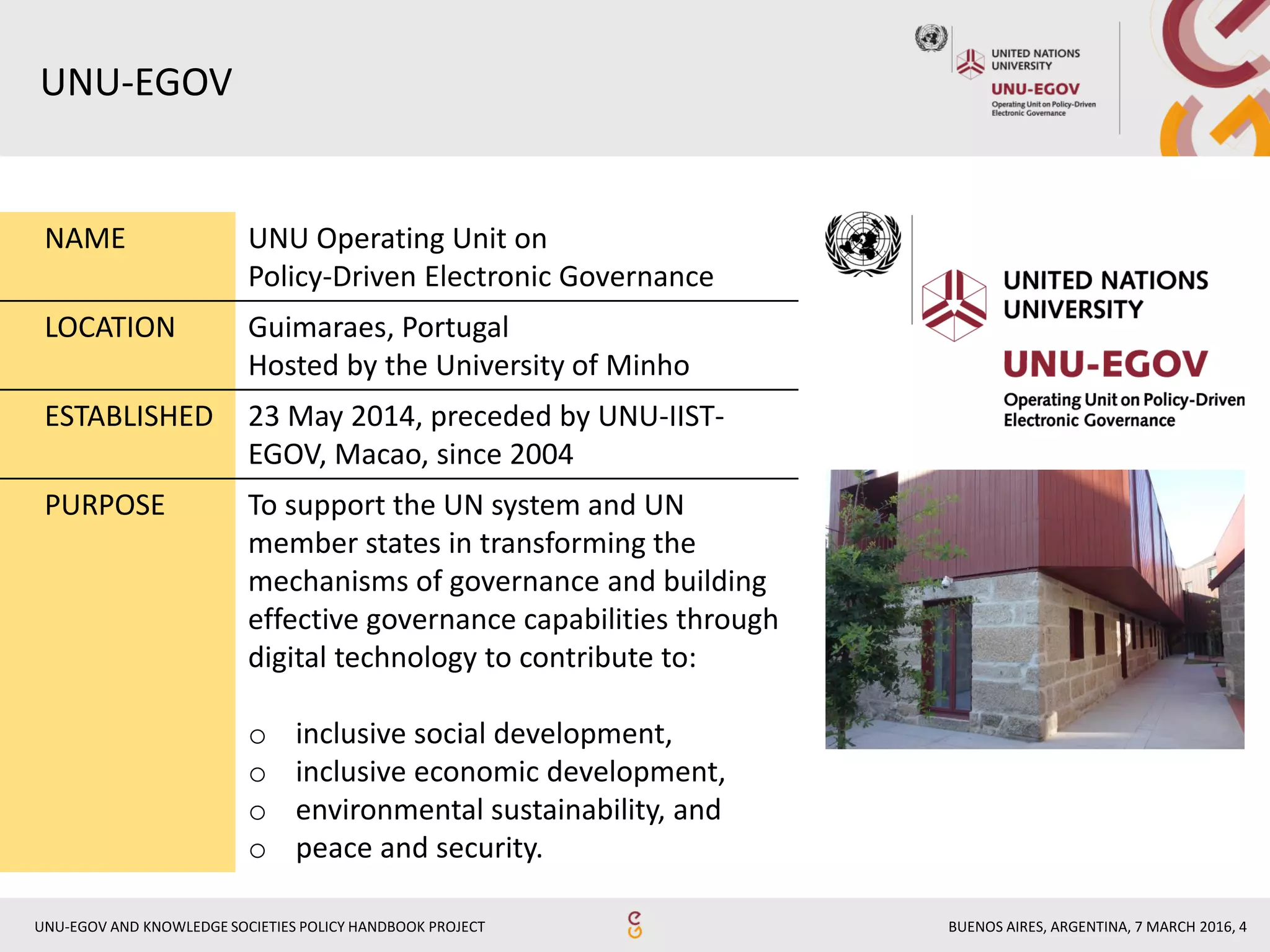
LOCATION Guimaraes, Portugal
Hosted by the University of Minho
ESTABLISHED 23 May 2014, preceded by UNU-IIST-
EGOV, Macao, since 2004
PURPOSE To support the UN system and UN
member states in transforming the
mechanisms of governance and building
effective governance capabilities through
digital technology to contribute to:
o inclusive social development,
o inclusive economic development,
o environmental sustainability, and
o peace and security.
BUENOS AIRES, ARGENTINA, 7 MARCH 2016, 5UNU-EGOV AND KNOWLEDGE SOCIETIES POLICY HANDBOOK PROJECT
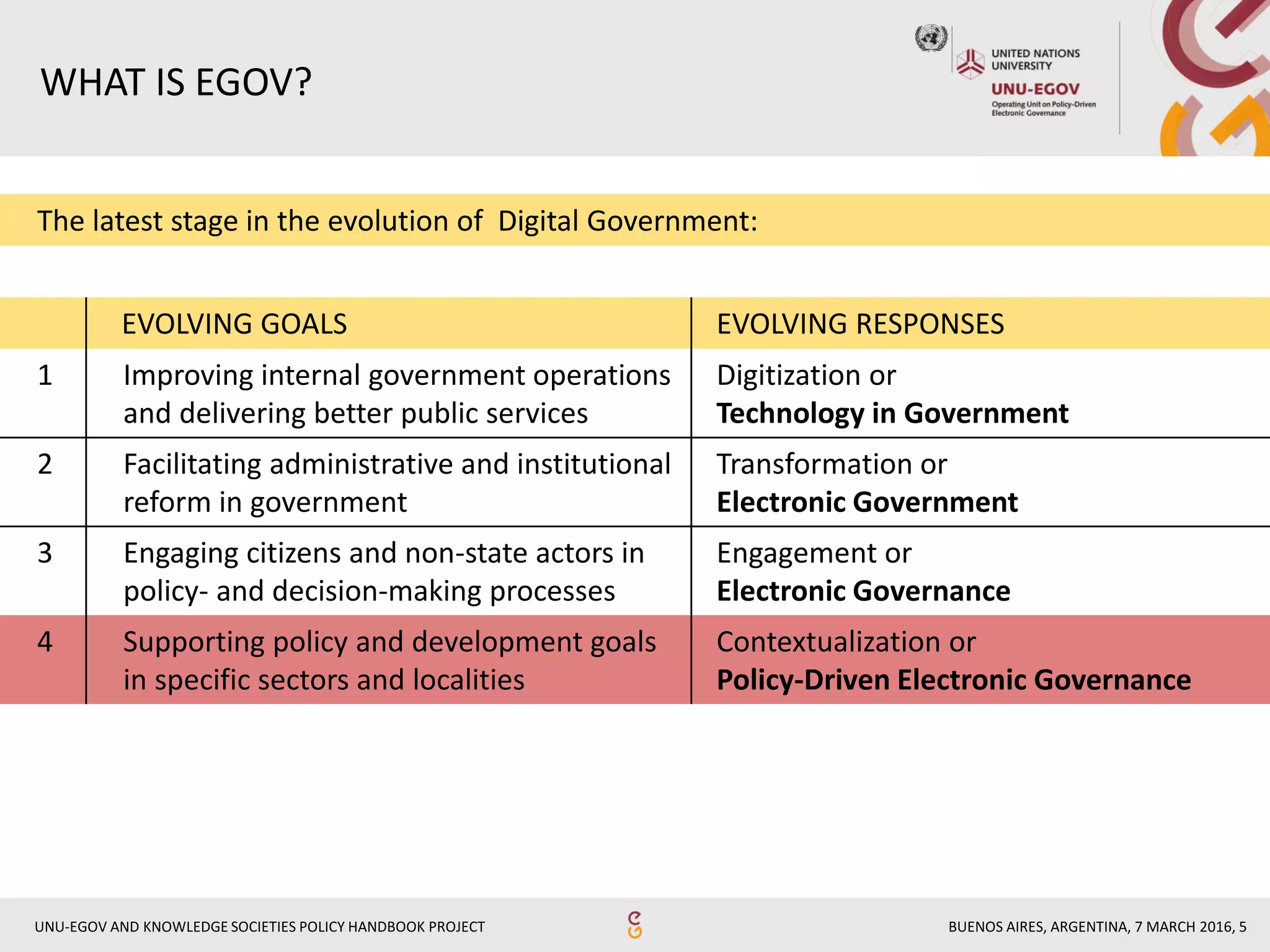
WHAT IS EGOV?
The latest stage in the evolution of Digital Government:
EVOLVING GOALS EVOLVING RESPONSES
1 Improving internal government operations
and delivering better public services
Digitization or
Technology in Government
2 Facilitating administrative and institutional
reform in government
Transformation or
Electronic Government
3 Engaging citizens and non-state actors in
policy- and decision-making processes
Engagement or
Electronic Governance
4 Supporting policy and development goals
in specific sectors and localities
Contextualization or
Policy-Driven Electronic Governance
BUENOS AIRES, ARGENTINA, 7 MARCH 2016, 6UNU-EGOV AND KNOWLEDGE SOCIETIES POLICY HANDBOOK PROJECT
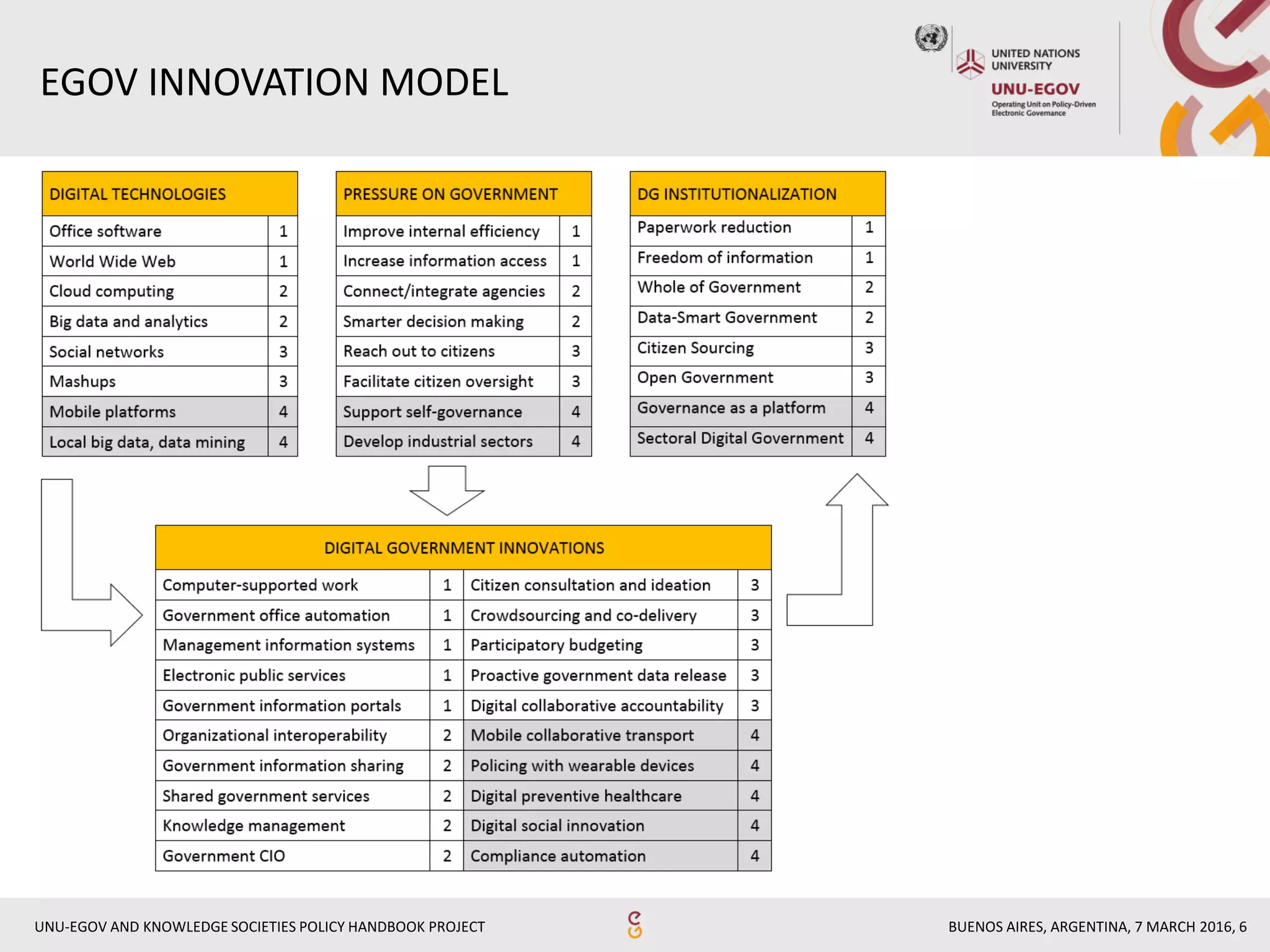
EGOV INNOVATION MODEL
BUENOS AIRES, ARGENTINA, 7 MARCH 2016, 7UNU-EGOV AND KNOWLEDGE SOCIETIES POLICY HANDBOOK PROJECT
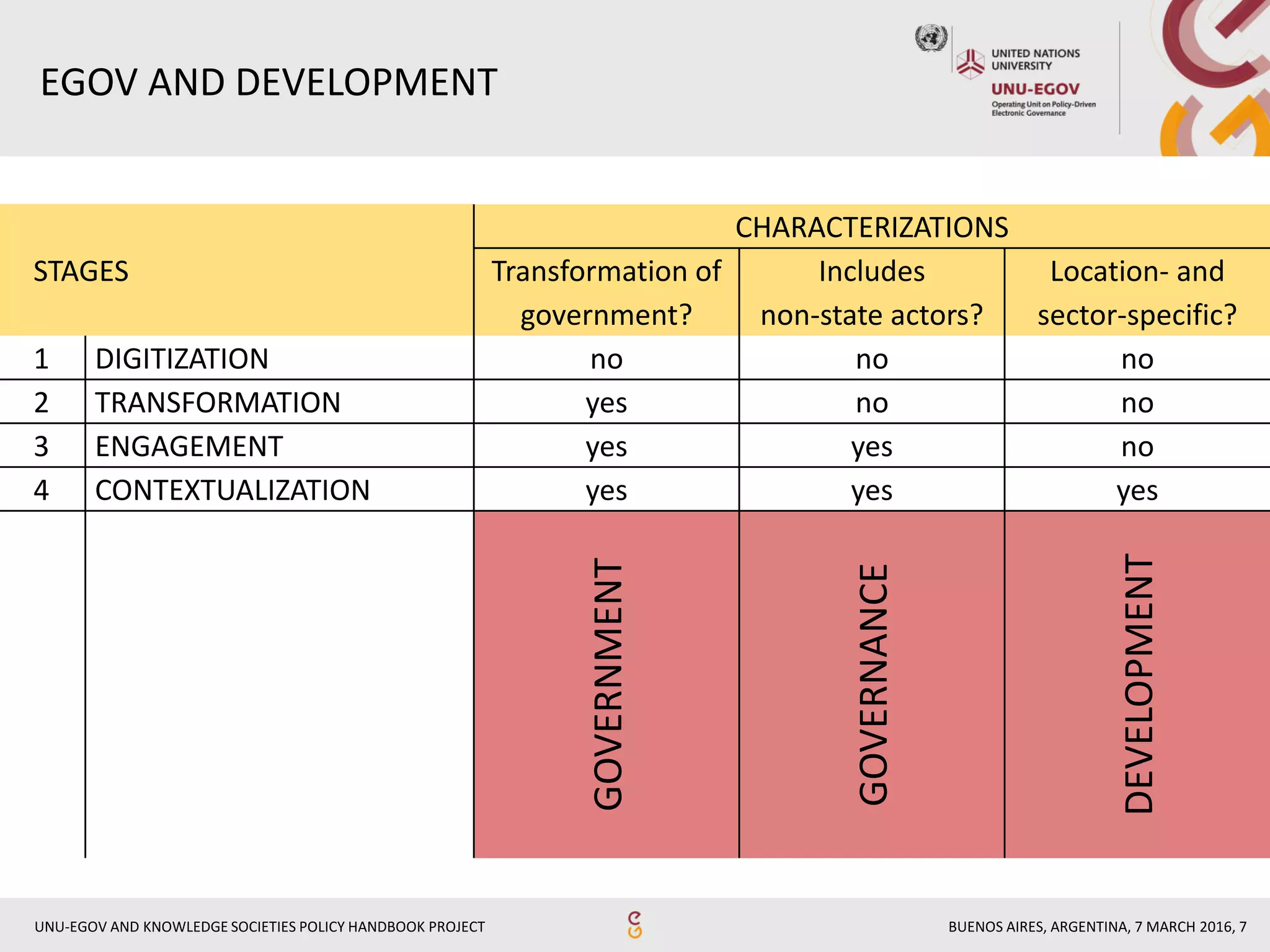
EGOV AND DEVELOPMENT
STAGES
CHARACTERIZATIONS
Transformation of
government?
Includes
non-state actors?
Location- and
sector-specific?
1 DIGITIZATION no no no
2 TRANSFORMATION yes no no
3 ENGAGEMENT yes yes no
4 CONTEXTUALIZATION yes yes yes
GOVERNMENT
GOVERNANCE
DEVELOPMENT
BUENOS AIRES, ARGENTINA, 7 MARCH 2016, 8UNU-EGOV AND KNOWLEDGE SOCIETIES POLICY HANDBOOK PROJECT
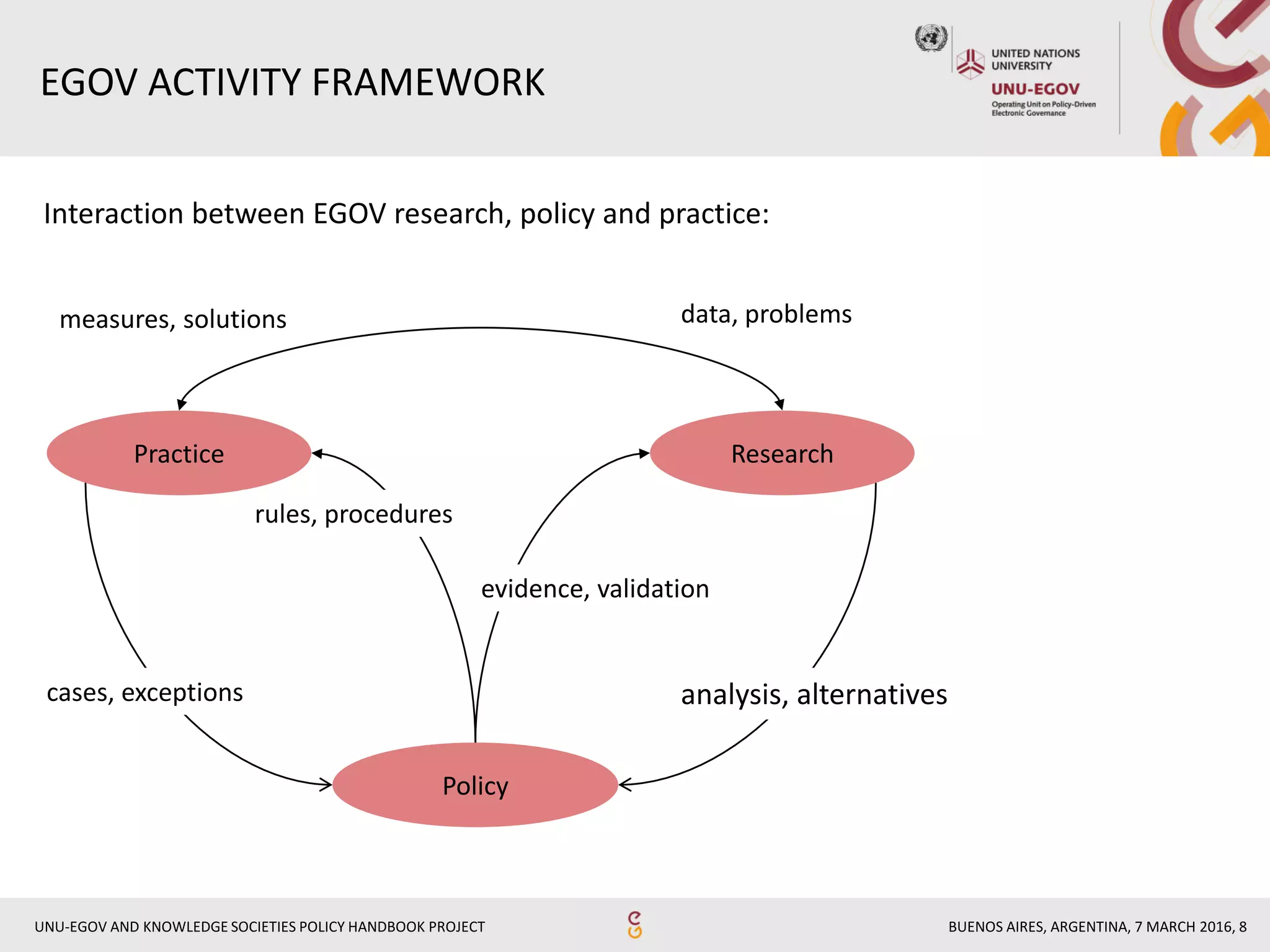
EGOV ACTIVITY FRAMEWORK
Practice Research
Policy
cases, exceptions
evidence, validation
data, problems
rules, procedures
analysis, alternatives
measures, solutions
Interaction between EGOV research, policy and practice:
BUENOS AIRES, ARGENTINA, 7 MARCH 2016, 9UNU-EGOV AND KNOWLEDGE SOCIETIES POLICY HANDBOOK PROJECT
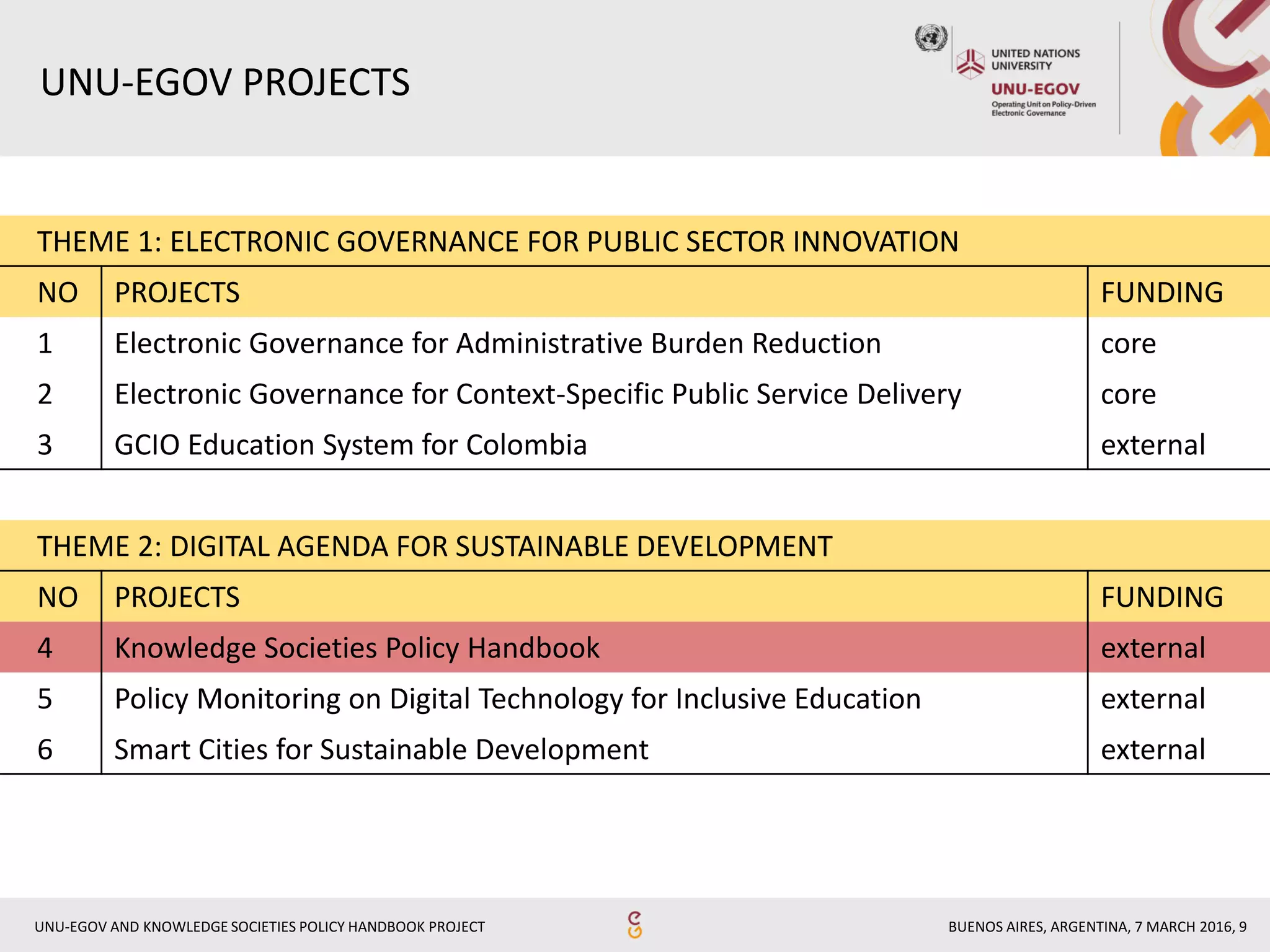
UNU-EGOV PROJECTS
THEME 1: ELECTRONIC GOVERNANCE FOR PUBLIC SECTOR INNOVATION
NO PROJECTS FUNDING
1 Electronic Governance for Administrative Burden Reduction core
2 Electronic Governance for Context-Specific Public Service Delivery core
3 GCIO Education System for Colombia external
THEME 2: DIGITAL AGENDA FOR SUSTAINABLE DEVELOPMENT
NO PROJECTS FUNDING
4 Knowledge Societies Policy Handbook external
5 Policy Monitoring on Digital Technology for Inclusive Education external
6 Smart Cities for Sustainable Development external
BUENOS AIRES, ARGENTINA, 7 MARCH 2016, 10UNU-EGOV AND KNOWLEDGE SOCIETIES POLICY HANDBOOK PROJECT
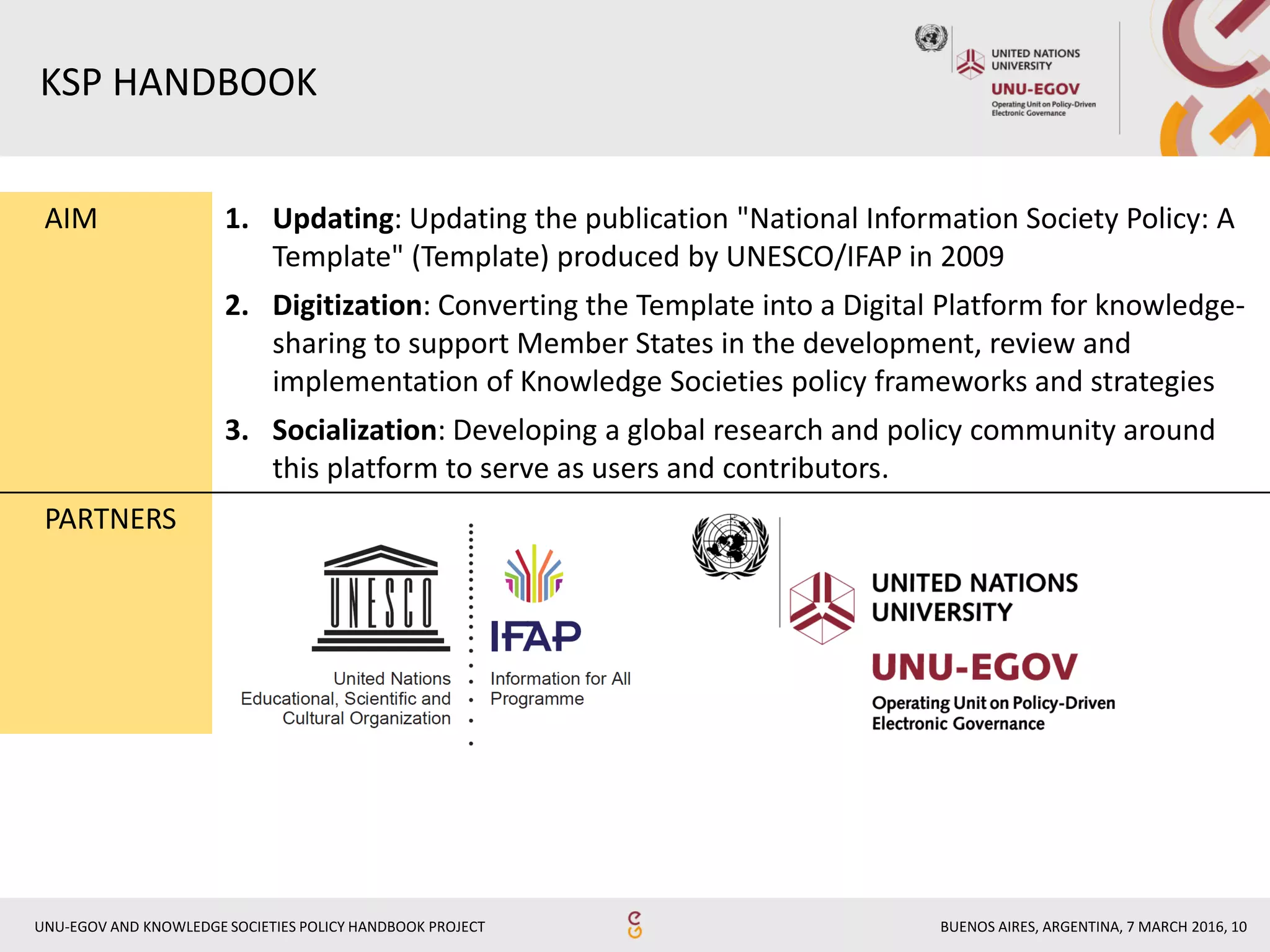
KSP HANDBOOK
AIM 1. Updating: Updating the publication "National Information Society Policy: A
Template" (Template) produced by UNESCO/IFAP in 2009
2. Digitization: Converting the Template into a Digital Platform for knowledge-
sharing to support Member States in the development, review and
implementation of Knowledge Societies policy frameworks and strategies
3. Socialization: Developing a global research and policy community around
this platform to serve as users and contributors.
PARTNERS
BUENOS AIRES, ARGENTINA, 7 MARCH 2016, 11UNU-EGOV AND KNOWLEDGE SOCIETIES POLICY HANDBOOK PROJECT
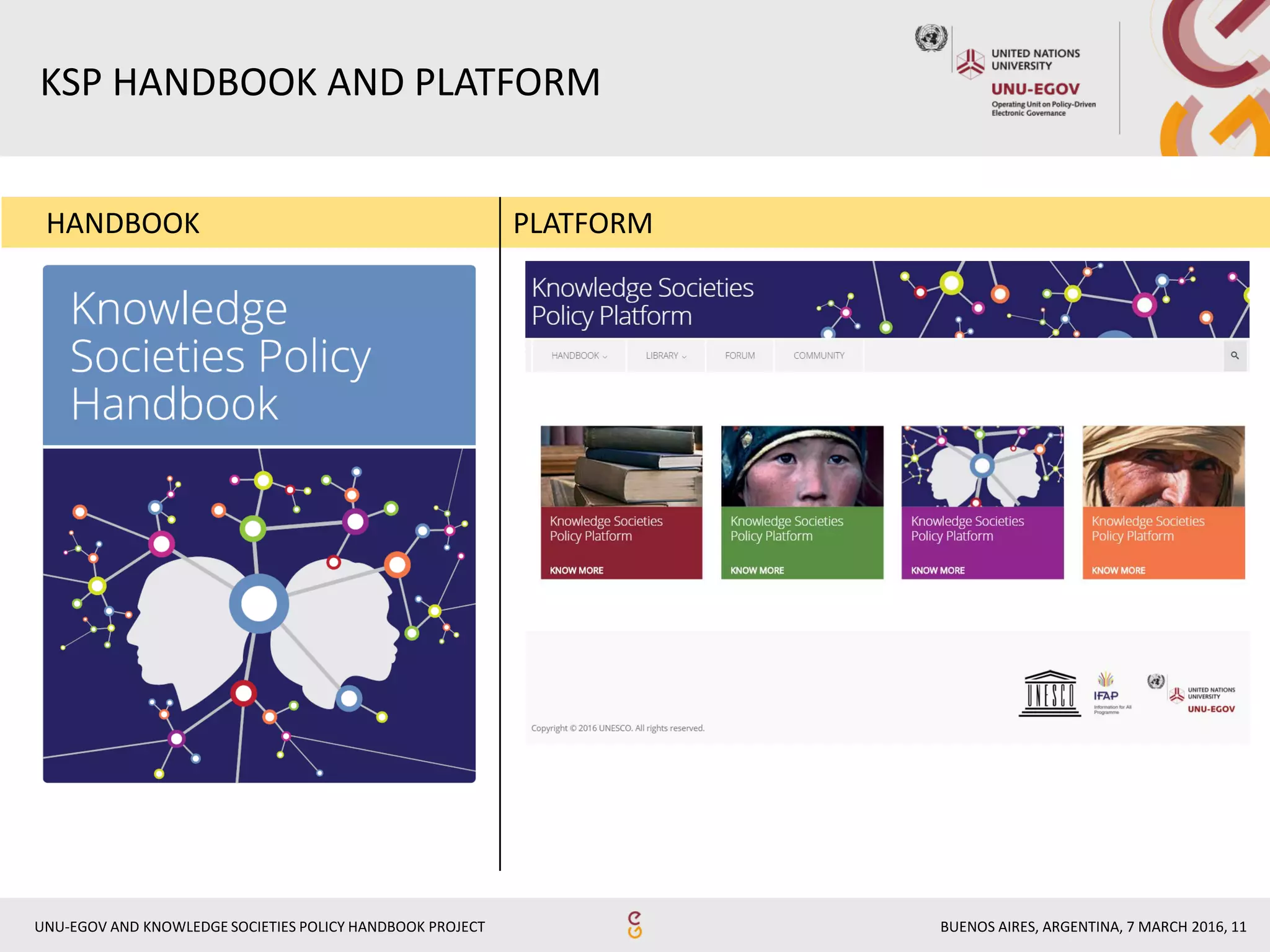
HANDBOOK PLATFORM
KSP HANDBOOK AND PLATFORM
BUENOS AIRES, ARGENTINA, 7 MARCH 2016, 12UNU-EGOV AND KNOWLEDGE SOCIETIES POLICY HANDBOOK PROJECT
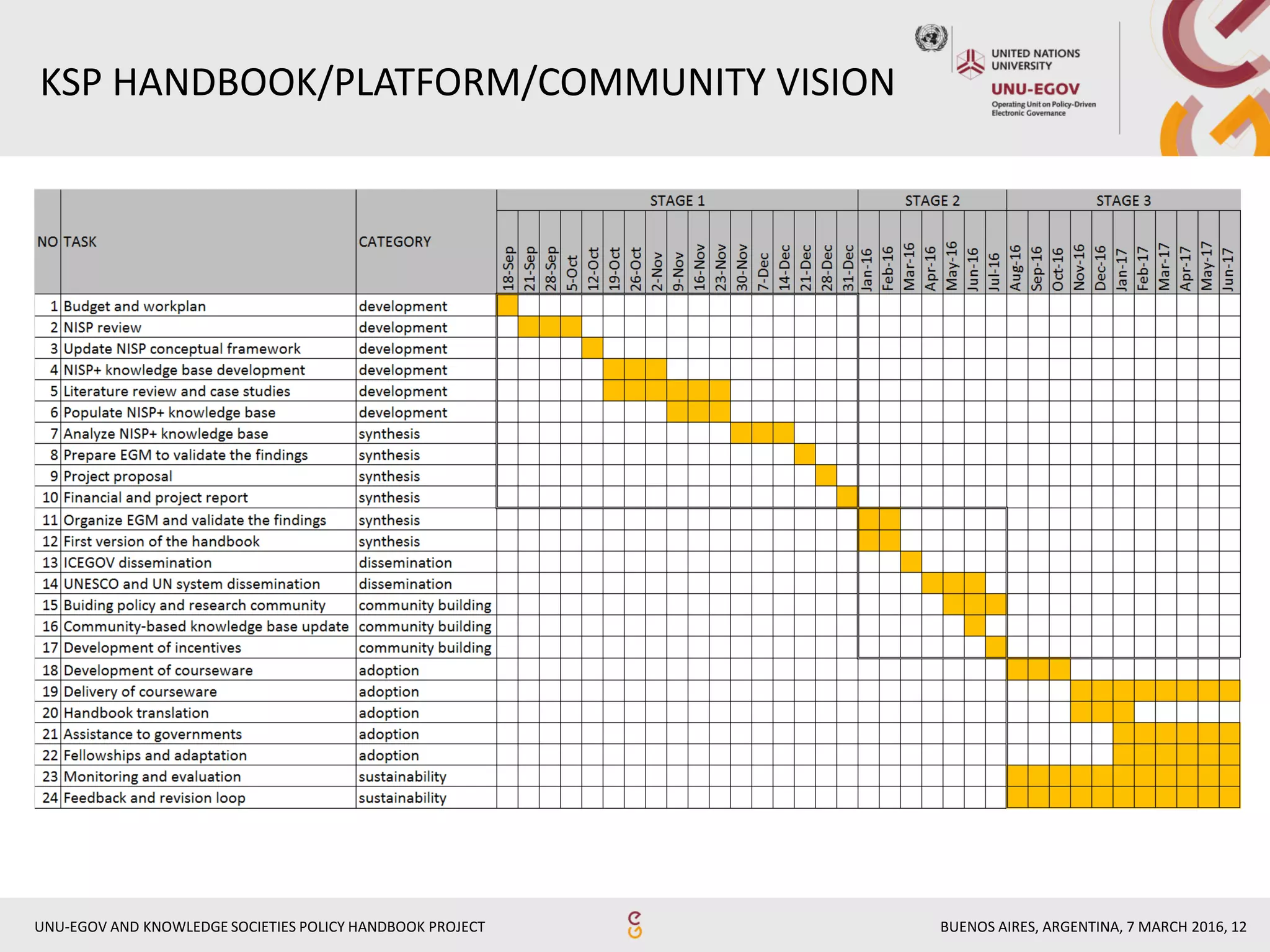
KSP HANDBOOK/PLATFORM/COMMUNITY VISION
BUENOS AIRES, ARGENTINA, 7 MARCH 2016, 13UNU-EGOV AND KNOWLEDGE SOCIETIES POLICY HANDBOOK PROJECT
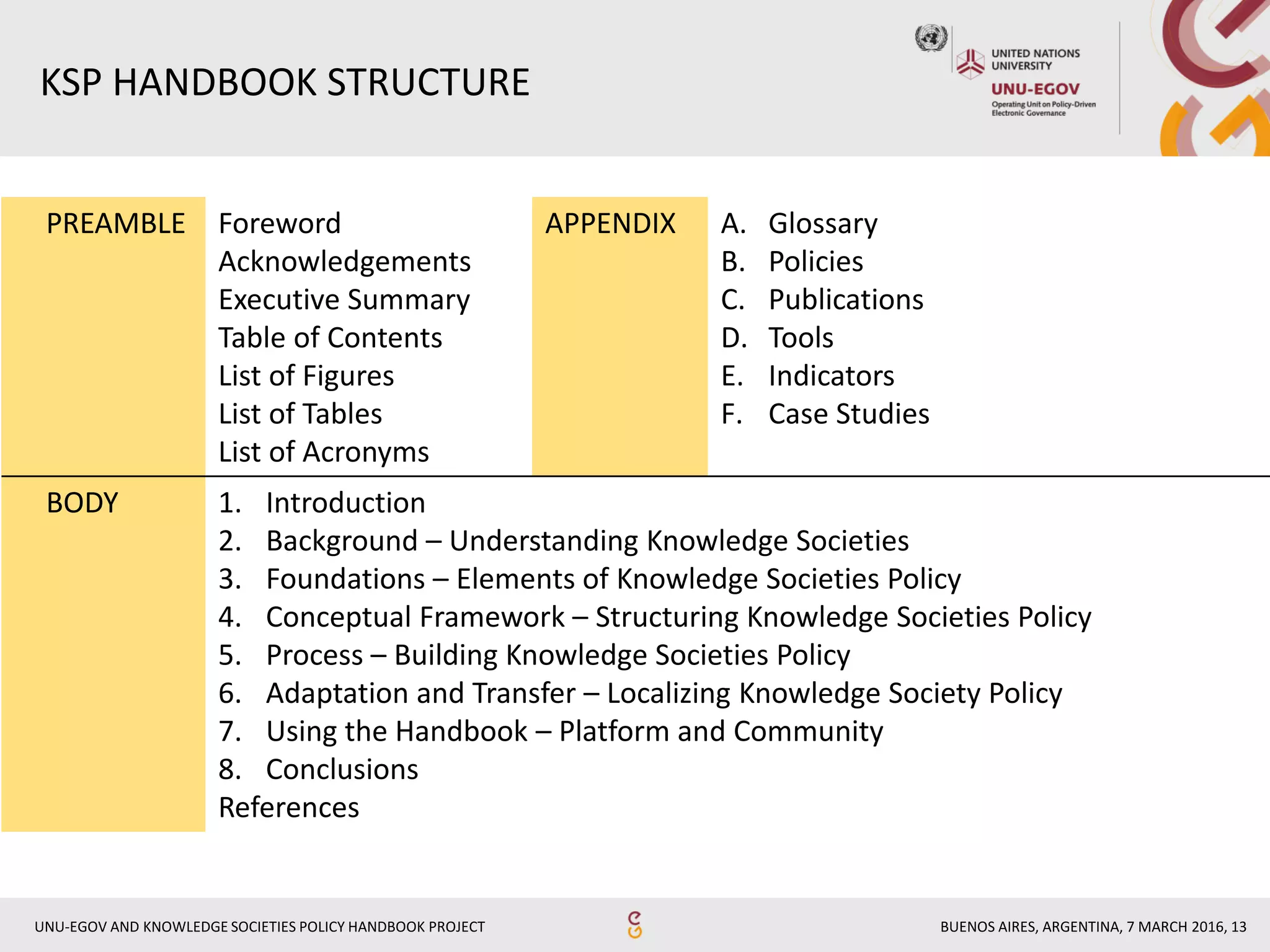
PREAMBLE Foreword
Acknowledgements
Executive Summary
Table of Contents
List of Figures
List of Tables
List of Acronyms
APPENDIX A. Glossary
B. Policies
C. Publications
D. Tools
E. Indicators
F. Case Studies
BODY 1. Introduction
2. Background – Understanding Knowledge Societies
3. Foundations – Elements of Knowledge Societies Policy
4. Conceptual Framework – Structuring Knowledge Societies Policy
5. Process – Building Knowledge Societies Policy
6. Adaptation and Transfer – Localizing Knowledge Society Policy
7. Using the Handbook – Platform and Community
8. Conclusions
References
KSP HANDBOOK STRUCTURE
BUENOS AIRES, ARGENTINA, 7 MARCH 2016, 14UNU-EGOV AND KNOWLEDGE SOCIETIES POLICY HANDBOOK PROJECT
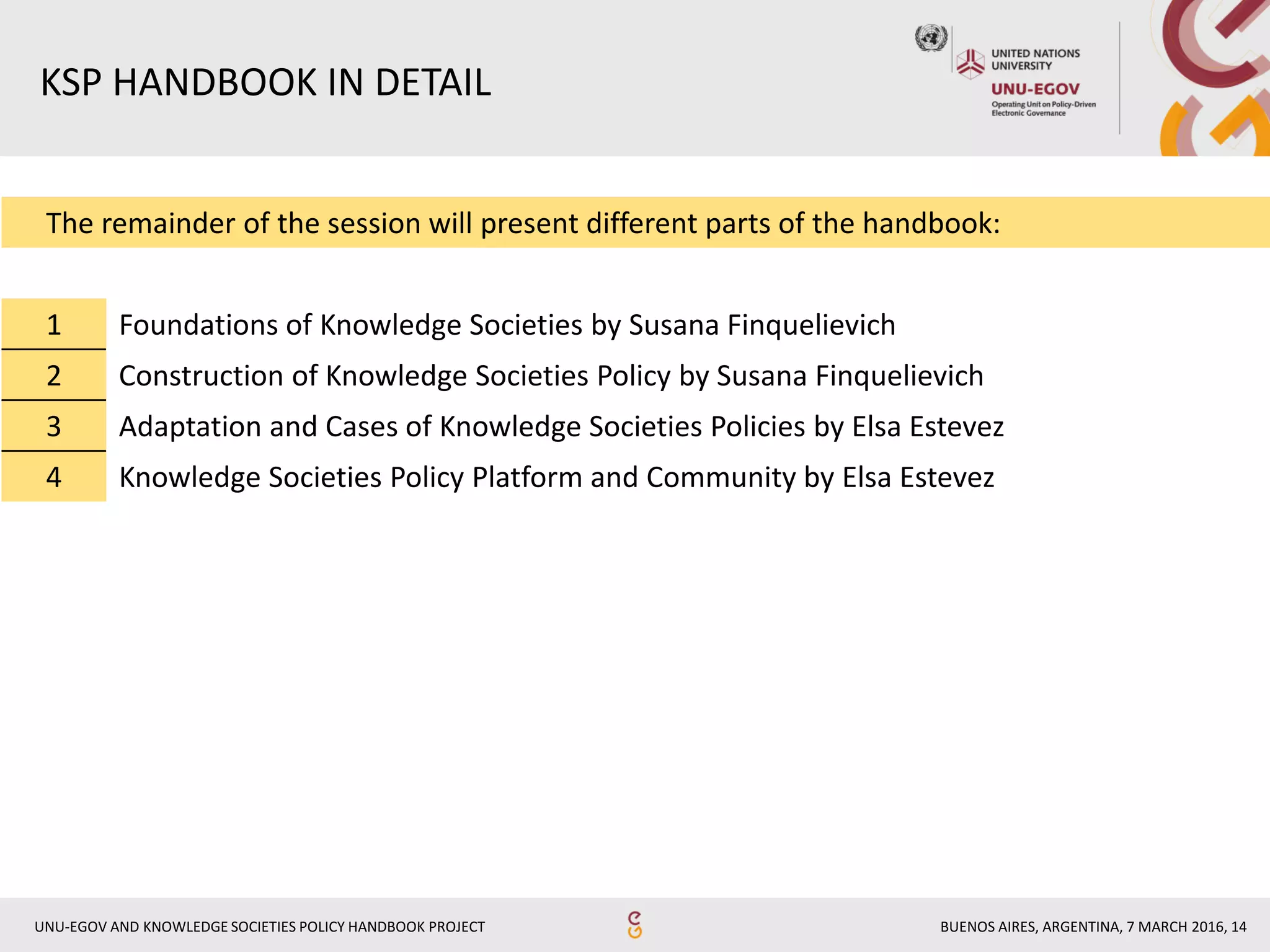
The remainder of the session will present different parts of the handbook:
1 Foundations of Knowledge Societies by Susana Finquelievich
2 Construction of Knowledge Societies Policy by Susana Finquelievich
3 Adaptation and Cases of Knowledge Societies Policies by Elsa Estevez
4 Knowledge Societies Policy Platform and Community by Elsa Estevez
KSP HANDBOOK IN DETAIL
BUENOS AIRES, ARGENTINA, 7 MARCH 2016, 15UNU-EGOV AND KNOWLEDGE SOCIETIES POLICY HANDBOOK PROJECT
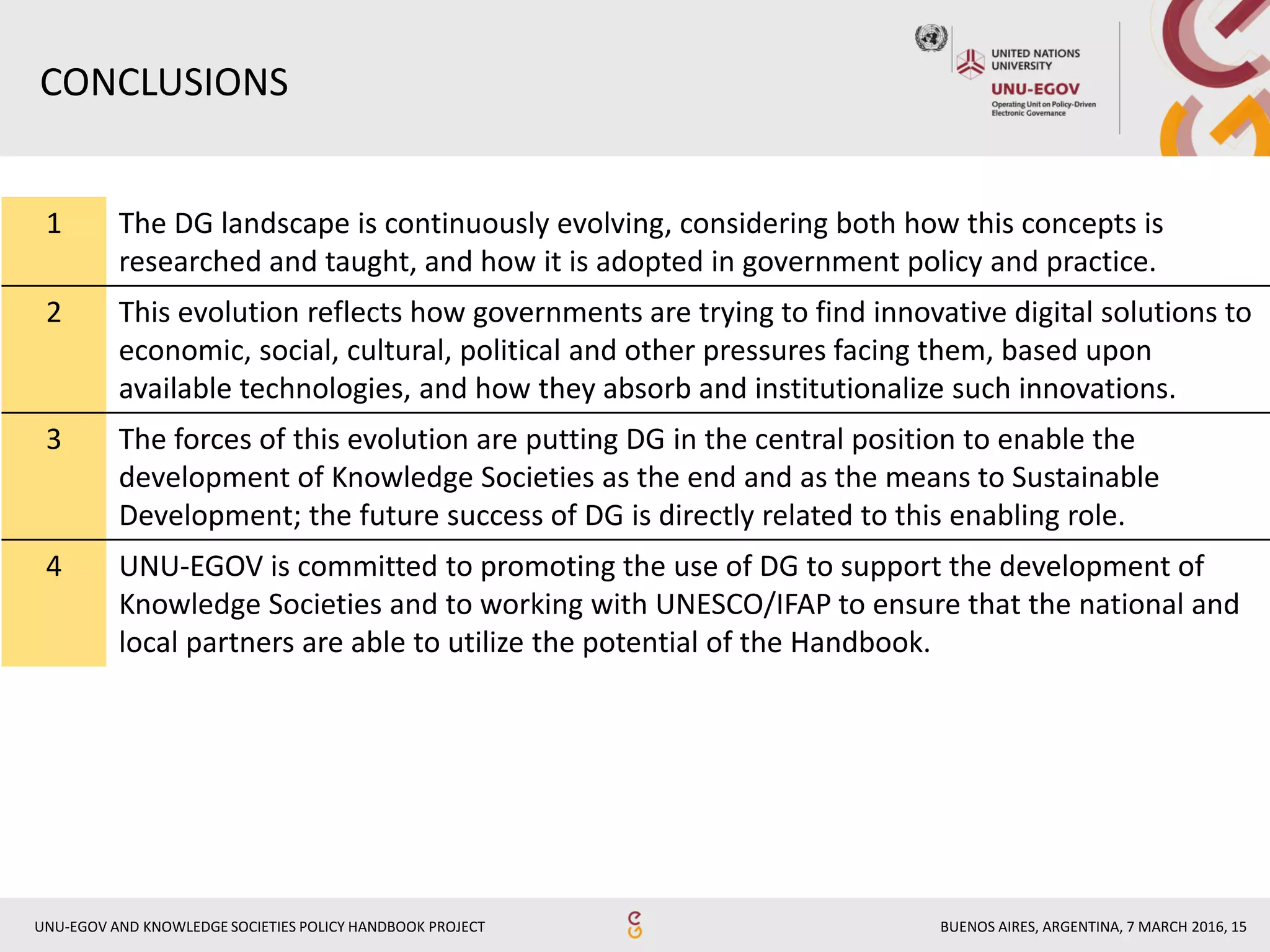
1 The DG landscape is continuously evolving, considering both how this concepts is
researched and taught, and how it is adopted in government policy and practice.
2 This evolution reflects how governments are trying to find innovative digital solutions to
economic, social, cultural, political and other pressures facing them, based upon
available technologies, and how they absorb and institutionalize such innovations.
3 The forces of this evolution are putting DG in the central position to enable the
development of Knowledge Societies as the end and as the means to Sustainable
Development; the future success of DG is directly related to this enabling role.
4 UNU-EGOV is committed to promoting the use of DG to support the development of
Knowledge Societies and to working with UNESCO/IFAP to ensure that the national and
local partners are able to utilize the potential of the Handbook.
CONCLUSIONS
Thank you for listening.
Any questions?
Tomasz Janowski
janowski@unu.edu

#ForoEGovAR | UNU_EGOV and Knowledge Societies Policy Handbook Project

  • 1.
    UNU-EGOV and Knowledge SocietiesPolicy Handbook Project Tomasz Janowski UNU-EGOV, Guimarães, Portugal janowski@unu.edu
  • 2.
    BUENOS AIRES, ARGENTINA,7 MARCH 2016, 2UNU-EGOV AND KNOWLEDGE SOCIETIES POLICY HANDBOOK PROJECT UNITED NATIONS UNIVERSITY (UNU) IDENTITY Global think tank and postgraduate teaching organization, part of United Nations system MISSION To contribute, through collaborative research and education, to efforts to resolve the pressing global problems of human survival, development and welfare that are the concern of the United Nations, its Peoples and Member States GOALS 1. Advancement of knowledge relevant to the role and work of the United Nations 2. Formulating sound principles, policies, strategies and programs for action 3. A bridge between the international academic community and the UN system 4. Contributing to capacity building, particularly in developing countries.
  • 3.
    BUENOS AIRES, ARGENTINA,7 MARCH 2016, 3UNU-EGOV AND KNOWLEDGE SOCIETIES POLICY HANDBOOK PROJECT UNU SYSTEM UNU-BIOLAC Biotechnology Venezuela UNU-CRIS Regional Integration Belgium UNU-CS Computing and Society Macao UNU-EGOV Electronic Governance Portugal UNU-EHS Environment and Human Security Germany UNU-FTP Fisheries, Geothermal Training Iceland UNU-IIGH Global Health Malaysia UNU-INRA Natural Resources Management Ghana UNU-INWEH Water, Environment and Health Canada UNU-IAS Sustainability Japan UNU-MERIT Innovation and Technology Netherlands UNU-ONY UNU Office in New York USA UNU-OP UNU Office in Paris France UNU-WIDER Development Economics Finland
  • 4.
    BUENOS AIRES, ARGENTINA,7 MARCH 2016, 4UNU-EGOV AND KNOWLEDGE SOCIETIES POLICY HANDBOOK PROJECT UNU-EGOV NAME UNU Operating Unit on Policy-Driven Electronic Governance LOCATION Guimaraes, Portugal Hosted by the University of Minho ESTABLISHED 23 May 2014, preceded by UNU-IIST- EGOV, Macao, since 2004 PURPOSE To support the UN system and UN member states in transforming the mechanisms of governance and building effective governance capabilities through digital technology to contribute to: o inclusive social development, o inclusive economic development, o environmental sustainability, and o peace and security.
  • 5.
    BUENOS AIRES, ARGENTINA,7 MARCH 2016, 5UNU-EGOV AND KNOWLEDGE SOCIETIES POLICY HANDBOOK PROJECT WHAT IS EGOV? The latest stage in the evolution of Digital Government: EVOLVING GOALS EVOLVING RESPONSES 1 Improving internal government operations and delivering better public services Digitization or Technology in Government 2 Facilitating administrative and institutional reform in government Transformation or Electronic Government 3 Engaging citizens and non-state actors in policy- and decision-making processes Engagement or Electronic Governance 4 Supporting policy and development goals in specific sectors and localities Contextualization or Policy-Driven Electronic Governance
  • 6.
    BUENOS AIRES, ARGENTINA,7 MARCH 2016, 6UNU-EGOV AND KNOWLEDGE SOCIETIES POLICY HANDBOOK PROJECT EGOV INNOVATION MODEL
  • 7.
    BUENOS AIRES, ARGENTINA,7 MARCH 2016, 7UNU-EGOV AND KNOWLEDGE SOCIETIES POLICY HANDBOOK PROJECT EGOV AND DEVELOPMENT STAGES CHARACTERIZATIONS Transformation of government? Includes non-state actors? Location- and sector-specific? 1 DIGITIZATION no no no 2 TRANSFORMATION yes no no 3 ENGAGEMENT yes yes no 4 CONTEXTUALIZATION yes yes yes GOVERNMENT GOVERNANCE DEVELOPMENT
  • 8.
    BUENOS AIRES, ARGENTINA,7 MARCH 2016, 8UNU-EGOV AND KNOWLEDGE SOCIETIES POLICY HANDBOOK PROJECT EGOV ACTIVITY FRAMEWORK Practice Research Policy cases, exceptions evidence, validation data, problems rules, procedures analysis, alternatives measures, solutions Interaction between EGOV research, policy and practice:
  • 9.
    BUENOS AIRES, ARGENTINA,7 MARCH 2016, 9UNU-EGOV AND KNOWLEDGE SOCIETIES POLICY HANDBOOK PROJECT UNU-EGOV PROJECTS THEME 1: ELECTRONIC GOVERNANCE FOR PUBLIC SECTOR INNOVATION NO PROJECTS FUNDING 1 Electronic Governance for Administrative Burden Reduction core 2 Electronic Governance for Context-Specific Public Service Delivery core 3 GCIO Education System for Colombia external THEME 2: DIGITAL AGENDA FOR SUSTAINABLE DEVELOPMENT NO PROJECTS FUNDING 4 Knowledge Societies Policy Handbook external 5 Policy Monitoring on Digital Technology for Inclusive Education external 6 Smart Cities for Sustainable Development external
  • 10.
    BUENOS AIRES, ARGENTINA,7 MARCH 2016, 10UNU-EGOV AND KNOWLEDGE SOCIETIES POLICY HANDBOOK PROJECT KSP HANDBOOK AIM 1. Updating: Updating the publication "National Information Society Policy: A Template" (Template) produced by UNESCO/IFAP in 2009 2. Digitization: Converting the Template into a Digital Platform for knowledge- sharing to support Member States in the development, review and implementation of Knowledge Societies policy frameworks and strategies 3. Socialization: Developing a global research and policy community around this platform to serve as users and contributors. PARTNERS
  • 11.
    BUENOS AIRES, ARGENTINA,7 MARCH 2016, 11UNU-EGOV AND KNOWLEDGE SOCIETIES POLICY HANDBOOK PROJECT HANDBOOK PLATFORM KSP HANDBOOK AND PLATFORM
  • 12.
    BUENOS AIRES, ARGENTINA,7 MARCH 2016, 12UNU-EGOV AND KNOWLEDGE SOCIETIES POLICY HANDBOOK PROJECT KSP HANDBOOK/PLATFORM/COMMUNITY VISION
  • 13.
    BUENOS AIRES, ARGENTINA,7 MARCH 2016, 13UNU-EGOV AND KNOWLEDGE SOCIETIES POLICY HANDBOOK PROJECT PREAMBLE Foreword Acknowledgements Executive Summary Table of Contents List of Figures List of Tables List of Acronyms APPENDIX A. Glossary B. Policies C. Publications D. Tools E. Indicators F. Case Studies BODY 1. Introduction 2. Background – Understanding Knowledge Societies 3. Foundations – Elements of Knowledge Societies Policy 4. Conceptual Framework – Structuring Knowledge Societies Policy 5. Process – Building Knowledge Societies Policy 6. Adaptation and Transfer – Localizing Knowledge Society Policy 7. Using the Handbook – Platform and Community 8. Conclusions References KSP HANDBOOK STRUCTURE
  • 14.
    BUENOS AIRES, ARGENTINA,7 MARCH 2016, 14UNU-EGOV AND KNOWLEDGE SOCIETIES POLICY HANDBOOK PROJECT The remainder of the session will present different parts of the handbook: 1 Foundations of Knowledge Societies by Susana Finquelievich 2 Construction of Knowledge Societies Policy by Susana Finquelievich 3 Adaptation and Cases of Knowledge Societies Policies by Elsa Estevez 4 Knowledge Societies Policy Platform and Community by Elsa Estevez KSP HANDBOOK IN DETAIL
  • 15.
    BUENOS AIRES, ARGENTINA,7 MARCH 2016, 15UNU-EGOV AND KNOWLEDGE SOCIETIES POLICY HANDBOOK PROJECT 1 The DG landscape is continuously evolving, considering both how this concepts is researched and taught, and how it is adopted in government policy and practice. 2 This evolution reflects how governments are trying to find innovative digital solutions to economic, social, cultural, political and other pressures facing them, based upon available technologies, and how they absorb and institutionalize such innovations. 3 The forces of this evolution are putting DG in the central position to enable the development of Knowledge Societies as the end and as the means to Sustainable Development; the future success of DG is directly related to this enabling role. 4 UNU-EGOV is committed to promoting the use of DG to support the development of Knowledge Societies and to working with UNESCO/IFAP to ensure that the national and local partners are able to utilize the potential of the Handbook. CONCLUSIONS
  • 16.
    Thank you forlistening. Any questions? Tomasz Janowski janowski@unu.edu