Forest-povertycommodity links
in the Congo
Basin: A value
chain perspective

NATURE INC?

QUESTIONING
THE MARKET PANACEA IN ENVIRONMENTAL
POLICY AND CONSERVATION

International Conference
30 June – 2 July 2011
ISS, The Hague, The
Netherlands

Verina Ingram
Centre for International Forestry Research (CIFOR), Central Africa
v.ingram@cgiar.org
THINKING beyond the canopy
Background

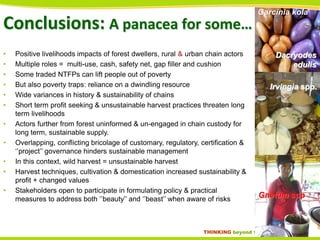
FORESTS

•

POVERTY

•

DEVELOPMENT •
COMMODITIES •
•

Congo Basin Forests

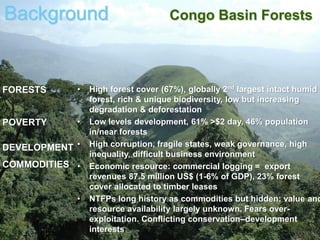
High forest cover (67%), globally 2nd largest intact humid
forest, rich & unique biodiversity, low but increasing
degradation & deforestation
Low levels development, 61% >$2 day, 46% population
in/near forests
High corruption, fragile states, weak governance, high
inequality, difficult business environment
Economic resource: commercial logging = export
revenues 87.5 million US$ (1-6% of GDP), 23% forest
cover allocated to timber leases
NTFPs long history as commodities but hidden: value and
resource availability largely unknown. Fears overexploitation. Conflicting conservation–development
interests
THINKING beyond the canopy
Aims & Research Questions

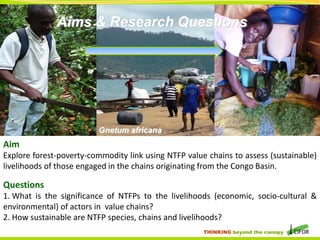
Gnetum africana

Aim
Explore forest-poverty-commodity link using NTFP value chains to assess (sustainable)
livelihoods of those engaged in the chains originating from the Congo Basin.

Questions
1. What is the significance of NTFPs to the livelihoods (economic, socio-cultural &
environmental) of actors in value chains?
2. How sustainable are NTFP species, chains and livelihoods?
THINKING beyond the canopy
North & Extreme
North
Northwest
&
Southwest

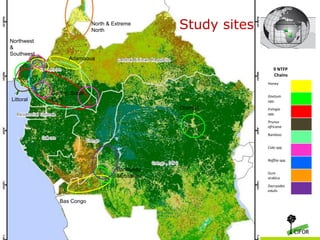
Study sites

Adamaoua
9 NTFP
Chains
Honey

Littoral

Centre, South,
East

Gnetum
spp.

Oriental

Irvingia
spp.
Prunus
africana

Bamboo
Cola spp.
Raffiia spp.

Bandundu
&Équateur

Gum
arabica
Dacryodes
edulis

Bas Congo
xxxxxxx
xxxxxxx
THINKING beyond the xx
canopy
Selection
Field
work

VCA

2007-2010

PAR

Analysis

Outputs

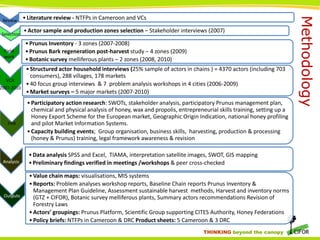
• Literature review - NTFPs in Cameroon and VCs
• Actor sample and production zones selection – Stakeholder interviews (2007)
• Prunus Inventory - 3 zones (2007-2008)
• Prunus Bark regeneration post-harvest study – 4 zones (2009)
• Botanic survey melliferous plants – 2 zones (2008, 2010)
• Structured actor household interviews (25% sample of actors in chains ) = 4370 actors (including 703
consumers), 288 villages, 178 markets
• 40 focus group interviews & 7 problem analysis workshops in 4 cities (2006-2009)
• Market surveys – 5 major markets (2007-2010)
• Participatory action research: SWOTs, stakeholder analysis, participatory Prunus management plan,
chemical and physical analysis of honey, wax and propolis, entrepreneurial skills training, setting up a
Honey Export Scheme for the European market, Geographic Origin Indication, national honey profiling
and pilot Market Information Systems.
• Capacity building events; Group organisation, business skills, harvesting, production & processing
(honey & Prunus) training, legal framework awareness & revision
• Data analysis SPSS and Excel, TIAMA, interpretation satellite images, SWOT, GIS mapping
• Preliminary findings verified in meetings /workshops & peer cross-checked

• Value chain maps: visualisations, MIS systems
• Reports: Problem analyses workshop reports, Baseline Chain reports Prunus Inventory &
Management Plan Guideline, Assessment sustainable harvest methods, Harvest and inventory norms
(GTZ + CIFOR), Botanic survey melliferous plants, Summary actors recommendations Revision of
Forestry Laws
• Actors’ groupings: Prunus Platform, Scientific Group supporting CITES Authority, Honey Federations
• Policy briefs: NTFPs in Cameroon & DRC Product sheets: 5 Cameroon & 3 DRC
THINKING beyond the canopy

Methodology

Review
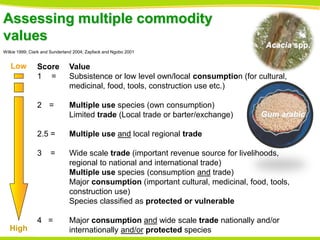
Assessing multiple commodity
values

Acacia spp.

Wilkie 1999; Clark and Sunderland 2004; Zapfack and Ngobo 2001

Low

Score
1 =

Value
Subsistence or low level own/local consumption (for cultural,
medicinal, food, tools, construction use etc.)
Irvingia spp.

2 =

Multiple use species (own consumption)
Limited trade (Local trade or barter/exchange)

Gum arabic

2.5 =

Multiple use and local regional trade

3

Wide scale trade (important revenue source for livelihoods,
regional to national and international trade)
Multiple use species (consumption and trade)
Major consumption (important cultural, medicinal, food, tools,
construction use)
Species classified as protected or vulnerable

=

4 =
High

Major consumption and wide scale trade nationally and/or
internationally and/or protected species
THINKING beyond the canopy
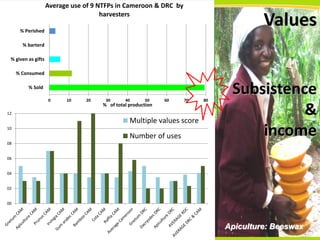
Average use of 9 NTFPs in Cameroon & DRC by
harvesters

Values

% Perished
% barterd
% given as gifts
% Consumed
% Sold
0

10

20

30

40

50

% of total production

60

70

12

Multiple values score
10

Number of uses

80

Subsistence
&
income

08

Score

06
04
02
00

Apiculture: Beeswax

THINKING beyond the canopy
11563

8953

10437

8629

10000
8000
3000

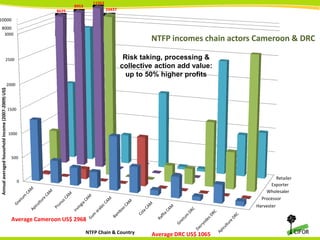
NTFP incomes chain actors Cameroon & DRC
Risk taking, processing &
collective action add value:
up to 50% higher profits

2500

Annual averaged household income (2007-2009) US$

2000

1500

1000

500

Retailer
Exporter
Wholesaler
Processor

0

Harvester

Average Cameroon US$ 2968
NTFP Chain & Country

Xx
THINKING beyond the canopy
Average DRC US$ 1065
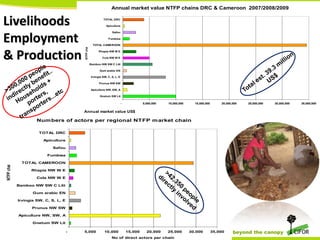
Annual market value NTFP chains DRC & Cameroon 2007/2008/2009
TOTAL DRC
Apiculture
Safou
Fumbwa

NTFP chain

Livelihoods
Employment
& Production

TOTAL CAMEROON
Rhapia NW W E
Cola NW W E
Bamboo NW SW C Litt
Gum arabic EN
Irvingia SW, C, S, L, E
Prunus NW SW
Apiculture NW, SW, A
Gnetum SW Lit

-

5,000,000

10,000,000

15,000,000

20,000,000

25,000,000

30,000,000

Annual market value US$

Num bers of actors per regional NTFP m arket chain
TOTAL DRC
Apiculture
Safou

NTFP chain

Fumbwa
TOTAL CAMEROON
Rhapia NW W E
Cola NW W E
Bamboo NW SW C Litt
Gum arabic EN
Irvingia SW, C, S, L, E
Prunus NW SW
Apiculture NW, SW, A
Gnetum SW Lit
-

5,000

10,000

15,000

20,000

25,000

No of direct actors per chain

30,000 THINKING
35,000

beyond the canopy

35,000,000
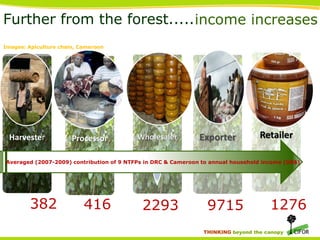
Further from the forest..... income increases
Images: Apiculture chain, Cameroon

Harvester

Processor

Wholesaler

Exporter

Retailer

Averaged (2007-2009) contribution of 9 NTFPs in DRC & Cameroon to annual household income (US$)

382

416

2293

9715

1276

THINKING beyond the canopy
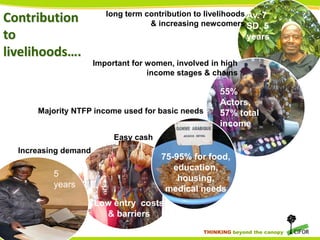
Contribution
to
livelihoods….

long term contribution to livelihoods Av. 7
& increasing newcomers SD. 5

years
Important for women, involved in high
income stages & chains

Majority NTFP income used for basic needs

Easy cash
Increasing demand

5
years

55%
Actors,
57% total
income

Av.
89%
75-95% for food,
education,
housing,
medical needs

Low entry costs
& barriers
THINKING beyond the canopy
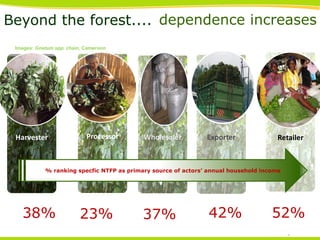
Beyond the forest.... dependence increases
Images: Gnetum spp. chain, Cameroon

Harvester

Processor

Wholesaler

Exporter

Retailer

% ranking specfic NTFP as primary source of actors’ annual household income

38%

23%

37% Xx

42%

52%

THINKING beyond the canopy
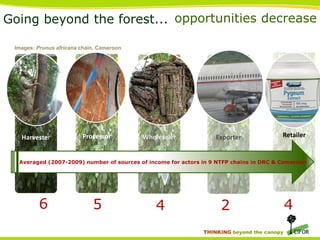
Going beyond the forest... opportunities decrease
Images: Prunus africana chain, Cameroon

Harvester

Processor

Wholesaler

Exporter

Retailer

Averaged (2007-2009) number of sources of income for actors in 9 NTFP chains in DRC & Cameroon

6

5

4

2
THINKING beyond the canopy

4
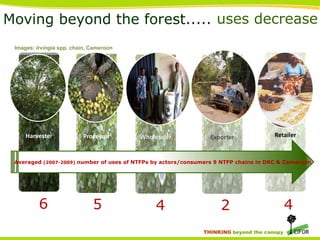
Moving beyond the forest..... uses decrease
Images: Irvingia spp. chain, Cameroon

Harvester

Processor

Wholesaler

Exporter

Retailer

Averaged (2007-2009) number of uses of NTFPs by actors/consumers 9 NTFP chains in DRC & Cameroon

6

5

4

2
THINKING beyond the canopy

4
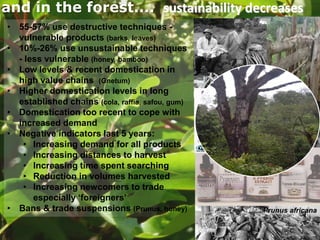
and in the forest.... sustainability decreases
• 55-57% use destructive techniques vulnerable products (barks, leaves)
• 10%-26% use unsustainable techniques
- less vulnerable (honey, bamboo)
• Low levels & recent domestication in
high value chains (Gnetum)
• Higher domestication levels in long
established chains (cola, raffia, safou, gum)
• Domestication too recent to cope with
increased demand
• Negative indicators last 5 years:
• Increasing demand for all products
• Increasing distances to harvest
• Increasing time spent searching
• Reduction in volumes harvested
• Increasing newcomers to trade
especially ‘foreigners’
• Bans & trade suspensions (Prunus, honey)

Photo: K Stewa

Prunus africana
THINKING beyond the canopy
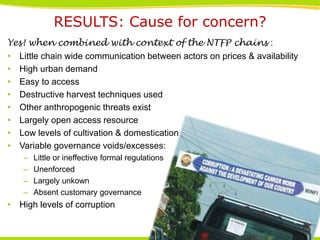
RESULTS: Cause for concern?
Yes! when combined with context of the NTFP chains :
• Little chain wide communication between actors on prices & availability
• High urban demand
• Easy to access
• Destructive harvest techniques used
• Other anthropogenic threats exist
• Largely open access resource
• Low levels of cultivation & domestication
• Variable governance voids/excesses:
–
–
–
–

Little or ineffective formal regulations
Unenforced
Largely unkown
Absent customary governance

• High levels of corruption
THINKING beyond the canopy
Conclusions: A panacea for some…
•
•
•
•
•
•

•
•
•
•
•

Positive livelihoods impacts of forest dwellers, rural & urban chain actors
Multiple roles = multi-use, cash, safety net, gap filler and cushion
Some traded NTFPs can lift people out of poverty
But also poverty traps: reliance on a dwindling resource
Wide variances in history & sustainability of chains
Short term profit seeking & unsustainable harvest practices threaten long
term livelihoods
Actors further from forest uninformed & un-engaged in chain custody for
long term, sustainable supply.
Overlapping, conflicting bricolage of customary, regulatory, certification &
‘’project’’ governance hinders sustainable management
In this context, wild harvest = unsustainable harvest
Harvest techniques, cultivation & domestication increased sustainability &
profit + changed values
Stakeholders open to participate in formulating policy & practical
measures to address both ‘’beauty’’ and ‘’beast’’ when aware of risks

Garcinia kola
.

Dacryodes
edulis
.

Irvingia spp.

Gnetum spp.

THINKING beyond the canopy
Thank you!
www.cifor.cgiar.org
v.ingram@cgiar.org
The Center for International Forestry Research (CIFOR)
is one of the 15 centres supported by the Consultative
Group on International Agricultural Research (CGIAR)

THINKING beyond the canopy

Forest-poverty-commodity links in the Congo Basin: A value chain perspective

  • 1.
    Forest-povertycommodity links in theCongo Basin: A value chain perspective NATURE INC? QUESTIONING THE MARKET PANACEA IN ENVIRONMENTAL POLICY AND CONSERVATION International Conference 30 June – 2 July 2011 ISS, The Hague, The Netherlands Verina Ingram Centre for International Forestry Research (CIFOR), Central Africa v.ingram@cgiar.org THINKING beyond the canopy THINKING beyond the canopy
  • 2.
    Background FORESTS • POVERTY • DEVELOPMENT • COMMODITIES • • CongoBasin Forests High forest cover (67%), globally 2nd largest intact humid forest, rich & unique biodiversity, low but increasing degradation & deforestation Low levels development, 61% >$2 day, 46% population in/near forests High corruption, fragile states, weak governance, high inequality, difficult business environment Economic resource: commercial logging = export revenues 87.5 million US$ (1-6% of GDP), 23% forest cover allocated to timber leases NTFPs long history as commodities but hidden: value and resource availability largely unknown. Fears overexploitation. Conflicting conservation–development interests THINKING beyond the canopy
  • 3.
    Aims & ResearchQuestions Gnetum africana Aim Explore forest-poverty-commodity link using NTFP value chains to assess (sustainable) livelihoods of those engaged in the chains originating from the Congo Basin. Questions 1. What is the significance of NTFPs to the livelihoods (economic, socio-cultural & environmental) of actors in value chains? 2. How sustainable are NTFP species, chains and livelihoods? THINKING beyond the canopy
  • 4.
    North & Extreme North Northwest & Southwest Studysites Adamaoua 9 NTFP Chains Honey Littoral Centre, South, East Gnetum spp. Oriental Irvingia spp. Prunus africana Bamboo Cola spp. Raffiia spp. Bandundu &Équateur Gum arabica Dacryodes edulis Bas Congo xxxxxxx xxxxxxx THINKING beyond the xx canopy
  • 5.
    Selection Field work VCA 2007-2010 PAR Analysis Outputs • Literature review- NTFPs in Cameroon and VCs • Actor sample and production zones selection – Stakeholder interviews (2007) • Prunus Inventory - 3 zones (2007-2008) • Prunus Bark regeneration post-harvest study – 4 zones (2009) • Botanic survey melliferous plants – 2 zones (2008, 2010) • Structured actor household interviews (25% sample of actors in chains ) = 4370 actors (including 703 consumers), 288 villages, 178 markets • 40 focus group interviews & 7 problem analysis workshops in 4 cities (2006-2009) • Market surveys – 5 major markets (2007-2010) • Participatory action research: SWOTs, stakeholder analysis, participatory Prunus management plan, chemical and physical analysis of honey, wax and propolis, entrepreneurial skills training, setting up a Honey Export Scheme for the European market, Geographic Origin Indication, national honey profiling and pilot Market Information Systems. • Capacity building events; Group organisation, business skills, harvesting, production & processing (honey & Prunus) training, legal framework awareness & revision • Data analysis SPSS and Excel, TIAMA, interpretation satellite images, SWOT, GIS mapping • Preliminary findings verified in meetings /workshops & peer cross-checked • Value chain maps: visualisations, MIS systems • Reports: Problem analyses workshop reports, Baseline Chain reports Prunus Inventory & Management Plan Guideline, Assessment sustainable harvest methods, Harvest and inventory norms (GTZ + CIFOR), Botanic survey melliferous plants, Summary actors recommendations Revision of Forestry Laws • Actors’ groupings: Prunus Platform, Scientific Group supporting CITES Authority, Honey Federations • Policy briefs: NTFPs in Cameroon & DRC Product sheets: 5 Cameroon & 3 DRC THINKING beyond the canopy Methodology Review
  • 6.
    Assessing multiple commodity values Acaciaspp. Wilkie 1999; Clark and Sunderland 2004; Zapfack and Ngobo 2001 Low Score 1 = Value Subsistence or low level own/local consumption (for cultural, medicinal, food, tools, construction use etc.) Irvingia spp. 2 = Multiple use species (own consumption) Limited trade (Local trade or barter/exchange) Gum arabic 2.5 = Multiple use and local regional trade 3 Wide scale trade (important revenue source for livelihoods, regional to national and international trade) Multiple use species (consumption and trade) Major consumption (important cultural, medicinal, food, tools, construction use) Species classified as protected or vulnerable = 4 = High Major consumption and wide scale trade nationally and/or internationally and/or protected species THINKING beyond the canopy
  • 7.
    Average use of9 NTFPs in Cameroon & DRC by harvesters Values % Perished % barterd % given as gifts % Consumed % Sold 0 10 20 30 40 50 % of total production 60 70 12 Multiple values score 10 Number of uses 80 Subsistence & income 08 Score 06 04 02 00 Apiculture: Beeswax THINKING beyond the canopy
  • 8.
    11563 8953 10437 8629 10000 8000 3000 NTFP incomes chainactors Cameroon & DRC Risk taking, processing & collective action add value: up to 50% higher profits 2500 Annual averaged household income (2007-2009) US$ 2000 1500 1000 500 Retailer Exporter Wholesaler Processor 0 Harvester Average Cameroon US$ 2968 NTFP Chain & Country Xx THINKING beyond the canopy Average DRC US$ 1065
  • 9.
    Annual market valueNTFP chains DRC & Cameroon 2007/2008/2009 TOTAL DRC Apiculture Safou Fumbwa NTFP chain Livelihoods Employment & Production TOTAL CAMEROON Rhapia NW W E Cola NW W E Bamboo NW SW C Litt Gum arabic EN Irvingia SW, C, S, L, E Prunus NW SW Apiculture NW, SW, A Gnetum SW Lit - 5,000,000 10,000,000 15,000,000 20,000,000 25,000,000 30,000,000 Annual market value US$ Num bers of actors per regional NTFP m arket chain TOTAL DRC Apiculture Safou NTFP chain Fumbwa TOTAL CAMEROON Rhapia NW W E Cola NW W E Bamboo NW SW C Litt Gum arabic EN Irvingia SW, C, S, L, E Prunus NW SW Apiculture NW, SW, A Gnetum SW Lit - 5,000 10,000 15,000 20,000 25,000 No of direct actors per chain 30,000 THINKING 35,000 beyond the canopy 35,000,000
  • 10.
    Further from theforest..... income increases Images: Apiculture chain, Cameroon Harvester Processor Wholesaler Exporter Retailer Averaged (2007-2009) contribution of 9 NTFPs in DRC & Cameroon to annual household income (US$) 382 416 2293 9715 1276 THINKING beyond the canopy
  • 11.
    Contribution to livelihoods…. long term contributionto livelihoods Av. 7 & increasing newcomers SD. 5 years Important for women, involved in high income stages & chains Majority NTFP income used for basic needs Easy cash Increasing demand 5 years 55% Actors, 57% total income Av. 89% 75-95% for food, education, housing, medical needs Low entry costs & barriers THINKING beyond the canopy
  • 12.
    Beyond the forest....dependence increases Images: Gnetum spp. chain, Cameroon Harvester Processor Wholesaler Exporter Retailer % ranking specfic NTFP as primary source of actors’ annual household income 38% 23% 37% Xx 42% 52% THINKING beyond the canopy
  • 13.
    Going beyond theforest... opportunities decrease Images: Prunus africana chain, Cameroon Harvester Processor Wholesaler Exporter Retailer Averaged (2007-2009) number of sources of income for actors in 9 NTFP chains in DRC & Cameroon 6 5 4 2 THINKING beyond the canopy 4
  • 14.
    Moving beyond theforest..... uses decrease Images: Irvingia spp. chain, Cameroon Harvester Processor Wholesaler Exporter Retailer Averaged (2007-2009) number of uses of NTFPs by actors/consumers 9 NTFP chains in DRC & Cameroon 6 5 4 2 THINKING beyond the canopy 4
  • 15.
    and in theforest.... sustainability decreases • 55-57% use destructive techniques vulnerable products (barks, leaves) • 10%-26% use unsustainable techniques - less vulnerable (honey, bamboo) • Low levels & recent domestication in high value chains (Gnetum) • Higher domestication levels in long established chains (cola, raffia, safou, gum) • Domestication too recent to cope with increased demand • Negative indicators last 5 years: • Increasing demand for all products • Increasing distances to harvest • Increasing time spent searching • Reduction in volumes harvested • Increasing newcomers to trade especially ‘foreigners’ • Bans & trade suspensions (Prunus, honey) Photo: K Stewa Prunus africana THINKING beyond the canopy
  • 16.
    RESULTS: Cause forconcern? Yes! when combined with context of the NTFP chains : • Little chain wide communication between actors on prices & availability • High urban demand • Easy to access • Destructive harvest techniques used • Other anthropogenic threats exist • Largely open access resource • Low levels of cultivation & domestication • Variable governance voids/excesses: – – – – Little or ineffective formal regulations Unenforced Largely unkown Absent customary governance • High levels of corruption THINKING beyond the canopy
  • 17.
    Conclusions: A panaceafor some… • • • • • • • • • • • Positive livelihoods impacts of forest dwellers, rural & urban chain actors Multiple roles = multi-use, cash, safety net, gap filler and cushion Some traded NTFPs can lift people out of poverty But also poverty traps: reliance on a dwindling resource Wide variances in history & sustainability of chains Short term profit seeking & unsustainable harvest practices threaten long term livelihoods Actors further from forest uninformed & un-engaged in chain custody for long term, sustainable supply. Overlapping, conflicting bricolage of customary, regulatory, certification & ‘’project’’ governance hinders sustainable management In this context, wild harvest = unsustainable harvest Harvest techniques, cultivation & domestication increased sustainability & profit + changed values Stakeholders open to participate in formulating policy & practical measures to address both ‘’beauty’’ and ‘’beast’’ when aware of risks Garcinia kola . Dacryodes edulis . Irvingia spp. Gnetum spp. THINKING beyond the canopy
  • 18.
    Thank you! www.cifor.cgiar.org v.ingram@cgiar.org The Centerfor International Forestry Research (CIFOR) is one of the 15 centres supported by the Consultative Group on International Agricultural Research (CGIAR) THINKING beyond the canopy THINKING beyond the canopy