Premium PowerPoint Slides by:
V. Andreea CHIRITESCU
Eastern Illinois University
N. GREGORY MANKIW
PRINCIPLES OF
ECONOMICS
Eighth Edition
Monopolistic
Competition
CHAPTER
16
© 2018 Cengage Learning®. May not be scanned, copied or duplicated, or posted to a publicly accessible website, in whole or in part, except for use
as permitted in a license distributed with a certain product or service or otherwise on a password-protected website or school-approved learning
management system for classroom use.
1
Look for the answers to these questions:
• What market structures lie between perfect
competition and monopoly, and what are
their characteristics?
• How do monopolistically competitive firms
choose price and quantity? Do they earn
economic profit?
• How does monopolistic competition affect
society’s welfare?
• What are the social costs and benefits of
advertising?
2
© 2018 Cengage Learning®. May not be scanned, copied or duplicated, or posted to a publicly accessible website, in whole or in part, except for use
as permitted in a license distributed with a certain product or service or otherwise on a password-protected website or school-approved learning
management system for classroom use.
Introduction
• Two extremes
• Perfect competition: many firms, identical
products
• Monopoly: one firm
• Imperfect competition – in between the
extremes:
–Oligopoly: only a few sellers offer similar
or identical products.
–Monopolistic competition: many firms sell
similar but not identical products.
3
© 2018 Cengage Learning®. May not be scanned, copied or duplicated, or posted to a publicly accessible website, in whole or in part, except for use
as permitted in a license distributed with a certain product or service or otherwise on a password-protected website or school-approved learning
management system for classroom use.
Monopolistic Competition
• Characteristics:
–Many sellers
–Product differentiation
• Not price takers; downward sloping D curve
–Free entry and exit
• Zero economic profit in the long run
• Examples of monopolistic competition:
–Apartments, books, bottled water,
clothing, fast food, night clubs
4
© 2018 Cengage Learning®. May not be scanned, copied or duplicated, or posted to a publicly accessible website, in whole or in part, except for use
as permitted in a license distributed with a certain product or service or otherwise on a password-protected website or school-approved learning
management system for classroom use.
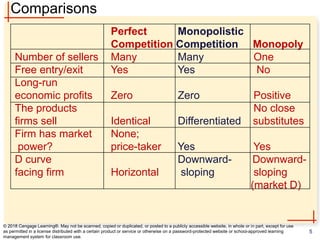
Comparisons
Perfect Monopolistic
Competition Competition Monopoly
Number of sellers Many Many One
Free entry/exit Yes Yes No
Long-run
economic profits Zero Zero Positive
The products No close
firms sell Identical Differentiated substitutes
Firm has market None;
power? price-taker Yes Yes
D curve Downward- Downward-
facing firm Horizontal sloping sloping
(market D)
5
© 2018 Cengage Learning®. May not be scanned, copied or duplicated, or posted to a publicly accessible website, in whole or in part, except for use
as permitted in a license distributed with a certain product or service or otherwise on a password-protected website or school-approved learning
management system for classroom use.
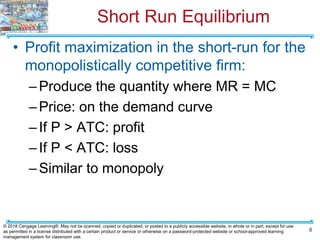
Short Run Equilibrium
• Profit maximization in the short-run for the
monopolistically competitive firm:
–Produce the quantity where MR = MC
–Price: on the demand curve
–If P > ATC: profit
–If P < ATC: loss
–Similar to monopoly
6
© 2018 Cengage Learning®. May not be scanned, copied or duplicated, or posted to a publicly accessible website, in whole or in part, except for use
as permitted in a license distributed with a certain product or service or otherwise on a password-protected website or school-approved learning
management system for classroom use.
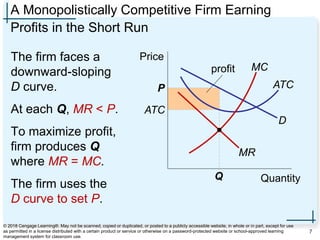
profit
ATC
P
A Monopolistically Competitive Firm Earning
Profits in the Short Run
The firm faces a
downward-sloping
D curve.
At each Q, MR < P.
To maximize profit,
firm produces Q
where MR = MC.
The firm uses the
D curve to set P.
7
© 2018 Cengage Learning®. May not be scanned, copied or duplicated, or posted to a publicly accessible website, in whole or in part, except for use
as permitted in a license distributed with a certain product or service or otherwise on a password-protected website or school-approved learning
management system for classroom use.
Quantity
Price
ATC
D
MR
MC
Q
losses
A Monopolistically Competitive Firm
With Losses in the Short Run
For this firm,
P < ATC
at the output where
MR = MC.
The best this firm
can do is to
minimize its losses.
8
© 2018 Cengage Learning®. May not be scanned, copied or duplicated, or posted to a publicly accessible website, in whole or in part, except for use
as permitted in a license distributed with a certain product or service or otherwise on a password-protected website or school-approved learning
management system for classroom use.
Quantity
Price
ATC
Q
P
ATC
MC
D
MR
Long Run Equilibrium
• If monopolistically competitive firms are
making profit in short run
– New firms: incentive to enter the market
• Increase number of products
– Reduces demand faced by each firm
• Demand curve shifts left; prices fall
– Each firm’s profit declines to zero
• If losses in the short run:
– Some firms exit the market, remaining firms
enjoy higher demand and prices
9
© 2018 Cengage Learning®. May not be scanned, copied or duplicated, or posted to a publicly accessible website, in whole or in part, except for use
as permitted in a license distributed with a certain product or service or otherwise on a password-protected website or school-approved learning
management system for classroom use.
A Monopolistic Competitor in the Long Run
Entry and exit occurs
until P = ATC and
profit = zero.
Notice that the firm
charges a markup of
price over marginal
cost and does not
produce at minimum
ATC.
10
© 2018 Cengage Learning®. May not be scanned, copied or duplicated, or posted to a publicly accessible website, in whole or in part, except for use
as permitted in a license distributed with a certain product or service or otherwise on a password-protected website or school-approved learning
management system for classroom use.
Quantity
Price
ATC
D
MR
Q
MC
MC
P = ATC
markup
Why Monopolistic Competition Is
Less Efficient than Perfect Competition
• Monopolistic competition
–Excess capacity: quantity is not at
minimum ATC (it is on the downward-
sloping portion of ATC)
–Markup over marginal cost: P > MC
• Perfect competition
–Quantity: at minimum ATC (efficient scale)
–P = MC
11
© 2018 Cengage Learning®. May not be scanned, copied or duplicated, or posted to a publicly accessible website, in whole or in part, except for use
as permitted in a license distributed with a certain product or service or otherwise on a password-protected website or school-approved learning
management system for classroom use.
Welfare of Society
• Monopolistically competitive markets
–Do not have all the desirable welfare
properties of perfectly competitive markets
• Sources of inefficiency
–Markup of price over marginal cost
–Too much or too little entry (number of
firms in the market)
• Product-variety externality
• Business-stealing externality
12
© 2018 Cengage Learning®. May not be scanned, copied or duplicated, or posted to a publicly accessible website, in whole or in part, except for use
as permitted in a license distributed with a certain product or service or otherwise on a password-protected website or school-approved learning
management system for classroom use.
Welfare of Society
• Markup, P > MC
–Market quantity < socially efficient quantity
• Deadweight loss of monopoly pricing
• The product-variety externality:
–Consumers get extra surplus from the
introduction of new products
• The business-stealing externality:
–Losses incurred by existing firms when
new firms enter market
13
© 2018 Cengage Learning®. May not be scanned, copied or duplicated, or posted to a publicly accessible website, in whole or in part, except for use
as permitted in a license distributed with a certain product or service or otherwise on a password-protected website or school-approved learning
management system for classroom use.
Active Learning 1 Advertising
1. So far, we have studied three market
structures: perfect competition, monopoly,
and monopolistic competition.
– In each of these, would you expect to see firms
spending money to advertise their products?
Why or why not?
2. Is advertising good or bad from society’s
viewpoint? Try to think of at least one “pro”
and “con.”
14
© 2018 Cengage Learning®. May not be scanned, copied or duplicated, or posted to a publicly accessible website, in whole or in part, except for use
as permitted in a license distributed with a certain product or service or otherwise on a password-protected website or school-approved learning
management system for classroom use.
Advertising
• Incentive to advertise
–When firms sell differentiated products
and charge prices above marginal cost
–Advertise to attract more buyers
• Advertising spending
–Highly differentiated goods: 10-20% of
revenue
–Industrial products: Little advertising
–Homogenous products: No advertising
15
© 2018 Cengage Learning®. May not be scanned, copied or duplicated, or posted to a publicly accessible website, in whole or in part, except for use
as permitted in a license distributed with a certain product or service or otherwise on a password-protected website or school-approved learning
management system for classroom use.
Advertising
• In monopolistically competitive industries
–Product differentiation and markup pricing
lead naturally to the use of advertising
• The more differentiated the products
–The more advertising firms buy
• Economists disagree about the social
value of advertising:
–Wasting resources?
–Valuable purpose?
16
© 2018 Cengage Learning®. May not be scanned, copied or duplicated, or posted to a publicly accessible website, in whole or in part, except for use
as permitted in a license distributed with a certain product or service or otherwise on a password-protected website or school-approved learning
management system for classroom use.
The Critique of Advertising
• Firms advertise to manipulate people’s
tastes
– Psychological rather than informational
• Creates a desire that otherwise might not
exist
• Advertising impedes competition
– Increase perception of product differentiation
• Foster brand loyalty; higher markups
• Makes buyers less concerned with price
differences among similar goods
17
© 2018 Cengage Learning®. May not be scanned, copied or duplicated, or posted to a publicly accessible website, in whole or in part, except for use
as permitted in a license distributed with a certain product or service or otherwise on a password-protected website or school-approved learning
management system for classroom use.
The Defense of Advertising
• The defense of advertising
– It provides useful information to buyers
– Informed buyers can more easily find and
exploit price differences
– Advertising promotes competition and
reduces market power
• Results of a prominent study:
– Eyeglasses were more expensive in states that
prohibited advertising by eyeglass makers than
in states that did not restrict such advertising
18
© 2018 Cengage Learning®. May not be scanned, copied or duplicated, or posted to a publicly accessible website, in whole or in part, except for use
as permitted in a license distributed with a certain product or service or otherwise on a password-protected website or school-approved learning
management system for classroom use.
Advertising
• Advertising as a signal of quality
–Little apparent information
–Real information offered – a signal
• Willingness to spend large
amount of money
• = signal about quality of the product
–Content of advertising = irrelevant
19
© 2018 Cengage Learning®. May not be scanned, copied or duplicated, or posted to a publicly accessible website, in whole or in part, except for use
as permitted in a license distributed with a certain product or service or otherwise on a password-protected website or school-approved learning
management system for classroom use.
Brand Names
• In many markets, brand name products
coexist with generic ones.
• Brand names
–Spend more on advertising and charge
higher prices than generic substitutes
• As with advertising, there is disagreement
about the economics of brand names…
20
© 2018 Cengage Learning®. May not be scanned, copied or duplicated, or posted to a publicly accessible website, in whole or in part, except for use
as permitted in a license distributed with a certain product or service or otherwise on a password-protected website or school-approved learning
management system for classroom use.
Advertising
• Critics of brand names
–Products – not differentiated
–Irrationality: consumers are willing to pay
more for brand names
• Defenders of brand names
–Consumers – information about quality
–Firms – incentive to maintain high quality
to protect the reputation of their brand
name
21
© 2018 Cengage Learning®. May not be scanned, copied or duplicated, or posted to a publicly accessible website, in whole or in part, except for use
as permitted in a license distributed with a certain product or service or otherwise on a password-protected website or school-approved learning
management system for classroom use.
Summary
• A monopolistically competitive market has
many firms, differentiated products, and free
entry.
• Each firm in a monopolistically competitive
market has excess capacity—it produces
less than the quantity that minimizes ATC.
Each firm charges a price above marginal
cost.
22
© 2018 Cengage Learning®. May not be scanned, copied or duplicated, or posted to a publicly accessible website, in whole or in part, except for use
as permitted in a license distributed with a certain product or service or otherwise on a password-protected website or school-approved learning
management system for classroom use.
Summary
• Monopolistic competition does not have all
of the desirable welfare properties of perfect
competition.
–There is a deadweight loss caused by the
markup of price over marginal cost.
–Also, the number of firms (and thus
varieties) can be too large or too small.
–There is no clear way for policymakers to
improve the market outcome.
23
© 2018 Cengage Learning®. May not be scanned, copied or duplicated, or posted to a publicly accessible website, in whole or in part, except for use
as permitted in a license distributed with a certain product or service or otherwise on a password-protected website or school-approved learning
management system for classroom use.
Summary
• Product differentiation and markup pricing
lead to the use of advertising and brand
names.
–Critics of advertising and brand names
argue that firms use them to reduce
competition and take advantage of
consumer irrationality.
–Defenders argue that firms use them to
inform consumers and to compete more
vigorously on price and product quality.
24
© 2018 Cengage Learning®. May not be scanned, copied or duplicated, or posted to a publicly accessible website, in whole or in part, except for use
as permitted in a license distributed with a certain product or service or otherwise on a password-protected website or school-approved learning
management system for classroom use.

Premium Ch 16 Monopolistic Competition.pptx

  • 1.
    Premium PowerPoint Slidesby: V. Andreea CHIRITESCU Eastern Illinois University N. GREGORY MANKIW PRINCIPLES OF ECONOMICS Eighth Edition Monopolistic Competition CHAPTER 16 © 2018 Cengage Learning®. May not be scanned, copied or duplicated, or posted to a publicly accessible website, in whole or in part, except for use as permitted in a license distributed with a certain product or service or otherwise on a password-protected website or school-approved learning management system for classroom use. 1
  • 2.
    Look for theanswers to these questions: • What market structures lie between perfect competition and monopoly, and what are their characteristics? • How do monopolistically competitive firms choose price and quantity? Do they earn economic profit? • How does monopolistic competition affect society’s welfare? • What are the social costs and benefits of advertising? 2 © 2018 Cengage Learning®. May not be scanned, copied or duplicated, or posted to a publicly accessible website, in whole or in part, except for use as permitted in a license distributed with a certain product or service or otherwise on a password-protected website or school-approved learning management system for classroom use.
  • 3.
    Introduction • Two extremes •Perfect competition: many firms, identical products • Monopoly: one firm • Imperfect competition – in between the extremes: –Oligopoly: only a few sellers offer similar or identical products. –Monopolistic competition: many firms sell similar but not identical products. 3 © 2018 Cengage Learning®. May not be scanned, copied or duplicated, or posted to a publicly accessible website, in whole or in part, except for use as permitted in a license distributed with a certain product or service or otherwise on a password-protected website or school-approved learning management system for classroom use.
  • 4.
    Monopolistic Competition • Characteristics: –Manysellers –Product differentiation • Not price takers; downward sloping D curve –Free entry and exit • Zero economic profit in the long run • Examples of monopolistic competition: –Apartments, books, bottled water, clothing, fast food, night clubs 4 © 2018 Cengage Learning®. May not be scanned, copied or duplicated, or posted to a publicly accessible website, in whole or in part, except for use as permitted in a license distributed with a certain product or service or otherwise on a password-protected website or school-approved learning management system for classroom use.
  • 5.
    Comparisons Perfect Monopolistic Competition CompetitionMonopoly Number of sellers Many Many One Free entry/exit Yes Yes No Long-run economic profits Zero Zero Positive The products No close firms sell Identical Differentiated substitutes Firm has market None; power? price-taker Yes Yes D curve Downward- Downward- facing firm Horizontal sloping sloping (market D) 5 © 2018 Cengage Learning®. May not be scanned, copied or duplicated, or posted to a publicly accessible website, in whole or in part, except for use as permitted in a license distributed with a certain product or service or otherwise on a password-protected website or school-approved learning management system for classroom use.
  • 6.
    Short Run Equilibrium •Profit maximization in the short-run for the monopolistically competitive firm: –Produce the quantity where MR = MC –Price: on the demand curve –If P > ATC: profit –If P < ATC: loss –Similar to monopoly 6 © 2018 Cengage Learning®. May not be scanned, copied or duplicated, or posted to a publicly accessible website, in whole or in part, except for use as permitted in a license distributed with a certain product or service or otherwise on a password-protected website or school-approved learning management system for classroom use.
  • 7.
    profit ATC P A Monopolistically CompetitiveFirm Earning Profits in the Short Run The firm faces a downward-sloping D curve. At each Q, MR < P. To maximize profit, firm produces Q where MR = MC. The firm uses the D curve to set P. 7 © 2018 Cengage Learning®. May not be scanned, copied or duplicated, or posted to a publicly accessible website, in whole or in part, except for use as permitted in a license distributed with a certain product or service or otherwise on a password-protected website or school-approved learning management system for classroom use. Quantity Price ATC D MR MC Q
  • 8.
    losses A Monopolistically CompetitiveFirm With Losses in the Short Run For this firm, P < ATC at the output where MR = MC. The best this firm can do is to minimize its losses. 8 © 2018 Cengage Learning®. May not be scanned, copied or duplicated, or posted to a publicly accessible website, in whole or in part, except for use as permitted in a license distributed with a certain product or service or otherwise on a password-protected website or school-approved learning management system for classroom use. Quantity Price ATC Q P ATC MC D MR
  • 9.
    Long Run Equilibrium •If monopolistically competitive firms are making profit in short run – New firms: incentive to enter the market • Increase number of products – Reduces demand faced by each firm • Demand curve shifts left; prices fall – Each firm’s profit declines to zero • If losses in the short run: – Some firms exit the market, remaining firms enjoy higher demand and prices 9 © 2018 Cengage Learning®. May not be scanned, copied or duplicated, or posted to a publicly accessible website, in whole or in part, except for use as permitted in a license distributed with a certain product or service or otherwise on a password-protected website or school-approved learning management system for classroom use.
  • 10.
    A Monopolistic Competitorin the Long Run Entry and exit occurs until P = ATC and profit = zero. Notice that the firm charges a markup of price over marginal cost and does not produce at minimum ATC. 10 © 2018 Cengage Learning®. May not be scanned, copied or duplicated, or posted to a publicly accessible website, in whole or in part, except for use as permitted in a license distributed with a certain product or service or otherwise on a password-protected website or school-approved learning management system for classroom use. Quantity Price ATC D MR Q MC MC P = ATC markup
  • 11.
    Why Monopolistic CompetitionIs Less Efficient than Perfect Competition • Monopolistic competition –Excess capacity: quantity is not at minimum ATC (it is on the downward- sloping portion of ATC) –Markup over marginal cost: P > MC • Perfect competition –Quantity: at minimum ATC (efficient scale) –P = MC 11 © 2018 Cengage Learning®. May not be scanned, copied or duplicated, or posted to a publicly accessible website, in whole or in part, except for use as permitted in a license distributed with a certain product or service or otherwise on a password-protected website or school-approved learning management system for classroom use.
  • 12.
    Welfare of Society •Monopolistically competitive markets –Do not have all the desirable welfare properties of perfectly competitive markets • Sources of inefficiency –Markup of price over marginal cost –Too much or too little entry (number of firms in the market) • Product-variety externality • Business-stealing externality 12 © 2018 Cengage Learning®. May not be scanned, copied or duplicated, or posted to a publicly accessible website, in whole or in part, except for use as permitted in a license distributed with a certain product or service or otherwise on a password-protected website or school-approved learning management system for classroom use.
  • 13.
    Welfare of Society •Markup, P > MC –Market quantity < socially efficient quantity • Deadweight loss of monopoly pricing • The product-variety externality: –Consumers get extra surplus from the introduction of new products • The business-stealing externality: –Losses incurred by existing firms when new firms enter market 13 © 2018 Cengage Learning®. May not be scanned, copied or duplicated, or posted to a publicly accessible website, in whole or in part, except for use as permitted in a license distributed with a certain product or service or otherwise on a password-protected website or school-approved learning management system for classroom use.
  • 14.
    Active Learning 1Advertising 1. So far, we have studied three market structures: perfect competition, monopoly, and monopolistic competition. – In each of these, would you expect to see firms spending money to advertise their products? Why or why not? 2. Is advertising good or bad from society’s viewpoint? Try to think of at least one “pro” and “con.” 14 © 2018 Cengage Learning®. May not be scanned, copied or duplicated, or posted to a publicly accessible website, in whole or in part, except for use as permitted in a license distributed with a certain product or service or otherwise on a password-protected website or school-approved learning management system for classroom use.
  • 15.
    Advertising • Incentive toadvertise –When firms sell differentiated products and charge prices above marginal cost –Advertise to attract more buyers • Advertising spending –Highly differentiated goods: 10-20% of revenue –Industrial products: Little advertising –Homogenous products: No advertising 15 © 2018 Cengage Learning®. May not be scanned, copied or duplicated, or posted to a publicly accessible website, in whole or in part, except for use as permitted in a license distributed with a certain product or service or otherwise on a password-protected website or school-approved learning management system for classroom use.
  • 16.
    Advertising • In monopolisticallycompetitive industries –Product differentiation and markup pricing lead naturally to the use of advertising • The more differentiated the products –The more advertising firms buy • Economists disagree about the social value of advertising: –Wasting resources? –Valuable purpose? 16 © 2018 Cengage Learning®. May not be scanned, copied or duplicated, or posted to a publicly accessible website, in whole or in part, except for use as permitted in a license distributed with a certain product or service or otherwise on a password-protected website or school-approved learning management system for classroom use.
  • 17.
    The Critique ofAdvertising • Firms advertise to manipulate people’s tastes – Psychological rather than informational • Creates a desire that otherwise might not exist • Advertising impedes competition – Increase perception of product differentiation • Foster brand loyalty; higher markups • Makes buyers less concerned with price differences among similar goods 17 © 2018 Cengage Learning®. May not be scanned, copied or duplicated, or posted to a publicly accessible website, in whole or in part, except for use as permitted in a license distributed with a certain product or service or otherwise on a password-protected website or school-approved learning management system for classroom use.
  • 18.
    The Defense ofAdvertising • The defense of advertising – It provides useful information to buyers – Informed buyers can more easily find and exploit price differences – Advertising promotes competition and reduces market power • Results of a prominent study: – Eyeglasses were more expensive in states that prohibited advertising by eyeglass makers than in states that did not restrict such advertising 18 © 2018 Cengage Learning®. May not be scanned, copied or duplicated, or posted to a publicly accessible website, in whole or in part, except for use as permitted in a license distributed with a certain product or service or otherwise on a password-protected website or school-approved learning management system for classroom use.
  • 19.
    Advertising • Advertising asa signal of quality –Little apparent information –Real information offered – a signal • Willingness to spend large amount of money • = signal about quality of the product –Content of advertising = irrelevant 19 © 2018 Cengage Learning®. May not be scanned, copied or duplicated, or posted to a publicly accessible website, in whole or in part, except for use as permitted in a license distributed with a certain product or service or otherwise on a password-protected website or school-approved learning management system for classroom use.
  • 20.
    Brand Names • Inmany markets, brand name products coexist with generic ones. • Brand names –Spend more on advertising and charge higher prices than generic substitutes • As with advertising, there is disagreement about the economics of brand names… 20 © 2018 Cengage Learning®. May not be scanned, copied or duplicated, or posted to a publicly accessible website, in whole or in part, except for use as permitted in a license distributed with a certain product or service or otherwise on a password-protected website or school-approved learning management system for classroom use.
  • 21.
    Advertising • Critics ofbrand names –Products – not differentiated –Irrationality: consumers are willing to pay more for brand names • Defenders of brand names –Consumers – information about quality –Firms – incentive to maintain high quality to protect the reputation of their brand name 21 © 2018 Cengage Learning®. May not be scanned, copied or duplicated, or posted to a publicly accessible website, in whole or in part, except for use as permitted in a license distributed with a certain product or service or otherwise on a password-protected website or school-approved learning management system for classroom use.
  • 22.
    Summary • A monopolisticallycompetitive market has many firms, differentiated products, and free entry. • Each firm in a monopolistically competitive market has excess capacity—it produces less than the quantity that minimizes ATC. Each firm charges a price above marginal cost. 22 © 2018 Cengage Learning®. May not be scanned, copied or duplicated, or posted to a publicly accessible website, in whole or in part, except for use as permitted in a license distributed with a certain product or service or otherwise on a password-protected website or school-approved learning management system for classroom use.
  • 23.
    Summary • Monopolistic competitiondoes not have all of the desirable welfare properties of perfect competition. –There is a deadweight loss caused by the markup of price over marginal cost. –Also, the number of firms (and thus varieties) can be too large or too small. –There is no clear way for policymakers to improve the market outcome. 23 © 2018 Cengage Learning®. May not be scanned, copied or duplicated, or posted to a publicly accessible website, in whole or in part, except for use as permitted in a license distributed with a certain product or service or otherwise on a password-protected website or school-approved learning management system for classroom use.
  • 24.
    Summary • Product differentiationand markup pricing lead to the use of advertising and brand names. –Critics of advertising and brand names argue that firms use them to reduce competition and take advantage of consumer irrationality. –Defenders argue that firms use them to inform consumers and to compete more vigorously on price and product quality. 24 © 2018 Cengage Learning®. May not be scanned, copied or duplicated, or posted to a publicly accessible website, in whole or in part, except for use as permitted in a license distributed with a certain product or service or otherwise on a password-protected website or school-approved learning management system for classroom use.

Editor's Notes

  • #2 Examples of monopolistic competition are everywhere: the clothes students wear, the fancy frozen coffee drinks they slurp up on their way to class, the magazines they read, the nightclubs where they dance. As a result, students find the theory of monopolistic competition more relevant than the theory of perfect competition, which best describes products like wheat and soybeans, products that few students ever consider buying. The last part of the chapter, on advertising and brand names, is especially interesting & useful for business students. If students are reasonably comfortable with the material on perfect competition and monopoly, then this chapter should not be difficult. It is also shorter than average.
  • #4 In the preceding two chapters, we studied the two extremes of the competition spectrum. This chapter focuses on monopolistic competition, one of the market structures in between the two extremes. Examples of each market type: Perfect competition: wheat, milk Monopoly: tap water, cable TV Oligopoly: tennis balls, cigarettes (we study oligopoly in the next chapter) Monopolistic competition: novels, movies
  • #5 While not all are emphasized in the book, here are some ways producers differentiate their products are: actual physical differences (a 30” TV offers a different Super Bowl experience than a 70” TV, right?), advertising (or branding; ), and location. Gasoline seems like an undifferentiated product, yet different gas stations charge different prices. How can some gas stations get away with charging 5 or even 10 cents more per gallon? The answer is product differentiation by location. Imagine you’re driving home in rush-hour traffic from a grueling 10-hour day at the office. The orange warning light comes on, indicating your car needs gas. After uttering a few choice expletives, you notice two gas stations at an upcoming intersection. The one on the right charges 5 cents more than the one on the left, but is easily accessible. The one on the left would require you to make a left-hand turn in heavy traffic to get into the station, and another to get out. And how much would you save? If you buy 20 gallons, you’d save only $1. Alternatively, imagine you run a gas station located in a highly residential area, in which there are few other businesses—including gas stations. If people want gas, they can buy it from you, or they can drive 10 minutes to a more commercial area with lots of gas stations. Your location allows you to charge a higher price. Businesspeople have long understood that location is a critical dimension of product differentiation. Hence the saying “location, location, location.”
  • #6 Monopolistic competition - Long-run profits for are zero because of free entry/exit. - The market power: it sells a product that is at least somewhat different from products sold by other firms. - The D curve is downward-sloping because the firm has a bit of market power and sells a unique variety. A monopoly is the sole seller of a product with no close substitutes. In contrast, the monopolistic competitor sells a product with many close substitutes. As a result, demand for the monopolist’s product is less elastic than demand for the monopolistic competitor’s product.
  • #8 7
  • #9 8
  • #10 Short run: Under monopolistic competition, firm behavior is very similar to monopoly. Long run: In monopolistic competition, entry and exit drive economic profit to zero.
  • #11 10
  • #12 Due to the markup of price over marginal cost, the market output under monopolistic competition will be smaller than the socially efficient output, as we discuss on the following slide.
  • #13 Each of the sources of inefficiency is discussed in more detail on the following slide.
  • #14 The problem of markup pricing facing policymakers here is similar to the problem arising from natural monopoly: With natural monopoly, ATC is always falling, so MC is below ATC. If regulators force a natural monopoly to price at marginal cost, it will incur losses. Yet, not easy for policymakers to fix this problem: Firms earn zero profits, so cannot require them to reduce prices. The product-variety externality is a positive one for consumers; while the business-stealing externality is a negative one on existing producers. It’s not clear which externality effect is bigger, and it may in fact differ by industry. The inefficiencies of monopolistic competition are subtle and hard to measure. No easy way for policymakers to improve the market outcome.
  • #15 Consider breaking up your lecture with a 10 minute discussion. First, give your students a few quiet moments to formulate their responses. Then, ask for volunteers to share their answers. If you have a chalkboard or dry-erase board, concisely paraphrase each student’s response as it is volunteered. If a student volunteers a “wrong” answer, write it down anyway. After the class has generated a list, have the class go over each item on the list to make sure it really belongs on the list. Benefits: 1) Breaks up the lecture into chunks. 2) Engages students. 3) Gets students to think about the implications of the market structures they’ve studied so far. (Hopefully, some will recognize that product differentiation is a critical determinant of firms’ motivation to spend on advertising.) 4) Makes students feel invested in learning the second half of the chapter.
  • #19 The study mentioned here was by economist Lee Benham, published in the Journal of Law and Economics in 1972. The textbook has a case study that discusses this research in more detail.
  • #20 A firm’s willingness to spend huge amounts on advertising may signal the quality of its product to consumers, regardless of the content of ads. Ads may convince buyers to try a product once, but the product must be of high quality for people to become repeat buyers. The most expensive ads are not worthwhile unless they lead to repeat buyers. When consumers see expensive ads, they think the product must be good if the company is willing to spend so much on advertising.
  • #22 To conclude: Differentiated products are everywhere; and examples of monopolistic competition abound. The theory of monopolistic competition describes many markets in the economy, yet offers little guidance to policymakers looking to improve the market’s allocation of resources.