Telecommunication
Networks:
1.1 Evolution of Telecommunications
1.2 Classification of Switching System
Chapter 1
The Evolution of
Telecommunications
Evolution of Telecommunication
Technology
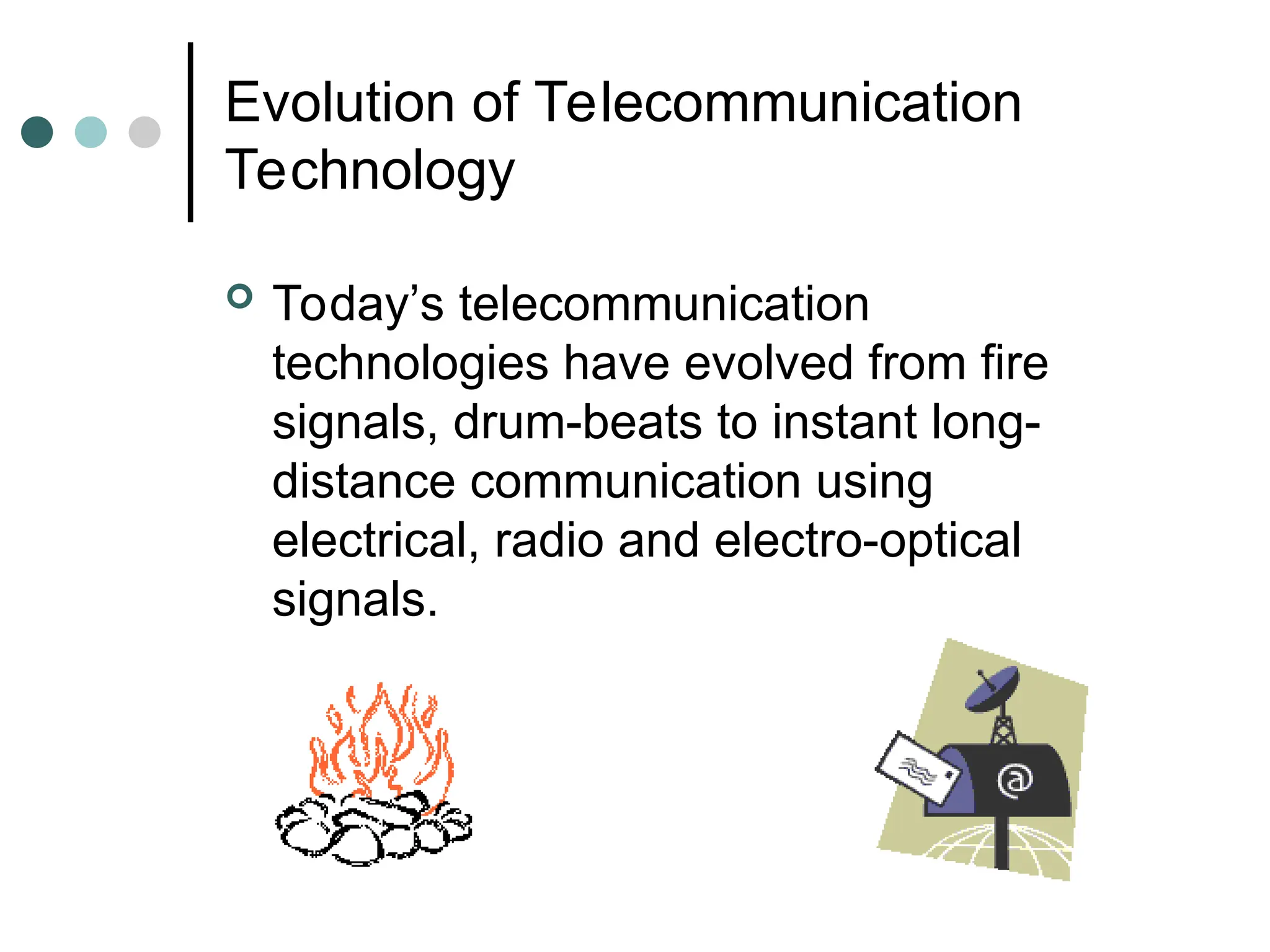
 Today’s telecommunication
technologies have evolved from fire
signals, drum-beats to instant long-
distance communication using
electrical, radio and electro-optical
signals.
Early Signaling and Telegraphy
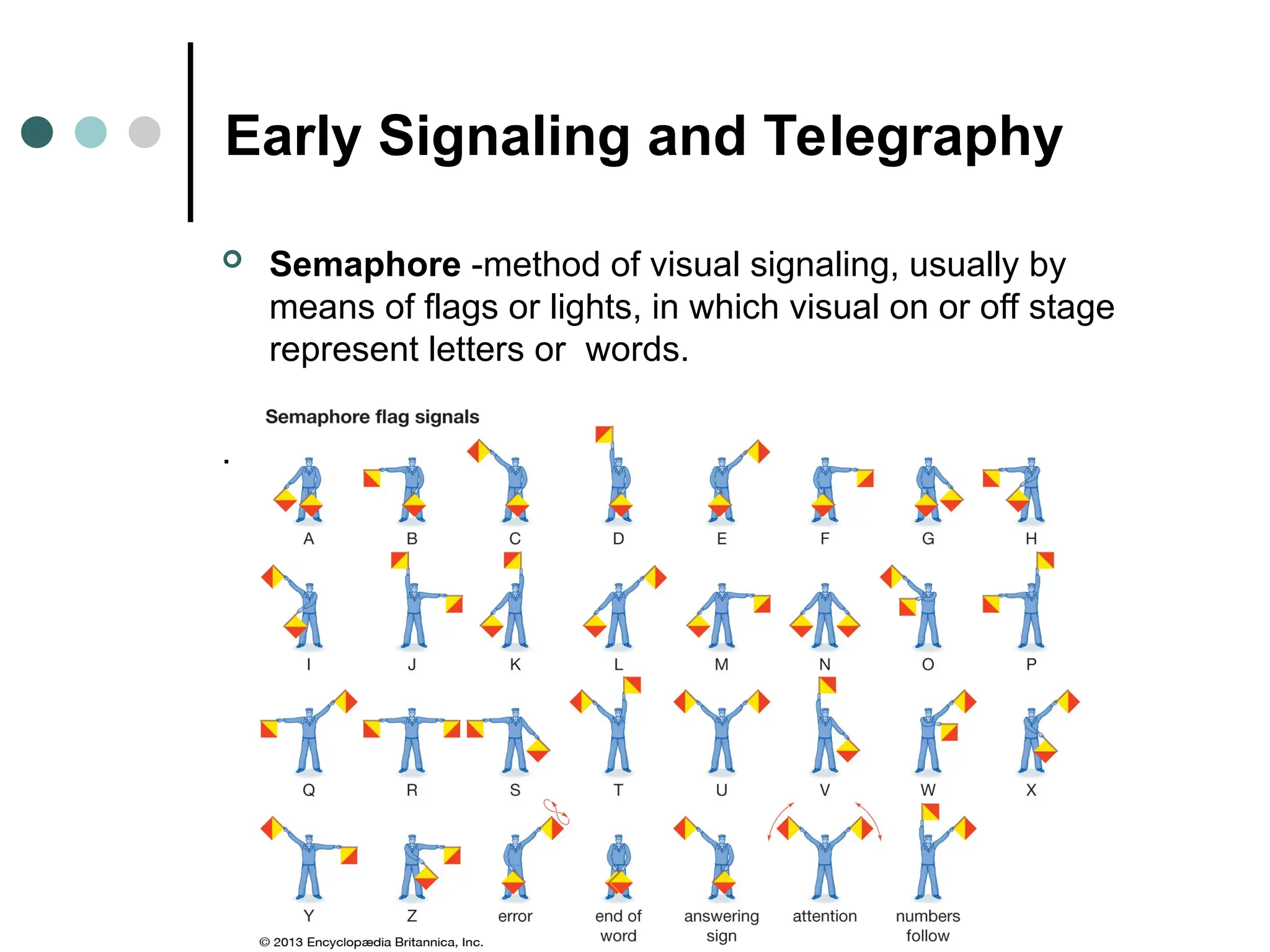
 Semaphore -method of visual signaling, usually by
means of flags or lights, in which visual on or off stage
represent letters or words.
.
Early Signaling and Telegraphy
 Morse code - the transmission of a series of short and
long pulses (dots and dashes) that represented
characters.
 Duplexing - simultaneously transmitting a signal in both
directions along the same wire.
 Multiplexing - simultaneously transmitting an
indeterminate number of multiple signals over one circuit.
Early Signaling and Telegraphy
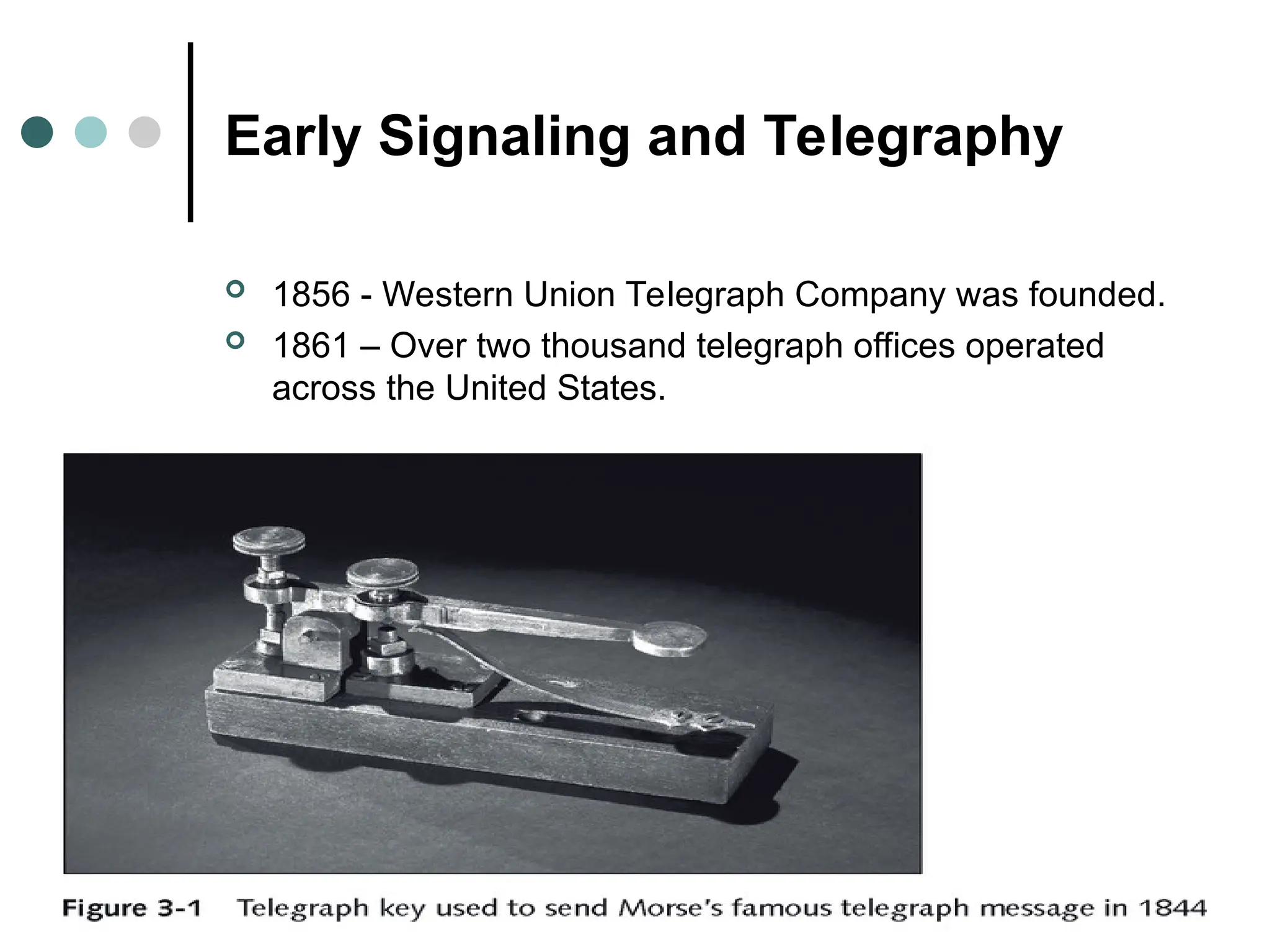
 1856 - Western Union Telegraph Company was founded.
 1861 – Over two thousand telegraph offices operated
across the United States.
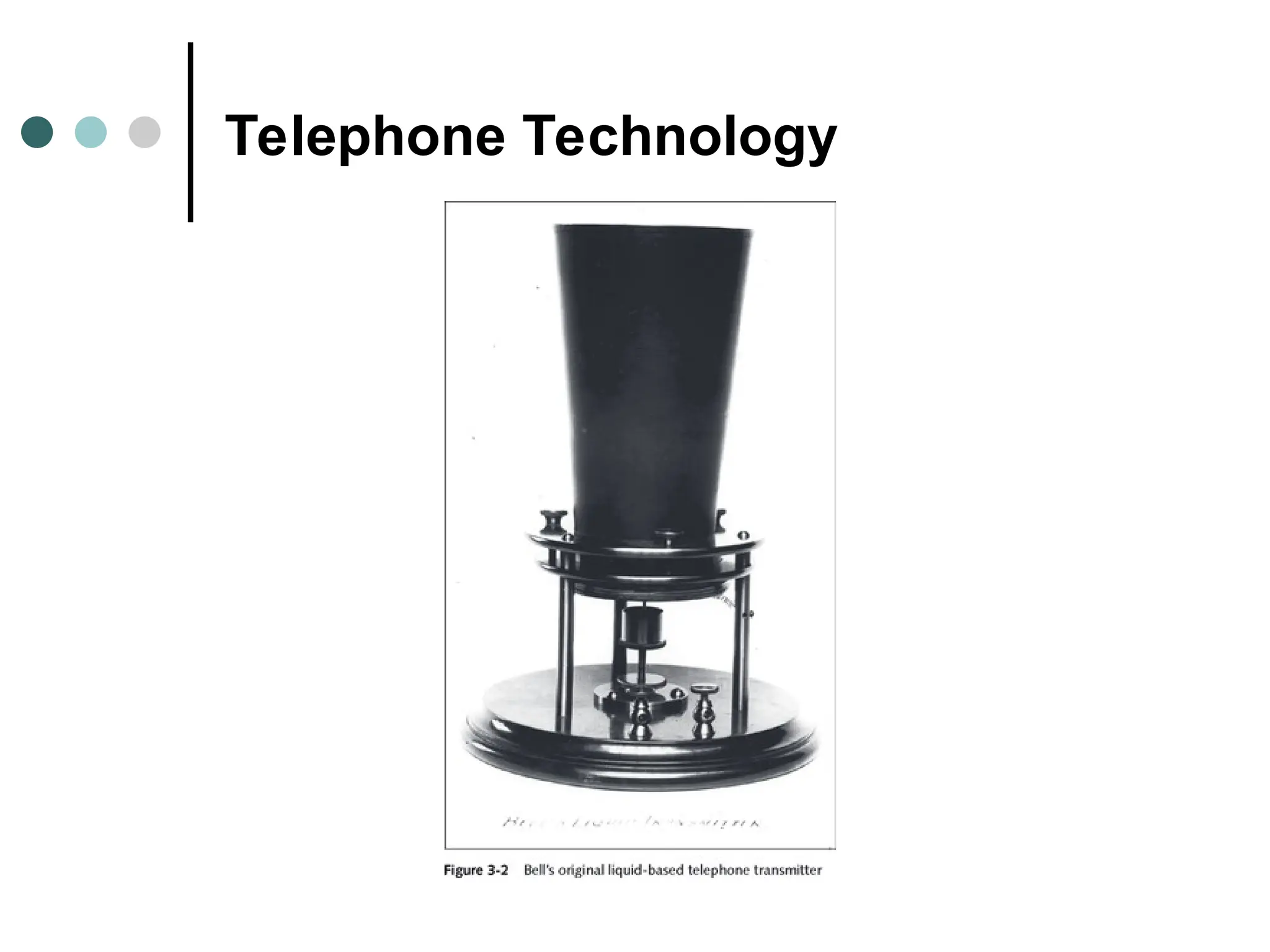
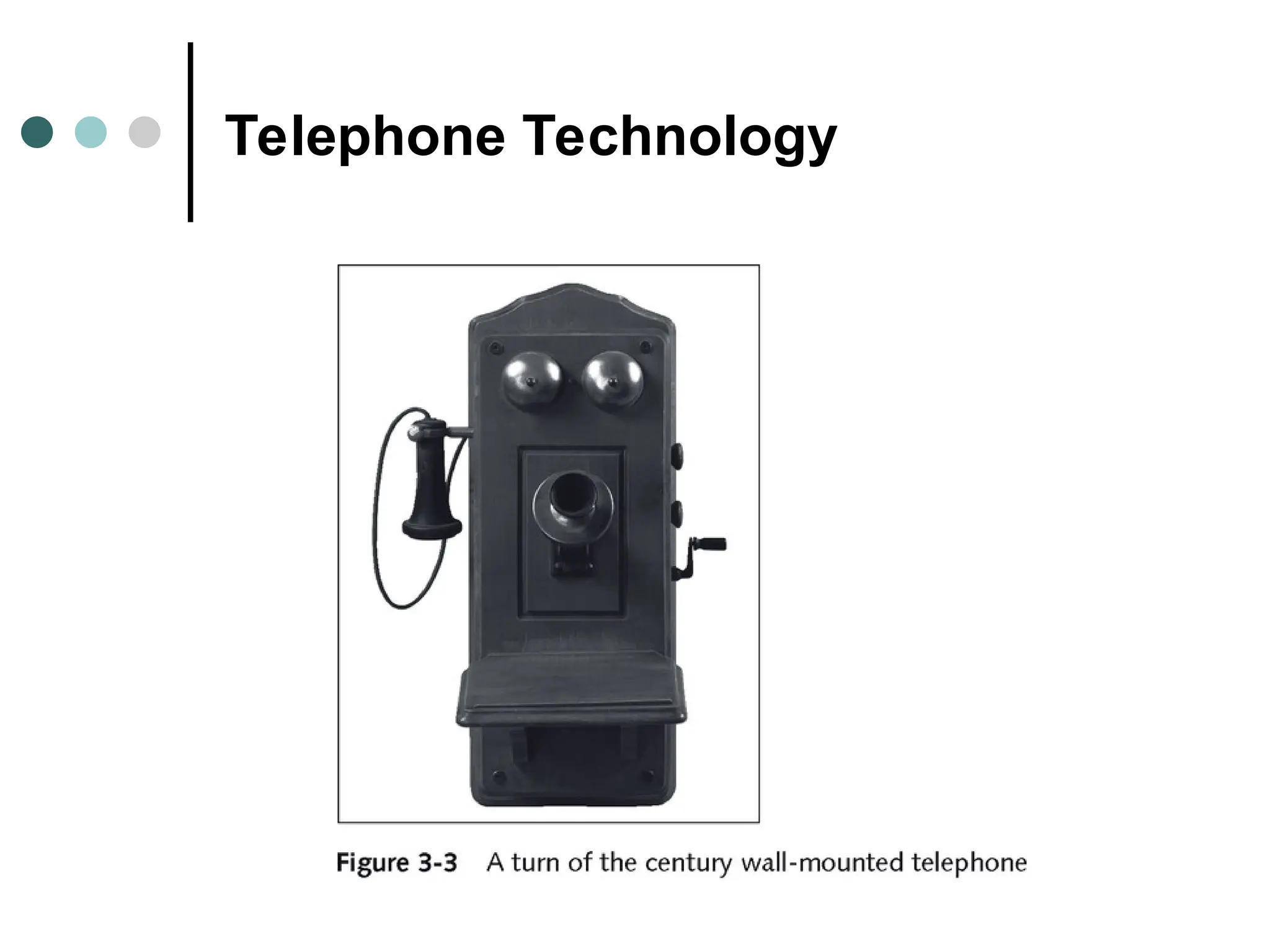
Telephone Technology
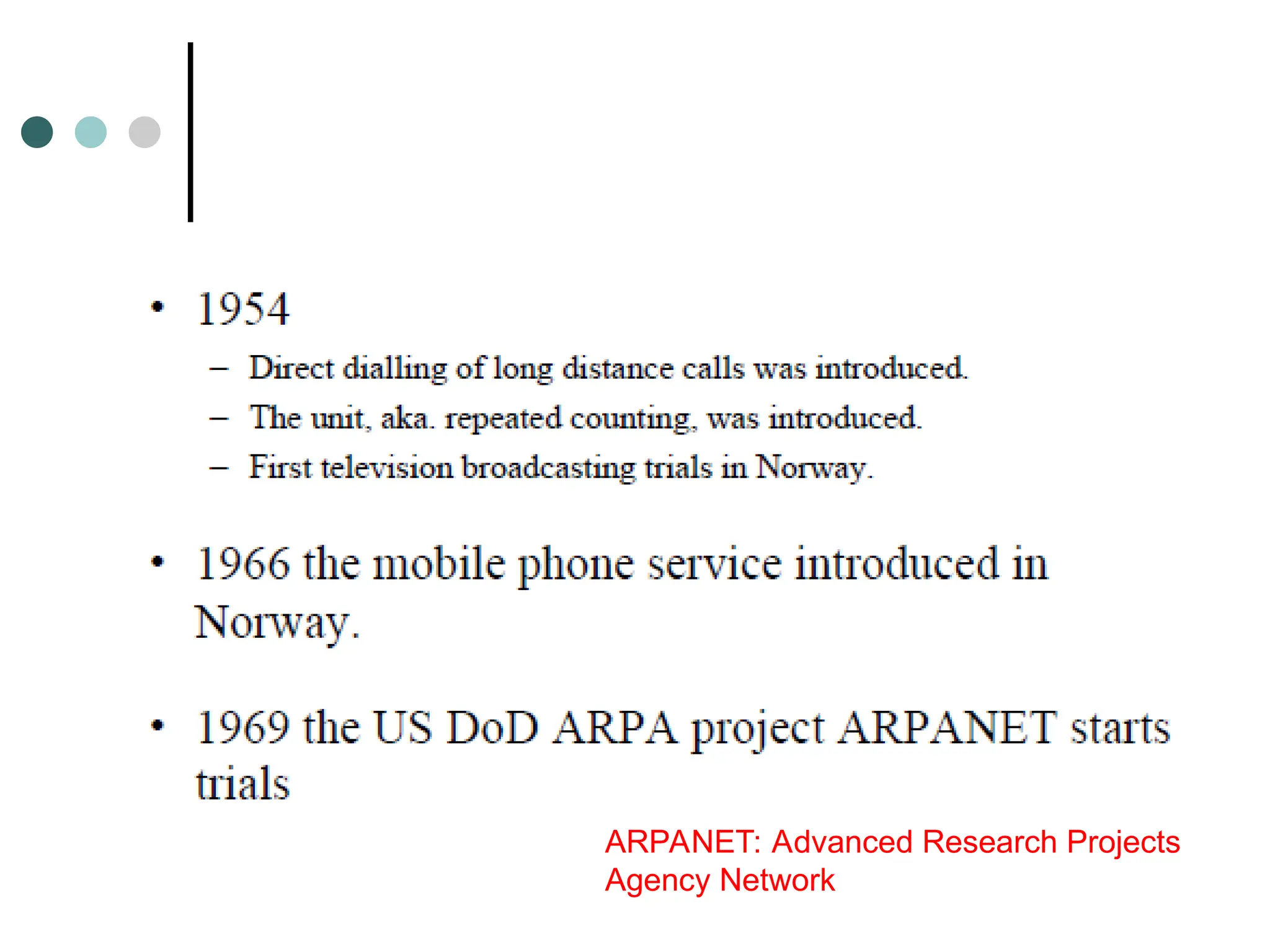
ARPANET: Advanced Research Projects
Agency Network
Infrastructure
 Wires criss-crossing cities and states and
terminating in several exchanges or central offices.
 Exchange was also known as a switching point because
the device used to open and close a circuit is known as a
switch.
 Operators would connect the circuits and complete
the call for the subscriber.
 Subscribers refers to a telephone company customer
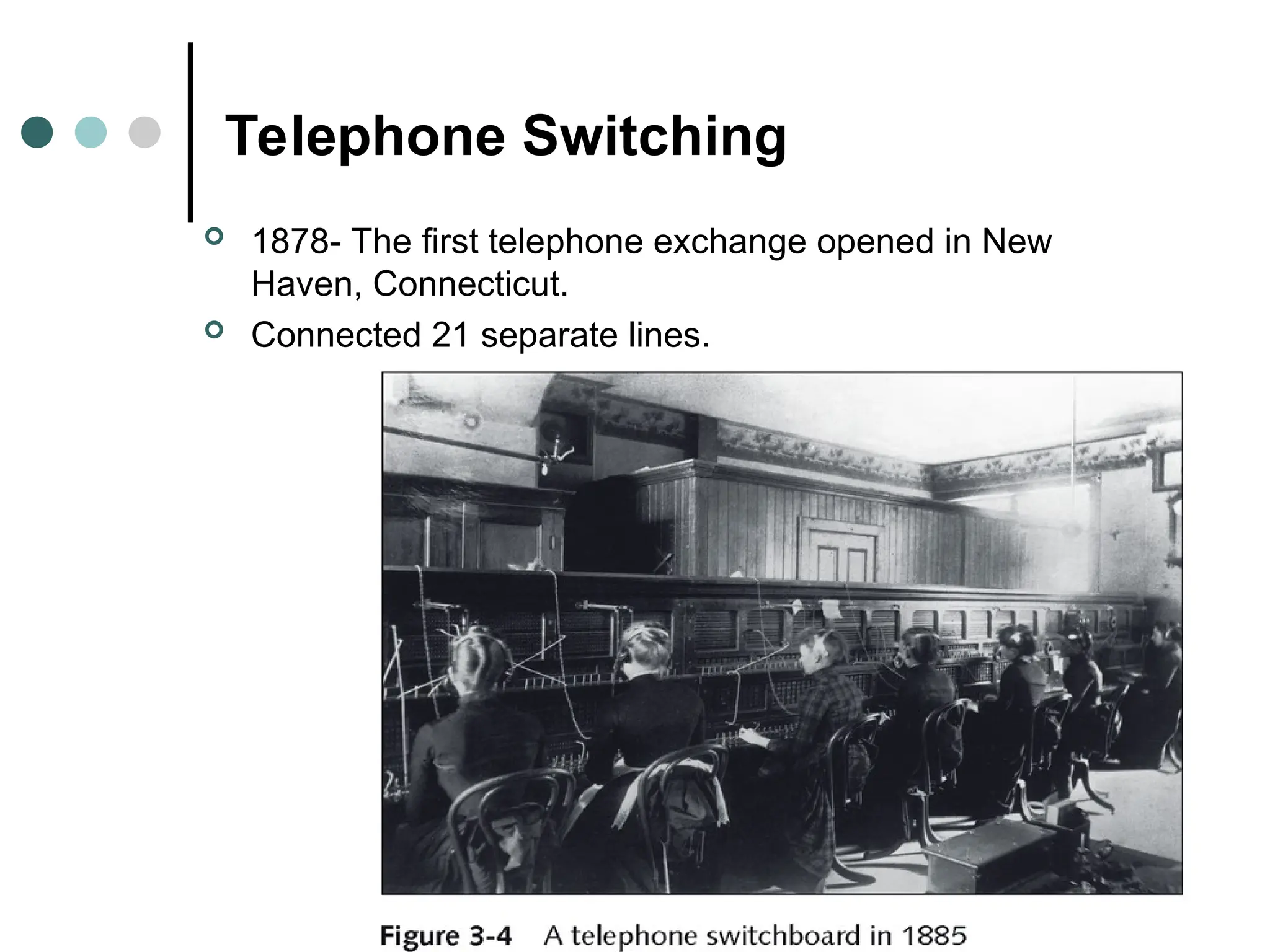
Telephone Switching
 1878- The first telephone exchange opened in New
Haven, Connecticut.
 Connected 21 separate lines.
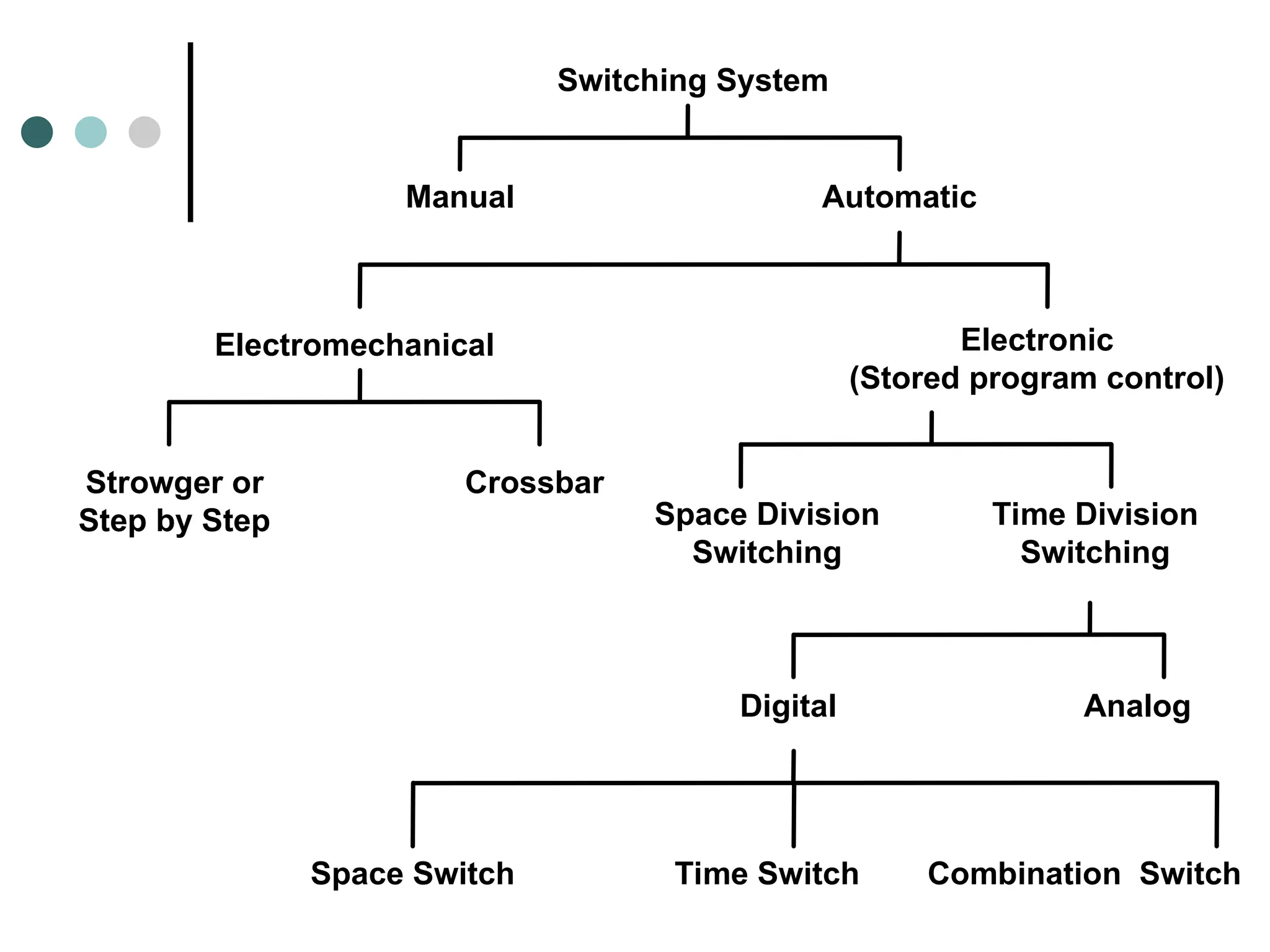
Switching System
Manual Automatic
Electromechanical Electronic
(Stored program control)
Strowger or
Step by Step
Crossbar
Space Division
Switching
Time Division
Switching
Digital Analog
Space Switch Time Switch Combination Switch
 In 1889 Almon Strowger developed the
automatic switch called the step-by-step.
 In 1896 he replaced the button-pushing
method with a rotary dialer.
 In 1913, N.J. Reynolds, a Western Electric
engineer, developed a better automatic switch,
the crossbar switch. It used a grid of horizontal
and vertical bars, with electromagnets at their
ends. The horizontal bars could rotate up and
down to connect to specific vertical bars and thus
complete circuits.
 Original version could complete 10 simultaneous
connections.
 By the 1970 a single crossbar could connect 35,000
connections.
 In the mid-20th
century AT&T integrated
electronics into crossbar switches
 1965 – first electronic switching system was
used
 Handled up to 65,000 two-way voice circuits.
 Until 1970 all telephone switches depended on
a continuous physical connection to complete
and maintain the call.
 1976 – New electronic switching device
was put into service.
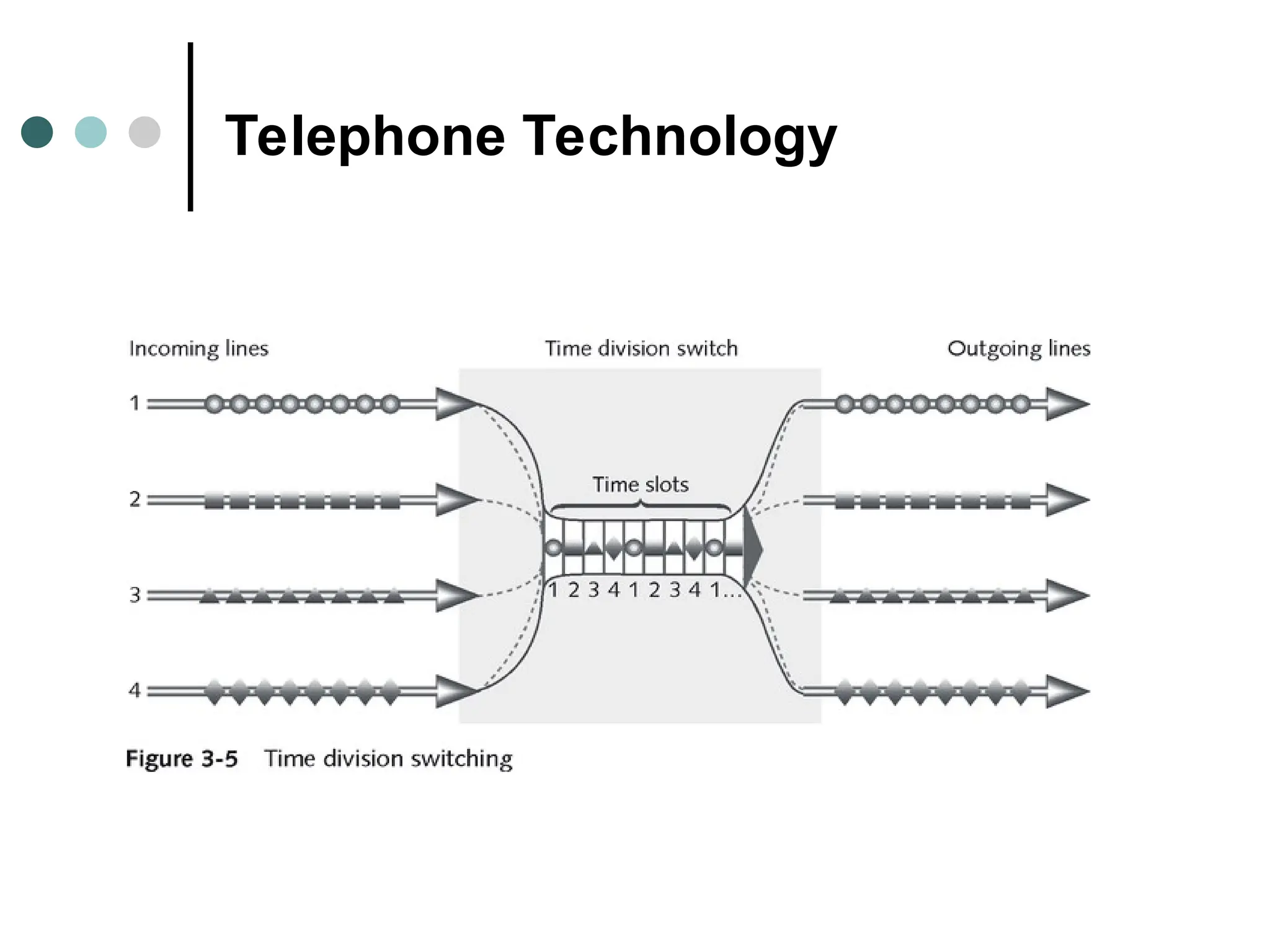
 Time division switching - a transmission
technique in which samples from multiple
incoming lines are digitized, then each
sample is issued to the same circuit, in a
predetermined sequence, before finally
being transmitted to the correct outbound
line.
 Space division switching - manipulating the physical
space between two lines, thereby closing a circuit to
connect a call.
 Local switching center (often called a local office) - a
place where multiple phone lines from homes and
businesses in one geographic area converge and
terminate.
 Tandem switching center - an exchange where lines
from multiple local offices converge and terminate.
 Toll switching center - an exchange where lines from
multiple tandem switching centers converge and
terminate.
Telephone Technology
Wireless Technology
 Telegraphs and telephones are examples of
wireline, or wire-bound technology, because
they rely on physically connected wires to
transmit and receive signals.
 Wireless technology - relies on the
atmosphere to transmit and receive signals.
Wireless Technology
 Examples of wireless technology
 Phones
 Radios
 Televisions
 Satellite communications
Wireless Technology
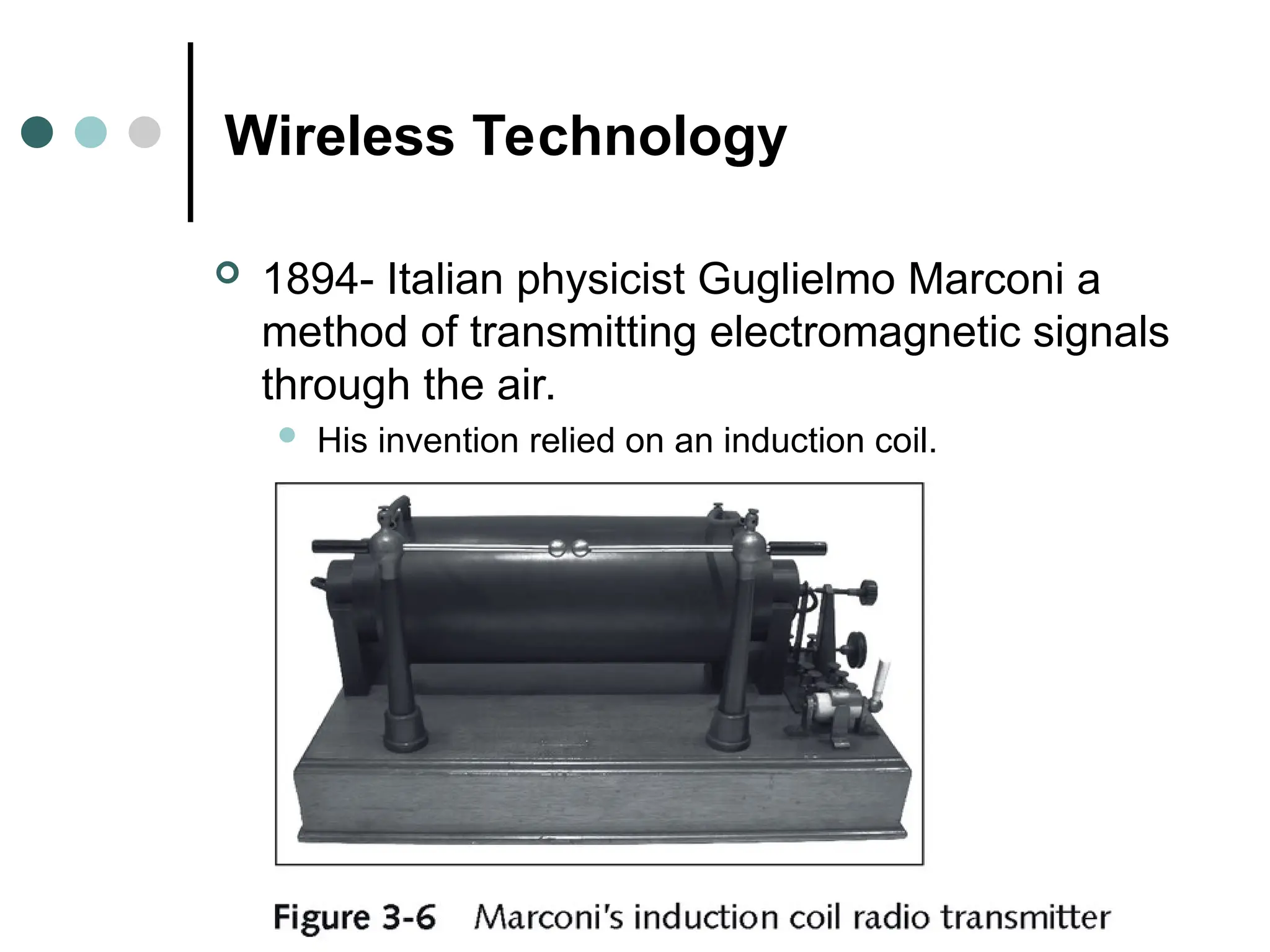
 1894- Italian physicist Guglielmo Marconi a
method of transmitting electromagnetic signals
through the air.
 His invention relied on an induction coil.
Wireless Technology
 Induction coil is made by winding wire in a either one or multiple
layers around a metal rod to form a coil then applying a charge
 Charged wire induces an electromagnetic field that generates
voltage
 Marconi connected an induction coil to a telegraph key. Each
time the key was pressed the coil discharged a voltage through
the air between to brass surfaces
 Metal filings in a glass cylinder became charged and cohered.
The length of time they cohered translated into short and long
pulses.
 Pulses were relayed to a Morse code printer.
 Marconi invention used the same type of signals sent and
received by a telegraph.
Wireless Technology
 Vacuum tube - a sealed container made of glass, metal,
or ceramic, that contains, in a vacuum, a charged plate
that transmits current to a filament.
 Audion - patented in 1907by DeForest, is a type of
vacuum tube that contains an additional electrode in the
middle of the positive and negative electrodes.
 Boosts or amplifies a signal.
 First instants of signal amplification and it formed the basis
for all subsequent radio and television advances.
 1912- Edwin Armstrong improved the Audion. He
discovered that by feeding the signal back the tube the
power of the Audion could be increased.
Wireless Technology
 Continued experimentation resulted in the
invention of Frequency modulation.
 Frequency modulation is technology used in FM
radio and other forms of wireless technology.
 In Frequency modulation one wave containing
the information to be transmitted (for example,
Kantipur FM, Hits FM) is combined with another
wave, called a carrier wave, whose frequency is
constant.
 Frequency is the number of times each second that a
sine wave completes a full cycle.
Wireless Technology
 The advent of FM radio afforded the best clarity of
all wireless technologies then available.
 Walkie-Talkies use frequency modulation
 1946- Bell Laboratories connect the first wireless
car phone to the St. Louis network.
 1962- Telstar Satellite successfully transmitted
television and telephone conversation across the
Atlantic for the first time.
Wireless Technology
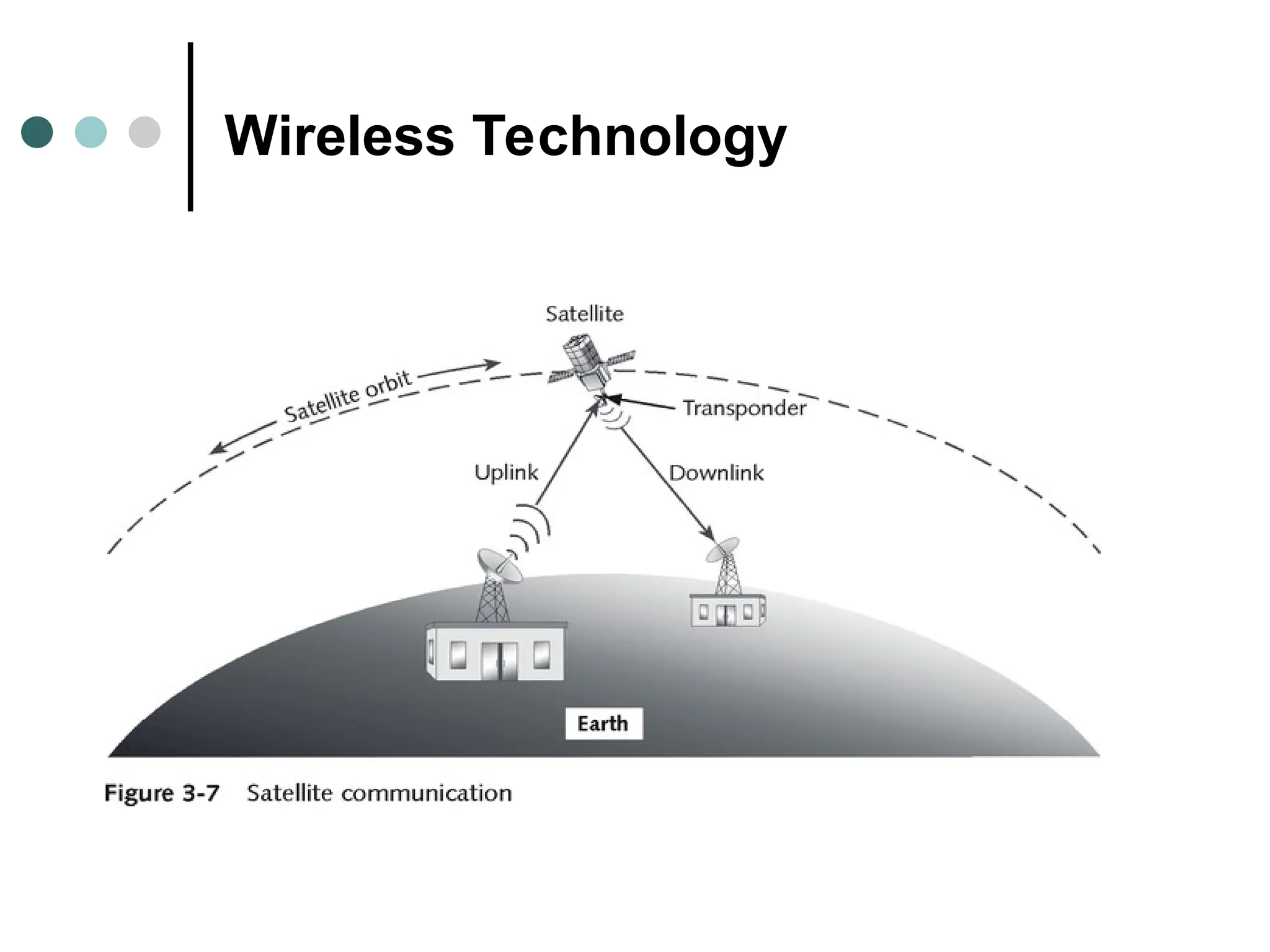
 Geosynchronous - means that satellites orbit
the earth at the same rate as the earth turns.
 Uplink - a broadcast from an earth-based
transmitter to an orbiting satellite.
 At the satellite, a transponder receives the
uplink, then transmits the signals to another
earth-based location in a downlink.
Wireless Technology
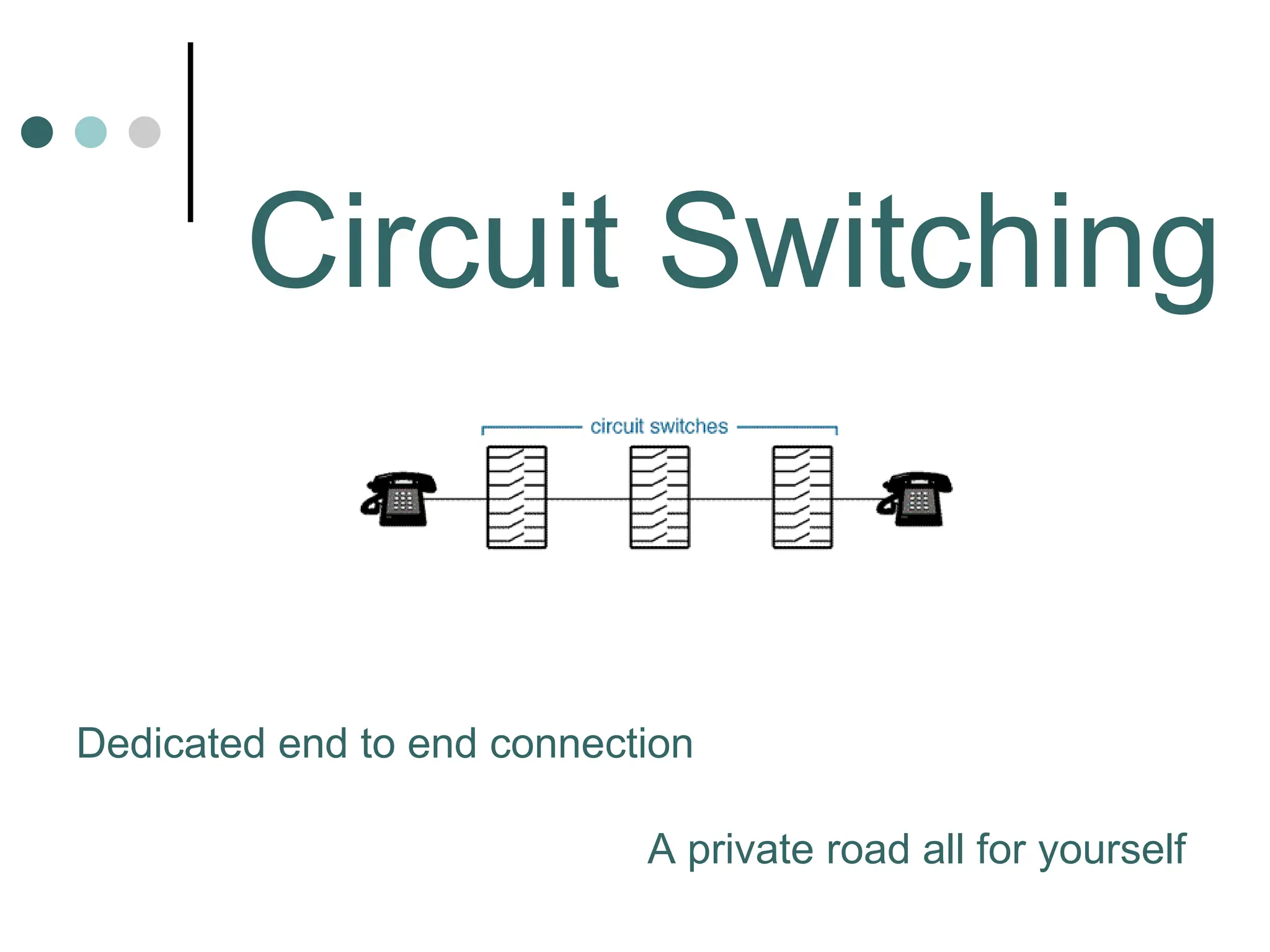
Circuit Switching
A private road all for yourself
Dedicated end to end connection
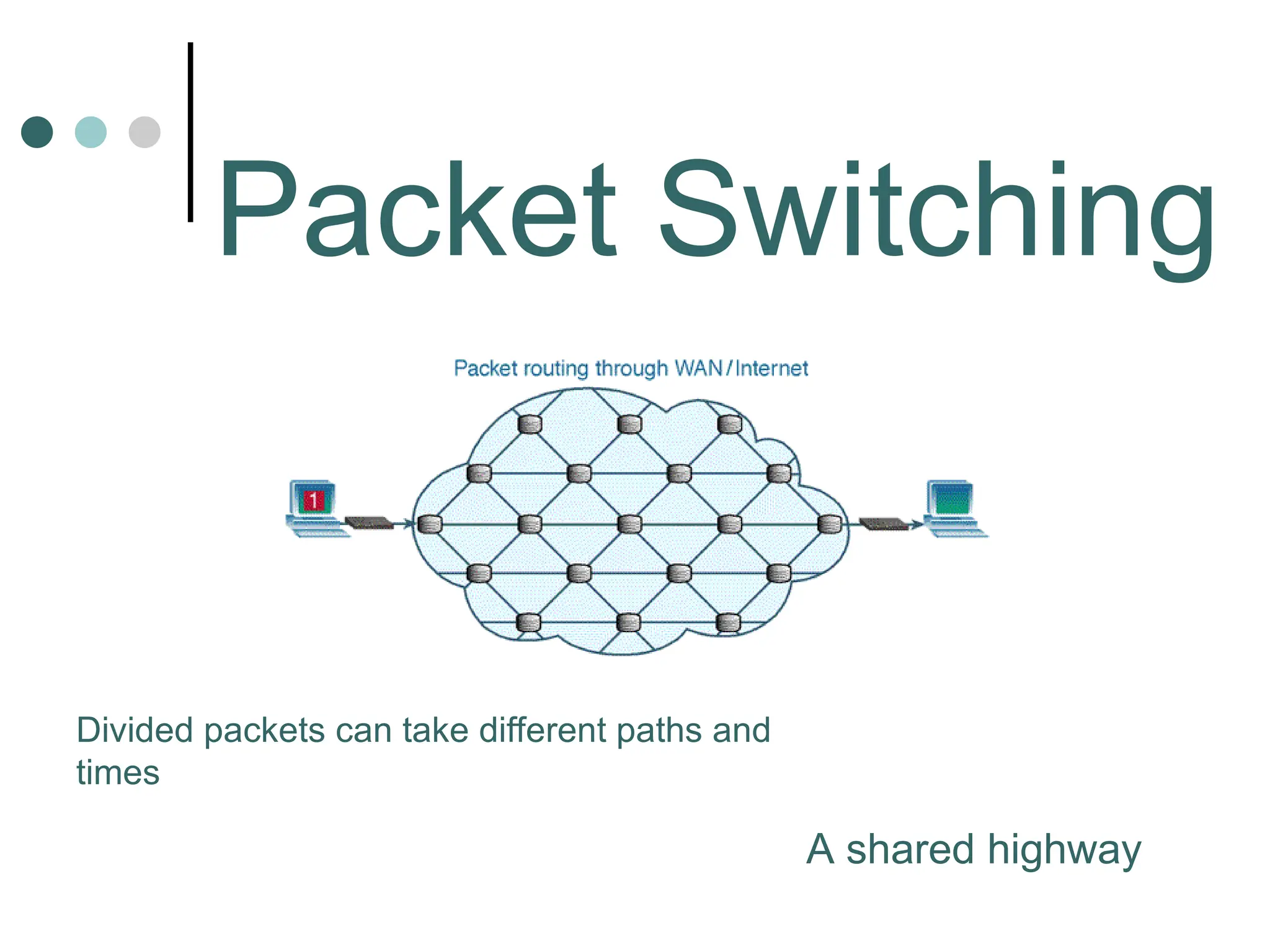
Packet Switching
Divided packets can take different paths and
times
A shared highway
Chapter 1 Telecommunication Networks.ppt

Chapter 1 Telecommunication Networks.ppt

  • 1.
    Telecommunication Networks: 1.1 Evolution ofTelecommunications 1.2 Classification of Switching System Chapter 1
  • 2.
  • 3.
    Evolution of Telecommunication Technology Today’s telecommunication technologies have evolved from fire signals, drum-beats to instant long- distance communication using electrical, radio and electro-optical signals.
  • 4.
    Early Signaling andTelegraphy  Semaphore -method of visual signaling, usually by means of flags or lights, in which visual on or off stage represent letters or words. .
  • 5.
    Early Signaling andTelegraphy  Morse code - the transmission of a series of short and long pulses (dots and dashes) that represented characters.  Duplexing - simultaneously transmitting a signal in both directions along the same wire.  Multiplexing - simultaneously transmitting an indeterminate number of multiple signals over one circuit.
  • 6.
    Early Signaling andTelegraphy  1856 - Western Union Telegraph Company was founded.  1861 – Over two thousand telegraph offices operated across the United States.
  • 7.
  • 8.
  • 13.
    ARPANET: Advanced ResearchProjects Agency Network
  • 21.
    Infrastructure  Wires criss-crossingcities and states and terminating in several exchanges or central offices.  Exchange was also known as a switching point because the device used to open and close a circuit is known as a switch.  Operators would connect the circuits and complete the call for the subscriber.  Subscribers refers to a telephone company customer
  • 22.
    Telephone Switching  1878-The first telephone exchange opened in New Haven, Connecticut.  Connected 21 separate lines.
  • 23.
    Switching System Manual Automatic ElectromechanicalElectronic (Stored program control) Strowger or Step by Step Crossbar Space Division Switching Time Division Switching Digital Analog Space Switch Time Switch Combination Switch
  • 24.
     In 1889Almon Strowger developed the automatic switch called the step-by-step.  In 1896 he replaced the button-pushing method with a rotary dialer.
  • 25.
     In 1913,N.J. Reynolds, a Western Electric engineer, developed a better automatic switch, the crossbar switch. It used a grid of horizontal and vertical bars, with electromagnets at their ends. The horizontal bars could rotate up and down to connect to specific vertical bars and thus complete circuits.  Original version could complete 10 simultaneous connections.  By the 1970 a single crossbar could connect 35,000 connections.
  • 26.
     In themid-20th century AT&T integrated electronics into crossbar switches  1965 – first electronic switching system was used  Handled up to 65,000 two-way voice circuits.  Until 1970 all telephone switches depended on a continuous physical connection to complete and maintain the call.
  • 27.
     1976 –New electronic switching device was put into service.  Time division switching - a transmission technique in which samples from multiple incoming lines are digitized, then each sample is issued to the same circuit, in a predetermined sequence, before finally being transmitted to the correct outbound line.
  • 28.
     Space divisionswitching - manipulating the physical space between two lines, thereby closing a circuit to connect a call.  Local switching center (often called a local office) - a place where multiple phone lines from homes and businesses in one geographic area converge and terminate.  Tandem switching center - an exchange where lines from multiple local offices converge and terminate.  Toll switching center - an exchange where lines from multiple tandem switching centers converge and terminate.
  • 29.
  • 30.
    Wireless Technology  Telegraphsand telephones are examples of wireline, or wire-bound technology, because they rely on physically connected wires to transmit and receive signals.  Wireless technology - relies on the atmosphere to transmit and receive signals.
  • 31.
    Wireless Technology  Examplesof wireless technology  Phones  Radios  Televisions  Satellite communications
  • 32.
    Wireless Technology  1894-Italian physicist Guglielmo Marconi a method of transmitting electromagnetic signals through the air.  His invention relied on an induction coil.
  • 33.
    Wireless Technology  Inductioncoil is made by winding wire in a either one or multiple layers around a metal rod to form a coil then applying a charge  Charged wire induces an electromagnetic field that generates voltage  Marconi connected an induction coil to a telegraph key. Each time the key was pressed the coil discharged a voltage through the air between to brass surfaces  Metal filings in a glass cylinder became charged and cohered. The length of time they cohered translated into short and long pulses.  Pulses were relayed to a Morse code printer.  Marconi invention used the same type of signals sent and received by a telegraph.
  • 34.
    Wireless Technology  Vacuumtube - a sealed container made of glass, metal, or ceramic, that contains, in a vacuum, a charged plate that transmits current to a filament.  Audion - patented in 1907by DeForest, is a type of vacuum tube that contains an additional electrode in the middle of the positive and negative electrodes.  Boosts or amplifies a signal.  First instants of signal amplification and it formed the basis for all subsequent radio and television advances.  1912- Edwin Armstrong improved the Audion. He discovered that by feeding the signal back the tube the power of the Audion could be increased.
  • 35.
    Wireless Technology  Continuedexperimentation resulted in the invention of Frequency modulation.  Frequency modulation is technology used in FM radio and other forms of wireless technology.  In Frequency modulation one wave containing the information to be transmitted (for example, Kantipur FM, Hits FM) is combined with another wave, called a carrier wave, whose frequency is constant.  Frequency is the number of times each second that a sine wave completes a full cycle.
  • 36.
    Wireless Technology  Theadvent of FM radio afforded the best clarity of all wireless technologies then available.  Walkie-Talkies use frequency modulation  1946- Bell Laboratories connect the first wireless car phone to the St. Louis network.  1962- Telstar Satellite successfully transmitted television and telephone conversation across the Atlantic for the first time.
  • 37.
    Wireless Technology  Geosynchronous- means that satellites orbit the earth at the same rate as the earth turns.  Uplink - a broadcast from an earth-based transmitter to an orbiting satellite.  At the satellite, a transponder receives the uplink, then transmits the signals to another earth-based location in a downlink.
  • 38.
  • 41.
    Circuit Switching A privateroad all for yourself Dedicated end to end connection
  • 42.
    Packet Switching Divided packetscan take different paths and times A shared highway