UNIT I : Wireless Communication
By
Mr.S.Selvaraj
Asst. Professor (SRG) / CSE
Kongu Engineering College
Perundurai, Erode, Tamilnadu, India
Thanks to and Resource from : Wireless communication by Jochen H. Schiller, 2nd Edition, Pearson, 2009.
18CST63 – Mobile Communication and IoT
Syllabus – Unit Wise
5/16/2022 1.1 _ Wireless Transmission 2
Course Outcome, CO and PO Mappings and Assessment Pattern
5/16/2022 1.1 _ Wireless Transmission 3
List of Exercises
5/16/2022 1.1 _ Wireless Transmission 4
Text Book and Reference Book
5/16/2022 1.1 _ Wireless Transmission 5
Unit I : Contents
1. Wireless transmission
– Frequencies for radio transmission
– Signals
– Antennas
2. GSM
3. GPRS
4. Satellite Systems
5. Wireless LAN
– Infrared Vs Radio Transmission
– Infrastructure Networks and Adhoc Networks
– IEEE 802.11
– Bluetooth
– Introduction to 3G, 4G and 5G.
5/16/2022 6
1.1 _ Wireless Transmission
5/16/2022 CSE 4215, Winter 2011 7
Early history of wireless communication
• Many people in history used light for communication
– heliographs, flags (“semaphore”), ...
– 150 BC smoke signals for communication;
(Polybius, Greece)
– 1794, optical telegraph, Claude Chappe
• Here electromagnetic waves are
of special importance:
– 1831 Faraday demonstrates electromagnetic induction
– J. Maxwell (1831-79): theory of electromagnetic Fields, wave
equations (1864)
– H. Hertz (1857-94): demonstrates
with an experiment the wave character
of electrical transmission through space
(1888, in Karlsruhe, Germany)
5/16/2022 CSE 4215, Winter 2011 8
History of wireless communication I
• 1896 Guglielmo Marconi
– first demonstration of wireless
telegraphy (digital!)
– long wave transmission, high
transmission power necessary (> 200kW)
• 1907 Commercial transatlantic connections
– huge base stations
(30 100m high antennas)
• 1915 Wireless voice transmission New York - San Francisco
• 1920 Discovery of short waves by Marconi
– reflection at the ionosphere
– smaller sender and receiver, possible due to the invention of the vacuum
tube (1906, Lee DeForest and Robert von Lieben)
• 1926 Train-phone on the line Hamburg - Berlin
• wires parallel to the railroad track
5/16/2022 CSE 4215, Winter 2011 9
History of wireless communication II
• 1928 many TV broadcast trials (across Atlantic, color TV, news)
• 1933 Frequency modulation (E. H. Armstrong)
• 1958 A-Netz in Germany
– analog, 160MHz, connection setup only from the mobile station, no
handover, 80% coverage, 1971 11000 customers
• 1972 B-Netz in Germany
– analog, 160MHz, connection setup from the fixed network too (but
location of the mobile station has to be known)
– available also in A, NL and LUX, 1979 13000 customers in D
• 1979 NMT at 450MHz (Scandinavian countries)
• 1982 Start of GSM-specification
– goal: pan-European digital mobile phone system with roaming
• 1983 Start of the American AMPS (Advanced Mobile Phone
System, analog)
• 1984 CT-1 standard (Europe) for cordless telephones
5/16/2022 CSE 4215, Winter 2011 10
History of wireless communication III
• 1986 C-Netz in Germany
– analog voice transmission, 450MHz, hand-over possible, digital signaling,
automatic location of mobile device
– was in use until 2000, services: FAX, modem, X.25, e-mail, 98% coverage
• 1991 Specification of DECT
– Digital European Cordless Telephone (today: Digital Enhanced Cordless
Telecommunications)
– 1880-1900MHz, ~100-500m range, 120 duplex channels, 1.2Mbit/s data
transmission, voice encryption, authentication, up to several 10000
user/km2, used in more than 50 countries
• 1992 Start of GSM
– in D as D1 and D2, fully digital, 900MHz, 124 channels
– automatic location, hand-over, cellular
– roaming in Europe - now worldwide in more than 200 countries
– services: data with 9.6kbit/s, FAX, voice, ...
5/16/2022 CSE 4215, Winter 2011 11
History of wireless communication IV
• 1994 E-Netz in Germany
– GSM with 1800MHz, smaller cells
– as Eplus in D (1997 98% coverage of the population)
• 1996 HiperLAN (High Performance Radio Local Area
Network)
– ETSI, standardization of type 1: 5.15 - 5.30GHz, 23.5Mbit/s
– recommendations for type 2 and 3 (both 5GHz) and 4 (17GHz) as wireless
ATM-networks (up to 155Mbit/s)
• 1997 Wireless LAN - IEEE802.11
– IEEE standard, 2.4 - 2.5GHz and infrared, 2Mbit/s
– already many (proprietary) products available in the beginning
• 1998 Specification of GSM successors
– for UMTS (Universal Mobile Telecommunications System) as European
proposals for IMT-2000
– Iridium
• 66 satellites (+6 spare), 1.6GHz to the mobile phone
5/16/2022 CSE 4215, Winter 2011 12
History of wireless communication V
• 1999 Standardization of additional wireless LANs
– IEEE standard 802.11b, 2.4-2.5GHz, 11Mbit/s
– Bluetooth for piconets, 2.4GHz, <1Mbit/s
– decision about IMT-2000
• several “members” of a “family”: UMTS, cdma2000, DECT, …
– Start of WAP (Wireless Application Protocol) and i-mode
• first step towards a unified Internet/mobile communication system
• access to many services via the mobile phone
• 2000 GSM with higher data rates
– HSCSD offers up to 57,6kbit/s
– first GPRS trials with up to 50 kbit/s (packet oriented!)
– UMTS auctions/beauty contests
• Hype followed by disillusionment (50 B$ paid in Germany for 6 licenses!)
– Iridium goes bankrupt
• 2001 Start of 3G systems
– Cdma2000 in Korea, UMTS tests in Europe, Foma (almost UMTS) in Japan
5/16/2022 CSE 4215, Winter 2011 13
History of wireless communication VI
• 2002
– WLAN hot-spots start to spread
• 2003
– UMTS starts in Germany
– Start of DVB-T in Germany replacing analog TV
• 2005
– WiMax starts as DSL alternative (not mobile)
– first ZigBee products
• 2006
– HSDPA starts in Germany as fast UMTS download version offering > 3 Mbit/s
– WLAN draft for 250 Mbit/s (802.11n) using MIMO
– WPA2 mandatory for Wi-Fi WLAN devices
• 2007
– over 3.3 billion subscribers for mobile phones (NOT 3 bn people!)
• 2008
– “real” Internet widely available on mobile phones (standard browsers, decent data
rates)
– 7.2 Mbit/s HSDPA, 1.4 Mbit/s HSUPA available in Germany, more than 100 operators
support HSPA worldwide, first LTE tests (>100 Mbit/s)
• 2009 – the story continues with netbooks, iphones, VoIPoWLAN…
5/16/2022 CSE 4215, Winter 2011 14
Wireless systems: overview of the development
cellular phones satellites
wireless
LAN
cordless
phones
1992:
GSM
1994:
DCS 1800
2001:
IMT-2000
1987:
CT1+
1982:
Inmarsat-
A
1992:
Inmarsat-B
Inmarsat-M
1998:
Iridium
1989:
CT 2
1991:
DECT 199x:
proprietary
1997:
IEEE 802.11
1999:
802.11b, Bluetooth
1988:
Inmarsat-
C
analog
digital
1991:
D-AMPS
1991:
CDMA
1981:
NMT 450
1986:
NMT 900
1980:
CT0
1984:
CT1
1983:
AMPS
1993:
PDC
4G – fourth generation: when and how?
… rather an incremental deployment!
2000:
GPRS
2000:
IEEE 802.11a
200?:
Fourth Generation
(Internet based)
Power of 10
5/16/2022 1.1 _ Wireless Transmission 15
5/16/2022 1.1 _ Wireless Transmission 16
5/16/2022 1.1 _ Wireless Transmission 17
Quiz 1
• 236 = ____?
5/16/2022 1.1 _ Wireless Transmission 18
Quiz 2
• 2200 = 10?
5/16/2022 1.1 _ Wireless Transmission 19
The Electromagnetic Spectrum
5/16/2022 1.1 _ Wireless Transmission 20
Types of Electromagnetic Spectrum
5/16/2022 1.1 _ Wireless Transmission 21
Frequencies for Radio Transmission
5/16/2022 1.1 _ Wireless Transmission 22
Frequencies for Radio Transmission
5/16/2022 1.1 _ Wireless Transmission 23
Frequencies for Mobile Communication
5/16/2022 1.1 _ Wireless Transmission 24
Wifi - HaLow
5/16/2022 1.1 _ Wireless Transmission 25
Frequencies and Regulations
5/16/2022 1.1 _ Wireless Transmission 26
Quiz 3
• Which frequency is used for Wireless
LAN(Bluetooth, Zigbee, Wi-Fi, Wifi HaLow,
LoRaWAN, WiMAX)?
A. SHF
B. UHF
C. VHF
D. VLF
E. EHF
5/16/2022 1.1 _ Wireless Transmission 27
Quiz 4
• Which frequency is used for FM Radio?
A. SHF
B. UHF
C. VHF
D. VLF
E. EHF
5/16/2022 1.1 _ Wireless Transmission 28
Quiz 5
• Which frequency is used for Mobile Networks
/ Cellular Network?
A. SHF
B. UHF
C. VHF
D. VLF
E. EHF
5/16/2022 1.1 _ Wireless Transmission 29
Quiz 6
• Which frequency is used for RADAR?
A. SHF
B. UHF
C. VHF
D. VLF
E. EHF
5/16/2022 1.1 _ Wireless Transmission 30
Quiz 7
• Which agency is responsible for worldwide
coordination of telecommunication activities
(wired and wireless)?
A. FCC
B. CEPT
C. ITU
D. ETSI
5/16/2022 1.1 _ Wireless Transmission 31
Analog Vs Digital Data
• Data can be analog or digital.
• The term analog data refers to information that is continuous; digital data
refers to information that has discrete states.
• For example, an analog clock that has hour, minute, and second hands
gives information in a continuous form; the movements of the hands are
continuous. On the other hand, a digital clock that reports the hours and
the minutes will change suddenly from 8:05 to 8:06.
• Analog data, such as the sounds made by a human voice, take on
continuous values. When someone speaks, an analog wave is created in
the air. This can be captured by a microphone and converted to an analog
signal or sampled and converted to a digital signal.
• Digital data take on discrete values. For example, data are stored in
computer memory in the form of 0s and 1s. They can be converted to a
digital signal or modulated into an analog signal for transmission across a
medium.
5/16/2022 1.1 _ Wireless Transmission 32
Analog Vs Digital Signals
5/16/2022 1.1 _ Wireless Transmission 33
Periodic Vs Non-periodic Signal
• A periodic signal completes a pattern within a
measurable time frame, called a period, and repeats
that pattern over subsequent identical periods. The
completion of one full pattern is called a cycle.
• A non-periodic signal changes without exhibiting a
pattern or cycle that repeats over time.
• Both analog and digital signals can be periodic or non-
periodic.
• In data communications, we commonly use periodic
analog signals and non-periodic digital signals.
5/16/2022 1.1 _ Wireless Transmission 34
Periodic Signal – Sine Wave
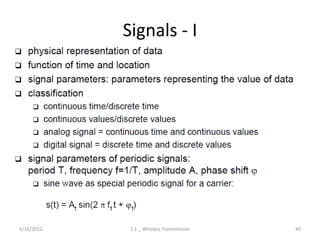
• sine wave can be represented by three
parameters: the peak amplitude, the
frequency, and the phase.
5/16/2022 1.1 _ Wireless Transmission 35
Peak Amplitude
• The peak amplitude of a signal is the absolute
value of its highest intensity, proportional to
the energy it carries. For electric signals, peak
amplitude is normally measured in volts.
5/16/2022 1.1 _ Wireless Transmission 36
Period and Frequency
• Period refers to the amount of time, in seconds, a
signal needs to complete 1 cycle.
• Frequency refers to the number of periods in 1 s.
• Note that period and frequency are just one
characteristic defined in two ways.
• Period is the inverse of frequency, and frequency is the
inverse of period, as the following formulas show.
• Period is formally expressed in seconds.
• Frequency is formally expressed in Hertz (Hz), which is
cycle per second.
5/16/2022 1.1 _ Wireless Transmission 37
Period and Frequency
5/16/2022 1.1 _ Wireless Transmission 38
Frequency Examples
5/16/2022 1.1 _ Wireless Transmission 39
Signals - I
5/16/2022 1.1 _ Wireless Transmission 40
Fourier Representation of Periodic Signal
5/16/2022 1.1 _ Wireless Transmission 41
Fourier Transform and Harmonics
5/16/2022 1.1 _ Wireless Transmission 42
Signals - II
5/16/2022 1.1 _ Wireless Transmission 43
Quiz 4
• Which layer of ISO/OSI basic reference model
is responsible for the conversion of data, i.e.,
bits, into signals and vice versa?
A. Application
B. Transport
C. Network
D. Data Link
E. Physical
5/16/2022 1.1 _ Wireless Transmission 44
Antenna
• Antennas couple electromagnetic energy to and from space to and
from a wire or coaxial cable (or any other appropriate conductor).
• In radio engineering, an antenna or aerial is the interface
between radio waves propagating through space and electric
currents moving in metal conductors, used with
a transmitter or receiver.
• In transmission, a radio transmitter supplies an electric current to
the antenna's terminals, and the antenna radiates the energy from
the current as electromagnetic waves (radio waves).
• In reception, an antenna intercepts some of the power of a radio
wave in order to produce an electric current at its terminals, that is
applied to a receiver to be amplified.
• Antennas are essential components of all radio equipment
5/16/2022 1.1 _ Wireless Transmission 45
Basic Antenna’s
• Omnidirectional – Wipe Antenna Used in Car.
• Directional – Yagi-Uda Antenna Used in Home.
• Parabolic Antenna
• Cellular Antenna
5/16/2022 1.1 _ Wireless Transmission 46
Antenna Types
5/16/2022 1.1 _ Wireless Transmission 47
Antennas : Isotropic Radiator
5/16/2022 1.1 _ Wireless Transmission 48
Animated Diagram of waves from Isotropic Radiator
5/16/2022 1.1 _ Wireless Transmission 49
Antennas: Simple Dipoles
5/16/2022 1.1 _ Wireless Transmission 50
Antenna and Wavelength
5/16/2022 1.1 _ Wireless Transmission 51
Animated Diagram of waves from dipole antenna
5/16/2022 1.1 _ Wireless Transmission 52
Antennas: Directed and Sectorized
5/16/2022 1.1 _ Wireless Transmission 53
Antenna Diversity
5/16/2022 1.1 _ Wireless Transmission 54
Thank you
5/16/2022 1.1 _ Wireless Transmission 55

[PPT] _ 1.1 Wireless Transmission.pptx

  • 1.
    UNIT I :Wireless Communication By Mr.S.Selvaraj Asst. Professor (SRG) / CSE Kongu Engineering College Perundurai, Erode, Tamilnadu, India Thanks to and Resource from : Wireless communication by Jochen H. Schiller, 2nd Edition, Pearson, 2009. 18CST63 – Mobile Communication and IoT
  • 2.
    Syllabus – UnitWise 5/16/2022 1.1 _ Wireless Transmission 2
  • 3.
    Course Outcome, COand PO Mappings and Assessment Pattern 5/16/2022 1.1 _ Wireless Transmission 3
  • 4.
    List of Exercises 5/16/20221.1 _ Wireless Transmission 4
  • 5.
    Text Book andReference Book 5/16/2022 1.1 _ Wireless Transmission 5
  • 6.
    Unit I :Contents 1. Wireless transmission – Frequencies for radio transmission – Signals – Antennas 2. GSM 3. GPRS 4. Satellite Systems 5. Wireless LAN – Infrared Vs Radio Transmission – Infrastructure Networks and Adhoc Networks – IEEE 802.11 – Bluetooth – Introduction to 3G, 4G and 5G. 5/16/2022 6 1.1 _ Wireless Transmission
  • 7.
    5/16/2022 CSE 4215,Winter 2011 7 Early history of wireless communication • Many people in history used light for communication – heliographs, flags (“semaphore”), ... – 150 BC smoke signals for communication; (Polybius, Greece) – 1794, optical telegraph, Claude Chappe • Here electromagnetic waves are of special importance: – 1831 Faraday demonstrates electromagnetic induction – J. Maxwell (1831-79): theory of electromagnetic Fields, wave equations (1864) – H. Hertz (1857-94): demonstrates with an experiment the wave character of electrical transmission through space (1888, in Karlsruhe, Germany)
  • 8.
    5/16/2022 CSE 4215,Winter 2011 8 History of wireless communication I • 1896 Guglielmo Marconi – first demonstration of wireless telegraphy (digital!) – long wave transmission, high transmission power necessary (> 200kW) • 1907 Commercial transatlantic connections – huge base stations (30 100m high antennas) • 1915 Wireless voice transmission New York - San Francisco • 1920 Discovery of short waves by Marconi – reflection at the ionosphere – smaller sender and receiver, possible due to the invention of the vacuum tube (1906, Lee DeForest and Robert von Lieben) • 1926 Train-phone on the line Hamburg - Berlin • wires parallel to the railroad track
  • 9.
    5/16/2022 CSE 4215,Winter 2011 9 History of wireless communication II • 1928 many TV broadcast trials (across Atlantic, color TV, news) • 1933 Frequency modulation (E. H. Armstrong) • 1958 A-Netz in Germany – analog, 160MHz, connection setup only from the mobile station, no handover, 80% coverage, 1971 11000 customers • 1972 B-Netz in Germany – analog, 160MHz, connection setup from the fixed network too (but location of the mobile station has to be known) – available also in A, NL and LUX, 1979 13000 customers in D • 1979 NMT at 450MHz (Scandinavian countries) • 1982 Start of GSM-specification – goal: pan-European digital mobile phone system with roaming • 1983 Start of the American AMPS (Advanced Mobile Phone System, analog) • 1984 CT-1 standard (Europe) for cordless telephones
  • 10.
    5/16/2022 CSE 4215,Winter 2011 10 History of wireless communication III • 1986 C-Netz in Germany – analog voice transmission, 450MHz, hand-over possible, digital signaling, automatic location of mobile device – was in use until 2000, services: FAX, modem, X.25, e-mail, 98% coverage • 1991 Specification of DECT – Digital European Cordless Telephone (today: Digital Enhanced Cordless Telecommunications) – 1880-1900MHz, ~100-500m range, 120 duplex channels, 1.2Mbit/s data transmission, voice encryption, authentication, up to several 10000 user/km2, used in more than 50 countries • 1992 Start of GSM – in D as D1 and D2, fully digital, 900MHz, 124 channels – automatic location, hand-over, cellular – roaming in Europe - now worldwide in more than 200 countries – services: data with 9.6kbit/s, FAX, voice, ...
  • 11.
    5/16/2022 CSE 4215,Winter 2011 11 History of wireless communication IV • 1994 E-Netz in Germany – GSM with 1800MHz, smaller cells – as Eplus in D (1997 98% coverage of the population) • 1996 HiperLAN (High Performance Radio Local Area Network) – ETSI, standardization of type 1: 5.15 - 5.30GHz, 23.5Mbit/s – recommendations for type 2 and 3 (both 5GHz) and 4 (17GHz) as wireless ATM-networks (up to 155Mbit/s) • 1997 Wireless LAN - IEEE802.11 – IEEE standard, 2.4 - 2.5GHz and infrared, 2Mbit/s – already many (proprietary) products available in the beginning • 1998 Specification of GSM successors – for UMTS (Universal Mobile Telecommunications System) as European proposals for IMT-2000 – Iridium • 66 satellites (+6 spare), 1.6GHz to the mobile phone
  • 12.
    5/16/2022 CSE 4215,Winter 2011 12 History of wireless communication V • 1999 Standardization of additional wireless LANs – IEEE standard 802.11b, 2.4-2.5GHz, 11Mbit/s – Bluetooth for piconets, 2.4GHz, <1Mbit/s – decision about IMT-2000 • several “members” of a “family”: UMTS, cdma2000, DECT, … – Start of WAP (Wireless Application Protocol) and i-mode • first step towards a unified Internet/mobile communication system • access to many services via the mobile phone • 2000 GSM with higher data rates – HSCSD offers up to 57,6kbit/s – first GPRS trials with up to 50 kbit/s (packet oriented!) – UMTS auctions/beauty contests • Hype followed by disillusionment (50 B$ paid in Germany for 6 licenses!) – Iridium goes bankrupt • 2001 Start of 3G systems – Cdma2000 in Korea, UMTS tests in Europe, Foma (almost UMTS) in Japan
  • 13.
    5/16/2022 CSE 4215,Winter 2011 13 History of wireless communication VI • 2002 – WLAN hot-spots start to spread • 2003 – UMTS starts in Germany – Start of DVB-T in Germany replacing analog TV • 2005 – WiMax starts as DSL alternative (not mobile) – first ZigBee products • 2006 – HSDPA starts in Germany as fast UMTS download version offering > 3 Mbit/s – WLAN draft for 250 Mbit/s (802.11n) using MIMO – WPA2 mandatory for Wi-Fi WLAN devices • 2007 – over 3.3 billion subscribers for mobile phones (NOT 3 bn people!) • 2008 – “real” Internet widely available on mobile phones (standard browsers, decent data rates) – 7.2 Mbit/s HSDPA, 1.4 Mbit/s HSUPA available in Germany, more than 100 operators support HSPA worldwide, first LTE tests (>100 Mbit/s) • 2009 – the story continues with netbooks, iphones, VoIPoWLAN…
  • 14.
    5/16/2022 CSE 4215,Winter 2011 14 Wireless systems: overview of the development cellular phones satellites wireless LAN cordless phones 1992: GSM 1994: DCS 1800 2001: IMT-2000 1987: CT1+ 1982: Inmarsat- A 1992: Inmarsat-B Inmarsat-M 1998: Iridium 1989: CT 2 1991: DECT 199x: proprietary 1997: IEEE 802.11 1999: 802.11b, Bluetooth 1988: Inmarsat- C analog digital 1991: D-AMPS 1991: CDMA 1981: NMT 450 1986: NMT 900 1980: CT0 1984: CT1 1983: AMPS 1993: PDC 4G – fourth generation: when and how? … rather an incremental deployment! 2000: GPRS 2000: IEEE 802.11a 200?: Fourth Generation (Internet based)
  • 15.
    Power of 10 5/16/20221.1 _ Wireless Transmission 15
  • 16.
    5/16/2022 1.1 _Wireless Transmission 16
  • 17.
    5/16/2022 1.1 _Wireless Transmission 17
  • 18.
    Quiz 1 • 236= ____? 5/16/2022 1.1 _ Wireless Transmission 18
  • 19.
    Quiz 2 • 2200= 10? 5/16/2022 1.1 _ Wireless Transmission 19
  • 20.
    The Electromagnetic Spectrum 5/16/20221.1 _ Wireless Transmission 20
  • 21.
    Types of ElectromagneticSpectrum 5/16/2022 1.1 _ Wireless Transmission 21
  • 22.
    Frequencies for RadioTransmission 5/16/2022 1.1 _ Wireless Transmission 22
  • 23.
    Frequencies for RadioTransmission 5/16/2022 1.1 _ Wireless Transmission 23
  • 24.
    Frequencies for MobileCommunication 5/16/2022 1.1 _ Wireless Transmission 24
  • 25.
    Wifi - HaLow 5/16/20221.1 _ Wireless Transmission 25
  • 26.
    Frequencies and Regulations 5/16/20221.1 _ Wireless Transmission 26
  • 27.
    Quiz 3 • Whichfrequency is used for Wireless LAN(Bluetooth, Zigbee, Wi-Fi, Wifi HaLow, LoRaWAN, WiMAX)? A. SHF B. UHF C. VHF D. VLF E. EHF 5/16/2022 1.1 _ Wireless Transmission 27
  • 28.
    Quiz 4 • Whichfrequency is used for FM Radio? A. SHF B. UHF C. VHF D. VLF E. EHF 5/16/2022 1.1 _ Wireless Transmission 28
  • 29.
    Quiz 5 • Whichfrequency is used for Mobile Networks / Cellular Network? A. SHF B. UHF C. VHF D. VLF E. EHF 5/16/2022 1.1 _ Wireless Transmission 29
  • 30.
    Quiz 6 • Whichfrequency is used for RADAR? A. SHF B. UHF C. VHF D. VLF E. EHF 5/16/2022 1.1 _ Wireless Transmission 30
  • 31.
    Quiz 7 • Whichagency is responsible for worldwide coordination of telecommunication activities (wired and wireless)? A. FCC B. CEPT C. ITU D. ETSI 5/16/2022 1.1 _ Wireless Transmission 31
  • 32.
    Analog Vs DigitalData • Data can be analog or digital. • The term analog data refers to information that is continuous; digital data refers to information that has discrete states. • For example, an analog clock that has hour, minute, and second hands gives information in a continuous form; the movements of the hands are continuous. On the other hand, a digital clock that reports the hours and the minutes will change suddenly from 8:05 to 8:06. • Analog data, such as the sounds made by a human voice, take on continuous values. When someone speaks, an analog wave is created in the air. This can be captured by a microphone and converted to an analog signal or sampled and converted to a digital signal. • Digital data take on discrete values. For example, data are stored in computer memory in the form of 0s and 1s. They can be converted to a digital signal or modulated into an analog signal for transmission across a medium. 5/16/2022 1.1 _ Wireless Transmission 32
  • 33.
    Analog Vs DigitalSignals 5/16/2022 1.1 _ Wireless Transmission 33
  • 34.
    Periodic Vs Non-periodicSignal • A periodic signal completes a pattern within a measurable time frame, called a period, and repeats that pattern over subsequent identical periods. The completion of one full pattern is called a cycle. • A non-periodic signal changes without exhibiting a pattern or cycle that repeats over time. • Both analog and digital signals can be periodic or non- periodic. • In data communications, we commonly use periodic analog signals and non-periodic digital signals. 5/16/2022 1.1 _ Wireless Transmission 34
  • 35.
    Periodic Signal –Sine Wave • sine wave can be represented by three parameters: the peak amplitude, the frequency, and the phase. 5/16/2022 1.1 _ Wireless Transmission 35
  • 36.
    Peak Amplitude • Thepeak amplitude of a signal is the absolute value of its highest intensity, proportional to the energy it carries. For electric signals, peak amplitude is normally measured in volts. 5/16/2022 1.1 _ Wireless Transmission 36
  • 37.
    Period and Frequency •Period refers to the amount of time, in seconds, a signal needs to complete 1 cycle. • Frequency refers to the number of periods in 1 s. • Note that period and frequency are just one characteristic defined in two ways. • Period is the inverse of frequency, and frequency is the inverse of period, as the following formulas show. • Period is formally expressed in seconds. • Frequency is formally expressed in Hertz (Hz), which is cycle per second. 5/16/2022 1.1 _ Wireless Transmission 37
  • 38.
    Period and Frequency 5/16/20221.1 _ Wireless Transmission 38
  • 39.
    Frequency Examples 5/16/2022 1.1_ Wireless Transmission 39
  • 40.
    Signals - I 5/16/20221.1 _ Wireless Transmission 40
  • 41.
    Fourier Representation ofPeriodic Signal 5/16/2022 1.1 _ Wireless Transmission 41
  • 42.
    Fourier Transform andHarmonics 5/16/2022 1.1 _ Wireless Transmission 42
  • 43.
    Signals - II 5/16/20221.1 _ Wireless Transmission 43
  • 44.
    Quiz 4 • Whichlayer of ISO/OSI basic reference model is responsible for the conversion of data, i.e., bits, into signals and vice versa? A. Application B. Transport C. Network D. Data Link E. Physical 5/16/2022 1.1 _ Wireless Transmission 44
  • 45.
    Antenna • Antennas coupleelectromagnetic energy to and from space to and from a wire or coaxial cable (or any other appropriate conductor). • In radio engineering, an antenna or aerial is the interface between radio waves propagating through space and electric currents moving in metal conductors, used with a transmitter or receiver. • In transmission, a radio transmitter supplies an electric current to the antenna's terminals, and the antenna radiates the energy from the current as electromagnetic waves (radio waves). • In reception, an antenna intercepts some of the power of a radio wave in order to produce an electric current at its terminals, that is applied to a receiver to be amplified. • Antennas are essential components of all radio equipment 5/16/2022 1.1 _ Wireless Transmission 45
  • 46.
    Basic Antenna’s • Omnidirectional– Wipe Antenna Used in Car. • Directional – Yagi-Uda Antenna Used in Home. • Parabolic Antenna • Cellular Antenna 5/16/2022 1.1 _ Wireless Transmission 46
  • 47.
    Antenna Types 5/16/2022 1.1_ Wireless Transmission 47
  • 48.
    Antennas : IsotropicRadiator 5/16/2022 1.1 _ Wireless Transmission 48
  • 49.
    Animated Diagram ofwaves from Isotropic Radiator 5/16/2022 1.1 _ Wireless Transmission 49
  • 50.
    Antennas: Simple Dipoles 5/16/20221.1 _ Wireless Transmission 50
  • 51.
    Antenna and Wavelength 5/16/20221.1 _ Wireless Transmission 51
  • 52.
    Animated Diagram ofwaves from dipole antenna 5/16/2022 1.1 _ Wireless Transmission 52
  • 53.
    Antennas: Directed andSectorized 5/16/2022 1.1 _ Wireless Transmission 53
  • 54.
    Antenna Diversity 5/16/2022 1.1_ Wireless Transmission 54
  • 55.
    Thank you 5/16/2022 1.1_ Wireless Transmission 55

Editor's Notes