Pre-Algebra Review  Chapter 1, Sections 1 and 2 By Ms. Dewey-Hoffman, 2009  http://msdhpowerpoints.blogspot.com/
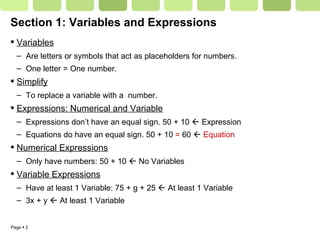
Section 1: Variables and Expressions Variables Are letters or symbols that act as placeholders for numbers.  One letter = One number. Simplify To replace a variable with a  number. Expressions: Numerical and Variable Expressions don’t have an equal sign. 50 + 10    Expression Equations do have an equal sign. 50 + 10  =  60     Equation Numerical Expressions Only have numbers: 50 + 10    No Variables Variable Expressions Have at least 1 Variable: 75 + g + 25    At least 1 Variable 3x + y    At least 1 Variable
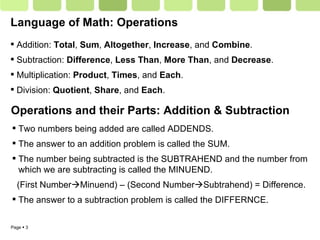
Language of Math: Operations Addition:  Total ,  Sum ,  Altogether ,  Increase , and  Combine . Subtraction:  Difference ,  Less Than ,  More Than , and  Decrease . Multiplication:  Product ,  Times , and  Each . Division:  Quotient ,  Share , and  Each .  Operations and their Parts: Addition & Subtraction Two numbers being added are called ADDENDS. The answer to an addition problem is called the SUM. The number being subtracted is the SUBTRAHEND and the number from which we are subtracting is called the MINUEND.  (First Number  Minuend) – (Second Number  Subtrahend) = Difference. The answer to a subtraction problem is called the DIFFERNCE.
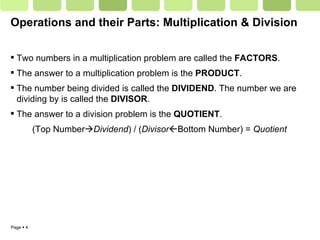
Operations and their Parts: Multiplication & Division Two numbers in a multiplication problem are called the  FACTORS . The answer to a multiplication problem is the  PRODUCT . The number being divided is called the  DIVIDEND . The number we are dividing by is called the  DIVISOR . The answer to a division problem is the  QUOTIENT . (Top Number  Dividend ) / ( Divisor  Bottom Number) =  Quotient
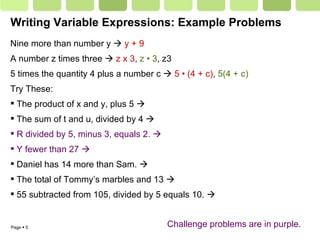
Writing Variable Expressions: Example Problems Nine more than number y     y + 9 A number z times three     z x 3 ,  z • 3 ,  z3 5 times the quantity 4 plus a number c     5 • (4 + c) ,  5(4 + c) Try These: The product of x and y, plus 5   The sum of t and u, divided by 4   R divided by 5, minus 3, equals 2.   Y fewer than 27   Daniel has 14 more than Sam.   The total of Tommy’s marbles and 13   55 subtracted from 105, divided by 5 equals 10.   Challenge problems are in purple.
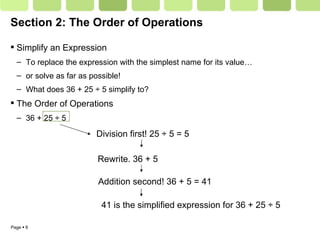
Section 2: The Order of Operations Simplify an Expression To replace the expression with the simplest name for its value… or solve as far as possible! What does 36 + 25 ÷ 5 simplify to?  The Order of Operations 36 + 25 ÷ 5 Division first! 25  ÷ 5 = 5 Rewrite. 36 + 5  Addition second! 36 + 5 = 41 41 is the simplified expression for 36 + 25  ÷ 5
The Order of Operations: PEMDAS P  :  Do operations inside  PARENTHESES  (or other delimiters/grouping symbols, like [BRACKETS] and division bars). Work from the inside of the Parentheses/Brackets to the outside.  Division Bars: Simplify the top and bottom first, then divide! E  :  Evaluate terms with  EXPONENTS . The exponent ONLY effects the NUMBERS/VARIABLES/PARENTHESES in front of the little number (to the left). Example: 5 10 , x 2 , (5 + 8) 3 . D M  :  Do  MULTIPLICATION  and  DIVISION . In order from  LEFT  to  RIGHT . 5 • 10 ÷ 2    5 • 10 = 50, 50 ÷ 2 = 25,  5•10÷2=25 A S  :  ADD  and  SUBTRACT  terms . In order from  LEFT  to  RIGHT . 8 + 7 – 5    8 + 7 = 15, 15 – 5 = 10,  8+7-5=10 PEDMAS is where order REALLY matters!
Example Problems: Show each Step of PEMDAS 2[(13 – 4) ÷ 3] = 1 +  10 – 2  =   4 4 – 1 • 2 + 6  ÷ 3 = 5 + 6 • 4 ÷ 3 – 1 = 6 3 4 12 Example of Showing Steps: PEMDAS 2[(13 – 4) ÷ 3] =  Copy Problem 2[(9) ÷ 3] =  Simplify Parentheses 2[3] =  Simplify Brackets 2[3] = 6,  Multiply 6,  Answer, Always Boxed!
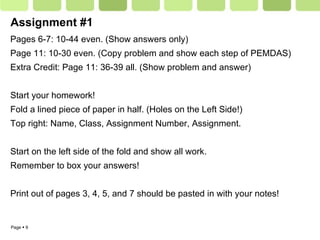
Assignment #1 Pages 6-7: 10-44 even. (Show answers only) Page 11: 10-30 even. (Copy problem and show each step of PEMDAS) Extra Credit: Page 11: 36-39 all. (Show problem and answer) Start your homework! Fold a lined piece of paper in half. (Holes on the Left Side!) Top right: Name, Class, Assignment Number, Assignment. Start on the left side of the fold and show all work.  Remember to box your answers! Print out of pages 3, 4, 5, and 7 should be pasted in with your notes!

Chapter 1, Section 1&2

  • 1.
    Pre-Algebra Review Chapter 1, Sections 1 and 2 By Ms. Dewey-Hoffman, 2009 http://msdhpowerpoints.blogspot.com/
  • 2.
    Section 1: Variablesand Expressions Variables Are letters or symbols that act as placeholders for numbers. One letter = One number. Simplify To replace a variable with a number. Expressions: Numerical and Variable Expressions don’t have an equal sign. 50 + 10  Expression Equations do have an equal sign. 50 + 10 = 60  Equation Numerical Expressions Only have numbers: 50 + 10  No Variables Variable Expressions Have at least 1 Variable: 75 + g + 25  At least 1 Variable 3x + y  At least 1 Variable
  • 3.
    Language of Math:Operations Addition: Total , Sum , Altogether , Increase , and Combine . Subtraction: Difference , Less Than , More Than , and Decrease . Multiplication: Product , Times , and Each . Division: Quotient , Share , and Each . Operations and their Parts: Addition & Subtraction Two numbers being added are called ADDENDS. The answer to an addition problem is called the SUM. The number being subtracted is the SUBTRAHEND and the number from which we are subtracting is called the MINUEND. (First Number  Minuend) – (Second Number  Subtrahend) = Difference. The answer to a subtraction problem is called the DIFFERNCE.
  • 4.
    Operations and theirParts: Multiplication & Division Two numbers in a multiplication problem are called the FACTORS . The answer to a multiplication problem is the PRODUCT . The number being divided is called the DIVIDEND . The number we are dividing by is called the DIVISOR . The answer to a division problem is the QUOTIENT . (Top Number  Dividend ) / ( Divisor  Bottom Number) = Quotient
  • 5.
    Writing Variable Expressions:Example Problems Nine more than number y  y + 9 A number z times three  z x 3 , z • 3 , z3 5 times the quantity 4 plus a number c  5 • (4 + c) , 5(4 + c) Try These: The product of x and y, plus 5  The sum of t and u, divided by 4  R divided by 5, minus 3, equals 2.  Y fewer than 27  Daniel has 14 more than Sam.  The total of Tommy’s marbles and 13  55 subtracted from 105, divided by 5 equals 10.  Challenge problems are in purple.
  • 6.
    Section 2: TheOrder of Operations Simplify an Expression To replace the expression with the simplest name for its value… or solve as far as possible! What does 36 + 25 ÷ 5 simplify to? The Order of Operations 36 + 25 ÷ 5 Division first! 25 ÷ 5 = 5 Rewrite. 36 + 5 Addition second! 36 + 5 = 41 41 is the simplified expression for 36 + 25 ÷ 5
  • 7.
    The Order ofOperations: PEMDAS P : Do operations inside PARENTHESES (or other delimiters/grouping symbols, like [BRACKETS] and division bars). Work from the inside of the Parentheses/Brackets to the outside. Division Bars: Simplify the top and bottom first, then divide! E : Evaluate terms with EXPONENTS . The exponent ONLY effects the NUMBERS/VARIABLES/PARENTHESES in front of the little number (to the left). Example: 5 10 , x 2 , (5 + 8) 3 . D M : Do MULTIPLICATION and DIVISION . In order from LEFT to RIGHT . 5 • 10 ÷ 2  5 • 10 = 50, 50 ÷ 2 = 25, 5•10÷2=25 A S : ADD and SUBTRACT terms . In order from LEFT to RIGHT . 8 + 7 – 5  8 + 7 = 15, 15 – 5 = 10, 8+7-5=10 PEDMAS is where order REALLY matters!
  • 8.
    Example Problems: Showeach Step of PEMDAS 2[(13 – 4) ÷ 3] = 1 + 10 – 2 = 4 4 – 1 • 2 + 6 ÷ 3 = 5 + 6 • 4 ÷ 3 – 1 = 6 3 4 12 Example of Showing Steps: PEMDAS 2[(13 – 4) ÷ 3] = Copy Problem 2[(9) ÷ 3] = Simplify Parentheses 2[3] = Simplify Brackets 2[3] = 6, Multiply 6, Answer, Always Boxed!
  • 9.
    Assignment #1 Pages6-7: 10-44 even. (Show answers only) Page 11: 10-30 even. (Copy problem and show each step of PEMDAS) Extra Credit: Page 11: 36-39 all. (Show problem and answer) Start your homework! Fold a lined piece of paper in half. (Holes on the Left Side!) Top right: Name, Class, Assignment Number, Assignment. Start on the left side of the fold and show all work. Remember to box your answers! Print out of pages 3, 4, 5, and 7 should be pasted in with your notes!