501
Algebra Questions
501
Algebra Questions
2nd Edition
N E W Y O R K
®
Copyright © 2006 LearningExpress, LLC.
All rights reserved under International and Pan-American Copyright Conventions.
Published in the United States by LearningExpress, LLC, New York.
Library of Congress Cataloging-in-Publication Data:
501 algebra questions.—2nd ed.
p. cm.
Rev. ed. of: 501 algebra questions / [William Recco]. 1st ed. © 2002.
ISBN 1-57685-552-X
1. Algebra—Problems, exercises, etc. I. Recco, William. 501 algebra
questions. II. LearningExpress (Organization). III. Title: Five hundred one
algebra questions. IV. Title: Five hundred and one algebra questions.
QA157.A15 2006
512—dc22
2006040834
Printed in the United States of America
9 8 7 6 5 4 3 2 1
Second Edition
ISBN 1-57685-552-X
For more information or to place an order, contact LearningExpress at:
55 Broadway
8th Floor
New York, NY 10006
Or visit us at:
www.learnatest.com
The LearningExpress Skill Builder in Focus Writing Team is
comprised of experts in test preparation, as well as educators and
teachers who specialize in language arts and math.
LearningExpress Skill Builder in Focus Writing Team
Brigit Dermott
Freelance Writer
English Tutor, New York Cares
New York, New York
Sandy Gade
Project Editor
LearningExpress
New York, New York
Kerry McLean
Project Editor
Math Tutor
Shirley, New York
William Recco
Middle School Math Teacher, Grade 8
New York Shoreham/Wading River School District
Math Tutor
St. James, New York
Colleen Schultz
Middle School Math Teacher, Grade 8
Vestal Central School District
Math Tutor
Vestal, New York
Introduction ix
1 Working with Integers 1
2 Working with Algebraic Expressions 12
3 Combining Like Terms 24
4 Solving Basic Equations 41
5 Solving Multi-Step Equations 49
6 Solving Equations with Variables on Both Sides
of an Equation 58
7 Using Formulas to Solve Equations 72
8 Graphing Linear Equations 81
9 Solving Inequalities 110
10 Graphing Inequalities 119
11 Graphing Systems of Linear Equations
and Inequalities 142
12 Solving Systems of Equations Algebraically 172
13 Working with Exponents 186
Contents
14 Multiplying Polynomials 194
15 Factoring Polynomials 206
16 Using Factoring 215
17 Solving Quadratic Equations 229
18 Simplifying Radicals 242
19 Solving Radical Equations 250
20 Solving Equations with the Quadratic Formula 261
viii
Contents
This book is designed to provide you with review and practice for algebra
success! It is not intended to teach common algebra topics. Instead, it provides
501 problems so you can flex your muscles and practice a variety of mathe-
matical and algebraic skills. 501 Algebra Questions is designed for many audi-
ences. It’s for anyone who has ever taken a course in algebra and needs to
refresh and revive forgotten skills. It can be used to supplement current instruc-
tion in a math class. Or, it can be used by teachers and tutors who need to rein-
force student skills. If, at some point, you feel you need further explanation
about some of the algebra topics highlighted in this book, you can find them in
the LearningExpress publication Algebra Success in 20 Minutes a Day.
How to Use This Book
First, look at the table of contents to see the types of algebra topics covered in
this book. The book is organized into 20 chapters with a variety of arithmetic,
algebra, and word problems. The structure follows a common sequence of con-
cepts introduced in basic algebra courses. You may want to follow the sequence,
as each succeeding chapter builds on skills taught in previous chapters. But if
Introduction
your skills are just rusty, or if you are using this book to supplement topics you are
currently learning, you may want to jump around from topic to topic.
Chapters are arranged using the same method. Each chapter has an introduction
describing the mathematical concepts covered in the chapter. Second, there are
helpful tips on how to practice the problems in each chapter. Last, you are pre-
sented with a variety of problems that generally range from easier to more difficult
problems and their answer explanations. In many books, you are given one model
problem and then asked to do many problems following that model. In this book,
every problem has a complete step-by-step explanation for the solutions. If you find
yourself getting stuck solving a problem, you can look at the answer explanation and
use it to help you understand the problem-solving process.
As you are solving problems, it is important to be as organized and sequential in
your written steps as possible. The purpose of drills and practice is to make you pro-
ficient at solving problems. Like an athlete preparing for the next season or a musi-
cian warming up for a concert, you become skillful with practice. If, after
completing all the problems in a section, you feel that you need more practice, do
the problems over. It’s not the answer that matters most—it’s the process and the
reasoning skills that you want to master.
You will probably want to have a calculator handy as you work through some of
the sections. It’s always a good idea to use it to check your calculations. If you have
difficulty factoring numbers, the multiplication chart on the next page may help
you. If you are unfamiliar with prime numbers, use the list on the next page so you
won’t waste time trying to factor numbers that can’t be factored. And don’t forget
to keep lots of scrap paper on hand.
Make a Commitment
Success does not come without effort. Make the commitment to improve your alge-
bra skills. Work for understanding. Why you do a math operation is as important
as how you do it. If you truly want to be successful, make a commitment to spend
the time you need to do a good job. You can do it! When you achieve algebra suc-
cess, you have laid the foundation for future challenges and success. So sharpen
your pencil and practice!
x
501 Algebra Questions
xi
Multiplication Table
× 2 3 4 5 6 7 8 9 10 11 12
2 4 6 8 10 12 14 16 18 20 22 24
3 6 9 12 15 18 21 24 27 30 33 36
4 8 12 16 20 24 28 32 36 40 44 48
5 10 15 20 25 30 35 40 45 50 55 60
6 12 18 24 30 36 42 48 54 60 66 72
7 14 21 28 35 42 49 56 63 70 77 84
8 16 24 32 40 48 56 64 72 80 88 96
9 18 27 36 45 54 63 72 81 90 99 108
10 20 30 40 50 60 70 80 90 100 110 120
11 22 33 44 55 66 77 88 99 110 121 132
12 24 36 48 60 72 84 96 108 120 132 144
Commonly Used Prime Numbers
2 3 5 7 11 13 17 19 23 29
31 37 41 43 47 53 59 61 67 71
73 79 83 89 97 101 103 107 109 113
127 131 137 139 149 151 157 163 167 173
179 181 191 193 197 199 211 223 227 229
233 239 241 251 257 263 269 271 277 281
283 293 307 311 313 317 331 337 347 349
353 359 367 373 379 383 389 397 401 409
419 421 431 433 439 443 449 457 461 463
467 479 487 491 499 503 509 521 523 541
547 557 563 569 571 577 587 593 599 601
607 613 617 619 631 641 643 647 653 659
661 673 677 683 691 701 709 719 727 733
739 743 751 757 761 769 773 787 797 809
811 821 823 827 829 839 853 857 859 863
877 881 883 887 907 911 919 929 937 941
947 953 967 971 977 983 991 997 1,009 1,013
501 Algebra Questions
501
Algebra Questions
For some people, it is helpful to try to simplify expressions containing
signed numbers as much as possible. When you find signed numbers with
addition and subtraction operations, you can simplify the task by changing
all subtraction to addition. Subtracting a number is the same as adding its
opposite. For example, subtracting a three is the same as adding a negative
three. Or subtracting a negative 14 is the same as adding a positive 14. As
you go through the step-by-step answer explanations, you will begin to see
how this process of using only addition can help simplify your understand-
ing of operations with signed numbers. As you begin to gain confidence,
you may be able to eliminate some of the steps by doing them in your head
and not having to write them down. After all, that’s the point of practice!
You work at the problems until the process becomes automatic. Then you
own that process and you are ready to use it in other situations.
The Tips for Working with Integers section that follows gives you
some simple rules to follow as you solve problems with integers. Refer to
them each time you do a problem until you don’t need to look at them.
That’s when you can consider them yours.
You will also want to review the rules for Order of Operations with
numerical expressions. You can use a memory device called a mnemonic
to help you remember a set of instructions. Try remembering the word
PEMDAS. This nonsense word helps you remember to:
1
Working with
Integers
P do operations inside Parentheses
E evaluate terms with Exponents
M D do Multiplication and Division in order from left to right
A S Add and Subtract terms in order from left to right
Tips for Working with Integers
Addition
Signed numbers the same? Find the SUM and use the same sign. Signed num-
bers different? Find the DIFFERENCE and use the sign of the larger num-
ber. (The larger number is the one whose value without a positive or negative
sign is greatest.)
Addition is commutative. That is, you can add numbers in any order and
the result is the same. As an example, 3 + 5 = 5 + 3, or –2 + –1 = –1 + –2.
Subtraction
Change the operation sign to addition, change the sign of the number fol-
lowing the operation, then follow the rules for addition.
Multiplication/Division
Signs the same? Multiply or divide and give the result a positive sign. Signs
different? Multiply or divide and give the result a negative sign.
Multiplication is commutative. You can multiply terms in any order and the
result will be the same. For example: (2 • 5 • 7) = (2 • 7 • 5) = (5 • 2 • 7) =
(5 • 7 • 2) and so on.
Evaluate the following expressions.
1. 27 + −5
2. −18 + −20 − 16
3. −15 − −7
4. 33 + −16
5. 8 + −4 − 12
6. 38 ÷ −2 + 9
7. −25 · −3 + 15 · −5
8. −5 · −9 · −2
9. 24 · −8 + 2
10. 2 · −3 · −7
11. −15 + 5 + −11
2
501 Algebra Questions
3
12. (49 ÷ 7) − (48 ÷ −4)
13. 3 + −7 − 14 + 5
14. −(5 · 3) + (12 ÷ −4)
15. (−18 ÷ 2) − (6 · −3)
16. 23 + (64 ÷ −16)
17. 23 − (−4)2
18. (3 − 5)3 + (18 ÷ 6)2
19. 21 + (11 + −8)3
20. (32 + 6) ÷ (−24 ÷ 8)
21. A scuba diver descends 80 feet, rises 25 feet, descends 12 feet, and then
rises 52 feet where he will do a safety stop for five minutes before
surfacing. At what depth did he do his safety stop?
22. A digital thermometer records the daily high and low temperatures. The
high for the day was +5° C. The low was −12° C. What was the difference
between the day’s high and low temperatures?
23. A checkbook balance sheet shows an initial balance for the month of $300.
During the month, checks were written in the amounts of $25, $82, $213,
and $97. Deposits were made into the account in the amounts of $84 and
$116. What was the balance at the end of the month?
24. A gambler begins playing a slot machine with $10 in quarters in her coin
bucket. She plays 15 quarters before winning a jackpot of 50 quarters. She
then plays 20 more quarters in the same machine before walking away.
How many quarters does she now have in her coin bucket?
25. A glider is towed to an altitude of 2,000 feet above the ground before
being released by the tow plane. The glider loses 450 feet of altitude
before finding an updraft that lifts it 1,750 feet. What is the glider’s
altitude now?
501 Algebra Questions
Answers
Numerical expressions in parentheses like this [ ] are operations performed on only part of the original
expression. The operations performed within these symbols are intended to show how to evaluate the
various terms that make up the entire expression.
Expressions with parentheses that look like this ( ) contain either numerical substitutions or expres-
sions that are part of a numerical expression. Once a single number appears within these parentheses,
the parentheses are no longer needed and need not be used the next time the entire expression is
written.
When two pair of parentheses appear side by side like this ( )( ), it means that the expressions within
are to be multiplied.
Sometimes parentheses appear within other parentheses in numerical or algebraic expressions.
Regardless of what symbol is used, ( ), { }, or [ ], perform operations in the innermost parentheses first
and work outward.
Underlined expressions show the original algebraic expression as an equation with the expression
equal to its simplified result.
1. The signs of the terms are different, so find the difference
of the values. [27 − 5 = 22]
The sign of the larger term is positive, so the sign of
the result is positive. 27 + −5 = +22
2. Change the subtraction sign to addition by
changing the sign of the number that follows it. −18 + −20 + (−16)
Since all the signs are negative, add the
absolute value of the numbers. [18 + 20 + 16 = 54]
Since the signs were negative, the result
is negative. −18 + −20 + −16 = −54
The simplified result of the numeric expression
is as follows: −18 − 20 − 16 = −54
3. Change the subtraction sign to addition by
changing the sign of the number that follows it. −15 + 7
Signs different? Subtract the absolute value of
the numbers. [15 − 7 = 8]
Give the result the sign of the larger term. −15 + 7 = −8
The simplified expression is as follows: −15 − 7 = −8
4. Signs different? Subtract the value of the numbers. [33 − 16 = 17]
Give the result the sign of the larger term. 33 + −16 = +17
4
501 Algebra Questions
5
5. Change the subtraction sign to addition by changing
the sign of the number that follows it. 8 + −4 + −12
With three terms, first group like terms and add. 8 + (−4 + −12)
Signs the same? Add the value of the terms and
give the result the same sign. [(−4 + −12) = −16]
Substitute the result into the first expression. 8 + (−16)
Signs different? Subtract the value of the numbers. [16 − 8 = 8]
Give the result the sign of the larger term. 8 + (−16) = −8
The simplified result of the numeric expression
is as follows: 8 + −4 − 12 = −8
6. First divide. Signs different? Divide and give the
result the negative sign. [(38 ÷ −2) = −19]
Substitute the result into the expression. (−19) + 9
Signs different? Subtract the value of the numbers. [19 − 9 = 10]
Give the result the sign of the term with the
larger value. (−19) + 9 = −10
The simplified result of the numeric expression
is as follows: 38 ÷ −2 + 9 = −10
7. First perform the multiplications.
Signs the same? Multiply the terms and give
the result a positive sign. [−25 · −3 = +75]
Signs different? Multiply the terms and give
the result a negative sign. [15 · −5 = −75]
Now substitute the results into the original
expression. (+75) + (−75)
Signs different? Subtract the value of the
numbers. [75 − 75 = 0]
The simplified result of the numeric
expression is as follows: −25 · −3 + 15 · −5 = 0
8. Because all the operators are multiplication, you
could group any two terms and the result would
be the same. Let’s group the first two terms. (−5 · −9) · −2
Signs the same? Multiply the terms and give
the result a positive sign. [5 · 9 = 45]
Now substitute the result into the original
expression. +45 · −2
Signs different? Multiply the terms and give
the result a negative sign. +45 · −2 = −90
The simplified result of the numeric expression
is as follows: −5 · −9 · −2 = −90
501 Algebra Questions
9. Group the terms being multiplied and evaluate. (24 · −8) + 2
Signs different? Multiply the terms and give the
result a negative sign. [24 · −8 = −192]
Substitute. (−192) + 2
Signs different? Subtract the value of the terms. [192 − 2 = 190]
Give the result the sign of the term with the
larger value. (−192) + 2 = −190
The simplified result of the numeric expression
is as follows: 24 · −8 + 2 = −190
10. Because all the operators are multiplication, you
could group any two terms and the result would be
the same. Let’s group the last two terms. 2 · (−3 · −7)
Signs the same? Multiply the terms and give the
result a positive sign. [(−3 · −7) = +21]
Substitute. 2 · (+21)
Signs the same? Multiply the terms and give the
result a positive sign. 2 · (+21) = +42
The simplified result of the numeric expression is
as follows: 2 · −3 · −7 = +42
11. Because all the operators are addition, you could
group any two terms and the result would be the
same. Or you could just work from left to right. (−15 + 5) + −11
Signs different? Subtract the value of the numbers. [15 − 5 = 10]
Give the result the sign of the term with the
larger value. [(−15 + 5) = −10]
Substitute. (−10) + −11
Signs the same? Add the value of the terms
and give the result the same sign. [10 + 11 = 21]
(−10) + −11 = −21
The simplified result of the numeric expression
is as follows: −15 + 5 + −11 = −21
12. First evaluate the expressions within the
parentheses. [49 ÷ 7 = 7]
Signs different? Divide and give the result
a negative sign. [48 ÷ −4 = −12]
Substitute into the original expression. (7) − (−12)
Change the subtraction sign to addition
by changing the sign of the number that
follows it. 7 + +12
Signs the same? Add the value of the terms
and give the result the same sign. 7 + +12 = +19
The simplified result of the numeric
expression is as follows: (49 ÷ 7) − (48 ÷ −4) = +19
6
501 Algebra Questions
7
13. Change the subtraction sign to addition by
changing the sign of the number that follows it. 3 + −7 + −14 + 5
Now perform additions from left to right. (3 + −7) + −14 + 5
Signs different? Subtract the value of the numbers
and give the result the sign of the higher value
number. [7 − 3 = 4]
[3 + −7 = −4]
Substitute. (−4) + −14 + 5
Add from left to right. (−4 + −14) + 5
Signs the same? Add the value of the terms and
give the result the same sign. [−4 + −14 = −18]
Substitute. (−18) + 5
Signs different? Subtract the value of the
numbers and give the result the sign of the
higher value number. [18 − 5 = 13]
(−18) + 5 = −13
The simplified result of the numeric expression
is as follows: 3 + −7 + −14 + 5 = −13
14. First evaluate the expressions within the
parentheses. [5 · 3 = 15]
Signs different? Divide and give the result
a negative sign. [12 ÷ −4 = −3]
Substitute the values into the original
expression. −(15) + (−3)
Signs the same? Add the value of the terms
and give the result the same sign. [15 + 3 = 18]
−(15) + (−3) = −18
The simplified result of the numeric
expression is as follows: −(5 · 3) + (12 ÷ −4) = −18
501 Algebra Questions
15. First evaluate the expressions within the
parentheses. [(−18 ÷ 2)]
Signs different? Divide the value of the
terms and give the result a negative sign. [18 ÷ 2 = 9]
[(−18 ÷ 2 = −9)]
Signs different? Multiply the term values
and give the result a negative sign. (6 · −3)
[6 · 3 = 18]
(6 · −3) = −18
Substitute the values into the original
expression. (−9) − (−18)
Change subtraction to addition and change
the sign of the term that follows. (−9) + (+18)
Signs different? Subtract the value of the
numbers and give the result the sign of the
higher value number. [18 − 9 = 9]
(−9) + (+18) = +9
The simplified result of the numeric
expression is as follows: (−18 ÷ 2) − (6 · −3) = +9
16. Evaluate the expressions within the parentheses. (64 ÷ −16)
Signs different? Divide and give the result
a negative sign. [64 ÷ 16 = 4]
(64 ÷ −16 = −4)
Substitute the value into the original expression. 23 + (−4)
Signs different? Subtract the value of the
numbers and give the result the sign of the
higher value number. [23 − 4 = 19]
23 + (−4) = +19
The simplified result of the numeric expression
is as follows: 23 + (64 ÷ −16) = +19
17. The order of operations tells us to evaluate the
terms with exponents first. [23 = 2 · 2 · 2 = 8]
[(−4)2 = (−4) · (−4)]
Signs the same? Multiply the terms and give
the result a positive sign. [4 · 4 = 16]
[(−4)2 = +16]
Substitute the values of terms with exponents
into the original expression. 23 − (−4)2 = (8) − (+16)
Change subtraction to addition and change
the sign of the term that follows. 8 + −16
Signs different? Subtract the value of the
numbers and give the result the sign of the
higher value number. [16 − 8 = 8]
8 + −16 = −8
8
501 Algebra Questions
9
The simplified result of the numeric expression
is as follows: 23 − (−4)2 = −8
18. First evaluate the expressions within the
parentheses. [3 − 5]
Change subtraction to addition and change
the sign of the term that follows. [3 + (−5)]
Signs different? Subtract the value of the
numbers and give the result the sign of the
higher value number. [5 − 3 = 2]
[3 − 5 = −2]
[18 ÷ 6 = 3]
Substitute the values of the expressions in
parentheses into the original expression. (−2)3 + (3)2
Evaluate the terms with exponents. [(−2)3 = −2 · −2 · −2]
[(−2 · −2) · −2 = (+4) · −2]
Signs different? Multiply the value of the
terms and give the result a negative sign. [(+4) · −2 = −8]
[(3)2 = 3 · 3 = 9]
Substitute the values into the expression. (−2)3 + (3)2 = −8 + 9
Signs different? Subtract the value of the
numbers and give the result the sign of the
higher value number. 9 − 8 = +1
The simplified result of the numeric
expression is as follows: (3 − 5)3 + (18 ÷ 6)2 = +1
19. First evaluate the expression within the parentheses. [11 + −8]
Signs different? Subtract the value of the numbers
and give the result the sign of the higher value
number. [11 − 8 = 3]
[11 + −8 = +3]
Substitute the value into the expression. 21 + (+3)3
Evaluate the term with the exponent. [(+3)3 = 33 = 27]
Substitute the value into the expression. 21 + (27) = 48
The simplified result of the numeric expression is
as follows: 21 + (11 + −8)3 = 48
20. First evaluate the expressions within the
parentheses. [32 + 6 = (9) + 6 = 15]
Signs different? Divide and give the result
the negative sign. [−24 ÷ 8 = −3]
Substitute values into the original expression. (15) ÷ (−3)
Signs different? Divide the value of the
terms and give the result a negative sign. [15 ÷ 3 = 5]
(15) ÷ (−3) = −5
The simplified result of the numeric
expression is as follows: (32 + 6) ÷ (−24 ÷ 8) = −5
501 Algebra Questions
21. If you think of distance above sea level as a positive number, then you must
think of going below sea level as a negative number. Going up is in the
positive direction, while going down is in the negative direction. Give all
the descending distances a negative sign and the ascending distances a
positive sign.
The resulting numerical expression would be
as follows: −80 + +25 + −12 + +52
Because addition is commutative, you can
associate like-signed numbers. (−80 + −12) + (+25 + +52)
Evaluate the numerical expression in each
parentheses. [−80 + −12 = −92]
[+25 + +52 = +77]
Substitute the values into the numerical
expression. (−92) + (+77)
Signs different? Subtract the value of the
numbers and give the result the sign of the
higher value number. [92 − 77 = 15]
The diver took his rest stop at −15 feet.
22. You could simply figure that +5° C is 5° above zero and −11° C is 11°
below. So the difference is the total of 5° + 11° = 16°.
Or you could find the difference between +5° and −11°.
That would be represented by the following
equation. +5° − −11° = +5° + +11° = +16°
23. You can consider that balances and deposits are positive signed numbers,
while checks are deductions, represented by negative signed numbers.
An expression to represent
the activity during the month
would be as follows: 300 + −25 + −82 + −213 + −97 + +84 + +116
Because addition is com-
mutative, you can associate
like signed numbers. (300 + +84 + +116) + (−25 + −82 + −213 + −97)
Evaluate the numbers
within each parentheses. [300 + +84 + +116 = +500]
[(−25 + −82 + −213 + −97 = −417]
Substitute the values into
the revised expression. (+500) + (−417) = +83
The balance at the end of the month would be $83.
10
501 Algebra Questions
11
24. You first figure out how many quarters she starts
with. Four quarters per dollar gives you 4 · 10
= 40 quarters. You can write an expression that
represents the quarters in the bucket and the
quarters added and subtracted. In chronological
order, the expression would be as follows: 40 − 15 + 50 − 20
Change all operation signs to addition and
the sign of the number that follows. 40 + −15 + 50 + −20
Because addition is commutative, you can
associate like-signed numbers. (40 + 50) + (−15 + −20)
Use the rules for adding integers with like
signs. [40 + 50 = 90]
[−15 + −20 = −35]
Substitute into the revised expression. (90) + (−35)
Signs different? Subtract the value of the
numbers and give the result the sign of the
higher value number. [90 − 35 = 55]
The simplified result of the numeric
expression is as follows: 40 + −15 + 50 + −20 = 55
25. As in problem 21, ascending is a positive number while descending is a neg-
ative number. You can assume ground level is the zero point.
An expression that represents the problem
is as follows: +2,000 + −450 + +1,750
Because addition is commutative, you can
associate like-signed numbers. (+2,000 + +1,750) + −450
Evaluate the expression in the parentheses. [+2,000 + +1,750 = +3,750]
Substitute into the revised equation. (+3,750) + −450
Signs different? Subtract the value of the
numbers and give the result the sign of the
higher value number. [3,750 − 450 = 3,300]
The simplified result of the numeric
expression is as follows: (+3,750) + −450 = +3,300
501 Algebra Questions
This chapter contains 25 algebraic expressions; each can contain up to
five variables. Remember that a variable is just a letter that represents a
number in a mathematical expression. When given numerical values for the
variables, you can turn an algebraic expression into a numerical one.
As you work through the problems in this chapter, you are to substitute
the assigned values for the variables into the expression and evaluate the
expression. You will be evaluating expressions very much like the previous
numerical expressions. The answer section contains complete explanations
of how to go about evaluating the expressions. Work on developing a sim-
ilar style throughout, and you will have one sure way of solving these kinds
of problems. As you become more familiar and comfortable with the look
and feel of these expressions, you will begin to find your own shortcuts.
Read through the Tips for Working with Algebraic Expressions
before you begin to solve the problems in this section.
Tips for Working with Algebraic Expressions
■ Substitute assigned values for the variables into the expression.
■ Use PEMDAS to perform operations in the proper order.
■ Recall and use the Tips for Working with Integers from
Chapter 1.
2
Working with
Algebraic Expressions
13
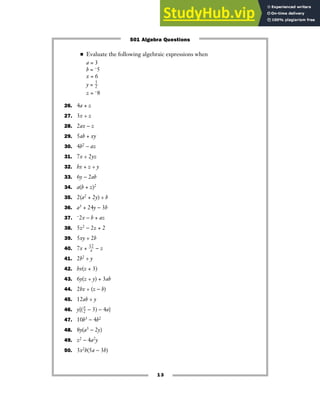
■ Evaluate the following algebraic expressions when
a = 3
b = −5
x = 6
y = ᎏ
1
2
ᎏ
z = −8
26. 4a + z
27. 3x ÷ z
28. 2ax − z
29. 5ab + xy
30. 4b2 − az
31. 7x ÷ 2yz
32. bx + z ÷ y
33. 6y − 2ab
34. a(b + z)2
35. 2(a2 + 2y) ÷ b
36. a3 + 24y − 3b
37. −2x − b + az
38. 5z2 − 2z + 2
39. 5xy ÷ 2b
40. 7x + ᎏ
1
x
2
ᎏ − z
41. 2b2 ÷ y
42. bx(z + 3)
43. 6y(z ÷ y) + 3ab
44. 2bx ÷ (z − b)
45. 12ab ÷ y
46. y{(ᎏ
2
x
ᎏ − 3) − 4a}
47. 10b3 − 4b2
48. 8y(a3 − 2y)
49. z2 − 4a2y
50. 3x2b(5a − 3b)
501 Algebra Questions
Answers
Numerical expressions in parentheses like this [ ] are operations performed on only part of the original
expression. The operations performed within these symbols are intended to show how to evaluate the
various terms that make up the entire expression.
Expressions with parentheses that look like this ( ) contain either numerical substitutions or expres-
sions that are part of a numerical expression. Once a single number appears within these parentheses,
the parentheses are no longer needed and need not be used the next time the entire expression is
written.
When two pair of parentheses appear side by side like this ( )( ), it means that the expressions within
are to be multiplied.
Sometimes parentheses appear within other parentheses in numerical or algebraic expressions.
Regardless of what symbol is used, ( ), { }, or [ ], perform operations in the innermost parentheses first
and work outward.
Underlined expressions show the original algebraic expression as an equation with the expression
equal to its simplified result.
a = 3
b = −5
x = 6
y = ᎏ
1
2
ᎏ
z = −8
26. Substitute the values for the variables into the expression. 4(3) + (−8)
Order of operations tells you to multiply first. [4(3) = 12]
Substitute. (12) + (−8)
Signs different? Subtract the value of the numbers. 12 − 8 = 4
Give the result the sign of the larger value. (No sign
means +) +4
The value of the expression is as follows: 4a + z = +4
27. Substitute the values for the variables into the
expression. 3(6) ÷ (−8)
PEMDAS: Multiply the first term. [3(6) = 18]
Substitute. (18) ÷ (−8)
Signs different? Divide and give the result the
negative sign. [18 ÷ 8 = 2ᎏ
2
8
ᎏ = 2ᎏ
1
4
ᎏ]
(−2ᎏ
1
4
ᎏ)
The value of the expression is as follows: 3x÷z=−2ᎏ
1
4
ᎏ or−2.25
28. Substitute the values for the variables into the expression. 2(3)(6) − (−8)
Multiply the factors of the first term. [2(3)(6) = 36]
Substitute. (36) − (−8)
Change the operator to addition and the sign of the
number that follows. (36) + (+8)
Signs the same? Add the value of the terms and give the
result the same sign. [36 + 8 = 44]
14
501 Algebra Questions
15
(+44)
The simplified value of the expression is as follows: 2ax − z = +44
29. Substitute the values for the variables into the
expression. 5(3)(−5) + (6)(ᎏ
1
2
ᎏ)
Evaluate the first term of the expression. [5(3)(−5) = 15(−5)]
Signs different? Multiply the terms and give the
result a negative sign. [15(−5) = −75]
Evaluate the second term of the expression. [(6)(ᎏ
1
2
ᎏ) = 3]
Substitute the equivalent values into the original
expression. (−75) + (3)
Signs different? Subtract the value of the numbers. [75 − 3 = 72]
Give the result the sign of the larger value. (−72)
The simplified value of the expression is as follows: 5ab + xy = −72
30. Substitute the values for the variables into the
expression. 4(−5)2 − (3)(−8)
PEMDAS: Evaluate the term with the exponent. [(−5)2 = (−5) · (−5)]
Signs the same? Multiply the terms and give the
result a positive sign. [5 · 5 = 25 = +25]
Substitute. [4(+25) = 100]
Now evaluate the other term. [(3)(−8)]
Signs different? Multiply and give the result a
negative sign. [3 · −8 = −24]
Substitute the equivalent values into the original
expression. (100) − (−24)
Change the operator to addition and the sign of
the number that follows. 100 + +24 = 124
The simplified value of the expression is as follows: 4b2 − az = 124
31. Substitute the values for the variables into the
expression. 7(6) ÷ 2(ᎏ
1
2
ᎏ)(−8)
PEMDAS: Multiply the terms in the
expression. [7 · 6 = 42]
[{2(ᎏ
1
2
ᎏ)}(−8) = (1)(−8) = −8]
Substitute the equivalent values into the
original expression. (42) ÷ (−8)
Signs different? Divide and give the result a
negative sign. [42 ÷ 8 = 5.25]
(42) ÷ (−8) = −5.25
The simplified value of the expression is
as follows: 7x ÷ 2yz = −5.25
501 Algebra Questions
32. Substitute the values for the variables into
the expression. (−5)(6) + (−8) ÷ (ᎏ
1
2
ᎏ)
Group terms using order of operations. (−5)(6) + {(−8) ÷ (ᎏ
1
2
ᎏ)}
PEMDAS: Multiply or divide the terms in
the expression. [(−5)(6)]
Signs different? Multiply and give the result
a negative sign. [5 · 6 = 30]
[(−5)(6) = −30]
Consider the second term. [(−8) ÷ (ᎏ
1
2
ᎏ)]
Signs different? Divide and give the result
a negative sign. [8 ÷ ᎏ
1
2
ᎏ]
To divide by a fraction, you multiply by
the reciprocal. [8 ÷ ᎏ
1
2
ᎏ = 8 · ᎏ
2
1
ᎏ = 8 · 2 = 16]
[(−8) ÷ (ᎏ
1
2
ᎏ) = −16]
Substitute the equivalent values into the
original expression. (−30) + (−16)
Signs the same? Add the value of the terms
and give the result the same sign. [30 + 16 = 46]
(−30) + (−16) = −46
The simplified value of the expression
is as follows: bx + z ÷ y = −46
33. Substitute the values for the variables into the
expression. 6(ᎏ
1
2
ᎏ) − 2(3)(−5)
Evaluate the terms on either side of the
subtraction sign. [6(ᎏ
1
2
ᎏ) = 3]
[2(3)(−5) = 2 · 3 · −5]
Positive times positive is positive. Positive times
negative is negative. [6 · −5 = −30]
Substitute the equivalent values into the original
expression. (3) − (−30)
Change the operator to addition and the sign
of the number that follows. 3 − (−30) = 3 + +30
3 + +30 = +33
The simplified value of the expression is as
follows: 6y − 2ab = +33
34. Substitute the values for the variables into the
expression. 3((−5) + (−8))2
PEMDAS: You must add the terms inside the
parentheses first. [(−5) + (−8)]
Signs the same? Add the value of the terms and
give the result the same sign. [5 + 8 = 13]
[(−5) + (−8) = −13]
16
501 Algebra Questions
17
Substitute into the original expression. 3(−13)2
Next you evaluate the term with the exponent. [(−13)2 = −13 · −13]
Signs the same? Multiply the terms and give the
result a positive sign. [13 · 13 = +169]
Substitute the equivalent values into the original
expression. 3(169) = 507
The simplified value of the expression is as follows: a(b + z)2 = 507
35. Substitute the values for the variables into the
expression. 2((3)2 + 2(ᎏ
1
2
ᎏ)) ÷ (−5)
Look first to evaluate the term inside the bold
parentheses. [(3)2 + 2(ᎏ
1
2
ᎏ)]
The first term has an exponent. Evaluate it. [(3)2 = 3 · 3 = 9]
Evaluate the second term. [2(ᎏ
1
2
ᎏ) = 1]
[(3)2 + 2(ᎏ
1
2
ᎏ) = 9 + 1 = 10]
Substitute into the original numerical
expression. 2(10) ÷ (−5)
Evaluate the first term. [2(10) = 20]
Substitute into the numerical expression. (20) ÷ (−5)
Signs different? Divide and give the result a
negative sign. [20 ÷ 5 = 4]
(20) ÷ (−5) = −4
The simplified value of the expression is as
follows: 2(a2 + 2y) ÷ b = −4
36. Substitute the values for the variables into the
expression. (3)3 + 24(ᎏ
1
2
ᎏ) − 3(−5)
Evaluate the term with the exponent. [(3)3 = 3 · 3 · 3 = 27]
Evaluate the second term. [24(ᎏ
1
2
ᎏ) = 12]
Evaluate the third term. [3(−5)]
Signs different? Multiply and give the result a
negative sign. [3 · 5 = 15]
[3(−5) = −15]
Substitute the equivalent values into the original
expression. (27) + (12) − (−15)
Change the subtraction to addition and the sign
of the number that follows. (27) + (12) + (+15)
Signs the same? Add the value of the terms and
give the result the same sign. 27 + 12 + 15 = 54
The simplified value of the expression is as
follows: a3 + 24y − 3b = +54
501 Algebra Questions
37. Substitute the values for the variables into the
expression. −2(6) − (−5) + (3)(−8)
Evaluate first and last terms. Positive times
negative results in a negative. [−2(6) = −2 · 6 = −12]
[(3)(−8) = 3 · −8 = −24]
Substitute the equivalent values into the original
expression. (−12) − (−5) + (−24)
Change the subtraction to addition and the
sign of the number that follows. −12 + (+5) + −24
Commutative property of addition allows
grouping of like signs. (−12 + −24) + (+5)
Signs the same? Add the value of the terms
and give the result the same sign. [−12 + −24 = −36]
Substitute. (−36) + (+5)
Signs different? Subtract and give the result
the sign of the higher value number. [36 − 5 = 31]
(−36) + (+5) = −31
The simplified value of the expression is as
follows: −2x − b + az = −31
38. Substitute the values for the variables into the
expression. 5(−8)2 − 2(−8) + 2
PEMDAS: Evaluate the term with the exponent
first. [(−8)2 = (−8)(−8) = +64]
Substitute the value into the numerical
expression. 5(+64) − 2(−8) + 2
PEMDAS: Evaluate terms with multiplication
next. [5(+64) = 320]
[2(−8) = −16]
Substitute the values into the numerical
expression. 320 − (−16) + 2
Change the subtraction to addition and the
sign of the number that follows. 320 + (+16) + 2
Add terms from left to right. All term signs are
positive, a result of addition +. 320 + 16 + 2 = 338
The simplified value of the expression is as
follows: 5z2 − 2z + 2 = 338
39. Substitute the values for the variables into the
expression. 5(6)(ᎏ
1
2
ᎏ) ÷ 2(−5)
Consider the two terms on either side of
the division sign.
Evaluate the first term by multiplying. [5 · 6 · ᎏ
1
2
ᎏ = (5 · 6) · ᎏ
1
2
ᎏ = 15]
Evaluate the second term. [2(−5) = −10]
18
501 Algebra Questions
19
Substitute the values into the original numerical
expression. (15) ÷ (−10)
Signs different? Divide and give the result a
negative sign. [15 ÷ 10 = 1ᎏ
1
2
ᎏ]
(15) ÷ (−10) = −1ᎏ
1
2
ᎏ
The simplified value of the expression is as
follows: 5xy ÷ 2b = −1ᎏ
1
2
ᎏ or −1.5
40. Substitute the values for the variables into the
expression. 7(6) + ᎏ
(
1
6
2
)
ᎏ − (−8)
Evaluate the first term. [7(6) = 7 · 6 = 42]
Evaluate the second term. [ᎏ
(
1
6
2
)
ᎏ = 12 ÷ 6 = 2]
Substitute the values into the original numerical
expression. (42) + (2) − −8
Change the subtraction to addition and the sign of
the number that follows. 42 + 2 + −8
Add terms from left to right. 42 + 2 + +8 = 52
The simplified value of the expression is as follows: 7x + ᎏ
1
x
2
ᎏ − z = 52
41. Substitute the values for the variables into the
expression. 2(−5)2 ÷ ᎏ
1
2
ᎏ
First, evaluate the term with the exponent. [2(−5)2 = 2 · (−5)(−5)]
Multiply from left to right. [{2 · (−5)} · (−5)]
Signs different? Multiply and give the result a
negative sign. [2 · (−5) = −10]
Signs the same? Multiply and give the result a
positive sign. [(−10) · (−5) = +50]
Substitute the values into the original numerical
expression. (+50) ÷ ᎏ
1
2
ᎏ
Change division to multiplication and change
the value to its reciprocal. (+50) · 2 = 100
The simplified value of the expression is as
follows: 2b2 ÷ y = 100
42. Substitute the values for the variables into the expression. (−5)(6)((−8) + 3)
First, evaluate the expression inside the parentheses. [(−8) + 3]
Signs different? Subtract and give the result the sign
of the higher value number. [8 − 3 = 5]
[(−8) + 3 = −5]
Substitute the result into the numerical expression. (−5)(6)(−5)
Multiply from left to right. Negative times positive
equals negative. [−5 · 6 = −30]
Signs the same? Multiply and give the result a
positive sign. (−30) · −5 = +150
The simplified value of the expression is as follows: bx(z + 3) = +150
501 Algebra Questions
43. Substitute the values for the variables into the
expression. 6(ᎏ
1
2
ᎏ)(−8 ÷ ᎏ
1
2
ᎏ) + 3(3)(−5)
First evaluate the expression inside the
parentheses.
Division by a fraction is the same as multiplica-
tion by its reciprocal. [−8 ÷ ᎏ
1
2
ᎏ = −8 · ᎏ
2
1
ᎏ = −16]
Substitute the result into the numerical
expression. 6(ᎏ
1
2
ᎏ)(−16) + 3(3)(−5)
Evaluate the first term in the expression. [6(ᎏ
1
2
ᎏ)(−16) = 6 · ᎏ
1
2
ᎏ · −16]
[3 · −16 = −48]
Evaluate the second term in the expression. [3(3)(−5) = 3 · 3 · −5]
[9 · −5 = −45]
Substitute the result into the numerical
expression. (−48) + (−45)
Signs the same? Add the value of the terms
and give the result the same sign. −48 + −45 = −93
The simplified value of the expression is
as follows: 6y(z ÷ y) + 3ab = −93
44. Substitute the values for the variables into the
expression. 2(−5)(6) ÷ ((−8) − (−5))
First evaluate the expression inside the
parentheses. [(−8 − −5)]
Change the subtraction to addition and the
sign of the number that follows. [−8 + 5]
Signs different? Subtract and give the result
the sign of the higher value number. [8 − 5 = 3]
[−8 + +5 = −3]
Substitute the results into the numerical
expression. 2(−5)(6) ÷ (−3)
Multiply from left to right. [2 · −5 · 6 = −60]
Substitute the result into the numerical
expression. (−60) ÷ −3
Signs the same? Divide and give the result
a positive sign. [60 ÷ 3 = 20]
(−60) ÷ −3 = 20
The simplified value of the expression is as
follows: 2bx ÷ (z − b) = 20
20
501 Algebra Questions
21
45. Substitute the values for the variables into the
expression. 12(3)(−5) ÷ (ᎏ
1
2
ᎏ)
Evaluate the first term. Multiply from left
to right. [12 · 3 · −5 = 36 · −5]
Signs different? Multiply the numbers and give
the result a negative sign. [36 · 5 = 180]
[36 · −5 = −180]
Substitute the result into the numerical
expression. (−180) ÷ (ᎏ
1
2
ᎏ)
Division by a fraction is the same as multiplication
by its reciprocal. −180 · (ᎏ
2
1
ᎏ) = −180 · 2
Signs different? Multiply numbers and give the
result a negative sign. [180 · 2 = 360]
−180 · 2 = −360
The simplified value of the expression is
as follows: 12ab ÷ y = −360
46. Substitute the values for the variables into the
expression. (ᎏ
1
2
ᎏ){(ᎏ
(6
2
)
ᎏ − 3) − 4(3)}
Evaluate the expression in the innermost
parentheses. [(ᎏ
(6
2
)
ᎏ − 3) = ᎏ
6
2
ᎏ − 3]
PEMDAS: Division before subtraction. [ᎏ
6
2
ᎏ − 3 = 3 − 3 = 0]
Substitute the result into the numerical
expression. (ᎏ
1
2
ᎏ){(0) − 4(3)}
Evaluate the expression inside the parentheses. [{0 − 4(3)} = 0 − 4 · 3]
PEMDAS: Multiply before subtraction. [0 − 4 · 3 = 0 − 12]
Change subtraction to addition and the sign
of the term that follows. [0 − 12 = 0 + −12 = −12]
Substitute the result into the numerical
expression. (ᎏ
1
2
ᎏ){−12} = ᎏ
1
2
ᎏ · −12
Signs different? Multiply numbers and give
the result a negative sign. [ᎏ
1
2
ᎏ · 12 = 6]
ᎏ
1
2
ᎏ · −12 = −6
The simplified value of the expression is as
follows: y{(ᎏ
2
x
ᎏ − 3) − 4a} = −6
501 Algebra Questions
47. Substitute the values for the variables into the
expression. 10(−5)3 − 4(−5)2
Evaluate the first term. [10(−5)3 = 10 · −5 · −5 · −5]
Multiply from left to right. [10 · −5 = (−50)]
[(−50) · −5 = +250]
[+250 · −5 = −1,250]
Evaluate the second term in the numerical
expression. [4(−5)2 = 4 · −5 · −5]
Multiply from left to right. [4 · −5 = −20]
[−20 · −5 = +100]
Substitute the results into the numerical
expression. −1,250 − +100
Change subtraction to addition and the sign
of the term that follows. −1,250 + −100
Same signs? Add the value of the terms
and give the result the same sign. [1,250 + 100 = 1,350]
10(−5)3 − 4(−5)2 = −1,350
The simplified value of the expression is as
follows: 10b3 − 4b2 = −1,350
48. Substitute the values for the variables into
the expression. 8(ᎏ
1
2
ᎏ)((3)3 − 2(ᎏ
1
2
ᎏ))
Evaluate the expression in the innermost
parentheses. ((3)3 − 2(ᎏ
1
2
ᎏ)) = (33 − 2 · ᎏ
1
2
ᎏ)
Evaluate the first term. Multiply from left
to right. [33 = 3 · 3 · 3 = 9 · 3 = 27]
Evaluate the second term. [2 · ᎏ
1
2
ᎏ = 1]
Substitute the results into the numerical
expression in the parentheses. [(27) − (1)]
Subtract. [27 − 1 = 26]
Substitute the result into the original
expression. 8(ᎏ
1
2
ᎏ)(26)
Multiply from left to right. [8 · ᎏ
1
2
ᎏ = 4]
[4 · 26 = 104]
The simplified value of the expression is
as follows: 8y(a3 − 2y) = 104
22
501 Algebra Questions
23
49. Substitute the values for the variables into the
expression. (−8)2 − 4(3)2(ᎏ
1
2
ᎏ)
Evaluate the first term. [(−8)2 = −8 · −8]
Signs the same? Multiply and give the result
a positive sign. [−8 · −8 = 64]
Evaluate the second term. [4(3)2(ᎏ
1
2
ᎏ) = 4 · 3 · 3 · ᎏ
1
2
ᎏ]
Multiply from left to right. [ 4 · 3 = 12]
[12 · 3 = 36]
[36 · ᎏ
1
2
ᎏ = 18]
Substitute the results into the numerical
expression. (64) − (18)
Yes, you can just subtract. 64 − 18 = 46
The simplified value of the expression is
as follows: z2 − 4a2y = 46
50. Substitute the values for the variables
into the expression. 3(6)2(−5)(5(3) −3(−5))
PEMDAS: Evaluate the expression
in the parentheses first. [(5(3) − 3(−5)) = 5 · 3 − 3 · −5]
[5 · 3 − 3 · −5 = 15 − −15]
Change subtraction to addition and
the sign of the term that follows. [15 + +15 = 30]
Substitute the result into the
numerical expression. 3(6)2(−5)(30)
PEMDAS: Evaluate terms with
exponents next. [(6)2 = 6 · 6 = 36]
Substitute the result into the
numerical expression. 3(36)(−5)(30)
Multiply from left to right. [3(36) = 108]
Signs different? Multiply the values
and give a negative sign. [(108) · (−5) = −540]
[(−540) · (30) = −16,200]
3(6)2(−5)(5(3) − 3(−5)) = −16,200
The simplified value of the expression
is as follows: 3x2b(5a −3b) = −16,200
501 Algebra Questions
In this chapter, you will practice simplifying algebraic expressions. As you
do this, you will recognize and combine terms with variables that are alike
and link them to other terms using the arithmetic operations.
You should know that
■ the numbers in front of the variable or variables are called
coefficients.
■ a coefficient is just a factor in an algebraic term, as are the
variable or variables in the term.
■ like terms can have different coefficients, but the configuration
of the variables must be the same for the terms to be alike. For
example, 3x and −4x are like terms but are different from 7ax
or 2x3.
You can think of an algebraic term as a series of factors with numbers,
and you can think of variables as factors. When the variables are given num-
ber values, you can multiply the factors of a term together to find its value,
as you did in Chapter 2. When you have terms that are alike, you can add
or subtract them as if they were signed numbers. You may find that com-
bining like terms may be easier if you do addition by changing all
subtraction to addition of the following term with its sign changed. This
3
Combining Like
Terms
25
strategy will continue to be shown in the answer explanations. But as you either
know or are beginning to see, sometimes it’s easier to just subtract.
You will also use the important commutative and associative properties of addi-
tion and multiplication. Another important and useful property is the distributive
property. See the Tips for Combining Like Terms.
Tips for Combining Like Terms
Distributive Property of Multiplication
The distributive property of multiplication tells you how to multiply the terms
inside a parentheses by the term outside the parentheses. Study the following
general and specific examples.
a(b + c) = ab + ac
a(b − c) = ab − ac
(b + c)a = ba + ca
4(6 + 3) = 4 · 6 + 4 · 3 = 24 + 12 = 36
(−5 + 8)3 = −5 · 3 + 8 · 3 = −15 + 24 = 9
7(10 + 3) = 7 · 10 + 7 · 3 = 70 + 21 = 91
3(x + 2y) = 3 · x + 3 · 2y = 3x + 6y
a(b − 5d) = a · b − a · 5d = ab − 5ad
Numerical examples of the commutative properties for addition and multiplica-
tion were given in the Tips for Working with Integers. Now look at the fol-
lowing examples:
Commutative Property of Addition
a + b = b + a
This equation reminds us that terms being combined by addition can change
their location (commute), but the value of the expression remains the same.
Commutative Property of Multiplication
x · y = y · x
This equation reminds us that the order in which we multiply expressions can
change without changing the value of the result.
501 Algebra Questions
Associative Property of Addition
(q + r) + s = q + (r + s)
This equation reminds us that when you are performing a series of additions
of terms, you can associate any term with any other and the result will be the
same.
Associative Property of Multiplication
(d · e) · f = d · (e · f )
This equation reminds us that you can multiply three or more terms in any
order without changing the value of the result.
Identity Property of Addition
n + 0 = n
Identity Property of Multiplication
n · 1 = n
Term Equivalents
x = 1 · x
For purposes of combining like terms, a variable by itself is understood to
mean one of that term.
n = +n
A term without a sign in front of it is considered to be positive.
a + −b = a − +b = a − b
Adding a negative term is the same as subtracting a positive term. Look at the
expressions on either side of the equal signs. Which one looks simpler? Of
course, it’s the last, a − b. Clarity is valued in mathematics. Writing expressions
as simply as possible is always appreciated.
While it may not seem relevant yet, as you go through the practice exercises,
you will see how each of these properties will come into play as we simplify
algebraic expressions by combining like terms.
26
501 Algebra Questions
27
Simplify the following expressions by combining like terms.
51. 5a + 2a + 7a
52. 7a + 6b + 3a
53. 4x + 2y − x + 3y
54. 27 − 3m + 12 − 5m
55. 7h + 6 + 2w − 3 + h
56. 4(x + 2y) + 2(x + y)
57. 3(2a + 3b) + 7(a − b)
58. 11(4m + 5) + 3(−3m + 8)
59. 64 + 5(n − 8) + 12n − 24
60. 4(x + y − 4) + 6(2 − 3y)
61. −7(a + b) +12a − 16b
62. 14 + 9(2w + 7) − 2(6 − w)
63. 8s − 3r + 5(2r − s)
64. 6(3m − 12) − 4(9m + 8)
65. 5(15 − 2j) + 11(7j − 3)
66. a(a + 4) + 3a2 − 2a + 10
67. 8(x − 7) + x(2 − x)
68. 3r2 + r(2 − r) + 6(r + 4)
69. 2x − x(5 + y) + 3xy + 4(2x − y)
70. −7(c − 2d) + 21c − 3(d − 5)
71. 5(3x − y) + x(5 + 2y) − 4(3 + x)
72. 6(m − 3n) + 3m(n + 5) − 2n(3 − m)
73. 9(2x − t) + 23xt + x(−4 + 5t)
74. 4{2a(a + 3) + 6(4 − a)} + 5a2
75. 8(2a − b − 3c) + 3(2a − b) − 4(6 − b)
501 Algebra Questions
Answers
Numerical expressions in parentheses like this [ ] are operations performed on only part of the original
expression. The operations performed within these symbols are intended to show how to evaluate the
various terms that make up the entire expression.
Expressions with parentheses that look like this ( ) contain either numerical substitutions or expres-
sions that are part of a numerical expression. Once a single number appears within these parentheses,
the parentheses are no longer needed and need not be used the next time the entire expression is
written.
When two pair of parentheses appear side by side like this ( )( ), it means that the expressions within
are to be multiplied.
Sometimes parentheses appear within other parentheses in numerical or algebraic expressions.
Regardless of what symbol is used, ( ), { }, or [ ], perform operations in the innermost parentheses first
and work outward.
Underlined expressions show the simplified result.
51. Use the associative property of addition. (5a + 2a) + 7a
Add like terms. [5a + 2a = 7a]
Substitute the results into the original expression. (7a) + 7a
Add like terms. 7a + 7a = 14a
The simplified result of the algebraic expression is: 5a + 2a + 7a = 14a
52. Use the commutative property of addition to
move like terms together. 7a + 3a + 6b
Use the associative property for addition. (7a + 3a) + 6b
Add like terms. [(7a + 3a) = 10a]
Substitute. (10a) + 6b
The simplified result of the algebraic
expression is: 7a + 6b + 3a = 10a + 6b
53. Change subtraction to addition and
change the sign of the term
that follows. 4x + 2y + (−x) + 3y
Use the commutative property of
addition to move like terms together. 4x + (−x) + 2y + 3y
Use the associative property
for addition. (4x + −x) + (2y + 3y)
Add like terms. [4x + −x = +3x = 3x]
[2y + 3y = 5y]
Substitute the results into the
expression. (4x + −x) + (2y + 3y) = (3x) + (5y)
The simplified algebraic
expression is: 4x + 2y − x + 3y = 3x + 5y
28
501 Algebra Questions
29
54. Change subtraction to addition
and change the sign of the term
that follows. 27 + −3m + 12 + −5m
Use the commutative property
for addition to put like terms
together. 27 + 12 + −3m + −5m
Use the associative property
for addition. (27 + 12) + (−3m + −5m)
Add like terms. [27 + 12 = 39]
[−3m + −5m = −8m]
Substitute the results into the
expression. (27 + 12) + (−3m + −5m) = (39) + (−8m)
Rewrite addition of a negative
term as subtraction of a positive
term by changing addition to
subtraction and changing the
sign of the following term. 39 − +8m = 39 − 8m
The simplified algebraic
expression is: 27 − 3m + 12 − 5m = 39 − 8m
55. Change subtraction to addition and change the
sign of the term that follows. 7h + 6 + 2w + (−3) + h
Use the commutative property for addition
to put like terms together. 7h + h + 2w + 6 + −3
Use the associative property for addition. (7h + h) + 2w + (6 + −3)
Add like terms. [(7h + h) = 8h]
[(6 + −3) = 3]
Substitute the result into the expression. (8h) + 2w + (3)
The simplified algebraic expression is: 8h + 2w + 3
56. Use the distributive property of multiplication
on the first expression. [4(x + 2y) = 4 · x + 4 · 2y]
[4x + 8y]
Use the distributive property of multiplication
on the second expression. [2(x + y) = 2 · x + 2 · y]
[2x + 2y]
Substitute the results into the expression. (4x + 8y) + (2x + 2y)
Use the commutative property of addition
to put like terms together. 4x + 2x + 8y + 2y
Use the associative property for addition. (4x + 2x) + (8y + 2y)
Add like terms. [4x + 2x = 6x]
[8y + 2y = 10y]
Substitute the results into the expression. (6x) + (10y)
The simplified algebraic expression is: 6x + 10y
501 Algebra Questions
57. Use the distributive property of multiplication
on the first term. [3(2a + 3b) = 3 · 2a + 3 · 3b]
[6a + 9b]
Use the distributive property of
multiplication on the second term. [7(a − b) = 7 · a − 7 · b]
[7a − 7b]
Substitute the results into the expression. (6a + 9b) + (7a − 7b)
6a + 9b + 7a − 7b
Change subtraction to addition and change
the sign of the term that follows. 6a + 9b + 7a + (−7b)
Use the commutative property for addition
to put like terms together. 6a + 7a + 9b + (−7b)
Use the associative property for addition. (6a + 7a) + (9b + −7b)
Add like terms. [6a + 7a = 13a]
Signs different? Subtract the value of
the terms. [9b + −7b = 2b]
Substitute the result into the expression. (13a) + (2b)
The simplified algebraic expression is: 13a + 2b
58. Use the distributive property of
multiplication on the first term. [11(4m + 5) = 11 · 4m + 11 · 5]
[44m + 55]
Use the distributive property of
multiplication on the second term. [3(−3m + 8) = 3 · −3m + 3 · 8]
[−9m + 24]
Substitute the result into the expression. (44m + 55) + (−9m + 24)
44m + 55 + −9m + 24
Use the commutative property for
addition to put like terms together. 44m + −9m + 55 + 24
Use the associative property for
addition. (44m + −9m) + (55 + 24)
Add like terms. [44m + −9m = 35m]
[55 + 24 = 79]
Substitute the result into the expression. (35m) + (79)
The simplified algebraic expression is: 35m + 79
59. Use the distributive property of
multiplication on the second term. [5(n − 8) = 5 · n − 5 · 8]
[5n − 40]
Substitute the result into the
expression. 64 + (5n − 40) + 12n − 24
Parentheses are no longer needed. 64 + 5n − 40 + 12n − 24
Change subtraction to addition
and change the sign of the term
that follows. 64 + 5n + −40 + 12n + −24
30
501 Algebra Questions
31
Use the commutative property for
addition to put like terms together. 5n + 12n + 64 + −40 + −24
Use the associative property for
addition. (5n + 12n) + (64 + −40 + −24)
Add like terms. [5n + 12n = 17n]
Add like terms. [64 + −40 + −24 = 64 +(−40 + −24)]
[64 + −64 = 0]
Substitute the results into the
expression. (17n) + (0)
The simplified algebraic
expression is: 17n
60. Use the distributive property of
multiplication on the first term. [4(x + y − 4) = 4 · x + 4 · y − 4 · 4]
[4 · x + 4 · y − 4 · 4 = 4x + 4y − 16]
Use the distributive property of
multiplication on the
second term. [6(2 − 3y) = 6 · 2 − 6 · 3y = 12 − 18y]
Substitute the results into the
expression. (4x + 4y − 16) + (12 − 18y)
Parentheses are no longer needed. 4x + 4y − 16 + 12 − 18y
Use the commutative property for
addition to put like terms
together.
Change subtraction to addition
and change the sign of the
terms that follow. 4x + 4y + −18y + −16 + 12
Use the associative property for
addition. 4x + (4y + −18y) + (−16 + 12)
Add like terms. [4y + −18y = −14y]
[−16 + 12 = 12 + −16 = −4]
Substitute the results into the
expression. 4x + (−14y) + (−4)
Rewrite addition of a negative term
as subtraction of a positive term
by changing addition to subtraction
and changing the sign of the
following term.
The simplified algebraic
expression is: 4x − 14y − 4
501 Algebra Questions
61. Use the distributive property of multiplication
on the first term. [−7(a + b) = −7 · a + −7 · b]
Substitute the results into the expression. (−7a + −7b) + 12a − 16b
Parentheses are no longer needed. −7a + −7b + 12a − 16b
Use the commutative property for addition
to put like terms together. 12a + −7a + −7b − 16b
Change subtraction to addition and
change the sign of the terms that follow. 12a + −7a + −7b + −16b
Use the associative property for addition. (12a + −7a) + (−7b + −16b)
Add like terms. [12a + −7a = 5a]
[−7b + −16b = −23b]
Substitute the results into the expression. (5a) + (−23b)
Adding a negative term is the same as
subtracting a positive term. 5a − 23b
62. Change subtraction to addition and
change the sign of the terms that follow. 14 + 9(2w + 7) + −2(6 + −w)
Use the distributive property of
multiplication on the second term. [9(2w + 7) = 9 · 2w + 9 · 7]
[9 · 2w + 9 · 7 = 18w + 63]
Use the distributive property of
multiplication on the third term. [−2(6 + −w) = −2 · 6 + −2 · −w]
Notice the result of multiplication
for opposite and like-signed terms. [−2 · 6 + −2 · −w = −12 + +2w]
Substitute the results into the original
expression. 14 + (18w + 63) + (−12 + +2w)
Parentheses are no longer needed. 14 + 18w + 63 + −12 + +2w
Use the commutative property of
addition to put like terms together. 18w + +2w + 14 + 63 + −12
Use the associative property for
addition. (18w + +2w) + (14 + 63 + −12)
Add like terms. [18w + +2w = 20w]
Add from left to right. [14 + 63 + −12 = 77 + −12 = 65]
Substitute the results into the
expression. (20w) + (65)
Parentheses are no longer needed. 20w + 65
32
501 Algebra Questions
33
63. Change subtraction to addition and change
the sign of the terms that follow. 8s + −3r + 5(2r + −s)
Use the distributive property of
multiplication on the third term. [5(2r + −s) = 5 · 2r + 5 · −s]
[5 · 2r + 5 · −s = 10r + −5s]
Substitute the results into the expression. 8s + −3r + (10r + −5s)
Parentheses are no longer needed. 8s + −3r + 10r + −5s
Use the commutative property of addition
to put like terms together. 8s + −5s + 10r + −3r
Use the associative property for addition. (8s + −5s) + (10r + −3r)
Add like terms. [8s + −5s = 3s]
[10r + −3r = 7r]
Substitute the results into the expression. (3s) + (7r)
Parentheses are no longer needed. 3s + 7r
64. Change subtraction to addition and change
the sign of the terms that follow. 6(3m + −12) + −4(9m + 8)
Use the distributive property of
multiplication on the first term. [6(3m + −12) = 6 · 3m + 6 · −12]
[6 · 3m + 6 · −12 = 18m + −72]
Use the distributive property of
multiplication on the second term. [−4(9m + 8) = −4 · 9m + −4 · 8]
[−4 · 9m + −4 · 8 = −36m + −32]
Substitute the results into the
expression. (18m + −72) + (−36m + −32)
Parentheses are no longer needed. 18m + −72 + −36m + −32
Use the commutative property of
addition to put like terms together. 18m + −36m + −72 + −32
Use the associative property for
addition. (18m + −36m) + (−72 + −32)
Add terms using the rules for terms
with different signs. [18m + −36m = −18m]
Add terms using the rules for terms
with the same signs. [−72 + −32 = −104]
Substitute the results into the
expression. (−18m) + (−104)
Parentheses are no longer needed. −18m + −104
Adding a negative term is the same as
subtracting a positive term. −18m − +104
Use the commutative property
of addition. −104 + −18m
Change addition to subtraction and
change the sign of the term
that follows. −104 − (+18m)
Either of the last two expressions is
correct, but the second is the simpler: −104 − 18m
501 Algebra Questions
65. Change subtraction to addition and
change the sign of the terms that follow. 5(15 + −2j) + 11(7j + −3)
Use the distributive property of
multiplication on the first term. [5(15 + −2j) = 5 · 15 + 5 · −2j]
[5 · 15 + 5 · −2j = 75 + −10j]
Use the distributive property of
multiplication on the second term. [11(7j + −3) = 11 · 7j + 11 · −3]
[11 · 7j + 11 · −3 = 77j + −33]
Substitute the results into the
expression. (75 + −10j) + (77j + −33)
Parentheses are no longer needed. 75 + −10j + 77j + −33
Use the commutative property of
addition to put like terms together. 77j + −10j + 75 + −33
Use the associative property for
addition. (77j + −10j) + (75 + −33)
Add terms using the rules for terms
with different signs. [77j + −10j = +67j]
Add terms using the rules for terms
with different signs. [75 + −33 = +42]
Substitute the results into the
expression. (67j) + (42)
Parentheses are no longer needed. 67j + 42
66. Change subtraction to addition and change
the sign of the terms that follow. a(a + 4) + 3a2 + −2a + 10
Use the distributive property of
multiplication on the first term. [a(a + 4) = a · a + a · 4]
Use the commutative property for
multiplication for the second term. [a · a + a · 4 = a2 + 4a]
Substitute the results into the expression. (a2 + 4a) + 3a2 + −2a + 10
Parentheses are no longer needed. a2 + 4a + 3a2 + −2a + 10
Use the commutative property of addition
to put like terms together. a2 + 3a2 + 4a + −2a + 10
Use the associative property for addition. (a2 + 3a2) + (4a + −2a) + 10
Add the first term using the rules for
terms with the same signs. [a2 + 3a2 = 4a2]
Add the second term using the rules for
terms with different signs. [4a + −2a = 2a]
Substitute the results into the expression. (4a2) + (2a) + 10
Parentheses are no longer needed. 4a2 + 2a + 10
34
501 Algebra Questions
35
67. Change subtraction to addition and change
the sign of the terms that follow. 8(x + −7) + x(2 + −x)
Use the distributive property of
multiplication on the first term. [8(x + −7) = 8 · x + 8 · −7]
[8 · x + 8 · −7 = 8x + −56]
Use the distributive property of
multiplication on the second term. [x(2 + −x) = x · 2 + x · −x]
[x · 2 + x · −x = 2x + −x2]
Substitute the results into the expression. (8x + −56) + 2x + −x2
Parentheses are no longer needed. 8x + −56 + 2x + −x2
Use the commutative property of addition
to put like terms together. 8x + 2x + −56 + −x2
Use the associative property for addition. (8x + 2x) + −56 + −x2
Add terms in parentheses using the rules
for terms with the same signs. (10x) + −56 + −x2
Change addition to subtraction and change
the sign of the term that follows. 10x − (+56) + −x2
Use the commutative property of addition
to put the terms in exponential order. −x2 + 10x − 56
68. Change subtraction to addition and change
the sign of the terms that follow. 3r2 + r(2 + −r) + 6(r + 4)
Use the distributive property of
multiplication on the second term. [r(2 + −r) = r · 2 + r · −r]
[r · 2 + r · −r = 2r + −r2]
Use the distributive property of
multiplication on the third term. [6(r + 4) = 6 · r + 6 · 4]
[6 · r + 6 · 4 = 6r + 24]
Substitute the results into the expression. 3r2 + (2r + −r2) + (6r + 24)
Remove the parentheses. 3r2 + 2r + −r2 + 6r + 24
Use the commutative property of addition
to put like terms together. 3r2 + −r2 + 2r + 6r + 24
Use the associative property for addition. (3r2 + −r2) + (2r + 6r) + 24
Add the first term using the rules for
terms with different signs. [3r2 + −r2 = 2r2]
Add the second term using the rules for
terms with the same signs. [2r + 6r = 8r]
Substitute the results into the expression. (2r2) + (8r) + 24
Remove the parentheses. 2r2 + 8r + 24
501 Algebra Questions
69. Change subtraction to addition and
the sign of the terms that follow. 2x + −x(5 + y) + 3xy + 4(2x + −y)
Use the distributive property of
multiplication on the second term. [−x(5 + y) = −x · 5 + −x · y]
Use the rules for multiplying
signed terms. [−x · 5 + −x · y = −5x + −xy]
Use the distributive property of
multiplication on the fourth term. [4(2x + −y) = 4 · 2x + 4 · −y]
Use the rules for multiplying
signed terms. [4 · 2x + 4 · −y = 8x + −4y]
Substitute the results into the
expression. 2x + (−5x + −xy) + 3xy + (8x + −4y)
Remove the parentheses. 2x + −5x + −xy + 3xy + 8x + −4y
Use the associative and commutative
properties for addition. (2x + −5x + 8x) + (−xy + 3xy) + (−4y)
Add the first set of terms using the
rules for terms with different signs. [2x + −5x + 8x = 5x]
Add the second set of terms using the
rules for terms with different signs. [−xy + 3xy = 2xy]
Substitute the results into the
expression. (−5x) + (2xy) + (−4y)
Remove the parentheses. 5x + 2xy −4y
70. Change subtraction to addition and the
sign of the terms that follow. −7(c + −2d) + 21c + −3(d + −5)
Use the distributive property of
multiplication on the first term. [−7(c + −2d) = −7 · c + −7 · −2d]
Use the rules for multiplying
signed terms. [−7 · c + −7 · −2d = −7c + +14d]
Use the distributive property of
multiplication on the third term. [−3(d + −5) = −3 · d + −3 · −5]
Use the rules for multiplying
signed terms. [−3 · d + −3 · −5 = −3d + +15]
Substitute the results into the
last expression. (−7c + +14d) + 21c + (−3d + +15)
Remove the parentheses. −7c + +14d + 21c + −3d + +15
Use the commutative property of
addition to move terms together. 21c + −7c + +14d + −3d + +15
Use the associative property for
addition. (21c + −7c) + (+14d + −3d) + +15
Combine like terms using addition
rules for signed numbers. (14c) + (11d) + 15
Remove the parentheses. 14c + 11d + 15
36
501 Algebra Questions
37
71. Change subtraction to addition and
the sign of the terms that follow. 5(3x + −y) + x(5 + 2y) + −4(3 + x)
Use the distributive property of
multiplication on the first term. [5(3x + −y) = 5 · 3x + 5 · −y]
Use the rules for multiplying
signed terms. [5 · 3x + 5 · −y = 15x + −5y]
Use the distributive property of
multiplication on the second term. [x(5 + 2y) = x · 5 + x · 2y]
Use the rules for multiplying
signed terms. [x · 5 + x · 2y = 5x + 2xy]
Use the distributive property of
multiplication on the third term. [−4(3 + x) = −4 · 3 + −4 · x]
Use the rules for multiplying
signed terms. [−4 · 3 + −4 · x = −12 + −4x]
Substitute the results into the
original expression. (15x + −5y) + (5x + 2xy) + (−12 + −4x)
Remove the parentheses. 15x + −5y + 5x + 2xy + −12 + −4x
Use the commutative property of
addition to move like terms
together. Use the associative
property for addition. (15x + 5x + −4x) + −5y + 2xy + −12
Combine like terms using addition
rules for signed numbers. (16x) + −5y + 2xy + −12
Adding a negative term is the same
as subtracting a positive term. (16x) − (+5y) + 2xy − (+12)
Remove the parentheses. 16x − 5y + 2xy − 12
501 Algebra Questions
72. Change subtraction to addition
and the sign of the terms
that follow. 6(m + −3n) + 3m(n + 5) + −2n(3 + −m)
Use the distributive property
of multiplication on the
first term. [6(m + −3n) = 6 · m + 6 · −3n]
Use the rules for multiplying
signed terms. [6 · m + 6 · −3n = 6m + −18n]
Use the distributive property
of multiplication on the
second term. [3m(n + 5) = 3m · n + 3m · 5]
Use the rules for multiplying
signed terms. [3m · n + 3m · 5 = 3mn + 15m]
Use the distributive property
of multiplication on the
third term. [−2n(3 + −m) = −2n · 3 + −2n · −m]
Use the rules for multiplying
signed terms. [−2n · 3 + −2n · −m = −6n + +2mn]
Substitute the results into
the original expression. (6m + −18n) + (3mn + 15m) + (−6n + +2mn)
Remove the parentheses. 6m + −18n + 3mn + 15m + −6n + +2mn
Use the commutative property
of addition to move like terms
together. Use the associative
property for addition. (6m + 15m) + (3mn + +2mn) + (−6n + −18n)
Combine like terms using
addition rules for
signed numbers. (21m) + (5mn) + (−24n)
Adding a negative term is
the same as subtracting a
positive term. 21m + 5mn − 24n
73. Change subtraction to addition and the
sign of the terms that follow. 9(2x + −t) + 23xt + x(−4 + 5t)
Use the distributive property of
multiplication on the first term. [9(2x + −t) = 9 · 2x + 9 · −t]
Use the rules for multiplying
signed terms. [9 · 2x + 9 · −t = 18x + −9t]
Use the distributive property of
multiplication on the third term. [x(−4 + 5t) = x · −4 + x · 5t]
Use the rules for multiplying
signed terms. [x · −4 + x · 5t = −4x + 5xt]
Substitute the results into the
expression. (18x + −9t) + 23xt + (−4x + 5xt)
Remove the parentheses. 18x + −9t + 23xt + −4x + 5xt
38
501 Algebra Questions
39
Use the commutative property of
addition to move like terms together. 18x + −4x + −18t + 23xt + 5xt
Use the associative property for
addition. (18x + −4x) + −9t + (23xt + 5xt)
Combine like terms using addition
rules for signed numbers. (14x) + −9t + (28xt)
Adding a negative term is the same as
subtracting a positive term. 14x − +9t + 28xt
14x − 9t + 28xt
74. Change subtraction to addition and the sign
of the terms that follow. 4{2a(a + 3) + 6(4 + −a)} + 5a2
Simplify the term inside the outer
parentheses first. [2a(a + 3) + 6(4 + −a)]
Use the distributive property of
multiplication on the first term. [2a(a + 3) = 2a · a + 2a · 3]
Use the rules for multiplying signed terms. [2a · a + 2a · 3 = 2a2 + 6a]
Use the distributive property of
multiplication on the second term. [6(4 + −a) = 6 · 4 + 6 · −a]
Use the rules for multiplying signed terms. [6 · 4 + 6 · −a = 24 + −6a]
Substitute the results into the expression. [(2a2 + 6a) + (24 + −6a)]
Remove the parentheses. [2a2 + 6a + 24 + −6a]
Use the commutative property of addition. [2a2 + 6a + −6a + 24]
Use the associative property for addition. [2a2 + (6a + −6a) + 24]
Combine like terms using addition rules
for signed numbers. [2a2 + (0) + 24]
Use the identity property of addition. [2a2 + 24]
Substitute the results into the expression. 4{2a2 + 24} + 5a2
Use the distributive property of
multiplication on the first term. [4 · 2a2 + 4 · 24]
[8a2 + 96]
Substitute into the expression. (8a2 + 96) + 5a2
Remove the parentheses. 8a2 + 96 + 5a2
Use the commutative property of addition. 8a2 + 5a2 + 96
Use the associative property for addition. (8a2 + 5a2) + 96
Add like terms. 13a2 + 96
501 Algebra Questions
75. Change subtraction to addition
and the sign of the terms
that follow. 8(2a + −b + −3c) + 3(2a + −b) + −4(6 + −b)
Use the distributive property
of multiplication on the
first term. [8(2a + −b + −3c) = 8 · 2a + 8 · −b + 8 · −3c]
Use the rules for multiplying
signed terms. [8 · 2a + 8 · −b + 8 · −3c = 16a + −8b + −24c]
Use the distributive property
of multiplication on the
second term. [3(2a + −b) = 3 · 2a + 3 · −b]
Use the rules for multiplying
signed terms. [3 · 2a + 3 · −b = 6a + −3b]
Use the distributive property
of multiplication on the
third term. [−4(6 + −b) = −4 · 6 + −4 · −b]
Use the rules for multiplying
signed terms. [−4 · 6 + −4 · −b = −24 + +4b]
Substitute the results into
the expression. (16a + −8b + −24c) + (6a + −3b) + (−24 + +4b)
Remove the parentheses. 16a + −8b + −24c + 6a + −3b + −24 + +4b
Use the commutative
property of addition to move
like terms together. 16a + 6a + −8b + −3b + +4b + −24c + −24
Use the associative property
for addition. (16a + 6a) + (−8b + −3b + +4b) + −24c + −24
Combine like terms using
addition rules for
signed numbers. (22a) + (−7b) + −24c + −24
Adding a negative term
is the same as subtracting a
positive term. 22a − 7b − 24c − 24
40
501 Algebra Questions
Solving equations is not very different from working with numerical or
algebraic expressions. An equation is a mathematical statement where two
expressions are set equal to each other. Using logic and mathematical oper-
ations, you can manipulate the equation to find a solution. Simply put, that
is what you have done when you have the variable on one side of the equal
sign and a number on the other. The answer explanations will show and
identify all the steps you will need to solve basic equations. There will be
different solutions to similar problems to show a variety of methods for
solving equations. But they all rely on the same rules. Look over the Tips
for Solving Basic Equations before you begin this chapter’s questions.
Tips for Solving Basic Equations
■ If a number is being added to or subtracted from a term on one
side of an equation, you can eliminate that number by
performing the inverse operation.
■ The inverse of addition is subtraction. The inverse of
subtraction is addition. If you add or subtract an amount from
one side of the equation, you must do the same to the other
side to maintain the equality.
4
Solving Basic
Equations
■ The inverse of multiplication is division. If a variable is being
multiplied by a coefficient, you can eliminate the coefficient by
dividing both sides of the equation by that coefficient, leaving you with
just one of the variables. If a is a number ≠ 0, then ax ÷ a = x.
■ The inverse of division is multiplication. If a number is dividing a
variable, you can multiply the term by the number, leaving you with
one of the variables. If b is a number ≠ 0, then b(ᎏ
b
y
ᎏ) = y.
■ You can perform any operation to a term in an equation. Just
remember that you must do it to both sides. When you have the
variable isolated on one side of the equation, the value on the other
side is your solution.
76. a + 21 = 32
77. x − 25 = 32
78. y + 17 = −12
79. b − 15 = 71
80. 12 − c = −9
81. s − −4 = −1
82. a + 1ᎏ
3
4
ᎏ = 6ᎏ
1
4
ᎏ
83. b − ᎏ
5
2
ᎏ = −ᎏ
2
3
ᎏ
84. c − 4(ᎏ
1
2
ᎏ − 5) = 20
85. m + 2(5 − 24) = −76
86. 2a = 24
87. 4x = −20
88. −3y = 18
89. 27b = 9
90. 45r = −30
91. 0.2c = 5.8
92. ᎏ
7
x
ᎏ = 16
93. ᎏ
−
y
4
ᎏ = −12
94. ᎏ
2
3
ᎏa = 54
95. ᎏ
8
5
ᎏb = −56
42
501 Algebra Questions
43
96. Jack paid $21,000 for his new car. This was ᎏ
7
8
ᎏ the suggested selling price of
the car. What was the suggested selling price of the car?
97. After putting 324 teddy bears into packing crates, there were 54 crates
filled with bears. If each crate contained the same number of bears, how
many bears were in each packing crate?
98. Only 3% of turtle hatchlings will live to become breeding adults. How
many turtles must have been born if the current number of breeding adults
is 1,200?
99. This year, a farmer planted 300 acres of corn. This was 1.5 times as many
acres as he planted last year. How many acres did he plant this year?
100. A business executive received a $6,000 bonus check from her company at
the end of the year. This was 5% of her annual salary. How much was her
annual salary before receiving the bonus?
501 Algebra Questions
Answers
Numerical expressions in parentheses like this [ ] are operations performed on only part of the original
expression. The operations performed within these symbols are intended to show how to evaluate the
various terms that make up the entire expression.
Expressions with parentheses that look like this ( ) contain either numerical substitutions or expres-
sions that are part of a numerical expression. Once a single number appears within these parentheses,
the parentheses are no longer needed and need not be used the next time the entire expression is
written.
When two pair of parentheses appear side by side like this ( )( ), it means that the expressions within
are to be multiplied.
Sometimes parentheses appear within other parentheses in numerical or algebraic expressions.
Regardless of what symbol is used, ( ), { }, or [ ], perform operations in the innermost parentheses first
and work outward.
Underlined equations show the simplified result.
76. Subtract 21 from both sides of the equation.
Associate like terms. a + (21 − 21) = (32 − 21)
Perform the numerical operation in the
parentheses. a + (0) = (11)
Zero is the identity element for addition. a = 11
77. Add 25 to each side of the equation. 25 + x − 25 = 32 + 25
Use the commutative property for addition. x + 25 − 25 = 32 + 25
Associate like terms. x + (25 − 25) = (32 + 25)
Perform the numerical operation in the
parentheses. x + (0) = (57)
Zero is the identity element for addition. x = 57
78. Subtract 17 from both sides of the equation. y + 17 − 17 = −12 − 17
Associate like terms. y + (17 − 17) = (−12 − 17)
Change subtraction to addition and
change the sign of the term that follows. y + (17 + −17) = (−12 + −17)
Apply the rules for operating with signed
numbers. y + (0) = −29
Zero is the identity element for addition. y = −29
79. Change subtraction to addition and change
the sign of the term that follows. b + −15 = 71
Add +15 to each side of the equation. b + −15 + +15 = 71 + +15
Associate like terms. b + (−15 + 15) = (71 + 15)
Apply the rules for operating with
signed numbers. b + (0) = 86
Zero is the identity element for addition. b = 86
44
501 Algebra Questions
45
80. Change subtraction to addition and change
the sign of the term that follows. 12 + −c = −9
Add +c to each side of the equation. 12 + −c + +c = −9 + +c
Associate like terms. 12 + (−c + +c) = −9 + +c
12 + (0) = −9 + c
12 = −9 + c
Add +9 to each side of the equation. +9 + 12 = +9 + −9 + c
Associate like terms. (+9 + 12) = (+9 + −9) + c
Apply the rules for operating with signed
numbers. (21) = (0) + c
Zero is the identity element for addition. 21 = c
81. Change subtraction to addition and change the
sign of the term that follows. s + +4 = −1
Add −4 to each side of the equation. s + +4 + −4 = −1 + −4
Associate like terms. s + (+4 + −4) = −1 + −4
Apply the rules for operating with
signed numbers. s + (0) = (−5)
Subtracting zero is the same as adding zero. s = −5
82. Add −1ᎏ
3
4
ᎏ to each side of the equation. a + 1ᎏ
3
4
ᎏ + −1ᎏ
3
4
ᎏ = 6ᎏ
1
4
ᎏ + −1ᎏ
3
4
ᎏ
Associate like terms. a + (1ᎏ
3
4
ᎏ + −1ᎏ
3
4
ᎏ) = 6ᎏ
1
4
ᎏ + −1ᎏ
3
4
ᎏ
Apply the rules for operating with
signed numbers. a + (0) = 4ᎏ
1
2
ᎏ
Zero is the identity element for addition. a = 4ᎏ
1
2
ᎏ
83. Change subtraction to addition and change
the sign of the term that follows. b + −ᎏ
5
2
ᎏ = −ᎏ
2
3
ᎏ
Subtract −ᎏ
5
2
ᎏ from both sides of the equation. b + −ᎏ
5
2
ᎏ − −ᎏ
5
2
ᎏ = −ᎏ
2
3
ᎏ − −ᎏ
5
2
ᎏ
Associate like terms. b + (−ᎏ
5
2
ᎏ − −ᎏ
5
2
ᎏ) = −ᎏ
2
3
ᎏ − −ᎏ
5
2
ᎏ
Change subtraction to addition and change
the sign of the term that follows. b + (−ᎏ
5
2
ᎏ + +ᎏ
5
2
ᎏ) = −ᎏ
2
3
ᎏ + +ᎏ
5
2
ᎏ
Apply the rules for operating with signed
numbers. b + (0) = ᎏ
1
6
1
ᎏ
Change the improper fraction to a
mixed number. b = 1ᎏ
5
6
ᎏ
501 Algebra Questions
84. Change subtraction to addition and change
the sign of the term that follows. c + −4(ᎏ
1
2
ᎏ + −5) = 20
Use the distributive property of multiplication. c + (−4 · ᎏ
1
2
ᎏ + −4 · −5) = 20
Perform the operation in parentheses. c + (−2 + +20) = 20
Apply the rules for operating with
signed numbers. c + (18) = 20
Subtract 18 from both sides of the equation. c + 18 − 18 = 20 − 18
Associate like terms. c + (18 − 18) = 20 − 18
Perform the operation in parentheses. c + 0 = 2
Zero is the identity element for addition. c = 2
85. Use the distributive property of multiplication. m + (2 · 5 − 2 · 24) = −76
The order of operations is to multiply first. m + (10 − 48) = −76
Add +38 to each side of the equation. m + −38 + +38 = −76 + +38
Associate like terms. m + (−38 + +38) = −76 + +38
Apply the rules for operating with
signed numbers. m + (0) = −38
m = −38
86. Divide both sides of the equation by 2. 2a ÷ 2 = 24 ÷ 2
a = 24 ÷ 2
Apply the rules for operating with signed numbers. a = 12
Another method is as follows: ᎏ
2
2
a
ᎏ = ᎏ
2
2
4
ᎏ
a = 12
87. Divide both sides of the equation by 4. 4x ÷ 4 = −20 ÷ 4
x = −20 ÷ 4
Apply the rules for operating with signed numbers. x
ᎏᎏ
=
ᎏᎏ
−
ᎏ
5
ᎏ
Another look for this solution method is as follows: ᎏ
4
4
x
ᎏ = −ᎏ
2
4
0
ᎏ
x = −5
88. Divide both sides of the equation by −3. ᎏ
−
−
3
3
y
ᎏ = ᎏ
1
−3
8
ᎏ
y = ᎏ
1
−3
8
ᎏ
Apply the rules for operating with signed numbers. y = −6
89. Divide both sides of the equation by 27. ᎏ
2
2
7
7
b
ᎏ = ᎏ
2
9
7
ᎏ
b = ᎏ
2
9
7
ᎏ
Reduce fractions to their simplest form. b = ᎏ
1
3
ᎏ
90. Divide both sides of the equation by 45. ᎏ
4
4
5
5
r
ᎏ = ᎏ
−
4
3
5
0
ᎏ
r = ᎏ
−
4
3
5
0
ᎏ
Reduce fractions to their simplest form (common factor
of 15). r = ᎏ
−
3
2
ᎏ
46
501 Algebra Questions
47
91. Divide both sides of the equation by 0.2. ᎏ
0
0
.
.
2
2
c
ᎏ = ᎏ
5
0
.
.
8
2
ᎏ
c = ᎏ
5
0
.
.
8
2
ᎏ
Divide. c = 29
92. Multiply both sides of the equation by 7. 7(ᎏ
7
x
ᎏ) = 7(16)
x = 7(16)
Multiply. x = 112
93. Multiply both sides of the equation by −4. −4 · ᎏ
−
y
4
ᎏ = −4 · −12
y = −4 · −12
Signs the same? Multiply and give the result a
positive sign. y = +48 = 48
94. Divide both sides of the equation by ᎏ
2
3
ᎏ. ᎏ
2
3
ᎏa ÷ ᎏ
2
3
ᎏ = 54 ÷ ᎏ
2
3
ᎏ
a = 54 ÷ ᎏ
2
3
ᎏ
Dividing by a fraction is the same as multiplying
by its reciprocal. a = 54 · ᎏ
3
2
ᎏ
a = 81
95. Divide both sides of the equation by ᎏ
8
5
ᎏ. ᎏ
8
5
ᎏb ÷ ᎏ
8
5
ᎏ = −56 ÷ ᎏ
8
5
ᎏ
b = −56 ÷ ᎏ
8
5
ᎏ
Dividing by a fraction is the same as multiplying
by its reciprocal. b = −56 · ᎏ
5
8
ᎏ
There are several ways to multiply fractions and
whole numbers. Here’s one. b = ᎏ
−5
1
6
ᎏ · ᎏ
5
8
ᎏ
b = ᎏ
−2
8
80
ᎏ
b = −35
96. Let x = the suggested selling price of the car. The
first and second sentences tell you that ᎏ
7
8
ᎏ of the
suggested price = $21,000. So your equation is: ᎏ
7
8
ᎏx = $21,000
Divide both sides of the equation by ᎏ
7
8
ᎏ. ᎏ
7
8
ᎏx ÷ ᎏ
7
8
ᎏ = 21,000 ÷ ᎏ
7
8
ᎏ
x = 21,000 ÷ ᎏ
7
8
ᎏ
Dividing by a fraction is the same as multiplying
by its reciprocal. x = 21,000 · ᎏ
8
7
ᎏ
x = $24,000
501 Algebra Questions
97. Let b = the number of bears in each packing crate.
The first sentence tells you that the number of
packing crates times the number of bears in each
is equal to the total number of bears. Your
equation is: 54b = 324
Divide both sides of the equation by 54. 54b ÷ 54 = 324 ÷ 54
b = 324 ÷ 54
Divide. b = 6
98. Let t = the number of turtle hatchlings born.
The first sentence tells you that only 3%
survive to adulthood. Three percent of the
turtles born is 1,200. Your equation will be: (3%)t = 1,200
The numerical equivalent of 3% is 0.03,
so the equation becomes 0.03t = 1,200.
Divide both sides of the equation by 0.03. 0.03t ÷ 0.03 = 1,200 ÷ 0.03
t = 1,200 ÷ 0.03
Divide. t = 40,000
99. Let c = the number of acres he planted last year.
1.5 times c is 300. 1.5c = 300
Divide both sides of the equation by 1.5. 1.5c ÷ 1.5 = 300 ÷ 1.5
c = 300 ÷ 1.5
Divide. c = 200
100. Let d = her annual salary. Five percent of her
salary equals her yearly bonus. Your
equation will be: (5%)d = $6,000
The numerical equivalent of 5% is
0.05, so the equation becomes 0.05d = 6,000.
Divide both sides of the equation by 0.05. 0.05d ÷ 0.05 = 6,000 ÷ 0.05
d = 6,000 ÷ 0.05
Divide. d = $120,000
48
501 Algebra Questions
Solving multi-step equations simply combines the work you have done in
the previous chapters. The solution techniques for the two types of basic
equations you worked on in Chapter 4 are both utilized in the equations in
this chapter.
Tips for Solving Multi-Step Equations
■ There are at least two ways to show multiplication. You may be
used to seeing multiplication shown with an × like this: 5 × 3 =
15. In equations, this becomes confusing. In algebra, the
convention is to show multiplication with either a · like this:
5 · 3 = 15, or with parentheses like this: 5(3) = 15. Both
conventions will be used in the answers, so you should get used
to either one.
■ Similarly, division can be shown using the standard division
symbol ÷, as in 10 ÷ 2 = 5. Or it can be shown using a fraction
bar like this: 10 ÷ 2 = ᎏ
1
2
0
ᎏ = 5. Use and get used to both.
■ Check your answers before looking at the answer solutions.
Just substitute the value you find for the variable and work
5
Solving Multi-Step
Equations
each side of the equation as if it were a numerical expression. If the
quantities you find are equal, your solution is correct.
■ Dividing by a fraction is the same as multiplying by its reciprocal. For
example, 9 ÷ ᎏ
2
3
ᎏ = 9(ᎏ
3
2
ᎏ).
■ To write an equation for a word problem, let the unknown quantity be
equal to the variable. Then write the equation based on the
information stated in the problem.
Find the solutions to the following equations.
101. 4x + 7 = 10
102. 13x + 21 = 60
103. 3x − 8 = 16
104. 5x − 6 = −26
105. ᎏ
3
x
ᎏ + 4 = 10
106. ᎏ
7
x
ᎏ − 5 = 1
107. 39 = 3a − 9
108. 4 = 4a + 20
109. 10a + 5 = 7
110. 0.3a + 0.25 = 1
111. ᎏ
2
3
ᎏm + 8 = 20
112. 9 = ᎏ
3
4
ᎏm − 3
113. 41 − 2m = 65
114. 4m − 14 = 50
115. ᎏ
2
5
m
ᎏ + 16 = 24
116. 7m − 6 = −2.5
117. 10s − 6 = 0
118. ᎏ
4
s
ᎏ + 2.7 = 3
119. 8s − 7 = 41
120. −55 = 25 − s
50
501 Algebra Questions
51
Solve the following word problems by letting a variable equal the unknown quan-
tity, making an equation from the information given, and then solving the equation.
121. A farmer is raising a hog that weighed 20 lbs. when he bought it. He
expects it to gain 12 pounds per month. He will sell it when it weighs 200
lbs. How many months will it be before he will sell the animal?
122. Mary earns $1.50 less than twice Bill’s hourly wage. Mary earns $12.50 per
hour. What is Bill’s hourly wage?
123. At year’s end, a share of stock in Axon Corporation was worth $37. This
was $8 less than three times its value at the beginning of the year. What
was the price of a share of Axon stock at the beginning of the year?
124. Jennifer earned $4,000 more than 1.5 times her former salary by changing
jobs. She earned $64,000 at her new job. What was her salary at her
previous employment?
125. Twenty-five more girls than ᎏ
2
3
ᎏ the number of boys participate in inter-
scholastic sports at a local high school. If the number of girls participating
is 105, how many boys participate?
501 Algebra Questions
Answers
Numerical expressions in parentheses like this [ ] are operations performed on only part of the original
expression. The operations performed within these symbols are intended to show how to evaluate the
various terms that make up the entire expression.
Expressions with parentheses that look like this ( ) contain either numerical substitutions or expres-
sions that are part of a numerical expression. Once a single number appears within these parentheses,
the parentheses are no longer needed and need not be used the next time the entire expression is
written.
When two pair of parentheses appear side by side like this ( )( ), it means that the expressions within
are to be multiplied.
Sometimes parentheses appear within other parentheses in numerical or algebraic expressions.
Regardless of what symbol is used, ( ), { }, or [ ], perform operations in the innermost parentheses first
and work outward.
Underlined equations show the simplified result.
101. Subtract 7 from both sides of the equation. 4x + 7 − 7 = 11 − 7
Associate like terms. 4x + (7 − 7) = (11 − 7)
Perform numerical operations. 4x + (0) = (4)
Zero is the identity element for addition. 4x = 4
Divide both sides of the equation by 4. 4x ÷ 4 = 4 ÷ 4
x = 1
102. Subtract 21 from both sides of the equation. 13x + 21 − 21 = 60 − 21
Associate like terms. 13x + (21 − 21) = (60 − 21)
Perform numerical operations. 13x + (0) = (39)
Zero is the identity element for addition. 13x = 39
Divide both sides of the equation by 13. 13x ÷ 13 = 39 ÷ 13
x = 3
103. Add 8 to each side of the equation. 3x − 8 + 8 = 16 + 8
Change subtraction to addition and change
the sign of the term that follows. 3x + −8 + 8 = 16 + 8
Associate like terms. 3x + (−8 + 8) = 16 + 8
Perform numerical operations. 3x + (0) = 24
Zero is the identity element for addition. 3x = 24
Divide both sides of the equation by 3. 3x ÷ 3 = 24 ÷ 3
x = 8
104. Add 6 to each side of the equation. 5x − 6 + 6 = −26 + 6
Change subtraction to addition and change
the sign of the term that follows. 5x + −6 + 6 = −26 + 6
Associate like terms. 5x + (−6 + 6) = −26 + 6
Perform numerical operations. 5x + (0) = −20
Zero is the identity element for addition. 5x = −20
Divide both sides of the equation by 5. 5x ÷ 5 = −20 ÷ 5
x = −4
52
501 Algebra Questions
53
105. Subtract 4 from both sides of the equation. ᎏ
3
x
ᎏ + 4 − 4 = 10 − 4
Associate like terms. ᎏ
3
x
ᎏ + (4 − 4) = 10 − 4
Perform numerical operations. ᎏ
3
x
ᎏ + (0) = 6
Zero is the identity element for addition. ᎏ
3
x
ᎏ = 6
Multiply both sides of the equation by 3. 3(ᎏ
3
x
ᎏ) = 3(6)
x = 18
106. Add 5 to each side of the equation. ᎏ
7
x
ᎏ − 5 + 5 = 1 + 5
Change subtraction to addition and change the
sign of the term that follows. ᎏ
7
x
ᎏ + −5 + 5 = 1 + 5
Associate like terms. ᎏ
7
x
ᎏ + (−5 + 5) = 1 + 5
Perform numerical operations. ᎏ
7
x
ᎏ + (0) = 6
Zero is the identity element for addition. ᎏ
7
x
ᎏ = 6
Multiply both sides of the equation by 7. 7(ᎏ
7
x
ᎏ) = 7(6)
x = 42
107. Add 9 to each side of the equation. 39 + 9 = 3a − 9 + 9
Change subtraction to addition and change
the sign of the term that follows. 39 + 9 = 3a + (−9 + 9)
Associate like terms. 39 + 9 = 3a + (−9 + 9)
Perform numerical operations. 48 = 3a + (0)
Zero is the identity element for addition. 48 = 3a
Divide both sides of the equation by 3. 48 ÷ 3 = 3a ÷ 3
16 = a
108. Subtract 20 from both sides of the equation. 4 − 20 = 4a + 20 − 20
Associate like terms. 4 − 20 = 4a + (20 − 20)
Perform numerical operations. −16 = 4a + (0)
Zero is the identity element for addition. −16 = 4a
Divide both sides of the equation by 4. ᎏ
−1
4
6
ᎏ = ᎏ
4
4
a
ᎏ
−4 = a
109. Subtract 5 from both sides of the equation. 10a + 5 − 5 = 7 − 5
Associate like terms. 10a + (5 − 5) = 7 − 5
Perform numerical operations. 10a + (0) = 2
Zero is the identity element for addition. 10a = 2
Divide both sides of the equation by 10. ᎏ
1
1
0
0
a
ᎏ = ᎏ
1
2
0
ᎏ
a = 0.2 or ᎏ
1
5
ᎏ
501 Algebra Questions
110. Subtract 0.25 from both sides of the
equation. 0.3a + 0.25 − 0.25 = 1 − 0.25
Associate like terms. 0.3a + (0.25 − 0.25) = 1 − 0.25
Perform numerical operations. 0.3a + (0) = 0.75
Zero is the identity element for addition. 0.3a = 0.75
Divide both sides of the equation by 0.3. ᎏ
0
0
.
.
3
3
a
ᎏ = ᎏ
0
0
.7
.3
5
ᎏ
Simplify the result. a = 2.5
111. Subtract 8 from both sides of the equation. ᎏ
2
3
ᎏm + 8 − 8 = 20 − 8
Associate like terms. ᎏ
2
3
ᎏm + (8 − 8) = 20 − 8
Perform numerical operations. ᎏ
2
3
ᎏm + (0) = 12
Zero is the identity element for addition. ᎏ
2
3
ᎏm = 12
Multiply both sides of the equation by
the reciprocal of ᎏ
2
3
ᎏ. ᎏ
3
2
ᎏ(ᎏ
2
3
ᎏm) = ᎏ
3
2
ᎏ(12)
m = 18
112. Add 3 to both sides of the equation. 9 + 3 = ᎏ
3
4
ᎏm − 3 + 3
Change subtraction to addition and change
the sign of the term that follows. 9 + 3 = ᎏ
3
4
ᎏm + −3 + 3
Associate like terms. 9 + 3 = ᎏ
3
4
ᎏm + (−3 + 3)
Perform numerical operations. 12 = ᎏ
3
4
ᎏm + (0)
Zero is the identity element for addition. 12 = ᎏ
3
4
ᎏm
Multiply both sides of the equation by
the reciprocal of ᎏ
3
4
ᎏ. ᎏ
4
3
ᎏ(12) = ᎏ
4
3
ᎏ(ᎏ
3
4
ᎏm)
16 = m
113. Subtract 41 from both sides of the equation. 41 − 41 − 2m = 65 − 41
Associate like terms. (41 − 41) − 2m = 65 − 41
Perform numerical operations. (0) − 2m = 24
Zero is the identity element for addition. −2m = 24
You can change the subtraction to addition
and the sign of the term following to its
opposite, which in this case is −2m. −2m = 24
Divide both sides of the equation by −2. ᎏ
−2
−2
m
ᎏ = ᎏ
2
−2
4
ᎏ
Use the rules for operating with
signed numbers. m = −12
114. Add 14 to each side of the equation. 4m − 14 + 14 = 50 + 14
Change subtraction to addition and change
the sign of the term that follows. 4m + −14 + 14 = 50 + 14
Associate like terms. 4m + (−14 + 14) = 50 + 14
54
501 Algebra Questions
55
Perform numerical operations. 4m + (0) = 64
Zero is the identity element for addition. 4m = 64
Divide both sides of the equation by 4. ᎏ
4
4
m
ᎏ = ᎏ
6
4
4
ᎏ
m = 16
115. This equation presents a slightly different look.
The variable in the numerator has a coefficient.
There are two methods for solving.
Subtract 16 from both sides of the equation. ᎏ
2
5
m
ᎏ + 16 − 16 = 24 − 16
Associate like terms. ᎏ
2
5
m
ᎏ + (16 − 16) = 24 − 16
Perform numerical operations. ᎏ
2
5
m
ᎏ + (0) = 8
Zero is the identity element for addition. ᎏ
2
5
m
ᎏ = 8
Multiply both sides of the equation by 5. 5(ᎏ
2
5
m
ᎏ) = 5(8)
Use rules for multiplying whole numbers
and fractions. ᎏ
5
1
ᎏ(ᎏ
2
5
m
ᎏ) = 40
ᎏ
5
1
·
·
2
5
m
ᎏ = 40
ᎏ
10
5
m
ᎏ = 40
2m = 40
Divide both sides by 2. ᎏ
2
2
m
ᎏ = ᎏ
4
2
0
ᎏ
m = 20
Or you can recognize that ᎏ
2
5
m
ᎏ = (ᎏ
2
5
ᎏ)m.
Then you would multiply by the reciprocal
of the coefficient. ᎏ
5
2
ᎏ(ᎏ
2
5
ᎏ)m = (ᎏ
5
2
ᎏ)8
m = 20
116. Add 6 to each side of the equation. 7m − 6 + 6 = −2.5 + 6
Change subtraction to addition and change
the sign of the term that follows. 7m + −6 + 6 = −2.5 + 6
Associate like terms. 7m + (−6 + 6) = −2.5 + 6
Perform numerical operations. 7m + (0) = 3.5
Divide both sides of the equation by 7. ᎏ
7
7
m
ᎏ = ᎏ
3
7
.5
ᎏ
m = 0.5
117. Add 6 to each side of the equation. 10s − 6 + 6 = 0 + 6
Change subtraction to addition and change
the sign of the term that follows. 10s + −6 + 6 = 0 + 6
Associate like terms. 10s + (−6 + 6) = 0 + 6
Perform numerical operations. 10s + (0) = 6
Divide both sides of the equation by 10. ᎏ
1
1
0
0
s
ᎏ = ᎏ
1
6
0
ᎏ
Express the answer in the simplest form. s = ᎏ
3
5
ᎏ = 0.6
501 Algebra Questions
118. Subtract 2.7 from both sides of the equation. ᎏ
4
s
ᎏ + 2.7 − 2.7 = 3 − 2.7
Associate like terms. ᎏ
4
s
ᎏ + (2.7 − 2.7) = 3 − 2.7
Perform numerical operations. ᎏ
4
s
ᎏ + (0) = 0.3
Multiply both sides of the equation by 4. 4(ᎏ
4
s
ᎏ) = 4(0.3)
s = 1.2
119. Add 7 to each side of the equation. 8s − 7 + 7 = 41 + 7
Change subtraction to addition and
change the sign of the term that follows. 8s + −7 + 7 = 41 + 7
Associate like terms. 8s + (−7 + 7) = 41 + 7
Perform numerical operations. 8s + (0) = 48
Divide both sides of the equation by 8. ᎏ
8
8
s
ᎏ = ᎏ
4
8
8
ᎏ
Express the answer in simplest form. s = 6
120. Subtract 25 from both sides of the equation. −55 − 25 = 25 − 25 − s
Change subtraction to addition and change
the sign of the term that follows. −55 + −25 = 25 + −25 + −s
Associate like terms. (−55 + −25) = (25 + −25) + −s
Perform numerical operations. −80 = (0) + −s
Zero is the identity element for addition. −80 = −s
You are to solve for s, but the term remaining
is −s. If you multiply both sides by −1, you
will be left with a +s or just s. −1(−80) = −1(−s)
Use the rules for operating with signed
numbers. 80 = s
121. Let x = the number of months. The number
of months (x), times 12 (pounds per month),
plus the starting weight (20), will be equal to
200 pounds. An equation that represents
these words would be 12x + 20 = 200.
Subtract 20 from both sides of the equation. 12x + 20 − 20 = 200 − 20
Associate like terms. 12x + (20 − 20) = 200 − 20
Perform numerical operations. 12x + (0) = 180
Divide both sides of the equation by 12. ᎏ
1
1
2
2
x
ᎏ = ᎏ
1
1
8
2
0
ᎏ
x = 15
The farmer would have to wait 15 months before selling his hog.
122. Let x = Bill’s hourly wage. Then 2x less
$1.50 is equal to Mary’s hourly wage.
The equation representing the last
statement would be 2x − 1.50 = 12.50.
Add 1.50 to both sides of the equation. 2x − 1.50 + 1.50 = 12.50 + 1.50
56
501 Algebra Questions
57
Perform numerical operations. 2x = 14.00
Divide both sides of the equation by 2. ᎏ
2
2
x
ᎏ = ᎏ
14
2
.00
ᎏ
x = 7.00
Bill’s hourly wage is $7.00 per hour.
123. Let x = the share price at the beginning of the year.
The statements tell us that if we multiply the share
price at the beginning of the year by 3 and then
subtract $8, it will equal $37. An equation that
represents this amount is 3x − 8 = 37.
Add 8 to both sides of the equation. 3x − 8 + 8 = 37 + 8
Perform numerical operations. 3x = 45
Divide both sides of the equation by 3. ᎏ
3
3
x
ᎏ = ᎏ
4
3
5
ᎏ
x = 15
One share of Axon costs $15 at the beginning of the year.
124. Let x = her previous salary. The
statements tell us that $64,000 is
equal to 1.5 times x plus $4,000.
An algebraic equation to
represent this statement is 64,000 = 1.5x + 4,000.
Subtract 4,000 from both sides
of the equation. 64,000 − 4,000 = 1.5x + 4,000 − 4,000
Perform numerical operations. 60,000 = 1.5x
Divide both sides of the
equation by 1.5. ᎏ
60
1
,0
.5
00
ᎏ = ᎏ
1
1
.
.
5
5
x
ᎏ
40,000 = x
Jennifer’s former salary was $40,000 per year.
125. Let x = the number of boys who participate in
interscholastic sports. The question tells us
that ᎏ
2
3
ᎏ the number of boys plus 25 is equal
to the number of girls who participate. An
equation that represents this statement is ᎏ
2
3
ᎏx + 25 = 105.
Subtract 25 from both sides of the equation. ᎏ
2
3
ᎏx + 25 − 25 = 105 − 25
Perform numerical operations. ᎏ
2
3
ᎏx = 80
Multiply by the reciprocal of ᎏ
2
3
ᎏ. ᎏ
3
2
ᎏ(ᎏ
2
3
ᎏx) = ᎏ
3
2
ᎏ(80)
x = 120
The number of boys who participate is 120.
501 Algebra Questions
If you have been solving the problems in this book with some success,
you will move easily into this chapter. Work through the questions carefully,
and refer to the answer explanations as you try and solve the equations by
yourself. Then check your answers with the solutions provided. If your
sequence of steps is not identical to the solution shown, but you are getting
the correct answers, that’s all right. There is often more than one way to
find a solution. And it demonstrates your mastery of the processes involved
in doing algebra.
Tips for Solving Equations with
Variables on Both Sides of the Equation
Use the distributive property of multiplication to expand and separate
terms. Notice that what follows are variations on the basic distributive
property.
6
Solving Equations
with Variables on
Both Sides of an
Equation
59
a(b − c) = ab − ac
−1(b + c) = −b − c
−1(b − c) = −b + c
−(b − c) = −b + c
The object is to isolate the variable on one side of the equation. When the vari-
able stands alone on one side of the equation, you have found the solution. There
are two instances that sometimes occur when solving equations. In the instance
where you have eliminated the variable altogether from the equation and end up
with two values that do not equal each other—such as 5 = 7, which we know is not
true—there is said to be no solution for the equation. Stated another way, the solu-
tion is the null set—that is, a set containing no elements. In another instance, you
find that the solution seems to be the variable, or some number, is equal to itself.
In that instance, any value can make the equation true; therefore, there are an infi-
nite number of solutions.
As you begin to practice solving the following equations, remember that you can
add, subtract, multiply, and divide variables on both sides of an equation just as you
did with numerical values.
Find the solutions for the following equations.
126. 11x + 7 = 3x − 9
127. 3x − 23 = 54 − 4x
128. 5x + 3 + 6x = 10x + 9 − x
129. 10x + 27 − 5x − 46 = 32 + 3x − 19
130. 20x − 5 − 5x = 11x + 49
131. 0.4 + 3x − 0.25 = 1.15 − 2x
132. 2x + 17 − 1.2x = 10 − 0.2x + 11
133. 2 + 6x − 0.2 = 5x + 2.1
134. 1.3 + 5x − 0.1 = −1.2 − 3x
135. 3x + 12 − 0.8x = 3.4 − 0.8x − 9.4
136. 7(x + 2) + 1 = 3(x + 14) − 4x
137. 4(4x + 3) = 6x − 28
138. 13 − 8(x − 2) = 7(x + 4) + 46
139. 13x + 3(3 − x) = −3(4 + 3x) − 2x
140. 2(2x + 19) − 9x = 9(13 − x) + 21
141. 12x − 4(x − 1) = 2(x − 2) + 16
501 Algebra Questions
142. 2x + 1ᎏ
4
5
ᎏx = 1 + 3x
143. ᎏ
5
2
ᎏ(x − 2) + 3x = 3(x + 2) − 10
144. 6(ᎏ
1
2
ᎏx + ᎏ
1
2
ᎏ) = 3(x + 1)
145. 0.7(0.2x − 1) = 0.3(3 − 0.2x)
146. 10(x + 2) + 7(1 − x) = 3(x + 9)
147. 4(9 − x) = 2x − 6(x + 6)
148. 5(2x + 3) − 9 = 14(x + 1)
149. 7(x − 10) + 110 = 4(x − 25) + 7x
150. 0.8(x + 20) − 4.5 = 0.7(5 + x) − 0.9x
60
501 Algebra Questions
61
Answers
Numerical expressions in parentheses like this [ ] are operations performed on only part of the original
expression. The operations performed within these symbols are intended to show how to evaluate the
various terms that make up the entire expression.
Expressions with parentheses that look like this ( ) contain either numerical substitutions or expres-
sions that are part of a numerical expression. Once a single number appears within these parentheses,
the parentheses are no longer needed and need not be used the next time the entire expression is
written.
When two pair of parentheses appear side by side like this ( )( ), it means that the expressions within
are to be multiplied.
Sometimes parentheses appear within other parentheses in numerical or algebraic expressions.
Regardless of what symbol is used, ( ), { }, or [ ], perform operations in the innermost parentheses first
and work outward.
Underlined equations show the simplified result.
126. Subtract 7 from both sides of the equation. 11x + 7 − 7 = 3x − 9 − 7
Simplify. 11x + (0) = 3x − 16
Identity property of 0 for addition. 11x = 3x − 16
Subtract 3x from both sides of the equation. 11x − 3x = 3x − 3x − 16
Simplify. 8x = −16
Divide both sides of the equation by 8. ᎏ
8
8
x
ᎏ = ᎏ
−1
8
6
ᎏ
Simplify. 1x = −2
Solution. x = −2
Let’s check the answer. Substitute −2 for x
in the original equation. 11(−2) + 7 = 3(−2) − 9
Simplify. −22 + 7 = −6 − 9
−15 = −15
The result is a true statement, so this answer is a correct solution.
127. Add 23 to both sides of the equation. 3x − 23 + 23 = 54 + 23 − 4x
Simplify by combining like terms. 3x + 0 = 77 − 4x
Identity property of 0 for addition. 3x = 77 − 4x
Now add 4x to both sides. 3x + 4x = 77 − 4x + 4x
Simplify. 7x = 77
Divide both sides of the equation by 7. ᎏ
7
7
x
ᎏ = ᎏ
7
7
7
ᎏ
Simplify. x = 11
501 Algebra Questions
128. Use the commutative property of addition with
like terms. 5x + 6x + 3 = 10x − x + 9
Combine like terms on each side of the
equation. 11x + 3 = 9x + 9
Subtract 3 from both sides. 11x + 3 − 3 = 9x + 9 − 3
Simplify. 11x = 9x + 6
Now subtract 9x from both sides of the
equation. 11x − 9x = 9x − 9x + 6
Simplify. 2x = 6
Divide both sides by 2. ᎏ
2
2
x
ᎏ = ᎏ
6
2
ᎏ
Simplify. x = 3
129. Use the commutative property
of addition with like terms. 10x − 5x + 27 − 46 = 3x + 32 − 19
Combine like terms on each
side of the equation. 5x − 19 = 3x + 13
Add 19 to both sides of the
equation. 5x + 19 − 19 = 3x + 19 + 13
Combine like terms on each
side of the equation. 5x = 3x + 32
Subtract 3x from both sides
of the equation to isolate the
variable on one side of the
equation. 5x − 3x = 3x − 3x + 32
Simplify. 2x = 32
Divide both sides of the
equation by 2. ᎏ
2
2
x
ᎏ = ᎏ
3
2
2
ᎏ
Simplify. x = 16
Let’s check this answer.
Substitute 16 for x in the
original equation. 10(16) + 27 − 5(16) − 46 = 32 + 3(16) − 19
Simplify by multiplying
factors. (160) + 27 − (80) − 46 = 32 + (48) − 19
Parentheses are not needed.
Add and subtract from left
to right. 187 − 80 − 46 = 80 − 19
107 − 46 = 61
61 = 61
The previous statement is true; therefore, the solution is correct.
62
501 Algebra Questions
63
130. Use the commutative property to move
like terms. 20x − 3x − 11 = 9x + 43
Combine like terms on each side of
the equation. 17x − 11 = 9x + 43
Add 11 to both sides of the equation. 17x + 11 − 11 = 9x + 43 + 11
Simplify. 17x = 9x + 54
Subtract 9x from both sides of the
equation. 17x − 9x = 9x − 9x + 54
Simplify. 8x = 54
Divide both sides of the equation by 8. ᎏ
8
8
x
ᎏ = ᎏ
5
8
4
ᎏ
Simplify the expression. x = 6.75
131. Use the commutative property to
move like terms. 3x + 0.4 − 0.25 = 1.15 − 2x
Combine like terms on each side of
the equation. 3x + 0.15 = 1.15 − 2x
Subtract 0.15 from both sides of
the equation. 3x + 0.15 − 0.15 = 1.15 − 0.15 − 2x
Combine like terms on each side
of the equation. 3x + (0) = 1 − 2x
Identity property of addition. 3x = 1 − 2x
Add 2x to both sides of the
equation. 3x + 2x = 1 − 2x + 2x
Simplify. 5x = 1
Divide both sides of the equation
by 5. ᎏ
5
5
x
ᎏ = ᎏ
1
5
ᎏ
Simplify the expression. x = ᎏ
1
5
ᎏ
132. Use the commutative property with
like terms. 2x − 1.2x + 17 = 10 + 11 − 0.2x
Combine like terms on each side of
the equation. 0.8x + 17 = 21 − 0.2x
Subtract 17 from both sides of
the equation. 0.8x + 17 − 17 = 21 − 17 − 0.2x
Combine like terms on each side of
the equation. 0.8x = 4 − 0.2x
Add 0.2x to both sides of the equation. 0.8x + 0.2x = 4 − 0.2x + 0.2x
Combine like terms on each side of
the equation. 1x = 4
Identity property of multiplication. x = 4
501 Algebra Questions
133. Use the commutative property with
like terms. 6x + 2 − 0.2 = 5x + 2.1
Combine like terms and simplify the
expression. 6x + 1.8 = 5x + 2.1
Subtract 1.8 from both sides of the
equation. 6x + 1.8 − 1.8 = 5x + 2.1 − 1.8
Combine like terms and simplify the
expression. 6x = 5x + 0.3
Subtract 5x from both sides of the equation. 6x − 5x = 5x − 5x + 0.3
Combine like terms on each side of the
equation. x
ᎏᎏ
=
ᎏᎏ
0
ᎏ
.
ᎏ
3
ᎏ
Let’s try this a slightly different way.
Instead of adding 1.8, try subtracting 2.1
from both sides of the equation. 6x + 1.8 − 2.1 = 5x + 2.1 − 2.1
Combine like terms on each side of the
equation. 6x − 0.3 = 5x
Now subtract 6x from both sides of the
equation. 6x − 6x − 0.3 = 5x − 6x
Combine like terms on each side of the
equation. −0.3 = −x
Now divide both sides by the coefficient of
the variable x, which is −1. ᎏ
−0
−1
.3
ᎏ = ᎏ
−
−
1
x
ᎏ
Dividing like signs results in a positive.
Simplify. 0.3 = x
The answer will be the same. As long as you do proper math, you can
manipulate an equation many ways and still get the correct solution.
134. Use the commutative property with
like terms. 3x + 0.4 − 0.25 = 1.15 − 2x
Associate like terms on each side
of the equation. 3x + (0.4 − 0.25) = 1.15 − 2x
Simplify the expression. 3x + (0.15) = 1.15 − 2x
Remove the parentheses. 3x + 0.15 = 1.15 − 2x
Add 2x to both sides of the equation. 3x + 2x + 0.15 = 1.15 + 2x − 2x
Associate like terms. (3x + 2x) + 0.15 = 1.15 + (2x − 2x)
Simplify the expression. 5x + 0.15 = 1.15
Subtract 0.15 from both sides of
the equation. 5x + 0.15 − 0.15 = 1.15 − 0.15
Combine like terms on each side
of the equation. 5x + 0 = 1
Identity property of addition. 5x = 1
Divide both sides of the equation
by 5. ᎏ
5
5
x
ᎏ = ᎏ
1
5
ᎏ
Simplify the expression. x = 0.2
64
501 Algebra Questions
65
135. Use the commutative property with
like terms. 3x − 0.8x + 12 = 3.4 − 9.4 − 0.8x
Associate like terms on each side
of the equation. (3x − 0.8x) + 12 = (3.4 − 9.4) − 0.8x
Simplify the expression. 2.2x + 12 = −6 − 0.8x
Subtract 12 from both sides of
the equation. 2.2x + 12 − 12 = −6 − 12 − 0.8x
Associate like terms on each side
of the equation. 2.2x + (12 − 12) = (−6 − 12) − 0.8x
Simplify the expression. 2.2x + (0) = (−18) − 0.8x
Identity property of addition. 2.2x = −18 − 0.8x
Add 0.8x to both sides of the
equation. 2.2x + 0.8x = −18 + 0.8x − 0.8x
Combine like terms on each side
of the equation. 3x = −18
Divide both sides of the equation
by 3. ᎏ
3
3
x
ᎏ = ᎏ
−1
3
8
ᎏ
Simplify the expression. x = −6
136. Use the distributive property of
multiplication. 7(x) + 7(2) + 1 = 3(x) + 3(14) − 4x
Simplify the expression. 7x + 14 + 1 = 3x + 42 − 4x
Use the commutative property with
like terms. 7x + 14 + 1 = 3x − 4x + 42
Combine like terms on each side
of the equation. 7x + 15 = −1x + 42
Subtract 15 from both sides of
the equation. 7x + 15 − 15 = −1x + 42 − 15
Combine like terms on each side of
the equation. 7x = −1x + 27
Add x to both sides of the equation. 7x + x = x + −1x + 27
Combine like terms on each side of
the equation. 8x = 27
Divide both sides of the equation
by 8. ᎏ
8
8
x
ᎏ = ᎏ
2
8
7
ᎏ
Simplify the expression. x = 3ᎏ
3
8
ᎏ
501 Algebra Questions
137. Use the distributive property of
multiplication. 4(4x) + 4(3) = 6x − 28
Simplify the expression. 16x + 12 = 6x − 28
Subtract 12 from both sides of the
equation. 16x + 12 − 12 = 6x − 28 − 12
Combine like terms on each side of the
equation. 16x = 6x − 40
Subtract 6x from both sides of the
equation. 16x − 6x = 6x − 6x − 40
Simplify the expression. 10x = −40
Divide both sides of the equation by 10. ᎏ
1
1
0
0
x
ᎏ = ᎏ
−
1
4
0
0
ᎏ
Simplify the expression. x = −4
138. Use the distributive property of
multiplication. 13 − 8(x) − 8(−2) = 7(x) + 7(4) + 46
Simplify the expression. 13 − 8x + 16 = 7x + 28 + 46
Use the commutative property with
like terms. 13 + 16 − 8x = 7x + 28 + 46
Combine like terms on each side of
the equation. 29 − 8x = 7x + 74
Add 8x to both sides of the equation. 29 + 8x − 8x = 8x + 7x + 74
Combine like terms on each side of
the equation. 29 = 15x + 74
Subtract 74 from both sides of the
equation. 29 − 74 = 15x + 74 − 74
Combine like terms on each side
of the equation. −45 = 15x
Divide both sides of the equation
by 15. ᎏ
−
1
4
5
5
ᎏ = ᎏ
1
1
5
5
x
ᎏ
Simplify the expression. −3 = x
139. Use the distributive property of
multiplication. 13x + 3(3) − 3(x) = −3(4) − 3(3x) − 2x
Simplify the expression. 13x + 9 − 3x = −12 − 9x − 2x
Use the commutative property
with like terms. 9 + 13x − 3x = −12 − 9x − 2x
Combine like terms on each side
of the equation. 9 + 10x = −12 − 11x
Add 11x to both sides of the
equation. 9 + 10x + 11x = −12 − 11x + 11x
Combine like terms on each side
of the equation. 9 + 21x = −12
Subtract 9 from both sides of the
equation. 9 − 9 + 21x = −12 − 9
66
501 Algebra Questions
67
Combine like terms on each side
of the equation. 21x = −21
Divide both sides of the equation
by 21. ᎏ
2
2
1
1
x
ᎏ = ᎏ
−
2
2
1
1
ᎏ
Simplify the expression. x = −1
140. Use the distributive property of
multiplication. 2(2x) + 2(19) − 9x = 9(13) − 9(x) + 21
Simplify the expression. 4x + 38 − 9x = 117 − 9x + 21
Use the commutative property
with like terms. 38 + 4x − 9x = 117 + 21 − 9x
Combine like terms on each side
of the equation. 38 − 5x = 138 − 9x
Subtract 38 from both sides
of the equation. 38 − 38 − 5x = 138 − 38 − 9x
Combine like terms on each side
of the equation. −5x = 100 − 9x
Add 9x to both sides of the
equation. −5x + 9x = 100 − 9x + 9x
Combine like terms on each
side of the equation. 4x = 100
Divide both sides of the
equation by 4. ᎏ
4
4
x
ᎏ = ᎏ
10
4
0
ᎏ
Simplify the expression. x = 25
Now let’s check the answer by
substituting the solution into
the original equation. 2(2(25) + 19) − 9(25) = 9(13 − (25)) + 21
Simplify the expression. Use
order of operations. 2(50 + 19) − 225 = 9(−12) + 21
2(69) − 225 = −108 + 21
138 − 225 = −87
−87 = −87
The solution is correct.
501 Algebra Questions
141. Use the distributive property of
multiplication. 12x − 4(x) − 4(−1) = 2(x) + 2(−2) + 16
Simplify the expression. 12x − 4x + 4 = 2x − 4 + 16
Combine like terms on each side
of the equation. 8x + 4 = 2x + 12
Subtract 4 from both sides of the
equation. 8x + 4 − 4 = 2x + 12 − 4
Simplify the expression. 8x = 2x + 8
Subtract 2x from both sides of the
equation. 8x − 2x = 2x − 2x + 8
Simplify the expression. 6x = 8
Divide both sides of the equation
by 6. ᎏ
6
6
x
ᎏ = ᎏ
8
6
ᎏ
Simplify the expression. x = ᎏ
4
3
ᎏ
Reduce fractions to simplest
terms. x = 1ᎏ
1
3
ᎏ
Now let’s check the answer by
substituting the solution into the
original equation. 12(ᎏ
4
3
ᎏ) − 4((ᎏ
4
3
ᎏ) − 1) = 2((ᎏ
4
3
ᎏ) − 2) + 16
Operate inside the parentheses
first. Change whole numbers to
fractional equivalents.
12(ᎏ
4
3
ᎏ) − 4(ᎏ
4
3
ᎏ − ᎏ
3
3
ᎏ) = 2(ᎏ
4
3
ᎏ − ᎏ
6
3
ᎏ) + 16
12(ᎏ
4
3
ᎏ) − 4(ᎏ
1
3
ᎏ) = 2(ᎏ
−
3
2
ᎏ) + 16
Multiply. ᎏ
4
3
8
ᎏ − ᎏ
4
3
ᎏ = −ᎏ
4
3
ᎏ + 16
Add ᎏ
4
3
ᎏ to both sides of the
equation. ᎏ
4
3
8
ᎏ + ᎏ
4
3
ᎏ − ᎏ
4
3
ᎏ = ᎏ
4
3
ᎏ − ᎏ
4
3
ᎏ + 16
Simplify the expression. 16 = 16
A true statement, so this solution is correct.
142. Simplify the equation by adding like terms. 3ᎏ
4
5
ᎏx = 1 + 3x
Subtract 3x from both sides of the equation. 3ᎏ
4
5
ᎏx − 3x = 1 + 3x − 3x
Combine like terms on each side of the
equation. ᎏ
4
5
ᎏx = 1
Divide both sides of the equation by ᎏ
4
5
ᎏ.
Remember that division by a fraction is the
same as multiplication by the reciprocal
of the fraction. You can multiply by ᎏ
5
4
ᎏ. ᎏ
5
4
ᎏ(ᎏ
4
5
ᎏx) = ᎏ
5
4
ᎏ(1)
Simplify the expression. x = ᎏ
5
4
ᎏ
143. Use the distributive property
on both sides. ᎏ
5
2
ᎏ(x) − ᎏ
5
2
ᎏ(2) + 3x = 3(x) + 3(2) − 10
Simplify the expression. ᎏ
5
2
ᎏx − 5 + 3x = 3x + 6 − 10
68
501 Algebra Questions
69
Use the commutative
property with like terms. ᎏ
5
2
ᎏx + 3x − 5 = 3x + 6 − 10
A simple way to avoid having
to operate with fractions is to
multiply the equation by a
factor that will eliminate the
denominator. In this case,
that would be a 2. 2(ᎏ
5
2
ᎏx + 3x − 5) = 2(3x + 6 − 10)
Use the distributive
property. 2(ᎏ
5
2
ᎏx) + 2(3x) − 2(5) = 2(3x) + 2(6) − 2(10)
Simplify the expressions. 5x + 6x − 10 = 6x + 12 − 20
Combine like terms on each
side of the equation. 11x − 10 = 6x − 8
Add 10 to both sides of the
equation. 11x − 10 + 10 = 6x − 8 + 10
Simplify the expression. 11x = 6x + 2
Subtract 6x from both sides
of the equation. 11x − 6x = 6x − 6x + 2
Combine like terms on each
side of the equation. 5x = 2
Divide both sides of the
equation by 5. ᎏ
5
5
x
ᎏ = ᎏ
2
5
ᎏ
Simplify the expression. x = ᎏ
2
5
ᎏ
144. Use the distributive property on both sides. 6(ᎏ
1
2
ᎏx) + 6(ᎏ
1
2
ᎏ) = 3(x) + 3(1)
Simplify the expression. 3x + 3 = 3x + 3
Subtract 3 from both sides of the equation. 3x + 3 − 3 = 3x + 3 − 3
Simplify the expression. 3x = 3x
Divide both sides of the equation by 3. ᎏ
3
3
x
ᎏ = ᎏ
3
3
x
ᎏ
Simplify the expression. x = x
There are an infinite number of solutions for this equation.
145. Use the distributive property on
both sides. 0.7(0.2x) − 0.7(1) = 0.3(3) − 0.3(0.2x)
Simplify the expressions. 0.14x − 0.7 = 0.9 − 0.06x
Add 0.06x to both sides of
the equation. 0.14x + 0.06x − 0.7 = 0.9 − 0.6x + 0.06x
Combine like terms on each
side of the equation. 0.2x − 0.7 = 0.9
Add 0.7 to both sides of the
equation. 0.2x − 0.7 + 0.7 = 0.9 + 0.7
Combine like terms on each
side of the equation. 0.2x = 1.6
Divide both sides of the
equation by 0.2. ᎏ
0
0
.
.
2
2
x
ᎏ = ᎏ
1
0
.
.
6
2
ᎏ
Simplify the expression. x = 8
501 Algebra Questions
146. Use the distributive property of
multiplication. 10(x) + 10(2) + 7(1) − 7(x) = 3(x) + 3(9)
Simplify the expression. 10x + 20 + 7 − 7x = 3x + 27
Use the commutative property
with like terms. 10x − 7x + 20 + 7 = 3x + 27
Combine like terms on each
side of the equation. 3x + 27 = 3x + 27
Look familiar? Subtract 27
from both sides. 3x + 27 − 27 = 3x + 27 − 27
Simplify the expression. 3x = 3x
Divide both sides of the
equation by 3. x = x
The solutions for this equation are infinite.
147. Use the distributive property of
multiplication. 4(9) − 4(x) = 2x − 6(x) − 6(6)
Simplify the expressions. 36 − 4x = 2x − 6x − 36
Combine like terms. 36 − 4x = −4x − 36
Add 4x to both sides of the equation. 36 + 4x − 4x = 4x − 4x − 36
Combine like terms on each side of
the equation. 36 = −36
This is not true. There is no solution for this equation. Another way of
saying this is to say that the solution for this equation is the null set.
148. Use the distributive property of
multiplication. 5(2x) + 5(3) − 9 = 14(x) + 14
Simplify the expressions. 10x + 15 − 9 = 14x + 14
Combine like terms. 10x + 6 = 14x + 14
Subtract 9x from both sides of the
equation. 10x − 10x + 6 = 14x − 10x + 14
Combine like terms on each side of
the equation. 6 = 4x + 14
Subtract 14 from both sides of the
equation. 6 − 14 = 4x + 14 − 14
Combine like terms on each side of
the equation. −8 = 4x
Divide both sides of the equation by 4. ᎏ
−
4
8
ᎏ = ᎏ
4
4
x
ᎏ
Simplify the expression. −2 = x
70
501 Algebra Questions
71
149. Use the distributive property of
multiplication. 7(x) − 7(10) + 110 = 4(x) − 4(25) + 7x
Simplify the expressions. 7x − 70 + 110 = 4x − 100 + 7x
Combine like terms on each side
of the equation. 7x + 40 = 11x − 100
Subtract 40 from both sides of
the equation. 7x + 40 − 40 = 11x − 100 − 40
Combine like terms on each side
of the equation. 7x = 11x − 140
Subtract 11x from both sides of
the equation. 7x − 11x = 11x − 11x − 140
Combine like terms on each side
of the equation. −4x = −140
Divide both sides of the equation
by −4. ᎏ
−
−
4
4
x
ᎏ = ᎏ
−1
−
4
4
0
ᎏ
Simplify the expressions. x = 35
150. You should look for opportunities to simplify
your work. In this equation, many of the
terms are in decimal form. If you multiply
the equation by 10, it might
make it easier for you. 10[0.8(x + 20) − 4.5] = 10[0.7(5 + x) − 0.9x]
Use the distributive property
of multiplication. 10[0.8(x + 20)] − 10[4.5]
= 10[0.7(5 + x)] − 10[0.9x]
Simplify the expressions. 8(x + 20) − 45 = 7(5 + x) − 9x
Use the distributive
property again. 8(x) + 8(20) − 45 = 7(5) + 7(x) − 9x
Simplify the expressions. 8x + 160 − 45 = 35 + 7x − 9x
Combine like terms on
each side of the equation. 8x + 115 = 35 − 2x
Subtract 115 from both
sides of the equation. 8x + 115 − 115 = 35 − 115 − 2x
Combine like terms on each
side of the equation. 8x = −80 − 2x
Add 2x to both sides of
the equation. 8x + 2x = −80 − 2x + 2x
Combine like terms on each
side of the equation. 10x = −80
Divide both sides of the
equation by 10. ᎏ
1
1
0
0
x
ᎏ = ᎏ
−
1
8
0
0
ᎏ
Simplify the expression. x = −8
501 Algebra Questions
Chances are you have been asked to use formulas to solve problems in
math, science, social studies, or technology. Algebra is a useful skill to know
when faced with problems in these areas. In this chapter, you will have the
chance to solve word problems that could pop up in any one of these sub-
ject areas. These word problems require you to find an unknown value in
a formula. You will be using your algebra problem-solving skills in every
problem.
Tips for Using Formulas to Solve Equations
Given a formula with several variables, you will generally be given values
for all but one. Then you will be asked to solve the equation for the miss-
ing variable. It can be helpful to list each variable with its given value. Put
a question mark next to the equal sign in place of the value for the unknown
variable.
Keep in mind the rules for order of operations.
Select from these formulas the appropriate one to solve the following
word problems:
Volume of a rectangular solid: V = lwh where l = length, w = width, h =
height
7
Using Formulas to
Solve Equations
73
Distance formula: D = rt where r = rate, t = time
Simple interest: I = prt where p = principal, r = interest rate, t = time in years
Area of a trapezoid: A = ᎏ
1
2
ᎏh(b1 + b2) where h = height and b1 and b2 are the bases
Fahrenheit/Celsius equivalence: C = ᎏ
5
9
ᎏ(F − 32)
Volume of a cylinder: V = πr2h (let π = 3.14) where r = radius and h = height
Surface area of a cylinder: S = 2πr(r + h) where r = radius of the base, h = height
of cylinder (let π = 3.14)
151. Find the volume of a rectangular solid whose length is 12 cm, width is 8
cm, and height is 3 cm.
152. A rectangular container has a volume of 98 ft3. If the length of the box is 7
ft, and its width is 3.5 ft, what is its height?
153. An airplane flies at an average velocity of 350 miles per hour. A flight from
Miami to Aruba takes 3.5 hours. How far is it from Miami to Aruba?
154. A bicycle tour group planned to travel 68 miles between two New England
towns. How long would the trip take if they averaged 17 miles per hour
for the trip?
155. A hiking group wanted to travel along a chapter of the Appalachian Trail
for 4 days. They planned to hike 6 hours per day and wanted to complete a
trail chapter that was 60 miles long. What rate of speed would they have to
average to complete the trail chapter as planned?
156. At an interest rate of 6%, how much interest would $12,000 earn over
2 years?
157. Over a three-year period, the total interest paid on a $4,500 loan was
$1,620. What was the interest rate?
158. In order to earn $1,000 in interest over 2 years at an annual rate of 4%,
how much principal must be put into a savings account?
159. How long will it take for a $3,000 savings account to double its value at a
simple interest rate of 10%?
160. What is the area of a trapezoid whose height is 8 cm and whose bases are
14 cm and 18 cm?
161. What would be the height of a trapezoidal building if, at its base, it
measured 80 feet, its roofline measured 40 feet, and the surface area of one
side was 7,200 ft2?
162. A trapezoid with an area of 240 square inches has a height of 12 inches.
What are the lengths of the bases, if the lower base is three times the
length of the upper?
501 Algebra Questions
163. You plan to visit a tropical island where the average daytime temperature is
40° Celsius. What would that temperature be on the Fahrenheit scale?
164. Jeff won’t play golf if the temperature falls below 50° Fahrenheit. He is
going to a country where the temperature is reported in Celsius. What
would Jeff’s low temperature limit be in that country? (Round your answer
to the nearest degree.)
165. A steel drum has a base with a radius of 2 feet and a height of 4 feet. What
is its volume in cubic feet?
166. Find the radius of a cylinder whose volume is 339.12 cubic centimeters
and whose height is 12 centimeters.
167. The volume of a cylindrical aquarium tank is 13,565 cubic feet. If its radius
is 12 feet, what is its height to the nearest foot?
168. The radius of the base of a cylinder is 20 cm. The height of the cylinder is
40 cm. What is its surface area?
169. What is the height of a cylinder whose surface area is 282.6 square inches
and whose radius is 3 inches?
170. A cylinder has a surface area of 2,512 square feet. The height of the
cylinder is three times the radius of the base of the cylinder. Find the
radius and the height of the cylinder.
74
501 Algebra Questions
75
Answers
Numerical expressions in parentheses like this [ ] are operations performed on only part of the original
expression. The operations performed within these symbols are intended to show how to evaluate the
various terms that make up the entire expression.
Expressions with parentheses that look like this ( ) contain either numerical substitutions or expres-
sions that are part of a numerical expression. Once a single number appears within these parentheses,
the parentheses are no longer needed and need not be used the next time the entire expression is
written.
When two pair of parentheses appear side by side like this ( )( ), it means that the expressions within
are to be multiplied.
Sometimes parentheses appear within other parentheses in numerical or algebraic expressions.
Regardless of what symbol is used, ( ), { }, or [ ], perform operations in the innermost parentheses first
and work outward.
The simplified result is underlined.
151. Write the applicable formula. V = lwh
List the values for the variables. V = ?
l = 12 cm
w = 8 cm
h = 3 cm
Substitute the values into the formula. V = (12)(8)(3)
Simplify the expression. V = 288
Include the units. V = 288 cm3
152. Write the appropriate formula. V = lwh
List the values for the variables. V = 98
l = 7
w = 3.5
h = ?
Substitute the values into the formula. 98 = (7)(3.5)h
Simplify the expression. 98 = 24.5h
Divide both sides of the equation by 24.5. ᎏ
2
9
4
8
.5
ᎏ = ᎏ
2
2
4
4
.
.
5
5
h
ᎏ
Simplify the expression. 4 = h
Include the units. h = 4 feet
153. Write the applicable formula. D = rt
List the values for the variables. D = ?
r = 350
t = 3.5
Substitute the values for the variables. D = (350)(3.5)
Simplify the expression. D = 1,225
Include the units. D = 1,225 miles
501 Algebra Questions
154. Write the applicable formula. D = rt
List the values for the variables. D = 68
r = 17
t = ?
Substitute the values for the variables. 68 = (17)t
Simplify the expression. 68 = 17t
Divide both sides of the equation by 17. ᎏ
6
1
8
7
ᎏ = ᎏ
1
1
7
7
t
ᎏ
Simplify the expression. 4 = t
Include the units. 4 hours = t
155. Write the applicable formula. D = rt
List the values for the variables. D = 60
r = ?
Calculate the total number of hours. 4 days · ᎏ
6
d
h
ay
rs
ᎏ = 24 hrs
t = 24
Substitute the given values into the formula. 60 = r(24)
Simplify the expression. 60 = 24r
Divide both sides of the equation by 18. ᎏ
6
2
0
4
ᎏ = ᎏ
2
2
4
4
r
ᎏ
Simplify the expression. 2.5 = r
Include the units. 2.5 miles per hour = r
156. Write the applicable formula. I = prt
List the values for the variables. I = ?
p = 12,000
r = 6%
t = 2
Substitute the given values into the formula. I = (12,000)(0.06)(2)
Simplify the expression. I = 1,440
Include the units. I = $1,440
157. Write the applicable formula. I = prt
List the values for the variables. I = 1,620
p = 4,500
r = ?
t = 3
Substitute the given values into the formula. 1,620 = (4,500)r(3)
Simplify the expression. 1,620 = 13,500r
Divide both sides of the equation by 13,500. ᎏ
1
1
3
6
5
2
0
0
0
ᎏ = ᎏ
1
1
3
3
,
,
5
5
0
0
0
0
r
ᎏ
Simplify the expression. 0.12 = r
Express as a percent. 12% = r
158. Write the applicable formula. I = prt
List the values for the variables. I = 1,000
p = ?
r = 4%
t = 2
76
501 Algebra Questions
77
Substitute the given values into the formula. 1,000 = p(0.04)(2)
Simplify the expression. 1,000 = 0.08p
Divide both sides of the equation by 0.08. ᎏ
1
0
,0
.0
0
8
0
ᎏ = ᎏ
0
0
.
.
0
0
8
8
p
ᎏ
Simplify the expression. 12,500 = p
Include the units. $12,500 = p
159. Write the applicable formula. I = prt
To double its value, the account would have
to earn $3,000 in interest.
List the values for the variables. I = 3,000
p = 3,000
r = 10%
t = ?
Substitute the given values into the formula. 3,000 = (3,000)(0.10)t
Simplify the expression. 3,000 = 300t
Divide both sides of the equation by 300. ᎏ
3
3
,0
0
0
0
0
ᎏ = ᎏ
3
3
0
0
0
0
t
ᎏ
Simplify the expression. 10 = t
Include the units. 10 years = t
160. Write the applicable formula. A = ᎏ
1
2
ᎏh(b1 + b2)
List the values for the variables. A = ?
b1 = 14
b2 = 18
h = 8
Substitute the given values into the formula. A = ᎏ
1
2
ᎏ · 8 · (14 + 18)
Simplify the expression. A = ᎏ
1
2
ᎏ · 8 · 32
A = ᎏ
1
2
ᎏ · 256
A = 128
Include the units. A = 128 cm2
161. Write the applicable formula. A = ᎏ
1
2
ᎏh(b1 + b2)
List the values for the variables. A = 7,200
b1 = 40
b2 = 80
h = ?
Substitute the given values into the formula. 7,200 = ᎏ
1
2
ᎏ · h · (40 + 80)
Simplify the expression. 7,200 = ᎏ
1
2
ᎏ · h · 120
7,200 = 60 h
Divide both sides of the equation by 60. ᎏ
7,
6
2
0
00
ᎏ = ᎏ
6
6
0
0
h
ᎏ
Simplify the expression. 120 = h
Include the units. 120 ft = h
501 Algebra Questions
162. Write the applicable formula. A = ᎏ
1
2
ᎏh(b1 + b2)
List the values for the variables. A = 240
b1 = x
b2 = 3x
h = 12
Substitute the given values into the
formula. 240 = ᎏ
1
2
ᎏ · 12 · (x + 3x)
Simplify the expression. 240 = ᎏ
1
2
ᎏ · 12 · 4x
240 = 6 · 4x
240 = 24x
Divide both sides of the equation by 24. ᎏ
2
2
4
4
0
ᎏ = ᎏ
2
2
4
4
x
ᎏ
Simplify the expression. 10 = x
Substitute 10 for x in the list of variables. b1 = 10
b2 = 3(10)
b2 = 30
163. Write the applicable formula. C = ᎏ
5
9
ᎏ(F − 32)
List the values for the variables. C = 40
F = ?
Substitute the given values into the
formula. 40 = ᎏ
5
9
ᎏ(F − 32)
Multiply both sides of the equation by 9. 9(40) = 9[ᎏ
5
9
ᎏ(F − 32)]
Simplify the expression. 360 = 5(F − 32)
360 = 5F − 5(32)
360 = 5F − 160
Add 160 to both sides of the equation. 360 + 160 = 5F + 160 − 160
Combine like terms on each side of the
equation. 520 = 5F
Divide both sides of the equation by 5. ᎏ
52
5
0
ᎏ = ᎏ
5
5
F
ᎏ
Simplify the expression. 104 = F
164. Write the applicable formula. C = ᎏ
5
9
ᎏ(F − 32)
List the values for the variables. C = ?
F = 50
Substitute the given values into the
formula. C = ᎏ
5
9
ᎏ(50 − 32)
Simplify the expression. C = ᎏ
5
9
ᎏ(18)
C = ᎏ
5
9
ᎏ(ᎏ
1
1
8
ᎏ)
C = 10
78
501 Algebra Questions
79
165. Write the applicable formula. V = πr2h
List the values for the variables. V = ?
r = 2
h = 4
π = 3.14
Substitute the given values into the formula. V = (3.14)(2)2(4)
Simplify the expression. V = 50.24
Include the units. V = 50.24 ft3
166. Write the applicable formula. V = πr2h
List the values for the variables. V = 339.12
r = ?
h = 12
π = 3.14
Substitute the given values into the formula. 339.12 = (3.14)r2(12)
Simplify the expression. 339.12 = 37.68 r2
Divide both sides of the equation by 37.68. ᎏ
3
3
3
7
9
.6
.1
8
2
ᎏ = ᎏ
3
3
7
7
.6
.6
8
8
r2
ᎏ
Simplify the expression. 9 = r2
3 = r
Include the units. 3 cm = r
167. Write the applicable formula. V = πr2h
List the values for the variables. V = 13,565
r = 12
h = ?
π = 3.14
Substitute the given values into the formula. 13,565 = (3.14)(122)h
Simplify the expression. 13,565 = 452.16h
Divide both sides of the equation by 452.16. ᎏ
1
4
3
5
,
2
5
.
6
1
5
6
ᎏ = ᎏ
4
4
5
5
2
2
.
.
1
1
6
6
h
ᎏ
Simplify the expression. 30 = h
Include the units. 30 feet = h
168. Write the applicable formula. S = 2πr(r + h)
List the values for the variables. S = ?
r = 20
h = 40
π = 3.14
Substitute the given values into the formula. S = 2(3.14)(20)(20 + 40)
Simplify the expression. S = 7,536
Include the units. S = 7,536 cm2
501 Algebra Questions
169. Write the applicable formula. S = 2πr(r + h)
List the values for the variables. S = 282.6
r = 3
h = ?
π = 3.14
Substitute the given values into
the formula. 282.6 = 2(3.14)(3)(3 + h)
Simplify the expression. 282.6 = 18.84(3 + h)
Use the distributive property
of multiplication. 282.6 = 18.84(3) + 18.84(h)
Simplify the expression. 282.6 = 56.52 + 18.84 h
Subtract 56.52 from both sides
of the equation. 282.6 − 56.52 = 56.52 − 56.52 + 18.84
Simplify the expression. 226.08 = 18.84h
Divide both sides of the
equation by 18.84. ᎏ
2
1
2
8
6
.8
.0
4
8
ᎏ = ᎏ
1
8
8
.8
.8
4
4
h
ᎏ
Simplify the expression. 12 = h
Include the units. 12 in = h
170. Write the applicable formula. S = 2πr(r + h)
List the values for the variables. S = 2,512
r = x
h = 3x
π = 3.14
Substitute the given values into
the formula. 2,512 = 2(3.14)(x)(x + 3x)
Simplify the expression. 2,512 = 6.28x(4x)
Divide both sides of the
equation by 25.12. ᎏ
2
2
,
5
5
.
1
1
2
2
ᎏ = ᎏ
2
2
5
5
.1
.1
2
2
x2
ᎏ
Simplify the expression. 100 = x2
Solve for x. 10 = x
Substitute the value for x into
the values list. r
ᎏᎏ
=
ᎏᎏ
x
ᎏᎏ
=
ᎏᎏ
1
ᎏ
0
ᎏᎏ
f
ᎏ
e
ᎏ
e
ᎏ
t
ᎏ
h = 3x = 3(10) = 30 feet
80
501 Algebra Questions
This chapter asks you to find solutions to linear equations by graphing.
The solution of a linear equation is the set of ordered pairs that form a line
on a coordinate graph. Every point on the line is a solution for the equa-
tion. One method for graphing the solution is to use a table with x and y
values that are solutions for the particular equation. You select a value for
x and solve for the y value. But in this chapter, we will focus on the slope
and y-intercept method.
The slope and y-intercept method may require you to change an equa-
tion into the slope-intercept form. That is, the equation with two variables
must be written in the form y = mx + b. Written in this form, the m value
is a number that represents the slope of the solution graph and the b is a
number that represents the y-intercept. The slope of a line is the ratio of the
change in the y value over the change in the x value from one point on the
solution graph to another. From one point to another, the slope is the rise
over the run. The y-intercept is the point where the solution graph (line)
crosses the y-axis. Another way of saying that is: The y-intercept is the place
where the value of x is 0.
Tips for Graphing Linear Equations
■ Rewrite the given equation in the form y = mx + b.
■ Use the b value to determine where the line crosses the y-axis.
That is the point (0,b).
8
Graphing Linear
Equations
■ Use the value of m as the slope of the equation. Write the slope as a
fraction. If the value of m is a whole number, the slope is the whole
number over 1. The value of m is = ᎏ
c
c
h
h
a
a
n
n
g
g
e
e
i
i
n
n
x
y
ᎏ.
■ If the value of m is negative, use a negative sign in only the numerator
or the denominator, not both. For example, −ᎏ
3
4
ᎏ = ᎏ
–
4
3
ᎏ = ᎏ
–
3
4
ᎏ.
Graph the following equations using the slope and y-intercept method.
171. y = 2x + 3
172. y = 5x − 2
173. y = −2x + 9
174. y = ᎏ
3
4
ᎏx − 1
175. y = ᎏ
5
2
ᎏx − 3
176. y − 2x = 4
177. y + 3x = −2
178. y − ᎏ
1
2
ᎏx = 3ᎏ
1
2
ᎏ
179. 2x + 5y = 30
180. 2y + 4x = 10
181. x − 3y = 12
182. 3x + 9y = −27
183. −5x − y = −ᎏ
7
2
ᎏ
184. x = 7y − 14
185. 0 = 3x + 2y
186. 3x + 12y = −18
187. y − 0.6x = −2
188. ᎏ
2
3
ᎏy − ᎏ
1
2
ᎏx = 0
189. ᎏ
5
6
ᎏx − ᎏ
1
3
ᎏy = 2
190. 7x = 4y + 8
191. 20x − 15 = 5y
192. 6y + 13x = 12
193. 0.1x = 0.7y + 1.4
82
501 Algebra Questions
83
194. −34x + 85 = 17y
195. 6y + 27x = −42
For the following problems, use the slope/y-intercept method to write an equation
that would enable you to draw a graphic solution for each problem.
196. A glider has a 25:1 descent ratio when there are no updrafts to raise its
altitude. That is, for every 25 feet it moves parallel to the ground, it will
lose 1 foot of altitude. Write an equation to represent the glider’s descent
from an altitude of 250 feet.
197. An Internet service provider charges $15 plus $0.25 per hour of usage per
month. Write an equation that would represent the monthly bill of a user.
198. A scooter rental agency charges $20 per day plus $0.05 per mile for the
rental of a motor scooter. Write an equation to represent the cost of one
day’s rental.
199. A dive resort rents scuba equipment at a weekly rate of $150 per week and
charges $8 per tank of compressed air used during the week of diving.
Write an equation to represent a diver’s cost for one week of diving at the
resort.
200. A recent backyard bird count showed that one out of every seven birds that
visited backyard feeders was a chickadee. Write an equation to represent
this ratio.
501 Algebra Questions
Answers
Numerical expressions in parentheses like this [ ] are operations performed on only part of the original
expression. The operations performed within these symbols are intended to show how to evaluate the
various terms that make up the entire expression.
Expressions with parentheses that look like this ( ) contain either numerical substitutions or expres-
sions that are part of a numerical expression. Once a single number appears within these parentheses,
the parentheses are no longer needed and need not be used the next time the entire expression is
written.
When two pair of parentheses appear side by side like this ( )( ), it means that the expressions within
are to be multiplied.
Sometimes parentheses appear within other parentheses in numerical or algebraic expressions.
Regardless of what symbol is used, ( ), { }, or [ ], perform operations in the innermost parentheses first
and work outward.
Underlined expressions show the original algebraic expression as an equation with the expression
equal to its simplified result.
171. The equation is in the proper
slope/y-intercept form. m = 2 = ᎏ
2
1
ᎏ = ᎏ
c
c
h
h
a
a
n
n
g
g
e
e
i
i
n
n
x
y
ᎏ
b = 3. The y-intercept is at the point (0,3).
A change in y of 2 and in x of 1
gives the point (0 + 1,3 + 2) or (1,5).
y
x
(1,5)
(0,3)
84
501 Algebra Questions
85
172. The equation is in the proper
slope/y-intercept form. m = 5 = ᎏ
5
1
ᎏ = ᎏ
c
c
h
h
a
a
n
n
g
g
e
e
i
i
n
n
x
y
ᎏ
b = −2. The y-intercept is at the point (0,−2).
A change in y of 5 and in x of 1
gives the point (0 + 1,−2 + 5) or (1,3).
y
x
(1,3)
(0,−2)
501 Algebra Questions
173. The equation is in the proper
slope/y-intercept form. m = −2 = −ᎏ
2
1
ᎏ = ᎏ
c
c
h
h
a
a
n
n
g
g
e
e
i
i
n
n
x
y
ᎏ
b = 9. The y-intercept is at the point (0,9).
A change in y of −2 and in x of 1
gives the point (0 + 1,9 − 2) or (1,7).
y
x
(0,9)
(1,7)
86
501 Algebra Questions
87
174. The equation is in the proper
slope/y-intercept form. m = ᎏ
3
4
ᎏ = ᎏ
c
c
h
h
a
a
n
n
g
g
e
e
i
i
n
n
x
y
ᎏ
b = −1. The y-intercept is at the point (0,−1).
A change in y of 3 and in x of 4
gives the point (0 + 4,−1 + 3) or (4,2).
y
x
(0,−1)
(4,2)
501 Algebra Questions
175. The equation is in the proper
slope/y-intercept form. m = ᎏ
5
2
ᎏ = ᎏ
c
c
h
h
a
a
n
n
g
g
e
e
i
i
n
n
x
y
ᎏ
b = −3. The y-intercept is at the point (0,−3).
A change in y of 5 and in x of 2
gives the point (0 + 2,−3 + 5) or (2,2).
y
x
(0,−3)
(2,2)
88
501 Algebra Questions
89
176. Put the equation in the proper form.
Add 2x to both sides of the
equation. y + 2x − 2x = 2x + 4
Simplify the equation. y = 2x + 4
The equation is in the proper
slope/y-intercept form. m = 2 = ᎏ
2
1
ᎏ = ᎏ
c
c
h
h
a
a
n
n
g
g
e
e
i
i
n
n
x
y
ᎏ
b = 4. The y-intercept is at the point (0,4).
A change in y of 2 and in x of 1
gives the point (0 + 1,4 + 2) or (1,6).
y
x
(0,4)
(1,6)
501 Algebra Questions
177. Put the equation in the proper form.
Subtract 3x from both sides
of the equation. y + 3x − 3x = −3x − 2
Simplify the equation. y = −3x − 2
The equation is in the proper
slope/y-intercept form. m = −3 = −ᎏ
3
1
ᎏ = ᎏ
c
c
h
h
a
a
n
n
g
g
e
e
i
i
n
n
x
y
ᎏ
b = −2. The y-intercept is at the point (0,−2).
A change in y of −3 and in x of 1
gives the point (0 + 1,−2 − 3) or (1,−5).
y
x
(1,−5)
(0,−2)
90
501 Algebra Questions
91
178. Put the equation in the proper form.
Add ᎏ
1
2
ᎏx to both sides of the
equation. y + ᎏ
1
2
ᎏx − ᎏ
1
2
ᎏx = ᎏ
1
2
ᎏx + 3ᎏ
1
2
ᎏ
Simplify the equation. y = ᎏ
1
2
ᎏx + 3ᎏ
1
2
ᎏ
The equation is in the proper
slope/y-intercept form. m = ᎏ
1
2
ᎏ = ᎏ
c
c
h
h
a
a
n
n
g
g
e
e
i
i
n
n
x
y
ᎏ
b = 3ᎏ
1
2
ᎏ. The y-intercept is at the point (0,3ᎏ
1
2
ᎏ).
A change in y of 1 and in x of 2
gives the point (0 + 2,3ᎏ
1
2
ᎏ + 1) or (2,4ᎏ
1
2
ᎏ).
y
x
(2,4  )
(0,3  )
501 Algebra Questions
179. Put the equation in the proper form.
Subtract 2x from both sides
of the equation. 2x − 2x + 5y = −2x + 30
Simplify the equation. 5y = −2x + 30
Divide both sides of the
equation by 5. ᎏ
5
5
y
ᎏ = ᎏ
(−2x
5
+ 30)
ᎏ
Simplify the equation. y = ᎏ
−2
5
x
ᎏ + ᎏ
3
5
0
ᎏ
y = ᎏ
5
−2
x
ᎏ + 6
The equation is in the proper
slope/y-intercept form. m = ᎏ
−
5
2
ᎏ = ᎏ
c
c
h
h
a
a
n
n
g
g
e
e
i
i
n
n
x
y
ᎏ
b = 6. The y-intercept is at the point (0,6).
A change in y of −2 and in x of 5
gives the point (0 + 5,6 − 2) or (5,4).
y
x
(0,6)
(5,4)
92
501 Algebra Questions
93
180. Put the equation in the proper form.
Subtract 4x from both sides of
the equation. 2y + 4x − 4x = −4x + 10
Simplify the equation. 2y = −4x + 10
Divide both sides of the equation
by 2. ᎏ
2
2
y
ᎏ = ᎏ
(−4x
2
+ 10)
ᎏ
Simplify the equation. y = ᎏ
−4
2
x
ᎏ + ᎏ
1
2
0
ᎏ
y = −2x + 5
The equation is in the proper
slope/y-intercept form. m = −2 = −ᎏ
2
1
ᎏ = ᎏ
c
c
h
h
a
a
n
n
g
g
e
e
i
i
n
n
x
y
ᎏ
b = 5. The y-intercept is at the point (0,5).
A change in y of −2 and in x of 1
gives the point (0 + 1,5 − 2) or (1,3).
y
x
(0,5)
(1,3)
501 Algebra Questions
181. Put the equation in the proper form.
Add 3y to both sides
of the equation. x − 3y + 3y = 12 + 3y
Simplify the equation. x = 12 + 3y
Subtract 12 from both
sides of the equation. x − 12 = 12 − 12 + 3y
Simplify the equation. x − 12 = 3y
Divide both sides of the
equation by 3. ᎏ
(x −
3
12)
ᎏ = y
Simplify the equation. ᎏ
3
x
ᎏ − ᎏ
1
3
2
ᎏ = y
ᎏ
3
x
ᎏ − 4 = y
ᎏ
3
x
ᎏ = ᎏ
(
(
3
1
)
)
(
(
1
x)
)
ᎏ = ᎏ
1
3
ᎏ · ᎏ
1
x
ᎏ = ᎏ
1
3
ᎏx ᎏ
1
3
ᎏx − 4 = y
The equation is equivalent
to the proper form. y = ᎏ
1
3
ᎏx − 4
The equation is in the proper
slope/y-intercept form. m = ᎏ
1
3
ᎏ = ᎏ
c
c
h
h
a
a
n
n
g
g
e
e
i
i
n
n
x
y
ᎏ
b = −4. The y-intercept is at the point (0,−4).
A change in y of 1 and in x of 3
gives the point (0 + 3,−4 + 1) or (3,−3).
y
x
(3,−3)
(0,−4)
94
501 Algebra Questions
95
182. Put the equation in the proper form.
Divide both sides of the
equation by 3. ᎏ
(3x
3
+ 9y)
ᎏ = ᎏ
−2
3
7
ᎏ
Simplify the equation. ᎏ
3
3
x
ᎏ + ᎏ
9
3
y
ᎏ = −9
x + 3y = −9
Subtract x from both sides
of the equation. x − x + 3y = −x − 9
Simplify the equation. 3y = −x − 9
Divide both sides of the
equation by 3. ᎏ
3
3
y
ᎏ = ᎏ
(−x
3
− 9)
ᎏ
Simplify the equation. y = ᎏ
−
3
x
ᎏ − ᎏ
9
3
ᎏ
y = ᎏ
−
3
x
ᎏ − ᎏ
−
3
9
ᎏ
y = ᎏ
3
−1
x
ᎏ − 3
The equation is in the proper
slope/y-intercept form. m = −ᎏ
1
3
ᎏ = ᎏ
c
c
h
h
a
a
n
n
g
g
e
e
i
i
n
n
x
y
ᎏ
b = −3. The y-intercept is at the point (0,−3).
A change in y of −1 and in x of 3
gives the point (0 + 3,−3 − 1) or (3,−4).
y
x
(3,−4)
(0,−3)
501 Algebra Questions
183. Put the equation in the proper form.
Add 5x to both sides of
the equation. 5x − 5x − y = 5x − ᎏ
7
2
ᎏ
Simplify the equation. −y = 5x − ᎏ
7
2
ᎏ
Multiply both sides of the
equation by −1. −1(−y) = −1(5x − ᎏ
7
2
ᎏ)
Simplify the equation. y = −5x + ᎏ
7
2
ᎏ
The equation is in the proper
slope/y-intercept form. m = −5 = −ᎏ
5
1
ᎏ = ᎏ
c
c
h
h
a
a
n
n
g
g
e
e
i
i
n
n
x
y
ᎏ
b = ᎏ
7
2
ᎏ = 3ᎏ
1
2
ᎏ. The y-intercept is at the point (0,3ᎏ
1
2
ᎏ).
A change in y of −5 and in x of 1
gives the point of (0 + 1,3ᎏ
1
2
ᎏ − 5) or (1,−1ᎏ
1
2
ᎏ).
y
x
(1,−1  )
(0,3  )
96
501 Algebra Questions
97
184. Put the equation in the proper form.
Add 14 to both sides of
the equation. x + 14 = 7y + 14 − 14
Simplify the equation. x + 14 = 7y
Divide both sides of the
equation by 7. ᎏ
(x +
7
14)
ᎏ = ᎏ
7
7
y
ᎏ
Simplify the equation. ᎏ
7
x
ᎏ + 2 = y
ᎏ
1
7
ᎏx + 2 = y
y = ᎏ
1
7
ᎏx + 2
The equation is in the
proper slope/y-intercept form. m = ᎏ
1
7
ᎏ = ᎏ
c
c
h
h
a
a
n
n
g
g
e
e
i
i
n
n
x
y
ᎏ
b = 2. The y-intercept is at the point (0,2).
A change in y of 1 and in x of 7
gives the point (0 + 7,2 + 1) or (7,3).
y
x
(7,3)
(0,2)
501 Algebra Questions
185. Put the equation in the proper form.
Subtract 2y from both sides
of the equation. 0 − 2y = 3x + 2y − 2y
Simplify the equation. −2y = 3x
Divide both sides of the
equation by −2. ᎏ
−
−
2
2
y
ᎏ = ᎏ
3
−2
x
ᎏ
Simplify the equation. y = ᎏ
−
2
3
ᎏx
The equation is in the proper
slope/y-intercept form. m = ᎏ
−
2
3
ᎏ = ᎏ
c
c
h
h
a
a
n
n
g
g
e
e
i
i
n
n
x
y
ᎏ
There is no b showing in the
equation, so b = 0. The y-intercept is at the point (0,0).
A change in y of −3 and in x of 2
gives the point (0 + 2,0 − 3) or (2,−3).
y
x
(2,−3)
(0,0)
98
501 Algebra Questions
99
186. Put the equation in the proper form.
Divide both sides of the
equation by 3. ᎏ
(3x +
3
12y)
ᎏ = ᎏ
−1
3
8
ᎏ
Simplify the equation. ᎏ
3
3
x
ᎏ + ᎏ
1
3
2y
ᎏ = −6
x + 4y = −6
Subtract x from both
sides of the equation. x − x + 4y = − x − 6
Simplify the equation. 4y = −x − 6
Divide both sides of the
equation by 4. ᎏ
4
4
y
ᎏ = ᎏ
(−x
4
− 6)
ᎏ
Simplify the equation. y = ᎏ
−
4
x
ᎏ − ᎏ
6
4
ᎏ
y = −ᎏ
1
4
ᎏx − 1ᎏ
1
2
ᎏ
The equation is in the proper
slope/y-intercept form. m = ᎏ
−
4
1
ᎏ = ᎏ
c
c
h
h
a
a
n
n
g
g
e
e
i
i
n
n
x
y
ᎏ
b = −ᎏ
3
2
ᎏ. The y-intercept is at the point (0,−1ᎏ
1
2
ᎏ).
A change in y of −1 and in x of 4
gives the point (0 + 4,−1ᎏ
1
2
ᎏ − 1) or (4,−2ᎏ
1
2
ᎏ).
y
x
(4,−2  )
(0,−1  )
501 Algebra Questions
187. Put the equation in the proper form.
Add 0.6x to both sides of the
equation. y + 0.6x − 0.6x = 0.6x − 2
Simplify the equation. y = 0.6x − 2
The equation is in the proper
slope/y-intercept form. m = 0.6 = ᎏ
1
6
0
ᎏ = ᎏ
3
5
ᎏ = ᎏ
c
c
h
h
a
a
n
n
g
g
e
e
i
i
n
n
x
y
ᎏ
b = −2. The y-intercept is at the point (0,−2).
A change in y of 3 and in x of 5
gives the point (0 + 5,−2 + 3) or (5,1).
y
x
(5,1)
(0,−2)
100
501 Algebra Questions
101
188. Put the equation in the proper form.
Add ᎏ
1
2
ᎏx to both sides of the
equation. ᎏ
2
3
ᎏy − ᎏ
1
2
ᎏx + ᎏ
1
2
ᎏx = 0 + ᎏ
1
2
ᎏx
Simplify the equation. ᎏ
2
3
ᎏy = ᎏ
1
2
ᎏx
Multiply both sides of the
equation by ᎏ
3
2
ᎏ. ᎏ
3
2
ᎏ(ᎏ
2
3
ᎏ)y = ᎏ
3
2
ᎏ(ᎏ
1
2
ᎏx)
Simplify the equation. 1y = ᎏ
3
4
ᎏx
y = ᎏ
3
4
ᎏx
The equation is in the proper
slope/y-intercept form. m = ᎏ
3
4
ᎏ = ᎏ
c
c
h
h
a
a
n
n
g
g
e
e
i
i
n
n
x
y
ᎏ
b = 0. The y-intercept is at the point (0,0).
A change in y of 3 and in x of 4
gives the point (0 + 4,0 + 3) or (4,3).
y
x
(4,3)
(0,0)
501 Algebra Questions
189. Simplify the equation. It would be easier to operate with an equation that
doesn’t have fractional coefficients. So, if you multiply the whole
equation by the lowest common multiple of the denominators, you
will have whole numbers with coefficients.
Multiply both sides of the
equation by 6. 6(ᎏ
5
6
ᎏx − ᎏ
1
3
ᎏy) = 6(2)
Use the distributive
property of multiplication. 6(ᎏ
5
6
ᎏx) − 6(ᎏ
1
3
ᎏy) = 6(2)
Simplify the equation. 5x − 2y = 12
Subtract 5x from both
sides of the equation. 5x − 5x − 2y = −5x + 12
Simplify the equation. −2y = −5x + 12
Divide both sides of the
equation by −2. ᎏ
−
−
2
2
y
ᎏ = ᎏ
−
−
5
2
x
ᎏ + ᎏ
1
−2
2
ᎏ
Simplify the equation. y = ᎏ
5
2
ᎏx − 6
The equation is in the proper
slope/y-intercept form. m = ᎏ
5
2
ᎏ = ᎏ
c
c
h
h
a
a
n
n
g
g
e
e
i
i
n
n
x
y
ᎏ
b = −6. The y-intercept is at the point (0,−6).
A change in y of 5 and in x of 2
gives the point (0 + 2,−6 + 5) or (2,−1).
y
x
(2,−1)
(0,−6)
102
501 Algebra Questions
103
190. Put the equation in the proper form.
Subtract 8 from both sides
of the equation. 7x − 8 = 4y + 8 − 8
Simplify the equation. 7x − 8 = 4y
Exchange the terms on each
side of the equal sign. 4y = 7x − 8
Divide both sides of the
equation by 4. ᎏ
4
4
y
ᎏ = ᎏ
7
4
x
ᎏ − ᎏ
8
4
ᎏ
Simplify the equation. y = ᎏ
7
4
ᎏx − 2
The equation is in the proper
slope/y-intercept form. m = ᎏ
7
4
ᎏ = ᎏ
c
c
h
h
a
a
n
n
g
g
e
e
i
i
n
n
x
y
ᎏ
b = −2. The y-intercept is at the point (0,−2).
A change in y of 7 and in x of 4
gives the point (0 + 4,−2 + 7) or (4,5).
y
x
(4,5)
(0,−2)
501 Algebra Questions
191. Exchange the terms on each side
of the equal sign. 5y = 20x − 15
Divide both sides of the
equation by 5. ᎏ
5
5
y
ᎏ = ᎏ
2
5
0x
ᎏ − ᎏ
1
5
5
ᎏ
Simplify the equation. y = 4x − 3
The equation is in the proper
slope/y-intercept form. m = 4 = ᎏ
4
1
ᎏ = ᎏ
c
c
h
h
a
a
n
n
g
g
e
e
i
i
n
n
x
y
ᎏ
b = −3. The y-intercept is at the point (0,−3).
A change in y of 4 and in x of 1
gives the point (0 + 1,−3 + 4) or (1,1).
y
x
(1,1)
(0,−3)
104
501 Algebra Questions
105
192. Put the equation in the proper form.
Subtract 13x from both sides
of the equation. 6y + 13x − 13x = −13x + 12
Simplify the equation. 6y = −13x + 12
Divide both sides of the
equation by 6. ᎏ
6
6
y
ᎏ = ᎏ
−1
6
3x
ᎏ + ᎏ
1
6
2
ᎏ
Simplify the equation. y = ᎏ
−1
6
3
ᎏx + 2
The equation is in the proper
slope/y-intercept form. m = ᎏ
−1
6
3
ᎏ = ᎏ
c
c
h
h
a
a
n
n
g
g
e
e
i
i
n
n
x
y
ᎏ
b = 2. The y-intercept is at the point (0,2).
A change in y of −13 and in x of 6
gives the point (0 + 6,2 − 13) or (6,−11).
y
x
(0,2)
(6,−11)
2 4 6 8 10 12 14 16 18
−18 −16 −14 −12 −10 −8 −6 −4 −2
18
16
14
12
10
8
6
2
−2
−4
−6
−8
−10
−12
−14
−16
−18
501 Algebra Questions
193. Once again, if it would be easier for you to operate with whole number
coefficients instead of decimals to start, you could multiply the whole
equation by 10.
Multiply both sides of the
equation by 10. 10(0.1x) = 10(0.7y + 1.4)
Simplify the expression. x = 7y + 14
Subtract 14 from both
sides of the equation. x − 14 = 7y + 14 − 14
Simplify the equation. x − 14 = 7y
If a = b, then b = a. 7y = x − 14
Divide both sides of the
equation by 7. ᎏ
7
7
y
ᎏ = ᎏ
7
x
ᎏ − ᎏ
1
7
4
ᎏ
Simplify the equation. y = ᎏ
1
7
ᎏx − 2
The equation is in the proper
slope/y-intercept form. m = ᎏ
1
7
ᎏ = ᎏ
c
c
h
h
a
a
n
n
g
g
e
e
i
i
n
n
x
y
ᎏ
b = −2. The y-intercept is at the point (0,−2).
A change in y of 1 and in x of 7
gives the point (0 + 7,−2 + 1) or (7,−1).
y
x
(7,−1)
(0,−2)
106
501 Algebra Questions
107
194. Exchange the terms on each side
of the equal sign. 17y = −34x + 85
Divide both sides of the
equation by 17. ᎏ
1
1
7
7
y
ᎏ = ᎏ
−3
1
4
7
x
ᎏ + ᎏ
8
1
5
7
ᎏ
Simplify the equation. y = −2x + 5
The equation is in the proper
slope/y-intercept form. m = −2 = ᎏ
−
1
2
ᎏ = ᎏ
c
c
h
h
a
a
n
n
g
g
e
e
i
i
n
n
x
y
ᎏ
b = 5. The y-intercept is at the point (0,5).
A change in y of −2 and in x of 1
gives the point (0 + 1,5 − 2) or (1,3).
y
x
(1,3)
(0,5)
501 Algebra Questions
195. Put the equation in the proper form.
Add −27x to both sides
of the equation. 6y + 27x − 27x = −27x − 42
Simplify the equation. 6y = −27x − 42
Divide both sides
of the equation by 6. ᎏ
6
6
y
ᎏ = ᎏ
–2
6
7x
ᎏ − ᎏ
4
6
2
ᎏ
Simplify the equation. y = ᎏ
−2
6
7
ᎏx − 7
Simplify the coefficient
of x by a common factor of 3. y = ᎏ
−
2
9
ᎏx − 7
The equation is in the proper
slope/y-intercept form. m = ᎏ
−
2
9
ᎏ = ᎏ
−
9
2
ᎏ = ᎏ
c
c
h
h
a
a
n
n
g
g
e
e
i
i
n
n
x
y
ᎏ
b = − 7. The y-intercept is at the point (0,−7).
A change in y of 9 and in x of −2
gives the point (0 − 2,−7 + 9) or (−2,2).
196. Let x = horizontal movement. Forward is in the positive direction.
Let y = vertical movement. Ascending is in the positive direction.
Descending is in the negative.
The change in position of the glider is described by the slope.
The change in y is −1 for every change
in x of +25. Slope = ᎏ
c
c
h
h
a
a
n
n
g
g
e
e
i
i
n
n
x
y
ᎏ = ᎏ
2
−1
5
ᎏ = m
y
x
(0,−7)
(−2,2)
108
501 Algebra Questions
109
The starting position for the purposes
of this graphic solution is at an altitude
of 250 ft or +250. So: b = 250
Using the standard form y = mx + b,
you substitute the given values into the
formula. y = ᎏ
2
−1
5
ᎏx + 250
A graph of this equation would have a slope of
−ᎏ
2
1
5
ᎏ and the y-intercept would be at (0,250)
197. Let y = the amount of a monthly bill.
Let x = the hours of Internet use for the month.
The costs for the month will equal $15 plus the
$.25 times the number of hours of use.
Written as an equation, this information would be
as follows: y = 0.25x + 15
A graph of this equation would have a slope of 0.25 or ᎏ
1
2
0
5
0
ᎏ = ᎏ
1
4
ᎏ
The y-intercept would be at (0,15)
198. Let y = the cost of a scooter rental for one day.
Let x = the number of miles driven in one day.
The problem tells us that the cost would be equal
to the daily charges plus the 0.05 times the number
of miles driven.
Written as an equation, this would be y = 0.05x + 20
The graph would have a y-intercept at (0,20)
and the slope would be ᎏ
1
5
00
ᎏ = ᎏ
2
1
0
ᎏ
199. Let y = the total cost for equipment.
Let x = the number of tanks used during the week.
The problem tells us that the cost would be equal to
the weekly charge for gear rental plus 8 times the
number of tanks used.
A formula that would represent this information
would be: y = 8x + 150
The y-intercept would be at (0,150) and the
slope = 8 = ᎏ
8
1
ᎏ.
200. Let y = the number of birds that visited a backyard feeder.
Let x = the number of chickadees that visited the feeder.
An equation that represents the statement would be: y = 7x
The y-intercept is (0,0) and the slope = 7 = ᎏ
7
1
ᎏ.
501 Algebra Questions
If you compare Chapter 9 to Chapter 6, you will find only a few differ-
ences between solving inequalities and solving equalities. The methods and
procedures you use are virtually the same. Your goal is to isolate the vari-
able on one side of the inequality, and the result will be your solution. In
this chapter, there will be 25 inequalities so you can practice your solving
skills. Look at the following tips to see what makes solving inequalities dif-
ferent from solving equalities.
Tips for Solving Inequalities
■ Keep the inequality symbol facing the same way when you
perform an addition or subtraction to both sides of the
inequality. Keep the symbol facing the same way when you
multiply or divide by a positive factor. But remember to
change the direction of the inequality when you multiply or
divide by a negative factor.
■ When you have fractional coefficients or terms in an equality
or inequality, multiply both sides by the least common multiple
of the denominators and work with whole numbers. If the
9
Solving Inequalities
111
coefficients and/or terms are decimals, multiply by multiples of ten
until you have whole numbers to work with.
Solve the following inequalities.
201. 3x + 2  11
202. 4x − 6  30
203. ᎏ
2
5
ᎏx ≤ 18
204. 4x + 26 ≥ 90
205. 8 − 6x  50
206. 5x − 9 ≤ –2
207. 2x + 0.29  0.79
208. −6(x + 1) ≥ 60
209. 3(5 − 4x)  x − 63
210. 4(x + 1)  5(x + 2)
211. 2(7x − 3) ≥ −2(5 + 3x)
212. 16x − 1  4(6 − x)
213. ᎏ
0
−
.
x
3
ᎏ ≤ 20
214. ᎏ
4
3
ᎏx − 5  x − 2
215. 3x + 5 ≥ −2(x + 10)
216. −4x + 3(x + 5) ≥ 3(x + 2)
217. x − ᎏ
3
4
ᎏ  –ᎏ
3
4
ᎏ(x + 2)
218. ᎏ
3
2
ᎏx + 0.1 ≥ 0.9 + x
219. x − 4ᎏ
1
3
ᎏ  9 + ᎏ
2
3
ᎏx
220. −7(x + 3)  −4x
221. ᎏ
5
4
ᎏ(x + 4)  ᎏ
1
2
ᎏ(x + 8) − 8
222. 3(1 − 3x) ≥ −3 (x + 27)
223. −5[9 + (x − 4)] ≥ 2(13 − x)
224. 11(1 − x) ≥ 3(3 − x) − 1
225. 3(x − 16) − 2  9(x − 2) − 7x
501 Algebra Questions
Answers
Numerical expressions in parentheses like this [ ] are operations performed on only part of the original
expression. The operations performed within these symbols are intended to show how to evaluate the
various terms that make up the entire expression.
Expressions with parentheses that look like this ( ) contain either numerical substitutions or expres-
sions that are part of a numerical expression. Once a single number appears within these parentheses,
the parentheses are no longer needed and need not be used the next time the entire expression is
written.
When two pair of parentheses appear side by side like this ( )( ), it means that the expressions within
are to be multiplied.
Sometimes parentheses appear within other parentheses in numerical or algebraic expressions.
Regardless of what symbol is used, ( ), { }, or [ ], perform operations in the innermost parentheses first
and work outward.
Underlined inequalities show the simplified result.
201. Subtract 2 from both sides of the inequality. 3x + 2 − 2  11 − 2
Simplify the inequality. 3x  9
Divide both sides of the inequality by 3. ᎏ
3
3
x
ᎏ  ᎏ
9
3
ᎏ
Simplify. x  3
202. Add 6 to both sides of the inequality. 4x − 6 + 6  30 + 6
Simplify the inequality. 4x  36
Divide both sides of the inequality by 4. ᎏ
4
4
x
ᎏ  ᎏ
3
4
6
ᎏ
Simplify. x  9
203. Multiply both sides of the inequality by ᎏ
5
2
ᎏ. ᎏ
5
2
ᎏ(ᎏ
2
5
ᎏ)x ≤ ᎏ
5
2
ᎏ(18)
Simplify. (ᎏ
1
1
0
0
ᎏ)x ≤ ᎏ
5
2
ᎏ(ᎏ
1
1
8
ᎏ)
(1)x ≤ 45
x ≤ 45
204. Subtract 26 from both sides of the inequality. 4x + 26 − 26 ≥ 90 − 26
Simplify. 4x ≥ 64
Divide both sides of the inequality by 4. ᎏ
4
4
x
ᎏ ≥ ᎏ
6
4
4
ᎏ
Simplify the inequality. x ≥ 16
205. Subtract 8 from both sides of the inequality. 8 − 8 − 6x  50 − 8
Simplify the inequality. −6x  42
Divide both sides of the inequality by −6 and
change the direction of the inequality sign. ᎏ
−
−
6
6
x
ᎏ  ᎏ
4
−6
2
ᎏ
Simplify. x  −7
112
501 Algebra Questions
113
206. Add 10 to both sides of the inequality. 5x − 9 + 9 ≤ −2 + 9
Combine like terms on each side of
the inequality. 5x ≤ 7
Divide both sides of the inequality
by 5. ᎏ
5
5
x
ᎏ ≤ ᎏ
7
5
ᎏ
Simplify. x ≤ ᎏ
7
5
ᎏ
x ≤ 1ᎏ
2
5
ᎏ
207. Subtract 0.29 from both sides of the
inequality. 2x + 0.29 − 0.29  0.79 − 0.29
Combine like terms on each side of
the inequality. 2x  0.50
Divide both sides of the inequality
by 2. ᎏ
2
2
x
ᎏ  ᎏ
0.
2
50
ᎏ
Simplify the inequality. x  0.25
208. Divide both sides of the inequality
by −6 and change the direction of
the inequality sign. ᎏ
−6(x
−6
+ 1)
ᎏ ≤ ᎏ
6
−6
0
ᎏ
Simplify the expressions. x + 1 ≤ −10
Subtract 1 from both sides of the
inequality. x + 1 − 1 ≤ −10 − 1
Simplify. x ≤ −11
209. Use the distributive property of
multiplication. 3(5) − 3(4x)  x − 63
Simplify. 15 − 12x  x − 63
Add 12x to both sides of the inequality. 15 − 12x + 12x  x + 12x − 63
Combine like terms on each side of
the inequality. 15  13x − 63
Add 63 to both sides of the
inequality. 15 + 63  13x − 63 + 63
Simplify the inequality. 78  13x
Divide both sides of the inequality
by 13. ᎏ
7
1
8
3
ᎏ  ᎏ
1
1
3
3
x
ᎏ
Simplify. 6  x
501 Algebra Questions
210. Use the distributive property of
multiplication. 4(x) + 4(1)  5(x) + 5(2)
Simplify. 4x + 4  5x + 10
Subtract 4 from both sides of the
inequality. 4x + 4 − 4  5x + 10 − 4
Combine like terms on each side
of the inequality. 4x  5x + 6
Subtract 5x from both sides of
the inequality. 4x − 5x  5x − 5x + 6
Simplify the inequality. −x  6
Multiply both sides of the equation
by −1 and change the direction of the
inequality sign. −1(−x)  −1(6)
Simplify. x  −6
211. Use the distributive property of
multiplication. 2(7x) − 2(3) ≥ −2(5) − 2(3x)
Simplify the expressions. 14x − 6 ≥ −10 − 6x
Add 6x to both sides of the inequality. 14x + 6x − 6 ≥ −10 − 6x + 6x
Combine like terms. 20x − 6 ≥ − 10
Add 6 to both sides of the inequality. 20x − 6 + 6 ≥ −10 + 6
Simplify. 20x ≥ −4
Divide both sides of the inequality
by 20. ᎏ
2
2
0
0
x
ᎏ ≥ ᎏ
2
–4
0
ᎏ
Simplify. x ≥ ᎏ
2
–4
0
ᎏ
Reduce the fraction to lowest terms. x ≥ ᎏ
−
5
1
ᎏ
212. Use the distributive property of
multiplication. 16x − 1  4(6) − 4(x)
Simplify. 16x − 1  24 − 4x
Add 1 to both sides of the inequality. 16x − 1 + 1  1 + 24 − 4x
Combine like terms. 16x  25 − 4x
Add 4x to both sides of the
inequality. 16x + 4x  25 − 4x + 4x
Combine like terms on each side
of the inequality. 20x  25
Divide both sides of the
inequality by 20. ᎏ
2
2
0
0
x
ᎏ  ᎏ
2
2
5
0
ᎏ
Simplify and express the fraction
in simplest terms. x  1ᎏ
1
4
ᎏ
213. Multiply both sides of the
inequality by 0.3. 0.3(ᎏ
0
−
.
x
3
ᎏ) ≤ 0.3(20)
Simplify the expressions
on both sides. −x ≤ 6
114
501 Algebra Questions
115
Multiply both sides of the
inequality by −1 and change the
direction of the inequality sign. −1(−x) ≥ −1(6)
Simplify the expressions. x ≥ −6
214. Add 5 to both sides of the inequality. ᎏ
4
3
ᎏx − 5 + 5  x − 2 + 5
Simplify. ᎏ
4
3
ᎏx  x + 3
Subtract 1x from both sides of the
inequality. ᎏ
4
3
ᎏx − x  x − x + 3
ᎏ
4
3
ᎏx − ᎏ
3
3
ᎏx  x − x + 3
Simplify the expressions. ᎏ
1
3
ᎏx  3
Multiply both sides of the inequality
by 3. 3(ᎏ
1
3
ᎏx)  3(3)
ᎏ
3
1
ᎏ(ᎏ
1
3
ᎏx)  3 (3)
Simplify the expressions. x  9
215. Use the distributive property of
multiplication. 3x + 5 ≥ −2(x) − 2(10)
Simplify. 3x + 5 ≥ −2x − 20
Subtract 5 from both sides of the
inequality. 3x + 5 − 5 ≥ −2x − 20 − 5
Combine like terms on each side of
the inequality. 3x ≥ −2x − 25
Add 2x to both sides of the inequality. 3x + 2x ≥ 2x − 2x − 25
Combine like terms. 5x ≥ −25
Divide both sides of the inequality by 5. ᎏ
5
5
x
ᎏ ≥ ᎏ
−2
5
5
ᎏ
Simplify. x ≥ − 5
216. Use the distributive property of
multiplication. −4x + 3(x) + 3(5) ≥ 3(x) + 3(2)
Simplify. −4x + 3x + 15 ≥ 3x + 6
Combine like terms. (−4x + 3x) + 15 ≥ 3x + 6
Simplify. –x + 15 ≥ 3x + 6
Add x to both sides of the inequality. x − x + 15 ≥ x + 3x + 6
Combine like terms. 15 ≥ 4x + 6
Subtract 6 from both sides of the
inequality. 15 − 6 ≥ 4x + 6 − 6
Simplify. 9 ≥ 4x
Divide both sides of the inequality by 4. ᎏ
9
4
ᎏ ≥ ᎏ
4
4
x
ᎏ
Simplify. ᎏ
9
4
ᎏ ≥ x
Express the fraction in its simplest form. 2ᎏ
1
4
ᎏ ≥ x
501 Algebra Questions
217. You can simplify equations (and inequalities)
with fractions by multiplying them by a
common multiple of the denominators.
Multiply both sides of the inequality
by 4. 4(x − ᎏ
3
4
ᎏ)  4(ᎏ
−
4
3
ᎏ(x + 2))
Use the distributive property
of multiplication. 4(x) − 4(ᎏ
3
4
ᎏ)  4(ᎏ
−
4
3
ᎏ)(x + 2)
Simplify the expressions. 4x − 3  −3(x + 2)
Use the distributive property of
multiplication. 4x − 3  −3(x) − 3(2)
Simplify. 4x − 3  −3x − 6
Add 3 to both sides of the inequality. 4x − 3 + 3  −3x − 6 + 3
Combine like terms. 4x  − 3x − 3
Add 3x to both sides of the equation. 3x + 4x  3x − 3x − 3
Combine like terms. 7x  −3
Divide both sides of the inequality by 7. ᎏ
7
7
x
ᎏ  ᎏ
−
7
3
ᎏ
Sure, you have a fraction for an answer,
but it can be easier to operate with
whole numbers until the last step.
Simplify the expressions. x  ᎏ
−
7
3
ᎏ
218. Subtract 0.1 from both sides of the
inequality. ᎏ
3
2
ᎏx + 0.1 − 0.1 ≥ 0.9 − 0.1 + x
Combine like terms on each side of the
inequality. ᎏ
3
2
ᎏx ≥ 0.8 + x
Subtract x from both sides of the
inequality. ᎏ
3
2
ᎏx − x ≥ 0.8 + x − x
Simplify. ᎏ
1
2
ᎏx ≥ 0.8
Multiply both sides of the inequality by 2. 2(ᎏ
1
2
ᎏx) ≥ 2(0.8)
Simplify the expressions. x ≥ 1.6
219. Change the term to an improper fraction. x − ᎏ
1
3
3
ᎏ  9 + ᎏ
2
3
ᎏx
Multiply both sides of the inequality by 3. 3(x − ᎏ
1
3
3
ᎏ)  3(9 + ᎏ
2
3
ᎏx)
Use the distributive property of
multiplication. 3(x) − 3(ᎏ
1
3
3
ᎏ)  3(9) + 3(ᎏ
2
3
ᎏx)
Simplify the terms. 3x − 13  27 + 2x
Add 13 to both sides of the inequality. 3x − 13 + 13  13 + 27 + 2x
Combine like terms and simplify. 3x  40 + 2x
Subtract 2x from both sides of the
inequality. 3x − 2x  40 + 2x − 2x
Simplify. x  40
116
501 Algebra Questions
117
220. Use the distributive property of
multiplication. −7(x) − 7(3)  −4x
Simplify the terms. −7x − 21  −4x
Add 21 to both sides of the inequality. −7x − 21 + 21  −4x + 21
Simplify by combining like terms. −7x  −4x + 21
Add 4x to both sides of the inequality. −7x + 4x  −4x + 4x + 21
Simplify the terms. −3x  21
Divide both sides of the inequality by −3
and change the direction of the
inequality sign. ᎏ
−
−
3
3
x
ᎏ  ᎏ
2
−3
1
ᎏ
Simplify the expressions. x  −7
221. Use the distributive property of
multiplication. ᎏ
5
4
ᎏ(x) + ᎏ
5
4
ᎏ(4)  ᎏ
1
2
ᎏ(x) + ᎏ
1
2
ᎏ(8) − 8
Simplify the terms. ᎏ
5
4
ᎏx + 5  ᎏ
1
2
ᎏx + 4 − 8
Combine like terms. ᎏ
5
4
ᎏx + 5  ᎏ
1
2
ᎏx − 4
Subtract ᎏ
1
2
ᎏx from both sides of the
inequality. ᎏ
5
4
ᎏx − ᎏ
1
2
ᎏx + 5  ᎏ
1
2
ᎏx − ᎏ
1
2
ᎏx − 4
Combine like terms. ᎏ
3
4
ᎏx + 5  −4
Subtract 5 from both sides of the
inequality. ᎏ
3
4
ᎏx + 5 − 5  4 − 5
Simplify. ᎏ
3
4
ᎏx  −9
Multiply both sides by ᎏ
4
3
ᎏ
(the reciprocal of ᎏ
3
4
ᎏ). ᎏ
4
3
ᎏ(ᎏ
3
4
ᎏx)  ᎏ
4
3
ᎏ(−9)
Simplify the expressions. x  −12
222. Use the distributive property of
multiplication. 3(1) − 3(3x) ≥ −3(x) − 3(27)
Simplify terms. 3 − 9x ≥ −3x − 81
Add 9x to both sides. 3 − 9x + 9x ≥ 9x − 3x − 81
Combine like terms. 3 ≥ 6x − 81
Add 81 to both sides of the inequality. 3 + 81 ≥ 6x − 81 + 81
Combine like terms. 84 ≥ 6x
Divide both sides of the inequality by 6. ᎏ
8
6
4
ᎏ ≥ ᎏ
6
6
x
ᎏ
Simplify. 14 ≥ x
501 Algebra Questions
223. Remove the inner brackets, use the
commutative property of addition and
combine like terms. −5[9 + x − 4] ≥ 2(13 − x)
−5[x + 9 − 4] ≥ 2(13 − x)
−5[x + 5] ≥ 2(13 − x)
Use the distributive property of
multiplication. −5[x] − 5[5] ≥ 2(13) − 2(x)
Simplify terms. −5x − 25 ≥ 26 − 2x
Add 5x to both sides of the inequality. −5x + 5x − 25 ≥ 26 − 2x + 5x
Combine like terms. −25 ≥ 26 + 3x
Subtract 26 from both sides of
the inequality. −25 − 26 ≥ 26 − 26 + 3x
Combine like terms. −51 ≥ 3x
Divide both sides of the inequality by 3. ᎏ
−5
3
1
ᎏ ≥ ᎏ
3
3
x
ᎏ
Simplify terms. −17 ≥ x
224. Use the distributive property of
multiplication. 11(1) − 11(x) ≥ 3(3) − 3(x) − 1
Simplify terms. 11 − 11x ≥ 9 − 3x − 1
Use the commutative property. 11 − 11x ≥ 9 − 1 − 3x
Combine like terms. 11 − 11x ≥ 8 − 3x
Subtract 8 from both sides of
the inequality. 11 − 8 − 11x ≥ 8 − 8 − 3x
Combine like terms. 3 − 11x ≥ −3x
Add 11x to both sides. 3 − 11x + 11x ≥ −3x + 11x
Combine like terms. 3 ≥ 8x
Divide both sides by 8. ᎏ
3
8
ᎏ ≥ ᎏ
8
8
x
ᎏ
Simplify. ᎏ
3
8
ᎏ ≥ x
225. Use the distributive property of
multiplication. 3(x) − 3(16) − 2  9(x) − 9(2) − 7x
Simplify terms. 3x − 48 − 2  9x − 18 − 7x
Use the commutative property
to associate like terms. 3x − 48 − 2  9x − 7x − 18
Simplify terms. 3x − 50  2x − 18
Add 50 to both sides of the
inequality. 3x − 50 + 50  2x − 18 + 50
Combine like terms. 3x  2x + 32
Subtract 2x from both sides of
the inequality. 3x − 2x  2x − 2x + 32
Combine like terms. x  32
118
501 Algebra Questions
In this chapter, you will practice graphing inequalities that have one or
two variables. When there is only one variable, you use a number line.
When there are two variables, you use a coordinate plane.
Tips for Graphing Inequalities
When using a number line to show the solution graph for an inequality, use
a solid circle on the number line as the endpoint when the inequality sym-
bol is ≤ or ≥. When the inequality symbol is  or , use an open circle to
show the endpoint. A solid circle shows that the solution graph includes the
endpoint; an open circle shows that the solution graph does not include the
endpoint.
When there are two variables, use a coordinate plane to graph the solu-
tion. Use the skills you have been practicing in the previous chapters to
transform the inequality into the slope/y-intercept form you used to graph
equalities with two variables. Use the slope and the y-intercept of the trans-
formed inequality to show the boundary line for your solution graph. Draw
a solid line when the inequality symbol is ≤ or ≥. Draw a dotted line when
the inequality symbol is  or . To complete the graph, shade the region
above the boundary line when the inequality symbol is  or ≥. Shade the
region below the boundary line when the inequality symbol is  or ≤.
10
Graphing
Inequalities
A simple way to check your graphic solution is to pick a point on either side of
the boundary line and substitute the x and y values in your inequality. If the result
is a true statement, then you have shaded the correct side of the boundary line. An
easy point to use, if it is not your y-intercept, is the origin (0,0).
Graph the following inequalities on a number line.
226. x ≥ 4
227. x  −1
228. x ≤ 6
229. x  5
230. x −1
Graph the following inequalities on a coordinate plane. (Use graph paper.)
231. y  x + 1
232. y ≥ –x + 2
233. y  4x − 5
234. ᎏ
1
2
ᎏx + y ≤ 3
235. 2y − 3x  8
236. y + 2 ≤ 3x + 5
237. 3x − 4 ≥ 2y
238. ᎏ
3
4
ᎏy + 6 ≥ 3x
239. 0.5y − x + 3  0
240. x − y ≤ 7
241. ᎏ
3
y
ᎏ  ᎏ
2
3
ᎏ − x
242. −3y + 9x ≤ −6
243. 0.5x  0.3 y − 0.9
244. 3x − y ≤ 7x + y − 8
245. 3y + 4x  9 − 2x
246. −12 ≤ −3(x + y)
247. 9y + 7 ≥ 2(x + 8)
248. ᎏ
3
x
ᎏ + y ≤ 3x − 5
249. 2( y + 3) − x ≥ 6(1 − x)
250. −28y ≥ 2x − 14( y + 10)
120
501 Algebra Questions
121
Answers
Numerical expressions in parentheses like this [ ] are operations performed on only part of the original
expression. The operations performed within these symbols are intended to show how to evaluate the
various terms that make up the entire expression.
Expressions with parentheses that look like this ( ) contain either numerical substitutions or expres-
sions that are part of a numerical expression. Once a single number appears within these parentheses,
the parentheses are no longer needed and need not be used the next time the entire expression is
written.
When two pair of parentheses appear side by side like this ( )( ), it means that the expressions within
are to be multiplied.
Sometimes parentheses appear within other parentheses in numerical or algebraic expressions.
Regardless of what symbol is used, ( ), { }, or [ ], perform operations in the innermost parentheses first
and work outward.
The answers to these questions are the graphs.
226.
227.
228.
229.
230. 5 10
−10 −5 0
5 10
−10 −5 0
5 10
−10 −5 0
5 10
−10 −5 0
5 10
−10 −5 0
501 Algebra Questions
231. The inequality is in the proper
slope/y-intercept form. m = 1 = ᎏ
1
1
ᎏ = ᎏ
c
c
h
h
a
a
n
n
g
g
e
e
i
i
n
n
x
y
ᎏ
b = 1. The y-intercept is at the point (0,1).
A change in y of 1 and in x of 1
gives the point (0 + 1,1 + 1) or (1,2).
Draw a dotted boundary line and shade below it.
y
x
(1,2)
(0,1)
122
501 Algebra Questions
123
232. The inequality is in the proper
slope/y-intercept form. m = −1 = ᎏ
−
1
1
ᎏ = ᎏ
c
c
h
h
a
a
n
n
g
g
e
e
i
i
n
n
x
y
ᎏ
b = 2. The y-intercept is at the point (0,2).
A change in y of −1 and in x of 1
gives the point (0 + 1,2 − 1) or (1,1).
Draw a solid boundary line and shade above it.
y
x
(0,2)
(1,1)
501 Algebra Questions
233. The inequality is in the proper
slope/y-intercept form. m = 4 = ᎏ
4
1
ᎏ = ᎏ
c
c
h
h
a
a
n
n
g
g
e
e
i
i
n
n
x
y
ᎏ
b = −5. The y-intercept is at the point (0,−5).
A change in y of 4 and in x of 1
gives the point (0 + 1,−5 + 4) or (1,−1).
Draw a dotted boundary line and shade below it.
y
x
(1,−1)
(0,−5)
124
501 Algebra Questions
125
234. Subtract ᎏ
1
2
ᎏx from both sides
of the inequality. ᎏ
1
2
ᎏx − ᎏ
1
2
ᎏx + y ≤ −ᎏ
1
2
ᎏx + 3
Combine like terms. y ≤ −ᎏ
1
2
ᎏx + 3
The inequality is in the proper
slope/y-intercept form. m = ᎏ
−
2
1
ᎏ = ᎏ
c
c
h
h
a
a
n
n
g
g
e
e
i
i
n
n
x
y
ᎏ
b = 3. The y-intercept is at the point (0,3).
A change in y of −1 and in x of 2
gives the point (0 + 2,3 − 1) or (2,2).
Draw a solid boundary line and shade below it.
y
x
(0,3)
(2,2)
501 Algebra Questions
235. Add 3x to both sides
of the inequality. 2y − 3x + 3x  3x + 8
Combine like terms. 2y  3x + 8
Divide both sides
of the inequality by 2. ᎏ
2
2
y
ᎏ  ᎏ
3
2
x
ᎏ + ᎏ
8
2
ᎏ
Simplify terms. y  ᎏ
3
2
ᎏx + 4
The inequality is in the proper
slope/y-intercept form. m = ᎏ
3
2
ᎏ = ᎏ
c
c
h
h
a
a
n
n
g
g
e
e
i
i
n
n
x
y
ᎏ
b = 4. The y-intercept is at the point (0,4).
A change in y of 3 and in x of 2
gives the point (0 + 2,4 + 3) or (2,7).
Draw a dotted boundary line and shade below it.
y
x
(2,7)
(0,4)
126
501 Algebra Questions
127
236. Subtract 2 from both
sides of the inequality. y + 2 − 2 ≤ 3x + 5 − 2
Combine like terms. y ≤ 3x + 3
The inequality is in the proper
slope/y-intercept form. m = 3 = ᎏ
3
1
ᎏ = ᎏ
c
c
h
h
a
a
n
n
g
g
e
e
i
i
n
n
x
y
ᎏ
b = 3. The y-intercept is at the point (0,3).
A change in y of 3 and in x of 1
gives the point (0 + 1,3 + 3) or (1,6).
Draw a solid boundary line and shade below it.
y
x
(0,3)
(1,6)
501 Algebra Questions
237. In an equation, if c = d, then d = c.
But for an inequality, the
direction of the inequality
symbol must change when
you change sides of the statement.
If c ≥ d, then d ≤ c. Rewrite the
inequality with sides exchanged
and the symbol reversed. 2y ≤ 3x − 4
Divide both sides
of the inequality by 2. ᎏ
2
2
y
ᎏ ≤ ᎏ
3
2
x
ᎏ − ᎏ
4
2
ᎏ
Simplify terms. y ≤ ᎏ
3
2
ᎏx − 2
The inequality is in the proper
slope/y-intercept form. m = ᎏ
3
2
ᎏ = ᎏ
c
c
h
h
a
a
n
n
g
g
e
e
i
i
n
n
x
y
ᎏ
b = −2. The y-intercept is at the point (0,−2).
A change in y of 3 and in x of 2
gives the point (0 + 2,−2 + 3) or (2,1).
Draw a solid boundary line and shade below it.
y
x
(2,1)
(0,−2)
128
501 Algebra Questions
129
238. Subtract 6 from both sides
of the inequality. ᎏ
3
4
ᎏy + 6 − 6 ≥ 3x − 6
Combine like terms. ᎏ
3
4
ᎏy ≥ 3x − 6
Multiply both sides of the
inequality by the reciprocal ᎏ
4
3
ᎏ. ᎏ
4
3
ᎏ(ᎏ
3
4
ᎏy) ≥ ᎏ
4
3
ᎏ(3x − 6)
Use the distributive property
of multiplication. ᎏ
4
3
ᎏ(ᎏ
3
4
ᎏy) ≥ ᎏ
4
3
ᎏ(3x) − ᎏ
4
3
ᎏ(6)
Simplify terms. y ≥ 4x − 8
The inequality is in the proper
slope/y-intercept form. m = ᎏ
4
1
ᎏ = ᎏ
c
c
h
h
a
a
n
n
g
g
e
e
i
i
n
n
x
y
ᎏ
b = −8. The y-intercept is at the point (0,−8).
A change in y of 4 and in x of 1
gives the point (0 + 1,−8 + 4) or (1,−4).
Draw a solid boundary line and shade above it.
y
x
(0,−8)
(1,−4)
501 Algebra Questions
239. Subtract 3 from both sides
of the inequality. 0.5y − x + 3 − 3  0 − 3
Combine like terms on each
side of the inequality. 0.5y − x  −3
Add 1x to both sides
of the inequality. 0.5y + x − x  x − 3
Combine like terms. 0.5y  x − 3
Divide both sides of the
inequality by 0.5. ᎏ
0
0
.
.
5
5
y
ᎏ  ᎏ
0
x
.5
ᎏ − ᎏ
0
3
.5
ᎏ
Simplify the expressions. y  ᎏ
0
x
.5
ᎏ − ᎏ
0
3
.5
ᎏ
Simplify terms. y  2x − 6
The inequality is in the proper
slope/y-intercept form. m = 2 = ᎏ
2
1
ᎏ = ᎏ
c
c
h
h
a
a
n
n
g
g
e
e
i
i
n
n
x
y
ᎏ
b = −6. The y-intercept is at the point (0,−6).
A change in y of 2 and in x of 1
gives the point (0 + 1,−6 + 2) or (1,−4).
Draw a dotted boundary line and shade above it.
y
x
(1,−4)
(0,−6)
130
501 Algebra Questions
131
240. Subtract x from both sides of the
inequality. x − y − x ≤ 7 − x
Use the commutative property of
addition to associate like terms. x − x − y ≤ 7 − x
Simplify the expression. –y ≤ 7 − x
Multiply both sides of the
inequality by −1 and change
the direction of the inequality
symbol. (−1)(−y) ≥ (−1)(7 − x)
Use the distributive property of
multiplication. (−1)(−y) ≥ (−1)(7) − (−1)(x)
Simplify terms. y ≥ −7 + x
Use the commutative property
of addition. y ≥ x − 7
The inequality is in the proper
slope/y-intercept form. m = 1 = ᎏ
1
1
ᎏ = ᎏ
c
c
h
h
a
a
n
n
g
g
e
e
i
i
n
n
x
y
ᎏ
b = −7. The y-intercept is at the point (0,−7).
A change in y of 1 and in x of 1
gives the point (0 + 1,−7 + 1) or (1,−6).
Draw a solid boundary line and shade above it.
y
x
(0,−7)
(1,−6)
501 Algebra Questions
241. Multiply both sides of the inequality
by 3. 3(ᎏ
3
y
ᎏ)  3(ᎏ
2
3
ᎏ − x)
Use the distributive property of
multiplication. 3(ᎏ
3
y
ᎏ)  3(ᎏ
2
3
ᎏ) − 3(x)
Simplify terms. y  2 − 3x
Use the commutative property
of addition. y  −3x + 2
The inequality is in the proper
slope/y-intercept form. m = −3 = ᎏ
−
1
3
ᎏ = ᎏ
c
c
h
h
a
a
n
n
g
g
e
e
i
i
n
n
x
y
ᎏ
b = 2. The y-intercept is at the point (0,2).
A change in y of −3 and in x of 1
gives the point (0 + 1,2 − 3) or (1,−1).
Draw a dotted boundary line and shade below it.
y
x
(1,−1)
(0,2)
132
501 Algebra Questions
133
242. Subtract 9x from both sides
of the inequality. −3y + 9x − 9x ≤ −6 − 9x
Combine like terms. −3y ≤ −6 − 9x
Divide both sides of the inequality
by −3 and change the direction
of the inequality symbol. ᎏ
−
−
3
3
y
ᎏ ≥ ᎏ
−
−
6
3
ᎏ − ᎏ
9
−3
x
ᎏ
Simplify the terms. y ≥ ᎏ
−
−
6
3
ᎏ − (ᎏ
9
−3
x
ᎏ)
y ≥ 2 − (−3x)
y ≥ 2 + 3x
Use the commutative property
of addition. y ≥ 3x + 2
The inequality is in the proper
slope/y-intercept form. m = 3 = ᎏ
3
1
ᎏ = ᎏ
c
c
h
h
a
a
n
n
g
g
e
e
i
i
n
n
x
y
ᎏ
b = 2. The y-intercept is at the point (0,2).
A change in y of 3 and in x of 1
gives the point (0 + 1,2 + 3) or (1,5).
Draw a solid boundary line and shade above it.
y
x
(0,2)
(1,5)
501 Algebra Questions
243. Subtract 0.3y from both sides of
the inequality. 0.5x − 0.3y  0.3y − 0.3y − 0.9
Combine like terms. 0.5x − 0.3y  −0.9
Subtract 0.5x from both sides
of the inequality. 0.5x − 0.5x − 0.3y  −0.5x − 0.9
Combine like terms. −0.3y  −0.5x − 0.9
Divide both sides of the inequality
by −0.3 and change the direction
of the inequality symbol. ᎏ
−
−
0
0
.
.
3
3
y
ᎏ  −0.5x − ᎏ
−
0
0
.
.
9
3
ᎏ
Simplify the expression. ᎏ
–
–
0
0
.
.
3
3
y
ᎏ  (ᎏ
−
−
0
0
.
.
5
3
x
ᎏ) − (ᎏ
−
0
0
.
.
9
3
ᎏ)
Simplify the terms. y  ᎏ
5
3
ᎏx − (−3)
Subtracting a negative number is
the same as adding a positive. y  ᎏ
5
3
ᎏx + 3
The inequality is in the proper
slope/y-intercept form. m = ᎏ
5
3
ᎏ = ᎏ
c
c
h
h
a
a
n
n
g
g
e
e
i
i
n
n
x
y
ᎏ
b = 3. The y-intercept is at the point (0,3).
A change in y of 3 and in x of 1
gives the point (0 + 3,3 + 5) or (3,8).
Draw a dotted boundary line and shade below it.
y
x
(0,3)
(3,8)
134
501 Algebra Questions
135
244. Subtract 3x from both sides
of the inequality. 3x − 3x − y ≤ 7x − 3x + y − 8
Combine like terms. −y ≤ 4x + y − 8
Subtract y from both sides of the
inequality. −y − y ≤ 4x + y − y − 8
Combine like terms. −2y ≤ 4x − 8
Divide both sides of the inequality
by −2 and change the direction
of the inequality symbol. ᎏ
−
−
2
2
y
ᎏ ≥ ᎏ
4x
−2
− 8
ᎏ
y ≥ ᎏ
4
−2
x
ᎏ − (ᎏ
−
8
2
ᎏ)
Simplify terms. y ≥ −2x − (−4)
Simplify. y ≥ −2x + 4
The inequality is in the proper
slope/y-intercept form. m = −2 = ᎏ
−
1
2
ᎏ = ᎏ
c
c
h
h
a
a
n
n
g
g
e
e
i
i
n
n
x
y
ᎏ
b = 4. The y-intercept is at the point (0,4).
A change in y of −2 and in x of 1
gives the point (0 + 1,4 − 2) or (1,2).
Draw a solid boundary line and shade above it.
y
x
(0,4)
(1,2)
501 Algebra Questions
245. Subtract 4x from both sides of
the inequality. 3y + 4x − 4x  9 − 2x − 4x
Combine like terms. 3y  9 − 6x
Divide both sides of the inequality
by 3. ᎏ
3
3
y
ᎏ  ᎏ
9
3
ᎏ − ᎏ
6
3
x
ᎏ
Simplify the expressions. y  (ᎏ
9
3
ᎏ) − (ᎏ
6
3
x
ᎏ)
Simplify the terms. y  3 − 2x
Use the commutative property. y  −2x + 3
The inequality is in the proper
slope/y-intercept form. m = ᎏ
–
1
2
ᎏ = ᎏ
c
c
h
h
a
a
n
n
g
g
e
e
i
i
n
n
x
y
ᎏ
b = 3. The y-intercept is at the point (0,3).
A change in y of −2 and in x of 1
gives the point (0 + 1,3 − 2) = (1,1).
Draw a dotted boundary line and shade below it.
y
x
(1,1)
(0,3)
136
501 Algebra Questions
137
246. Use the distributive property
of multiplication. −12 ≤ −3x − 3y
Add 3y to both sides of the
inequality. 3y − 12 ≤ −3x − 3y + 3y
Combine like terms. 3y − 12 ≤ −3x
Add 12 to both sides of the
inequality. 3y − 12 + 12 ≤ −3x + 12
Combine like terms. 3y ≤ −3x + 12
Divide both sides of the
inequality by 3. ᎏ
3
3
y
ᎏ ≤ ᎏ
−3
3
x
ᎏ + ᎏ
1
3
2
ᎏ
Simplify the expressions. y ≤ –x + 4
The inequality is in the proper
slope/y-intercept form. m = −1 = ᎏ
−
1
1
ᎏ = ᎏ
c
c
h
h
a
a
n
n
g
g
e
e
i
i
n
n
x
y
ᎏ
b = 4. The y-intercept is at the point (0,4).
A change in y of −1 and in x of 1
gives the point (0 + 1,4 − 1) or (1,3).
Draw a solid boundary line and shade below it.
y
x
(0,4)
(1,3)
501 Algebra Questions
247. Use the distributive property
of multiplication. 9y + 7 ≥ 2x + 16
Subtract 7 from both sides of
the inequality. 9y + 7 − 7 ≥ 2x + 16 − 7
Combine like terms. 9y ≥ 2x + 9
Divide both sides of the
inequality by 9. ᎏ
9
9
y
ᎏ ≥ ᎏ
2
9
x
ᎏ + ᎏ
9
9
ᎏ
Simplify the expressions. y ≥ ᎏ
2
9
ᎏx + 1
The inequality is in the proper
slope/y-intercept form. m = ᎏ
2
9
ᎏ = ᎏ
c
c
h
h
a
a
n
n
g
g
e
e
i
i
n
n
x
y
ᎏ
b = 1. The y-intercept is at the point (0,1).
A change in y of 2 and in x of 9
gives the point (0 + 9,1 + 2) or (9,3).
Draw a solid boundary line and shade above it.
y
x
(0,1)
(9,3)
138
501 Algebra Questions
139
248. Multiply both sides of the
inequality by 3. 3(ᎏ
3
x
ᎏ + y) ≤ 3(3x − 5)
Use the distributive property of
multiplication. 3(ᎏ
3
x
ᎏ) + 3( y) ≤ 3(3x) − 3(5)
Simplify terms. x + 3y ≤ 9x − 15
Subtract x from both sides of
the inequality. x − x + 3y ≤ 9x − x − 15
Combine like terms. 3y ≤ 8x − 15
Divide both sides of the
inequality by 3. ᎏ
3
3
y
ᎏ ≤ ᎏ
8
3
x
ᎏ − ᎏ
1
3
5
ᎏ
Simplify the expressions. y ≤ ᎏ
8
3
ᎏx − 5
The inequality is in the proper
slope/y-intercept form. m = ᎏ
8
3
ᎏ = ᎏ
c
c
h
h
a
a
n
n
g
g
e
e
i
i
n
n
x
y
ᎏ
b = −5. The y-intercept is at the point (0,−5).
A change in y of 8 and in x of 3
gives the point (0 + 3,−5 + 8) or (3,3).
Draw a solid boundary line and shade below it.
y
x
(0,−5)
(3,3)
501 Algebra Questions
249. Use the distributive property
of multiplication. 2( y) + 2(3) − x ≥ 6(1) − 6(x)
Simplify terms. 2y + 6 − x ≥ 6 − 6x
Add x to both sides of the
inequality. 2y + 6 − x + x ≥ 6 − 6x + x
Combine like terms. 2y + 6 ≥ 6 − 5x
Subtract 6 from both sides of
the inequality. 2y + 6 − 6 ≥ 6 − 5x − 6
Use the commutative property
with like terms. 2y + 6 − 6 ≥ 6 − 6 − 5x
Combine like terms. 2y ≥ −5x
Divide both sides of the inequality
by 2. ᎏ
2
2
y
ᎏ ≥ ᎏ
−5
2
x
ᎏ
Simplify terms. y ≥ ᎏ
−
2
5
ᎏx
The inequality is in the proper
slope/y-intercept form. m = ᎏ
−
2
5
ᎏ = ᎏ
c
c
h
h
a
a
n
n
g
g
e
e
i
i
n
n
x
y
ᎏ
b = 0. The y-intercept is at the point (0,0).
A change in y of −5 and in x of 2
gives the point (0 + 2,0 − 5) or (2,−5).
Draw a solid boundary line and shade above it.
y
x
(0,0)
(2,−5)
140
501 Algebra Questions
141
250. Use the distributive property of
multiplication. −28y ≥ 2x − 14( y) − 14(10)
Simplify terms. −28y ≥ 2x − 14y − 140
Add 14y to both sides of the
inequality. −28y + 14y ≥ 2x − 14y + 14y − 140
Combine like terms on each side
of the inequality. −14y ≥ 2x − 140
Divide both sides of the inequality
by −14 and change the direction
of the inequality symbol. ᎏ
−
−
1
1
4
4
y
ᎏ ≤ ᎏ
−
2
1
x
4
ᎏ − ᎏ
1
−1
4
4
0
ᎏ
Simplify the terms. y ≤ ᎏ
−
7
1
ᎏx + 10
The inequality is in the proper
slope/y-intercept form. m = ᎏ
−
7
1
ᎏ = ᎏ
c
c
h
h
a
a
n
n
g
g
e
e
i
i
n
n
x
y
ᎏ
b = 10. The y-intercept is at the point (0,10).
A change in y of −1 and in x of 7
gives the point (0 + 7,10 − 1) or (7,9).
Draw a solid boundary line and shade below it.
y
x
(0,10) (7,9)
501 Algebra Questions
This chapter will present 15 systems of equalities and ten systems of
inequalities as practice in finding solutions graphically. You will find com-
plete explanations and graphs in the answer explanations.
Graphing systems of linear equations on the same coordinate plane will
give you a solution that is common to both equations. There are three pos-
sibilities for a pair of equations:
■ The solution will be one coordinate pair at the point of
intersection.
■ The solution will be all the points on the line graph because
the equations coincide.
■ There will be no solution if the line graphs have the same slope
but different y-intercepts. In this case, the lines are parallel and
will not intersect.
Pairs of inequalities can also have a common solution. The graphic solu-
tion will either be the common areas of the graphs of the inequalities or
there will be no solution if the areas do not overlap.
11
Graphing Systems
of Linear Equations
and Inequalities
143
Tips for Graphing Systems of Linear Equations and
Inequalities
Transform each equation or inequality into the slope/y-intercept form.
For equations, graph the lines and look for the point or points of intersection.
That is the solution.
For inequalities, graph the boundaries as the appropriate dotted or solid line and
shade the area for each inequality depending upon the inequality symbol present.
The intersection of the shaded areas will be the solution for the system.
When multiplying or dividing by a negative term, change the direction of the
inequality symbol for each operation.
Find the solutions for the following systems of equations by graphing on graph
paper.
251. y = x + 4
y = –x + 4
252. 2y − x = 2
3x + y = 8
253. 4y = −7(x + 4)
4y = x + 4
254. y − x = 5 − x
−4y = 8 − 7x
255. 2y = 6x + 14
4y = x − 16
256. 2x + y = 4
3( y + 9) = 7x
257. y = x + 9
4y = 16 − x
258. 4x − 5y = 5
5y = 20 − x
259. 6y = 9(x − 6)
3(2y + 5x) = −6
260. 15y = 6(3x + 15)
y = 6(1 − x)
261. 3y = 6x + 6
5y = 10(x − 5)
262. 3(2x + 3y) = 63
27y = 9(x − 6)
501 Algebra Questions
263. x − 20 = 5y
10y = 8x + 20
264. 3x + 4y = 12
y = 3 − ᎏ
6
8
ᎏx
265. 16y = 10(x − 8)
8y − 17x = 56
Find the solution for each of the following systems of inequalities by graphing and
shading.
266. 2y − 3x ≥ −6
y ≥ 5 − ᎏ
5
2
ᎏx
267. 6y  5x − 30
2y  −x + 4
268. y − x ≥ 6
11y ≥ −2(x + 11)
269. 5y ≤ 8(x + 5)
5y ≤ 12(5 − x)
270. 2(x + 5y)  5(x + 6)
4x + y  4x + 5
271. 3y ≥ −2(x + 3)
3y ≤ 2(6 − x)
272. 9( y − 4)  4x
−9y  2(x + 9)
273. 7( y − 5)  −5x
−3  ᎏ
1
4
ᎏ(2x − 3y)
274. y  ᎏ
7
4
ᎏ(4 − x)
3( y + 5)  7x
275. 5x − 2( y + 10) ≤ 0
2x + y ≤ −3
144
501 Algebra Questions
145
Answers
Numerical expressions in parentheses like this [ ] are operations performed on only part of the original
expression. The operations performed within these symbols are intended to show how to evaluate the
various terms that make up the entire expression.
Expressions with parentheses that look like this ( ) contain either numerical substitutions or expres-
sions that are part of a numerical expression. Once a single number appears within these parentheses,
the parentheses are no longer needed and need not be used the next time the entire expression is
written.
When two pair of parentheses appear side by side like this ( )( ), it means that the expressions within
are to be multiplied.
Sometimes parentheses appear within other parentheses in numerical or algebraic expressions.
Regardless of what symbol is used, ( ), { }, or [ ], perform operations in the innermost parentheses first
and work outward.
The underlined ordered pair is the solution. The graph is shown.
501 Algebra Questions
251. Transform equations into
slope/y-intercept form. y = x + 4
The equation is in the proper
slope/y-intercept form. m = 1 = ᎏ
1
1
ᎏ = ᎏ
c
c
h
h
a
a
n
n
g
g
e
e
i
i
n
n
x
y
ᎏ
b = 4. The y-intercept is at the point (0,4).
The slope tells you to go up
1 space and right 1 for (1,5).
* * * * * * * * * * * *
y = −x + 2
The equation is in the proper
slope/y-intercept form. m = −1 = ᎏ
−
1
1
ᎏ = ᎏ
c
c
h
h
a
a
n
n
g
g
e
e
i
i
n
n
x
y
ᎏ
b = 2. The y-intercept is at the point (0,2).
The slope tells you to go down
1 space and right 1 for (1,1).
The solution is (−1,3).
y
x
(1,5)
(–1,3)
(1,1)
146
501 Algebra Questions
147
252. Transform equations into
slope/y-intercept form. 2y − x = 2
Add x to both sides. 2y − x + x = x + 2
Combine like terms. 2y = x + 2
Divide both sides by 2. y = ᎏ
1
2
ᎏx + 1
The equation is in the proper
slope/y-intercept form. m = ᎏ
1
2
ᎏ = ᎏ
c
c
h
h
a
a
n
n
g
g
e
e
i
i
n
n
x
y
ᎏ
b = 1. The y-intercept is at the point (0,1).
The slope tells you to go up
1 space and right 2 for (2,2).
* * * * * * * * * * * *
3x + y = 8
Subtract 3x from both sides. 3x − 3x + y = −3x + 8
Simplify. y = −3x + 8
The equation is in the
proper slope/y-intercept form. m = −3 = ᎏ
−
1
3
ᎏ = ᎏ
c
c
h
h
a
a
n
n
g
g
e
e
i
i
n
n
x
y
ᎏ
b = 8. The y-intercept is at the point (0,8).
The slope tells you to go down
3 spaces and right 1 for (1,5).
The solution is (2,2).
y
x
(0,8)
(0,1)
(1,5)
(2,2)
501 Algebra Questions
253. Transform equations into
slope/y-intercept form. 4y = −7(x + 4)
Use the distributive property
of multiplication. 4 y = −7x − 28
Divide both sides by 4. y = ᎏ
−
4
7
ᎏx − 7
The equation is in the proper
slope/y-intercept form. m = ᎏ
−
4
7
ᎏ = ᎏ
c
c
h
h
a
a
n
n
g
g
e
e
i
i
n
n
x
y
ᎏ
b = −7. The y-intercept is at the point (0,−7).
The slope tells you to go down
7 spaces and right 4 for (4,−14).
* * * * * * * * * * * *
4y = x + 4
Divide both sides by 4. y = ᎏ
1
4
ᎏx + 1
The equation is in the proper
slope/y-intercept form. m = ᎏ
1
4
ᎏ = ᎏ
c
c
h
h
a
a
n
n
g
g
e
e
i
i
n
n
x
y
ᎏ
b = 1. The y-intercept is at the point (0,1).
The slope tells you to go up
1 space and right 4 for (4,2).
The solution is (−4,0).
y
x
(0,−7)
(0,1) (4,2)
(4,−14)
(−4,0)
148
501 Algebra Questions
149
254. Transform equations into
slope/y-intercept form. y − x = 5 − x
Add x to both sides. y − x + x = 5 − x + x
Combine like terms on each side. y = 5
The graph is a line parallel to
the x-axis through (0,5).
* * * * * * * * * * * * −4y = 8 − 7x
Divide both sides by −4. ᎏ
−
−
4
4
y
ᎏ = ᎏ
−
8
4
ᎏ − ᎏ
7
−4
x
ᎏ
Simplify terms. y = −2 + ᎏ
7
4
ᎏx
Use the commutative property. y = ᎏ
7
4
ᎏx − 2
The equation is in the proper
slope/y-intercept form. m = ᎏ
7
4
ᎏ = ᎏ
c
c
h
h
a
a
n
n
g
g
e
e
i
i
n
n
x
y
ᎏ
b = −2. The y-intercept is at the point (0,−2).
The slope tells you to go up
7 spaces and right 4 for (4,5).
The solution is (4,5).
y
x
(0,−2)
(0,5) (4,5)
501 Algebra Questions
255. Transform equations into
slope/y-intercept form. 2y = 6x + 14
Divide both sides by 2. y = ᎏ
6
2
ᎏx + 7
The equation is in the proper
slope/y-intercept form.
Use the negatives to keep the
coordinates near the origin. m = ᎏ
6
2
ᎏ = ᎏ
−
−
6
2
ᎏ = ᎏ
c
c
h
h
a
a
n
n
g
g
e
e
i
i
n
n
x
y
ᎏ
b = 7. The y-intercept is at the point (0,7).
The slope tells you to go down
6 spaces and left 2 for (−2,1).
* * * * * * * * * * * *
4y = x − 16
Divide both sides by 4. y = ᎏ
1
4
ᎏx − 4
The equation is in the proper
slope/y-intercept form. m = ᎏ
1
4
ᎏ = ᎏ
c
c
h
h
a
a
n
n
g
g
e
e
i
i
n
n
x
y
ᎏ
b = −4. The y-intercept is at the point (0,−4).
The slope tells you to go up
1 space and right 4 for (4,−3).
The solution for the system of equations is (−4,−5).
y
x
(0,−4)
(−4,−5)
(−2,1)
(0,7)
(4,−3)
150
501 Algebra Questions
151
256. Transform equations into
slope/y-intercept form. 2x + y = 4
Subtract 2x from both sides. 2x − 2x + y = 4 − 2x
Combine like terms on each side. y = 4 − 2x
Use the commutative property. y = −2x + 4
The equation is in the proper
slope/y-intercept form. m = −2 = ᎏ
−
1
2
ᎏ = ᎏ
c
c
h
h
a
a
n
n
g
g
e
e
i
i
n
n
x
y
ᎏ
b = 4. The y-intercept is at the point (0,4).
The slope tells you to go down
2 spaces and right 1 for (1,2).
* * * * * * * * * * * *
3( y + 9) = 7x
Use the distributive property of
multiplication. 3y + 27 = 7x
Subtract 27 from both sides. 3y + 27 − 27 = 7x − 27
Simplify. 3y = 7x − 27
Divide both sides by 3. y = ᎏ
7
3
ᎏx − 9
The equation is in the proper
slope/y-intercept form. m = ᎏ
7
3
ᎏ = ᎏ
c
c
h
h
a
a
n
n
g
g
e
e
i
i
n
n
x
y
ᎏ
b = −9. The y-intercept is at the point (0,−9).
The slope tells you to go up
7 spaces and right 3 for (3,−2).
The solution for the system of equations is (3,−2).
y
x
(0,−9)
(1,2)
(0,4)
(3,−2)
501 Algebra Questions
257. Transform equations into
slope/y-intercept form. y = x + 9
The equation is in the proper
slope/y-intercept form. m = 1 = ᎏ
1
1
ᎏ = ᎏ
c
c
h
h
a
a
n
n
g
g
e
e
i
i
n
n
x
y
ᎏ
b = 9. The y-intercept is at the point (0,9).
The slope tells you to go up
1 space and right 1 for (1,10).
* * * * * * * * * * * *
4y = 16 − x
Use the commutative property. 4y = −x + 16
Divide both sides by 4. y = −ᎏ
1
4
ᎏx + 4
The equation is in the proper
slope/y-intercept form. m = ᎏ
−
4
1
ᎏ = ᎏ
c
c
h
h
a
a
n
n
g
g
e
e
i
i
n
n
x
y
ᎏ
b = 4. The y-intercept is at the point (0,4).
The slope tells you to go down
1 space and right 4 for (4,3).
The solution for the system of equations is (−4,5).
y
x
(0,9)
(1,10)
(0,4)
(4,3)
(−4,5)
152
501 Algebra Questions
153
258. Transform equations into
slope/y-intercept form. 4x − 5y = 5
Subtract 4x from both sides. 4x − 4x − 5y = 5 − 4x
Simplify. −5y = 5 − 4x
Use the commutative property. −5y = −4x + 5
Divide both sides by −5. y = ᎏ
4
5
ᎏx − 1
The equation is in the proper
slope/y-intercept form. m = ᎏ
4
5
ᎏ = ᎏ
c
c
h
h
a
a
n
n
g
g
e
e
i
i
n
n
x
y
ᎏ
b = −1. The y-intercept is at the point (0,−1).
The slope tells you to go up
4 spaces and right 5 for (5,3).
* * * * * * * * * * * *
5y = 20 − x
Divide both sides by 5. y = 4 − ᎏ
1
5
ᎏx
Use the commutative property. y = ᎏ
−
5
1
ᎏx + 4
The equation is in the proper
slope/y-intercept form. m = ᎏ
−
5
1
ᎏ = ᎏ
c
c
h
h
a
a
n
n
g
g
e
e
i
i
n
n
x
y
ᎏ
b = 4. The y-intercept is at the point (0,4).
The slope tells you to go down
1 space and right 5 for (5,3).
The solution for the system of equations is (5,3).
y
x
(0,−1)
(0,4)
(5,3)
501 Algebra Questions
259. Transform equations into
slope/y-intercept form. 6y = 9(x − 6)
Use the distributive property
of multiplication. 6y = 9x − 54
Divide both sides by 6. y = ᎏ
9
6
ᎏx − 9
The equation is in the proper
slope/y-intercept form. m = ᎏ
9
6
ᎏ = ᎏ
c
c
h
h
a
a
n
n
g
g
e
e
i
i
n
n
x
y
ᎏ
b = −9. The y-intercept is at the point (0,−9).
The slope tells you to go up
9 spaces and right 6 for (6,0).
* * * * * * * * * * * *
3(2y + 5x) = −6
Use the distributive property
of multiplication. 6y + 15x = −6
Subtract 15x from both sides. 6y + 15x − 15x = −15x − 6
Simplify. 6y = −15x − 6
Divide both sides by 6. y = ᎏ
−1
6
5
ᎏx − 1
The equation is in the proper
slope/y-intercept form. m = ᎏ
−1
6
5
ᎏ = ᎏ
−
2
5
ᎏ = ᎏ
c
c
h
h
a
a
n
n
g
g
e
e
i
i
n
n
x
y
ᎏ
b = −1. The y-intercept is at the point (0,−1).
The slope tells you to go down
5 spaces and right 2 for (2,−6).
The solution for the system of equations is (2,−6).
y
x
(6,0)
(0,−9)
(2,−6)
(0,−1)
154
501 Algebra Questions
155
260. Transform equations into
slope/y-intercept form. 15y = 6(3x + 15)
Use the distributive property
of multiplication. 15y = 18x + 90
Divide both sides by 15. y = ᎏ
1
1
8
5
ᎏx + 6
The equation is in the proper
slope/y-intercept form. m = ᎏ
1
1
8
5
ᎏ = ᎏ
6
5
ᎏ = ᎏ
−
−
6
5
ᎏ = ᎏ
c
c
h
h
a
a
n
n
g
g
e
e
i
i
n
n
x
y
ᎏ
b = 6. The y-intercept is at the point (0,6).
The slope tells you to go down
6 spaces and left 5 for (−5,0).
* * * * * * * * * * * *
y = 6(1 − x)
Use the distributive property
of multiplication. y = 6 − 6x
Use the commutative property. y = −6x + 6
The equation is in the proper
slope/y-intercept form. m = −6 = ᎏ
−
1
6
ᎏ = ᎏ
c
c
h
h
a
a
n
n
g
g
e
e
i
i
n
n
x
y
ᎏ
b = 6. The y-intercept is at the point (0,6).
The slope tells you to go down
6 spaces and right 1 for (1,0).
The solution for the system of equations is (0,6).
y
x
(1,0)
(−5,0)
(0,6)
501 Algebra Questions
261. Transform equations into
slope/y-intercept form. 3y = 6x + 6
Divide both sides by 3. y = 2x + 2
The equation is in the proper
slope/y-intercept form. m = 2 = ᎏ
2
1
ᎏ = ᎏ
c
c
h
h
a
a
n
n
g
g
e
e
i
i
n
n
x
y
ᎏ
b = 2. The y-intercept is at the point (0,2).
The slope tells you to go up
2 spaces and right 1 for (1,4).
* * * * * * * * * * * *
5y = 10(x − 5)
Use the distributive property. 5y = 10x − 50
Divide both sides by 5. y = 2x − 10
The equation is in the proper
slope/y-intercept form. m = 2 = ᎏ
2
1
ᎏ = ᎏ
c
c
h
h
a
a
n
n
g
g
e
e
i
i
n
n
x
y
ᎏ
b = −10. The y-intercept is at the point (0,−10).
The slope tells you to go up
2 spaces and right 1 for (1,−8).
The slopes are the same, so the line graphs are parallel and do not
intersect.
y
x
(1,4)
(1,−8)
(0,2)
(0,−10)
156
501 Algebra Questions
157
262. Transform equations into
slope/y-intercept form. 3(2x + 3y) = 63
Use the distributive property
of multiplication. 6x + 9y = 63
Subtract 6x from both sides. 6x − 6x + 9y = 63 − 6x
Simplify. 9y = 63 − 6x
Use the commutative property. 9y = −6x + 63
Divide both sides by 9. y = ᎏ
−
9
6
ᎏx + 7
The equation is in the proper
slope/y-intercept form. m = ᎏ
−
9
6
ᎏ = ᎏ
−
3
2
ᎏ = ᎏ
c
c
h
h
a
a
n
n
g
g
e
e
i
i
n
n
x
y
ᎏ
b = 7. The y-intercept is at the point (0,7).
The slope tells you to go down
2 spaces and right 3 for (3,5).
* * * * * * * * * * * *
27y = 9(x − 6)
Use the distributive property
of multiplication. 27y = 9x − 54
Divide both sides by 27. y = ᎏ
2
9
7
ᎏx − 2
The equation is in the proper
slope/y-intercept form. m = ᎏ
2
9
7
ᎏ = ᎏ
1
3
ᎏ = ᎏ
c
c
h
h
a
a
n
n
g
g
e
e
i
i
n
n
x
y
ᎏ
b = −2. The y-intercept is at the point (0,−2).
The slope tells you to go up
1 space and right 3 for (3,−1).
The solution for the system of equations is (9,1).
y
x
(3,5)
(9,1)
(3,−1)
(0,7)
(0,−2)
501 Algebra Questions
263. Transform equations into
slope/y-intercept form. x − 20 = 5y
If a = b, then b = a. 5y = x − 20
Divide both sides by 5. y = ᎏ
1
5
ᎏx − 4
The equation is in the proper
slope/y-intercept form. m = ᎏ
1
5
ᎏ = ᎏ
c
c
h
h
a
a
n
n
g
g
e
e
i
i
n
n
x
y
ᎏ
b = −4. The y-intercept is at the point (0,−4).
The slope tells you to go up
1 space and right 5 for (5,−3).
* * * * * * * * * * * *
10y = 8x + 20
Divide both sides by 10. y = ᎏ
1
8
0
ᎏx + 2
The equation is in the proper
slope/y-intercept form. m = ᎏ
1
8
0
ᎏ = ᎏ
4
5
ᎏ = ᎏ
c
c
h
h
a
a
n
n
g
g
e
e
i
i
n
n
x
y
ᎏ
b = 2. The y-intercept is at the point (0,2).
The slope tells you to go up
4 spaces and right 5 for (5,6).
The solution for the system of equations is (−10,−6).
y
x
(5,6)
(−10,−6)
(5,−3)
(0,2)
(0,−4)
158
501 Algebra Questions
159
264. Transform equations into
slope/y-intercept form. 3x + 4y = 12
Subtract 3x from both sides. 3x − 3x + 4y = −3x + 12
Simplify. 4y = −3x + 12
Divide both sides by 4. y = ᎏ
−
4
3
ᎏx + 3
The equation is in the proper
slope/y-intercept form. m = ᎏ
−
4
3
ᎏ = ᎏ
c
c
h
h
a
a
n
n
g
g
e
e
i
i
n
n
x
y
ᎏ
b = +3. The y-intercept is at the point (0,3).
The slope tells you to go down
3 spaces and right 4 for (4,0).
* * * * * * * * * * * *
y = 3 − ᎏ
6
8
ᎏx
Use the commutative property. y = ᎏ
−
8
6
ᎏx + 3
The equation is in the proper
slope/y-intercept form. m = ᎏ
−
8
6
ᎏ = ᎏ
c
c
h
h
a
a
n
n
g
g
e
e
i
i
n
n
x
y
ᎏ
b = 3. The y-intercept is at the point (0,3).
The slope tells you to go down
6 spaces and right 8 for (8,−3).
The solution for the system of equations is the entire line because
the graphs coincide.
y
x
(4,0)
(8,−3)
(0,3)
501 Algebra Questions
265. Transform equations into
slope/y-intercept form. 16y = 10(x − 8)
Use the distributive property
of multiplication. 16y = 10x − 80
Divide both sides by 16. y = ᎏ
1
1
0
6
ᎏx − 5
The equation is in the proper
slope/y-intercept form. m = ᎏ
1
1
0
6
ᎏ = ᎏ
5
8
ᎏ = ᎏ
−
−
5
8
ᎏ = ᎏ
c
c
h
h
a
a
n
n
g
g
e
e
i
i
n
n
x
y
ᎏ
{Use the negatives to keep the
coordinates near the origin.}
b = −5. The y-intercept is at the point (0,−5).
The slope tells you to go down
5 spaces and left 8 for (−8,−10).
* * * * * * * * * * * *
8y − 17x = 56
Subtract 17x from both sides. 8y − 17x + 17 x = 17x + 56
Simplify. 8y = 17x + 56
Divide both sides by 8. y = ᎏ
1
8
7
ᎏx + 7
The equation is in the proper
slope/y-intercept form. m = ᎏ
1
8
7
ᎏ = ᎏ
−
−
1
8
7
ᎏ = ᎏ
c
c
h
h
a
a
n
n
g
g
e
e
i
i
n
n
x
y
ᎏ
{Use the negatives to keep the
coordinates near the origin.}
b = 7. The y-intercept is at the point (0,7).
The slope tells you to go down
17 spaces and left 8 for (−8,−10).
The solution for the system of equations is (−8,−10).
y
x
(0,−5)
(−8,−10)
(0,7)
(8,0)
160
501 Algebra Questions
161
266. Transform the inequalities into
slope/y-intercept form. 2y − 3x ≥ −6
Add 3x to both sides. 2y − 3x + 3x ≥ +3x − 6
Simplify. 2y ≥ 3x − 6
Divide both sides by 2. y ≥ ᎏ
3
2
ᎏx − 3
m = ᎏ
3
2
ᎏ = ᎏ
c
c
h
h
a
a
n
n
g
g
e
e
i
i
n
n
x
y
ᎏ
b = −3. The y-intercept is at the point (0,−3).
The slope tells you to go up
3 spaces and right 2 for (2,0).
Use a solid line for the border
and shade above the line
because the symbol is ≥.
* * * * * * * * * * * *
y ≥ 5 − ᎏ
5
2
ᎏx
Use the commutative property. y ≥ −ᎏ
5
2
ᎏx + 5
m = ᎏ
−
2
5
ᎏ = ᎏ
c
c
h
h
a
a
n
n
g
g
e
e
i
i
n
n
x
y
ᎏ
{Use the negatives to keep the
coordinates near the origin.}
b = 5. The y-intercept is at the point (0,5).
The slope tells you to go down
5 spaces and right 2 for (2,0).
Use a solid line for the border
and shade above the line
because the symbol is ≥.
The solution for the system of inequalities is where the shaded areas
overlap.
y
x
(0,−3)
(0,5)
(2,0)
501 Algebra Questions
267. Transform equations into
slope/y-intercept form. 6y  5x − 30
Divide both sides by 6. y  ᎏ
5
6
ᎏx − 5
m = ᎏ
5
6
ᎏ = ᎏ
c
c
h
h
a
a
n
n
g
g
e
e
i
i
n
n
x
y
ᎏ
b = −5. The y-intercept is at the point (0,−5).
The slope tells you to go up
5 spaces and right 6 for (6,0).
Use a dotted line for the border and
shade below it because the symbol is .
* * * * * * * * * * * *
2y  −x + 4
Divide both sides by 2. y  ᎏ
−
2
1
ᎏx + 2
m = ᎏ
−
2
1
ᎏ = ᎏ
c
c
h
h
a
a
n
n
g
g
e
e
i
i
n
n
x
y
ᎏ
b = 2. The y-intercept is at the point (0,2).
The slope tells you to go down
1 space and right 2 for (2,1).
Use a dotted line for the border and
shade below it because the symbol is .
The solution for the system of inequalities is the double-shaded area on
the graph.
y
x
(0,−5)
(0,2)
(2,1)
(6,0)
162
501 Algebra Questions
163
268. Transform equations into
slope/y-intercept form. y − x ≥ 6
Add x to both sides. y − x + x ≥ x + 6
Simplify. y ≥ x + 6
m = 1 = ᎏ
−
−
1
1
ᎏ = ᎏ
c
c
h
h
a
a
n
n
g
g
e
e
i
i
n
n
x
y
ᎏ
b = 6. The y-intercept is at the point (0,6).
The slope tells you to go down
1 space and left 1 for (−1,5).
Use a solid line for the border and
shade above it because the symbol is ≥.
* * * * * * * * * * * *
Use the distributive property
of multiplication. 11y ≥ −2(x + 11)
Simplify. 11y ≥ −2x − 22
Divide both sides by 11. y ≥ ᎏ
1
−2
1
ᎏx − 2
m = ᎏ
1
−2
1
ᎏ = ᎏ
c
c
h
h
a
a
n
n
g
g
e
e
i
i
n
n
x
y
ᎏ
b = −2. The y-intercept is at the point (0,−2).
The slope tells you to go down
2 spaces and right 11 for (11,−4).
Use a solid line for the border and shade
above the line because the symbol is ≥.
The solution for the system of inequalities is the double-shaded area
on the graph.
y
x
(0,−2)
(0,6)
(−1,5)
(11,−4)
501 Algebra Questions
269. Transform equations into
slope/y-intercept form. 3x + 4y = 12
Use the distributive property
of multiplication. 5y ≤ 8x + 40
Divide both sides by 5. y ≤ ᎏ
8
5
ᎏx + 8
m = ᎏ
8
5
ᎏ = ᎏ
−
−
8
5
ᎏ = ᎏ
c
c
h
h
a
a
n
n
g
g
e
e
i
i
n
n
x
y
ᎏ
{Use the negatives to keep the
coordinates near the origin.}
b = 8. The y-intercept is at the point (0,8).
The slope tells you to go down
8 spaces and left 5 for (−5,0).
Use a solid line for the border and
shade below it because the symbol is ≤.
* * * * * * * * * * * *
5y ≤ 12(5 − x)
Use the distributive property
of multiplication. 5y ≤ 60 − 12x
Use the commutative property
of addition. 5y ≤ −12x + 60
Divide both sides by 5. y ≤ ᎏ
−1
5
2
ᎏx + 12
m = ᎏ
−1
5
2
ᎏ = ᎏ
c
c
h
h
a
a
n
n
g
g
e
e
i
i
n
n
x
y
ᎏ
b = 12. The y-intercept is at the point (0,12).
The slope tells you to go down
12 spaces and right 5 for (5,0).
Use a solid line for the border and shade
below the line because the symbol is ≤.
The solution for the system of inequalities is the double-shaded area
on the graph.
y
x
(−5,0)
(0,8)
(0,12)
(5,0)
164
501 Algebra Questions
165
270. Transform equations into
slope/y-intercept form. 2(x + 5y)  5(x + 6)
Use the distributive property
of multiplication. 2x + 10y  5x + 30
Subtract 2x from both sides. 2x − 2x + 10y  5 x − 2x + 30
Simplify the inequality. 10y  3x + 30
Divide both sides by 10. y  ᎏ
1
3
0
ᎏx + 3
m = ᎏ
1
3
0
ᎏ = ᎏ
c
c
h
h
a
a
n
n
g
g
e
e
i
i
n
n
x
y
ᎏ
b = 3. The y-intercept is at the point (0,3).
The slope tells you to go up
3 spaces and right 10 for (10,6).
Use a dotted line for the border and
shade above it because the symbol is .
* * * * * * * * * * * *
4x + y  4x + 5
Subtract 4x from both sides. 4x − 4x + y  4x − 4x + 5
Simplify. y  0x + 5
With a slope of zero, the line is
parallel to the x-axis.
The y-intercept is (0,5).
Use a dotted line for the border and
shade below it because the symbol is .
The solution for the system of inequalities is the double-shaded area
on the graph.
y
x
(0,3)
(0,5)
(10,6)
501 Algebra Questions
271. Transform equations into
slope/y-intercept form. 3y ≥ −2(x + 3)
Use the distributive property
of multiplication. 3 y ≥ −2x − 6
Divide both sides by 3. y ≥ ᎏ
−
3
2
ᎏx − 2
m = ᎏ
−
3
2
ᎏ = ᎏ
c
c
h
h
a
a
n
n
g
g
e
e
i
i
n
n
x
y
ᎏ
b = −2. The y-intercept is at the point (0,−2).
The slope tells you to go down
2 spaces and right 3 for (3,−4).
Use a solid line for the border and
shade above it because the symbol is ≥.
* * * * * * * * * * * *
Use the distributive property
of multiplication. 3y ≤ 12 − 2x
Use the commutative property. 3y ≤ −2x + 12
Divide both sides by 3. y ≤ ᎏ
−
3
2
ᎏx + 4
m = ᎏ
−
3
2
ᎏ = ᎏ
c
c
h
h
a
a
n
n
g
g
e
e
i
i
n
n
x
y
ᎏ
{Slopes that are the same will
result in parallel lines.}
b = 4. The y-intercept is at the point (0,4).
The slope tells you to go down
2 spaces and right 3 for (3,2).
Use a solid line for the border and shade
below the line because the symbol is ≤.
The solution for the system of inequalities is the double-shaded area
on the graph.
y
x
(0,−2)
(3,−4)
(0,4)
(3,2)
166
501 Algebra Questions
167
272. Transform equations into
slope/y-intercept form. 9( y − 4)  4x
Use the distributive property
of multiplication. 9y − 36  4x
Add 36 to both sides. 9y − 36 + 36  4x + 36
Divide both sides by 9. y  ᎏ
4
9
ᎏx + 4
m = ᎏ
4
9
ᎏ = ᎏ
c
c
h
h
a
a
n
n
g
g
e
e
i
i
n
n
x
y
ᎏ
b = 4. The y-intercept is at the point (0,4).
The slope tells you to go up
4 spaces and right 9 for (9,8).
Use a dotted line for the border and
shade below it because the symbol is .
* * * * * * * * * * * *
−9y  2(x + 9)
Use the distributive property
of multiplication. −9y  2x + 18
Divide both sides by −9. Change
the direction of the symbol
when dividing by a negative. y  ᎏ
−
9
2
ᎏx − 2
m = ᎏ
−
9
2
ᎏ = ᎏ
c
c
h
h
a
a
n
n
g
g
e
e
i
i
n
n
x
y
ᎏ
b = −2. The y-intercept is at the point (0,−2).
The slope tells you to go down
2 spaces and right 9 for (9,−4).
Use a dotted line for the border and shade
above the line because the symbol is .
The solution for the system of inequalities is the double-shaded area
on the graph.
y
x
(0,−2)
(9,−4)
(0,4)
(9,8)
501 Algebra Questions
273. Transform equations into
slope/y-intercept form. 7( y − 5)  −5x
Use the distributive property
of multiplication. 7y − 35  −5x
Add 35 to both sides. 7y − 35 + 35  −5x + 35
Simplify. 7y  −5x + 35
Divide both sides by 7. y  ᎏ
−
7
5
ᎏx + 5
m = ᎏ
−
7
5
ᎏ = ᎏ
c
c
h
h
a
a
n
n
g
g
e
e
i
i
n
n
x
y
ᎏ
b = 5. The y-intercept is at the point (0,5).
The slope tells you to go down
5 spaces and right 7 for (7,0).
Use a dotted line for the border and
shade below it because the symbol is .
* * * * * * * * * * * *
−3  ᎏ
1
4
ᎏ(2x − 3y)
Multiply both sides of the
inequality by 4. 4(−3)  4(ᎏ
1
4
ᎏ)(2x − 3y)
Simplify the inequality. −12  1(2x − 3y)
−12  2x −3y
Add 3y to both sides. −12 + 3y  2x − 3y + 3y
Simplify the inequality. −12 + 3y  2x
Add 12 to both sides. −12 + 12 + 3y  2x + 12
Simplify the inequality. 3y  2x + 12
Divide both sides by 3. y  ᎏ
2
3
ᎏx + 4
m = ᎏ
2
3
ᎏ = ᎏ
c
c
h
h
a
a
n
n
g
g
e
e
i
i
n
n
x
y
ᎏ
b = 4. The y-intercept is at the point (0,4).
The slope tells you to go up
2 spaces and right 3 for (3,6).
Use a dotted line for the border
and shade below the line because
the symbol is .
The solution for the system of inequalities is the double-shaded area
on the graph (next page).
168
501 Algebra Questions
169
Graph for question 273
274. Transform equations into
slope/y-intercept form. y  ᎏ
7
4
ᎏ(4 − x)
Use the distributive property
of multiplication. y  7 − ᎏ
7
4
ᎏx
Use the commutative property. y  ᎏ
−
4
7
ᎏx + 7
m = ᎏ
−
4
7
ᎏ = ᎏ
c
c
h
h
a
a
n
n
g
g
e
e
i
i
n
n
x
y
ᎏ
b = 7. The y-intercept is at the point (0,7).
The slope tells you to go down
7 spaces and right 4 for (4,0).
Use a dotted line for the border and
shade above it because the symbol is .
* * * * * * * * * * * *
3( y + 5)  7x
Use the distributive property
of multiplication. 3y + 15  7x
Subtract 15 from both sides. 3y + 15 − 15  7x − 15
Simplify the inequality. 3y  7x − 15
Divide both sides by 3. y  ᎏ
7
3
ᎏx − 5
m = ᎏ
7
3
ᎏ = ᎏ
c
c
h
h
a
a
n
n
g
g
e
e
i
i
n
n
x
y
ᎏ
b = −5. The y-intercept is at the point (0,−5).
y
x
(0,5)
(7,0)
(0,4)
(3,6)
501 Algebra Questions
The slope tells you to go up 7 spaces
and right 3 for (3,2).
Use a dotted line for the border and shade
above the line because the symbol is .
The solution for the system of inequalities is the double-shaded area
on the graph.
Graph for question 274
275. Transform equations into
slope/y-intercept form. 5x − 2( y + 10) ≤ 0
Use the distributive property
of multiplication. 5x − 2y − 20 ≤ 0
Subtract 5x from both sides. 5x − 5x − 2y − 20 ≤ −5x
Add 20 to both sides. −2y − 20 + 20 ≤ −5x + 20
Simplify the inequality. −2y ≤ −5x + 20
Divide both sides by −2. Change
the direction of the symbol
when dividing by a negative. y ≥ ᎏ
5
2
ᎏx − 10
m = ᎏ
5
2
ᎏ = ᎏ
c
c
h
h
a
a
n
n
g
g
e
e
i
i
n
n
x
y
ᎏ
b = −10. The y-intercept is at the point (0,−10).
The slope tells you to go up
5 spaces and right 2 for (2,−5).
y
x
(0,7)
(4,0)
(0,−5)
(3,2)
170
501 Algebra Questions
171
Use a solid line for the border and shade
above it because the symbol is ≥.
* * * * * * * * * * * *
2x + y ≤ −3
Subtract 2x from both sides. 2x − 2x + y ≤ −2x − 3
Simplify the inequality. y ≤ −2x − 3
m = ᎏ
−
1
2
ᎏ = ᎏ
c
c
h
h
a
a
n
n
g
g
e
e
i
i
n
n
x
y
ᎏ
b = −3. The y-intercept is at the point (0,−3).
The slope tells you to go down
2 spaces and right 1 for (1,−5).
Use a solid line for the border and shade
below the line because the symbol is ≤.
The solution for the system of inequalities is the double-shaded area
on the graph.
Graph for question 275
y
x
(0,−3)
(2,−5)
(0,−10)
(1,−5)
501 Algebra Questions
There is a faster way to solve systems of equations than graphing and
finding the solution point. You can solve systems of equations using alge-
braic methods. The two methods you will practice here are called the elim-
ination method and the substitution method. You will be using the skills
you have practiced in the chapters on working with algebraic expressions,
combining like terms, and solving equations.
In the elimination method, you will transform one or both of the two
equations in the system so that when you add the two equations together,
one of the variables will be eliminated. Then you solve the remaining equa-
tion for the remaining variable. When you find a numerical value for the
remaining variable, you just substitute the found value into one of the equa-
tions and solve for the other variable.
In the substitution method, you will transform one of the equations so
that one variable is expressed in terms of the other. Then you will eliminate
the variable by substituting into the other equation and solve. When you
find a numerical value for one variable, use it in one of the two equations
to determine the value of the remaining variable.
One method is not better than the other. But you may find that you will
begin to see which equations, because of their structure, lend themselves to
one method over the other. Practice will help you decide.
12
Solving Systems
of Equations
Algebraically
173
Tips for Solving Systems of Equations Algebraically
When using the elimination method, first make a plan to determine which variable
you will eliminate from the system. Then transform the equation or equations so
that you will get the result you want.
Express your solution as a coordinate point or in the form (x,y), or as variables
such as x = 2 and y = 4.
Use the elimination method to solve the following systems of equations.
276. x + y = 4
2x − y = −1
277. 3x + 4y = 17
−x + 2y = 1
278. 7x + 3y = 11
2x + y = 3
279. 0.5x + 5y = 28
3x − y = 13
280. 3(x + y) = 18
5x + y = −2
281. ᎏ
1
2
ᎏx + 2y = 11
2x − y = 17
282. 5x + 8y = 25
3x − 15 = y
283. 6y + 3x = 30
2y + 6x = 0
284. 3x = 5 − 7y
2y = x − 6
285. 3x + y = 20
ᎏ
3
x
ᎏ + 10 = y
286. 2x + 7y = 45
3x + 4y = 22
287. 3x − 5y = −21
2(2y − x) = 16
288. ᎏ
1
4
ᎏx + y = 12
2x − ᎏ
1
3
ᎏy = 21
501 Algebra Questions
Use the substitution method to solve the following systems of equations.
289. y = 5x
4x + 5y = 87
290. x + y = 3
3x + 101 = 7y
291. 5x + y = 3.6
y + 21x = 8.4
292. 8x − y = 0
10x + y = 27
293. ᎏ
3
x
ᎏ = y + 2
2x − 4y = 32
294. y + 3x = 0
y − 3x = 24
295. 5x + y = 20
3x = ᎏ
1
2
ᎏy + 1
296. 2x + y = 2 − 5y
x − y = 5
297. ᎏ
1
2
0
x
ᎏ + ᎏ
5
y
ᎏ = 1
3x + 2y = 12
298. x + 6y = 11
x − 3 = 2y
299. 4y + 31 = 3x
y + 10 = 3x
300. 2(2 − x) = 3y − 2
3x + 9 = 4(5 − y)
174
501 Algebra Questions
175
Answers
Numerical expressions in parentheses like this [ ] are operations performed on only part of the original
expression. The operations performed within these symbols are intended to show how to evaluate the
various terms that make up the entire expression.
Expressions with parentheses that look like this ( ) contain either numerical substitutions or expres-
sions that are part of a numerical expression. Once a single number appears within these parentheses,
the parentheses are no longer needed and need not be used the next time the entire expression is
written.
When two pair of parentheses appear side by side like this ( )( ), it means that the expressions within
are to be multiplied.
Sometimes parentheses appear within other parentheses in numerical or algebraic expressions.
Regardless of what symbol is used, ( ), { }, or [ ], perform operations in the innermost parentheses first
and work outward.
The underlined ordered pair is the solution. Be aware that you may have used a different method
of elimination to arrive at the correct answer.
276. Add the equations. x + y = 4
2x − y = −1
3x + 0 = 3
Additive identity. 3x = 3
Now solve for x.
Divide both sides by 3. ᎏ
3
3
x
ᎏ = ᎏ
3
3
ᎏ
Simplify terms. x = 1
Substitute the value of x into one of the equations
in the system and solve for y. (1) + y = 4
Subtract 1 from both sides. 1 − 1 + y = 4 − 1
Simplify. y = 3
The solution for the system of equations is (1,3).
277. We could add the equations together if we had
a −3x in the second equation.
Multiply the second equation by 3. 3(–x + 2y = 1)
Simplify. −3x + 6y = 3
Add the first and transformed second equations. 3x + 4y = 17
0 + 10y = 20
Identity element of addition. 10y = 20
Divide both sides by 4. y = 2
Substitute the value of y into one of the equations
in the system and solve for x. −x + 2(2) = 1
Simplify. −x + 4 = 1
Subtract 4 from both sides. −x + 4 − 4 = 1 − 4
Simplify. −x = −3
Multiply both sides by −1. x = 3
The solution for the system of equations is (3,2).
501 Algebra Questions
278. Transform the second equation so you can
add it to the first and eliminate y.
Multiply the equation by −3. −3(2x + y = 3)
Simplify. −6x − 3y = −9
Add the first equation to the transformed second.
−6x − 3y = −9
7x + 3y = 11
x + 0 = 2
x = 2
Substitute the value of x into one of the equations
in the system and solve for y. 2(2) + y = 3
4 + y = 3
Subtract 4 from both sides. 4 − 4 + y = 3 − 4
Simplify. y = −1
The solution for the system of equations is (2,−1).
279. If you multiply the second equation by 5
and add the equations together, you
can eliminate the y. 5(3x − y) = 5(13)
Distributive property of multiplication. 5(3x) − 5( y) = 5(13)
Simplify terms. 15x − 5y = 65
Add the first and second equations. 0.5x + 5y = 28
15.5x + 0 = 93
Additive identity. 15.5x = 93
Divide both sides by 15.5. x = 6
Substitute the value of x into one of the equations
in the system and solve for y. 3(6) − y = 13
Simplify. 18 − y = 13
Subtract 18 from both sides. 18 − 18 − y = 13 − 18
Simplify. −y = −5
Multiply both sides by −1. (−1)(−y) = (−1)(−5)
Simplify. y = 5
The solution for the system of equations is (6,5).
280. See what the first equation looks like after
distributing the multiplication on the left.
Use the distributive property of multiplication. 3x + 3y = 18
Multiply the second equation by −3 and add
equations to eliminate y. −3(5x + y) = −3(−2)
Use the distributive property of multiplication. −3(5x) − 3( y) = −3(−2)
Simplify terms. −15x − 3y = 6
Add the transformed first equation. 3x + 3y = 18
−12x + 0 = 24
Additive identity. −12x = 24
Divide both sides by −12. x = −2
176
501 Algebra Questions
177
Substitute the value of x into one of the equations
in the system and solve for y. 5(−2) + y = −2
−10 + y = −2
Add 10 to both sides. 10 − 10 + y = 10 − 2
Simplify. y = 8
The solution for the system of equations is (−2,8).
281. Multiply the second equation by 2 and add to
the first to eliminate y. 2(2x − y) = 2(17)
Use the distributive property of multiplication. 2(2x) − 2( y) = 2(17)
Simplify. 4x − 2y = 34
Add the first equation to the second. ᎏ
1
2
ᎏx + 2y = 11
4ᎏ
1
2
ᎏx + 0 = 45
Additive identity. 4ᎏ
1
2
ᎏx = 45
Multiply the equation by 2 to simplify the fraction. 2(4ᎏ
1
2
ᎏx = 45)
Simplify. 9x = 90
Divide both sides by 9. x = 10
Substitute the value of x into one of the equations
in the system and solve for y. 2(10) − y = 17
Subtract 20 from both sides. 20 − 20 − y = 17 − 20
Combine like terms on each side. −y = −3
Multiply the equation by −1. y = 3
The solution for the system of equations is (10,3).
282. Transform the second equation into a similar
format to the first equation, then line up
like terms.
Add 15 to both sides. 3x − 15 + 15 = y + 15
Simplify. 3x = y + 15
Subtract y from both sides. 3x − y = y − y + 15
Simplify. 3x − y = 15
Multiply the second equation by 8 and add
the first equation to the second. 8(3x − y) = 15
Use the distributive property of multiplication. 24x − 8y = 120
Add the first equation to the second. 5x + 8y = 25
29x + 0 = 145
Additive identity. 29x = 145
Divide both sides by 29. x = 5
Substitute the value of x into one of the equations
in the system and solve for y. 3(5) − 15 = y
Simplify. 15 − 15 = y
0 = y
The solution for the system of equations is (5,0).
501 Algebra Questions
283. Multiply the second equation by −3 and add it
to the first equation to eliminate y. −3(2y + 6x = 0)
−6y − 18x = 0
6y + 3x = 30
0 − 15x = 30
Additive identity. Divide both sides by −15. x = −2
Substitute the value of x into one of the
equations in the system and solve for y. 2y + 6(−2) = 0
2y − 12 = 0
Add 12 to both sides. 2y − 12 + 12 = 0 + 12
Simplify. 2y = 12
Divide both sides by 2. y = 6
The solution for the system of equations is (−2,6).
284. Transform the first equation into
familiar form (ax + by = c). 3x = 5 − 7y
Add 7y to both sides. 3x + 7y = 5 − 7y + 7y
Simplify. 3x + 7y = 5
Transform the second equation into
familiar form (ax + by = c). 2y = x − 6
Subtract x from both sides. −x + 2y = x − x − 6
Simplify. −x + 2y = −6
Multiply equation by 3. 3(−x + 2y = −6)
3(−x) + 3 (2y) = 3(−6)
Simplify terms. −3x + 6y = −18
Add the transformed first equation. 3x + 7y = 5
0 + 13y = −13
Additive identity. Divide both sides by 13. y = −1
Substitute the value of y into one of the
equations in the system and solve for x. 3x = 5 − 7(−1)
3x = 5 + 7
3x = 12
Divide both sides by 3. x = 4
The solution for the system of equations is (4,−1).
178
501 Algebra Questions
179
285. Transform the second equation into familiar form
(ax + by = c).
Multiply the equation by 3. 3(ᎏ
3
x
ᎏ + 10 = y)
Use the distributive property. 3(ᎏ
3
x
ᎏ) + 3(10) = 3( y)
Simplify terms. x + 30 = 3y
Subtract 30 from each side. x + 30 − 30 = 3y − 30
Simplify. x = 3y − 30
Subtract 3y from both sides. x − 3y = 3y − 3y − 30
Simplify. x − 3y = −30
Multiply the first equation by 3 and add to the
second equation to eliminate y. 3(3x + y = 20)
Use the distributive property. 3(3x) + 3( y) = 3(20)
Simplify terms. 9x + 3y = 60
Add the transformed second equation to the first. x − 3y = −30
10x + 0 = 30
Additive identity. Divide both sides by 10. x = 3
Substitute the value of x into one of the equations
in the system and solve for y. ᎏ
(3
3
)
ᎏ + 10 = y
Simplify terms. 1 + 10 = y
11 = y
The solution for the system of equations is (3,11).
286. Transform the first equation by multiplying
by 3, the second by multiplying by −2, and
eliminate the x variable by adding the
equations together. 3(2x + 7y = 45)
Use the distributive property. 3(2x) + 3(7y) = 3(45)
Simplify terms. 6x + 21y = 135
Second equation. −2(3x + 4y = 22)
Use the distributive property. −2(3x) − 2(4y) = −2(22)
Simplify terms. −6x − 8y = −44
Add the transformed first equation to the
second equation. 6x + 21y = 135
0 + 13y = 91
Additive identity. Divide both sides by 13. y = 7
Substitute the value of y into one of the
equations in the system and solve for x. 3x + 4(7) = 22
Simplify terms. 3x + 28 = 22
Subtract 28 from both sides. 3x + 28 − 28 = 22 − 28
Simplify. 3x = −6
Divide both sides by 3. x = −2
The solution for the system of equations is (−2,7).
501 Algebra Questions
287. Transform the second equation into a
similar form to the first equation.
Use the distributive property of multiplication. 2(2y) − 2(x) = 16
Simplify terms. 4y − 2x = 16
Commutative property of addition. −2x + 4y = 16
Multiply the first equation by 2 and
the second equation by 3, and add
the transformed equations to eliminate
the variable x. 2(3x − 5y = −21)
Distributive property. Simplify terms. 6x − 10y = −42
3(−2x + 4y = 16)
Distributive property. Simplify terms. −6x + 12y = 48
Add the first equation to the second. 6x − 10y = −42
2y = 6
Divide both sides by 2. y = 3
Substitute the value of y into one of the
equations in the system and solve for x. 3x − 5(3) = −21
Simplify terms and add 15 to each side. 3x − 15 + 15 = −21 + 15
Combine like terms on each side. 3x = −6
Divide both sides by 3. x = −2
The solution for the system of equations is (−2,3).
288. Transform the second equation by multiplying it by 3.
Then, add the equations together to eliminate y. 3(2x − ᎏ
1
3
ᎏy = 21)
Use the distributive property of multiplication. 3(2x) − 3(ᎏ
1
3
ᎏy) = 3(21)
Simplify terms. 6x − y = 63
Add the first equation to the second. ᎏ
1
4
ᎏx + y = 12
6ᎏ
1
4
ᎏx + 0 = 75
Additive identity. 6ᎏ
1
4
ᎏx = 75
Divide both sides by 6ᎏ
1
4
ᎏ. =
Simplify. x = 12
Substitute the value of x into one of the equations
in the system and solve for y. ᎏ
1
4
ᎏ(12) + y = 12
Simplify the first term and subtract from both sides. 3 − 3 + y = 12 − 3
Simplify. y = 9
The solution for the system of equations is (12,9).
75
ᎏ
6ᎏ
1
4
ᎏ
6ᎏ
1
4
ᎏx
ᎏ
6ᎏ
1
4
ᎏ
180
501 Algebra Questions
181
289. The first equation tells you that y = 5x.
Substitute 5x for y in the second equation
and then solve for x. 4x + 5(5x) = 87
Simplify term and add like terms. 4x + 25x = 87
29x = 87
Divide both sides by 29. x = ᎏ
8
2
7
9
ᎏ = 3
Substitute 3 for x in one of the equations. y = 5 · (3) = 15
The solution for the system of equations is (3,15).
290. Transform the first equation so that the value of x
is expressed in terms of y.
Subtract y from both sides of the equation. x + y − y = 3 − y
Simplify. x = 3 − y
Substitute 3 − y for x in the second equation
and solve for y. 3(3 − y) + 101 = 7y
Use the distributive property of multiplication. 9 − 3y + 101 = 7y
Use the commutative property of addition. 9 + 101 − 3y = 7y
Add like terms. Add 3y to both sides. 110 − 3y + 3y = 7y + 3y
Combine like terms. 110 = 10y
Divide both sides by 10. 11 = y
Substitute the value of y into one of the equations
in the system and solve for x. x + (11) = 3
Subtract 11 from both sides. x + 11 − 11 = 3 − 11
Combine like terms on each side. x = −8
The solution for the system of equations is (−8,11).
291. Transform the first equation so that y is
expressed in terms of x. 5x + y = 3.6
Subtract 5x from both sides of the equation. 5x − 5x + y = 3.6 − 5x
Combine like terms on each side. y = 3.6 − 5x
Substitute the value of y into the
second equation. (3.6 − 5x) + 21x = 8.4
Combine like terms. 3.6 + 16x = 8.4
Subtract 3.6 from both sides. 3.6 − 3.6 + 16x = 8.4 − 3.6
Combine like terms on each side. 16x = 4.8
Divide both sides by 16. x = 0.3
Substitute the value of x into one of the
equations in the system and solve for y. 5(0.3) + y = 3.6
Simplify terms. 1.5 + y = 3.6
Subtract 1.5 from both sides. 1.5 − 1.5 + y = 3.6 − 1.5
Combine like terms on each side. y = 2.1
The solution for the system of equations is (0.3,2.1).
501 Algebra Questions
292. Transform the first equation so that y
is expressed in terms of x. 8x − y = 0
Add y to both sides of the equation. 8x + y − y = y + 0
Combine like terms on each side and simplify. 8x = y
Substitute the value of y into the second equation. 10x + 8x = 27
Combine like terms. 18x = 27
Divide both sides by 18. x = ᎏ
3
2
ᎏ
Substitute the value of x into one of the equations
in the system and solve for y. 8(ᎏ
3
2
ᎏ) − y = 0
Simplify terms. 12 − y = 0
Add y to both sides of the equation. 12 − y + y = 0 + y
Simplify. 12 = y
The solution for the system of equations is (ᎏ
3
2
ᎏ,12).
293. Transform the first equation so that the
value of x is expressed in terms of y.
Multiply the equation by 3. 3((ᎏ
3
x
ᎏ) = y + 2)
Use the distributive property. 3(ᎏ
3
x
ᎏ) = 3y + 6
Simplify. x = 3y + 6
Substitute the value of x into the second
equation in the system and solve for y. 2(3y + 6) − 4y = 32
Use the distributive property of multiplication. 6y + 12 − 4y = 32
Use the commutative property of addition. 6y − 4y + 12 = 32
Combine like terms. Subtract 12
from both sides. 2y + 12 − 12 = 32 − 12
Combine like terms on each side. 2y = 20
Divide both sides by 2. y = 10
Substitute the value of y into one of the
equations in the system and solve for x. 2x − 4(10) = 32
Simplify and add 40 to both sides. 2x − 40 + 40 = 32 + 40
Combine like terms. 2x = 72
Divide both sides by 2. x = 36
The solution for the system of equations is (36,10).
294. Express y in terms of x in the first equation. y + 3x = 0
Subtract 3x from both sides. y + 3x − 3x = 0 − 3x
Combine like terms and simplify. y = −3x
Substitute the value of y into the second equation
in the system and solve for x. (−3x) − 3x = 24
Combine like terms. −6x = 24
Divide both sides by −6. x = −4
Substitute the found value for x into
one of the equations and solve for y. y + 3(−4) = 0
Simplify. y − 12 = 0
Add 12 to both sides. y = 12
The solution for the system of equations is (−4,12).
182
501 Algebra Questions
183
295. Transform the first equation so that the value
of y is expressed in terms of x. Subtract 5x
from both sides of the equation. 5x − 5x + y = 20 − 5x
Combine like terms. y = 20 − 5x
Substitute the value of y into the second
equation in the system and solve for x. 3x = ᎏ
1
2
ᎏ(20 − 5x) + 1
Use the distributive property
of multiplication. 3x = 10 − ᎏ
5
2
ᎏx + 1
Combine like terms. 3x = 11 − ᎏ
5
2
ᎏx
Add ᎏ
5
2
ᎏx to both sides. 3x + ᎏ
5
2
ᎏx = 11 + ᎏ
5
2
ᎏx − ᎏ
5
2
ᎏx
Combine like terms. 5ᎏ
1
2
ᎏx = 11
Divide both sides by 5ᎏ
1
2
ᎏ. =
Simplify terms. x = 2
Substitute the found value for x into one
of the equations and solve for y. 5(2) + y = 20
Simplify. 10 + y = 20
Subtract 10 from both sides. y = 10
The solution for the system of equations is (2,10).
296. Transform the second equation so that the
value of x is expressed in terms of y. Add y
to both sides of the equation. x − y + y = 5 + y
Combine like terms on each side. x = 5 + y
Substitute the value of x into the second
equation in the system and solve for y. 2(5 + y) + y = 2 − 5y
Use the distributive property
of multiplication. 10 + 2y + y = 2 − 5y
Add 5y to both sides of the equation. 10 + 2y + y + 5y = 2 − 5y + 5y
Combine like terms on each side. 10 + 8y = 2
Subtract 10 from both sides. 10 − 10 + 8y = 2 − 10
Combine like terms on each side. 8y = −8
Divide both sides by 8. y = −1
Substitute the found value for y into one
of the equations and solve for x. x − (−1) = 5
Simplify. x + 1 = 5
x = 4
The solution for the system of equations is (4,−1).
297. Transform the first equation by eliminating
the denominators.
Multiply both sides of the equation by 10. 10(ᎏ
1
2
0
x
ᎏ + ᎏ
5
y
ᎏ) = 10(1)
Use the distributive property of multiplication. 10(ᎏ
1
2
0
x
ᎏ) + 10(ᎏ
5
y
ᎏ) = 10
Simplify terms. 2x + 2y = 10
11
ᎏ
5ᎏ
1
2
ᎏ
5ᎏ
1
2
ᎏx
ᎏ
5ᎏ
1
2
ᎏ
501 Algebra Questions
Divide both sides by 2. ᎏ
2x
2
+ 2y
ᎏ = ᎏ
1
2
0
ᎏ
Simplify terms. x + y = 5
Now express x in terms of y. Subtract y from
both sides of the equation. x + y − y = 5 − y
Simplify. x = 5 − y
Substitute the value of x into the second equation
and solve for y. 3(5 − y) + 2y = 12
Use the distributive property of multiplication. 3(5) − 3y + 2y = 12
Combine like terms on each side. 15 − y = 12
Add y to both sides. 15 − y + y = 12 + y
Combine like terms. 15 = 12 + y
Subtract 12 from both sides. 15 − 12 = 12 − 12 + y
Simplify. 3 = y
Substitute the value of y into one of the equations
in the system and solve for x. 3x + 2(3) = 12
Simplify the term and subtract 6
from both sides. 3x + 6 − 6 = 12 − 6
Combine like terms on each side. 3x = 6
Divide both sides by 3. x = 2
The solution for the system of equations is (2,3).
298. Transform the second equation so that the value
of x is expressed in terms of y. Add 3 to both sides. x − 3 + 3 = 2y + 3
Combine like terms on each side. x = 2y + 3
Substitute the value of x into the first equation
in the system and solve for y. (2y + 3) + 6y = 11
Use the commutative property of addition. 2y + 6y + 3 = 11
Combine like terms. 8y + 3 = 11
Subtract 3 from both sides. 8y + 3 − 3 = 11 − 3
Combine like terms on each side. 8y = 8
Divide both sides by 8. y = 1
Substitute the found value for y into the first
equation and solve for x. x + 6(1) = 11
Subtract 6 from both sides. x + 6 − 6 = 11 − 6
Simplify. x = 5
The solution for the system of equations is (5,1).
299. Transform the second equation so that the
value of y is expressed in terms of x.
Subtract 10 from both sides of the equation. y + 10 − 10 = 3x − 10
Combine like terms on each side. y = 3x − 10
Substitute the value of y into the first
equation in the system and solve for x. 4(3x − 10) + 31 = 3x
Use the distributive property of multiplication. 4(3x) − 4 (10) + 31 = 3x
Simplify terms. 12x − 40 + 31 = 3x
Combine like terms on each side. 12x − 9 = 3x
Add 9 to both sides of the equation. 12x − 9 + 9 = 3x + 9
184
501 Algebra Questions
185
Combine like terms on each side. 12x = 3x + 9
Subtract 3x from both sides. 12x − 3x = 3x − 3x + 9
Combine like terms on each side. 9x = 9
Divide both sides by 9. x = 1
Substitute the value of x into the second
equation and solve for y. y + 10 = 3(1)
Subtract 10 from both sides. y + 10 − 10 = 3 − 10
Combine like terms on each side. y = −7
The solution for the system of equations is (1,−7).
300. Begin with the second equation and
express x in terms of y.
Use the distributive property
of multiplication. 3x + 9 = 20 − 4y
Subtract 9 from both sides. 3x + 9 − 9 = 20 − 9 − 4y
Combine like terms on each side. 3x = 11 − 4y
Divide both sides by 3. x = ᎏ
11
3
− 4y
ᎏ
Substitute the value of x into the second
equation and solve for y. First, use the
distributive property to simplify
the equation. 4 − 2x = 3y − 2
4 − 2(ᎏ
11
3
− 4y
ᎏ) = 3y − 2
Multiply the numerator by the factor 2. 4 − (ᎏ
22
3
− 8y
ᎏ) = 3y − 2
Multiply both sides of the equation by 3
to eliminate the denominator. 3(4 − (ᎏ
22
3
− 8y
ᎏ)) = 3(3y − 2)
Use the distributive property
of multiplication. 3(4) − 3(ᎏ
22
3
− 8y
ᎏ) = 3(3y) − 3(2)
Simplify each term. 12 − (22 − 8y) = 9y − 6
Simplify the second term and the − sign. 12 − 22 + 8y = 9y − 6
Combine like terms. −10 + 8y = 9y − 6
Add 6 to both sides. 6 − 10 + 8y = 9y + 6 − 6
Combine like terms on each side. −4 + 8y = 9y
Subtract 8y from both sides. −4 + 8y − 8y = 9y − 8y
Combine like terms on each side. −4 = y
Substitute the value of y into the first
equation in the system and solve for x. 2(2 − x) = 3(−4) − 2
Distributive property of multiplication. 4 − 2x = −12 − 2
Subtract 4 from both sides. 4 − 4 − 2x = −12 − 2 − 4
Simplify. −2x = −18
Divide both sides by −2. x = 9
The solution for the system of equations is (9,−4).
501 Algebra Questions
In this chapter, you will practice adding, subtracting, multiplying, and
dividing expressions that contain variables with exponents. You will follow
all the rules you have learned about operating with variables, but in this
chapter, the variables have exponents.
Tips for Working with Exponents
Add and subtract like terms:
3n + 5n = 8n, or 5x2y − 3x2y = 2x2y.
When multiplying variables with exponents, if the variables are the same,
add the exponents and write the base only once:
(a4)(a3) = a(4 + 3) = a7
(x2y3)(axy5) = ax(2 + 1)y(3 + 5) = ax3y8
13
Working with
Exponents
187
When dividing variables with exponents, if the variables are the same, you subtract
the exponents:
ᎏ
n
n
5
2
ᎏ = ᎏ
n · n
n
· n
· n
· n · n
ᎏ = n5 − 2 = n3
If the exponent of a similar term in the denominator is larger than the one in the
numerator, the exponent will have a negative sign:
ᎏ
2
x
x
4
3
ᎏ = 2x−1
ᎏ
n
n
5
8
ᎏ = n5 − 8 = n−3
A negative numerator becomes positive when the variable is moved into the
denominator.
2x−1 = 2(ᎏ
x
1
1
ᎏ) = ᎏ
2
x
ᎏ
n−3 = ᎏ
n
1
3
ᎏ
When the result of a division leaves an exponent of zero, the term raised to the
power of zero equals 1:
z0 = 1
3ᎏ
r
r
2
2
ᎏ = 3r0 = 3(1) = 3
When a variable with an exponent is raised to a power, you multiply the exponent
to form the new term:
(b2)3 = b2 · b2 · b2 = b(2 + 2 + 2) = b6
(2x2y)2 = 2x2y · 2x2y = 2 · 2 · x2 · x2 · y · y = 22x2 + 2y1 + 1 = 4x4y2
Remember order of operations: PEMDAS. Generally, list terms in order from
highest power to lowest power.
501 Algebra Questions
Simplify the following expressions:
301. 5x2 + 8x2
302. 5ab4 − ab4
303. 9mn3 + 8mn + 2mn3
304. 5c2 + 3c − 2c2 + 4 − 7c
305. 3x2 + 4ax − 8a2 + 7x2 − 2ax + 7a2
306. (5n2)(2n5 − 2n3 + 3n7)
307. 5xy · 6xy + 7x2y2
308. (5a2 · 3ab) + 2a3b
309. ᎏ
8
2
x
x
y
y
2
ᎏ
310. (4a2)3 + (2a3)2 − 11a6
311. ᎏ
x
(
2
3
•
x)
x
3
4
ᎏ
312. ᎏ
(12s
3
2
s
)
3
(2s4)
ᎏ
313. ᎏ
2
7
8
a
a
3b
b
5
2
ᎏ
314. (3xy5)2 − 11x2y2(4y4)2
315. ᎏ
2(3x
3
2
(
y
x
)
y
2
)
(
2
xy)3
ᎏ
316. ᎏ
2
x
x
5
2
y
y
3
5
ᎏ
317. 4x−2(3ax)5
318. ᎏ
3
x
x
5
–2
ᎏ − ᎏ
2
x
x
8
ᎏ
319. (5a2x3y)3
320. ᎏ
(
2
2
4
x
x
)
3
2
ᎏ + ᎏ
3
x
x
4
5
ᎏ − ᎏ
(3
a
a
2
x
x
)2
ᎏ
321. (4x2y)3 + ᎏ
(2
2
x
x
2
2
y
y
)4
ᎏ
322. ᎏ
(
8
a
a
2x
x
)
2
3
ᎏ
323. (ab2)3 + 2b2 − (4a)3b6
324. ᎏ
(
(
2
4
a
b
b
)2
2
x
x
–
)
2
2
ᎏ
325. (2xy · ᎏ
4
x
ᎏ)2 + ᎏ
(
9
3
y
y
2
)2
ᎏ
188
501 Algebra Questions
189
Answers
Numerical expressions in parentheses like this [ ] are operations performed on only part of the original
expression. The operations performed within these symbols are intended to show how to evaluate the
various terms that make up the entire expression.
Expressions with parentheses that look like this ( ) contain either numerical substitutions or expres-
sions that are part of a numerical expression. Once a single number appears within these parentheses,
the parentheses are no longer needed and need not be used the next time the entire expression is
written.
When two pair of parentheses appear side by side like this ( )( ), it means that the expressions within
are to be multiplied.
Sometimes parentheses appear within other parentheses in numerical or algebraic expressions.
Regardless of what symbol is used, ( ), { }, or [ ], perform operations in the innermost parentheses first
and work outward.
Underlined expressions show the simplified result.
301. Add like terms. 5x2 + 8x2 = 13x2
302. Subtract like terms. 5ab4 − ab4 = 4ab4
303. Use the commutative property
of addition. 9mn3 + 2mn3 + 8mn
Combine like terms. 11mn3 + 8mn
304. Use the commutative property
of addition. 5c2 − 2c2 − 7c + 3c + 4
Combine like terms. 3c2 − 4c + 4
305. Use the commutative property
of addition. 3x2 + 7x2 + 4ax − 2ax − 8a2 + 7a2
Combine like terms. 10x2 + 2ax − a2
306. Use the distributive property. (5n2)(2n5) − (5n2)(2n3) + (5n2)(3n7)
Use the commutative property
of multiplication. (5 · 2 · n2n5) – (5 · 2 · n2n3) + (5 · 3 · n2n7)
Add the exponents of the variables. (10 · n2 + 5) − (10 · n2 + 3) + (15 · n2 + 7)
10n7 − 10n5 + 15n9
Show expression in decreasing
exponential order. 15n9 + 10n7 − 10n5
307. Use the commutative property
of multiplication. 5 · 6xxyy + 7x2y2
When the same variables are multiplied,
add the exponents of the variables. (30x2y2) + 7x2y2
Combine like terms. 37x2y2
501 Algebra Questions
308. Use the commutative property
of multiplication. (5 · 3a2ab) + 2a3b
When the same variables are multiplied,
add the exponents of the variables. 15a3b + 2a3b
Combine like terms. 17a3b
309. Divide numerical terms. ᎏ
8
2
x
x
y
y
2
ᎏ = ᎏ
4
x
x
y
y2
ᎏ
When similar factors, or bases, are being divided,
subtract the exponent in the denominator from
the exponent in the numerator. ᎏ
4
x
x
y
y2
ᎏ = 4x1 − 1y2 − 1
Simplify. 4x0y1 = 4(1)y = 4y
310. Terms within parentheses are the base of
the exponent outside the parentheses. (4a2)(4a2)(4a2)
+ (2a3)(2a3) − 11a6
Use the distributive property of multiplication. (4 · 4 · 4)(a2 · a2 · a2)
+ (2 · 2)(a3 · a3) − 11a6
When the same variables are multiplied, add
the exponents of the variables. 64(a2 + 2 + 2) + 4(a3 + 3) − 11a6
Simplify. 64a6 + 4a6 − 11a6
Combine like terms. 57a6
Another way of solving this problem is to
multiply the exponents of each factor
inside the parentheses by the exponent
outside of the parentheses. 4(1)3a(2)3 + 2(1)2a(3)2 − 11a6
Simplify the expressions in the exponents. 43a6 + 22a6 − 11a6
Simplify terms. 64a6 + 4a6 − 11a6
Combine like terms. 57a6
311. In the denominator, multiply the exponents of each
factor inside the parentheses by the exponent
outside of the parentheses. ᎏ
x
3
2
3
•
x
x
3
4
ᎏ
In the numerator, add the exponents of similar bases. ᎏ
x
3
2
3x
+
3
4
ᎏ = ᎏ
27
x6
x3
ᎏ
When similar factors, or bases, are being divided,
you subtract the exponent in the denominator
from the exponent in the numerator. 27x3 − 6 = 27x−3
A base with a negative exponent in the numerator
is equivalent to the same variable or base in the
denominator with the inverse sign for the exponent. 27x−3 = ᎏ
2
3
7x
ᎏ
312. Commutative property of multiplication. ᎏ
12 ·
3
2
s
s
3
2 · s4
ᎏ
When similar factors, or bases, are multiplied, add
the exponents of the variables. ᎏ
12 ·
3
2
s3
s2 + 4
ᎏ
Simplify the exponent and coefficients. ᎏ
8
s
s
3
6
ᎏ
190
501 Algebra Questions
191
When similar factors, or bases, are being divided,
subtract the exponent in the denominator from the
exponent in the numerator. 8s6 − 3 = 8s3
313. Divide out the common factor of 7 in the
numerator and denominator. ᎏ
1
4
·
·
7
7
a
a
3
b
b
2
5
ᎏ = ᎏ
1
4
a
a
3
b
b
2
5
ᎏ
When similar factors, or bases, are being divided, subtract
the exponent in the denominator from the exponent in
the numerator. ᎏ
1
4
a
a
3
b
b
2
5
ᎏ = ᎏ
1a3 –
4
1b5 – 2
ᎏ
Simplify exponents. ᎏ
1a
4
2b3
ᎏ
Separate the coefficient from the variable. ᎏ
1a
4
2b3
ᎏ = ᎏ
1
4
ᎏa2b3
Either expression is an acceptable answer.
314. Multiply the exponents of each factor inside
the parentheses by the exponent outside
the parentheses. 32x2y10 − 11x2y242y8
Use the commutative property of multiplication. 32x2y10 − 11 · 42x2y2y8
When similar factors, or bases, are multiplied,
add the exponents of the variables. 32x2y10 − 11 · 16 · x2y10
Evaluate numerical factors. 9x2y10 − 176x2y10
Combine like terms. −167x2y10
315. Multiply the exponents of each factor inside the
parentheses by the exponent outside the parentheses. ᎏ
2(32
3
x
(
4
x
y
2
2
y
)(
2
x
)
3y3)
ᎏ
Use the commutative property of multiplication. ᎏ
2 · 9
3
·
x
x
2
4
y
x
2
3y2y3
ᎏ
When similar factors, or bases, are multiplied, add the
exponents of the variables. ᎏ
2 · 9 ·
3
x
x
4
2y
+
2
3y2 + 3
ᎏ
Factor out like numerical terms in the fraction, and
simplify exponents with operations. ᎏ
6
x
x
2
7
y
y
2
5
ᎏ
When similar factors, or bases, are being divided,
subtract the exponent in the denominator from the
exponent in the numerator. 6x7 − 2y5 − 2
Simplify the operations in the exponents. 6x5y3
316. When similar factors, or bases, are being divided,
subtract the exponent in the denominator from
the exponent in the numerator. ᎏ
2
x
x
5
2
y
y
3
5
ᎏ = 2x2 − 5y5 − 3
Simplify the operations in the exponents. 2x2 − 5y5 − 3 = 2x−3y2
A base with a negative exponent in the numerator
is equivalent to the same variable or base in the
denominator with the inverse sign for the exponent. 2x−3y2 = ᎏ
2
x
y
3
2
ᎏ
317. Multiply the exponents of each factor inside the
parentheses by the exponent outside the parentheses. 4x−2(23a3x3)
Use the commutative property of multiplication. 4 · 33 · a3x3x
−2
501 Algebra Questions
Evaluate numerical terms. 108a3x3x
−2
When similar factors, or bases, are being
multiplied, add the exponents. 108a3x3 − 2
Simplify the operations in the exponents. 108a3x
318. When similar factors, or bases, are being divided,
subtract the exponent in the denominator
from the exponent in the numerator. 3x−2 − 5 − 2x1 − 8
Simplify the operations in the exponents. 3x
−7 − 2x
−7
Subtract like terms. x
−7
A base with a negative exponent in the numerator
is equivalent to the same variable or base in the
denominator with the inverse sign for the exponent. x
−7 = ᎏ
x
1
7
ᎏ
319. Multiply the exponents of each factor inside the
parentheses by the exponent outside the parentheses. 53a6x9y3
Evaluate the numerical coefficient. 125a6x9y3
320. Multiply the exponents of each factor inside
the parentheses by the exponent outside
the parentheses. ᎏ
2
2
4
2x
x
2
3
ᎏ + ᎏ
3
x
x
4
5
ᎏ − ᎏ
32
a
a
2
2
x
x2
ᎏ
Evaluate the numerical coefficients and divide
out common numerical factors in the terms. ᎏ
6
x
x
2
3
ᎏ + ᎏ
3
x
x
4
5
ᎏ − ᎏ
9
a
a
2
2
x
x2
ᎏ
When similar factors, or bases, are being divided,
subtract the exponent in the denominator
from the exponent in the numerator. 6x3 − 2 + 3x5 − 4 − 9a2 − 2x2
− 1
Simplify the operations in the exponents. 6x1 + 3x1 − 9a0x1
Any term to the power of zero equals 1. 6x + 3x − 9(1)x
Combine like terms. 6x + 3x − 9x = 0x = 0
321. Multiply the exponents of each factor
inside the parentheses by the exponent
outside the parentheses. 43x6y3 + ᎏ
2
2
4x
x
8
2
y
y
4
ᎏ
When similar factors, or bases, are being
divided, subtract the exponent in the
denominator from the exponent in the
numerator. 43x6y3 + 24 − 1x8 − 2y4 − 1
Simplify the operations in the exponents. 43x6y3 + 23x6y3
Evaluate the numerical coefficients. 64x6y3 + 8x6y3
Add like terms. 72x6y3
322. Multiply the exponents of each factor inside the
parentheses by the exponent outside the parentheses. ᎏ
8
a
a
6x
x
3
2
ᎏ
When similar factors, or bases, are being divided,
subtract the exponent in the denominator from
the exponent in the numerator. 8a1 − 6x2 − 3
Simplify the operations in the exponents. 8a
−5x
−1
192
501 Algebra Questions
193
A base with a negative exponent in the numerator is
equivalent to the same variable or base in the denom-
inator with the inverse sign for the exponent. 8a
−5x
−1 = ᎏ
a5
8
x1
ᎏ = ᎏ
a
8
5x
ᎏ
323. Multiply the exponents of each factor inside the paren-
theses by the exponent outside the parentheses. a3b6 + 2b2 − 43a3b6
Evaluate the numerical coefficients. a3b6 + 2b2 − 64a3b6
Use the commutative property of addition. 2b2 − 64a3b6 + a3b6
Combine like terms in the expression. 2b2 − 63a3b6
324. Multiply the exponents of each factor inside the parentheses
by the exponent outside the parentheses. ᎏ
2
4
2
2
a
b
2
2
b
x
4
–
x
2
2
ᎏ
Evaluate the numerical coefficients. ᎏ
1
4
6
a2
b
b
2
4
x
x
–
2
2
ᎏ
Simplify the numerical factors in the numerator and the
denominator. ᎏ
4
a2
b
b
2
4
x
x
–
2
2
ᎏ
When similar factors, or bases, are being divided, subtract
the exponent in the denominator from the exponent in
the numerator. ᎏ
4b2 –
a
4
2
x–2 – 2
ᎏ
Simplify the operations in the exponents. ᎏ
4b−
a
2
2
x−4
ᎏ
A base with a negative exponent in the numerator is equivalent
to the same variable or base in the denominator with the
inverse sign for the exponent. ᎏ
a2b
4
2x4
ᎏ
325. Multiply the exponents of each factor inside the
parentheses by the exponent outside the parentheses. (2xy)2 · (ᎏ
4
x
ᎏ)2 + ᎏ
3
9
2
y
y
2
2
ᎏ
Repeat the previous step. (22x2y2)(ᎏ
4
x2
2
ᎏ) + ᎏ
3
9
2
y
y
2
2
ᎏ
Evaluate numerical factors. (4x2y2)(ᎏ
1
x
6
2
ᎏ) + ᎏ
9
9
y
y
2
2
ᎏ
The last term is equivalent to 1. (4x2y2)(ᎏ
1
x
6
2
ᎏ) + 1
Multiply the fraction in the first term by the
factor in the first term. (ᎏ
(4x2
x
y
2
2)16
ᎏ) + 1
Use the commutative property of multiplication. (ᎏ
4 · 1
x
6
2
x2y2
ᎏ) + 1
Evaluate numerical factors. ᎏ
64
x
x
2
2y2
ᎏ + 1
Divide out the common factor of x2 in the
numerator and denominator. 64y2 + 1
501 Algebra Questions
This chapter will present problems for you to solve in the multiplication
of polynomials. Specifically, you will practice solving problems multiplying
a monomial (one term) and a polynomial, multiplying binomials (expres-
sions with two terms), and multiplying a trinomial and a binomial.
Tips for Multiplying Polynomials
When multiplying a polynomial by a monomial, you use the distributive
property of multiplication to multiply each term in the polynomial by the
monomial.
a(b + c + d + e) = ab + ac + ad + ae
14
Multiplying
Polynomials
195
When multiplying a binomial by a binomial,
you use the mnemonic FOIL to remind
you of the order with which you multiply
terms in the binomials. (a + b)(c + d)
F is for first. Multiply the first terms
of each binomial. ([a] + b)([c] + d) gives the term ac.
O is for outer. Multiply the outer
terms of each binomial. ([a] + b)(c + [d]) gives the term ad.
I is for inner. Multiply the inner terms
of each binomial. (a + [b])([c] + d) gives the term bc.
L is for last. Multiply the last terms
of each binomial. (a + [b])(c + [d]) gives the term bd.
Then you combine the terms. ac + ad + bc + bd
Multiplying a trinomial by a binomial is relatively easy. You proceed similarly to the
way you would when using the distributive property of multiplication. Multiply
each term in the trinomial by the first and then the second term in the binomial.
Then add the results.
(a + b)(c + d + e) = (ac + ad + ae) + (bc + bd + be)
Multiply the following polynomials.
326. x(5x + 3y − 7)
327. 2a(5a2 − 7a + 9)
328. 4bc(3b2c + 7b − 9c + 2bc2 − 8)
329. 3mn(−4m + 6n + 7mn2 − 3m2n)
330. 4x(9x3 + ᎏ
x
3
2
ᎏ − x4 + ᎏ
6x
x
−
2
1
ᎏ)
331. (x + 3)(x + 6)
332. (x − 4)(x − 9)
333. (2x + 1)(3x − 7)
334. (x + 2)(x − 3y)
335. (7x + 2y)(2x − 4y)
336. (5x + 7)(5x − 7)
337. (28x + 7)(ᎏ
7
x
ᎏ − 11)
338. (3x2 + y2)(x2 − 2y2)
339. (4 + 2x2)(9 − 3x)
501 Algebra Questions
340. (2x2 + y2)(x2 − y2)
341. (x + 2)(3x2 − 5x + 2)
342. (2x − 3)(x3 + 3x2 − 4x)
343. (4a + b)(5a2 + 2ab − b2)
344. (3y − 7)(6y2 − 3y + 7)
345. (3x + 2)(3x2 − 2x − 5)
346. (x + 2)(2x + 1)(x − 1)
347. (3a − 4)(5a + 2)(a + 3)
348. (2n − 3)(2n + 3)(n + 4)
349. (5r − 7)(3r4 + 2r2 + 6)
350. (3x2 + 4)(x − 3)(3x2 − 4)
196
501 Algebra Questions
197
Answers
Numerical expressions in parentheses like this [ ] are operations performed on only part of the original
expression. The operations performed within these symbols are intended to show how to evaluate the
various terms that make up the entire expression.
Expressions with parentheses that look like this ( ) contain either numerical substitutions or expres-
sions that are part of a numerical expression. Once a single number appears within these parentheses,
the parentheses are no longer needed and need not be used the next time the entire expression is
written.
When two pair of parentheses appear side by side like this ( )( ), it means that the expressions within
are to be multiplied.
Sometimes parentheses appear within other parentheses in numerical or algebraic expressions.
Regardless of what symbol is used, ( ), { }, or [ ], perform operations in the innermost parentheses first
and work outward.
Underlined expressions show the simplified result.
326. Multiply each term in the trinomial by x. x(5x) + x(3y) − x(7)
Simplify terms. 5x2 + 3xy − 7x
327. Multiply each term in the trinomial by 2a. 2a(5a2) − 2a(7a) + 2a(9)
Simplify terms. 10a3 − 14a2 + 18a
328. Multiply each term in the
polynomial by 4bc. 4bc(3b2c) + 4bc(7b) − 4bc(9c) + 4bc(2bc2) − 4bc(8)
Simplify terms. 12b3c2 + 28b2c − 36bc2 + 8b2c3 − 32bc
329. Multiply each term in the
polynomial by 3mn. 3mn(−4m) + 3mn(6n) + 3mn(7mn2) − 3mn(3m2n)
Simplify terms. −12m2n + 18mn2 + 21m2n3 − 9m3n2
501 Algebra Questions
330. Multiply each term in the
polynomial by 4x. 4x(9x3) + 4x(ᎏ
x
3
2
ᎏ) − 4x(x4) + 4x(ᎏ
6x
x
−
2
1
ᎏ)
Simplify terms. 36x4 + ᎏ
1
x
2
2
x
ᎏ − 4x5 + ᎏ
4x(6
x
x
2
− 1)
ᎏ
Use the distributive property in the
numerator of the fourth term. 36x4 + ᎏ
1
x
2
2
x
ᎏ − 4x5 + ᎏ
24x2
x2
− 4x
ᎏ
When similar factors, or bases, are
being divided, subtract the exponent
in the denominator from the
exponent in the numerator. 36x4 + 12x1−2 − 4x5 + 24x2−2 − 4x1−2
Simplify operations in the
exponents. 36x4 + 12x−1 − 4x5 + 24x0 − 4x−1
Use the associative property
of addition. 36x4 + 12x−1 − 4x−1 − 4x5 + 24x0
Combine like terms. 36x4 + 8x−1 − 4x5 + 24x0
A base with a negative exponent
in the numerator is equivalent
to the same variable or base in
the denominator with the
inverse sign for the exponent. 36x4 + ᎏ
8
x
ᎏ − 4x5 + 24x0
A variable to the power of zero
equals 1. 36x4 + ᎏ
8
x
ᎏ − 4x5 + 24(1)
Simplify and put in order. −4x5 + 36x4 + ᎏ
8
x
ᎏ + 24
331. Use FOIL to multiply binomials.
Multiply the first terms in each binomial. ([x] + 3)([x] + 6)
x2
Multiply the outer terms in each binomial. ([x] + 3)(x + [6])
+6x
Multiply the inner terms in each binomial. (x + [3])([x] + 6)
+3x
Multiply the last terms in each binomial. (x + [3])(x + [6])
+18
Add the products of FOIL together. x2 + 6x + 3x + 18
Combine like terms. x2 + 9x + 18
332. Use FOIL to multiply binomials.
Multiply the first terms in each binomial. ([x] − 4)([x] − 9)
x2
Multiply the outer terms in each binomial. ([x] − 4)(x − [9])
−9x
Multiply the inner terms in each binomial. (x − [4])([x] − 9)
−4x
Multiply the last terms in each binomial. (x − [4])(x − [9])
+36
Add the products of FOIL together. x2 − 9x − 4x + 36
Combine like terms. x2 − 13x + 36
198
501 Algebra Questions
199
333. Use FOIL to multiply binomials.
Multiply the first terms in each binomial. ([2x] + 1)([3x] − 7)
6x2
Multiply the outer terms in each binomial. ([2x] + 1)(3x − [7])
−14x
Multiply the inner terms in each binomial. (2x + [1])([3x] − 7)
+3x
Multiply the last terms in each binomial. (2x + [1])(3x − [7])
−7
Add the products of FOIL together. 6x2 − 14x + 3x − 7
Combine like terms. 6x2 − 11x − 7
334. Use FOIL to multiply binomials.
Multiply the first terms in each binomial. ([x] + 2)([x] − 3y)
x2
Multiply the outer terms in each binomial. ([x] + 2)(x − [3y])
−3xy
Multiply the inner terms in each binomial. (x + [2])([x] − 3y)
+2x
Multiply the last terms in each binomial. (x + [2])(x − [3y])
−6y
Add the products of FOIL together. x2 − 3xy + 2x − 6y
335. Use FOIL to multiply binomials.
Multiply the first terms in each binomial. ([7x] + 2y)([2x] − 4y)
14x2
Multiply the outer terms in each binomial. ([7x] + 2y)(2x − [4y])
−28xy
Multiply the inner terms in each binomial. (7x + [2y])([2x] − 4y)
+4xy
Multiply the last terms in each binomial. (7x + [2y])(2x − [4y])
−8y2
Add the products of FOIL together. 14x2 − 28xy + 4xy − 8y2
Combine like terms. 14x2 − 24xy − 8y2
336. Use FOIL to multiply binomials.
Multiply the first terms in each binomial. ([5x] + 7)([5x] − 7)
25x2
Multiply the outer terms in each binomial. ([5x] + 7)(5x − [7])
−35x
Multiply the inner terms in each binomial. (5x + [7])([5x] − 7)
+35x
Multiply the last terms in each binomial. (5x + [7] (5x − [7])
−49
Add the products of FOIL together. 25x2 − 35x + 35x − 49
Combine like terms. 25x2 − 49
501 Algebra Questions
337. Use FOIL to multiply binomials.
Multiply the first terms in each binomial. ([28x] + 7)([ᎏ
7
x
ᎏ] − 11)
4x2
Multiply the outer terms in each binomial. ([28x] + 7)(ᎏ
7
x
ᎏ − [11])
−308x
Multiply the inner terms in each binomial. (28x + [7])([ᎏ
7
x
ᎏ] − 11)
+x
Multiply the last terms in each binomial. (28x + [7])(ᎏ
7
x
ᎏ − [11])
−77
Add the products of FOIL together. 4x2 − 308x + x − 77
Combine like terms. 4x2 − 307x − 77
338. Use FOIL to multiply binomials.
Multiply the first terms in each binomial. ([3x2] + y2)([x2] − 2y2)
3x4
Multiply the outer terms in each binomial. ([3x2] + y2)(x2 − [2y2])
−6x2y2
Multiply the inner terms in each binomial. (3x2 + [y2])([x2] − 2y2
+x2y2
Multiply the last terms in each binomial. (3x2 + [y2])(x2 − [2y2])
−2y4
Add the products of FOIL together. 3x4 − 6x2y2 + x2y2 − 2y4
Combine like terms. 3x4 − 5x2y2 − 2y4
339. Use FOIL to multiply binomials.
Multiply the first terms in each binomial. ([4] + 2x2)([9] − 3x)
+36
Multiply the outer terms in each binomial. ([4] + 2x2)(9 − [3x])
−12x
Multiply the inner terms in each binomial. (4 + [2x2])([9] − 3x)
+18x2
Multiply the last terms in each binomial. (4 + [2x2])(9 − [3x])
−3x3
Add the products of FOIL together. 36 − 12x + 18x2 − 3x3
Simplify and put them in order from the
highest power. −3x3 + 18x2 − 12x + 36
340. Use FOIL to multiply binomials.
Multiply the first terms in each binomial. ([2x2] + y2)([x2] − y2)
2x4
Multiply the outer terms in each binomial. ([2x2] + y2)(x2 − [y2])
−2x2y2
Multiply the inner terms in each binomial. (2x2 + [y2])([x2] − y2)
+x2y2
Multiply the last terms in each binomial. (2x2 + [y2])(x2 − [y2])
−y4
Add the products of FOIL together. 2x4 − 2x2y2 + x2y2 − y4
Combine like terms. 2x4 − x2y2 − y4
200
501 Algebra Questions
201
341. Multiply the trinomial by the first term
in the binomial, x. [x(3x2 − 5x + 2)]
[x(3x2) − x(5x) + x(2)]
Simplify terms. [3x3 − 5x2 + 2x]
Multiply the trinomial by the second
term in the binomial, 2. [2(3x2 − 5x + 2)]
[2(3x2) − 2(5x) + 2(2)]
Simplify terms. [6x2 − 10x + 4]
Add the results of multiplying by the
terms in the binomial together. [3x3 − 5x2 + 2x] + [6x2 − 10x + 4]
Use the commutative property of addition. 3x3 − 5x2 + 6x2 + 2x − 10x + 4
Combine like terms. 3x3 + x2 − 8x + 4
342. Multiply the trinomial by the first
term in the binomial, 2x. [2x(x3 + 3x2 − 4x)]
Use the distributive property of
multiplication. [2x(x3) + 2x(3x2) − 2x(4x)]
Simplify terms. [2x4 + 6x3 − 8x2]
Multiply the trinomial by the second
term in the binomial, −3. [−3(x3 + 3x2 − 4x)]
Use the distributive property of
multiplication. [−3(x3) − 3(3x2) − 3(−4x)]
Simplify terms. [−3x3 − 9x2 + 12x]
Add the results of multiplying by the
terms in the binomial together. [2x4 + 6x3 − 8x2] + [−3x3 − 9x2 + 12x)]
Use the commutative property
of addition. 2x4 + 6x3 − 3x3 + 8x2 − 9x2 + 12x
Combine like terms. 2x4 + 3x3 − 17x2 + 12x
343. Multiply the trinomial by the first
term in the binomial, 4a. [4a(5a2 + 2ab − b2)]
Use the distributive property of
multiplication. [4a(5a2) + 4a(2ab) − 4a(b2)]
Simplify terms. [20a3 + 8a2b − 4ab2]
Multiply the trinomial by the
second term in the binomial, b. [b(5a2 + 2ab − b2)]
Use the distributive property of
multiplication. [b(5a2) + b(2ab) − b(b2)]
Simplify terms. [5a2b + 2ab2 – b3]
Add the results of multiplying by
the terms in the binomial
together. [20a3 + 8a2b − 4ab2] + [5a2b + 2ab2 − b3)]
Use the commutative property of
addition. 20a3 + 8a2b + 5a2b − 4ab2 + 2ab2 − b3
Combine like terms. 20a3 + 13a2b − 2ab2 − b3
501 Algebra Questions
344. Multiply the trinomial by the first
term in the binomial, 3y. [3y(6y2 − 3y + 7)]
Use the distributive property of
multiplication. [3y(6y2) − 3y(3y) + 3y(7)]
Simplify terms. [18y3 − 9y2 + 21y]
Multiply the trinomial by the
second term in the binomial, −7. [−7(6y2 − 3y + 7)]
Use the distributive property of
multiplication. [−7(6y2) − 7(−3y) − 7(7)]
Simplify terms. [−42y2 + 21y − 49]
Add the results of multiplying
by the terms in the binomial
together. [18y3 − 9y2 + 21y] + [−42y2 + 21y − 49]
Use the commutative property
of addition. 18y3 − 9y2 − 42y2 + 21y + 21y − 49
Combine like terms. 18y3 − 51y2 + 42y − 49
345. Multiply the trinomial by the first term
in the binomial, 3x. [3x(3x2 − 2x − 5)]
Use the distributive property
of multiplication. [3x(3x2) − 3x(2x) − 3x(5)]
Simplify terms. [9x3 − 6x2 − 15x]
Multiply the trinomial by the second
term in the binomial, 2. [2(3x2 − 2x − 5)]
Use the distributive property
of multiplication. [2(3x2) − 2(2x) − 2(5)]
Simplify terms. [6x2 − 4x − 10]
Add the results of multiplying by the
terms in the binomial together. [9x3 − 6x2 − 15x] + [6x2 − 4x − 10]
Use the commutative property
of addition. 9x3 – 6x2 + 6x2 − 15x − 4x − 10
Combine like terms. 9x3 − 19x − 10
346. Multiply the first two parenthetical terms
in the expression using FOIL.
Multiply the first terms in each binomial. ([x] + 2)([2x] + 1)
2x2
Multiply the outer terms in each
binomial. ([x] + 2)(2x + [1])
+x
Multiply the inner terms in each
binomial. (x + [2])([2x] + 1)
+4x
Multiply the last terms in each binomial. (x + [2])(2x + [1])
+2
Add the products of FOIL together. 2x2 + x + 4x + 2
Combine like terms. 2x2 + 5x + 2
202
501 Algebra Questions
203
Multiply the resulting trinomial by the
last binomial in the original
expression. (x − 1)(2x2 + 5x + 2)
Multiply the trinomial by the first term
in the binomial, x. [x(2x2 + 5x + 2)]
Use the distributive property
of multiplication. [x(2x2) + x(5x) + x(2)]
Simplify terms. [2x3 + 5x2 + 2x]
Multiply the trinomial by the second
term in the binomial, −1. [−1(2x2 + 5x + 2)]
Use the distributive property
of multiplication. [−2x2 − 5x − 2]
Add the results of multiplying by the
terms in the binomial together. [2x3 + 5x2 + 2x] + [−2x2 − 5x − 2]
Use the commutative property
of addition. 2x3 + 5x2 − 2x2 + 2x − 5x − 2
Combine like terms. 2x3 + 3x2 − 3x − 2
347. Multiply the first two parenthetical terms
in the expression using FOIL.
Multiply the first terms in each
binomial. ([3a] − 4)([5a] + 2)
15a2
Multiply the outer terms in each
binomial. ([3a] − 4)(5a + [2])
+6a
Multiply the inner terms in each
binomial. (3a − [4])([5a] + 2)
−20a
Multiply the last terms in each
binomial. (3a − [4])(5a + [2])
−8
Add the products of FOIL together. 15a2 + 6a − 20a − 8
Combine like terms. 15a2 − 14a − 8
Multiply the resulting trinomial by
the last binomial in the original
expression. (a + 3)(15a2 − 14a − 8)
Multiply the trinomial by the first
term in the binomial, a. [a(15a2 − 14a − 8)]
Use the distributive property of
multiplication. [a(15a2) − a(14a) – a(8)]
Simplify terms. [15a3 − 14a2 − 8a]
Multiply the trinomial by the
second term in the binomial, 3. [3(15a2) − 3(14a) − 3(8)]
Use the distributive property of
multiplication. [45a2 − 42a − 24]
501 Algebra Questions
Add the results of multiplying by the
terms in the binomial together. [15a3 − 14a2 − 8a] + [45a2 − 42a − 24]
Use the commutative property
of addition. 15a3 − 14a2 + 45a2 − 8a − 42a − 24
Combine like terms. 15a3 + 31a2 − 50a − 24
348. Multiply the first two parenthetical terms
in the expression using FOIL.
Multiply the first terms in each binomial. ([2n] − 3)([2n] + 3)
4n2
Multiply the outer terms in each binomial. ([2n] − 3)(2n + [3])
+6n
Multiply the inner terms in each binomial. (2n − [3])([2n] + 3)
−6n
Multiply the last terms in each binomial. (2n − [3])(2n + [3])
−9
Add the products of FOIL together. 4n2 + 6n − 6n − 9
Combine like terms. 4n2 − 9
Now we again have two binomials. Use FOIL
to find the solution. (n + 4)(4n2 − 9)
Multiply the first terms in each binomial. ([n] + 4)([4n2] − 9)
4n3
Multiply the outer terms in each binomial. ([n] + 4)(4n2 − [9])
−9n
Multiply the inner terms in each binomial. (n + [4])([4n2] − 9)
+16n2
Multiply the last terms in each binomial. (n + [4])(4n2 − [9])
−36
Add the products of FOIL together. 4n3 − 9n + 16n2 − 36
Order terms from the highest to lowest power. 4n3 + 16n2 − 9n − 36
349. Multiply the trinomial by the
first term in the binomial, 5r. [5r(3r4 + 2r2 + 6)]
Use the distributive property of
multiplication. [5r(3r4) + 5r(2r2) + 5r(6)]
Simplify terms. [15r5 + 10r3 + 30r]
Multiply the trinomial by the sec-
ond term in the binomial, −7. [−7(3r4 + 2r2 + 6)]
Use the distributive property of
multiplication. [−7(3r4) − 7(2r2) − 7(6)]
Simplify terms. [−21r4 − 14r2 − 42]
Add the results of multiplying
by the terms in the binomial
together. [15r5 + 10r3 + 30r] + [−21r4 − 14r2 − 42]
Use the commutative property
of addition. 15r5 − 21r4 + 10r3 − 14r2 + 30r − 42
204
501 Algebra Questions
205
350. Multiply the first two parenthetical terms
in the expression using FOIL.
Multiply the first terms in each binomial. ([3x2] + 4)([x] − 3)
3x3
Multiply the outer terms in each binomial. ([3x2] + 4)(x − [3])
−9x2
Multiply the inner terms in each binomial. (3x2 + [4])([x] − 3)
+4x
Multiply the last terms in each binomial. (3x2 + [4])(x − [3])
−12
Add the products of FOIL together. (3x3 − 9x2 + 4x − 12)
Multiply the resulting trinomial by the last
binomial in the original expression. (3x2 − 4)(3x3 − 9x2 + 4x − 12)
Multiply the trinomial by the first term
in the binomial, 3x2. [3x2(3x3 − 9x2 + 4x − 12)]
Use the distributive property
of multiplication. [3x2 (3x3) − 3x2(9x2)
+ 3x2(4x) − 3x2(12)]
Simplify terms. [9x5 − 27x4 + 12x3 − 36x2]
Multiply the trinomial by the second
term in the binomial, –4. [−4(3x3 − 9x2 + 4x − 12)]
Use the distributive property
of multiplication. [−12x3 + 36x2 − 16x + 48]
Add the results of multiplying by the
terms in the binomial together. [9x5 − 27x4 + 12x3 − 36x2]
+ [−12x3 + 36x2 − 16x + 48]
Use the commutative property of addition. 9x5 − 27x4 + 12x3 − 12x3 −
36x2 + 36x2 − 16x + 48
Combine like terms. 9x5 − 27x4 − 16x + 48
501 Algebra Questions
This chapter will present algebraic expressions for you to factor. You can
use three different techniques to factor polynomials. In the first technique,
you look for common factors in the terms of the polynomial. In the second,
you will factor polynomials that are the difference of two perfect squares.
The third technique, called the trinomial factor method, will allow you to
factor algebraic expressions that have three terms. The trinomial expres-
sions in this chapter will be in the form of x2 ± ax ± b, where a and b are
whole numbers. The problems will be presented in random order to give
you practice at recognizing which method or combination of methods will
be required to factor the polynomial. Complete explanations of the solu-
tions will follow.
Tips for Factoring Polynomials
Factoring using the greatest common factor: Look for a factor com-
mon to every term in the polynomial. Put that factor outside a set of
parentheses and the polynomial inside with the factor removed from
each term, e.g. 2x2 + 8 = 2(x2 + 4)
Factoring using the difference of two perfect squares: Polynomials
in the form x2 − y2 can be factored into two terms: (x + y)(x − y).
Factoring using the trinomial method: This method requires you to
factor the first and third terms and put the factors into the following
15
Factoring
Polynomials
207
factored form: ([ ] ± [ ])([ ] ± [ ]). The factors of the first term go in the first
position in the parentheses and the factors of the third term go in the second
position in each factor, e.g. x2 + 2x + 1 = (x + 1)(x + 1).
Factor the following polynomials.
351. 9a + 15
352. 3a2x + 9ax
353. x2 − 16
354. 4a2 − 25
355. 7n2 − 28n
356. 7x4y2 − 35x2y2 + 14x2y4
357. x2 + 3x + 2
358. 9r2 − 49
359. x2 − 2x − 8
360. x2 + 5x + 6
361. x2 + x − 6
362. b2 − 100
363. x2 + 7x + 12
364. x2 − 3x − 18
365. b2 − 6b + 8
366. b2 − 4b − 21
367. a2 + 11a − 12
368. x2 + 10x + 25
369. 36y4 − 4z2
370. x2 + 20x + 99
371. c2 − 12c + 32
372. h2 − 12h + 11
373. m2 − 11m + 18
374. v4 − 13v2 − 48
375. x2 − 20x + 36
501 Algebra Questions
Answers
Numerical expressions in parentheses like this [ ] are operations performed on only part of the original
expression. The operations performed within these symbols are intended to show how to evaluate the
various terms that make up the entire expression.
Expressions with parentheses that look like this ( ) contain either numerical substitutions or expres-
sions that are part of a numerical expression. Once a single number appears within these parentheses,
the parentheses are no longer needed and need not be used the next time the entire expression is
written.
When two pair of parentheses appear side by side like this ( )( ), it means that the expressions within
are to be multiplied.
Sometimes parentheses appear within other parentheses in numerical or algebraic expressions.
Regardless of what symbol is used, ( ), { }, or [ ], perform operations in the innermost parentheses first
and work outward.
Underlined expressions show the original algebraic expression as an equation with the expression
equal to its simplified result.
351. The terms have a common factor of 3.
Factor 3 out of each term and write the
expression in factored form. 9a + 15 = 3(3a + 5)
352. The terms have a common factor of 3ax.
Factor 3ax out of each term and write the
expression in factored form. 3a2x + 9ax = 3ax(a + 3)
353. Both terms in the polynomial are perfect
squares. Use the form for factoring the
difference of two perfect squares and
put the roots of each factor in the
proper place. x2 − 16 = (x + 4)(x − 4)
Check using FOIL. (x + 4)(x − 4) = x2 − 4x + 4x − 16 = x2 − 16
354. Both terms in the polynomial are perfect
squares. 4a2 = (2a)2, and 25 = 52. Use
the form for factoring the difference of
two perfect squares and put the roots
of each factor in the proper place. 4a2 − 25 = (2a + 5)(2a − 5)
Check using FOIL. (2a + 5)(2a − 5) = 4a2 − 10a + 10a − 25 = 4a2 − 25
355. The terms have a common factor of 7n. Factor
7n out of each term and write the expression
in factored form. 7n2 − 28n = 7n(n − 4)
356. The terms have a common factor of 7x2y2. Factor
7x2y2 out of each term in the expression and
write it in factored form. 7x2y2(x2 − 5 + 2y2)
208
501 Algebra Questions
209
357. This expression can be factored using the trinomial
method. The factors of x2 are x and x, and the
factors of 2 are 1 and 2. Place the factors
into the trinomial factor form
and check using FOIL. (x + 2)(x + 1) = x2 + x + 2x + 2 = x2 + 3x + 2
The factors are correct.
358. Both terms in the polynomial are perfect squares.
9r2 = (3r)2 and 49 = 72. Use the form for
factoring the difference of two perfect
squares and put the roots of each factor
in the proper place. 9r2 − 36 = (3r + 7)(3r − 7)
359. This expression can be factored using the
trinomial method. The factors of x2 are
x and x, and the factors of 8 are (1)(8) and
(2)(4). You want the result of the O and I of
the FOIL method for multiplying factors to
add up to −2x. Only terms with opposite signs
will result in a negative numerical term, which
is what you need, since the third term is −8.
Place the factors (2)(4) into the trinomial
factor form and check using
FOIL. (x + 4)(x − 2) = x2 − 2x + 4x − 8 = x2 + 2x − 8
Almost correct! Change the position of the factors
of the numerical term and check
using FOIL. (x + 2)(x − 4) = x2 − 4x + 2x − 8 = x2 − 2x − 8
The factors of the trinomial are now correct.
360. This expression can be factored using the
trinomial method. The factors of x2 are
x and x, and the factors of 6 are (1)(6) and
(2)(3). Since the numerical term of the poly-
nomial is positive, the signs in the factor form
for trinomials will be the same because only
two like signs multiplied together will result
in a positive. Now consider the second term
in the trinomial. In order to add up to 5x, the
result of multiplying the Inner and Outer
terms of the trinomial factors will have to be
positive. Try using two positive signs and the
factors 2 and 3, which add up
to 5. Check using FOIL. (x + 2)(x + 3) = x2 + 2x + 3x + 6 = x2 + 5x + 6
501 Algebra Questions
361. This expression can be factored using the
trinomial method. The factors of x2 are
x and x, and the factors of 6 are (1)(6) and
(2)(3). You want the result of the O and I of
the FOIL method for multiplying factors
to add up to +1x. Only terms with opposite
signs will result in a negative numerical
term that you need with the third term
being a −6. Place the factors (2)(3) into
the trinomial factor form and check
using FOIL. (x + 3)(x − 2) = x2 − 2x + 3x − 6 = x2 + x − 6
The factors of the trinomial are now correct.
362. Both terms in the polynomial are perfect squares.
b2 = (b)2 and 100 = 102. Use the form for
factoring the difference of two perfect squares
and put the roots of each factor in the
proper place. b2 − 100 = (b + 10)(b − 10)
Check using FOIL. (b + 10)(b − 10) = b2 − 10b + 10b − 100 = b2 − 100
363. This expression can be factored using the
trinomial method. The factors of x2 are
x and x, and the factors of 12 are (1)(12) or
(2)(6) or (3)(4). You want the result of the
O and I of the FOIL method for multiplying
factors to add up to +7x. The factors (3)(4)
would give terms that add up to 7. Since
all signs are positive, use positive signs
in the factored form
for the trinomial. (x + 3)(x + 4) = x2 + 3x + 4x + 12 = x2 + 7x + 12
The result is correct. This is not just luck. You
can use logical guesses to find the correct
combination of factors and signs.
364. This expression can be factored using the
trinomial method. The factors of x2 are
x and x, and the factors of 18 are (1)(18) or
(2)(9) or (3)(6). Only the product of a positive
and a negative numerical term will result in
−18. The sum of the results of multiplying
the Outer and Inner terms of the trinomial
factors needs to add up to a −3x. So use
(3)(6) in the trinomial factors form and check
using FOIL. (x + 3)(x − 6) = x2 − 6x + 3x − 18 = x2 − 3x − 18
210
501 Algebra Questions
211
365. This expression can be factored using the
trinomial method. The factors of b2 are b
and b, and the factors of 8 are (1)(8) or
(2)(4). You want the result of the O and I
of the FOIL method for multiplying factors
to add up to −6b. The signs within the paren-
theses of the factorization of the trinomial
must be the same to result in a positive
numerical term in the trinomial. The middle
term has a negative sign, so let’s try two
negative signs. How can you get 6 from
adding the two of the factors of 8? Right!
Use the (2)(4).
Check the answer
using FOIL. (b − 2)(b − 4) = b2 − 4b − 2b + 8 = b2 − 6b + 8
366. This expression can be factored using the
trinomial method. The factors of b2 are
b and b, and the factors of 21 are (1)(21) or
(3)(7). You want the result of the O and I
products of the FOIL method for multiplying
factors to add up to −4b. Only the product
of a positive and a negative numerical term
will result in −21. So let’s use (3) and (7)
in the trinomial factors form because the
difference between 3 and 7 is 4.
Check using FOIL. (b + 3)(b − 7) = b2 − 7b + 3b − 21 = b2 − 4b − 21
367. This expression can be factored using the
trinomial method. The factors of a2 are
a and a, and the factors of 12 are (1)(12) or
(2)(6) or (3)(4). You want the result of the
O and I of the FOIL method for multiplying
factors to add up to +11a. Only the product
of a positive and a negative numerical term
will result in −12. Since the signs in the factors
must be one positive and one negative, use the
factors 12 and 1 in the trinomial factors form.
Use FOIL to check
the answer. (a + 12)(a − 1) = a2 − 1a + 12a − 12 = a2 + 11a − 12
501 Algebra Questions
368. This expression can be factored using the
trinomial method. The factors of x2 are
x and x, and the factors of 25 are (1)(25)
or (5)(5). To get a positive 25 after multiplying
the factors of the trinomial expression, the
signs in the two factors must both be positive
or both be negative. The sum of the results
of multiplying the Outer and Inner terms of
the trinomial factors needs to add up to a
+10x. So let’s use (5)(5) in the trinomial
factors form and
check using FOIL. (x + 5)(x + 5) = x2 + 5x + 5x + 25 = x2 + 10x + 25
369. Both terms in the polynomial are perfect
squares. 36y2 = (6y2)2 and 4z2 = (2z)2
Use the form for factoring the difference of
two perfect squares and put the roots of
each factor in the proper place. (6y2 + 2z)(6y2 − 2z)
Check using FOIL. (6y2 + 2z)(6y2 − 2z) = 36y4 − 12y2z + 12y2z − 4z2 = 36y4 − 4z2
370. This expression can be factored using the
trinomial method. The factors of x2 are
x and x, and the factors of 99 are (1)(99)
or (3)(33) or (9)(11). To get a positive 99
after multiplying the factors of the trinomial
expression, the signs in the two factors must
both be positive or both are negative. The
sum of the results of multiplying the Outer
and Inner terms of the trinomial factors
needs to add up to a +20x. So let’s use
(9)(11) in the trinomial factors form
because 9 + 11 = 20.
Check using FOIL. (x + 9)(x + 11) = x2 + 9x + 11x + 99 = x2 + 20x + 99
371. This expression can be factored using the
trinomial method. The factors of x2 are
x and x, and the factors of 32 are (1)(32) or
(2)(16) or (4)(8). The sign of the numerical
term is positive, so the signs in the factors
of our trinomial factorization must be the
same. The sign of the first-degree term
(the variable to the power of 1) is negative.
This leads one to believe that the signs in
the trinomial factors will both be negative.
The only factors of 32 that add up to 12
are 4 and 8.
Check using FOIL. (c − 4)(c − 8) = c2 − 8c − 4c + 32 = c2 − 12c + 32
212
501 Algebra Questions
213
372. The factors of h2 are h and h, and the factors
of 11 are (1)(11). The sign of the numerical
term is positive, so the signs in the factors
of our trinomial factorization must be the
same. The sign of the first-degree term (the
variable to the power of 1) is negative. So use
negative signs in the trinomial factors. Check
your answer. (h − 1)(h − 11) = h2 − 11h − 1h + 11 = h2 − 12h + 11
373. This expression can be factored using the
trinomial method. The factors of m2 are
m and m, and the factors of 18 are (1)(18)
or (2)(9) or (3)(6). The sign of the numerical
term is positive, so the signs in the factors of
our trinomial factorization must be the same.
The sum of the results of multiplying the
Outer and Inner terms of the trinomial factors
needs to add up to −11m. The only factors of 18
that can be added or subtracted in any way to
equal 11 are 2 and 9. Use them and two subtraction
signs in the trinomial factor terms. Check your answer
using FOIL. (m − 2)(m − 9) = m2 − 9m − 2m + 18 = m2 − 11m + 18
374. This expression can be factored using the
trinomial method. The factors of v4 are
(v2)(v2), and the factors of 48 are (1)(48) or
(2)(24) or (3)(16) or (4)(12) or (6)(8). Only
the product of a positive and a negative
numerical term will result in −48. The only
factors of 48 that can be added or subtracted
in any way to equal 13 are 3 and 16. Use 3 and
16 and a positive and negative sign in the terms
of the trinomial factors. Check your answer
using FOIL. (v2 + 3)(v2 − 16) = v4 − 16v2 + 3v2 − 48 = v4 − 13v − 48
You may notice that one of the two factors of
the trinomial expression can itself be factored.
The second term is the difference of two perfect
squares. Factor (v2 − 16) using the form for
factoring the difference of
two perfect squares. (v + 4)(v − 4) = v2 − 4v + 4v − 16 = v2 − 16
This now makes the complete
factorization of v4 − 13v2 − 48 = (v2 + 3)(v + 4)(v − 4).
501 Algebra Questions
375. The factors of x2 are x and x, and the factors
of 36 are (1)(36) or (2)(18) or (4)(9) or (6)(6).
The sign of the numerical term is positive, so
the signs in the factors of our trinomial
factorization must be the same. The sign of
the first-degree term (the variable to the
power of 1) is negative. This leads one to
believe that the signs in the trinomial factors
will both be negative. The only factors of 36
that add up to 20 are 2 and 18. Use them and
two negative signs in the trinomial factor form.
Check your answer
using FOIL. (x − 2)(x − 18) = x2 − 18x − 2x + 36 = x2 − 20x + 36
214
501 Algebra Questions
This chapter will present polynomial expressions for you to factor. In the
previous chapter, all the coefficients of the second-degree terms were 1. In
this chapter, the coefficients of the second-degree terms will often be whole
numbers greater than 1. This will complicate the process of factoring by
adding more possibilities to check. In some cases, you will find that you can
factor using more than one of the three methods of factoring polynomials
on the given expression.
Always look to factor algebraic expressions using the greatest common
factor method first. Then analyze the remaining expression to determine if
other factoring methods can be used. The three methods for factoring poly-
nomial expressions are:
1. Greatest common factor method
2. Difference of two perfect squares method
3. Trinomial method
When presented with a polynomial with a coefficient greater than 1 for
the second-degree term, use the trinomial factor form (ax ± ( ))(bx ± ( ))
where a · b = the coefficient of the second-degree term. List the factors of
the numerical term of the trinomial and consider the choices of factors and
signs that will result in the correct trinomial factorization.
16
Using Factoring
After choosing terms to try in the trinomial factors form, use FOIL to check
your guesses for the trinomial factors. You will want to do a partial check by first
completing the O and the I part of FOIL to determine if you have the first-degree
term right.
Tips for Using Factoring
When factoring a trinomial expression, first determine the signs that will be used
in the two factors.
Next, list the possible factors of the second-degree term.
Then list the factors of the numerical term.
Finally, place the factors into the trinomial factor form in all possible ways and
use FOIL to check for the correct factorization.
Be systematic in your attempts to be sure you try all possible choices. You will
become better at factoring as you learn to look for the combinations of factors that
will give you the required results for the first-degree term.
Factor the following expressions.
376. 2x2 + 7x + 6
377. 3x2 + 13x + 12
378. 5x2 − 14x − 3
379. 9x2 + 15x + 4
380. 9x2 + 34x − 8
381. 3x2 − 3x − 18
382. 4a2 − 16a − 9
383. 6a2 − 13a − 15
384. 6a2 − 5a − 6
385. 16y2 − 100
386. 6x2 + 15x − 36
387. 4bc2 + 22bc − 42b
388. 2a6 + a3 − 21
389. 6a2x − 39ax − 72x
390. 8x2 − 6x − 9
216
501 Algebra Questions
217
391. 5c2 − 9c − 2
392. 9x3 − 4x
393. 8r2 + 46r + 63
394. 4x4 − 37x2 + 9
395. 12d2 + 7d − 12
396. 4xy3 + 6xy2 − 10xy
397. 4ax2 − 38ax − 66a
398. 3c2 + 19c − 40
399. 2a2 + 17a − 84
400. 4x4 + 2x2 − 30
501 Algebra Questions
Answers
Numerical expressions in parentheses like this [ ] are operations performed on only part of the original
expression. The operations performed within these symbols are intended to show how to evaluate the
various terms that make up the entire expression.
Expressions with parentheses that look like this ( ) contain either numerical substitutions or expres-
sions that are part of a numerical expression. Once a single number appears within these parentheses,
the parentheses are no longer needed and need not be used the next time the entire expression is
written.
When two pair of parentheses appear side by side like this ( )( ), it means that the expressions within
are to be multiplied.
Sometimes parentheses appear within other parentheses in numerical or algebraic expressions.
Regardless of what symbol is used, ( ), { }, or [ ], perform operations in the innermost parentheses first
and work outward.
Underlined expressions show the original algebraic expression as an equation with the expression
equal to its simplified result.
376. Both signs in the trinomial are positive, so use positive signs in the
trinomial factor form.
(ax + ( ))(bx + ( ))
The factors of the second-degree term are 2x2 = (2x)(x).
The numerical term 6 = (1)(6) = (2)(3).
You want to get 7x from adding the result of the Outer and Inner
multiplications when using FOIL. You could make the following
guesses for the factors of the original expression.
(2x + (1))(x + (6))
(2x + (6))(x + (1))
(2x + (2))(x + (3))
(2x + (3))(x + (2))
Now just consider the results of the Outer and Inner products of the terms
for each guess. The one that results in a first-degree term of 7x is the
factorization you want to fully check.
(2x + (1))(x + (6)) will result in Outer product plus Inner product:
2x(6) + (1)x = 12x + x = 13x.
(2x + (6))(x + (1)) will result in Outer product plus Inner product:
2x(1) + (6)x = 2x + 6 x = 8x.
(2x + (2))(x + (3)) will result in Outer product plus Inner product:
2x(3) + (2)x = 6x + 2x = 8x.
(2x + (3))(x + (2)) will result in Outer product plus Inner product:
2x(2) + (3)x = 4x + 3x = 7x.
Place the factors in the trinomial factor form so that the product of the
outer terms (2x)(2) = 4x and the product of the inner terms (3)(x) = 3x.
That way, 4x + 3x = 7x, the middle term of the trinomial.
(2x + (3))(x + (2))
Check using FOIL.
First—−(2x)(x) = 2x2
218
501 Algebra Questions
219
Outer—−(2x)(2) = 4x
Inner—−(3)(x) = 3x
Last—−(3)(2) = 6
Add the products of multiplication
using FOIL. 2x2 + 4x + 3x + 6 = 2x2 + 7x + 6
The factors check out. (2x + 3)(x + 2) = 2x2 + 7x + 6
377. Both signs in the trinomial are positive, so use positive signs in the
trinomial factor form.
(ax + ( ))(bx + ( ))
The factors of the second-degree term are 3x2 = (3x)(x).
The factors of the numerical term 12 = (1)(12) = (2)(6) = (3)(4).
You want to get 13x from adding the result of the Outer and Inner
multiplications when using FOIL. Place the factors in the trinomial
factor form so that the product of the outer terms (3x)(3) = 9x and the
product of the inner terms (4)(x) = 4x. Then 9x + 4x = 13x, the middle
term of the trinomial.
(3x + 4)(x + 3)
Check using FOIL.
First—−(3x)(x) = 3x2
Outer—−(3x)(3) = 9x
Inner—−(4)(x) = 4x
Last—−(4)(3) = 12
Add the products of multiplication using FOIL.
3x2 + 9x + 4x + 12 = 3x2 + 13x + 12
The factors check out. (3x + 4)(x + 3) = 3x2 + 13x + 12
378. Both signs in the trinomial are negative. To get a negative sign for the
numerical term, the signs in the factors must be + and -.
(ax + ( ))(bx − ( ))
The factors of the second-degree term are 5x2 = (5x)(x).
The factors of the numerical term 3 = (1)(3).
When you multiply the Outer and Inner terms of the trinomial factors,
the results must add up to be −14x. Multiplying, 5x(−3) = −15x, and
1x(+1) = +1x. Adding (−15x) + (+1x) = −14x. Place those terms into the
trinomial factor form.
(5x + (1))(x − (3))
Check using FOIL.
First—−(5x)(x) = 5x2
Outer—−(5x)(−3) = −15x
Inner—−(1)(x) = x
Last—−(1)(−3) = −3
Add the products of multiplication using FOIL.
5x2 − 15x + 1x − 3 = 5x2 − 14x − 3
The factors check out. (5x + 1)(x − 3) = 5x2 − 14x − 3
501 Algebra Questions
379. Both signs in the trinomial are positive, so use positive signs in the
trinomial factor form. (ax + ( ))(bx + ( ))
The factors of the second-degree term 9x2 = (9x)(x) or 9x2 = (3x)(3x).
The factors of the numerical term 4 = (1)(4) or 4 = (2)(2)
To get 15x from adding the result of the Outer and Inner multiplications
when using FOIL, place the factors in the trinomial factor form so that
the product of the outer terms (3x)(1) = 3x and the product of the
inner terms (4)(3x) = 12x. Then 3x + 12x = 15x,
the middle term of the trinomial. (3x + 4)(3x + 1)
Check using FOIL.
First—−(3x)(3x) = 9x2
Outer—−(3x)(1) = 3x
Inner—−(4)(3x) = 12x
Last—−(4)(1) = 4
The factors check out. (3x + 2)(3x + 1) = 9x2 + 3x + 6x + 2 = 9x2 + 9x + 2
380. The sign of the numerical term is negative. So the signs in the trinomial
factor form will have to be + and −. That is the only way to get a
negative sign by multiplying the Last terms when checking with FOIL.
(ax + ( ))(bx − ( ))
The factors of the second-degree term are 9x2 = (9x)(x) or 9x2 = (3x)(3x).
The factors of the numerical term 8 = (1)(8) or (2)(4). Let’s try putting in
factors in the trinomial factor form and see what we get. (9x + 1)(x − 8)
Using FOIL to check, we get 9x2 − 72x + 1x − 8 = 9x2 − 71x − 8.
No, that doesn’t work. You are looking for a positive x term in the middle
of the expression. Changing position of the signs would help but not
with these factors because the term would be +71x. Try different factors
of 8. (9x − 2)(x + 4)
Check using FOIL. 9x2 + 36x − 2x − 8 = 9x2 + 34x − 8
There it is! And on only the second try. Be persistent and learn from your
mistakes.
381. The three terms have a common factor of 3. You can factor out 3 and
represent the trinomial as 3(x2 − x − 6). Now factor the trinomial in the
parentheses, and don’t forget to include the factor 3 when you are done.
The sign of the numerical term is negative. So the signs in the trinomial
factor form will have to be + and −, because that is the only way to get a
negative sign when multiplying the Last terms when
checking with FOIL. (ax + ( ))(bx − ( ))
The factors of the second-degree term are 3x2 = (3x)(x).
The sign of the second term is negative. That tells you that the result of
adding the products of the Outer and Inner terms of the trinomial
factors must result in a negative sum for the x term. The factors of the
numerical term 6 are (1)(6) or (2)(3). Put the + with the 2 and the − with
the 3. (x + 2)(x − 3)
Check using FOIL.
220
501 Algebra Questions
221
First—−(x)(x) = x2
Outer—−(x)(−3) = −3x
Inner—−(2)(x) = 2x
Last—−(2)(−3) = −6
The factors check out. (x + 2)(x − 3) = x2 − 3x + 2x − 6 = x2 − x − 6
Include the common factor of 3 so that
3(x + 2)(x − 3) = 3(x2 − x − 6) = 3x2 − 3x − 18.
382. Both signs in the trinomial expression are negative. To get a negative sign
for the numerical term, the signs within the trinomial factors must be
+ and −. (ax + ( ))(bx − ( ))
The factors of the second-degree term 4a2 = (4a)(a) or 4a2 = (2a)(2a).
The factors of the numerical term 9 are (1)(9) or (3)(3).
The coefficient of the first-degree term is 2 less than 18. You can multiply
2a and (9) to get 18a leaving the factors 2a and (1) to get a 2a. Use this
information to place factors within the trinomial factor form.
(2a + 1)(2a − 9)
Check using FOIL.
First—−(2a)(2a) = 4a2
Outer—−(2a)(−9) = −18a
Inner—−(1)(2a) = 2a
Last—−(1)(−9) = −9
The result of multiplying the factors is
(2a + 1)(2a − 9) = 4a2 − 18a + 2a − 9 = 4a2 − 16a − 9.
383. Both signs in the trinomial expression are negative. To get a negative sign
for the numerical term, the signs within the trinomial factors must be
+ and −. (ax + ( ))(bx − ( ))
The factors of the second-degree term 6a2 = (6a)(a) or (2a)(3a).
The factors of the numerical term 15 are (1)(15) or (3)(5).
We can predict that 13 = 18 − 5. The factors (6a)(3) = 18a. The remaining
factors (a)(5) = 5a. But we need the 13 to be negative, so arrange the 6a
and the (3) so their product is −18a.
(6a + 5)(a − 3)
Check using FOIL.
First—−(6a)(a) = 6a2
Outer—−(6a)(−3) = −18a
Inner—−(5)(a) = 5a
Last—−(5)(−3) = −15
Combining the results of multiplying using FOIL results in
(6a + 5)(a − 3) = 6a2 − 18a + 5a − 15 = 6a2 − 13a − 15.
The factors check out.
501 Algebra Questions
384. Both signs in the trinomial expression are negative. To get a negative sign
for the numerical term, the signs within the trinomial factors must be
+ and −. (ax + ( ))(bx − ( ))
The factors of the second-degree term 6a2 = (6a)(a) or 6a2 = (2a)(3a).
The factors of the numerical term 6 are (6)(1) or (2)(3).
The trinomial looks balanced with a 6 on each end and a 5 in the middle.
Try a balanced factor arrangement. (3a + 2)(2a − 3)
Check using FOIL.
First—−(3a)(2a) = 6a2
Outer—−(3a)(−3) = −9a
Inner—−(2)(a) = 2a
Last—−(2)(−3) = −6
Combining the results of multiplying using FOIL results in
(3a + 2)(2a − 3) = 6a2 − 9a + 4a − 6 = 6a2 − 5a − 6.
Didn’t that work out nicely? A sense of balance can be useful.
385. This expression is the difference between two perfect squares. Using the
form for the difference of two perfect squares gives you the factors
(4y + 10)(4y − 10).
However, there is a greatest common factor that could be factored out first
to leave 4(4y2 − 25). Now you need only factor the difference of two
simpler perfect squares.
4(4y2 − 25) = 4(2y + 5)(2y − 5)
The first factorization is equivalent to the second because you
can factor out two from each of the factors. This will result in
(2)(2)(2y + 5)(2y − 5) or 4(2y + 5)(2y − 5). When factoring
polynomials, watch for the greatest common factors first.
386. The terms of the trinomial have a greatest common factor of 3. So the
term 3(2x2 + 5x − 12) will simplify the trinomial factoring. You need
only factor the trinomial within the parentheses.
The sign of the numerical term is negative. So the signs in the trinomial
factor form will have to be + and −. (ax + ( ))(bx − ( ))
The factors of the second-degree term are 2x2 = (2x)(x).
The factors of the numerical term 12 are (1)(12) or (2)(6) or (3)(4).
The factors (2x)(4) = 8x and the remaining factors (x)(3) = 3x. It’s clear that
8x − 3x = 5x. Use those factors in the trinomial factor form.
(2x − 3)(x + 4)
Check using FOIL.
First—−(2x)(x) = 2x2
Outer—−(2x)(4) = 8x
Inner—−(−3)(x) = −3x
Last—−(−3)(4) = −12
The result of multiplying factors is 2x2 + 8x − 3x − 12 = 2x2 + 5x − 12.
Now include the greatest common factor of 3 for the final solution.
3(2x − 3)(x + 4) = 6x2 + 15x − 36
222
501 Algebra Questions
223
387. Each term in the polynomial has a common factor of 2b. The resulting
expression looks like this: 2b(2c2 + 11c − 21)
The sign of the numerical term is negative. So the signs in the trinomial
factor form will have to be + and − because that is the only way to get a
negative sign when multiplying the Last terms when checking with
FOIL. (ax + ( ))(bx − ( ))
The factors of the second-degree term 2c2 = (2c)(c).
The factors of the numerical term 21 are (1)(21) or (3)(7). The factors
(2c)(7) = 14c and the associated factors (c)(3) = 3c. Place these factors in
the trinomial factor form so that the result of the Outer and Inner
products when using FOIL to multiply are +14c and −3c. (2c − 3)(c + 7)
Check using FOIL.
First—−(2c)(c) = 2c2
Outer—−(2c)(7) = 14c
Inner—−(−3)(c) = −3c
Last—−(−3)(7) = −21
The product of the factors is
(2c − 3)(c + 7) = 2c2 + 14c − 3c − 21 = 2c2 + 11c − 21.
Now include the greatest common factor term.
2b(2c − 3)(c + 7) = 2b(2c2 + 11c − 21 = 4bc2 + 22bc − 42b
388. This expression appears to be in the familiar trinomial form, but what’s
with those exponents? Think of a6 = (a3)2. Then the expression becomes
2(a3)2 + (a3) − 21. Now you factor like it was a trinomial expression. The
sign of the numerical term is negative. So the signs in the trinomial
factor form will have to be + and −. (ax + ( ))(bx − ( ))
The second-degree term 2(a3)2 = 2(a3)(a3).
The factors of the numerical term 21 are (1)(21) or (3)(7). The factors
(a3)(7) = 7(a3) and the factors (2(a3))(3) = 6(a3). The difference of 7 and 6
is 1. Place these factors in the trinomial factor form so that the first
degree term is 1(a3).
(a3 − 3)(2a3 + 7)
Check using FOIL.
First—−(a3)(2a3) = 2a6
Outer—−(a3)(7) = 7a3
Inner—−(−3)(2a3) = −6a3
Last—−(−3)(7) = −21
The product of the factors is
(a3 − 3)(2a3 + 7) = 2a6 + 7a3 − 6a3 − 21 = 2a6 + a3 − 21.
The factors of the trinomial are correct.
501 Algebra Questions
389. The greatest common factor of the terms in the trinomial expression is 3x.
Factoring 3x out results in the expression 3x(2a2 − 13a − 24). Factor the
trinomial expression inside the parentheses.
The sign of the numerical term is negative. So the signs in the trinomial
factor form will have to be + and −. (ax + ( ))(bx − ( ))
The factors of the term 2a2 = (2a)(a).
The factors of the numerical term 24 are (1)(24) or (2)(12) or (3)(8)
or (4)(6).
The factors (2a)(8) = 16a, and the related factors (a)(3) = 3a. The
difference of 16 and 3 is 13. Place these numbers in the trinomial factor
form, and check the expression using FOIL.
(2a + 3)(a − 8)
First—−(2a)(a) = 2a2
Outer—−(2a)(−8) = −16a
Inner—−(3)(a) = 3a
Last—−(3)(−8) = −24
The result is (2a + 3)(a − 8) = 2a2 − 16a + 3a − 24 = 2a2 − 13a − 24.
Now include the greatest common factor if 3x.
3x(2a + 3)(a − 8) = 3x(2a2 − 13a − 24) = 6a2x − 39ax − 72x
390. The numerical term of the trinomial has a negative sign, so the signs
within the factors of the trinomial will be a + and −. (ax + ( ))(bx − ( ))
The factors of the second-degree term are 8x2 = (x)(8x) or 8x2 = (2x)(4x).
The numerical term of the trinomial 9 has factors of (1)(9) or (3)(3).
What combination will result in a −6x when the Outer and Inner products
of the multiplication of the trinomial factors are added together?
Consider just the coefficients of x and the numerical term factors. The
numbers 2(3) = 6, and the corresponding 4(3) = 12. The difference
between 12 and 6 is 6. So use the second-degree term factors (2x)(4x)
and the numerical factors (3)(3).
(2x − 3)(4x + 3)
Check using FOIL.
First—−(2x)(4x) = 8x2
Outer—−(2x)(3) = 6x
Inner—−(−3)(4x) = −12x
Last—−(−3)(3) = −9
The product of the factors
(2x − 3)(4x + 3) = 8x2 + 6x − 12x − 9 = 8x2 − 6x − 9.
391. The numerical term of the trinomial has a negative sign, so the signs
within the factors of the trinomial will be a + and −. (ax + ( ))(bx − ( ))
The only factors of the second-degree term are (c)(5c).
The numerical term of the trinomial 2 has factors of (1)(2). What
combination will result in a −9c when the Outer and Inner products of
the trinomial factors are added together?
224
501 Algebra Questions
225
Our choices are (5)(1)c + (1)(−2)c, (5)(−1)c + (1)(2), (5)(2)c + (1)(−1)c, (5)(−2)c
+ (1)(1)c. The last of these is equal to the desired −9c, which gives the
factoring (5c + 1)(c − 2). Check using FOIL to multiply terms. (5c + 1)(c − 2)
Check using FOIL.
First—−(5c)(c) = 5c2
Outer—−(5c)(−2) = −10c
Inner—−(1)(c) = c
Last—−(1)(−2) = −2
The product of the factors (5c + 1)(c − 2) = 5c2 − 10c + c − 2 = 5c2 − 9c − 2.
392. The terms of the expression have a greatest common factor of x. Factoring
x out of the expression results in x(9x2 − 4).
The expression inside the parentheses is the difference of two perfect
squares. Factor that expression using the form for the difference of two
perfect squares. Include the greatest common factor to complete the
factorization of the original expression.
9x2 = (3x)2
4 = 22
Using the form, the factorization of the difference of two perfect squares is
(3x − 2)(3x + 2).
Check using FOIL.
First—−(3x)(3x) = 9x2
Outer—−(3x)(2) = 6x
Inner—−(−2)(3x) = −6x
Last—−(−2)(2) = −4
Include the greatest common factor x in the complete factorization.
x(3x − 2)(3x + 2) = x(9x2 − 4) = 9x3 − 4x
393. The terms in the trinomial expression are all positive, so the signs in the
trinomial factor form will be positive. (ax + ( ))(bx + ( ))
The factors of the second-degree term are 8r2 = (r)(8r) or (2r)(4r).
The numerical term 63 has the factors (1)(63) or (3)(21) or (7)(9).
You need two sets of factors that when multiplied and added will result in a
46. Let’s look at the possibilities using the 2r and 4r. 2r(1) + 4r(63) =
254r is too much. 2r(3) + 4r(21) = 87r is still too much. Try 2r(21) and
4r(3) = 54r. Getting closer. 2r(7) + 4r(9) = 50r. Nope. Now try 2r(9) +
4r(7) = 46r. Bingo!
(2r + 7)(4r + 9)
Check using FOIL.
First—−(2r)(4r) = 8r2
Outer—−(2r)(9) = 18r
Inner—−(4r)(7) = 28r
Last—−(7)(9) = 63
Add the result of the multiplication. 8r2 + 18r + 28r + 63 = 8r2 + 46r + 63
The factors check out. (2r + 7)(4r + 9) = 8r2 + 46r + 63
501 Algebra Questions
394. When you think of x4 = (x2)2, you can see that the expression is a trinomial
that is easy to factor.
The numerical term is positive, so the signs in the trinomial factor form
will be the same. The sign of the first-degree term is negative, so you
will use two − signs. (ax − ( ))(bx − ( ))
The factors of the second-degree term are 4x4 = (x2)(4x2) or (2x2)(2x2).
The numerical term 9 has (1)(9) or (3)(3) as factors.
What combination will result in a total of 37 when the Outer and Inner
products are determined? 4x2(9) = 36x2, 1x2 (1) = 1x2 and 36x2 + 1x2 =
37x2. Use these factors in the trinomial factor form.
(4x2 − 1)(x2 − 9)
Check using FOIL and you will find
(4x2 − 1)(x2 − 9) = 4x4 − 36x2 − x2 + 9 = 4x4 − 37x2 + 9.
Now you need to notice that the factors of the original trinomial
expression are both factorable. Why? Because they are both the
difference of two perfect squares.
Use the factor form for the difference of two perfect squares for each
factor of the trinomial.
(4x2 − 1) = (2x + 1)(2x − 1)
(x2 − 9) = (x + 3)(x − 3)
Put the factors together to complete the factorization of the original
expression.
(4x2 − 1)(x2 − 9) = (2x + 1)(2x − 1)(x + 3)(x − 3)
395. The negative sign in front of the numerical term tells you that the signs of
the trinomial factors will be + and −. (ax + ( ))(bx − ( ))
This expression has a nice balance to it with 12 at the extremities and a
modest 7 in the middle. Let’s guess at some middle of the road factors
to plug in. Use FOIL to check.
(4d + 3)(3d − 4)
Using FOIL, you find
(4d + 3)(3d − 4) = 12d2 − 16d + 9d − 12 = 12d2 − 7d − 12.
Those are the right terms but the wrong signs. Try changing the signs
around.
(4d − 3)(3d + 4)
Multiply the factors using FOIL.
(4d − 3)(3d + 4) = 12d2 + 16d − 9d − 12 = 12d2 + 7d − 12
This is the correct factorization of the original expression.
396. Each term in the expression has a common factor of 2xy. When factored
out, the expression becomes 2xy(2y2 + 3y − 5). Now factor the trinomial
in the parentheses.
The last sign is negative, so the signs within the factor form will be a +
and −.
(ax + ( ))(bx − ( ))
226
501 Algebra Questions
227
The factors of the second-degree term are 2y2 = y(2y).
The numerical term 5 has factors (5)(1).
Place the factors of the second degree and the numerical terms so that the
result of the Outer and Inner multiplication of terms within the factor
form of a trinomial expression results in a +3x.
(2y + 5)( y − 1)
Multiply using FOIL. (2y + 5)( y − 1) = 2y2 − 2y + 5x − 5 = 2y2 + 3x − 5
The factors of the trinomial expression are correct. Now include the
greatest common factor to complete the factorization of the original
expression.
2xy(2y + 5)( y − 1) = 2xy(2y2 − 2y + 5x − 5) = 2xy(2y2 + 3x − 5)
397. The terms of the trinomial have a greatest common factor of 2a. When
factored out, the resulting expression is 2a(2x2 − 19x − 33). The
expression within the parentheses is a trinomial and can be factored.
The signs within the terms of the factor form will be + and − because the
numerical term has a negative sign. Only a (+)(–) = (–). (ax + ( ))(bx − ( ))
The factors of the second-degree term are 2a2 = a(2a).
The numerical term 33 has (1)(33) or (3)(11) as factors.
Since 2a(11) = 22a, and a(3) = 3a, and 22a − 3a = 19a, use those factors in
the trinomial factor form so that the result of the multiplication of the
Outer and Inner terms results in −19x.
(2x + 3)(x − 11)
Check using FOIL. (2x + 3)(x − 11) = 2x2 − 22x + 3x − 33 = 2x2 − 19x − 33
The factorization of the trinomial factor is correct. Now include the
greatest common factor of the original expression to get the complete
factorization of the original expression.
2a(2x + 3)(x − 11) = 2a(2x2 − 22x + 3x − 33) = 2a(2x2 − 19x − 33)
398. The signs within the terms of the factor form will be + and − because the
numerical term has a negative sign. (ax + ( ))(bx − ( ))
The factors of the second-degree term are 3c2 = c(3c).
The numerical term 40 has (1)(40) or (2)(20) or (4)(10) or (5)(8) as factors.
You want the result of multiplying and then adding the Outer and Inner
terms of the trinomial factor form to result in a +19c when the like terms
are combined. Using trial and error, you can determine that 3c(8) = 24c,
and c(5) = 5c, and 24c − 5c = 19c. Use those factors in the factor form in
such a way that you get the result you seek.
(3c − 5)(c + 8) = 3c2 + 24c − 5c − 40 = 3c2 + 19c − 40
The complete factorization of the original expression is (3c − 5)(c + 8).
501 Algebra Questions
399. The signs within the terms of the factor form will be + and − because the
numerical term has a negative sign. (ax + ( ))(bx − ( ))
The factors of the second-degree term are 2a2 = a(2a).
The numerical term 84 has (1)(84) or (2)(42) or (3)(28) or (4)(21) or (6)(14)
or (7)(12) as factors. You want the result of multiplying and then adding
the Outer and Inner terms of the trinomial factor form to result in a
+17a when the like terms are combined.
2a(12) = 24a, and a(7) = 7a, and 24a − 7a = 17a. Use the factors 2a and a as
the first terms in the factor form and use (12) and (7) as the numerical
terms. Place them in position so you get the result that you want.
(2a − 7)(a + 12) = 2a2 + 24a − 7a − 84 = 2a2 + 17a − 84
The complete factorization of the original expression is (2a − 7)(a + 12).
400. This expression is in trinomial form. If you think of the variable as x2, you
can see that the expression is in the trinomial form. Use x2 where you
usually put a first-degree variable. The trinomial you will be factoring
looks like this: 4(x2)2 + 2(x2) − 30.
The signs within the terms of the factor form will be + and − because the
numerical term has a negative sign.
(ax + ( ))(bx − ( ))
The term (4x2)2 can be factored as (4x2)2 = x2(4x2) or (2x2)(2x2).
The numerical term 30 can be factored as (1)(30) or (2)(15) or (3)(10) or
(5)(6).
The factors (4x2)(3) = 12x2 and x2(10) = 10x2 will give you 12x2 − 10x2 =
2x2 when you perform the Inner and Outer multiplications and combine
like terms using FOIL with the terms in the trinomial factor form. The
factors of the expression will be (4x2 − 10)(x2 + 3).
Check using FOIL.
(4x2 − 10)(x2 + 3) = 4x4 + 12x2 − 10x2 − 30 = 4x4 + 2x2 − 30
The expression (4x2 − 10)(x2 + 3) is the correct factorization of the original
expression. However, the first factor has a greatest common factor of 2.
So a complete factorization would be 2(2x2 − 5)(x2 + 3).
Did you notice that you could have used the greatest common factor
method to factor out a 2 from each term in the original polynomial? If
you did, you would have had to factor the trinomial expression
2x4 + x2 − 15 and multiply the result by the factor 2 to equal the original
expression. Let’s see:
2(2x4 + x2 − 15) = 2(2x2 − 5)(x2 + 3) = (4x2 − 10)(x2 + 3) = 4x4 + 2x2 − 30
It all comes out the same, but if you left the factor of 2 in the term (4x2 −
10), you wouldn’t have done a complete factorization of the original
trinomial expression.
228
501 Algebra Questions
This chapter will give you practice in finding solutions to quadratic equa-
tions. Quadratic equations are those equations that can be written in the
form ax2 + bx + c = 0, where a ≠ 0. While there are several methods for solv-
ing quadratic equations, solutions for all the equations presented here can
be found by factoring.
In the previous chapter, you practiced factoring polynomials by using the
greatest common factor method, the difference of two perfect squares
method, and the trinomial factor method. Use these methods to factor the
equations that have been transformed into quadratic equations. Then, using
the zero product property (if (a)(b) = 0, then a = 0 or b = 0 or both = 0), let
each factor equal zero and solve for the variable. There will be two solutions
for each quadratic equation. (Ignore numerical factors such as the 3 in the
factored equation 3(x + 1)(x + 1) = 0 when finding solutions to quadratic
equations. The solutions will be the same for equations with or without the
numerical factors.)
17
Solving Quadratic
Equations
Find the solutions to the following quadratic equations.
401. x2 − 25 = 0
402. n2 − 169 = 0
403. a2 + 12a + 32 = 0
404. y2 − 15y + 56 = 0
405. b2 + b − 90 = 0
406. 4x2 = 49
407. 25r2 = 144
408. 2n2 + 20n + 42 = 0
409. 3c2 − 33c − 78 = 0
410. 100r2 = 144
411. 3x2 − 36x + 108 = 0
412. 7a2 − 21a − 28 = 0
413. 8y2 + 56y + 96 = 0
414. 2x2 + 9x = –10
415. 4x2 + 4x = 15
416. 9x2 + 12x = −4
417. 3x2 = 19x − 20
418. 8b2 + 10b = 42
419. 14n2 = 7n + 21
420. 6b2 + 20b = −9b − 20
421. 15x2 − 70x − 120 = 0
422. 7x2 = 52x − 21
423. 36z2 + 78z = −36
424. 12r2 = 192 − 40r
425. 24x2 = 3(43x − 15)
230
501 Algebra Questions
231
Answers
Numerical expressions in parentheses like this [ ] are operations performed on only part of the original
expression. The operations performed within these symbols are intended to show how to evaluate the
various terms that make up the entire expression.
Expressions with parentheses that look like this ( ) contain either numerical substitutions or expres-
sions that are part of a numerical expression. Once a single number appears within these parentheses,
the parentheses are no longer needed and need not be used the next time the entire expression is
written.
When two pair of parentheses appear side by side like this ( )( ), it means that the expressions within
are to be multiplied.
Sometimes parentheses appear within other parentheses in numerical or algebraic expressions.
Regardless of what symbol is used, ( ), { }, or [ ], perform operations in the innermost parentheses first
and work outward.
The solutions are underlined.
401. The expression is the difference of two perfect squares.
The equation factors into (x + 5)(x − 5) = 0.
Applying the zero product property (if (a)(b) = 0,
then a = 0 or b = 0 or both = 0), the first factor
or the second factor or both must equal zero. (x + 5) = 0
Subtract 5 from both sides of the equation. x + 5 − 5 = 0 − 5
Combine like terms on each side. x = −5
Let the second factor equal zero. x − 5 = 0
Add 5 to both sides of the equation. x − 5 + 5 = 0 + 5
Combine like terms on each side. x = 5
The solutions for the equation are x = 5 and x = −5.
402. The expression is the difference of two perfect
squares.
The equation factors into (n + 13)(n − 13) = 0.
Applying the zero product property (if (a)(b) = 0,
then a = 0 or b = 0 or both = 0), the first factor
or the second factor or both must equal zero. (n + 13) = 0
Subtract 13 from both sides of the equation. n + 13 − 13 = 0 − 13
Combine like terms on each side. n = −13
Let the second factor equal zero. n − 13 = 0
Add 13 to both sides of the equation. n − 13 + 13 = 0 + 13
Combine like terms on each side. n = 13
The solutions for the equation are n = 13 and n = −13.
501 Algebra Questions
403. Factor the trinomial expression using the trinomial
factor form. (a + 4)(a + 8) = 0
Using the zero product property, subtract 4 from
both sides. (a + 4) = 0
a + 4 − 4 = 0 − 4
Combine like terms on each side. a = −4
Let the second factor equal zero. (a + 8) = 0
Subtract 8 from both sides. a + 8 − 8 = 0 − 8
Combine like terms on each side. a = −8
The solutions for the quadratic equation a2 + 12a + 32 = 0 are a = −4
and a = −8.
404. Factor the trinomial expression using the trinomial
factor form. ( y − 8)(y − 7) = 0
Using the zero product property, add 8 to ( y − 8) = 0
both sides. y − 8 + 8 = 0 + 8
Combine like terms on each side. y = 8
Let the second factor equal zero. ( y − 7) = 0
Add 7 to both sides. y − 7 + 7 = 0 + 7
Combine like terms on each side. y = 7
The solutions for the equation y2 − 15y + 56 = 0 are y = 8 and y = 7.
405. Factor the trinomial expression using the trinomial
factor form. (b + 10)(b − 9) = 0
Using the zero product property, subtract 10 from
both sides. (b + 10) = 0
b + 10 − 10 = 0 − 10
Combine like terms on each side. b = −10
Let the second factor equal zero. (b − 9) = 0
Add 9 to both sides. b − 9 + 9 = 0 + 9
Combine like terms on each side. b = 9
The solutions for the quadratic equation b2 + b − 90 = 0 are b = −10
and b = 9.
406. Transform the equation so that all terms are on one
side and are equal to zero.
Subtract 49 from both sides. 4x2 − 49 = 49 − 49
Combine like terms on each side. 4x2 − 49 = 0
The expression is the difference of two perfect
squares.
The equation factors into (2x + 7)(2x − 7) = 0.
Applying the zero product property (if (a)(b) = 0,
then a = 0 or b = 0 or both = 0), the first factor
or the second factor or both must equal zero. (2x + 7) = 0
Subtract 7 from both sides of the equation. 2x + 7 − 7 = 0 − 7
Combine like terms on each side. 2x = −7
Divide both sides by 2. ᎏ
2
2
x
ᎏ = ᎏ
−
2
7
ᎏ
232
501 Algebra Questions
233
Simplify. x = −3ᎏ
1
2
ᎏ
Let the second factor equal zero. (2x − 7) = 0
Add 7 to both sides of the equation. 2x − 7 + 7 = 0 + 7
Combine like terms on both sides. 2x = 7
Divide both sides by 2. x = 3ᎏ
1
2
ᎏ
The solutions for the quadratic equation 4x2 = 81 are x = −3ᎏ
1
2
ᎏ
and x = 3ᎏ
1
2
ᎏ.
407. Transform the equation so that all terms are
on one side and are equal to zero.
Subtract 144 from both sides. 25r2 − 144 = 144 − 144
Combine like terms on each side. 25r2 − 144 = 0
The expression is the difference of two perfect
squares.
The equation factors into (5r + 12)(5r − 12) = 0.
Applying the zero product property (if (a)(b) = 0,
then a = 0 or b = 0 or both = 0), the first factor
or the second factor or both must equal zero. (5r + 12) = 0
Subtract 12 from both sides of the equation. 5r + 12 − 12 = 0 − 12
Combine like terms on each side. 5r = −12
Divide both sides by 5. ᎏ
5
5
r
ᎏ = ᎏ
−1
5
2
ᎏ
Simplify. r = −2ᎏ
2
5
ᎏ
Let the second factor equal zero. (5r − 12) = 0
Add 12 to both sides of the equation. 5r − 12 + 12 = 0 + 12
Combine like terms on each side. 5r = 12
Divide both sides by 5. ᎏ
5
5
r
ᎏ = ᎏ
1
5
2
ᎏ
Simplify. r = 2ᎏ
2
5
ᎏ
The solution for the quadratic equation 25r2 = 144 is r = ±2ᎏ
2
5
ᎏ.
408. Factor the trinomial expression using the
trinomial factor form. (2n + 6)(n + 7) = 0
Using the zero product property, subtract 6 from
both sides. (2n + 6) = 0
2n + 6 − 6 = 0 − 6
Combine like terms on each side. 2n = −6
Divide both sides by 2. ᎏ
2
2
n
ᎏ = ᎏ
−
2
6
ᎏ
Simplify terms. n = −3
Let the second factor equal zero. (n + 7) = 0
Subtract 7 from both sides. n + 7 − 7 = 0 − 7
Combine like terms on each side. n = −7
The solutions for the quadratic equation 2n2 + 20n + 42 = 0 are n = −3
and n = −7.
501 Algebra Questions
409. Use the greatest common factor method. 3(c2 − 11c − 26) = 0
Factor the trinomial expression using the
trinomial factor form. 3(c − 13)(c + 2) = 0
Ignore the factor 3 in the expression.
Using the zero product property, add 13 to both sides. (c − 13) = 0
c − 13 + 13 = 0 + 13
Combine like terms on each side. c = 13
Let the second factor equal zero. (c + 2) = 0
Subtract 2 from both sides. c + 2 − 2 = 0 − 2
Combine like terms on each side. c = −2
The solutions for the quadratic equation 3c2 − 33c − 78 = 0 are c = 13
and c = −2.
410. Transform the equation so that all terms are on
one side and are equal to zero.
Subtract 144 from both sides. 100r2 − 144 = 144 − 144
Combine like terms on each side. 100r2 − 144 = 0
The expression is the difference of two
perfect squares.
The equation factors into (10r + 12)(10r − 12) = 0.
Applying the zero product property (if (a)(b) = 0,
then a = 0 or b = 0 or both = 0), the first factor
or the second factor or both must equal zero. (10r + 12) = 0
Subtract 12 from both sides of the equation. 10r + 12 − 12 = 0 − 12
Combine like terms on each side. 10r = −12
Divide both sides by 10. ᎏ
1
1
0
0
r
ᎏ = ᎏ
−
1
1
0
2
ᎏ = ᎏ
−
5
6
ᎏ
Simplify terms. r = −1ᎏ
1
5
ᎏ
Let the second factor equal zero. (10r − 12) = 0
Add 12 to both sides of the equation. 10r − 12 + 12 = 0 + 12
Combine like terms on each side. 10r = 12
Divide both sides by 10. ᎏ
1
1
0
0
r
ᎏ = ᎏ
1
1
2
0
ᎏ = ᎏ
6
5
ᎏ
Simplify terms. r = 1ᎏ
1
5
ᎏ
The solution for the quadratic equation 100r2 = 144 is r = ±1ᎏ
1
5
ᎏ.
411. Use the greatest common factor method. 3(x2 − 12x + 36) = 0
Factor the trinomial expression using the trinomial
factor form. 3(x − 6)(x − 6) = 0
Ignore the factor 3 in the expression.
Using the zero product property, add 6 to both sides. (x − 6) = 0
x − 6 + 6 = 0 + 6
Combine like terms on each side. x = 6
Since both factors of the trinomial expression are the same, the solution
for the quadratic equation 3x2 − 36x + 108 = 0 is x = 6.
234
501 Algebra Questions
235
412. Use the greatest common factor method. 7(a2 − 3a − 4) = 0
Factor the trinomial expression using the trinomial
factor form. 7(a − 4)(a + 1) = 0
Ignore the factor 7 in the expression.
Using the zero product property, add 4 to both sides. (a − 4) = 0
a − 4 + 4 = 0 + 4
Combine like terms on each side. a = 4
Let the second factor equal zero. (a + 1) = 0
Subtract 2 from both sides. a + 1 − 1 = 0 − 1
Combine like terms on each side. a = −1
The solutions for the quadratic equation 7a2 − 21a − 70 = 0 are a = −2
and a = 5.
413. Use the greatest common factor method. 8( y2 + 7y + 12) = 0
Factor the trinomial expression using the trinomial
factor form. 8( y + 4)( y + 3) = 0
Ignore the factor 8 in the expression.
Using the zero product property, subtract 4 from
both sides. ( y + 4) = 0
y + 4 − 4 = 0 − 4
Combine like terms on each side. y = −4
Let the second factor equal zero. ( y + 3) = 0
Subtract 3 from both sides. y + 3 − 3 = 0 − 3
Simplify. y = −3
The solutions for the quadratic equation 8y2 + 56y + 96 = 0 are y = −4
and y = −3.
414. Transform the equation into the familiar trinomial
equation form.
Add 10 from both sides of the equation. 2x2 + 9x + 10 = −10 + 10
Combine like terms on each side. 2x2 + 9x + 10 = 0
Factor the trinomial expression using the trinomial
factor form. (2x + 5)(x + 2) = 0
Using the zero product property, subtract 5 from
both sides. (2x + 5) = 0
2x + 5 − 5 = 0 − 5
Combine like terms on each side. 2x = −5
Divide both sides by 2. ᎏ
2
2
x
ᎏ = ᎏ
−
2
5
ᎏ
Simplify terms. x = −2ᎏ
1
2
ᎏ
Let the second term equal zero. x + 2 = 0
Subtract 2 to both sides. x + 2 − 2 = 0 − 2
Simplify. x = −2
The solutions for the quadratic equation 2x2 + x = 10 are x = −2ᎏ
1
2
ᎏ
and x = −2.
501 Algebra Questions
415. Transform the equation into the familiar
trinomial equation form.
Subtract 15 from both sides of the equation. 4x2 + 4x − 15 = 15 − 15
Combine like terms on each side. 4x2 + 4x − 15 = 0
Factor the trinomial expression using the
trinomial factor form. (2x − 3)(2x + 5) = 0
Using the zero product property, subtract 5 (2x + 5) = 0
from both sides. 2x + 5 − 5 = 0 − 5
Simplify. 2x = −5
Divide both sides by 2. ᎏ
2
2
x
ᎏ = ᎏ
−
2
5
ᎏ
Simplify terms. x = −2ᎏ
1
2
ᎏ
Let the second factor equal zero. (2x − 3) = 0
Add 3 to both sides. 2x − 3 + 3 = 0 + 3
Simplify. 2x = 3
Divide both sides by 2. ᎏ
2
2
x
ᎏ = ᎏ
3
2
ᎏ
Simplify terms. x = 1ᎏ
1
2
ᎏ
The solutions for the quadratic equation 4x2 + 4x = 15 are x = −2ᎏ
1
2
ᎏ
and x = 1ᎏ
1
2
ᎏ.
416. Transform the equation into the familiar
trinomial equation form.
Add 4 to both sides of the equation. 9x2 + 12x + 4 = −4 + 4
Combine like terms on each side. 9x2 + 12x + 4 = 0
Factor the trinomial expression using the trinomial
factor form. (3x + 2)(3x + 2) = 0
Using the zero product property, subtract 2 from
both sides. (3x + 2) = 0
3x + 2 − 2 = 0 − 2
Simplify. 3x = −2
Divide both sides by 3. ᎏ
3
3
x
ᎏ = ᎏ
−
3
2
ᎏ
Simplify terms. x = ᎏ
−
3
2
ᎏ
Since both factors of the trinomial are the same, the solution to the
quadratic equation 9x2 + 12x = −4 is x = ᎏ
–
3
2
ᎏ.
236
501 Algebra Questions
237
417. Transform the equation into the familiar
trinomial equation form.
Subtract 19x from both sides. 3x2 − 19x = 19x − 19x − 20
Combine like terms. 3x2 − 19x = −20
Add 20 to both sides. 3x2 − 19x + 20 = −20 + 20
Combine like terms on each side. 3x2 − 19x + 20 = 0
Factor the trinomial expression using the
trinomial factor form. (3x − 4)(x − 5) = 0
Using the zero product property, add 4 (3x − 4) = 0
to both sides. 3x − 4 + 4 = 0 + 4
Simplify. 3x = 4
Divide both sides by 3. ᎏ
3
3
x
ᎏ = ᎏ
4
3
ᎏ
Simplify terms. x = 1ᎏ
1
3
ᎏ
Now let the second term equal zero. x − 5 = 0
Add 5 to both sides. x − 5 + 5 = 0 + 5
Simplify. x = 5
The solutions for the quadratic equation 3x2 = 19x − 20 are x = 1ᎏ
1
3
ᎏ
and x = 5.
418. Transform the equation into the familiar
trinomial equation form.
Subtract 42 from both sides of the equation. 8b2 + 10b − 42 = 42 − 42
Simplify. 8b2 + 10b − 42 = 0
Use the greatest common factor method to
factor out 2. 2(4b2 + 5b − 21) = 0
Factor the trinomial expression using the
trinomial factor form. 2(4b − 7)(b + 3) = 0
Ignore the factor 2 in the expression.
Using the zero product property, add 7 to
both sides. (4b − 7) = 0
4b − 7 + 7 = 0 + 7
Simplify. 4b = 7
Divide both sides by 4. ᎏ
4
4
b
ᎏ = ᎏ
7
4
ᎏ
Simplify terms. b = 1ᎏ
3
4
ᎏ
Now let the second term equal zero. (b + 3) = 0
Subtract 3 from both sides. b + 3 − 3 = 0 − 3
Simplify. b = −3
The solutions for the quadratic equation 8b2 + 10b = 42 are b = 1ᎏ
3
4
ᎏ
and b = −3.
501 Algebra Questions
419. Transform the equation into the familiar
trinomial equation form.
Subtract 7n from both sides of the equation. 14n2 − 7n = 7n − 7n + 21
Simplify and subtract 21 from both sides. 14n2 − 7n − 21 = 21 − 21
Simplify the equation. 14n2 − 7n − 21 = 0
Factor the greatest common factor from
each term. 7(2n2 − n − 3) = 0
Factor the trinomial expression using the
trinomial factor form. 7(2n − 3)(n + 1) = 0
Ignore the factor 7 in the expression.
Using the zero product property, add 3 to
both sides. (2n − 3) = 0
2n − 3 + 3 = 0 + 3
Simplify. 2n = 3
Divide both sides by 2. ᎏ
2
2
n
ᎏ = ᎏ
3
2
ᎏ
Simplify terms. n = 1ᎏ
1
2
ᎏ
Now set the second equal to zero. n + 1 = 0
Subtract 1 from both sides. n + 1 − 1 = 0 − 1
Simplify. n = −1
The solutions for the quadratic equation 14n2 = 7n + 21 are n = 1ᎏ
1
2
ᎏ
and n = −1.
420. Transform the equation into the familiar
trinomial equation form.
Add 9b to both sides of the equation. 6b2 + 20b + 9b = −9b + 9b − 20
Simplify and add 20 to both sides of the
equation. 6b2 + 29b + 20 = 20 − 20
Simplify. 6b2 + 29b + 20 = 0
Factor the trinomial expression using the
trinomial factor form. (6b + 5)(b + 4) = 0
Using the zero product property, subtract 5
from both sides. (6b + 5) = 0
6b + 5 − 5 = 0 − 5
Simplify. 6b = −5
Divide both sides by 6. ᎏ
6
6
b
ᎏ = ᎏ
−
6
5
ᎏ
Simplify terms. b = ᎏ
−
6
5
ᎏ
Now set the second factor equal to zero. b + 4 = 0
Subtract 4 from both sides. b + 4 − 4 = 0 − 4
Simplify. b = −4
The solutions for the quadratic equation 6b2 + 20b = −9b − 20 are
b = ᎏ
−
6
5
ᎏ and b = −4.
238
501 Algebra Questions
239
421. Factor the greatest common factor from
each term. 5(3x2 − 14x − 24) = 0
Now factor the trinomial expression using the
trinomial factor form. 5(3x + 4)(x − 6) = 0
Using the zero product property, subtract 4 from
both sides. (3x + 4) = 0
3x + 4 − 4 = 0 − 4
Simplify. 3x = −4
Divide both sides by 3. ᎏ
3
3
x
ᎏ = ᎏ
−
3
4
ᎏ
Simplify terms. x = ᎏ
−
3
4
ᎏ
Add 6 to both sides. x − 6 + 6 = 0 + 6
Simplify. x = 6
The solutions for the quadratic equation 15x2 − 70x − 120 = 0 are
x = ᎏ
–
3
4
ᎏ and x = 6.
422. Transform the equation into the familiar
trinomial equation form.
Subtract 52x from both sides of the equation. 7x2 − 52x = 52x − 52x − 21
Simplify and add 21 to both sides of the
equation. 7x2 − 52x + 21 = 21 − 21
Simplify. 7x2 − 52x + 21 = 0
Factor the trinomial expression using the
trinomial factor form. (7x − 3)(x − 7) = 0
Using the zero product property, add 3
to both sides. (7x − 3) = 0
7x − 3 + 3 = 0 + 3
Simplify. 7x = 3
Divide both sides by 7. ᎏ
7
7
x
ᎏ = ᎏ
3
7
ᎏ
Simplify terms. x = ᎏ
3
7
ᎏ
Now set the second factor equal to zero. x − 7 = 0
Add 7 to both sides of the equation. x − 7 + 7 = 0 + 7
Simplify. x = 7
The solutions for the quadratic equation 7x2 = 52x − 21 are x = ᎏ
3
7
ᎏ
and x = 7.
501 Algebra Questions
ᎏ
–
3
4
ᎏ
423. Transform the equation into the familiar
trinomial equation form.
Add 36 to both sides of the equation. 36z2 + 78z + 36 = −36 + 36
Combine like terms. 36z2 + 78z + 36 = 0
Factor out the greatest common factor from
each term. 6(6z2 + 13z + 6) = 0
Factor the trinomial expression into
two factors. 6(2z + 3)(3z + 2) = 0
Ignore the numerical factor and set the first
factor equal to zero. (2z + 3) = 0
Subtract 3 from both sides. 2z + 3 − 3 = 0 − 3
Simplify terms. 2z = −3
Divide both sides by 2. ᎏ
2
2
z
ᎏ = ᎏ
−
2
3
ᎏ
Simplify terms. z = −1ᎏ
1
2
ᎏ
Now let the second factor equal zero. (3z + 2) = 0
Subtract 2 from both sides. 3z + 2 − 2 = 0 − 2
Simplify terms. 3z = −2
Divide both sides by 3. ᎏ
3
3
z
ᎏ = ᎏ
−
3
2
ᎏ
Simplify terms. z = ᎏ
−
3
2
ᎏ
The solutions for the quadratic equation 36z2 + 78z = −36 are z = −1ᎏ
1
2
ᎏ
and z = ᎏ
−
3
2
ᎏ.
424. Transform the equation into the
familiar trinomial equation form.
Add (40r − 192) to both sides
of the equation. 12r2 + 40r − 192 = 192 − 40r + 40r − 192
Combine like terms. 12r2 + 40r − 192 = 0
Factor the greatest common
factor, 4, out of each term. 4(3r2 + 10r − 48) = 0
Now factor the trinomial
expression. 4(r + 6)(3r − 8) = 0
Ignoring the numerical factor,
set one factor equal to zero. (r + 6) = 0
Subtract 6 from both sides. r + 6 − 6 = 0 − 6
Simplify. r = −6
Now set the second factor
equal to zero. 3r − 8 = 0
Add 8 to both sides. 3r − 8 + 8 = 0 + 8
Simplify. 3r = 8
Divide both sides by 3. ᎏ
3
3
r
ᎏ = ᎏ
8
3
ᎏ
Simplify terms. r = 2ᎏ
2
3
ᎏ
The solutions for the quadratic equation 12r2 = 192 − 40r are r = −6
and r = 2ᎏ
2
3
ᎏ.
240
501 Algebra Questions
241
425. Divide both sides of the equation
by 3. ᎏ
24
3
x2
ᎏ = ᎏ
3(43x
3
− 15)
ᎏ
Simplify terms. 8x2 = 43x − 15
Add (15 − 43x) to both sides of
the equation. 8x2 + 15 − 43x = 43x − 15 + 15 − 43x
Combine like terms. 8x2 + 15 − 43x = 0
Use the commutative property
to move terms. 8x2 − 43x + 15 = 0
Factor the trinomial expression. (8x − 3)(x − 5) = 0
Using the zero product property,
add 3 to both sides and
divide by 8. 8x − 3 = 0
ᎏ
8
8
x
ᎏ = ᎏ
3
8
ᎏ
Simplify terms. x = ᎏ
3
8
ᎏ
Now let the second factor equal zero. x − 5 = 0
Add 5 to both sides. x = 5
The solutions for the quadratic equation 24x2 = 3(43x − 15) are
x = ᎏ
3
8
ᎏ and x = 5.
501 Algebra Questions
This chapter will give you practice in operating with radicals. You will not
always be able to factor polynomials by factoring whole numbers and whole
number coefficients. Nor do all trinomials with whole numbers have whole
numbers for solutions. In these last chapters, you will need to know how to
operate with radicals.
The radical sign 兹苶 tells you to find the root of a number. The number
under the radical sign is called the radicand. Generally, a number has two
roots, one positive and one negative. It is understood in mathematics that
兹苶 or +兹苶 is telling you to find the positive root. The symbol −兹苶 tells you
to find the negative root. The symbol ±兹苶 asks for both roots.
Tips for Simplifying Radicals
Simplify radicals by completely factoring the radicand and taking out the
square root. The most thorough method for factoring is to do a prime fac-
torization of the radicand. Then you look for square roots that can be factored
out of the radicand.
18
Simplifying
Radicals
243
e.g., 兹28
苶 = 兹2 · 2 ·
苶7
苶 = 兹2 · 2
苶 · 兹7
苶 = 2兹7
苶
or 兹4x3
苶 = 兹2 · 2 ·
苶x · x ·
苶x
苶 = 兹2 · 2
苶 · 兹x · x
苶 · 兹x
苶 = 2x兹x
苶
You may also recognize perfect squares within the radicand. Then you can sim-
plify their roots out of the radical sign.
It is improper form for the radicand to be a fraction. If you get rid of the denom-
inator within the radical sign, you will no longer have a fractional radicand. This
is known as rationalizing the denominator.
e.g., 冪ᎏ
2
5
x
ᎏ
莦 = 冪ᎏ
2
5
x
ᎏ · ᎏ
5
5
ᎏ
莦= 冪ᎏ
1
5
0
2
x
ᎏ
莦 = 冪ᎏ
5
1
2
ᎏ · 10
莦x
莦= ᎏ
1
5
ᎏ兹10x
苶
When there is a radical in the denominator, you can rationalize the expression as
follows:
ᎏ
√
3
6
ᎏ = ᎏ
√
3
6
ᎏ · ᎏ
√
√
6
6
ᎏ = ᎏ
3√
6
6
ᎏ = ᎏ
1
2
ᎏ兹6
苶
If the radicands are the same, radicals can be added and subtracted as if the radi-
cals were variables.
e.g., 3兹3
苶 + 2兹3
苶 = 5兹3
苶 or 5兹x
苶 − 2兹x
苶 = 3兹x
苶
Product property of radicals
When multiplying radicals, multiply the terms in front of the radicals, then multi-
ply the radicands and put that result under the radical sign.
e.g., 4兹3
苶 · 7兹5
苶 = 4 · 7兹3 · 5
苶 = 28兹15
苶
Quotient property of radicals
When dividing radicals, first divide the terms in front of the radicals, and then
divide the radicands.
e.g., ᎏ
6
3
√
√
1
2
0
ᎏ = ᎏ
6
3
ᎏ冪ᎏ
1
2
0
ᎏ
莦 = 2兹5
苶
Simplify the following radical expressions.
426. 兹12
苶
427. 兹500
苶
428. 兹3n2
苶
429. 兹24x5
苶
501 Algebra Questions
430. 冪ᎏ
3
4
x2
ᎏ
431. 兹50a2b
苶
432. 冪ᎏ
7
4
ᎏ
莦
433. ᎏ
兹
3
5
苶
ᎏ
434. ᎏ
兹
兹
12
x
苶
xy
苶
ᎏ
435. 3兹3
苶 ⫹ 6兹5
苶 ⫹ 2兹5
苶
436. 2兹7
苶 − 3兹28
苶
437. (9兹a2b
苶)(3a兹b
苶)
438. 2兹5
苶 · 3兹15
苶
439.
冪ᎏ
1
9
6
ᎏ · 32
莦
440. 冪ᎏ
5
4
6
ᎏ
莦
441. ᎏ
√
√
16
2
0
ᎏ
442. ᎏ
√
√
15
3
0
ᎏ
443. 5冪ᎏ
6
8
4
ᎏ
莦
444.
445. ᎏ
√
√
2
7
7
2
ᎏ
446. −4兹3
苶 · 兹27
苶
447. 冪ᎏ
4
3
ᎏ
莦 · 冪ᎏ
1
3
0
ᎏ
莦
448. ᎏ
√15
−
·
3
√105
ᎏ
449. 3兹54
苶兹6
苶
450. ᎏ
6√
√
1
1
2
8
6
ᎏ
⫺2兹128
苶
ᎏᎏ
兹2
苶
244
501 Algebra Questions
245
Answers
Numerical expressions in parentheses like this [ ] are operations performed on only part of the original
expression. The operations performed within these symbols are intended to show how to evaluate the
various terms that make up the entire expression.
Expressions with parentheses that look like this ( ) contain either numerical substitutions or expres-
sions that are part of a numerical expression. Once a single number appears within these parentheses,
the parentheses are no longer needed and need not be used the next time the entire expression is
written.
When two pair of parentheses appear side by side like this ( )( ), it means that the expressions within
are to be multiplied.
Sometimes parentheses appear within other parentheses in numerical or algebraic expressions.
Regardless of what symbol is used, ( ), { }, or [ ], perform operations in the innermost parentheses first
and work outward.
Underlined expressions show simplified result.
426. First, factor the radicand. 兹12
苶 = 兹2 · 2 ·
苶3
苶
Now take out the square root of any pair of
factors or any perfect squares you recognize. 兹2 · 2 ·
苶3
苶 = 2兹3
苶
427. First, factor the radicand. 兹500
苶 = 兹5 · 10
苶· 10
苶
Now take out the square root. 兹5 · 10
苶· 10
苶 = 10兹5
苶
428. First, factor the radicand. 兹3n2
苶 = 兹3 · n ·
苶n
苶
Now take out the square root. 兹3 · n ·
苶n
苶 = n兹3
苶
429. First, factor the radicand and
look for squares. 兹24x5
苶 = 兹6 · 2 ·
苶2 · x ·
苶x · x ·
苶x · x
苶
Now take out the
square root. 兹6 · 2 ·
苶2 · x ·
苶x · x ·
苶x · x
苶 = 2x · x兹6x
苶 = 2x2兹6x
苶
430. Although it looks complex, you can still begin by factoring the terms in the
radical sign.
冪ᎏ
3
4
x2
ᎏ
莦 = 冪ᎏ
3
2
· x
· 2
·
莦
x
ᎏ
莦 = 冪3 · ᎏ
2
x ·
·
x
2
ᎏ
莦
Factoring out the squares leaves 冪3 · ᎏ
2
x ·
·
x
2
ᎏ
莦= ᎏ
2
x
ᎏ兹3
苶.
This result can be written a few
different ways. ᎏ
2
x
ᎏ兹3
苶 = ᎏ
√
2
3x
ᎏ = ᎏ
√
2
3
ᎏx = ᎏ
1
2
ᎏx兹3
苶
431. First, factor the radicand and look for
squares. 兹50a2b
苶 = 兹2 · 5 ·
苶5 · a ·
苶a · b
苶
Take out the square roots. 兹2 · 5 ·
苶5 · a ·
苶a · b
苶 = 5a兹2b
苶
501 Algebra Questions
432. Use the quotient property of radicals
and rationalize the denominator. 冪ᎏ
7
4
ᎏ
莦 = = =
433. For this expression, you must rationalize the
denominator. Use the identity property of
multiplication and multiply the expression
by 1 in a form useful for your purposes. In
this case, that is to get the radical out of
the denominator. = =
434. First, rationalize the denominator for this
expression. Then see if it can be simplified
any further. As in the previous problem,
multiply the expression by 1 in a form
suitable for this purpose. ᎏ
√1
√
2
x
xy
ᎏ = ᎏ
√1
√
2
x
xy
ᎏ · ᎏ
√
√
x
x
ᎏ
Use the product property of radicals to
combine the radicands in the numerator.
In the denominator, a square root times
itself is the radicand by itself. ᎏ
√1
√
2
x
xy
ᎏ · ᎏ
√
√
x
x
ᎏ = ᎏ
√12
x
xyx
ᎏ
Now factor the radicand. ᎏ
√12
x
xyx
ᎏ = ᎏ
√3 ·
x
4x2y
ᎏ
Factoring out the square roots results in ᎏ
√3 ·
x
4x2y
ᎏ = ᎏ
2x
x
√3y
ᎏ
The x in the numerator and the denominator
divides out, leaving 2兹3y
苶.
435. In this expression, add the “like terms’’ as if
the similar radicals were similar
variables. 3兹3
苶 + 6兹5
苶 + 2兹5
苶 = 3兹3
苶 + 8兹5
苶
The radical terms cannot be added further
because the radicands are different.
436. Simplify the second term of the expression
by factoring the radicand. 2兹7
苶 − 3兹28
苶 = 2兹7
苶 − 3兹4 · 7
苶
Now simplify the radicand. 2兹7
苶 − 3兹4 · 7
苶 = 2兹7
苶 − 3 · 2兹7
苶
Finally, combine like terms. 2兹7
苶 − 6兹7
苶 = −4兹7
苶
437. For this expression, use the product property
of radicals and combine the factors in the
radicand and outside the radical signs.
(9兹a2b
苶)(3a兹b
苶) = 9 · 3a兹a2b · b
苶 = 27a兹a2b2
苶 = 27a · ab = 27a2b
438. Use the product property of radicals to simplify
the expression. 2兹5
苶 · 3兹15
苶 = 2 · 3兹5 · 15
苶
3兹5
苶
ᎏ
5
兹5
苶
ᎏ
兹5
苶
3
ᎏ
兹5
苶
3
ᎏ
兹5
苶
兹7
苶
ᎏ
2
兹7
苶
ᎏ
兹2 · 2
苶
兹7
苶
ᎏ
兹4
苶
246
501 Algebra Questions
.
247
Now look for a perfect square in the radicand.
You can multiply and
then factor or just
factor first. 6兹5 · 15
苶 = 6兹75
苶 = 6兹25 · 3
苶 = 6 · 5兹3
苶 = 30兹3
苶
Or if you just factor the
radicand, you will see the
perfect square as 5 times 5. 6兹5 · 15
苶 = 6兹5 · 5 ·
苶3
苶 = 6 · 5兹3
苶 = 30兹3
苶
439. You can start by using the product property
to simplify the expression. 冪ᎏ
1
9
6
ᎏ · 32
莦= 冪ᎏ
1
9
6
ᎏ
莦 · 兹32
苶
Now use the quotient property to simplify
the first radical. 冪ᎏ
1
9
6
ᎏ
莦 · 兹32
苶 = ᎏ
√
√
1
9
6
ᎏ · 兹32
苶
You should recognize the perfect squares 9
and 16. Simplify the fraction and factor
the radicand of the second radical term.
ᎏ
√
√
1
9
6
ᎏ · 兹32
苶 = ᎏ
4
3
ᎏ兹16 · 2
苶 = ᎏ
4
3
ᎏ · 4兹2
苶 = ᎏ
16
3
√2
ᎏ
440. Use the quotient property to get the
denominator out of the radicand. 冪ᎏ
5
4
6
ᎏ
莦 = ᎏ
√
√
5
4
6
ᎏ = ᎏ
√
2
56
ᎏ
Now simplify the radicand by factoring so
that any perfect squares will come out of
the radical sign. ᎏ
√
2
56
ᎏ = ᎏ
√4
2
· 14
ᎏ = ᎏ
2√
2
14
ᎏ
The common factor in both the numerator and
denominator divides out, and you are left with 兹14
苶.
441. For this term, factor the radicand in the
numerator and look for perfect squares.
ᎏ
√
√
16
2
0
ᎏ = ᎏ
√4 · 4
√2
· 2 · 5
ᎏ = ᎏ
4√
√
2
2
· 5
ᎏ
Use the product property in the numerator. ᎏ
4√
√
2
2
· 5
ᎏ = ᎏ
4√2
√2
· √5
ᎏ
Divide out the common factor in the numerator
and the denominator. ᎏ
4√2
√2
· √5
ᎏ = 4兹5
苶
442. You could proceed in the same way as the previous
solution, but let’s try another way.
Rationalize the denominator. ᎏ
√
√
15
3
0
ᎏ · ᎏ
√
√
3
3
ᎏ = ᎏ
√
√
15
3
0
· √
· √
3
3
ᎏ = ᎏ
√150
3
· √3
ᎏ
Use the product property to simplify
the numerator. ᎏ
√150
3
· √3
ᎏ = ᎏ
√15
3
0 · 3
ᎏ
Factor the radicand seeking perfect
squares. ᎏ
√15
3
0 · 3
ᎏ = ᎏ
√25 · 2
3
· 3 · 3
ᎏ
Simplify the numerator. ᎏ
√25 · 2
3
· 3 · 3
ᎏ = ᎏ
5 ·
3
3√2
ᎏ
Divide out the common factor in the
numerator and denominator and you’re done. ᎏ
5 ·
3
3√2
ᎏ = 5兹2
苶
501 Algebra Questions
443. You use the quotient property to begin
rationalizing the denominator. 5冪ᎏ
6
8
4
ᎏ
莦 = 5ᎏ
√
√
6
8
4
ᎏ
The 5 becomes part of the numerator. Factor
the numerator and simplify the perfect square
in the denominator. 5ᎏ
√
√
6
8
4
ᎏ = ᎏ
5√4
8
· 2
ᎏ
Simplify the numerator. ᎏ
5√4
8
· 2
ᎏ = ᎏ
5 ·
8
2√2
ᎏ
Factor 2 out of the numerator and denominator. ᎏ
5 ·
8
2√2
ᎏ = ᎏ
5√
4
2
ᎏ
444. Begin simplifying this term by rationalizing the
denominator. · =
Using the product property, simplify the
numerator and write the product of the
term in the denominator. =
Divide out the common factor in the numerator
and denominator. Then factor the
radicand looking for perfect
squares. = –兹2 · 2 ·
苶2 · 2 ·
苶2 · 2
苶 = –2 · 2 · 2 = –8
445. You will have to rationalize the denominator,
but first factor the radicands and look for
perfect squares. ᎏ
√
√
2
7
7
2
ᎏ = ᎏ
√
√
3
9
6
·
·
3
2
ᎏ = ᎏ
3
6
√
√
3
2
ᎏ
You can simplify the whole numbers in the
numerator and denominator by a factor of 3. ᎏ
3
6
√
√
3
2
ᎏ = ᎏ
2
√
√
3
2
ᎏ
Now rationalize the denominator. ᎏ
2
√
√
3
2
ᎏ · ᎏ
√
√
2
2
ᎏ = ᎏ
2
√
·
3
√2
· √
·
2
√2
ᎏ
Simplify terms by using the product property
in the numerator and multiplying terms
in the denominator. ᎏ
2
√
·
3
√2
· √
·
2
√2
ᎏ = ᎏ
√
2
3
·
·
2
2
ᎏ = ᎏ
√
4
6
ᎏ
446. Factor the radicand in the last radical. −4兹3
苶 · 兹27
苶 = −4兹3
苶 · 兹9 · 3
苶
Simplify the perfect square. −4兹3
苶 · 兹9 · 3
苶 = −4兹3
苶 · 3兹3
苶
Use the commutative property of
multiplication. −4兹3
苶 · 3兹3
苶 = −4 · 3 · 兹3
苶 · 兹3
苶
Now simplify terms. −4 · 3 · 兹3
苶 · 兹3
苶 = −12 · 3 = −36
447. Using the product property, put all terms
in one radical sign. 冪ᎏ
4
3
ᎏ
莦 · 冪ᎏ
1
3
0
ᎏ
莦 = 冪ᎏ
4
3
·
·
1
3
0
ᎏ
莦
Now use the quotient property to continue
simplifying. 冪ᎏ
4
3
·
·
1
3
0
ᎏ
莦 = ᎏ
√4
√
·
9
10
ᎏ
Simplify the perfect squares in the numerator
and denominator. ᎏ
√4
√
·
9
10
ᎏ = ᎏ
2√
3
10
ᎏ
The expression is fine the way it is,
or it could be written as ᎏ
2
3
ᎏ兹10
苶.
–2兹128
苶
ᎏ
2
⫺2 · 兹128 · 2
苶
ᎏᎏ
2
⫺2 · 兹128
苶 · 兹2
苶
ᎏᎏ
兹2
苶 · 兹2
苶
–2 · 兹128
苶 · 2
ᎏᎏ
兹2
苶 · 兹2
苶
兹2
苶
ᎏ
兹2
苶
⫺2兹128
苶
ᎏᎏ
兹2
苶
248
501 Algebra Questions
249
448. Begin by factoring the radicand of the
second radical. ᎏ
√15
−
·
3
√105
ᎏ = ᎏ
√15 ·
−
√
3
15 · 7
ᎏ
Now use the product property to separate
the factors of the second radical term
into two radical terms. Why? Because
you will then have the product of two
identical radicals. ᎏ
√15 ·
−
√
3
15 · 7
ᎏ = ᎏ
√15 · √
−3
15 · √7
ᎏ = ᎏ
15
−3
√7
ᎏ
Now simplify the whole numbers. ᎏ
15
−3
√7
ᎏ = −5兹7
苶
449. There is more than one way to simplify
an expression. Start this one by using
the product property to combine the
radicands. 3兹54
苶兹6
苶 = 3兹54 · 6
苶
Now factor the terms in the
radicand and look for perfect
squares. 3兹54 · 6
苶 = 3兹9 · 6 ·
苶6
苶 = 3兹3 · 3 ·
苶6 · 6
苶
Simplify the radical. 3兹3 · 3 ·
苶6 · 6
苶 = 3 · 3 · 6 = 54
Another way is to multiply 6 and 54
to get 324, another perfect square.
Then 3 times 18 equals 54.
450. Begin by rationalizing the denominator. ᎏ
6√
√
1
1
2
8
6
ᎏ · ᎏ
√
√
1
1
8
8
ᎏ = ᎏ
6√12
1
6
8
· √18
ᎏ
Use the product property to simplify the
numerator. ᎏ
6√12
1
6
8
· √18
ᎏ = ᎏ
6√12
1
6
8
· 18
ᎏ
Simplify the whole numbers in the
numerator and denominator.
Then factor the radicand
and look for perfect squares. ᎏ
6√12
1
6
8
· 18
ᎏ = ᎏ
√9 · 7 ·
3
2 · 2 · 9
ᎏ = ᎏ
√9 · 9 ·
3
2 · 2 · 7
ᎏ
Simplify the numerator and divide
out common factors in the
numerator and denominator. ᎏ
√9 · 9 ·
3
2 · 2 · 7
ᎏ = ᎏ
9 ·
3
2√7
ᎏ = ᎏ
18
3
√7
ᎏ = 6兹7
苶
501 Algebra Questions
This chapter will give you more practice operating with radicals. How-
ever, the focus here is to use radicals to solve equations. An equation is con-
sidered a radical equation when the radicand contains a variable. When you
use a radical to solve an equation, you must be aware of the positive and
negative roots. You should always check your results in the original equa-
tion to see that both solutions work. When one of the solutions does not
work, it is called an extraneous solution. When neither solution works in the
original equation, there is said to be no solution.
Tips for Solving Radical Equations
■ Squaring both sides of an equation is a valuable tool when
solving radical equations. Use the following property: When a
and b are algebraic expressions, if a = b, then a2 = b2.
■ Isolate the radical on one side of an equation before using the
squaring property.
■ Squaring a radical results in the radical symbol disappearing,
e.g., (兹x + 5
苶)2 = x + 5.
19
Solving Radical
Equations
251
■ For second-degree equations, use the radical sign on both sides of the
equation to find a solution for the variable. Check your answers.
Solve the following radical equations. Watch for extraneous solutions.
451. x2 = 49
452. x2 = 135
453. 兹n
苶 = 11
454. 2兹a
苶 = 24
455. 兹2x
苶 − 4 = 4
456. 兹4x + 6
苶 = 8
457. 兹3x + 4
苶 + 8 = 12
458. 兹5x − 4
苶 + 3 = 12
459. 兹4x + 9
苶 = −13
460. 兹5x − 6
苶 + 3 = 11
461. 兹9 − x
苶 + 14 = 25
462. 3兹3x + 1
苶 = 15
463. 3兹−x
苶 + 7 = 25
464. 3 = 10 − 兹100x −
苶 1
苶
465. 兹3x + 4
苶6
苶 + 24 = 38
466. −7 = 10 − 兹25x +
苶39
苶
467. 3兹13x +
苶43
苶 − 4 = 29
468. ᎏ
√5
2
x
8
+ 1
ᎏ = 7
469. x = 兹8 − 2x
苶
470. x = 兹3x + 4
苶
471. x = 兹x + 12
苶
472. x = 兹7x − 1
苶0
苶
473. 兹4x + 3
苶 = 2x
474.
冪2 − ᎏ
7
2
ᎏx
莦= x
475. x = 冪ᎏ
3
2
ᎏx + 1
莦0
莦
501 Algebra Questions
Answers
Numerical expressions in parentheses like this [ ] are operations performed on only part of the original
expression. The operations performed within these symbols are intended to show how to evaluate the
various terms that make up the entire expression.
Expressions with parentheses that look like this ( ) contain either numerical substitutions or expres-
sions that are part of a numerical expression. Once a single number appears within these parentheses,
the parentheses are no longer needed and need not be used the next time the entire expression is
written.
When two pair of parentheses appear side by side like this ( )( ), it means that the expressions within
are to be multiplied.
Sometimes parentheses appear within other parentheses in numerical or algebraic expressions.
Regardless of what symbol is used, ( ), { }, or [ ], perform operations in the innermost parentheses first
and work outward.
The solution is underlined.
451. Use the radical sign on both sides of the equation. 兹x2
苶 = 兹49
苶
Show both solutions for the square root of 49. x = ±7
Check the first solution in the original equation. (7)2 = 49
49 = 49
Check the second solution in the original equation. (−7)2 = 49
49 = 49
Both solutions, x = ±7, check out.
452. Use the radical sign on both sides of the
equation. 兹x2
苶 = 兹135
苶
Simplify the radical. x = 兹135
苶 = 兹9 · 15
苶 = ±3兹15
苶
Check the first solution in the original
equation. (3兹15
苶)2 = 135
32(兹15
苶)2 = 135
9(15) = 135
135 = 135
Check the second solution in the original
equation. (−3兹15
苶)2 = 135
(−3)2(兹15
苶)2 = 135
(9)(15) = 135
135 = 135
Both solutions, x = ±3兹15
苶, check out.
453. First, square both sides of the equation. (兹n
苶)2 = 112
Simplify both terms. n = 121
Check by substituting in the original equation. 兹121
苶 = 11
The original equation asks for only the positive root
of n. So when you substitute 121 into the original
equation, only the positive root 兹n
苶 = 11 is to be
considered. 11 = 11 checks out. Although this may
seem trivial at this point, as the radical equations
become more complex, this will become important.
252
501 Algebra Questions
253
454. Isolate the radical on one side of the equation.
Divide both sides by 2. = ᎏ
2
2
4
ᎏ
Simplify terms. 兹a
苶 = 12
Now square both sides of the equation. (兹a
苶)2 = 122
Simplify terms. a = 144
Check the solution in the original equation. 2兹144
苶 = 24
2(12) = 24
The solution a = 144 checks out. 24 = 24
455. Begin by adding 4 to both sides to isolate the radical. 兹2x
苶 − 4 + 4 = 4 + 4
Combine like terms on each side. 兹2x
苶 = 8
Square both sides of the equation. (兹2x
苶)2 = 82
Simplify terms. 2x = 64
Divide both sides by 2. x = 32
Check the solution in the original equation. 兹2(32)
苶 − 4 = 4
兹64
苶 − 4 = 4
The solution x = 32 checks out. 8 − 4 = 4, 4 = 4
456. Square both sides of the equation. (兹4x + 6
苶)2 = 82
4x + 6 = 64
Subtract 6 from both sides of the equation. 4x = 58
Divide both sides by 4 and simplify. x = ᎏ
5
4
8
ᎏ = 14.5
Check the solution in the original equation. 兹4(14.5
苶) + 6
苶 = 8
Simplify terms. 兹64
苶 = 8
The solution x = 14.5 checks out. 8 = 8
457. Subtract 8 from both sides in order to isolate the
radical. 兹3x + 4
苶 = 4
Square both sides of the equation. (兹3x + 4
苶)2 = 42
Simplify terms. 3x + 4 = 16
Subtract 4 from both sides and divide by 3. x = 4
Check your solution in the original equation. 兹3(4) +
苶4
苶 + 8 = 12
Simplify terms. 兹16
苶 + 8 = 12
4 + 8 = 12
The solution x = 4 checks out. 12 = 12
2兹a
苶
ᎏ
2
501 Algebra Questions
458. Subtract 3 from both sides of the equation
isolating the radical. 兹5x − 4
苶 = 9
Square both sides of the equation. (兹5x − 4
苶)2 = 92
Simplify terms on both sides. 5x − 4 = 81
Add 4 to both sides and then divide by 5. x = ᎏ
8
5
5
ᎏ = 17
Check your solution in the original equation. 兹5(17) −
苶 4
苶 + 3 = 12
Simplify terms under the radical sign. 兹81
苶 + 3 = 12
Find the positive square root of 81. 9 + 3 = 12
Simplify. 12 = 12
The solution x = 17 checks out.
459. Square both sides of the equation. (兹4x + 9
苶)2 = (−13)2
Simplify terms on both sides of the equation. 4x + 9 = 169
Subtract 9 from both sides and then divide by 4. x = 40
Substitute the solution in the original equation. 兹4(40 +
苶 9)
苶 = −13
Simplify the expression under the radical sign. 兹169
苶 = −13
The radical sign calls for the positive square root. 13 ≠ −13
The solution does not check out.
T
ᎏ
h
ᎏ
e
ᎏ
r
ᎏ
e
ᎏᎏ
i
ᎏ
s
ᎏᎏ
n
ᎏ
o
ᎏᎏ
s
ᎏ
o
ᎏ
l
ᎏ
u
ᎏ
t
ᎏ
i
ᎏ
o
ᎏ
n
ᎏᎏ
f
ᎏ
o
ᎏ
r
ᎏᎏ
t
ᎏ
h
ᎏ
i
ᎏ
s
ᎏᎏ
e
ᎏ
q
ᎏ
u
ᎏ
a
ᎏ
t
ᎏ
i
ᎏ
o
ᎏ
n
ᎏ
.
ᎏ
460. Subtract 3 from both sides isolating the radical. 兹5x − 6
苶 = 8
Square both sides of the equation. (兹5x − 6
苶)2 = 82
Simplify terms. 5x − 6 = 64
Add 6 to both sides and divide the result by 5. x = 14
Check the solution in the original equation. 兹5(14) −
苶 6
苶 + 3 = 11
Simplify the expression under the radical. 兹64
苶 + 3 = 11
Find the positive square root of 64 and add 3. 8 + 3 = 11
The solution x = 14 checks out. 11 = 11
461. Subtract 14 from both sides to isolate the radical. 兹9 − x
苶 = 11
Now square both sides of the equation. 9 − x = 121
Subtract 9 from both sides. −x = 112
Multiply both sides by negative 1 to solve for x. x = −112
Check the solution in the original equation. 兹9 − (−1
苶12)
苶 + 14 = 25
Simplify the expression under the radical sign. 兹121
苶 + 14 = 25
The square root of 121 is 11. Add 14 and the
solution x = −112 checks. 25 = 25
254
501 Algebra Questions
255
462. To isolate the radical, divide both sides by 3. 兹3x + 1
苶 = 5
Square both sides of the equation. (兹3x + 1
苶)2 = 52
Simplify terms. 3x + 1 = 25
Subtract 1 from both sides of the equation and
divide by 3. x = 8
Check the solution in the original equation. 3兹3(8) +
苶1
苶 = 15
Simplify the expression under the radical sign. 3兹25
苶 = 15
Multiply 3 by the positive root of 25. 3(5) = 15
The solution x = 8 checks out. 15 = 15
463. Subtract 7 from both sides of the equation. 3兹−x
苶 = 18
Divide both sides by 3 to isolate the radical. 兹−x
苶 = 6
Square both sides of the equation. (兹−x
苶)2 = 62
Simplify terms. −x = 36
Multiply both sides by negative 1. x = −36
Check the solution in the original equation. 3兹−(−36)
苶 + 7 = 25
Simplify terms under the radical. 3兹36
苶 + 7 = 25
Use the positive square root of 25. 3(6) + 7 = 25
18 + 7 = 25
The solution x = −25 checks out. 25 = 25
464. Add 兹100x −
苶 1
苶 to both
sides of the equation. 3 + 兹100x −
苶 1
苶 = 10 − 兹100x −
苶 1
苶 + 兹100x −
苶 1
苶
Combine like terms and simplify the equation. 3 + 兹100x −
苶 1
苶 = 10
Now subtract 3 from both sides. 兹100x −
苶 1
苶 = 7
Square both sides of the equation. 100x − 1 = 49
Add 1 to both sides of the equation and
divide by 100. x = 0.5
Check the solution in the original equation. 3 = 10 − 兹100(0.
苶5) − 1
苶
Simplify the expression under the radical sign. 3 = 10 − 兹49
苶
The equation asks you to subtract the positive
square root of 49 from 10. 3 = 10 − 7
The solution x = 0.5 checks out. 3 = 3
465. Subtract 24 from both sides to isolate the radical. 兹3x + 4
苶6
苶 = 14
Square both sides of the equation. 3x + 46 = 196
Subtract 46 from both sides of the equation
and divide by 3. x = 50
Check the solution in the original equation. 兹3(50) +
苶 46
苶 + 24 = 38
Simplify the expression under the radical sign. 兹196
苶 + 24 = 38
14 + 24 = 38
The solution x = 50 checks out. 38 = 38
501 Algebra Questions
466. Add 兹25x +
苶39
苶 to both
sides of the equation. 兹25x +
苶39
苶 − 7 = 10 − 兹25x +
苶39
苶 + 兹25x +
苶39
苶
Combine like terms and simplify the equation. 兹25x +
苶39
苶 − 7 = 10
Add 7 to both sides of the equation. 兹25x +
苶39
苶 = 17
Square both sides. 25x + 39 = 289
Subtract 39 from both sides and divide
the result by 25. x = 10
Check the solution in the original equation. −7 = 10 − 兹25(10)
苶 + 39
苶
Simplify the expression under the radical sign. −7 = 10 − 兹289
苶
The equation asks you to subtract the positive
square root of 289 from 10. −7 = 10 − 17
The solution x = 10 checks out. −7 = −7
467. To isolate the radical on one side of the equation,
add 4 to both sides and divide the result by 3. 兹13x +
苶43
苶 = 11
Square both sides of the equation. 13x + 43 = 121
Subtract 43 from both sides and divide by 13. x = 6
Check the solution in the original equation. 3兹13(6) +
苶 43
苶 − 4 = 29
Simplify the expression under the radical sign. 3兹121
苶 − 4 = 29
Evaluate the left side of the equation. 3(11) − 4 = 29
The solution x = 6 checks out. 29 = 29
468. To isolate the radical on one side of the equation,
multiply both sides by 兹5x + 1
苶. 28 = 7兹5x + 1
苶
Divide both sides of the equation by 7. 4 = 兹5x + 1
苶
Square both sides of the equation. 16 = 5x + 1
Subtract 1 from both sides and divide the result by 5. 3 = x
Check the solution in the original equation. ᎏ
√5(
2
3
8
) + 1
ᎏ = 7
Simplify the expression under the radical sign. ᎏ
√
2
1
8
6
ᎏ = 7
Divide the numerator by the positive square root of 16. ᎏ
2
4
8
ᎏ = 7
The solution 3 = x checks out. 7 = 7
469. The radical is alone on one side. Square
both sides. x2 = 8 − 2x
Transform the equation by putting all terms
on one side. x2 + 2x − 8 = 0
The result is a quadratic equation. Solve
for x by factoring using the trinomial
factor form and setting each factor equal
to zero and solving for x. (Refer to
Chapter 16 for practice and tips for
256
501 Algebra Questions
257
factoring quadratic equations.) It will be
important to check each solution. x2 + 2x − 8 = (x + 4)(x − 2) = 0
Let the first factor equal zero and solve
for x. x + 4 = 0
Subtract 4 from both sides. x = −4
Check the solution in the original equation. (−4) = 兹8 − 2(−
苶4)
苶
Evaluate the expression under the
radical sign. −4 = 兹16
苶
The radical sign calls for a positive root. −4 ≠ 4
Therefore, x cannot equal −4. x = −4 is an
example of an extraneous root.
Let the second factor equal zero and solve
for x. x − 2 = 0
Subtract 2 from both sides. x = 2
Check the solution in the original equation. (2) = 兹8 − 2(2
苶)
苶
Evaluate the expression under the
radical sign. 2 = 兹4
苶
The positive square root of 4 is 2. 2 = 2
Therefore, the only solution for the
equation is x = 2.
470. With the radical alone on one side of the
equation, square both sides. x2 = 3x + 4
The resulting quadratic equation may have
up to two solutions. Put it into standard
form and factor the equation using the
trinomial factor form to find the
solutions. Then check the solutions in
the original equation. x2 − 3x − 4 = (x − 4)(x + 1) = 0
Letting each factor equal zero and solving
for x results in two possible solutions,
x = 4 and/or −1. Check the first possible
solution in the original equation. (4) = 兹3(4) +
苶4
苶 = 兹16
苶 = 4
The solution checks out. Now check the
second possible solution in the
original equation. (−1) = 兹3(−1) +
苶 4
苶 = 兹1
苶 = 1
−1 ≠ 1
Therefore, x ≠ −1. x = −1 is an extraneous root.
The only solution for the original equation
is x = 4.
501 Algebra Questions
471. Square both sides of the equation. x2 = x + 12
Subtract (x + 12) from both sides of
the equation. x2 − x − 12 = 0
The resulting quadratic equation may have
up to two solutions. Factor the equation
to find the solutions and check in the
original equation. x2 − x − 12 = (x − 4)(x + 3) = 0
Let the first factor equal zero and
solve for x. x − 4 = 0, so x = 4
Let the second factor equal zero and
solve for x. x + 3 = 0, so x = −3
Check each solution in the original
equation to rule out an extraneous solution. (4) = 兹(4) + 1
苶2
苶
Simplify the expression under the radical sign. 4 = 兹16
苶
The solution x = 4 checks out.
Now check the second possible solution
in the original equation. (−3) = 兹(−3) +
苶12
苶
You could simplify the expression under the
radical sign to get the square root of 9.
However, the radical sign indicates that
the positive solution is called for, and the
left side of the original equation when
x = −3 is a negative number. So, x = −3 is
not a solution.
472. Square both sides of the equation. x2 = 7x − 10
Subtract (7x − 10) from both sides of the
equation. x2 − 7x + 10 = 0
Factor the quadratic equation to find the
solutions, and check each in the original
equation to rule out any extraneous
solution. x2 − 7x + 10 = (x − 5)(x − 2) = 0
The first factor will give you the solution
x = 5. The second factor will give the
solution x = 2. Check the first solution
for the quadratic equation in the
original equation. (5) = 兹7(5) −
苶10
苶
Simplify the expression under the
radical sign. 5 = 兹25
苶 or 5 = 5
The solution x = 5 is a solution to the
original equation.
Now check the second solution to the
quadratic equation in the original. (2) = 兹7(2) −
苶10
苶
Simplify the expression under the
radical sign. 2 = 兹4
苶or 2 = 2
There are two solutions to the original
equation, x = 2 and x = 5
258
501 Algebra Questions
259
473. Square both sides of the radical
equation. 4x + 3 = 4x2
Transform the equation into a
quadratic equation. 4x2 − 4x − 3 = 0
Factor the result using the trinomial
factor form. 4x2 − 4x − 3 = (2x + 1)(2x − 3) = 0
Let the first factor equal zero and
solve for x. 2x + 1 = 0, so x = −0.5
Let the second factor equal zero and
solve for x. 2x − 3 = 0, so x = 1.5
When you substitute −0.5 for x in the
original equation, the result will be
兹1
苶 = −1. That cannot be true for the
original equation, so x ≠ −0.5.
Substitute 1.5 for x in the original
equation. 兹4(1.5)
苶+ 3
苶 = 2(1.5)
Simplify the terms on each side of
the equal sign. 兹9
苶 = 3 or 3 = 3
The only solution for the original
equation is x = 1.5.
474. Square both sides of the equation. 2 − ᎏ
7
2
ᎏx = x2
Subtract (2 − ᎏ
7
2
ᎏx) from both sides
of the equation. 0 = x2 + ᎏ
7
2
ᎏx − 2
Multiply both sides of the equation
by 2 to simplify the fraction. 0 = 2x2 + 7x − 4
Factor using the trinomial factor form. 2x2 + 7x − 4 = (2x − 1)(x + 4) = 0
Let the first factor equal zero and
solve for x. 2x − 1 = 0, so x = ᎏ
1
2
ᎏ
Let the second factor equal zero and
solve for x. x + 4 = 0, so x = −4
Check the first possible solution in
the original equation. 冪2 − ᎏ
7
2
ᎏ(ᎏ
莦1
2
ᎏ)
莦= (ᎏ
1
2
ᎏ)
Simplify the expression under the
radical sign. 冪2 − ᎏ
7
4
ᎏ
莦= 冪2 − 1ᎏ
3
4
ᎏ
莦= 冪ᎏ
1
4
ᎏ
莦 = ᎏ
1
2
ᎏ
ᎏ
1
2
ᎏ = ᎏ
1
2
ᎏ
So x = ᎏ
1
2
ᎏ is a solution.
Check the solution x = −4 in the
original equation. 冪2 − ᎏ
7
2
ᎏ(−
莦4)
莦= (−4)
Simplify the expression. 兹16
苶 = (−4) or 4 = −4
This is not true. There is one solution
for the original equation, x = ᎏ
1
2
ᎏ.
501 Algebra Questions
475. Square both sides of the equation. x2 = ᎏ
3
2
ᎏx + 10
Add (ᎏ
2
−3
x
ᎏ − 10) to both sides of
the equation. x2 − ᎏ
3
2
ᎏx − 10 = 0
Multiply the equation by 2 to
eliminate the fraction. 2x2 − 3x − 20 = 0
Factor using the trinomial factor form. 2x2 − 3x − 20 = (x − 4)(2x + 5) = 0
Letting each factor of the trinomial
factors equal zero results in two
possible solutions for the original
equation, x = 4 and/or x = −2ᎏ
1
2
ᎏ.
Check the first possible solution in
the original equation. 4 = 冪ᎏ
3
2
ᎏ(4) +
莦10
莦
Simplify the radical expression. 4 = 兹16
苶 or 4 = 4
The solution x = 4 checks out as a
solution for the original equation.
Check the second possible solution
in the original equation. −2ᎏ
1
2
ᎏ = 冪ᎏ
3
2
ᎏ(−2ᎏ
1
2
ᎏ)
莦+ 10
莦
A negative number cannot be equal to
a positive square root as the radical
sign in the original expression calls for.
Therefore, x = −2ᎏ
1
2
ᎏ is not a solution
to the original equation. The only
solution for this equation is x = 4.
260
501 Algebra Questions
In this chapter, you will have the opportunity to practice solving equa-
tions using the quadratic formula. In Chapter 17, you practiced using fac-
toring to solve quadratic equations, but factoring is useful only for those
equations that can easily be factored. The quadratic formula will allow you
to find solutions for any quadratic equation that can be put in the form
ax2 + bx + c = 0, where a, b, and c are numbers.
The quadratic formula tells you that for any equation in the form ax2 +
bx + c = 0, the solution will be x = ᎏ
−b ± √
2
b
a
2 − 4ac
ᎏ. The solutions found using the
quadratic formula are also called the roots of the equation. Some solutions
will be in the form of whole numbers or fractions. Some will be in the form
of a radical. Some will be undefined, as when the radicand is equal to a neg-
ative number. The ± in the quadratic equation tells you that there will be
two solutions, one when you add the radical and one when you subtract it.
20
Solving Equations
with the
Quadratic Formula
Tips for Solving Equations with the
Quadratic Formula
■ Transform the equation into the form ax2 + bx + c = 0. Use the values
for a, b, and c in the quadratic equation to determine the solution for
the original equation.
■ For solutions that contain a radical, be sure to simplify the radical as
you practiced in Chapter 18.
■ When you are asked to find the solution to the nearest hundredth, you
can use a calculator to find the value of the radical.
Solve the following equations using the quadratic formula. Reduce answers to their
simplest form or to the simplest radical form. Use of a calculator is recommended.
476. x2 + 2x − 8 = 0
477. 2x2 − 7x − 30 = 0
478. 6x2 + 13x − 28 = 0
479. 18x2 + 9x + 1 = 0
480. 6x2 + 17x = 28
481. 14x2 = 12x + 32
482. 4x2 + 5x = 0
483. 5x2 = 27
484. 5x2 = 18x − 17
485. 3x2 + 11x − 7 = 0
486. 5x2 + 52x + 20 = 0
487. x2 = ᎏ
−5x
2
− 2
ᎏ
488. x2 + 8x = 5
489. x2 = 20x − 19
490. 23x2 = 2(8x − 1)
491. x2 + 10x + 11 = 0
492. 24x2 + 18x − 6 = 0
493. 7x2 = 4(3x + 1)
494. ᎏ
1
3
ᎏx2 + ᎏ
3
4
ᎏx − 3 = 0
495. 5x2 − 12x + 1 = 0
262
501 Algebra Questions
263
Find the solution to the following equations to the nearest hundredth.
496. 11r2 − 4r − 7 = 0
497. 3m2 + 21m − 8 = 0
498. 4y2 = 16y − 5
499. 5s2 + 12s − 1 = 0
500. 4c2 − 11c + 2 = 0
501. 11k2 − 32k + 10 = 0
501 Algebra Questions
Answers
Numerical expressions in parentheses like this [ ] are operations performed on only part of the original
expression. The operations performed within these symbols are intended to show how to evaluate the
various terms that make up the entire expression.
Expressions with parentheses that look like this ( ) contain either numerical substitutions or expres-
sions that are part of a numerical expression. Once a single number appears within these parentheses,
the parentheses are no longer needed and need not be used the next time the entire expression is
written.
When two pair of parentheses appear side by side like this ( )( ), it means that the expressions within
are to be multiplied.
Sometimes parentheses appear within other parentheses in numerical or algebraic expressions.
Regardless of what symbol is used, ( ), { }, or [ ], perform operations in the innermost parentheses first
and work outward.
The solutions are underlined.
476. The equation is in the proper form.
First, list the values for a, b, and c. a = 1 b = 2 c = −8
Substitute the values into the quadratic
equation. x =
Simplify the expression under the radical sign. x = =
Evaluate the square root of 36. x = ᎏ
−2
2
± 6
ᎏ
Find the two solutions for x by simplifying
terms. First add the terms in the
numerator, and then subtract them. x = ᎏ
−2
2
+ 6
ᎏ = ᎏ
4
2
ᎏ = 2 and
x = ᎏ
−2
2
− 6
ᎏ = ᎏ
−
2
8
ᎏ = −4
The two solutions for the variable x are x = 2
and x = −4.
477. The equation is in the proper form.
First, list the values for a, b, and c. a = 2 b = −7 c = −30
Substitute the values into the
quadratic equation. x =
Simplify the expression. x = = =
Find the two solutions for x by
adding and then subtracting in
the numerator. x = ᎏ
7 +
4
17
ᎏ = ᎏ
2
4
4
ᎏ = 6 and
x = ᎏ
7 −
4
17
ᎏ = ᎏ
−1
4
0
ᎏ = −2.5
The two solutions for the variable x
are x = 6 and x = -2.5.
7 ± 17
ᎏ
4
7 ± √289
ᎏ
4
7 ± √49 − (−240)
ᎏᎏ
4
−(−7) ± √(−7)2 − 4(2)(−30)
ᎏᎏᎏ
2(2)
−2 ± √36
ᎏ
2
–2 ± 兹4 – –32
苶
ᎏᎏ
2
−2 ± √(2)2 − 4(1)(−8)
ᎏᎏᎏ
2
264
501 Algebra Questions
265
478. The equation is in the proper form.
First, list the values for a, b,
and c. a = 6 b = 13 c = −28
Substitute the values into the
quadratic equation. x =
Simplify the expression. x = = =
Find the two solutions for x by
adding and then subtracting
in the numerator. x = ᎏ
−13
1
+
2
29
ᎏ = ᎏ
1
1
6
2
ᎏ = 1ᎏ
1
3
ᎏ and
x = ᎏ
−13
1
−
2
29
ᎏ = ᎏ
−
1
4
2
2
ᎏ = −3ᎏ
1
2
ᎏ
The two solutions for the variable
x are x = 1ᎏ
1
3
ᎏ and x = −3ᎏ
1
2
ᎏ.
479. The equation is in the proper form.
First, list the values for a, b, and c. a = 18 b = 9 c = 1
Substitute the values into the
quadratic equation. x =
Simplify the expression. x = = =
Find the two solutions for x by adding
and then subtracting in the
numerator. x = ᎏ
−9
3
+
6
3
ᎏ = ᎏ
3
−6
6
ᎏ = ᎏ
−
6
1
ᎏ and
x = ᎏ
−
3
1
6
2
ᎏ = ᎏ
−
3
1
ᎏ
The two solutions for the variable x
are x = ᎏ
−
6
1
ᎏ and x = ᎏ
−
3
1
ᎏ.
480. First transform the equation into the
proper form. Subtract 28 from
both sides of the equation. 6x2 + 17x − 28 = 28 − 28
Combine like terms on both
sides. 6x2 + 17x − 28 = 0
Now list the values for a, b,
and c. a = 6 b = 17 c = −28
Substitute the values into the
quadratic equation. x =
Simplify the expression. x = = =
Find the two solutions for x by
adding and then subtracting
in the numerator. x = ᎏ
−17
1
+
2
31
ᎏ = ᎏ
1
1
4
2
ᎏ = 1ᎏ
1
6
ᎏ and
x = ᎏ
−17
1
−
2
31
ᎏ = ᎏ
−
1
4
2
8
ᎏ = −4
The two solutions for the variable
x are x = 1ᎏ
1
6
ᎏ and x = −4.
−17 ± 31
ᎏ
12
−17 ± √961
ᎏᎏ
12
−17 ± √289 + 672
ᎏᎏ
12
−(17) ± √(17)2 − 4(6)(−28)
ᎏᎏᎏ
2(6)
−9 ± 3
ᎏ
36
−9 ± √9
ᎏ
36
−9 ± √81 − 72
ᎏᎏ
36
−(9) ± √(9)2 − 4(18)(1)
ᎏᎏᎏ
2(18)
−13 ± 29
ᎏ
12
−13 ± √841
ᎏᎏ
12
−13 ± √169 + 672
ᎏᎏ
12
−(13) ± √(13)2 − 4(6)(−28)
ᎏᎏᎏ
2(6)
501 Algebra Questions
481. First transform the equation into
the proper form. Add (−12x − 32)
to both sides of the equation. 14x2 − 12x − 32 = 12x + 32 − 12x − 32
Combine like terms. 14x2 − 12x − 32 = 0
Now list the values for a, b,
and c. a = 14 b = −12 c = −32
Substitute the values into the
quadratic equation. x =
Simplify the expression. x = = =
Find the two solutions for x by
adding and then subtracting
in the numerator. x = ᎏ
12
2
+
8
44
ᎏ = ᎏ
5
2
6
8
ᎏ = 2 and
x = ᎏ
12
2
−
8
44
ᎏ = ᎏ
−
2
3
8
2
ᎏ = −1ᎏ
1
7
ᎏ
The two solutions for the variable x are x = 2 and x = −1ᎏ
1
7
ᎏ.
Yes, you could have divided both sides of the equation
by 2 before listing your a, b, and c values. However,
the solution would have been the same. Try it yourself.
482. The equation may not appear to be in proper
form because there is no value for c. But you
could write it as 4x2 + 5x + 0 = 0, and then
your values would be a = 4, b = 5, and c = 0.
Substitute the values into the quadratic equation. x =
Simplify the expression. x = − =
Find the two solutions for x by adding and then
subtracting in the numerator. x = ᎏ
−5
8
+ 5
ᎏ = ᎏ
0
8
ᎏ = 0 and
x = ᎏ
−5
8
− 5
ᎏ = ᎏ
−1
8
0
ᎏ = −1ᎏ
1
4
ᎏ
The two solutions for the variable x are x = 0 and x = −1ᎏ
1
4
ᎏ.
483. Subtract 27 from both sides of the
equation. 5x2 − 27 = 27 − 27 or 5x2 − 27 = 0
In this equation, there appears to be
no coefficient for the x term unless
you realize that 0x = 0.
So you could write the equation in
the proper form like this: 5x2 + 0x − 27 = 0
Now list the values for a, b, and c. a = 5 b = 0 c = −27
Substitute the values into the
quadratic equation. x =
Simplify the expression.
x = = = = ± ±
3兹15
苶
ᎏ
5
6兹15
苶
ᎏ
10
±2 · 3兹5 · 3
苶
ᎏᎏ
10
±兹4 · 9 ·
苶5 · 3
苶
ᎏᎏ
10
±兹4 · 5 ·
苶27
苶
ᎏᎏ
10
−(0) ± √(0)2 − 4(5)(−27)
ᎏᎏᎏ
2(5)
−5 ± 5
ᎏ
8
5 ± √25 − 0
ᎏᎏ
8
−(5) ± √(5)2 − 4(4)(0)
ᎏᎏᎏ
2(4)
12 ± 44
ᎏ
28
12 ± 兹1,936
苶
ᎏᎏ
28
12 ± √144 + 1,792
ᎏᎏ
28
−(−12) ± √(−12)2 − 4(14)(−32)
ᎏᎏᎏ
2(14)
266
501 Algebra Questions
267
Simplify the radical. = ±1ᎏ
1
2
ᎏ兹6
苶
The two solutions for the variable x
are x = ±1ᎏ
1
2
ᎏ兹6
苶.
484. Transform the equation into the
desired form. Subtract 18x and
add 17 to both sides. 5x2 − 18x + 17 = 18x − 18x − 17 + 17
Combine like terms on both sides. 5x2 − 18x + 17 = 0
Now list the values for a, b, and c. a = 5 b = −18 c = 17
Substitute the values into the
quadratic equation. x =
Simplify the expression. x = =
Since there is no rational number
equal to the square root of a
negative number, there are
no solutions for this equation.
485. List the values of a, b,
and c. a = 3 b = 11 c = −7
Substitute the values into
the quadratic equation. x =
Simplify the expression. x = = = −1ᎏ
5
6
ᎏ ± ᎏ
1
6
ᎏ兹205
苶
The solutions for the variable
x are x = −1ᎏ
5
6
ᎏ ± ᎏ
1
6
ᎏ兹205
苶.
486. List the values of a, b, and c. a = 5 b = 52 c = 20
Substitute the values into the
quadratic equation. x =
Simplify the expression. x = = =
Find the two solutions for x by
adding and then subtracting
in the numerator. x = ᎏ
−52
1
+
0
48
ᎏ = ᎏ
1
−4
0
ᎏ = −0.4 and
x = −ᎏ
52
1
−
0
48
ᎏ = ᎏ
−1
1
0
0
0
ᎏ = −10
The two solutions for the
variable x are x = −0.4 and x = −10.
−52 ± 48
ᎏ
10
−52 ± √2,304
ᎏᎏ
10
−52 ± √2,704 − 400
ᎏᎏ
10
−(52) ± √(52)2 − 4(5)(20)
ᎏᎏᎏ
2(5)
−11 ± √205
ᎏᎏ
6
−11 ± √121 + 84
ᎏᎏ
6
−(11) ± √(11)2 − 4(3)(−7)
ᎏᎏᎏ
2(3)
18 ± √−16
ᎏᎏ
10
18 ± √324 − 340
ᎏᎏ
10
−(−18) ± √(−18)2 − 4(5)(17)
ᎏᎏᎏ
2(5)
± 3兹6
苶
ᎏ
2
501 Algebra Questions
487. First, multiply both sides of
the equation by 2. 2x2 = −5x − 2
Then add 5x + 2 to both
sides of the equation. 2x2 + 5x + 2 = 0
List the values of a, b, and c. a = 2 b = 5 c = 2
Substitute the values into
the quadratic equation. x = = =
Find the two solutions for
x by adding and then sub-
tracting in the numerator. x = ᎏ
−5
4
+ 3
ᎏ = ᎏ
−
4
2
ᎏ = ᎏ
−
2
1
ᎏ and x = ᎏ
−5
4
− 3
ᎏ = ᎏ
−
4
8
ᎏ = −2
The two solutions for the variable x are x = −ᎏ
1
2
ᎏ and x = −2.
488. Transform the equation by
subtracting 5 from both sides. x2 + 8x − 5 = 0
List the values of a, b, and c. a = 1 b = 8 c = −5
Substitute the values into the
quadratic equation. x =
Simplify the expression. x = =
x = = = −4 ± 兹21
苶
The solution for the variable x is x = −4 ± 兹21
苶.
489. Transform the equation by subtracting
20x and adding 19 to both sides
of the equation. x2 − 20x + 19 = 0
List the values of a, b, and c. a = 1 b = −20 c = 19
Substitute the values into the
quadratic equation. x =
Simplify the expression. x = ᎏ
20 ± √4
2
00 − 76
ᎏ = ᎏ
20 ±
2
√324
ᎏ = ᎏ
20 ±
2
18
ᎏ
Find the two solutions for x by adding
and then subtracting in the
numerator. x = ᎏ
20 +
2
18
ᎏ = ᎏ
3
2
8
ᎏ = 19 and
x = ᎏ
20 −
2
18
ᎏ = ᎏ
2
2
ᎏ = 1
The two solutions for the variable x are x = 19 and x = 1.
490. Transform the equation into proper form.
Use the distributive property of multiplica-
tion on the right side of the equation. 23x2 = 16x − 2
Subtract 16x and add 2 to both sides. 23x2 − 16x + 2 = 0
List the values of a, b, and c. a = 23 b = −16 c = 2
Substitute the values into the
quadratic equation. x =
Simplify the expression.
−(−16) ± 兹(−16)2
苶− 4(23
苶)(2)
苶
ᎏᎏᎏ
2(23)
−(−20) ± √(−20)2 − 4(1)(19)
ᎏᎏᎏ
2(1)
−8 ± 2兹21
苶
ᎏᎏ
2
−8 ± 兹4 · 21
苶
ᎏᎏ
2
−8 ± 兹84
苶
ᎏᎏ
2
−8 ± 兹64 + 2
苶0
苶
ᎏᎏ
2
−8 ± √82 − 4(1)(−5)
ᎏᎏᎏ
2(1)
−5 ± 3
ᎏ
4
−5 ± √25 − 16
ᎏᎏ
2(2)
−(5) ± √(5)2 − 4(2)(2)
ᎏᎏᎏ
2(2)
268
501 Algebra Questions
269
x = ᎏ
16 ± √
2
2
(2
5
3
6
)
− 184
ᎏ = ᎏ
16
2(
±
2
√
3)
72
ᎏ = ᎏ
16 ±
2
√
(2
4
3
·
)
9 · 2
ᎏ = ᎏ
2 · 8
2
±
(2
2
3
·
)
3 √2
ᎏ = ᎏ
8 ±
2
3
3
√2
ᎏ = ᎏ
2
8
3
ᎏ ± ᎏ
2
3
3
ᎏ兹2
苶
The solution for the variable x is x = ᎏ
2
8
3
ᎏ ± ᎏ
2
3
3
ᎏ兹2
苶.
491. List the values of a, b, and c. a = 1 b = 10 c = 11
Substitute the values into the
quadratic equation. x =
Simplify the expression.
x = ᎏ
−10 ± √1
2
00 − 44
ᎏ = ᎏ
−10 ±
2
√56
ᎏ = ᎏ
−10 ±
2
√4 · 14
ᎏ = ᎏ
−10 ±
2
2√14
ᎏ = −5 ± 兹14
苶
The two solutions for the variable x are x = −5 + 兹14
苶 and x = −5 − 兹14
苶.
492. List the values of a, b, and c. a = 24 b = 18 c = −6
Substitute the values into the
quadratic equation. x =
Simplify the expression. x = = =
Find the two solutions for x by
adding and then subtracting
in the numerator. x = ᎏ
−18
4
+
8
30
ᎏ = ᎏ
1
4
2
8
ᎏ = ᎏ
1
4
ᎏ and
x = ᎏ
−18
4
−
8
30
ᎏ = ᎏ
−
4
4
8
8
ᎏ = −1
The two solutions for the variable x are x = ᎏ
1
4
ᎏ and x = −1.
493. Transform the equation into the
proper form. First use the
distributive property of
multiplication. 7x2 = 4(3x) + 4(1) = 12x + 4
Then subtract (12x + 4) from
both sides. 7x2 − 12x − 4 = 0
List the values of a, b, and c. a = 7 b = −12 c = −4
Substitute the values into the
quadratic equation. x =
Simplify the expression. x = = =
Find the two solutions for x by
adding and then subtracting in
the numerator. x = ᎏ
12
1
+
4
16
ᎏ = ᎏ
2
1
8
4
ᎏ = 2 and
x = ᎏ
12
1
−
4
16
ᎏ = ᎏ
1
−4
4
ᎏ = ᎏ
−
7
2
ᎏ
The two solutions for the variable x are x = 2 and x = ᎏ
−
7
2
ᎏ.
12 ± 16
ᎏ
14
12 ± √256
ᎏᎏ
14
12 ± √144 + 112
ᎏᎏ
14
−(−12) ± √(−12)2 − 4(7)(−4)
ᎏᎏᎏ
2(7)
−18 ± 30
ᎏ
48
−18 ± √900
ᎏᎏ
48
−18 ± √324 + 576
ᎏᎏ
48
−(18) ± √(18)2 − 4(24)(−6)
ᎏᎏᎏ
2(24)
−(10) ± √(102 − 4(1)(11)
ᎏᎏᎏ
2(1)
501 Algebra Questions
494. You could use the fractions as values
for a and b, but it might be easier
to first transform the equation by
multiplying it by 12. 12(ᎏ
1
3
ᎏx2 + ᎏ
3
4
ᎏx − 3 = 0)
Using the distributive property,
you get 12(13x2) + 12(ᎏ
3
4
ᎏx) − 12(3) = 12(0).
Simplify the terms. 4x2 + 9x − 36 = 0
List the values of a, b, and c. a = 4 b = 9 c = −36
Substitute the values into the
quadratic equation. x =
Simplify the expression. x = ᎏ
−9 ± √8
8
1 + 576
ᎏ = ᎏ
−9 ±
8
√657
ᎏ
= ᎏ
−9 ± √
8
9 · 73
ᎏ = ᎏ
−9 ±
8
3 √73
ᎏ
The two solutions for the variable x are x = ᎏ
−9 +
8
3√73
ᎏ and x = ᎏ
9 − 3
8
√73
ᎏ.
495. List the values of a, b, and c. a = 5 b = −12 c = 1
Substitute the values into the
quadratic equation. x =
Simplify the expression.
x = ᎏ
12 ± √
2
1
(5
4
)
4 − 20
ᎏ = ᎏ
12
2
±
(
√
5)
124
ᎏ = ᎏ
12 ±
2
√
(5
4
)
· 31
ᎏ = ᎏ
12
2
±
(
2
5
√
)
31
ᎏ = ᎏ
6 ±
5
√31
ᎏ
The two solutions for the variable x are x = ᎏ
6 +
5
√31
ᎏ and x = ᎏ
6 −
5
√31
ᎏ.
496. List the values of a, b, and c. a = 11 b = −4 c = −7
Substitute the values into the
quadratic equation. x =
Simplify the expression. r = ᎏ
4 ± √1
2
6
2
+ 308
ᎏ = ᎏ
4 ±
2
√
2
324
ᎏ = ᎏ
4 ±
22
18
ᎏ
Find the two solutions for r by adding
and then subtracting in the numerator. r = ᎏ
4 +
22
18
ᎏ = ᎏ
2
2
2
2
ᎏ = 1 and
r = ᎏ
4 −
22
18
ᎏ = ᎏ
−
2
1
2
4
ᎏ = −0.64
The two solutions for the variable r are r = 1 and r = −0.64.
497. List the values of a, b, and c. a = 3 b = 21 c = −8
Substitute the values into the
quadratic equation. m =
Simplify the expression. m = ᎏ
−21 ± √4
6
41 + 96
ᎏ = ᎏ
−21 ±
6
√537
ᎏ
The square root of 537 rounded to the
nearest hundredth is 23.17. Substitute
into the expression and simplify. m = ᎏ
−21 +
6
23.17
ᎏ = ᎏ
2.
6
17
ᎏ = 0.36 and
m = ᎏ
−21 −
6
23.17
ᎏ = ᎏ
−44
6
.17
ᎏ = −7.36
The two solutions for the variable m are m = 0.36 and m = −7.36.
−(21) ± √(21)2 − 4(3)(−8)
ᎏᎏᎏ
2(3)
−(−4) ± √(−4)2 − 4(11)(−7)
ᎏᎏᎏ
2(11)
−(−12) ± √(−12)2 − 4(5)(1)
ᎏᎏᎏ
2(5)
−(9) ± √(9)2 − 4(4)(−36)
ᎏᎏᎏ
2(4)
270
501 Algebra Questions
271
498. Transform the equation by subtracting
16y from and adding 5 to both sides. 4y2 − 16y + 5 = 16y − 5 − 16y + 5
Combine like terms. 4y2 − 16y + 5 = 0
List the values of a, b, and c. a = 4 b = −16 c = 5
Substitute the values into the
quadratic equation. y =
Simplify the expression.
y = ᎏ
16 ± √2
8
56 − 80
ᎏ = ᎏ
16 ±
8
√176
ᎏ = ᎏ
16 ± √
8
16 · 11
ᎏ = ᎏ
16 ±
8
4√11
ᎏ
The square root of 11 rounded to the
nearest hundredth is 3.32. Substitute
into the expression and simplify. y = ᎏ
16 + 4
8
(3.32)
ᎏ = ᎏ
29
8
.28
ᎏ = 3.66 and
y = ᎏ
16 − 4
8
(3.32)
ᎏ = ᎏ
2.
8
72
ᎏ = 0.34
The two solutions for the variable y are y = 3.66 and y = 0.34.
499. List the values of a, b, and c. a = 5 b = 12 c = −1
Substitute the values into the
quadratic equation. s =
Simplify the expression. s = =
The square root of 164 rounded to the
nearest hundredth is 12.81. Substitute
into the expression and simplify. s = ᎏ
−12 +
10
12.81
ᎏ = ᎏ
0
1
.8
0
1
ᎏ = 0.081
and s = ᎏ
−12 −
10
12.81
ᎏ = ᎏ
−2
1
4
0
.81
ᎏ = −2.48
The two solutions for the variable s are s = 0.08 and s = −2.48.
500. List the values of a, b, and c. a = 4 b = −11 c = 2
Substitute the values into the
quadratic equation. c =
Simplify the expression. c = ᎏ
11 ± √1
8
21 − 32
ᎏ = ᎏ
11 ±
8
√89
ᎏ = ᎏ
11 ±
8
9.43
ᎏ
c = ᎏ
11 +
8
9.43
ᎏ = ᎏ
20
8
.43
ᎏ = 2.55 and
c = ᎏ
11 −
8
9.43
ᎏ = ᎏ
1.
8
57
ᎏ = 0.20
The two solutions for the variable c are c = 2.55 and c = 0.20.
501. List the values of a, b, and c. a = 11 b = −32 c = 10
Substitute the values into the
quadratic equation. k =
Simplify the expression. k = = =
k = ᎏ
32 +
2
2
2
4.17
ᎏ = ᎏ
56
2
.
2
17
ᎏ = 2.55 and
k = ᎏ
32 −
2
2
2
4.17
ᎏ = 7.8322 = 0.36
The two solutions for the variable k are k = 2.55 and k = 0.36.
32 ± 24.17
ᎏᎏ
22
32 ± √584
ᎏᎏ
22
32 ± √1,024 − 440
ᎏᎏ
22
−(−32) ± √(−32)2 − 4(11)(10)
ᎏᎏᎏ
2(11)
−(−11) ± √(−11)2 − 4(4)(2)
ᎏᎏᎏ
2(4)
−12 ± √164
ᎏᎏ
10
−12 ± √144 + 20
ᎏᎏ
10
−(12) ± √(12)2 − 4(5)(−1)
ᎏᎏᎏ
2(5)
−(−16) ± √(−16)2 − 4(4)(5)
ᎏᎏᎏ
2(4)
501 Algebra Questions

Algebra Questions.pdf

  • 1.
  • 3.
  • 4.
    Copyright © 2006LearningExpress, LLC. All rights reserved under International and Pan-American Copyright Conventions. Published in the United States by LearningExpress, LLC, New York. Library of Congress Cataloging-in-Publication Data: 501 algebra questions.—2nd ed. p. cm. Rev. ed. of: 501 algebra questions / [William Recco]. 1st ed. © 2002. ISBN 1-57685-552-X 1. Algebra—Problems, exercises, etc. I. Recco, William. 501 algebra questions. II. LearningExpress (Organization). III. Title: Five hundred one algebra questions. IV. Title: Five hundred and one algebra questions. QA157.A15 2006 512—dc22 2006040834 Printed in the United States of America 9 8 7 6 5 4 3 2 1 Second Edition ISBN 1-57685-552-X For more information or to place an order, contact LearningExpress at: 55 Broadway 8th Floor New York, NY 10006 Or visit us at: www.learnatest.com
  • 5.
    The LearningExpress SkillBuilder in Focus Writing Team is comprised of experts in test preparation, as well as educators and teachers who specialize in language arts and math. LearningExpress Skill Builder in Focus Writing Team Brigit Dermott Freelance Writer English Tutor, New York Cares New York, New York Sandy Gade Project Editor LearningExpress New York, New York Kerry McLean Project Editor Math Tutor Shirley, New York William Recco Middle School Math Teacher, Grade 8 New York Shoreham/Wading River School District Math Tutor St. James, New York Colleen Schultz Middle School Math Teacher, Grade 8 Vestal Central School District Math Tutor Vestal, New York
  • 7.
    Introduction ix 1 Workingwith Integers 1 2 Working with Algebraic Expressions 12 3 Combining Like Terms 24 4 Solving Basic Equations 41 5 Solving Multi-Step Equations 49 6 Solving Equations with Variables on Both Sides of an Equation 58 7 Using Formulas to Solve Equations 72 8 Graphing Linear Equations 81 9 Solving Inequalities 110 10 Graphing Inequalities 119 11 Graphing Systems of Linear Equations and Inequalities 142 12 Solving Systems of Equations Algebraically 172 13 Working with Exponents 186 Contents
  • 8.
    14 Multiplying Polynomials194 15 Factoring Polynomials 206 16 Using Factoring 215 17 Solving Quadratic Equations 229 18 Simplifying Radicals 242 19 Solving Radical Equations 250 20 Solving Equations with the Quadratic Formula 261 viii Contents
  • 9.
    This book isdesigned to provide you with review and practice for algebra success! It is not intended to teach common algebra topics. Instead, it provides 501 problems so you can flex your muscles and practice a variety of mathe- matical and algebraic skills. 501 Algebra Questions is designed for many audi- ences. It’s for anyone who has ever taken a course in algebra and needs to refresh and revive forgotten skills. It can be used to supplement current instruc- tion in a math class. Or, it can be used by teachers and tutors who need to rein- force student skills. If, at some point, you feel you need further explanation about some of the algebra topics highlighted in this book, you can find them in the LearningExpress publication Algebra Success in 20 Minutes a Day. How to Use This Book First, look at the table of contents to see the types of algebra topics covered in this book. The book is organized into 20 chapters with a variety of arithmetic, algebra, and word problems. The structure follows a common sequence of con- cepts introduced in basic algebra courses. You may want to follow the sequence, as each succeeding chapter builds on skills taught in previous chapters. But if Introduction
  • 10.
    your skills arejust rusty, or if you are using this book to supplement topics you are currently learning, you may want to jump around from topic to topic. Chapters are arranged using the same method. Each chapter has an introduction describing the mathematical concepts covered in the chapter. Second, there are helpful tips on how to practice the problems in each chapter. Last, you are pre- sented with a variety of problems that generally range from easier to more difficult problems and their answer explanations. In many books, you are given one model problem and then asked to do many problems following that model. In this book, every problem has a complete step-by-step explanation for the solutions. If you find yourself getting stuck solving a problem, you can look at the answer explanation and use it to help you understand the problem-solving process. As you are solving problems, it is important to be as organized and sequential in your written steps as possible. The purpose of drills and practice is to make you pro- ficient at solving problems. Like an athlete preparing for the next season or a musi- cian warming up for a concert, you become skillful with practice. If, after completing all the problems in a section, you feel that you need more practice, do the problems over. It’s not the answer that matters most—it’s the process and the reasoning skills that you want to master. You will probably want to have a calculator handy as you work through some of the sections. It’s always a good idea to use it to check your calculations. If you have difficulty factoring numbers, the multiplication chart on the next page may help you. If you are unfamiliar with prime numbers, use the list on the next page so you won’t waste time trying to factor numbers that can’t be factored. And don’t forget to keep lots of scrap paper on hand. Make a Commitment Success does not come without effort. Make the commitment to improve your alge- bra skills. Work for understanding. Why you do a math operation is as important as how you do it. If you truly want to be successful, make a commitment to spend the time you need to do a good job. You can do it! When you achieve algebra suc- cess, you have laid the foundation for future challenges and success. So sharpen your pencil and practice! x 501 Algebra Questions
  • 11.
    xi Multiplication Table × 23 4 5 6 7 8 9 10 11 12 2 4 6 8 10 12 14 16 18 20 22 24 3 6 9 12 15 18 21 24 27 30 33 36 4 8 12 16 20 24 28 32 36 40 44 48 5 10 15 20 25 30 35 40 45 50 55 60 6 12 18 24 30 36 42 48 54 60 66 72 7 14 21 28 35 42 49 56 63 70 77 84 8 16 24 32 40 48 56 64 72 80 88 96 9 18 27 36 45 54 63 72 81 90 99 108 10 20 30 40 50 60 70 80 90 100 110 120 11 22 33 44 55 66 77 88 99 110 121 132 12 24 36 48 60 72 84 96 108 120 132 144 Commonly Used Prime Numbers 2 3 5 7 11 13 17 19 23 29 31 37 41 43 47 53 59 61 67 71 73 79 83 89 97 101 103 107 109 113 127 131 137 139 149 151 157 163 167 173 179 181 191 193 197 199 211 223 227 229 233 239 241 251 257 263 269 271 277 281 283 293 307 311 313 317 331 337 347 349 353 359 367 373 379 383 389 397 401 409 419 421 431 433 439 443 449 457 461 463 467 479 487 491 499 503 509 521 523 541 547 557 563 569 571 577 587 593 599 601 607 613 617 619 631 641 643 647 653 659 661 673 677 683 691 701 709 719 727 733 739 743 751 757 761 769 773 787 797 809 811 821 823 827 829 839 853 857 859 863 877 881 883 887 907 911 919 929 937 941 947 953 967 971 977 983 991 997 1,009 1,013 501 Algebra Questions
  • 13.
  • 15.
    For some people,it is helpful to try to simplify expressions containing signed numbers as much as possible. When you find signed numbers with addition and subtraction operations, you can simplify the task by changing all subtraction to addition. Subtracting a number is the same as adding its opposite. For example, subtracting a three is the same as adding a negative three. Or subtracting a negative 14 is the same as adding a positive 14. As you go through the step-by-step answer explanations, you will begin to see how this process of using only addition can help simplify your understand- ing of operations with signed numbers. As you begin to gain confidence, you may be able to eliminate some of the steps by doing them in your head and not having to write them down. After all, that’s the point of practice! You work at the problems until the process becomes automatic. Then you own that process and you are ready to use it in other situations. The Tips for Working with Integers section that follows gives you some simple rules to follow as you solve problems with integers. Refer to them each time you do a problem until you don’t need to look at them. That’s when you can consider them yours. You will also want to review the rules for Order of Operations with numerical expressions. You can use a memory device called a mnemonic to help you remember a set of instructions. Try remembering the word PEMDAS. This nonsense word helps you remember to: 1 Working with Integers
  • 16.
    P do operationsinside Parentheses E evaluate terms with Exponents M D do Multiplication and Division in order from left to right A S Add and Subtract terms in order from left to right Tips for Working with Integers Addition Signed numbers the same? Find the SUM and use the same sign. Signed num- bers different? Find the DIFFERENCE and use the sign of the larger num- ber. (The larger number is the one whose value without a positive or negative sign is greatest.) Addition is commutative. That is, you can add numbers in any order and the result is the same. As an example, 3 + 5 = 5 + 3, or –2 + –1 = –1 + –2. Subtraction Change the operation sign to addition, change the sign of the number fol- lowing the operation, then follow the rules for addition. Multiplication/Division Signs the same? Multiply or divide and give the result a positive sign. Signs different? Multiply or divide and give the result a negative sign. Multiplication is commutative. You can multiply terms in any order and the result will be the same. For example: (2 • 5 • 7) = (2 • 7 • 5) = (5 • 2 • 7) = (5 • 7 • 2) and so on. Evaluate the following expressions. 1. 27 + −5 2. −18 + −20 − 16 3. −15 − −7 4. 33 + −16 5. 8 + −4 − 12 6. 38 ÷ −2 + 9 7. −25 · −3 + 15 · −5 8. −5 · −9 · −2 9. 24 · −8 + 2 10. 2 · −3 · −7 11. −15 + 5 + −11 2 501 Algebra Questions
  • 17.
    3 12. (49 ÷7) − (48 ÷ −4) 13. 3 + −7 − 14 + 5 14. −(5 · 3) + (12 ÷ −4) 15. (−18 ÷ 2) − (6 · −3) 16. 23 + (64 ÷ −16) 17. 23 − (−4)2 18. (3 − 5)3 + (18 ÷ 6)2 19. 21 + (11 + −8)3 20. (32 + 6) ÷ (−24 ÷ 8) 21. A scuba diver descends 80 feet, rises 25 feet, descends 12 feet, and then rises 52 feet where he will do a safety stop for five minutes before surfacing. At what depth did he do his safety stop? 22. A digital thermometer records the daily high and low temperatures. The high for the day was +5° C. The low was −12° C. What was the difference between the day’s high and low temperatures? 23. A checkbook balance sheet shows an initial balance for the month of $300. During the month, checks were written in the amounts of $25, $82, $213, and $97. Deposits were made into the account in the amounts of $84 and $116. What was the balance at the end of the month? 24. A gambler begins playing a slot machine with $10 in quarters in her coin bucket. She plays 15 quarters before winning a jackpot of 50 quarters. She then plays 20 more quarters in the same machine before walking away. How many quarters does she now have in her coin bucket? 25. A glider is towed to an altitude of 2,000 feet above the ground before being released by the tow plane. The glider loses 450 feet of altitude before finding an updraft that lifts it 1,750 feet. What is the glider’s altitude now? 501 Algebra Questions
  • 18.
    Answers Numerical expressions inparentheses like this [ ] are operations performed on only part of the original expression. The operations performed within these symbols are intended to show how to evaluate the various terms that make up the entire expression. Expressions with parentheses that look like this ( ) contain either numerical substitutions or expres- sions that are part of a numerical expression. Once a single number appears within these parentheses, the parentheses are no longer needed and need not be used the next time the entire expression is written. When two pair of parentheses appear side by side like this ( )( ), it means that the expressions within are to be multiplied. Sometimes parentheses appear within other parentheses in numerical or algebraic expressions. Regardless of what symbol is used, ( ), { }, or [ ], perform operations in the innermost parentheses first and work outward. Underlined expressions show the original algebraic expression as an equation with the expression equal to its simplified result. 1. The signs of the terms are different, so find the difference of the values. [27 − 5 = 22] The sign of the larger term is positive, so the sign of the result is positive. 27 + −5 = +22 2. Change the subtraction sign to addition by changing the sign of the number that follows it. −18 + −20 + (−16) Since all the signs are negative, add the absolute value of the numbers. [18 + 20 + 16 = 54] Since the signs were negative, the result is negative. −18 + −20 + −16 = −54 The simplified result of the numeric expression is as follows: −18 − 20 − 16 = −54 3. Change the subtraction sign to addition by changing the sign of the number that follows it. −15 + 7 Signs different? Subtract the absolute value of the numbers. [15 − 7 = 8] Give the result the sign of the larger term. −15 + 7 = −8 The simplified expression is as follows: −15 − 7 = −8 4. Signs different? Subtract the value of the numbers. [33 − 16 = 17] Give the result the sign of the larger term. 33 + −16 = +17 4 501 Algebra Questions
  • 19.
    5 5. Change thesubtraction sign to addition by changing the sign of the number that follows it. 8 + −4 + −12 With three terms, first group like terms and add. 8 + (−4 + −12) Signs the same? Add the value of the terms and give the result the same sign. [(−4 + −12) = −16] Substitute the result into the first expression. 8 + (−16) Signs different? Subtract the value of the numbers. [16 − 8 = 8] Give the result the sign of the larger term. 8 + (−16) = −8 The simplified result of the numeric expression is as follows: 8 + −4 − 12 = −8 6. First divide. Signs different? Divide and give the result the negative sign. [(38 ÷ −2) = −19] Substitute the result into the expression. (−19) + 9 Signs different? Subtract the value of the numbers. [19 − 9 = 10] Give the result the sign of the term with the larger value. (−19) + 9 = −10 The simplified result of the numeric expression is as follows: 38 ÷ −2 + 9 = −10 7. First perform the multiplications. Signs the same? Multiply the terms and give the result a positive sign. [−25 · −3 = +75] Signs different? Multiply the terms and give the result a negative sign. [15 · −5 = −75] Now substitute the results into the original expression. (+75) + (−75) Signs different? Subtract the value of the numbers. [75 − 75 = 0] The simplified result of the numeric expression is as follows: −25 · −3 + 15 · −5 = 0 8. Because all the operators are multiplication, you could group any two terms and the result would be the same. Let’s group the first two terms. (−5 · −9) · −2 Signs the same? Multiply the terms and give the result a positive sign. [5 · 9 = 45] Now substitute the result into the original expression. +45 · −2 Signs different? Multiply the terms and give the result a negative sign. +45 · −2 = −90 The simplified result of the numeric expression is as follows: −5 · −9 · −2 = −90 501 Algebra Questions
  • 20.
    9. Group theterms being multiplied and evaluate. (24 · −8) + 2 Signs different? Multiply the terms and give the result a negative sign. [24 · −8 = −192] Substitute. (−192) + 2 Signs different? Subtract the value of the terms. [192 − 2 = 190] Give the result the sign of the term with the larger value. (−192) + 2 = −190 The simplified result of the numeric expression is as follows: 24 · −8 + 2 = −190 10. Because all the operators are multiplication, you could group any two terms and the result would be the same. Let’s group the last two terms. 2 · (−3 · −7) Signs the same? Multiply the terms and give the result a positive sign. [(−3 · −7) = +21] Substitute. 2 · (+21) Signs the same? Multiply the terms and give the result a positive sign. 2 · (+21) = +42 The simplified result of the numeric expression is as follows: 2 · −3 · −7 = +42 11. Because all the operators are addition, you could group any two terms and the result would be the same. Or you could just work from left to right. (−15 + 5) + −11 Signs different? Subtract the value of the numbers. [15 − 5 = 10] Give the result the sign of the term with the larger value. [(−15 + 5) = −10] Substitute. (−10) + −11 Signs the same? Add the value of the terms and give the result the same sign. [10 + 11 = 21] (−10) + −11 = −21 The simplified result of the numeric expression is as follows: −15 + 5 + −11 = −21 12. First evaluate the expressions within the parentheses. [49 ÷ 7 = 7] Signs different? Divide and give the result a negative sign. [48 ÷ −4 = −12] Substitute into the original expression. (7) − (−12) Change the subtraction sign to addition by changing the sign of the number that follows it. 7 + +12 Signs the same? Add the value of the terms and give the result the same sign. 7 + +12 = +19 The simplified result of the numeric expression is as follows: (49 ÷ 7) − (48 ÷ −4) = +19 6 501 Algebra Questions
  • 21.
    7 13. Change thesubtraction sign to addition by changing the sign of the number that follows it. 3 + −7 + −14 + 5 Now perform additions from left to right. (3 + −7) + −14 + 5 Signs different? Subtract the value of the numbers and give the result the sign of the higher value number. [7 − 3 = 4] [3 + −7 = −4] Substitute. (−4) + −14 + 5 Add from left to right. (−4 + −14) + 5 Signs the same? Add the value of the terms and give the result the same sign. [−4 + −14 = −18] Substitute. (−18) + 5 Signs different? Subtract the value of the numbers and give the result the sign of the higher value number. [18 − 5 = 13] (−18) + 5 = −13 The simplified result of the numeric expression is as follows: 3 + −7 + −14 + 5 = −13 14. First evaluate the expressions within the parentheses. [5 · 3 = 15] Signs different? Divide and give the result a negative sign. [12 ÷ −4 = −3] Substitute the values into the original expression. −(15) + (−3) Signs the same? Add the value of the terms and give the result the same sign. [15 + 3 = 18] −(15) + (−3) = −18 The simplified result of the numeric expression is as follows: −(5 · 3) + (12 ÷ −4) = −18 501 Algebra Questions
  • 22.
    15. First evaluatethe expressions within the parentheses. [(−18 ÷ 2)] Signs different? Divide the value of the terms and give the result a negative sign. [18 ÷ 2 = 9] [(−18 ÷ 2 = −9)] Signs different? Multiply the term values and give the result a negative sign. (6 · −3) [6 · 3 = 18] (6 · −3) = −18 Substitute the values into the original expression. (−9) − (−18) Change subtraction to addition and change the sign of the term that follows. (−9) + (+18) Signs different? Subtract the value of the numbers and give the result the sign of the higher value number. [18 − 9 = 9] (−9) + (+18) = +9 The simplified result of the numeric expression is as follows: (−18 ÷ 2) − (6 · −3) = +9 16. Evaluate the expressions within the parentheses. (64 ÷ −16) Signs different? Divide and give the result a negative sign. [64 ÷ 16 = 4] (64 ÷ −16 = −4) Substitute the value into the original expression. 23 + (−4) Signs different? Subtract the value of the numbers and give the result the sign of the higher value number. [23 − 4 = 19] 23 + (−4) = +19 The simplified result of the numeric expression is as follows: 23 + (64 ÷ −16) = +19 17. The order of operations tells us to evaluate the terms with exponents first. [23 = 2 · 2 · 2 = 8] [(−4)2 = (−4) · (−4)] Signs the same? Multiply the terms and give the result a positive sign. [4 · 4 = 16] [(−4)2 = +16] Substitute the values of terms with exponents into the original expression. 23 − (−4)2 = (8) − (+16) Change subtraction to addition and change the sign of the term that follows. 8 + −16 Signs different? Subtract the value of the numbers and give the result the sign of the higher value number. [16 − 8 = 8] 8 + −16 = −8 8 501 Algebra Questions
  • 23.
    9 The simplified resultof the numeric expression is as follows: 23 − (−4)2 = −8 18. First evaluate the expressions within the parentheses. [3 − 5] Change subtraction to addition and change the sign of the term that follows. [3 + (−5)] Signs different? Subtract the value of the numbers and give the result the sign of the higher value number. [5 − 3 = 2] [3 − 5 = −2] [18 ÷ 6 = 3] Substitute the values of the expressions in parentheses into the original expression. (−2)3 + (3)2 Evaluate the terms with exponents. [(−2)3 = −2 · −2 · −2] [(−2 · −2) · −2 = (+4) · −2] Signs different? Multiply the value of the terms and give the result a negative sign. [(+4) · −2 = −8] [(3)2 = 3 · 3 = 9] Substitute the values into the expression. (−2)3 + (3)2 = −8 + 9 Signs different? Subtract the value of the numbers and give the result the sign of the higher value number. 9 − 8 = +1 The simplified result of the numeric expression is as follows: (3 − 5)3 + (18 ÷ 6)2 = +1 19. First evaluate the expression within the parentheses. [11 + −8] Signs different? Subtract the value of the numbers and give the result the sign of the higher value number. [11 − 8 = 3] [11 + −8 = +3] Substitute the value into the expression. 21 + (+3)3 Evaluate the term with the exponent. [(+3)3 = 33 = 27] Substitute the value into the expression. 21 + (27) = 48 The simplified result of the numeric expression is as follows: 21 + (11 + −8)3 = 48 20. First evaluate the expressions within the parentheses. [32 + 6 = (9) + 6 = 15] Signs different? Divide and give the result the negative sign. [−24 ÷ 8 = −3] Substitute values into the original expression. (15) ÷ (−3) Signs different? Divide the value of the terms and give the result a negative sign. [15 ÷ 3 = 5] (15) ÷ (−3) = −5 The simplified result of the numeric expression is as follows: (32 + 6) ÷ (−24 ÷ 8) = −5 501 Algebra Questions
  • 24.
    21. If youthink of distance above sea level as a positive number, then you must think of going below sea level as a negative number. Going up is in the positive direction, while going down is in the negative direction. Give all the descending distances a negative sign and the ascending distances a positive sign. The resulting numerical expression would be as follows: −80 + +25 + −12 + +52 Because addition is commutative, you can associate like-signed numbers. (−80 + −12) + (+25 + +52) Evaluate the numerical expression in each parentheses. [−80 + −12 = −92] [+25 + +52 = +77] Substitute the values into the numerical expression. (−92) + (+77) Signs different? Subtract the value of the numbers and give the result the sign of the higher value number. [92 − 77 = 15] The diver took his rest stop at −15 feet. 22. You could simply figure that +5° C is 5° above zero and −11° C is 11° below. So the difference is the total of 5° + 11° = 16°. Or you could find the difference between +5° and −11°. That would be represented by the following equation. +5° − −11° = +5° + +11° = +16° 23. You can consider that balances and deposits are positive signed numbers, while checks are deductions, represented by negative signed numbers. An expression to represent the activity during the month would be as follows: 300 + −25 + −82 + −213 + −97 + +84 + +116 Because addition is com- mutative, you can associate like signed numbers. (300 + +84 + +116) + (−25 + −82 + −213 + −97) Evaluate the numbers within each parentheses. [300 + +84 + +116 = +500] [(−25 + −82 + −213 + −97 = −417] Substitute the values into the revised expression. (+500) + (−417) = +83 The balance at the end of the month would be $83. 10 501 Algebra Questions
  • 25.
    11 24. You firstfigure out how many quarters she starts with. Four quarters per dollar gives you 4 · 10 = 40 quarters. You can write an expression that represents the quarters in the bucket and the quarters added and subtracted. In chronological order, the expression would be as follows: 40 − 15 + 50 − 20 Change all operation signs to addition and the sign of the number that follows. 40 + −15 + 50 + −20 Because addition is commutative, you can associate like-signed numbers. (40 + 50) + (−15 + −20) Use the rules for adding integers with like signs. [40 + 50 = 90] [−15 + −20 = −35] Substitute into the revised expression. (90) + (−35) Signs different? Subtract the value of the numbers and give the result the sign of the higher value number. [90 − 35 = 55] The simplified result of the numeric expression is as follows: 40 + −15 + 50 + −20 = 55 25. As in problem 21, ascending is a positive number while descending is a neg- ative number. You can assume ground level is the zero point. An expression that represents the problem is as follows: +2,000 + −450 + +1,750 Because addition is commutative, you can associate like-signed numbers. (+2,000 + +1,750) + −450 Evaluate the expression in the parentheses. [+2,000 + +1,750 = +3,750] Substitute into the revised equation. (+3,750) + −450 Signs different? Subtract the value of the numbers and give the result the sign of the higher value number. [3,750 − 450 = 3,300] The simplified result of the numeric expression is as follows: (+3,750) + −450 = +3,300 501 Algebra Questions
  • 26.
    This chapter contains25 algebraic expressions; each can contain up to five variables. Remember that a variable is just a letter that represents a number in a mathematical expression. When given numerical values for the variables, you can turn an algebraic expression into a numerical one. As you work through the problems in this chapter, you are to substitute the assigned values for the variables into the expression and evaluate the expression. You will be evaluating expressions very much like the previous numerical expressions. The answer section contains complete explanations of how to go about evaluating the expressions. Work on developing a sim- ilar style throughout, and you will have one sure way of solving these kinds of problems. As you become more familiar and comfortable with the look and feel of these expressions, you will begin to find your own shortcuts. Read through the Tips for Working with Algebraic Expressions before you begin to solve the problems in this section. Tips for Working with Algebraic Expressions ■ Substitute assigned values for the variables into the expression. ■ Use PEMDAS to perform operations in the proper order. ■ Recall and use the Tips for Working with Integers from Chapter 1. 2 Working with Algebraic Expressions
  • 27.
    13 ■ Evaluate thefollowing algebraic expressions when a = 3 b = −5 x = 6 y = ᎏ 1 2 ᎏ z = −8 26. 4a + z 27. 3x ÷ z 28. 2ax − z 29. 5ab + xy 30. 4b2 − az 31. 7x ÷ 2yz 32. bx + z ÷ y 33. 6y − 2ab 34. a(b + z)2 35. 2(a2 + 2y) ÷ b 36. a3 + 24y − 3b 37. −2x − b + az 38. 5z2 − 2z + 2 39. 5xy ÷ 2b 40. 7x + ᎏ 1 x 2 ᎏ − z 41. 2b2 ÷ y 42. bx(z + 3) 43. 6y(z ÷ y) + 3ab 44. 2bx ÷ (z − b) 45. 12ab ÷ y 46. y{(ᎏ 2 x ᎏ − 3) − 4a} 47. 10b3 − 4b2 48. 8y(a3 − 2y) 49. z2 − 4a2y 50. 3x2b(5a − 3b) 501 Algebra Questions
  • 28.
    Answers Numerical expressions inparentheses like this [ ] are operations performed on only part of the original expression. The operations performed within these symbols are intended to show how to evaluate the various terms that make up the entire expression. Expressions with parentheses that look like this ( ) contain either numerical substitutions or expres- sions that are part of a numerical expression. Once a single number appears within these parentheses, the parentheses are no longer needed and need not be used the next time the entire expression is written. When two pair of parentheses appear side by side like this ( )( ), it means that the expressions within are to be multiplied. Sometimes parentheses appear within other parentheses in numerical or algebraic expressions. Regardless of what symbol is used, ( ), { }, or [ ], perform operations in the innermost parentheses first and work outward. Underlined expressions show the original algebraic expression as an equation with the expression equal to its simplified result. a = 3 b = −5 x = 6 y = ᎏ 1 2 ᎏ z = −8 26. Substitute the values for the variables into the expression. 4(3) + (−8) Order of operations tells you to multiply first. [4(3) = 12] Substitute. (12) + (−8) Signs different? Subtract the value of the numbers. 12 − 8 = 4 Give the result the sign of the larger value. (No sign means +) +4 The value of the expression is as follows: 4a + z = +4 27. Substitute the values for the variables into the expression. 3(6) ÷ (−8) PEMDAS: Multiply the first term. [3(6) = 18] Substitute. (18) ÷ (−8) Signs different? Divide and give the result the negative sign. [18 ÷ 8 = 2ᎏ 2 8 ᎏ = 2ᎏ 1 4 ᎏ] (−2ᎏ 1 4 ᎏ) The value of the expression is as follows: 3x÷z=−2ᎏ 1 4 ᎏ or−2.25 28. Substitute the values for the variables into the expression. 2(3)(6) − (−8) Multiply the factors of the first term. [2(3)(6) = 36] Substitute. (36) − (−8) Change the operator to addition and the sign of the number that follows. (36) + (+8) Signs the same? Add the value of the terms and give the result the same sign. [36 + 8 = 44] 14 501 Algebra Questions
  • 29.
    15 (+44) The simplified valueof the expression is as follows: 2ax − z = +44 29. Substitute the values for the variables into the expression. 5(3)(−5) + (6)(ᎏ 1 2 ᎏ) Evaluate the first term of the expression. [5(3)(−5) = 15(−5)] Signs different? Multiply the terms and give the result a negative sign. [15(−5) = −75] Evaluate the second term of the expression. [(6)(ᎏ 1 2 ᎏ) = 3] Substitute the equivalent values into the original expression. (−75) + (3) Signs different? Subtract the value of the numbers. [75 − 3 = 72] Give the result the sign of the larger value. (−72) The simplified value of the expression is as follows: 5ab + xy = −72 30. Substitute the values for the variables into the expression. 4(−5)2 − (3)(−8) PEMDAS: Evaluate the term with the exponent. [(−5)2 = (−5) · (−5)] Signs the same? Multiply the terms and give the result a positive sign. [5 · 5 = 25 = +25] Substitute. [4(+25) = 100] Now evaluate the other term. [(3)(−8)] Signs different? Multiply and give the result a negative sign. [3 · −8 = −24] Substitute the equivalent values into the original expression. (100) − (−24) Change the operator to addition and the sign of the number that follows. 100 + +24 = 124 The simplified value of the expression is as follows: 4b2 − az = 124 31. Substitute the values for the variables into the expression. 7(6) ÷ 2(ᎏ 1 2 ᎏ)(−8) PEMDAS: Multiply the terms in the expression. [7 · 6 = 42] [{2(ᎏ 1 2 ᎏ)}(−8) = (1)(−8) = −8] Substitute the equivalent values into the original expression. (42) ÷ (−8) Signs different? Divide and give the result a negative sign. [42 ÷ 8 = 5.25] (42) ÷ (−8) = −5.25 The simplified value of the expression is as follows: 7x ÷ 2yz = −5.25 501 Algebra Questions
  • 30.
    32. Substitute thevalues for the variables into the expression. (−5)(6) + (−8) ÷ (ᎏ 1 2 ᎏ) Group terms using order of operations. (−5)(6) + {(−8) ÷ (ᎏ 1 2 ᎏ)} PEMDAS: Multiply or divide the terms in the expression. [(−5)(6)] Signs different? Multiply and give the result a negative sign. [5 · 6 = 30] [(−5)(6) = −30] Consider the second term. [(−8) ÷ (ᎏ 1 2 ᎏ)] Signs different? Divide and give the result a negative sign. [8 ÷ ᎏ 1 2 ᎏ] To divide by a fraction, you multiply by the reciprocal. [8 ÷ ᎏ 1 2 ᎏ = 8 · ᎏ 2 1 ᎏ = 8 · 2 = 16] [(−8) ÷ (ᎏ 1 2 ᎏ) = −16] Substitute the equivalent values into the original expression. (−30) + (−16) Signs the same? Add the value of the terms and give the result the same sign. [30 + 16 = 46] (−30) + (−16) = −46 The simplified value of the expression is as follows: bx + z ÷ y = −46 33. Substitute the values for the variables into the expression. 6(ᎏ 1 2 ᎏ) − 2(3)(−5) Evaluate the terms on either side of the subtraction sign. [6(ᎏ 1 2 ᎏ) = 3] [2(3)(−5) = 2 · 3 · −5] Positive times positive is positive. Positive times negative is negative. [6 · −5 = −30] Substitute the equivalent values into the original expression. (3) − (−30) Change the operator to addition and the sign of the number that follows. 3 − (−30) = 3 + +30 3 + +30 = +33 The simplified value of the expression is as follows: 6y − 2ab = +33 34. Substitute the values for the variables into the expression. 3((−5) + (−8))2 PEMDAS: You must add the terms inside the parentheses first. [(−5) + (−8)] Signs the same? Add the value of the terms and give the result the same sign. [5 + 8 = 13] [(−5) + (−8) = −13] 16 501 Algebra Questions
  • 31.
    17 Substitute into theoriginal expression. 3(−13)2 Next you evaluate the term with the exponent. [(−13)2 = −13 · −13] Signs the same? Multiply the terms and give the result a positive sign. [13 · 13 = +169] Substitute the equivalent values into the original expression. 3(169) = 507 The simplified value of the expression is as follows: a(b + z)2 = 507 35. Substitute the values for the variables into the expression. 2((3)2 + 2(ᎏ 1 2 ᎏ)) ÷ (−5) Look first to evaluate the term inside the bold parentheses. [(3)2 + 2(ᎏ 1 2 ᎏ)] The first term has an exponent. Evaluate it. [(3)2 = 3 · 3 = 9] Evaluate the second term. [2(ᎏ 1 2 ᎏ) = 1] [(3)2 + 2(ᎏ 1 2 ᎏ) = 9 + 1 = 10] Substitute into the original numerical expression. 2(10) ÷ (−5) Evaluate the first term. [2(10) = 20] Substitute into the numerical expression. (20) ÷ (−5) Signs different? Divide and give the result a negative sign. [20 ÷ 5 = 4] (20) ÷ (−5) = −4 The simplified value of the expression is as follows: 2(a2 + 2y) ÷ b = −4 36. Substitute the values for the variables into the expression. (3)3 + 24(ᎏ 1 2 ᎏ) − 3(−5) Evaluate the term with the exponent. [(3)3 = 3 · 3 · 3 = 27] Evaluate the second term. [24(ᎏ 1 2 ᎏ) = 12] Evaluate the third term. [3(−5)] Signs different? Multiply and give the result a negative sign. [3 · 5 = 15] [3(−5) = −15] Substitute the equivalent values into the original expression. (27) + (12) − (−15) Change the subtraction to addition and the sign of the number that follows. (27) + (12) + (+15) Signs the same? Add the value of the terms and give the result the same sign. 27 + 12 + 15 = 54 The simplified value of the expression is as follows: a3 + 24y − 3b = +54 501 Algebra Questions
  • 32.
    37. Substitute thevalues for the variables into the expression. −2(6) − (−5) + (3)(−8) Evaluate first and last terms. Positive times negative results in a negative. [−2(6) = −2 · 6 = −12] [(3)(−8) = 3 · −8 = −24] Substitute the equivalent values into the original expression. (−12) − (−5) + (−24) Change the subtraction to addition and the sign of the number that follows. −12 + (+5) + −24 Commutative property of addition allows grouping of like signs. (−12 + −24) + (+5) Signs the same? Add the value of the terms and give the result the same sign. [−12 + −24 = −36] Substitute. (−36) + (+5) Signs different? Subtract and give the result the sign of the higher value number. [36 − 5 = 31] (−36) + (+5) = −31 The simplified value of the expression is as follows: −2x − b + az = −31 38. Substitute the values for the variables into the expression. 5(−8)2 − 2(−8) + 2 PEMDAS: Evaluate the term with the exponent first. [(−8)2 = (−8)(−8) = +64] Substitute the value into the numerical expression. 5(+64) − 2(−8) + 2 PEMDAS: Evaluate terms with multiplication next. [5(+64) = 320] [2(−8) = −16] Substitute the values into the numerical expression. 320 − (−16) + 2 Change the subtraction to addition and the sign of the number that follows. 320 + (+16) + 2 Add terms from left to right. All term signs are positive, a result of addition +. 320 + 16 + 2 = 338 The simplified value of the expression is as follows: 5z2 − 2z + 2 = 338 39. Substitute the values for the variables into the expression. 5(6)(ᎏ 1 2 ᎏ) ÷ 2(−5) Consider the two terms on either side of the division sign. Evaluate the first term by multiplying. [5 · 6 · ᎏ 1 2 ᎏ = (5 · 6) · ᎏ 1 2 ᎏ = 15] Evaluate the second term. [2(−5) = −10] 18 501 Algebra Questions
  • 33.
    19 Substitute the valuesinto the original numerical expression. (15) ÷ (−10) Signs different? Divide and give the result a negative sign. [15 ÷ 10 = 1ᎏ 1 2 ᎏ] (15) ÷ (−10) = −1ᎏ 1 2 ᎏ The simplified value of the expression is as follows: 5xy ÷ 2b = −1ᎏ 1 2 ᎏ or −1.5 40. Substitute the values for the variables into the expression. 7(6) + ᎏ ( 1 6 2 ) ᎏ − (−8) Evaluate the first term. [7(6) = 7 · 6 = 42] Evaluate the second term. [ᎏ ( 1 6 2 ) ᎏ = 12 ÷ 6 = 2] Substitute the values into the original numerical expression. (42) + (2) − −8 Change the subtraction to addition and the sign of the number that follows. 42 + 2 + −8 Add terms from left to right. 42 + 2 + +8 = 52 The simplified value of the expression is as follows: 7x + ᎏ 1 x 2 ᎏ − z = 52 41. Substitute the values for the variables into the expression. 2(−5)2 ÷ ᎏ 1 2 ᎏ First, evaluate the term with the exponent. [2(−5)2 = 2 · (−5)(−5)] Multiply from left to right. [{2 · (−5)} · (−5)] Signs different? Multiply and give the result a negative sign. [2 · (−5) = −10] Signs the same? Multiply and give the result a positive sign. [(−10) · (−5) = +50] Substitute the values into the original numerical expression. (+50) ÷ ᎏ 1 2 ᎏ Change division to multiplication and change the value to its reciprocal. (+50) · 2 = 100 The simplified value of the expression is as follows: 2b2 ÷ y = 100 42. Substitute the values for the variables into the expression. (−5)(6)((−8) + 3) First, evaluate the expression inside the parentheses. [(−8) + 3] Signs different? Subtract and give the result the sign of the higher value number. [8 − 3 = 5] [(−8) + 3 = −5] Substitute the result into the numerical expression. (−5)(6)(−5) Multiply from left to right. Negative times positive equals negative. [−5 · 6 = −30] Signs the same? Multiply and give the result a positive sign. (−30) · −5 = +150 The simplified value of the expression is as follows: bx(z + 3) = +150 501 Algebra Questions
  • 34.
    43. Substitute thevalues for the variables into the expression. 6(ᎏ 1 2 ᎏ)(−8 ÷ ᎏ 1 2 ᎏ) + 3(3)(−5) First evaluate the expression inside the parentheses. Division by a fraction is the same as multiplica- tion by its reciprocal. [−8 ÷ ᎏ 1 2 ᎏ = −8 · ᎏ 2 1 ᎏ = −16] Substitute the result into the numerical expression. 6(ᎏ 1 2 ᎏ)(−16) + 3(3)(−5) Evaluate the first term in the expression. [6(ᎏ 1 2 ᎏ)(−16) = 6 · ᎏ 1 2 ᎏ · −16] [3 · −16 = −48] Evaluate the second term in the expression. [3(3)(−5) = 3 · 3 · −5] [9 · −5 = −45] Substitute the result into the numerical expression. (−48) + (−45) Signs the same? Add the value of the terms and give the result the same sign. −48 + −45 = −93 The simplified value of the expression is as follows: 6y(z ÷ y) + 3ab = −93 44. Substitute the values for the variables into the expression. 2(−5)(6) ÷ ((−8) − (−5)) First evaluate the expression inside the parentheses. [(−8 − −5)] Change the subtraction to addition and the sign of the number that follows. [−8 + 5] Signs different? Subtract and give the result the sign of the higher value number. [8 − 5 = 3] [−8 + +5 = −3] Substitute the results into the numerical expression. 2(−5)(6) ÷ (−3) Multiply from left to right. [2 · −5 · 6 = −60] Substitute the result into the numerical expression. (−60) ÷ −3 Signs the same? Divide and give the result a positive sign. [60 ÷ 3 = 20] (−60) ÷ −3 = 20 The simplified value of the expression is as follows: 2bx ÷ (z − b) = 20 20 501 Algebra Questions
  • 35.
    21 45. Substitute thevalues for the variables into the expression. 12(3)(−5) ÷ (ᎏ 1 2 ᎏ) Evaluate the first term. Multiply from left to right. [12 · 3 · −5 = 36 · −5] Signs different? Multiply the numbers and give the result a negative sign. [36 · 5 = 180] [36 · −5 = −180] Substitute the result into the numerical expression. (−180) ÷ (ᎏ 1 2 ᎏ) Division by a fraction is the same as multiplication by its reciprocal. −180 · (ᎏ 2 1 ᎏ) = −180 · 2 Signs different? Multiply numbers and give the result a negative sign. [180 · 2 = 360] −180 · 2 = −360 The simplified value of the expression is as follows: 12ab ÷ y = −360 46. Substitute the values for the variables into the expression. (ᎏ 1 2 ᎏ){(ᎏ (6 2 ) ᎏ − 3) − 4(3)} Evaluate the expression in the innermost parentheses. [(ᎏ (6 2 ) ᎏ − 3) = ᎏ 6 2 ᎏ − 3] PEMDAS: Division before subtraction. [ᎏ 6 2 ᎏ − 3 = 3 − 3 = 0] Substitute the result into the numerical expression. (ᎏ 1 2 ᎏ){(0) − 4(3)} Evaluate the expression inside the parentheses. [{0 − 4(3)} = 0 − 4 · 3] PEMDAS: Multiply before subtraction. [0 − 4 · 3 = 0 − 12] Change subtraction to addition and the sign of the term that follows. [0 − 12 = 0 + −12 = −12] Substitute the result into the numerical expression. (ᎏ 1 2 ᎏ){−12} = ᎏ 1 2 ᎏ · −12 Signs different? Multiply numbers and give the result a negative sign. [ᎏ 1 2 ᎏ · 12 = 6] ᎏ 1 2 ᎏ · −12 = −6 The simplified value of the expression is as follows: y{(ᎏ 2 x ᎏ − 3) − 4a} = −6 501 Algebra Questions
  • 36.
    47. Substitute thevalues for the variables into the expression. 10(−5)3 − 4(−5)2 Evaluate the first term. [10(−5)3 = 10 · −5 · −5 · −5] Multiply from left to right. [10 · −5 = (−50)] [(−50) · −5 = +250] [+250 · −5 = −1,250] Evaluate the second term in the numerical expression. [4(−5)2 = 4 · −5 · −5] Multiply from left to right. [4 · −5 = −20] [−20 · −5 = +100] Substitute the results into the numerical expression. −1,250 − +100 Change subtraction to addition and the sign of the term that follows. −1,250 + −100 Same signs? Add the value of the terms and give the result the same sign. [1,250 + 100 = 1,350] 10(−5)3 − 4(−5)2 = −1,350 The simplified value of the expression is as follows: 10b3 − 4b2 = −1,350 48. Substitute the values for the variables into the expression. 8(ᎏ 1 2 ᎏ)((3)3 − 2(ᎏ 1 2 ᎏ)) Evaluate the expression in the innermost parentheses. ((3)3 − 2(ᎏ 1 2 ᎏ)) = (33 − 2 · ᎏ 1 2 ᎏ) Evaluate the first term. Multiply from left to right. [33 = 3 · 3 · 3 = 9 · 3 = 27] Evaluate the second term. [2 · ᎏ 1 2 ᎏ = 1] Substitute the results into the numerical expression in the parentheses. [(27) − (1)] Subtract. [27 − 1 = 26] Substitute the result into the original expression. 8(ᎏ 1 2 ᎏ)(26) Multiply from left to right. [8 · ᎏ 1 2 ᎏ = 4] [4 · 26 = 104] The simplified value of the expression is as follows: 8y(a3 − 2y) = 104 22 501 Algebra Questions
  • 37.
    23 49. Substitute thevalues for the variables into the expression. (−8)2 − 4(3)2(ᎏ 1 2 ᎏ) Evaluate the first term. [(−8)2 = −8 · −8] Signs the same? Multiply and give the result a positive sign. [−8 · −8 = 64] Evaluate the second term. [4(3)2(ᎏ 1 2 ᎏ) = 4 · 3 · 3 · ᎏ 1 2 ᎏ] Multiply from left to right. [ 4 · 3 = 12] [12 · 3 = 36] [36 · ᎏ 1 2 ᎏ = 18] Substitute the results into the numerical expression. (64) − (18) Yes, you can just subtract. 64 − 18 = 46 The simplified value of the expression is as follows: z2 − 4a2y = 46 50. Substitute the values for the variables into the expression. 3(6)2(−5)(5(3) −3(−5)) PEMDAS: Evaluate the expression in the parentheses first. [(5(3) − 3(−5)) = 5 · 3 − 3 · −5] [5 · 3 − 3 · −5 = 15 − −15] Change subtraction to addition and the sign of the term that follows. [15 + +15 = 30] Substitute the result into the numerical expression. 3(6)2(−5)(30) PEMDAS: Evaluate terms with exponents next. [(6)2 = 6 · 6 = 36] Substitute the result into the numerical expression. 3(36)(−5)(30) Multiply from left to right. [3(36) = 108] Signs different? Multiply the values and give a negative sign. [(108) · (−5) = −540] [(−540) · (30) = −16,200] 3(6)2(−5)(5(3) − 3(−5)) = −16,200 The simplified value of the expression is as follows: 3x2b(5a −3b) = −16,200 501 Algebra Questions
  • 38.
    In this chapter,you will practice simplifying algebraic expressions. As you do this, you will recognize and combine terms with variables that are alike and link them to other terms using the arithmetic operations. You should know that ■ the numbers in front of the variable or variables are called coefficients. ■ a coefficient is just a factor in an algebraic term, as are the variable or variables in the term. ■ like terms can have different coefficients, but the configuration of the variables must be the same for the terms to be alike. For example, 3x and −4x are like terms but are different from 7ax or 2x3. You can think of an algebraic term as a series of factors with numbers, and you can think of variables as factors. When the variables are given num- ber values, you can multiply the factors of a term together to find its value, as you did in Chapter 2. When you have terms that are alike, you can add or subtract them as if they were signed numbers. You may find that com- bining like terms may be easier if you do addition by changing all subtraction to addition of the following term with its sign changed. This 3 Combining Like Terms
  • 39.
    25 strategy will continueto be shown in the answer explanations. But as you either know or are beginning to see, sometimes it’s easier to just subtract. You will also use the important commutative and associative properties of addi- tion and multiplication. Another important and useful property is the distributive property. See the Tips for Combining Like Terms. Tips for Combining Like Terms Distributive Property of Multiplication The distributive property of multiplication tells you how to multiply the terms inside a parentheses by the term outside the parentheses. Study the following general and specific examples. a(b + c) = ab + ac a(b − c) = ab − ac (b + c)a = ba + ca 4(6 + 3) = 4 · 6 + 4 · 3 = 24 + 12 = 36 (−5 + 8)3 = −5 · 3 + 8 · 3 = −15 + 24 = 9 7(10 + 3) = 7 · 10 + 7 · 3 = 70 + 21 = 91 3(x + 2y) = 3 · x + 3 · 2y = 3x + 6y a(b − 5d) = a · b − a · 5d = ab − 5ad Numerical examples of the commutative properties for addition and multiplica- tion were given in the Tips for Working with Integers. Now look at the fol- lowing examples: Commutative Property of Addition a + b = b + a This equation reminds us that terms being combined by addition can change their location (commute), but the value of the expression remains the same. Commutative Property of Multiplication x · y = y · x This equation reminds us that the order in which we multiply expressions can change without changing the value of the result. 501 Algebra Questions
  • 40.
    Associative Property ofAddition (q + r) + s = q + (r + s) This equation reminds us that when you are performing a series of additions of terms, you can associate any term with any other and the result will be the same. Associative Property of Multiplication (d · e) · f = d · (e · f ) This equation reminds us that you can multiply three or more terms in any order without changing the value of the result. Identity Property of Addition n + 0 = n Identity Property of Multiplication n · 1 = n Term Equivalents x = 1 · x For purposes of combining like terms, a variable by itself is understood to mean one of that term. n = +n A term without a sign in front of it is considered to be positive. a + −b = a − +b = a − b Adding a negative term is the same as subtracting a positive term. Look at the expressions on either side of the equal signs. Which one looks simpler? Of course, it’s the last, a − b. Clarity is valued in mathematics. Writing expressions as simply as possible is always appreciated. While it may not seem relevant yet, as you go through the practice exercises, you will see how each of these properties will come into play as we simplify algebraic expressions by combining like terms. 26 501 Algebra Questions
  • 41.
    27 Simplify the followingexpressions by combining like terms. 51. 5a + 2a + 7a 52. 7a + 6b + 3a 53. 4x + 2y − x + 3y 54. 27 − 3m + 12 − 5m 55. 7h + 6 + 2w − 3 + h 56. 4(x + 2y) + 2(x + y) 57. 3(2a + 3b) + 7(a − b) 58. 11(4m + 5) + 3(−3m + 8) 59. 64 + 5(n − 8) + 12n − 24 60. 4(x + y − 4) + 6(2 − 3y) 61. −7(a + b) +12a − 16b 62. 14 + 9(2w + 7) − 2(6 − w) 63. 8s − 3r + 5(2r − s) 64. 6(3m − 12) − 4(9m + 8) 65. 5(15 − 2j) + 11(7j − 3) 66. a(a + 4) + 3a2 − 2a + 10 67. 8(x − 7) + x(2 − x) 68. 3r2 + r(2 − r) + 6(r + 4) 69. 2x − x(5 + y) + 3xy + 4(2x − y) 70. −7(c − 2d) + 21c − 3(d − 5) 71. 5(3x − y) + x(5 + 2y) − 4(3 + x) 72. 6(m − 3n) + 3m(n + 5) − 2n(3 − m) 73. 9(2x − t) + 23xt + x(−4 + 5t) 74. 4{2a(a + 3) + 6(4 − a)} + 5a2 75. 8(2a − b − 3c) + 3(2a − b) − 4(6 − b) 501 Algebra Questions
  • 42.
    Answers Numerical expressions inparentheses like this [ ] are operations performed on only part of the original expression. The operations performed within these symbols are intended to show how to evaluate the various terms that make up the entire expression. Expressions with parentheses that look like this ( ) contain either numerical substitutions or expres- sions that are part of a numerical expression. Once a single number appears within these parentheses, the parentheses are no longer needed and need not be used the next time the entire expression is written. When two pair of parentheses appear side by side like this ( )( ), it means that the expressions within are to be multiplied. Sometimes parentheses appear within other parentheses in numerical or algebraic expressions. Regardless of what symbol is used, ( ), { }, or [ ], perform operations in the innermost parentheses first and work outward. Underlined expressions show the simplified result. 51. Use the associative property of addition. (5a + 2a) + 7a Add like terms. [5a + 2a = 7a] Substitute the results into the original expression. (7a) + 7a Add like terms. 7a + 7a = 14a The simplified result of the algebraic expression is: 5a + 2a + 7a = 14a 52. Use the commutative property of addition to move like terms together. 7a + 3a + 6b Use the associative property for addition. (7a + 3a) + 6b Add like terms. [(7a + 3a) = 10a] Substitute. (10a) + 6b The simplified result of the algebraic expression is: 7a + 6b + 3a = 10a + 6b 53. Change subtraction to addition and change the sign of the term that follows. 4x + 2y + (−x) + 3y Use the commutative property of addition to move like terms together. 4x + (−x) + 2y + 3y Use the associative property for addition. (4x + −x) + (2y + 3y) Add like terms. [4x + −x = +3x = 3x] [2y + 3y = 5y] Substitute the results into the expression. (4x + −x) + (2y + 3y) = (3x) + (5y) The simplified algebraic expression is: 4x + 2y − x + 3y = 3x + 5y 28 501 Algebra Questions
  • 43.
    29 54. Change subtractionto addition and change the sign of the term that follows. 27 + −3m + 12 + −5m Use the commutative property for addition to put like terms together. 27 + 12 + −3m + −5m Use the associative property for addition. (27 + 12) + (−3m + −5m) Add like terms. [27 + 12 = 39] [−3m + −5m = −8m] Substitute the results into the expression. (27 + 12) + (−3m + −5m) = (39) + (−8m) Rewrite addition of a negative term as subtraction of a positive term by changing addition to subtraction and changing the sign of the following term. 39 − +8m = 39 − 8m The simplified algebraic expression is: 27 − 3m + 12 − 5m = 39 − 8m 55. Change subtraction to addition and change the sign of the term that follows. 7h + 6 + 2w + (−3) + h Use the commutative property for addition to put like terms together. 7h + h + 2w + 6 + −3 Use the associative property for addition. (7h + h) + 2w + (6 + −3) Add like terms. [(7h + h) = 8h] [(6 + −3) = 3] Substitute the result into the expression. (8h) + 2w + (3) The simplified algebraic expression is: 8h + 2w + 3 56. Use the distributive property of multiplication on the first expression. [4(x + 2y) = 4 · x + 4 · 2y] [4x + 8y] Use the distributive property of multiplication on the second expression. [2(x + y) = 2 · x + 2 · y] [2x + 2y] Substitute the results into the expression. (4x + 8y) + (2x + 2y) Use the commutative property of addition to put like terms together. 4x + 2x + 8y + 2y Use the associative property for addition. (4x + 2x) + (8y + 2y) Add like terms. [4x + 2x = 6x] [8y + 2y = 10y] Substitute the results into the expression. (6x) + (10y) The simplified algebraic expression is: 6x + 10y 501 Algebra Questions
  • 44.
    57. Use thedistributive property of multiplication on the first term. [3(2a + 3b) = 3 · 2a + 3 · 3b] [6a + 9b] Use the distributive property of multiplication on the second term. [7(a − b) = 7 · a − 7 · b] [7a − 7b] Substitute the results into the expression. (6a + 9b) + (7a − 7b) 6a + 9b + 7a − 7b Change subtraction to addition and change the sign of the term that follows. 6a + 9b + 7a + (−7b) Use the commutative property for addition to put like terms together. 6a + 7a + 9b + (−7b) Use the associative property for addition. (6a + 7a) + (9b + −7b) Add like terms. [6a + 7a = 13a] Signs different? Subtract the value of the terms. [9b + −7b = 2b] Substitute the result into the expression. (13a) + (2b) The simplified algebraic expression is: 13a + 2b 58. Use the distributive property of multiplication on the first term. [11(4m + 5) = 11 · 4m + 11 · 5] [44m + 55] Use the distributive property of multiplication on the second term. [3(−3m + 8) = 3 · −3m + 3 · 8] [−9m + 24] Substitute the result into the expression. (44m + 55) + (−9m + 24) 44m + 55 + −9m + 24 Use the commutative property for addition to put like terms together. 44m + −9m + 55 + 24 Use the associative property for addition. (44m + −9m) + (55 + 24) Add like terms. [44m + −9m = 35m] [55 + 24 = 79] Substitute the result into the expression. (35m) + (79) The simplified algebraic expression is: 35m + 79 59. Use the distributive property of multiplication on the second term. [5(n − 8) = 5 · n − 5 · 8] [5n − 40] Substitute the result into the expression. 64 + (5n − 40) + 12n − 24 Parentheses are no longer needed. 64 + 5n − 40 + 12n − 24 Change subtraction to addition and change the sign of the term that follows. 64 + 5n + −40 + 12n + −24 30 501 Algebra Questions
  • 45.
    31 Use the commutativeproperty for addition to put like terms together. 5n + 12n + 64 + −40 + −24 Use the associative property for addition. (5n + 12n) + (64 + −40 + −24) Add like terms. [5n + 12n = 17n] Add like terms. [64 + −40 + −24 = 64 +(−40 + −24)] [64 + −64 = 0] Substitute the results into the expression. (17n) + (0) The simplified algebraic expression is: 17n 60. Use the distributive property of multiplication on the first term. [4(x + y − 4) = 4 · x + 4 · y − 4 · 4] [4 · x + 4 · y − 4 · 4 = 4x + 4y − 16] Use the distributive property of multiplication on the second term. [6(2 − 3y) = 6 · 2 − 6 · 3y = 12 − 18y] Substitute the results into the expression. (4x + 4y − 16) + (12 − 18y) Parentheses are no longer needed. 4x + 4y − 16 + 12 − 18y Use the commutative property for addition to put like terms together. Change subtraction to addition and change the sign of the terms that follow. 4x + 4y + −18y + −16 + 12 Use the associative property for addition. 4x + (4y + −18y) + (−16 + 12) Add like terms. [4y + −18y = −14y] [−16 + 12 = 12 + −16 = −4] Substitute the results into the expression. 4x + (−14y) + (−4) Rewrite addition of a negative term as subtraction of a positive term by changing addition to subtraction and changing the sign of the following term. The simplified algebraic expression is: 4x − 14y − 4 501 Algebra Questions
  • 46.
    61. Use thedistributive property of multiplication on the first term. [−7(a + b) = −7 · a + −7 · b] Substitute the results into the expression. (−7a + −7b) + 12a − 16b Parentheses are no longer needed. −7a + −7b + 12a − 16b Use the commutative property for addition to put like terms together. 12a + −7a + −7b − 16b Change subtraction to addition and change the sign of the terms that follow. 12a + −7a + −7b + −16b Use the associative property for addition. (12a + −7a) + (−7b + −16b) Add like terms. [12a + −7a = 5a] [−7b + −16b = −23b] Substitute the results into the expression. (5a) + (−23b) Adding a negative term is the same as subtracting a positive term. 5a − 23b 62. Change subtraction to addition and change the sign of the terms that follow. 14 + 9(2w + 7) + −2(6 + −w) Use the distributive property of multiplication on the second term. [9(2w + 7) = 9 · 2w + 9 · 7] [9 · 2w + 9 · 7 = 18w + 63] Use the distributive property of multiplication on the third term. [−2(6 + −w) = −2 · 6 + −2 · −w] Notice the result of multiplication for opposite and like-signed terms. [−2 · 6 + −2 · −w = −12 + +2w] Substitute the results into the original expression. 14 + (18w + 63) + (−12 + +2w) Parentheses are no longer needed. 14 + 18w + 63 + −12 + +2w Use the commutative property of addition to put like terms together. 18w + +2w + 14 + 63 + −12 Use the associative property for addition. (18w + +2w) + (14 + 63 + −12) Add like terms. [18w + +2w = 20w] Add from left to right. [14 + 63 + −12 = 77 + −12 = 65] Substitute the results into the expression. (20w) + (65) Parentheses are no longer needed. 20w + 65 32 501 Algebra Questions
  • 47.
    33 63. Change subtractionto addition and change the sign of the terms that follow. 8s + −3r + 5(2r + −s) Use the distributive property of multiplication on the third term. [5(2r + −s) = 5 · 2r + 5 · −s] [5 · 2r + 5 · −s = 10r + −5s] Substitute the results into the expression. 8s + −3r + (10r + −5s) Parentheses are no longer needed. 8s + −3r + 10r + −5s Use the commutative property of addition to put like terms together. 8s + −5s + 10r + −3r Use the associative property for addition. (8s + −5s) + (10r + −3r) Add like terms. [8s + −5s = 3s] [10r + −3r = 7r] Substitute the results into the expression. (3s) + (7r) Parentheses are no longer needed. 3s + 7r 64. Change subtraction to addition and change the sign of the terms that follow. 6(3m + −12) + −4(9m + 8) Use the distributive property of multiplication on the first term. [6(3m + −12) = 6 · 3m + 6 · −12] [6 · 3m + 6 · −12 = 18m + −72] Use the distributive property of multiplication on the second term. [−4(9m + 8) = −4 · 9m + −4 · 8] [−4 · 9m + −4 · 8 = −36m + −32] Substitute the results into the expression. (18m + −72) + (−36m + −32) Parentheses are no longer needed. 18m + −72 + −36m + −32 Use the commutative property of addition to put like terms together. 18m + −36m + −72 + −32 Use the associative property for addition. (18m + −36m) + (−72 + −32) Add terms using the rules for terms with different signs. [18m + −36m = −18m] Add terms using the rules for terms with the same signs. [−72 + −32 = −104] Substitute the results into the expression. (−18m) + (−104) Parentheses are no longer needed. −18m + −104 Adding a negative term is the same as subtracting a positive term. −18m − +104 Use the commutative property of addition. −104 + −18m Change addition to subtraction and change the sign of the term that follows. −104 − (+18m) Either of the last two expressions is correct, but the second is the simpler: −104 − 18m 501 Algebra Questions
  • 48.
    65. Change subtractionto addition and change the sign of the terms that follow. 5(15 + −2j) + 11(7j + −3) Use the distributive property of multiplication on the first term. [5(15 + −2j) = 5 · 15 + 5 · −2j] [5 · 15 + 5 · −2j = 75 + −10j] Use the distributive property of multiplication on the second term. [11(7j + −3) = 11 · 7j + 11 · −3] [11 · 7j + 11 · −3 = 77j + −33] Substitute the results into the expression. (75 + −10j) + (77j + −33) Parentheses are no longer needed. 75 + −10j + 77j + −33 Use the commutative property of addition to put like terms together. 77j + −10j + 75 + −33 Use the associative property for addition. (77j + −10j) + (75 + −33) Add terms using the rules for terms with different signs. [77j + −10j = +67j] Add terms using the rules for terms with different signs. [75 + −33 = +42] Substitute the results into the expression. (67j) + (42) Parentheses are no longer needed. 67j + 42 66. Change subtraction to addition and change the sign of the terms that follow. a(a + 4) + 3a2 + −2a + 10 Use the distributive property of multiplication on the first term. [a(a + 4) = a · a + a · 4] Use the commutative property for multiplication for the second term. [a · a + a · 4 = a2 + 4a] Substitute the results into the expression. (a2 + 4a) + 3a2 + −2a + 10 Parentheses are no longer needed. a2 + 4a + 3a2 + −2a + 10 Use the commutative property of addition to put like terms together. a2 + 3a2 + 4a + −2a + 10 Use the associative property for addition. (a2 + 3a2) + (4a + −2a) + 10 Add the first term using the rules for terms with the same signs. [a2 + 3a2 = 4a2] Add the second term using the rules for terms with different signs. [4a + −2a = 2a] Substitute the results into the expression. (4a2) + (2a) + 10 Parentheses are no longer needed. 4a2 + 2a + 10 34 501 Algebra Questions
  • 49.
    35 67. Change subtractionto addition and change the sign of the terms that follow. 8(x + −7) + x(2 + −x) Use the distributive property of multiplication on the first term. [8(x + −7) = 8 · x + 8 · −7] [8 · x + 8 · −7 = 8x + −56] Use the distributive property of multiplication on the second term. [x(2 + −x) = x · 2 + x · −x] [x · 2 + x · −x = 2x + −x2] Substitute the results into the expression. (8x + −56) + 2x + −x2 Parentheses are no longer needed. 8x + −56 + 2x + −x2 Use the commutative property of addition to put like terms together. 8x + 2x + −56 + −x2 Use the associative property for addition. (8x + 2x) + −56 + −x2 Add terms in parentheses using the rules for terms with the same signs. (10x) + −56 + −x2 Change addition to subtraction and change the sign of the term that follows. 10x − (+56) + −x2 Use the commutative property of addition to put the terms in exponential order. −x2 + 10x − 56 68. Change subtraction to addition and change the sign of the terms that follow. 3r2 + r(2 + −r) + 6(r + 4) Use the distributive property of multiplication on the second term. [r(2 + −r) = r · 2 + r · −r] [r · 2 + r · −r = 2r + −r2] Use the distributive property of multiplication on the third term. [6(r + 4) = 6 · r + 6 · 4] [6 · r + 6 · 4 = 6r + 24] Substitute the results into the expression. 3r2 + (2r + −r2) + (6r + 24) Remove the parentheses. 3r2 + 2r + −r2 + 6r + 24 Use the commutative property of addition to put like terms together. 3r2 + −r2 + 2r + 6r + 24 Use the associative property for addition. (3r2 + −r2) + (2r + 6r) + 24 Add the first term using the rules for terms with different signs. [3r2 + −r2 = 2r2] Add the second term using the rules for terms with the same signs. [2r + 6r = 8r] Substitute the results into the expression. (2r2) + (8r) + 24 Remove the parentheses. 2r2 + 8r + 24 501 Algebra Questions
  • 50.
    69. Change subtractionto addition and the sign of the terms that follow. 2x + −x(5 + y) + 3xy + 4(2x + −y) Use the distributive property of multiplication on the second term. [−x(5 + y) = −x · 5 + −x · y] Use the rules for multiplying signed terms. [−x · 5 + −x · y = −5x + −xy] Use the distributive property of multiplication on the fourth term. [4(2x + −y) = 4 · 2x + 4 · −y] Use the rules for multiplying signed terms. [4 · 2x + 4 · −y = 8x + −4y] Substitute the results into the expression. 2x + (−5x + −xy) + 3xy + (8x + −4y) Remove the parentheses. 2x + −5x + −xy + 3xy + 8x + −4y Use the associative and commutative properties for addition. (2x + −5x + 8x) + (−xy + 3xy) + (−4y) Add the first set of terms using the rules for terms with different signs. [2x + −5x + 8x = 5x] Add the second set of terms using the rules for terms with different signs. [−xy + 3xy = 2xy] Substitute the results into the expression. (−5x) + (2xy) + (−4y) Remove the parentheses. 5x + 2xy −4y 70. Change subtraction to addition and the sign of the terms that follow. −7(c + −2d) + 21c + −3(d + −5) Use the distributive property of multiplication on the first term. [−7(c + −2d) = −7 · c + −7 · −2d] Use the rules for multiplying signed terms. [−7 · c + −7 · −2d = −7c + +14d] Use the distributive property of multiplication on the third term. [−3(d + −5) = −3 · d + −3 · −5] Use the rules for multiplying signed terms. [−3 · d + −3 · −5 = −3d + +15] Substitute the results into the last expression. (−7c + +14d) + 21c + (−3d + +15) Remove the parentheses. −7c + +14d + 21c + −3d + +15 Use the commutative property of addition to move terms together. 21c + −7c + +14d + −3d + +15 Use the associative property for addition. (21c + −7c) + (+14d + −3d) + +15 Combine like terms using addition rules for signed numbers. (14c) + (11d) + 15 Remove the parentheses. 14c + 11d + 15 36 501 Algebra Questions
  • 51.
    37 71. Change subtractionto addition and the sign of the terms that follow. 5(3x + −y) + x(5 + 2y) + −4(3 + x) Use the distributive property of multiplication on the first term. [5(3x + −y) = 5 · 3x + 5 · −y] Use the rules for multiplying signed terms. [5 · 3x + 5 · −y = 15x + −5y] Use the distributive property of multiplication on the second term. [x(5 + 2y) = x · 5 + x · 2y] Use the rules for multiplying signed terms. [x · 5 + x · 2y = 5x + 2xy] Use the distributive property of multiplication on the third term. [−4(3 + x) = −4 · 3 + −4 · x] Use the rules for multiplying signed terms. [−4 · 3 + −4 · x = −12 + −4x] Substitute the results into the original expression. (15x + −5y) + (5x + 2xy) + (−12 + −4x) Remove the parentheses. 15x + −5y + 5x + 2xy + −12 + −4x Use the commutative property of addition to move like terms together. Use the associative property for addition. (15x + 5x + −4x) + −5y + 2xy + −12 Combine like terms using addition rules for signed numbers. (16x) + −5y + 2xy + −12 Adding a negative term is the same as subtracting a positive term. (16x) − (+5y) + 2xy − (+12) Remove the parentheses. 16x − 5y + 2xy − 12 501 Algebra Questions
  • 52.
    72. Change subtractionto addition and the sign of the terms that follow. 6(m + −3n) + 3m(n + 5) + −2n(3 + −m) Use the distributive property of multiplication on the first term. [6(m + −3n) = 6 · m + 6 · −3n] Use the rules for multiplying signed terms. [6 · m + 6 · −3n = 6m + −18n] Use the distributive property of multiplication on the second term. [3m(n + 5) = 3m · n + 3m · 5] Use the rules for multiplying signed terms. [3m · n + 3m · 5 = 3mn + 15m] Use the distributive property of multiplication on the third term. [−2n(3 + −m) = −2n · 3 + −2n · −m] Use the rules for multiplying signed terms. [−2n · 3 + −2n · −m = −6n + +2mn] Substitute the results into the original expression. (6m + −18n) + (3mn + 15m) + (−6n + +2mn) Remove the parentheses. 6m + −18n + 3mn + 15m + −6n + +2mn Use the commutative property of addition to move like terms together. Use the associative property for addition. (6m + 15m) + (3mn + +2mn) + (−6n + −18n) Combine like terms using addition rules for signed numbers. (21m) + (5mn) + (−24n) Adding a negative term is the same as subtracting a positive term. 21m + 5mn − 24n 73. Change subtraction to addition and the sign of the terms that follow. 9(2x + −t) + 23xt + x(−4 + 5t) Use the distributive property of multiplication on the first term. [9(2x + −t) = 9 · 2x + 9 · −t] Use the rules for multiplying signed terms. [9 · 2x + 9 · −t = 18x + −9t] Use the distributive property of multiplication on the third term. [x(−4 + 5t) = x · −4 + x · 5t] Use the rules for multiplying signed terms. [x · −4 + x · 5t = −4x + 5xt] Substitute the results into the expression. (18x + −9t) + 23xt + (−4x + 5xt) Remove the parentheses. 18x + −9t + 23xt + −4x + 5xt 38 501 Algebra Questions
  • 53.
    39 Use the commutativeproperty of addition to move like terms together. 18x + −4x + −18t + 23xt + 5xt Use the associative property for addition. (18x + −4x) + −9t + (23xt + 5xt) Combine like terms using addition rules for signed numbers. (14x) + −9t + (28xt) Adding a negative term is the same as subtracting a positive term. 14x − +9t + 28xt 14x − 9t + 28xt 74. Change subtraction to addition and the sign of the terms that follow. 4{2a(a + 3) + 6(4 + −a)} + 5a2 Simplify the term inside the outer parentheses first. [2a(a + 3) + 6(4 + −a)] Use the distributive property of multiplication on the first term. [2a(a + 3) = 2a · a + 2a · 3] Use the rules for multiplying signed terms. [2a · a + 2a · 3 = 2a2 + 6a] Use the distributive property of multiplication on the second term. [6(4 + −a) = 6 · 4 + 6 · −a] Use the rules for multiplying signed terms. [6 · 4 + 6 · −a = 24 + −6a] Substitute the results into the expression. [(2a2 + 6a) + (24 + −6a)] Remove the parentheses. [2a2 + 6a + 24 + −6a] Use the commutative property of addition. [2a2 + 6a + −6a + 24] Use the associative property for addition. [2a2 + (6a + −6a) + 24] Combine like terms using addition rules for signed numbers. [2a2 + (0) + 24] Use the identity property of addition. [2a2 + 24] Substitute the results into the expression. 4{2a2 + 24} + 5a2 Use the distributive property of multiplication on the first term. [4 · 2a2 + 4 · 24] [8a2 + 96] Substitute into the expression. (8a2 + 96) + 5a2 Remove the parentheses. 8a2 + 96 + 5a2 Use the commutative property of addition. 8a2 + 5a2 + 96 Use the associative property for addition. (8a2 + 5a2) + 96 Add like terms. 13a2 + 96 501 Algebra Questions
  • 54.
    75. Change subtractionto addition and the sign of the terms that follow. 8(2a + −b + −3c) + 3(2a + −b) + −4(6 + −b) Use the distributive property of multiplication on the first term. [8(2a + −b + −3c) = 8 · 2a + 8 · −b + 8 · −3c] Use the rules for multiplying signed terms. [8 · 2a + 8 · −b + 8 · −3c = 16a + −8b + −24c] Use the distributive property of multiplication on the second term. [3(2a + −b) = 3 · 2a + 3 · −b] Use the rules for multiplying signed terms. [3 · 2a + 3 · −b = 6a + −3b] Use the distributive property of multiplication on the third term. [−4(6 + −b) = −4 · 6 + −4 · −b] Use the rules for multiplying signed terms. [−4 · 6 + −4 · −b = −24 + +4b] Substitute the results into the expression. (16a + −8b + −24c) + (6a + −3b) + (−24 + +4b) Remove the parentheses. 16a + −8b + −24c + 6a + −3b + −24 + +4b Use the commutative property of addition to move like terms together. 16a + 6a + −8b + −3b + +4b + −24c + −24 Use the associative property for addition. (16a + 6a) + (−8b + −3b + +4b) + −24c + −24 Combine like terms using addition rules for signed numbers. (22a) + (−7b) + −24c + −24 Adding a negative term is the same as subtracting a positive term. 22a − 7b − 24c − 24 40 501 Algebra Questions
  • 55.
    Solving equations isnot very different from working with numerical or algebraic expressions. An equation is a mathematical statement where two expressions are set equal to each other. Using logic and mathematical oper- ations, you can manipulate the equation to find a solution. Simply put, that is what you have done when you have the variable on one side of the equal sign and a number on the other. The answer explanations will show and identify all the steps you will need to solve basic equations. There will be different solutions to similar problems to show a variety of methods for solving equations. But they all rely on the same rules. Look over the Tips for Solving Basic Equations before you begin this chapter’s questions. Tips for Solving Basic Equations ■ If a number is being added to or subtracted from a term on one side of an equation, you can eliminate that number by performing the inverse operation. ■ The inverse of addition is subtraction. The inverse of subtraction is addition. If you add or subtract an amount from one side of the equation, you must do the same to the other side to maintain the equality. 4 Solving Basic Equations
  • 56.
    ■ The inverseof multiplication is division. If a variable is being multiplied by a coefficient, you can eliminate the coefficient by dividing both sides of the equation by that coefficient, leaving you with just one of the variables. If a is a number ≠ 0, then ax ÷ a = x. ■ The inverse of division is multiplication. If a number is dividing a variable, you can multiply the term by the number, leaving you with one of the variables. If b is a number ≠ 0, then b(ᎏ b y ᎏ) = y. ■ You can perform any operation to a term in an equation. Just remember that you must do it to both sides. When you have the variable isolated on one side of the equation, the value on the other side is your solution. 76. a + 21 = 32 77. x − 25 = 32 78. y + 17 = −12 79. b − 15 = 71 80. 12 − c = −9 81. s − −4 = −1 82. a + 1ᎏ 3 4 ᎏ = 6ᎏ 1 4 ᎏ 83. b − ᎏ 5 2 ᎏ = −ᎏ 2 3 ᎏ 84. c − 4(ᎏ 1 2 ᎏ − 5) = 20 85. m + 2(5 − 24) = −76 86. 2a = 24 87. 4x = −20 88. −3y = 18 89. 27b = 9 90. 45r = −30 91. 0.2c = 5.8 92. ᎏ 7 x ᎏ = 16 93. ᎏ − y 4 ᎏ = −12 94. ᎏ 2 3 ᎏa = 54 95. ᎏ 8 5 ᎏb = −56 42 501 Algebra Questions
  • 57.
    43 96. Jack paid$21,000 for his new car. This was ᎏ 7 8 ᎏ the suggested selling price of the car. What was the suggested selling price of the car? 97. After putting 324 teddy bears into packing crates, there were 54 crates filled with bears. If each crate contained the same number of bears, how many bears were in each packing crate? 98. Only 3% of turtle hatchlings will live to become breeding adults. How many turtles must have been born if the current number of breeding adults is 1,200? 99. This year, a farmer planted 300 acres of corn. This was 1.5 times as many acres as he planted last year. How many acres did he plant this year? 100. A business executive received a $6,000 bonus check from her company at the end of the year. This was 5% of her annual salary. How much was her annual salary before receiving the bonus? 501 Algebra Questions
  • 58.
    Answers Numerical expressions inparentheses like this [ ] are operations performed on only part of the original expression. The operations performed within these symbols are intended to show how to evaluate the various terms that make up the entire expression. Expressions with parentheses that look like this ( ) contain either numerical substitutions or expres- sions that are part of a numerical expression. Once a single number appears within these parentheses, the parentheses are no longer needed and need not be used the next time the entire expression is written. When two pair of parentheses appear side by side like this ( )( ), it means that the expressions within are to be multiplied. Sometimes parentheses appear within other parentheses in numerical or algebraic expressions. Regardless of what symbol is used, ( ), { }, or [ ], perform operations in the innermost parentheses first and work outward. Underlined equations show the simplified result. 76. Subtract 21 from both sides of the equation. Associate like terms. a + (21 − 21) = (32 − 21) Perform the numerical operation in the parentheses. a + (0) = (11) Zero is the identity element for addition. a = 11 77. Add 25 to each side of the equation. 25 + x − 25 = 32 + 25 Use the commutative property for addition. x + 25 − 25 = 32 + 25 Associate like terms. x + (25 − 25) = (32 + 25) Perform the numerical operation in the parentheses. x + (0) = (57) Zero is the identity element for addition. x = 57 78. Subtract 17 from both sides of the equation. y + 17 − 17 = −12 − 17 Associate like terms. y + (17 − 17) = (−12 − 17) Change subtraction to addition and change the sign of the term that follows. y + (17 + −17) = (−12 + −17) Apply the rules for operating with signed numbers. y + (0) = −29 Zero is the identity element for addition. y = −29 79. Change subtraction to addition and change the sign of the term that follows. b + −15 = 71 Add +15 to each side of the equation. b + −15 + +15 = 71 + +15 Associate like terms. b + (−15 + 15) = (71 + 15) Apply the rules for operating with signed numbers. b + (0) = 86 Zero is the identity element for addition. b = 86 44 501 Algebra Questions
  • 59.
    45 80. Change subtractionto addition and change the sign of the term that follows. 12 + −c = −9 Add +c to each side of the equation. 12 + −c + +c = −9 + +c Associate like terms. 12 + (−c + +c) = −9 + +c 12 + (0) = −9 + c 12 = −9 + c Add +9 to each side of the equation. +9 + 12 = +9 + −9 + c Associate like terms. (+9 + 12) = (+9 + −9) + c Apply the rules for operating with signed numbers. (21) = (0) + c Zero is the identity element for addition. 21 = c 81. Change subtraction to addition and change the sign of the term that follows. s + +4 = −1 Add −4 to each side of the equation. s + +4 + −4 = −1 + −4 Associate like terms. s + (+4 + −4) = −1 + −4 Apply the rules for operating with signed numbers. s + (0) = (−5) Subtracting zero is the same as adding zero. s = −5 82. Add −1ᎏ 3 4 ᎏ to each side of the equation. a + 1ᎏ 3 4 ᎏ + −1ᎏ 3 4 ᎏ = 6ᎏ 1 4 ᎏ + −1ᎏ 3 4 ᎏ Associate like terms. a + (1ᎏ 3 4 ᎏ + −1ᎏ 3 4 ᎏ) = 6ᎏ 1 4 ᎏ + −1ᎏ 3 4 ᎏ Apply the rules for operating with signed numbers. a + (0) = 4ᎏ 1 2 ᎏ Zero is the identity element for addition. a = 4ᎏ 1 2 ᎏ 83. Change subtraction to addition and change the sign of the term that follows. b + −ᎏ 5 2 ᎏ = −ᎏ 2 3 ᎏ Subtract −ᎏ 5 2 ᎏ from both sides of the equation. b + −ᎏ 5 2 ᎏ − −ᎏ 5 2 ᎏ = −ᎏ 2 3 ᎏ − −ᎏ 5 2 ᎏ Associate like terms. b + (−ᎏ 5 2 ᎏ − −ᎏ 5 2 ᎏ) = −ᎏ 2 3 ᎏ − −ᎏ 5 2 ᎏ Change subtraction to addition and change the sign of the term that follows. b + (−ᎏ 5 2 ᎏ + +ᎏ 5 2 ᎏ) = −ᎏ 2 3 ᎏ + +ᎏ 5 2 ᎏ Apply the rules for operating with signed numbers. b + (0) = ᎏ 1 6 1 ᎏ Change the improper fraction to a mixed number. b = 1ᎏ 5 6 ᎏ 501 Algebra Questions
  • 60.
    84. Change subtractionto addition and change the sign of the term that follows. c + −4(ᎏ 1 2 ᎏ + −5) = 20 Use the distributive property of multiplication. c + (−4 · ᎏ 1 2 ᎏ + −4 · −5) = 20 Perform the operation in parentheses. c + (−2 + +20) = 20 Apply the rules for operating with signed numbers. c + (18) = 20 Subtract 18 from both sides of the equation. c + 18 − 18 = 20 − 18 Associate like terms. c + (18 − 18) = 20 − 18 Perform the operation in parentheses. c + 0 = 2 Zero is the identity element for addition. c = 2 85. Use the distributive property of multiplication. m + (2 · 5 − 2 · 24) = −76 The order of operations is to multiply first. m + (10 − 48) = −76 Add +38 to each side of the equation. m + −38 + +38 = −76 + +38 Associate like terms. m + (−38 + +38) = −76 + +38 Apply the rules for operating with signed numbers. m + (0) = −38 m = −38 86. Divide both sides of the equation by 2. 2a ÷ 2 = 24 ÷ 2 a = 24 ÷ 2 Apply the rules for operating with signed numbers. a = 12 Another method is as follows: ᎏ 2 2 a ᎏ = ᎏ 2 2 4 ᎏ a = 12 87. Divide both sides of the equation by 4. 4x ÷ 4 = −20 ÷ 4 x = −20 ÷ 4 Apply the rules for operating with signed numbers. x ᎏᎏ = ᎏᎏ − ᎏ 5 ᎏ Another look for this solution method is as follows: ᎏ 4 4 x ᎏ = −ᎏ 2 4 0 ᎏ x = −5 88. Divide both sides of the equation by −3. ᎏ − − 3 3 y ᎏ = ᎏ 1 −3 8 ᎏ y = ᎏ 1 −3 8 ᎏ Apply the rules for operating with signed numbers. y = −6 89. Divide both sides of the equation by 27. ᎏ 2 2 7 7 b ᎏ = ᎏ 2 9 7 ᎏ b = ᎏ 2 9 7 ᎏ Reduce fractions to their simplest form. b = ᎏ 1 3 ᎏ 90. Divide both sides of the equation by 45. ᎏ 4 4 5 5 r ᎏ = ᎏ − 4 3 5 0 ᎏ r = ᎏ − 4 3 5 0 ᎏ Reduce fractions to their simplest form (common factor of 15). r = ᎏ − 3 2 ᎏ 46 501 Algebra Questions
  • 61.
    47 91. Divide bothsides of the equation by 0.2. ᎏ 0 0 . . 2 2 c ᎏ = ᎏ 5 0 . . 8 2 ᎏ c = ᎏ 5 0 . . 8 2 ᎏ Divide. c = 29 92. Multiply both sides of the equation by 7. 7(ᎏ 7 x ᎏ) = 7(16) x = 7(16) Multiply. x = 112 93. Multiply both sides of the equation by −4. −4 · ᎏ − y 4 ᎏ = −4 · −12 y = −4 · −12 Signs the same? Multiply and give the result a positive sign. y = +48 = 48 94. Divide both sides of the equation by ᎏ 2 3 ᎏ. ᎏ 2 3 ᎏa ÷ ᎏ 2 3 ᎏ = 54 ÷ ᎏ 2 3 ᎏ a = 54 ÷ ᎏ 2 3 ᎏ Dividing by a fraction is the same as multiplying by its reciprocal. a = 54 · ᎏ 3 2 ᎏ a = 81 95. Divide both sides of the equation by ᎏ 8 5 ᎏ. ᎏ 8 5 ᎏb ÷ ᎏ 8 5 ᎏ = −56 ÷ ᎏ 8 5 ᎏ b = −56 ÷ ᎏ 8 5 ᎏ Dividing by a fraction is the same as multiplying by its reciprocal. b = −56 · ᎏ 5 8 ᎏ There are several ways to multiply fractions and whole numbers. Here’s one. b = ᎏ −5 1 6 ᎏ · ᎏ 5 8 ᎏ b = ᎏ −2 8 80 ᎏ b = −35 96. Let x = the suggested selling price of the car. The first and second sentences tell you that ᎏ 7 8 ᎏ of the suggested price = $21,000. So your equation is: ᎏ 7 8 ᎏx = $21,000 Divide both sides of the equation by ᎏ 7 8 ᎏ. ᎏ 7 8 ᎏx ÷ ᎏ 7 8 ᎏ = 21,000 ÷ ᎏ 7 8 ᎏ x = 21,000 ÷ ᎏ 7 8 ᎏ Dividing by a fraction is the same as multiplying by its reciprocal. x = 21,000 · ᎏ 8 7 ᎏ x = $24,000 501 Algebra Questions
  • 62.
    97. Let b= the number of bears in each packing crate. The first sentence tells you that the number of packing crates times the number of bears in each is equal to the total number of bears. Your equation is: 54b = 324 Divide both sides of the equation by 54. 54b ÷ 54 = 324 ÷ 54 b = 324 ÷ 54 Divide. b = 6 98. Let t = the number of turtle hatchlings born. The first sentence tells you that only 3% survive to adulthood. Three percent of the turtles born is 1,200. Your equation will be: (3%)t = 1,200 The numerical equivalent of 3% is 0.03, so the equation becomes 0.03t = 1,200. Divide both sides of the equation by 0.03. 0.03t ÷ 0.03 = 1,200 ÷ 0.03 t = 1,200 ÷ 0.03 Divide. t = 40,000 99. Let c = the number of acres he planted last year. 1.5 times c is 300. 1.5c = 300 Divide both sides of the equation by 1.5. 1.5c ÷ 1.5 = 300 ÷ 1.5 c = 300 ÷ 1.5 Divide. c = 200 100. Let d = her annual salary. Five percent of her salary equals her yearly bonus. Your equation will be: (5%)d = $6,000 The numerical equivalent of 5% is 0.05, so the equation becomes 0.05d = 6,000. Divide both sides of the equation by 0.05. 0.05d ÷ 0.05 = 6,000 ÷ 0.05 d = 6,000 ÷ 0.05 Divide. d = $120,000 48 501 Algebra Questions
  • 63.
    Solving multi-step equationssimply combines the work you have done in the previous chapters. The solution techniques for the two types of basic equations you worked on in Chapter 4 are both utilized in the equations in this chapter. Tips for Solving Multi-Step Equations ■ There are at least two ways to show multiplication. You may be used to seeing multiplication shown with an × like this: 5 × 3 = 15. In equations, this becomes confusing. In algebra, the convention is to show multiplication with either a · like this: 5 · 3 = 15, or with parentheses like this: 5(3) = 15. Both conventions will be used in the answers, so you should get used to either one. ■ Similarly, division can be shown using the standard division symbol ÷, as in 10 ÷ 2 = 5. Or it can be shown using a fraction bar like this: 10 ÷ 2 = ᎏ 1 2 0 ᎏ = 5. Use and get used to both. ■ Check your answers before looking at the answer solutions. Just substitute the value you find for the variable and work 5 Solving Multi-Step Equations
  • 64.
    each side ofthe equation as if it were a numerical expression. If the quantities you find are equal, your solution is correct. ■ Dividing by a fraction is the same as multiplying by its reciprocal. For example, 9 ÷ ᎏ 2 3 ᎏ = 9(ᎏ 3 2 ᎏ). ■ To write an equation for a word problem, let the unknown quantity be equal to the variable. Then write the equation based on the information stated in the problem. Find the solutions to the following equations. 101. 4x + 7 = 10 102. 13x + 21 = 60 103. 3x − 8 = 16 104. 5x − 6 = −26 105. ᎏ 3 x ᎏ + 4 = 10 106. ᎏ 7 x ᎏ − 5 = 1 107. 39 = 3a − 9 108. 4 = 4a + 20 109. 10a + 5 = 7 110. 0.3a + 0.25 = 1 111. ᎏ 2 3 ᎏm + 8 = 20 112. 9 = ᎏ 3 4 ᎏm − 3 113. 41 − 2m = 65 114. 4m − 14 = 50 115. ᎏ 2 5 m ᎏ + 16 = 24 116. 7m − 6 = −2.5 117. 10s − 6 = 0 118. ᎏ 4 s ᎏ + 2.7 = 3 119. 8s − 7 = 41 120. −55 = 25 − s 50 501 Algebra Questions
  • 65.
    51 Solve the followingword problems by letting a variable equal the unknown quan- tity, making an equation from the information given, and then solving the equation. 121. A farmer is raising a hog that weighed 20 lbs. when he bought it. He expects it to gain 12 pounds per month. He will sell it when it weighs 200 lbs. How many months will it be before he will sell the animal? 122. Mary earns $1.50 less than twice Bill’s hourly wage. Mary earns $12.50 per hour. What is Bill’s hourly wage? 123. At year’s end, a share of stock in Axon Corporation was worth $37. This was $8 less than three times its value at the beginning of the year. What was the price of a share of Axon stock at the beginning of the year? 124. Jennifer earned $4,000 more than 1.5 times her former salary by changing jobs. She earned $64,000 at her new job. What was her salary at her previous employment? 125. Twenty-five more girls than ᎏ 2 3 ᎏ the number of boys participate in inter- scholastic sports at a local high school. If the number of girls participating is 105, how many boys participate? 501 Algebra Questions
  • 66.
    Answers Numerical expressions inparentheses like this [ ] are operations performed on only part of the original expression. The operations performed within these symbols are intended to show how to evaluate the various terms that make up the entire expression. Expressions with parentheses that look like this ( ) contain either numerical substitutions or expres- sions that are part of a numerical expression. Once a single number appears within these parentheses, the parentheses are no longer needed and need not be used the next time the entire expression is written. When two pair of parentheses appear side by side like this ( )( ), it means that the expressions within are to be multiplied. Sometimes parentheses appear within other parentheses in numerical or algebraic expressions. Regardless of what symbol is used, ( ), { }, or [ ], perform operations in the innermost parentheses first and work outward. Underlined equations show the simplified result. 101. Subtract 7 from both sides of the equation. 4x + 7 − 7 = 11 − 7 Associate like terms. 4x + (7 − 7) = (11 − 7) Perform numerical operations. 4x + (0) = (4) Zero is the identity element for addition. 4x = 4 Divide both sides of the equation by 4. 4x ÷ 4 = 4 ÷ 4 x = 1 102. Subtract 21 from both sides of the equation. 13x + 21 − 21 = 60 − 21 Associate like terms. 13x + (21 − 21) = (60 − 21) Perform numerical operations. 13x + (0) = (39) Zero is the identity element for addition. 13x = 39 Divide both sides of the equation by 13. 13x ÷ 13 = 39 ÷ 13 x = 3 103. Add 8 to each side of the equation. 3x − 8 + 8 = 16 + 8 Change subtraction to addition and change the sign of the term that follows. 3x + −8 + 8 = 16 + 8 Associate like terms. 3x + (−8 + 8) = 16 + 8 Perform numerical operations. 3x + (0) = 24 Zero is the identity element for addition. 3x = 24 Divide both sides of the equation by 3. 3x ÷ 3 = 24 ÷ 3 x = 8 104. Add 6 to each side of the equation. 5x − 6 + 6 = −26 + 6 Change subtraction to addition and change the sign of the term that follows. 5x + −6 + 6 = −26 + 6 Associate like terms. 5x + (−6 + 6) = −26 + 6 Perform numerical operations. 5x + (0) = −20 Zero is the identity element for addition. 5x = −20 Divide both sides of the equation by 5. 5x ÷ 5 = −20 ÷ 5 x = −4 52 501 Algebra Questions
  • 67.
    53 105. Subtract 4from both sides of the equation. ᎏ 3 x ᎏ + 4 − 4 = 10 − 4 Associate like terms. ᎏ 3 x ᎏ + (4 − 4) = 10 − 4 Perform numerical operations. ᎏ 3 x ᎏ + (0) = 6 Zero is the identity element for addition. ᎏ 3 x ᎏ = 6 Multiply both sides of the equation by 3. 3(ᎏ 3 x ᎏ) = 3(6) x = 18 106. Add 5 to each side of the equation. ᎏ 7 x ᎏ − 5 + 5 = 1 + 5 Change subtraction to addition and change the sign of the term that follows. ᎏ 7 x ᎏ + −5 + 5 = 1 + 5 Associate like terms. ᎏ 7 x ᎏ + (−5 + 5) = 1 + 5 Perform numerical operations. ᎏ 7 x ᎏ + (0) = 6 Zero is the identity element for addition. ᎏ 7 x ᎏ = 6 Multiply both sides of the equation by 7. 7(ᎏ 7 x ᎏ) = 7(6) x = 42 107. Add 9 to each side of the equation. 39 + 9 = 3a − 9 + 9 Change subtraction to addition and change the sign of the term that follows. 39 + 9 = 3a + (−9 + 9) Associate like terms. 39 + 9 = 3a + (−9 + 9) Perform numerical operations. 48 = 3a + (0) Zero is the identity element for addition. 48 = 3a Divide both sides of the equation by 3. 48 ÷ 3 = 3a ÷ 3 16 = a 108. Subtract 20 from both sides of the equation. 4 − 20 = 4a + 20 − 20 Associate like terms. 4 − 20 = 4a + (20 − 20) Perform numerical operations. −16 = 4a + (0) Zero is the identity element for addition. −16 = 4a Divide both sides of the equation by 4. ᎏ −1 4 6 ᎏ = ᎏ 4 4 a ᎏ −4 = a 109. Subtract 5 from both sides of the equation. 10a + 5 − 5 = 7 − 5 Associate like terms. 10a + (5 − 5) = 7 − 5 Perform numerical operations. 10a + (0) = 2 Zero is the identity element for addition. 10a = 2 Divide both sides of the equation by 10. ᎏ 1 1 0 0 a ᎏ = ᎏ 1 2 0 ᎏ a = 0.2 or ᎏ 1 5 ᎏ 501 Algebra Questions
  • 68.
    110. Subtract 0.25from both sides of the equation. 0.3a + 0.25 − 0.25 = 1 − 0.25 Associate like terms. 0.3a + (0.25 − 0.25) = 1 − 0.25 Perform numerical operations. 0.3a + (0) = 0.75 Zero is the identity element for addition. 0.3a = 0.75 Divide both sides of the equation by 0.3. ᎏ 0 0 . . 3 3 a ᎏ = ᎏ 0 0 .7 .3 5 ᎏ Simplify the result. a = 2.5 111. Subtract 8 from both sides of the equation. ᎏ 2 3 ᎏm + 8 − 8 = 20 − 8 Associate like terms. ᎏ 2 3 ᎏm + (8 − 8) = 20 − 8 Perform numerical operations. ᎏ 2 3 ᎏm + (0) = 12 Zero is the identity element for addition. ᎏ 2 3 ᎏm = 12 Multiply both sides of the equation by the reciprocal of ᎏ 2 3 ᎏ. ᎏ 3 2 ᎏ(ᎏ 2 3 ᎏm) = ᎏ 3 2 ᎏ(12) m = 18 112. Add 3 to both sides of the equation. 9 + 3 = ᎏ 3 4 ᎏm − 3 + 3 Change subtraction to addition and change the sign of the term that follows. 9 + 3 = ᎏ 3 4 ᎏm + −3 + 3 Associate like terms. 9 + 3 = ᎏ 3 4 ᎏm + (−3 + 3) Perform numerical operations. 12 = ᎏ 3 4 ᎏm + (0) Zero is the identity element for addition. 12 = ᎏ 3 4 ᎏm Multiply both sides of the equation by the reciprocal of ᎏ 3 4 ᎏ. ᎏ 4 3 ᎏ(12) = ᎏ 4 3 ᎏ(ᎏ 3 4 ᎏm) 16 = m 113. Subtract 41 from both sides of the equation. 41 − 41 − 2m = 65 − 41 Associate like terms. (41 − 41) − 2m = 65 − 41 Perform numerical operations. (0) − 2m = 24 Zero is the identity element for addition. −2m = 24 You can change the subtraction to addition and the sign of the term following to its opposite, which in this case is −2m. −2m = 24 Divide both sides of the equation by −2. ᎏ −2 −2 m ᎏ = ᎏ 2 −2 4 ᎏ Use the rules for operating with signed numbers. m = −12 114. Add 14 to each side of the equation. 4m − 14 + 14 = 50 + 14 Change subtraction to addition and change the sign of the term that follows. 4m + −14 + 14 = 50 + 14 Associate like terms. 4m + (−14 + 14) = 50 + 14 54 501 Algebra Questions
  • 69.
    55 Perform numerical operations.4m + (0) = 64 Zero is the identity element for addition. 4m = 64 Divide both sides of the equation by 4. ᎏ 4 4 m ᎏ = ᎏ 6 4 4 ᎏ m = 16 115. This equation presents a slightly different look. The variable in the numerator has a coefficient. There are two methods for solving. Subtract 16 from both sides of the equation. ᎏ 2 5 m ᎏ + 16 − 16 = 24 − 16 Associate like terms. ᎏ 2 5 m ᎏ + (16 − 16) = 24 − 16 Perform numerical operations. ᎏ 2 5 m ᎏ + (0) = 8 Zero is the identity element for addition. ᎏ 2 5 m ᎏ = 8 Multiply both sides of the equation by 5. 5(ᎏ 2 5 m ᎏ) = 5(8) Use rules for multiplying whole numbers and fractions. ᎏ 5 1 ᎏ(ᎏ 2 5 m ᎏ) = 40 ᎏ 5 1 · · 2 5 m ᎏ = 40 ᎏ 10 5 m ᎏ = 40 2m = 40 Divide both sides by 2. ᎏ 2 2 m ᎏ = ᎏ 4 2 0 ᎏ m = 20 Or you can recognize that ᎏ 2 5 m ᎏ = (ᎏ 2 5 ᎏ)m. Then you would multiply by the reciprocal of the coefficient. ᎏ 5 2 ᎏ(ᎏ 2 5 ᎏ)m = (ᎏ 5 2 ᎏ)8 m = 20 116. Add 6 to each side of the equation. 7m − 6 + 6 = −2.5 + 6 Change subtraction to addition and change the sign of the term that follows. 7m + −6 + 6 = −2.5 + 6 Associate like terms. 7m + (−6 + 6) = −2.5 + 6 Perform numerical operations. 7m + (0) = 3.5 Divide both sides of the equation by 7. ᎏ 7 7 m ᎏ = ᎏ 3 7 .5 ᎏ m = 0.5 117. Add 6 to each side of the equation. 10s − 6 + 6 = 0 + 6 Change subtraction to addition and change the sign of the term that follows. 10s + −6 + 6 = 0 + 6 Associate like terms. 10s + (−6 + 6) = 0 + 6 Perform numerical operations. 10s + (0) = 6 Divide both sides of the equation by 10. ᎏ 1 1 0 0 s ᎏ = ᎏ 1 6 0 ᎏ Express the answer in the simplest form. s = ᎏ 3 5 ᎏ = 0.6 501 Algebra Questions
  • 70.
    118. Subtract 2.7from both sides of the equation. ᎏ 4 s ᎏ + 2.7 − 2.7 = 3 − 2.7 Associate like terms. ᎏ 4 s ᎏ + (2.7 − 2.7) = 3 − 2.7 Perform numerical operations. ᎏ 4 s ᎏ + (0) = 0.3 Multiply both sides of the equation by 4. 4(ᎏ 4 s ᎏ) = 4(0.3) s = 1.2 119. Add 7 to each side of the equation. 8s − 7 + 7 = 41 + 7 Change subtraction to addition and change the sign of the term that follows. 8s + −7 + 7 = 41 + 7 Associate like terms. 8s + (−7 + 7) = 41 + 7 Perform numerical operations. 8s + (0) = 48 Divide both sides of the equation by 8. ᎏ 8 8 s ᎏ = ᎏ 4 8 8 ᎏ Express the answer in simplest form. s = 6 120. Subtract 25 from both sides of the equation. −55 − 25 = 25 − 25 − s Change subtraction to addition and change the sign of the term that follows. −55 + −25 = 25 + −25 + −s Associate like terms. (−55 + −25) = (25 + −25) + −s Perform numerical operations. −80 = (0) + −s Zero is the identity element for addition. −80 = −s You are to solve for s, but the term remaining is −s. If you multiply both sides by −1, you will be left with a +s or just s. −1(−80) = −1(−s) Use the rules for operating with signed numbers. 80 = s 121. Let x = the number of months. The number of months (x), times 12 (pounds per month), plus the starting weight (20), will be equal to 200 pounds. An equation that represents these words would be 12x + 20 = 200. Subtract 20 from both sides of the equation. 12x + 20 − 20 = 200 − 20 Associate like terms. 12x + (20 − 20) = 200 − 20 Perform numerical operations. 12x + (0) = 180 Divide both sides of the equation by 12. ᎏ 1 1 2 2 x ᎏ = ᎏ 1 1 8 2 0 ᎏ x = 15 The farmer would have to wait 15 months before selling his hog. 122. Let x = Bill’s hourly wage. Then 2x less $1.50 is equal to Mary’s hourly wage. The equation representing the last statement would be 2x − 1.50 = 12.50. Add 1.50 to both sides of the equation. 2x − 1.50 + 1.50 = 12.50 + 1.50 56 501 Algebra Questions
  • 71.
    57 Perform numerical operations.2x = 14.00 Divide both sides of the equation by 2. ᎏ 2 2 x ᎏ = ᎏ 14 2 .00 ᎏ x = 7.00 Bill’s hourly wage is $7.00 per hour. 123. Let x = the share price at the beginning of the year. The statements tell us that if we multiply the share price at the beginning of the year by 3 and then subtract $8, it will equal $37. An equation that represents this amount is 3x − 8 = 37. Add 8 to both sides of the equation. 3x − 8 + 8 = 37 + 8 Perform numerical operations. 3x = 45 Divide both sides of the equation by 3. ᎏ 3 3 x ᎏ = ᎏ 4 3 5 ᎏ x = 15 One share of Axon costs $15 at the beginning of the year. 124. Let x = her previous salary. The statements tell us that $64,000 is equal to 1.5 times x plus $4,000. An algebraic equation to represent this statement is 64,000 = 1.5x + 4,000. Subtract 4,000 from both sides of the equation. 64,000 − 4,000 = 1.5x + 4,000 − 4,000 Perform numerical operations. 60,000 = 1.5x Divide both sides of the equation by 1.5. ᎏ 60 1 ,0 .5 00 ᎏ = ᎏ 1 1 . . 5 5 x ᎏ 40,000 = x Jennifer’s former salary was $40,000 per year. 125. Let x = the number of boys who participate in interscholastic sports. The question tells us that ᎏ 2 3 ᎏ the number of boys plus 25 is equal to the number of girls who participate. An equation that represents this statement is ᎏ 2 3 ᎏx + 25 = 105. Subtract 25 from both sides of the equation. ᎏ 2 3 ᎏx + 25 − 25 = 105 − 25 Perform numerical operations. ᎏ 2 3 ᎏx = 80 Multiply by the reciprocal of ᎏ 2 3 ᎏ. ᎏ 3 2 ᎏ(ᎏ 2 3 ᎏx) = ᎏ 3 2 ᎏ(80) x = 120 The number of boys who participate is 120. 501 Algebra Questions
  • 72.
    If you havebeen solving the problems in this book with some success, you will move easily into this chapter. Work through the questions carefully, and refer to the answer explanations as you try and solve the equations by yourself. Then check your answers with the solutions provided. If your sequence of steps is not identical to the solution shown, but you are getting the correct answers, that’s all right. There is often more than one way to find a solution. And it demonstrates your mastery of the processes involved in doing algebra. Tips for Solving Equations with Variables on Both Sides of the Equation Use the distributive property of multiplication to expand and separate terms. Notice that what follows are variations on the basic distributive property. 6 Solving Equations with Variables on Both Sides of an Equation
  • 73.
    59 a(b − c)= ab − ac −1(b + c) = −b − c −1(b − c) = −b + c −(b − c) = −b + c The object is to isolate the variable on one side of the equation. When the vari- able stands alone on one side of the equation, you have found the solution. There are two instances that sometimes occur when solving equations. In the instance where you have eliminated the variable altogether from the equation and end up with two values that do not equal each other—such as 5 = 7, which we know is not true—there is said to be no solution for the equation. Stated another way, the solu- tion is the null set—that is, a set containing no elements. In another instance, you find that the solution seems to be the variable, or some number, is equal to itself. In that instance, any value can make the equation true; therefore, there are an infi- nite number of solutions. As you begin to practice solving the following equations, remember that you can add, subtract, multiply, and divide variables on both sides of an equation just as you did with numerical values. Find the solutions for the following equations. 126. 11x + 7 = 3x − 9 127. 3x − 23 = 54 − 4x 128. 5x + 3 + 6x = 10x + 9 − x 129. 10x + 27 − 5x − 46 = 32 + 3x − 19 130. 20x − 5 − 5x = 11x + 49 131. 0.4 + 3x − 0.25 = 1.15 − 2x 132. 2x + 17 − 1.2x = 10 − 0.2x + 11 133. 2 + 6x − 0.2 = 5x + 2.1 134. 1.3 + 5x − 0.1 = −1.2 − 3x 135. 3x + 12 − 0.8x = 3.4 − 0.8x − 9.4 136. 7(x + 2) + 1 = 3(x + 14) − 4x 137. 4(4x + 3) = 6x − 28 138. 13 − 8(x − 2) = 7(x + 4) + 46 139. 13x + 3(3 − x) = −3(4 + 3x) − 2x 140. 2(2x + 19) − 9x = 9(13 − x) + 21 141. 12x − 4(x − 1) = 2(x − 2) + 16 501 Algebra Questions
  • 74.
    142. 2x +1ᎏ 4 5 ᎏx = 1 + 3x 143. ᎏ 5 2 ᎏ(x − 2) + 3x = 3(x + 2) − 10 144. 6(ᎏ 1 2 ᎏx + ᎏ 1 2 ᎏ) = 3(x + 1) 145. 0.7(0.2x − 1) = 0.3(3 − 0.2x) 146. 10(x + 2) + 7(1 − x) = 3(x + 9) 147. 4(9 − x) = 2x − 6(x + 6) 148. 5(2x + 3) − 9 = 14(x + 1) 149. 7(x − 10) + 110 = 4(x − 25) + 7x 150. 0.8(x + 20) − 4.5 = 0.7(5 + x) − 0.9x 60 501 Algebra Questions
  • 75.
    61 Answers Numerical expressions inparentheses like this [ ] are operations performed on only part of the original expression. The operations performed within these symbols are intended to show how to evaluate the various terms that make up the entire expression. Expressions with parentheses that look like this ( ) contain either numerical substitutions or expres- sions that are part of a numerical expression. Once a single number appears within these parentheses, the parentheses are no longer needed and need not be used the next time the entire expression is written. When two pair of parentheses appear side by side like this ( )( ), it means that the expressions within are to be multiplied. Sometimes parentheses appear within other parentheses in numerical or algebraic expressions. Regardless of what symbol is used, ( ), { }, or [ ], perform operations in the innermost parentheses first and work outward. Underlined equations show the simplified result. 126. Subtract 7 from both sides of the equation. 11x + 7 − 7 = 3x − 9 − 7 Simplify. 11x + (0) = 3x − 16 Identity property of 0 for addition. 11x = 3x − 16 Subtract 3x from both sides of the equation. 11x − 3x = 3x − 3x − 16 Simplify. 8x = −16 Divide both sides of the equation by 8. ᎏ 8 8 x ᎏ = ᎏ −1 8 6 ᎏ Simplify. 1x = −2 Solution. x = −2 Let’s check the answer. Substitute −2 for x in the original equation. 11(−2) + 7 = 3(−2) − 9 Simplify. −22 + 7 = −6 − 9 −15 = −15 The result is a true statement, so this answer is a correct solution. 127. Add 23 to both sides of the equation. 3x − 23 + 23 = 54 + 23 − 4x Simplify by combining like terms. 3x + 0 = 77 − 4x Identity property of 0 for addition. 3x = 77 − 4x Now add 4x to both sides. 3x + 4x = 77 − 4x + 4x Simplify. 7x = 77 Divide both sides of the equation by 7. ᎏ 7 7 x ᎏ = ᎏ 7 7 7 ᎏ Simplify. x = 11 501 Algebra Questions
  • 76.
    128. Use thecommutative property of addition with like terms. 5x + 6x + 3 = 10x − x + 9 Combine like terms on each side of the equation. 11x + 3 = 9x + 9 Subtract 3 from both sides. 11x + 3 − 3 = 9x + 9 − 3 Simplify. 11x = 9x + 6 Now subtract 9x from both sides of the equation. 11x − 9x = 9x − 9x + 6 Simplify. 2x = 6 Divide both sides by 2. ᎏ 2 2 x ᎏ = ᎏ 6 2 ᎏ Simplify. x = 3 129. Use the commutative property of addition with like terms. 10x − 5x + 27 − 46 = 3x + 32 − 19 Combine like terms on each side of the equation. 5x − 19 = 3x + 13 Add 19 to both sides of the equation. 5x + 19 − 19 = 3x + 19 + 13 Combine like terms on each side of the equation. 5x = 3x + 32 Subtract 3x from both sides of the equation to isolate the variable on one side of the equation. 5x − 3x = 3x − 3x + 32 Simplify. 2x = 32 Divide both sides of the equation by 2. ᎏ 2 2 x ᎏ = ᎏ 3 2 2 ᎏ Simplify. x = 16 Let’s check this answer. Substitute 16 for x in the original equation. 10(16) + 27 − 5(16) − 46 = 32 + 3(16) − 19 Simplify by multiplying factors. (160) + 27 − (80) − 46 = 32 + (48) − 19 Parentheses are not needed. Add and subtract from left to right. 187 − 80 − 46 = 80 − 19 107 − 46 = 61 61 = 61 The previous statement is true; therefore, the solution is correct. 62 501 Algebra Questions
  • 77.
    63 130. Use thecommutative property to move like terms. 20x − 3x − 11 = 9x + 43 Combine like terms on each side of the equation. 17x − 11 = 9x + 43 Add 11 to both sides of the equation. 17x + 11 − 11 = 9x + 43 + 11 Simplify. 17x = 9x + 54 Subtract 9x from both sides of the equation. 17x − 9x = 9x − 9x + 54 Simplify. 8x = 54 Divide both sides of the equation by 8. ᎏ 8 8 x ᎏ = ᎏ 5 8 4 ᎏ Simplify the expression. x = 6.75 131. Use the commutative property to move like terms. 3x + 0.4 − 0.25 = 1.15 − 2x Combine like terms on each side of the equation. 3x + 0.15 = 1.15 − 2x Subtract 0.15 from both sides of the equation. 3x + 0.15 − 0.15 = 1.15 − 0.15 − 2x Combine like terms on each side of the equation. 3x + (0) = 1 − 2x Identity property of addition. 3x = 1 − 2x Add 2x to both sides of the equation. 3x + 2x = 1 − 2x + 2x Simplify. 5x = 1 Divide both sides of the equation by 5. ᎏ 5 5 x ᎏ = ᎏ 1 5 ᎏ Simplify the expression. x = ᎏ 1 5 ᎏ 132. Use the commutative property with like terms. 2x − 1.2x + 17 = 10 + 11 − 0.2x Combine like terms on each side of the equation. 0.8x + 17 = 21 − 0.2x Subtract 17 from both sides of the equation. 0.8x + 17 − 17 = 21 − 17 − 0.2x Combine like terms on each side of the equation. 0.8x = 4 − 0.2x Add 0.2x to both sides of the equation. 0.8x + 0.2x = 4 − 0.2x + 0.2x Combine like terms on each side of the equation. 1x = 4 Identity property of multiplication. x = 4 501 Algebra Questions
  • 78.
    133. Use thecommutative property with like terms. 6x + 2 − 0.2 = 5x + 2.1 Combine like terms and simplify the expression. 6x + 1.8 = 5x + 2.1 Subtract 1.8 from both sides of the equation. 6x + 1.8 − 1.8 = 5x + 2.1 − 1.8 Combine like terms and simplify the expression. 6x = 5x + 0.3 Subtract 5x from both sides of the equation. 6x − 5x = 5x − 5x + 0.3 Combine like terms on each side of the equation. x ᎏᎏ = ᎏᎏ 0 ᎏ . ᎏ 3 ᎏ Let’s try this a slightly different way. Instead of adding 1.8, try subtracting 2.1 from both sides of the equation. 6x + 1.8 − 2.1 = 5x + 2.1 − 2.1 Combine like terms on each side of the equation. 6x − 0.3 = 5x Now subtract 6x from both sides of the equation. 6x − 6x − 0.3 = 5x − 6x Combine like terms on each side of the equation. −0.3 = −x Now divide both sides by the coefficient of the variable x, which is −1. ᎏ −0 −1 .3 ᎏ = ᎏ − − 1 x ᎏ Dividing like signs results in a positive. Simplify. 0.3 = x The answer will be the same. As long as you do proper math, you can manipulate an equation many ways and still get the correct solution. 134. Use the commutative property with like terms. 3x + 0.4 − 0.25 = 1.15 − 2x Associate like terms on each side of the equation. 3x + (0.4 − 0.25) = 1.15 − 2x Simplify the expression. 3x + (0.15) = 1.15 − 2x Remove the parentheses. 3x + 0.15 = 1.15 − 2x Add 2x to both sides of the equation. 3x + 2x + 0.15 = 1.15 + 2x − 2x Associate like terms. (3x + 2x) + 0.15 = 1.15 + (2x − 2x) Simplify the expression. 5x + 0.15 = 1.15 Subtract 0.15 from both sides of the equation. 5x + 0.15 − 0.15 = 1.15 − 0.15 Combine like terms on each side of the equation. 5x + 0 = 1 Identity property of addition. 5x = 1 Divide both sides of the equation by 5. ᎏ 5 5 x ᎏ = ᎏ 1 5 ᎏ Simplify the expression. x = 0.2 64 501 Algebra Questions
  • 79.
    65 135. Use thecommutative property with like terms. 3x − 0.8x + 12 = 3.4 − 9.4 − 0.8x Associate like terms on each side of the equation. (3x − 0.8x) + 12 = (3.4 − 9.4) − 0.8x Simplify the expression. 2.2x + 12 = −6 − 0.8x Subtract 12 from both sides of the equation. 2.2x + 12 − 12 = −6 − 12 − 0.8x Associate like terms on each side of the equation. 2.2x + (12 − 12) = (−6 − 12) − 0.8x Simplify the expression. 2.2x + (0) = (−18) − 0.8x Identity property of addition. 2.2x = −18 − 0.8x Add 0.8x to both sides of the equation. 2.2x + 0.8x = −18 + 0.8x − 0.8x Combine like terms on each side of the equation. 3x = −18 Divide both sides of the equation by 3. ᎏ 3 3 x ᎏ = ᎏ −1 3 8 ᎏ Simplify the expression. x = −6 136. Use the distributive property of multiplication. 7(x) + 7(2) + 1 = 3(x) + 3(14) − 4x Simplify the expression. 7x + 14 + 1 = 3x + 42 − 4x Use the commutative property with like terms. 7x + 14 + 1 = 3x − 4x + 42 Combine like terms on each side of the equation. 7x + 15 = −1x + 42 Subtract 15 from both sides of the equation. 7x + 15 − 15 = −1x + 42 − 15 Combine like terms on each side of the equation. 7x = −1x + 27 Add x to both sides of the equation. 7x + x = x + −1x + 27 Combine like terms on each side of the equation. 8x = 27 Divide both sides of the equation by 8. ᎏ 8 8 x ᎏ = ᎏ 2 8 7 ᎏ Simplify the expression. x = 3ᎏ 3 8 ᎏ 501 Algebra Questions
  • 80.
    137. Use thedistributive property of multiplication. 4(4x) + 4(3) = 6x − 28 Simplify the expression. 16x + 12 = 6x − 28 Subtract 12 from both sides of the equation. 16x + 12 − 12 = 6x − 28 − 12 Combine like terms on each side of the equation. 16x = 6x − 40 Subtract 6x from both sides of the equation. 16x − 6x = 6x − 6x − 40 Simplify the expression. 10x = −40 Divide both sides of the equation by 10. ᎏ 1 1 0 0 x ᎏ = ᎏ − 1 4 0 0 ᎏ Simplify the expression. x = −4 138. Use the distributive property of multiplication. 13 − 8(x) − 8(−2) = 7(x) + 7(4) + 46 Simplify the expression. 13 − 8x + 16 = 7x + 28 + 46 Use the commutative property with like terms. 13 + 16 − 8x = 7x + 28 + 46 Combine like terms on each side of the equation. 29 − 8x = 7x + 74 Add 8x to both sides of the equation. 29 + 8x − 8x = 8x + 7x + 74 Combine like terms on each side of the equation. 29 = 15x + 74 Subtract 74 from both sides of the equation. 29 − 74 = 15x + 74 − 74 Combine like terms on each side of the equation. −45 = 15x Divide both sides of the equation by 15. ᎏ − 1 4 5 5 ᎏ = ᎏ 1 1 5 5 x ᎏ Simplify the expression. −3 = x 139. Use the distributive property of multiplication. 13x + 3(3) − 3(x) = −3(4) − 3(3x) − 2x Simplify the expression. 13x + 9 − 3x = −12 − 9x − 2x Use the commutative property with like terms. 9 + 13x − 3x = −12 − 9x − 2x Combine like terms on each side of the equation. 9 + 10x = −12 − 11x Add 11x to both sides of the equation. 9 + 10x + 11x = −12 − 11x + 11x Combine like terms on each side of the equation. 9 + 21x = −12 Subtract 9 from both sides of the equation. 9 − 9 + 21x = −12 − 9 66 501 Algebra Questions
  • 81.
    67 Combine like termson each side of the equation. 21x = −21 Divide both sides of the equation by 21. ᎏ 2 2 1 1 x ᎏ = ᎏ − 2 2 1 1 ᎏ Simplify the expression. x = −1 140. Use the distributive property of multiplication. 2(2x) + 2(19) − 9x = 9(13) − 9(x) + 21 Simplify the expression. 4x + 38 − 9x = 117 − 9x + 21 Use the commutative property with like terms. 38 + 4x − 9x = 117 + 21 − 9x Combine like terms on each side of the equation. 38 − 5x = 138 − 9x Subtract 38 from both sides of the equation. 38 − 38 − 5x = 138 − 38 − 9x Combine like terms on each side of the equation. −5x = 100 − 9x Add 9x to both sides of the equation. −5x + 9x = 100 − 9x + 9x Combine like terms on each side of the equation. 4x = 100 Divide both sides of the equation by 4. ᎏ 4 4 x ᎏ = ᎏ 10 4 0 ᎏ Simplify the expression. x = 25 Now let’s check the answer by substituting the solution into the original equation. 2(2(25) + 19) − 9(25) = 9(13 − (25)) + 21 Simplify the expression. Use order of operations. 2(50 + 19) − 225 = 9(−12) + 21 2(69) − 225 = −108 + 21 138 − 225 = −87 −87 = −87 The solution is correct. 501 Algebra Questions
  • 82.
    141. Use thedistributive property of multiplication. 12x − 4(x) − 4(−1) = 2(x) + 2(−2) + 16 Simplify the expression. 12x − 4x + 4 = 2x − 4 + 16 Combine like terms on each side of the equation. 8x + 4 = 2x + 12 Subtract 4 from both sides of the equation. 8x + 4 − 4 = 2x + 12 − 4 Simplify the expression. 8x = 2x + 8 Subtract 2x from both sides of the equation. 8x − 2x = 2x − 2x + 8 Simplify the expression. 6x = 8 Divide both sides of the equation by 6. ᎏ 6 6 x ᎏ = ᎏ 8 6 ᎏ Simplify the expression. x = ᎏ 4 3 ᎏ Reduce fractions to simplest terms. x = 1ᎏ 1 3 ᎏ Now let’s check the answer by substituting the solution into the original equation. 12(ᎏ 4 3 ᎏ) − 4((ᎏ 4 3 ᎏ) − 1) = 2((ᎏ 4 3 ᎏ) − 2) + 16 Operate inside the parentheses first. Change whole numbers to fractional equivalents. 12(ᎏ 4 3 ᎏ) − 4(ᎏ 4 3 ᎏ − ᎏ 3 3 ᎏ) = 2(ᎏ 4 3 ᎏ − ᎏ 6 3 ᎏ) + 16 12(ᎏ 4 3 ᎏ) − 4(ᎏ 1 3 ᎏ) = 2(ᎏ − 3 2 ᎏ) + 16 Multiply. ᎏ 4 3 8 ᎏ − ᎏ 4 3 ᎏ = −ᎏ 4 3 ᎏ + 16 Add ᎏ 4 3 ᎏ to both sides of the equation. ᎏ 4 3 8 ᎏ + ᎏ 4 3 ᎏ − ᎏ 4 3 ᎏ = ᎏ 4 3 ᎏ − ᎏ 4 3 ᎏ + 16 Simplify the expression. 16 = 16 A true statement, so this solution is correct. 142. Simplify the equation by adding like terms. 3ᎏ 4 5 ᎏx = 1 + 3x Subtract 3x from both sides of the equation. 3ᎏ 4 5 ᎏx − 3x = 1 + 3x − 3x Combine like terms on each side of the equation. ᎏ 4 5 ᎏx = 1 Divide both sides of the equation by ᎏ 4 5 ᎏ. Remember that division by a fraction is the same as multiplication by the reciprocal of the fraction. You can multiply by ᎏ 5 4 ᎏ. ᎏ 5 4 ᎏ(ᎏ 4 5 ᎏx) = ᎏ 5 4 ᎏ(1) Simplify the expression. x = ᎏ 5 4 ᎏ 143. Use the distributive property on both sides. ᎏ 5 2 ᎏ(x) − ᎏ 5 2 ᎏ(2) + 3x = 3(x) + 3(2) − 10 Simplify the expression. ᎏ 5 2 ᎏx − 5 + 3x = 3x + 6 − 10 68 501 Algebra Questions
  • 83.
    69 Use the commutative propertywith like terms. ᎏ 5 2 ᎏx + 3x − 5 = 3x + 6 − 10 A simple way to avoid having to operate with fractions is to multiply the equation by a factor that will eliminate the denominator. In this case, that would be a 2. 2(ᎏ 5 2 ᎏx + 3x − 5) = 2(3x + 6 − 10) Use the distributive property. 2(ᎏ 5 2 ᎏx) + 2(3x) − 2(5) = 2(3x) + 2(6) − 2(10) Simplify the expressions. 5x + 6x − 10 = 6x + 12 − 20 Combine like terms on each side of the equation. 11x − 10 = 6x − 8 Add 10 to both sides of the equation. 11x − 10 + 10 = 6x − 8 + 10 Simplify the expression. 11x = 6x + 2 Subtract 6x from both sides of the equation. 11x − 6x = 6x − 6x + 2 Combine like terms on each side of the equation. 5x = 2 Divide both sides of the equation by 5. ᎏ 5 5 x ᎏ = ᎏ 2 5 ᎏ Simplify the expression. x = ᎏ 2 5 ᎏ 144. Use the distributive property on both sides. 6(ᎏ 1 2 ᎏx) + 6(ᎏ 1 2 ᎏ) = 3(x) + 3(1) Simplify the expression. 3x + 3 = 3x + 3 Subtract 3 from both sides of the equation. 3x + 3 − 3 = 3x + 3 − 3 Simplify the expression. 3x = 3x Divide both sides of the equation by 3. ᎏ 3 3 x ᎏ = ᎏ 3 3 x ᎏ Simplify the expression. x = x There are an infinite number of solutions for this equation. 145. Use the distributive property on both sides. 0.7(0.2x) − 0.7(1) = 0.3(3) − 0.3(0.2x) Simplify the expressions. 0.14x − 0.7 = 0.9 − 0.06x Add 0.06x to both sides of the equation. 0.14x + 0.06x − 0.7 = 0.9 − 0.6x + 0.06x Combine like terms on each side of the equation. 0.2x − 0.7 = 0.9 Add 0.7 to both sides of the equation. 0.2x − 0.7 + 0.7 = 0.9 + 0.7 Combine like terms on each side of the equation. 0.2x = 1.6 Divide both sides of the equation by 0.2. ᎏ 0 0 . . 2 2 x ᎏ = ᎏ 1 0 . . 6 2 ᎏ Simplify the expression. x = 8 501 Algebra Questions
  • 84.
    146. Use thedistributive property of multiplication. 10(x) + 10(2) + 7(1) − 7(x) = 3(x) + 3(9) Simplify the expression. 10x + 20 + 7 − 7x = 3x + 27 Use the commutative property with like terms. 10x − 7x + 20 + 7 = 3x + 27 Combine like terms on each side of the equation. 3x + 27 = 3x + 27 Look familiar? Subtract 27 from both sides. 3x + 27 − 27 = 3x + 27 − 27 Simplify the expression. 3x = 3x Divide both sides of the equation by 3. x = x The solutions for this equation are infinite. 147. Use the distributive property of multiplication. 4(9) − 4(x) = 2x − 6(x) − 6(6) Simplify the expressions. 36 − 4x = 2x − 6x − 36 Combine like terms. 36 − 4x = −4x − 36 Add 4x to both sides of the equation. 36 + 4x − 4x = 4x − 4x − 36 Combine like terms on each side of the equation. 36 = −36 This is not true. There is no solution for this equation. Another way of saying this is to say that the solution for this equation is the null set. 148. Use the distributive property of multiplication. 5(2x) + 5(3) − 9 = 14(x) + 14 Simplify the expressions. 10x + 15 − 9 = 14x + 14 Combine like terms. 10x + 6 = 14x + 14 Subtract 9x from both sides of the equation. 10x − 10x + 6 = 14x − 10x + 14 Combine like terms on each side of the equation. 6 = 4x + 14 Subtract 14 from both sides of the equation. 6 − 14 = 4x + 14 − 14 Combine like terms on each side of the equation. −8 = 4x Divide both sides of the equation by 4. ᎏ − 4 8 ᎏ = ᎏ 4 4 x ᎏ Simplify the expression. −2 = x 70 501 Algebra Questions
  • 85.
    71 149. Use thedistributive property of multiplication. 7(x) − 7(10) + 110 = 4(x) − 4(25) + 7x Simplify the expressions. 7x − 70 + 110 = 4x − 100 + 7x Combine like terms on each side of the equation. 7x + 40 = 11x − 100 Subtract 40 from both sides of the equation. 7x + 40 − 40 = 11x − 100 − 40 Combine like terms on each side of the equation. 7x = 11x − 140 Subtract 11x from both sides of the equation. 7x − 11x = 11x − 11x − 140 Combine like terms on each side of the equation. −4x = −140 Divide both sides of the equation by −4. ᎏ − − 4 4 x ᎏ = ᎏ −1 − 4 4 0 ᎏ Simplify the expressions. x = 35 150. You should look for opportunities to simplify your work. In this equation, many of the terms are in decimal form. If you multiply the equation by 10, it might make it easier for you. 10[0.8(x + 20) − 4.5] = 10[0.7(5 + x) − 0.9x] Use the distributive property of multiplication. 10[0.8(x + 20)] − 10[4.5] = 10[0.7(5 + x)] − 10[0.9x] Simplify the expressions. 8(x + 20) − 45 = 7(5 + x) − 9x Use the distributive property again. 8(x) + 8(20) − 45 = 7(5) + 7(x) − 9x Simplify the expressions. 8x + 160 − 45 = 35 + 7x − 9x Combine like terms on each side of the equation. 8x + 115 = 35 − 2x Subtract 115 from both sides of the equation. 8x + 115 − 115 = 35 − 115 − 2x Combine like terms on each side of the equation. 8x = −80 − 2x Add 2x to both sides of the equation. 8x + 2x = −80 − 2x + 2x Combine like terms on each side of the equation. 10x = −80 Divide both sides of the equation by 10. ᎏ 1 1 0 0 x ᎏ = ᎏ − 1 8 0 0 ᎏ Simplify the expression. x = −8 501 Algebra Questions
  • 86.
    Chances are youhave been asked to use formulas to solve problems in math, science, social studies, or technology. Algebra is a useful skill to know when faced with problems in these areas. In this chapter, you will have the chance to solve word problems that could pop up in any one of these sub- ject areas. These word problems require you to find an unknown value in a formula. You will be using your algebra problem-solving skills in every problem. Tips for Using Formulas to Solve Equations Given a formula with several variables, you will generally be given values for all but one. Then you will be asked to solve the equation for the miss- ing variable. It can be helpful to list each variable with its given value. Put a question mark next to the equal sign in place of the value for the unknown variable. Keep in mind the rules for order of operations. Select from these formulas the appropriate one to solve the following word problems: Volume of a rectangular solid: V = lwh where l = length, w = width, h = height 7 Using Formulas to Solve Equations
  • 87.
    73 Distance formula: D= rt where r = rate, t = time Simple interest: I = prt where p = principal, r = interest rate, t = time in years Area of a trapezoid: A = ᎏ 1 2 ᎏh(b1 + b2) where h = height and b1 and b2 are the bases Fahrenheit/Celsius equivalence: C = ᎏ 5 9 ᎏ(F − 32) Volume of a cylinder: V = πr2h (let π = 3.14) where r = radius and h = height Surface area of a cylinder: S = 2πr(r + h) where r = radius of the base, h = height of cylinder (let π = 3.14) 151. Find the volume of a rectangular solid whose length is 12 cm, width is 8 cm, and height is 3 cm. 152. A rectangular container has a volume of 98 ft3. If the length of the box is 7 ft, and its width is 3.5 ft, what is its height? 153. An airplane flies at an average velocity of 350 miles per hour. A flight from Miami to Aruba takes 3.5 hours. How far is it from Miami to Aruba? 154. A bicycle tour group planned to travel 68 miles between two New England towns. How long would the trip take if they averaged 17 miles per hour for the trip? 155. A hiking group wanted to travel along a chapter of the Appalachian Trail for 4 days. They planned to hike 6 hours per day and wanted to complete a trail chapter that was 60 miles long. What rate of speed would they have to average to complete the trail chapter as planned? 156. At an interest rate of 6%, how much interest would $12,000 earn over 2 years? 157. Over a three-year period, the total interest paid on a $4,500 loan was $1,620. What was the interest rate? 158. In order to earn $1,000 in interest over 2 years at an annual rate of 4%, how much principal must be put into a savings account? 159. How long will it take for a $3,000 savings account to double its value at a simple interest rate of 10%? 160. What is the area of a trapezoid whose height is 8 cm and whose bases are 14 cm and 18 cm? 161. What would be the height of a trapezoidal building if, at its base, it measured 80 feet, its roofline measured 40 feet, and the surface area of one side was 7,200 ft2? 162. A trapezoid with an area of 240 square inches has a height of 12 inches. What are the lengths of the bases, if the lower base is three times the length of the upper? 501 Algebra Questions
  • 88.
    163. You planto visit a tropical island where the average daytime temperature is 40° Celsius. What would that temperature be on the Fahrenheit scale? 164. Jeff won’t play golf if the temperature falls below 50° Fahrenheit. He is going to a country where the temperature is reported in Celsius. What would Jeff’s low temperature limit be in that country? (Round your answer to the nearest degree.) 165. A steel drum has a base with a radius of 2 feet and a height of 4 feet. What is its volume in cubic feet? 166. Find the radius of a cylinder whose volume is 339.12 cubic centimeters and whose height is 12 centimeters. 167. The volume of a cylindrical aquarium tank is 13,565 cubic feet. If its radius is 12 feet, what is its height to the nearest foot? 168. The radius of the base of a cylinder is 20 cm. The height of the cylinder is 40 cm. What is its surface area? 169. What is the height of a cylinder whose surface area is 282.6 square inches and whose radius is 3 inches? 170. A cylinder has a surface area of 2,512 square feet. The height of the cylinder is three times the radius of the base of the cylinder. Find the radius and the height of the cylinder. 74 501 Algebra Questions
  • 89.
    75 Answers Numerical expressions inparentheses like this [ ] are operations performed on only part of the original expression. The operations performed within these symbols are intended to show how to evaluate the various terms that make up the entire expression. Expressions with parentheses that look like this ( ) contain either numerical substitutions or expres- sions that are part of a numerical expression. Once a single number appears within these parentheses, the parentheses are no longer needed and need not be used the next time the entire expression is written. When two pair of parentheses appear side by side like this ( )( ), it means that the expressions within are to be multiplied. Sometimes parentheses appear within other parentheses in numerical or algebraic expressions. Regardless of what symbol is used, ( ), { }, or [ ], perform operations in the innermost parentheses first and work outward. The simplified result is underlined. 151. Write the applicable formula. V = lwh List the values for the variables. V = ? l = 12 cm w = 8 cm h = 3 cm Substitute the values into the formula. V = (12)(8)(3) Simplify the expression. V = 288 Include the units. V = 288 cm3 152. Write the appropriate formula. V = lwh List the values for the variables. V = 98 l = 7 w = 3.5 h = ? Substitute the values into the formula. 98 = (7)(3.5)h Simplify the expression. 98 = 24.5h Divide both sides of the equation by 24.5. ᎏ 2 9 4 8 .5 ᎏ = ᎏ 2 2 4 4 . . 5 5 h ᎏ Simplify the expression. 4 = h Include the units. h = 4 feet 153. Write the applicable formula. D = rt List the values for the variables. D = ? r = 350 t = 3.5 Substitute the values for the variables. D = (350)(3.5) Simplify the expression. D = 1,225 Include the units. D = 1,225 miles 501 Algebra Questions
  • 90.
    154. Write theapplicable formula. D = rt List the values for the variables. D = 68 r = 17 t = ? Substitute the values for the variables. 68 = (17)t Simplify the expression. 68 = 17t Divide both sides of the equation by 17. ᎏ 6 1 8 7 ᎏ = ᎏ 1 1 7 7 t ᎏ Simplify the expression. 4 = t Include the units. 4 hours = t 155. Write the applicable formula. D = rt List the values for the variables. D = 60 r = ? Calculate the total number of hours. 4 days · ᎏ 6 d h ay rs ᎏ = 24 hrs t = 24 Substitute the given values into the formula. 60 = r(24) Simplify the expression. 60 = 24r Divide both sides of the equation by 18. ᎏ 6 2 0 4 ᎏ = ᎏ 2 2 4 4 r ᎏ Simplify the expression. 2.5 = r Include the units. 2.5 miles per hour = r 156. Write the applicable formula. I = prt List the values for the variables. I = ? p = 12,000 r = 6% t = 2 Substitute the given values into the formula. I = (12,000)(0.06)(2) Simplify the expression. I = 1,440 Include the units. I = $1,440 157. Write the applicable formula. I = prt List the values for the variables. I = 1,620 p = 4,500 r = ? t = 3 Substitute the given values into the formula. 1,620 = (4,500)r(3) Simplify the expression. 1,620 = 13,500r Divide both sides of the equation by 13,500. ᎏ 1 1 3 6 5 2 0 0 0 ᎏ = ᎏ 1 1 3 3 , , 5 5 0 0 0 0 r ᎏ Simplify the expression. 0.12 = r Express as a percent. 12% = r 158. Write the applicable formula. I = prt List the values for the variables. I = 1,000 p = ? r = 4% t = 2 76 501 Algebra Questions
  • 91.
    77 Substitute the givenvalues into the formula. 1,000 = p(0.04)(2) Simplify the expression. 1,000 = 0.08p Divide both sides of the equation by 0.08. ᎏ 1 0 ,0 .0 0 8 0 ᎏ = ᎏ 0 0 . . 0 0 8 8 p ᎏ Simplify the expression. 12,500 = p Include the units. $12,500 = p 159. Write the applicable formula. I = prt To double its value, the account would have to earn $3,000 in interest. List the values for the variables. I = 3,000 p = 3,000 r = 10% t = ? Substitute the given values into the formula. 3,000 = (3,000)(0.10)t Simplify the expression. 3,000 = 300t Divide both sides of the equation by 300. ᎏ 3 3 ,0 0 0 0 0 ᎏ = ᎏ 3 3 0 0 0 0 t ᎏ Simplify the expression. 10 = t Include the units. 10 years = t 160. Write the applicable formula. A = ᎏ 1 2 ᎏh(b1 + b2) List the values for the variables. A = ? b1 = 14 b2 = 18 h = 8 Substitute the given values into the formula. A = ᎏ 1 2 ᎏ · 8 · (14 + 18) Simplify the expression. A = ᎏ 1 2 ᎏ · 8 · 32 A = ᎏ 1 2 ᎏ · 256 A = 128 Include the units. A = 128 cm2 161. Write the applicable formula. A = ᎏ 1 2 ᎏh(b1 + b2) List the values for the variables. A = 7,200 b1 = 40 b2 = 80 h = ? Substitute the given values into the formula. 7,200 = ᎏ 1 2 ᎏ · h · (40 + 80) Simplify the expression. 7,200 = ᎏ 1 2 ᎏ · h · 120 7,200 = 60 h Divide both sides of the equation by 60. ᎏ 7, 6 2 0 00 ᎏ = ᎏ 6 6 0 0 h ᎏ Simplify the expression. 120 = h Include the units. 120 ft = h 501 Algebra Questions
  • 92.
    162. Write theapplicable formula. A = ᎏ 1 2 ᎏh(b1 + b2) List the values for the variables. A = 240 b1 = x b2 = 3x h = 12 Substitute the given values into the formula. 240 = ᎏ 1 2 ᎏ · 12 · (x + 3x) Simplify the expression. 240 = ᎏ 1 2 ᎏ · 12 · 4x 240 = 6 · 4x 240 = 24x Divide both sides of the equation by 24. ᎏ 2 2 4 4 0 ᎏ = ᎏ 2 2 4 4 x ᎏ Simplify the expression. 10 = x Substitute 10 for x in the list of variables. b1 = 10 b2 = 3(10) b2 = 30 163. Write the applicable formula. C = ᎏ 5 9 ᎏ(F − 32) List the values for the variables. C = 40 F = ? Substitute the given values into the formula. 40 = ᎏ 5 9 ᎏ(F − 32) Multiply both sides of the equation by 9. 9(40) = 9[ᎏ 5 9 ᎏ(F − 32)] Simplify the expression. 360 = 5(F − 32) 360 = 5F − 5(32) 360 = 5F − 160 Add 160 to both sides of the equation. 360 + 160 = 5F + 160 − 160 Combine like terms on each side of the equation. 520 = 5F Divide both sides of the equation by 5. ᎏ 52 5 0 ᎏ = ᎏ 5 5 F ᎏ Simplify the expression. 104 = F 164. Write the applicable formula. C = ᎏ 5 9 ᎏ(F − 32) List the values for the variables. C = ? F = 50 Substitute the given values into the formula. C = ᎏ 5 9 ᎏ(50 − 32) Simplify the expression. C = ᎏ 5 9 ᎏ(18) C = ᎏ 5 9 ᎏ(ᎏ 1 1 8 ᎏ) C = 10 78 501 Algebra Questions
  • 93.
    79 165. Write theapplicable formula. V = πr2h List the values for the variables. V = ? r = 2 h = 4 π = 3.14 Substitute the given values into the formula. V = (3.14)(2)2(4) Simplify the expression. V = 50.24 Include the units. V = 50.24 ft3 166. Write the applicable formula. V = πr2h List the values for the variables. V = 339.12 r = ? h = 12 π = 3.14 Substitute the given values into the formula. 339.12 = (3.14)r2(12) Simplify the expression. 339.12 = 37.68 r2 Divide both sides of the equation by 37.68. ᎏ 3 3 3 7 9 .6 .1 8 2 ᎏ = ᎏ 3 3 7 7 .6 .6 8 8 r2 ᎏ Simplify the expression. 9 = r2 3 = r Include the units. 3 cm = r 167. Write the applicable formula. V = πr2h List the values for the variables. V = 13,565 r = 12 h = ? π = 3.14 Substitute the given values into the formula. 13,565 = (3.14)(122)h Simplify the expression. 13,565 = 452.16h Divide both sides of the equation by 452.16. ᎏ 1 4 3 5 , 2 5 . 6 1 5 6 ᎏ = ᎏ 4 4 5 5 2 2 . . 1 1 6 6 h ᎏ Simplify the expression. 30 = h Include the units. 30 feet = h 168. Write the applicable formula. S = 2πr(r + h) List the values for the variables. S = ? r = 20 h = 40 π = 3.14 Substitute the given values into the formula. S = 2(3.14)(20)(20 + 40) Simplify the expression. S = 7,536 Include the units. S = 7,536 cm2 501 Algebra Questions
  • 94.
    169. Write theapplicable formula. S = 2πr(r + h) List the values for the variables. S = 282.6 r = 3 h = ? π = 3.14 Substitute the given values into the formula. 282.6 = 2(3.14)(3)(3 + h) Simplify the expression. 282.6 = 18.84(3 + h) Use the distributive property of multiplication. 282.6 = 18.84(3) + 18.84(h) Simplify the expression. 282.6 = 56.52 + 18.84 h Subtract 56.52 from both sides of the equation. 282.6 − 56.52 = 56.52 − 56.52 + 18.84 Simplify the expression. 226.08 = 18.84h Divide both sides of the equation by 18.84. ᎏ 2 1 2 8 6 .8 .0 4 8 ᎏ = ᎏ 1 8 8 .8 .8 4 4 h ᎏ Simplify the expression. 12 = h Include the units. 12 in = h 170. Write the applicable formula. S = 2πr(r + h) List the values for the variables. S = 2,512 r = x h = 3x π = 3.14 Substitute the given values into the formula. 2,512 = 2(3.14)(x)(x + 3x) Simplify the expression. 2,512 = 6.28x(4x) Divide both sides of the equation by 25.12. ᎏ 2 2 , 5 5 . 1 1 2 2 ᎏ = ᎏ 2 2 5 5 .1 .1 2 2 x2 ᎏ Simplify the expression. 100 = x2 Solve for x. 10 = x Substitute the value for x into the values list. r ᎏᎏ = ᎏᎏ x ᎏᎏ = ᎏᎏ 1 ᎏ 0 ᎏᎏ f ᎏ e ᎏ e ᎏ t ᎏ h = 3x = 3(10) = 30 feet 80 501 Algebra Questions
  • 95.
    This chapter asksyou to find solutions to linear equations by graphing. The solution of a linear equation is the set of ordered pairs that form a line on a coordinate graph. Every point on the line is a solution for the equa- tion. One method for graphing the solution is to use a table with x and y values that are solutions for the particular equation. You select a value for x and solve for the y value. But in this chapter, we will focus on the slope and y-intercept method. The slope and y-intercept method may require you to change an equa- tion into the slope-intercept form. That is, the equation with two variables must be written in the form y = mx + b. Written in this form, the m value is a number that represents the slope of the solution graph and the b is a number that represents the y-intercept. The slope of a line is the ratio of the change in the y value over the change in the x value from one point on the solution graph to another. From one point to another, the slope is the rise over the run. The y-intercept is the point where the solution graph (line) crosses the y-axis. Another way of saying that is: The y-intercept is the place where the value of x is 0. Tips for Graphing Linear Equations ■ Rewrite the given equation in the form y = mx + b. ■ Use the b value to determine where the line crosses the y-axis. That is the point (0,b). 8 Graphing Linear Equations
  • 96.
    ■ Use thevalue of m as the slope of the equation. Write the slope as a fraction. If the value of m is a whole number, the slope is the whole number over 1. The value of m is = ᎏ c c h h a a n n g g e e i i n n x y ᎏ. ■ If the value of m is negative, use a negative sign in only the numerator or the denominator, not both. For example, −ᎏ 3 4 ᎏ = ᎏ – 4 3 ᎏ = ᎏ – 3 4 ᎏ. Graph the following equations using the slope and y-intercept method. 171. y = 2x + 3 172. y = 5x − 2 173. y = −2x + 9 174. y = ᎏ 3 4 ᎏx − 1 175. y = ᎏ 5 2 ᎏx − 3 176. y − 2x = 4 177. y + 3x = −2 178. y − ᎏ 1 2 ᎏx = 3ᎏ 1 2 ᎏ 179. 2x + 5y = 30 180. 2y + 4x = 10 181. x − 3y = 12 182. 3x + 9y = −27 183. −5x − y = −ᎏ 7 2 ᎏ 184. x = 7y − 14 185. 0 = 3x + 2y 186. 3x + 12y = −18 187. y − 0.6x = −2 188. ᎏ 2 3 ᎏy − ᎏ 1 2 ᎏx = 0 189. ᎏ 5 6 ᎏx − ᎏ 1 3 ᎏy = 2 190. 7x = 4y + 8 191. 20x − 15 = 5y 192. 6y + 13x = 12 193. 0.1x = 0.7y + 1.4 82 501 Algebra Questions
  • 97.
    83 194. −34x +85 = 17y 195. 6y + 27x = −42 For the following problems, use the slope/y-intercept method to write an equation that would enable you to draw a graphic solution for each problem. 196. A glider has a 25:1 descent ratio when there are no updrafts to raise its altitude. That is, for every 25 feet it moves parallel to the ground, it will lose 1 foot of altitude. Write an equation to represent the glider’s descent from an altitude of 250 feet. 197. An Internet service provider charges $15 plus $0.25 per hour of usage per month. Write an equation that would represent the monthly bill of a user. 198. A scooter rental agency charges $20 per day plus $0.05 per mile for the rental of a motor scooter. Write an equation to represent the cost of one day’s rental. 199. A dive resort rents scuba equipment at a weekly rate of $150 per week and charges $8 per tank of compressed air used during the week of diving. Write an equation to represent a diver’s cost for one week of diving at the resort. 200. A recent backyard bird count showed that one out of every seven birds that visited backyard feeders was a chickadee. Write an equation to represent this ratio. 501 Algebra Questions
  • 98.
    Answers Numerical expressions inparentheses like this [ ] are operations performed on only part of the original expression. The operations performed within these symbols are intended to show how to evaluate the various terms that make up the entire expression. Expressions with parentheses that look like this ( ) contain either numerical substitutions or expres- sions that are part of a numerical expression. Once a single number appears within these parentheses, the parentheses are no longer needed and need not be used the next time the entire expression is written. When two pair of parentheses appear side by side like this ( )( ), it means that the expressions within are to be multiplied. Sometimes parentheses appear within other parentheses in numerical or algebraic expressions. Regardless of what symbol is used, ( ), { }, or [ ], perform operations in the innermost parentheses first and work outward. Underlined expressions show the original algebraic expression as an equation with the expression equal to its simplified result. 171. The equation is in the proper slope/y-intercept form. m = 2 = ᎏ 2 1 ᎏ = ᎏ c c h h a a n n g g e e i i n n x y ᎏ b = 3. The y-intercept is at the point (0,3). A change in y of 2 and in x of 1 gives the point (0 + 1,3 + 2) or (1,5). y x (1,5) (0,3) 84 501 Algebra Questions
  • 99.
    85 172. The equationis in the proper slope/y-intercept form. m = 5 = ᎏ 5 1 ᎏ = ᎏ c c h h a a n n g g e e i i n n x y ᎏ b = −2. The y-intercept is at the point (0,−2). A change in y of 5 and in x of 1 gives the point (0 + 1,−2 + 5) or (1,3). y x (1,3) (0,−2) 501 Algebra Questions
  • 100.
    173. The equationis in the proper slope/y-intercept form. m = −2 = −ᎏ 2 1 ᎏ = ᎏ c c h h a a n n g g e e i i n n x y ᎏ b = 9. The y-intercept is at the point (0,9). A change in y of −2 and in x of 1 gives the point (0 + 1,9 − 2) or (1,7). y x (0,9) (1,7) 86 501 Algebra Questions
  • 101.
    87 174. The equationis in the proper slope/y-intercept form. m = ᎏ 3 4 ᎏ = ᎏ c c h h a a n n g g e e i i n n x y ᎏ b = −1. The y-intercept is at the point (0,−1). A change in y of 3 and in x of 4 gives the point (0 + 4,−1 + 3) or (4,2). y x (0,−1) (4,2) 501 Algebra Questions
  • 102.
    175. The equationis in the proper slope/y-intercept form. m = ᎏ 5 2 ᎏ = ᎏ c c h h a a n n g g e e i i n n x y ᎏ b = −3. The y-intercept is at the point (0,−3). A change in y of 5 and in x of 2 gives the point (0 + 2,−3 + 5) or (2,2). y x (0,−3) (2,2) 88 501 Algebra Questions
  • 103.
    89 176. Put theequation in the proper form. Add 2x to both sides of the equation. y + 2x − 2x = 2x + 4 Simplify the equation. y = 2x + 4 The equation is in the proper slope/y-intercept form. m = 2 = ᎏ 2 1 ᎏ = ᎏ c c h h a a n n g g e e i i n n x y ᎏ b = 4. The y-intercept is at the point (0,4). A change in y of 2 and in x of 1 gives the point (0 + 1,4 + 2) or (1,6). y x (0,4) (1,6) 501 Algebra Questions
  • 104.
    177. Put theequation in the proper form. Subtract 3x from both sides of the equation. y + 3x − 3x = −3x − 2 Simplify the equation. y = −3x − 2 The equation is in the proper slope/y-intercept form. m = −3 = −ᎏ 3 1 ᎏ = ᎏ c c h h a a n n g g e e i i n n x y ᎏ b = −2. The y-intercept is at the point (0,−2). A change in y of −3 and in x of 1 gives the point (0 + 1,−2 − 3) or (1,−5). y x (1,−5) (0,−2) 90 501 Algebra Questions
  • 105.
    91 178. Put theequation in the proper form. Add ᎏ 1 2 ᎏx to both sides of the equation. y + ᎏ 1 2 ᎏx − ᎏ 1 2 ᎏx = ᎏ 1 2 ᎏx + 3ᎏ 1 2 ᎏ Simplify the equation. y = ᎏ 1 2 ᎏx + 3ᎏ 1 2 ᎏ The equation is in the proper slope/y-intercept form. m = ᎏ 1 2 ᎏ = ᎏ c c h h a a n n g g e e i i n n x y ᎏ b = 3ᎏ 1 2 ᎏ. The y-intercept is at the point (0,3ᎏ 1 2 ᎏ). A change in y of 1 and in x of 2 gives the point (0 + 2,3ᎏ 1 2 ᎏ + 1) or (2,4ᎏ 1 2 ᎏ). y x (2,4 ) (0,3 ) 501 Algebra Questions
  • 106.
    179. Put theequation in the proper form. Subtract 2x from both sides of the equation. 2x − 2x + 5y = −2x + 30 Simplify the equation. 5y = −2x + 30 Divide both sides of the equation by 5. ᎏ 5 5 y ᎏ = ᎏ (−2x 5 + 30) ᎏ Simplify the equation. y = ᎏ −2 5 x ᎏ + ᎏ 3 5 0 ᎏ y = ᎏ 5 −2 x ᎏ + 6 The equation is in the proper slope/y-intercept form. m = ᎏ − 5 2 ᎏ = ᎏ c c h h a a n n g g e e i i n n x y ᎏ b = 6. The y-intercept is at the point (0,6). A change in y of −2 and in x of 5 gives the point (0 + 5,6 − 2) or (5,4). y x (0,6) (5,4) 92 501 Algebra Questions
  • 107.
    93 180. Put theequation in the proper form. Subtract 4x from both sides of the equation. 2y + 4x − 4x = −4x + 10 Simplify the equation. 2y = −4x + 10 Divide both sides of the equation by 2. ᎏ 2 2 y ᎏ = ᎏ (−4x 2 + 10) ᎏ Simplify the equation. y = ᎏ −4 2 x ᎏ + ᎏ 1 2 0 ᎏ y = −2x + 5 The equation is in the proper slope/y-intercept form. m = −2 = −ᎏ 2 1 ᎏ = ᎏ c c h h a a n n g g e e i i n n x y ᎏ b = 5. The y-intercept is at the point (0,5). A change in y of −2 and in x of 1 gives the point (0 + 1,5 − 2) or (1,3). y x (0,5) (1,3) 501 Algebra Questions
  • 108.
    181. Put theequation in the proper form. Add 3y to both sides of the equation. x − 3y + 3y = 12 + 3y Simplify the equation. x = 12 + 3y Subtract 12 from both sides of the equation. x − 12 = 12 − 12 + 3y Simplify the equation. x − 12 = 3y Divide both sides of the equation by 3. ᎏ (x − 3 12) ᎏ = y Simplify the equation. ᎏ 3 x ᎏ − ᎏ 1 3 2 ᎏ = y ᎏ 3 x ᎏ − 4 = y ᎏ 3 x ᎏ = ᎏ ( ( 3 1 ) ) ( ( 1 x) ) ᎏ = ᎏ 1 3 ᎏ · ᎏ 1 x ᎏ = ᎏ 1 3 ᎏx ᎏ 1 3 ᎏx − 4 = y The equation is equivalent to the proper form. y = ᎏ 1 3 ᎏx − 4 The equation is in the proper slope/y-intercept form. m = ᎏ 1 3 ᎏ = ᎏ c c h h a a n n g g e e i i n n x y ᎏ b = −4. The y-intercept is at the point (0,−4). A change in y of 1 and in x of 3 gives the point (0 + 3,−4 + 1) or (3,−3). y x (3,−3) (0,−4) 94 501 Algebra Questions
  • 109.
    95 182. Put theequation in the proper form. Divide both sides of the equation by 3. ᎏ (3x 3 + 9y) ᎏ = ᎏ −2 3 7 ᎏ Simplify the equation. ᎏ 3 3 x ᎏ + ᎏ 9 3 y ᎏ = −9 x + 3y = −9 Subtract x from both sides of the equation. x − x + 3y = −x − 9 Simplify the equation. 3y = −x − 9 Divide both sides of the equation by 3. ᎏ 3 3 y ᎏ = ᎏ (−x 3 − 9) ᎏ Simplify the equation. y = ᎏ − 3 x ᎏ − ᎏ 9 3 ᎏ y = ᎏ − 3 x ᎏ − ᎏ − 3 9 ᎏ y = ᎏ 3 −1 x ᎏ − 3 The equation is in the proper slope/y-intercept form. m = −ᎏ 1 3 ᎏ = ᎏ c c h h a a n n g g e e i i n n x y ᎏ b = −3. The y-intercept is at the point (0,−3). A change in y of −1 and in x of 3 gives the point (0 + 3,−3 − 1) or (3,−4). y x (3,−4) (0,−3) 501 Algebra Questions
  • 110.
    183. Put theequation in the proper form. Add 5x to both sides of the equation. 5x − 5x − y = 5x − ᎏ 7 2 ᎏ Simplify the equation. −y = 5x − ᎏ 7 2 ᎏ Multiply both sides of the equation by −1. −1(−y) = −1(5x − ᎏ 7 2 ᎏ) Simplify the equation. y = −5x + ᎏ 7 2 ᎏ The equation is in the proper slope/y-intercept form. m = −5 = −ᎏ 5 1 ᎏ = ᎏ c c h h a a n n g g e e i i n n x y ᎏ b = ᎏ 7 2 ᎏ = 3ᎏ 1 2 ᎏ. The y-intercept is at the point (0,3ᎏ 1 2 ᎏ). A change in y of −5 and in x of 1 gives the point of (0 + 1,3ᎏ 1 2 ᎏ − 5) or (1,−1ᎏ 1 2 ᎏ). y x (1,−1 ) (0,3 ) 96 501 Algebra Questions
  • 111.
    97 184. Put theequation in the proper form. Add 14 to both sides of the equation. x + 14 = 7y + 14 − 14 Simplify the equation. x + 14 = 7y Divide both sides of the equation by 7. ᎏ (x + 7 14) ᎏ = ᎏ 7 7 y ᎏ Simplify the equation. ᎏ 7 x ᎏ + 2 = y ᎏ 1 7 ᎏx + 2 = y y = ᎏ 1 7 ᎏx + 2 The equation is in the proper slope/y-intercept form. m = ᎏ 1 7 ᎏ = ᎏ c c h h a a n n g g e e i i n n x y ᎏ b = 2. The y-intercept is at the point (0,2). A change in y of 1 and in x of 7 gives the point (0 + 7,2 + 1) or (7,3). y x (7,3) (0,2) 501 Algebra Questions
  • 112.
    185. Put theequation in the proper form. Subtract 2y from both sides of the equation. 0 − 2y = 3x + 2y − 2y Simplify the equation. −2y = 3x Divide both sides of the equation by −2. ᎏ − − 2 2 y ᎏ = ᎏ 3 −2 x ᎏ Simplify the equation. y = ᎏ − 2 3 ᎏx The equation is in the proper slope/y-intercept form. m = ᎏ − 2 3 ᎏ = ᎏ c c h h a a n n g g e e i i n n x y ᎏ There is no b showing in the equation, so b = 0. The y-intercept is at the point (0,0). A change in y of −3 and in x of 2 gives the point (0 + 2,0 − 3) or (2,−3). y x (2,−3) (0,0) 98 501 Algebra Questions
  • 113.
    99 186. Put theequation in the proper form. Divide both sides of the equation by 3. ᎏ (3x + 3 12y) ᎏ = ᎏ −1 3 8 ᎏ Simplify the equation. ᎏ 3 3 x ᎏ + ᎏ 1 3 2y ᎏ = −6 x + 4y = −6 Subtract x from both sides of the equation. x − x + 4y = − x − 6 Simplify the equation. 4y = −x − 6 Divide both sides of the equation by 4. ᎏ 4 4 y ᎏ = ᎏ (−x 4 − 6) ᎏ Simplify the equation. y = ᎏ − 4 x ᎏ − ᎏ 6 4 ᎏ y = −ᎏ 1 4 ᎏx − 1ᎏ 1 2 ᎏ The equation is in the proper slope/y-intercept form. m = ᎏ − 4 1 ᎏ = ᎏ c c h h a a n n g g e e i i n n x y ᎏ b = −ᎏ 3 2 ᎏ. The y-intercept is at the point (0,−1ᎏ 1 2 ᎏ). A change in y of −1 and in x of 4 gives the point (0 + 4,−1ᎏ 1 2 ᎏ − 1) or (4,−2ᎏ 1 2 ᎏ). y x (4,−2 ) (0,−1 ) 501 Algebra Questions
  • 114.
    187. Put theequation in the proper form. Add 0.6x to both sides of the equation. y + 0.6x − 0.6x = 0.6x − 2 Simplify the equation. y = 0.6x − 2 The equation is in the proper slope/y-intercept form. m = 0.6 = ᎏ 1 6 0 ᎏ = ᎏ 3 5 ᎏ = ᎏ c c h h a a n n g g e e i i n n x y ᎏ b = −2. The y-intercept is at the point (0,−2). A change in y of 3 and in x of 5 gives the point (0 + 5,−2 + 3) or (5,1). y x (5,1) (0,−2) 100 501 Algebra Questions
  • 115.
    101 188. Put theequation in the proper form. Add ᎏ 1 2 ᎏx to both sides of the equation. ᎏ 2 3 ᎏy − ᎏ 1 2 ᎏx + ᎏ 1 2 ᎏx = 0 + ᎏ 1 2 ᎏx Simplify the equation. ᎏ 2 3 ᎏy = ᎏ 1 2 ᎏx Multiply both sides of the equation by ᎏ 3 2 ᎏ. ᎏ 3 2 ᎏ(ᎏ 2 3 ᎏ)y = ᎏ 3 2 ᎏ(ᎏ 1 2 ᎏx) Simplify the equation. 1y = ᎏ 3 4 ᎏx y = ᎏ 3 4 ᎏx The equation is in the proper slope/y-intercept form. m = ᎏ 3 4 ᎏ = ᎏ c c h h a a n n g g e e i i n n x y ᎏ b = 0. The y-intercept is at the point (0,0). A change in y of 3 and in x of 4 gives the point (0 + 4,0 + 3) or (4,3). y x (4,3) (0,0) 501 Algebra Questions
  • 116.
    189. Simplify theequation. It would be easier to operate with an equation that doesn’t have fractional coefficients. So, if you multiply the whole equation by the lowest common multiple of the denominators, you will have whole numbers with coefficients. Multiply both sides of the equation by 6. 6(ᎏ 5 6 ᎏx − ᎏ 1 3 ᎏy) = 6(2) Use the distributive property of multiplication. 6(ᎏ 5 6 ᎏx) − 6(ᎏ 1 3 ᎏy) = 6(2) Simplify the equation. 5x − 2y = 12 Subtract 5x from both sides of the equation. 5x − 5x − 2y = −5x + 12 Simplify the equation. −2y = −5x + 12 Divide both sides of the equation by −2. ᎏ − − 2 2 y ᎏ = ᎏ − − 5 2 x ᎏ + ᎏ 1 −2 2 ᎏ Simplify the equation. y = ᎏ 5 2 ᎏx − 6 The equation is in the proper slope/y-intercept form. m = ᎏ 5 2 ᎏ = ᎏ c c h h a a n n g g e e i i n n x y ᎏ b = −6. The y-intercept is at the point (0,−6). A change in y of 5 and in x of 2 gives the point (0 + 2,−6 + 5) or (2,−1). y x (2,−1) (0,−6) 102 501 Algebra Questions
  • 117.
    103 190. Put theequation in the proper form. Subtract 8 from both sides of the equation. 7x − 8 = 4y + 8 − 8 Simplify the equation. 7x − 8 = 4y Exchange the terms on each side of the equal sign. 4y = 7x − 8 Divide both sides of the equation by 4. ᎏ 4 4 y ᎏ = ᎏ 7 4 x ᎏ − ᎏ 8 4 ᎏ Simplify the equation. y = ᎏ 7 4 ᎏx − 2 The equation is in the proper slope/y-intercept form. m = ᎏ 7 4 ᎏ = ᎏ c c h h a a n n g g e e i i n n x y ᎏ b = −2. The y-intercept is at the point (0,−2). A change in y of 7 and in x of 4 gives the point (0 + 4,−2 + 7) or (4,5). y x (4,5) (0,−2) 501 Algebra Questions
  • 118.
    191. Exchange theterms on each side of the equal sign. 5y = 20x − 15 Divide both sides of the equation by 5. ᎏ 5 5 y ᎏ = ᎏ 2 5 0x ᎏ − ᎏ 1 5 5 ᎏ Simplify the equation. y = 4x − 3 The equation is in the proper slope/y-intercept form. m = 4 = ᎏ 4 1 ᎏ = ᎏ c c h h a a n n g g e e i i n n x y ᎏ b = −3. The y-intercept is at the point (0,−3). A change in y of 4 and in x of 1 gives the point (0 + 1,−3 + 4) or (1,1). y x (1,1) (0,−3) 104 501 Algebra Questions
  • 119.
    105 192. Put theequation in the proper form. Subtract 13x from both sides of the equation. 6y + 13x − 13x = −13x + 12 Simplify the equation. 6y = −13x + 12 Divide both sides of the equation by 6. ᎏ 6 6 y ᎏ = ᎏ −1 6 3x ᎏ + ᎏ 1 6 2 ᎏ Simplify the equation. y = ᎏ −1 6 3 ᎏx + 2 The equation is in the proper slope/y-intercept form. m = ᎏ −1 6 3 ᎏ = ᎏ c c h h a a n n g g e e i i n n x y ᎏ b = 2. The y-intercept is at the point (0,2). A change in y of −13 and in x of 6 gives the point (0 + 6,2 − 13) or (6,−11). y x (0,2) (6,−11) 2 4 6 8 10 12 14 16 18 −18 −16 −14 −12 −10 −8 −6 −4 −2 18 16 14 12 10 8 6 2 −2 −4 −6 −8 −10 −12 −14 −16 −18 501 Algebra Questions
  • 120.
    193. Once again,if it would be easier for you to operate with whole number coefficients instead of decimals to start, you could multiply the whole equation by 10. Multiply both sides of the equation by 10. 10(0.1x) = 10(0.7y + 1.4) Simplify the expression. x = 7y + 14 Subtract 14 from both sides of the equation. x − 14 = 7y + 14 − 14 Simplify the equation. x − 14 = 7y If a = b, then b = a. 7y = x − 14 Divide both sides of the equation by 7. ᎏ 7 7 y ᎏ = ᎏ 7 x ᎏ − ᎏ 1 7 4 ᎏ Simplify the equation. y = ᎏ 1 7 ᎏx − 2 The equation is in the proper slope/y-intercept form. m = ᎏ 1 7 ᎏ = ᎏ c c h h a a n n g g e e i i n n x y ᎏ b = −2. The y-intercept is at the point (0,−2). A change in y of 1 and in x of 7 gives the point (0 + 7,−2 + 1) or (7,−1). y x (7,−1) (0,−2) 106 501 Algebra Questions
  • 121.
    107 194. Exchange theterms on each side of the equal sign. 17y = −34x + 85 Divide both sides of the equation by 17. ᎏ 1 1 7 7 y ᎏ = ᎏ −3 1 4 7 x ᎏ + ᎏ 8 1 5 7 ᎏ Simplify the equation. y = −2x + 5 The equation is in the proper slope/y-intercept form. m = −2 = ᎏ − 1 2 ᎏ = ᎏ c c h h a a n n g g e e i i n n x y ᎏ b = 5. The y-intercept is at the point (0,5). A change in y of −2 and in x of 1 gives the point (0 + 1,5 − 2) or (1,3). y x (1,3) (0,5) 501 Algebra Questions
  • 122.
    195. Put theequation in the proper form. Add −27x to both sides of the equation. 6y + 27x − 27x = −27x − 42 Simplify the equation. 6y = −27x − 42 Divide both sides of the equation by 6. ᎏ 6 6 y ᎏ = ᎏ –2 6 7x ᎏ − ᎏ 4 6 2 ᎏ Simplify the equation. y = ᎏ −2 6 7 ᎏx − 7 Simplify the coefficient of x by a common factor of 3. y = ᎏ − 2 9 ᎏx − 7 The equation is in the proper slope/y-intercept form. m = ᎏ − 2 9 ᎏ = ᎏ − 9 2 ᎏ = ᎏ c c h h a a n n g g e e i i n n x y ᎏ b = − 7. The y-intercept is at the point (0,−7). A change in y of 9 and in x of −2 gives the point (0 − 2,−7 + 9) or (−2,2). 196. Let x = horizontal movement. Forward is in the positive direction. Let y = vertical movement. Ascending is in the positive direction. Descending is in the negative. The change in position of the glider is described by the slope. The change in y is −1 for every change in x of +25. Slope = ᎏ c c h h a a n n g g e e i i n n x y ᎏ = ᎏ 2 −1 5 ᎏ = m y x (0,−7) (−2,2) 108 501 Algebra Questions
  • 123.
    109 The starting positionfor the purposes of this graphic solution is at an altitude of 250 ft or +250. So: b = 250 Using the standard form y = mx + b, you substitute the given values into the formula. y = ᎏ 2 −1 5 ᎏx + 250 A graph of this equation would have a slope of −ᎏ 2 1 5 ᎏ and the y-intercept would be at (0,250) 197. Let y = the amount of a monthly bill. Let x = the hours of Internet use for the month. The costs for the month will equal $15 plus the $.25 times the number of hours of use. Written as an equation, this information would be as follows: y = 0.25x + 15 A graph of this equation would have a slope of 0.25 or ᎏ 1 2 0 5 0 ᎏ = ᎏ 1 4 ᎏ The y-intercept would be at (0,15) 198. Let y = the cost of a scooter rental for one day. Let x = the number of miles driven in one day. The problem tells us that the cost would be equal to the daily charges plus the 0.05 times the number of miles driven. Written as an equation, this would be y = 0.05x + 20 The graph would have a y-intercept at (0,20) and the slope would be ᎏ 1 5 00 ᎏ = ᎏ 2 1 0 ᎏ 199. Let y = the total cost for equipment. Let x = the number of tanks used during the week. The problem tells us that the cost would be equal to the weekly charge for gear rental plus 8 times the number of tanks used. A formula that would represent this information would be: y = 8x + 150 The y-intercept would be at (0,150) and the slope = 8 = ᎏ 8 1 ᎏ. 200. Let y = the number of birds that visited a backyard feeder. Let x = the number of chickadees that visited the feeder. An equation that represents the statement would be: y = 7x The y-intercept is (0,0) and the slope = 7 = ᎏ 7 1 ᎏ. 501 Algebra Questions
  • 124.
    If you compareChapter 9 to Chapter 6, you will find only a few differ- ences between solving inequalities and solving equalities. The methods and procedures you use are virtually the same. Your goal is to isolate the vari- able on one side of the inequality, and the result will be your solution. In this chapter, there will be 25 inequalities so you can practice your solving skills. Look at the following tips to see what makes solving inequalities dif- ferent from solving equalities. Tips for Solving Inequalities ■ Keep the inequality symbol facing the same way when you perform an addition or subtraction to both sides of the inequality. Keep the symbol facing the same way when you multiply or divide by a positive factor. But remember to change the direction of the inequality when you multiply or divide by a negative factor. ■ When you have fractional coefficients or terms in an equality or inequality, multiply both sides by the least common multiple of the denominators and work with whole numbers. If the 9 Solving Inequalities
  • 125.
    111 coefficients and/or termsare decimals, multiply by multiples of ten until you have whole numbers to work with. Solve the following inequalities. 201. 3x + 2 11 202. 4x − 6 30 203. ᎏ 2 5 ᎏx ≤ 18 204. 4x + 26 ≥ 90 205. 8 − 6x 50 206. 5x − 9 ≤ –2 207. 2x + 0.29 0.79 208. −6(x + 1) ≥ 60 209. 3(5 − 4x) x − 63 210. 4(x + 1) 5(x + 2) 211. 2(7x − 3) ≥ −2(5 + 3x) 212. 16x − 1 4(6 − x) 213. ᎏ 0 − . x 3 ᎏ ≤ 20 214. ᎏ 4 3 ᎏx − 5 x − 2 215. 3x + 5 ≥ −2(x + 10) 216. −4x + 3(x + 5) ≥ 3(x + 2) 217. x − ᎏ 3 4 ᎏ –ᎏ 3 4 ᎏ(x + 2) 218. ᎏ 3 2 ᎏx + 0.1 ≥ 0.9 + x 219. x − 4ᎏ 1 3 ᎏ 9 + ᎏ 2 3 ᎏx 220. −7(x + 3) −4x 221. ᎏ 5 4 ᎏ(x + 4) ᎏ 1 2 ᎏ(x + 8) − 8 222. 3(1 − 3x) ≥ −3 (x + 27) 223. −5[9 + (x − 4)] ≥ 2(13 − x) 224. 11(1 − x) ≥ 3(3 − x) − 1 225. 3(x − 16) − 2 9(x − 2) − 7x 501 Algebra Questions
  • 126.
    Answers Numerical expressions inparentheses like this [ ] are operations performed on only part of the original expression. The operations performed within these symbols are intended to show how to evaluate the various terms that make up the entire expression. Expressions with parentheses that look like this ( ) contain either numerical substitutions or expres- sions that are part of a numerical expression. Once a single number appears within these parentheses, the parentheses are no longer needed and need not be used the next time the entire expression is written. When two pair of parentheses appear side by side like this ( )( ), it means that the expressions within are to be multiplied. Sometimes parentheses appear within other parentheses in numerical or algebraic expressions. Regardless of what symbol is used, ( ), { }, or [ ], perform operations in the innermost parentheses first and work outward. Underlined inequalities show the simplified result. 201. Subtract 2 from both sides of the inequality. 3x + 2 − 2 11 − 2 Simplify the inequality. 3x 9 Divide both sides of the inequality by 3. ᎏ 3 3 x ᎏ ᎏ 9 3 ᎏ Simplify. x 3 202. Add 6 to both sides of the inequality. 4x − 6 + 6 30 + 6 Simplify the inequality. 4x 36 Divide both sides of the inequality by 4. ᎏ 4 4 x ᎏ ᎏ 3 4 6 ᎏ Simplify. x 9 203. Multiply both sides of the inequality by ᎏ 5 2 ᎏ. ᎏ 5 2 ᎏ(ᎏ 2 5 ᎏ)x ≤ ᎏ 5 2 ᎏ(18) Simplify. (ᎏ 1 1 0 0 ᎏ)x ≤ ᎏ 5 2 ᎏ(ᎏ 1 1 8 ᎏ) (1)x ≤ 45 x ≤ 45 204. Subtract 26 from both sides of the inequality. 4x + 26 − 26 ≥ 90 − 26 Simplify. 4x ≥ 64 Divide both sides of the inequality by 4. ᎏ 4 4 x ᎏ ≥ ᎏ 6 4 4 ᎏ Simplify the inequality. x ≥ 16 205. Subtract 8 from both sides of the inequality. 8 − 8 − 6x 50 − 8 Simplify the inequality. −6x 42 Divide both sides of the inequality by −6 and change the direction of the inequality sign. ᎏ − − 6 6 x ᎏ ᎏ 4 −6 2 ᎏ Simplify. x −7 112 501 Algebra Questions
  • 127.
    113 206. Add 10to both sides of the inequality. 5x − 9 + 9 ≤ −2 + 9 Combine like terms on each side of the inequality. 5x ≤ 7 Divide both sides of the inequality by 5. ᎏ 5 5 x ᎏ ≤ ᎏ 7 5 ᎏ Simplify. x ≤ ᎏ 7 5 ᎏ x ≤ 1ᎏ 2 5 ᎏ 207. Subtract 0.29 from both sides of the inequality. 2x + 0.29 − 0.29 0.79 − 0.29 Combine like terms on each side of the inequality. 2x 0.50 Divide both sides of the inequality by 2. ᎏ 2 2 x ᎏ ᎏ 0. 2 50 ᎏ Simplify the inequality. x 0.25 208. Divide both sides of the inequality by −6 and change the direction of the inequality sign. ᎏ −6(x −6 + 1) ᎏ ≤ ᎏ 6 −6 0 ᎏ Simplify the expressions. x + 1 ≤ −10 Subtract 1 from both sides of the inequality. x + 1 − 1 ≤ −10 − 1 Simplify. x ≤ −11 209. Use the distributive property of multiplication. 3(5) − 3(4x) x − 63 Simplify. 15 − 12x x − 63 Add 12x to both sides of the inequality. 15 − 12x + 12x x + 12x − 63 Combine like terms on each side of the inequality. 15 13x − 63 Add 63 to both sides of the inequality. 15 + 63 13x − 63 + 63 Simplify the inequality. 78 13x Divide both sides of the inequality by 13. ᎏ 7 1 8 3 ᎏ ᎏ 1 1 3 3 x ᎏ Simplify. 6 x 501 Algebra Questions
  • 128.
    210. Use thedistributive property of multiplication. 4(x) + 4(1) 5(x) + 5(2) Simplify. 4x + 4 5x + 10 Subtract 4 from both sides of the inequality. 4x + 4 − 4 5x + 10 − 4 Combine like terms on each side of the inequality. 4x 5x + 6 Subtract 5x from both sides of the inequality. 4x − 5x 5x − 5x + 6 Simplify the inequality. −x 6 Multiply both sides of the equation by −1 and change the direction of the inequality sign. −1(−x) −1(6) Simplify. x −6 211. Use the distributive property of multiplication. 2(7x) − 2(3) ≥ −2(5) − 2(3x) Simplify the expressions. 14x − 6 ≥ −10 − 6x Add 6x to both sides of the inequality. 14x + 6x − 6 ≥ −10 − 6x + 6x Combine like terms. 20x − 6 ≥ − 10 Add 6 to both sides of the inequality. 20x − 6 + 6 ≥ −10 + 6 Simplify. 20x ≥ −4 Divide both sides of the inequality by 20. ᎏ 2 2 0 0 x ᎏ ≥ ᎏ 2 –4 0 ᎏ Simplify. x ≥ ᎏ 2 –4 0 ᎏ Reduce the fraction to lowest terms. x ≥ ᎏ − 5 1 ᎏ 212. Use the distributive property of multiplication. 16x − 1 4(6) − 4(x) Simplify. 16x − 1 24 − 4x Add 1 to both sides of the inequality. 16x − 1 + 1 1 + 24 − 4x Combine like terms. 16x 25 − 4x Add 4x to both sides of the inequality. 16x + 4x 25 − 4x + 4x Combine like terms on each side of the inequality. 20x 25 Divide both sides of the inequality by 20. ᎏ 2 2 0 0 x ᎏ ᎏ 2 2 5 0 ᎏ Simplify and express the fraction in simplest terms. x 1ᎏ 1 4 ᎏ 213. Multiply both sides of the inequality by 0.3. 0.3(ᎏ 0 − . x 3 ᎏ) ≤ 0.3(20) Simplify the expressions on both sides. −x ≤ 6 114 501 Algebra Questions
  • 129.
    115 Multiply both sidesof the inequality by −1 and change the direction of the inequality sign. −1(−x) ≥ −1(6) Simplify the expressions. x ≥ −6 214. Add 5 to both sides of the inequality. ᎏ 4 3 ᎏx − 5 + 5 x − 2 + 5 Simplify. ᎏ 4 3 ᎏx x + 3 Subtract 1x from both sides of the inequality. ᎏ 4 3 ᎏx − x x − x + 3 ᎏ 4 3 ᎏx − ᎏ 3 3 ᎏx x − x + 3 Simplify the expressions. ᎏ 1 3 ᎏx 3 Multiply both sides of the inequality by 3. 3(ᎏ 1 3 ᎏx) 3(3) ᎏ 3 1 ᎏ(ᎏ 1 3 ᎏx) 3 (3) Simplify the expressions. x 9 215. Use the distributive property of multiplication. 3x + 5 ≥ −2(x) − 2(10) Simplify. 3x + 5 ≥ −2x − 20 Subtract 5 from both sides of the inequality. 3x + 5 − 5 ≥ −2x − 20 − 5 Combine like terms on each side of the inequality. 3x ≥ −2x − 25 Add 2x to both sides of the inequality. 3x + 2x ≥ 2x − 2x − 25 Combine like terms. 5x ≥ −25 Divide both sides of the inequality by 5. ᎏ 5 5 x ᎏ ≥ ᎏ −2 5 5 ᎏ Simplify. x ≥ − 5 216. Use the distributive property of multiplication. −4x + 3(x) + 3(5) ≥ 3(x) + 3(2) Simplify. −4x + 3x + 15 ≥ 3x + 6 Combine like terms. (−4x + 3x) + 15 ≥ 3x + 6 Simplify. –x + 15 ≥ 3x + 6 Add x to both sides of the inequality. x − x + 15 ≥ x + 3x + 6 Combine like terms. 15 ≥ 4x + 6 Subtract 6 from both sides of the inequality. 15 − 6 ≥ 4x + 6 − 6 Simplify. 9 ≥ 4x Divide both sides of the inequality by 4. ᎏ 9 4 ᎏ ≥ ᎏ 4 4 x ᎏ Simplify. ᎏ 9 4 ᎏ ≥ x Express the fraction in its simplest form. 2ᎏ 1 4 ᎏ ≥ x 501 Algebra Questions
  • 130.
    217. You cansimplify equations (and inequalities) with fractions by multiplying them by a common multiple of the denominators. Multiply both sides of the inequality by 4. 4(x − ᎏ 3 4 ᎏ) 4(ᎏ − 4 3 ᎏ(x + 2)) Use the distributive property of multiplication. 4(x) − 4(ᎏ 3 4 ᎏ) 4(ᎏ − 4 3 ᎏ)(x + 2) Simplify the expressions. 4x − 3 −3(x + 2) Use the distributive property of multiplication. 4x − 3 −3(x) − 3(2) Simplify. 4x − 3 −3x − 6 Add 3 to both sides of the inequality. 4x − 3 + 3 −3x − 6 + 3 Combine like terms. 4x − 3x − 3 Add 3x to both sides of the equation. 3x + 4x 3x − 3x − 3 Combine like terms. 7x −3 Divide both sides of the inequality by 7. ᎏ 7 7 x ᎏ ᎏ − 7 3 ᎏ Sure, you have a fraction for an answer, but it can be easier to operate with whole numbers until the last step. Simplify the expressions. x ᎏ − 7 3 ᎏ 218. Subtract 0.1 from both sides of the inequality. ᎏ 3 2 ᎏx + 0.1 − 0.1 ≥ 0.9 − 0.1 + x Combine like terms on each side of the inequality. ᎏ 3 2 ᎏx ≥ 0.8 + x Subtract x from both sides of the inequality. ᎏ 3 2 ᎏx − x ≥ 0.8 + x − x Simplify. ᎏ 1 2 ᎏx ≥ 0.8 Multiply both sides of the inequality by 2. 2(ᎏ 1 2 ᎏx) ≥ 2(0.8) Simplify the expressions. x ≥ 1.6 219. Change the term to an improper fraction. x − ᎏ 1 3 3 ᎏ 9 + ᎏ 2 3 ᎏx Multiply both sides of the inequality by 3. 3(x − ᎏ 1 3 3 ᎏ) 3(9 + ᎏ 2 3 ᎏx) Use the distributive property of multiplication. 3(x) − 3(ᎏ 1 3 3 ᎏ) 3(9) + 3(ᎏ 2 3 ᎏx) Simplify the terms. 3x − 13 27 + 2x Add 13 to both sides of the inequality. 3x − 13 + 13 13 + 27 + 2x Combine like terms and simplify. 3x 40 + 2x Subtract 2x from both sides of the inequality. 3x − 2x 40 + 2x − 2x Simplify. x 40 116 501 Algebra Questions
  • 131.
    117 220. Use thedistributive property of multiplication. −7(x) − 7(3) −4x Simplify the terms. −7x − 21 −4x Add 21 to both sides of the inequality. −7x − 21 + 21 −4x + 21 Simplify by combining like terms. −7x −4x + 21 Add 4x to both sides of the inequality. −7x + 4x −4x + 4x + 21 Simplify the terms. −3x 21 Divide both sides of the inequality by −3 and change the direction of the inequality sign. ᎏ − − 3 3 x ᎏ ᎏ 2 −3 1 ᎏ Simplify the expressions. x −7 221. Use the distributive property of multiplication. ᎏ 5 4 ᎏ(x) + ᎏ 5 4 ᎏ(4) ᎏ 1 2 ᎏ(x) + ᎏ 1 2 ᎏ(8) − 8 Simplify the terms. ᎏ 5 4 ᎏx + 5 ᎏ 1 2 ᎏx + 4 − 8 Combine like terms. ᎏ 5 4 ᎏx + 5 ᎏ 1 2 ᎏx − 4 Subtract ᎏ 1 2 ᎏx from both sides of the inequality. ᎏ 5 4 ᎏx − ᎏ 1 2 ᎏx + 5 ᎏ 1 2 ᎏx − ᎏ 1 2 ᎏx − 4 Combine like terms. ᎏ 3 4 ᎏx + 5 −4 Subtract 5 from both sides of the inequality. ᎏ 3 4 ᎏx + 5 − 5 4 − 5 Simplify. ᎏ 3 4 ᎏx −9 Multiply both sides by ᎏ 4 3 ᎏ (the reciprocal of ᎏ 3 4 ᎏ). ᎏ 4 3 ᎏ(ᎏ 3 4 ᎏx) ᎏ 4 3 ᎏ(−9) Simplify the expressions. x −12 222. Use the distributive property of multiplication. 3(1) − 3(3x) ≥ −3(x) − 3(27) Simplify terms. 3 − 9x ≥ −3x − 81 Add 9x to both sides. 3 − 9x + 9x ≥ 9x − 3x − 81 Combine like terms. 3 ≥ 6x − 81 Add 81 to both sides of the inequality. 3 + 81 ≥ 6x − 81 + 81 Combine like terms. 84 ≥ 6x Divide both sides of the inequality by 6. ᎏ 8 6 4 ᎏ ≥ ᎏ 6 6 x ᎏ Simplify. 14 ≥ x 501 Algebra Questions
  • 132.
    223. Remove theinner brackets, use the commutative property of addition and combine like terms. −5[9 + x − 4] ≥ 2(13 − x) −5[x + 9 − 4] ≥ 2(13 − x) −5[x + 5] ≥ 2(13 − x) Use the distributive property of multiplication. −5[x] − 5[5] ≥ 2(13) − 2(x) Simplify terms. −5x − 25 ≥ 26 − 2x Add 5x to both sides of the inequality. −5x + 5x − 25 ≥ 26 − 2x + 5x Combine like terms. −25 ≥ 26 + 3x Subtract 26 from both sides of the inequality. −25 − 26 ≥ 26 − 26 + 3x Combine like terms. −51 ≥ 3x Divide both sides of the inequality by 3. ᎏ −5 3 1 ᎏ ≥ ᎏ 3 3 x ᎏ Simplify terms. −17 ≥ x 224. Use the distributive property of multiplication. 11(1) − 11(x) ≥ 3(3) − 3(x) − 1 Simplify terms. 11 − 11x ≥ 9 − 3x − 1 Use the commutative property. 11 − 11x ≥ 9 − 1 − 3x Combine like terms. 11 − 11x ≥ 8 − 3x Subtract 8 from both sides of the inequality. 11 − 8 − 11x ≥ 8 − 8 − 3x Combine like terms. 3 − 11x ≥ −3x Add 11x to both sides. 3 − 11x + 11x ≥ −3x + 11x Combine like terms. 3 ≥ 8x Divide both sides by 8. ᎏ 3 8 ᎏ ≥ ᎏ 8 8 x ᎏ Simplify. ᎏ 3 8 ᎏ ≥ x 225. Use the distributive property of multiplication. 3(x) − 3(16) − 2 9(x) − 9(2) − 7x Simplify terms. 3x − 48 − 2 9x − 18 − 7x Use the commutative property to associate like terms. 3x − 48 − 2 9x − 7x − 18 Simplify terms. 3x − 50 2x − 18 Add 50 to both sides of the inequality. 3x − 50 + 50 2x − 18 + 50 Combine like terms. 3x 2x + 32 Subtract 2x from both sides of the inequality. 3x − 2x 2x − 2x + 32 Combine like terms. x 32 118 501 Algebra Questions
  • 133.
    In this chapter,you will practice graphing inequalities that have one or two variables. When there is only one variable, you use a number line. When there are two variables, you use a coordinate plane. Tips for Graphing Inequalities When using a number line to show the solution graph for an inequality, use a solid circle on the number line as the endpoint when the inequality sym- bol is ≤ or ≥. When the inequality symbol is or , use an open circle to show the endpoint. A solid circle shows that the solution graph includes the endpoint; an open circle shows that the solution graph does not include the endpoint. When there are two variables, use a coordinate plane to graph the solu- tion. Use the skills you have been practicing in the previous chapters to transform the inequality into the slope/y-intercept form you used to graph equalities with two variables. Use the slope and the y-intercept of the trans- formed inequality to show the boundary line for your solution graph. Draw a solid line when the inequality symbol is ≤ or ≥. Draw a dotted line when the inequality symbol is or . To complete the graph, shade the region above the boundary line when the inequality symbol is or ≥. Shade the region below the boundary line when the inequality symbol is or ≤. 10 Graphing Inequalities
  • 134.
    A simple wayto check your graphic solution is to pick a point on either side of the boundary line and substitute the x and y values in your inequality. If the result is a true statement, then you have shaded the correct side of the boundary line. An easy point to use, if it is not your y-intercept, is the origin (0,0). Graph the following inequalities on a number line. 226. x ≥ 4 227. x −1 228. x ≤ 6 229. x 5 230. x −1 Graph the following inequalities on a coordinate plane. (Use graph paper.) 231. y x + 1 232. y ≥ –x + 2 233. y 4x − 5 234. ᎏ 1 2 ᎏx + y ≤ 3 235. 2y − 3x 8 236. y + 2 ≤ 3x + 5 237. 3x − 4 ≥ 2y 238. ᎏ 3 4 ᎏy + 6 ≥ 3x 239. 0.5y − x + 3 0 240. x − y ≤ 7 241. ᎏ 3 y ᎏ ᎏ 2 3 ᎏ − x 242. −3y + 9x ≤ −6 243. 0.5x 0.3 y − 0.9 244. 3x − y ≤ 7x + y − 8 245. 3y + 4x 9 − 2x 246. −12 ≤ −3(x + y) 247. 9y + 7 ≥ 2(x + 8) 248. ᎏ 3 x ᎏ + y ≤ 3x − 5 249. 2( y + 3) − x ≥ 6(1 − x) 250. −28y ≥ 2x − 14( y + 10) 120 501 Algebra Questions
  • 135.
    121 Answers Numerical expressions inparentheses like this [ ] are operations performed on only part of the original expression. The operations performed within these symbols are intended to show how to evaluate the various terms that make up the entire expression. Expressions with parentheses that look like this ( ) contain either numerical substitutions or expres- sions that are part of a numerical expression. Once a single number appears within these parentheses, the parentheses are no longer needed and need not be used the next time the entire expression is written. When two pair of parentheses appear side by side like this ( )( ), it means that the expressions within are to be multiplied. Sometimes parentheses appear within other parentheses in numerical or algebraic expressions. Regardless of what symbol is used, ( ), { }, or [ ], perform operations in the innermost parentheses first and work outward. The answers to these questions are the graphs. 226. 227. 228. 229. 230. 5 10 −10 −5 0 5 10 −10 −5 0 5 10 −10 −5 0 5 10 −10 −5 0 5 10 −10 −5 0 501 Algebra Questions
  • 136.
    231. The inequalityis in the proper slope/y-intercept form. m = 1 = ᎏ 1 1 ᎏ = ᎏ c c h h a a n n g g e e i i n n x y ᎏ b = 1. The y-intercept is at the point (0,1). A change in y of 1 and in x of 1 gives the point (0 + 1,1 + 1) or (1,2). Draw a dotted boundary line and shade below it. y x (1,2) (0,1) 122 501 Algebra Questions
  • 137.
    123 232. The inequalityis in the proper slope/y-intercept form. m = −1 = ᎏ − 1 1 ᎏ = ᎏ c c h h a a n n g g e e i i n n x y ᎏ b = 2. The y-intercept is at the point (0,2). A change in y of −1 and in x of 1 gives the point (0 + 1,2 − 1) or (1,1). Draw a solid boundary line and shade above it. y x (0,2) (1,1) 501 Algebra Questions
  • 138.
    233. The inequalityis in the proper slope/y-intercept form. m = 4 = ᎏ 4 1 ᎏ = ᎏ c c h h a a n n g g e e i i n n x y ᎏ b = −5. The y-intercept is at the point (0,−5). A change in y of 4 and in x of 1 gives the point (0 + 1,−5 + 4) or (1,−1). Draw a dotted boundary line and shade below it. y x (1,−1) (0,−5) 124 501 Algebra Questions
  • 139.
    125 234. Subtract ᎏ 1 2 ᎏxfrom both sides of the inequality. ᎏ 1 2 ᎏx − ᎏ 1 2 ᎏx + y ≤ −ᎏ 1 2 ᎏx + 3 Combine like terms. y ≤ −ᎏ 1 2 ᎏx + 3 The inequality is in the proper slope/y-intercept form. m = ᎏ − 2 1 ᎏ = ᎏ c c h h a a n n g g e e i i n n x y ᎏ b = 3. The y-intercept is at the point (0,3). A change in y of −1 and in x of 2 gives the point (0 + 2,3 − 1) or (2,2). Draw a solid boundary line and shade below it. y x (0,3) (2,2) 501 Algebra Questions
  • 140.
    235. Add 3xto both sides of the inequality. 2y − 3x + 3x 3x + 8 Combine like terms. 2y 3x + 8 Divide both sides of the inequality by 2. ᎏ 2 2 y ᎏ ᎏ 3 2 x ᎏ + ᎏ 8 2 ᎏ Simplify terms. y ᎏ 3 2 ᎏx + 4 The inequality is in the proper slope/y-intercept form. m = ᎏ 3 2 ᎏ = ᎏ c c h h a a n n g g e e i i n n x y ᎏ b = 4. The y-intercept is at the point (0,4). A change in y of 3 and in x of 2 gives the point (0 + 2,4 + 3) or (2,7). Draw a dotted boundary line and shade below it. y x (2,7) (0,4) 126 501 Algebra Questions
  • 141.
    127 236. Subtract 2from both sides of the inequality. y + 2 − 2 ≤ 3x + 5 − 2 Combine like terms. y ≤ 3x + 3 The inequality is in the proper slope/y-intercept form. m = 3 = ᎏ 3 1 ᎏ = ᎏ c c h h a a n n g g e e i i n n x y ᎏ b = 3. The y-intercept is at the point (0,3). A change in y of 3 and in x of 1 gives the point (0 + 1,3 + 3) or (1,6). Draw a solid boundary line and shade below it. y x (0,3) (1,6) 501 Algebra Questions
  • 142.
    237. In anequation, if c = d, then d = c. But for an inequality, the direction of the inequality symbol must change when you change sides of the statement. If c ≥ d, then d ≤ c. Rewrite the inequality with sides exchanged and the symbol reversed. 2y ≤ 3x − 4 Divide both sides of the inequality by 2. ᎏ 2 2 y ᎏ ≤ ᎏ 3 2 x ᎏ − ᎏ 4 2 ᎏ Simplify terms. y ≤ ᎏ 3 2 ᎏx − 2 The inequality is in the proper slope/y-intercept form. m = ᎏ 3 2 ᎏ = ᎏ c c h h a a n n g g e e i i n n x y ᎏ b = −2. The y-intercept is at the point (0,−2). A change in y of 3 and in x of 2 gives the point (0 + 2,−2 + 3) or (2,1). Draw a solid boundary line and shade below it. y x (2,1) (0,−2) 128 501 Algebra Questions
  • 143.
    129 238. Subtract 6from both sides of the inequality. ᎏ 3 4 ᎏy + 6 − 6 ≥ 3x − 6 Combine like terms. ᎏ 3 4 ᎏy ≥ 3x − 6 Multiply both sides of the inequality by the reciprocal ᎏ 4 3 ᎏ. ᎏ 4 3 ᎏ(ᎏ 3 4 ᎏy) ≥ ᎏ 4 3 ᎏ(3x − 6) Use the distributive property of multiplication. ᎏ 4 3 ᎏ(ᎏ 3 4 ᎏy) ≥ ᎏ 4 3 ᎏ(3x) − ᎏ 4 3 ᎏ(6) Simplify terms. y ≥ 4x − 8 The inequality is in the proper slope/y-intercept form. m = ᎏ 4 1 ᎏ = ᎏ c c h h a a n n g g e e i i n n x y ᎏ b = −8. The y-intercept is at the point (0,−8). A change in y of 4 and in x of 1 gives the point (0 + 1,−8 + 4) or (1,−4). Draw a solid boundary line and shade above it. y x (0,−8) (1,−4) 501 Algebra Questions
  • 144.
    239. Subtract 3from both sides of the inequality. 0.5y − x + 3 − 3 0 − 3 Combine like terms on each side of the inequality. 0.5y − x −3 Add 1x to both sides of the inequality. 0.5y + x − x x − 3 Combine like terms. 0.5y x − 3 Divide both sides of the inequality by 0.5. ᎏ 0 0 . . 5 5 y ᎏ ᎏ 0 x .5 ᎏ − ᎏ 0 3 .5 ᎏ Simplify the expressions. y ᎏ 0 x .5 ᎏ − ᎏ 0 3 .5 ᎏ Simplify terms. y 2x − 6 The inequality is in the proper slope/y-intercept form. m = 2 = ᎏ 2 1 ᎏ = ᎏ c c h h a a n n g g e e i i n n x y ᎏ b = −6. The y-intercept is at the point (0,−6). A change in y of 2 and in x of 1 gives the point (0 + 1,−6 + 2) or (1,−4). Draw a dotted boundary line and shade above it. y x (1,−4) (0,−6) 130 501 Algebra Questions
  • 145.
    131 240. Subtract xfrom both sides of the inequality. x − y − x ≤ 7 − x Use the commutative property of addition to associate like terms. x − x − y ≤ 7 − x Simplify the expression. –y ≤ 7 − x Multiply both sides of the inequality by −1 and change the direction of the inequality symbol. (−1)(−y) ≥ (−1)(7 − x) Use the distributive property of multiplication. (−1)(−y) ≥ (−1)(7) − (−1)(x) Simplify terms. y ≥ −7 + x Use the commutative property of addition. y ≥ x − 7 The inequality is in the proper slope/y-intercept form. m = 1 = ᎏ 1 1 ᎏ = ᎏ c c h h a a n n g g e e i i n n x y ᎏ b = −7. The y-intercept is at the point (0,−7). A change in y of 1 and in x of 1 gives the point (0 + 1,−7 + 1) or (1,−6). Draw a solid boundary line and shade above it. y x (0,−7) (1,−6) 501 Algebra Questions
  • 146.
    241. Multiply bothsides of the inequality by 3. 3(ᎏ 3 y ᎏ) 3(ᎏ 2 3 ᎏ − x) Use the distributive property of multiplication. 3(ᎏ 3 y ᎏ) 3(ᎏ 2 3 ᎏ) − 3(x) Simplify terms. y 2 − 3x Use the commutative property of addition. y −3x + 2 The inequality is in the proper slope/y-intercept form. m = −3 = ᎏ − 1 3 ᎏ = ᎏ c c h h a a n n g g e e i i n n x y ᎏ b = 2. The y-intercept is at the point (0,2). A change in y of −3 and in x of 1 gives the point (0 + 1,2 − 3) or (1,−1). Draw a dotted boundary line and shade below it. y x (1,−1) (0,2) 132 501 Algebra Questions
  • 147.
    133 242. Subtract 9xfrom both sides of the inequality. −3y + 9x − 9x ≤ −6 − 9x Combine like terms. −3y ≤ −6 − 9x Divide both sides of the inequality by −3 and change the direction of the inequality symbol. ᎏ − − 3 3 y ᎏ ≥ ᎏ − − 6 3 ᎏ − ᎏ 9 −3 x ᎏ Simplify the terms. y ≥ ᎏ − − 6 3 ᎏ − (ᎏ 9 −3 x ᎏ) y ≥ 2 − (−3x) y ≥ 2 + 3x Use the commutative property of addition. y ≥ 3x + 2 The inequality is in the proper slope/y-intercept form. m = 3 = ᎏ 3 1 ᎏ = ᎏ c c h h a a n n g g e e i i n n x y ᎏ b = 2. The y-intercept is at the point (0,2). A change in y of 3 and in x of 1 gives the point (0 + 1,2 + 3) or (1,5). Draw a solid boundary line and shade above it. y x (0,2) (1,5) 501 Algebra Questions
  • 148.
    243. Subtract 0.3yfrom both sides of the inequality. 0.5x − 0.3y 0.3y − 0.3y − 0.9 Combine like terms. 0.5x − 0.3y −0.9 Subtract 0.5x from both sides of the inequality. 0.5x − 0.5x − 0.3y −0.5x − 0.9 Combine like terms. −0.3y −0.5x − 0.9 Divide both sides of the inequality by −0.3 and change the direction of the inequality symbol. ᎏ − − 0 0 . . 3 3 y ᎏ −0.5x − ᎏ − 0 0 . . 9 3 ᎏ Simplify the expression. ᎏ – – 0 0 . . 3 3 y ᎏ (ᎏ − − 0 0 . . 5 3 x ᎏ) − (ᎏ − 0 0 . . 9 3 ᎏ) Simplify the terms. y ᎏ 5 3 ᎏx − (−3) Subtracting a negative number is the same as adding a positive. y ᎏ 5 3 ᎏx + 3 The inequality is in the proper slope/y-intercept form. m = ᎏ 5 3 ᎏ = ᎏ c c h h a a n n g g e e i i n n x y ᎏ b = 3. The y-intercept is at the point (0,3). A change in y of 3 and in x of 1 gives the point (0 + 3,3 + 5) or (3,8). Draw a dotted boundary line and shade below it. y x (0,3) (3,8) 134 501 Algebra Questions
  • 149.
    135 244. Subtract 3xfrom both sides of the inequality. 3x − 3x − y ≤ 7x − 3x + y − 8 Combine like terms. −y ≤ 4x + y − 8 Subtract y from both sides of the inequality. −y − y ≤ 4x + y − y − 8 Combine like terms. −2y ≤ 4x − 8 Divide both sides of the inequality by −2 and change the direction of the inequality symbol. ᎏ − − 2 2 y ᎏ ≥ ᎏ 4x −2 − 8 ᎏ y ≥ ᎏ 4 −2 x ᎏ − (ᎏ − 8 2 ᎏ) Simplify terms. y ≥ −2x − (−4) Simplify. y ≥ −2x + 4 The inequality is in the proper slope/y-intercept form. m = −2 = ᎏ − 1 2 ᎏ = ᎏ c c h h a a n n g g e e i i n n x y ᎏ b = 4. The y-intercept is at the point (0,4). A change in y of −2 and in x of 1 gives the point (0 + 1,4 − 2) or (1,2). Draw a solid boundary line and shade above it. y x (0,4) (1,2) 501 Algebra Questions
  • 150.
    245. Subtract 4xfrom both sides of the inequality. 3y + 4x − 4x 9 − 2x − 4x Combine like terms. 3y 9 − 6x Divide both sides of the inequality by 3. ᎏ 3 3 y ᎏ ᎏ 9 3 ᎏ − ᎏ 6 3 x ᎏ Simplify the expressions. y (ᎏ 9 3 ᎏ) − (ᎏ 6 3 x ᎏ) Simplify the terms. y 3 − 2x Use the commutative property. y −2x + 3 The inequality is in the proper slope/y-intercept form. m = ᎏ – 1 2 ᎏ = ᎏ c c h h a a n n g g e e i i n n x y ᎏ b = 3. The y-intercept is at the point (0,3). A change in y of −2 and in x of 1 gives the point (0 + 1,3 − 2) = (1,1). Draw a dotted boundary line and shade below it. y x (1,1) (0,3) 136 501 Algebra Questions
  • 151.
    137 246. Use thedistributive property of multiplication. −12 ≤ −3x − 3y Add 3y to both sides of the inequality. 3y − 12 ≤ −3x − 3y + 3y Combine like terms. 3y − 12 ≤ −3x Add 12 to both sides of the inequality. 3y − 12 + 12 ≤ −3x + 12 Combine like terms. 3y ≤ −3x + 12 Divide both sides of the inequality by 3. ᎏ 3 3 y ᎏ ≤ ᎏ −3 3 x ᎏ + ᎏ 1 3 2 ᎏ Simplify the expressions. y ≤ –x + 4 The inequality is in the proper slope/y-intercept form. m = −1 = ᎏ − 1 1 ᎏ = ᎏ c c h h a a n n g g e e i i n n x y ᎏ b = 4. The y-intercept is at the point (0,4). A change in y of −1 and in x of 1 gives the point (0 + 1,4 − 1) or (1,3). Draw a solid boundary line and shade below it. y x (0,4) (1,3) 501 Algebra Questions
  • 152.
    247. Use thedistributive property of multiplication. 9y + 7 ≥ 2x + 16 Subtract 7 from both sides of the inequality. 9y + 7 − 7 ≥ 2x + 16 − 7 Combine like terms. 9y ≥ 2x + 9 Divide both sides of the inequality by 9. ᎏ 9 9 y ᎏ ≥ ᎏ 2 9 x ᎏ + ᎏ 9 9 ᎏ Simplify the expressions. y ≥ ᎏ 2 9 ᎏx + 1 The inequality is in the proper slope/y-intercept form. m = ᎏ 2 9 ᎏ = ᎏ c c h h a a n n g g e e i i n n x y ᎏ b = 1. The y-intercept is at the point (0,1). A change in y of 2 and in x of 9 gives the point (0 + 9,1 + 2) or (9,3). Draw a solid boundary line and shade above it. y x (0,1) (9,3) 138 501 Algebra Questions
  • 153.
    139 248. Multiply bothsides of the inequality by 3. 3(ᎏ 3 x ᎏ + y) ≤ 3(3x − 5) Use the distributive property of multiplication. 3(ᎏ 3 x ᎏ) + 3( y) ≤ 3(3x) − 3(5) Simplify terms. x + 3y ≤ 9x − 15 Subtract x from both sides of the inequality. x − x + 3y ≤ 9x − x − 15 Combine like terms. 3y ≤ 8x − 15 Divide both sides of the inequality by 3. ᎏ 3 3 y ᎏ ≤ ᎏ 8 3 x ᎏ − ᎏ 1 3 5 ᎏ Simplify the expressions. y ≤ ᎏ 8 3 ᎏx − 5 The inequality is in the proper slope/y-intercept form. m = ᎏ 8 3 ᎏ = ᎏ c c h h a a n n g g e e i i n n x y ᎏ b = −5. The y-intercept is at the point (0,−5). A change in y of 8 and in x of 3 gives the point (0 + 3,−5 + 8) or (3,3). Draw a solid boundary line and shade below it. y x (0,−5) (3,3) 501 Algebra Questions
  • 154.
    249. Use thedistributive property of multiplication. 2( y) + 2(3) − x ≥ 6(1) − 6(x) Simplify terms. 2y + 6 − x ≥ 6 − 6x Add x to both sides of the inequality. 2y + 6 − x + x ≥ 6 − 6x + x Combine like terms. 2y + 6 ≥ 6 − 5x Subtract 6 from both sides of the inequality. 2y + 6 − 6 ≥ 6 − 5x − 6 Use the commutative property with like terms. 2y + 6 − 6 ≥ 6 − 6 − 5x Combine like terms. 2y ≥ −5x Divide both sides of the inequality by 2. ᎏ 2 2 y ᎏ ≥ ᎏ −5 2 x ᎏ Simplify terms. y ≥ ᎏ − 2 5 ᎏx The inequality is in the proper slope/y-intercept form. m = ᎏ − 2 5 ᎏ = ᎏ c c h h a a n n g g e e i i n n x y ᎏ b = 0. The y-intercept is at the point (0,0). A change in y of −5 and in x of 2 gives the point (0 + 2,0 − 5) or (2,−5). Draw a solid boundary line and shade above it. y x (0,0) (2,−5) 140 501 Algebra Questions
  • 155.
    141 250. Use thedistributive property of multiplication. −28y ≥ 2x − 14( y) − 14(10) Simplify terms. −28y ≥ 2x − 14y − 140 Add 14y to both sides of the inequality. −28y + 14y ≥ 2x − 14y + 14y − 140 Combine like terms on each side of the inequality. −14y ≥ 2x − 140 Divide both sides of the inequality by −14 and change the direction of the inequality symbol. ᎏ − − 1 1 4 4 y ᎏ ≤ ᎏ − 2 1 x 4 ᎏ − ᎏ 1 −1 4 4 0 ᎏ Simplify the terms. y ≤ ᎏ − 7 1 ᎏx + 10 The inequality is in the proper slope/y-intercept form. m = ᎏ − 7 1 ᎏ = ᎏ c c h h a a n n g g e e i i n n x y ᎏ b = 10. The y-intercept is at the point (0,10). A change in y of −1 and in x of 7 gives the point (0 + 7,10 − 1) or (7,9). Draw a solid boundary line and shade below it. y x (0,10) (7,9) 501 Algebra Questions
  • 156.
    This chapter willpresent 15 systems of equalities and ten systems of inequalities as practice in finding solutions graphically. You will find com- plete explanations and graphs in the answer explanations. Graphing systems of linear equations on the same coordinate plane will give you a solution that is common to both equations. There are three pos- sibilities for a pair of equations: ■ The solution will be one coordinate pair at the point of intersection. ■ The solution will be all the points on the line graph because the equations coincide. ■ There will be no solution if the line graphs have the same slope but different y-intercepts. In this case, the lines are parallel and will not intersect. Pairs of inequalities can also have a common solution. The graphic solu- tion will either be the common areas of the graphs of the inequalities or there will be no solution if the areas do not overlap. 11 Graphing Systems of Linear Equations and Inequalities
  • 157.
    143 Tips for GraphingSystems of Linear Equations and Inequalities Transform each equation or inequality into the slope/y-intercept form. For equations, graph the lines and look for the point or points of intersection. That is the solution. For inequalities, graph the boundaries as the appropriate dotted or solid line and shade the area for each inequality depending upon the inequality symbol present. The intersection of the shaded areas will be the solution for the system. When multiplying or dividing by a negative term, change the direction of the inequality symbol for each operation. Find the solutions for the following systems of equations by graphing on graph paper. 251. y = x + 4 y = –x + 4 252. 2y − x = 2 3x + y = 8 253. 4y = −7(x + 4) 4y = x + 4 254. y − x = 5 − x −4y = 8 − 7x 255. 2y = 6x + 14 4y = x − 16 256. 2x + y = 4 3( y + 9) = 7x 257. y = x + 9 4y = 16 − x 258. 4x − 5y = 5 5y = 20 − x 259. 6y = 9(x − 6) 3(2y + 5x) = −6 260. 15y = 6(3x + 15) y = 6(1 − x) 261. 3y = 6x + 6 5y = 10(x − 5) 262. 3(2x + 3y) = 63 27y = 9(x − 6) 501 Algebra Questions
  • 158.
    263. x −20 = 5y 10y = 8x + 20 264. 3x + 4y = 12 y = 3 − ᎏ 6 8 ᎏx 265. 16y = 10(x − 8) 8y − 17x = 56 Find the solution for each of the following systems of inequalities by graphing and shading. 266. 2y − 3x ≥ −6 y ≥ 5 − ᎏ 5 2 ᎏx 267. 6y 5x − 30 2y −x + 4 268. y − x ≥ 6 11y ≥ −2(x + 11) 269. 5y ≤ 8(x + 5) 5y ≤ 12(5 − x) 270. 2(x + 5y) 5(x + 6) 4x + y 4x + 5 271. 3y ≥ −2(x + 3) 3y ≤ 2(6 − x) 272. 9( y − 4) 4x −9y 2(x + 9) 273. 7( y − 5) −5x −3 ᎏ 1 4 ᎏ(2x − 3y) 274. y ᎏ 7 4 ᎏ(4 − x) 3( y + 5) 7x 275. 5x − 2( y + 10) ≤ 0 2x + y ≤ −3 144 501 Algebra Questions
  • 159.
    145 Answers Numerical expressions inparentheses like this [ ] are operations performed on only part of the original expression. The operations performed within these symbols are intended to show how to evaluate the various terms that make up the entire expression. Expressions with parentheses that look like this ( ) contain either numerical substitutions or expres- sions that are part of a numerical expression. Once a single number appears within these parentheses, the parentheses are no longer needed and need not be used the next time the entire expression is written. When two pair of parentheses appear side by side like this ( )( ), it means that the expressions within are to be multiplied. Sometimes parentheses appear within other parentheses in numerical or algebraic expressions. Regardless of what symbol is used, ( ), { }, or [ ], perform operations in the innermost parentheses first and work outward. The underlined ordered pair is the solution. The graph is shown. 501 Algebra Questions
  • 160.
    251. Transform equationsinto slope/y-intercept form. y = x + 4 The equation is in the proper slope/y-intercept form. m = 1 = ᎏ 1 1 ᎏ = ᎏ c c h h a a n n g g e e i i n n x y ᎏ b = 4. The y-intercept is at the point (0,4). The slope tells you to go up 1 space and right 1 for (1,5). * * * * * * * * * * * * y = −x + 2 The equation is in the proper slope/y-intercept form. m = −1 = ᎏ − 1 1 ᎏ = ᎏ c c h h a a n n g g e e i i n n x y ᎏ b = 2. The y-intercept is at the point (0,2). The slope tells you to go down 1 space and right 1 for (1,1). The solution is (−1,3). y x (1,5) (–1,3) (1,1) 146 501 Algebra Questions
  • 161.
    147 252. Transform equationsinto slope/y-intercept form. 2y − x = 2 Add x to both sides. 2y − x + x = x + 2 Combine like terms. 2y = x + 2 Divide both sides by 2. y = ᎏ 1 2 ᎏx + 1 The equation is in the proper slope/y-intercept form. m = ᎏ 1 2 ᎏ = ᎏ c c h h a a n n g g e e i i n n x y ᎏ b = 1. The y-intercept is at the point (0,1). The slope tells you to go up 1 space and right 2 for (2,2). * * * * * * * * * * * * 3x + y = 8 Subtract 3x from both sides. 3x − 3x + y = −3x + 8 Simplify. y = −3x + 8 The equation is in the proper slope/y-intercept form. m = −3 = ᎏ − 1 3 ᎏ = ᎏ c c h h a a n n g g e e i i n n x y ᎏ b = 8. The y-intercept is at the point (0,8). The slope tells you to go down 3 spaces and right 1 for (1,5). The solution is (2,2). y x (0,8) (0,1) (1,5) (2,2) 501 Algebra Questions
  • 162.
    253. Transform equationsinto slope/y-intercept form. 4y = −7(x + 4) Use the distributive property of multiplication. 4 y = −7x − 28 Divide both sides by 4. y = ᎏ − 4 7 ᎏx − 7 The equation is in the proper slope/y-intercept form. m = ᎏ − 4 7 ᎏ = ᎏ c c h h a a n n g g e e i i n n x y ᎏ b = −7. The y-intercept is at the point (0,−7). The slope tells you to go down 7 spaces and right 4 for (4,−14). * * * * * * * * * * * * 4y = x + 4 Divide both sides by 4. y = ᎏ 1 4 ᎏx + 1 The equation is in the proper slope/y-intercept form. m = ᎏ 1 4 ᎏ = ᎏ c c h h a a n n g g e e i i n n x y ᎏ b = 1. The y-intercept is at the point (0,1). The slope tells you to go up 1 space and right 4 for (4,2). The solution is (−4,0). y x (0,−7) (0,1) (4,2) (4,−14) (−4,0) 148 501 Algebra Questions
  • 163.
    149 254. Transform equationsinto slope/y-intercept form. y − x = 5 − x Add x to both sides. y − x + x = 5 − x + x Combine like terms on each side. y = 5 The graph is a line parallel to the x-axis through (0,5). * * * * * * * * * * * * −4y = 8 − 7x Divide both sides by −4. ᎏ − − 4 4 y ᎏ = ᎏ − 8 4 ᎏ − ᎏ 7 −4 x ᎏ Simplify terms. y = −2 + ᎏ 7 4 ᎏx Use the commutative property. y = ᎏ 7 4 ᎏx − 2 The equation is in the proper slope/y-intercept form. m = ᎏ 7 4 ᎏ = ᎏ c c h h a a n n g g e e i i n n x y ᎏ b = −2. The y-intercept is at the point (0,−2). The slope tells you to go up 7 spaces and right 4 for (4,5). The solution is (4,5). y x (0,−2) (0,5) (4,5) 501 Algebra Questions
  • 164.
    255. Transform equationsinto slope/y-intercept form. 2y = 6x + 14 Divide both sides by 2. y = ᎏ 6 2 ᎏx + 7 The equation is in the proper slope/y-intercept form. Use the negatives to keep the coordinates near the origin. m = ᎏ 6 2 ᎏ = ᎏ − − 6 2 ᎏ = ᎏ c c h h a a n n g g e e i i n n x y ᎏ b = 7. The y-intercept is at the point (0,7). The slope tells you to go down 6 spaces and left 2 for (−2,1). * * * * * * * * * * * * 4y = x − 16 Divide both sides by 4. y = ᎏ 1 4 ᎏx − 4 The equation is in the proper slope/y-intercept form. m = ᎏ 1 4 ᎏ = ᎏ c c h h a a n n g g e e i i n n x y ᎏ b = −4. The y-intercept is at the point (0,−4). The slope tells you to go up 1 space and right 4 for (4,−3). The solution for the system of equations is (−4,−5). y x (0,−4) (−4,−5) (−2,1) (0,7) (4,−3) 150 501 Algebra Questions
  • 165.
    151 256. Transform equationsinto slope/y-intercept form. 2x + y = 4 Subtract 2x from both sides. 2x − 2x + y = 4 − 2x Combine like terms on each side. y = 4 − 2x Use the commutative property. y = −2x + 4 The equation is in the proper slope/y-intercept form. m = −2 = ᎏ − 1 2 ᎏ = ᎏ c c h h a a n n g g e e i i n n x y ᎏ b = 4. The y-intercept is at the point (0,4). The slope tells you to go down 2 spaces and right 1 for (1,2). * * * * * * * * * * * * 3( y + 9) = 7x Use the distributive property of multiplication. 3y + 27 = 7x Subtract 27 from both sides. 3y + 27 − 27 = 7x − 27 Simplify. 3y = 7x − 27 Divide both sides by 3. y = ᎏ 7 3 ᎏx − 9 The equation is in the proper slope/y-intercept form. m = ᎏ 7 3 ᎏ = ᎏ c c h h a a n n g g e e i i n n x y ᎏ b = −9. The y-intercept is at the point (0,−9). The slope tells you to go up 7 spaces and right 3 for (3,−2). The solution for the system of equations is (3,−2). y x (0,−9) (1,2) (0,4) (3,−2) 501 Algebra Questions
  • 166.
    257. Transform equationsinto slope/y-intercept form. y = x + 9 The equation is in the proper slope/y-intercept form. m = 1 = ᎏ 1 1 ᎏ = ᎏ c c h h a a n n g g e e i i n n x y ᎏ b = 9. The y-intercept is at the point (0,9). The slope tells you to go up 1 space and right 1 for (1,10). * * * * * * * * * * * * 4y = 16 − x Use the commutative property. 4y = −x + 16 Divide both sides by 4. y = −ᎏ 1 4 ᎏx + 4 The equation is in the proper slope/y-intercept form. m = ᎏ − 4 1 ᎏ = ᎏ c c h h a a n n g g e e i i n n x y ᎏ b = 4. The y-intercept is at the point (0,4). The slope tells you to go down 1 space and right 4 for (4,3). The solution for the system of equations is (−4,5). y x (0,9) (1,10) (0,4) (4,3) (−4,5) 152 501 Algebra Questions
  • 167.
    153 258. Transform equationsinto slope/y-intercept form. 4x − 5y = 5 Subtract 4x from both sides. 4x − 4x − 5y = 5 − 4x Simplify. −5y = 5 − 4x Use the commutative property. −5y = −4x + 5 Divide both sides by −5. y = ᎏ 4 5 ᎏx − 1 The equation is in the proper slope/y-intercept form. m = ᎏ 4 5 ᎏ = ᎏ c c h h a a n n g g e e i i n n x y ᎏ b = −1. The y-intercept is at the point (0,−1). The slope tells you to go up 4 spaces and right 5 for (5,3). * * * * * * * * * * * * 5y = 20 − x Divide both sides by 5. y = 4 − ᎏ 1 5 ᎏx Use the commutative property. y = ᎏ − 5 1 ᎏx + 4 The equation is in the proper slope/y-intercept form. m = ᎏ − 5 1 ᎏ = ᎏ c c h h a a n n g g e e i i n n x y ᎏ b = 4. The y-intercept is at the point (0,4). The slope tells you to go down 1 space and right 5 for (5,3). The solution for the system of equations is (5,3). y x (0,−1) (0,4) (5,3) 501 Algebra Questions
  • 168.
    259. Transform equationsinto slope/y-intercept form. 6y = 9(x − 6) Use the distributive property of multiplication. 6y = 9x − 54 Divide both sides by 6. y = ᎏ 9 6 ᎏx − 9 The equation is in the proper slope/y-intercept form. m = ᎏ 9 6 ᎏ = ᎏ c c h h a a n n g g e e i i n n x y ᎏ b = −9. The y-intercept is at the point (0,−9). The slope tells you to go up 9 spaces and right 6 for (6,0). * * * * * * * * * * * * 3(2y + 5x) = −6 Use the distributive property of multiplication. 6y + 15x = −6 Subtract 15x from both sides. 6y + 15x − 15x = −15x − 6 Simplify. 6y = −15x − 6 Divide both sides by 6. y = ᎏ −1 6 5 ᎏx − 1 The equation is in the proper slope/y-intercept form. m = ᎏ −1 6 5 ᎏ = ᎏ − 2 5 ᎏ = ᎏ c c h h a a n n g g e e i i n n x y ᎏ b = −1. The y-intercept is at the point (0,−1). The slope tells you to go down 5 spaces and right 2 for (2,−6). The solution for the system of equations is (2,−6). y x (6,0) (0,−9) (2,−6) (0,−1) 154 501 Algebra Questions
  • 169.
    155 260. Transform equationsinto slope/y-intercept form. 15y = 6(3x + 15) Use the distributive property of multiplication. 15y = 18x + 90 Divide both sides by 15. y = ᎏ 1 1 8 5 ᎏx + 6 The equation is in the proper slope/y-intercept form. m = ᎏ 1 1 8 5 ᎏ = ᎏ 6 5 ᎏ = ᎏ − − 6 5 ᎏ = ᎏ c c h h a a n n g g e e i i n n x y ᎏ b = 6. The y-intercept is at the point (0,6). The slope tells you to go down 6 spaces and left 5 for (−5,0). * * * * * * * * * * * * y = 6(1 − x) Use the distributive property of multiplication. y = 6 − 6x Use the commutative property. y = −6x + 6 The equation is in the proper slope/y-intercept form. m = −6 = ᎏ − 1 6 ᎏ = ᎏ c c h h a a n n g g e e i i n n x y ᎏ b = 6. The y-intercept is at the point (0,6). The slope tells you to go down 6 spaces and right 1 for (1,0). The solution for the system of equations is (0,6). y x (1,0) (−5,0) (0,6) 501 Algebra Questions
  • 170.
    261. Transform equationsinto slope/y-intercept form. 3y = 6x + 6 Divide both sides by 3. y = 2x + 2 The equation is in the proper slope/y-intercept form. m = 2 = ᎏ 2 1 ᎏ = ᎏ c c h h a a n n g g e e i i n n x y ᎏ b = 2. The y-intercept is at the point (0,2). The slope tells you to go up 2 spaces and right 1 for (1,4). * * * * * * * * * * * * 5y = 10(x − 5) Use the distributive property. 5y = 10x − 50 Divide both sides by 5. y = 2x − 10 The equation is in the proper slope/y-intercept form. m = 2 = ᎏ 2 1 ᎏ = ᎏ c c h h a a n n g g e e i i n n x y ᎏ b = −10. The y-intercept is at the point (0,−10). The slope tells you to go up 2 spaces and right 1 for (1,−8). The slopes are the same, so the line graphs are parallel and do not intersect. y x (1,4) (1,−8) (0,2) (0,−10) 156 501 Algebra Questions
  • 171.
    157 262. Transform equationsinto slope/y-intercept form. 3(2x + 3y) = 63 Use the distributive property of multiplication. 6x + 9y = 63 Subtract 6x from both sides. 6x − 6x + 9y = 63 − 6x Simplify. 9y = 63 − 6x Use the commutative property. 9y = −6x + 63 Divide both sides by 9. y = ᎏ − 9 6 ᎏx + 7 The equation is in the proper slope/y-intercept form. m = ᎏ − 9 6 ᎏ = ᎏ − 3 2 ᎏ = ᎏ c c h h a a n n g g e e i i n n x y ᎏ b = 7. The y-intercept is at the point (0,7). The slope tells you to go down 2 spaces and right 3 for (3,5). * * * * * * * * * * * * 27y = 9(x − 6) Use the distributive property of multiplication. 27y = 9x − 54 Divide both sides by 27. y = ᎏ 2 9 7 ᎏx − 2 The equation is in the proper slope/y-intercept form. m = ᎏ 2 9 7 ᎏ = ᎏ 1 3 ᎏ = ᎏ c c h h a a n n g g e e i i n n x y ᎏ b = −2. The y-intercept is at the point (0,−2). The slope tells you to go up 1 space and right 3 for (3,−1). The solution for the system of equations is (9,1). y x (3,5) (9,1) (3,−1) (0,7) (0,−2) 501 Algebra Questions
  • 172.
    263. Transform equationsinto slope/y-intercept form. x − 20 = 5y If a = b, then b = a. 5y = x − 20 Divide both sides by 5. y = ᎏ 1 5 ᎏx − 4 The equation is in the proper slope/y-intercept form. m = ᎏ 1 5 ᎏ = ᎏ c c h h a a n n g g e e i i n n x y ᎏ b = −4. The y-intercept is at the point (0,−4). The slope tells you to go up 1 space and right 5 for (5,−3). * * * * * * * * * * * * 10y = 8x + 20 Divide both sides by 10. y = ᎏ 1 8 0 ᎏx + 2 The equation is in the proper slope/y-intercept form. m = ᎏ 1 8 0 ᎏ = ᎏ 4 5 ᎏ = ᎏ c c h h a a n n g g e e i i n n x y ᎏ b = 2. The y-intercept is at the point (0,2). The slope tells you to go up 4 spaces and right 5 for (5,6). The solution for the system of equations is (−10,−6). y x (5,6) (−10,−6) (5,−3) (0,2) (0,−4) 158 501 Algebra Questions
  • 173.
    159 264. Transform equationsinto slope/y-intercept form. 3x + 4y = 12 Subtract 3x from both sides. 3x − 3x + 4y = −3x + 12 Simplify. 4y = −3x + 12 Divide both sides by 4. y = ᎏ − 4 3 ᎏx + 3 The equation is in the proper slope/y-intercept form. m = ᎏ − 4 3 ᎏ = ᎏ c c h h a a n n g g e e i i n n x y ᎏ b = +3. The y-intercept is at the point (0,3). The slope tells you to go down 3 spaces and right 4 for (4,0). * * * * * * * * * * * * y = 3 − ᎏ 6 8 ᎏx Use the commutative property. y = ᎏ − 8 6 ᎏx + 3 The equation is in the proper slope/y-intercept form. m = ᎏ − 8 6 ᎏ = ᎏ c c h h a a n n g g e e i i n n x y ᎏ b = 3. The y-intercept is at the point (0,3). The slope tells you to go down 6 spaces and right 8 for (8,−3). The solution for the system of equations is the entire line because the graphs coincide. y x (4,0) (8,−3) (0,3) 501 Algebra Questions
  • 174.
    265. Transform equationsinto slope/y-intercept form. 16y = 10(x − 8) Use the distributive property of multiplication. 16y = 10x − 80 Divide both sides by 16. y = ᎏ 1 1 0 6 ᎏx − 5 The equation is in the proper slope/y-intercept form. m = ᎏ 1 1 0 6 ᎏ = ᎏ 5 8 ᎏ = ᎏ − − 5 8 ᎏ = ᎏ c c h h a a n n g g e e i i n n x y ᎏ {Use the negatives to keep the coordinates near the origin.} b = −5. The y-intercept is at the point (0,−5). The slope tells you to go down 5 spaces and left 8 for (−8,−10). * * * * * * * * * * * * 8y − 17x = 56 Subtract 17x from both sides. 8y − 17x + 17 x = 17x + 56 Simplify. 8y = 17x + 56 Divide both sides by 8. y = ᎏ 1 8 7 ᎏx + 7 The equation is in the proper slope/y-intercept form. m = ᎏ 1 8 7 ᎏ = ᎏ − − 1 8 7 ᎏ = ᎏ c c h h a a n n g g e e i i n n x y ᎏ {Use the negatives to keep the coordinates near the origin.} b = 7. The y-intercept is at the point (0,7). The slope tells you to go down 17 spaces and left 8 for (−8,−10). The solution for the system of equations is (−8,−10). y x (0,−5) (−8,−10) (0,7) (8,0) 160 501 Algebra Questions
  • 175.
    161 266. Transform theinequalities into slope/y-intercept form. 2y − 3x ≥ −6 Add 3x to both sides. 2y − 3x + 3x ≥ +3x − 6 Simplify. 2y ≥ 3x − 6 Divide both sides by 2. y ≥ ᎏ 3 2 ᎏx − 3 m = ᎏ 3 2 ᎏ = ᎏ c c h h a a n n g g e e i i n n x y ᎏ b = −3. The y-intercept is at the point (0,−3). The slope tells you to go up 3 spaces and right 2 for (2,0). Use a solid line for the border and shade above the line because the symbol is ≥. * * * * * * * * * * * * y ≥ 5 − ᎏ 5 2 ᎏx Use the commutative property. y ≥ −ᎏ 5 2 ᎏx + 5 m = ᎏ − 2 5 ᎏ = ᎏ c c h h a a n n g g e e i i n n x y ᎏ {Use the negatives to keep the coordinates near the origin.} b = 5. The y-intercept is at the point (0,5). The slope tells you to go down 5 spaces and right 2 for (2,0). Use a solid line for the border and shade above the line because the symbol is ≥. The solution for the system of inequalities is where the shaded areas overlap. y x (0,−3) (0,5) (2,0) 501 Algebra Questions
  • 176.
    267. Transform equationsinto slope/y-intercept form. 6y 5x − 30 Divide both sides by 6. y ᎏ 5 6 ᎏx − 5 m = ᎏ 5 6 ᎏ = ᎏ c c h h a a n n g g e e i i n n x y ᎏ b = −5. The y-intercept is at the point (0,−5). The slope tells you to go up 5 spaces and right 6 for (6,0). Use a dotted line for the border and shade below it because the symbol is . * * * * * * * * * * * * 2y −x + 4 Divide both sides by 2. y ᎏ − 2 1 ᎏx + 2 m = ᎏ − 2 1 ᎏ = ᎏ c c h h a a n n g g e e i i n n x y ᎏ b = 2. The y-intercept is at the point (0,2). The slope tells you to go down 1 space and right 2 for (2,1). Use a dotted line for the border and shade below it because the symbol is . The solution for the system of inequalities is the double-shaded area on the graph. y x (0,−5) (0,2) (2,1) (6,0) 162 501 Algebra Questions
  • 177.
    163 268. Transform equationsinto slope/y-intercept form. y − x ≥ 6 Add x to both sides. y − x + x ≥ x + 6 Simplify. y ≥ x + 6 m = 1 = ᎏ − − 1 1 ᎏ = ᎏ c c h h a a n n g g e e i i n n x y ᎏ b = 6. The y-intercept is at the point (0,6). The slope tells you to go down 1 space and left 1 for (−1,5). Use a solid line for the border and shade above it because the symbol is ≥. * * * * * * * * * * * * Use the distributive property of multiplication. 11y ≥ −2(x + 11) Simplify. 11y ≥ −2x − 22 Divide both sides by 11. y ≥ ᎏ 1 −2 1 ᎏx − 2 m = ᎏ 1 −2 1 ᎏ = ᎏ c c h h a a n n g g e e i i n n x y ᎏ b = −2. The y-intercept is at the point (0,−2). The slope tells you to go down 2 spaces and right 11 for (11,−4). Use a solid line for the border and shade above the line because the symbol is ≥. The solution for the system of inequalities is the double-shaded area on the graph. y x (0,−2) (0,6) (−1,5) (11,−4) 501 Algebra Questions
  • 178.
    269. Transform equationsinto slope/y-intercept form. 3x + 4y = 12 Use the distributive property of multiplication. 5y ≤ 8x + 40 Divide both sides by 5. y ≤ ᎏ 8 5 ᎏx + 8 m = ᎏ 8 5 ᎏ = ᎏ − − 8 5 ᎏ = ᎏ c c h h a a n n g g e e i i n n x y ᎏ {Use the negatives to keep the coordinates near the origin.} b = 8. The y-intercept is at the point (0,8). The slope tells you to go down 8 spaces and left 5 for (−5,0). Use a solid line for the border and shade below it because the symbol is ≤. * * * * * * * * * * * * 5y ≤ 12(5 − x) Use the distributive property of multiplication. 5y ≤ 60 − 12x Use the commutative property of addition. 5y ≤ −12x + 60 Divide both sides by 5. y ≤ ᎏ −1 5 2 ᎏx + 12 m = ᎏ −1 5 2 ᎏ = ᎏ c c h h a a n n g g e e i i n n x y ᎏ b = 12. The y-intercept is at the point (0,12). The slope tells you to go down 12 spaces and right 5 for (5,0). Use a solid line for the border and shade below the line because the symbol is ≤. The solution for the system of inequalities is the double-shaded area on the graph. y x (−5,0) (0,8) (0,12) (5,0) 164 501 Algebra Questions
  • 179.
    165 270. Transform equationsinto slope/y-intercept form. 2(x + 5y) 5(x + 6) Use the distributive property of multiplication. 2x + 10y 5x + 30 Subtract 2x from both sides. 2x − 2x + 10y 5 x − 2x + 30 Simplify the inequality. 10y 3x + 30 Divide both sides by 10. y ᎏ 1 3 0 ᎏx + 3 m = ᎏ 1 3 0 ᎏ = ᎏ c c h h a a n n g g e e i i n n x y ᎏ b = 3. The y-intercept is at the point (0,3). The slope tells you to go up 3 spaces and right 10 for (10,6). Use a dotted line for the border and shade above it because the symbol is . * * * * * * * * * * * * 4x + y 4x + 5 Subtract 4x from both sides. 4x − 4x + y 4x − 4x + 5 Simplify. y 0x + 5 With a slope of zero, the line is parallel to the x-axis. The y-intercept is (0,5). Use a dotted line for the border and shade below it because the symbol is . The solution for the system of inequalities is the double-shaded area on the graph. y x (0,3) (0,5) (10,6) 501 Algebra Questions
  • 180.
    271. Transform equationsinto slope/y-intercept form. 3y ≥ −2(x + 3) Use the distributive property of multiplication. 3 y ≥ −2x − 6 Divide both sides by 3. y ≥ ᎏ − 3 2 ᎏx − 2 m = ᎏ − 3 2 ᎏ = ᎏ c c h h a a n n g g e e i i n n x y ᎏ b = −2. The y-intercept is at the point (0,−2). The slope tells you to go down 2 spaces and right 3 for (3,−4). Use a solid line for the border and shade above it because the symbol is ≥. * * * * * * * * * * * * Use the distributive property of multiplication. 3y ≤ 12 − 2x Use the commutative property. 3y ≤ −2x + 12 Divide both sides by 3. y ≤ ᎏ − 3 2 ᎏx + 4 m = ᎏ − 3 2 ᎏ = ᎏ c c h h a a n n g g e e i i n n x y ᎏ {Slopes that are the same will result in parallel lines.} b = 4. The y-intercept is at the point (0,4). The slope tells you to go down 2 spaces and right 3 for (3,2). Use a solid line for the border and shade below the line because the symbol is ≤. The solution for the system of inequalities is the double-shaded area on the graph. y x (0,−2) (3,−4) (0,4) (3,2) 166 501 Algebra Questions
  • 181.
    167 272. Transform equationsinto slope/y-intercept form. 9( y − 4) 4x Use the distributive property of multiplication. 9y − 36 4x Add 36 to both sides. 9y − 36 + 36 4x + 36 Divide both sides by 9. y ᎏ 4 9 ᎏx + 4 m = ᎏ 4 9 ᎏ = ᎏ c c h h a a n n g g e e i i n n x y ᎏ b = 4. The y-intercept is at the point (0,4). The slope tells you to go up 4 spaces and right 9 for (9,8). Use a dotted line for the border and shade below it because the symbol is . * * * * * * * * * * * * −9y 2(x + 9) Use the distributive property of multiplication. −9y 2x + 18 Divide both sides by −9. Change the direction of the symbol when dividing by a negative. y ᎏ − 9 2 ᎏx − 2 m = ᎏ − 9 2 ᎏ = ᎏ c c h h a a n n g g e e i i n n x y ᎏ b = −2. The y-intercept is at the point (0,−2). The slope tells you to go down 2 spaces and right 9 for (9,−4). Use a dotted line for the border and shade above the line because the symbol is . The solution for the system of inequalities is the double-shaded area on the graph. y x (0,−2) (9,−4) (0,4) (9,8) 501 Algebra Questions
  • 182.
    273. Transform equationsinto slope/y-intercept form. 7( y − 5) −5x Use the distributive property of multiplication. 7y − 35 −5x Add 35 to both sides. 7y − 35 + 35 −5x + 35 Simplify. 7y −5x + 35 Divide both sides by 7. y ᎏ − 7 5 ᎏx + 5 m = ᎏ − 7 5 ᎏ = ᎏ c c h h a a n n g g e e i i n n x y ᎏ b = 5. The y-intercept is at the point (0,5). The slope tells you to go down 5 spaces and right 7 for (7,0). Use a dotted line for the border and shade below it because the symbol is . * * * * * * * * * * * * −3 ᎏ 1 4 ᎏ(2x − 3y) Multiply both sides of the inequality by 4. 4(−3) 4(ᎏ 1 4 ᎏ)(2x − 3y) Simplify the inequality. −12 1(2x − 3y) −12 2x −3y Add 3y to both sides. −12 + 3y 2x − 3y + 3y Simplify the inequality. −12 + 3y 2x Add 12 to both sides. −12 + 12 + 3y 2x + 12 Simplify the inequality. 3y 2x + 12 Divide both sides by 3. y ᎏ 2 3 ᎏx + 4 m = ᎏ 2 3 ᎏ = ᎏ c c h h a a n n g g e e i i n n x y ᎏ b = 4. The y-intercept is at the point (0,4). The slope tells you to go up 2 spaces and right 3 for (3,6). Use a dotted line for the border and shade below the line because the symbol is . The solution for the system of inequalities is the double-shaded area on the graph (next page). 168 501 Algebra Questions
  • 183.
    169 Graph for question273 274. Transform equations into slope/y-intercept form. y ᎏ 7 4 ᎏ(4 − x) Use the distributive property of multiplication. y 7 − ᎏ 7 4 ᎏx Use the commutative property. y ᎏ − 4 7 ᎏx + 7 m = ᎏ − 4 7 ᎏ = ᎏ c c h h a a n n g g e e i i n n x y ᎏ b = 7. The y-intercept is at the point (0,7). The slope tells you to go down 7 spaces and right 4 for (4,0). Use a dotted line for the border and shade above it because the symbol is . * * * * * * * * * * * * 3( y + 5) 7x Use the distributive property of multiplication. 3y + 15 7x Subtract 15 from both sides. 3y + 15 − 15 7x − 15 Simplify the inequality. 3y 7x − 15 Divide both sides by 3. y ᎏ 7 3 ᎏx − 5 m = ᎏ 7 3 ᎏ = ᎏ c c h h a a n n g g e e i i n n x y ᎏ b = −5. The y-intercept is at the point (0,−5). y x (0,5) (7,0) (0,4) (3,6) 501 Algebra Questions
  • 184.
    The slope tellsyou to go up 7 spaces and right 3 for (3,2). Use a dotted line for the border and shade above the line because the symbol is . The solution for the system of inequalities is the double-shaded area on the graph. Graph for question 274 275. Transform equations into slope/y-intercept form. 5x − 2( y + 10) ≤ 0 Use the distributive property of multiplication. 5x − 2y − 20 ≤ 0 Subtract 5x from both sides. 5x − 5x − 2y − 20 ≤ −5x Add 20 to both sides. −2y − 20 + 20 ≤ −5x + 20 Simplify the inequality. −2y ≤ −5x + 20 Divide both sides by −2. Change the direction of the symbol when dividing by a negative. y ≥ ᎏ 5 2 ᎏx − 10 m = ᎏ 5 2 ᎏ = ᎏ c c h h a a n n g g e e i i n n x y ᎏ b = −10. The y-intercept is at the point (0,−10). The slope tells you to go up 5 spaces and right 2 for (2,−5). y x (0,7) (4,0) (0,−5) (3,2) 170 501 Algebra Questions
  • 185.
    171 Use a solidline for the border and shade above it because the symbol is ≥. * * * * * * * * * * * * 2x + y ≤ −3 Subtract 2x from both sides. 2x − 2x + y ≤ −2x − 3 Simplify the inequality. y ≤ −2x − 3 m = ᎏ − 1 2 ᎏ = ᎏ c c h h a a n n g g e e i i n n x y ᎏ b = −3. The y-intercept is at the point (0,−3). The slope tells you to go down 2 spaces and right 1 for (1,−5). Use a solid line for the border and shade below the line because the symbol is ≤. The solution for the system of inequalities is the double-shaded area on the graph. Graph for question 275 y x (0,−3) (2,−5) (0,−10) (1,−5) 501 Algebra Questions
  • 186.
    There is afaster way to solve systems of equations than graphing and finding the solution point. You can solve systems of equations using alge- braic methods. The two methods you will practice here are called the elim- ination method and the substitution method. You will be using the skills you have practiced in the chapters on working with algebraic expressions, combining like terms, and solving equations. In the elimination method, you will transform one or both of the two equations in the system so that when you add the two equations together, one of the variables will be eliminated. Then you solve the remaining equa- tion for the remaining variable. When you find a numerical value for the remaining variable, you just substitute the found value into one of the equa- tions and solve for the other variable. In the substitution method, you will transform one of the equations so that one variable is expressed in terms of the other. Then you will eliminate the variable by substituting into the other equation and solve. When you find a numerical value for one variable, use it in one of the two equations to determine the value of the remaining variable. One method is not better than the other. But you may find that you will begin to see which equations, because of their structure, lend themselves to one method over the other. Practice will help you decide. 12 Solving Systems of Equations Algebraically
  • 187.
    173 Tips for SolvingSystems of Equations Algebraically When using the elimination method, first make a plan to determine which variable you will eliminate from the system. Then transform the equation or equations so that you will get the result you want. Express your solution as a coordinate point or in the form (x,y), or as variables such as x = 2 and y = 4. Use the elimination method to solve the following systems of equations. 276. x + y = 4 2x − y = −1 277. 3x + 4y = 17 −x + 2y = 1 278. 7x + 3y = 11 2x + y = 3 279. 0.5x + 5y = 28 3x − y = 13 280. 3(x + y) = 18 5x + y = −2 281. ᎏ 1 2 ᎏx + 2y = 11 2x − y = 17 282. 5x + 8y = 25 3x − 15 = y 283. 6y + 3x = 30 2y + 6x = 0 284. 3x = 5 − 7y 2y = x − 6 285. 3x + y = 20 ᎏ 3 x ᎏ + 10 = y 286. 2x + 7y = 45 3x + 4y = 22 287. 3x − 5y = −21 2(2y − x) = 16 288. ᎏ 1 4 ᎏx + y = 12 2x − ᎏ 1 3 ᎏy = 21 501 Algebra Questions
  • 188.
    Use the substitutionmethod to solve the following systems of equations. 289. y = 5x 4x + 5y = 87 290. x + y = 3 3x + 101 = 7y 291. 5x + y = 3.6 y + 21x = 8.4 292. 8x − y = 0 10x + y = 27 293. ᎏ 3 x ᎏ = y + 2 2x − 4y = 32 294. y + 3x = 0 y − 3x = 24 295. 5x + y = 20 3x = ᎏ 1 2 ᎏy + 1 296. 2x + y = 2 − 5y x − y = 5 297. ᎏ 1 2 0 x ᎏ + ᎏ 5 y ᎏ = 1 3x + 2y = 12 298. x + 6y = 11 x − 3 = 2y 299. 4y + 31 = 3x y + 10 = 3x 300. 2(2 − x) = 3y − 2 3x + 9 = 4(5 − y) 174 501 Algebra Questions
  • 189.
    175 Answers Numerical expressions inparentheses like this [ ] are operations performed on only part of the original expression. The operations performed within these symbols are intended to show how to evaluate the various terms that make up the entire expression. Expressions with parentheses that look like this ( ) contain either numerical substitutions or expres- sions that are part of a numerical expression. Once a single number appears within these parentheses, the parentheses are no longer needed and need not be used the next time the entire expression is written. When two pair of parentheses appear side by side like this ( )( ), it means that the expressions within are to be multiplied. Sometimes parentheses appear within other parentheses in numerical or algebraic expressions. Regardless of what symbol is used, ( ), { }, or [ ], perform operations in the innermost parentheses first and work outward. The underlined ordered pair is the solution. Be aware that you may have used a different method of elimination to arrive at the correct answer. 276. Add the equations. x + y = 4 2x − y = −1 3x + 0 = 3 Additive identity. 3x = 3 Now solve for x. Divide both sides by 3. ᎏ 3 3 x ᎏ = ᎏ 3 3 ᎏ Simplify terms. x = 1 Substitute the value of x into one of the equations in the system and solve for y. (1) + y = 4 Subtract 1 from both sides. 1 − 1 + y = 4 − 1 Simplify. y = 3 The solution for the system of equations is (1,3). 277. We could add the equations together if we had a −3x in the second equation. Multiply the second equation by 3. 3(–x + 2y = 1) Simplify. −3x + 6y = 3 Add the first and transformed second equations. 3x + 4y = 17 0 + 10y = 20 Identity element of addition. 10y = 20 Divide both sides by 4. y = 2 Substitute the value of y into one of the equations in the system and solve for x. −x + 2(2) = 1 Simplify. −x + 4 = 1 Subtract 4 from both sides. −x + 4 − 4 = 1 − 4 Simplify. −x = −3 Multiply both sides by −1. x = 3 The solution for the system of equations is (3,2). 501 Algebra Questions
  • 190.
    278. Transform thesecond equation so you can add it to the first and eliminate y. Multiply the equation by −3. −3(2x + y = 3) Simplify. −6x − 3y = −9 Add the first equation to the transformed second. −6x − 3y = −9 7x + 3y = 11 x + 0 = 2 x = 2 Substitute the value of x into one of the equations in the system and solve for y. 2(2) + y = 3 4 + y = 3 Subtract 4 from both sides. 4 − 4 + y = 3 − 4 Simplify. y = −1 The solution for the system of equations is (2,−1). 279. If you multiply the second equation by 5 and add the equations together, you can eliminate the y. 5(3x − y) = 5(13) Distributive property of multiplication. 5(3x) − 5( y) = 5(13) Simplify terms. 15x − 5y = 65 Add the first and second equations. 0.5x + 5y = 28 15.5x + 0 = 93 Additive identity. 15.5x = 93 Divide both sides by 15.5. x = 6 Substitute the value of x into one of the equations in the system and solve for y. 3(6) − y = 13 Simplify. 18 − y = 13 Subtract 18 from both sides. 18 − 18 − y = 13 − 18 Simplify. −y = −5 Multiply both sides by −1. (−1)(−y) = (−1)(−5) Simplify. y = 5 The solution for the system of equations is (6,5). 280. See what the first equation looks like after distributing the multiplication on the left. Use the distributive property of multiplication. 3x + 3y = 18 Multiply the second equation by −3 and add equations to eliminate y. −3(5x + y) = −3(−2) Use the distributive property of multiplication. −3(5x) − 3( y) = −3(−2) Simplify terms. −15x − 3y = 6 Add the transformed first equation. 3x + 3y = 18 −12x + 0 = 24 Additive identity. −12x = 24 Divide both sides by −12. x = −2 176 501 Algebra Questions
  • 191.
    177 Substitute the valueof x into one of the equations in the system and solve for y. 5(−2) + y = −2 −10 + y = −2 Add 10 to both sides. 10 − 10 + y = 10 − 2 Simplify. y = 8 The solution for the system of equations is (−2,8). 281. Multiply the second equation by 2 and add to the first to eliminate y. 2(2x − y) = 2(17) Use the distributive property of multiplication. 2(2x) − 2( y) = 2(17) Simplify. 4x − 2y = 34 Add the first equation to the second. ᎏ 1 2 ᎏx + 2y = 11 4ᎏ 1 2 ᎏx + 0 = 45 Additive identity. 4ᎏ 1 2 ᎏx = 45 Multiply the equation by 2 to simplify the fraction. 2(4ᎏ 1 2 ᎏx = 45) Simplify. 9x = 90 Divide both sides by 9. x = 10 Substitute the value of x into one of the equations in the system and solve for y. 2(10) − y = 17 Subtract 20 from both sides. 20 − 20 − y = 17 − 20 Combine like terms on each side. −y = −3 Multiply the equation by −1. y = 3 The solution for the system of equations is (10,3). 282. Transform the second equation into a similar format to the first equation, then line up like terms. Add 15 to both sides. 3x − 15 + 15 = y + 15 Simplify. 3x = y + 15 Subtract y from both sides. 3x − y = y − y + 15 Simplify. 3x − y = 15 Multiply the second equation by 8 and add the first equation to the second. 8(3x − y) = 15 Use the distributive property of multiplication. 24x − 8y = 120 Add the first equation to the second. 5x + 8y = 25 29x + 0 = 145 Additive identity. 29x = 145 Divide both sides by 29. x = 5 Substitute the value of x into one of the equations in the system and solve for y. 3(5) − 15 = y Simplify. 15 − 15 = y 0 = y The solution for the system of equations is (5,0). 501 Algebra Questions
  • 192.
    283. Multiply thesecond equation by −3 and add it to the first equation to eliminate y. −3(2y + 6x = 0) −6y − 18x = 0 6y + 3x = 30 0 − 15x = 30 Additive identity. Divide both sides by −15. x = −2 Substitute the value of x into one of the equations in the system and solve for y. 2y + 6(−2) = 0 2y − 12 = 0 Add 12 to both sides. 2y − 12 + 12 = 0 + 12 Simplify. 2y = 12 Divide both sides by 2. y = 6 The solution for the system of equations is (−2,6). 284. Transform the first equation into familiar form (ax + by = c). 3x = 5 − 7y Add 7y to both sides. 3x + 7y = 5 − 7y + 7y Simplify. 3x + 7y = 5 Transform the second equation into familiar form (ax + by = c). 2y = x − 6 Subtract x from both sides. −x + 2y = x − x − 6 Simplify. −x + 2y = −6 Multiply equation by 3. 3(−x + 2y = −6) 3(−x) + 3 (2y) = 3(−6) Simplify terms. −3x + 6y = −18 Add the transformed first equation. 3x + 7y = 5 0 + 13y = −13 Additive identity. Divide both sides by 13. y = −1 Substitute the value of y into one of the equations in the system and solve for x. 3x = 5 − 7(−1) 3x = 5 + 7 3x = 12 Divide both sides by 3. x = 4 The solution for the system of equations is (4,−1). 178 501 Algebra Questions
  • 193.
    179 285. Transform thesecond equation into familiar form (ax + by = c). Multiply the equation by 3. 3(ᎏ 3 x ᎏ + 10 = y) Use the distributive property. 3(ᎏ 3 x ᎏ) + 3(10) = 3( y) Simplify terms. x + 30 = 3y Subtract 30 from each side. x + 30 − 30 = 3y − 30 Simplify. x = 3y − 30 Subtract 3y from both sides. x − 3y = 3y − 3y − 30 Simplify. x − 3y = −30 Multiply the first equation by 3 and add to the second equation to eliminate y. 3(3x + y = 20) Use the distributive property. 3(3x) + 3( y) = 3(20) Simplify terms. 9x + 3y = 60 Add the transformed second equation to the first. x − 3y = −30 10x + 0 = 30 Additive identity. Divide both sides by 10. x = 3 Substitute the value of x into one of the equations in the system and solve for y. ᎏ (3 3 ) ᎏ + 10 = y Simplify terms. 1 + 10 = y 11 = y The solution for the system of equations is (3,11). 286. Transform the first equation by multiplying by 3, the second by multiplying by −2, and eliminate the x variable by adding the equations together. 3(2x + 7y = 45) Use the distributive property. 3(2x) + 3(7y) = 3(45) Simplify terms. 6x + 21y = 135 Second equation. −2(3x + 4y = 22) Use the distributive property. −2(3x) − 2(4y) = −2(22) Simplify terms. −6x − 8y = −44 Add the transformed first equation to the second equation. 6x + 21y = 135 0 + 13y = 91 Additive identity. Divide both sides by 13. y = 7 Substitute the value of y into one of the equations in the system and solve for x. 3x + 4(7) = 22 Simplify terms. 3x + 28 = 22 Subtract 28 from both sides. 3x + 28 − 28 = 22 − 28 Simplify. 3x = −6 Divide both sides by 3. x = −2 The solution for the system of equations is (−2,7). 501 Algebra Questions
  • 194.
    287. Transform thesecond equation into a similar form to the first equation. Use the distributive property of multiplication. 2(2y) − 2(x) = 16 Simplify terms. 4y − 2x = 16 Commutative property of addition. −2x + 4y = 16 Multiply the first equation by 2 and the second equation by 3, and add the transformed equations to eliminate the variable x. 2(3x − 5y = −21) Distributive property. Simplify terms. 6x − 10y = −42 3(−2x + 4y = 16) Distributive property. Simplify terms. −6x + 12y = 48 Add the first equation to the second. 6x − 10y = −42 2y = 6 Divide both sides by 2. y = 3 Substitute the value of y into one of the equations in the system and solve for x. 3x − 5(3) = −21 Simplify terms and add 15 to each side. 3x − 15 + 15 = −21 + 15 Combine like terms on each side. 3x = −6 Divide both sides by 3. x = −2 The solution for the system of equations is (−2,3). 288. Transform the second equation by multiplying it by 3. Then, add the equations together to eliminate y. 3(2x − ᎏ 1 3 ᎏy = 21) Use the distributive property of multiplication. 3(2x) − 3(ᎏ 1 3 ᎏy) = 3(21) Simplify terms. 6x − y = 63 Add the first equation to the second. ᎏ 1 4 ᎏx + y = 12 6ᎏ 1 4 ᎏx + 0 = 75 Additive identity. 6ᎏ 1 4 ᎏx = 75 Divide both sides by 6ᎏ 1 4 ᎏ. = Simplify. x = 12 Substitute the value of x into one of the equations in the system and solve for y. ᎏ 1 4 ᎏ(12) + y = 12 Simplify the first term and subtract from both sides. 3 − 3 + y = 12 − 3 Simplify. y = 9 The solution for the system of equations is (12,9). 75 ᎏ 6ᎏ 1 4 ᎏ 6ᎏ 1 4 ᎏx ᎏ 6ᎏ 1 4 ᎏ 180 501 Algebra Questions
  • 195.
    181 289. The firstequation tells you that y = 5x. Substitute 5x for y in the second equation and then solve for x. 4x + 5(5x) = 87 Simplify term and add like terms. 4x + 25x = 87 29x = 87 Divide both sides by 29. x = ᎏ 8 2 7 9 ᎏ = 3 Substitute 3 for x in one of the equations. y = 5 · (3) = 15 The solution for the system of equations is (3,15). 290. Transform the first equation so that the value of x is expressed in terms of y. Subtract y from both sides of the equation. x + y − y = 3 − y Simplify. x = 3 − y Substitute 3 − y for x in the second equation and solve for y. 3(3 − y) + 101 = 7y Use the distributive property of multiplication. 9 − 3y + 101 = 7y Use the commutative property of addition. 9 + 101 − 3y = 7y Add like terms. Add 3y to both sides. 110 − 3y + 3y = 7y + 3y Combine like terms. 110 = 10y Divide both sides by 10. 11 = y Substitute the value of y into one of the equations in the system and solve for x. x + (11) = 3 Subtract 11 from both sides. x + 11 − 11 = 3 − 11 Combine like terms on each side. x = −8 The solution for the system of equations is (−8,11). 291. Transform the first equation so that y is expressed in terms of x. 5x + y = 3.6 Subtract 5x from both sides of the equation. 5x − 5x + y = 3.6 − 5x Combine like terms on each side. y = 3.6 − 5x Substitute the value of y into the second equation. (3.6 − 5x) + 21x = 8.4 Combine like terms. 3.6 + 16x = 8.4 Subtract 3.6 from both sides. 3.6 − 3.6 + 16x = 8.4 − 3.6 Combine like terms on each side. 16x = 4.8 Divide both sides by 16. x = 0.3 Substitute the value of x into one of the equations in the system and solve for y. 5(0.3) + y = 3.6 Simplify terms. 1.5 + y = 3.6 Subtract 1.5 from both sides. 1.5 − 1.5 + y = 3.6 − 1.5 Combine like terms on each side. y = 2.1 The solution for the system of equations is (0.3,2.1). 501 Algebra Questions
  • 196.
    292. Transform thefirst equation so that y is expressed in terms of x. 8x − y = 0 Add y to both sides of the equation. 8x + y − y = y + 0 Combine like terms on each side and simplify. 8x = y Substitute the value of y into the second equation. 10x + 8x = 27 Combine like terms. 18x = 27 Divide both sides by 18. x = ᎏ 3 2 ᎏ Substitute the value of x into one of the equations in the system and solve for y. 8(ᎏ 3 2 ᎏ) − y = 0 Simplify terms. 12 − y = 0 Add y to both sides of the equation. 12 − y + y = 0 + y Simplify. 12 = y The solution for the system of equations is (ᎏ 3 2 ᎏ,12). 293. Transform the first equation so that the value of x is expressed in terms of y. Multiply the equation by 3. 3((ᎏ 3 x ᎏ) = y + 2) Use the distributive property. 3(ᎏ 3 x ᎏ) = 3y + 6 Simplify. x = 3y + 6 Substitute the value of x into the second equation in the system and solve for y. 2(3y + 6) − 4y = 32 Use the distributive property of multiplication. 6y + 12 − 4y = 32 Use the commutative property of addition. 6y − 4y + 12 = 32 Combine like terms. Subtract 12 from both sides. 2y + 12 − 12 = 32 − 12 Combine like terms on each side. 2y = 20 Divide both sides by 2. y = 10 Substitute the value of y into one of the equations in the system and solve for x. 2x − 4(10) = 32 Simplify and add 40 to both sides. 2x − 40 + 40 = 32 + 40 Combine like terms. 2x = 72 Divide both sides by 2. x = 36 The solution for the system of equations is (36,10). 294. Express y in terms of x in the first equation. y + 3x = 0 Subtract 3x from both sides. y + 3x − 3x = 0 − 3x Combine like terms and simplify. y = −3x Substitute the value of y into the second equation in the system and solve for x. (−3x) − 3x = 24 Combine like terms. −6x = 24 Divide both sides by −6. x = −4 Substitute the found value for x into one of the equations and solve for y. y + 3(−4) = 0 Simplify. y − 12 = 0 Add 12 to both sides. y = 12 The solution for the system of equations is (−4,12). 182 501 Algebra Questions
  • 197.
    183 295. Transform thefirst equation so that the value of y is expressed in terms of x. Subtract 5x from both sides of the equation. 5x − 5x + y = 20 − 5x Combine like terms. y = 20 − 5x Substitute the value of y into the second equation in the system and solve for x. 3x = ᎏ 1 2 ᎏ(20 − 5x) + 1 Use the distributive property of multiplication. 3x = 10 − ᎏ 5 2 ᎏx + 1 Combine like terms. 3x = 11 − ᎏ 5 2 ᎏx Add ᎏ 5 2 ᎏx to both sides. 3x + ᎏ 5 2 ᎏx = 11 + ᎏ 5 2 ᎏx − ᎏ 5 2 ᎏx Combine like terms. 5ᎏ 1 2 ᎏx = 11 Divide both sides by 5ᎏ 1 2 ᎏ. = Simplify terms. x = 2 Substitute the found value for x into one of the equations and solve for y. 5(2) + y = 20 Simplify. 10 + y = 20 Subtract 10 from both sides. y = 10 The solution for the system of equations is (2,10). 296. Transform the second equation so that the value of x is expressed in terms of y. Add y to both sides of the equation. x − y + y = 5 + y Combine like terms on each side. x = 5 + y Substitute the value of x into the second equation in the system and solve for y. 2(5 + y) + y = 2 − 5y Use the distributive property of multiplication. 10 + 2y + y = 2 − 5y Add 5y to both sides of the equation. 10 + 2y + y + 5y = 2 − 5y + 5y Combine like terms on each side. 10 + 8y = 2 Subtract 10 from both sides. 10 − 10 + 8y = 2 − 10 Combine like terms on each side. 8y = −8 Divide both sides by 8. y = −1 Substitute the found value for y into one of the equations and solve for x. x − (−1) = 5 Simplify. x + 1 = 5 x = 4 The solution for the system of equations is (4,−1). 297. Transform the first equation by eliminating the denominators. Multiply both sides of the equation by 10. 10(ᎏ 1 2 0 x ᎏ + ᎏ 5 y ᎏ) = 10(1) Use the distributive property of multiplication. 10(ᎏ 1 2 0 x ᎏ) + 10(ᎏ 5 y ᎏ) = 10 Simplify terms. 2x + 2y = 10 11 ᎏ 5ᎏ 1 2 ᎏ 5ᎏ 1 2 ᎏx ᎏ 5ᎏ 1 2 ᎏ 501 Algebra Questions
  • 198.
    Divide both sidesby 2. ᎏ 2x 2 + 2y ᎏ = ᎏ 1 2 0 ᎏ Simplify terms. x + y = 5 Now express x in terms of y. Subtract y from both sides of the equation. x + y − y = 5 − y Simplify. x = 5 − y Substitute the value of x into the second equation and solve for y. 3(5 − y) + 2y = 12 Use the distributive property of multiplication. 3(5) − 3y + 2y = 12 Combine like terms on each side. 15 − y = 12 Add y to both sides. 15 − y + y = 12 + y Combine like terms. 15 = 12 + y Subtract 12 from both sides. 15 − 12 = 12 − 12 + y Simplify. 3 = y Substitute the value of y into one of the equations in the system and solve for x. 3x + 2(3) = 12 Simplify the term and subtract 6 from both sides. 3x + 6 − 6 = 12 − 6 Combine like terms on each side. 3x = 6 Divide both sides by 3. x = 2 The solution for the system of equations is (2,3). 298. Transform the second equation so that the value of x is expressed in terms of y. Add 3 to both sides. x − 3 + 3 = 2y + 3 Combine like terms on each side. x = 2y + 3 Substitute the value of x into the first equation in the system and solve for y. (2y + 3) + 6y = 11 Use the commutative property of addition. 2y + 6y + 3 = 11 Combine like terms. 8y + 3 = 11 Subtract 3 from both sides. 8y + 3 − 3 = 11 − 3 Combine like terms on each side. 8y = 8 Divide both sides by 8. y = 1 Substitute the found value for y into the first equation and solve for x. x + 6(1) = 11 Subtract 6 from both sides. x + 6 − 6 = 11 − 6 Simplify. x = 5 The solution for the system of equations is (5,1). 299. Transform the second equation so that the value of y is expressed in terms of x. Subtract 10 from both sides of the equation. y + 10 − 10 = 3x − 10 Combine like terms on each side. y = 3x − 10 Substitute the value of y into the first equation in the system and solve for x. 4(3x − 10) + 31 = 3x Use the distributive property of multiplication. 4(3x) − 4 (10) + 31 = 3x Simplify terms. 12x − 40 + 31 = 3x Combine like terms on each side. 12x − 9 = 3x Add 9 to both sides of the equation. 12x − 9 + 9 = 3x + 9 184 501 Algebra Questions
  • 199.
    185 Combine like termson each side. 12x = 3x + 9 Subtract 3x from both sides. 12x − 3x = 3x − 3x + 9 Combine like terms on each side. 9x = 9 Divide both sides by 9. x = 1 Substitute the value of x into the second equation and solve for y. y + 10 = 3(1) Subtract 10 from both sides. y + 10 − 10 = 3 − 10 Combine like terms on each side. y = −7 The solution for the system of equations is (1,−7). 300. Begin with the second equation and express x in terms of y. Use the distributive property of multiplication. 3x + 9 = 20 − 4y Subtract 9 from both sides. 3x + 9 − 9 = 20 − 9 − 4y Combine like terms on each side. 3x = 11 − 4y Divide both sides by 3. x = ᎏ 11 3 − 4y ᎏ Substitute the value of x into the second equation and solve for y. First, use the distributive property to simplify the equation. 4 − 2x = 3y − 2 4 − 2(ᎏ 11 3 − 4y ᎏ) = 3y − 2 Multiply the numerator by the factor 2. 4 − (ᎏ 22 3 − 8y ᎏ) = 3y − 2 Multiply both sides of the equation by 3 to eliminate the denominator. 3(4 − (ᎏ 22 3 − 8y ᎏ)) = 3(3y − 2) Use the distributive property of multiplication. 3(4) − 3(ᎏ 22 3 − 8y ᎏ) = 3(3y) − 3(2) Simplify each term. 12 − (22 − 8y) = 9y − 6 Simplify the second term and the − sign. 12 − 22 + 8y = 9y − 6 Combine like terms. −10 + 8y = 9y − 6 Add 6 to both sides. 6 − 10 + 8y = 9y + 6 − 6 Combine like terms on each side. −4 + 8y = 9y Subtract 8y from both sides. −4 + 8y − 8y = 9y − 8y Combine like terms on each side. −4 = y Substitute the value of y into the first equation in the system and solve for x. 2(2 − x) = 3(−4) − 2 Distributive property of multiplication. 4 − 2x = −12 − 2 Subtract 4 from both sides. 4 − 4 − 2x = −12 − 2 − 4 Simplify. −2x = −18 Divide both sides by −2. x = 9 The solution for the system of equations is (9,−4). 501 Algebra Questions
  • 200.
    In this chapter,you will practice adding, subtracting, multiplying, and dividing expressions that contain variables with exponents. You will follow all the rules you have learned about operating with variables, but in this chapter, the variables have exponents. Tips for Working with Exponents Add and subtract like terms: 3n + 5n = 8n, or 5x2y − 3x2y = 2x2y. When multiplying variables with exponents, if the variables are the same, add the exponents and write the base only once: (a4)(a3) = a(4 + 3) = a7 (x2y3)(axy5) = ax(2 + 1)y(3 + 5) = ax3y8 13 Working with Exponents
  • 201.
    187 When dividing variableswith exponents, if the variables are the same, you subtract the exponents: ᎏ n n 5 2 ᎏ = ᎏ n · n n · n · n · n · n ᎏ = n5 − 2 = n3 If the exponent of a similar term in the denominator is larger than the one in the numerator, the exponent will have a negative sign: ᎏ 2 x x 4 3 ᎏ = 2x−1 ᎏ n n 5 8 ᎏ = n5 − 8 = n−3 A negative numerator becomes positive when the variable is moved into the denominator. 2x−1 = 2(ᎏ x 1 1 ᎏ) = ᎏ 2 x ᎏ n−3 = ᎏ n 1 3 ᎏ When the result of a division leaves an exponent of zero, the term raised to the power of zero equals 1: z0 = 1 3ᎏ r r 2 2 ᎏ = 3r0 = 3(1) = 3 When a variable with an exponent is raised to a power, you multiply the exponent to form the new term: (b2)3 = b2 · b2 · b2 = b(2 + 2 + 2) = b6 (2x2y)2 = 2x2y · 2x2y = 2 · 2 · x2 · x2 · y · y = 22x2 + 2y1 + 1 = 4x4y2 Remember order of operations: PEMDAS. Generally, list terms in order from highest power to lowest power. 501 Algebra Questions
  • 202.
    Simplify the followingexpressions: 301. 5x2 + 8x2 302. 5ab4 − ab4 303. 9mn3 + 8mn + 2mn3 304. 5c2 + 3c − 2c2 + 4 − 7c 305. 3x2 + 4ax − 8a2 + 7x2 − 2ax + 7a2 306. (5n2)(2n5 − 2n3 + 3n7) 307. 5xy · 6xy + 7x2y2 308. (5a2 · 3ab) + 2a3b 309. ᎏ 8 2 x x y y 2 ᎏ 310. (4a2)3 + (2a3)2 − 11a6 311. ᎏ x ( 2 3 • x) x 3 4 ᎏ 312. ᎏ (12s 3 2 s ) 3 (2s4) ᎏ 313. ᎏ 2 7 8 a a 3b b 5 2 ᎏ 314. (3xy5)2 − 11x2y2(4y4)2 315. ᎏ 2(3x 3 2 ( y x ) y 2 ) ( 2 xy)3 ᎏ 316. ᎏ 2 x x 5 2 y y 3 5 ᎏ 317. 4x−2(3ax)5 318. ᎏ 3 x x 5 –2 ᎏ − ᎏ 2 x x 8 ᎏ 319. (5a2x3y)3 320. ᎏ ( 2 2 4 x x ) 3 2 ᎏ + ᎏ 3 x x 4 5 ᎏ − ᎏ (3 a a 2 x x )2 ᎏ 321. (4x2y)3 + ᎏ (2 2 x x 2 2 y y )4 ᎏ 322. ᎏ ( 8 a a 2x x ) 2 3 ᎏ 323. (ab2)3 + 2b2 − (4a)3b6 324. ᎏ ( ( 2 4 a b b )2 2 x x – ) 2 2 ᎏ 325. (2xy · ᎏ 4 x ᎏ)2 + ᎏ ( 9 3 y y 2 )2 ᎏ 188 501 Algebra Questions
  • 203.
    189 Answers Numerical expressions inparentheses like this [ ] are operations performed on only part of the original expression. The operations performed within these symbols are intended to show how to evaluate the various terms that make up the entire expression. Expressions with parentheses that look like this ( ) contain either numerical substitutions or expres- sions that are part of a numerical expression. Once a single number appears within these parentheses, the parentheses are no longer needed and need not be used the next time the entire expression is written. When two pair of parentheses appear side by side like this ( )( ), it means that the expressions within are to be multiplied. Sometimes parentheses appear within other parentheses in numerical or algebraic expressions. Regardless of what symbol is used, ( ), { }, or [ ], perform operations in the innermost parentheses first and work outward. Underlined expressions show the simplified result. 301. Add like terms. 5x2 + 8x2 = 13x2 302. Subtract like terms. 5ab4 − ab4 = 4ab4 303. Use the commutative property of addition. 9mn3 + 2mn3 + 8mn Combine like terms. 11mn3 + 8mn 304. Use the commutative property of addition. 5c2 − 2c2 − 7c + 3c + 4 Combine like terms. 3c2 − 4c + 4 305. Use the commutative property of addition. 3x2 + 7x2 + 4ax − 2ax − 8a2 + 7a2 Combine like terms. 10x2 + 2ax − a2 306. Use the distributive property. (5n2)(2n5) − (5n2)(2n3) + (5n2)(3n7) Use the commutative property of multiplication. (5 · 2 · n2n5) – (5 · 2 · n2n3) + (5 · 3 · n2n7) Add the exponents of the variables. (10 · n2 + 5) − (10 · n2 + 3) + (15 · n2 + 7) 10n7 − 10n5 + 15n9 Show expression in decreasing exponential order. 15n9 + 10n7 − 10n5 307. Use the commutative property of multiplication. 5 · 6xxyy + 7x2y2 When the same variables are multiplied, add the exponents of the variables. (30x2y2) + 7x2y2 Combine like terms. 37x2y2 501 Algebra Questions
  • 204.
    308. Use thecommutative property of multiplication. (5 · 3a2ab) + 2a3b When the same variables are multiplied, add the exponents of the variables. 15a3b + 2a3b Combine like terms. 17a3b 309. Divide numerical terms. ᎏ 8 2 x x y y 2 ᎏ = ᎏ 4 x x y y2 ᎏ When similar factors, or bases, are being divided, subtract the exponent in the denominator from the exponent in the numerator. ᎏ 4 x x y y2 ᎏ = 4x1 − 1y2 − 1 Simplify. 4x0y1 = 4(1)y = 4y 310. Terms within parentheses are the base of the exponent outside the parentheses. (4a2)(4a2)(4a2) + (2a3)(2a3) − 11a6 Use the distributive property of multiplication. (4 · 4 · 4)(a2 · a2 · a2) + (2 · 2)(a3 · a3) − 11a6 When the same variables are multiplied, add the exponents of the variables. 64(a2 + 2 + 2) + 4(a3 + 3) − 11a6 Simplify. 64a6 + 4a6 − 11a6 Combine like terms. 57a6 Another way of solving this problem is to multiply the exponents of each factor inside the parentheses by the exponent outside of the parentheses. 4(1)3a(2)3 + 2(1)2a(3)2 − 11a6 Simplify the expressions in the exponents. 43a6 + 22a6 − 11a6 Simplify terms. 64a6 + 4a6 − 11a6 Combine like terms. 57a6 311. In the denominator, multiply the exponents of each factor inside the parentheses by the exponent outside of the parentheses. ᎏ x 3 2 3 • x x 3 4 ᎏ In the numerator, add the exponents of similar bases. ᎏ x 3 2 3x + 3 4 ᎏ = ᎏ 27 x6 x3 ᎏ When similar factors, or bases, are being divided, you subtract the exponent in the denominator from the exponent in the numerator. 27x3 − 6 = 27x−3 A base with a negative exponent in the numerator is equivalent to the same variable or base in the denominator with the inverse sign for the exponent. 27x−3 = ᎏ 2 3 7x ᎏ 312. Commutative property of multiplication. ᎏ 12 · 3 2 s s 3 2 · s4 ᎏ When similar factors, or bases, are multiplied, add the exponents of the variables. ᎏ 12 · 3 2 s3 s2 + 4 ᎏ Simplify the exponent and coefficients. ᎏ 8 s s 3 6 ᎏ 190 501 Algebra Questions
  • 205.
    191 When similar factors,or bases, are being divided, subtract the exponent in the denominator from the exponent in the numerator. 8s6 − 3 = 8s3 313. Divide out the common factor of 7 in the numerator and denominator. ᎏ 1 4 · · 7 7 a a 3 b b 2 5 ᎏ = ᎏ 1 4 a a 3 b b 2 5 ᎏ When similar factors, or bases, are being divided, subtract the exponent in the denominator from the exponent in the numerator. ᎏ 1 4 a a 3 b b 2 5 ᎏ = ᎏ 1a3 – 4 1b5 – 2 ᎏ Simplify exponents. ᎏ 1a 4 2b3 ᎏ Separate the coefficient from the variable. ᎏ 1a 4 2b3 ᎏ = ᎏ 1 4 ᎏa2b3 Either expression is an acceptable answer. 314. Multiply the exponents of each factor inside the parentheses by the exponent outside the parentheses. 32x2y10 − 11x2y242y8 Use the commutative property of multiplication. 32x2y10 − 11 · 42x2y2y8 When similar factors, or bases, are multiplied, add the exponents of the variables. 32x2y10 − 11 · 16 · x2y10 Evaluate numerical factors. 9x2y10 − 176x2y10 Combine like terms. −167x2y10 315. Multiply the exponents of each factor inside the parentheses by the exponent outside the parentheses. ᎏ 2(32 3 x ( 4 x y 2 2 y )( 2 x ) 3y3) ᎏ Use the commutative property of multiplication. ᎏ 2 · 9 3 · x x 2 4 y x 2 3y2y3 ᎏ When similar factors, or bases, are multiplied, add the exponents of the variables. ᎏ 2 · 9 · 3 x x 4 2y + 2 3y2 + 3 ᎏ Factor out like numerical terms in the fraction, and simplify exponents with operations. ᎏ 6 x x 2 7 y y 2 5 ᎏ When similar factors, or bases, are being divided, subtract the exponent in the denominator from the exponent in the numerator. 6x7 − 2y5 − 2 Simplify the operations in the exponents. 6x5y3 316. When similar factors, or bases, are being divided, subtract the exponent in the denominator from the exponent in the numerator. ᎏ 2 x x 5 2 y y 3 5 ᎏ = 2x2 − 5y5 − 3 Simplify the operations in the exponents. 2x2 − 5y5 − 3 = 2x−3y2 A base with a negative exponent in the numerator is equivalent to the same variable or base in the denominator with the inverse sign for the exponent. 2x−3y2 = ᎏ 2 x y 3 2 ᎏ 317. Multiply the exponents of each factor inside the parentheses by the exponent outside the parentheses. 4x−2(23a3x3) Use the commutative property of multiplication. 4 · 33 · a3x3x −2 501 Algebra Questions
  • 206.
    Evaluate numerical terms.108a3x3x −2 When similar factors, or bases, are being multiplied, add the exponents. 108a3x3 − 2 Simplify the operations in the exponents. 108a3x 318. When similar factors, or bases, are being divided, subtract the exponent in the denominator from the exponent in the numerator. 3x−2 − 5 − 2x1 − 8 Simplify the operations in the exponents. 3x −7 − 2x −7 Subtract like terms. x −7 A base with a negative exponent in the numerator is equivalent to the same variable or base in the denominator with the inverse sign for the exponent. x −7 = ᎏ x 1 7 ᎏ 319. Multiply the exponents of each factor inside the parentheses by the exponent outside the parentheses. 53a6x9y3 Evaluate the numerical coefficient. 125a6x9y3 320. Multiply the exponents of each factor inside the parentheses by the exponent outside the parentheses. ᎏ 2 2 4 2x x 2 3 ᎏ + ᎏ 3 x x 4 5 ᎏ − ᎏ 32 a a 2 2 x x2 ᎏ Evaluate the numerical coefficients and divide out common numerical factors in the terms. ᎏ 6 x x 2 3 ᎏ + ᎏ 3 x x 4 5 ᎏ − ᎏ 9 a a 2 2 x x2 ᎏ When similar factors, or bases, are being divided, subtract the exponent in the denominator from the exponent in the numerator. 6x3 − 2 + 3x5 − 4 − 9a2 − 2x2 − 1 Simplify the operations in the exponents. 6x1 + 3x1 − 9a0x1 Any term to the power of zero equals 1. 6x + 3x − 9(1)x Combine like terms. 6x + 3x − 9x = 0x = 0 321. Multiply the exponents of each factor inside the parentheses by the exponent outside the parentheses. 43x6y3 + ᎏ 2 2 4x x 8 2 y y 4 ᎏ When similar factors, or bases, are being divided, subtract the exponent in the denominator from the exponent in the numerator. 43x6y3 + 24 − 1x8 − 2y4 − 1 Simplify the operations in the exponents. 43x6y3 + 23x6y3 Evaluate the numerical coefficients. 64x6y3 + 8x6y3 Add like terms. 72x6y3 322. Multiply the exponents of each factor inside the parentheses by the exponent outside the parentheses. ᎏ 8 a a 6x x 3 2 ᎏ When similar factors, or bases, are being divided, subtract the exponent in the denominator from the exponent in the numerator. 8a1 − 6x2 − 3 Simplify the operations in the exponents. 8a −5x −1 192 501 Algebra Questions
  • 207.
    193 A base witha negative exponent in the numerator is equivalent to the same variable or base in the denom- inator with the inverse sign for the exponent. 8a −5x −1 = ᎏ a5 8 x1 ᎏ = ᎏ a 8 5x ᎏ 323. Multiply the exponents of each factor inside the paren- theses by the exponent outside the parentheses. a3b6 + 2b2 − 43a3b6 Evaluate the numerical coefficients. a3b6 + 2b2 − 64a3b6 Use the commutative property of addition. 2b2 − 64a3b6 + a3b6 Combine like terms in the expression. 2b2 − 63a3b6 324. Multiply the exponents of each factor inside the parentheses by the exponent outside the parentheses. ᎏ 2 4 2 2 a b 2 2 b x 4 – x 2 2 ᎏ Evaluate the numerical coefficients. ᎏ 1 4 6 a2 b b 2 4 x x – 2 2 ᎏ Simplify the numerical factors in the numerator and the denominator. ᎏ 4 a2 b b 2 4 x x – 2 2 ᎏ When similar factors, or bases, are being divided, subtract the exponent in the denominator from the exponent in the numerator. ᎏ 4b2 – a 4 2 x–2 – 2 ᎏ Simplify the operations in the exponents. ᎏ 4b− a 2 2 x−4 ᎏ A base with a negative exponent in the numerator is equivalent to the same variable or base in the denominator with the inverse sign for the exponent. ᎏ a2b 4 2x4 ᎏ 325. Multiply the exponents of each factor inside the parentheses by the exponent outside the parentheses. (2xy)2 · (ᎏ 4 x ᎏ)2 + ᎏ 3 9 2 y y 2 2 ᎏ Repeat the previous step. (22x2y2)(ᎏ 4 x2 2 ᎏ) + ᎏ 3 9 2 y y 2 2 ᎏ Evaluate numerical factors. (4x2y2)(ᎏ 1 x 6 2 ᎏ) + ᎏ 9 9 y y 2 2 ᎏ The last term is equivalent to 1. (4x2y2)(ᎏ 1 x 6 2 ᎏ) + 1 Multiply the fraction in the first term by the factor in the first term. (ᎏ (4x2 x y 2 2)16 ᎏ) + 1 Use the commutative property of multiplication. (ᎏ 4 · 1 x 6 2 x2y2 ᎏ) + 1 Evaluate numerical factors. ᎏ 64 x x 2 2y2 ᎏ + 1 Divide out the common factor of x2 in the numerator and denominator. 64y2 + 1 501 Algebra Questions
  • 208.
    This chapter willpresent problems for you to solve in the multiplication of polynomials. Specifically, you will practice solving problems multiplying a monomial (one term) and a polynomial, multiplying binomials (expres- sions with two terms), and multiplying a trinomial and a binomial. Tips for Multiplying Polynomials When multiplying a polynomial by a monomial, you use the distributive property of multiplication to multiply each term in the polynomial by the monomial. a(b + c + d + e) = ab + ac + ad + ae 14 Multiplying Polynomials
  • 209.
    195 When multiplying abinomial by a binomial, you use the mnemonic FOIL to remind you of the order with which you multiply terms in the binomials. (a + b)(c + d) F is for first. Multiply the first terms of each binomial. ([a] + b)([c] + d) gives the term ac. O is for outer. Multiply the outer terms of each binomial. ([a] + b)(c + [d]) gives the term ad. I is for inner. Multiply the inner terms of each binomial. (a + [b])([c] + d) gives the term bc. L is for last. Multiply the last terms of each binomial. (a + [b])(c + [d]) gives the term bd. Then you combine the terms. ac + ad + bc + bd Multiplying a trinomial by a binomial is relatively easy. You proceed similarly to the way you would when using the distributive property of multiplication. Multiply each term in the trinomial by the first and then the second term in the binomial. Then add the results. (a + b)(c + d + e) = (ac + ad + ae) + (bc + bd + be) Multiply the following polynomials. 326. x(5x + 3y − 7) 327. 2a(5a2 − 7a + 9) 328. 4bc(3b2c + 7b − 9c + 2bc2 − 8) 329. 3mn(−4m + 6n + 7mn2 − 3m2n) 330. 4x(9x3 + ᎏ x 3 2 ᎏ − x4 + ᎏ 6x x − 2 1 ᎏ) 331. (x + 3)(x + 6) 332. (x − 4)(x − 9) 333. (2x + 1)(3x − 7) 334. (x + 2)(x − 3y) 335. (7x + 2y)(2x − 4y) 336. (5x + 7)(5x − 7) 337. (28x + 7)(ᎏ 7 x ᎏ − 11) 338. (3x2 + y2)(x2 − 2y2) 339. (4 + 2x2)(9 − 3x) 501 Algebra Questions
  • 210.
    340. (2x2 +y2)(x2 − y2) 341. (x + 2)(3x2 − 5x + 2) 342. (2x − 3)(x3 + 3x2 − 4x) 343. (4a + b)(5a2 + 2ab − b2) 344. (3y − 7)(6y2 − 3y + 7) 345. (3x + 2)(3x2 − 2x − 5) 346. (x + 2)(2x + 1)(x − 1) 347. (3a − 4)(5a + 2)(a + 3) 348. (2n − 3)(2n + 3)(n + 4) 349. (5r − 7)(3r4 + 2r2 + 6) 350. (3x2 + 4)(x − 3)(3x2 − 4) 196 501 Algebra Questions
  • 211.
    197 Answers Numerical expressions inparentheses like this [ ] are operations performed on only part of the original expression. The operations performed within these symbols are intended to show how to evaluate the various terms that make up the entire expression. Expressions with parentheses that look like this ( ) contain either numerical substitutions or expres- sions that are part of a numerical expression. Once a single number appears within these parentheses, the parentheses are no longer needed and need not be used the next time the entire expression is written. When two pair of parentheses appear side by side like this ( )( ), it means that the expressions within are to be multiplied. Sometimes parentheses appear within other parentheses in numerical or algebraic expressions. Regardless of what symbol is used, ( ), { }, or [ ], perform operations in the innermost parentheses first and work outward. Underlined expressions show the simplified result. 326. Multiply each term in the trinomial by x. x(5x) + x(3y) − x(7) Simplify terms. 5x2 + 3xy − 7x 327. Multiply each term in the trinomial by 2a. 2a(5a2) − 2a(7a) + 2a(9) Simplify terms. 10a3 − 14a2 + 18a 328. Multiply each term in the polynomial by 4bc. 4bc(3b2c) + 4bc(7b) − 4bc(9c) + 4bc(2bc2) − 4bc(8) Simplify terms. 12b3c2 + 28b2c − 36bc2 + 8b2c3 − 32bc 329. Multiply each term in the polynomial by 3mn. 3mn(−4m) + 3mn(6n) + 3mn(7mn2) − 3mn(3m2n) Simplify terms. −12m2n + 18mn2 + 21m2n3 − 9m3n2 501 Algebra Questions
  • 212.
    330. Multiply eachterm in the polynomial by 4x. 4x(9x3) + 4x(ᎏ x 3 2 ᎏ) − 4x(x4) + 4x(ᎏ 6x x − 2 1 ᎏ) Simplify terms. 36x4 + ᎏ 1 x 2 2 x ᎏ − 4x5 + ᎏ 4x(6 x x 2 − 1) ᎏ Use the distributive property in the numerator of the fourth term. 36x4 + ᎏ 1 x 2 2 x ᎏ − 4x5 + ᎏ 24x2 x2 − 4x ᎏ When similar factors, or bases, are being divided, subtract the exponent in the denominator from the exponent in the numerator. 36x4 + 12x1−2 − 4x5 + 24x2−2 − 4x1−2 Simplify operations in the exponents. 36x4 + 12x−1 − 4x5 + 24x0 − 4x−1 Use the associative property of addition. 36x4 + 12x−1 − 4x−1 − 4x5 + 24x0 Combine like terms. 36x4 + 8x−1 − 4x5 + 24x0 A base with a negative exponent in the numerator is equivalent to the same variable or base in the denominator with the inverse sign for the exponent. 36x4 + ᎏ 8 x ᎏ − 4x5 + 24x0 A variable to the power of zero equals 1. 36x4 + ᎏ 8 x ᎏ − 4x5 + 24(1) Simplify and put in order. −4x5 + 36x4 + ᎏ 8 x ᎏ + 24 331. Use FOIL to multiply binomials. Multiply the first terms in each binomial. ([x] + 3)([x] + 6) x2 Multiply the outer terms in each binomial. ([x] + 3)(x + [6]) +6x Multiply the inner terms in each binomial. (x + [3])([x] + 6) +3x Multiply the last terms in each binomial. (x + [3])(x + [6]) +18 Add the products of FOIL together. x2 + 6x + 3x + 18 Combine like terms. x2 + 9x + 18 332. Use FOIL to multiply binomials. Multiply the first terms in each binomial. ([x] − 4)([x] − 9) x2 Multiply the outer terms in each binomial. ([x] − 4)(x − [9]) −9x Multiply the inner terms in each binomial. (x − [4])([x] − 9) −4x Multiply the last terms in each binomial. (x − [4])(x − [9]) +36 Add the products of FOIL together. x2 − 9x − 4x + 36 Combine like terms. x2 − 13x + 36 198 501 Algebra Questions
  • 213.
    199 333. Use FOILto multiply binomials. Multiply the first terms in each binomial. ([2x] + 1)([3x] − 7) 6x2 Multiply the outer terms in each binomial. ([2x] + 1)(3x − [7]) −14x Multiply the inner terms in each binomial. (2x + [1])([3x] − 7) +3x Multiply the last terms in each binomial. (2x + [1])(3x − [7]) −7 Add the products of FOIL together. 6x2 − 14x + 3x − 7 Combine like terms. 6x2 − 11x − 7 334. Use FOIL to multiply binomials. Multiply the first terms in each binomial. ([x] + 2)([x] − 3y) x2 Multiply the outer terms in each binomial. ([x] + 2)(x − [3y]) −3xy Multiply the inner terms in each binomial. (x + [2])([x] − 3y) +2x Multiply the last terms in each binomial. (x + [2])(x − [3y]) −6y Add the products of FOIL together. x2 − 3xy + 2x − 6y 335. Use FOIL to multiply binomials. Multiply the first terms in each binomial. ([7x] + 2y)([2x] − 4y) 14x2 Multiply the outer terms in each binomial. ([7x] + 2y)(2x − [4y]) −28xy Multiply the inner terms in each binomial. (7x + [2y])([2x] − 4y) +4xy Multiply the last terms in each binomial. (7x + [2y])(2x − [4y]) −8y2 Add the products of FOIL together. 14x2 − 28xy + 4xy − 8y2 Combine like terms. 14x2 − 24xy − 8y2 336. Use FOIL to multiply binomials. Multiply the first terms in each binomial. ([5x] + 7)([5x] − 7) 25x2 Multiply the outer terms in each binomial. ([5x] + 7)(5x − [7]) −35x Multiply the inner terms in each binomial. (5x + [7])([5x] − 7) +35x Multiply the last terms in each binomial. (5x + [7] (5x − [7]) −49 Add the products of FOIL together. 25x2 − 35x + 35x − 49 Combine like terms. 25x2 − 49 501 Algebra Questions
  • 214.
    337. Use FOILto multiply binomials. Multiply the first terms in each binomial. ([28x] + 7)([ᎏ 7 x ᎏ] − 11) 4x2 Multiply the outer terms in each binomial. ([28x] + 7)(ᎏ 7 x ᎏ − [11]) −308x Multiply the inner terms in each binomial. (28x + [7])([ᎏ 7 x ᎏ] − 11) +x Multiply the last terms in each binomial. (28x + [7])(ᎏ 7 x ᎏ − [11]) −77 Add the products of FOIL together. 4x2 − 308x + x − 77 Combine like terms. 4x2 − 307x − 77 338. Use FOIL to multiply binomials. Multiply the first terms in each binomial. ([3x2] + y2)([x2] − 2y2) 3x4 Multiply the outer terms in each binomial. ([3x2] + y2)(x2 − [2y2]) −6x2y2 Multiply the inner terms in each binomial. (3x2 + [y2])([x2] − 2y2 +x2y2 Multiply the last terms in each binomial. (3x2 + [y2])(x2 − [2y2]) −2y4 Add the products of FOIL together. 3x4 − 6x2y2 + x2y2 − 2y4 Combine like terms. 3x4 − 5x2y2 − 2y4 339. Use FOIL to multiply binomials. Multiply the first terms in each binomial. ([4] + 2x2)([9] − 3x) +36 Multiply the outer terms in each binomial. ([4] + 2x2)(9 − [3x]) −12x Multiply the inner terms in each binomial. (4 + [2x2])([9] − 3x) +18x2 Multiply the last terms in each binomial. (4 + [2x2])(9 − [3x]) −3x3 Add the products of FOIL together. 36 − 12x + 18x2 − 3x3 Simplify and put them in order from the highest power. −3x3 + 18x2 − 12x + 36 340. Use FOIL to multiply binomials. Multiply the first terms in each binomial. ([2x2] + y2)([x2] − y2) 2x4 Multiply the outer terms in each binomial. ([2x2] + y2)(x2 − [y2]) −2x2y2 Multiply the inner terms in each binomial. (2x2 + [y2])([x2] − y2) +x2y2 Multiply the last terms in each binomial. (2x2 + [y2])(x2 − [y2]) −y4 Add the products of FOIL together. 2x4 − 2x2y2 + x2y2 − y4 Combine like terms. 2x4 − x2y2 − y4 200 501 Algebra Questions
  • 215.
    201 341. Multiply thetrinomial by the first term in the binomial, x. [x(3x2 − 5x + 2)] [x(3x2) − x(5x) + x(2)] Simplify terms. [3x3 − 5x2 + 2x] Multiply the trinomial by the second term in the binomial, 2. [2(3x2 − 5x + 2)] [2(3x2) − 2(5x) + 2(2)] Simplify terms. [6x2 − 10x + 4] Add the results of multiplying by the terms in the binomial together. [3x3 − 5x2 + 2x] + [6x2 − 10x + 4] Use the commutative property of addition. 3x3 − 5x2 + 6x2 + 2x − 10x + 4 Combine like terms. 3x3 + x2 − 8x + 4 342. Multiply the trinomial by the first term in the binomial, 2x. [2x(x3 + 3x2 − 4x)] Use the distributive property of multiplication. [2x(x3) + 2x(3x2) − 2x(4x)] Simplify terms. [2x4 + 6x3 − 8x2] Multiply the trinomial by the second term in the binomial, −3. [−3(x3 + 3x2 − 4x)] Use the distributive property of multiplication. [−3(x3) − 3(3x2) − 3(−4x)] Simplify terms. [−3x3 − 9x2 + 12x] Add the results of multiplying by the terms in the binomial together. [2x4 + 6x3 − 8x2] + [−3x3 − 9x2 + 12x)] Use the commutative property of addition. 2x4 + 6x3 − 3x3 + 8x2 − 9x2 + 12x Combine like terms. 2x4 + 3x3 − 17x2 + 12x 343. Multiply the trinomial by the first term in the binomial, 4a. [4a(5a2 + 2ab − b2)] Use the distributive property of multiplication. [4a(5a2) + 4a(2ab) − 4a(b2)] Simplify terms. [20a3 + 8a2b − 4ab2] Multiply the trinomial by the second term in the binomial, b. [b(5a2 + 2ab − b2)] Use the distributive property of multiplication. [b(5a2) + b(2ab) − b(b2)] Simplify terms. [5a2b + 2ab2 – b3] Add the results of multiplying by the terms in the binomial together. [20a3 + 8a2b − 4ab2] + [5a2b + 2ab2 − b3)] Use the commutative property of addition. 20a3 + 8a2b + 5a2b − 4ab2 + 2ab2 − b3 Combine like terms. 20a3 + 13a2b − 2ab2 − b3 501 Algebra Questions
  • 216.
    344. Multiply thetrinomial by the first term in the binomial, 3y. [3y(6y2 − 3y + 7)] Use the distributive property of multiplication. [3y(6y2) − 3y(3y) + 3y(7)] Simplify terms. [18y3 − 9y2 + 21y] Multiply the trinomial by the second term in the binomial, −7. [−7(6y2 − 3y + 7)] Use the distributive property of multiplication. [−7(6y2) − 7(−3y) − 7(7)] Simplify terms. [−42y2 + 21y − 49] Add the results of multiplying by the terms in the binomial together. [18y3 − 9y2 + 21y] + [−42y2 + 21y − 49] Use the commutative property of addition. 18y3 − 9y2 − 42y2 + 21y + 21y − 49 Combine like terms. 18y3 − 51y2 + 42y − 49 345. Multiply the trinomial by the first term in the binomial, 3x. [3x(3x2 − 2x − 5)] Use the distributive property of multiplication. [3x(3x2) − 3x(2x) − 3x(5)] Simplify terms. [9x3 − 6x2 − 15x] Multiply the trinomial by the second term in the binomial, 2. [2(3x2 − 2x − 5)] Use the distributive property of multiplication. [2(3x2) − 2(2x) − 2(5)] Simplify terms. [6x2 − 4x − 10] Add the results of multiplying by the terms in the binomial together. [9x3 − 6x2 − 15x] + [6x2 − 4x − 10] Use the commutative property of addition. 9x3 – 6x2 + 6x2 − 15x − 4x − 10 Combine like terms. 9x3 − 19x − 10 346. Multiply the first two parenthetical terms in the expression using FOIL. Multiply the first terms in each binomial. ([x] + 2)([2x] + 1) 2x2 Multiply the outer terms in each binomial. ([x] + 2)(2x + [1]) +x Multiply the inner terms in each binomial. (x + [2])([2x] + 1) +4x Multiply the last terms in each binomial. (x + [2])(2x + [1]) +2 Add the products of FOIL together. 2x2 + x + 4x + 2 Combine like terms. 2x2 + 5x + 2 202 501 Algebra Questions
  • 217.
    203 Multiply the resultingtrinomial by the last binomial in the original expression. (x − 1)(2x2 + 5x + 2) Multiply the trinomial by the first term in the binomial, x. [x(2x2 + 5x + 2)] Use the distributive property of multiplication. [x(2x2) + x(5x) + x(2)] Simplify terms. [2x3 + 5x2 + 2x] Multiply the trinomial by the second term in the binomial, −1. [−1(2x2 + 5x + 2)] Use the distributive property of multiplication. [−2x2 − 5x − 2] Add the results of multiplying by the terms in the binomial together. [2x3 + 5x2 + 2x] + [−2x2 − 5x − 2] Use the commutative property of addition. 2x3 + 5x2 − 2x2 + 2x − 5x − 2 Combine like terms. 2x3 + 3x2 − 3x − 2 347. Multiply the first two parenthetical terms in the expression using FOIL. Multiply the first terms in each binomial. ([3a] − 4)([5a] + 2) 15a2 Multiply the outer terms in each binomial. ([3a] − 4)(5a + [2]) +6a Multiply the inner terms in each binomial. (3a − [4])([5a] + 2) −20a Multiply the last terms in each binomial. (3a − [4])(5a + [2]) −8 Add the products of FOIL together. 15a2 + 6a − 20a − 8 Combine like terms. 15a2 − 14a − 8 Multiply the resulting trinomial by the last binomial in the original expression. (a + 3)(15a2 − 14a − 8) Multiply the trinomial by the first term in the binomial, a. [a(15a2 − 14a − 8)] Use the distributive property of multiplication. [a(15a2) − a(14a) – a(8)] Simplify terms. [15a3 − 14a2 − 8a] Multiply the trinomial by the second term in the binomial, 3. [3(15a2) − 3(14a) − 3(8)] Use the distributive property of multiplication. [45a2 − 42a − 24] 501 Algebra Questions
  • 218.
    Add the resultsof multiplying by the terms in the binomial together. [15a3 − 14a2 − 8a] + [45a2 − 42a − 24] Use the commutative property of addition. 15a3 − 14a2 + 45a2 − 8a − 42a − 24 Combine like terms. 15a3 + 31a2 − 50a − 24 348. Multiply the first two parenthetical terms in the expression using FOIL. Multiply the first terms in each binomial. ([2n] − 3)([2n] + 3) 4n2 Multiply the outer terms in each binomial. ([2n] − 3)(2n + [3]) +6n Multiply the inner terms in each binomial. (2n − [3])([2n] + 3) −6n Multiply the last terms in each binomial. (2n − [3])(2n + [3]) −9 Add the products of FOIL together. 4n2 + 6n − 6n − 9 Combine like terms. 4n2 − 9 Now we again have two binomials. Use FOIL to find the solution. (n + 4)(4n2 − 9) Multiply the first terms in each binomial. ([n] + 4)([4n2] − 9) 4n3 Multiply the outer terms in each binomial. ([n] + 4)(4n2 − [9]) −9n Multiply the inner terms in each binomial. (n + [4])([4n2] − 9) +16n2 Multiply the last terms in each binomial. (n + [4])(4n2 − [9]) −36 Add the products of FOIL together. 4n3 − 9n + 16n2 − 36 Order terms from the highest to lowest power. 4n3 + 16n2 − 9n − 36 349. Multiply the trinomial by the first term in the binomial, 5r. [5r(3r4 + 2r2 + 6)] Use the distributive property of multiplication. [5r(3r4) + 5r(2r2) + 5r(6)] Simplify terms. [15r5 + 10r3 + 30r] Multiply the trinomial by the sec- ond term in the binomial, −7. [−7(3r4 + 2r2 + 6)] Use the distributive property of multiplication. [−7(3r4) − 7(2r2) − 7(6)] Simplify terms. [−21r4 − 14r2 − 42] Add the results of multiplying by the terms in the binomial together. [15r5 + 10r3 + 30r] + [−21r4 − 14r2 − 42] Use the commutative property of addition. 15r5 − 21r4 + 10r3 − 14r2 + 30r − 42 204 501 Algebra Questions
  • 219.
    205 350. Multiply thefirst two parenthetical terms in the expression using FOIL. Multiply the first terms in each binomial. ([3x2] + 4)([x] − 3) 3x3 Multiply the outer terms in each binomial. ([3x2] + 4)(x − [3]) −9x2 Multiply the inner terms in each binomial. (3x2 + [4])([x] − 3) +4x Multiply the last terms in each binomial. (3x2 + [4])(x − [3]) −12 Add the products of FOIL together. (3x3 − 9x2 + 4x − 12) Multiply the resulting trinomial by the last binomial in the original expression. (3x2 − 4)(3x3 − 9x2 + 4x − 12) Multiply the trinomial by the first term in the binomial, 3x2. [3x2(3x3 − 9x2 + 4x − 12)] Use the distributive property of multiplication. [3x2 (3x3) − 3x2(9x2) + 3x2(4x) − 3x2(12)] Simplify terms. [9x5 − 27x4 + 12x3 − 36x2] Multiply the trinomial by the second term in the binomial, –4. [−4(3x3 − 9x2 + 4x − 12)] Use the distributive property of multiplication. [−12x3 + 36x2 − 16x + 48] Add the results of multiplying by the terms in the binomial together. [9x5 − 27x4 + 12x3 − 36x2] + [−12x3 + 36x2 − 16x + 48] Use the commutative property of addition. 9x5 − 27x4 + 12x3 − 12x3 − 36x2 + 36x2 − 16x + 48 Combine like terms. 9x5 − 27x4 − 16x + 48 501 Algebra Questions
  • 220.
    This chapter willpresent algebraic expressions for you to factor. You can use three different techniques to factor polynomials. In the first technique, you look for common factors in the terms of the polynomial. In the second, you will factor polynomials that are the difference of two perfect squares. The third technique, called the trinomial factor method, will allow you to factor algebraic expressions that have three terms. The trinomial expres- sions in this chapter will be in the form of x2 ± ax ± b, where a and b are whole numbers. The problems will be presented in random order to give you practice at recognizing which method or combination of methods will be required to factor the polynomial. Complete explanations of the solu- tions will follow. Tips for Factoring Polynomials Factoring using the greatest common factor: Look for a factor com- mon to every term in the polynomial. Put that factor outside a set of parentheses and the polynomial inside with the factor removed from each term, e.g. 2x2 + 8 = 2(x2 + 4) Factoring using the difference of two perfect squares: Polynomials in the form x2 − y2 can be factored into two terms: (x + y)(x − y). Factoring using the trinomial method: This method requires you to factor the first and third terms and put the factors into the following 15 Factoring Polynomials
  • 221.
    207 factored form: ([] ± [ ])([ ] ± [ ]). The factors of the first term go in the first position in the parentheses and the factors of the third term go in the second position in each factor, e.g. x2 + 2x + 1 = (x + 1)(x + 1). Factor the following polynomials. 351. 9a + 15 352. 3a2x + 9ax 353. x2 − 16 354. 4a2 − 25 355. 7n2 − 28n 356. 7x4y2 − 35x2y2 + 14x2y4 357. x2 + 3x + 2 358. 9r2 − 49 359. x2 − 2x − 8 360. x2 + 5x + 6 361. x2 + x − 6 362. b2 − 100 363. x2 + 7x + 12 364. x2 − 3x − 18 365. b2 − 6b + 8 366. b2 − 4b − 21 367. a2 + 11a − 12 368. x2 + 10x + 25 369. 36y4 − 4z2 370. x2 + 20x + 99 371. c2 − 12c + 32 372. h2 − 12h + 11 373. m2 − 11m + 18 374. v4 − 13v2 − 48 375. x2 − 20x + 36 501 Algebra Questions
  • 222.
    Answers Numerical expressions inparentheses like this [ ] are operations performed on only part of the original expression. The operations performed within these symbols are intended to show how to evaluate the various terms that make up the entire expression. Expressions with parentheses that look like this ( ) contain either numerical substitutions or expres- sions that are part of a numerical expression. Once a single number appears within these parentheses, the parentheses are no longer needed and need not be used the next time the entire expression is written. When two pair of parentheses appear side by side like this ( )( ), it means that the expressions within are to be multiplied. Sometimes parentheses appear within other parentheses in numerical or algebraic expressions. Regardless of what symbol is used, ( ), { }, or [ ], perform operations in the innermost parentheses first and work outward. Underlined expressions show the original algebraic expression as an equation with the expression equal to its simplified result. 351. The terms have a common factor of 3. Factor 3 out of each term and write the expression in factored form. 9a + 15 = 3(3a + 5) 352. The terms have a common factor of 3ax. Factor 3ax out of each term and write the expression in factored form. 3a2x + 9ax = 3ax(a + 3) 353. Both terms in the polynomial are perfect squares. Use the form for factoring the difference of two perfect squares and put the roots of each factor in the proper place. x2 − 16 = (x + 4)(x − 4) Check using FOIL. (x + 4)(x − 4) = x2 − 4x + 4x − 16 = x2 − 16 354. Both terms in the polynomial are perfect squares. 4a2 = (2a)2, and 25 = 52. Use the form for factoring the difference of two perfect squares and put the roots of each factor in the proper place. 4a2 − 25 = (2a + 5)(2a − 5) Check using FOIL. (2a + 5)(2a − 5) = 4a2 − 10a + 10a − 25 = 4a2 − 25 355. The terms have a common factor of 7n. Factor 7n out of each term and write the expression in factored form. 7n2 − 28n = 7n(n − 4) 356. The terms have a common factor of 7x2y2. Factor 7x2y2 out of each term in the expression and write it in factored form. 7x2y2(x2 − 5 + 2y2) 208 501 Algebra Questions
  • 223.
    209 357. This expressioncan be factored using the trinomial method. The factors of x2 are x and x, and the factors of 2 are 1 and 2. Place the factors into the trinomial factor form and check using FOIL. (x + 2)(x + 1) = x2 + x + 2x + 2 = x2 + 3x + 2 The factors are correct. 358. Both terms in the polynomial are perfect squares. 9r2 = (3r)2 and 49 = 72. Use the form for factoring the difference of two perfect squares and put the roots of each factor in the proper place. 9r2 − 36 = (3r + 7)(3r − 7) 359. This expression can be factored using the trinomial method. The factors of x2 are x and x, and the factors of 8 are (1)(8) and (2)(4). You want the result of the O and I of the FOIL method for multiplying factors to add up to −2x. Only terms with opposite signs will result in a negative numerical term, which is what you need, since the third term is −8. Place the factors (2)(4) into the trinomial factor form and check using FOIL. (x + 4)(x − 2) = x2 − 2x + 4x − 8 = x2 + 2x − 8 Almost correct! Change the position of the factors of the numerical term and check using FOIL. (x + 2)(x − 4) = x2 − 4x + 2x − 8 = x2 − 2x − 8 The factors of the trinomial are now correct. 360. This expression can be factored using the trinomial method. The factors of x2 are x and x, and the factors of 6 are (1)(6) and (2)(3). Since the numerical term of the poly- nomial is positive, the signs in the factor form for trinomials will be the same because only two like signs multiplied together will result in a positive. Now consider the second term in the trinomial. In order to add up to 5x, the result of multiplying the Inner and Outer terms of the trinomial factors will have to be positive. Try using two positive signs and the factors 2 and 3, which add up to 5. Check using FOIL. (x + 2)(x + 3) = x2 + 2x + 3x + 6 = x2 + 5x + 6 501 Algebra Questions
  • 224.
    361. This expressioncan be factored using the trinomial method. The factors of x2 are x and x, and the factors of 6 are (1)(6) and (2)(3). You want the result of the O and I of the FOIL method for multiplying factors to add up to +1x. Only terms with opposite signs will result in a negative numerical term that you need with the third term being a −6. Place the factors (2)(3) into the trinomial factor form and check using FOIL. (x + 3)(x − 2) = x2 − 2x + 3x − 6 = x2 + x − 6 The factors of the trinomial are now correct. 362. Both terms in the polynomial are perfect squares. b2 = (b)2 and 100 = 102. Use the form for factoring the difference of two perfect squares and put the roots of each factor in the proper place. b2 − 100 = (b + 10)(b − 10) Check using FOIL. (b + 10)(b − 10) = b2 − 10b + 10b − 100 = b2 − 100 363. This expression can be factored using the trinomial method. The factors of x2 are x and x, and the factors of 12 are (1)(12) or (2)(6) or (3)(4). You want the result of the O and I of the FOIL method for multiplying factors to add up to +7x. The factors (3)(4) would give terms that add up to 7. Since all signs are positive, use positive signs in the factored form for the trinomial. (x + 3)(x + 4) = x2 + 3x + 4x + 12 = x2 + 7x + 12 The result is correct. This is not just luck. You can use logical guesses to find the correct combination of factors and signs. 364. This expression can be factored using the trinomial method. The factors of x2 are x and x, and the factors of 18 are (1)(18) or (2)(9) or (3)(6). Only the product of a positive and a negative numerical term will result in −18. The sum of the results of multiplying the Outer and Inner terms of the trinomial factors needs to add up to a −3x. So use (3)(6) in the trinomial factors form and check using FOIL. (x + 3)(x − 6) = x2 − 6x + 3x − 18 = x2 − 3x − 18 210 501 Algebra Questions
  • 225.
    211 365. This expressioncan be factored using the trinomial method. The factors of b2 are b and b, and the factors of 8 are (1)(8) or (2)(4). You want the result of the O and I of the FOIL method for multiplying factors to add up to −6b. The signs within the paren- theses of the factorization of the trinomial must be the same to result in a positive numerical term in the trinomial. The middle term has a negative sign, so let’s try two negative signs. How can you get 6 from adding the two of the factors of 8? Right! Use the (2)(4). Check the answer using FOIL. (b − 2)(b − 4) = b2 − 4b − 2b + 8 = b2 − 6b + 8 366. This expression can be factored using the trinomial method. The factors of b2 are b and b, and the factors of 21 are (1)(21) or (3)(7). You want the result of the O and I products of the FOIL method for multiplying factors to add up to −4b. Only the product of a positive and a negative numerical term will result in −21. So let’s use (3) and (7) in the trinomial factors form because the difference between 3 and 7 is 4. Check using FOIL. (b + 3)(b − 7) = b2 − 7b + 3b − 21 = b2 − 4b − 21 367. This expression can be factored using the trinomial method. The factors of a2 are a and a, and the factors of 12 are (1)(12) or (2)(6) or (3)(4). You want the result of the O and I of the FOIL method for multiplying factors to add up to +11a. Only the product of a positive and a negative numerical term will result in −12. Since the signs in the factors must be one positive and one negative, use the factors 12 and 1 in the trinomial factors form. Use FOIL to check the answer. (a + 12)(a − 1) = a2 − 1a + 12a − 12 = a2 + 11a − 12 501 Algebra Questions
  • 226.
    368. This expressioncan be factored using the trinomial method. The factors of x2 are x and x, and the factors of 25 are (1)(25) or (5)(5). To get a positive 25 after multiplying the factors of the trinomial expression, the signs in the two factors must both be positive or both be negative. The sum of the results of multiplying the Outer and Inner terms of the trinomial factors needs to add up to a +10x. So let’s use (5)(5) in the trinomial factors form and check using FOIL. (x + 5)(x + 5) = x2 + 5x + 5x + 25 = x2 + 10x + 25 369. Both terms in the polynomial are perfect squares. 36y2 = (6y2)2 and 4z2 = (2z)2 Use the form for factoring the difference of two perfect squares and put the roots of each factor in the proper place. (6y2 + 2z)(6y2 − 2z) Check using FOIL. (6y2 + 2z)(6y2 − 2z) = 36y4 − 12y2z + 12y2z − 4z2 = 36y4 − 4z2 370. This expression can be factored using the trinomial method. The factors of x2 are x and x, and the factors of 99 are (1)(99) or (3)(33) or (9)(11). To get a positive 99 after multiplying the factors of the trinomial expression, the signs in the two factors must both be positive or both are negative. The sum of the results of multiplying the Outer and Inner terms of the trinomial factors needs to add up to a +20x. So let’s use (9)(11) in the trinomial factors form because 9 + 11 = 20. Check using FOIL. (x + 9)(x + 11) = x2 + 9x + 11x + 99 = x2 + 20x + 99 371. This expression can be factored using the trinomial method. The factors of x2 are x and x, and the factors of 32 are (1)(32) or (2)(16) or (4)(8). The sign of the numerical term is positive, so the signs in the factors of our trinomial factorization must be the same. The sign of the first-degree term (the variable to the power of 1) is negative. This leads one to believe that the signs in the trinomial factors will both be negative. The only factors of 32 that add up to 12 are 4 and 8. Check using FOIL. (c − 4)(c − 8) = c2 − 8c − 4c + 32 = c2 − 12c + 32 212 501 Algebra Questions
  • 227.
    213 372. The factorsof h2 are h and h, and the factors of 11 are (1)(11). The sign of the numerical term is positive, so the signs in the factors of our trinomial factorization must be the same. The sign of the first-degree term (the variable to the power of 1) is negative. So use negative signs in the trinomial factors. Check your answer. (h − 1)(h − 11) = h2 − 11h − 1h + 11 = h2 − 12h + 11 373. This expression can be factored using the trinomial method. The factors of m2 are m and m, and the factors of 18 are (1)(18) or (2)(9) or (3)(6). The sign of the numerical term is positive, so the signs in the factors of our trinomial factorization must be the same. The sum of the results of multiplying the Outer and Inner terms of the trinomial factors needs to add up to −11m. The only factors of 18 that can be added or subtracted in any way to equal 11 are 2 and 9. Use them and two subtraction signs in the trinomial factor terms. Check your answer using FOIL. (m − 2)(m − 9) = m2 − 9m − 2m + 18 = m2 − 11m + 18 374. This expression can be factored using the trinomial method. The factors of v4 are (v2)(v2), and the factors of 48 are (1)(48) or (2)(24) or (3)(16) or (4)(12) or (6)(8). Only the product of a positive and a negative numerical term will result in −48. The only factors of 48 that can be added or subtracted in any way to equal 13 are 3 and 16. Use 3 and 16 and a positive and negative sign in the terms of the trinomial factors. Check your answer using FOIL. (v2 + 3)(v2 − 16) = v4 − 16v2 + 3v2 − 48 = v4 − 13v − 48 You may notice that one of the two factors of the trinomial expression can itself be factored. The second term is the difference of two perfect squares. Factor (v2 − 16) using the form for factoring the difference of two perfect squares. (v + 4)(v − 4) = v2 − 4v + 4v − 16 = v2 − 16 This now makes the complete factorization of v4 − 13v2 − 48 = (v2 + 3)(v + 4)(v − 4). 501 Algebra Questions
  • 228.
    375. The factorsof x2 are x and x, and the factors of 36 are (1)(36) or (2)(18) or (4)(9) or (6)(6). The sign of the numerical term is positive, so the signs in the factors of our trinomial factorization must be the same. The sign of the first-degree term (the variable to the power of 1) is negative. This leads one to believe that the signs in the trinomial factors will both be negative. The only factors of 36 that add up to 20 are 2 and 18. Use them and two negative signs in the trinomial factor form. Check your answer using FOIL. (x − 2)(x − 18) = x2 − 18x − 2x + 36 = x2 − 20x + 36 214 501 Algebra Questions
  • 229.
    This chapter willpresent polynomial expressions for you to factor. In the previous chapter, all the coefficients of the second-degree terms were 1. In this chapter, the coefficients of the second-degree terms will often be whole numbers greater than 1. This will complicate the process of factoring by adding more possibilities to check. In some cases, you will find that you can factor using more than one of the three methods of factoring polynomials on the given expression. Always look to factor algebraic expressions using the greatest common factor method first. Then analyze the remaining expression to determine if other factoring methods can be used. The three methods for factoring poly- nomial expressions are: 1. Greatest common factor method 2. Difference of two perfect squares method 3. Trinomial method When presented with a polynomial with a coefficient greater than 1 for the second-degree term, use the trinomial factor form (ax ± ( ))(bx ± ( )) where a · b = the coefficient of the second-degree term. List the factors of the numerical term of the trinomial and consider the choices of factors and signs that will result in the correct trinomial factorization. 16 Using Factoring
  • 230.
    After choosing termsto try in the trinomial factors form, use FOIL to check your guesses for the trinomial factors. You will want to do a partial check by first completing the O and the I part of FOIL to determine if you have the first-degree term right. Tips for Using Factoring When factoring a trinomial expression, first determine the signs that will be used in the two factors. Next, list the possible factors of the second-degree term. Then list the factors of the numerical term. Finally, place the factors into the trinomial factor form in all possible ways and use FOIL to check for the correct factorization. Be systematic in your attempts to be sure you try all possible choices. You will become better at factoring as you learn to look for the combinations of factors that will give you the required results for the first-degree term. Factor the following expressions. 376. 2x2 + 7x + 6 377. 3x2 + 13x + 12 378. 5x2 − 14x − 3 379. 9x2 + 15x + 4 380. 9x2 + 34x − 8 381. 3x2 − 3x − 18 382. 4a2 − 16a − 9 383. 6a2 − 13a − 15 384. 6a2 − 5a − 6 385. 16y2 − 100 386. 6x2 + 15x − 36 387. 4bc2 + 22bc − 42b 388. 2a6 + a3 − 21 389. 6a2x − 39ax − 72x 390. 8x2 − 6x − 9 216 501 Algebra Questions
  • 231.
    217 391. 5c2 −9c − 2 392. 9x3 − 4x 393. 8r2 + 46r + 63 394. 4x4 − 37x2 + 9 395. 12d2 + 7d − 12 396. 4xy3 + 6xy2 − 10xy 397. 4ax2 − 38ax − 66a 398. 3c2 + 19c − 40 399. 2a2 + 17a − 84 400. 4x4 + 2x2 − 30 501 Algebra Questions
  • 232.
    Answers Numerical expressions inparentheses like this [ ] are operations performed on only part of the original expression. The operations performed within these symbols are intended to show how to evaluate the various terms that make up the entire expression. Expressions with parentheses that look like this ( ) contain either numerical substitutions or expres- sions that are part of a numerical expression. Once a single number appears within these parentheses, the parentheses are no longer needed and need not be used the next time the entire expression is written. When two pair of parentheses appear side by side like this ( )( ), it means that the expressions within are to be multiplied. Sometimes parentheses appear within other parentheses in numerical or algebraic expressions. Regardless of what symbol is used, ( ), { }, or [ ], perform operations in the innermost parentheses first and work outward. Underlined expressions show the original algebraic expression as an equation with the expression equal to its simplified result. 376. Both signs in the trinomial are positive, so use positive signs in the trinomial factor form. (ax + ( ))(bx + ( )) The factors of the second-degree term are 2x2 = (2x)(x). The numerical term 6 = (1)(6) = (2)(3). You want to get 7x from adding the result of the Outer and Inner multiplications when using FOIL. You could make the following guesses for the factors of the original expression. (2x + (1))(x + (6)) (2x + (6))(x + (1)) (2x + (2))(x + (3)) (2x + (3))(x + (2)) Now just consider the results of the Outer and Inner products of the terms for each guess. The one that results in a first-degree term of 7x is the factorization you want to fully check. (2x + (1))(x + (6)) will result in Outer product plus Inner product: 2x(6) + (1)x = 12x + x = 13x. (2x + (6))(x + (1)) will result in Outer product plus Inner product: 2x(1) + (6)x = 2x + 6 x = 8x. (2x + (2))(x + (3)) will result in Outer product plus Inner product: 2x(3) + (2)x = 6x + 2x = 8x. (2x + (3))(x + (2)) will result in Outer product plus Inner product: 2x(2) + (3)x = 4x + 3x = 7x. Place the factors in the trinomial factor form so that the product of the outer terms (2x)(2) = 4x and the product of the inner terms (3)(x) = 3x. That way, 4x + 3x = 7x, the middle term of the trinomial. (2x + (3))(x + (2)) Check using FOIL. First—−(2x)(x) = 2x2 218 501 Algebra Questions
  • 233.
    219 Outer—−(2x)(2) = 4x Inner—−(3)(x)= 3x Last—−(3)(2) = 6 Add the products of multiplication using FOIL. 2x2 + 4x + 3x + 6 = 2x2 + 7x + 6 The factors check out. (2x + 3)(x + 2) = 2x2 + 7x + 6 377. Both signs in the trinomial are positive, so use positive signs in the trinomial factor form. (ax + ( ))(bx + ( )) The factors of the second-degree term are 3x2 = (3x)(x). The factors of the numerical term 12 = (1)(12) = (2)(6) = (3)(4). You want to get 13x from adding the result of the Outer and Inner multiplications when using FOIL. Place the factors in the trinomial factor form so that the product of the outer terms (3x)(3) = 9x and the product of the inner terms (4)(x) = 4x. Then 9x + 4x = 13x, the middle term of the trinomial. (3x + 4)(x + 3) Check using FOIL. First—−(3x)(x) = 3x2 Outer—−(3x)(3) = 9x Inner—−(4)(x) = 4x Last—−(4)(3) = 12 Add the products of multiplication using FOIL. 3x2 + 9x + 4x + 12 = 3x2 + 13x + 12 The factors check out. (3x + 4)(x + 3) = 3x2 + 13x + 12 378. Both signs in the trinomial are negative. To get a negative sign for the numerical term, the signs in the factors must be + and -. (ax + ( ))(bx − ( )) The factors of the second-degree term are 5x2 = (5x)(x). The factors of the numerical term 3 = (1)(3). When you multiply the Outer and Inner terms of the trinomial factors, the results must add up to be −14x. Multiplying, 5x(−3) = −15x, and 1x(+1) = +1x. Adding (−15x) + (+1x) = −14x. Place those terms into the trinomial factor form. (5x + (1))(x − (3)) Check using FOIL. First—−(5x)(x) = 5x2 Outer—−(5x)(−3) = −15x Inner—−(1)(x) = x Last—−(1)(−3) = −3 Add the products of multiplication using FOIL. 5x2 − 15x + 1x − 3 = 5x2 − 14x − 3 The factors check out. (5x + 1)(x − 3) = 5x2 − 14x − 3 501 Algebra Questions
  • 234.
    379. Both signsin the trinomial are positive, so use positive signs in the trinomial factor form. (ax + ( ))(bx + ( )) The factors of the second-degree term 9x2 = (9x)(x) or 9x2 = (3x)(3x). The factors of the numerical term 4 = (1)(4) or 4 = (2)(2) To get 15x from adding the result of the Outer and Inner multiplications when using FOIL, place the factors in the trinomial factor form so that the product of the outer terms (3x)(1) = 3x and the product of the inner terms (4)(3x) = 12x. Then 3x + 12x = 15x, the middle term of the trinomial. (3x + 4)(3x + 1) Check using FOIL. First—−(3x)(3x) = 9x2 Outer—−(3x)(1) = 3x Inner—−(4)(3x) = 12x Last—−(4)(1) = 4 The factors check out. (3x + 2)(3x + 1) = 9x2 + 3x + 6x + 2 = 9x2 + 9x + 2 380. The sign of the numerical term is negative. So the signs in the trinomial factor form will have to be + and −. That is the only way to get a negative sign by multiplying the Last terms when checking with FOIL. (ax + ( ))(bx − ( )) The factors of the second-degree term are 9x2 = (9x)(x) or 9x2 = (3x)(3x). The factors of the numerical term 8 = (1)(8) or (2)(4). Let’s try putting in factors in the trinomial factor form and see what we get. (9x + 1)(x − 8) Using FOIL to check, we get 9x2 − 72x + 1x − 8 = 9x2 − 71x − 8. No, that doesn’t work. You are looking for a positive x term in the middle of the expression. Changing position of the signs would help but not with these factors because the term would be +71x. Try different factors of 8. (9x − 2)(x + 4) Check using FOIL. 9x2 + 36x − 2x − 8 = 9x2 + 34x − 8 There it is! And on only the second try. Be persistent and learn from your mistakes. 381. The three terms have a common factor of 3. You can factor out 3 and represent the trinomial as 3(x2 − x − 6). Now factor the trinomial in the parentheses, and don’t forget to include the factor 3 when you are done. The sign of the numerical term is negative. So the signs in the trinomial factor form will have to be + and −, because that is the only way to get a negative sign when multiplying the Last terms when checking with FOIL. (ax + ( ))(bx − ( )) The factors of the second-degree term are 3x2 = (3x)(x). The sign of the second term is negative. That tells you that the result of adding the products of the Outer and Inner terms of the trinomial factors must result in a negative sum for the x term. The factors of the numerical term 6 are (1)(6) or (2)(3). Put the + with the 2 and the − with the 3. (x + 2)(x − 3) Check using FOIL. 220 501 Algebra Questions
  • 235.
    221 First—−(x)(x) = x2 Outer—−(x)(−3)= −3x Inner—−(2)(x) = 2x Last—−(2)(−3) = −6 The factors check out. (x + 2)(x − 3) = x2 − 3x + 2x − 6 = x2 − x − 6 Include the common factor of 3 so that 3(x + 2)(x − 3) = 3(x2 − x − 6) = 3x2 − 3x − 18. 382. Both signs in the trinomial expression are negative. To get a negative sign for the numerical term, the signs within the trinomial factors must be + and −. (ax + ( ))(bx − ( )) The factors of the second-degree term 4a2 = (4a)(a) or 4a2 = (2a)(2a). The factors of the numerical term 9 are (1)(9) or (3)(3). The coefficient of the first-degree term is 2 less than 18. You can multiply 2a and (9) to get 18a leaving the factors 2a and (1) to get a 2a. Use this information to place factors within the trinomial factor form. (2a + 1)(2a − 9) Check using FOIL. First—−(2a)(2a) = 4a2 Outer—−(2a)(−9) = −18a Inner—−(1)(2a) = 2a Last—−(1)(−9) = −9 The result of multiplying the factors is (2a + 1)(2a − 9) = 4a2 − 18a + 2a − 9 = 4a2 − 16a − 9. 383. Both signs in the trinomial expression are negative. To get a negative sign for the numerical term, the signs within the trinomial factors must be + and −. (ax + ( ))(bx − ( )) The factors of the second-degree term 6a2 = (6a)(a) or (2a)(3a). The factors of the numerical term 15 are (1)(15) or (3)(5). We can predict that 13 = 18 − 5. The factors (6a)(3) = 18a. The remaining factors (a)(5) = 5a. But we need the 13 to be negative, so arrange the 6a and the (3) so their product is −18a. (6a + 5)(a − 3) Check using FOIL. First—−(6a)(a) = 6a2 Outer—−(6a)(−3) = −18a Inner—−(5)(a) = 5a Last—−(5)(−3) = −15 Combining the results of multiplying using FOIL results in (6a + 5)(a − 3) = 6a2 − 18a + 5a − 15 = 6a2 − 13a − 15. The factors check out. 501 Algebra Questions
  • 236.
    384. Both signsin the trinomial expression are negative. To get a negative sign for the numerical term, the signs within the trinomial factors must be + and −. (ax + ( ))(bx − ( )) The factors of the second-degree term 6a2 = (6a)(a) or 6a2 = (2a)(3a). The factors of the numerical term 6 are (6)(1) or (2)(3). The trinomial looks balanced with a 6 on each end and a 5 in the middle. Try a balanced factor arrangement. (3a + 2)(2a − 3) Check using FOIL. First—−(3a)(2a) = 6a2 Outer—−(3a)(−3) = −9a Inner—−(2)(a) = 2a Last—−(2)(−3) = −6 Combining the results of multiplying using FOIL results in (3a + 2)(2a − 3) = 6a2 − 9a + 4a − 6 = 6a2 − 5a − 6. Didn’t that work out nicely? A sense of balance can be useful. 385. This expression is the difference between two perfect squares. Using the form for the difference of two perfect squares gives you the factors (4y + 10)(4y − 10). However, there is a greatest common factor that could be factored out first to leave 4(4y2 − 25). Now you need only factor the difference of two simpler perfect squares. 4(4y2 − 25) = 4(2y + 5)(2y − 5) The first factorization is equivalent to the second because you can factor out two from each of the factors. This will result in (2)(2)(2y + 5)(2y − 5) or 4(2y + 5)(2y − 5). When factoring polynomials, watch for the greatest common factors first. 386. The terms of the trinomial have a greatest common factor of 3. So the term 3(2x2 + 5x − 12) will simplify the trinomial factoring. You need only factor the trinomial within the parentheses. The sign of the numerical term is negative. So the signs in the trinomial factor form will have to be + and −. (ax + ( ))(bx − ( )) The factors of the second-degree term are 2x2 = (2x)(x). The factors of the numerical term 12 are (1)(12) or (2)(6) or (3)(4). The factors (2x)(4) = 8x and the remaining factors (x)(3) = 3x. It’s clear that 8x − 3x = 5x. Use those factors in the trinomial factor form. (2x − 3)(x + 4) Check using FOIL. First—−(2x)(x) = 2x2 Outer—−(2x)(4) = 8x Inner—−(−3)(x) = −3x Last—−(−3)(4) = −12 The result of multiplying factors is 2x2 + 8x − 3x − 12 = 2x2 + 5x − 12. Now include the greatest common factor of 3 for the final solution. 3(2x − 3)(x + 4) = 6x2 + 15x − 36 222 501 Algebra Questions
  • 237.
    223 387. Each termin the polynomial has a common factor of 2b. The resulting expression looks like this: 2b(2c2 + 11c − 21) The sign of the numerical term is negative. So the signs in the trinomial factor form will have to be + and − because that is the only way to get a negative sign when multiplying the Last terms when checking with FOIL. (ax + ( ))(bx − ( )) The factors of the second-degree term 2c2 = (2c)(c). The factors of the numerical term 21 are (1)(21) or (3)(7). The factors (2c)(7) = 14c and the associated factors (c)(3) = 3c. Place these factors in the trinomial factor form so that the result of the Outer and Inner products when using FOIL to multiply are +14c and −3c. (2c − 3)(c + 7) Check using FOIL. First—−(2c)(c) = 2c2 Outer—−(2c)(7) = 14c Inner—−(−3)(c) = −3c Last—−(−3)(7) = −21 The product of the factors is (2c − 3)(c + 7) = 2c2 + 14c − 3c − 21 = 2c2 + 11c − 21. Now include the greatest common factor term. 2b(2c − 3)(c + 7) = 2b(2c2 + 11c − 21 = 4bc2 + 22bc − 42b 388. This expression appears to be in the familiar trinomial form, but what’s with those exponents? Think of a6 = (a3)2. Then the expression becomes 2(a3)2 + (a3) − 21. Now you factor like it was a trinomial expression. The sign of the numerical term is negative. So the signs in the trinomial factor form will have to be + and −. (ax + ( ))(bx − ( )) The second-degree term 2(a3)2 = 2(a3)(a3). The factors of the numerical term 21 are (1)(21) or (3)(7). The factors (a3)(7) = 7(a3) and the factors (2(a3))(3) = 6(a3). The difference of 7 and 6 is 1. Place these factors in the trinomial factor form so that the first degree term is 1(a3). (a3 − 3)(2a3 + 7) Check using FOIL. First—−(a3)(2a3) = 2a6 Outer—−(a3)(7) = 7a3 Inner—−(−3)(2a3) = −6a3 Last—−(−3)(7) = −21 The product of the factors is (a3 − 3)(2a3 + 7) = 2a6 + 7a3 − 6a3 − 21 = 2a6 + a3 − 21. The factors of the trinomial are correct. 501 Algebra Questions
  • 238.
    389. The greatestcommon factor of the terms in the trinomial expression is 3x. Factoring 3x out results in the expression 3x(2a2 − 13a − 24). Factor the trinomial expression inside the parentheses. The sign of the numerical term is negative. So the signs in the trinomial factor form will have to be + and −. (ax + ( ))(bx − ( )) The factors of the term 2a2 = (2a)(a). The factors of the numerical term 24 are (1)(24) or (2)(12) or (3)(8) or (4)(6). The factors (2a)(8) = 16a, and the related factors (a)(3) = 3a. The difference of 16 and 3 is 13. Place these numbers in the trinomial factor form, and check the expression using FOIL. (2a + 3)(a − 8) First—−(2a)(a) = 2a2 Outer—−(2a)(−8) = −16a Inner—−(3)(a) = 3a Last—−(3)(−8) = −24 The result is (2a + 3)(a − 8) = 2a2 − 16a + 3a − 24 = 2a2 − 13a − 24. Now include the greatest common factor if 3x. 3x(2a + 3)(a − 8) = 3x(2a2 − 13a − 24) = 6a2x − 39ax − 72x 390. The numerical term of the trinomial has a negative sign, so the signs within the factors of the trinomial will be a + and −. (ax + ( ))(bx − ( )) The factors of the second-degree term are 8x2 = (x)(8x) or 8x2 = (2x)(4x). The numerical term of the trinomial 9 has factors of (1)(9) or (3)(3). What combination will result in a −6x when the Outer and Inner products of the multiplication of the trinomial factors are added together? Consider just the coefficients of x and the numerical term factors. The numbers 2(3) = 6, and the corresponding 4(3) = 12. The difference between 12 and 6 is 6. So use the second-degree term factors (2x)(4x) and the numerical factors (3)(3). (2x − 3)(4x + 3) Check using FOIL. First—−(2x)(4x) = 8x2 Outer—−(2x)(3) = 6x Inner—−(−3)(4x) = −12x Last—−(−3)(3) = −9 The product of the factors (2x − 3)(4x + 3) = 8x2 + 6x − 12x − 9 = 8x2 − 6x − 9. 391. The numerical term of the trinomial has a negative sign, so the signs within the factors of the trinomial will be a + and −. (ax + ( ))(bx − ( )) The only factors of the second-degree term are (c)(5c). The numerical term of the trinomial 2 has factors of (1)(2). What combination will result in a −9c when the Outer and Inner products of the trinomial factors are added together? 224 501 Algebra Questions
  • 239.
    225 Our choices are(5)(1)c + (1)(−2)c, (5)(−1)c + (1)(2), (5)(2)c + (1)(−1)c, (5)(−2)c + (1)(1)c. The last of these is equal to the desired −9c, which gives the factoring (5c + 1)(c − 2). Check using FOIL to multiply terms. (5c + 1)(c − 2) Check using FOIL. First—−(5c)(c) = 5c2 Outer—−(5c)(−2) = −10c Inner—−(1)(c) = c Last—−(1)(−2) = −2 The product of the factors (5c + 1)(c − 2) = 5c2 − 10c + c − 2 = 5c2 − 9c − 2. 392. The terms of the expression have a greatest common factor of x. Factoring x out of the expression results in x(9x2 − 4). The expression inside the parentheses is the difference of two perfect squares. Factor that expression using the form for the difference of two perfect squares. Include the greatest common factor to complete the factorization of the original expression. 9x2 = (3x)2 4 = 22 Using the form, the factorization of the difference of two perfect squares is (3x − 2)(3x + 2). Check using FOIL. First—−(3x)(3x) = 9x2 Outer—−(3x)(2) = 6x Inner—−(−2)(3x) = −6x Last—−(−2)(2) = −4 Include the greatest common factor x in the complete factorization. x(3x − 2)(3x + 2) = x(9x2 − 4) = 9x3 − 4x 393. The terms in the trinomial expression are all positive, so the signs in the trinomial factor form will be positive. (ax + ( ))(bx + ( )) The factors of the second-degree term are 8r2 = (r)(8r) or (2r)(4r). The numerical term 63 has the factors (1)(63) or (3)(21) or (7)(9). You need two sets of factors that when multiplied and added will result in a 46. Let’s look at the possibilities using the 2r and 4r. 2r(1) + 4r(63) = 254r is too much. 2r(3) + 4r(21) = 87r is still too much. Try 2r(21) and 4r(3) = 54r. Getting closer. 2r(7) + 4r(9) = 50r. Nope. Now try 2r(9) + 4r(7) = 46r. Bingo! (2r + 7)(4r + 9) Check using FOIL. First—−(2r)(4r) = 8r2 Outer—−(2r)(9) = 18r Inner—−(4r)(7) = 28r Last—−(7)(9) = 63 Add the result of the multiplication. 8r2 + 18r + 28r + 63 = 8r2 + 46r + 63 The factors check out. (2r + 7)(4r + 9) = 8r2 + 46r + 63 501 Algebra Questions
  • 240.
    394. When youthink of x4 = (x2)2, you can see that the expression is a trinomial that is easy to factor. The numerical term is positive, so the signs in the trinomial factor form will be the same. The sign of the first-degree term is negative, so you will use two − signs. (ax − ( ))(bx − ( )) The factors of the second-degree term are 4x4 = (x2)(4x2) or (2x2)(2x2). The numerical term 9 has (1)(9) or (3)(3) as factors. What combination will result in a total of 37 when the Outer and Inner products are determined? 4x2(9) = 36x2, 1x2 (1) = 1x2 and 36x2 + 1x2 = 37x2. Use these factors in the trinomial factor form. (4x2 − 1)(x2 − 9) Check using FOIL and you will find (4x2 − 1)(x2 − 9) = 4x4 − 36x2 − x2 + 9 = 4x4 − 37x2 + 9. Now you need to notice that the factors of the original trinomial expression are both factorable. Why? Because they are both the difference of two perfect squares. Use the factor form for the difference of two perfect squares for each factor of the trinomial. (4x2 − 1) = (2x + 1)(2x − 1) (x2 − 9) = (x + 3)(x − 3) Put the factors together to complete the factorization of the original expression. (4x2 − 1)(x2 − 9) = (2x + 1)(2x − 1)(x + 3)(x − 3) 395. The negative sign in front of the numerical term tells you that the signs of the trinomial factors will be + and −. (ax + ( ))(bx − ( )) This expression has a nice balance to it with 12 at the extremities and a modest 7 in the middle. Let’s guess at some middle of the road factors to plug in. Use FOIL to check. (4d + 3)(3d − 4) Using FOIL, you find (4d + 3)(3d − 4) = 12d2 − 16d + 9d − 12 = 12d2 − 7d − 12. Those are the right terms but the wrong signs. Try changing the signs around. (4d − 3)(3d + 4) Multiply the factors using FOIL. (4d − 3)(3d + 4) = 12d2 + 16d − 9d − 12 = 12d2 + 7d − 12 This is the correct factorization of the original expression. 396. Each term in the expression has a common factor of 2xy. When factored out, the expression becomes 2xy(2y2 + 3y − 5). Now factor the trinomial in the parentheses. The last sign is negative, so the signs within the factor form will be a + and −. (ax + ( ))(bx − ( )) 226 501 Algebra Questions
  • 241.
    227 The factors ofthe second-degree term are 2y2 = y(2y). The numerical term 5 has factors (5)(1). Place the factors of the second degree and the numerical terms so that the result of the Outer and Inner multiplication of terms within the factor form of a trinomial expression results in a +3x. (2y + 5)( y − 1) Multiply using FOIL. (2y + 5)( y − 1) = 2y2 − 2y + 5x − 5 = 2y2 + 3x − 5 The factors of the trinomial expression are correct. Now include the greatest common factor to complete the factorization of the original expression. 2xy(2y + 5)( y − 1) = 2xy(2y2 − 2y + 5x − 5) = 2xy(2y2 + 3x − 5) 397. The terms of the trinomial have a greatest common factor of 2a. When factored out, the resulting expression is 2a(2x2 − 19x − 33). The expression within the parentheses is a trinomial and can be factored. The signs within the terms of the factor form will be + and − because the numerical term has a negative sign. Only a (+)(–) = (–). (ax + ( ))(bx − ( )) The factors of the second-degree term are 2a2 = a(2a). The numerical term 33 has (1)(33) or (3)(11) as factors. Since 2a(11) = 22a, and a(3) = 3a, and 22a − 3a = 19a, use those factors in the trinomial factor form so that the result of the multiplication of the Outer and Inner terms results in −19x. (2x + 3)(x − 11) Check using FOIL. (2x + 3)(x − 11) = 2x2 − 22x + 3x − 33 = 2x2 − 19x − 33 The factorization of the trinomial factor is correct. Now include the greatest common factor of the original expression to get the complete factorization of the original expression. 2a(2x + 3)(x − 11) = 2a(2x2 − 22x + 3x − 33) = 2a(2x2 − 19x − 33) 398. The signs within the terms of the factor form will be + and − because the numerical term has a negative sign. (ax + ( ))(bx − ( )) The factors of the second-degree term are 3c2 = c(3c). The numerical term 40 has (1)(40) or (2)(20) or (4)(10) or (5)(8) as factors. You want the result of multiplying and then adding the Outer and Inner terms of the trinomial factor form to result in a +19c when the like terms are combined. Using trial and error, you can determine that 3c(8) = 24c, and c(5) = 5c, and 24c − 5c = 19c. Use those factors in the factor form in such a way that you get the result you seek. (3c − 5)(c + 8) = 3c2 + 24c − 5c − 40 = 3c2 + 19c − 40 The complete factorization of the original expression is (3c − 5)(c + 8). 501 Algebra Questions
  • 242.
    399. The signswithin the terms of the factor form will be + and − because the numerical term has a negative sign. (ax + ( ))(bx − ( )) The factors of the second-degree term are 2a2 = a(2a). The numerical term 84 has (1)(84) or (2)(42) or (3)(28) or (4)(21) or (6)(14) or (7)(12) as factors. You want the result of multiplying and then adding the Outer and Inner terms of the trinomial factor form to result in a +17a when the like terms are combined. 2a(12) = 24a, and a(7) = 7a, and 24a − 7a = 17a. Use the factors 2a and a as the first terms in the factor form and use (12) and (7) as the numerical terms. Place them in position so you get the result that you want. (2a − 7)(a + 12) = 2a2 + 24a − 7a − 84 = 2a2 + 17a − 84 The complete factorization of the original expression is (2a − 7)(a + 12). 400. This expression is in trinomial form. If you think of the variable as x2, you can see that the expression is in the trinomial form. Use x2 where you usually put a first-degree variable. The trinomial you will be factoring looks like this: 4(x2)2 + 2(x2) − 30. The signs within the terms of the factor form will be + and − because the numerical term has a negative sign. (ax + ( ))(bx − ( )) The term (4x2)2 can be factored as (4x2)2 = x2(4x2) or (2x2)(2x2). The numerical term 30 can be factored as (1)(30) or (2)(15) or (3)(10) or (5)(6). The factors (4x2)(3) = 12x2 and x2(10) = 10x2 will give you 12x2 − 10x2 = 2x2 when you perform the Inner and Outer multiplications and combine like terms using FOIL with the terms in the trinomial factor form. The factors of the expression will be (4x2 − 10)(x2 + 3). Check using FOIL. (4x2 − 10)(x2 + 3) = 4x4 + 12x2 − 10x2 − 30 = 4x4 + 2x2 − 30 The expression (4x2 − 10)(x2 + 3) is the correct factorization of the original expression. However, the first factor has a greatest common factor of 2. So a complete factorization would be 2(2x2 − 5)(x2 + 3). Did you notice that you could have used the greatest common factor method to factor out a 2 from each term in the original polynomial? If you did, you would have had to factor the trinomial expression 2x4 + x2 − 15 and multiply the result by the factor 2 to equal the original expression. Let’s see: 2(2x4 + x2 − 15) = 2(2x2 − 5)(x2 + 3) = (4x2 − 10)(x2 + 3) = 4x4 + 2x2 − 30 It all comes out the same, but if you left the factor of 2 in the term (4x2 − 10), you wouldn’t have done a complete factorization of the original trinomial expression. 228 501 Algebra Questions
  • 243.
    This chapter willgive you practice in finding solutions to quadratic equa- tions. Quadratic equations are those equations that can be written in the form ax2 + bx + c = 0, where a ≠ 0. While there are several methods for solv- ing quadratic equations, solutions for all the equations presented here can be found by factoring. In the previous chapter, you practiced factoring polynomials by using the greatest common factor method, the difference of two perfect squares method, and the trinomial factor method. Use these methods to factor the equations that have been transformed into quadratic equations. Then, using the zero product property (if (a)(b) = 0, then a = 0 or b = 0 or both = 0), let each factor equal zero and solve for the variable. There will be two solutions for each quadratic equation. (Ignore numerical factors such as the 3 in the factored equation 3(x + 1)(x + 1) = 0 when finding solutions to quadratic equations. The solutions will be the same for equations with or without the numerical factors.) 17 Solving Quadratic Equations
  • 244.
    Find the solutionsto the following quadratic equations. 401. x2 − 25 = 0 402. n2 − 169 = 0 403. a2 + 12a + 32 = 0 404. y2 − 15y + 56 = 0 405. b2 + b − 90 = 0 406. 4x2 = 49 407. 25r2 = 144 408. 2n2 + 20n + 42 = 0 409. 3c2 − 33c − 78 = 0 410. 100r2 = 144 411. 3x2 − 36x + 108 = 0 412. 7a2 − 21a − 28 = 0 413. 8y2 + 56y + 96 = 0 414. 2x2 + 9x = –10 415. 4x2 + 4x = 15 416. 9x2 + 12x = −4 417. 3x2 = 19x − 20 418. 8b2 + 10b = 42 419. 14n2 = 7n + 21 420. 6b2 + 20b = −9b − 20 421. 15x2 − 70x − 120 = 0 422. 7x2 = 52x − 21 423. 36z2 + 78z = −36 424. 12r2 = 192 − 40r 425. 24x2 = 3(43x − 15) 230 501 Algebra Questions
  • 245.
    231 Answers Numerical expressions inparentheses like this [ ] are operations performed on only part of the original expression. The operations performed within these symbols are intended to show how to evaluate the various terms that make up the entire expression. Expressions with parentheses that look like this ( ) contain either numerical substitutions or expres- sions that are part of a numerical expression. Once a single number appears within these parentheses, the parentheses are no longer needed and need not be used the next time the entire expression is written. When two pair of parentheses appear side by side like this ( )( ), it means that the expressions within are to be multiplied. Sometimes parentheses appear within other parentheses in numerical or algebraic expressions. Regardless of what symbol is used, ( ), { }, or [ ], perform operations in the innermost parentheses first and work outward. The solutions are underlined. 401. The expression is the difference of two perfect squares. The equation factors into (x + 5)(x − 5) = 0. Applying the zero product property (if (a)(b) = 0, then a = 0 or b = 0 or both = 0), the first factor or the second factor or both must equal zero. (x + 5) = 0 Subtract 5 from both sides of the equation. x + 5 − 5 = 0 − 5 Combine like terms on each side. x = −5 Let the second factor equal zero. x − 5 = 0 Add 5 to both sides of the equation. x − 5 + 5 = 0 + 5 Combine like terms on each side. x = 5 The solutions for the equation are x = 5 and x = −5. 402. The expression is the difference of two perfect squares. The equation factors into (n + 13)(n − 13) = 0. Applying the zero product property (if (a)(b) = 0, then a = 0 or b = 0 or both = 0), the first factor or the second factor or both must equal zero. (n + 13) = 0 Subtract 13 from both sides of the equation. n + 13 − 13 = 0 − 13 Combine like terms on each side. n = −13 Let the second factor equal zero. n − 13 = 0 Add 13 to both sides of the equation. n − 13 + 13 = 0 + 13 Combine like terms on each side. n = 13 The solutions for the equation are n = 13 and n = −13. 501 Algebra Questions
  • 246.
    403. Factor thetrinomial expression using the trinomial factor form. (a + 4)(a + 8) = 0 Using the zero product property, subtract 4 from both sides. (a + 4) = 0 a + 4 − 4 = 0 − 4 Combine like terms on each side. a = −4 Let the second factor equal zero. (a + 8) = 0 Subtract 8 from both sides. a + 8 − 8 = 0 − 8 Combine like terms on each side. a = −8 The solutions for the quadratic equation a2 + 12a + 32 = 0 are a = −4 and a = −8. 404. Factor the trinomial expression using the trinomial factor form. ( y − 8)(y − 7) = 0 Using the zero product property, add 8 to ( y − 8) = 0 both sides. y − 8 + 8 = 0 + 8 Combine like terms on each side. y = 8 Let the second factor equal zero. ( y − 7) = 0 Add 7 to both sides. y − 7 + 7 = 0 + 7 Combine like terms on each side. y = 7 The solutions for the equation y2 − 15y + 56 = 0 are y = 8 and y = 7. 405. Factor the trinomial expression using the trinomial factor form. (b + 10)(b − 9) = 0 Using the zero product property, subtract 10 from both sides. (b + 10) = 0 b + 10 − 10 = 0 − 10 Combine like terms on each side. b = −10 Let the second factor equal zero. (b − 9) = 0 Add 9 to both sides. b − 9 + 9 = 0 + 9 Combine like terms on each side. b = 9 The solutions for the quadratic equation b2 + b − 90 = 0 are b = −10 and b = 9. 406. Transform the equation so that all terms are on one side and are equal to zero. Subtract 49 from both sides. 4x2 − 49 = 49 − 49 Combine like terms on each side. 4x2 − 49 = 0 The expression is the difference of two perfect squares. The equation factors into (2x + 7)(2x − 7) = 0. Applying the zero product property (if (a)(b) = 0, then a = 0 or b = 0 or both = 0), the first factor or the second factor or both must equal zero. (2x + 7) = 0 Subtract 7 from both sides of the equation. 2x + 7 − 7 = 0 − 7 Combine like terms on each side. 2x = −7 Divide both sides by 2. ᎏ 2 2 x ᎏ = ᎏ − 2 7 ᎏ 232 501 Algebra Questions
  • 247.
    233 Simplify. x =−3ᎏ 1 2 ᎏ Let the second factor equal zero. (2x − 7) = 0 Add 7 to both sides of the equation. 2x − 7 + 7 = 0 + 7 Combine like terms on both sides. 2x = 7 Divide both sides by 2. x = 3ᎏ 1 2 ᎏ The solutions for the quadratic equation 4x2 = 81 are x = −3ᎏ 1 2 ᎏ and x = 3ᎏ 1 2 ᎏ. 407. Transform the equation so that all terms are on one side and are equal to zero. Subtract 144 from both sides. 25r2 − 144 = 144 − 144 Combine like terms on each side. 25r2 − 144 = 0 The expression is the difference of two perfect squares. The equation factors into (5r + 12)(5r − 12) = 0. Applying the zero product property (if (a)(b) = 0, then a = 0 or b = 0 or both = 0), the first factor or the second factor or both must equal zero. (5r + 12) = 0 Subtract 12 from both sides of the equation. 5r + 12 − 12 = 0 − 12 Combine like terms on each side. 5r = −12 Divide both sides by 5. ᎏ 5 5 r ᎏ = ᎏ −1 5 2 ᎏ Simplify. r = −2ᎏ 2 5 ᎏ Let the second factor equal zero. (5r − 12) = 0 Add 12 to both sides of the equation. 5r − 12 + 12 = 0 + 12 Combine like terms on each side. 5r = 12 Divide both sides by 5. ᎏ 5 5 r ᎏ = ᎏ 1 5 2 ᎏ Simplify. r = 2ᎏ 2 5 ᎏ The solution for the quadratic equation 25r2 = 144 is r = ±2ᎏ 2 5 ᎏ. 408. Factor the trinomial expression using the trinomial factor form. (2n + 6)(n + 7) = 0 Using the zero product property, subtract 6 from both sides. (2n + 6) = 0 2n + 6 − 6 = 0 − 6 Combine like terms on each side. 2n = −6 Divide both sides by 2. ᎏ 2 2 n ᎏ = ᎏ − 2 6 ᎏ Simplify terms. n = −3 Let the second factor equal zero. (n + 7) = 0 Subtract 7 from both sides. n + 7 − 7 = 0 − 7 Combine like terms on each side. n = −7 The solutions for the quadratic equation 2n2 + 20n + 42 = 0 are n = −3 and n = −7. 501 Algebra Questions
  • 248.
    409. Use thegreatest common factor method. 3(c2 − 11c − 26) = 0 Factor the trinomial expression using the trinomial factor form. 3(c − 13)(c + 2) = 0 Ignore the factor 3 in the expression. Using the zero product property, add 13 to both sides. (c − 13) = 0 c − 13 + 13 = 0 + 13 Combine like terms on each side. c = 13 Let the second factor equal zero. (c + 2) = 0 Subtract 2 from both sides. c + 2 − 2 = 0 − 2 Combine like terms on each side. c = −2 The solutions for the quadratic equation 3c2 − 33c − 78 = 0 are c = 13 and c = −2. 410. Transform the equation so that all terms are on one side and are equal to zero. Subtract 144 from both sides. 100r2 − 144 = 144 − 144 Combine like terms on each side. 100r2 − 144 = 0 The expression is the difference of two perfect squares. The equation factors into (10r + 12)(10r − 12) = 0. Applying the zero product property (if (a)(b) = 0, then a = 0 or b = 0 or both = 0), the first factor or the second factor or both must equal zero. (10r + 12) = 0 Subtract 12 from both sides of the equation. 10r + 12 − 12 = 0 − 12 Combine like terms on each side. 10r = −12 Divide both sides by 10. ᎏ 1 1 0 0 r ᎏ = ᎏ − 1 1 0 2 ᎏ = ᎏ − 5 6 ᎏ Simplify terms. r = −1ᎏ 1 5 ᎏ Let the second factor equal zero. (10r − 12) = 0 Add 12 to both sides of the equation. 10r − 12 + 12 = 0 + 12 Combine like terms on each side. 10r = 12 Divide both sides by 10. ᎏ 1 1 0 0 r ᎏ = ᎏ 1 1 2 0 ᎏ = ᎏ 6 5 ᎏ Simplify terms. r = 1ᎏ 1 5 ᎏ The solution for the quadratic equation 100r2 = 144 is r = ±1ᎏ 1 5 ᎏ. 411. Use the greatest common factor method. 3(x2 − 12x + 36) = 0 Factor the trinomial expression using the trinomial factor form. 3(x − 6)(x − 6) = 0 Ignore the factor 3 in the expression. Using the zero product property, add 6 to both sides. (x − 6) = 0 x − 6 + 6 = 0 + 6 Combine like terms on each side. x = 6 Since both factors of the trinomial expression are the same, the solution for the quadratic equation 3x2 − 36x + 108 = 0 is x = 6. 234 501 Algebra Questions
  • 249.
    235 412. Use thegreatest common factor method. 7(a2 − 3a − 4) = 0 Factor the trinomial expression using the trinomial factor form. 7(a − 4)(a + 1) = 0 Ignore the factor 7 in the expression. Using the zero product property, add 4 to both sides. (a − 4) = 0 a − 4 + 4 = 0 + 4 Combine like terms on each side. a = 4 Let the second factor equal zero. (a + 1) = 0 Subtract 2 from both sides. a + 1 − 1 = 0 − 1 Combine like terms on each side. a = −1 The solutions for the quadratic equation 7a2 − 21a − 70 = 0 are a = −2 and a = 5. 413. Use the greatest common factor method. 8( y2 + 7y + 12) = 0 Factor the trinomial expression using the trinomial factor form. 8( y + 4)( y + 3) = 0 Ignore the factor 8 in the expression. Using the zero product property, subtract 4 from both sides. ( y + 4) = 0 y + 4 − 4 = 0 − 4 Combine like terms on each side. y = −4 Let the second factor equal zero. ( y + 3) = 0 Subtract 3 from both sides. y + 3 − 3 = 0 − 3 Simplify. y = −3 The solutions for the quadratic equation 8y2 + 56y + 96 = 0 are y = −4 and y = −3. 414. Transform the equation into the familiar trinomial equation form. Add 10 from both sides of the equation. 2x2 + 9x + 10 = −10 + 10 Combine like terms on each side. 2x2 + 9x + 10 = 0 Factor the trinomial expression using the trinomial factor form. (2x + 5)(x + 2) = 0 Using the zero product property, subtract 5 from both sides. (2x + 5) = 0 2x + 5 − 5 = 0 − 5 Combine like terms on each side. 2x = −5 Divide both sides by 2. ᎏ 2 2 x ᎏ = ᎏ − 2 5 ᎏ Simplify terms. x = −2ᎏ 1 2 ᎏ Let the second term equal zero. x + 2 = 0 Subtract 2 to both sides. x + 2 − 2 = 0 − 2 Simplify. x = −2 The solutions for the quadratic equation 2x2 + x = 10 are x = −2ᎏ 1 2 ᎏ and x = −2. 501 Algebra Questions
  • 250.
    415. Transform theequation into the familiar trinomial equation form. Subtract 15 from both sides of the equation. 4x2 + 4x − 15 = 15 − 15 Combine like terms on each side. 4x2 + 4x − 15 = 0 Factor the trinomial expression using the trinomial factor form. (2x − 3)(2x + 5) = 0 Using the zero product property, subtract 5 (2x + 5) = 0 from both sides. 2x + 5 − 5 = 0 − 5 Simplify. 2x = −5 Divide both sides by 2. ᎏ 2 2 x ᎏ = ᎏ − 2 5 ᎏ Simplify terms. x = −2ᎏ 1 2 ᎏ Let the second factor equal zero. (2x − 3) = 0 Add 3 to both sides. 2x − 3 + 3 = 0 + 3 Simplify. 2x = 3 Divide both sides by 2. ᎏ 2 2 x ᎏ = ᎏ 3 2 ᎏ Simplify terms. x = 1ᎏ 1 2 ᎏ The solutions for the quadratic equation 4x2 + 4x = 15 are x = −2ᎏ 1 2 ᎏ and x = 1ᎏ 1 2 ᎏ. 416. Transform the equation into the familiar trinomial equation form. Add 4 to both sides of the equation. 9x2 + 12x + 4 = −4 + 4 Combine like terms on each side. 9x2 + 12x + 4 = 0 Factor the trinomial expression using the trinomial factor form. (3x + 2)(3x + 2) = 0 Using the zero product property, subtract 2 from both sides. (3x + 2) = 0 3x + 2 − 2 = 0 − 2 Simplify. 3x = −2 Divide both sides by 3. ᎏ 3 3 x ᎏ = ᎏ − 3 2 ᎏ Simplify terms. x = ᎏ − 3 2 ᎏ Since both factors of the trinomial are the same, the solution to the quadratic equation 9x2 + 12x = −4 is x = ᎏ – 3 2 ᎏ. 236 501 Algebra Questions
  • 251.
    237 417. Transform theequation into the familiar trinomial equation form. Subtract 19x from both sides. 3x2 − 19x = 19x − 19x − 20 Combine like terms. 3x2 − 19x = −20 Add 20 to both sides. 3x2 − 19x + 20 = −20 + 20 Combine like terms on each side. 3x2 − 19x + 20 = 0 Factor the trinomial expression using the trinomial factor form. (3x − 4)(x − 5) = 0 Using the zero product property, add 4 (3x − 4) = 0 to both sides. 3x − 4 + 4 = 0 + 4 Simplify. 3x = 4 Divide both sides by 3. ᎏ 3 3 x ᎏ = ᎏ 4 3 ᎏ Simplify terms. x = 1ᎏ 1 3 ᎏ Now let the second term equal zero. x − 5 = 0 Add 5 to both sides. x − 5 + 5 = 0 + 5 Simplify. x = 5 The solutions for the quadratic equation 3x2 = 19x − 20 are x = 1ᎏ 1 3 ᎏ and x = 5. 418. Transform the equation into the familiar trinomial equation form. Subtract 42 from both sides of the equation. 8b2 + 10b − 42 = 42 − 42 Simplify. 8b2 + 10b − 42 = 0 Use the greatest common factor method to factor out 2. 2(4b2 + 5b − 21) = 0 Factor the trinomial expression using the trinomial factor form. 2(4b − 7)(b + 3) = 0 Ignore the factor 2 in the expression. Using the zero product property, add 7 to both sides. (4b − 7) = 0 4b − 7 + 7 = 0 + 7 Simplify. 4b = 7 Divide both sides by 4. ᎏ 4 4 b ᎏ = ᎏ 7 4 ᎏ Simplify terms. b = 1ᎏ 3 4 ᎏ Now let the second term equal zero. (b + 3) = 0 Subtract 3 from both sides. b + 3 − 3 = 0 − 3 Simplify. b = −3 The solutions for the quadratic equation 8b2 + 10b = 42 are b = 1ᎏ 3 4 ᎏ and b = −3. 501 Algebra Questions
  • 252.
    419. Transform theequation into the familiar trinomial equation form. Subtract 7n from both sides of the equation. 14n2 − 7n = 7n − 7n + 21 Simplify and subtract 21 from both sides. 14n2 − 7n − 21 = 21 − 21 Simplify the equation. 14n2 − 7n − 21 = 0 Factor the greatest common factor from each term. 7(2n2 − n − 3) = 0 Factor the trinomial expression using the trinomial factor form. 7(2n − 3)(n + 1) = 0 Ignore the factor 7 in the expression. Using the zero product property, add 3 to both sides. (2n − 3) = 0 2n − 3 + 3 = 0 + 3 Simplify. 2n = 3 Divide both sides by 2. ᎏ 2 2 n ᎏ = ᎏ 3 2 ᎏ Simplify terms. n = 1ᎏ 1 2 ᎏ Now set the second equal to zero. n + 1 = 0 Subtract 1 from both sides. n + 1 − 1 = 0 − 1 Simplify. n = −1 The solutions for the quadratic equation 14n2 = 7n + 21 are n = 1ᎏ 1 2 ᎏ and n = −1. 420. Transform the equation into the familiar trinomial equation form. Add 9b to both sides of the equation. 6b2 + 20b + 9b = −9b + 9b − 20 Simplify and add 20 to both sides of the equation. 6b2 + 29b + 20 = 20 − 20 Simplify. 6b2 + 29b + 20 = 0 Factor the trinomial expression using the trinomial factor form. (6b + 5)(b + 4) = 0 Using the zero product property, subtract 5 from both sides. (6b + 5) = 0 6b + 5 − 5 = 0 − 5 Simplify. 6b = −5 Divide both sides by 6. ᎏ 6 6 b ᎏ = ᎏ − 6 5 ᎏ Simplify terms. b = ᎏ − 6 5 ᎏ Now set the second factor equal to zero. b + 4 = 0 Subtract 4 from both sides. b + 4 − 4 = 0 − 4 Simplify. b = −4 The solutions for the quadratic equation 6b2 + 20b = −9b − 20 are b = ᎏ − 6 5 ᎏ and b = −4. 238 501 Algebra Questions
  • 253.
    239 421. Factor thegreatest common factor from each term. 5(3x2 − 14x − 24) = 0 Now factor the trinomial expression using the trinomial factor form. 5(3x + 4)(x − 6) = 0 Using the zero product property, subtract 4 from both sides. (3x + 4) = 0 3x + 4 − 4 = 0 − 4 Simplify. 3x = −4 Divide both sides by 3. ᎏ 3 3 x ᎏ = ᎏ − 3 4 ᎏ Simplify terms. x = ᎏ − 3 4 ᎏ Add 6 to both sides. x − 6 + 6 = 0 + 6 Simplify. x = 6 The solutions for the quadratic equation 15x2 − 70x − 120 = 0 are x = ᎏ – 3 4 ᎏ and x = 6. 422. Transform the equation into the familiar trinomial equation form. Subtract 52x from both sides of the equation. 7x2 − 52x = 52x − 52x − 21 Simplify and add 21 to both sides of the equation. 7x2 − 52x + 21 = 21 − 21 Simplify. 7x2 − 52x + 21 = 0 Factor the trinomial expression using the trinomial factor form. (7x − 3)(x − 7) = 0 Using the zero product property, add 3 to both sides. (7x − 3) = 0 7x − 3 + 3 = 0 + 3 Simplify. 7x = 3 Divide both sides by 7. ᎏ 7 7 x ᎏ = ᎏ 3 7 ᎏ Simplify terms. x = ᎏ 3 7 ᎏ Now set the second factor equal to zero. x − 7 = 0 Add 7 to both sides of the equation. x − 7 + 7 = 0 + 7 Simplify. x = 7 The solutions for the quadratic equation 7x2 = 52x − 21 are x = ᎏ 3 7 ᎏ and x = 7. 501 Algebra Questions ᎏ – 3 4 ᎏ
  • 254.
    423. Transform theequation into the familiar trinomial equation form. Add 36 to both sides of the equation. 36z2 + 78z + 36 = −36 + 36 Combine like terms. 36z2 + 78z + 36 = 0 Factor out the greatest common factor from each term. 6(6z2 + 13z + 6) = 0 Factor the trinomial expression into two factors. 6(2z + 3)(3z + 2) = 0 Ignore the numerical factor and set the first factor equal to zero. (2z + 3) = 0 Subtract 3 from both sides. 2z + 3 − 3 = 0 − 3 Simplify terms. 2z = −3 Divide both sides by 2. ᎏ 2 2 z ᎏ = ᎏ − 2 3 ᎏ Simplify terms. z = −1ᎏ 1 2 ᎏ Now let the second factor equal zero. (3z + 2) = 0 Subtract 2 from both sides. 3z + 2 − 2 = 0 − 2 Simplify terms. 3z = −2 Divide both sides by 3. ᎏ 3 3 z ᎏ = ᎏ − 3 2 ᎏ Simplify terms. z = ᎏ − 3 2 ᎏ The solutions for the quadratic equation 36z2 + 78z = −36 are z = −1ᎏ 1 2 ᎏ and z = ᎏ − 3 2 ᎏ. 424. Transform the equation into the familiar trinomial equation form. Add (40r − 192) to both sides of the equation. 12r2 + 40r − 192 = 192 − 40r + 40r − 192 Combine like terms. 12r2 + 40r − 192 = 0 Factor the greatest common factor, 4, out of each term. 4(3r2 + 10r − 48) = 0 Now factor the trinomial expression. 4(r + 6)(3r − 8) = 0 Ignoring the numerical factor, set one factor equal to zero. (r + 6) = 0 Subtract 6 from both sides. r + 6 − 6 = 0 − 6 Simplify. r = −6 Now set the second factor equal to zero. 3r − 8 = 0 Add 8 to both sides. 3r − 8 + 8 = 0 + 8 Simplify. 3r = 8 Divide both sides by 3. ᎏ 3 3 r ᎏ = ᎏ 8 3 ᎏ Simplify terms. r = 2ᎏ 2 3 ᎏ The solutions for the quadratic equation 12r2 = 192 − 40r are r = −6 and r = 2ᎏ 2 3 ᎏ. 240 501 Algebra Questions
  • 255.
    241 425. Divide bothsides of the equation by 3. ᎏ 24 3 x2 ᎏ = ᎏ 3(43x 3 − 15) ᎏ Simplify terms. 8x2 = 43x − 15 Add (15 − 43x) to both sides of the equation. 8x2 + 15 − 43x = 43x − 15 + 15 − 43x Combine like terms. 8x2 + 15 − 43x = 0 Use the commutative property to move terms. 8x2 − 43x + 15 = 0 Factor the trinomial expression. (8x − 3)(x − 5) = 0 Using the zero product property, add 3 to both sides and divide by 8. 8x − 3 = 0 ᎏ 8 8 x ᎏ = ᎏ 3 8 ᎏ Simplify terms. x = ᎏ 3 8 ᎏ Now let the second factor equal zero. x − 5 = 0 Add 5 to both sides. x = 5 The solutions for the quadratic equation 24x2 = 3(43x − 15) are x = ᎏ 3 8 ᎏ and x = 5. 501 Algebra Questions
  • 256.
    This chapter willgive you practice in operating with radicals. You will not always be able to factor polynomials by factoring whole numbers and whole number coefficients. Nor do all trinomials with whole numbers have whole numbers for solutions. In these last chapters, you will need to know how to operate with radicals. The radical sign 兹苶 tells you to find the root of a number. The number under the radical sign is called the radicand. Generally, a number has two roots, one positive and one negative. It is understood in mathematics that 兹苶 or +兹苶 is telling you to find the positive root. The symbol −兹苶 tells you to find the negative root. The symbol ±兹苶 asks for both roots. Tips for Simplifying Radicals Simplify radicals by completely factoring the radicand and taking out the square root. The most thorough method for factoring is to do a prime fac- torization of the radicand. Then you look for square roots that can be factored out of the radicand. 18 Simplifying Radicals
  • 257.
    243 e.g., 兹28 苶 =兹2 · 2 · 苶7 苶 = 兹2 · 2 苶 · 兹7 苶 = 2兹7 苶 or 兹4x3 苶 = 兹2 · 2 · 苶x · x · 苶x 苶 = 兹2 · 2 苶 · 兹x · x 苶 · 兹x 苶 = 2x兹x 苶 You may also recognize perfect squares within the radicand. Then you can sim- plify their roots out of the radical sign. It is improper form for the radicand to be a fraction. If you get rid of the denom- inator within the radical sign, you will no longer have a fractional radicand. This is known as rationalizing the denominator. e.g., 冪ᎏ 2 5 x ᎏ 莦 = 冪ᎏ 2 5 x ᎏ · ᎏ 5 5 ᎏ 莦= 冪ᎏ 1 5 0 2 x ᎏ 莦 = 冪ᎏ 5 1 2 ᎏ · 10 莦x 莦= ᎏ 1 5 ᎏ兹10x 苶 When there is a radical in the denominator, you can rationalize the expression as follows: ᎏ √ 3 6 ᎏ = ᎏ √ 3 6 ᎏ · ᎏ √ √ 6 6 ᎏ = ᎏ 3√ 6 6 ᎏ = ᎏ 1 2 ᎏ兹6 苶 If the radicands are the same, radicals can be added and subtracted as if the radi- cals were variables. e.g., 3兹3 苶 + 2兹3 苶 = 5兹3 苶 or 5兹x 苶 − 2兹x 苶 = 3兹x 苶 Product property of radicals When multiplying radicals, multiply the terms in front of the radicals, then multi- ply the radicands and put that result under the radical sign. e.g., 4兹3 苶 · 7兹5 苶 = 4 · 7兹3 · 5 苶 = 28兹15 苶 Quotient property of radicals When dividing radicals, first divide the terms in front of the radicals, and then divide the radicands. e.g., ᎏ 6 3 √ √ 1 2 0 ᎏ = ᎏ 6 3 ᎏ冪ᎏ 1 2 0 ᎏ 莦 = 2兹5 苶 Simplify the following radical expressions. 426. 兹12 苶 427. 兹500 苶 428. 兹3n2 苶 429. 兹24x5 苶 501 Algebra Questions
  • 258.
    430. 冪ᎏ 3 4 x2 ᎏ 431. 兹50a2b 苶 432.冪ᎏ 7 4 ᎏ 莦 433. ᎏ 兹 3 5 苶 ᎏ 434. ᎏ 兹 兹 12 x 苶 xy 苶 ᎏ 435. 3兹3 苶 ⫹ 6兹5 苶 ⫹ 2兹5 苶 436. 2兹7 苶 − 3兹28 苶 437. (9兹a2b 苶)(3a兹b 苶) 438. 2兹5 苶 · 3兹15 苶 439. 冪ᎏ 1 9 6 ᎏ · 32 莦 440. 冪ᎏ 5 4 6 ᎏ 莦 441. ᎏ √ √ 16 2 0 ᎏ 442. ᎏ √ √ 15 3 0 ᎏ 443. 5冪ᎏ 6 8 4 ᎏ 莦 444. 445. ᎏ √ √ 2 7 7 2 ᎏ 446. −4兹3 苶 · 兹27 苶 447. 冪ᎏ 4 3 ᎏ 莦 · 冪ᎏ 1 3 0 ᎏ 莦 448. ᎏ √15 − · 3 √105 ᎏ 449. 3兹54 苶兹6 苶 450. ᎏ 6√ √ 1 1 2 8 6 ᎏ ⫺2兹128 苶 ᎏᎏ 兹2 苶 244 501 Algebra Questions
  • 259.
    245 Answers Numerical expressions inparentheses like this [ ] are operations performed on only part of the original expression. The operations performed within these symbols are intended to show how to evaluate the various terms that make up the entire expression. Expressions with parentheses that look like this ( ) contain either numerical substitutions or expres- sions that are part of a numerical expression. Once a single number appears within these parentheses, the parentheses are no longer needed and need not be used the next time the entire expression is written. When two pair of parentheses appear side by side like this ( )( ), it means that the expressions within are to be multiplied. Sometimes parentheses appear within other parentheses in numerical or algebraic expressions. Regardless of what symbol is used, ( ), { }, or [ ], perform operations in the innermost parentheses first and work outward. Underlined expressions show simplified result. 426. First, factor the radicand. 兹12 苶 = 兹2 · 2 · 苶3 苶 Now take out the square root of any pair of factors or any perfect squares you recognize. 兹2 · 2 · 苶3 苶 = 2兹3 苶 427. First, factor the radicand. 兹500 苶 = 兹5 · 10 苶· 10 苶 Now take out the square root. 兹5 · 10 苶· 10 苶 = 10兹5 苶 428. First, factor the radicand. 兹3n2 苶 = 兹3 · n · 苶n 苶 Now take out the square root. 兹3 · n · 苶n 苶 = n兹3 苶 429. First, factor the radicand and look for squares. 兹24x5 苶 = 兹6 · 2 · 苶2 · x · 苶x · x · 苶x · x 苶 Now take out the square root. 兹6 · 2 · 苶2 · x · 苶x · x · 苶x · x 苶 = 2x · x兹6x 苶 = 2x2兹6x 苶 430. Although it looks complex, you can still begin by factoring the terms in the radical sign. 冪ᎏ 3 4 x2 ᎏ 莦 = 冪ᎏ 3 2 · x · 2 · 莦 x ᎏ 莦 = 冪3 · ᎏ 2 x · · x 2 ᎏ 莦 Factoring out the squares leaves 冪3 · ᎏ 2 x · · x 2 ᎏ 莦= ᎏ 2 x ᎏ兹3 苶. This result can be written a few different ways. ᎏ 2 x ᎏ兹3 苶 = ᎏ √ 2 3x ᎏ = ᎏ √ 2 3 ᎏx = ᎏ 1 2 ᎏx兹3 苶 431. First, factor the radicand and look for squares. 兹50a2b 苶 = 兹2 · 5 · 苶5 · a · 苶a · b 苶 Take out the square roots. 兹2 · 5 · 苶5 · a · 苶a · b 苶 = 5a兹2b 苶 501 Algebra Questions
  • 260.
    432. Use thequotient property of radicals and rationalize the denominator. 冪ᎏ 7 4 ᎏ 莦 = = = 433. For this expression, you must rationalize the denominator. Use the identity property of multiplication and multiply the expression by 1 in a form useful for your purposes. In this case, that is to get the radical out of the denominator. = = 434. First, rationalize the denominator for this expression. Then see if it can be simplified any further. As in the previous problem, multiply the expression by 1 in a form suitable for this purpose. ᎏ √1 √ 2 x xy ᎏ = ᎏ √1 √ 2 x xy ᎏ · ᎏ √ √ x x ᎏ Use the product property of radicals to combine the radicands in the numerator. In the denominator, a square root times itself is the radicand by itself. ᎏ √1 √ 2 x xy ᎏ · ᎏ √ √ x x ᎏ = ᎏ √12 x xyx ᎏ Now factor the radicand. ᎏ √12 x xyx ᎏ = ᎏ √3 · x 4x2y ᎏ Factoring out the square roots results in ᎏ √3 · x 4x2y ᎏ = ᎏ 2x x √3y ᎏ The x in the numerator and the denominator divides out, leaving 2兹3y 苶. 435. In this expression, add the “like terms’’ as if the similar radicals were similar variables. 3兹3 苶 + 6兹5 苶 + 2兹5 苶 = 3兹3 苶 + 8兹5 苶 The radical terms cannot be added further because the radicands are different. 436. Simplify the second term of the expression by factoring the radicand. 2兹7 苶 − 3兹28 苶 = 2兹7 苶 − 3兹4 · 7 苶 Now simplify the radicand. 2兹7 苶 − 3兹4 · 7 苶 = 2兹7 苶 − 3 · 2兹7 苶 Finally, combine like terms. 2兹7 苶 − 6兹7 苶 = −4兹7 苶 437. For this expression, use the product property of radicals and combine the factors in the radicand and outside the radical signs. (9兹a2b 苶)(3a兹b 苶) = 9 · 3a兹a2b · b 苶 = 27a兹a2b2 苶 = 27a · ab = 27a2b 438. Use the product property of radicals to simplify the expression. 2兹5 苶 · 3兹15 苶 = 2 · 3兹5 · 15 苶 3兹5 苶 ᎏ 5 兹5 苶 ᎏ 兹5 苶 3 ᎏ 兹5 苶 3 ᎏ 兹5 苶 兹7 苶 ᎏ 2 兹7 苶 ᎏ 兹2 · 2 苶 兹7 苶 ᎏ 兹4 苶 246 501 Algebra Questions .
  • 261.
    247 Now look fora perfect square in the radicand. You can multiply and then factor or just factor first. 6兹5 · 15 苶 = 6兹75 苶 = 6兹25 · 3 苶 = 6 · 5兹3 苶 = 30兹3 苶 Or if you just factor the radicand, you will see the perfect square as 5 times 5. 6兹5 · 15 苶 = 6兹5 · 5 · 苶3 苶 = 6 · 5兹3 苶 = 30兹3 苶 439. You can start by using the product property to simplify the expression. 冪ᎏ 1 9 6 ᎏ · 32 莦= 冪ᎏ 1 9 6 ᎏ 莦 · 兹32 苶 Now use the quotient property to simplify the first radical. 冪ᎏ 1 9 6 ᎏ 莦 · 兹32 苶 = ᎏ √ √ 1 9 6 ᎏ · 兹32 苶 You should recognize the perfect squares 9 and 16. Simplify the fraction and factor the radicand of the second radical term. ᎏ √ √ 1 9 6 ᎏ · 兹32 苶 = ᎏ 4 3 ᎏ兹16 · 2 苶 = ᎏ 4 3 ᎏ · 4兹2 苶 = ᎏ 16 3 √2 ᎏ 440. Use the quotient property to get the denominator out of the radicand. 冪ᎏ 5 4 6 ᎏ 莦 = ᎏ √ √ 5 4 6 ᎏ = ᎏ √ 2 56 ᎏ Now simplify the radicand by factoring so that any perfect squares will come out of the radical sign. ᎏ √ 2 56 ᎏ = ᎏ √4 2 · 14 ᎏ = ᎏ 2√ 2 14 ᎏ The common factor in both the numerator and denominator divides out, and you are left with 兹14 苶. 441. For this term, factor the radicand in the numerator and look for perfect squares. ᎏ √ √ 16 2 0 ᎏ = ᎏ √4 · 4 √2 · 2 · 5 ᎏ = ᎏ 4√ √ 2 2 · 5 ᎏ Use the product property in the numerator. ᎏ 4√ √ 2 2 · 5 ᎏ = ᎏ 4√2 √2 · √5 ᎏ Divide out the common factor in the numerator and the denominator. ᎏ 4√2 √2 · √5 ᎏ = 4兹5 苶 442. You could proceed in the same way as the previous solution, but let’s try another way. Rationalize the denominator. ᎏ √ √ 15 3 0 ᎏ · ᎏ √ √ 3 3 ᎏ = ᎏ √ √ 15 3 0 · √ · √ 3 3 ᎏ = ᎏ √150 3 · √3 ᎏ Use the product property to simplify the numerator. ᎏ √150 3 · √3 ᎏ = ᎏ √15 3 0 · 3 ᎏ Factor the radicand seeking perfect squares. ᎏ √15 3 0 · 3 ᎏ = ᎏ √25 · 2 3 · 3 · 3 ᎏ Simplify the numerator. ᎏ √25 · 2 3 · 3 · 3 ᎏ = ᎏ 5 · 3 3√2 ᎏ Divide out the common factor in the numerator and denominator and you’re done. ᎏ 5 · 3 3√2 ᎏ = 5兹2 苶 501 Algebra Questions
  • 262.
    443. You usethe quotient property to begin rationalizing the denominator. 5冪ᎏ 6 8 4 ᎏ 莦 = 5ᎏ √ √ 6 8 4 ᎏ The 5 becomes part of the numerator. Factor the numerator and simplify the perfect square in the denominator. 5ᎏ √ √ 6 8 4 ᎏ = ᎏ 5√4 8 · 2 ᎏ Simplify the numerator. ᎏ 5√4 8 · 2 ᎏ = ᎏ 5 · 8 2√2 ᎏ Factor 2 out of the numerator and denominator. ᎏ 5 · 8 2√2 ᎏ = ᎏ 5√ 4 2 ᎏ 444. Begin simplifying this term by rationalizing the denominator. · = Using the product property, simplify the numerator and write the product of the term in the denominator. = Divide out the common factor in the numerator and denominator. Then factor the radicand looking for perfect squares. = –兹2 · 2 · 苶2 · 2 · 苶2 · 2 苶 = –2 · 2 · 2 = –8 445. You will have to rationalize the denominator, but first factor the radicands and look for perfect squares. ᎏ √ √ 2 7 7 2 ᎏ = ᎏ √ √ 3 9 6 · · 3 2 ᎏ = ᎏ 3 6 √ √ 3 2 ᎏ You can simplify the whole numbers in the numerator and denominator by a factor of 3. ᎏ 3 6 √ √ 3 2 ᎏ = ᎏ 2 √ √ 3 2 ᎏ Now rationalize the denominator. ᎏ 2 √ √ 3 2 ᎏ · ᎏ √ √ 2 2 ᎏ = ᎏ 2 √ · 3 √2 · √ · 2 √2 ᎏ Simplify terms by using the product property in the numerator and multiplying terms in the denominator. ᎏ 2 √ · 3 √2 · √ · 2 √2 ᎏ = ᎏ √ 2 3 · · 2 2 ᎏ = ᎏ √ 4 6 ᎏ 446. Factor the radicand in the last radical. −4兹3 苶 · 兹27 苶 = −4兹3 苶 · 兹9 · 3 苶 Simplify the perfect square. −4兹3 苶 · 兹9 · 3 苶 = −4兹3 苶 · 3兹3 苶 Use the commutative property of multiplication. −4兹3 苶 · 3兹3 苶 = −4 · 3 · 兹3 苶 · 兹3 苶 Now simplify terms. −4 · 3 · 兹3 苶 · 兹3 苶 = −12 · 3 = −36 447. Using the product property, put all terms in one radical sign. 冪ᎏ 4 3 ᎏ 莦 · 冪ᎏ 1 3 0 ᎏ 莦 = 冪ᎏ 4 3 · · 1 3 0 ᎏ 莦 Now use the quotient property to continue simplifying. 冪ᎏ 4 3 · · 1 3 0 ᎏ 莦 = ᎏ √4 √ · 9 10 ᎏ Simplify the perfect squares in the numerator and denominator. ᎏ √4 √ · 9 10 ᎏ = ᎏ 2√ 3 10 ᎏ The expression is fine the way it is, or it could be written as ᎏ 2 3 ᎏ兹10 苶. –2兹128 苶 ᎏ 2 ⫺2 · 兹128 · 2 苶 ᎏᎏ 2 ⫺2 · 兹128 苶 · 兹2 苶 ᎏᎏ 兹2 苶 · 兹2 苶 –2 · 兹128 苶 · 2 ᎏᎏ 兹2 苶 · 兹2 苶 兹2 苶 ᎏ 兹2 苶 ⫺2兹128 苶 ᎏᎏ 兹2 苶 248 501 Algebra Questions
  • 263.
    249 448. Begin byfactoring the radicand of the second radical. ᎏ √15 − · 3 √105 ᎏ = ᎏ √15 · − √ 3 15 · 7 ᎏ Now use the product property to separate the factors of the second radical term into two radical terms. Why? Because you will then have the product of two identical radicals. ᎏ √15 · − √ 3 15 · 7 ᎏ = ᎏ √15 · √ −3 15 · √7 ᎏ = ᎏ 15 −3 √7 ᎏ Now simplify the whole numbers. ᎏ 15 −3 √7 ᎏ = −5兹7 苶 449. There is more than one way to simplify an expression. Start this one by using the product property to combine the radicands. 3兹54 苶兹6 苶 = 3兹54 · 6 苶 Now factor the terms in the radicand and look for perfect squares. 3兹54 · 6 苶 = 3兹9 · 6 · 苶6 苶 = 3兹3 · 3 · 苶6 · 6 苶 Simplify the radical. 3兹3 · 3 · 苶6 · 6 苶 = 3 · 3 · 6 = 54 Another way is to multiply 6 and 54 to get 324, another perfect square. Then 3 times 18 equals 54. 450. Begin by rationalizing the denominator. ᎏ 6√ √ 1 1 2 8 6 ᎏ · ᎏ √ √ 1 1 8 8 ᎏ = ᎏ 6√12 1 6 8 · √18 ᎏ Use the product property to simplify the numerator. ᎏ 6√12 1 6 8 · √18 ᎏ = ᎏ 6√12 1 6 8 · 18 ᎏ Simplify the whole numbers in the numerator and denominator. Then factor the radicand and look for perfect squares. ᎏ 6√12 1 6 8 · 18 ᎏ = ᎏ √9 · 7 · 3 2 · 2 · 9 ᎏ = ᎏ √9 · 9 · 3 2 · 2 · 7 ᎏ Simplify the numerator and divide out common factors in the numerator and denominator. ᎏ √9 · 9 · 3 2 · 2 · 7 ᎏ = ᎏ 9 · 3 2√7 ᎏ = ᎏ 18 3 √7 ᎏ = 6兹7 苶 501 Algebra Questions
  • 264.
    This chapter willgive you more practice operating with radicals. How- ever, the focus here is to use radicals to solve equations. An equation is con- sidered a radical equation when the radicand contains a variable. When you use a radical to solve an equation, you must be aware of the positive and negative roots. You should always check your results in the original equa- tion to see that both solutions work. When one of the solutions does not work, it is called an extraneous solution. When neither solution works in the original equation, there is said to be no solution. Tips for Solving Radical Equations ■ Squaring both sides of an equation is a valuable tool when solving radical equations. Use the following property: When a and b are algebraic expressions, if a = b, then a2 = b2. ■ Isolate the radical on one side of an equation before using the squaring property. ■ Squaring a radical results in the radical symbol disappearing, e.g., (兹x + 5 苶)2 = x + 5. 19 Solving Radical Equations
  • 265.
    251 ■ For second-degreeequations, use the radical sign on both sides of the equation to find a solution for the variable. Check your answers. Solve the following radical equations. Watch for extraneous solutions. 451. x2 = 49 452. x2 = 135 453. 兹n 苶 = 11 454. 2兹a 苶 = 24 455. 兹2x 苶 − 4 = 4 456. 兹4x + 6 苶 = 8 457. 兹3x + 4 苶 + 8 = 12 458. 兹5x − 4 苶 + 3 = 12 459. 兹4x + 9 苶 = −13 460. 兹5x − 6 苶 + 3 = 11 461. 兹9 − x 苶 + 14 = 25 462. 3兹3x + 1 苶 = 15 463. 3兹−x 苶 + 7 = 25 464. 3 = 10 − 兹100x − 苶 1 苶 465. 兹3x + 4 苶6 苶 + 24 = 38 466. −7 = 10 − 兹25x + 苶39 苶 467. 3兹13x + 苶43 苶 − 4 = 29 468. ᎏ √5 2 x 8 + 1 ᎏ = 7 469. x = 兹8 − 2x 苶 470. x = 兹3x + 4 苶 471. x = 兹x + 12 苶 472. x = 兹7x − 1 苶0 苶 473. 兹4x + 3 苶 = 2x 474. 冪2 − ᎏ 7 2 ᎏx 莦= x 475. x = 冪ᎏ 3 2 ᎏx + 1 莦0 莦 501 Algebra Questions
  • 266.
    Answers Numerical expressions inparentheses like this [ ] are operations performed on only part of the original expression. The operations performed within these symbols are intended to show how to evaluate the various terms that make up the entire expression. Expressions with parentheses that look like this ( ) contain either numerical substitutions or expres- sions that are part of a numerical expression. Once a single number appears within these parentheses, the parentheses are no longer needed and need not be used the next time the entire expression is written. When two pair of parentheses appear side by side like this ( )( ), it means that the expressions within are to be multiplied. Sometimes parentheses appear within other parentheses in numerical or algebraic expressions. Regardless of what symbol is used, ( ), { }, or [ ], perform operations in the innermost parentheses first and work outward. The solution is underlined. 451. Use the radical sign on both sides of the equation. 兹x2 苶 = 兹49 苶 Show both solutions for the square root of 49. x = ±7 Check the first solution in the original equation. (7)2 = 49 49 = 49 Check the second solution in the original equation. (−7)2 = 49 49 = 49 Both solutions, x = ±7, check out. 452. Use the radical sign on both sides of the equation. 兹x2 苶 = 兹135 苶 Simplify the radical. x = 兹135 苶 = 兹9 · 15 苶 = ±3兹15 苶 Check the first solution in the original equation. (3兹15 苶)2 = 135 32(兹15 苶)2 = 135 9(15) = 135 135 = 135 Check the second solution in the original equation. (−3兹15 苶)2 = 135 (−3)2(兹15 苶)2 = 135 (9)(15) = 135 135 = 135 Both solutions, x = ±3兹15 苶, check out. 453. First, square both sides of the equation. (兹n 苶)2 = 112 Simplify both terms. n = 121 Check by substituting in the original equation. 兹121 苶 = 11 The original equation asks for only the positive root of n. So when you substitute 121 into the original equation, only the positive root 兹n 苶 = 11 is to be considered. 11 = 11 checks out. Although this may seem trivial at this point, as the radical equations become more complex, this will become important. 252 501 Algebra Questions
  • 267.
    253 454. Isolate theradical on one side of the equation. Divide both sides by 2. = ᎏ 2 2 4 ᎏ Simplify terms. 兹a 苶 = 12 Now square both sides of the equation. (兹a 苶)2 = 122 Simplify terms. a = 144 Check the solution in the original equation. 2兹144 苶 = 24 2(12) = 24 The solution a = 144 checks out. 24 = 24 455. Begin by adding 4 to both sides to isolate the radical. 兹2x 苶 − 4 + 4 = 4 + 4 Combine like terms on each side. 兹2x 苶 = 8 Square both sides of the equation. (兹2x 苶)2 = 82 Simplify terms. 2x = 64 Divide both sides by 2. x = 32 Check the solution in the original equation. 兹2(32) 苶 − 4 = 4 兹64 苶 − 4 = 4 The solution x = 32 checks out. 8 − 4 = 4, 4 = 4 456. Square both sides of the equation. (兹4x + 6 苶)2 = 82 4x + 6 = 64 Subtract 6 from both sides of the equation. 4x = 58 Divide both sides by 4 and simplify. x = ᎏ 5 4 8 ᎏ = 14.5 Check the solution in the original equation. 兹4(14.5 苶) + 6 苶 = 8 Simplify terms. 兹64 苶 = 8 The solution x = 14.5 checks out. 8 = 8 457. Subtract 8 from both sides in order to isolate the radical. 兹3x + 4 苶 = 4 Square both sides of the equation. (兹3x + 4 苶)2 = 42 Simplify terms. 3x + 4 = 16 Subtract 4 from both sides and divide by 3. x = 4 Check your solution in the original equation. 兹3(4) + 苶4 苶 + 8 = 12 Simplify terms. 兹16 苶 + 8 = 12 4 + 8 = 12 The solution x = 4 checks out. 12 = 12 2兹a 苶 ᎏ 2 501 Algebra Questions
  • 268.
    458. Subtract 3from both sides of the equation isolating the radical. 兹5x − 4 苶 = 9 Square both sides of the equation. (兹5x − 4 苶)2 = 92 Simplify terms on both sides. 5x − 4 = 81 Add 4 to both sides and then divide by 5. x = ᎏ 8 5 5 ᎏ = 17 Check your solution in the original equation. 兹5(17) − 苶 4 苶 + 3 = 12 Simplify terms under the radical sign. 兹81 苶 + 3 = 12 Find the positive square root of 81. 9 + 3 = 12 Simplify. 12 = 12 The solution x = 17 checks out. 459. Square both sides of the equation. (兹4x + 9 苶)2 = (−13)2 Simplify terms on both sides of the equation. 4x + 9 = 169 Subtract 9 from both sides and then divide by 4. x = 40 Substitute the solution in the original equation. 兹4(40 + 苶 9) 苶 = −13 Simplify the expression under the radical sign. 兹169 苶 = −13 The radical sign calls for the positive square root. 13 ≠ −13 The solution does not check out. T ᎏ h ᎏ e ᎏ r ᎏ e ᎏᎏ i ᎏ s ᎏᎏ n ᎏ o ᎏᎏ s ᎏ o ᎏ l ᎏ u ᎏ t ᎏ i ᎏ o ᎏ n ᎏᎏ f ᎏ o ᎏ r ᎏᎏ t ᎏ h ᎏ i ᎏ s ᎏᎏ e ᎏ q ᎏ u ᎏ a ᎏ t ᎏ i ᎏ o ᎏ n ᎏ . ᎏ 460. Subtract 3 from both sides isolating the radical. 兹5x − 6 苶 = 8 Square both sides of the equation. (兹5x − 6 苶)2 = 82 Simplify terms. 5x − 6 = 64 Add 6 to both sides and divide the result by 5. x = 14 Check the solution in the original equation. 兹5(14) − 苶 6 苶 + 3 = 11 Simplify the expression under the radical. 兹64 苶 + 3 = 11 Find the positive square root of 64 and add 3. 8 + 3 = 11 The solution x = 14 checks out. 11 = 11 461. Subtract 14 from both sides to isolate the radical. 兹9 − x 苶 = 11 Now square both sides of the equation. 9 − x = 121 Subtract 9 from both sides. −x = 112 Multiply both sides by negative 1 to solve for x. x = −112 Check the solution in the original equation. 兹9 − (−1 苶12) 苶 + 14 = 25 Simplify the expression under the radical sign. 兹121 苶 + 14 = 25 The square root of 121 is 11. Add 14 and the solution x = −112 checks. 25 = 25 254 501 Algebra Questions
  • 269.
    255 462. To isolatethe radical, divide both sides by 3. 兹3x + 1 苶 = 5 Square both sides of the equation. (兹3x + 1 苶)2 = 52 Simplify terms. 3x + 1 = 25 Subtract 1 from both sides of the equation and divide by 3. x = 8 Check the solution in the original equation. 3兹3(8) + 苶1 苶 = 15 Simplify the expression under the radical sign. 3兹25 苶 = 15 Multiply 3 by the positive root of 25. 3(5) = 15 The solution x = 8 checks out. 15 = 15 463. Subtract 7 from both sides of the equation. 3兹−x 苶 = 18 Divide both sides by 3 to isolate the radical. 兹−x 苶 = 6 Square both sides of the equation. (兹−x 苶)2 = 62 Simplify terms. −x = 36 Multiply both sides by negative 1. x = −36 Check the solution in the original equation. 3兹−(−36) 苶 + 7 = 25 Simplify terms under the radical. 3兹36 苶 + 7 = 25 Use the positive square root of 25. 3(6) + 7 = 25 18 + 7 = 25 The solution x = −25 checks out. 25 = 25 464. Add 兹100x − 苶 1 苶 to both sides of the equation. 3 + 兹100x − 苶 1 苶 = 10 − 兹100x − 苶 1 苶 + 兹100x − 苶 1 苶 Combine like terms and simplify the equation. 3 + 兹100x − 苶 1 苶 = 10 Now subtract 3 from both sides. 兹100x − 苶 1 苶 = 7 Square both sides of the equation. 100x − 1 = 49 Add 1 to both sides of the equation and divide by 100. x = 0.5 Check the solution in the original equation. 3 = 10 − 兹100(0. 苶5) − 1 苶 Simplify the expression under the radical sign. 3 = 10 − 兹49 苶 The equation asks you to subtract the positive square root of 49 from 10. 3 = 10 − 7 The solution x = 0.5 checks out. 3 = 3 465. Subtract 24 from both sides to isolate the radical. 兹3x + 4 苶6 苶 = 14 Square both sides of the equation. 3x + 46 = 196 Subtract 46 from both sides of the equation and divide by 3. x = 50 Check the solution in the original equation. 兹3(50) + 苶 46 苶 + 24 = 38 Simplify the expression under the radical sign. 兹196 苶 + 24 = 38 14 + 24 = 38 The solution x = 50 checks out. 38 = 38 501 Algebra Questions
  • 270.
    466. Add 兹25x+ 苶39 苶 to both sides of the equation. 兹25x + 苶39 苶 − 7 = 10 − 兹25x + 苶39 苶 + 兹25x + 苶39 苶 Combine like terms and simplify the equation. 兹25x + 苶39 苶 − 7 = 10 Add 7 to both sides of the equation. 兹25x + 苶39 苶 = 17 Square both sides. 25x + 39 = 289 Subtract 39 from both sides and divide the result by 25. x = 10 Check the solution in the original equation. −7 = 10 − 兹25(10) 苶 + 39 苶 Simplify the expression under the radical sign. −7 = 10 − 兹289 苶 The equation asks you to subtract the positive square root of 289 from 10. −7 = 10 − 17 The solution x = 10 checks out. −7 = −7 467. To isolate the radical on one side of the equation, add 4 to both sides and divide the result by 3. 兹13x + 苶43 苶 = 11 Square both sides of the equation. 13x + 43 = 121 Subtract 43 from both sides and divide by 13. x = 6 Check the solution in the original equation. 3兹13(6) + 苶 43 苶 − 4 = 29 Simplify the expression under the radical sign. 3兹121 苶 − 4 = 29 Evaluate the left side of the equation. 3(11) − 4 = 29 The solution x = 6 checks out. 29 = 29 468. To isolate the radical on one side of the equation, multiply both sides by 兹5x + 1 苶. 28 = 7兹5x + 1 苶 Divide both sides of the equation by 7. 4 = 兹5x + 1 苶 Square both sides of the equation. 16 = 5x + 1 Subtract 1 from both sides and divide the result by 5. 3 = x Check the solution in the original equation. ᎏ √5( 2 3 8 ) + 1 ᎏ = 7 Simplify the expression under the radical sign. ᎏ √ 2 1 8 6 ᎏ = 7 Divide the numerator by the positive square root of 16. ᎏ 2 4 8 ᎏ = 7 The solution 3 = x checks out. 7 = 7 469. The radical is alone on one side. Square both sides. x2 = 8 − 2x Transform the equation by putting all terms on one side. x2 + 2x − 8 = 0 The result is a quadratic equation. Solve for x by factoring using the trinomial factor form and setting each factor equal to zero and solving for x. (Refer to Chapter 16 for practice and tips for 256 501 Algebra Questions
  • 271.
    257 factoring quadratic equations.)It will be important to check each solution. x2 + 2x − 8 = (x + 4)(x − 2) = 0 Let the first factor equal zero and solve for x. x + 4 = 0 Subtract 4 from both sides. x = −4 Check the solution in the original equation. (−4) = 兹8 − 2(− 苶4) 苶 Evaluate the expression under the radical sign. −4 = 兹16 苶 The radical sign calls for a positive root. −4 ≠ 4 Therefore, x cannot equal −4. x = −4 is an example of an extraneous root. Let the second factor equal zero and solve for x. x − 2 = 0 Subtract 2 from both sides. x = 2 Check the solution in the original equation. (2) = 兹8 − 2(2 苶) 苶 Evaluate the expression under the radical sign. 2 = 兹4 苶 The positive square root of 4 is 2. 2 = 2 Therefore, the only solution for the equation is x = 2. 470. With the radical alone on one side of the equation, square both sides. x2 = 3x + 4 The resulting quadratic equation may have up to two solutions. Put it into standard form and factor the equation using the trinomial factor form to find the solutions. Then check the solutions in the original equation. x2 − 3x − 4 = (x − 4)(x + 1) = 0 Letting each factor equal zero and solving for x results in two possible solutions, x = 4 and/or −1. Check the first possible solution in the original equation. (4) = 兹3(4) + 苶4 苶 = 兹16 苶 = 4 The solution checks out. Now check the second possible solution in the original equation. (−1) = 兹3(−1) + 苶 4 苶 = 兹1 苶 = 1 −1 ≠ 1 Therefore, x ≠ −1. x = −1 is an extraneous root. The only solution for the original equation is x = 4. 501 Algebra Questions
  • 272.
    471. Square bothsides of the equation. x2 = x + 12 Subtract (x + 12) from both sides of the equation. x2 − x − 12 = 0 The resulting quadratic equation may have up to two solutions. Factor the equation to find the solutions and check in the original equation. x2 − x − 12 = (x − 4)(x + 3) = 0 Let the first factor equal zero and solve for x. x − 4 = 0, so x = 4 Let the second factor equal zero and solve for x. x + 3 = 0, so x = −3 Check each solution in the original equation to rule out an extraneous solution. (4) = 兹(4) + 1 苶2 苶 Simplify the expression under the radical sign. 4 = 兹16 苶 The solution x = 4 checks out. Now check the second possible solution in the original equation. (−3) = 兹(−3) + 苶12 苶 You could simplify the expression under the radical sign to get the square root of 9. However, the radical sign indicates that the positive solution is called for, and the left side of the original equation when x = −3 is a negative number. So, x = −3 is not a solution. 472. Square both sides of the equation. x2 = 7x − 10 Subtract (7x − 10) from both sides of the equation. x2 − 7x + 10 = 0 Factor the quadratic equation to find the solutions, and check each in the original equation to rule out any extraneous solution. x2 − 7x + 10 = (x − 5)(x − 2) = 0 The first factor will give you the solution x = 5. The second factor will give the solution x = 2. Check the first solution for the quadratic equation in the original equation. (5) = 兹7(5) − 苶10 苶 Simplify the expression under the radical sign. 5 = 兹25 苶 or 5 = 5 The solution x = 5 is a solution to the original equation. Now check the second solution to the quadratic equation in the original. (2) = 兹7(2) − 苶10 苶 Simplify the expression under the radical sign. 2 = 兹4 苶or 2 = 2 There are two solutions to the original equation, x = 2 and x = 5 258 501 Algebra Questions
  • 273.
    259 473. Square bothsides of the radical equation. 4x + 3 = 4x2 Transform the equation into a quadratic equation. 4x2 − 4x − 3 = 0 Factor the result using the trinomial factor form. 4x2 − 4x − 3 = (2x + 1)(2x − 3) = 0 Let the first factor equal zero and solve for x. 2x + 1 = 0, so x = −0.5 Let the second factor equal zero and solve for x. 2x − 3 = 0, so x = 1.5 When you substitute −0.5 for x in the original equation, the result will be 兹1 苶 = −1. That cannot be true for the original equation, so x ≠ −0.5. Substitute 1.5 for x in the original equation. 兹4(1.5) 苶+ 3 苶 = 2(1.5) Simplify the terms on each side of the equal sign. 兹9 苶 = 3 or 3 = 3 The only solution for the original equation is x = 1.5. 474. Square both sides of the equation. 2 − ᎏ 7 2 ᎏx = x2 Subtract (2 − ᎏ 7 2 ᎏx) from both sides of the equation. 0 = x2 + ᎏ 7 2 ᎏx − 2 Multiply both sides of the equation by 2 to simplify the fraction. 0 = 2x2 + 7x − 4 Factor using the trinomial factor form. 2x2 + 7x − 4 = (2x − 1)(x + 4) = 0 Let the first factor equal zero and solve for x. 2x − 1 = 0, so x = ᎏ 1 2 ᎏ Let the second factor equal zero and solve for x. x + 4 = 0, so x = −4 Check the first possible solution in the original equation. 冪2 − ᎏ 7 2 ᎏ(ᎏ 莦1 2 ᎏ) 莦= (ᎏ 1 2 ᎏ) Simplify the expression under the radical sign. 冪2 − ᎏ 7 4 ᎏ 莦= 冪2 − 1ᎏ 3 4 ᎏ 莦= 冪ᎏ 1 4 ᎏ 莦 = ᎏ 1 2 ᎏ ᎏ 1 2 ᎏ = ᎏ 1 2 ᎏ So x = ᎏ 1 2 ᎏ is a solution. Check the solution x = −4 in the original equation. 冪2 − ᎏ 7 2 ᎏ(− 莦4) 莦= (−4) Simplify the expression. 兹16 苶 = (−4) or 4 = −4 This is not true. There is one solution for the original equation, x = ᎏ 1 2 ᎏ. 501 Algebra Questions
  • 274.
    475. Square bothsides of the equation. x2 = ᎏ 3 2 ᎏx + 10 Add (ᎏ 2 −3 x ᎏ − 10) to both sides of the equation. x2 − ᎏ 3 2 ᎏx − 10 = 0 Multiply the equation by 2 to eliminate the fraction. 2x2 − 3x − 20 = 0 Factor using the trinomial factor form. 2x2 − 3x − 20 = (x − 4)(2x + 5) = 0 Letting each factor of the trinomial factors equal zero results in two possible solutions for the original equation, x = 4 and/or x = −2ᎏ 1 2 ᎏ. Check the first possible solution in the original equation. 4 = 冪ᎏ 3 2 ᎏ(4) + 莦10 莦 Simplify the radical expression. 4 = 兹16 苶 or 4 = 4 The solution x = 4 checks out as a solution for the original equation. Check the second possible solution in the original equation. −2ᎏ 1 2 ᎏ = 冪ᎏ 3 2 ᎏ(−2ᎏ 1 2 ᎏ) 莦+ 10 莦 A negative number cannot be equal to a positive square root as the radical sign in the original expression calls for. Therefore, x = −2ᎏ 1 2 ᎏ is not a solution to the original equation. The only solution for this equation is x = 4. 260 501 Algebra Questions
  • 275.
    In this chapter,you will have the opportunity to practice solving equa- tions using the quadratic formula. In Chapter 17, you practiced using fac- toring to solve quadratic equations, but factoring is useful only for those equations that can easily be factored. The quadratic formula will allow you to find solutions for any quadratic equation that can be put in the form ax2 + bx + c = 0, where a, b, and c are numbers. The quadratic formula tells you that for any equation in the form ax2 + bx + c = 0, the solution will be x = ᎏ −b ± √ 2 b a 2 − 4ac ᎏ. The solutions found using the quadratic formula are also called the roots of the equation. Some solutions will be in the form of whole numbers or fractions. Some will be in the form of a radical. Some will be undefined, as when the radicand is equal to a neg- ative number. The ± in the quadratic equation tells you that there will be two solutions, one when you add the radical and one when you subtract it. 20 Solving Equations with the Quadratic Formula
  • 276.
    Tips for SolvingEquations with the Quadratic Formula ■ Transform the equation into the form ax2 + bx + c = 0. Use the values for a, b, and c in the quadratic equation to determine the solution for the original equation. ■ For solutions that contain a radical, be sure to simplify the radical as you practiced in Chapter 18. ■ When you are asked to find the solution to the nearest hundredth, you can use a calculator to find the value of the radical. Solve the following equations using the quadratic formula. Reduce answers to their simplest form or to the simplest radical form. Use of a calculator is recommended. 476. x2 + 2x − 8 = 0 477. 2x2 − 7x − 30 = 0 478. 6x2 + 13x − 28 = 0 479. 18x2 + 9x + 1 = 0 480. 6x2 + 17x = 28 481. 14x2 = 12x + 32 482. 4x2 + 5x = 0 483. 5x2 = 27 484. 5x2 = 18x − 17 485. 3x2 + 11x − 7 = 0 486. 5x2 + 52x + 20 = 0 487. x2 = ᎏ −5x 2 − 2 ᎏ 488. x2 + 8x = 5 489. x2 = 20x − 19 490. 23x2 = 2(8x − 1) 491. x2 + 10x + 11 = 0 492. 24x2 + 18x − 6 = 0 493. 7x2 = 4(3x + 1) 494. ᎏ 1 3 ᎏx2 + ᎏ 3 4 ᎏx − 3 = 0 495. 5x2 − 12x + 1 = 0 262 501 Algebra Questions
  • 277.
    263 Find the solutionto the following equations to the nearest hundredth. 496. 11r2 − 4r − 7 = 0 497. 3m2 + 21m − 8 = 0 498. 4y2 = 16y − 5 499. 5s2 + 12s − 1 = 0 500. 4c2 − 11c + 2 = 0 501. 11k2 − 32k + 10 = 0 501 Algebra Questions
  • 278.
    Answers Numerical expressions inparentheses like this [ ] are operations performed on only part of the original expression. The operations performed within these symbols are intended to show how to evaluate the various terms that make up the entire expression. Expressions with parentheses that look like this ( ) contain either numerical substitutions or expres- sions that are part of a numerical expression. Once a single number appears within these parentheses, the parentheses are no longer needed and need not be used the next time the entire expression is written. When two pair of parentheses appear side by side like this ( )( ), it means that the expressions within are to be multiplied. Sometimes parentheses appear within other parentheses in numerical or algebraic expressions. Regardless of what symbol is used, ( ), { }, or [ ], perform operations in the innermost parentheses first and work outward. The solutions are underlined. 476. The equation is in the proper form. First, list the values for a, b, and c. a = 1 b = 2 c = −8 Substitute the values into the quadratic equation. x = Simplify the expression under the radical sign. x = = Evaluate the square root of 36. x = ᎏ −2 2 ± 6 ᎏ Find the two solutions for x by simplifying terms. First add the terms in the numerator, and then subtract them. x = ᎏ −2 2 + 6 ᎏ = ᎏ 4 2 ᎏ = 2 and x = ᎏ −2 2 − 6 ᎏ = ᎏ − 2 8 ᎏ = −4 The two solutions for the variable x are x = 2 and x = −4. 477. The equation is in the proper form. First, list the values for a, b, and c. a = 2 b = −7 c = −30 Substitute the values into the quadratic equation. x = Simplify the expression. x = = = Find the two solutions for x by adding and then subtracting in the numerator. x = ᎏ 7 + 4 17 ᎏ = ᎏ 2 4 4 ᎏ = 6 and x = ᎏ 7 − 4 17 ᎏ = ᎏ −1 4 0 ᎏ = −2.5 The two solutions for the variable x are x = 6 and x = -2.5. 7 ± 17 ᎏ 4 7 ± √289 ᎏ 4 7 ± √49 − (−240) ᎏᎏ 4 −(−7) ± √(−7)2 − 4(2)(−30) ᎏᎏᎏ 2(2) −2 ± √36 ᎏ 2 –2 ± 兹4 – –32 苶 ᎏᎏ 2 −2 ± √(2)2 − 4(1)(−8) ᎏᎏᎏ 2 264 501 Algebra Questions
  • 279.
    265 478. The equationis in the proper form. First, list the values for a, b, and c. a = 6 b = 13 c = −28 Substitute the values into the quadratic equation. x = Simplify the expression. x = = = Find the two solutions for x by adding and then subtracting in the numerator. x = ᎏ −13 1 + 2 29 ᎏ = ᎏ 1 1 6 2 ᎏ = 1ᎏ 1 3 ᎏ and x = ᎏ −13 1 − 2 29 ᎏ = ᎏ − 1 4 2 2 ᎏ = −3ᎏ 1 2 ᎏ The two solutions for the variable x are x = 1ᎏ 1 3 ᎏ and x = −3ᎏ 1 2 ᎏ. 479. The equation is in the proper form. First, list the values for a, b, and c. a = 18 b = 9 c = 1 Substitute the values into the quadratic equation. x = Simplify the expression. x = = = Find the two solutions for x by adding and then subtracting in the numerator. x = ᎏ −9 3 + 6 3 ᎏ = ᎏ 3 −6 6 ᎏ = ᎏ − 6 1 ᎏ and x = ᎏ − 3 1 6 2 ᎏ = ᎏ − 3 1 ᎏ The two solutions for the variable x are x = ᎏ − 6 1 ᎏ and x = ᎏ − 3 1 ᎏ. 480. First transform the equation into the proper form. Subtract 28 from both sides of the equation. 6x2 + 17x − 28 = 28 − 28 Combine like terms on both sides. 6x2 + 17x − 28 = 0 Now list the values for a, b, and c. a = 6 b = 17 c = −28 Substitute the values into the quadratic equation. x = Simplify the expression. x = = = Find the two solutions for x by adding and then subtracting in the numerator. x = ᎏ −17 1 + 2 31 ᎏ = ᎏ 1 1 4 2 ᎏ = 1ᎏ 1 6 ᎏ and x = ᎏ −17 1 − 2 31 ᎏ = ᎏ − 1 4 2 8 ᎏ = −4 The two solutions for the variable x are x = 1ᎏ 1 6 ᎏ and x = −4. −17 ± 31 ᎏ 12 −17 ± √961 ᎏᎏ 12 −17 ± √289 + 672 ᎏᎏ 12 −(17) ± √(17)2 − 4(6)(−28) ᎏᎏᎏ 2(6) −9 ± 3 ᎏ 36 −9 ± √9 ᎏ 36 −9 ± √81 − 72 ᎏᎏ 36 −(9) ± √(9)2 − 4(18)(1) ᎏᎏᎏ 2(18) −13 ± 29 ᎏ 12 −13 ± √841 ᎏᎏ 12 −13 ± √169 + 672 ᎏᎏ 12 −(13) ± √(13)2 − 4(6)(−28) ᎏᎏᎏ 2(6) 501 Algebra Questions
  • 280.
    481. First transformthe equation into the proper form. Add (−12x − 32) to both sides of the equation. 14x2 − 12x − 32 = 12x + 32 − 12x − 32 Combine like terms. 14x2 − 12x − 32 = 0 Now list the values for a, b, and c. a = 14 b = −12 c = −32 Substitute the values into the quadratic equation. x = Simplify the expression. x = = = Find the two solutions for x by adding and then subtracting in the numerator. x = ᎏ 12 2 + 8 44 ᎏ = ᎏ 5 2 6 8 ᎏ = 2 and x = ᎏ 12 2 − 8 44 ᎏ = ᎏ − 2 3 8 2 ᎏ = −1ᎏ 1 7 ᎏ The two solutions for the variable x are x = 2 and x = −1ᎏ 1 7 ᎏ. Yes, you could have divided both sides of the equation by 2 before listing your a, b, and c values. However, the solution would have been the same. Try it yourself. 482. The equation may not appear to be in proper form because there is no value for c. But you could write it as 4x2 + 5x + 0 = 0, and then your values would be a = 4, b = 5, and c = 0. Substitute the values into the quadratic equation. x = Simplify the expression. x = − = Find the two solutions for x by adding and then subtracting in the numerator. x = ᎏ −5 8 + 5 ᎏ = ᎏ 0 8 ᎏ = 0 and x = ᎏ −5 8 − 5 ᎏ = ᎏ −1 8 0 ᎏ = −1ᎏ 1 4 ᎏ The two solutions for the variable x are x = 0 and x = −1ᎏ 1 4 ᎏ. 483. Subtract 27 from both sides of the equation. 5x2 − 27 = 27 − 27 or 5x2 − 27 = 0 In this equation, there appears to be no coefficient for the x term unless you realize that 0x = 0. So you could write the equation in the proper form like this: 5x2 + 0x − 27 = 0 Now list the values for a, b, and c. a = 5 b = 0 c = −27 Substitute the values into the quadratic equation. x = Simplify the expression. x = = = = ± ± 3兹15 苶 ᎏ 5 6兹15 苶 ᎏ 10 ±2 · 3兹5 · 3 苶 ᎏᎏ 10 ±兹4 · 9 · 苶5 · 3 苶 ᎏᎏ 10 ±兹4 · 5 · 苶27 苶 ᎏᎏ 10 −(0) ± √(0)2 − 4(5)(−27) ᎏᎏᎏ 2(5) −5 ± 5 ᎏ 8 5 ± √25 − 0 ᎏᎏ 8 −(5) ± √(5)2 − 4(4)(0) ᎏᎏᎏ 2(4) 12 ± 44 ᎏ 28 12 ± 兹1,936 苶 ᎏᎏ 28 12 ± √144 + 1,792 ᎏᎏ 28 −(−12) ± √(−12)2 − 4(14)(−32) ᎏᎏᎏ 2(14) 266 501 Algebra Questions
  • 281.
    267 Simplify the radical.= ±1ᎏ 1 2 ᎏ兹6 苶 The two solutions for the variable x are x = ±1ᎏ 1 2 ᎏ兹6 苶. 484. Transform the equation into the desired form. Subtract 18x and add 17 to both sides. 5x2 − 18x + 17 = 18x − 18x − 17 + 17 Combine like terms on both sides. 5x2 − 18x + 17 = 0 Now list the values for a, b, and c. a = 5 b = −18 c = 17 Substitute the values into the quadratic equation. x = Simplify the expression. x = = Since there is no rational number equal to the square root of a negative number, there are no solutions for this equation. 485. List the values of a, b, and c. a = 3 b = 11 c = −7 Substitute the values into the quadratic equation. x = Simplify the expression. x = = = −1ᎏ 5 6 ᎏ ± ᎏ 1 6 ᎏ兹205 苶 The solutions for the variable x are x = −1ᎏ 5 6 ᎏ ± ᎏ 1 6 ᎏ兹205 苶. 486. List the values of a, b, and c. a = 5 b = 52 c = 20 Substitute the values into the quadratic equation. x = Simplify the expression. x = = = Find the two solutions for x by adding and then subtracting in the numerator. x = ᎏ −52 1 + 0 48 ᎏ = ᎏ 1 −4 0 ᎏ = −0.4 and x = −ᎏ 52 1 − 0 48 ᎏ = ᎏ −1 1 0 0 0 ᎏ = −10 The two solutions for the variable x are x = −0.4 and x = −10. −52 ± 48 ᎏ 10 −52 ± √2,304 ᎏᎏ 10 −52 ± √2,704 − 400 ᎏᎏ 10 −(52) ± √(52)2 − 4(5)(20) ᎏᎏᎏ 2(5) −11 ± √205 ᎏᎏ 6 −11 ± √121 + 84 ᎏᎏ 6 −(11) ± √(11)2 − 4(3)(−7) ᎏᎏᎏ 2(3) 18 ± √−16 ᎏᎏ 10 18 ± √324 − 340 ᎏᎏ 10 −(−18) ± √(−18)2 − 4(5)(17) ᎏᎏᎏ 2(5) ± 3兹6 苶 ᎏ 2 501 Algebra Questions
  • 282.
    487. First, multiplyboth sides of the equation by 2. 2x2 = −5x − 2 Then add 5x + 2 to both sides of the equation. 2x2 + 5x + 2 = 0 List the values of a, b, and c. a = 2 b = 5 c = 2 Substitute the values into the quadratic equation. x = = = Find the two solutions for x by adding and then sub- tracting in the numerator. x = ᎏ −5 4 + 3 ᎏ = ᎏ − 4 2 ᎏ = ᎏ − 2 1 ᎏ and x = ᎏ −5 4 − 3 ᎏ = ᎏ − 4 8 ᎏ = −2 The two solutions for the variable x are x = −ᎏ 1 2 ᎏ and x = −2. 488. Transform the equation by subtracting 5 from both sides. x2 + 8x − 5 = 0 List the values of a, b, and c. a = 1 b = 8 c = −5 Substitute the values into the quadratic equation. x = Simplify the expression. x = = x = = = −4 ± 兹21 苶 The solution for the variable x is x = −4 ± 兹21 苶. 489. Transform the equation by subtracting 20x and adding 19 to both sides of the equation. x2 − 20x + 19 = 0 List the values of a, b, and c. a = 1 b = −20 c = 19 Substitute the values into the quadratic equation. x = Simplify the expression. x = ᎏ 20 ± √4 2 00 − 76 ᎏ = ᎏ 20 ± 2 √324 ᎏ = ᎏ 20 ± 2 18 ᎏ Find the two solutions for x by adding and then subtracting in the numerator. x = ᎏ 20 + 2 18 ᎏ = ᎏ 3 2 8 ᎏ = 19 and x = ᎏ 20 − 2 18 ᎏ = ᎏ 2 2 ᎏ = 1 The two solutions for the variable x are x = 19 and x = 1. 490. Transform the equation into proper form. Use the distributive property of multiplica- tion on the right side of the equation. 23x2 = 16x − 2 Subtract 16x and add 2 to both sides. 23x2 − 16x + 2 = 0 List the values of a, b, and c. a = 23 b = −16 c = 2 Substitute the values into the quadratic equation. x = Simplify the expression. −(−16) ± 兹(−16)2 苶− 4(23 苶)(2) 苶 ᎏᎏᎏ 2(23) −(−20) ± √(−20)2 − 4(1)(19) ᎏᎏᎏ 2(1) −8 ± 2兹21 苶 ᎏᎏ 2 −8 ± 兹4 · 21 苶 ᎏᎏ 2 −8 ± 兹84 苶 ᎏᎏ 2 −8 ± 兹64 + 2 苶0 苶 ᎏᎏ 2 −8 ± √82 − 4(1)(−5) ᎏᎏᎏ 2(1) −5 ± 3 ᎏ 4 −5 ± √25 − 16 ᎏᎏ 2(2) −(5) ± √(5)2 − 4(2)(2) ᎏᎏᎏ 2(2) 268 501 Algebra Questions
  • 283.
    269 x = ᎏ 16± √ 2 2 (2 5 3 6 ) − 184 ᎏ = ᎏ 16 2( ± 2 √ 3) 72 ᎏ = ᎏ 16 ± 2 √ (2 4 3 · ) 9 · 2 ᎏ = ᎏ 2 · 8 2 ± (2 2 3 · ) 3 √2 ᎏ = ᎏ 8 ± 2 3 3 √2 ᎏ = ᎏ 2 8 3 ᎏ ± ᎏ 2 3 3 ᎏ兹2 苶 The solution for the variable x is x = ᎏ 2 8 3 ᎏ ± ᎏ 2 3 3 ᎏ兹2 苶. 491. List the values of a, b, and c. a = 1 b = 10 c = 11 Substitute the values into the quadratic equation. x = Simplify the expression. x = ᎏ −10 ± √1 2 00 − 44 ᎏ = ᎏ −10 ± 2 √56 ᎏ = ᎏ −10 ± 2 √4 · 14 ᎏ = ᎏ −10 ± 2 2√14 ᎏ = −5 ± 兹14 苶 The two solutions for the variable x are x = −5 + 兹14 苶 and x = −5 − 兹14 苶. 492. List the values of a, b, and c. a = 24 b = 18 c = −6 Substitute the values into the quadratic equation. x = Simplify the expression. x = = = Find the two solutions for x by adding and then subtracting in the numerator. x = ᎏ −18 4 + 8 30 ᎏ = ᎏ 1 4 2 8 ᎏ = ᎏ 1 4 ᎏ and x = ᎏ −18 4 − 8 30 ᎏ = ᎏ − 4 4 8 8 ᎏ = −1 The two solutions for the variable x are x = ᎏ 1 4 ᎏ and x = −1. 493. Transform the equation into the proper form. First use the distributive property of multiplication. 7x2 = 4(3x) + 4(1) = 12x + 4 Then subtract (12x + 4) from both sides. 7x2 − 12x − 4 = 0 List the values of a, b, and c. a = 7 b = −12 c = −4 Substitute the values into the quadratic equation. x = Simplify the expression. x = = = Find the two solutions for x by adding and then subtracting in the numerator. x = ᎏ 12 1 + 4 16 ᎏ = ᎏ 2 1 8 4 ᎏ = 2 and x = ᎏ 12 1 − 4 16 ᎏ = ᎏ 1 −4 4 ᎏ = ᎏ − 7 2 ᎏ The two solutions for the variable x are x = 2 and x = ᎏ − 7 2 ᎏ. 12 ± 16 ᎏ 14 12 ± √256 ᎏᎏ 14 12 ± √144 + 112 ᎏᎏ 14 −(−12) ± √(−12)2 − 4(7)(−4) ᎏᎏᎏ 2(7) −18 ± 30 ᎏ 48 −18 ± √900 ᎏᎏ 48 −18 ± √324 + 576 ᎏᎏ 48 −(18) ± √(18)2 − 4(24)(−6) ᎏᎏᎏ 2(24) −(10) ± √(102 − 4(1)(11) ᎏᎏᎏ 2(1) 501 Algebra Questions
  • 284.
    494. You coulduse the fractions as values for a and b, but it might be easier to first transform the equation by multiplying it by 12. 12(ᎏ 1 3 ᎏx2 + ᎏ 3 4 ᎏx − 3 = 0) Using the distributive property, you get 12(13x2) + 12(ᎏ 3 4 ᎏx) − 12(3) = 12(0). Simplify the terms. 4x2 + 9x − 36 = 0 List the values of a, b, and c. a = 4 b = 9 c = −36 Substitute the values into the quadratic equation. x = Simplify the expression. x = ᎏ −9 ± √8 8 1 + 576 ᎏ = ᎏ −9 ± 8 √657 ᎏ = ᎏ −9 ± √ 8 9 · 73 ᎏ = ᎏ −9 ± 8 3 √73 ᎏ The two solutions for the variable x are x = ᎏ −9 + 8 3√73 ᎏ and x = ᎏ 9 − 3 8 √73 ᎏ. 495. List the values of a, b, and c. a = 5 b = −12 c = 1 Substitute the values into the quadratic equation. x = Simplify the expression. x = ᎏ 12 ± √ 2 1 (5 4 ) 4 − 20 ᎏ = ᎏ 12 2 ± ( √ 5) 124 ᎏ = ᎏ 12 ± 2 √ (5 4 ) · 31 ᎏ = ᎏ 12 2 ± ( 2 5 √ ) 31 ᎏ = ᎏ 6 ± 5 √31 ᎏ The two solutions for the variable x are x = ᎏ 6 + 5 √31 ᎏ and x = ᎏ 6 − 5 √31 ᎏ. 496. List the values of a, b, and c. a = 11 b = −4 c = −7 Substitute the values into the quadratic equation. x = Simplify the expression. r = ᎏ 4 ± √1 2 6 2 + 308 ᎏ = ᎏ 4 ± 2 √ 2 324 ᎏ = ᎏ 4 ± 22 18 ᎏ Find the two solutions for r by adding and then subtracting in the numerator. r = ᎏ 4 + 22 18 ᎏ = ᎏ 2 2 2 2 ᎏ = 1 and r = ᎏ 4 − 22 18 ᎏ = ᎏ − 2 1 2 4 ᎏ = −0.64 The two solutions for the variable r are r = 1 and r = −0.64. 497. List the values of a, b, and c. a = 3 b = 21 c = −8 Substitute the values into the quadratic equation. m = Simplify the expression. m = ᎏ −21 ± √4 6 41 + 96 ᎏ = ᎏ −21 ± 6 √537 ᎏ The square root of 537 rounded to the nearest hundredth is 23.17. Substitute into the expression and simplify. m = ᎏ −21 + 6 23.17 ᎏ = ᎏ 2. 6 17 ᎏ = 0.36 and m = ᎏ −21 − 6 23.17 ᎏ = ᎏ −44 6 .17 ᎏ = −7.36 The two solutions for the variable m are m = 0.36 and m = −7.36. −(21) ± √(21)2 − 4(3)(−8) ᎏᎏᎏ 2(3) −(−4) ± √(−4)2 − 4(11)(−7) ᎏᎏᎏ 2(11) −(−12) ± √(−12)2 − 4(5)(1) ᎏᎏᎏ 2(5) −(9) ± √(9)2 − 4(4)(−36) ᎏᎏᎏ 2(4) 270 501 Algebra Questions
  • 285.
    271 498. Transform theequation by subtracting 16y from and adding 5 to both sides. 4y2 − 16y + 5 = 16y − 5 − 16y + 5 Combine like terms. 4y2 − 16y + 5 = 0 List the values of a, b, and c. a = 4 b = −16 c = 5 Substitute the values into the quadratic equation. y = Simplify the expression. y = ᎏ 16 ± √2 8 56 − 80 ᎏ = ᎏ 16 ± 8 √176 ᎏ = ᎏ 16 ± √ 8 16 · 11 ᎏ = ᎏ 16 ± 8 4√11 ᎏ The square root of 11 rounded to the nearest hundredth is 3.32. Substitute into the expression and simplify. y = ᎏ 16 + 4 8 (3.32) ᎏ = ᎏ 29 8 .28 ᎏ = 3.66 and y = ᎏ 16 − 4 8 (3.32) ᎏ = ᎏ 2. 8 72 ᎏ = 0.34 The two solutions for the variable y are y = 3.66 and y = 0.34. 499. List the values of a, b, and c. a = 5 b = 12 c = −1 Substitute the values into the quadratic equation. s = Simplify the expression. s = = The square root of 164 rounded to the nearest hundredth is 12.81. Substitute into the expression and simplify. s = ᎏ −12 + 10 12.81 ᎏ = ᎏ 0 1 .8 0 1 ᎏ = 0.081 and s = ᎏ −12 − 10 12.81 ᎏ = ᎏ −2 1 4 0 .81 ᎏ = −2.48 The two solutions for the variable s are s = 0.08 and s = −2.48. 500. List the values of a, b, and c. a = 4 b = −11 c = 2 Substitute the values into the quadratic equation. c = Simplify the expression. c = ᎏ 11 ± √1 8 21 − 32 ᎏ = ᎏ 11 ± 8 √89 ᎏ = ᎏ 11 ± 8 9.43 ᎏ c = ᎏ 11 + 8 9.43 ᎏ = ᎏ 20 8 .43 ᎏ = 2.55 and c = ᎏ 11 − 8 9.43 ᎏ = ᎏ 1. 8 57 ᎏ = 0.20 The two solutions for the variable c are c = 2.55 and c = 0.20. 501. List the values of a, b, and c. a = 11 b = −32 c = 10 Substitute the values into the quadratic equation. k = Simplify the expression. k = = = k = ᎏ 32 + 2 2 2 4.17 ᎏ = ᎏ 56 2 . 2 17 ᎏ = 2.55 and k = ᎏ 32 − 2 2 2 4.17 ᎏ = 7.8322 = 0.36 The two solutions for the variable k are k = 2.55 and k = 0.36. 32 ± 24.17 ᎏᎏ 22 32 ± √584 ᎏᎏ 22 32 ± √1,024 − 440 ᎏᎏ 22 −(−32) ± √(−32)2 − 4(11)(10) ᎏᎏᎏ 2(11) −(−11) ± √(−11)2 − 4(4)(2) ᎏᎏᎏ 2(4) −12 ± √164 ᎏᎏ 10 −12 ± √144 + 20 ᎏᎏ 10 −(12) ± √(12)2 − 4(5)(−1) ᎏᎏᎏ 2(5) −(−16) ± √(−16)2 − 4(4)(5) ᎏᎏᎏ 2(4) 501 Algebra Questions