ALGEBRA
Learning Objectives:
• Understandthat letters can be used to represent unknown numbers,
variables or constants.
• Understand that the laws of arithmetic and order of operations apply
to algebraic terms and expressions (four operations: +, - , ÷ , x).
2.
What is Algebra
•Algebra is a branch of mathematics that uses letters and symbols
• It helps us solve problems and describe relationships between
quantities
• Can you think of any real-life situations where algebra might be
useful?
3.
In algebra, letterare use to represent unknown numbers. Often the task
is to find the value of the unknown number but not always. This unit
introduces the main forms that algebra can take.
Expressions.
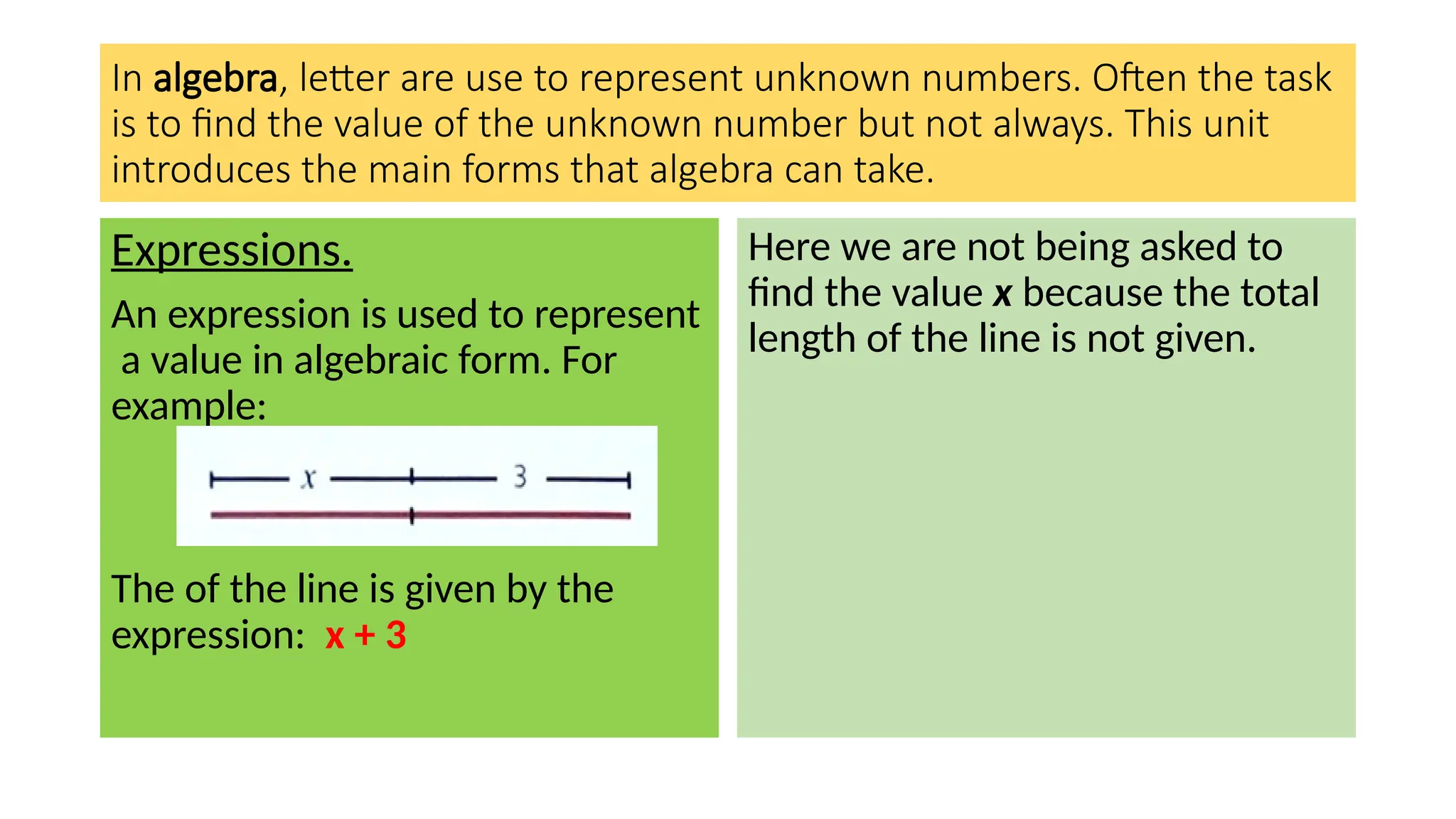
An expression is used to represent
a value in algebraic form. For
example:
The of the line is given by the
expression: x + 3
Here we are not being asked to
find the value x because the total
length of the line is not given.
4.
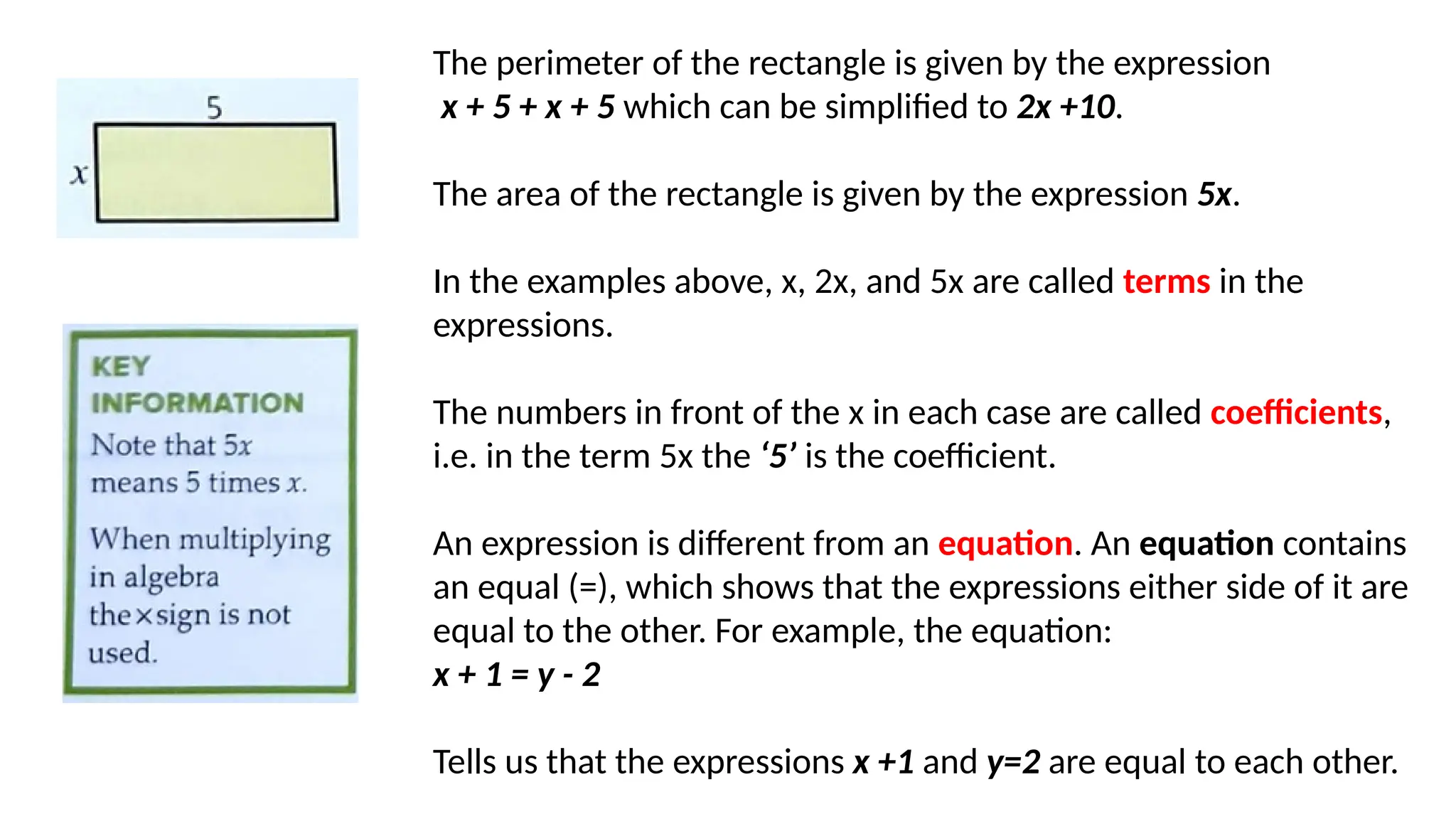
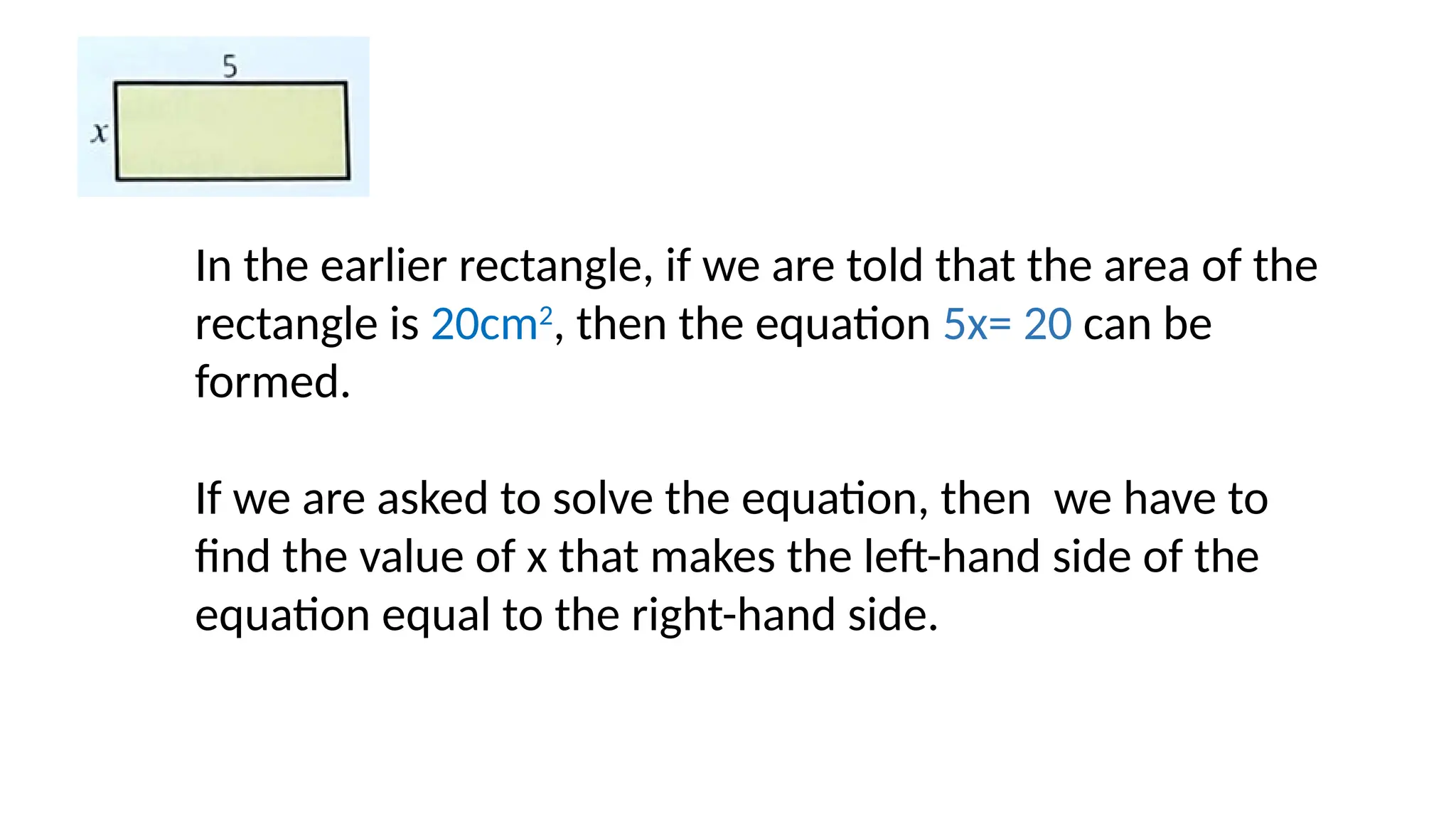
The perimeter ofthe rectangle is given by the expression
x + 5 + x + 5 which can be simplified to 2x +10.
The area of the rectangle is given by the expression 5x.
In the examples above, x, 2x, and 5x are called terms in the
expressions.
The numbers in front of the x in each case are called coefficients,
i.e. in the term 5x the ‘5’ is the coefficient.
An expression is different from an equation. An equation contains
an equal (=), which shows that the expressions either side of it are
equal to the other. For example, the equation:
x + 1 = y - 2
Tells us that the expressions x +1 and y=2 are equal to each other.
5.
In the earlierrectangle, if we are told that the area of the
rectangle is 20cm2
, then the equation 5x= 20 can be
formed.
If we are asked to solve the equation, then we have to
find the value of x that makes the left-hand side of the
equation equal to the right-hand side.
13.
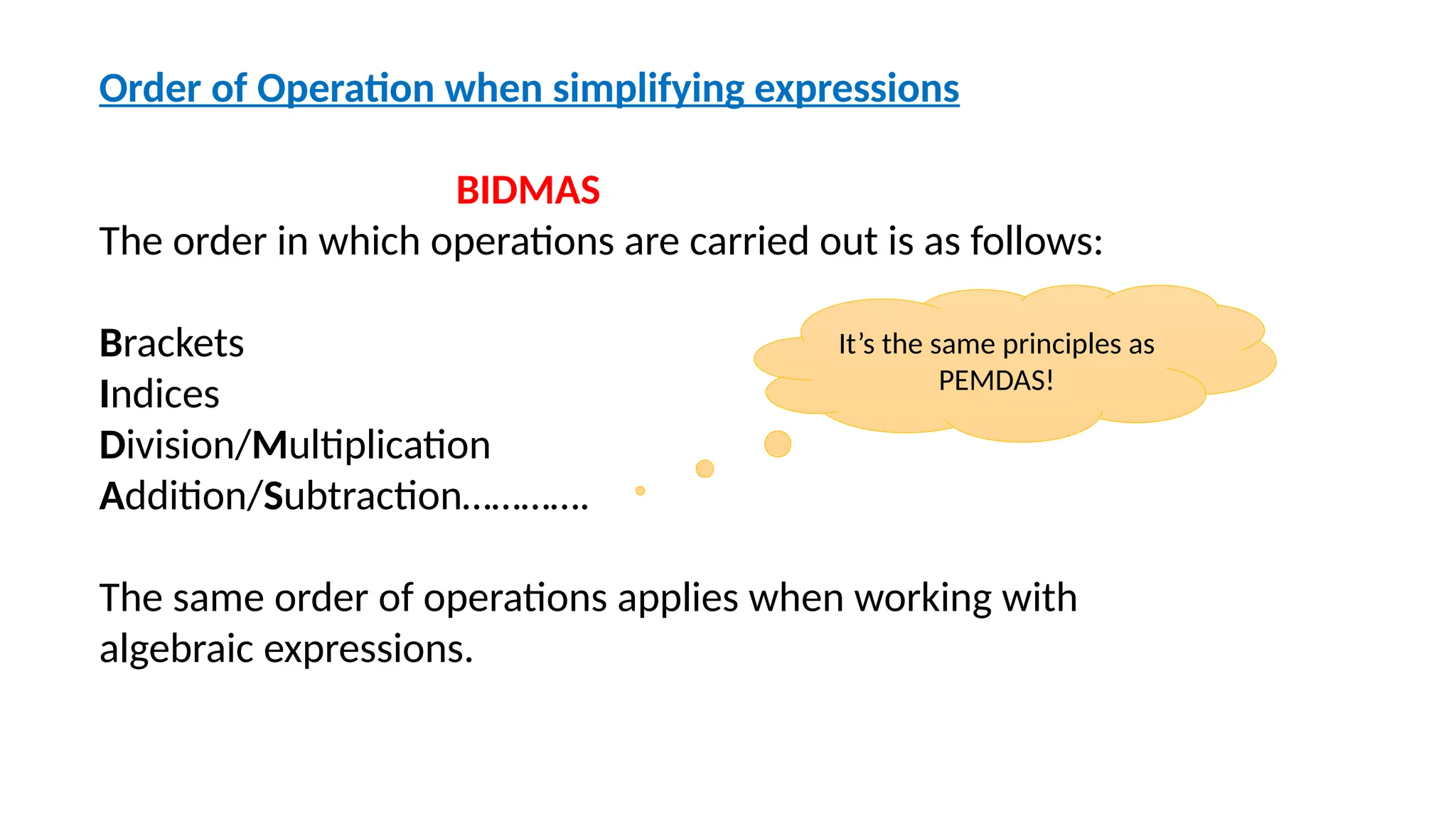
Order of Operationwhen simplifying expressions
BIDMAS
The order in which operations are carried out is as follows:
Brackets
Indices
Division/Multiplication
Addition/Subtraction………….
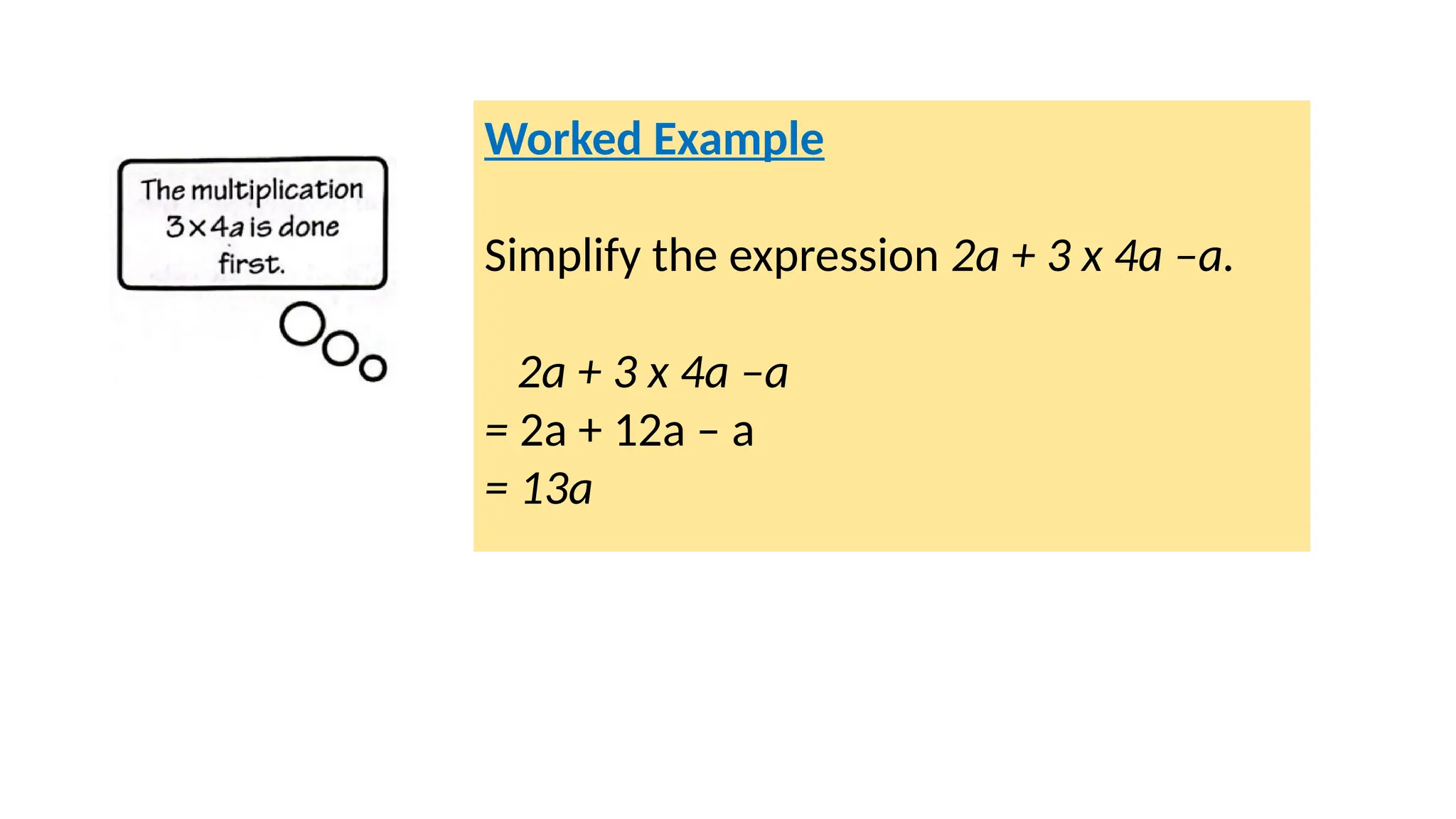
The same order of operations applies when working with
algebraic expressions.
It’s the same principles as
PEMDAS!