Lecture 8
ETHICAL AND SOCIAL ISSUES IN INFORMATION
SYSTEMS (continued)
© Prentice Hall 20111
• What ethical, social, and political issues are raised by
information systems?
• What specific principles for conduct can be used to guide
ethical decisions?
• Why do contemporary information systems technology and
the Internet pose challenges to the protection of individual
privacy and intellectual property?
• How have information systems affected everyday life?
Learning Objectives
© Prentice Hall 20112
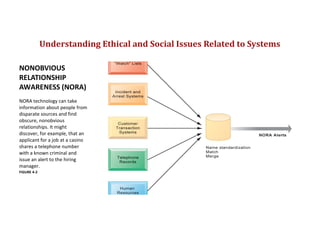
Understanding Ethical and Social Issues Related to Systems
NONOBVIOUS
RELATIONSHIP
AWARENESS (NORA)
NORA technology can take
information about people from
disparate sources and find
obscure, nonobvious
relationships. It might
discover, for example, that an
applicant for a job at a casino
shares a telephone number
with a known criminal and
issue an alert to the hiring
manager.
FIGURE 4-2
© Prentice Hall 20113
• Basic concepts for ethical analysis
– Responsibility:
• Accepting the potential costs, duties, and obligations for
decisions
– Accountability:
• Mechanisms for identifying responsible parties
– Liability:
• Permits individuals (and firms) to recover damages done to
them
– Due process:
• Laws are well known and understood, with an ability to
appeal to higher authorities
Ethics in an Information Society
© Prentice Hall 20114
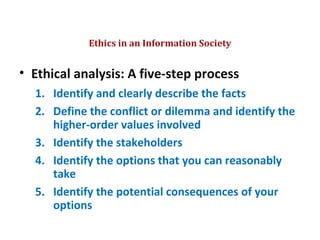
• Ethical analysis: A five-step process
1. Identify and clearly describe the facts
2. Define the conflict or dilemma and identify the
higher-order values involved
3. Identify the stakeholders
4. Identify the options that you can reasonably
take
5. Identify the potential consequences of your
options
Ethics in an Information Society
© Prentice Hall 20115
• Six Candidate Ethical Principles
1. Golden Rule
• Do unto others as you would have them do unto you
1. Immanuel Kant’s Categorical Imperative
• If an action is not right for everyone to take, it is not right for
anyone
1. Descartes’ Rule of Change
• If an action cannot be taken repeatedly, it is not right to take at all
Ethics in an Information Society
© Prentice Hall 20116
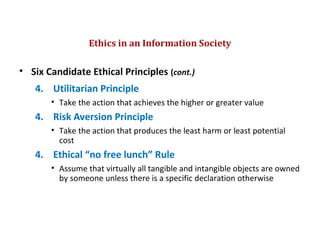
• Six Candidate Ethical Principles (cont.)
4. Utilitarian Principle
• Take the action that achieves the higher or greater value
4. Risk Aversion Principle
• Take the action that produces the least harm or least potential
cost
4. Ethical “no free lunch” Rule
• Assume that virtually all tangible and intangible objects are owned
by someone unless there is a specific declaration otherwise
Ethics in an Information Society
© Prentice Hall 20117
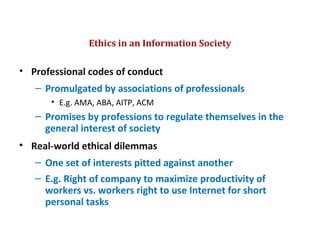
• Professional codes of conduct
– Promulgated by associations of professionals
• E.g. AMA, ABA, AITP, ACM
– Promises by professions to regulate themselves in the
general interest of society
• Real-world ethical dilemmas
– One set of interests pitted against another
– E.g. Right of company to maximize productivity of
workers vs. workers right to use Internet for short
personal tasks
Ethics in an Information Society
© Prentice Hall 20118
• Privacy:
– Claim of individuals to be left alone, free from
surveillance or interference from other individuals,
organizations, or state. Claim to be able to control
information about yourself
• In U.S., privacy protected by:
– First Amendment (freedom of speech)
– Fourth Amendment (unreasonable search and seizure)
– Additional federal statues (e.g. Privacy Act of 1974)
The Moral Dimensions of Information Systems
© Prentice Hall 20119
• Fair information practices:
– Set of principles governing the collection and use of
information
– Basis of most U.S. and European privacy laws
– Based on mutuality of interest between record holder
and individual
– Restated and extended by FTC in 1998 to provide
guidelines for protecting online privacy
– Used to drive changes in privacy legislation
• COPPA
• Gramm-Leach-Bliley Act
• HIPAA
The Moral Dimensions of Information Systems
© Prentice Hall 201110
• FTC FIP principles:
1. Notice/awareness (core principle)
2. Choice/consent (core principle)
3. Access/participation
4. Security
5. Enforcement
The Moral Dimensions of Information Systems
© Prentice Hall 201111
• European Directive on Data Protection:
– Requires companies to inform people when they collect
information about them and disclose how it will be stored
and used.
– Requires informed consent of customer
– EU member nations cannot transfer personal data to
countries with no similar privacy protection (e.g. U.S.)
– U.S. businesses use safe harbor framework
• Self-regulating policy to meet objectives of government legislation
without involving government regulation or enforcement.
The Moral Dimensions of Information Systems
© Prentice Hall 201112

PPIT Lecture 8

  • 1.
    Lecture 8 ETHICAL ANDSOCIAL ISSUES IN INFORMATION SYSTEMS (continued) © Prentice Hall 20111
  • 2.
    • What ethical,social, and political issues are raised by information systems? • What specific principles for conduct can be used to guide ethical decisions? • Why do contemporary information systems technology and the Internet pose challenges to the protection of individual privacy and intellectual property? • How have information systems affected everyday life? Learning Objectives © Prentice Hall 20112
  • 3.
    Understanding Ethical andSocial Issues Related to Systems NONOBVIOUS RELATIONSHIP AWARENESS (NORA) NORA technology can take information about people from disparate sources and find obscure, nonobvious relationships. It might discover, for example, that an applicant for a job at a casino shares a telephone number with a known criminal and issue an alert to the hiring manager. FIGURE 4-2 © Prentice Hall 20113
  • 4.
    • Basic conceptsfor ethical analysis – Responsibility: • Accepting the potential costs, duties, and obligations for decisions – Accountability: • Mechanisms for identifying responsible parties – Liability: • Permits individuals (and firms) to recover damages done to them – Due process: • Laws are well known and understood, with an ability to appeal to higher authorities Ethics in an Information Society © Prentice Hall 20114
  • 5.
    • Ethical analysis:A five-step process 1. Identify and clearly describe the facts 2. Define the conflict or dilemma and identify the higher-order values involved 3. Identify the stakeholders 4. Identify the options that you can reasonably take 5. Identify the potential consequences of your options Ethics in an Information Society © Prentice Hall 20115
  • 6.
    • Six CandidateEthical Principles 1. Golden Rule • Do unto others as you would have them do unto you 1. Immanuel Kant’s Categorical Imperative • If an action is not right for everyone to take, it is not right for anyone 1. Descartes’ Rule of Change • If an action cannot be taken repeatedly, it is not right to take at all Ethics in an Information Society © Prentice Hall 20116
  • 7.
    • Six CandidateEthical Principles (cont.) 4. Utilitarian Principle • Take the action that achieves the higher or greater value 4. Risk Aversion Principle • Take the action that produces the least harm or least potential cost 4. Ethical “no free lunch” Rule • Assume that virtually all tangible and intangible objects are owned by someone unless there is a specific declaration otherwise Ethics in an Information Society © Prentice Hall 20117
  • 8.
    • Professional codesof conduct – Promulgated by associations of professionals • E.g. AMA, ABA, AITP, ACM – Promises by professions to regulate themselves in the general interest of society • Real-world ethical dilemmas – One set of interests pitted against another – E.g. Right of company to maximize productivity of workers vs. workers right to use Internet for short personal tasks Ethics in an Information Society © Prentice Hall 20118
  • 9.
    • Privacy: – Claimof individuals to be left alone, free from surveillance or interference from other individuals, organizations, or state. Claim to be able to control information about yourself • In U.S., privacy protected by: – First Amendment (freedom of speech) – Fourth Amendment (unreasonable search and seizure) – Additional federal statues (e.g. Privacy Act of 1974) The Moral Dimensions of Information Systems © Prentice Hall 20119
  • 10.
    • Fair informationpractices: – Set of principles governing the collection and use of information – Basis of most U.S. and European privacy laws – Based on mutuality of interest between record holder and individual – Restated and extended by FTC in 1998 to provide guidelines for protecting online privacy – Used to drive changes in privacy legislation • COPPA • Gramm-Leach-Bliley Act • HIPAA The Moral Dimensions of Information Systems © Prentice Hall 201110
  • 11.
    • FTC FIPprinciples: 1. Notice/awareness (core principle) 2. Choice/consent (core principle) 3. Access/participation 4. Security 5. Enforcement The Moral Dimensions of Information Systems © Prentice Hall 201111
  • 12.
    • European Directiveon Data Protection: – Requires companies to inform people when they collect information about them and disclose how it will be stored and used. – Requires informed consent of customer – EU member nations cannot transfer personal data to countries with no similar privacy protection (e.g. U.S.) – U.S. businesses use safe harbor framework • Self-regulating policy to meet objectives of government legislation without involving government regulation or enforcement. The Moral Dimensions of Information Systems © Prentice Hall 201112

Editor's Notes

  • #3 Ask students what their first impressions are after seeing these objectives. Can they point to examples of how information systems have affected everyday life? If not, explain that they will be surprised to learn that information systems affect almost every area of daily life. Can students explain how the Internet poses challenges to privacy and intellectual property? Ask them how Google, Facebook, and peer-to-peer networks are related to these issues. What about breakdowns in important networks and software at banks, air traffic control, and other business firms?
  • #4 Explain that NORA is used by both the government and the private sector for its profiling capabilities. Ask students to provide potential examples of NORA (other than the one mentioned in the caption) for both governmental and business purposes. One such example might be an airline identifying potential terrorists attempting to board a plane. Another might government identifying potential terrorists by monitoring phone calls.
  • #5 Explain that information systems do not exist in a vacuum and that these concepts are instrumental in understanding the impact of systems and measuring their success. Ask students why liability and due process are such important ethical concepts. (A rough answer would be that they provide recourse to individuals negatively effected by mismanagement of information systems, providing incentive to ‘play by the rules’.)
  • #6 Do students believe that any aspect of ethical analysis is lacking from this process? If so, what? Can students offer a brief example of an ethical dilemma and how they would resolve it using this process? One class exercise is to work with students to identify an ethical situation they are aware of, or that may have been in the news. Then, go through the ethical analysis described in the slide to illustrate the process of analyzing an ethical situation.
  • #7 This slide and the next review six traditional ethical principles. Ensure students understand the difference between the categorical imperative and the rule of change. Briefly, the difference is that the categorical imperative spans the entirety of the populace, while the rule of change applies to the decisions of one person over time. For example, the categorical imperative applies to an employee who tries to steal money from his employer. He shouldn’t do this, because if all employees attempted to do so, the company would fail. The rule of change applied to the same situation might run as follows: while the employee’s stealing one dollar from the company would not lead to any true problem, repeatedly stealing one dollar, or stealing a lot of dollars, would be unacceptable and ultimately lead to the destruction of the company.
  • #8 How does the “no free lunch” rule relate to copyrights, patents, and trademarks? (These concepts are discussed in later slides.) Explain that the appearance of unethical behavior is as harmful as actual unethical behavior at times, so adherence to these principles are critical. In an age of “open software” how does the principle of “no free lunch” work out?
  • #9 Other ethical dilemmas include companies trying to use new systems to reduce the size of their workforce, such as telephone companies using automated systems to reduce the need for human operators. Emphasize that in cases like these, right and wrong are not clearly defined, but instead, contrasting values are at odds with one another (companies value productivity, employees value their work).
  • #10 Do students believe that there are sufficient protections for privacy in law? If not, what are possible methods of developing appropriate privacy protections? Table 4-3 in the text lists a variety of other laws affecting both the government and private institutions, but few areas of the private sector are as well regulated with respect to privacy. Do an in-class poll and ask students who among them feel they can control the use of their personal information on the Internet. You should get no one raising their hand.
  • #11 Explain what is meant by a ‘mutuality of interest between record holder and individual.’ (Briefly, the individual wants to engage in a transaction, and the record holder needs information about the individual to support the transaction – both are interested parties in the transaction.)
  • #12 These five Fair Information Practices provide the foundation for all privacy legislation in the United States, and much of Europe. You can ask students or explain what each means: (1) Notice/awareness: Web sites must disclose practices before collecting data; (2) Choice/consent: Consumers must be able to choose how information is used for secondary purposes; (3) Access/participation: Consumers must be able to review, contest accuracy of personal data; (4) Security: Data collectors must take steps to ensure accuracy, security of personal data; (5) Enforcement: There must be a mechanism to enforce FIP principles In addition, you might go to a popular Web site, such as bestbuy.com, find its privacy policy, and see how well the site conforms to the principles above. Chances are good that the Web site you choose will have several statements in their policies which permit them to do anything they want with personal information. Also, do a search on “FTC privacy” and go to one of the reports listed. A search on “FTC behavioral targeting” also produces many fine reports on the topic.
  • #13 EU protections of privacy are far more powerful than the United States because they require informed consent before a firm can do anything with personal information besides support the transaction at hand. In Europe, there is no junk postal mail for instance because advertising firms are prohibited from using personal information obtained from third parties, and without the consent of the individual.