Creating Brand Equity
alfina@uisi.ac.id
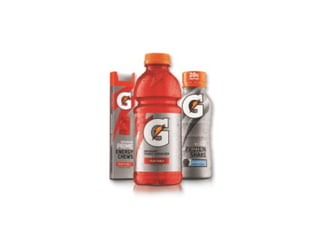
One of the most valuable
intangible assets of a
firm is its brands
The American Marketing Association defines a
brand as
“a name, term, sign, symbol, or design, or a
combination of them, intended to identify
the goods or services of one seller or group
of sellers and to differentiate them from
those of competitors”
Importance of Brands to…
CONSUMER
• Identification of the source
of the product
• Assignment of responsibility
to product maker
• Risk reducer
• Search cost reducer
• Promise, bond, or pact with
product maker (loyalty)
• Symbolic device
• Signal of quality
FIRMS
• Identification to simplify
handling or tracing
• Legally protecting unique
features
• Signal of quality level
• Endowing products with
unique associations
• Source of competitive
advantage
• Source of financial returns
1.5
1.6
Reducing the Risks in Product Decisions
• Consumers may perceive many different types of risks in buying
and consuming a product:
• Functional risk—The product does not perform up to
expectations.
• Physical risk—The product poses a threat to the physical well-
being or health of the user or others.
• Financial risk—The product is not worth the price paid.
• Social risk—The product results in embarrassment from others.
• Psychological risk—The product affects the mental well-being
of the user.
• Time risk—The failure of the product results in an opportunity
cost of finding another satisfactory product.
Defining Brand Equity
• Brand equity is the added value endowed to
products and services with consumers. It may be
reflected in the way consumers think, feel, and act
with respect to the brand, as well as in the prices,
market share, and profitability it commands.
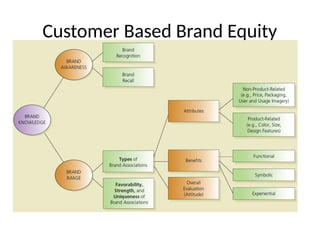
• Customer-based brand equity is thus the
differential effect brand knowledge has on
consumer response to the marketing of that brand
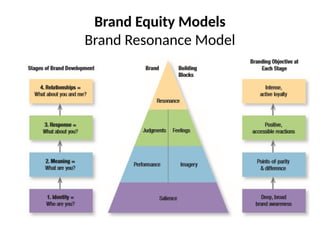
Brand Equity Models
Brand Resonance Model
Customer Based Brand Equity
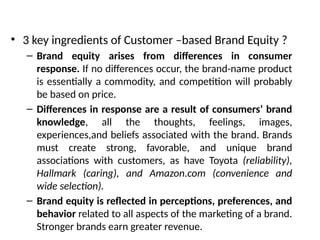
• 3 key ingredients of Customer –based Brand Equity ?
– Brand equity arises from differences in consumer
response. If no differences occur, the brand-name product
is essentially a commodity, and competition will probably
be based on price.
– Differences in response are a result of consumers’ brand
knowledge, all the thoughts, feelings, images,
experiences,and beliefs associated with the brand. Brands
must create strong, favorable, and unique brand
associations with customers, as have Toyota (reliability),
Hallmark (caring), and Amazon.com (convenience and
wide selection).
– Brand equity is reflected in perceptions, preferences, and
behavior related to all aspects of the marketing of a brand.
Stronger brands earn greater revenue.
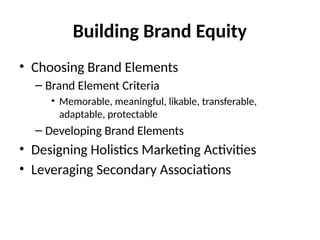
Building Brand Equity
• Choosing Brand Elements
– Brand Element Criteria
• Memorable, meaningful, likable, transferable,
adaptable, protectable
– Developing Brand Elements
• Designing Holistics Marketing Activities
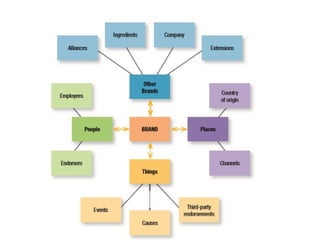
• Leveraging Secondary Associations
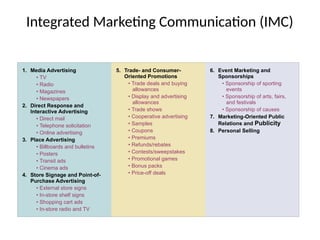
Integrated Marketing Communication (IMC)
1. Media Advertising
• TV
• Radio
• Magazines
• Newspapers
2. Direct Response and
Interactive Advertising
• Direct mail
• Telephone solicitation
• Online advertising
3. Place Advertising
• Billboards and bulletins
• Posters
• Transit ads
• Cinema ads
4. Store Signage and Point-of-
Purchase Advertising
• External store signs
• In-store shelf signs
• Shopping cart ads
• In-store radio and TV
5. Trade- and Consumer-
Oriented Promotions
• Trade deals and buying
allowances
• Display and advertising
allowances
• Trade shows
• Cooperative advertising
• Samples
• Coupons
• Premiums
• Refunds/rebates
• Contests/sweepstakes
• Promotional games
• Bonus packs
• Price-off deals
6. Event Marketing and
Sponsorships
• Sponsorship of sporting
events
• Sponsorship of arts, fairs,
and festivals
• Sponsorship of causes
7. Marketing-Oriented Public
Relations and Publicity
8. Personal Selling
Chapter 11 - Creating Brand Equityjjjjjjj

Chapter 11 - Creating Brand Equityjjjjjjj

  • 1.
  • 2.
    One of themost valuable intangible assets of a firm is its brands
  • 4.
    The American MarketingAssociation defines a brand as “a name, term, sign, symbol, or design, or a combination of them, intended to identify the goods or services of one seller or group of sellers and to differentiate them from those of competitors”
  • 5.
    Importance of Brandsto… CONSUMER • Identification of the source of the product • Assignment of responsibility to product maker • Risk reducer • Search cost reducer • Promise, bond, or pact with product maker (loyalty) • Symbolic device • Signal of quality FIRMS • Identification to simplify handling or tracing • Legally protecting unique features • Signal of quality level • Endowing products with unique associations • Source of competitive advantage • Source of financial returns 1.5
  • 6.
    1.6 Reducing the Risksin Product Decisions • Consumers may perceive many different types of risks in buying and consuming a product: • Functional risk—The product does not perform up to expectations. • Physical risk—The product poses a threat to the physical well- being or health of the user or others. • Financial risk—The product is not worth the price paid. • Social risk—The product results in embarrassment from others. • Psychological risk—The product affects the mental well-being of the user. • Time risk—The failure of the product results in an opportunity cost of finding another satisfactory product.
  • 7.
    Defining Brand Equity •Brand equity is the added value endowed to products and services with consumers. It may be reflected in the way consumers think, feel, and act with respect to the brand, as well as in the prices, market share, and profitability it commands. • Customer-based brand equity is thus the differential effect brand knowledge has on consumer response to the marketing of that brand
  • 9.
  • 10.
  • 11.
    • 3 keyingredients of Customer –based Brand Equity ? – Brand equity arises from differences in consumer response. If no differences occur, the brand-name product is essentially a commodity, and competition will probably be based on price. – Differences in response are a result of consumers’ brand knowledge, all the thoughts, feelings, images, experiences,and beliefs associated with the brand. Brands must create strong, favorable, and unique brand associations with customers, as have Toyota (reliability), Hallmark (caring), and Amazon.com (convenience and wide selection). – Brand equity is reflected in perceptions, preferences, and behavior related to all aspects of the marketing of a brand. Stronger brands earn greater revenue.
  • 12.
    Building Brand Equity •Choosing Brand Elements – Brand Element Criteria • Memorable, meaningful, likable, transferable, adaptable, protectable – Developing Brand Elements • Designing Holistics Marketing Activities • Leveraging Secondary Associations
  • 13.
    Integrated Marketing Communication(IMC) 1. Media Advertising • TV • Radio • Magazines • Newspapers 2. Direct Response and Interactive Advertising • Direct mail • Telephone solicitation • Online advertising 3. Place Advertising • Billboards and bulletins • Posters • Transit ads • Cinema ads 4. Store Signage and Point-of- Purchase Advertising • External store signs • In-store shelf signs • Shopping cart ads • In-store radio and TV 5. Trade- and Consumer- Oriented Promotions • Trade deals and buying allowances • Display and advertising allowances • Trade shows • Cooperative advertising • Samples • Coupons • Premiums • Refunds/rebates • Contests/sweepstakes • Promotional games • Bonus packs • Price-off deals 6. Event Marketing and Sponsorships • Sponsorship of sporting events • Sponsorship of arts, fairs, and festivals • Sponsorship of causes 7. Marketing-Oriented Public Relations and Publicity 8. Personal Selling