Lesson 5 -
Types of
Reservation
Systems &
Symbols used
in Front Office
Prepared by: Mr. Joshua B. Laxa, Lpt
Credits to: noviengayaan
Symbols used in
Front Office
Why
Reservatio
n Systems
Matter?
 Reservation systems are the
backbone of efficient hotel and
lodging operations. They play a
pivotal role in ensuring that
guests have a seamless and
satisfactory experience. In our
fast-paced world, the ability to
book rooms, services, and
amenities efficiently has become
a standard expectation for
travelers.
 Think about your own travel
experiences. Whether it's
booking a hotel room for a
vacation, reserving a table at a
restaurant, or securing a ticket
for a flight, reservation systems
are all around us. They impact
not only the way businesses
operate but also our own
convenience and peace of mind
as customers.
The Significance of Reservations
 So, what exactly are reservation
systems? At their core, these
systems are designed to manage
bookings, appointments, and
reservations. They help businesses
keep track of who's coming, when
they're coming, and what they need
during their visit.
What Are Reservation
Systems?
 In the context of the hospitality industry,
reservation systems are used by hotels,
resorts, motels, and other lodging
establishments to manage room
bookings, but their scope goes far beyond
that. They also handle reservations for
services, such as dining, spa treatments,
and recreational activities.
Reservation Systems in
Hospitality
 Reservation systems provide several key functions:
• They capture guest information.
• They manage room availability.
• They facilitate communication between guests and
the establishment.
• They process payments and ensure accurate
billing.
• They play a central role in ensuring guest
satisfaction.
Key Functions of Reservation Systems
Types of
Reservation
Systems
Exploring Property
Level, CRS, GDS, and
IDS
1. Property
Level
Reservation
System
Definition
A Property Level Reservation System, often referred to as
a "PMS" (Property Management System), is a reservation
system used directly by an individual hotel or lodging
property.
It serves as the primary tool for managing room
reservations, guest check-ins and check-outs, and other
essential functions within a specific property.
• Reservation Management: Allows the hotel to record,
track, and manage guest reservations efficiently.
• Room Availability: Provides real-time information on
room availability, ensuring optimal occupancy levels.
• Guest Information: Stores guest profiles and preferences,
enabling personalized service.
• Check-In and Check-Out: Facilitates the guest registration
process, including assigning rooms and managing billing.
• Billing and Invoicing: Handles guest charges, payments,
and invoicing, ensuring accurate billing.
• Housekeeping Coordination: Coordinates with
housekeeping to manage room cleaning and readiness.
• Reporting and Analytics: Generates reports for hotel
performance analysis and decision-making.
Key Features of a
Property Level
Reservation System:
• Direct Control: The hotel has full control
over its reservations and guest data,
enhancing security.
• Customization: Can be tailored to the
specific needs and branding of the property.
• Personalization: Allows for personalized
guest experiences, fostering guest loyalty.
• Cost Control: Eliminates commission fees
paid to third-party booking platforms.
• Integration: Can integrate with other hotel
systems such as point-of-sale and
accounting software.
Advantages:
• Limited Exposure: May have limited visibility to
potential guests compared to global distribution.
• Resource-Intensive: Requires investment in
software, training, and ongoing maintenance.
• Competitive Disadvantage: Smaller properties
may struggle to compete with larger chains on a
global scale.
• Manual Entry: Data entry errors can occur
without diligent monitoring.
• Dependency: The property is responsible for its
marketing and exposure.
Challenges:
2. Central
Reservation
System (CRS)
Definition
A Central Reservation System (CRS) is a
specialized software platform used by hotel
chains or hotel groups to manage reservations,
room inventory, and rates across multiple
properties from a centralized location.
• Inventory Management: Maintains real-time information on room
availability, rates, and restrictions for all properties.
• Rate Management: Allows for dynamic pricing strategies to maximize
revenue.
• Distribution Channels: Provides connectivity to various online and offline
distribution channels, including websites, travel agencies, and global
distribution systems (GDS).
• Integrated Bookings: Consolidates reservations from different sources into
a single platform.
• Reporting and Analytics: Offers comprehensive reporting tools for
performance analysis.
Key Features of a Central Reservation System
(CRS)
• Efficiency: Streamlines the reservation process, reducing
manual data entry and errors.
• Global Reach: Expands a hotel group's global reach by
connecting to multiple distribution channels.
• Consistency: Ensures consistent room availability and pricing
across all properties.
• Competitive Edge: Enables real-time rate adjustments to stay
competitive in the market.
• Data Centralization: Centralizes guest data and reservation
information for enhanced customer service.
Advantages of Using a Central Reservation
System (CRS):
• Sabre Hospitality Solutions: Offers CRS solutions for hotel
chains, connecting properties to global distribution networks.
• Amadeus Hospitality: Provides a comprehensive CRS that
integrates with other hotel systems.
• TravelClick (Now part of Amadeus): Offers cloud-based CRS
solutions with a focus on revenue management.
Examples of Central Reservation System (CRS)
Providers:
 Definition
• A Global Distribution System (GDS) is a vast
network of computerized reservation
systems that enable travel professionals
and agencies to access and book travel-
related services worldwide.
• GDSs serve as intermediaries that connect
travel providers (e.g., airlines, hotels, car
rental companies) with travel agencies,
online booking sites, and other distribution
channels.
3. Global Distribution System (GDS)
• Comprehensive Inventory: Offer a wide range of travel-related
services, including flights, hotel accommodations, car rentals, and
more.
• Real-time Access: Provide instant access to up-to-date information
on availability, pricing, and booking confirmations.
• Booking Capabilities: Allow travel agents to make reservations and
issue electronic tickets efficiently.
• Content Aggregation: Consolidate offerings from various providers
into a single platform.
• Integration: Seamlessly integrate with booking tools used by travel
professionals.
Key Features of Global Distribution Systems
(GDS):
• Global Reach: GDSs connect travel providers to a vast network of
travel agencies and online booking platforms, expanding their reach
to a global audience.
• Efficiency: Streamlines the booking process for travel agents,
reducing the time and effort required to make reservations.
• Competitive Advantage: Allows travel providers to showcase their
services to a wide audience, gaining a competitive edge in the market.
• Consolidation: Offers a one-stop-shop for travel professionals,
simplifying the booking of multiple travel components.
• Reliability: Provides accurate and real-time information, ensuring
booking accuracy and customer satisfaction.
Importance of GDS in the Travel
Industry:
• An Internet Distribution System (IDS) is a
technology-driven platform used by
hotels, resorts, and other lodging
establishments to distribute their room
inventory and services to various online
travel agencies (OTAs) and third-party
booking platforms.
• IDSs enable hotels to reach a vast online
audience, allowing travelers to book
rooms and services through the internet.
Internet Distribution System (IDS)
• Online Presence: Provides hotels with a strong online presence by
listing their rooms and services on various OTAs and booking websites.
• Real-time Updates: Ensures that room availability, rates, and
promotional offers are updated in real-time across all distribution
channels.
• Rate Parity: Maintains consistent pricing across multiple platforms to
prevent rate disparities.
• Channel Management: Allows hotels to manage and monitor
reservations from different sources in one central system.
• Integration: Integrates with hotel management software and
reservation systems.
Key Features of Internet Distribution Systems
(IDS):
• Digital Visibility: In an era where travelers rely heavily on online research
and booking, IDSs provide hotels with digital visibility and accessibility.
• Global Reach: IDSs allow hotels to reach a global audience, attracting
travelers from various regions and markets.
• Competitive Edge: Staying connected to multiple OTAs and online
booking platforms helps hotels remain competitive in a crowded
marketplace.
• Revenue Maximization: Enables hotels to optimize their revenue by
adjusting rates and promotions based on demand.
• Efficient Distribution: Streamlines the distribution of rooms and services
across the digital landscape.
Importance of IDS in the Digital Age:
1. SynXis by Sabre: SynXis is a popular IDS that offers a wide range
of distribution and connectivity solutions to hotels and resorts.
2. Siteminder: Siteminder provides a comprehensive hotel
distribution platform that connects properties with various OTAs
and booking sites.
3. RateGain: RateGain offers IDS solutions, including channel
management and rate parity tools, to enhance a hotel's digital
distribution strategy.
4. TravelClick (Part of Amadeus): TravelClick's IDS solutions help
hotels optimize their online presence and reservations.
Examples of Internet Distribution System (IDS)
Providers:
Hotel Type
Target Market
Budget
Scalability
Factors to Consider
When Choosing a
Reservation System
• Throughout this presentation, we've
explored various types of
reservation systems:
• Property Level Reservation
System
• Central Reservation System (CRS)
• Global Distribution System (GDS)
• Internet Distribution System
(IDS)
Recap of Key
Points
• It directly impacts:
• Operational efficiency
• Guest satisfaction
• Revenue generation
• Competitive positioning
Choosing the right reservation
system is a critical decision for
hotels and lodging establishments.
• Property Level for individual
control and customization.
• CRS for hotel chains' centralized
management.
• GDS for global reach and
connectivity.
• IDS for digital visibility and
online bookings.
Each system has its unique
advantages and considerations:
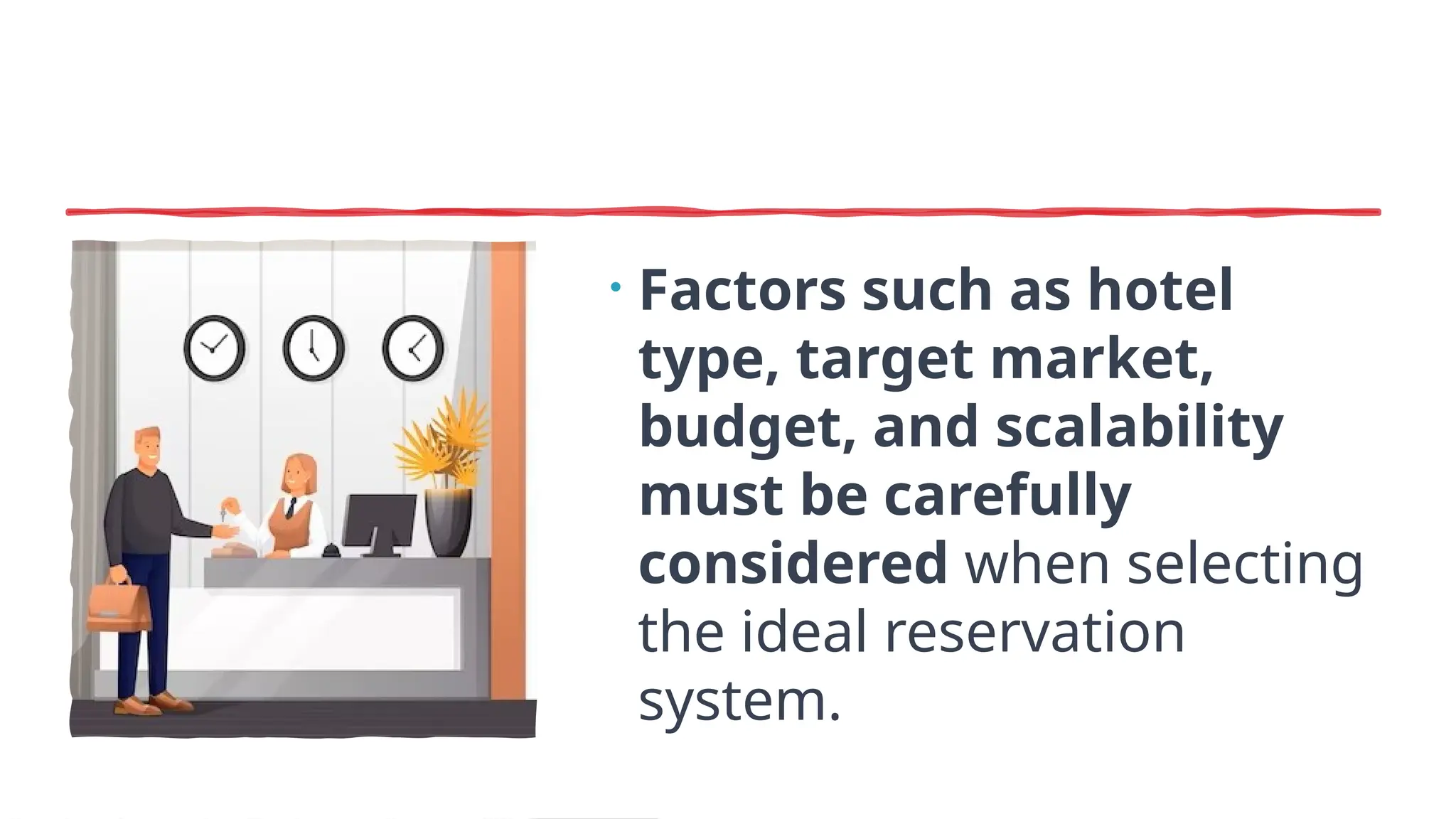
• Factors such as hotel
type, target market,
budget, and scalability
must be carefully
considered when selecting
the ideal reservation
system.
 Remember that the right
reservation system can
help your property thrive
in a competitive market,
delivering exceptional
guest experiences and
optimizing revenue.

Lesson 5 - Types of Reservation Systems.pptx

  • 1.
    Lesson 5 - Typesof Reservation Systems & Symbols used in Front Office Prepared by: Mr. Joshua B. Laxa, Lpt Credits to: noviengayaan
  • 2.
  • 5.
  • 6.
     Reservation systemsare the backbone of efficient hotel and lodging operations. They play a pivotal role in ensuring that guests have a seamless and satisfactory experience. In our fast-paced world, the ability to book rooms, services, and amenities efficiently has become a standard expectation for travelers.
  • 7.
     Think aboutyour own travel experiences. Whether it's booking a hotel room for a vacation, reserving a table at a restaurant, or securing a ticket for a flight, reservation systems are all around us. They impact not only the way businesses operate but also our own convenience and peace of mind as customers. The Significance of Reservations
  • 8.
     So, whatexactly are reservation systems? At their core, these systems are designed to manage bookings, appointments, and reservations. They help businesses keep track of who's coming, when they're coming, and what they need during their visit. What Are Reservation Systems?
  • 9.
     In thecontext of the hospitality industry, reservation systems are used by hotels, resorts, motels, and other lodging establishments to manage room bookings, but their scope goes far beyond that. They also handle reservations for services, such as dining, spa treatments, and recreational activities. Reservation Systems in Hospitality
  • 10.
     Reservation systemsprovide several key functions: • They capture guest information. • They manage room availability. • They facilitate communication between guests and the establishment. • They process payments and ensure accurate billing. • They play a central role in ensuring guest satisfaction. Key Functions of Reservation Systems
  • 11.
  • 12.
    1. Property Level Reservation System Definition A PropertyLevel Reservation System, often referred to as a "PMS" (Property Management System), is a reservation system used directly by an individual hotel or lodging property. It serves as the primary tool for managing room reservations, guest check-ins and check-outs, and other essential functions within a specific property.
  • 13.
    • Reservation Management:Allows the hotel to record, track, and manage guest reservations efficiently. • Room Availability: Provides real-time information on room availability, ensuring optimal occupancy levels. • Guest Information: Stores guest profiles and preferences, enabling personalized service. • Check-In and Check-Out: Facilitates the guest registration process, including assigning rooms and managing billing. • Billing and Invoicing: Handles guest charges, payments, and invoicing, ensuring accurate billing. • Housekeeping Coordination: Coordinates with housekeeping to manage room cleaning and readiness. • Reporting and Analytics: Generates reports for hotel performance analysis and decision-making. Key Features of a Property Level Reservation System:
  • 14.
    • Direct Control:The hotel has full control over its reservations and guest data, enhancing security. • Customization: Can be tailored to the specific needs and branding of the property. • Personalization: Allows for personalized guest experiences, fostering guest loyalty. • Cost Control: Eliminates commission fees paid to third-party booking platforms. • Integration: Can integrate with other hotel systems such as point-of-sale and accounting software. Advantages:
  • 15.
    • Limited Exposure:May have limited visibility to potential guests compared to global distribution. • Resource-Intensive: Requires investment in software, training, and ongoing maintenance. • Competitive Disadvantage: Smaller properties may struggle to compete with larger chains on a global scale. • Manual Entry: Data entry errors can occur without diligent monitoring. • Dependency: The property is responsible for its marketing and exposure. Challenges:
  • 16.
    2. Central Reservation System (CRS) Definition ACentral Reservation System (CRS) is a specialized software platform used by hotel chains or hotel groups to manage reservations, room inventory, and rates across multiple properties from a centralized location.
  • 17.
    • Inventory Management:Maintains real-time information on room availability, rates, and restrictions for all properties. • Rate Management: Allows for dynamic pricing strategies to maximize revenue. • Distribution Channels: Provides connectivity to various online and offline distribution channels, including websites, travel agencies, and global distribution systems (GDS). • Integrated Bookings: Consolidates reservations from different sources into a single platform. • Reporting and Analytics: Offers comprehensive reporting tools for performance analysis. Key Features of a Central Reservation System (CRS)
  • 18.
    • Efficiency: Streamlinesthe reservation process, reducing manual data entry and errors. • Global Reach: Expands a hotel group's global reach by connecting to multiple distribution channels. • Consistency: Ensures consistent room availability and pricing across all properties. • Competitive Edge: Enables real-time rate adjustments to stay competitive in the market. • Data Centralization: Centralizes guest data and reservation information for enhanced customer service. Advantages of Using a Central Reservation System (CRS):
  • 19.
    • Sabre HospitalitySolutions: Offers CRS solutions for hotel chains, connecting properties to global distribution networks. • Amadeus Hospitality: Provides a comprehensive CRS that integrates with other hotel systems. • TravelClick (Now part of Amadeus): Offers cloud-based CRS solutions with a focus on revenue management. Examples of Central Reservation System (CRS) Providers:
  • 20.
     Definition • AGlobal Distribution System (GDS) is a vast network of computerized reservation systems that enable travel professionals and agencies to access and book travel- related services worldwide. • GDSs serve as intermediaries that connect travel providers (e.g., airlines, hotels, car rental companies) with travel agencies, online booking sites, and other distribution channels. 3. Global Distribution System (GDS)
  • 21.
    • Comprehensive Inventory:Offer a wide range of travel-related services, including flights, hotel accommodations, car rentals, and more. • Real-time Access: Provide instant access to up-to-date information on availability, pricing, and booking confirmations. • Booking Capabilities: Allow travel agents to make reservations and issue electronic tickets efficiently. • Content Aggregation: Consolidate offerings from various providers into a single platform. • Integration: Seamlessly integrate with booking tools used by travel professionals. Key Features of Global Distribution Systems (GDS):
  • 22.
    • Global Reach:GDSs connect travel providers to a vast network of travel agencies and online booking platforms, expanding their reach to a global audience. • Efficiency: Streamlines the booking process for travel agents, reducing the time and effort required to make reservations. • Competitive Advantage: Allows travel providers to showcase their services to a wide audience, gaining a competitive edge in the market. • Consolidation: Offers a one-stop-shop for travel professionals, simplifying the booking of multiple travel components. • Reliability: Provides accurate and real-time information, ensuring booking accuracy and customer satisfaction. Importance of GDS in the Travel Industry:
  • 23.
    • An InternetDistribution System (IDS) is a technology-driven platform used by hotels, resorts, and other lodging establishments to distribute their room inventory and services to various online travel agencies (OTAs) and third-party booking platforms. • IDSs enable hotels to reach a vast online audience, allowing travelers to book rooms and services through the internet. Internet Distribution System (IDS)
  • 24.
    • Online Presence:Provides hotels with a strong online presence by listing their rooms and services on various OTAs and booking websites. • Real-time Updates: Ensures that room availability, rates, and promotional offers are updated in real-time across all distribution channels. • Rate Parity: Maintains consistent pricing across multiple platforms to prevent rate disparities. • Channel Management: Allows hotels to manage and monitor reservations from different sources in one central system. • Integration: Integrates with hotel management software and reservation systems. Key Features of Internet Distribution Systems (IDS):
  • 25.
    • Digital Visibility:In an era where travelers rely heavily on online research and booking, IDSs provide hotels with digital visibility and accessibility. • Global Reach: IDSs allow hotels to reach a global audience, attracting travelers from various regions and markets. • Competitive Edge: Staying connected to multiple OTAs and online booking platforms helps hotels remain competitive in a crowded marketplace. • Revenue Maximization: Enables hotels to optimize their revenue by adjusting rates and promotions based on demand. • Efficient Distribution: Streamlines the distribution of rooms and services across the digital landscape. Importance of IDS in the Digital Age:
  • 26.
    1. SynXis bySabre: SynXis is a popular IDS that offers a wide range of distribution and connectivity solutions to hotels and resorts. 2. Siteminder: Siteminder provides a comprehensive hotel distribution platform that connects properties with various OTAs and booking sites. 3. RateGain: RateGain offers IDS solutions, including channel management and rate parity tools, to enhance a hotel's digital distribution strategy. 4. TravelClick (Part of Amadeus): TravelClick's IDS solutions help hotels optimize their online presence and reservations. Examples of Internet Distribution System (IDS) Providers:
  • 27.
    Hotel Type Target Market Budget Scalability Factorsto Consider When Choosing a Reservation System
  • 28.
    • Throughout thispresentation, we've explored various types of reservation systems: • Property Level Reservation System • Central Reservation System (CRS) • Global Distribution System (GDS) • Internet Distribution System (IDS) Recap of Key Points
  • 29.
    • It directlyimpacts: • Operational efficiency • Guest satisfaction • Revenue generation • Competitive positioning Choosing the right reservation system is a critical decision for hotels and lodging establishments.
  • 30.
    • Property Levelfor individual control and customization. • CRS for hotel chains' centralized management. • GDS for global reach and connectivity. • IDS for digital visibility and online bookings. Each system has its unique advantages and considerations:
  • 31.
    • Factors suchas hotel type, target market, budget, and scalability must be carefully considered when selecting the ideal reservation system.
  • 32.
     Remember thatthe right reservation system can help your property thrive in a competitive market, delivering exceptional guest experiences and optimizing revenue.