Life Skills
• Time& Stress Management
• Decision Making
• Creative Thinking
• Critical Thinking
• Problem Solving
• Negotiating Skills
• Change Management
• Interpersonal relationship
• Self Awareness
• Empathy
• Effective Communication
• Ethics & Values
3.
The Teachers :What We Are !
• Care Givers
• Counselors
• Nurses
• Coaches
• Administrators
• Programme Designers
• Trainers
• Facilitators
• Mentors……..
4.
We are: RoleModel
• Our Dress
• Speech
• Action
• Life
• Walk the talk
• The list goes on ……
5.
What is TimeManagement?
• Development of Processes and tools that increase efficiency, efficacy
and productivity of individuals
• Doesn’t Just Happen- It is the skill that must be worked on and is life
long
6.
Why Time Management?
•To utilise the available time in the optimum manner to achieve
one’s personal and professional goals.
• Good time management
• Allows you to accomplish more in a shorter period of time
• Leads to more free time
• Lets you take advantage of learning opportunities
• Lowers stress and helps you focus
• Leads to greater career success.
7.
7
Just Think
• Howmuch of your typical work week do you spend stressed about
not having enough time to complete a task or reach a goal?
• Do you think you cannot fulfill dreams, travel to exotic locations,
finish projects before the deadline, get enough sleep every night and
spend enough time with loved ones… because you don’t have enough
time.
• With all your duties as a new teacher, there are probably times when
you feel like there are simply not enough minutes in the day!
8.
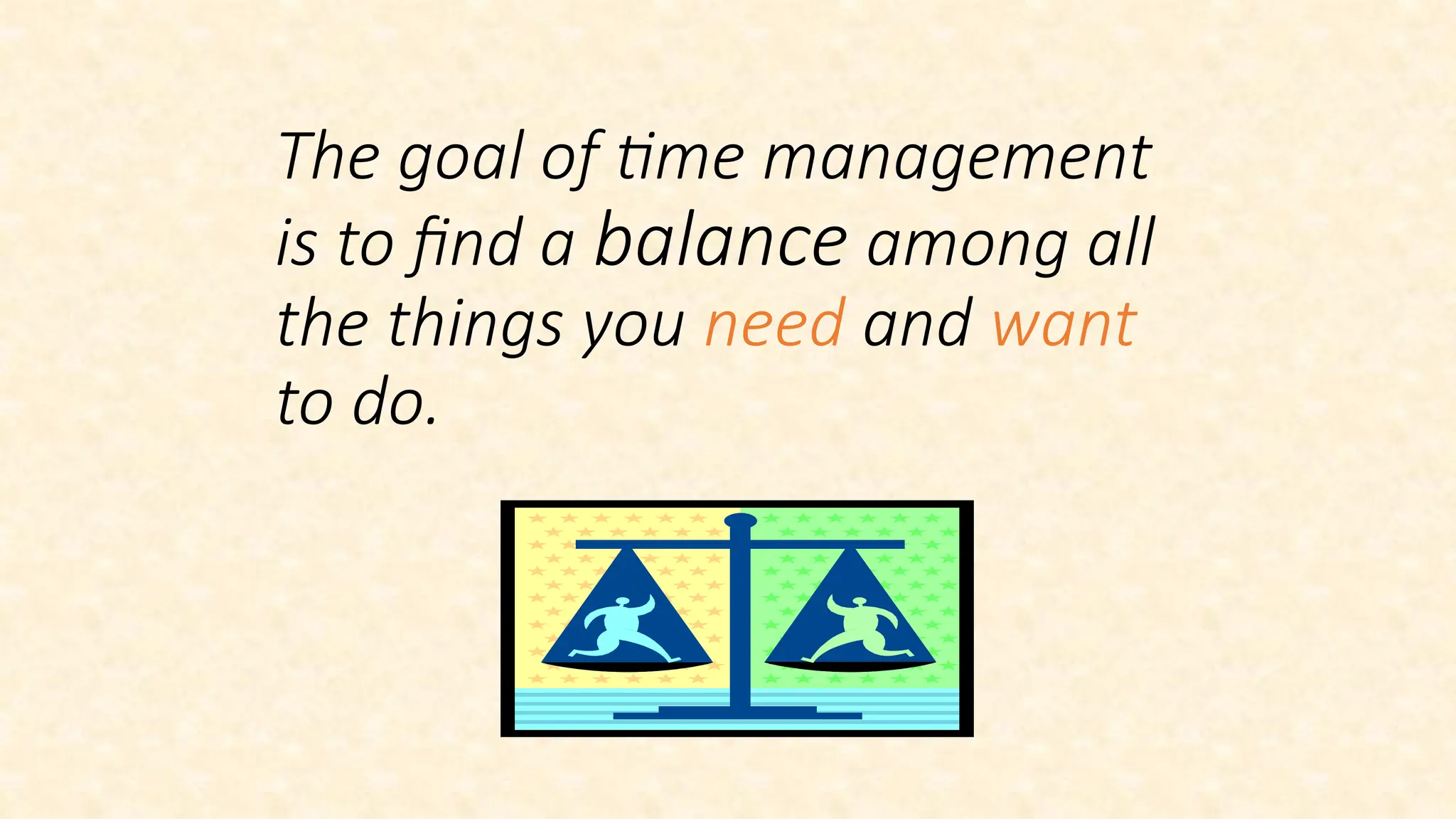
The goal oftime management
is to find a balance among all
the things you need and want
to do.
Are you allocatingsufficient time to your current activities?
Are you spending too much time on some parts of your
tasks?
Do you organize your day according to your priorities?
Are you able to complete the tasks uninterrupted?
12
Four Questions
13.
Time Robbers
• Distractions
•Interruptions
• Intrusive interruptions – Phone call
• Non Intrusive interruptions – E mail
14.
Time Robbers
• Distractions
•Interruptions
• Intrusive interruptions – Phone call
• Non Intrusive interruptions – E mail
• Procrastination
15.
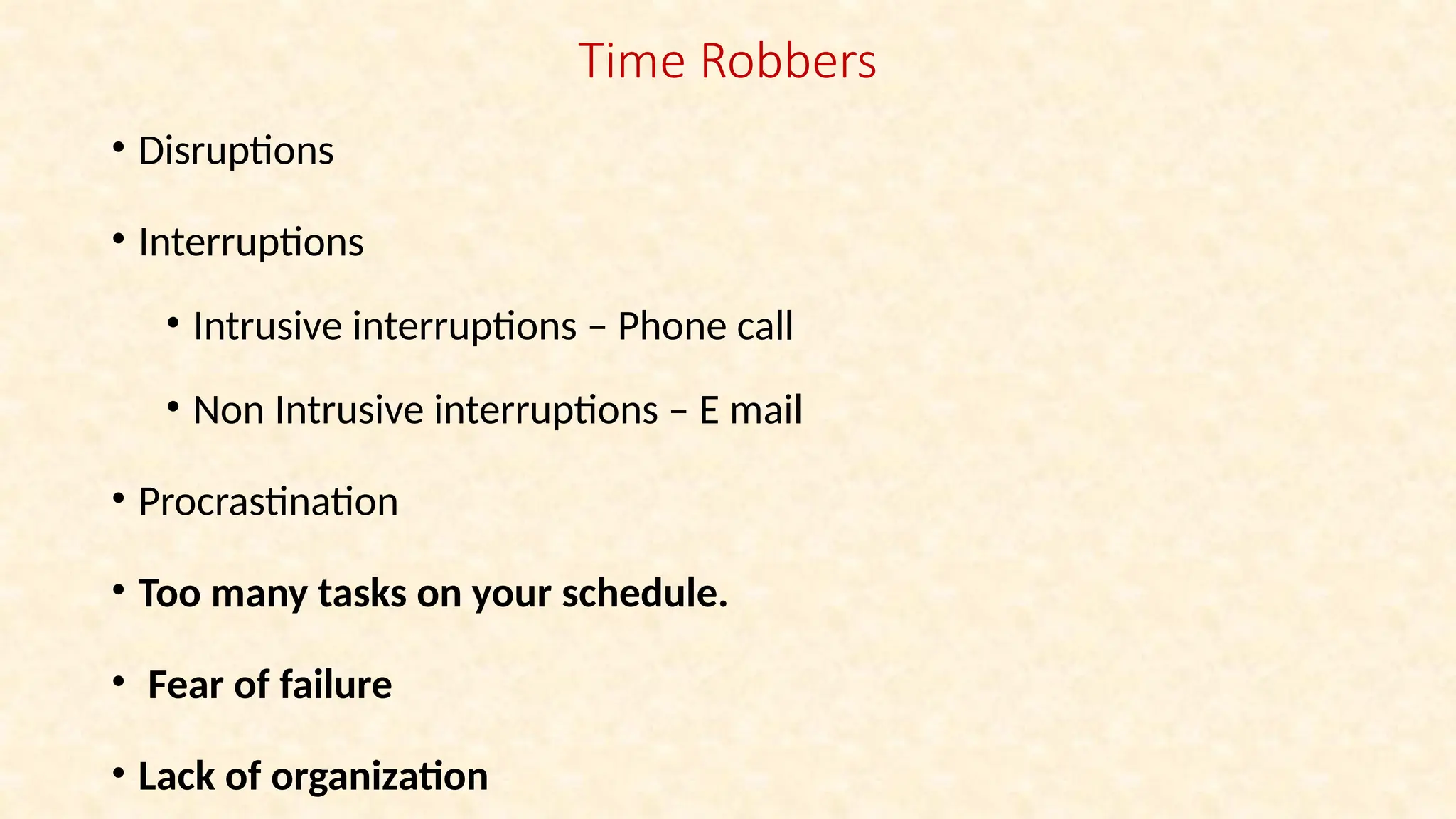
Time Robbers
• Disruptions
•Interruptions
• Intrusive interruptions – Phone call
• Non Intrusive interruptions – E mail
• Procrastination
• Too many tasks on your schedule.
• Fear of failure
• Lack of organization
16.
Lack of Organization
“If we wait for the moment when
everything, absolutely everything
is ready, we will never begin!”
17.
Time Robbers
• Disruptions
•Interruptions
• Intrusive interruptions – Phone call
• Non Intrusive interruptions – E mail
• Procrastination
• Too many tasks on our schedule.
• Fear of failure
• Lack of organization
• Lack of a strategic direction
• Unable to say NO!
18.
Time Robbers
• UnscheduledMeetings
• Over commitment
• Too much Multitasking
• Lack of personal organization
• Crisis Management - Fire Fighting
19.
How to Manage: Tips
• Make your to-do lists realistic.
• Be flexible, so you can keep learning.
• Take advantage of those small windows of time
• Hide!
• Learn to say “no”
• Team up to tackle time management
• Weekly schedules can be flexible, but tackle top priorities by midweek
20.
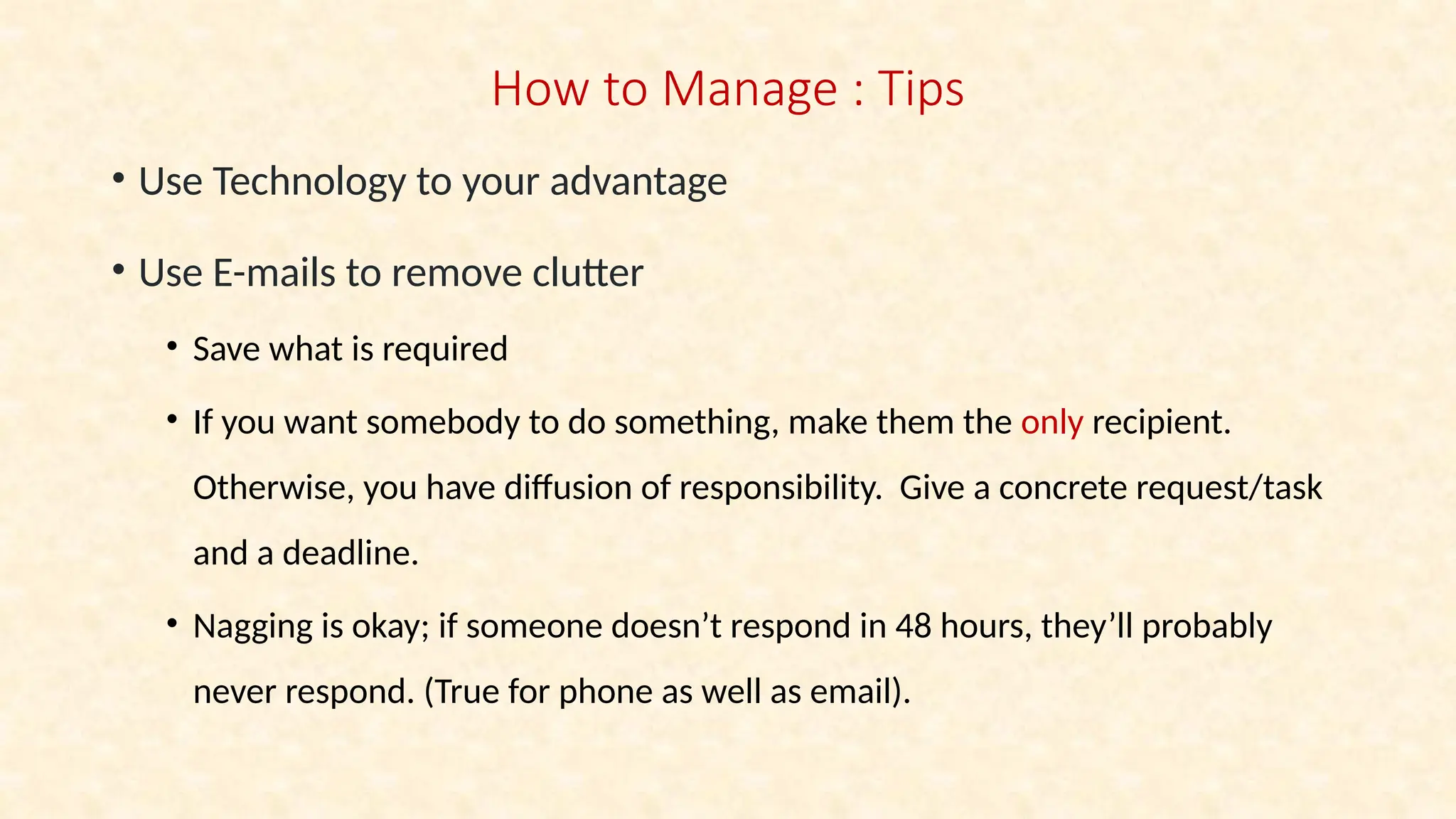
How to Manage: Tips
• Use Technology to your advantage
• Use E-mails to remove clutter
• Save what is required
• If you want somebody to do something, make them the only recipient.
Otherwise, you have diffusion of responsibility. Give a concrete request/task
and a deadline.
• Nagging is okay; if someone doesn’t respond in 48 hours, they’ll probably
never respond. (True for phone as well as email).
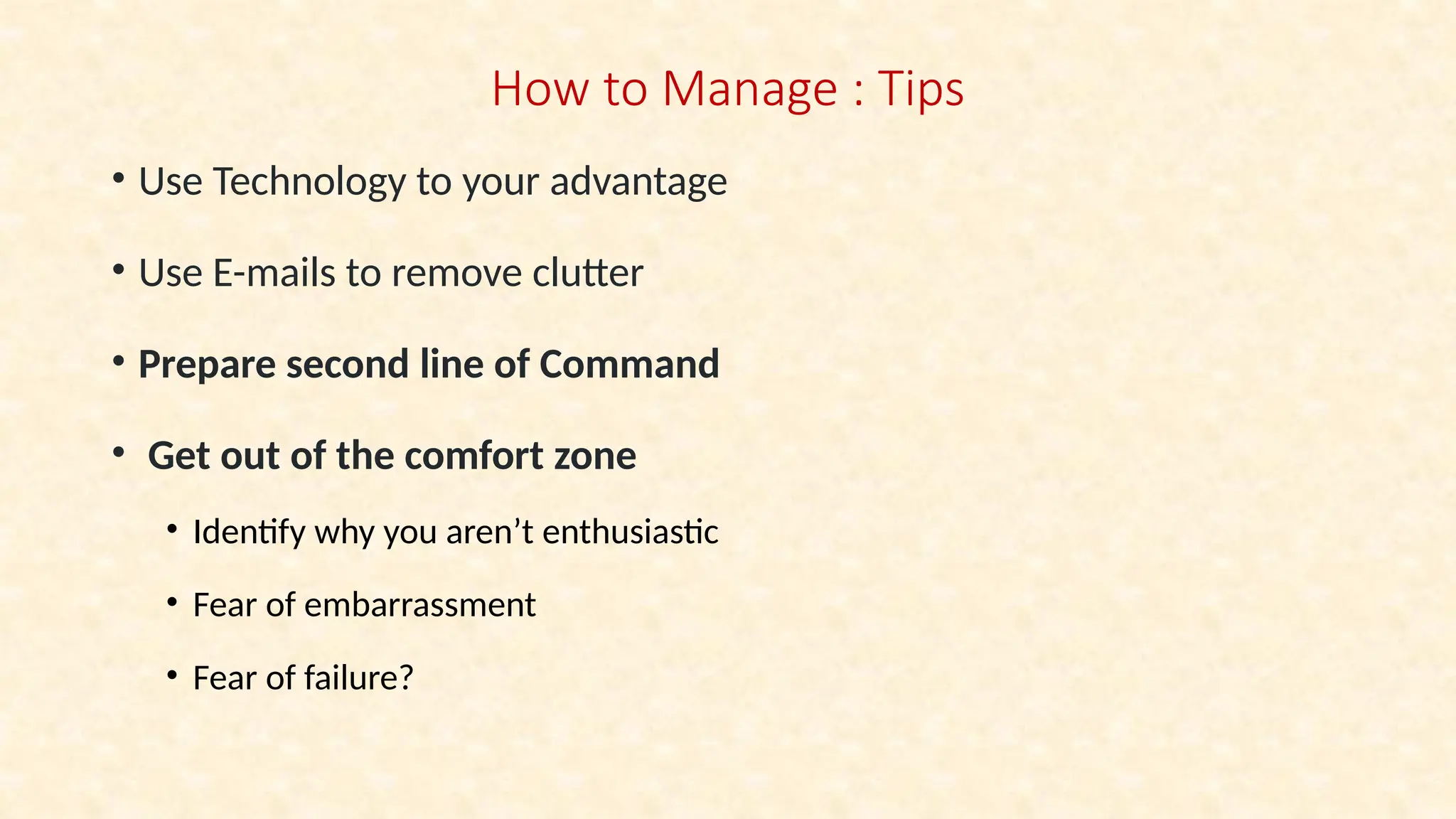
21.
How to Manage: Tips
• Use Technology to your advantage
• Use E-mails to remove clutter
• Prepare second line of Command
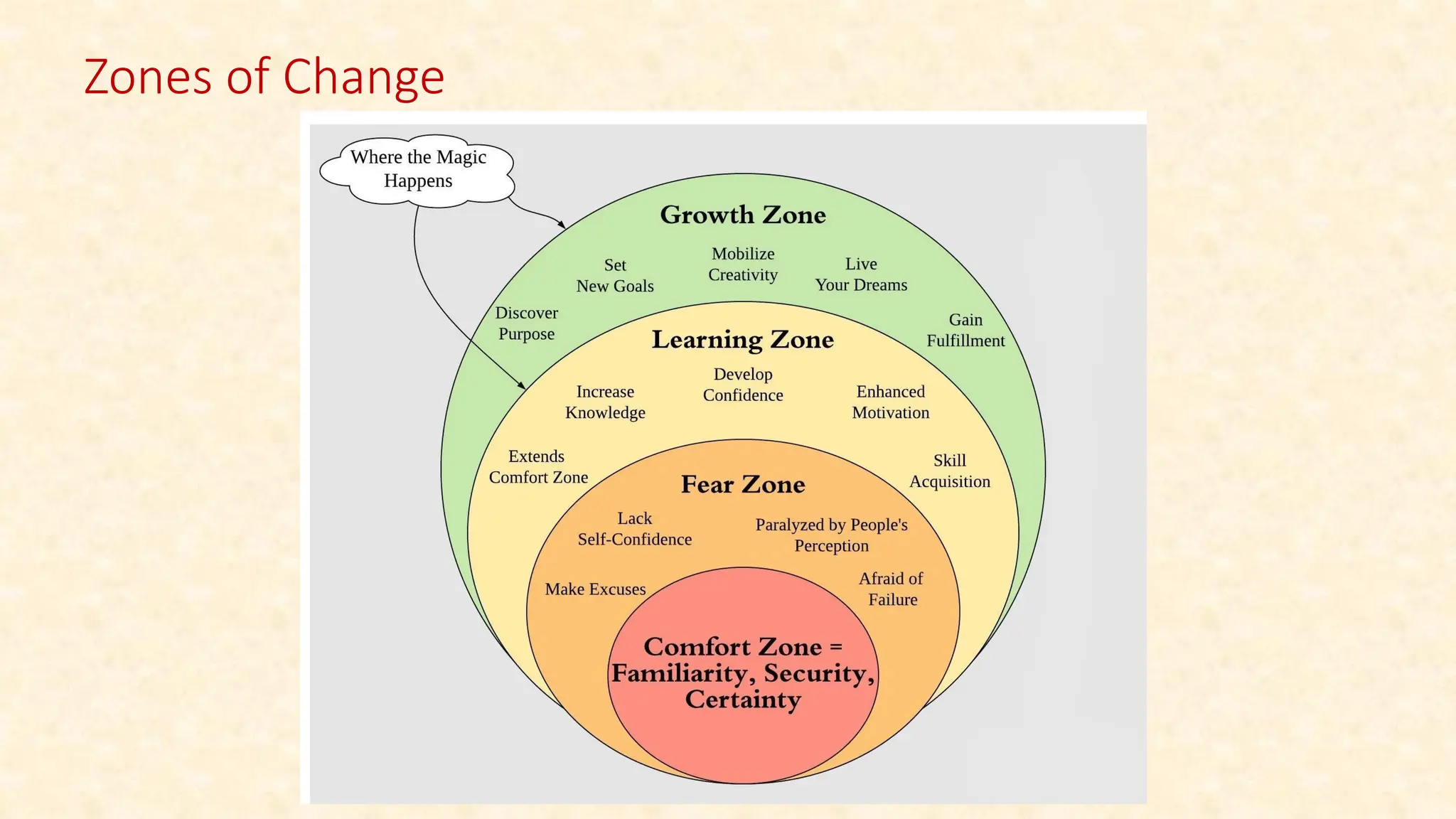
• Get out of the comfort zone
• Identify why you aren’t enthusiastic
• Fear of embarrassment
• Fear of failure?
22.
How to Manage: Tips
• Use Technology to your advantage
• Use E-mails to remove clutter
• Prepare second line of Command
• Get out of comfort zone
• Delegation
What is Change?
•Systematic Transformation of Education System
• Structural changes in educational system
• Policy
• Programmes
• Courses
• Technological changes
25.
The Changed TeachingParadigm
• A globalised world
• Digitalised society
• Complex relationships
• Altered employability expectations
• Diminished employment opportunities
• Different political scenario
• Social change
26.
• Rapid increasein competition
• Decrease in government funding
• Greater public scrutiny
• Rapid spread of Communication technology
Why Change?
• Managing changerequires innovation
• Teaching Methodology
• Use of Technology
• Teacher as Leader
• Assist, inspire and encourage
• Walk the Talk
How to Change?
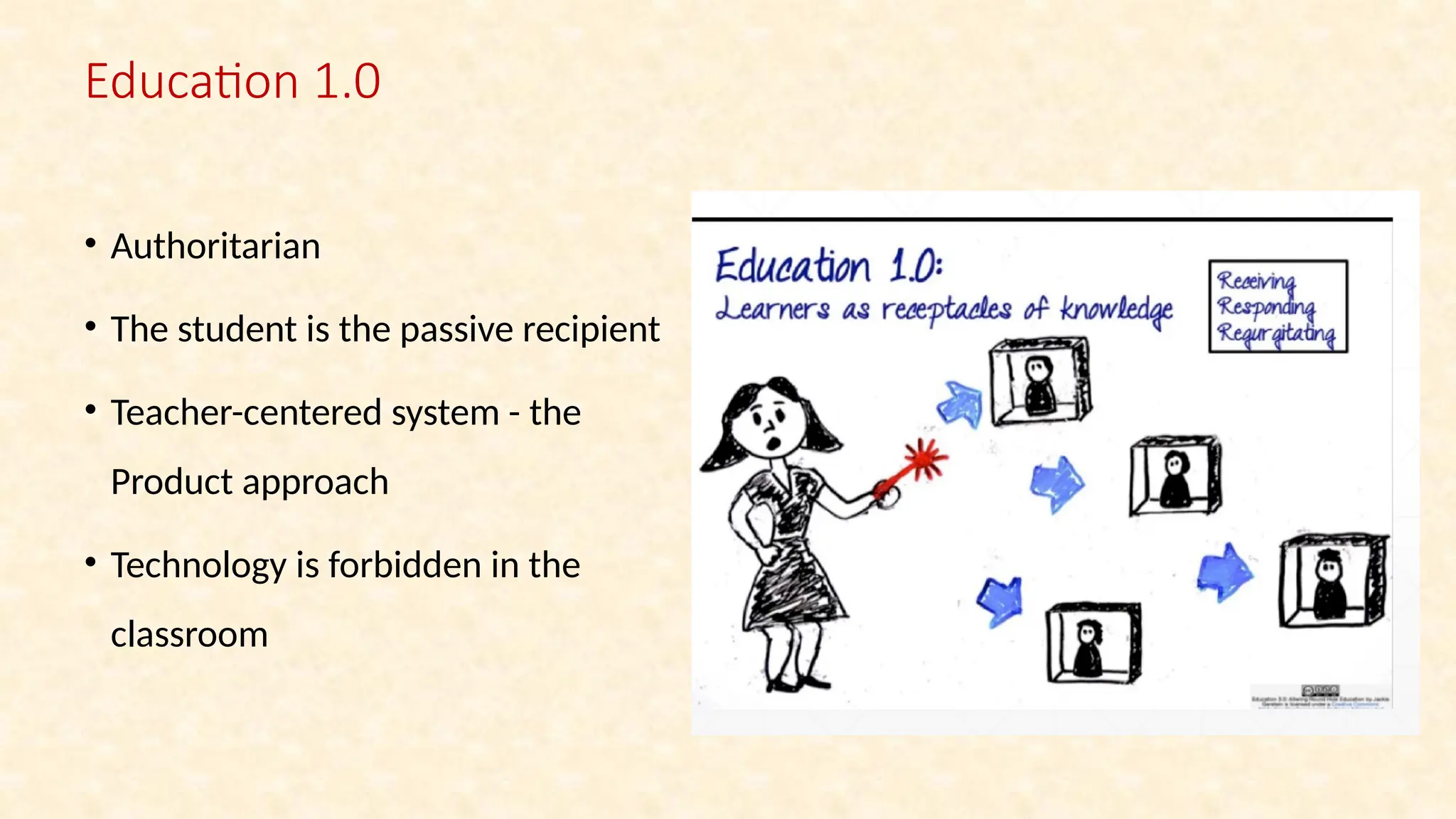
Education 1.0
• Authoritarian
•The student is the passive recipient
• Teacher-centered system - the
Product approach
• Technology is forbidden in the
classroom
33.
Education 2.0….
• Communicationand collaboration started to grow
• Exam-based approach - the result is the
examination - Memorization of knowledge
• An underdeveloped student-centered approach,
we don’t walk the talk.
• Some people think they stopped talking about
teaching and they talked about learning and
learning outcomes but all on paper.
• The schools still talking about hours of
teaching ......... But should talk about hours of
34.
…..Education 2.0
• Invasionof technology and social networking
• We apply technology to the classroom as a trend indicator,
but ...... the class continues to have the same structure.
• Complete confusion ... .. students know the technologies better
than teachers
• Many choices, there is no money for buying and applying,
uncoordinated technology correlation with the curriculum .
• No teacher training ...... data is everywhere ... .. Google Search
faster than traditional libraries ... the web knows more than the
teacher ....
35.
Education 4.0
• Co-creationand innovation at the center
• Learning is done at home or outside school, while in
school students develop skills
• Development of personalized teaching and learning
• Learning Plans are now called Creativity Plans
• The technology is free or/and easily accessible,
Increased use of virtual reality, Continuous evolution
and innovation and therefore a need for continuous
Communication to SupportChange
Awareness
of the need for
change
Knowledge
on how to
change
Desire
to participate
in and support
the change
Reinforcement
to sustain the
change
Ability
to implement
changes on a
daily basis
•What’s
changing?
•Why is it
necessary?
•What are risks
of not
changing?
•What are
benefits of the
change?
•What’s in it for
me?
•How will my
job change?
•How will
processes
change?
•What
processes are
changing and
when?
•What do I
need to
know/learn to
be successful?
•What training
is required?
•Will I have the
tools and
access
necessary to do
my job?
•Who can
answer
questions?
•How will
barriers be
removed and
problems
solved?
•What
resources are
available to
support new
processes and
behaviors?
•How will we
celebrate
success?
•How will we
continue to
improve?
38.
Phase 3- Exploration
•Confusion and Chaos
• Accept need for change
• Indecisive
• Start Learning new ways
• Clarify goals
Learning Circle…
• Ahighly interactive, participatory structure for organizing group work.
• A place where a group of people come together to examine an issue
in which they are interested
• Goal – Build, Share and Express knowledge through open dialogue
• Teachers in the LCs share their knowledge and experiences, learn new
information, apply and test new skills. These circles are learning
networks that create successful knowledge communities
41.
…Learning Circle
• LCsprovide a rich, fruitful learning situation.
• Teaching and learning involve communication with different people.
• Teachers can’t develop skills without a group of people, who can support, advise,
inquire, criticize and offer appropriate alternatives.
• A learning circle gives essential feedback to teachers from colleagues who are
working on the same context, the same body of skills and information and whose
suggestions on techniques and resources are essentially valuable
#29 Douglas Reeves:
"Educational leadership is more than being a spot on a hierarchical organization chart. The quality and practice of leadership at every level have a demonstrable impact on organizational health and on student achievement."
"Embracing teacher leadership does not diminish the role of the principal and other administrators. In fact, they have an enormously important additional role: that of talent scout, constantly on the prowl for effective practice." (pg. 71)