10 - 1
© 2008 The McGraw-Hill Companies, Inc. All rights reserved
10 - 2
ChapterChapter
McGraw-Hill/Irwin
Ethical PowerEthical Power
and Politicsand Politics
1010
10 - 3
IntroductionIntroduction (1 of 2)(1 of 2)
Power is needed to reach objectives in all
organizations
Power affects performance
The way managers use power affects human
relations and performance
Successful global companies are sharing
power with employees through empowerment
Employee empowerment forms the basis of new
decentralized decision-making of contemporary
organizational structures
10 - 4
IntroductionIntroduction (2 of 2)(2 of 2)
Politics is important to organizational
performance
Political human relations affect performance
People who use ethical politics are more
productive in the long run than people who use
unethical politics
10 - 5
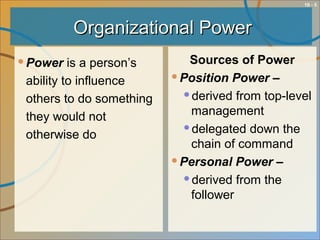
Organizational PowerOrganizational Power
Power is a person’s
ability to influence
others to do something
they would not
otherwise do
Sources of Power
Position Power –
derived from top-level
management
delegated down the
chain of command
Personal Power –
derived from the
follower
10 - 6
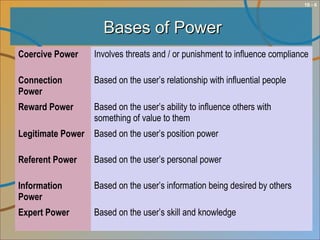
Bases of PowerBases of Power
Coercive Power Involves threats and / or punishment to influence compliance
Connection
Power
Based on the user’s relationship with influential people
Reward Power Based on the user’s ability to influence others with
something of value to them
Legitimate Power Based on the user’s position power
Referent Power Based on the user’s personal power
Information
Power
Based on the user’s information being desired by others
Expert Power Based on the user’s skill and knowledge
10 - 7
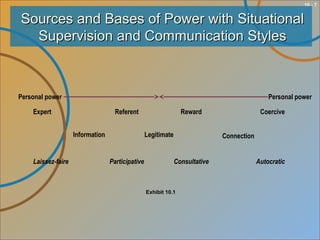
Sources and Bases of Power with SituationalSources and Bases of Power with Situational
Supervision and Communication StylesSupervision and Communication Styles
Personal power Personal power
Expert Referent Reward Coercive
Information Legitimate Connection
Laissez-faire Participative Consultative Autocratic
Exhibit 10.1
10 - 8
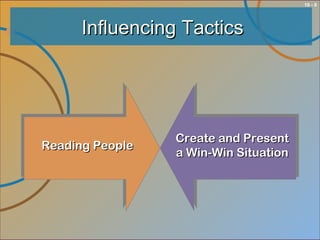
Influencing TacticsInfluencing Tactics
Reading PeopleReading People
Create and PresentCreate and Present
a Win-Win Situationa Win-Win Situation
10 - 9
Reading PeopleReading People (1 of 2)(1 of 2)
Put yourself in the place of the person you
want to persuade
Anticipate how the person sees the world
Anticipate what his or her expectations are during your
persuasion presentation
Get the other person’s expectations right
If you don’t, you most likely will not influence the person
10 - 10
Reading PeopleReading People (2 of 2)(2 of 2)
Incorporate the information about the other
person’s expectations into your persuasive
presentation
Use the influencing tactic that will work best with the person
Keep the focus on the other person’s
expectations when trying to persuade
This helps create a win-win situation
Other person wants to hear how they will benefit
10 - 11
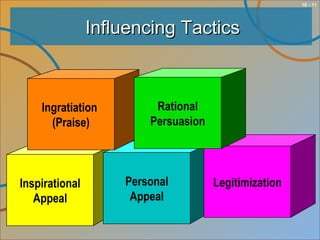
Influencing TacticsInfluencing Tactics
Inspirational
Appeal
Personal
Appeal
Legitimization
Ingratiation
(Praise)
Rational
Persuasion
10 - 12
Guidelines for UsingGuidelines for Using IngratiationIngratiation
Being friendly and giving praise to get the person
in a good mood before making a request
Be sensitive to the person’s moods
Complement the person’s past related
achievements
State why the person was selected for the task
Acknowledge inconvenience by your request
10 - 13
Guidelines for UsingGuidelines for Using Rational PersuasionRational Persuasion
Includes logical arguments with factual evidence
Explain the reason why your objective needs to
be met
Explain how the other person will benefit by
meeting your objective
Provide evidence that your objective can be met
Explain how potential problems and concerns will
be met
Explain why your proposal is better than
competing ones
10 - 14
Guidelines for UsingGuidelines for Using Inspirational AppealInspirational Appeal
Attempts to arouse follower enthusiasm through
internalization
Develop emotions and enthusiasm based on the
other person’s values
Link the appeal to the person’s self-concept
Link the request to a clear appealing vision
Be positive and optimistic
Use nonverbal communication to bring emotions
to the verbal message
10 - 15
Guidelines for UsingGuidelines for Using Personal AppealPersonal Appeal
Request the person to meet an objective based on
loyalty and friendship
Begin by stating that you need a favor and why it
is important
Then ask for the favor
Appeal to your friendship
Tell the person that you are counting on him or
her
10 - 16
Guidelines for UsingGuidelines for Using LegitimizationLegitimization
Relying on organizational authority
Refer to organizational policies, procedures,
rules, and other documentation
Refer to written documents
Refer to precedent
10 - 17
Organizational PoliticsOrganizational Politics
Politics – the process of gaining and using
power
The network of interactions by which power is
acquired, transferred, and exercised upon others
Like power, politics often has a negative
connotation due to people who abuse political
power
The amount and importance of politics varies from
organization to organization
10 - 18
Political BehaviorPolitical Behavior
Three primary political behaviors:
Networking - process of developing relationship
alliances with key people for the purpose of politicking
Reciprocity – involves:
creating obligations and debts,
developing alliances, and
using them to accomplish objectives
Coalition Building – a coalition is a network of
alliances that help you achieve a specific objective
10 - 19
Business EthicsBusiness Ethics
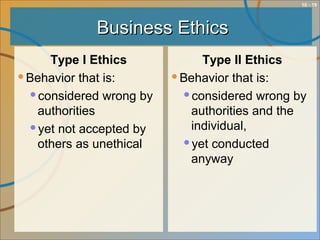
Type I Ethics
Behavior that is:
considered wrong by
authorities
yet not accepted by
others as unethical
Type II Ethics
Behavior that is:
considered wrong by
authorities and the
individual,
yet conducted
anyway
10 - 20
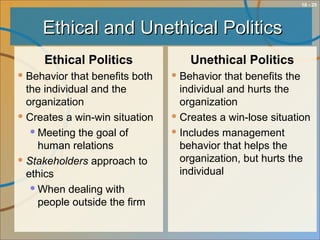
Ethical and Unethical PoliticsEthical and Unethical Politics
Ethical Politics
 Behavior that benefits both
the individual and the
organization
 Creates a win-win situation
Meeting the goal of
human relations
 Stakeholders approach to
ethics
When dealing with
people outside the firm
Unethical Politics
 Behavior that benefits the
individual and hurts the
organization
 Creates a win-lose situation
 Includes management
behavior that helps the
organization, but hurts the
individual
10 - 21
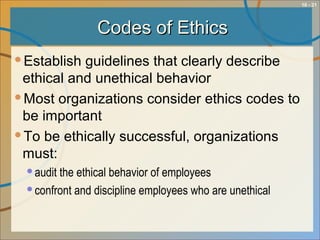
Codes of EthicsCodes of Ethics
Establish guidelines that clearly describe
ethical and unethical behavior
Most organizations consider ethics codes to
be important
To be ethically successful, organizations
must:
audit the ethical behavior of employees
confront and discipline employees who are unethical
10 - 22
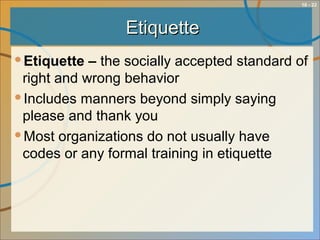
EtiquetteEtiquette
Etiquette – the socially accepted standard of
right and wrong behavior
Includes manners beyond simply saying
please and thank you
Most organizations do not usually have
codes or any formal training in etiquette
10 - 23
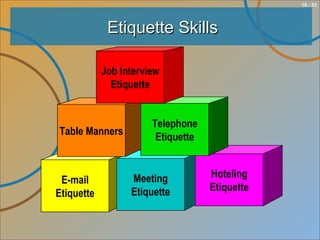
E-mail
Etiquette
Meeting
Etiquette
Hoteling
Etiquette
Table Manners
Telephone
Etiquette
Job Interview
Etiquette
Etiquette SkillsEtiquette Skills
10 - 24
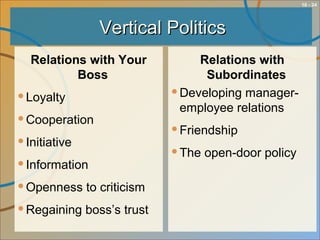
Vertical PoliticsVertical Politics
Relations with Your
Boss
Loyalty
Cooperation
Initiative
Information
Openness to criticism
Regaining boss’s trust
Relations with
Subordinates
Developing manager-
employee relations
Friendship
The open-door policy
10 - 25
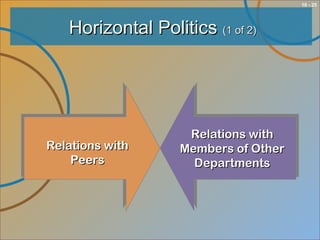
Horizontal PoliticsHorizontal Politics (1 of 2)(1 of 2)
Relations withRelations with
PeersPeers
Relations withRelations with
Members of OtherMembers of Other
DepartmentsDepartments
10 - 26
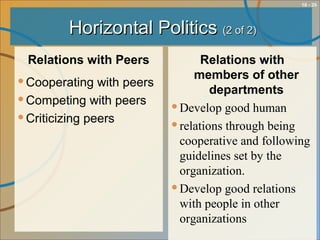
Horizontal PoliticsHorizontal Politics (2 of 2)(2 of 2)
Relations with Peers
Cooperating with peers
Competing with peers
Criticizing peers
Relations with
members of other
departments
Develop good human
relations through being
cooperative and following
guidelines set by the
organization.
Develop good relations
with people in other
organizations
10 - 27
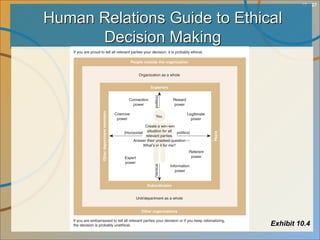
Human Relations Guide to EthicalHuman Relations Guide to Ethical
Decision MakingDecision Making
Exhibit 10.4
10 - 28
Do Power, Politics, and Etiquette ApplyDo Power, Politics, and Etiquette Apply
Globally?Globally? (1 of 3)(1 of 3)
Power is perceived and exercised differently
around the globe
Power distance – the extent to which
employees feel comfortable interacting
across hierarchical levels
It reflects expectations of centralized or
decentralized decision-making
10 - 29
Do Power, Politics, and Etiquette ApplyDo Power, Politics, and Etiquette Apply
Globally?Globally? (2 of 3)(2 of 3)
In high power distance cultures:
Using strong power and politics is acceptable
Leaders are expected to behave differently from
people in low ranks
Differences in rank are more apparent
i.e., Latin American cultures, Mexico, Venezuela,
Philippines, Yugoslavia, France
10 - 30
Do Power, Politics, and Etiquette ApplyDo Power, Politics, and Etiquette Apply
Globally?Globally? (3 of 3)(3 of 3)
In low power distance cultures:
Using strong power and politics is not acceptable
Power is expected to be shared with employees
through empowerment
People are less comfortable with differences in
power
Less emphasis on social class distinction and
hierarchical rank
i.e., U.S., Ireland, Australia, New Zealand,
Denmark, Israel, the Netherlands

chap010

  • 1.
  • 2.
    © 2008 TheMcGraw-Hill Companies, Inc. All rights reserved 10 - 2 ChapterChapter McGraw-Hill/Irwin Ethical PowerEthical Power and Politicsand Politics 1010
  • 3.
    10 - 3 IntroductionIntroduction(1 of 2)(1 of 2) Power is needed to reach objectives in all organizations Power affects performance The way managers use power affects human relations and performance Successful global companies are sharing power with employees through empowerment Employee empowerment forms the basis of new decentralized decision-making of contemporary organizational structures
  • 4.
    10 - 4 IntroductionIntroduction(2 of 2)(2 of 2) Politics is important to organizational performance Political human relations affect performance People who use ethical politics are more productive in the long run than people who use unethical politics
  • 5.
    10 - 5 OrganizationalPowerOrganizational Power Power is a person’s ability to influence others to do something they would not otherwise do Sources of Power Position Power – derived from top-level management delegated down the chain of command Personal Power – derived from the follower
  • 6.
    10 - 6 Basesof PowerBases of Power Coercive Power Involves threats and / or punishment to influence compliance Connection Power Based on the user’s relationship with influential people Reward Power Based on the user’s ability to influence others with something of value to them Legitimate Power Based on the user’s position power Referent Power Based on the user’s personal power Information Power Based on the user’s information being desired by others Expert Power Based on the user’s skill and knowledge
  • 7.
    10 - 7 Sourcesand Bases of Power with SituationalSources and Bases of Power with Situational Supervision and Communication StylesSupervision and Communication Styles Personal power Personal power Expert Referent Reward Coercive Information Legitimate Connection Laissez-faire Participative Consultative Autocratic Exhibit 10.1
  • 8.
    10 - 8 InfluencingTacticsInfluencing Tactics Reading PeopleReading People Create and PresentCreate and Present a Win-Win Situationa Win-Win Situation
  • 9.
    10 - 9 ReadingPeopleReading People (1 of 2)(1 of 2) Put yourself in the place of the person you want to persuade Anticipate how the person sees the world Anticipate what his or her expectations are during your persuasion presentation Get the other person’s expectations right If you don’t, you most likely will not influence the person
  • 10.
    10 - 10 ReadingPeopleReading People (2 of 2)(2 of 2) Incorporate the information about the other person’s expectations into your persuasive presentation Use the influencing tactic that will work best with the person Keep the focus on the other person’s expectations when trying to persuade This helps create a win-win situation Other person wants to hear how they will benefit
  • 11.
    10 - 11 InfluencingTacticsInfluencing Tactics Inspirational Appeal Personal Appeal Legitimization Ingratiation (Praise) Rational Persuasion
  • 12.
    10 - 12 Guidelinesfor UsingGuidelines for Using IngratiationIngratiation Being friendly and giving praise to get the person in a good mood before making a request Be sensitive to the person’s moods Complement the person’s past related achievements State why the person was selected for the task Acknowledge inconvenience by your request
  • 13.
    10 - 13 Guidelinesfor UsingGuidelines for Using Rational PersuasionRational Persuasion Includes logical arguments with factual evidence Explain the reason why your objective needs to be met Explain how the other person will benefit by meeting your objective Provide evidence that your objective can be met Explain how potential problems and concerns will be met Explain why your proposal is better than competing ones
  • 14.
    10 - 14 Guidelinesfor UsingGuidelines for Using Inspirational AppealInspirational Appeal Attempts to arouse follower enthusiasm through internalization Develop emotions and enthusiasm based on the other person’s values Link the appeal to the person’s self-concept Link the request to a clear appealing vision Be positive and optimistic Use nonverbal communication to bring emotions to the verbal message
  • 15.
    10 - 15 Guidelinesfor UsingGuidelines for Using Personal AppealPersonal Appeal Request the person to meet an objective based on loyalty and friendship Begin by stating that you need a favor and why it is important Then ask for the favor Appeal to your friendship Tell the person that you are counting on him or her
  • 16.
    10 - 16 Guidelinesfor UsingGuidelines for Using LegitimizationLegitimization Relying on organizational authority Refer to organizational policies, procedures, rules, and other documentation Refer to written documents Refer to precedent
  • 17.
    10 - 17 OrganizationalPoliticsOrganizational Politics Politics – the process of gaining and using power The network of interactions by which power is acquired, transferred, and exercised upon others Like power, politics often has a negative connotation due to people who abuse political power The amount and importance of politics varies from organization to organization
  • 18.
    10 - 18 PoliticalBehaviorPolitical Behavior Three primary political behaviors: Networking - process of developing relationship alliances with key people for the purpose of politicking Reciprocity – involves: creating obligations and debts, developing alliances, and using them to accomplish objectives Coalition Building – a coalition is a network of alliances that help you achieve a specific objective
  • 19.
    10 - 19 BusinessEthicsBusiness Ethics Type I Ethics Behavior that is: considered wrong by authorities yet not accepted by others as unethical Type II Ethics Behavior that is: considered wrong by authorities and the individual, yet conducted anyway
  • 20.
    10 - 20 Ethicaland Unethical PoliticsEthical and Unethical Politics Ethical Politics  Behavior that benefits both the individual and the organization  Creates a win-win situation Meeting the goal of human relations  Stakeholders approach to ethics When dealing with people outside the firm Unethical Politics  Behavior that benefits the individual and hurts the organization  Creates a win-lose situation  Includes management behavior that helps the organization, but hurts the individual
  • 21.
    10 - 21 Codesof EthicsCodes of Ethics Establish guidelines that clearly describe ethical and unethical behavior Most organizations consider ethics codes to be important To be ethically successful, organizations must: audit the ethical behavior of employees confront and discipline employees who are unethical
  • 22.
    10 - 22 EtiquetteEtiquette Etiquette– the socially accepted standard of right and wrong behavior Includes manners beyond simply saying please and thank you Most organizations do not usually have codes or any formal training in etiquette
  • 23.
    10 - 23 E-mail Etiquette Meeting Etiquette Hoteling Etiquette TableManners Telephone Etiquette Job Interview Etiquette Etiquette SkillsEtiquette Skills
  • 24.
    10 - 24 VerticalPoliticsVertical Politics Relations with Your Boss Loyalty Cooperation Initiative Information Openness to criticism Regaining boss’s trust Relations with Subordinates Developing manager- employee relations Friendship The open-door policy
  • 25.
    10 - 25 HorizontalPoliticsHorizontal Politics (1 of 2)(1 of 2) Relations withRelations with PeersPeers Relations withRelations with Members of OtherMembers of Other DepartmentsDepartments
  • 26.
    10 - 26 HorizontalPoliticsHorizontal Politics (2 of 2)(2 of 2) Relations with Peers Cooperating with peers Competing with peers Criticizing peers Relations with members of other departments Develop good human relations through being cooperative and following guidelines set by the organization. Develop good relations with people in other organizations
  • 27.
    10 - 27 HumanRelations Guide to EthicalHuman Relations Guide to Ethical Decision MakingDecision Making Exhibit 10.4
  • 28.
    10 - 28 DoPower, Politics, and Etiquette ApplyDo Power, Politics, and Etiquette Apply Globally?Globally? (1 of 3)(1 of 3) Power is perceived and exercised differently around the globe Power distance – the extent to which employees feel comfortable interacting across hierarchical levels It reflects expectations of centralized or decentralized decision-making
  • 29.
    10 - 29 DoPower, Politics, and Etiquette ApplyDo Power, Politics, and Etiquette Apply Globally?Globally? (2 of 3)(2 of 3) In high power distance cultures: Using strong power and politics is acceptable Leaders are expected to behave differently from people in low ranks Differences in rank are more apparent i.e., Latin American cultures, Mexico, Venezuela, Philippines, Yugoslavia, France
  • 30.
    10 - 30 DoPower, Politics, and Etiquette ApplyDo Power, Politics, and Etiquette Apply Globally?Globally? (3 of 3)(3 of 3) In low power distance cultures: Using strong power and politics is not acceptable Power is expected to be shared with employees through empowerment People are less comfortable with differences in power Less emphasis on social class distinction and hierarchical rank i.e., U.S., Ireland, Australia, New Zealand, Denmark, Israel, the Netherlands

Editor's Notes

  • #12 The following suggestions specify the types of changes in jobs that are most likely to lead to improvements in each of the five core dimensions. (1) Combine tasks - managers should put existing fractionalized tasks back together to form a new, larger module of work. This increases skill variety and task identify. (2) Create natural work units - managers should design tasks that form an identifiable and meaningful whole. This increases employee “ownership” of the work and encourages employees to view their work as meaningful and important rather than as irrelevant and boring. (3) Establish client relationships - the client is the user of the product or service that the employee works on. Whenever possible, managers should establish direct relationships between workers and their clients. This increases skill variety, autonomy, and feedback for the employee. (4) Expand jobs vertically - vertical expansion means giving employees responsibilities and controls that were formerly reserved for management. It partially closes the gap between the “doing” and “controlling” aspects of the job, and it increases employee autonomy. (5) Open feedback channels - by increasing feedback, employees not only learn how well they are performing their jobs but also whether their performances are improving, deteriorating, or remaining at a constant level. Ideally, employees should receive performance feedback directly as they do their jobs rather than from management on an occasional basis.
  • #24 Break-even Analysis identifies profit or loss at various sales volumes Return on Investment measures productivity of assets Marginal Analysis compares the additional cost in a particular decision rather than average cost Game Theory mathematical models that analyze multi-party decision contexts Linear Programming for optimally solving resource allocation problems Queuing Theory for calculating waiting lines