Chapter 5: Power and
Politics
PREPARED BY: DEEVEYAH A/P S RAMASI
(18DAT19F1005)
PRIYADARISHINI A/P GANASEN (18DAT19F1027)
ROHINI A/P BALAKRISHNAN (18DAT19F1017)
NARMATHA A/P LEDHUMANAN (18DAT19F1043)
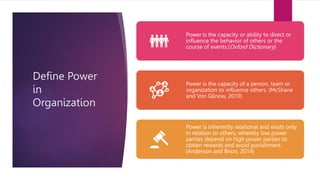
Define Power
in
Organization
Power is the capacity or ability to direct or
influence the behavior of others or the
course of events.(Oxford Dictionary)
Power is the capacity of a person, team or
organization to influence others. (McShane
and Von Glinow, 2010)
Power is inherently relational and exists only
in relation to others, whereby low power
parties depend on high power parties to
obtain rewards and avoid punishment.
(Anderson and Brion, 2014)
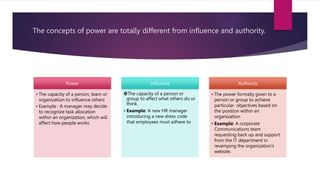
The concepts of power are totally different from influence and authority.
Power
• The capacity of a person, team or
organization to influence others
• Example : A manager may decide
to recognize task allocation
within an organization, which will
affect how people works
Influence
The capacity of a person or
group to affect what others do or
think.
• Example: A new HR manager
introducing a new dress code
that employees must adhere to
Authority
• The power formally given to a
person or group to achieve
particular objectives based on
the position within an
organization
• Example: A corporate
Communications team
requesting back up and support
from the IT department in
revamping the organization’s
website.
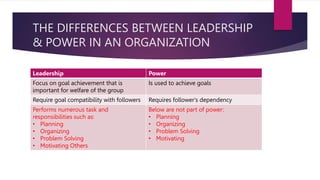
THE DIFFERENCES BETWEEN LEADERSHIP
& POWER IN AN ORGANIZATION
Leadership Power
Focus on goal achievement that is
important for welfare of the group
Is used to achieve goals
Require goal compatibility with followers Requires follower's dependency
Performs numerous task and
responsibilities such as:
• Planning
• Organizing
• Problem Solving
• Motivating Others
Below are not part of power:
• Planning
• Organizing
• Problem Solving
• Motivating
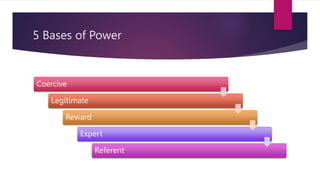
5 Bases of Power
Coercive
Legitimate
Reward
Expert
Referent
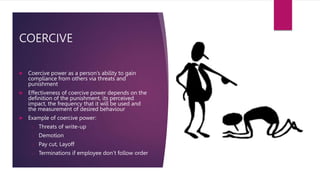
COERCIVE
 Coercive power as a person’s ability to gain
compliance from others via threats and
punishment
 Effectiveness of coercive power depends on the
definition of the punishment, its perceived
impact, the frequency that it will be used and
the measurement of desired behaviour
 Example of coercive power:
o Threats of write-up
o Demotion
o Pay cut, Layoff
o Terminations if employee don’t follow order
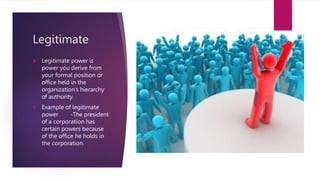
Legitimate
 Legitimate power is
power you derive from
your formal position or
office held in the
organization’s hierarchy
of authority.
 Example of legitimate
power -The president
of a corporation has
certain powers because
of the office he holds in
the corporation.
Reward
 Reward power is simply the power of a
manager to give some type of reward to an
employee to influence the employee to act.
Expert
 Expert power is power based upon employee's
perception that a manager or some other
member of an organization has a high level of
knowledge or a specialized set of skills that other
employees or members of the organization do
not possess
 Example:
o Lawyers
o Doctors
o Scientist
o Accountants and Consultants
Referent
Capacity to influence others
based on identification with and
respect for the power holder
Referent power is associated with
charismatic leadership, where a
person influences others via
admiration, respect and trust
Nine Influence (Power)
Tactics
Introduction
OB RESEARCHERS HAVE
IDENTIFIED VARIOUS TYPES OF
INFLUENCE TACTICS THAT ARE
COMMONLY USED IN AN
ORGANIZATION TO INFLUENCE
THE BEHAVIOR OF OTHERS
ACCORDING TO MCSHANE AND
VON GLINOW (2010), THERE
ARE 9 INFLUENCE TACTICS
9 Influence Tactics
Silent
Authority
Assertiveness
Inspirational
Appeals
Coalition
Formation
Upwards
Appeal
Persuasion Ingratiation Exchange Consultative
Silent Authority (Legitimating)
Silent Authority means Owner or upper management influencing their
subordinates only with their presence
It means that behavior comply with the requester’s legitimate power
For example, saying yes to your superior when you may or may not agree
with him
The requester does not give too many instruction as he believes the
subordinates know their own role expectation
Assertiveness
 In assertiveness, the requester might use
legitimate and coercive power to influence the
behavior of others
 The requester will continuously remind
subordinates of his or her obligation
 Frequently check their work, confront and use
threats of sanction to force compliance among
subordinates.
 Failure to comply with standards may result in
punishment
 For example, a credit card sales manager
continuously reminding sales representatives of
target and monitoring sales performance
Inspirational Appeals
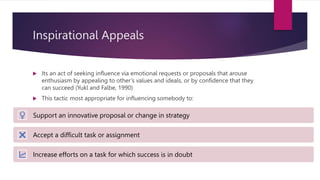
 Its an act of seeking influence via emotional requests or proposals that arouse
enthusiasm by appealing to other’s values and ideals, or by confidence that they
can succeed (Yukl and Falbe, 1990)
 This tactic most appropriate for influencing somebody to:
Support an innovative proposal or change in strategy
Accept a difficult task or assignment
Increase efforts on a task for which success is in doubt
Coalition Formation
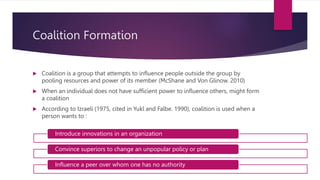
 Coalition is a group that attempts to influence people outside the group by
pooling resources and power of its member (McShane and Von Glinow. 2010)
 When an individual does not have sufficient power to influence others, might form
a coalition
 According to Izraeli (1975, cited in Yukl and Falbe. 1990), coalition is used when a
person wants to :
Introduce innovations in an organization
Convince superiors to change an unpopular policy or plan
Influence a peer over whom one has no authority
Continues….
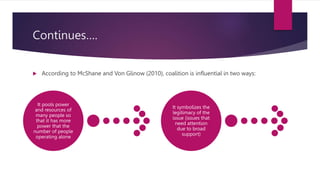
 According to McShane and Von Glinow (2010), coalition is influential in two ways:
It pools power
and resources of
many people so
that it has more
power that the
number of people
operating alone
It symbolizes the
legitimacy of the
issue (issues that
need attention
due to broad
support)
Upwards Appeal
Higher authority or expertise is called to support the influencer position (McShane
and Von Glinow, 2010)
Using group support in the influence attempt
Upwards appeal are easier to use and are more successful with subordinates
(downward influences) and peers (lateral influences) rather than to influence
superiors (Sayles, 1989)
Continues….
 According to Yukl and Falbe (1990), upward appeal is an
attempt to invoke authority and power of higher
management by:
o Telling the target you are acting on behalf of higher
management
o Threatening to go over the target’s head (also a pressure
tactic)
o Directly asking superiors to help you influence the target
Persuasion
Persuasion is the ability to present
fact, logical arguments and
emotional appeals to change other
person's attitude and behavior.
The effectiveness of persuasion as
an influence tactics depends on:
The characteristic of the persuader
The message content
The communication medium
The audience being persuaded
Ingratiation
According to McShane and Von
Glinow (2010), ingratiation is any
attempt to increase liking by or
perceived similarity with some
targeted person
It is one of the most effective
influence tactics in boosting a
person’s career; however, people
who are involved in high ingratiation
are less likely to get promoted as it
shows dishonesty and selfishness.
Exchange
 A person makes an explicit or implicit promise
that you will receive rewards or tangible benefits
if you comply with a request or support a
proposal or reminds you of a prior favor to be
reciprocated (Yukl and Falbe, (1990).
 Negotiation is an integral part of exchange
influences activities.
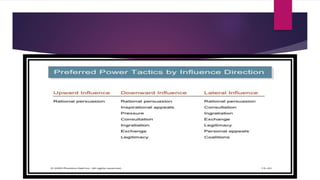
 Exchange tactics are used more often in
downward and lateral influences rather than
upward influences, as most of the organizational
resources are controlled by the manager
Consultation
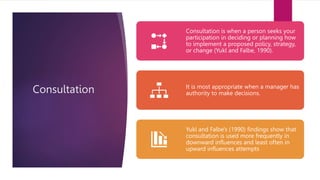
Consultation is when a person seeks your
participation in deciding or planning how
to implement a proposed policy, strategy,
or change (Yukl and Falbe, 1990).
It is most appropriate when a manager has
authority to make decisions.
Yukl and Falbe's (1990) findings show that
consultation is used more frequently in
downward influences and least often in
upward influences attempts
Thank You

OB chapter 5 Presentation 2.pptx

  • 1.
    Chapter 5: Powerand Politics PREPARED BY: DEEVEYAH A/P S RAMASI (18DAT19F1005) PRIYADARISHINI A/P GANASEN (18DAT19F1027) ROHINI A/P BALAKRISHNAN (18DAT19F1017) NARMATHA A/P LEDHUMANAN (18DAT19F1043)
  • 2.
    Define Power in Organization Power isthe capacity or ability to direct or influence the behavior of others or the course of events.(Oxford Dictionary) Power is the capacity of a person, team or organization to influence others. (McShane and Von Glinow, 2010) Power is inherently relational and exists only in relation to others, whereby low power parties depend on high power parties to obtain rewards and avoid punishment. (Anderson and Brion, 2014)
  • 4.
    The concepts ofpower are totally different from influence and authority. Power • The capacity of a person, team or organization to influence others • Example : A manager may decide to recognize task allocation within an organization, which will affect how people works Influence The capacity of a person or group to affect what others do or think. • Example: A new HR manager introducing a new dress code that employees must adhere to Authority • The power formally given to a person or group to achieve particular objectives based on the position within an organization • Example: A corporate Communications team requesting back up and support from the IT department in revamping the organization’s website.
  • 5.
    THE DIFFERENCES BETWEENLEADERSHIP & POWER IN AN ORGANIZATION Leadership Power Focus on goal achievement that is important for welfare of the group Is used to achieve goals Require goal compatibility with followers Requires follower's dependency Performs numerous task and responsibilities such as: • Planning • Organizing • Problem Solving • Motivating Others Below are not part of power: • Planning • Organizing • Problem Solving • Motivating
  • 6.
    5 Bases ofPower Coercive Legitimate Reward Expert Referent
  • 7.
    COERCIVE  Coercive poweras a person’s ability to gain compliance from others via threats and punishment  Effectiveness of coercive power depends on the definition of the punishment, its perceived impact, the frequency that it will be used and the measurement of desired behaviour  Example of coercive power: o Threats of write-up o Demotion o Pay cut, Layoff o Terminations if employee don’t follow order
  • 8.
    Legitimate  Legitimate poweris power you derive from your formal position or office held in the organization’s hierarchy of authority.  Example of legitimate power -The president of a corporation has certain powers because of the office he holds in the corporation.
  • 9.
    Reward  Reward poweris simply the power of a manager to give some type of reward to an employee to influence the employee to act.
  • 10.
    Expert  Expert poweris power based upon employee's perception that a manager or some other member of an organization has a high level of knowledge or a specialized set of skills that other employees or members of the organization do not possess  Example: o Lawyers o Doctors o Scientist o Accountants and Consultants
  • 11.
    Referent Capacity to influenceothers based on identification with and respect for the power holder Referent power is associated with charismatic leadership, where a person influences others via admiration, respect and trust
  • 12.
  • 13.
    Introduction OB RESEARCHERS HAVE IDENTIFIEDVARIOUS TYPES OF INFLUENCE TACTICS THAT ARE COMMONLY USED IN AN ORGANIZATION TO INFLUENCE THE BEHAVIOR OF OTHERS ACCORDING TO MCSHANE AND VON GLINOW (2010), THERE ARE 9 INFLUENCE TACTICS
  • 14.
  • 16.
    Silent Authority (Legitimating) SilentAuthority means Owner or upper management influencing their subordinates only with their presence It means that behavior comply with the requester’s legitimate power For example, saying yes to your superior when you may or may not agree with him The requester does not give too many instruction as he believes the subordinates know their own role expectation
  • 17.
    Assertiveness  In assertiveness,the requester might use legitimate and coercive power to influence the behavior of others  The requester will continuously remind subordinates of his or her obligation  Frequently check their work, confront and use threats of sanction to force compliance among subordinates.  Failure to comply with standards may result in punishment  For example, a credit card sales manager continuously reminding sales representatives of target and monitoring sales performance
  • 18.
    Inspirational Appeals  Itsan act of seeking influence via emotional requests or proposals that arouse enthusiasm by appealing to other’s values and ideals, or by confidence that they can succeed (Yukl and Falbe, 1990)  This tactic most appropriate for influencing somebody to: Support an innovative proposal or change in strategy Accept a difficult task or assignment Increase efforts on a task for which success is in doubt
  • 19.
    Coalition Formation  Coalitionis a group that attempts to influence people outside the group by pooling resources and power of its member (McShane and Von Glinow. 2010)  When an individual does not have sufficient power to influence others, might form a coalition  According to Izraeli (1975, cited in Yukl and Falbe. 1990), coalition is used when a person wants to : Introduce innovations in an organization Convince superiors to change an unpopular policy or plan Influence a peer over whom one has no authority
  • 20.
    Continues….  According toMcShane and Von Glinow (2010), coalition is influential in two ways: It pools power and resources of many people so that it has more power that the number of people operating alone It symbolizes the legitimacy of the issue (issues that need attention due to broad support)
  • 21.
    Upwards Appeal Higher authorityor expertise is called to support the influencer position (McShane and Von Glinow, 2010) Using group support in the influence attempt Upwards appeal are easier to use and are more successful with subordinates (downward influences) and peers (lateral influences) rather than to influence superiors (Sayles, 1989)
  • 22.
    Continues….  According toYukl and Falbe (1990), upward appeal is an attempt to invoke authority and power of higher management by: o Telling the target you are acting on behalf of higher management o Threatening to go over the target’s head (also a pressure tactic) o Directly asking superiors to help you influence the target
  • 23.
    Persuasion Persuasion is theability to present fact, logical arguments and emotional appeals to change other person's attitude and behavior. The effectiveness of persuasion as an influence tactics depends on: The characteristic of the persuader The message content The communication medium The audience being persuaded
  • 24.
    Ingratiation According to McShaneand Von Glinow (2010), ingratiation is any attempt to increase liking by or perceived similarity with some targeted person It is one of the most effective influence tactics in boosting a person’s career; however, people who are involved in high ingratiation are less likely to get promoted as it shows dishonesty and selfishness.
  • 25.
    Exchange  A personmakes an explicit or implicit promise that you will receive rewards or tangible benefits if you comply with a request or support a proposal or reminds you of a prior favor to be reciprocated (Yukl and Falbe, (1990).  Negotiation is an integral part of exchange influences activities.  Exchange tactics are used more often in downward and lateral influences rather than upward influences, as most of the organizational resources are controlled by the manager
  • 26.
    Consultation Consultation is whena person seeks your participation in deciding or planning how to implement a proposed policy, strategy, or change (Yukl and Falbe, 1990). It is most appropriate when a manager has authority to make decisions. Yukl and Falbe's (1990) findings show that consultation is used more frequently in downward influences and least often in upward influences attempts
  • 27.