Emily Yetzer
ACG2021-004
Executive Summary
Lowe’s has had a great 2005 year. They have had a 19 percent sales growth and a 27 percent net earnings growth. As one
of the top home improvement chains Lowe’s continues to be prosperous in the industry due to their constant attention to the
needs of their customers and their investments into their expansion. Due to Lowe’s strong drive and performance, in
2005, Lowe's earned several notable industry distinctions, including:
• Ranked 42 on the FORTUNE® 500
• Named 2003, 2004 and 2005 ENERGY STAR® Retail Partner of the Year
• Operates more than 1,234 stores in 49 states
http://www.shareholder.com/lowes/annual.cfm
Introduction
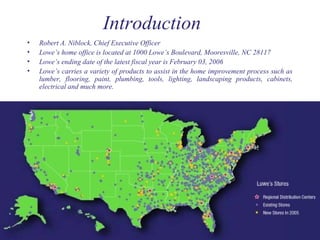
• Robert A. Niblock, Chief Executive Officer
• Lowe’s home office is located at 1000 Lowe’s Boulevard, Mooresville, NC 28117
• Lowe’s ending date of the latest fiscal year is February 03, 2006
• Lowe’s carries a variety of products to assist in the home improvement process such as
lumber, flooring, paint, plumbing, tools, lighting, landscaping products, cabinets,
electrical and much more.
Independent
Auditors
Deloitte & Touche LLP
1100 Carillon Building
227 West Trade Street
Charlotte, NC 28202-1675
Lowe’s was audited in accordance to
the standards of the Public Company
Accounting Oversight Board and
found that Lowe’s records were
accurately and fairly translated. The
auditors conclude that Lowe’s has
maintained effective internal control
over financial reporting as of
February 3, 2006.
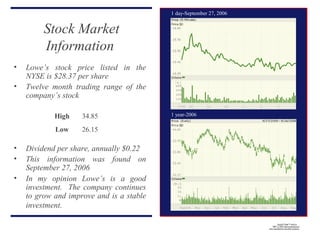
• Lowe’s stock price listed in the
NYSE is $28.37 per share
• Twelve month trading range of the
company’s stock
• Dividend per share, annually $0.22
• This information was found on
September 27, 2006
• In my opinion Lowe’s is a good
investment. The company continues
to grow and improve and is a stable
investment.
Stock Market
Information
High 34.85
Low 26.15
1 day-September 27, 2006
1 year-2006
QuickTime™ and a
TIFF (LZW) decompressor
are needed to see this picture.
Industry Situation and Company Plans
The U.S. has hit a record high of homeownership, all who would like to personalize their
homes. Lowe’s is here to help. Lowe's, who has been a leader in the home improvement
industry for the past 60 years and has recently implemented a new program, for those who
need help or do not have the time for “do-it-yourself” projects, the program is called “do-it-
for-me”. By offering this new program Lowe’s has estimated the program to draw a $150
billion dollar revenue. Not only is Lowe's growing internally but continues to grow externally
as well by opening 150 new stores this year with a continued expansion plan of 155 stores
opening in 2006.
QuickTime™ and a
TIFF (LZW) decompressor
are needed to see this picture.
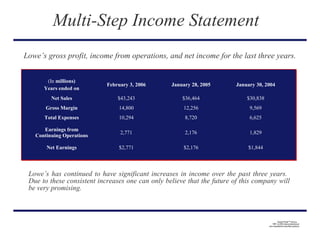
Lowe’s has continued to have significant increases in income over the past three years.
Due to these consistent increases one can only believe that the future of this company will
be very promising.
(In millions)
Years ended on
February 3, 2006 January 28, 2005 January 30, 2004
Net Sales $43,243 $36,464 $30,838
Gross Margin 14,800 12,256 9,569
Total Expenses 10,294 8,720 6,625
Earnings from
Continuing Operations
2,771 2,176 1,829
Net Earnings $2,771 $2,176 $1,844
Lowe’s gross profit, income from operations, and net income for the last three years.
Multi-Step Income Statement
QuickTime™ and a
TIFF (LZW) decompressor
are needed to see this picture.
Lowe’s Assets, Liabilities and Stockholders’ Equity for the past two years.
The biggest change on the balance sheet is the increase in stockholders’ equity from the fiscal
2005 to 2006 year. Stockholders’ equity represents the capital received from investors in
exchange for stock and also includes retained earnings. Therefore the change in stockholder’s
equity is a result of the stockholders’ investments.
Balance Sheet
QuickTime™ and a
TIFF (LZW) decompressor
are needed to see this picture.
(in millions) February 3, 2006 January 30, 2005
Total Assets
(=)
$24,682 $21,138
Total Liabilities
(+)
10,343 9,603
Total Stockholders Equity 14,339 11,535
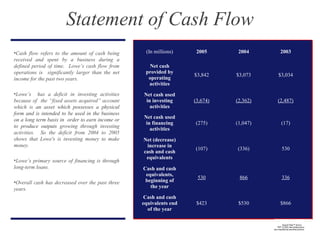
•Cash flow refers to the amount of cash being
received and spent by a business during a
defined period of time. Lowe’s cash flow from
operations is significantly larger than the net
income for the past two years.
•Lowe’s has a deficit in investing activities
because of the “fixed assets acquired” account
which is an asset which possesses a physical
form and is intended to be used in the business
on a long term basis in order to earn income or
to produce outputs growing through investing
activities. So the deficit from 2004 to 2005
shows that Lowe's is investing money to make
money.
•Lowe’s primary source of financing is through
long-term loans.
•Overall cash has decreased over the past three
years.
(In millions) 2005 2004 2003
Net cash
provided by
operating
activities
$3,842 $3,073 $3,034
Net cash used
in investing
activities
(3,674) (2,362) (2,487)
Net cash used
in financing
activities
(275) (1,047) (17)
Net (decrease)
increase in
cash and cash
equivalents
(107) (336) 530
Cash and cash
equivalents,
beginning of
the year
530 866 336
Cash and cash
equivalents end
of the year
$423 $530 $866
Statement of Cash Flow
QuickTime™ and a
TIFF (LZW) decompressor
are needed to see this picture.
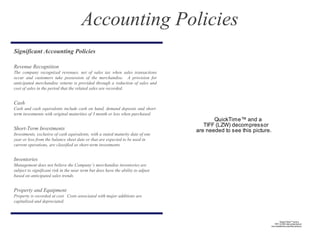
Significant Accounting Policies
Revenue Recognition
The company recognized revenues, net of sales tax when sales transactions
occur and customers take possession of the merchandise. A provision for
anticipated merchandise returns is provided through a reduction of sales and
cost of sales in the period that the related sales are recorded.
Cash
Cash and cash equivalents include cash on hand, demand deposits and short-
term investments with original maturities of 3 month or less when purchased.
Short-Term Investments
Investments, exclusive of cash equivalents, with a stated maturity date of one
year or less from the balance sheet date or that are expected to be used in
current operations, are classified as short-term investments.
Inventories
Management does not believe the Company’s merchandise inventories are
subject to significant risk in the near term but does have the ability to adjust
based on anticipated sales trends.
Property and Equipment
Property is recorded at cost. Costs associated with major additions are
capitalized and depreciated.
QuickTime™ and a
TIFF (LZW) decompressor
are needed to see this picture.
Accounting Policies
QuickTime™ and a
TIFF (LZW) decompressor
are needed to see this picture.
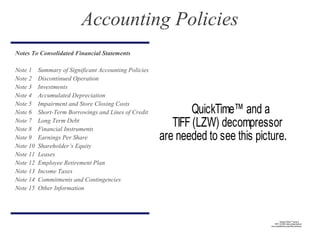
Notes To Consolidated Financial Statements
Note 1 Summary of Significant Accounting Policies
Note 2 Discontinued Operation
Note 3 Investments
Note 4 Accumulated Depreciation
Note 5 Impairment and Store Closing Costs
Note 6 Short-Term Borrowings and Lines of Credit
Note 7 Long Term Debt
Note 8 Financial Instruments
Note 9 Earnings Per Share
Note 10 Shareholder’s Equity
Note 11 Leases
Note 12 Employee Retirement Plan
Note 13 Income Taxes
Note 14 Commitments and Contingencies
Note 15 Other Information
Accounting Policies
QuickTime™ and a
TIFF (LZW) decompressor
are needed to see this picture.
QuickTime™ and a
TIFF(LZW) decompressor
are needed to see this picture.
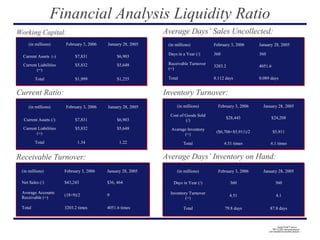
Working Capital:
(in millions) February 3, 2006 January 28, 2005
Current Assets (-) $7,831 $6,903
Current Liabilities
(=)
$5,832 $5,648
Total $1,999 $1,255
(in millions) February 3, 2006 January 28, 2005
Current Assets (/) $7,831 $6,903
Current Liabilities
(=)
$5,832 $5,648
Total 1.34 1.22
Financial Analysis Liquidity Ratio
QuickTime™ and a
TIFF (LZW) decompressor
are needed to see this picture.
Average Days’ Sales Uncollected:
Current Ratio:
Receivable Turnover:
Inventory Turnover:
Average Days’ Inventory on Hand:
(in millions) February 3, 2006 January 28, 2005
Net Sales (/) $43,243 $36, 464
Average Accounts
Receivable (=)
(18+9)/2 9
Total 3203.2 times 4051.6 times
(in millions) February 3, 2006 January 28, 2005
Days in a Year (/) 360 360
Receivable Turnover
(=)
3203.2 4051.6
Total 0.112 days 0.089 days
(in millions) February 3, 2006 January 28, 2005
Cost of Goods Sold
(/)
$28,443 $24,208
Average Inventory
(=)
($6,706+$5,911)/2 $5,911
Total 4.51 times 4.1 times
(in millions) February 3, 2006 January 28, 2005
Days in Year (/) 360 360
Inventory Turnover
(=)
4.51 4.1
Total 79.8 days 87.8 days
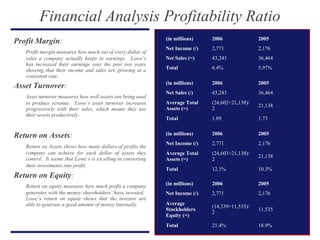
Profit Margin:
Profit margin measures how much out of every dollar of
sales a company actually keeps in earnings. Lowe’s
has increased their earnings over the past two years
showing that their income and sales are growing at a
consistent rate..
Asset Turnover:
Asset turnover measures how well assets are being used
to produce revenue. Lowe’s asset turnover increases
progressively with their sales, which means they use
their assets productively.
Return on Assets:
Return on Assets shows how many dollars of profits the
company can achieve for each dollar of assets they
control. It seems that Lowe’s is excelling in converting
their investments into profit.
Return on Equity:
Return on equity measures how much profit a company
generates with the money shareholders’ have invested.
Lowe’s return on equity shows that the investor are
able to generate a good amount of money internally.
Financial Analysis Profitability Ratio
(in millions) 2006 2005
Net Income (/) 2,771 2,176
Net Sales (=) 43,243 36,464
Total 6.4% 5.97%
(in millions) 2006 2005
Net Sales (/) 43,243 36,464
Average Total
Assets (=)
(24,602+21,138)/
2
21,138
Total 1.89 1.73
(in millions) 2006 2005
Net Income (/) 2,771 2,176
Average Total
Assets (=)
(24,603+21,138)/
2
21,138
Total 12.1% 10.3%
(in millions) 2006 2005
Net Income (/) 2,771 2,176
Average
Stockholders
Equity (=)
(14,339+11,535)/
2
11,535
Total 21.4% 18.9%
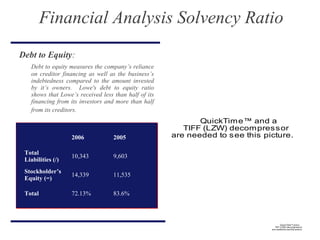
Debt to Equity:
Debt to equity measures the company’s reliance
on creditor financing as well as the business’s
indebtedness compared to the amount invested
by it’s owners. Lowe's debt to equity ratio
shows that Lowe’s received less than half of its
financing from its investors and more than half
from its creditors.
Financial Analysis Solvency Ratio
2006 2005
Total
Liabilities (/)
10,343 9,603
Stockholder’s
Equity (=)
14,339 11,535
Total 72.13% 83.6%
QuickTime™ and a
TIFF (LZW) decompressor
are needed to see this picture.
QuickTime™ and a
TIFF (LZW) decompressor
are needed to see this picture.
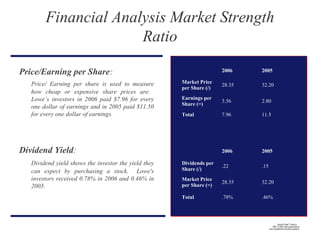
Price/Earning per Share:
Price/ Earning per share is used to measure
how cheap or expensive share prices are.
Lowe’s investors in 2006 paid $7.96 for every
one dollar of earnings and in 2005 paid $11.50
for every one dollar of earnings.
Dividend Yield:
Dividend yield shows the investor the yield they
can expect by purchasing a stock. Lowe's
investors received 0.78% in 2006 and 0.46% in
2005.
Financial Analysis Market Strength
Ratio
2006 2005
Market Price
per Share (/)
28.35 32.20
Earnings per
Share (=)
3.56 2.80
Total 7.96 11.5
2006 2005
Dividends per
Share (/)
.22 .15
Market Price
per Share (=)
28.35 32.20
Total .78% .46%
QuickTime™ and a
TIFF (LZW) decompressor
are needed to see this picture.

Lowe's emy

  • 1.
  • 2.
    Executive Summary Lowe’s hashad a great 2005 year. They have had a 19 percent sales growth and a 27 percent net earnings growth. As one of the top home improvement chains Lowe’s continues to be prosperous in the industry due to their constant attention to the needs of their customers and their investments into their expansion. Due to Lowe’s strong drive and performance, in 2005, Lowe's earned several notable industry distinctions, including: • Ranked 42 on the FORTUNE® 500 • Named 2003, 2004 and 2005 ENERGY STAR® Retail Partner of the Year • Operates more than 1,234 stores in 49 states http://www.shareholder.com/lowes/annual.cfm
  • 3.
    Introduction • Robert A.Niblock, Chief Executive Officer • Lowe’s home office is located at 1000 Lowe’s Boulevard, Mooresville, NC 28117 • Lowe’s ending date of the latest fiscal year is February 03, 2006 • Lowe’s carries a variety of products to assist in the home improvement process such as lumber, flooring, paint, plumbing, tools, lighting, landscaping products, cabinets, electrical and much more.
  • 4.
    Independent Auditors Deloitte & ToucheLLP 1100 Carillon Building 227 West Trade Street Charlotte, NC 28202-1675 Lowe’s was audited in accordance to the standards of the Public Company Accounting Oversight Board and found that Lowe’s records were accurately and fairly translated. The auditors conclude that Lowe’s has maintained effective internal control over financial reporting as of February 3, 2006.
  • 5.
    • Lowe’s stockprice listed in the NYSE is $28.37 per share • Twelve month trading range of the company’s stock • Dividend per share, annually $0.22 • This information was found on September 27, 2006 • In my opinion Lowe’s is a good investment. The company continues to grow and improve and is a stable investment. Stock Market Information High 34.85 Low 26.15 1 day-September 27, 2006 1 year-2006 QuickTime™ and a TIFF (LZW) decompressor are needed to see this picture.
  • 6.
    Industry Situation andCompany Plans The U.S. has hit a record high of homeownership, all who would like to personalize their homes. Lowe’s is here to help. Lowe's, who has been a leader in the home improvement industry for the past 60 years and has recently implemented a new program, for those who need help or do not have the time for “do-it-yourself” projects, the program is called “do-it- for-me”. By offering this new program Lowe’s has estimated the program to draw a $150 billion dollar revenue. Not only is Lowe's growing internally but continues to grow externally as well by opening 150 new stores this year with a continued expansion plan of 155 stores opening in 2006. QuickTime™ and a TIFF (LZW) decompressor are needed to see this picture.
  • 7.
    Lowe’s has continuedto have significant increases in income over the past three years. Due to these consistent increases one can only believe that the future of this company will be very promising. (In millions) Years ended on February 3, 2006 January 28, 2005 January 30, 2004 Net Sales $43,243 $36,464 $30,838 Gross Margin 14,800 12,256 9,569 Total Expenses 10,294 8,720 6,625 Earnings from Continuing Operations 2,771 2,176 1,829 Net Earnings $2,771 $2,176 $1,844 Lowe’s gross profit, income from operations, and net income for the last three years. Multi-Step Income Statement QuickTime™ and a TIFF (LZW) decompressor are needed to see this picture.
  • 8.
    Lowe’s Assets, Liabilitiesand Stockholders’ Equity for the past two years. The biggest change on the balance sheet is the increase in stockholders’ equity from the fiscal 2005 to 2006 year. Stockholders’ equity represents the capital received from investors in exchange for stock and also includes retained earnings. Therefore the change in stockholder’s equity is a result of the stockholders’ investments. Balance Sheet QuickTime™ and a TIFF (LZW) decompressor are needed to see this picture. (in millions) February 3, 2006 January 30, 2005 Total Assets (=) $24,682 $21,138 Total Liabilities (+) 10,343 9,603 Total Stockholders Equity 14,339 11,535
  • 9.
    •Cash flow refersto the amount of cash being received and spent by a business during a defined period of time. Lowe’s cash flow from operations is significantly larger than the net income for the past two years. •Lowe’s has a deficit in investing activities because of the “fixed assets acquired” account which is an asset which possesses a physical form and is intended to be used in the business on a long term basis in order to earn income or to produce outputs growing through investing activities. So the deficit from 2004 to 2005 shows that Lowe's is investing money to make money. •Lowe’s primary source of financing is through long-term loans. •Overall cash has decreased over the past three years. (In millions) 2005 2004 2003 Net cash provided by operating activities $3,842 $3,073 $3,034 Net cash used in investing activities (3,674) (2,362) (2,487) Net cash used in financing activities (275) (1,047) (17) Net (decrease) increase in cash and cash equivalents (107) (336) 530 Cash and cash equivalents, beginning of the year 530 866 336 Cash and cash equivalents end of the year $423 $530 $866 Statement of Cash Flow QuickTime™ and a TIFF (LZW) decompressor are needed to see this picture.
  • 10.
    Significant Accounting Policies RevenueRecognition The company recognized revenues, net of sales tax when sales transactions occur and customers take possession of the merchandise. A provision for anticipated merchandise returns is provided through a reduction of sales and cost of sales in the period that the related sales are recorded. Cash Cash and cash equivalents include cash on hand, demand deposits and short- term investments with original maturities of 3 month or less when purchased. Short-Term Investments Investments, exclusive of cash equivalents, with a stated maturity date of one year or less from the balance sheet date or that are expected to be used in current operations, are classified as short-term investments. Inventories Management does not believe the Company’s merchandise inventories are subject to significant risk in the near term but does have the ability to adjust based on anticipated sales trends. Property and Equipment Property is recorded at cost. Costs associated with major additions are capitalized and depreciated. QuickTime™ and a TIFF (LZW) decompressor are needed to see this picture. Accounting Policies QuickTime™ and a TIFF (LZW) decompressor are needed to see this picture.
  • 11.
    Notes To ConsolidatedFinancial Statements Note 1 Summary of Significant Accounting Policies Note 2 Discontinued Operation Note 3 Investments Note 4 Accumulated Depreciation Note 5 Impairment and Store Closing Costs Note 6 Short-Term Borrowings and Lines of Credit Note 7 Long Term Debt Note 8 Financial Instruments Note 9 Earnings Per Share Note 10 Shareholder’s Equity Note 11 Leases Note 12 Employee Retirement Plan Note 13 Income Taxes Note 14 Commitments and Contingencies Note 15 Other Information Accounting Policies QuickTime™ and a TIFF (LZW) decompressor are needed to see this picture. QuickTime™ and a TIFF(LZW) decompressor are needed to see this picture.
  • 12.
    Working Capital: (in millions)February 3, 2006 January 28, 2005 Current Assets (-) $7,831 $6,903 Current Liabilities (=) $5,832 $5,648 Total $1,999 $1,255 (in millions) February 3, 2006 January 28, 2005 Current Assets (/) $7,831 $6,903 Current Liabilities (=) $5,832 $5,648 Total 1.34 1.22 Financial Analysis Liquidity Ratio QuickTime™ and a TIFF (LZW) decompressor are needed to see this picture. Average Days’ Sales Uncollected: Current Ratio: Receivable Turnover: Inventory Turnover: Average Days’ Inventory on Hand: (in millions) February 3, 2006 January 28, 2005 Net Sales (/) $43,243 $36, 464 Average Accounts Receivable (=) (18+9)/2 9 Total 3203.2 times 4051.6 times (in millions) February 3, 2006 January 28, 2005 Days in a Year (/) 360 360 Receivable Turnover (=) 3203.2 4051.6 Total 0.112 days 0.089 days (in millions) February 3, 2006 January 28, 2005 Cost of Goods Sold (/) $28,443 $24,208 Average Inventory (=) ($6,706+$5,911)/2 $5,911 Total 4.51 times 4.1 times (in millions) February 3, 2006 January 28, 2005 Days in Year (/) 360 360 Inventory Turnover (=) 4.51 4.1 Total 79.8 days 87.8 days
  • 13.
    Profit Margin: Profit marginmeasures how much out of every dollar of sales a company actually keeps in earnings. Lowe’s has increased their earnings over the past two years showing that their income and sales are growing at a consistent rate.. Asset Turnover: Asset turnover measures how well assets are being used to produce revenue. Lowe’s asset turnover increases progressively with their sales, which means they use their assets productively. Return on Assets: Return on Assets shows how many dollars of profits the company can achieve for each dollar of assets they control. It seems that Lowe’s is excelling in converting their investments into profit. Return on Equity: Return on equity measures how much profit a company generates with the money shareholders’ have invested. Lowe’s return on equity shows that the investor are able to generate a good amount of money internally. Financial Analysis Profitability Ratio (in millions) 2006 2005 Net Income (/) 2,771 2,176 Net Sales (=) 43,243 36,464 Total 6.4% 5.97% (in millions) 2006 2005 Net Sales (/) 43,243 36,464 Average Total Assets (=) (24,602+21,138)/ 2 21,138 Total 1.89 1.73 (in millions) 2006 2005 Net Income (/) 2,771 2,176 Average Total Assets (=) (24,603+21,138)/ 2 21,138 Total 12.1% 10.3% (in millions) 2006 2005 Net Income (/) 2,771 2,176 Average Stockholders Equity (=) (14,339+11,535)/ 2 11,535 Total 21.4% 18.9%
  • 14.
    Debt to Equity: Debtto equity measures the company’s reliance on creditor financing as well as the business’s indebtedness compared to the amount invested by it’s owners. Lowe's debt to equity ratio shows that Lowe’s received less than half of its financing from its investors and more than half from its creditors. Financial Analysis Solvency Ratio 2006 2005 Total Liabilities (/) 10,343 9,603 Stockholder’s Equity (=) 14,339 11,535 Total 72.13% 83.6% QuickTime™ and a TIFF (LZW) decompressor are needed to see this picture. QuickTime™ and a TIFF (LZW) decompressor are needed to see this picture.
  • 15.
    Price/Earning per Share: Price/Earning per share is used to measure how cheap or expensive share prices are. Lowe’s investors in 2006 paid $7.96 for every one dollar of earnings and in 2005 paid $11.50 for every one dollar of earnings. Dividend Yield: Dividend yield shows the investor the yield they can expect by purchasing a stock. Lowe's investors received 0.78% in 2006 and 0.46% in 2005. Financial Analysis Market Strength Ratio 2006 2005 Market Price per Share (/) 28.35 32.20 Earnings per Share (=) 3.56 2.80 Total 7.96 11.5 2006 2005 Dividends per Share (/) .22 .15 Market Price per Share (=) 28.35 32.20 Total .78% .46% QuickTime™ and a TIFF (LZW) decompressor are needed to see this picture.