BCS-DS-301A: DATA STRUCTURES & ALGORITHMS
Ms. Swati Hans
Assistant Professor, CSE
Manav Rachna International Institute of Research and Studies, Faridabad
1
2
BCS-DS-301A: DATA STRUCTURES & ALGORITHMS
Unit 4
Trees
Ms. Swati Hans
Assistant Professor, CSE
MRIIRS
• Tree
– Tree terminology
• Binary Tree
– Binary tree representation
– Binary tree traversal
Unit Content
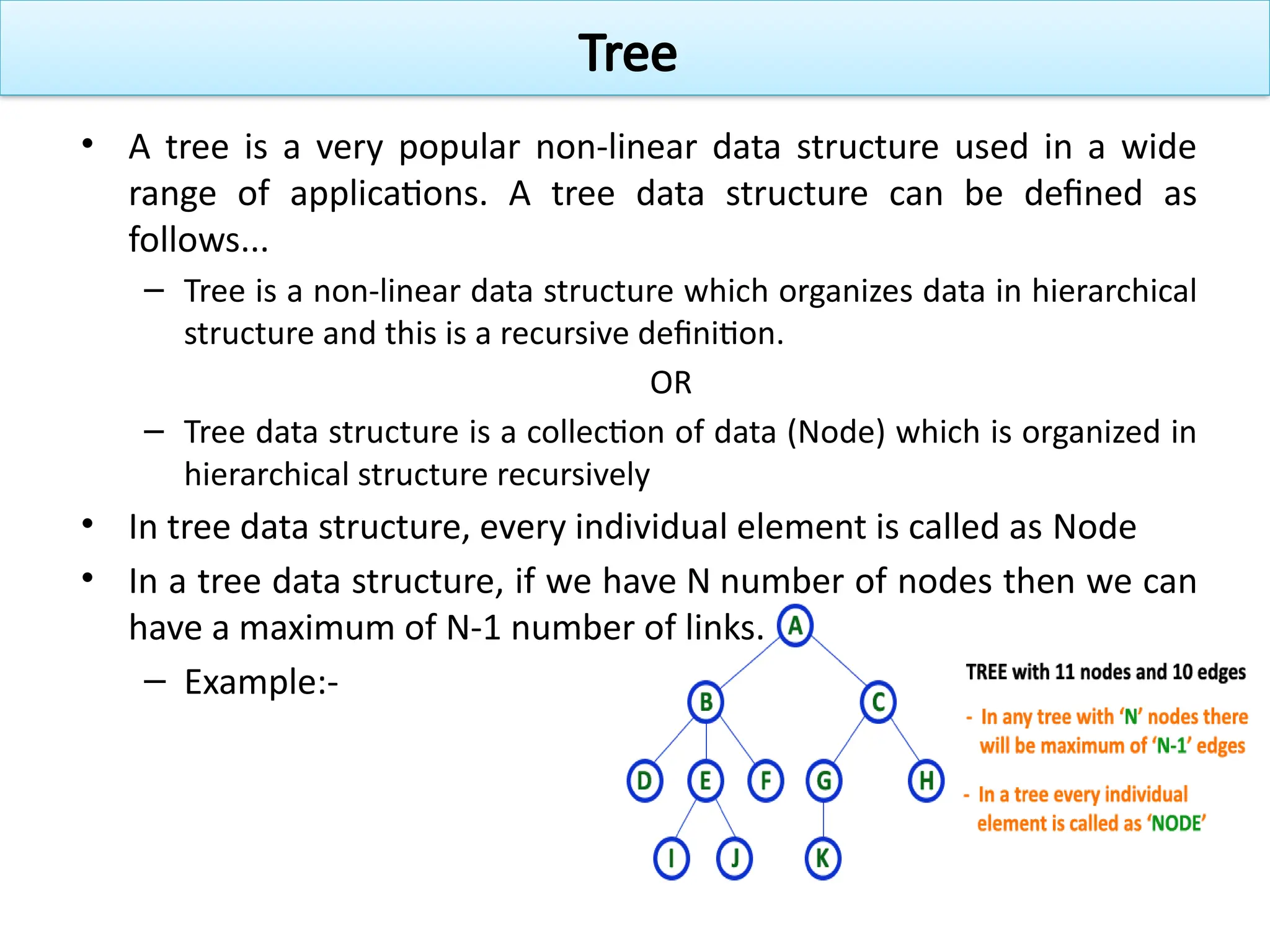
• A tree is a very popular non-linear data structure used in a wide
range of applications. A tree data structure can be defined as
follows...
– Tree is a non-linear data structure which organizes data in hierarchical
structure and this is a recursive definition.
OR
– Tree data structure is a collection of data (Node) which is organized in
hierarchical structure recursively
• In tree data structure, every individual element is called as Node
• In a tree data structure, if we have N number of nodes then we can
have a maximum of N-1 number of links.
– Example:-
Tree
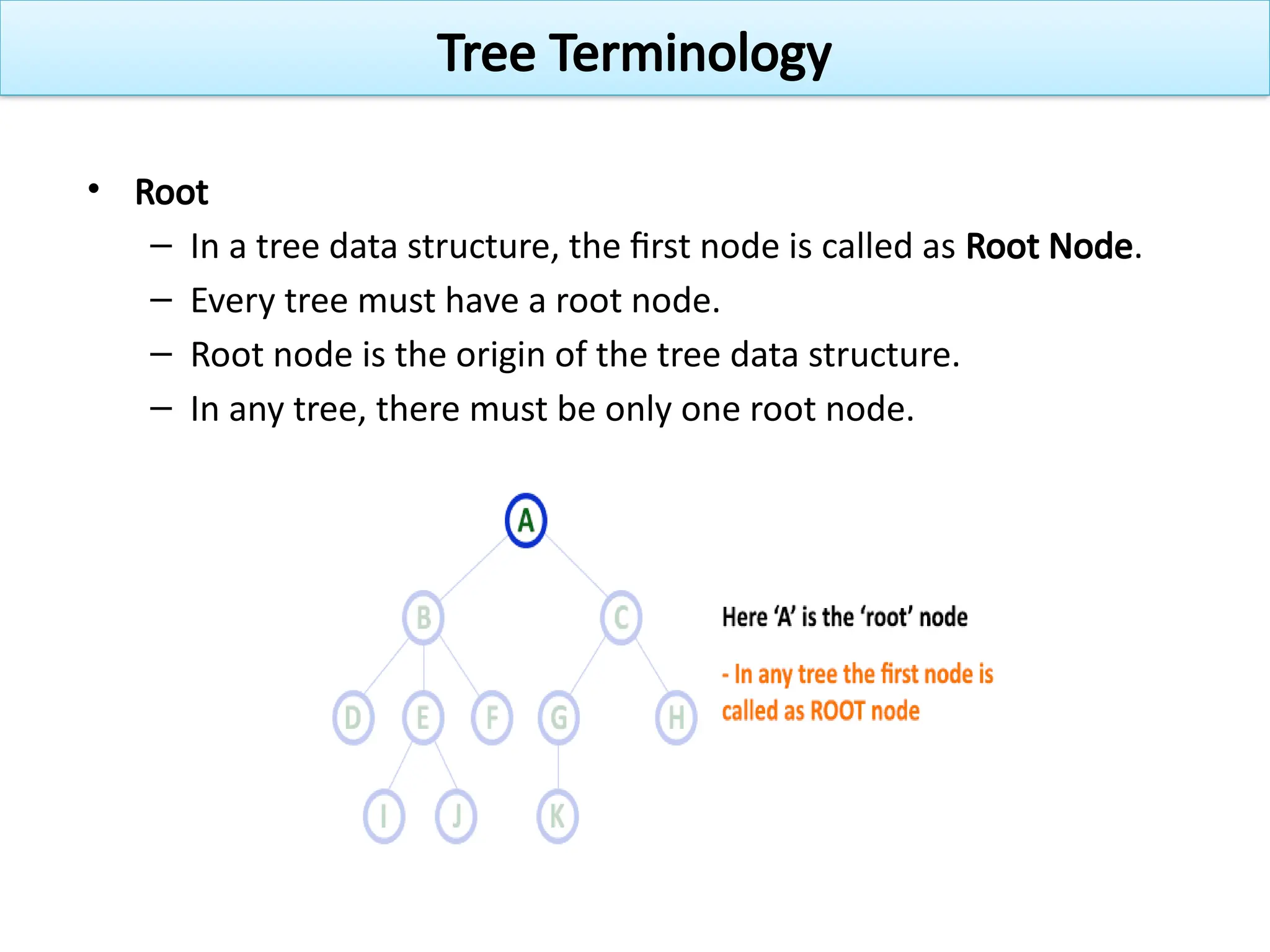
• Root
– In a tree data structure, the first node is called as Root Node.
– Every tree must have a root node.
– Root node is the origin of the tree data structure.
– In any tree, there must be only one root node.
Tree Terminology
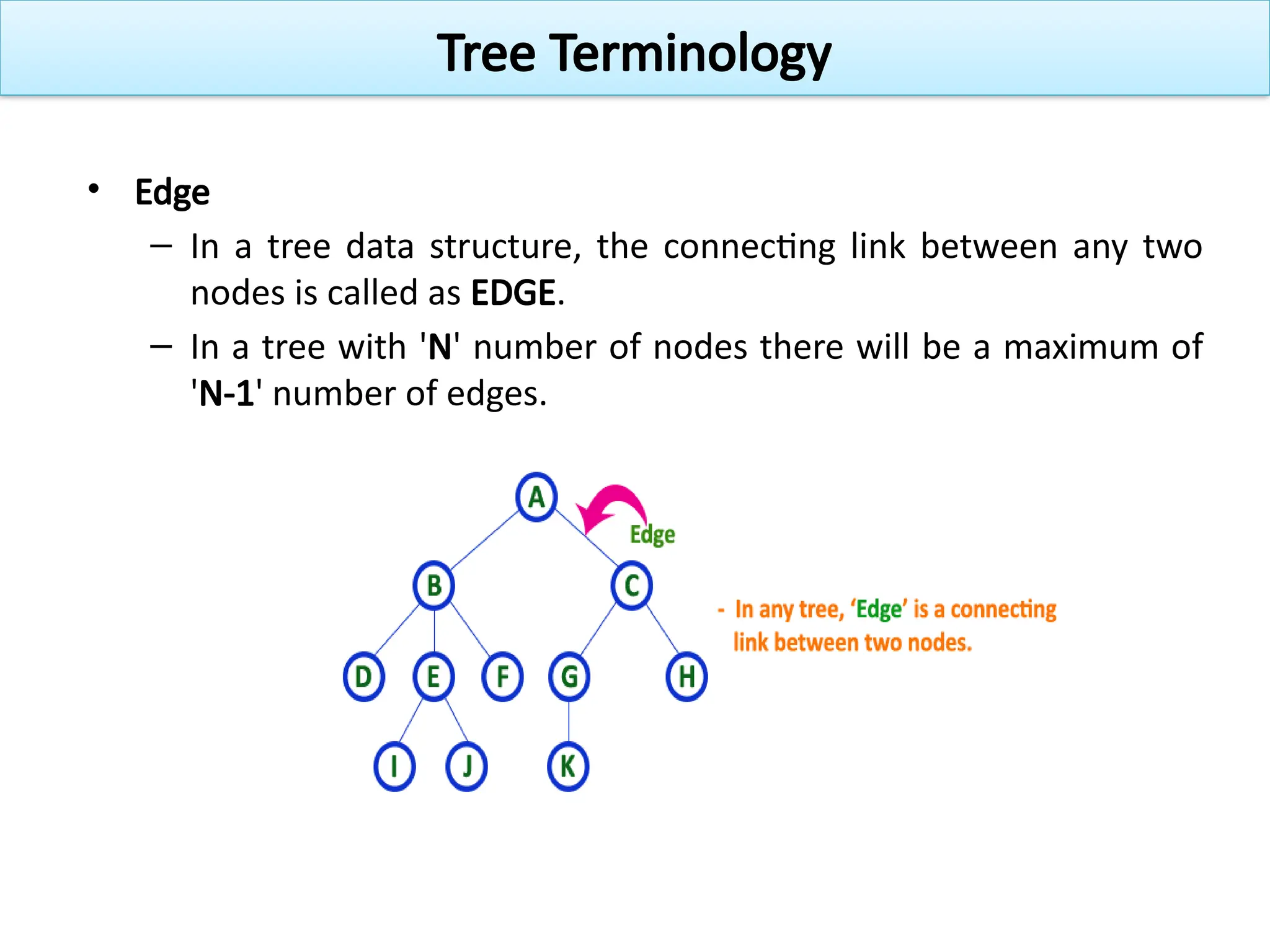
• Edge
– In a tree data structure, the connecting link between any two
nodes is called as EDGE.
– In a tree with 'N' number of nodes there will be a maximum of
'N-1' number of edges.
Tree Terminology
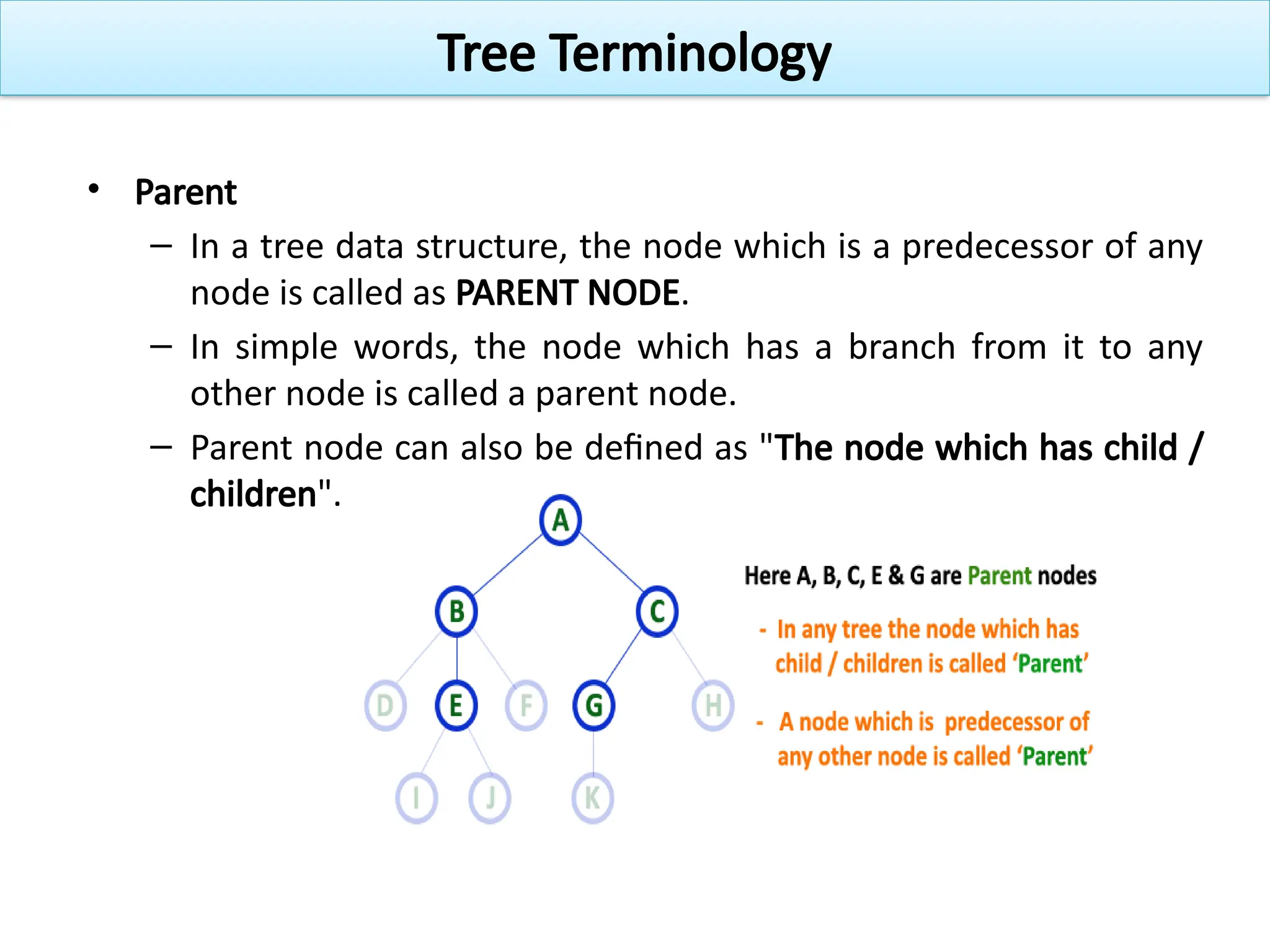
• Parent
– In a tree data structure, the node which is a predecessor of any
node is called as PARENT NODE.
– In simple words, the node which has a branch from it to any
other node is called a parent node.
– Parent node can also be defined as "The node which has child /
children".
Tree Terminology
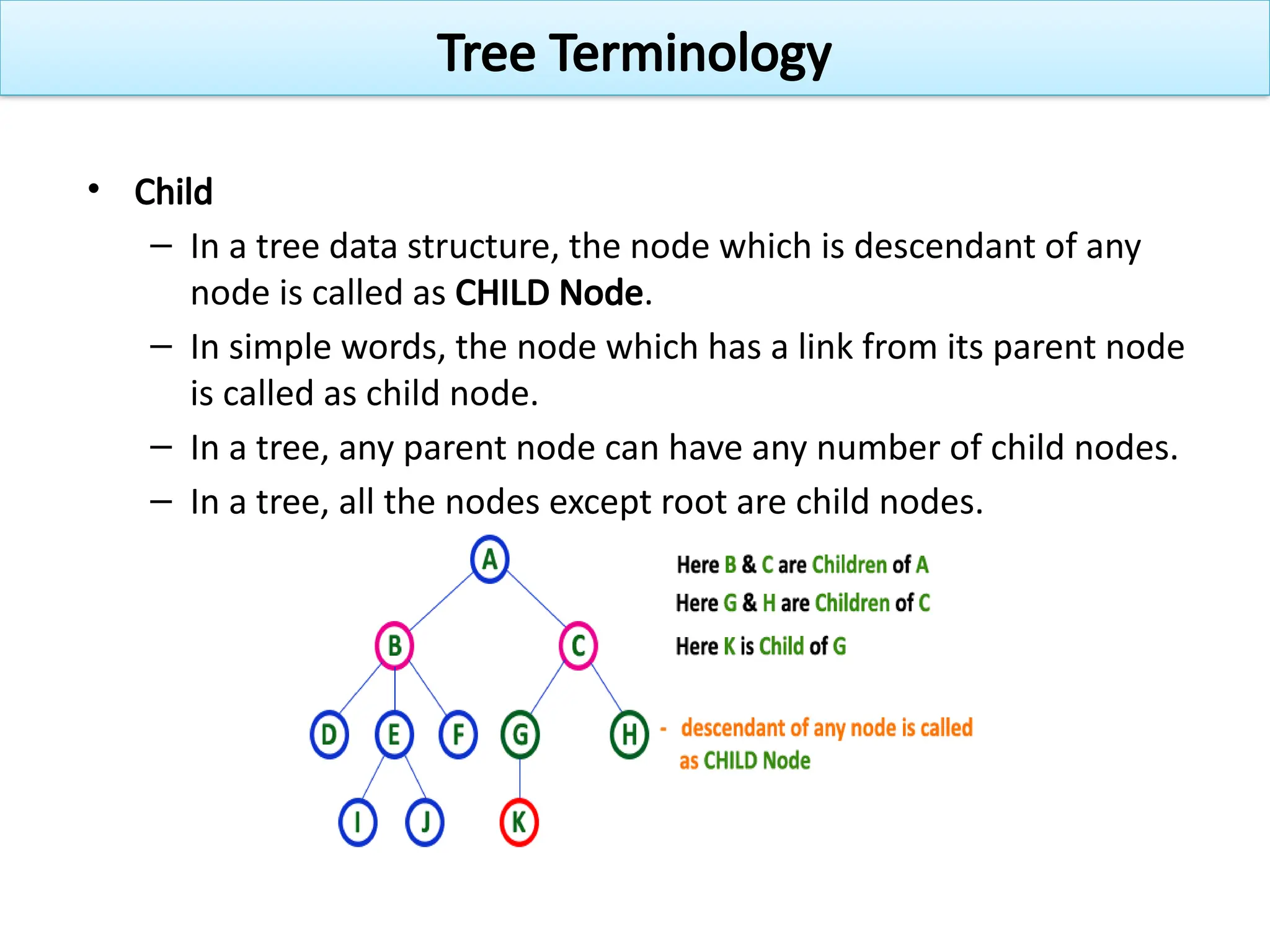
• Child
– In a tree data structure, the node which is descendant of any
node is called as CHILD Node.
– In simple words, the node which has a link from its parent node
is called as child node.
– In a tree, any parent node can have any number of child nodes.
– In a tree, all the nodes except root are child nodes.
Tree Terminology
• Siblings
– In a tree data structure, nodes which belong to same Parent are
called as SIBLINGS.
– In simple words, the nodes with the same parent are called
Sibling nodes
Tree Terminology
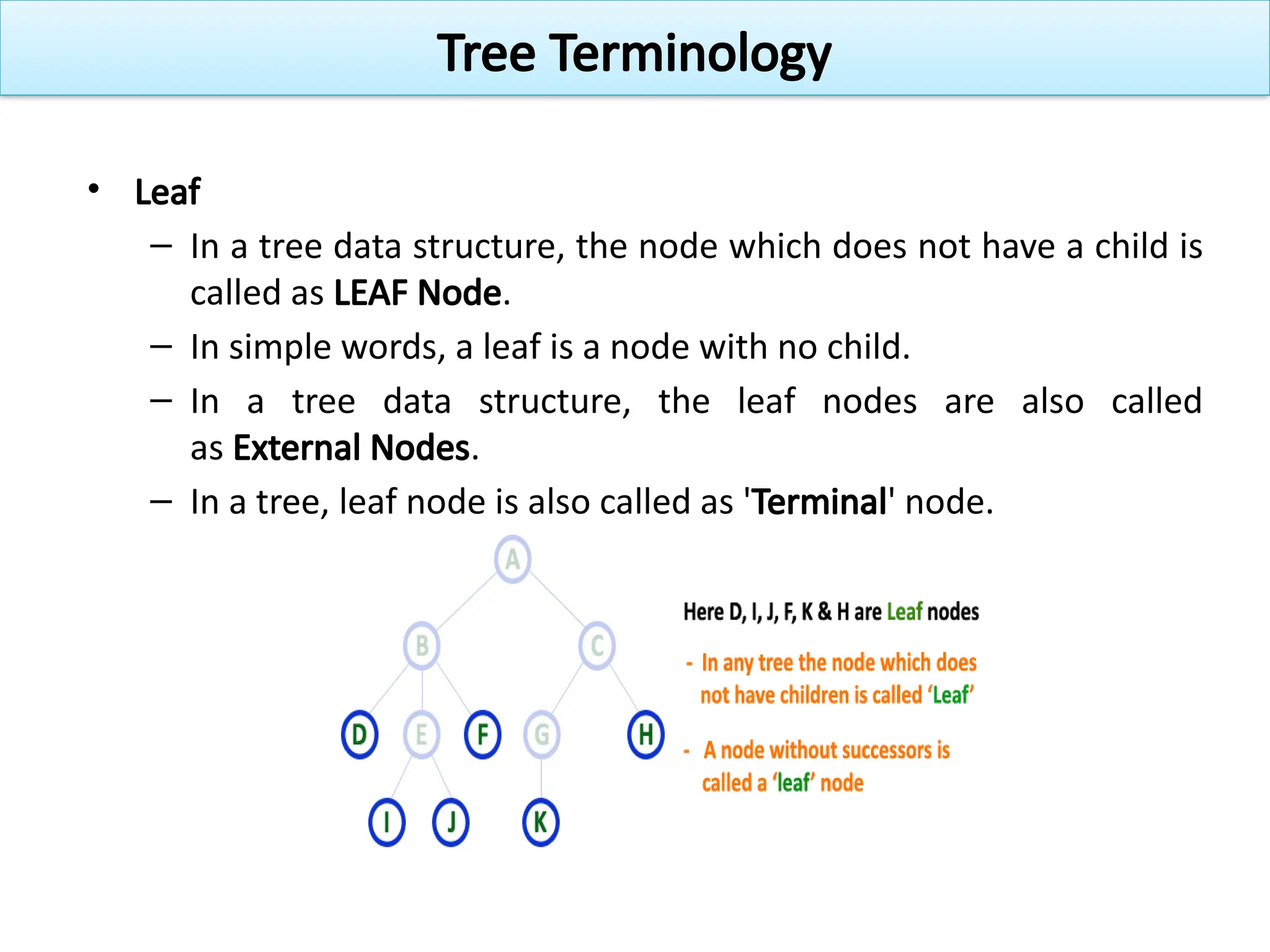
• Leaf
– In a tree data structure, the node which does not have a child is
called as LEAF Node.
– In simple words, a leaf is a node with no child.
– In a tree data structure, the leaf nodes are also called
as External Nodes.
– In a tree, leaf node is also called as 'Terminal' node.
Tree Terminology
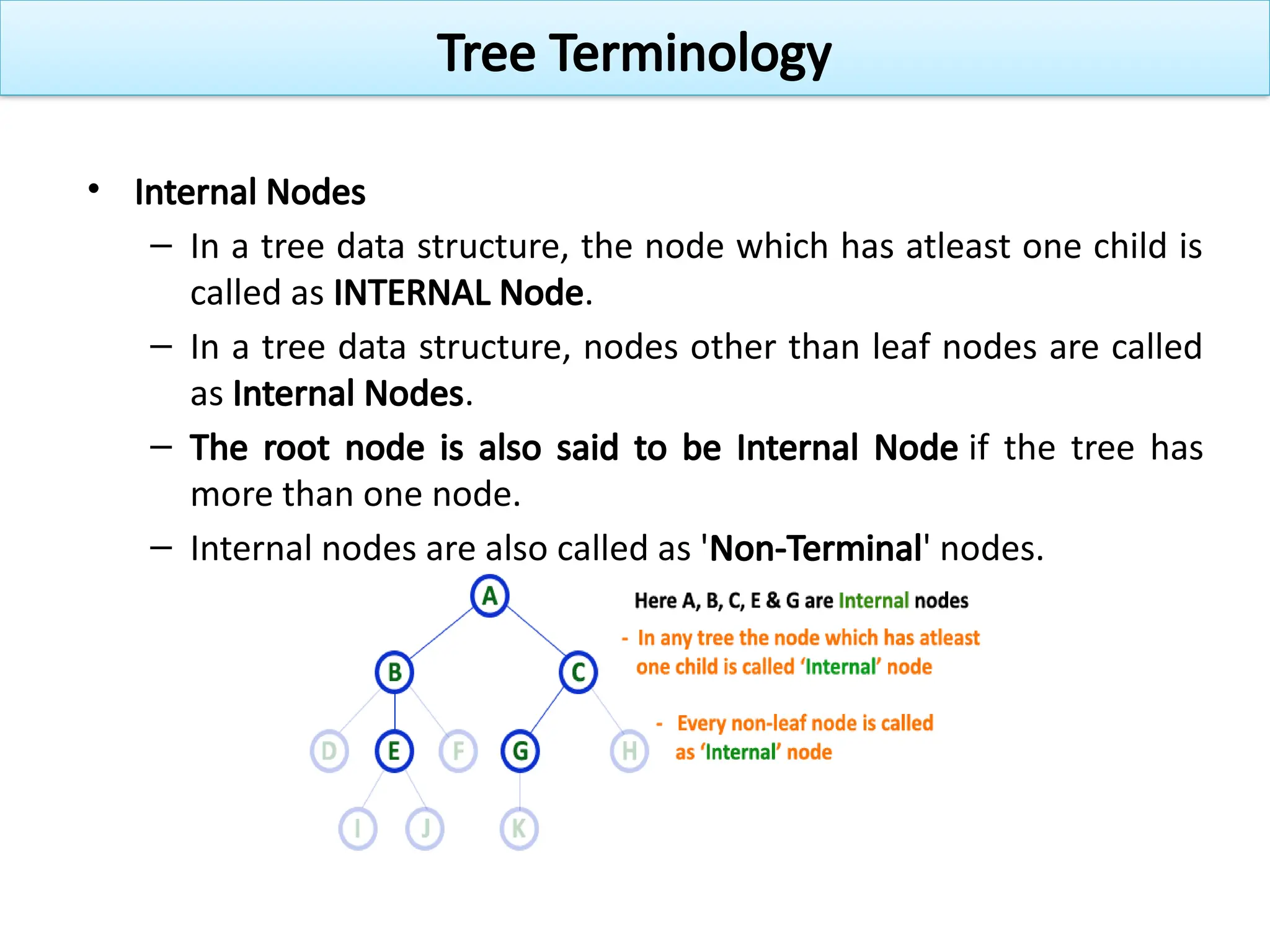
• Internal Nodes
– In a tree data structure, the node which has atleast one child is
called as INTERNAL Node.
– In a tree data structure, nodes other than leaf nodes are called
as Internal Nodes.
– The root node is also said to be Internal Node if the tree has
more than one node.
– Internal nodes are also called as 'Non-Terminal' nodes.
Tree Terminology
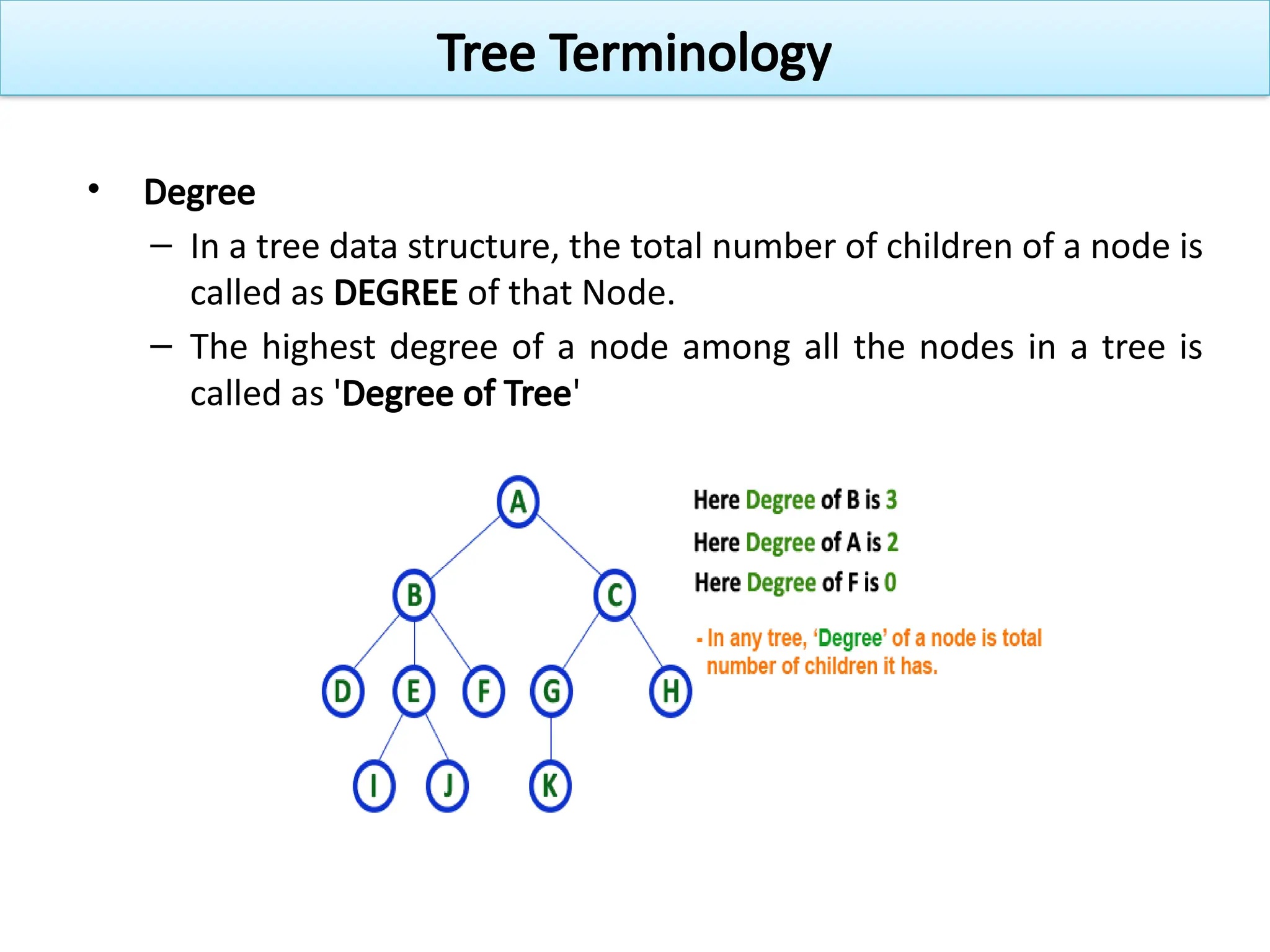
• Degree
– In a tree data structure, the total number of children of a node is
called as DEGREE of that Node.
– The highest degree of a node among all the nodes in a tree is
called as 'Degree of Tree'
Tree Terminology
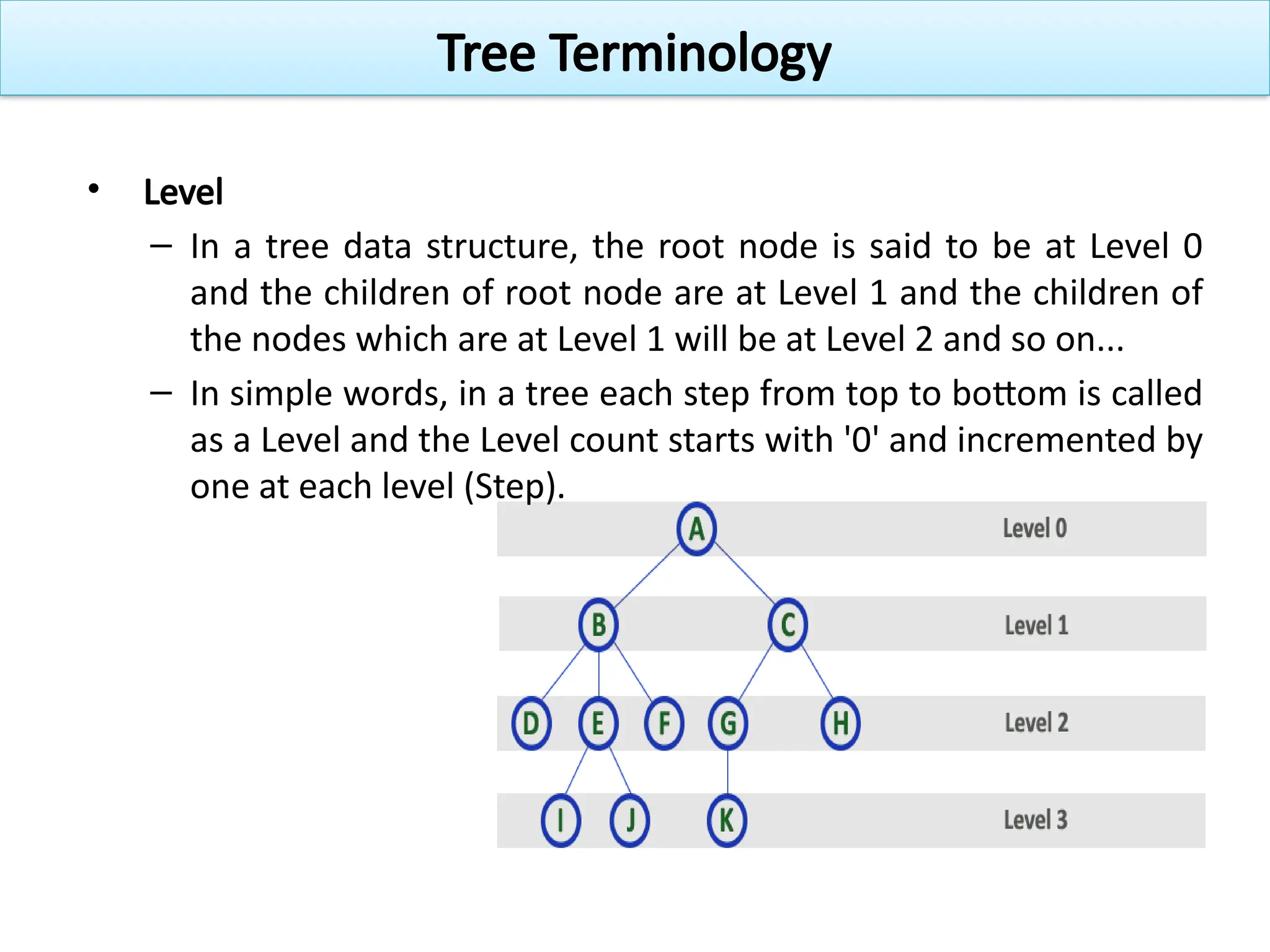
• Level
– In a tree data structure, the root node is said to be at Level 0
and the children of root node are at Level 1 and the children of
the nodes which are at Level 1 will be at Level 2 and so on...
– In simple words, in a tree each step from top to bottom is called
as a Level and the Level count starts with '0' and incremented by
one at each level (Step).
Tree Terminology
• Height
– In a tree data structure, the total number of edges from leaf
node to a particular node in the longest path is called
as HEIGHT of that Node.
– In a tree, height of the root node is said to be height of the tree.
– In a tree, height of all leaf nodes is '0'.
Tree Terminology
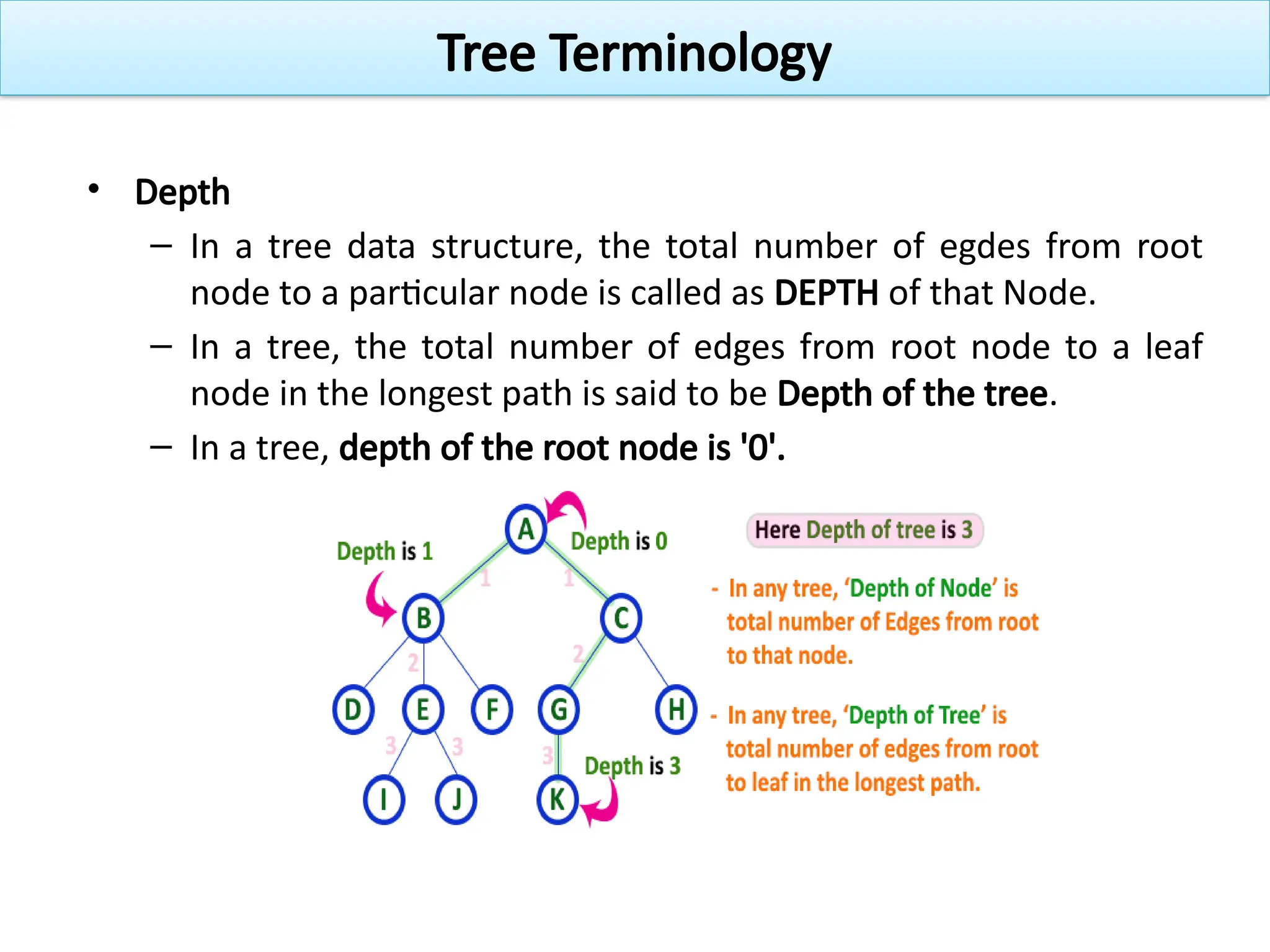
• Depth
– In a tree data structure, the total number of egdes from root
node to a particular node is called as DEPTH of that Node.
– In a tree, the total number of edges from root node to a leaf
node in the longest path is said to be Depth of the tree.
– In a tree, depth of the root node is '0'.
Tree Terminology
• Path
– In a tree data structure, the sequence of Nodes and Edges from
one node to another node is called as PATH between that two
Nodes.
– Length of a Path is total number of nodes in that path.
– In below example the path A - B - E - J has length 4.
Tree Terminology
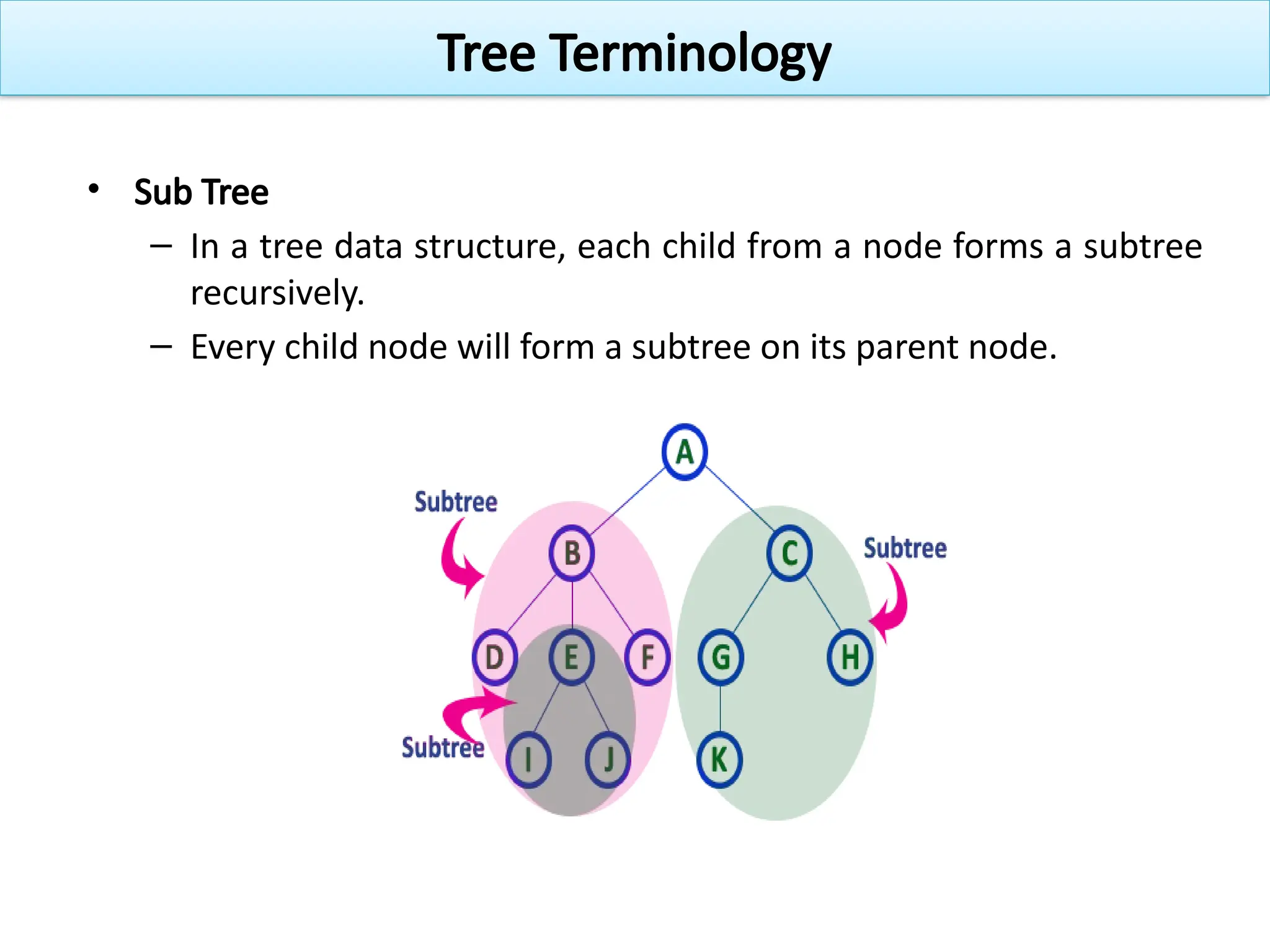
• Sub Tree
– In a tree data structure, each child from a node forms a subtree
recursively.
– Every child node will form a subtree on its parent node.
Tree Terminology
• In a normal tree, every node can have any number of children.
• A binary tree is a special type of tree data structure in which every
node can have a maximum of 2 children.
• One is known as a left child and the other is known as right child.
• A tree in which every node can have a maximum of two children is
called Binary Tree.
• In a binary tree, every node can have either 0 children or 1 child or
2 children but not more than 2 children.
– Example
Binary Tree
• Full Binary Tree
– A binary tree in which every node has either two or zero
number of children is called Strictly Binary Tree
– Full binary tree is also called as strictly Binary Tree or Proper
Binary Tree or 2-Tree
Binary Tree
• Strictly binary tree data structure is used to represent mathematical
expressions.
Binary Tree
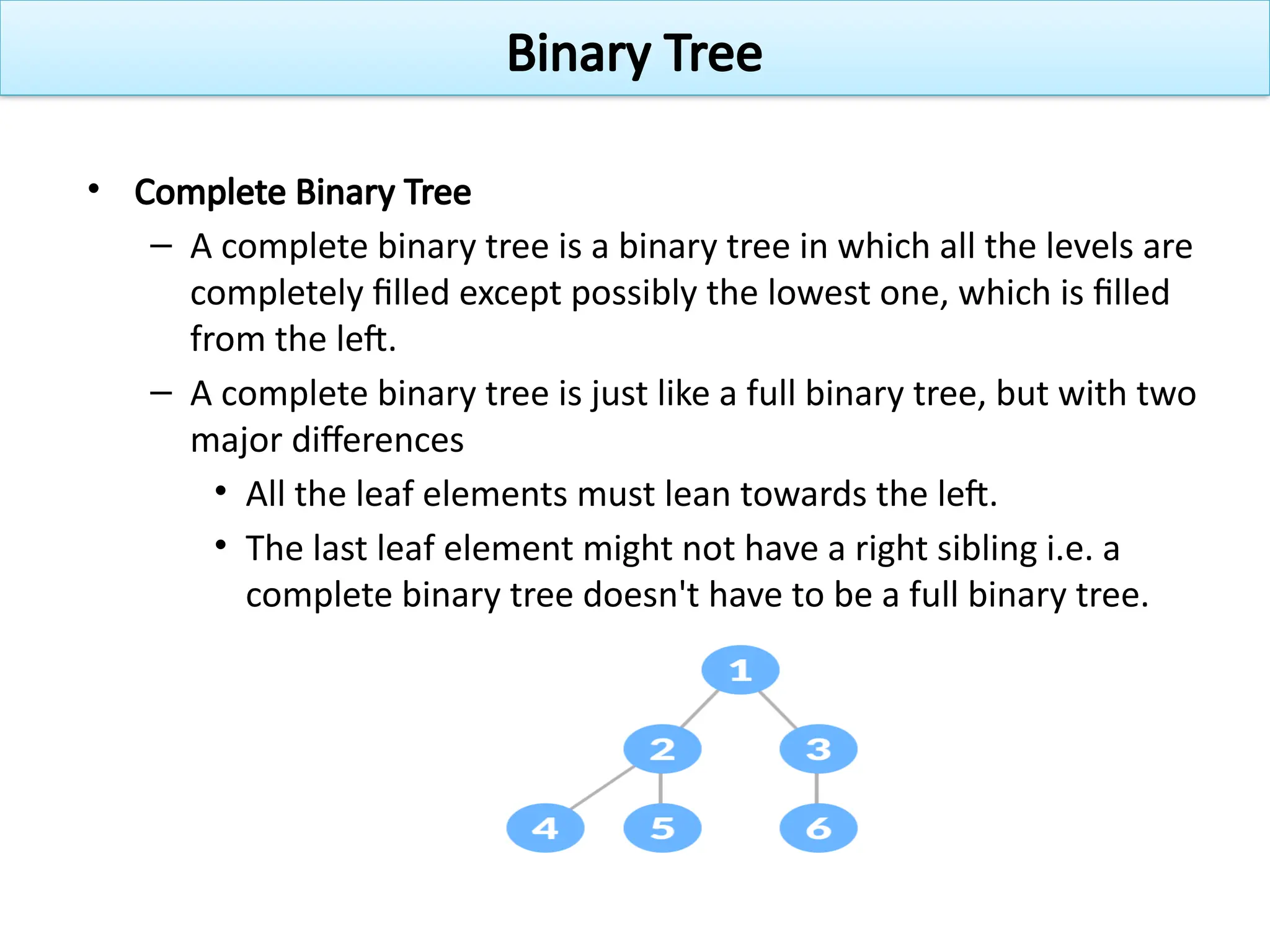
• Complete Binary Tree
– A complete binary tree is a binary tree in which all the levels are
completely filled except possibly the lowest one, which is filled
from the left.
– A complete binary tree is just like a full binary tree, but with two
major differences
• All the leaf elements must lean towards the left.
• The last leaf element might not have a right sibling i.e. a
complete binary tree doesn't have to be a full binary tree.
Binary Tree
• Perfect Binary Tree
 perfect binary tree: a binary tree with all leaf nodes at the same depth. All
internal nodes have exactly two children.
 a perfect binary tree has the maximum number of nodes for a given height
 a perfect binary tree has (2(n+1) - 1) nodes where n is the height of the
tree
– height = 0 -> 1 node
– height = 1 -> 3 nodes
– height = 2 -> 7 nodes
– height = 3 -> 15 nodes
Binary Tree
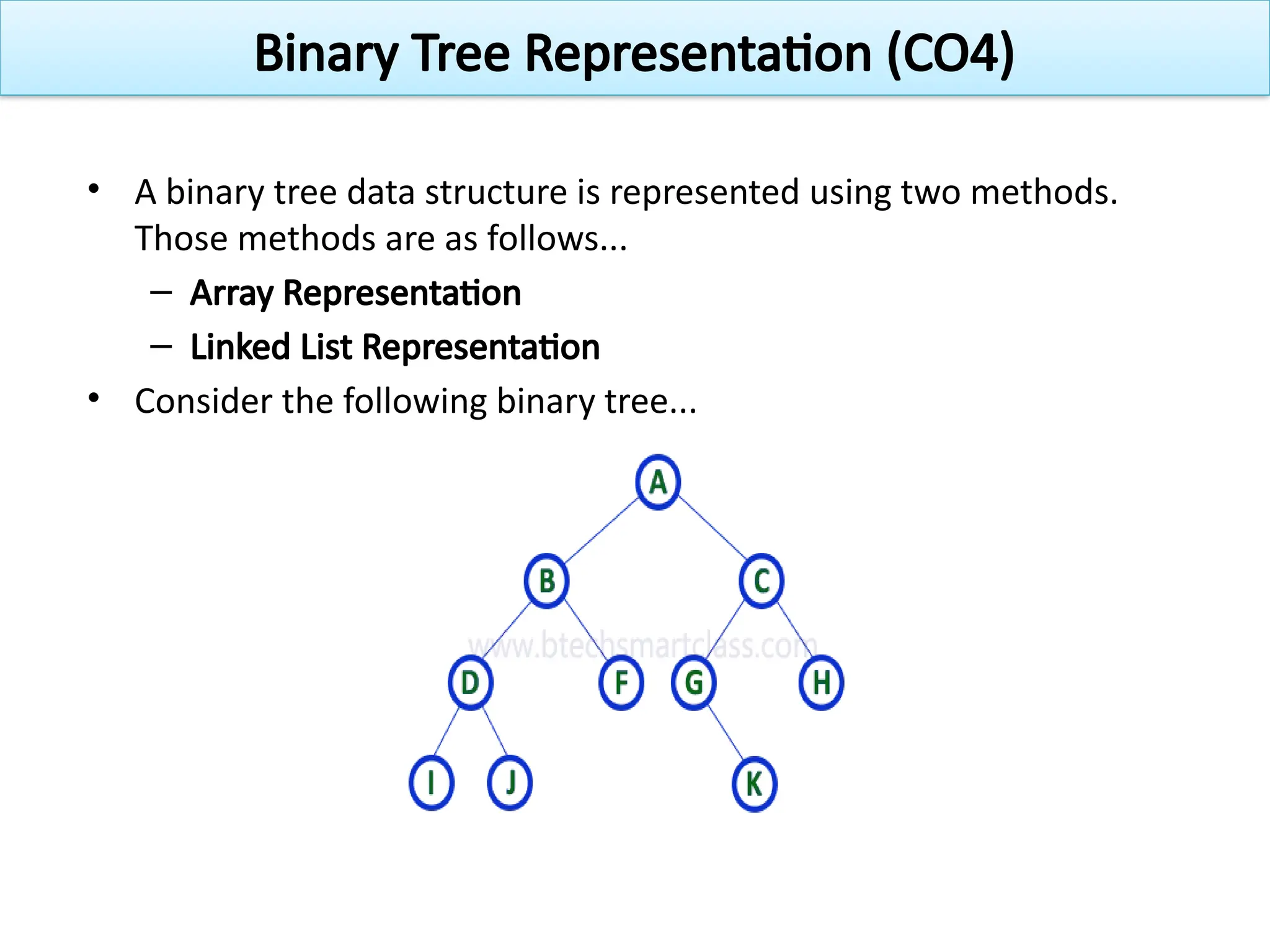
• A binary tree data structure is represented using two methods.
Those methods are as follows...
– Array Representation
– Linked List Representation
• Consider the following binary tree...
Binary Tree Representation (CO4)
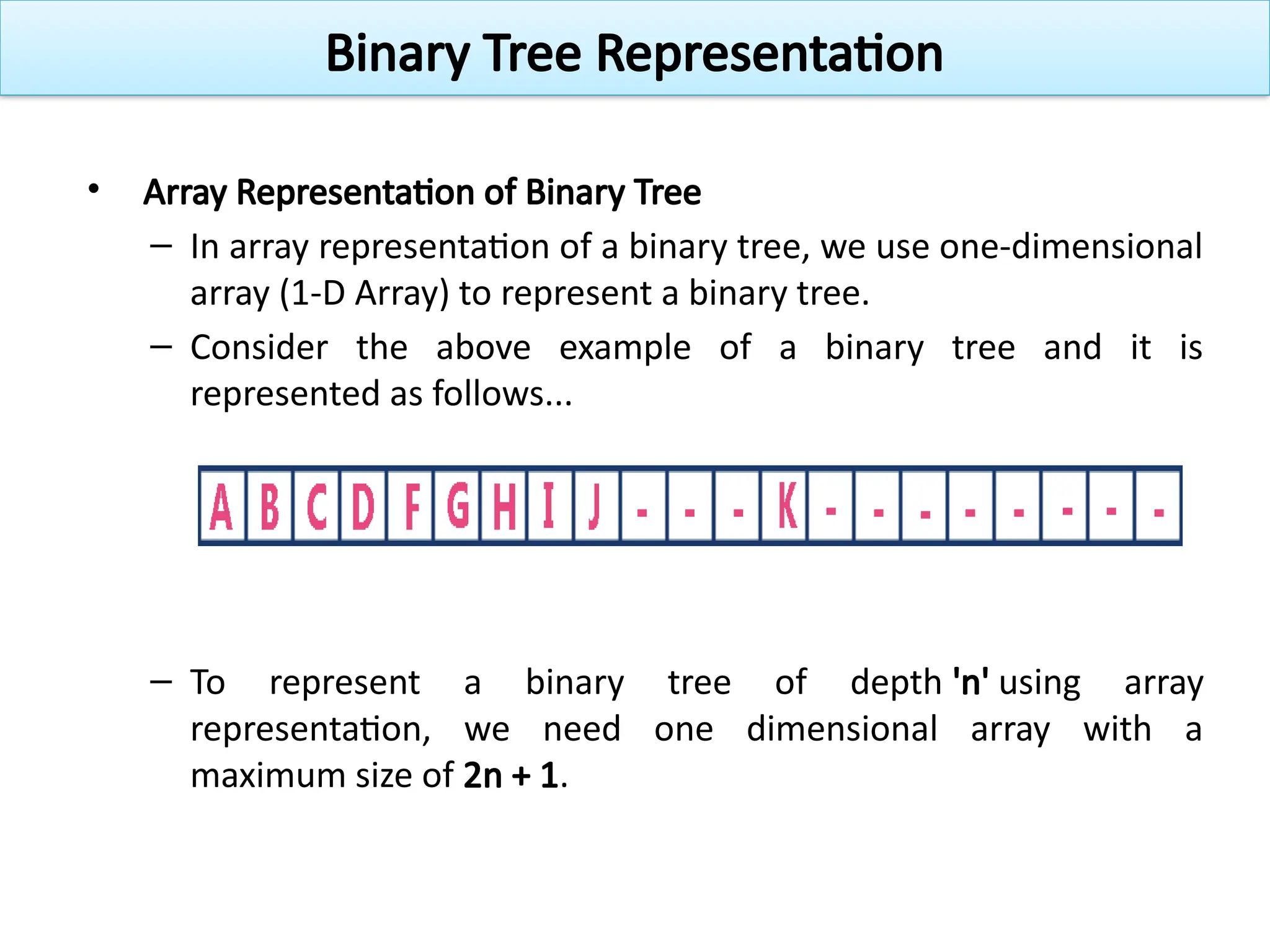
• Array Representation of Binary Tree
– In array representation of a binary tree, we use one-dimensional
array (1-D Array) to represent a binary tree.
– Consider the above example of a binary tree and it is
represented as follows...
– To represent a binary tree of depth 'n' using array
representation, we need one dimensional array with a
maximum size of 2n + 1.
Binary Tree Representation
• Linked List Representation of Binary Tree
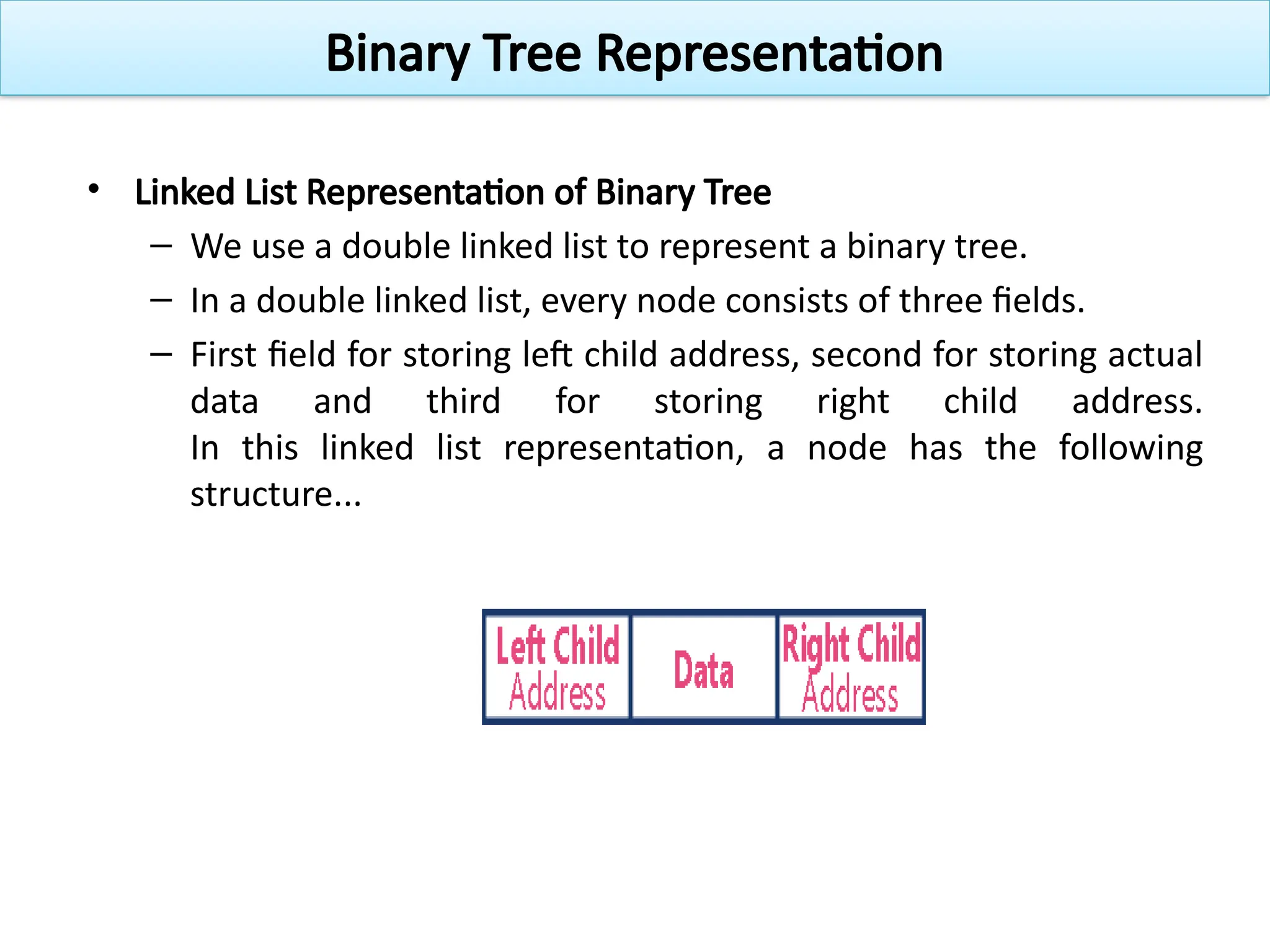
– We use a double linked list to represent a binary tree.
– In a double linked list, every node consists of three fields.
– First field for storing left child address, second for storing actual
data and third for storing right child address.
In this linked list representation, a node has the following
structure...
Binary Tree Representation
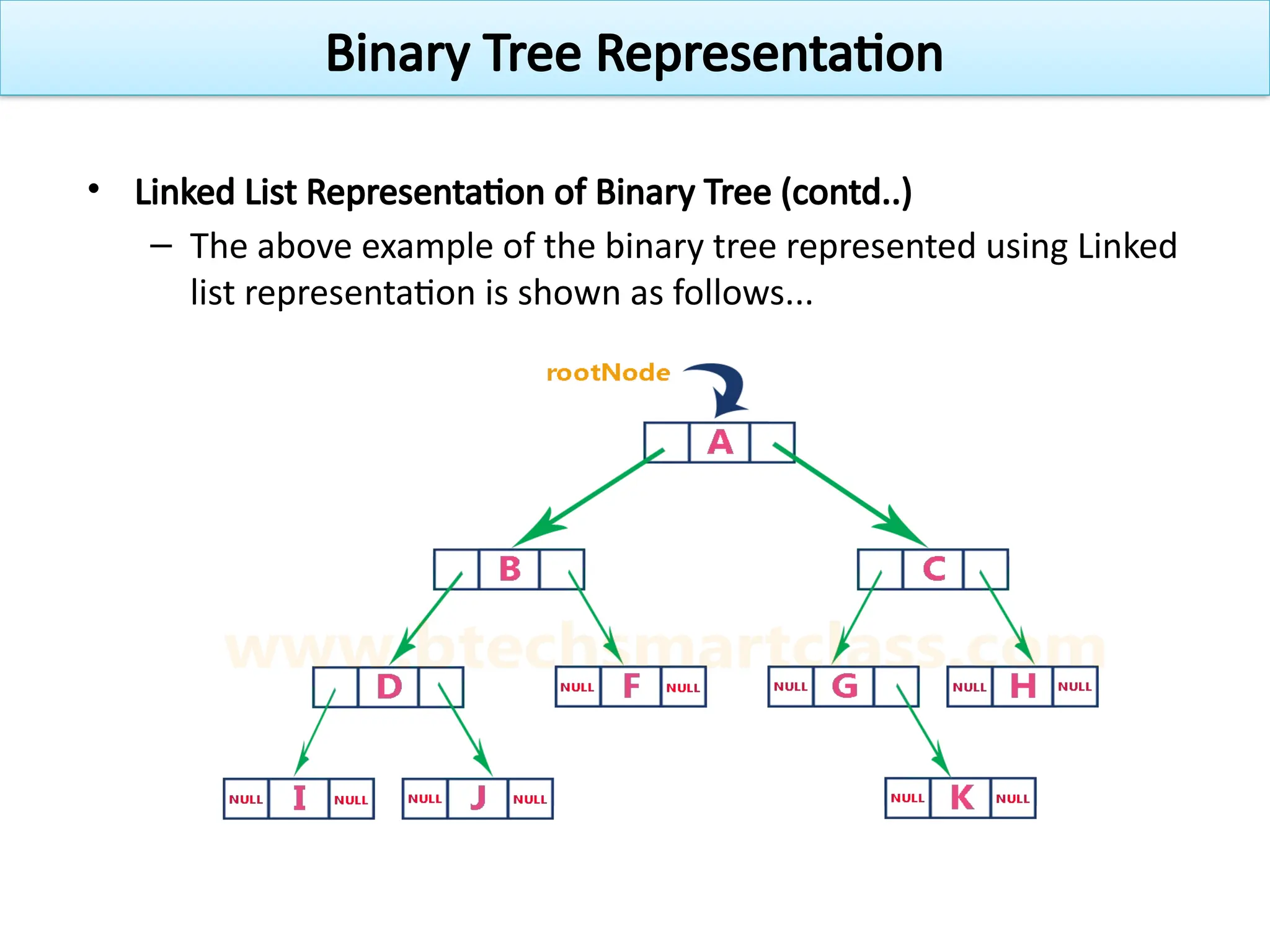
• Linked List Representation of Binary Tree (contd..)
– The above example of the binary tree represented using Linked
list representation is shown as follows...
Binary Tree Representation
• Displaying (or) visiting order of nodes in a binary tree is called as Binary Tree
Traversal.
• There are three recursive techniques for binary tree traversal
• In each technique, the left subtree is traversed recursively, the right
subtree is traversed recursively, and the root is visited
• What distinguishes the techniques from one another is the order of those
3 tasks
• There are three types of binary tree traversals.
– In - Order Traversal
– Pre - Order Traversal
– Post - Order Traversal
Binary Tree Traversal
CS 103 28
Preoder, Inorder, Postorder
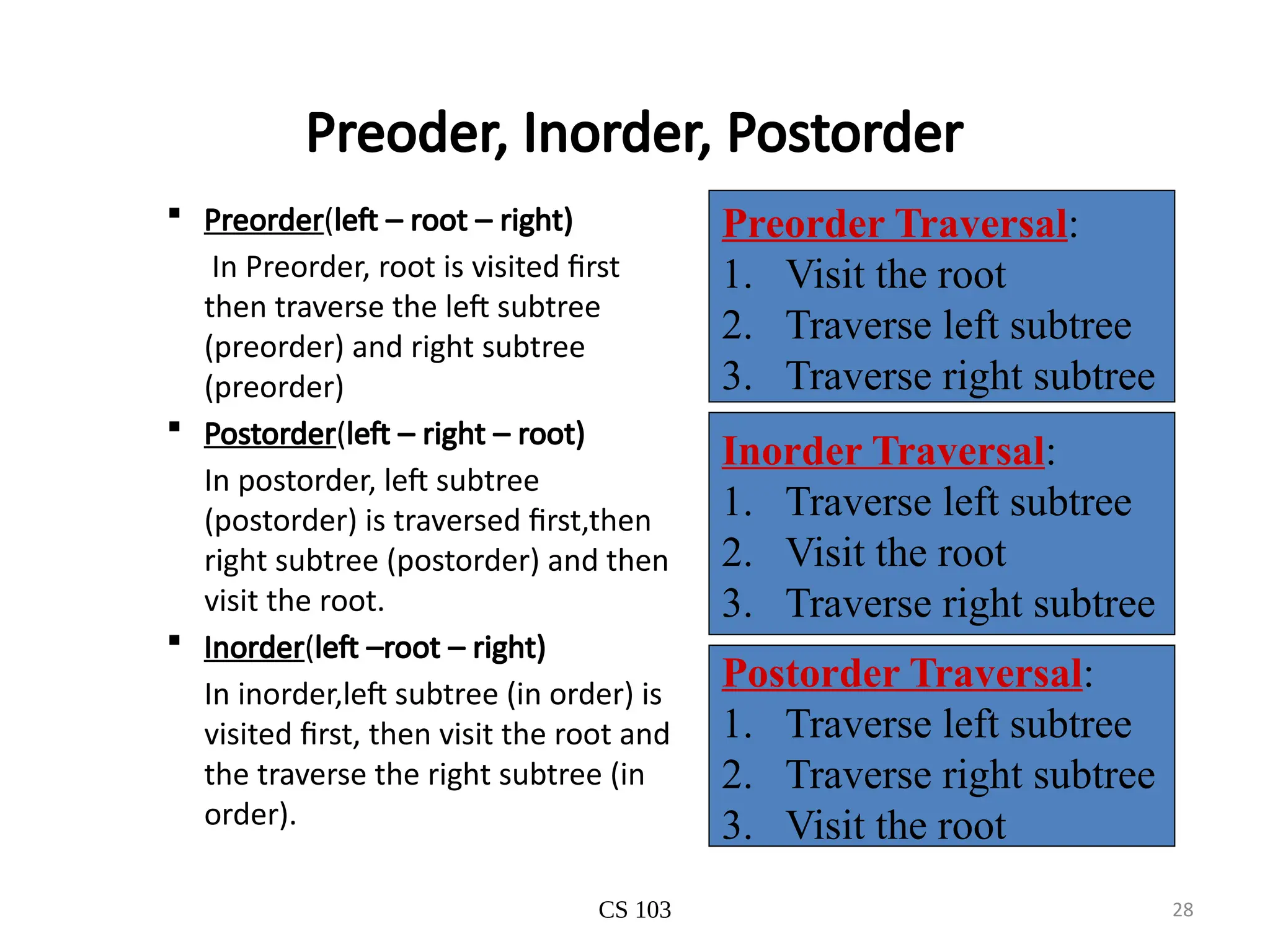
 Preorder(left – root – right)
In Preorder, root is visited first
then traverse the left subtree
(preorder) and right subtree
(preorder)
 Postorder(left – right – root)
In postorder, left subtree
(postorder) is traversed first,then
right subtree (postorder) and then
visit the root.
 Inorder(left –root – right)
In inorder,left subtree (in order) is
visited first, then visit the root and
the traverse the right subtree (in
order).
Preorder Traversal:
1. Visit the root
2. Traverse left subtree
3. Traverse right subtree
Inorder Traversal:
1. Traverse left subtree
2. Visit the root
3. Traverse right subtree
Postorder Traversal:
1. Traverse left subtree
2. Traverse right subtree
3. Visit the root
Tree Traversals: Example 1
A
E F
C
B
G
D
Preorder: ABDECFG
Postorder: DEBGFCA
In Order: DBEAFGC
CS 103 30
Tree Traversals: Example 2
• Assume: visiting a node
is printing its data
• Preorder: 15 8 2 6 3 7
11 10 12 14 20 27 22 30
• Inorder: 2 3 6 7 8 10 11
12 14 15 20 22 27 30
• Postorder: 3 7 6 2 10 14
12 11 8 22 30 27 20 15
6
15
8
2
3 7
11
10
14
12
20
27
22 30
CS 103 31
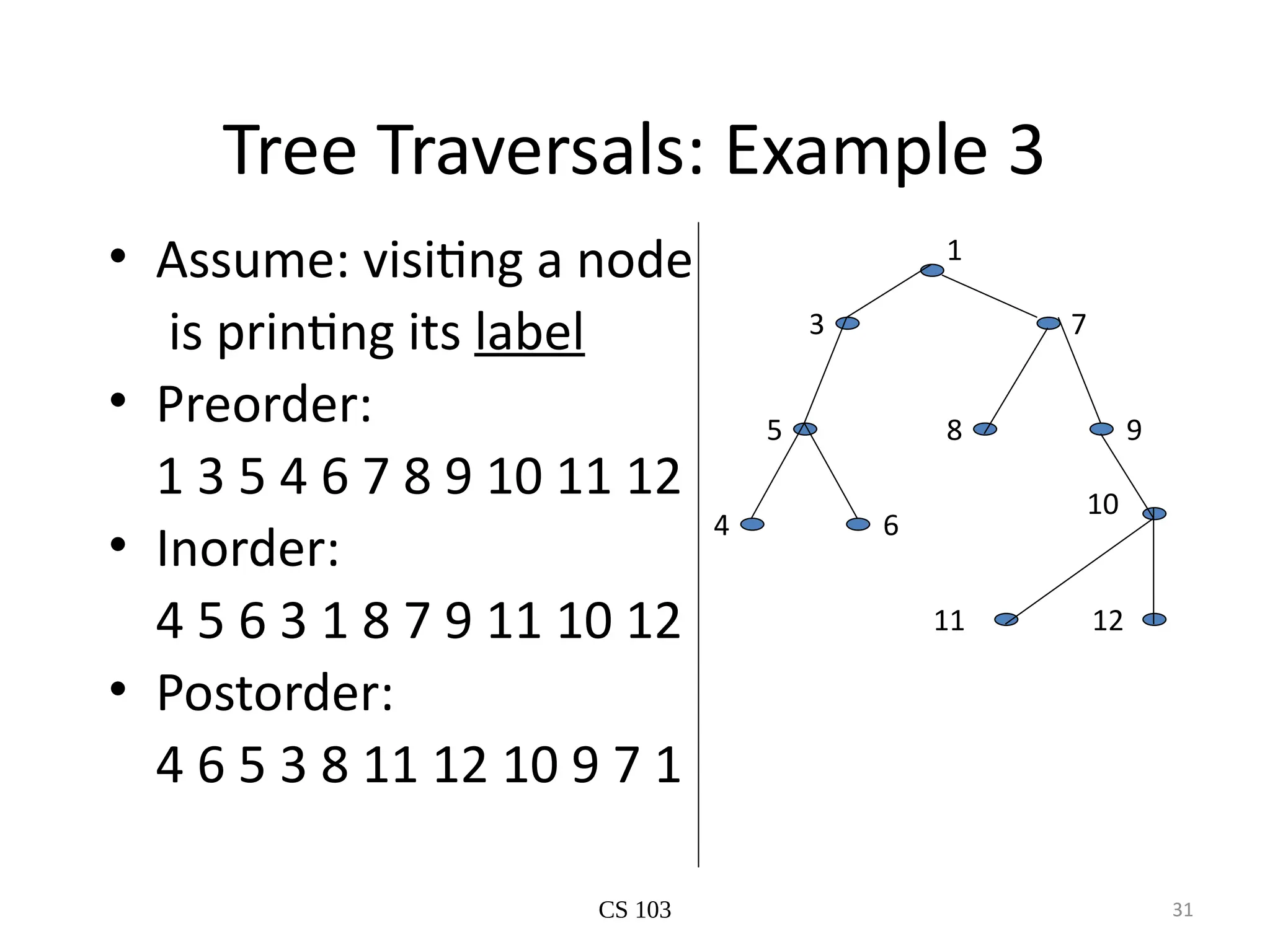
Tree Traversals: Example 3
• Assume: visiting a node
is printing its label
• Preorder:
1 3 5 4 6 7 8 9 10 11 12
• Inorder:
4 5 6 3 1 8 7 9 11 10 12
• Postorder:
4 6 5 3 8 11 12 10 9 7 1
1
3
11
9
8
4 6
5
7
12
10
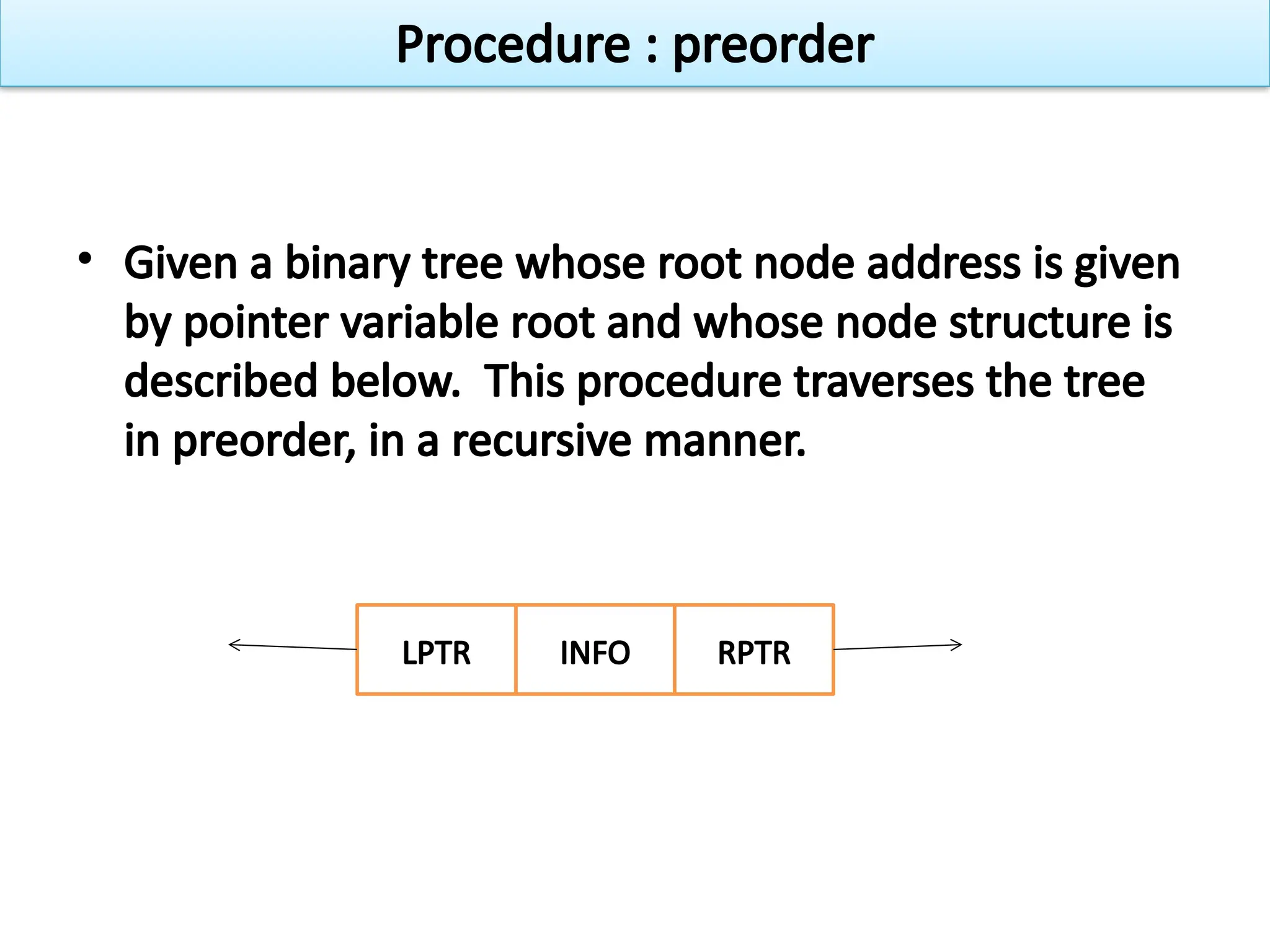
• Given a binary tree whose root node address is given
by pointer variable root and whose node structure is
described below. This procedure traverses the tree
in preorder, in a recursive manner.
LPTR INFO RPTR
Procedure : preorder
void preorder (root)
{
if (root==NULL)
return;
printf (“ %dn ”, root->info);
preorder ( root-> left);
preorder ( root-> right);
}
Procedure : preorder
• Given a binary tree whose root node address is given
by pointer variable “root” and whose node structure
is described below. This procedure traverses the tree
in inorder, in a recursive manner.
LPTR INFO RPTR
Procedure : inorder
void inorder (root->left)
{
if (root==NULL)
return;
inorder ( root);
printf (“ %dn ”, root->info);
inorder ( root-> right);
}
Procedure : inorder
• Given a binary tree whose root node address is given
by pointer variable “root” and whose node structure
is described below. This procedure traverses the tree
in postorder, in a recursive manner.
LPTR INFO RPTR
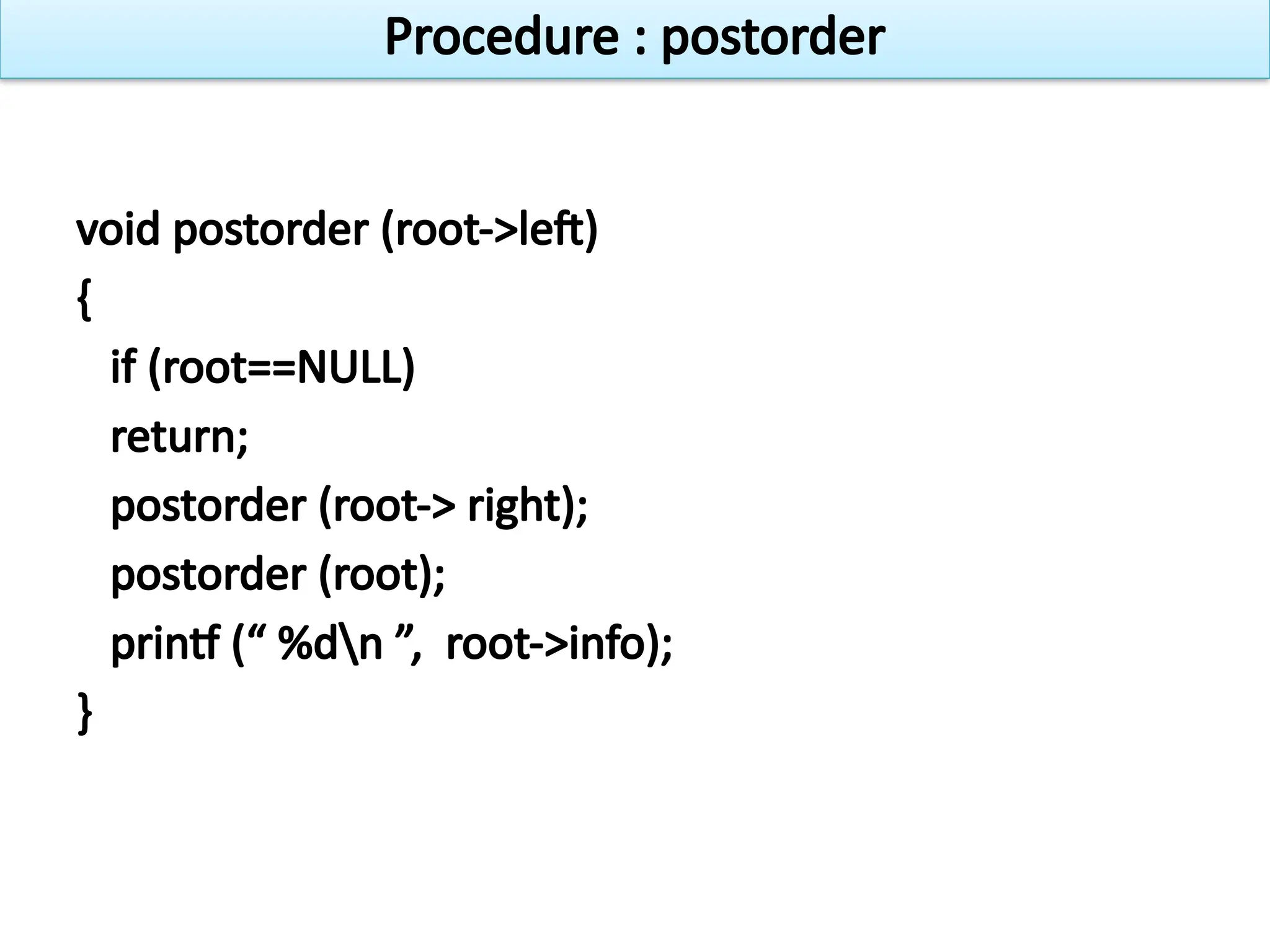
Procedure : postorder
void postorder (root->left)
{
if (root==NULL)
return;
postorder (root-> right);
postorder (root);
printf (“ %dn ”, root->info);
}
Procedure : postorder
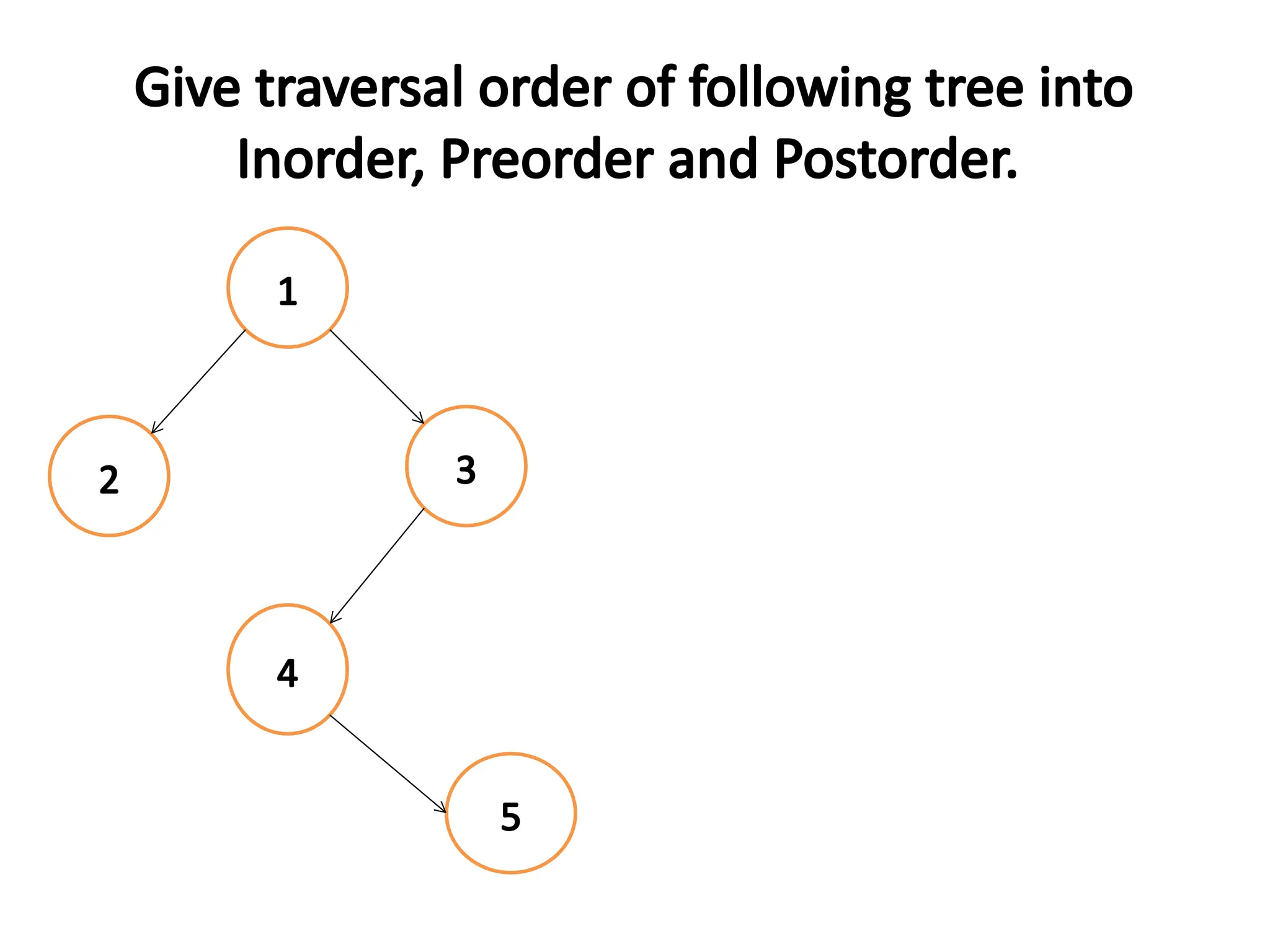
Give traversal order of following tree into
Inorder, Preorder and Postorder.
1
2 3
4
5

Trees and traversals _

  • 1.
    BCS-DS-301A: DATA STRUCTURES& ALGORITHMS Ms. Swati Hans Assistant Professor, CSE Manav Rachna International Institute of Research and Studies, Faridabad 1
  • 2.
    2 BCS-DS-301A: DATA STRUCTURES& ALGORITHMS Unit 4 Trees Ms. Swati Hans Assistant Professor, CSE MRIIRS
  • 3.
    • Tree – Treeterminology • Binary Tree – Binary tree representation – Binary tree traversal Unit Content
  • 4.
    • A treeis a very popular non-linear data structure used in a wide range of applications. A tree data structure can be defined as follows... – Tree is a non-linear data structure which organizes data in hierarchical structure and this is a recursive definition. OR – Tree data structure is a collection of data (Node) which is organized in hierarchical structure recursively • In tree data structure, every individual element is called as Node • In a tree data structure, if we have N number of nodes then we can have a maximum of N-1 number of links. – Example:- Tree
  • 5.
    • Root – Ina tree data structure, the first node is called as Root Node. – Every tree must have a root node. – Root node is the origin of the tree data structure. – In any tree, there must be only one root node. Tree Terminology
  • 6.
    • Edge – Ina tree data structure, the connecting link between any two nodes is called as EDGE. – In a tree with 'N' number of nodes there will be a maximum of 'N-1' number of edges. Tree Terminology
  • 7.
    • Parent – Ina tree data structure, the node which is a predecessor of any node is called as PARENT NODE. – In simple words, the node which has a branch from it to any other node is called a parent node. – Parent node can also be defined as "The node which has child / children". Tree Terminology
  • 8.
    • Child – Ina tree data structure, the node which is descendant of any node is called as CHILD Node. – In simple words, the node which has a link from its parent node is called as child node. – In a tree, any parent node can have any number of child nodes. – In a tree, all the nodes except root are child nodes. Tree Terminology
  • 9.
    • Siblings – Ina tree data structure, nodes which belong to same Parent are called as SIBLINGS. – In simple words, the nodes with the same parent are called Sibling nodes Tree Terminology
  • 10.
    • Leaf – Ina tree data structure, the node which does not have a child is called as LEAF Node. – In simple words, a leaf is a node with no child. – In a tree data structure, the leaf nodes are also called as External Nodes. – In a tree, leaf node is also called as 'Terminal' node. Tree Terminology
  • 11.
    • Internal Nodes –In a tree data structure, the node which has atleast one child is called as INTERNAL Node. – In a tree data structure, nodes other than leaf nodes are called as Internal Nodes. – The root node is also said to be Internal Node if the tree has more than one node. – Internal nodes are also called as 'Non-Terminal' nodes. Tree Terminology
  • 12.
    • Degree – Ina tree data structure, the total number of children of a node is called as DEGREE of that Node. – The highest degree of a node among all the nodes in a tree is called as 'Degree of Tree' Tree Terminology
  • 13.
    • Level – Ina tree data structure, the root node is said to be at Level 0 and the children of root node are at Level 1 and the children of the nodes which are at Level 1 will be at Level 2 and so on... – In simple words, in a tree each step from top to bottom is called as a Level and the Level count starts with '0' and incremented by one at each level (Step). Tree Terminology
  • 14.
    • Height – Ina tree data structure, the total number of edges from leaf node to a particular node in the longest path is called as HEIGHT of that Node. – In a tree, height of the root node is said to be height of the tree. – In a tree, height of all leaf nodes is '0'. Tree Terminology
  • 15.
    • Depth – Ina tree data structure, the total number of egdes from root node to a particular node is called as DEPTH of that Node. – In a tree, the total number of edges from root node to a leaf node in the longest path is said to be Depth of the tree. – In a tree, depth of the root node is '0'. Tree Terminology
  • 16.
    • Path – Ina tree data structure, the sequence of Nodes and Edges from one node to another node is called as PATH between that two Nodes. – Length of a Path is total number of nodes in that path. – In below example the path A - B - E - J has length 4. Tree Terminology
  • 17.
    • Sub Tree –In a tree data structure, each child from a node forms a subtree recursively. – Every child node will form a subtree on its parent node. Tree Terminology
  • 18.
    • In anormal tree, every node can have any number of children. • A binary tree is a special type of tree data structure in which every node can have a maximum of 2 children. • One is known as a left child and the other is known as right child. • A tree in which every node can have a maximum of two children is called Binary Tree. • In a binary tree, every node can have either 0 children or 1 child or 2 children but not more than 2 children. – Example Binary Tree
  • 19.
    • Full BinaryTree – A binary tree in which every node has either two or zero number of children is called Strictly Binary Tree – Full binary tree is also called as strictly Binary Tree or Proper Binary Tree or 2-Tree Binary Tree
  • 20.
    • Strictly binarytree data structure is used to represent mathematical expressions. Binary Tree
  • 21.
    • Complete BinaryTree – A complete binary tree is a binary tree in which all the levels are completely filled except possibly the lowest one, which is filled from the left. – A complete binary tree is just like a full binary tree, but with two major differences • All the leaf elements must lean towards the left. • The last leaf element might not have a right sibling i.e. a complete binary tree doesn't have to be a full binary tree. Binary Tree
  • 22.
    • Perfect BinaryTree  perfect binary tree: a binary tree with all leaf nodes at the same depth. All internal nodes have exactly two children.  a perfect binary tree has the maximum number of nodes for a given height  a perfect binary tree has (2(n+1) - 1) nodes where n is the height of the tree – height = 0 -> 1 node – height = 1 -> 3 nodes – height = 2 -> 7 nodes – height = 3 -> 15 nodes Binary Tree
  • 23.
    • A binarytree data structure is represented using two methods. Those methods are as follows... – Array Representation – Linked List Representation • Consider the following binary tree... Binary Tree Representation (CO4)
  • 24.
    • Array Representationof Binary Tree – In array representation of a binary tree, we use one-dimensional array (1-D Array) to represent a binary tree. – Consider the above example of a binary tree and it is represented as follows... – To represent a binary tree of depth 'n' using array representation, we need one dimensional array with a maximum size of 2n + 1. Binary Tree Representation
  • 25.
    • Linked ListRepresentation of Binary Tree – We use a double linked list to represent a binary tree. – In a double linked list, every node consists of three fields. – First field for storing left child address, second for storing actual data and third for storing right child address. In this linked list representation, a node has the following structure... Binary Tree Representation
  • 26.
    • Linked ListRepresentation of Binary Tree (contd..) – The above example of the binary tree represented using Linked list representation is shown as follows... Binary Tree Representation
  • 27.
    • Displaying (or)visiting order of nodes in a binary tree is called as Binary Tree Traversal. • There are three recursive techniques for binary tree traversal • In each technique, the left subtree is traversed recursively, the right subtree is traversed recursively, and the root is visited • What distinguishes the techniques from one another is the order of those 3 tasks • There are three types of binary tree traversals. – In - Order Traversal – Pre - Order Traversal – Post - Order Traversal Binary Tree Traversal
  • 28.
    CS 103 28 Preoder,Inorder, Postorder  Preorder(left – root – right) In Preorder, root is visited first then traverse the left subtree (preorder) and right subtree (preorder)  Postorder(left – right – root) In postorder, left subtree (postorder) is traversed first,then right subtree (postorder) and then visit the root.  Inorder(left –root – right) In inorder,left subtree (in order) is visited first, then visit the root and the traverse the right subtree (in order). Preorder Traversal: 1. Visit the root 2. Traverse left subtree 3. Traverse right subtree Inorder Traversal: 1. Traverse left subtree 2. Visit the root 3. Traverse right subtree Postorder Traversal: 1. Traverse left subtree 2. Traverse right subtree 3. Visit the root
  • 29.
    Tree Traversals: Example1 A E F C B G D Preorder: ABDECFG Postorder: DEBGFCA In Order: DBEAFGC
  • 30.
    CS 103 30 TreeTraversals: Example 2 • Assume: visiting a node is printing its data • Preorder: 15 8 2 6 3 7 11 10 12 14 20 27 22 30 • Inorder: 2 3 6 7 8 10 11 12 14 15 20 22 27 30 • Postorder: 3 7 6 2 10 14 12 11 8 22 30 27 20 15 6 15 8 2 3 7 11 10 14 12 20 27 22 30
  • 31.
    CS 103 31 TreeTraversals: Example 3 • Assume: visiting a node is printing its label • Preorder: 1 3 5 4 6 7 8 9 10 11 12 • Inorder: 4 5 6 3 1 8 7 9 11 10 12 • Postorder: 4 6 5 3 8 11 12 10 9 7 1 1 3 11 9 8 4 6 5 7 12 10
  • 32.
    • Given abinary tree whose root node address is given by pointer variable root and whose node structure is described below. This procedure traverses the tree in preorder, in a recursive manner. LPTR INFO RPTR Procedure : preorder
  • 33.
    void preorder (root) { if(root==NULL) return; printf (“ %dn ”, root->info); preorder ( root-> left); preorder ( root-> right); } Procedure : preorder
  • 34.
    • Given abinary tree whose root node address is given by pointer variable “root” and whose node structure is described below. This procedure traverses the tree in inorder, in a recursive manner. LPTR INFO RPTR Procedure : inorder
  • 35.
    void inorder (root->left) { if(root==NULL) return; inorder ( root); printf (“ %dn ”, root->info); inorder ( root-> right); } Procedure : inorder
  • 36.
    • Given abinary tree whose root node address is given by pointer variable “root” and whose node structure is described below. This procedure traverses the tree in postorder, in a recursive manner. LPTR INFO RPTR Procedure : postorder
  • 37.
    void postorder (root->left) { if(root==NULL) return; postorder (root-> right); postorder (root); printf (“ %dn ”, root->info); } Procedure : postorder
  • 38.
    Give traversal orderof following tree into Inorder, Preorder and Postorder. 1 2 3 4 5