






Chapter 4

CONSUMER
 BUYING
BEHAVIOR
The Buying Process
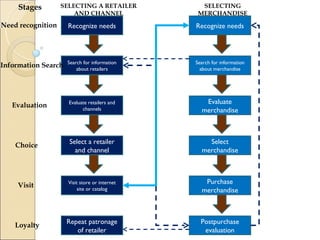
Stages        SELECTING A RETAILER          SELECTING
                       AND CHANNEL              MERCHANDISE
Need recognition     Recognize needs           Recognize needs


                     Search for information    Search for information
Information Search       about retailers         about merchandise


   Evaluation        Evaluate retailers and       Evaluate
                           channels              merchandise


    Choice           Select a retailer             Select
                       and channel               merchandise


     Visit           Visit store or internet      Purchase
                         site or catalog         merchandise


    Loyalty          Repeat patronage            Postpurchase
                        of retailer               evaluation
Need Recognition
Types of Needs
Utilitarian    Needs- when consumers
 go shopping to accomplish a specific task.
 It is associated with work.


Hedonic     Needs- when consumers go
 shopping for pleasure. It is associated
 with fun.
Some Hedonic Needs
Stimulation
Social experience
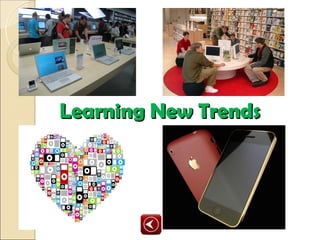
Learning new trends
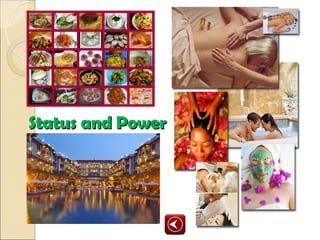
Status and power
Self-reward
Adventure
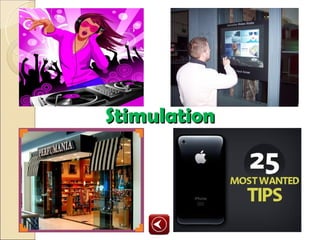
Stimulation
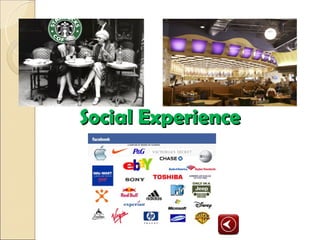
Social Experience
Learning New Trends
Status and Power
Self-reward
Adventure
Information Search
Factors influencing the amount
 of information search include
 1. The nature and use of the product
   being purchased
 2. Characteristics of the individual
   customer
 3. Aspects of the market and buying
   situation in which the purchase is
   made
Marketplace and situational factors
affecting information search include
  1. The number of competing brands and
     retail outlets
  2. The time pressure under which the
     purchase must be made
Sources of Information
Internal   Sources – are information
 in a customer’s memory such as
 names, images and past experiences
 with different stores.

External  Sources – are information
 provided by ads and other people.
Purchasing the Merchandise or
                 Service
1.   Don’t stock out of popular merchandise. Have a
     complete assortment of sizes and colors for
     customers to buy. For services retailers, have
     service providers available when customers are
     ready to place orders.

2.   Reduce the risk of purchasing merchandise or
     services by offering liberal return policies,
     money-back guarantees, and refunds if the
     same merchandise is available at a lower price
     from another retailer.
Cont.
        3. Offer Credit.
        4. Make it easy to purchase
           merchandise by having
           convenient checkout terminals.
        5. Reduce the actual and perceived
           waiting time in lines at checkout
           terminals.
Types of Buying Decisions

Extended Problem Solving
Limited Problem Solving
Habitual Decision Making
Types of Buying Decisions
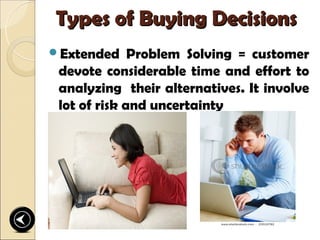
Extended     Problem Solving = customer
 devote considerable time and effort to
 analyzing their alternatives. It involve
 lot of risk and uncertainty
Types of Buying Decisions
Limited  Problem Solving = they have some
 prior experience with the product or service is
 moderate. Customers rely more on their
 personal knowledge than on external
 information.
 Impulse buying
 = buying decision made
 by customers on the spot.
Types of Buying Decisions
Habitual Decision Making = Is
 a purchase decision involving little or no
 conscious effort
 Brand Loyalty means the customers
 like and consistently buy a specific brand
 in a product category.
 Store Loyalty means that customers
 like and habitually visit the same store to
 purchase a type of merchandise.
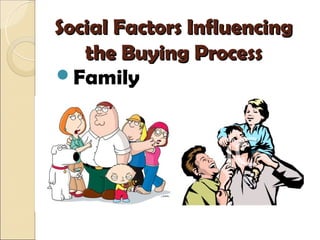
Social Factors Influencing
   the Buying Process
Family
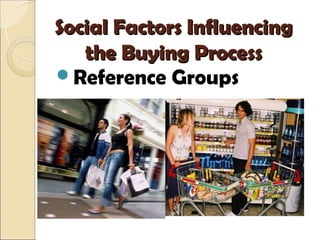
Social Factors Influencing
   the Buying Process
Reference Groups
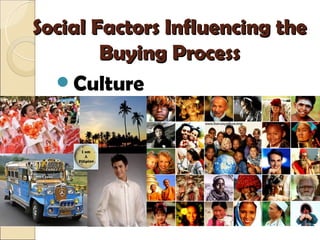
Social Factors Influencing the
        Buying Process
  Culture
Criteria for Evaluating Market
            Segments
 Actionability
 Identifiability
 Accessibility
 Size
Approaches for Segmenting
        Markets
    Geographic Segmentation
    Demographic Segmentation
    Geodemographic Segmentation
    Lifestyle Segmentation
    Buying Situation Segmentation
    Benefit Segmentation
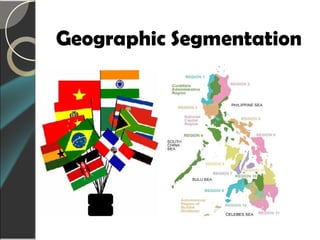
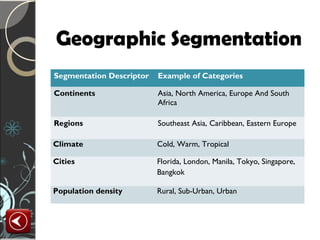
Geographic Segmentation
Segmentation Descriptor   Example of Categories

Continents                Asia, North America, Europe And South
                          Africa

Regions                   Southeast Asia, Caribbean, Eastern Europe

Climate                   Cold, Warm, Tropical

Cities                    Florida, London, Manila, Tokyo, Singapore,
                          Bangkok

Population density        Rural, Sub-Urban, Urban
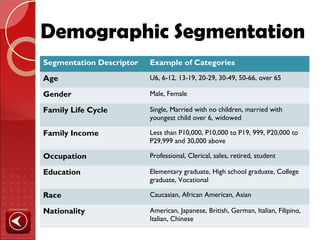
Demographic Segmentation
Segmentation Descriptor   Example of Categories
Age                       U6, 6-12, 13-19, 20-29, 30-49, 50-66, over 65

Gender                    Male, Female

Family Life Cycle         Single, Married with no children, married with
                          youngest child over 6, widowed

Family Income             Less than P10,000, P10,000 to P19, 999, P20,000 to
                          P29,999 and 30,000 above

Occupation                Professional, Clerical, sales, retired, student

Education                 Elementary graduate, High school graduate, College
                          graduate, Vocational

Race                      Caucasian, African American, Asian

Nationality               American, Japanese, British, German, Italian, Filipino,
                          Italian, Chinese
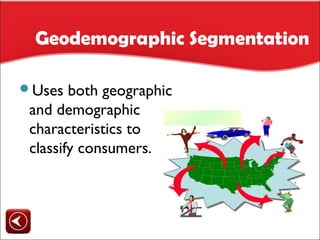
Geodemographic Segmentation

Uses   both geographic
 and demographic
 characteristics to
 classify consumers.
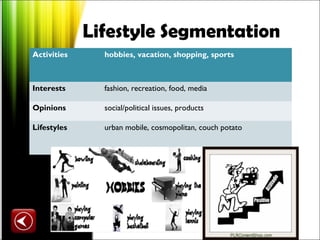
Lifestyle Segmentation
Activities     hobbies, vacation, shopping, sports


Interests      fashion, recreation, food, media

Opinions       social/political issues, products

Lifestyles     urban mobile, cosmopolitan, couch potato
Buying Situation Segmentation


The   buying behavior of customers
 with the same demographics or
 lifestyle can differ depending on their
 buying situation.
Benefit Segmentation

Another   approach for defining a
 target segment is to group
 customers seeking similar benefits.
Summary
   The Buying Process
   Need Recognition
   Types of Needs
   Some Hedonic Needs
   The Types of Buying Decisions
   Social Factors Influencing the Buying
    Process
   Criteria for Evaluating Market Segments
   Approaches for Segmenting Markets
Cont.
      To satisfy customer needs, retailers must
thoroughly understand how customers make
store choice and purchase decisions and the
factors they consider when deciding.
The importance of the stages depends on the
nature of the customer’s decision. When
decisions are important and risky, the buying
process is longer because customers spend more
time and effort on information search and
evaluating alternatives. When buying decisions
are less important to customers, they spend little
time in the buying process, and their buying
behavior may become habitual.
Cont.
      The buying process of consumers is influenced
by their personal beliefs, attitudes, and values and
by their social environmental. The primary social
influences are provided by the consumers’ families,
reference groups, and culture.
      To develop cost effective retail programs,
retailers group customers into segments. Some
approaches for segmenting markets are based on
geography, demographics, geodemographics,
lifestyles, usage situations, and benefits sought.
Because each approach has its advantages and
disadvantages, retailers typically define their target
segment by several characteristics.
The End
   Reported by:
   Nikki Joy Iwan
Miriam Ruth San Jose
 Catherine Briones

Chap. 4. consumer behavior. quiwa

  • 1.
  • 2.
  • 3.
    Stages SELECTING A RETAILER SELECTING AND CHANNEL MERCHANDISE Need recognition Recognize needs Recognize needs Search for information Search for information Information Search about retailers about merchandise Evaluation Evaluate retailers and Evaluate channels merchandise Choice Select a retailer Select and channel merchandise Visit Visit store or internet Purchase site or catalog merchandise Loyalty Repeat patronage Postpurchase of retailer evaluation
  • 4.
  • 5.
    Types of Needs Utilitarian Needs- when consumers go shopping to accomplish a specific task. It is associated with work. Hedonic Needs- when consumers go shopping for pleasure. It is associated with fun.
  • 6.
    Some Hedonic Needs Stimulation Socialexperience Learning new trends Status and power Self-reward Adventure
  • 7.
  • 8.
  • 9.
  • 10.
  • 11.
  • 12.
  • 13.
  • 14.
    Factors influencing theamount of information search include 1. The nature and use of the product being purchased 2. Characteristics of the individual customer 3. Aspects of the market and buying situation in which the purchase is made
  • 15.
    Marketplace and situationalfactors affecting information search include 1. The number of competing brands and retail outlets 2. The time pressure under which the purchase must be made
  • 16.
    Sources of Information Internal Sources – are information in a customer’s memory such as names, images and past experiences with different stores. External Sources – are information provided by ads and other people.
  • 17.
    Purchasing the Merchandiseor Service 1. Don’t stock out of popular merchandise. Have a complete assortment of sizes and colors for customers to buy. For services retailers, have service providers available when customers are ready to place orders. 2. Reduce the risk of purchasing merchandise or services by offering liberal return policies, money-back guarantees, and refunds if the same merchandise is available at a lower price from another retailer.
  • 18.
    Cont. 3. Offer Credit. 4. Make it easy to purchase merchandise by having convenient checkout terminals. 5. Reduce the actual and perceived waiting time in lines at checkout terminals.
  • 19.
    Types of BuyingDecisions Extended Problem Solving Limited Problem Solving Habitual Decision Making
  • 20.
    Types of BuyingDecisions Extended Problem Solving = customer devote considerable time and effort to analyzing their alternatives. It involve lot of risk and uncertainty
  • 21.
    Types of BuyingDecisions Limited Problem Solving = they have some prior experience with the product or service is moderate. Customers rely more on their personal knowledge than on external information. Impulse buying = buying decision made by customers on the spot.
  • 22.
    Types of BuyingDecisions Habitual Decision Making = Is a purchase decision involving little or no conscious effort Brand Loyalty means the customers like and consistently buy a specific brand in a product category. Store Loyalty means that customers like and habitually visit the same store to purchase a type of merchandise.
  • 23.
    Social Factors Influencing the Buying Process Family
  • 24.
    Social Factors Influencing the Buying Process Reference Groups
  • 25.
    Social Factors Influencingthe Buying Process Culture
  • 26.
    Criteria for EvaluatingMarket Segments Actionability Identifiability Accessibility Size
  • 27.
    Approaches for Segmenting Markets Geographic Segmentation Demographic Segmentation Geodemographic Segmentation Lifestyle Segmentation Buying Situation Segmentation Benefit Segmentation
  • 28.
  • 29.
    Geographic Segmentation Segmentation Descriptor Example of Categories Continents Asia, North America, Europe And South Africa Regions Southeast Asia, Caribbean, Eastern Europe Climate Cold, Warm, Tropical Cities Florida, London, Manila, Tokyo, Singapore, Bangkok Population density Rural, Sub-Urban, Urban
  • 30.
  • 31.
    Demographic Segmentation Segmentation Descriptor Example of Categories Age U6, 6-12, 13-19, 20-29, 30-49, 50-66, over 65 Gender Male, Female Family Life Cycle Single, Married with no children, married with youngest child over 6, widowed Family Income Less than P10,000, P10,000 to P19, 999, P20,000 to P29,999 and 30,000 above Occupation Professional, Clerical, sales, retired, student Education Elementary graduate, High school graduate, College graduate, Vocational Race Caucasian, African American, Asian Nationality American, Japanese, British, German, Italian, Filipino, Italian, Chinese
  • 32.
    Geodemographic Segmentation Uses both geographic and demographic characteristics to classify consumers.
  • 33.
    Lifestyle Segmentation Activities hobbies, vacation, shopping, sports Interests fashion, recreation, food, media Opinions social/political issues, products Lifestyles urban mobile, cosmopolitan, couch potato
  • 34.
    Buying Situation Segmentation The buying behavior of customers with the same demographics or lifestyle can differ depending on their buying situation.
  • 35.
    Benefit Segmentation Another approach for defining a target segment is to group customers seeking similar benefits.
  • 36.
    Summary  The Buying Process  Need Recognition  Types of Needs  Some Hedonic Needs  The Types of Buying Decisions  Social Factors Influencing the Buying Process  Criteria for Evaluating Market Segments  Approaches for Segmenting Markets
  • 37.
    Cont. To satisfy customer needs, retailers must thoroughly understand how customers make store choice and purchase decisions and the factors they consider when deciding. The importance of the stages depends on the nature of the customer’s decision. When decisions are important and risky, the buying process is longer because customers spend more time and effort on information search and evaluating alternatives. When buying decisions are less important to customers, they spend little time in the buying process, and their buying behavior may become habitual.
  • 38.
    Cont. The buying process of consumers is influenced by their personal beliefs, attitudes, and values and by their social environmental. The primary social influences are provided by the consumers’ families, reference groups, and culture. To develop cost effective retail programs, retailers group customers into segments. Some approaches for segmenting markets are based on geography, demographics, geodemographics, lifestyles, usage situations, and benefits sought. Because each approach has its advantages and disadvantages, retailers typically define their target segment by several characteristics.
  • 39.
    The End Reported by: Nikki Joy Iwan Miriam Ruth San Jose Catherine Briones