Definition
Channel designrefers to those decisions involving the
development of new marketing channels where none
had existed before or to the modification of existing
channels.
Channel design is presented as a decision faced by the
marketer, and it includes either setting up channels
from scratch or modifying existing channels.
3.
This issometimes referred to as reengineering the
channel and in practice is more common than setting up
channels from scratch.
The term design implies that the marketer is consciously
and actively allocating the distribution tasks to develop
an efficient channel, and the term selection means the
actual selection of channel members.
4.
Con.t
Finally, channel designhas a strategic connotation,
as it will be used as a strategic tool for gaining a
differential advantage.
Who Engages in Channel Design?
Producers and manufacturers, wholesalers, and
retailers all face channel design decisions.
5.
A Paradigm ofthe Channel Design Decision
The channel design decision can be broken down into
seven phases or steps. These are:
Phase 1: Recognizing the Need for a Channel Design
Decision. Many situations can indicate the need for a
channel design decision. Among them are:
1. Developing a new product or product line
2. Aiming an existing product to a new target market
6.
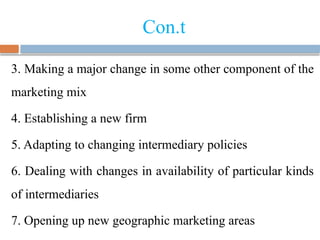
Con.t
3. Making amajor change in some other component of the
marketing mix
4. Establishing a new firm
5. Adapting to changing intermediary policies
6. Dealing with changes in availability of particular kinds
of intermediaries
7. Opening up new geographic marketing areas
7.
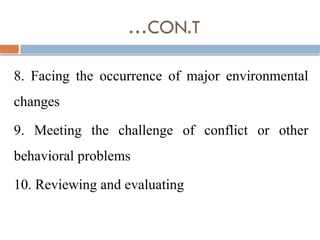
…CON.T
8. Facing theoccurrence of major environmental
changes
9. Meeting the challenge of conflict or other
behavioral problems
10. Reviewing and evaluating
8.
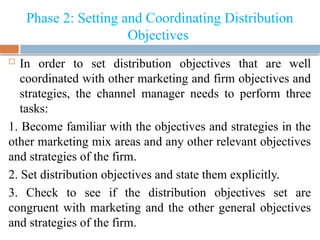
Phase 2: Settingand Coordinating Distribution
Objectives
In order to set distribution objectives that are well
coordinated with other marketing and firm objectives and
strategies, the channel manager needs to perform three
tasks:
1. Become familiar with the objectives and strategies in the
other marketing mix areas and any other relevant objectives
and strategies of the firm.
2. Set distribution objectives and state them explicitly.
3. Check to see if the distribution objectives set are
congruent with marketing and the other general objectives
and strategies of the firm.
9.
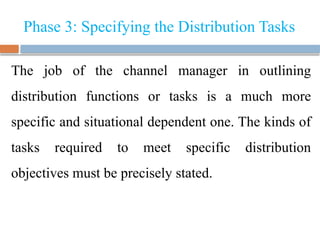
Phase 3: Specifyingthe Distribution Tasks
The job of the channel manager in outlining
distribution functions or tasks is a much more
specific and situational dependent one. The kinds of
tasks required to meet specific distribution
objectives must be precisely stated.
10.
Phase 4: DevelopingPossible Alternative Channel
Structures
The channel manager should consider alternative ways of
allocating distribution objectives to achieve their
distribution tasks. Whether single – or multiple – channel
structures are chosen, the allocation alternatives (possible
channel structures) should be evaluated in terms of the
following three dimensions:
(1) number of levels in the channel
(2) Intensity at the Various Levels
(3) Types of Intermediaries
11.
Phase 5: Evaluatingthe Variables Affecting Channel
Structure
Having laid out alternative channel structures, the
channel manager should then evaluate a number of
variables to determine how they are likely to
influence various channel structures. These six basic
categories are most important:
Market variables the most fundamental variables to
consider when designing a marketing channel.
12.
Con.t
A. Market Geography:refers to the geographical size
of the markets and their physical location and distance
from the producer and manufacturer.
“The greater the distance between the manufacturer
and its markets, the higher the probability that the use
of intermediaries will be less expensive than direct
distribution.”
13.
Con.t
B. Market size: From a channel design standpoint, the
larger the number of individual customers, the larger
the market size. A heuristic about market size relative
to channel structure is: “If the market is large, the use
of intermediaries is more likely to be needed because
of the high transaction costs of serving large numbers
of individual customers.
14.
Con.t
C) Market Density:The number of buying units per unit of land
area determines the density of the market. In general, the less
dense the market, the more difficult and expensive is distribution.
D) Market Behavior :Market behavior refers to the following four
types of buying behaviors: 1) How customers buy
2) When customers buy 3) Where customers buy 4)
Who does the buying? Each of these patterns of buying behavior
may have a significant effect on channel structure.
15.
Con.t
2) Product Variables:Product variables such as bulk
and weight, perishability, unit value etc..
3) Company Variables: The most important
company variables affecting channel design are (A)
size, (B) financial capacity, (C) managerial
expertise, and (D) objectives and strategies.
16.
Con.t
4) Intermediary Variables:The key intermediary
variables related to channel structure are (A)
availability, (B) costs, and (C) the services offered.
5) Environmental Variables
Economic, socio-cultural, competitive, technological,
and legal environmental forces can have a significant
impact on channel structure.
17.
Phase 6: Choosingthe “Best” Channel Structure
In theory, the channel manager should choose an optimal
structure that would offer the desired level of effectiveness in
performing the distribution tasks at the lowest possible cost. the
main emphasis for choosing a channel structure should be based
upon product variables.
Phase 7: Selecting the channel members : is any part of the
network that connects companies with their customers.
18.
Chapter seven (7)
MOTIVATINGTHE CHANNEL MEMBERS
Channel management is necessary, and a
fundamental part of channel management is
that of motivating the channel members.
19.
…CON.T
One ofthe most fundamental and important
aspects of channel management is motivating the
channel members.
Motivation: Refers to the actions taken by the
manufacturer to foster channel member
cooperation in implementing the manufacturer’s
distribution objectives.
20.
Con.t
There are threebasic facets involved in motivation
management:
1. Finding out the needs and problems of channel
members
Before the channel manager can successfully motivate
channel members, an attempt must be made to learn what
the members want for the channel relationship.
21.
CON.T
2. Offering Supportto Channel Members
Support for channel members refers to the manufacturer’s
efforts in helping channel members to meet their needs and
solve their problems.
3. Providing Leadership to Motivate Channel Members
Control must still be exercised through effective
leadership on a continuing basis to attain a well-
motivated team of channel members.
22.
Channel conflict
Channel conflictis generated when one channel
member's actions prevent another channel from
achieving its goal.
Causes of Channel Conflict
Some causes of channel conflict are easy to resolve,
others are not. Conflict may arise from:
23.
Con.t
Goal incompatibility.For example, the manufacturer may
want to achieve rapid market penetration through a low-
price policy. Dealers, in contrast, may prefer to work with
high margins and pursue short-run profitability.
Unclear roles and rights. HP may sell personal computers to
large accounts through its own sales force, but its licensed
dealers may also be trying to sell to large accounts.
24.
Con.t
Territory boundaries andcredit for sales often produce conflict.
Differences in perception. The manufacturer may be
optimistic about the short-term economic outlook and want
dealers to carry higher inventory. Dealers may be
pessimistic. In the beverage category, it is not uncommon for
disputes to arise between manufacturers and their
distributors about the optimal advertising strategy.
25.
Con.t
Intermediaries' dependenceon the manufacturer. The
fortunes of exclusive dealers, such as auto dealers, are
profoundly affected by the manufacturer's product and
pricing decisions. This situation creates a high potential
for conflict.
26.
Types of Conflictand Competition
Suppose a manufacturer sets up a vertical channel
consisting of wholesalers and retailers. The manufacturer
hopes for channel cooperation that will produce greater
profits for each channel member. Yet vertical, horizontal,
and multichannel conflict can occur.
1.Vertical channel conflict: means conflict between
different levels within the same channel.
27.
Con.t
2.Horizontal channel conflictis conflict between members
at the same level within the channel.
3.Multichannel conflict exists when the manufacturer has
established two or more channels that sell to the same
market. It's likely to be especially intense when the
members of one channel get a lower price (based on
larger-volume purchases) or work with a lower margin.
28.
Managing Channel Conflict
Ascompanies add channels to grow sales, they
run the risk of creating channel conflict. The
challenge is not to eliminate conflict but to
manage it better.