Change of Meaning in the History of the English Language
This presentation traces how the meaning of English words changed categorically. The examples are from An Outline History of the English Language by F T Wood.
1. Generalisation (Broadeningof Meaning)
• A word with a specific meaning expands to a broader application.
• Examples:
– Box originally referred to a type of tree and its wood → later applied to small caskets →
now means any container of any size or material.
– Journey once meant a day's travel → now applies to any trip of any length.
– Companion originally meant "one who eats bread with another" → now means a close
friend.
– Nice has expanded in meaning over time, once having a more precise use.
– Common nouns derived from trade names: Vaseline, Hoover, Thermos, Sellotape, Biro
(pen).
– The name of a material applied to objects made from it: iron, copper, tin, glass, paper.
– The name of a container used for the contents: a glass of beer, a box of chocolates, a tin
of biscuits.
3.
2. Specialisation (Narrowingof Meaning)
• A word once used broadly becomes more specific.
• Examples:
– Fowl once meant any bird → now refers specifically to domestic poultry.
– Deer once meant any wild animal → now refers to a specific species.
– Weeds meant clothing → now only survives in widow’s weeds.
– Doom once meant "judgment" → now refers to disaster or fate.
– Meat originally meant any kind of food → now refers specifically to animal
flesh.
– Doctor once meant "teacher" → now commonly refers to a medical professional.
– Voyage once meant any journey → now associated with sea travel.
– Toy originally meant any trivial thing → now means a child’s plaything.
4.
Other Observations:
• Manywords take on more negative meanings over time (stink, lust,
mistress).
• Some words undergo both generalisation and specialisation at
different stages (slay, sack, crate, bushel).
• Specialisation continues in modern times, e.g., Prohibition now
primarily refers to alcohol bans.
5.
3. Extension orTransference, Followed by Differentiation
of Meaning
• Some words undergo a change in meaning through generalization
and specialization.
• This process, called differentiation, allows a word to acquire
additional meanings while retaining its original sense.
• Example: "Wire" originally referred to metallic filament but also
came to mean a telegram due to association.
6.
Other examples:
• "Togive a ring" (telephone call) and "to drop a line" (send a
letter).
• Words like "board" and "book" have multiple meanings.
• Many names of animals, birds, and body parts undergo this change.
• "Crane" (bird and machine), "kite" (bird and toy).
• Body parts: "leg," "arm," "foot," "eye," etc. used metaphorically in
different contexts.
• Some words disguise their original meaning:
• "Window" originally meant "wind-eye" (hole for air), now
replaced by "ventilator".
7.
Diverging Meanings OverTime
• Words can develop meanings that seem opposite or unrelated:
• "Fast" originally meant "firm", but also came to mean "quick-
moving" and "abstaining from food".
• "Fret" meant "to eat", later evolved into "to worry" and
"fretwork" (design).
• "Fine" derived from "finished", leading to meanings of "delicate"
and "high quality".
• "Brand" (originally a burning piece of wood) evolved to mean
quality, trademarks, and branding.
8.
Spelling Variations toShow Meaning Differences
• Some words changed spelling to differentiate meanings:
– "Flour" and "flower" (originally the same word).
– "Curtsey" and "courtesy", "human" and "humane",
"metal" and "mettle".
– "Salon" and "saloon", "posy" (flowers) and "poesy"
(poetry).
– "Antic" (grotesque) and "antique" (old).
9.
4. Association ofIdeas
• Some words took on negative connotations based on social
attitudes:
– "Villain" (originally "labourer") now means a bad person.
– "Tramp" (traveler) now means shabby person.
– "Vulgarity" (from Latin "crowd") came to mean "low-class behavior".
• Words connected to peasants or rural life often took on negative
meanings:
– "Churl" (peasant), "boor", "pagan", "heathen" (country dweller).
– "Lewd" once meant "uneducated", later became "immoral".
10.
4. Association ofIdeas
• Other words evolved through metaphorical use:
– "Dilapidated" (originally meant "unstoned" for ruined stone
buildings) now applies to anything in bad condition.
– "Traffic" originally meant trade, now refers to vehicles.
– "Crescent" (originally meant "growing") came to refer to its
shape.
– "Reek" (originally meant "smoke") now implies a bad smell.
– "Drive" once applied to animals, later to cars and vehicles.
11.
5. Polarisation orColouring of Words
• Words acquire emotional significance over time without etymological
justification.
• Some changes are temporary, while others persist and alter meaning.
• Examples of Words with Changed Connotations
– Gothic (18th century) → Initially meant uncouth or barbarous but later
regained its neutral meaning.
– Enthusiasm (18th century) → Used to mean fanaticism.
– Victorian → Once neutral, later implied disapproval (though less so today).
– Nationalism (first used in 1844) → Originally neutral, now carries a negative
connotation.
– Patriotism → Gained a positive connotation, often contrasted with nationalism.
12.
5. Polarisation orColouring of Words
• The Case of Propaganda
– Initially meant organized religious mission work.
– Later applied to any cause-related publicity.
– Before 1914, it meant informing the public.
– Post-World War I → Shifted to imply misinformation and deception.
– Modern use suggests distortion or falsehood.
• Other Words with Evolving Meanings
– Bolshevik → Once a highly negative term, now mostly historical.
– Anarchist → Initially referred to an idealistic political philosophy but now associated with
lawlessness and violence.
– Harbour → Originally meant to provide shelter but now implies harboring criminals or
undesirable things.
– Fellow → Once an equalizing term but later took on a lower-class or depreciative meaning.
– Amateur → Initially meant someone pursuing a passion but now implies a lack of skill.
13.
6. Loss ofDistinctive Colouring
• Some words lose their controversial or prejudicial connotations over
time.
• Christian → Originally a derogatory term.
• Methodist, Quaker → Once mockery, now accepted.
• Mohammedanism, Freethinker → Once seen negatively, now
neutral.
• Politics, Policy, Politician → Previously associated with dishonesty,
now neutral.
• Brave → Once meant boastful or gaudy, now means courageous.
14.
7. Metaphorical Application
•Many words are used metaphorically, sometimes unconsciously.
• Two main categories:
– Words with both literal and metaphorical meanings (e.g., "keen," "dull," "sharp").
– Words where the metaphorical meaning has replaced the original (e.g., "sad" originally
meant "full," "silly" meant "happy").
• Some metaphorical meanings have become dominant:
– "Crank" (originally a bent object) now means an eccentric person.
– "Bias" (from bowling) now means a prejudice.
– "Hypocrite" (originally meant "actor") now means someone insincere.
– "Broadcast" (originally scattering seeds) now primarily refers to mass communication.
– "Pineapple" (once meant "pine cone") now refers to the tropical fruit.
15.
8. Euphemism
• Euphemismis the practice of using milder terms to describe unpleasant
concepts.
• Common areas where euphemism changes word meanings:
– Death: "Passing" or "falling asleep" instead of "dying."
– Mental illness: "Mental case" instead of "insane."
– Madness: "Simple," "lunatic" (from belief in moon influence), "idiot"
(originally meant "private person").
– Funeral professions: "Undertaker" became "funeral director" due to
negative connotations.
• Some euphemisms lose their original softer intent over time and
require replacements.
16.
9. Prudery
• Someeuphemisms stem from false delicacy, refinement, social
snobbery, or affectation.
• Examples include:
– "Paying guest" for "boarder"
– "Financier" for "moneylender"
– "Turf-accountant" for "bookmaker"
– "Sanitary engineer" for "plumber"
– "Meat purveyor" for "butcher"
– "Interesting event" for "birth"
– "A certain condition" for "pregnancy"
17.
9. Prudery
• Manysuch expressions are temporary, tied to a particular period (e.g., Victorian era).
• The term "trousers" was once considered too improper to mention in mixed company.
• "Expectorate" (for "spit") and "fallen woman" (for "prostitute") were once polite
alternatives.
• Words like "guts" and "belly" were replaced by "stomach" due to Victorian sensibilities.
• "Serviette" was originally considered affected but later became common, replacing
"table-napkin."
• Some words, once euphemisms, are now seen as indelicate:
– "Lavatory" replaced by "toilet"
– "Dung" replaced by "manure," which in turn became "fertilizer"
18.
10. Reversal ofMeaning
• Some words have changed to mean the opposite of their original sense.
• Grocer: Originally meant a wholesaler (from "en gros"), now refers to a
retail trader.
• Restive: Initially meant "stubbornly still," now means "impatient, restless."
• Scan: Originally meant "to read carefully," now often means "to skim
quickly."
• Wiseacre: Once meant "wise person" but now is used ironically to mean a
know-it-all.
19.
11. Popular Misunderstanding
•Misinterpretation of Words
– A student misunderstood "undulating" as meaning "hilly" and created "dulating" to mean
"flat."
– The prefix "un-" in "undulating" is not an English negative but part of the Latin root unda
(wave).
• Words Changing Due to Misunderstanding
– Helpmate: Originally a mistaken reading of "help meet."
– Preposterous: Originally meant "before-after" (illogical order), now means "absurd."
– Premises: From logical arguments to meaning "a property" due to legal usage.
– Transpire: Originally meant "to leak out," now often used incorrectly as "to happen."
– Emergency: Originally meant "emerge," now means "urgent situation."
– Demean: Meant "to conduct oneself," now means "to degrade" due to confusion with "mean."
– Pester: Originally meant "to entangle," changed due to association with "pest."
20.
12. Proper NamesBecoming Common Words
• Dunce: From philosopher Duns Scotus, now means "stupid person."
• Guy: From Guy Fawkes, originally meant an effigy, now means a person.
• Atlas: Named after the Titan, became associated with maps.
• Meander: From a winding river in Asia Minor, now means "to wander
aimlessly."
• Bedlam: From Bethlehem Hospital, originally a lunatic asylum, now means
chaos.
• Maudlin: From Mary Magdalene, associated with excessive sentimentality.
• Hooligan: From a rowdy Irish family in Southwark, now means "violent
troublemaker."
21.
Complex Word Evolutions
•Romance: From Latin for "Roman," later meant adventure stories,
then love stories, now used broadly.
• Bureau: From "cloth" to "desk" to "office" to "government agency."
• Fairy: Originally "fay" (supernatural being), changed meaning over
time.
• Miniature: From minium (red lead used in illustrations) to "small
detailed portrait" to "small version."
• Gossip: Originally "godparent," later "close friend," then "talkative
person," now means spreading rumors.
22.
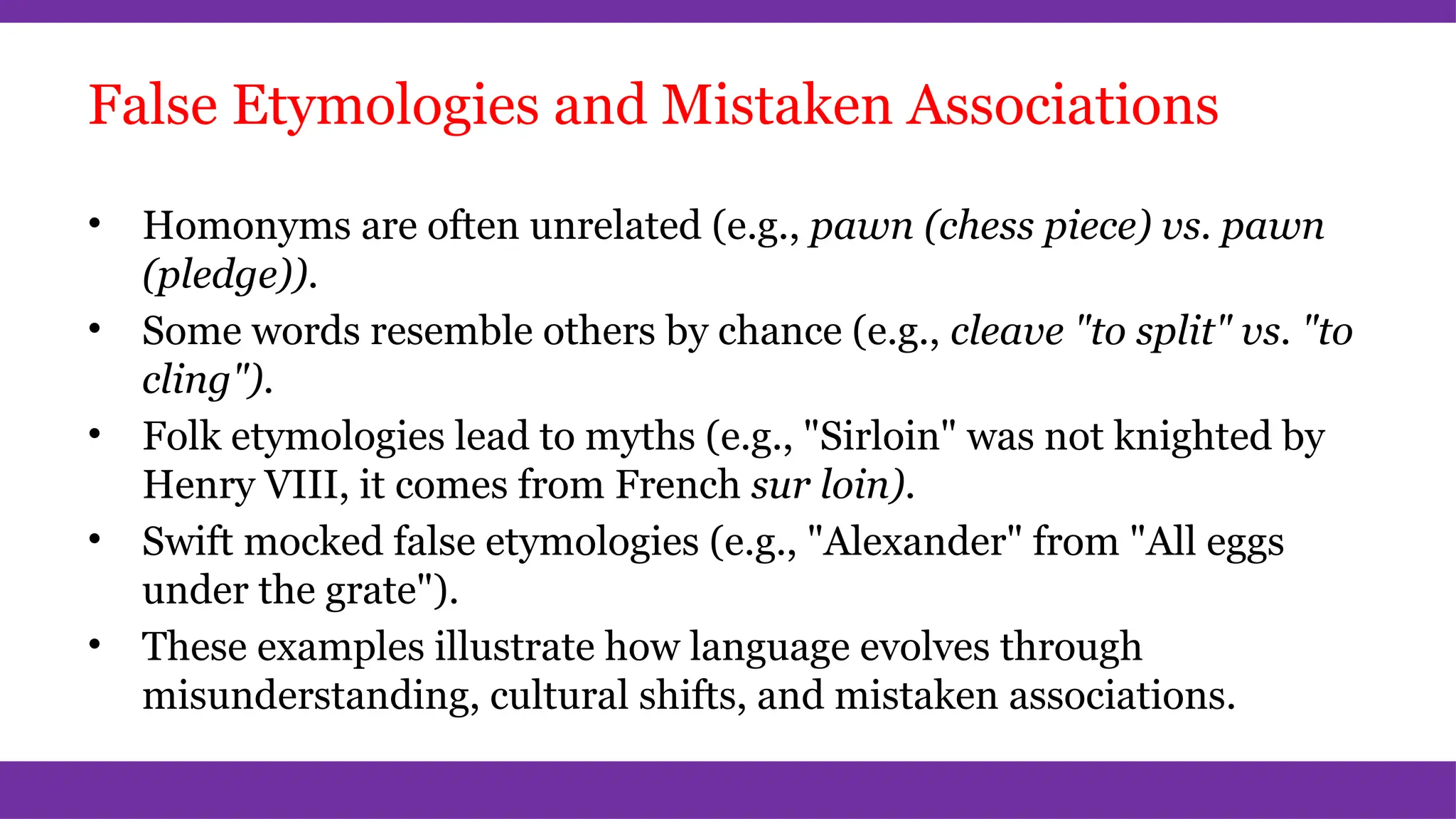
False Etymologies andMistaken Associations
• Homonyms are often unrelated (e.g., pawn (chess piece) vs. pawn
(pledge)).
• Some words resemble others by chance (e.g., cleave "to split" vs. "to
cling").
• Folk etymologies lead to myths (e.g., "Sirloin" was not knighted by
Henry VIII, it comes from French sur loin).
• Swift mocked false etymologies (e.g., "Alexander" from "All eggs
under the grate").
• These examples illustrate how language evolves through
misunderstanding, cultural shifts, and mistaken associations.