COMMON MISCONCEPTIONS
ABOUT RPA
Abhinav Sabharwal Principal
Consultant & Trainer @ School of RPA
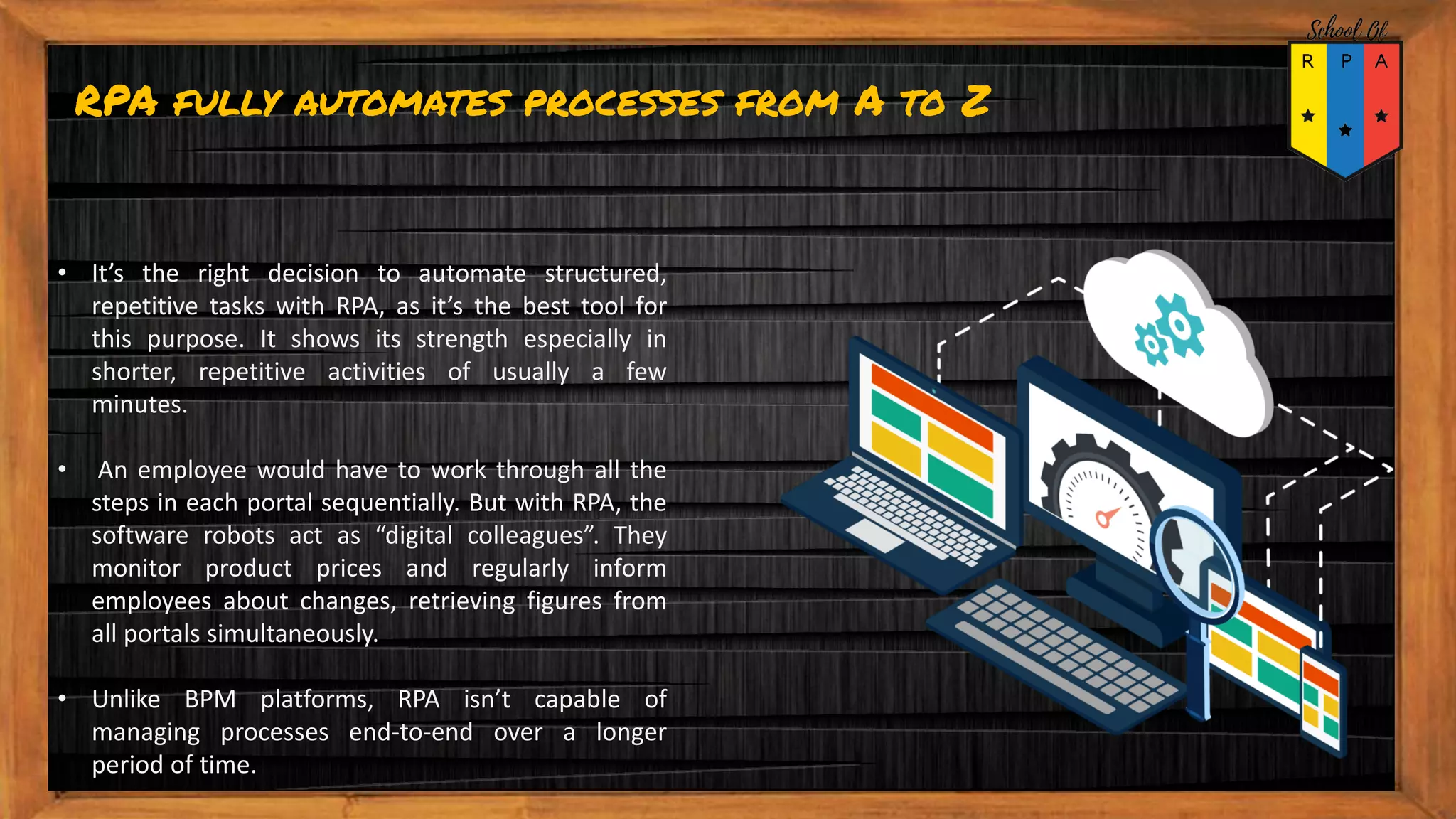
RPA fully automates processes from A to Z
• It’s the right decision to automate structured,
repetitive tasks with RPA, as it’s the best tool for
this purpose. It shows its strength especially in
shorter, repetitive activities of usually a few
minutes.
• An employee would have to work through all the
steps in each portal sequentially. But with RPA, the
software robots act as “digital colleagues”. They
monitor product prices and regularly inform
employees about changes, retrieving figures from
all portals simultaneously.
• Unlike BPM platforms, RPA isn’t capable of
managing processes end-to-end over a longer
period of time.
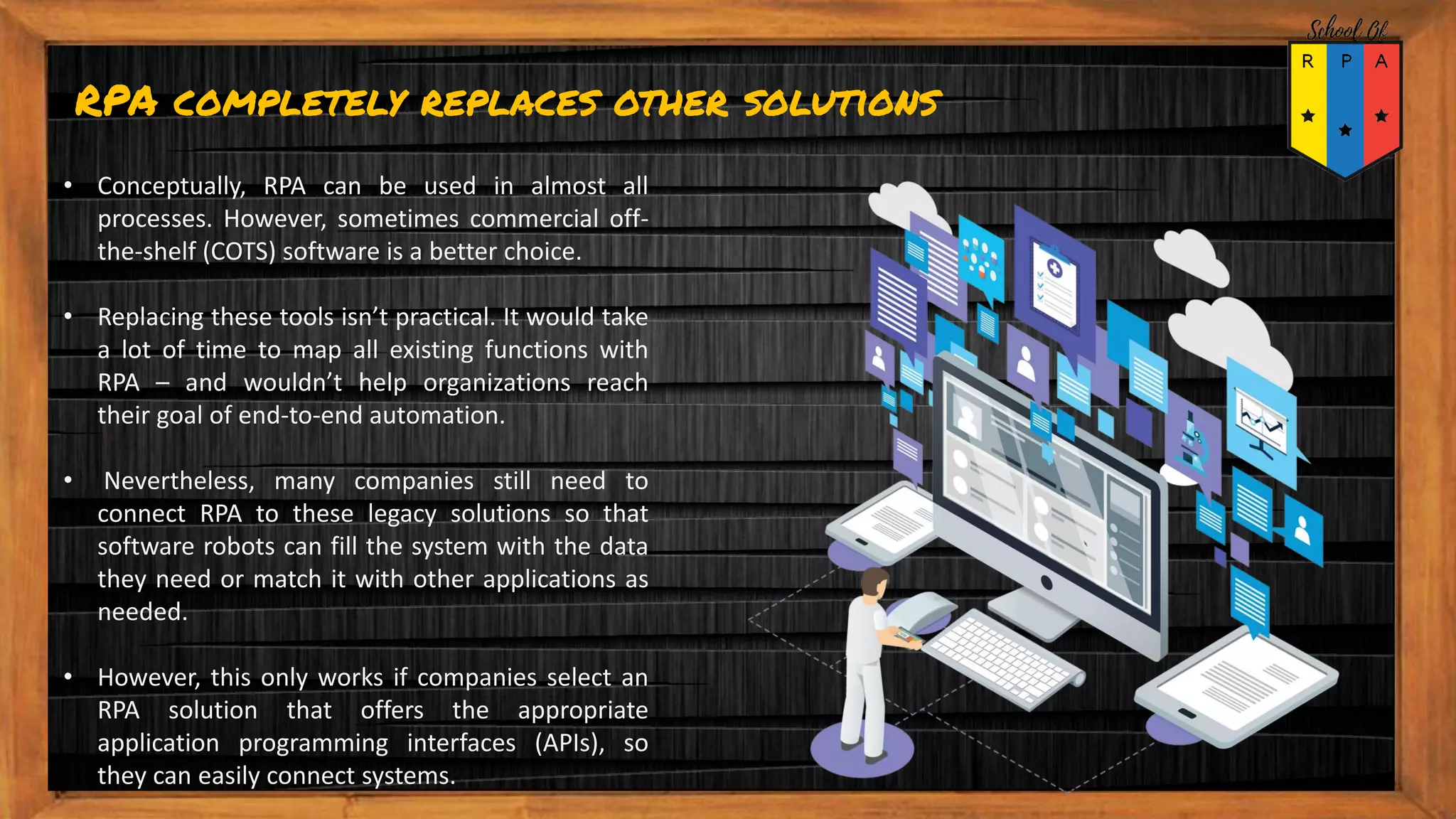
RPA completely replaces other solutions
• Conceptually, RPA can be used in almost all
processes. However, sometimes commercial off-
the-shelf (COTS) software is a better choice.
• Replacing these tools isn’t practical. It would take
a lot of time to map all existing functions with
RPA – and wouldn’t help organizations reach
their goal of end-to-end automation.
• Nevertheless, many companies still need to
connect RPA to these legacy solutions so that
software robots can fill the system with the data
they need or match it with other applications as
needed.
• However, this only works if companies select an
RPA solution that offers the appropriate
application programming interfaces (APIs), so
they can easily connect systems.
RPA automates processes best via user interfaces
• Although in many cases it makes sense to
use existing tools and not simply replace
them with RPA, RPA definitely has its
raison d’être – to integrate different
systems with each other.
• This is a major challenge facing many
companies. Integration is time-consuming
and expensive because some clients, the
web browser or legacy system
applications are difficult to integrate with
modern technologies.
• However, RPA makes it easy to set up an
integration between systems very quickly
via user interfaces (UI). Direct interfaces
such as APIs or web services, are generally
preferred, since these are usually faster
and don’t change as frequently as user
interfaces.
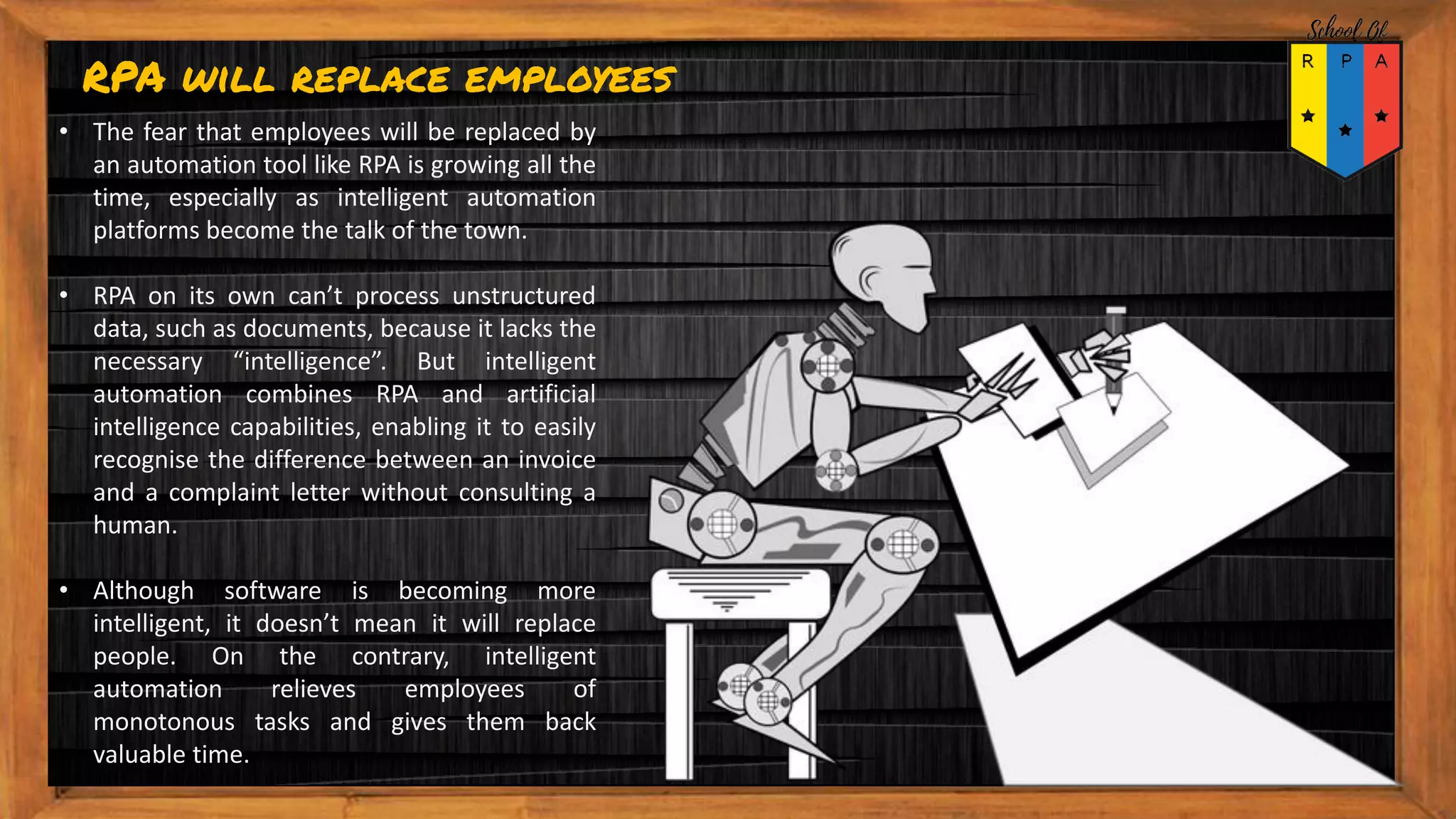
RPA will replace employees
• The fear that employees will be replaced by
an automation tool like RPA is growing all the
time, especially as intelligent automation
platforms become the talk of the town.
• RPA on its own can’t process unstructured
data, such as documents, because it lacks the
necessary “intelligence”. But intelligent
automation combines RPA and artificial
intelligence capabilities, enabling it to easily
recognise the difference between an invoice
and a complaint letter without consulting a
human.
• Although software is becoming more
intelligent, it doesn’t mean it will replace
people. On the contrary, intelligent
automation relieves employees of
monotonous tasks and gives them back
valuable time.
RPA will replace employees
• As RPA is predominantly used for simpler
activities, one might believe that it has no impact
on customer satisfaction. But that’s not true.
• When digital colleagues take over repetitive tasks,
not only are requests processed more quickly, but
employees spend more time building relationships
with customers.
• Another benefit of RPA is that it improves data
quality. According to estimates, about 5 percent of
an organisation’s data is incorrect, either because
information is lost during copying or errors are
made during data entry.
• For example, an employee of an energy supplier
might read the electricity meter and then
accidentally assign the status to another customer
when entering it into the system.
RPA can Automate complex processes immediately
• Companies recognise that RPA offers enormous
optimisation potential. It’s possible to deploy RPA
across the enterprise and even use it for some
complex processes.
• However, companies sometimes make the
mistake of thinking RPA can help them achieve
end-to-end automation. Nevertheless, RPA is
better suited for the automation of tasks rather
than processes.
• The best way to approach end-to-end automation
is to establish a “Centre of Excellence”. It’s
especially important to include business owners
on this project team.
• Companies often begin with the finance
department, where the robots take over the very
time-consuming creation of reports.

6 common misconceptions about rpa

  • 1.
    COMMON MISCONCEPTIONS ABOUT RPA AbhinavSabharwal Principal Consultant & Trainer @ School of RPA
  • 2.
    RPA fully automatesprocesses from A to Z • It’s the right decision to automate structured, repetitive tasks with RPA, as it’s the best tool for this purpose. It shows its strength especially in shorter, repetitive activities of usually a few minutes. • An employee would have to work through all the steps in each portal sequentially. But with RPA, the software robots act as “digital colleagues”. They monitor product prices and regularly inform employees about changes, retrieving figures from all portals simultaneously. • Unlike BPM platforms, RPA isn’t capable of managing processes end-to-end over a longer period of time.
  • 3.
    RPA completely replacesother solutions • Conceptually, RPA can be used in almost all processes. However, sometimes commercial off- the-shelf (COTS) software is a better choice. • Replacing these tools isn’t practical. It would take a lot of time to map all existing functions with RPA – and wouldn’t help organizations reach their goal of end-to-end automation. • Nevertheless, many companies still need to connect RPA to these legacy solutions so that software robots can fill the system with the data they need or match it with other applications as needed. • However, this only works if companies select an RPA solution that offers the appropriate application programming interfaces (APIs), so they can easily connect systems.
  • 4.
    RPA automates processesbest via user interfaces • Although in many cases it makes sense to use existing tools and not simply replace them with RPA, RPA definitely has its raison d’être – to integrate different systems with each other. • This is a major challenge facing many companies. Integration is time-consuming and expensive because some clients, the web browser or legacy system applications are difficult to integrate with modern technologies. • However, RPA makes it easy to set up an integration between systems very quickly via user interfaces (UI). Direct interfaces such as APIs or web services, are generally preferred, since these are usually faster and don’t change as frequently as user interfaces.
  • 5.
    RPA will replaceemployees • The fear that employees will be replaced by an automation tool like RPA is growing all the time, especially as intelligent automation platforms become the talk of the town. • RPA on its own can’t process unstructured data, such as documents, because it lacks the necessary “intelligence”. But intelligent automation combines RPA and artificial intelligence capabilities, enabling it to easily recognise the difference between an invoice and a complaint letter without consulting a human. • Although software is becoming more intelligent, it doesn’t mean it will replace people. On the contrary, intelligent automation relieves employees of monotonous tasks and gives them back valuable time.
  • 6.
    RPA will replaceemployees • As RPA is predominantly used for simpler activities, one might believe that it has no impact on customer satisfaction. But that’s not true. • When digital colleagues take over repetitive tasks, not only are requests processed more quickly, but employees spend more time building relationships with customers. • Another benefit of RPA is that it improves data quality. According to estimates, about 5 percent of an organisation’s data is incorrect, either because information is lost during copying or errors are made during data entry. • For example, an employee of an energy supplier might read the electricity meter and then accidentally assign the status to another customer when entering it into the system.
  • 7.
    RPA can Automatecomplex processes immediately • Companies recognise that RPA offers enormous optimisation potential. It’s possible to deploy RPA across the enterprise and even use it for some complex processes. • However, companies sometimes make the mistake of thinking RPA can help them achieve end-to-end automation. Nevertheless, RPA is better suited for the automation of tasks rather than processes. • The best way to approach end-to-end automation is to establish a “Centre of Excellence”. It’s especially important to include business owners on this project team. • Companies often begin with the finance department, where the robots take over the very time-consuming creation of reports.