Steps To
Creating A
Lasting Digital
Footprint
Abhinav Sabharwal Principal Consultant & Trainer @ School of RPA
People are biased to look for
simple and immediate solutions
that reduce uncertainty,
especially during times of
crises.
No surprise then that digital
transformation efforts driven by
business survival look different
from those that are carefully
planned and prepared. Instead
of a North Star that hovers in the
distance above all digital
initiatives, the overarching
question becomes:
How can we leverage digital
technologies to ensure business
continuity now?
INTRODUCTION
However, avoiding irrevocable
mistakes is critical to ensure a
more long-term oriented
digitalization later.
As one business leader in the
education sector told us: “The
trick is not to squeeze a 3 year
digital program into a 3 month
program.
The trick is to make sure that
what you do today is still
valuable in a few years from
now.”
The following four steps provide
a guideline for companies to
leverage the current momentum
of their digital transformation for
long-term digital success.
INTRODUCTION
1. Create and empower your digital A-team
There has been much discussion
whether digital needs to be driven by a
dedicated team or distributed across
the different parts of the organization.
Prior studies show that an empowered
and well-funded unit is critical for
avoiding unnecessary bureaucracy and
for accelerating implementations,
especially in times of high pressure.
When we compared successful and
failed digital transformations, one major
distinguishing aspect stood out:
successful digital teams were able to hit
the ground running from the get-go.
That is, while the skills and expertise of
team members are surely important, it
was the organizational environment and
support that was in place to support the
digital take-off.
1. Create and empower your digital A-team
Successful digital teams report directly
to the CEO, have enough funding
available to make a real impact, and
own the decision rights to actually
effect change on an organization-wide
scale. Leveraging digital talent, a Chief
Digital Officer (CDO) who has proven
transformation experience, and a core
digital team comprising diverse
competencies and an entrepreneurial
spirit are key. Reporting directly to the
CEO, Jouret built a centralized team
with dedicated funding to “make the
rest of ABB more digital.”
2. Do not lose track of complementary technologies to RPA
• When artificial intelligence is
combined with traditional
automation tools, it enables the
automation of increasingly complex
processes.
• The more complex a process, the
more likely that its automation
requires joint work from RPA and
Impersonalised offers and
promotions, internal communication
monitoring, customer queries, risk
exposure monitoring, personalised
financial advice, etc.,
3. Make sure to capture great ideas
• Organizations that implement a
systematic ideation approach not
only benefit from enhanced
innovation, but also improved
communication, better workplace
satisfaction, and the ability to spot
changes in their business landscape
before their competitors. During a
crisis, actively scouting
and leveraging great ideas is
essential. The recent burst of open
innovation during the pandemic
shows the vast potential of creating
value with front-line employees,
customers, and partners. For open
innovation to be successful, diversity
among partners is key. In fact, the
best ideas may come from
unexpected places.
3. Make sure to capture great ideas
• At the peak of the pandemic,
Scandinavian trucking giant Scania
for example established a shared
command centre with the Karolinska
Hospital in Stockholm in a common
effort to make sure that the supply
for personal protective equipment
for healthcare workers is ensured.
3. Make sure to capture great ideas
• Great ideas are generated both
internally and externally - from
employees, customers, suppliers, and
partners.
• To effectively leverage the creative
power of their networks, companies
need a systematic approach to
capture ideas and funnel them into a
pipeline for evaluation and
prioritization.
• Leading organizations have set up
clear processes and the appropriate
tools/platforms that help them to
manage a constant flow of ideas.
• It represented a strategic pivot, from
viewing their customers as “hackers”
infringing copyright to actively
leveraging them to feed LEGO’s
product development
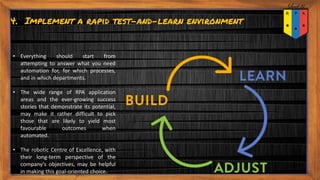
4. Implement a rapid test-and-learn environment
• Everything should start from
attempting to answer what you need
automation for, for which processes,
and in which departments.
• The wide range of RPA application
areas and the ever-growing success
stories that demonstrate its potential,
may make it rather difficult to pick
those that are likely to yield most
favourable outcomes when
automated.
• The robotic Centre of Excellence, with
their long-term perspective of the
company’s objectives, may be helpful
in making this goal-oriented choice.
5. Plan for long-term success beyond survival
• Upon identifying routine, high
volume, stable processes with
measurable savings, as well as the
pitfalls of manual processing that can
be more easily avoided with
automation
• The best-fit candidates for RPA will be
the tasks with the most significant
effect on accelerating and amplifying
the return on investment.
• With this knowledge in mind, it will
be easier to prioritise the most
relevant use cases for the attainment
of your business goals.
Want to Learn RPA FROM US
CALL US ON
Phone :+91 900 480 9189
Email: info@schoolofrpa.co.in
Watch RPA Videos on Our You Tube Channel
https://www.youtube.com/channel/UCvPTB
1snZvxLr2XjSxE8BQg

4 steps to creating a lasting digital footprint

  • 1.
    Steps To Creating A LastingDigital Footprint Abhinav Sabharwal Principal Consultant & Trainer @ School of RPA
  • 2.
    People are biasedto look for simple and immediate solutions that reduce uncertainty, especially during times of crises. No surprise then that digital transformation efforts driven by business survival look different from those that are carefully planned and prepared. Instead of a North Star that hovers in the distance above all digital initiatives, the overarching question becomes: How can we leverage digital technologies to ensure business continuity now? INTRODUCTION
  • 3.
    However, avoiding irrevocable mistakesis critical to ensure a more long-term oriented digitalization later. As one business leader in the education sector told us: “The trick is not to squeeze a 3 year digital program into a 3 month program. The trick is to make sure that what you do today is still valuable in a few years from now.” The following four steps provide a guideline for companies to leverage the current momentum of their digital transformation for long-term digital success. INTRODUCTION
  • 4.
    1. Create andempower your digital A-team There has been much discussion whether digital needs to be driven by a dedicated team or distributed across the different parts of the organization. Prior studies show that an empowered and well-funded unit is critical for avoiding unnecessary bureaucracy and for accelerating implementations, especially in times of high pressure. When we compared successful and failed digital transformations, one major distinguishing aspect stood out: successful digital teams were able to hit the ground running from the get-go. That is, while the skills and expertise of team members are surely important, it was the organizational environment and support that was in place to support the digital take-off.
  • 5.
    1. Create andempower your digital A-team Successful digital teams report directly to the CEO, have enough funding available to make a real impact, and own the decision rights to actually effect change on an organization-wide scale. Leveraging digital talent, a Chief Digital Officer (CDO) who has proven transformation experience, and a core digital team comprising diverse competencies and an entrepreneurial spirit are key. Reporting directly to the CEO, Jouret built a centralized team with dedicated funding to “make the rest of ABB more digital.”
  • 6.
    2. Do notlose track of complementary technologies to RPA • When artificial intelligence is combined with traditional automation tools, it enables the automation of increasingly complex processes. • The more complex a process, the more likely that its automation requires joint work from RPA and Impersonalised offers and promotions, internal communication monitoring, customer queries, risk exposure monitoring, personalised financial advice, etc.,
  • 7.
    3. Make sureto capture great ideas • Organizations that implement a systematic ideation approach not only benefit from enhanced innovation, but also improved communication, better workplace satisfaction, and the ability to spot changes in their business landscape before their competitors. During a crisis, actively scouting and leveraging great ideas is essential. The recent burst of open innovation during the pandemic shows the vast potential of creating value with front-line employees, customers, and partners. For open innovation to be successful, diversity among partners is key. In fact, the best ideas may come from unexpected places.
  • 8.
    3. Make sureto capture great ideas • At the peak of the pandemic, Scandinavian trucking giant Scania for example established a shared command centre with the Karolinska Hospital in Stockholm in a common effort to make sure that the supply for personal protective equipment for healthcare workers is ensured.
  • 9.
    3. Make sureto capture great ideas • Great ideas are generated both internally and externally - from employees, customers, suppliers, and partners. • To effectively leverage the creative power of their networks, companies need a systematic approach to capture ideas and funnel them into a pipeline for evaluation and prioritization. • Leading organizations have set up clear processes and the appropriate tools/platforms that help them to manage a constant flow of ideas. • It represented a strategic pivot, from viewing their customers as “hackers” infringing copyright to actively leveraging them to feed LEGO’s product development
  • 10.
    4. Implement arapid test-and-learn environment • Everything should start from attempting to answer what you need automation for, for which processes, and in which departments. • The wide range of RPA application areas and the ever-growing success stories that demonstrate its potential, may make it rather difficult to pick those that are likely to yield most favourable outcomes when automated. • The robotic Centre of Excellence, with their long-term perspective of the company’s objectives, may be helpful in making this goal-oriented choice.
  • 11.
    5. Plan forlong-term success beyond survival • Upon identifying routine, high volume, stable processes with measurable savings, as well as the pitfalls of manual processing that can be more easily avoided with automation • The best-fit candidates for RPA will be the tasks with the most significant effect on accelerating and amplifying the return on investment. • With this knowledge in mind, it will be easier to prioritise the most relevant use cases for the attainment of your business goals.
  • 12.
    Want to LearnRPA FROM US CALL US ON Phone :+91 900 480 9189 Email: info@schoolofrpa.co.in Watch RPA Videos on Our You Tube Channel https://www.youtube.com/channel/UCvPTB 1snZvxLr2XjSxE8BQg