28th October, 2021
Volunteering for All –
Scotland’s national framework
the story so far
Volunteer Scotland AGM
Alan Stevenson, CEO, Volunteer Scotland
from framework into action
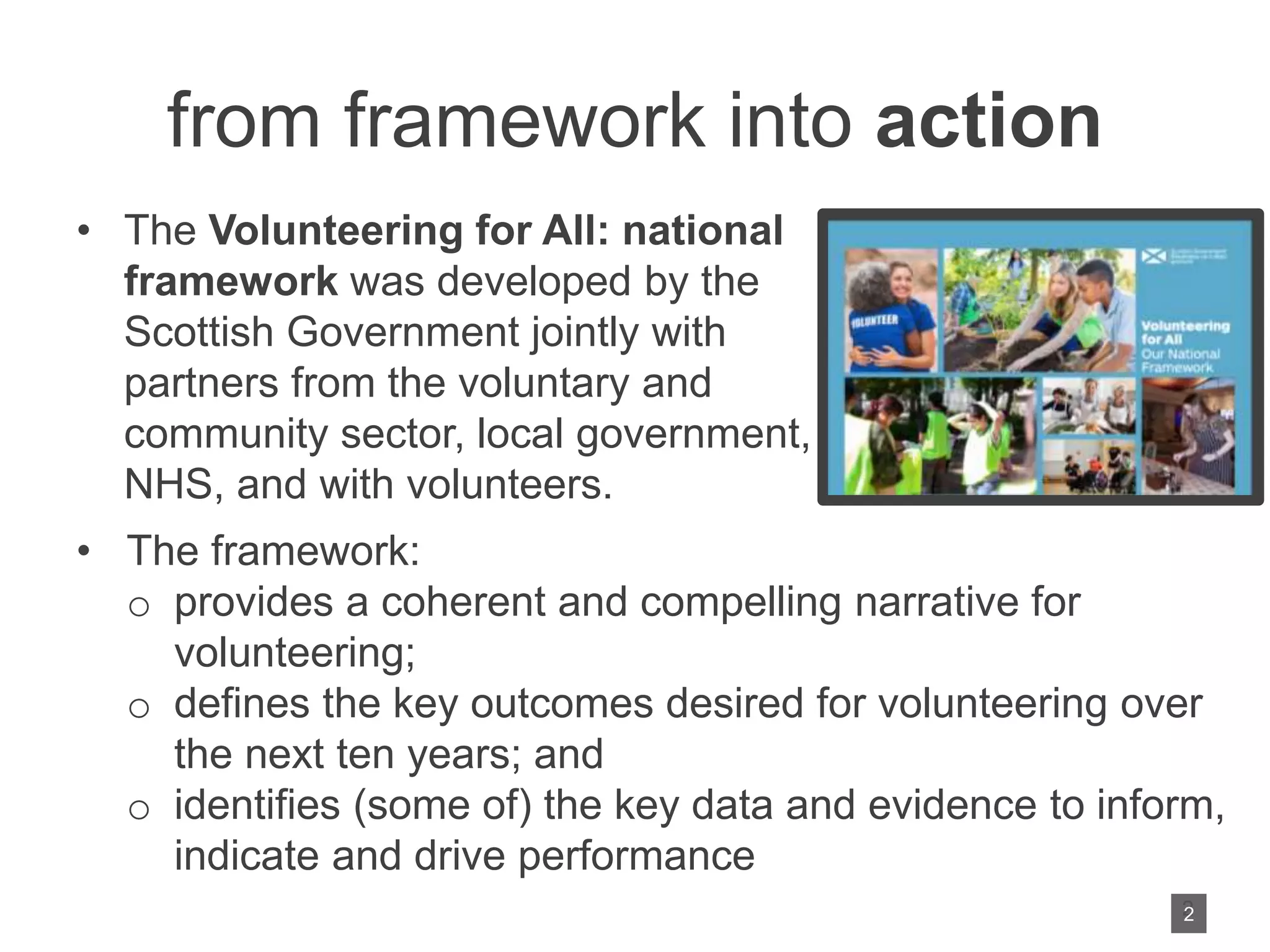
• The Volunteering for All: national
framework was developed by the
Scottish Government jointly with
partners from the voluntary and
community sector, local government,
NHS, and with volunteers.
2
• The framework:
o provides a coherent and compelling narrative for
volunteering;
o defines the key outcomes desired for volunteering over
the next ten years; and
o identifies (some of) the key data and evidence to inform,
indicate and drive performance
2
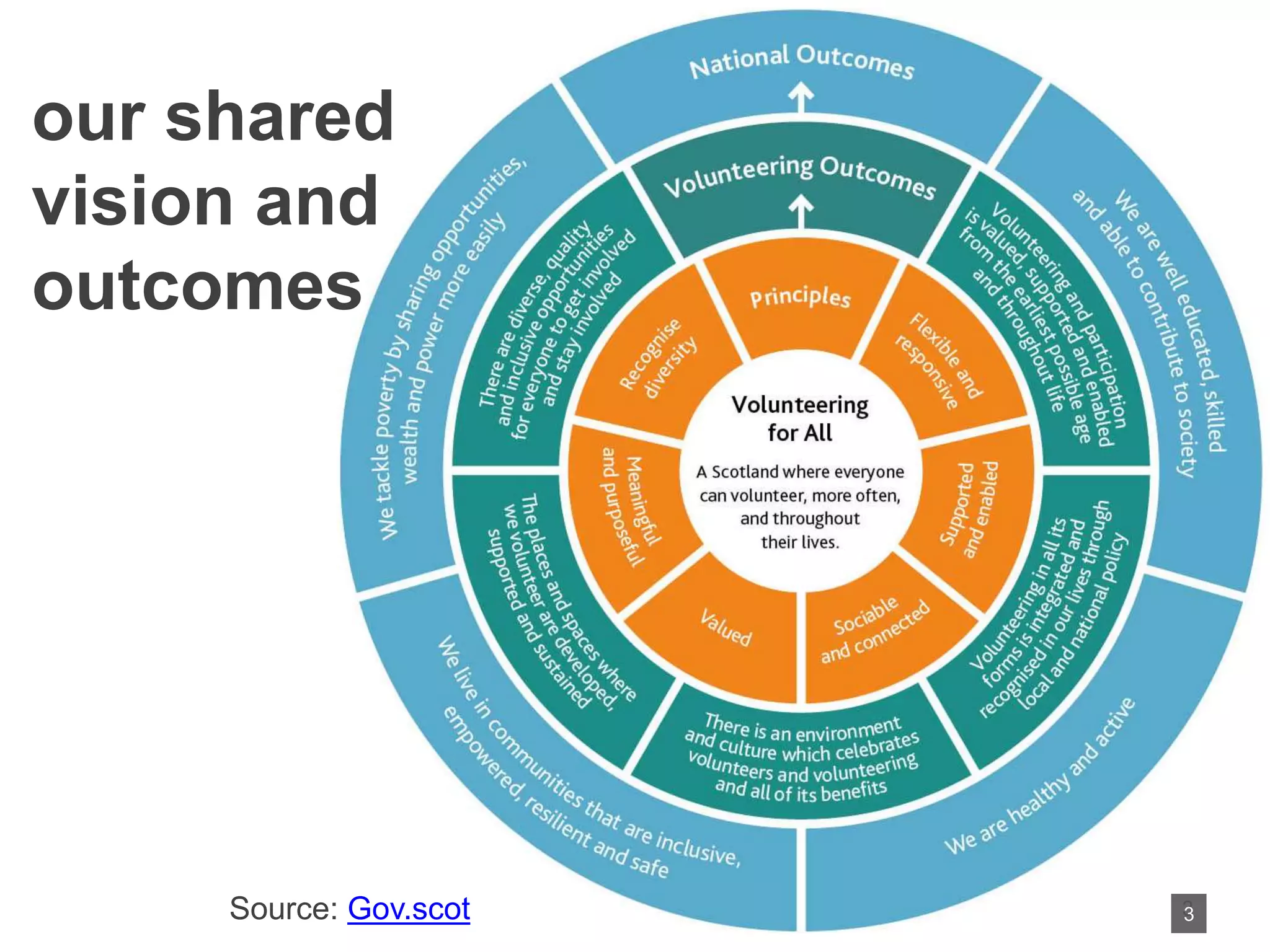
our shared
vision and
outcomes
3
Source: Gov.scot 3
from framework into action
• The Volunteering Action Plan provides ‘actions
on the ground’ achieved through co-production,
learning and a spirit of reciprocity.
• Within the timeframe of 1 year we’ll translate five
outcome areas into specific actions. The ‘Plan’ will
be a ‘living document’ which will facilitate and
enable future actions over the next decade.
• The Plan’s development is modelled on the
Human Learning Systems (HLS) approach to
public management, which is a response to
complexity developed by Dr Toby Lowe and
Collaborate CIC.
4
4
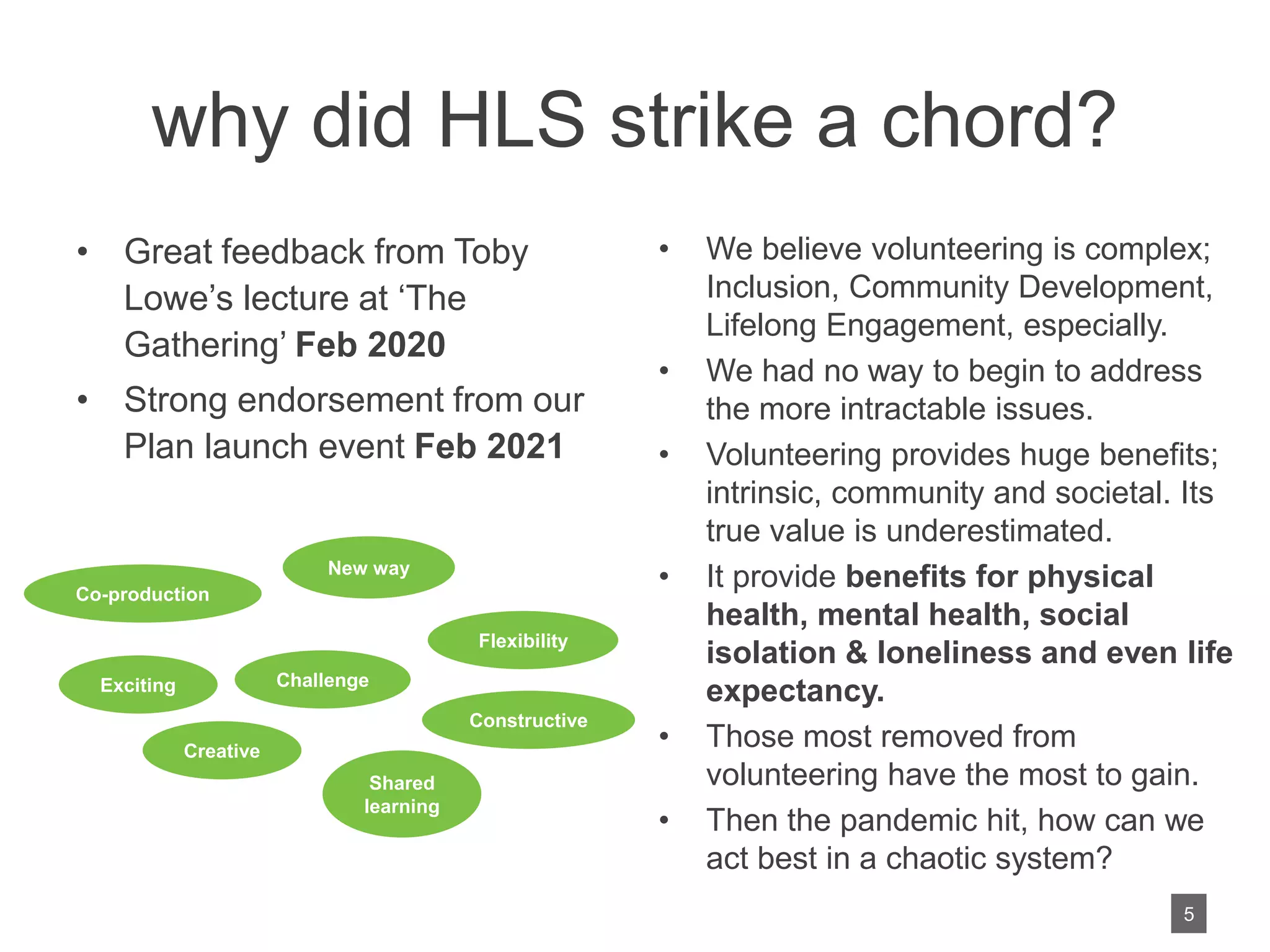
why did HLS strike a chord?
• Great feedback from Toby
Lowe’s lecture at ‘The
Gathering’ Feb 2020
• Strong endorsement from our
Plan launch event Feb 2021
• We believe volunteering is complex;
Inclusion, Community Development,
Lifelong Engagement, especially.
• We had no way to begin to address
the more intractable issues.
• Volunteering provides huge benefits;
intrinsic, community and societal. Its
true value is underestimated.
• It provide benefits for physical
health, mental health, social
isolation & loneliness and even life
expectancy.
• Those most removed from
volunteering have the most to gain.
• Then the pandemic hit, how can we
act best in a chaotic system?
New way
Creative
Challenge
Exciting
Shared
learning
Constructive
Flexibility
Co-production
5
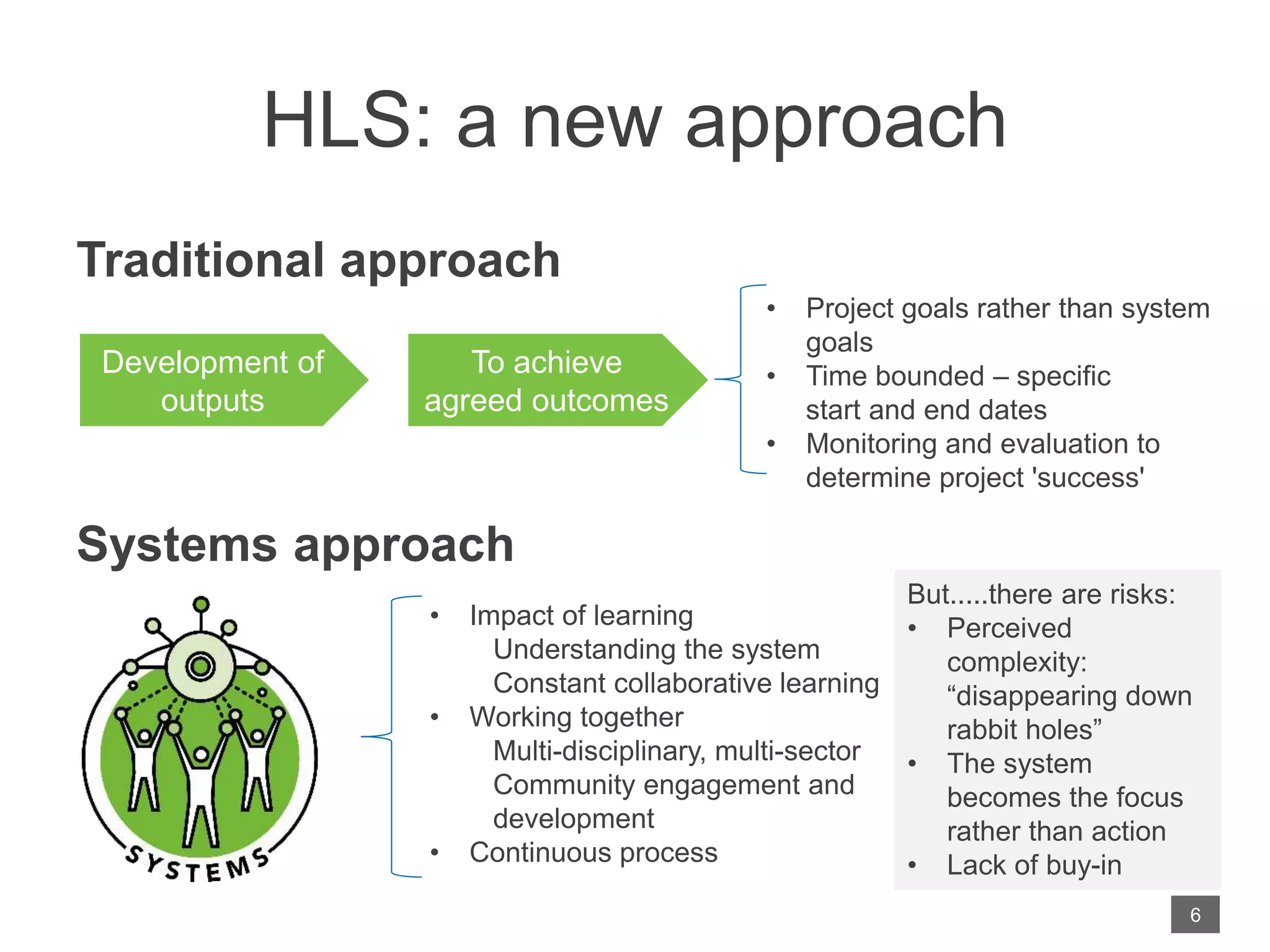
HLS: a new approach
Traditional approach
Systems approach
Development of
outputs
To achieve
agreed outcomes
• Project goals rather than system
goals
• Time bounded – specific
start and end dates
• Monitoring and evaluation to
determine project 'success'
6
• Impact of learning
Understanding the system
Constant collaborative learning
• Working together
Multi-disciplinary, multi-sector
Community engagement and
development
• Continuous process
But.....there are risks:
• Perceived
complexity:
“disappearing down
rabbit holes”
• The system
becomes the focus
rather than action
• Lack of buy-in
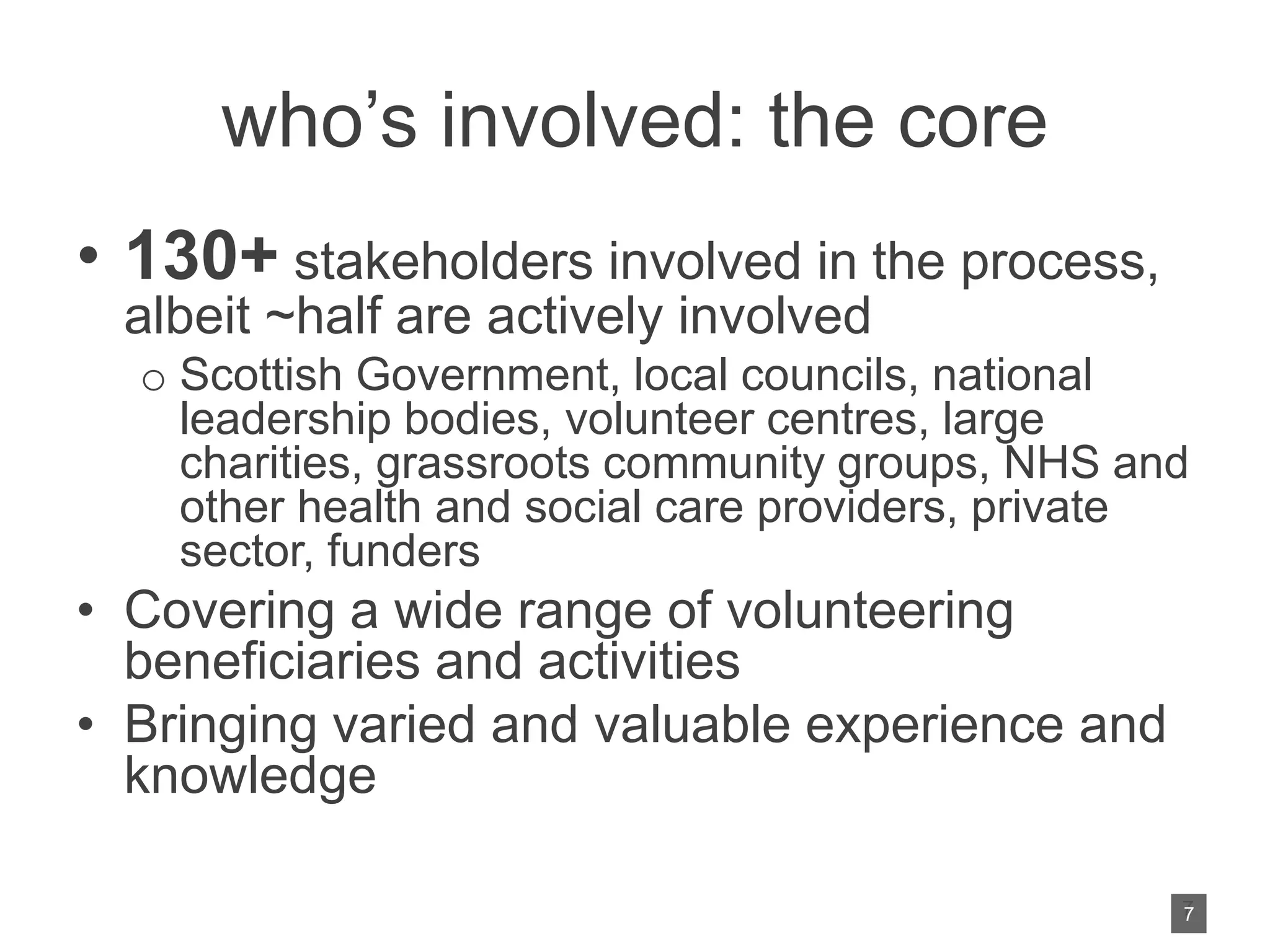
who’s involved: the core
• 130+ stakeholders involved in the process,
albeit ~half are actively involved
o Scottish Government, local councils, national
leadership bodies, volunteer centres, large
charities, grassroots community groups, NHS and
other health and social care providers, private
sector, funders
• Covering a wide range of volunteering
beneficiaries and activities
• Bringing varied and valuable experience and
knowledge
7
7
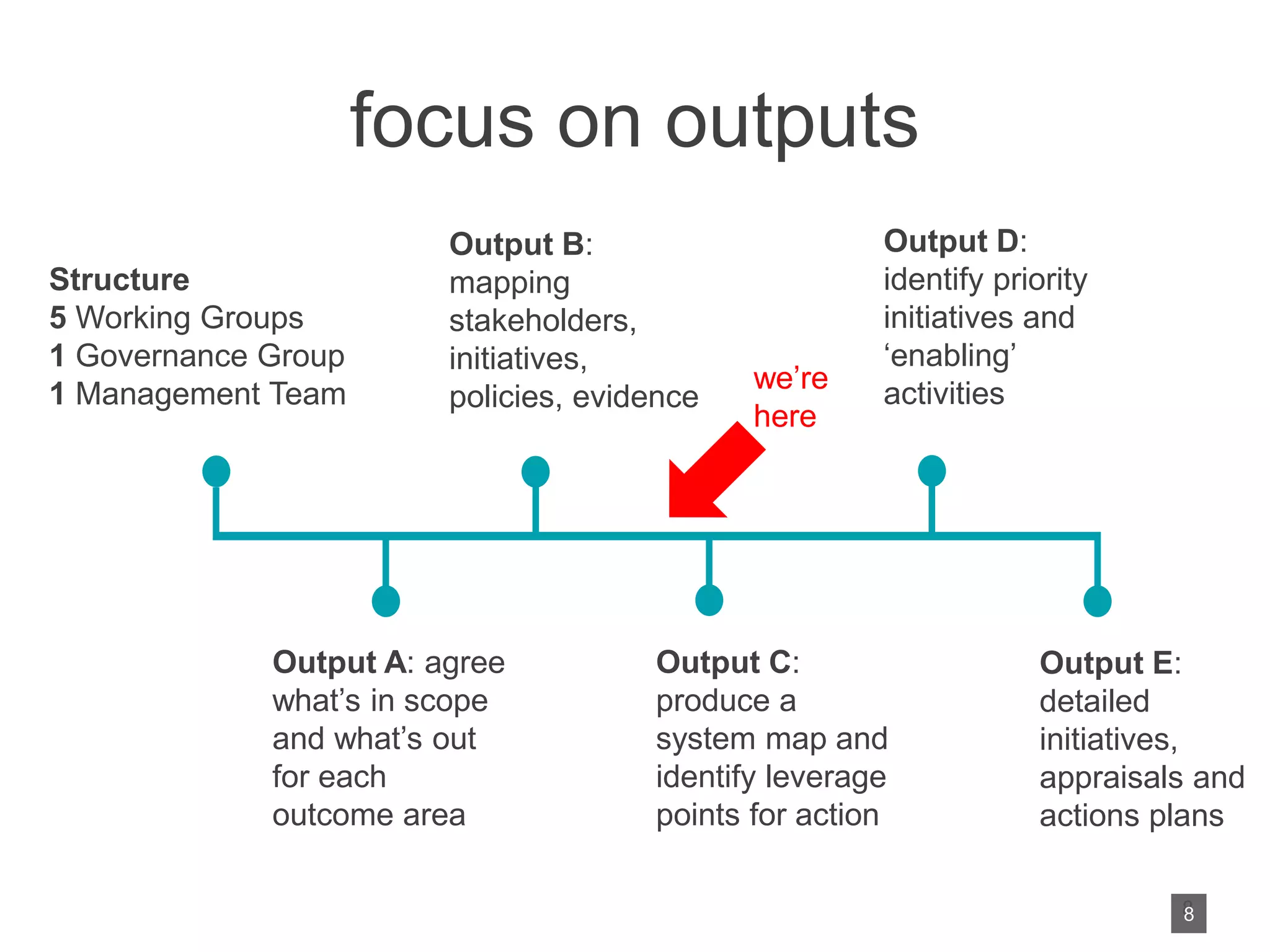
focus on outputs
8
Output A: agree
what’s in scope
and what’s out
for each
outcome area
Structure
5 Working Groups
1 Governance Group
1 Management Team
Output B:
mapping
stakeholders,
initiatives,
policies, evidence
Output C:
produce a
system map and
identify leverage
points for action
we’re
here
Output D:
identify priority
initiatives and
‘enabling’
activities
Output E:
detailed
initiatives,
appraisals and
actions plans
8
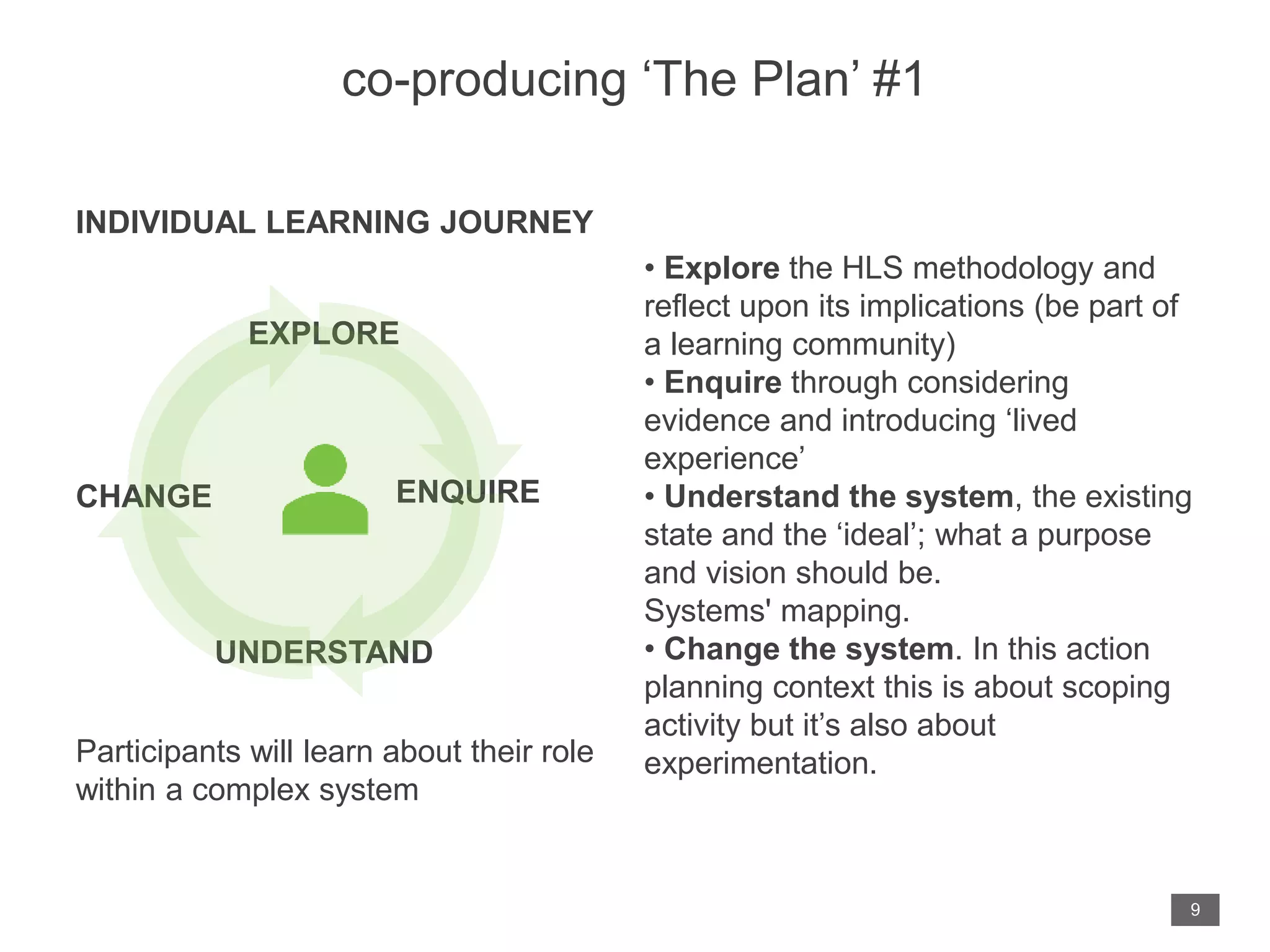
co-producing ‘The Plan’ #1
9
EXPLORE
ENQUIRE
UNDERSTAND
CHANGE
• Explore the HLS methodology and
reflect upon its implications (be part of
a learning community)
• Enquire through considering
evidence and introducing ‘lived
experience’
• Understand the system, the existing
state and the ‘ideal’; what a purpose
and vision should be.
Systems' mapping.
• Change the system. In this action
planning context this is about scoping
activity but it’s also about
experimentation.
INDIVIDUAL LEARNING JOURNEY
Participants will learn about their role
within a complex system
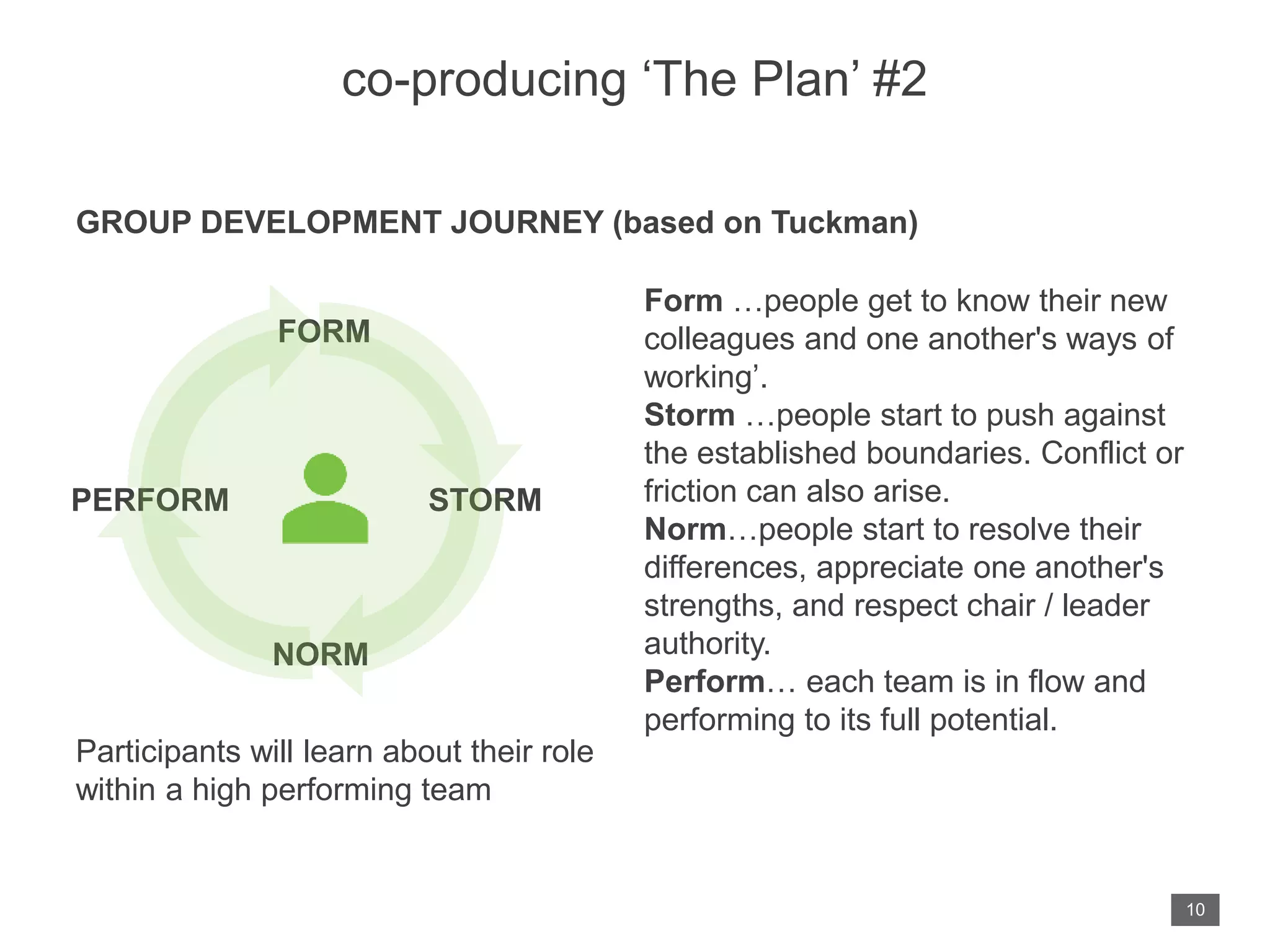
co-producing ‘The Plan’ #2
10
FORM
STORM
NORM
PERFORM
Form …people get to know their new
colleagues and one another's ways of
working’.
Storm …people start to push against
the established boundaries. Conflict or
friction can also arise.
Norm…people start to resolve their
differences, appreciate one another's
strengths, and respect chair / leader
authority.
Perform… each team is in flow and
performing to its full potential.
GROUP DEVELOPMENT JOURNEY (based on Tuckman)
Participants will learn about their role
within a high performing team
supporting the ‘Plan’…
• Group and participant resources:
– The Participant Handbook
– Learning lunch sessions
– Evidence sessions / clinics for each outcome area
– Resource library
– Support issues arising addressed by Management Team
• Communications:
– Meet ups: governance group, management team, chairs,
working groups and individual check-ins
– Participant communications (#Slack, Emails, Email newsletter)
11
11
implementing the ‘Plan’…
• Your involvement in this process:
– You may already be participating
– Voice and influence
– Kept informed
– Part of a learning community?
– Become a System Steward?
• Key next steps:
– Group outputs (specifying action)
– Action plan development (writing the plan)
– External communications and engagement
12
12
Thank you
Alan Stevenson
alan.stevenson@VolunteerScotland.org.uk

Change Calling: VAP intro

  • 1.
    28th October, 2021 Volunteeringfor All – Scotland’s national framework the story so far Volunteer Scotland AGM Alan Stevenson, CEO, Volunteer Scotland
  • 2.
    from framework intoaction • The Volunteering for All: national framework was developed by the Scottish Government jointly with partners from the voluntary and community sector, local government, NHS, and with volunteers. 2 • The framework: o provides a coherent and compelling narrative for volunteering; o defines the key outcomes desired for volunteering over the next ten years; and o identifies (some of) the key data and evidence to inform, indicate and drive performance 2
  • 3.
  • 4.
    from framework intoaction • The Volunteering Action Plan provides ‘actions on the ground’ achieved through co-production, learning and a spirit of reciprocity. • Within the timeframe of 1 year we’ll translate five outcome areas into specific actions. The ‘Plan’ will be a ‘living document’ which will facilitate and enable future actions over the next decade. • The Plan’s development is modelled on the Human Learning Systems (HLS) approach to public management, which is a response to complexity developed by Dr Toby Lowe and Collaborate CIC. 4 4
  • 5.
    why did HLSstrike a chord? • Great feedback from Toby Lowe’s lecture at ‘The Gathering’ Feb 2020 • Strong endorsement from our Plan launch event Feb 2021 • We believe volunteering is complex; Inclusion, Community Development, Lifelong Engagement, especially. • We had no way to begin to address the more intractable issues. • Volunteering provides huge benefits; intrinsic, community and societal. Its true value is underestimated. • It provide benefits for physical health, mental health, social isolation & loneliness and even life expectancy. • Those most removed from volunteering have the most to gain. • Then the pandemic hit, how can we act best in a chaotic system? New way Creative Challenge Exciting Shared learning Constructive Flexibility Co-production 5
  • 6.
    HLS: a newapproach Traditional approach Systems approach Development of outputs To achieve agreed outcomes • Project goals rather than system goals • Time bounded – specific start and end dates • Monitoring and evaluation to determine project 'success' 6 • Impact of learning Understanding the system Constant collaborative learning • Working together Multi-disciplinary, multi-sector Community engagement and development • Continuous process But.....there are risks: • Perceived complexity: “disappearing down rabbit holes” • The system becomes the focus rather than action • Lack of buy-in
  • 7.
    who’s involved: thecore • 130+ stakeholders involved in the process, albeit ~half are actively involved o Scottish Government, local councils, national leadership bodies, volunteer centres, large charities, grassroots community groups, NHS and other health and social care providers, private sector, funders • Covering a wide range of volunteering beneficiaries and activities • Bringing varied and valuable experience and knowledge 7 7
  • 8.
    focus on outputs 8 OutputA: agree what’s in scope and what’s out for each outcome area Structure 5 Working Groups 1 Governance Group 1 Management Team Output B: mapping stakeholders, initiatives, policies, evidence Output C: produce a system map and identify leverage points for action we’re here Output D: identify priority initiatives and ‘enabling’ activities Output E: detailed initiatives, appraisals and actions plans 8
  • 9.
    co-producing ‘The Plan’#1 9 EXPLORE ENQUIRE UNDERSTAND CHANGE • Explore the HLS methodology and reflect upon its implications (be part of a learning community) • Enquire through considering evidence and introducing ‘lived experience’ • Understand the system, the existing state and the ‘ideal’; what a purpose and vision should be. Systems' mapping. • Change the system. In this action planning context this is about scoping activity but it’s also about experimentation. INDIVIDUAL LEARNING JOURNEY Participants will learn about their role within a complex system
  • 10.
    co-producing ‘The Plan’#2 10 FORM STORM NORM PERFORM Form …people get to know their new colleagues and one another's ways of working’. Storm …people start to push against the established boundaries. Conflict or friction can also arise. Norm…people start to resolve their differences, appreciate one another's strengths, and respect chair / leader authority. Perform… each team is in flow and performing to its full potential. GROUP DEVELOPMENT JOURNEY (based on Tuckman) Participants will learn about their role within a high performing team
  • 11.
    supporting the ‘Plan’… •Group and participant resources: – The Participant Handbook – Learning lunch sessions – Evidence sessions / clinics for each outcome area – Resource library – Support issues arising addressed by Management Team • Communications: – Meet ups: governance group, management team, chairs, working groups and individual check-ins – Participant communications (#Slack, Emails, Email newsletter) 11 11
  • 12.
    implementing the ‘Plan’… •Your involvement in this process: – You may already be participating – Voice and influence – Kept informed – Part of a learning community? – Become a System Steward? • Key next steps: – Group outputs (specifying action) – Action plan development (writing the plan) – External communications and engagement 12 12
  • 13.