Impact of COVID-19
on Charities
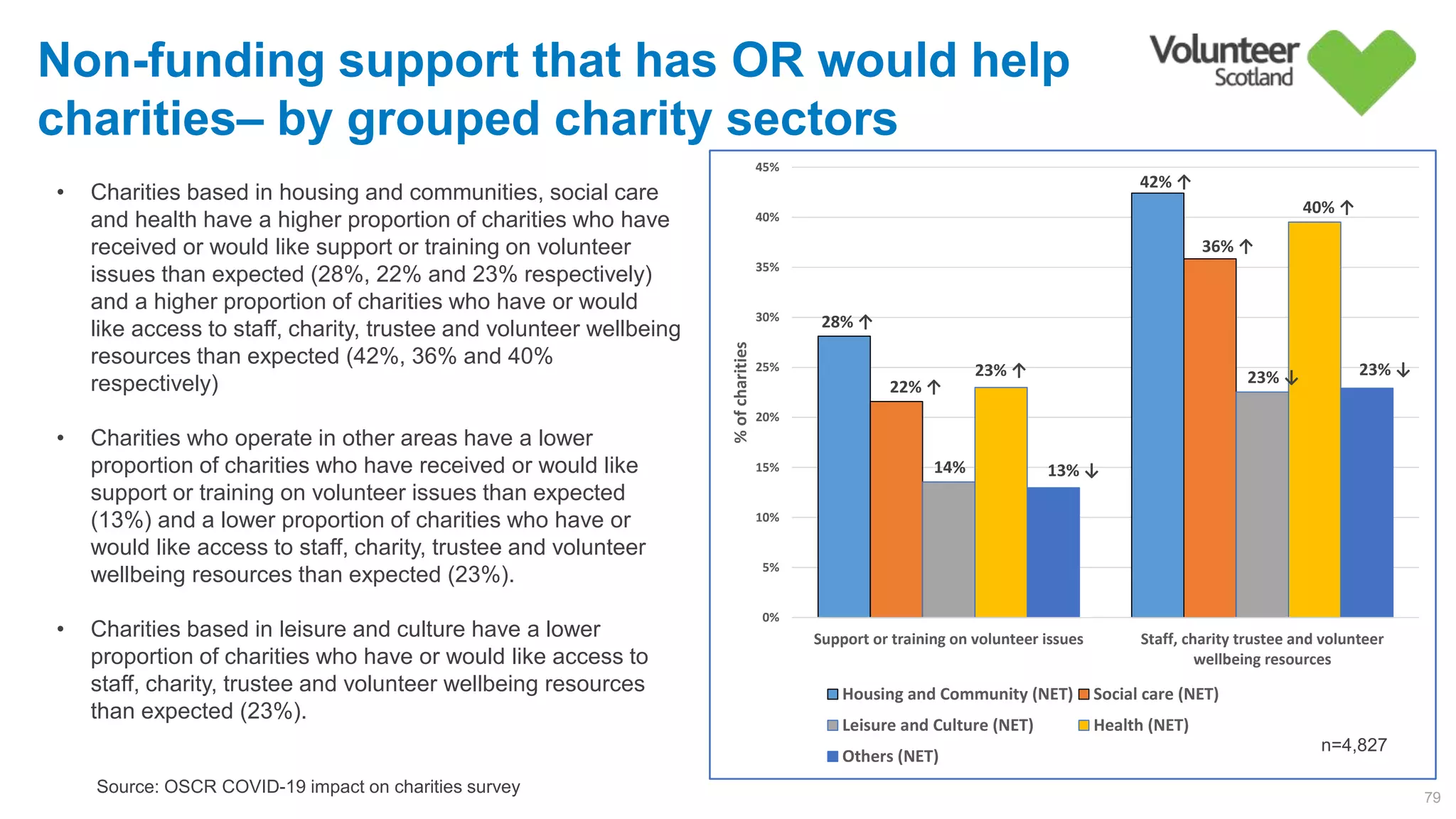
in Scotland
Full presentation of
volunteering data from
OSCR's 'Impact of COVID-19
on Scottish charities' survey
September 2020
Sections
2
• Research scope, structure and methodology
• Summary of key findings
• Profile of charities surveyed
• Understanding the wider business context
• Impact of COVID-19 on charities' volunteering
• Charities' responses to COVID-19
• Impact of COVID-19 on the number of volunteers
• Need for mental health and wellbeing support
• Non-funding support that has or would help charities
Link to the national 'OSCR COVID-19 impact on charities survey' results: https://www.oscr.org.uk/about-charities/surveys/
Research scope, structure
and methodology
OSCR's COVID-19 impact on charities survey
4
• Objective – ‘To gain a deeper understanding of the impact of
COVID-19 and subsequent lockdown measures on charities in Scotland.
• Method – online survey conducted by 'Breaking Blue' on behalf of OSCR
during 5th to 15th May 2020. Link to Questionnaire
• Response – 4,827 responses from a large number and representative
cross-section of registered Scottish charities.
• Acknowledgement – Volunteer Scotland would like to thank
OSCR for providing access to their data.
Link to the national 'OSCR COVID-19 impact on charities survey' results: https://www.oscr.org.uk/about-charities/surveys/
Structure of Volunteer Scotland's
analysis
Impact on
volunteering
Impact on organisations
Understanding the wider
business context
Implications
For recovery &
post-recovery
5
Methodology – Analysis of statistical
significance
6
• To test whether a sub-category (e.g. charities who have been established for 1-3 years ) has a statistically significant
relationship with a survey question (e.g. volunteers are unable to work) Z tests are used.
• For a Z test a null and alternate hypothesis are stated
• Null hypothesis – The same proportion of charities who have been established for 1-3 years have volunteers unable to
work as the proportion of charities overall.
• Alternate hypothesis – The proportion of charities who have been established for 1-3 years have a different proportion
of charities unable to work than charities overall.
• A test statistic (p value) is calculated and compared to the critical P value (0.05 for this analysis) to confirm if the null or
alternate hypothesis is true. This allows a conclusion to be made with 95% confidence.
• For example
• 37% of all charities have volunteers unable to work compared to 43% of charities who have been established for 1-3
years. The Z test shows that this difference is statistically significant.
• Throughout the presentation statistically significant results are presented on the charts with a where the relationship
is statistically significant, and the proportion is higher than the overall proportion and a where the relationship is
statistically significant and the proportion is lower than the overall proportion.
• For the example above the results would be presented on the chart as those established for 1-3 years 43% , and in
the text as a higher proportion than expected.
Methodology – Terminology
7
Definition of 'Net' categories
• In some questions similar response categories have been aggregated by OSCR to give an overall result
and this is referred to as 'Net' in the text and charts.
• For example, the survey asks respondents whether they have used different types of grants such as local
government grants, Scottish Government grants and other public sector grants. The results are combined
to give the proportion of charities that receive any of these grants and this is labelled as 'Grants (Net)'.
Aggregating impact response categories
• For some survey questions such as 'How has your charity been affected by COVID-19 & lockdown
measures more generally?' there is a second follow up question that asks how severely the measures
have affected charities.
• For example – charities that 'Do not have the capacity to make use of the available volunteers' are asked
to state how significantly this has affected them on a five-point scale: not affected, very slightly affected,
moderately affected, very much affected and severely affected. For analysis in this presentation we have
reported the aggregated data for ‘very much or severely affected’. This data is not presented in chart
format but can be accessed at https://www.oscr.org.uk/about-charities/surveys/.
Summary of key findings
Impact of COVID-19 on charities' operations and
financial sustainability
9
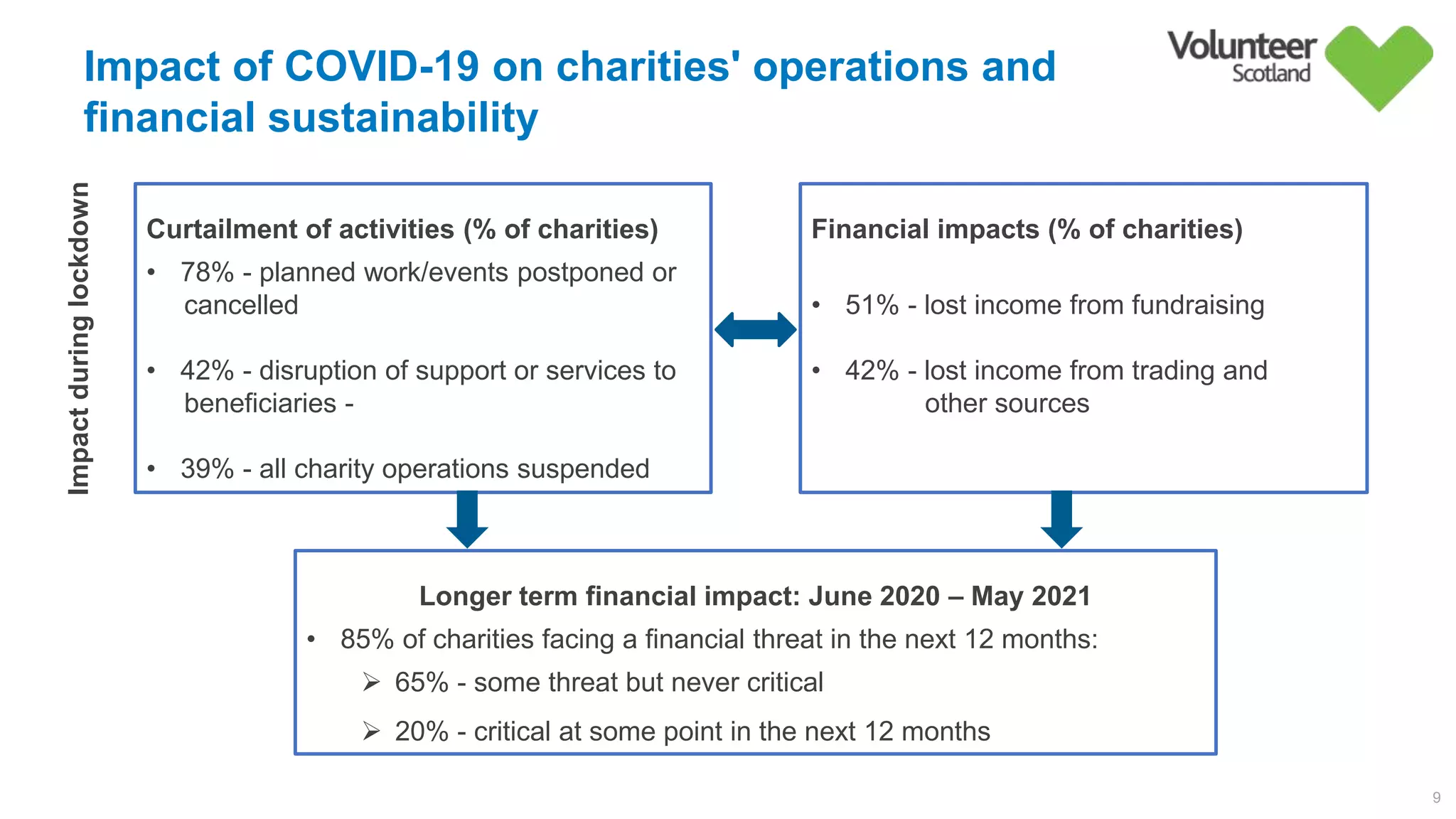
Curtailment of activities (% of charities)
• 78% - planned work/events postponed or
cancelled
• 42% - disruption of support or services to
beneficiaries -
• 39% - all charity operations suspended
Financial impacts (% of charities)
• 51% - lost income from fundraising
• 42% - lost income from trading and
other sources
Impactduringlockdown
Longer term financial impact: June 2020 – May 2021
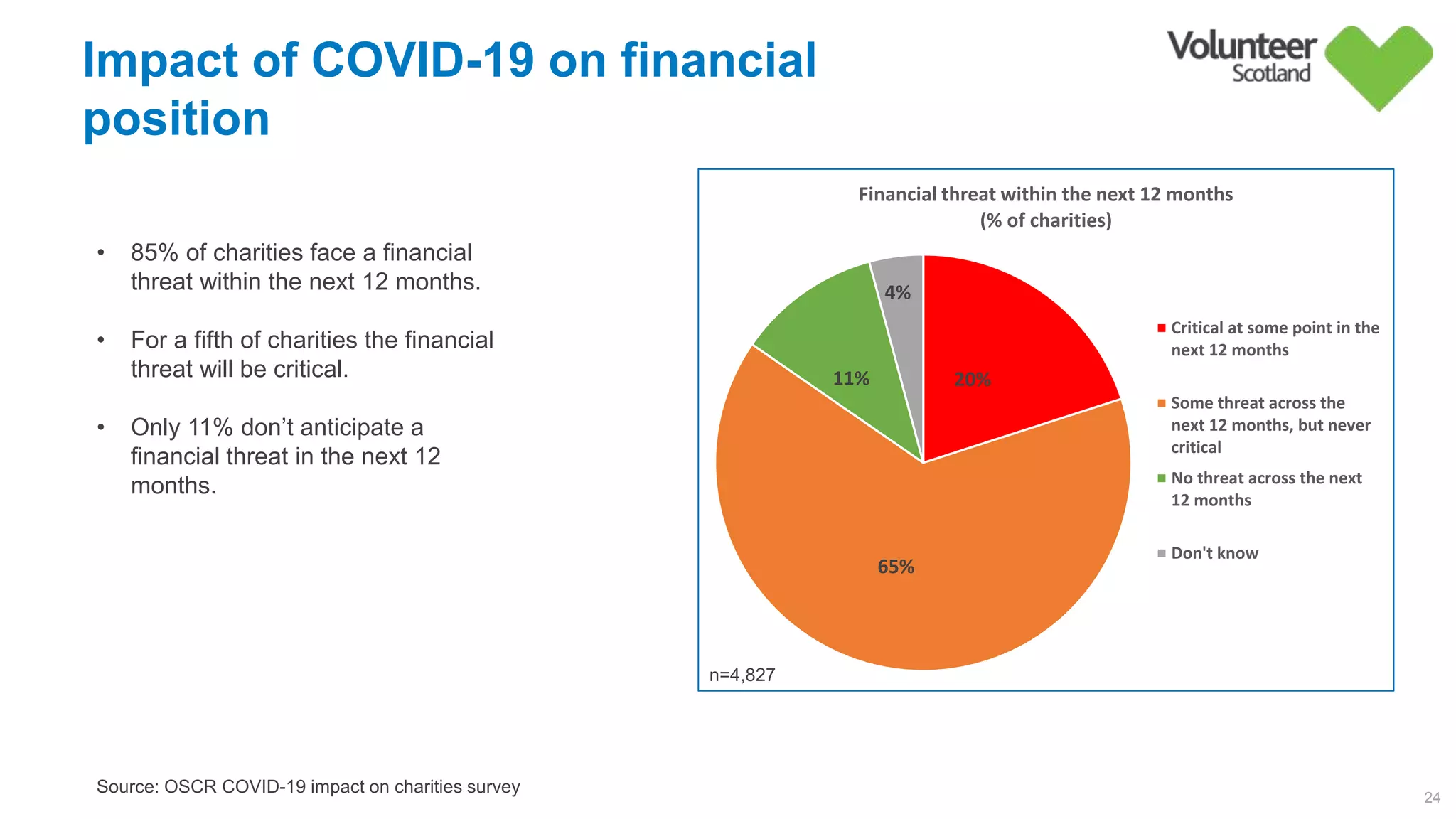
• 85% of charities facing a financial threat in the next 12 months:
 65% - some threat but never critical
 20% - critical at some point in the next 12 months
Impact of COVID-19 on charities' volunteers
during lockdown
10
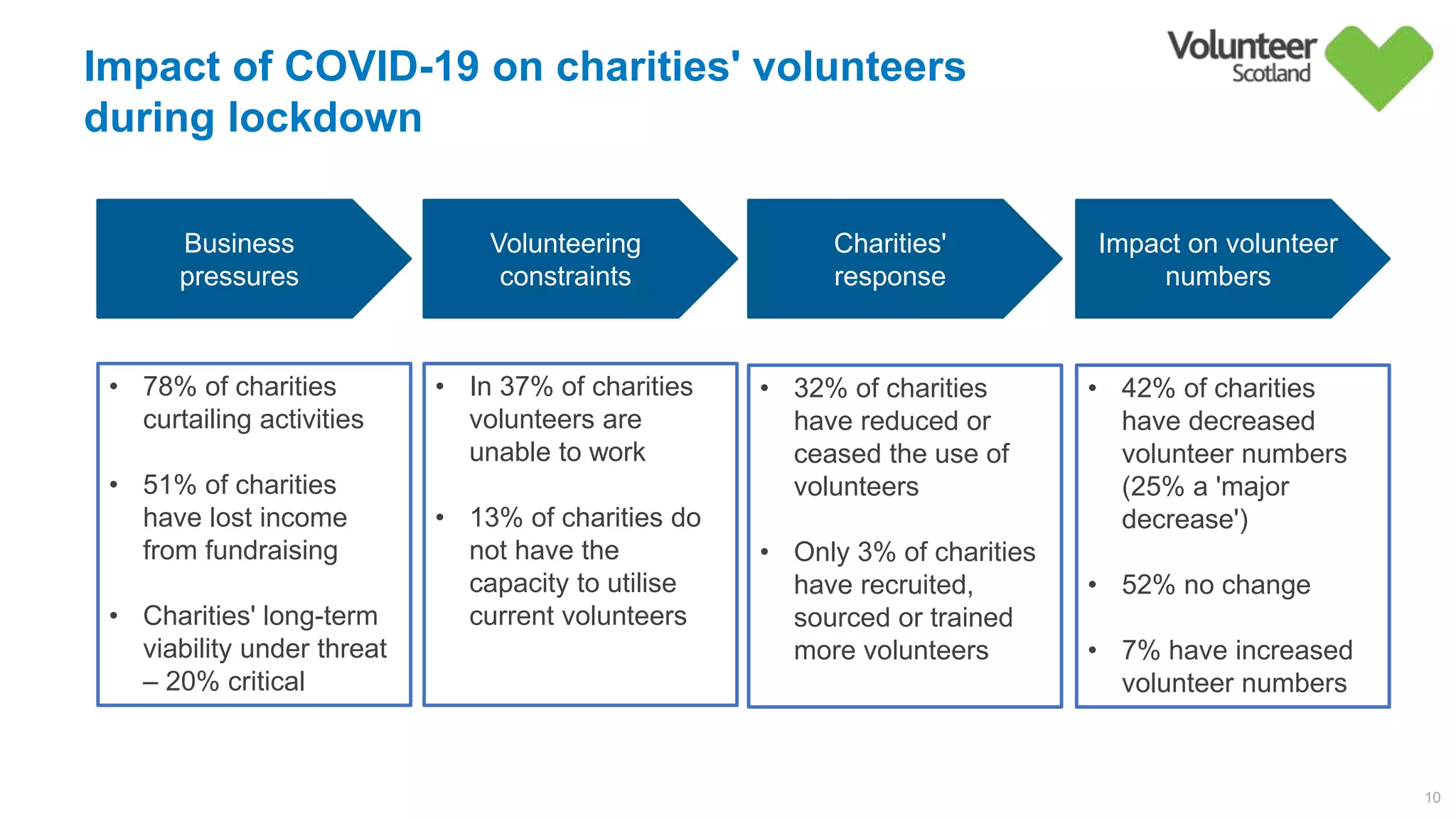
• 78% of charities
curtailing activities
• 51% of charities
have lost income
from fundraising
• Charities' long-term
viability under threat
– 20% critical
Business
pressures
Volunteering
constraints
Charities'
response
Impact on volunteer
numbers
• In 37% of charities
volunteers are
unable to work
• 13% of charities do
not have the
capacity to utilise
current volunteers
• 32% of charities
have reduced or
ceased the use of
volunteers
• Only 3% of charities
have recruited,
sourced or trained
more volunteers
• 42% of charities
have decreased
volunteer numbers
(25% a 'major
decrease')
• 52% no change
• 7% have increased
volunteer numbers
Analysis of COVID-19's volunteering impacts by
charities' characteristics
11
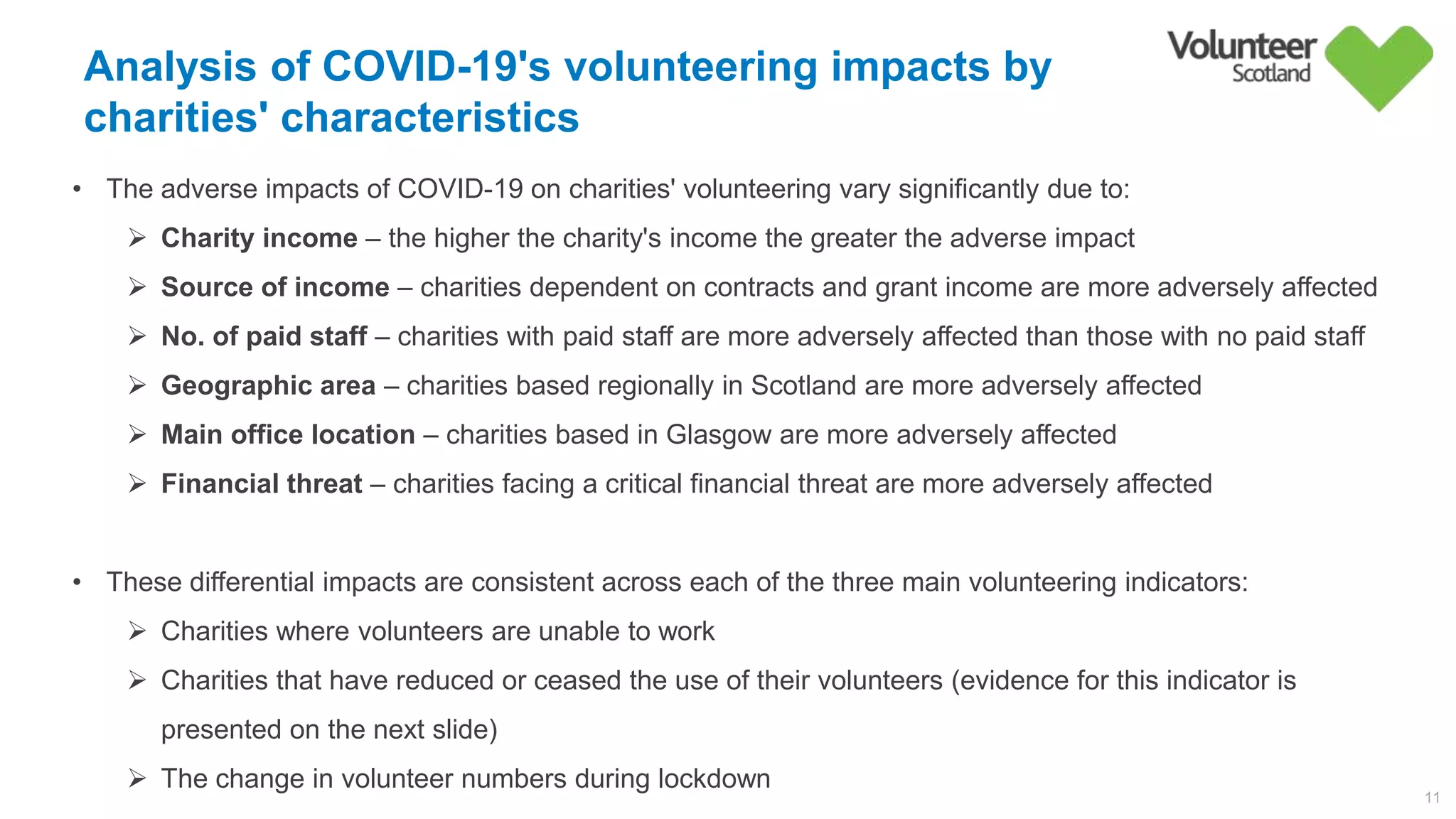
• The adverse impacts of COVID-19 on charities' volunteering vary significantly due to:
 Charity income – the higher the charity's income the greater the adverse impact
 Source of income – charities dependent on contracts and grant income are more adversely affected
 No. of paid staff – charities with paid staff are more adversely affected than those with no paid staff
 Geographic area – charities based regionally in Scotland are more adversely affected
 Main office location – charities based in Glasgow are more adversely affected
 Financial threat – charities facing a critical financial threat are more adversely affected
• These differential impacts are consistent across each of the three main volunteering indicators:
 Charities where volunteers are unable to work
 Charities that have reduced or ceased the use of their volunteers (evidence for this indicator is
presented on the next slide)
 The change in volunteer numbers during lockdown
Reduced or ceased use of volunteers by charities'
characteristics
12
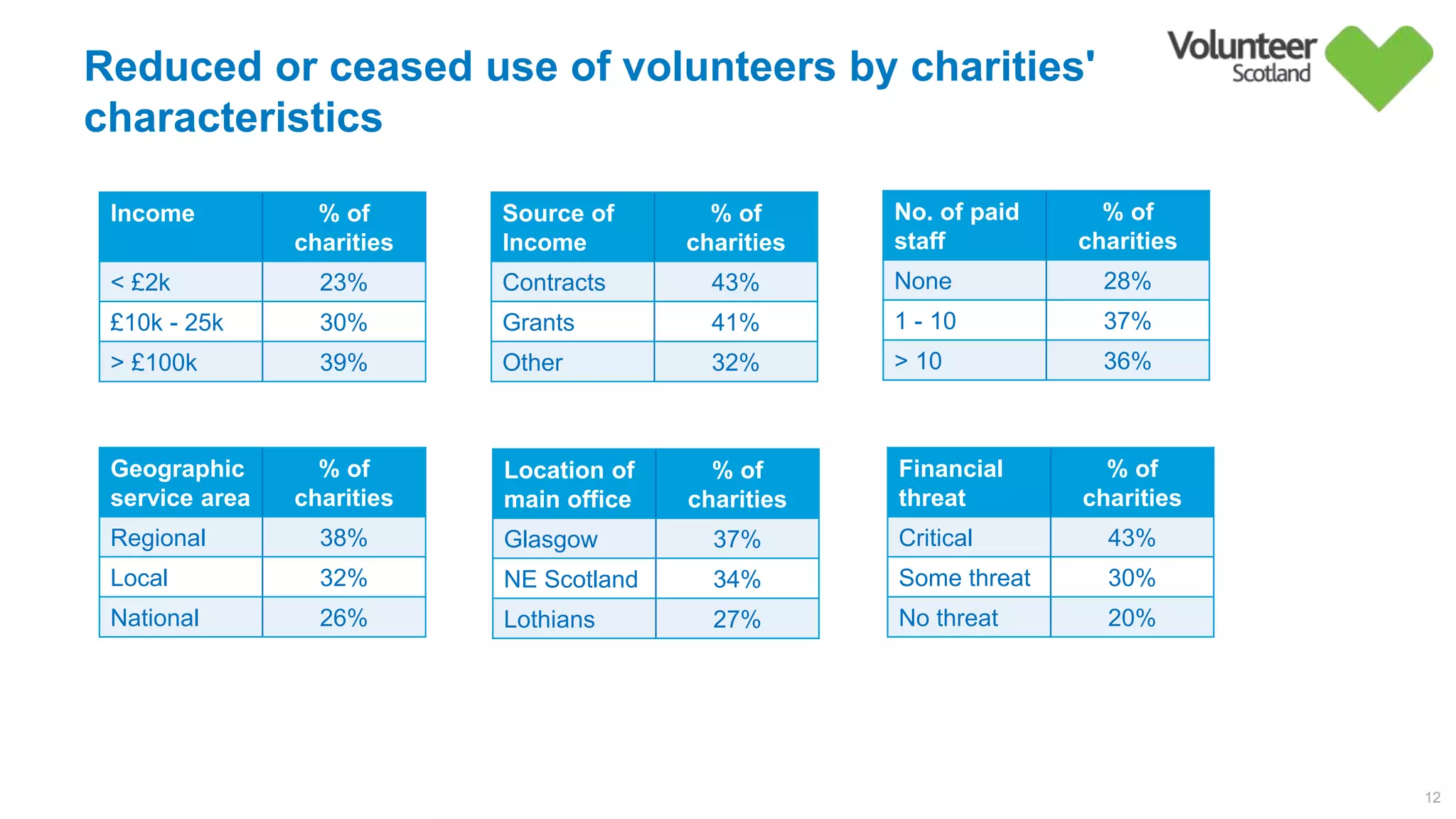
Income % of
charities
< £2k 23%
£10k - 25k 30%
> £100k 39%
Source of
Income
% of
charities
Contracts 43%
Grants 41%
Other 32%
No. of paid
staff
% of
charities
None 28%
1 - 10 37%
> 10 36%
Geographic
service area
% of
charities
Regional 38%
Local 32%
National 26%
Financial
threat
% of
charities
Critical 43%
Some threat 30%
No threat 20%
Location of
main office
% of
charities
Glasgow 37%
NE Scotland 34%
Lothians 27%
Health and wellbeing impact of COVID-19 on
volunteers during lockdown
13
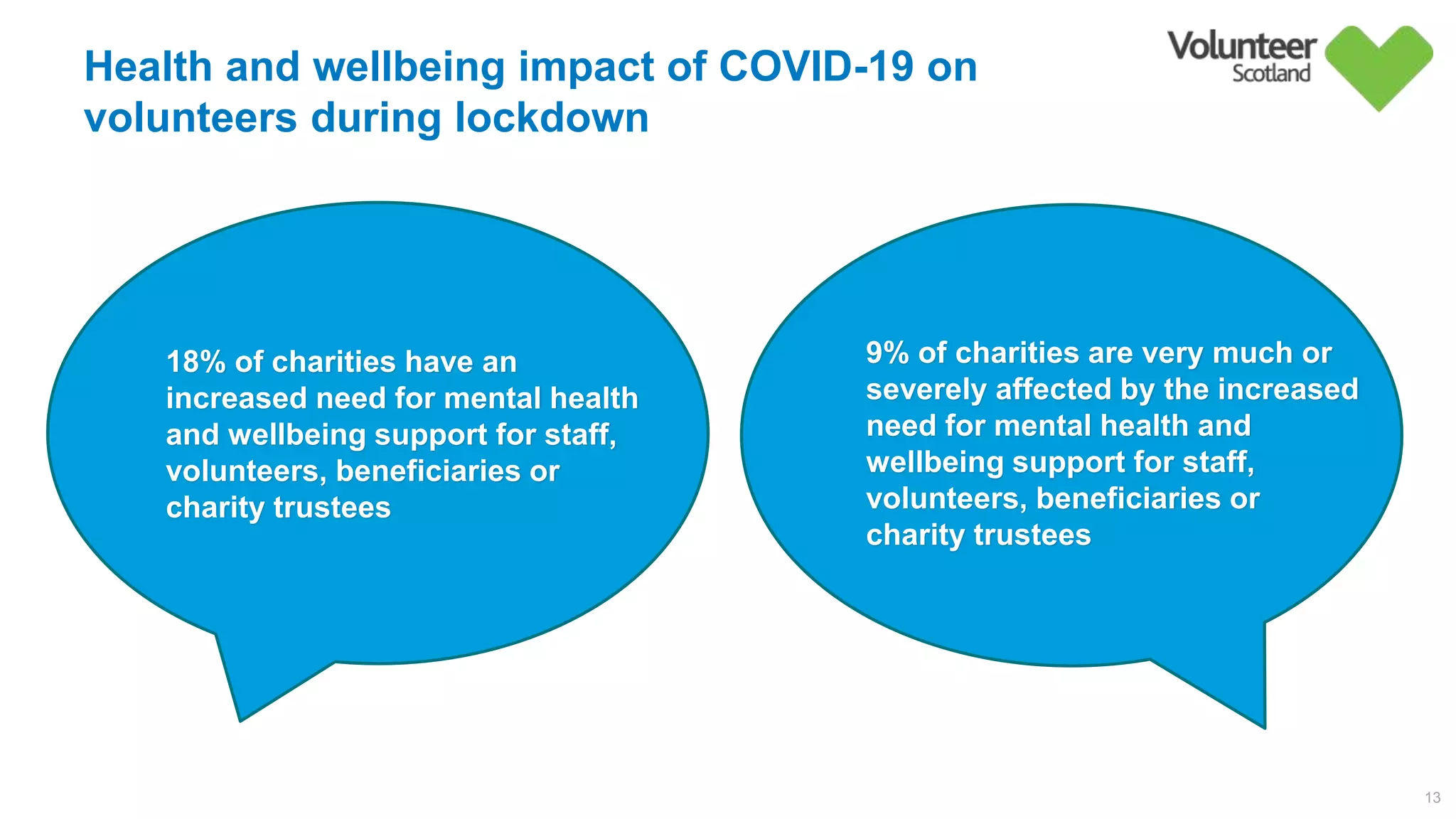
18% of charities have an
increased need for mental health
and wellbeing support for staff,
volunteers, beneficiaries or
charity trustees
9% of charities are very much or
severely affected by the increased
need for mental health and
wellbeing support for staff,
volunteers, beneficiaries or
charity trustees
Non-funding support that has OR would
help charities
14
25%        
14%        
15%        
17%        
19%        
20%        
25%        
45%        
46%        
51%        
0%         10%         20%         30%         40%         50%         60%        
None of these
Support or training on volunteer issues
Support or training on staffing issues
Support or training on remote leadership
Maintaining momentum on current policy
and government business unrelated to…
Technical support and training for working
remotely
Staff, charity trustee and volunteer wellbeing
resources
Flexibility in filing or reporting deadlines
More guidance on how charities should
continue during the pandemic
Information and advice on the financial
support charities can claim
% of charities
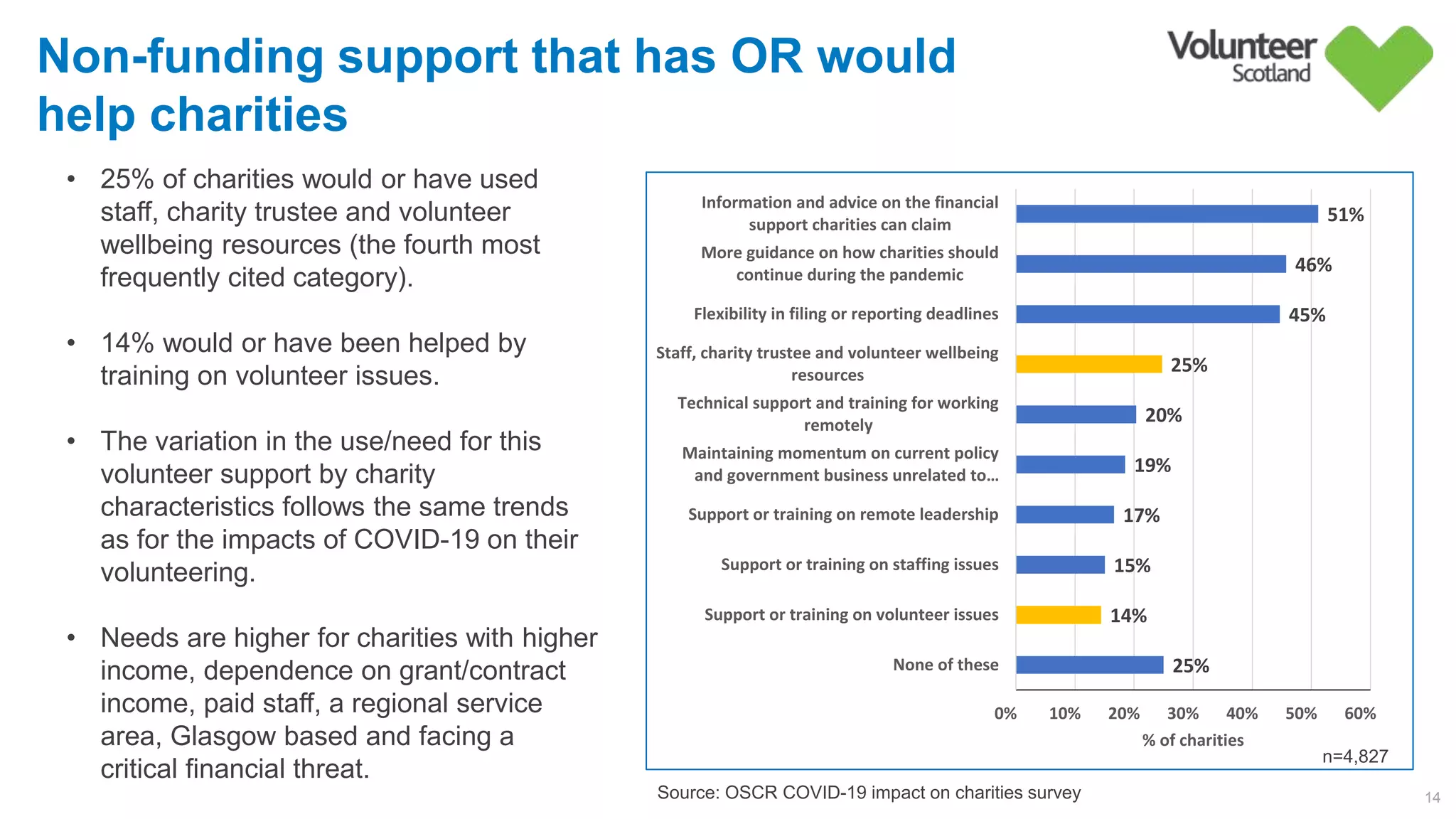
• 25% of charities would or have used
staff, charity trustee and volunteer
wellbeing resources (the fourth most
frequently cited category).
• 14% would or have been helped by
training on volunteer issues.
• The variation in the use/need for this
volunteer support by charity
characteristics follows the same trends
as for the impacts of COVID-19 on their
volunteering.
• Needs are higher for charities with higher
income, dependence on grant/contract
income, paid staff, a regional service
area, Glasgow based and facing a
critical financial threat.
Source: OSCR COVID-19 impact on charities survey
n=4,827
Profile of charities
surveyed
Profile of charities surveyed – by number of
staff and volunteers
16
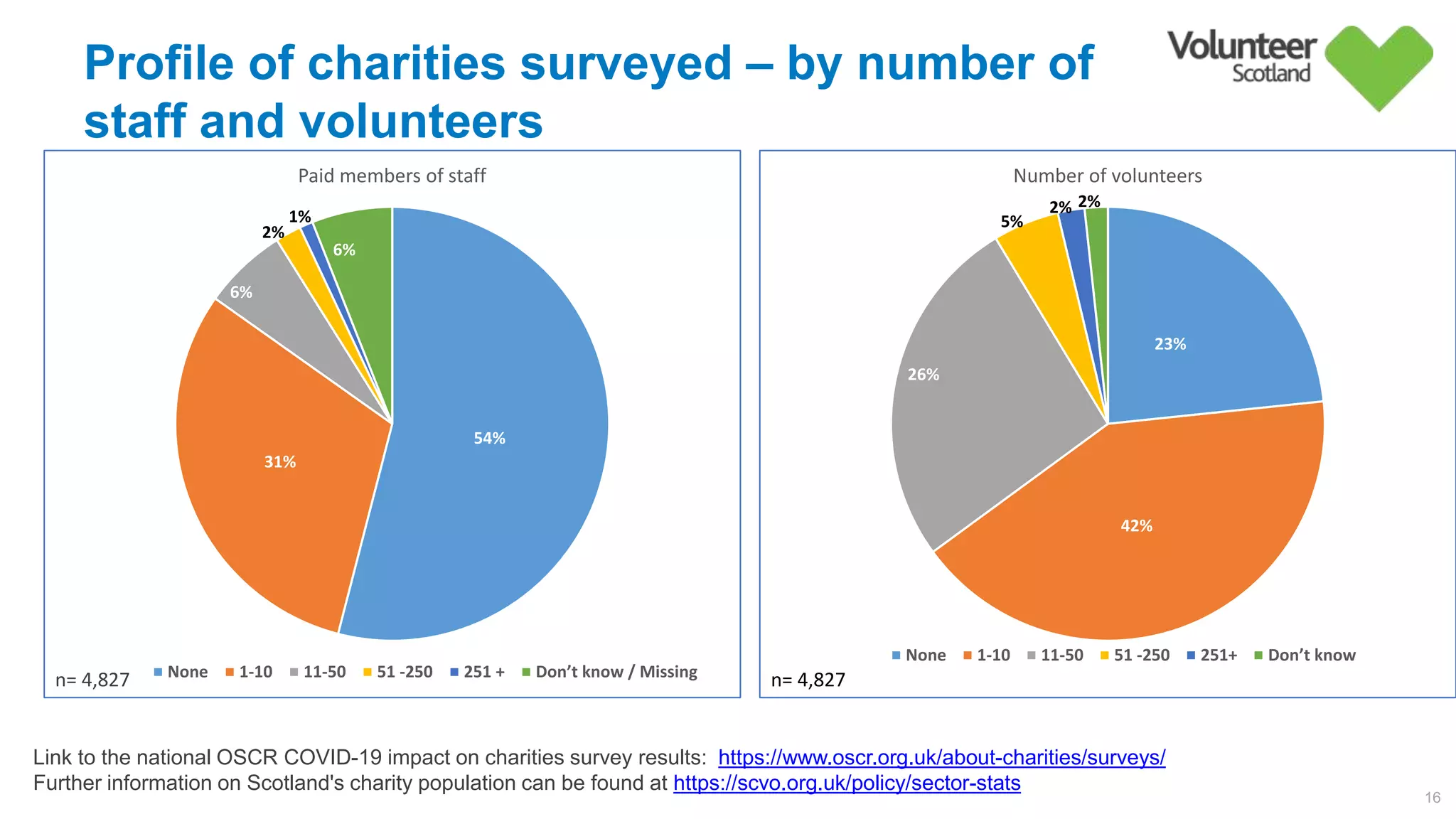
54%        
31%        
6%        
2%        
1%        
6%        
Paid members of staff
None 1-10 11-50 51 -250 251 + Don’t know / Missing
23%        
42%        
26%        
5%        
2%        2%        
Number of volunteers
None 1-10 11-50 51 -250 251+ Don’t know
n= 4,827
Link to the national OSCR COVID-19 impact on charities survey results: https://www.oscr.org.uk/about-charities/surveys/
Further information on Scotland's charity population can be found at https://scvo.org.uk/policy/sector-stats
n= 4,827
Profile of charities surveyed – by age and
income
17
Link to the national OSCR COVID-19 impact on charities survey results: https://www.oscr.org.uk/about-charities/surveys/
Further information on Scotland's charity population can be found at https://scvo.org.uk/policy/sector-stats
[CELLRANGE]
6%        
[CELLRANGE]
8%        
[CELLRANGE]
18%        
[CELLRANGE]
29%        
[CELLRANGE]
21%        
[CELLRANGE]
15%        
[CELLRANGE]
3%        
Age of Charity
8%        
19%        
17%        
24%        
16%        
2%        
5%        
8%        
0%        
5%        
10%        
15%        
20%        
25%        
Under
£2,000
£2,001 to
£10,000
£10,001
to
£25,000
£25,001
to
£100,000
£100,001
-
£500,000
£500,001
- £1m
£1m + Don’t
know /
Missing
%ofcharities
Income of charities
n= 4,827n= 4,827
18
13%        
17%        
16%        
6%        
7%        
13%        
14%        
9%        
3%        
0%        
2%        
4%        
6%        
8%        
10%        
12%        
14%        
16%        
18%        
20%        
%ofcharities
2% of charities did not respond to the question
Link to the national OSCR COVID-19 impact on charities survey results: https://www.oscr.org.uk/about-charities/surveys/
Further information on Scotland's charity population can be found at https://scvo.org.uk/policy/sector-stats
n= 4,827
n= 4,827
Profile of charities surveyed – by location of
main office
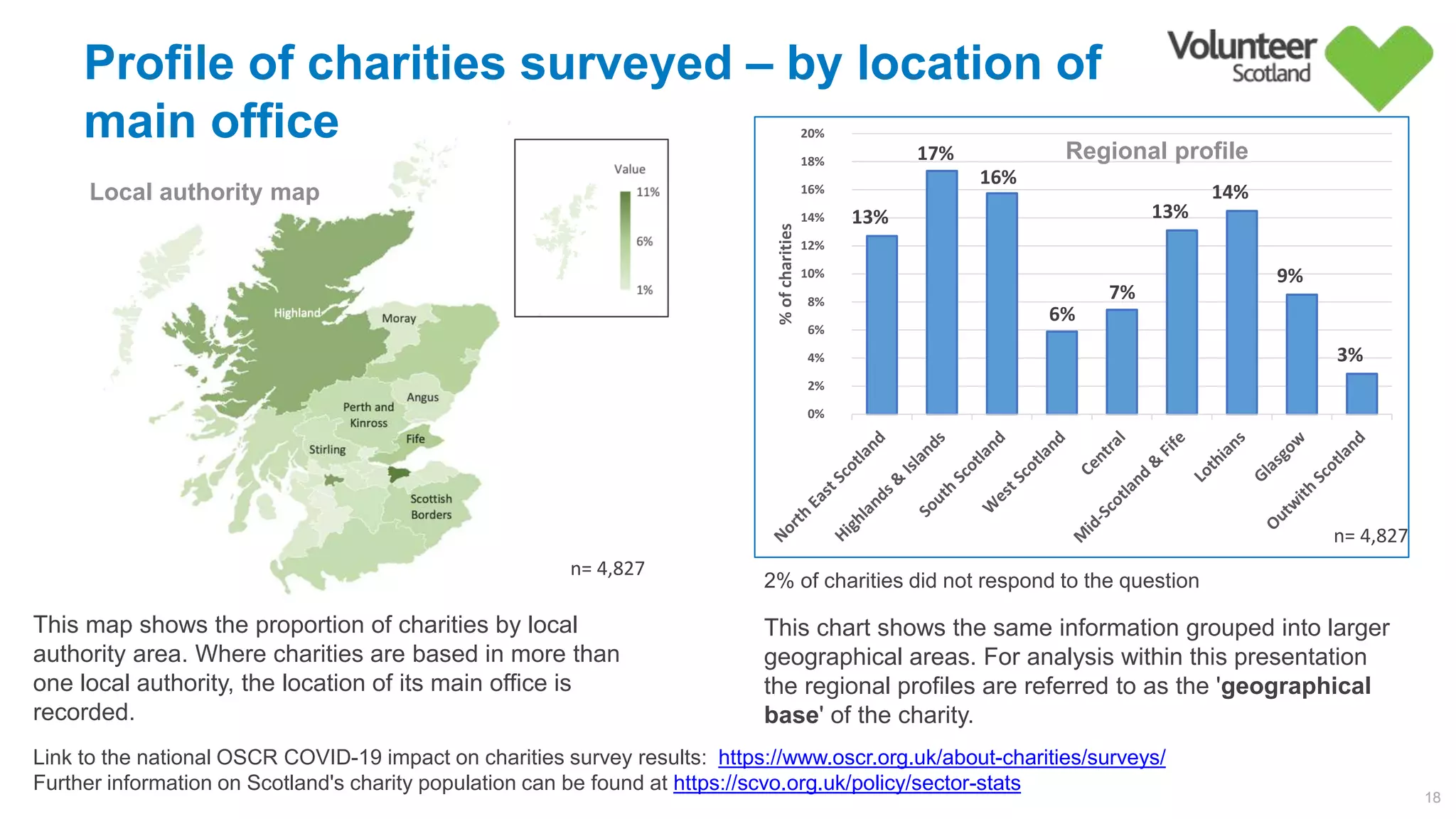
This map shows the proportion of charities by local
authority area. Where charities are based in more than
one local authority, the location of its main office is
recorded.
This chart shows the same information grouped into larger
geographical areas. For analysis within this presentation
the regional profiles are referred to as the 'geographical
base' of the charity.
Local authority map
Regional profile
Profile of charities surveyed – by income
source and geographic scale
19
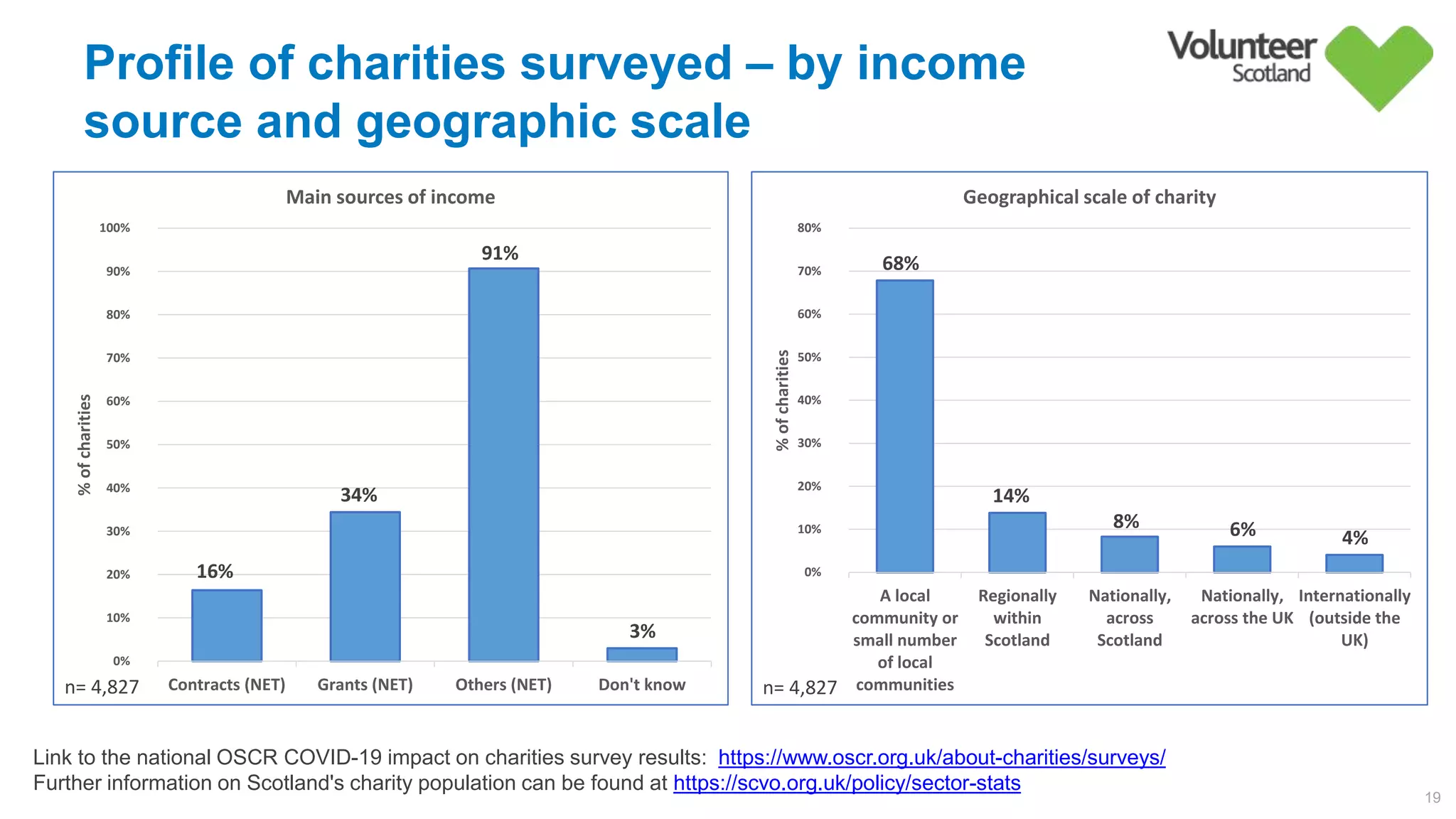
16%        
34%        
91%        
3%        
0%        
10%        
20%        
30%        
40%        
50%        
60%        
70%        
80%        
90%        
100%        
Contracts (NET) Grants (NET) Others (NET) Don't know
%ofcharities
Main sources of income
68%        
14%        
8%         6%         4%        
0%        
10%        
20%        
30%        
40%        
50%        
60%        
70%        
80%        
A local
community or
small number
of local
communities
Regionally
within
Scotland
Nationally,
across
Scotland
Nationally,
across the UK
Internationally
(outside the
UK)
%ofcharities
Geographical scale of charity
Link to the national OSCR COVID-19 impact on charities survey results: https://www.oscr.org.uk/about-charities/surveys/
Further information on Scotland's charity population can be found at https://scvo.org.uk/policy/sector-stats
n= 4,827 n= 4,827
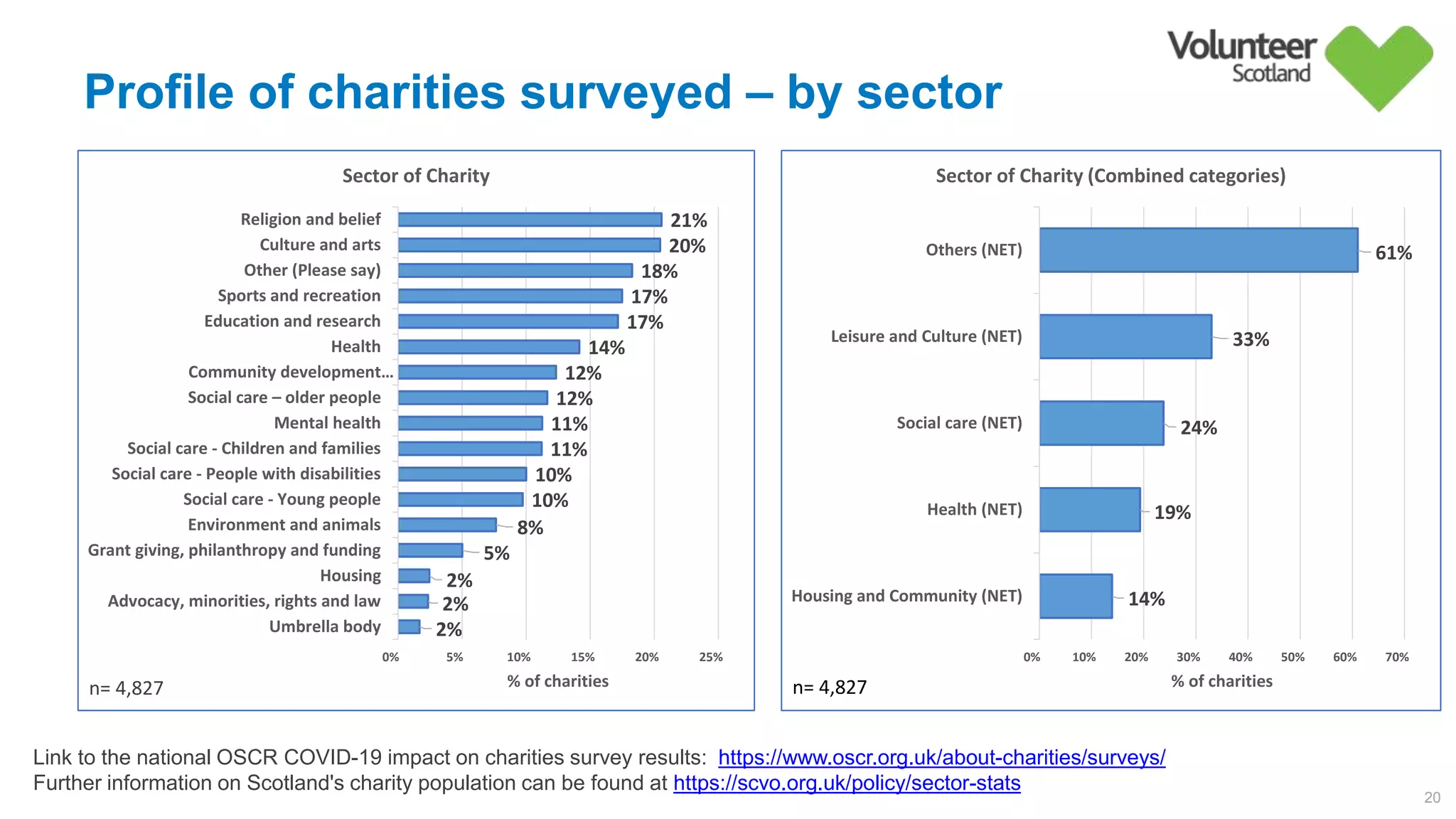
Profile of charities surveyed – by sector
20
2%        
2%        
2%        
5%        
8%        
10%        
10%        
11%        
11%        
12%        
12%        
14%        
17%        
17%        
18%        
20%        
21%        
0%         5%         10%         15%         20%         25%        
Umbrella body
Advocacy, minorities, rights and law
Housing
Grant giving, philanthropy and funding
Environment and animals
Social care - Young people
Social care - People with disabilities
Social care - Children and families
Mental health
Social care – older people
Community development…
Health
Education and research
Sports and recreation
Other (Please say)
Culture and arts
Religion and belief
% of charities
Sector of Charity
14%        
19%        
24%        
33%        
61%        
0%         10%         20%         30%         40%         50%         60%         70%        
Housing and Community (NET)
Health (NET)
Social care (NET)
Leisure and Culture (NET)
Others (NET)
% of charities
Sector of Charity (Combined categories)
n= 4,827
Link to the national OSCR COVID-19 impact on charities survey results: https://www.oscr.org.uk/about-charities/surveys/
Further information on Scotland's charity population can be found at https://scvo.org.uk/policy/sector-stats
n= 4,827
Impact of COVID-19
Understanding the wider
business context
Impact of COVID-19 on Charities
Summary
22
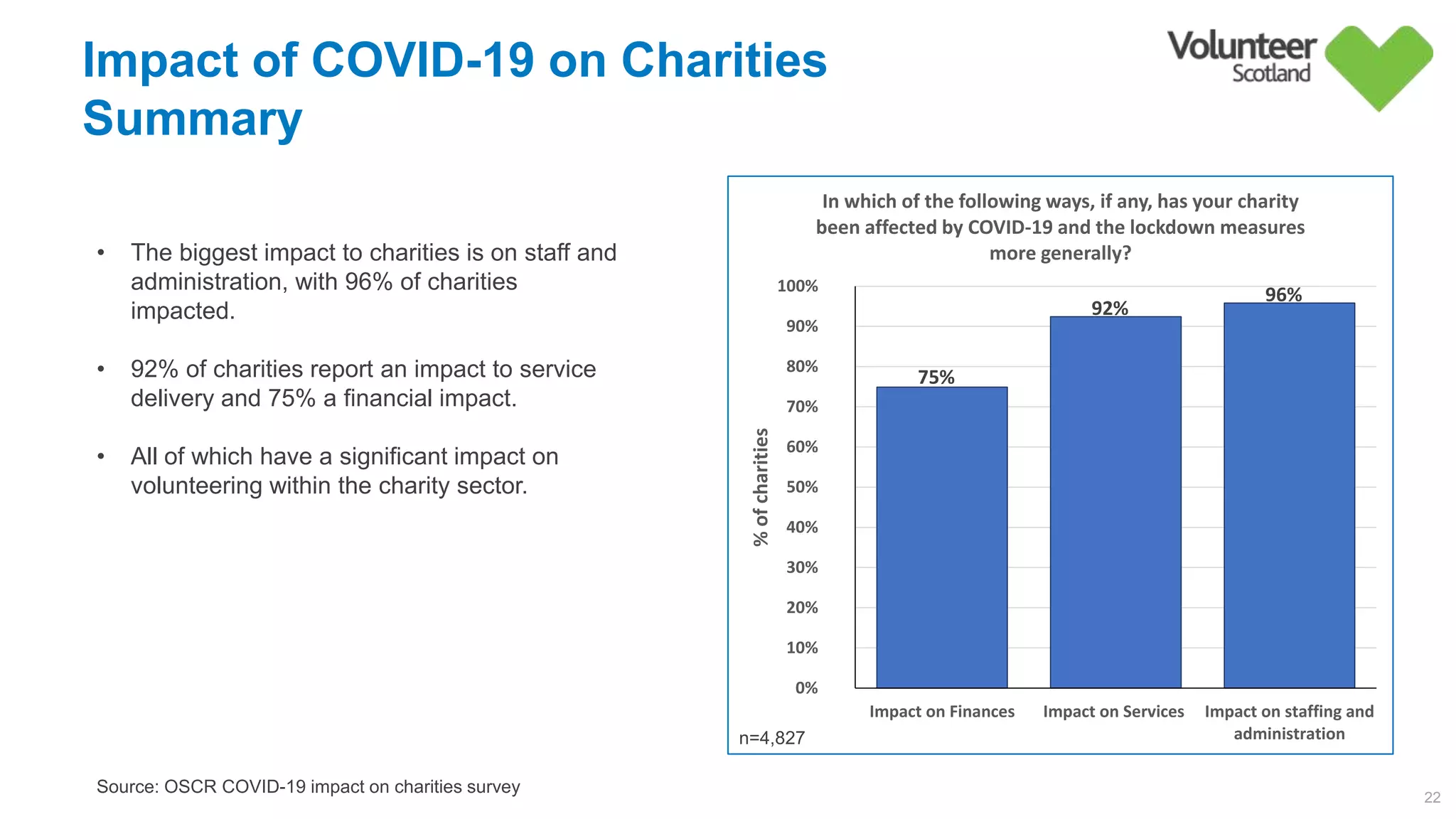
• The biggest impact to charities is on staff and
administration, with 96% of charities
impacted.
• 92% of charities report an impact to service
delivery and 75% a financial impact.
• All of which have a significant impact on
volunteering within the charity sector.
75%        
92%        
96%        
0%        
10%        
20%        
30%        
40%        
50%        
60%        
70%        
80%        
90%        
100%        
Impact on Finances Impact on Services Impact on staffing and
administration
%ofcharities
In which of the following ways, if any, has your charity
been affected by COVID-19 and the lockdown measures
more generally?
Source: OSCR COVID-19 impact on charities survey
n=4,827
Impact of COVID-19 on Charities
Specific impacts
23
30%        
33%        
34%        
36%        
37%        
39%        
42%        
42%        
51%        
78%        
0%        10%        20%        30%        40%        50%        60%        70%        80%        90%        
Short-term risk (within next 6 months) to charity
reserves
Long-term risk to charity reserves
Charity trustees struggling to meet or discuss matters
Unable to hold an AGM
Volunteers are unable to work
All charity operations suspended
Lost income from trading and other sources
(not fundraising)
Disruption of support or services to beneficiaries
Lost income from fundraising
Planned work / events postponed or cancelled
% of charities
In which of the following ways, if any, has your charity been affected by
COVID-19 and the lockdown measures more generally - Ten most common
impacts
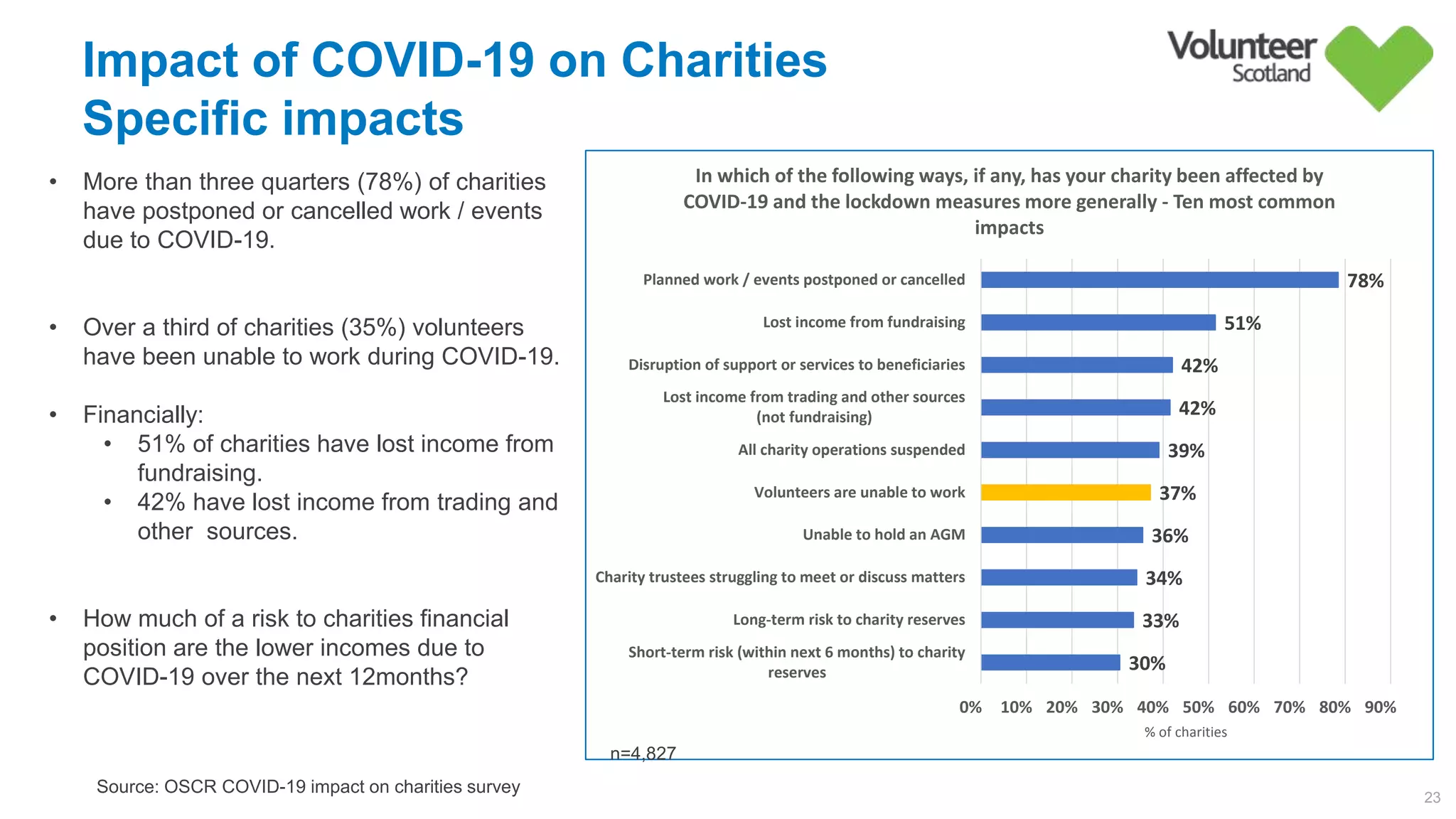
• More than three quarters (78%) of charities
have postponed or cancelled work / events
due to COVID-19.
• Over a third of charities (35%) volunteers
have been unable to work during COVID-19.
• Financially:
• 51% of charities have lost income from
fundraising.
• 42% have lost income from trading and
other sources.
• How much of a risk to charities financial
position are the lower incomes due to
COVID-19 over the next 12months?
n=4,827
Source: OSCR COVID-19 impact on charities survey
Impact of COVID-19 on financial
position
24
• 85% of charities face a financial
threat within the next 12 months.
• For a fifth of charities the financial
threat will be critical.
• Only 11% don’t anticipate a
financial threat in the next 12
months.
20%        
65%        
11%        
4%        
Financial threat within the next 12 months
(% of charities)
Critical at some point in the
next 12 months
Some threat across the
next 12 months, but never
critical
No threat across the next
12 months
Don't know
Source: OSCR COVID-19 impact on charities survey
n=4,827
Impact of COVID-19 on
charities' volunteering
13%        
37%
0%         10%         20%         30%         40%        
Do not have the capacity to make
use of the available volunteers
Volunteers are unable to work
% of charities
In what ways has your charity been affected by COVID-19
generally
26
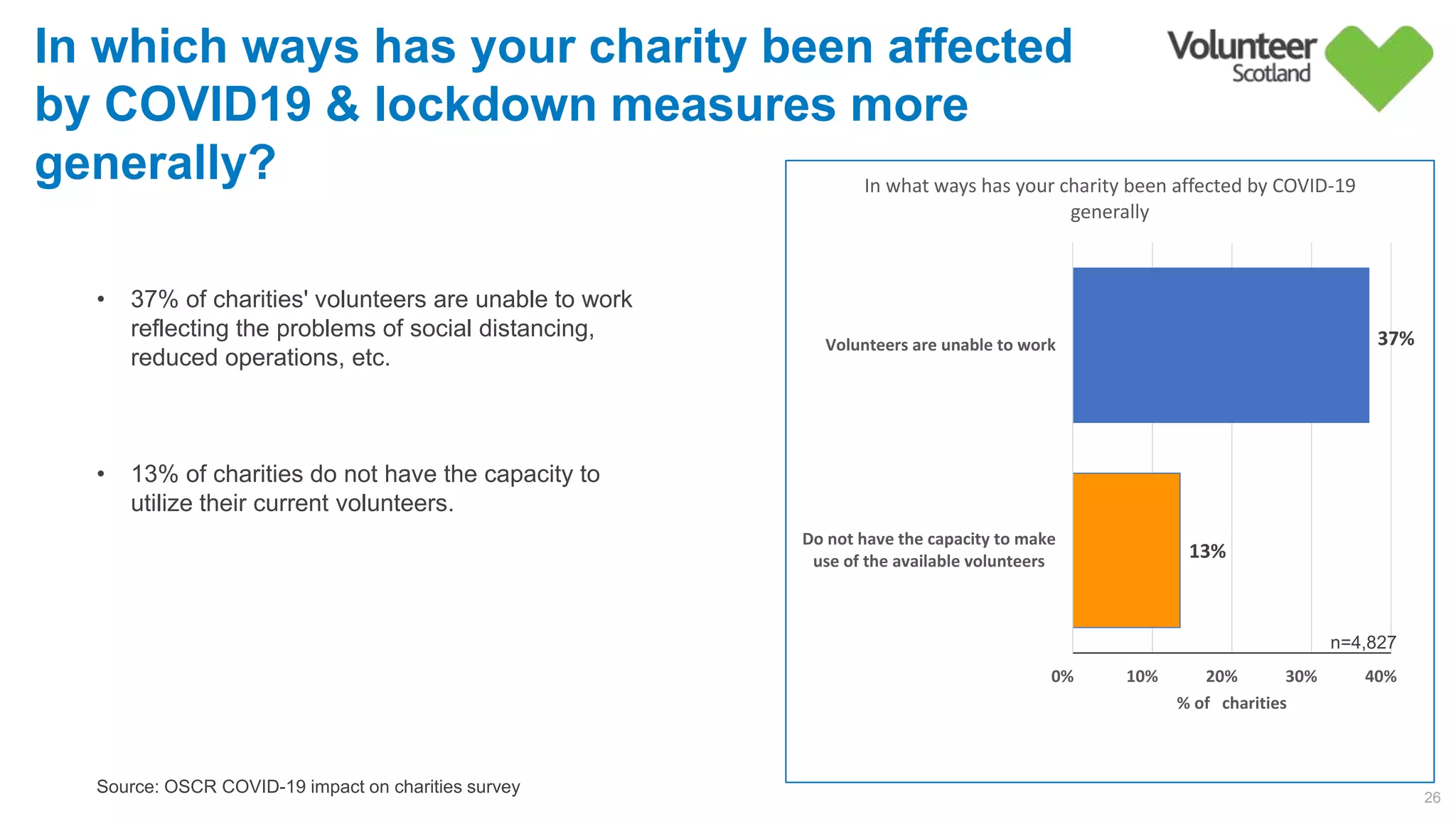
• 37% of charities' volunteers are unable to work
reflecting the problems of social distancing,
reduced operations, etc.
• 13% of charities do not have the capacity to
utilize their current volunteers.
n=4,827
Source: OSCR COVID-19 impact on charities survey
In which ways has your charity been affected
by COVID19 & lockdown measures more
generally?
27
Source: OSCR COVID-19 impact on charities survey
In which ways has your charity been affected
by COVID19 & lockdown measures more
generally – by age of charity
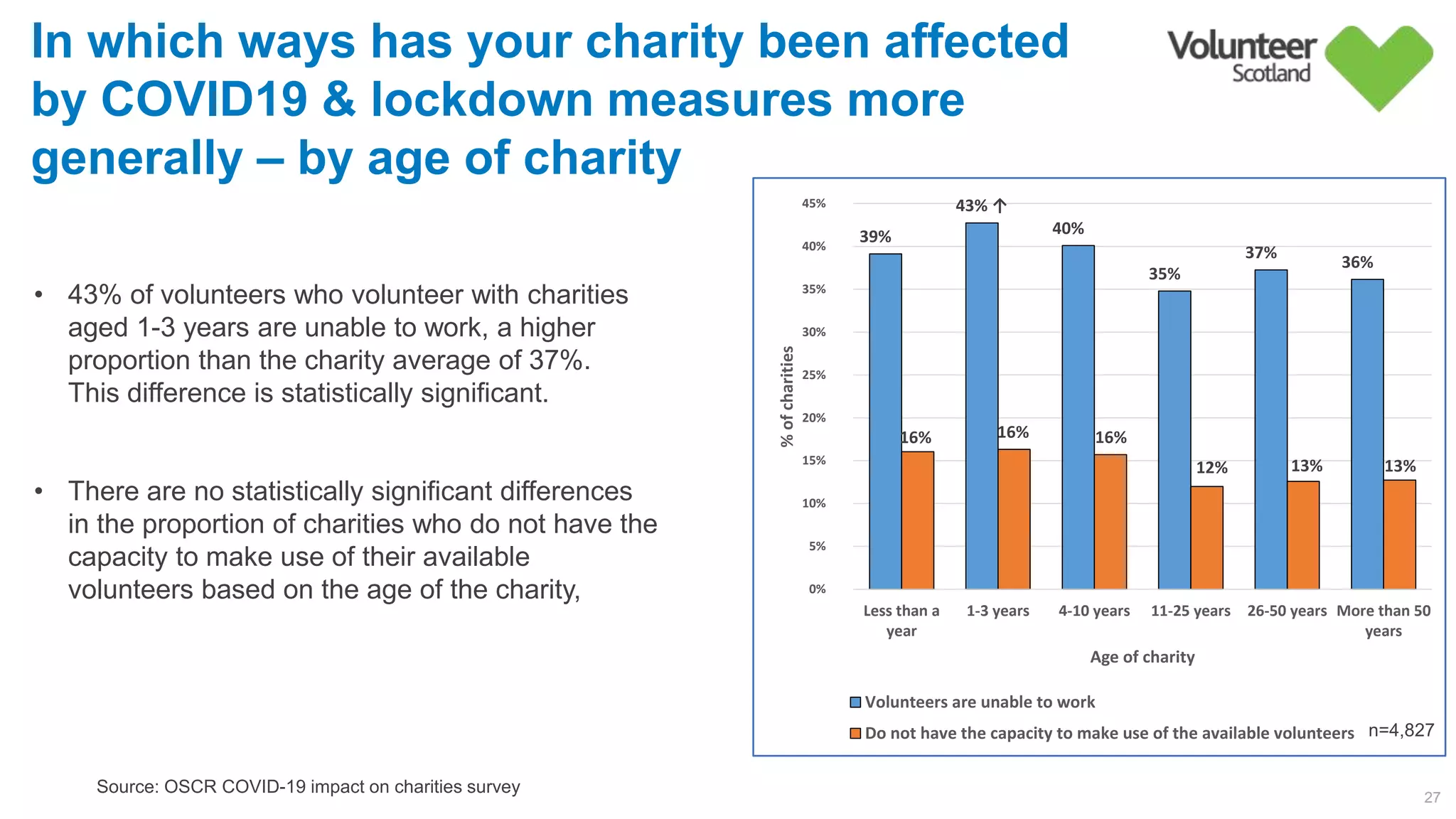
• 43% of volunteers who volunteer with charities
aged 1-3 years are unable to work, a higher
proportion than the charity average of 37%.
This difference is statistically significant.
• There are no statistically significant differences
in the proportion of charities who do not have the
capacity to make use of their available
volunteers based on the age of the charity,
39%        
43% ↑
40%        
35%        
37%        
36%        
16%         16%         16%        
12%         13%         13%        
0%        
5%        
10%        
15%        
20%        
25%        
30%        
35%        
40%        
45%        
Less than a
year
1-3 years 4-10 years 11-25 years 26-50 years More than 50
years
%ofcharities
Age of charity
Volunteers are unable to work
Do not have the capacity to make use of the available volunteers n=4,827
32%        
29% ↓
35%        
40% ↑
43% ↑
10%         9% ↓ 11%        
16% ↑
17% ↑
0%        
5%        
10%        
15%        
20%        
25%        
30%        
35%        
40%        
45%        
50%        
Under £2,000 £2,001 to
£10,000
£10,001 to
£25,000
£25,001 to
£100,000
£100,001+
%ofcharities
Income of charities
Volunteers are unable to work
Do not have the capacity to make use of the available volunteers
28
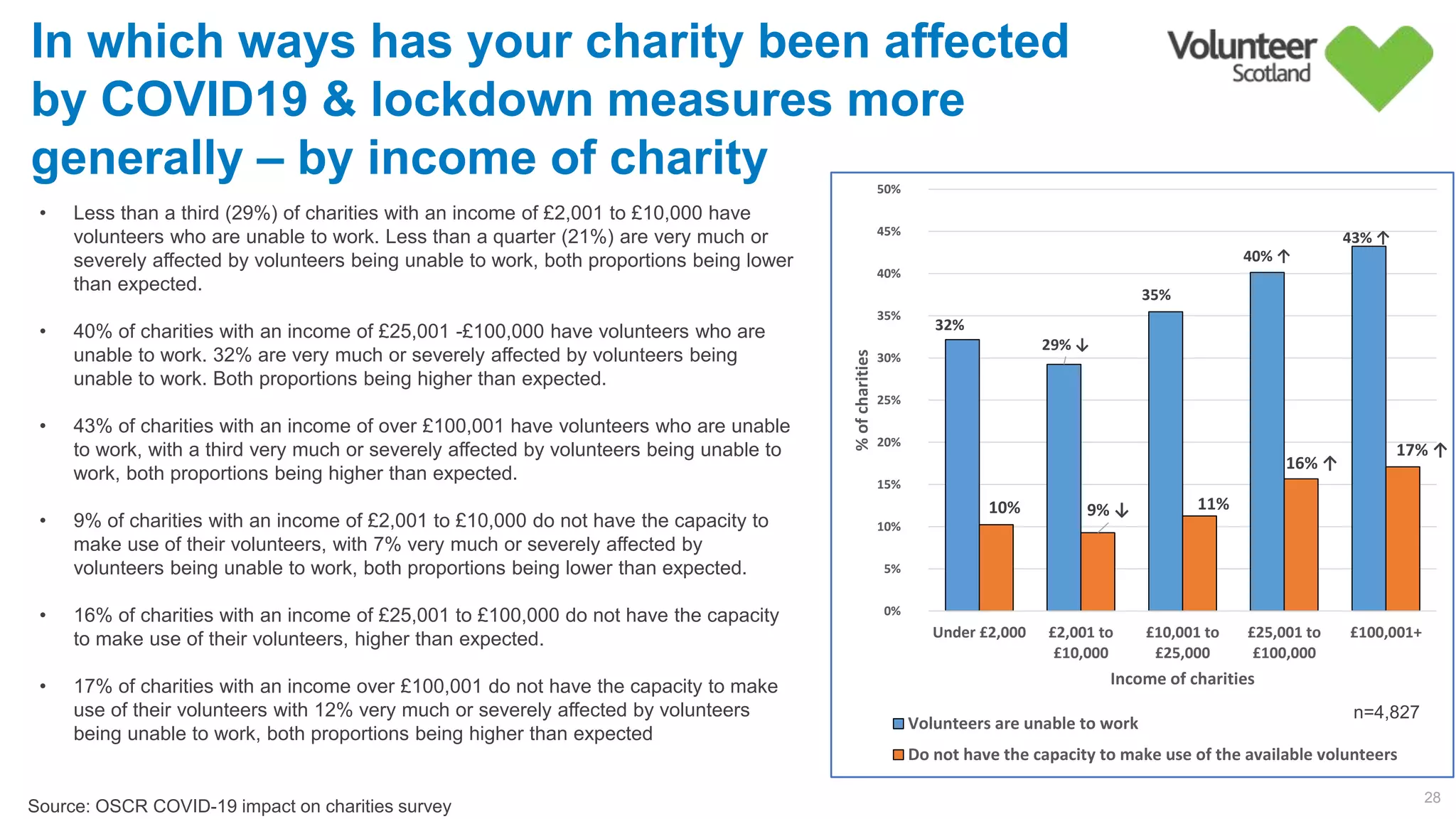
• Less than a third (29%) of charities with an income of £2,001 to £10,000 have
volunteers who are unable to work. Less than a quarter (21%) are very much or
severely affected by volunteers being unable to work, both proportions being lower
than expected.
• 40% of charities with an income of £25,001 -£100,000 have volunteers who are
unable to work. 32% are very much or severely affected by volunteers being
unable to work. Both proportions being higher than expected.
• 43% of charities with an income of over £100,001 have volunteers who are unable
to work, with a third very much or severely affected by volunteers being unable to
work, both proportions being higher than expected.
• 9% of charities with an income of £2,001 to £10,000 do not have the capacity to
make use of their volunteers, with 7% very much or severely affected by
volunteers being unable to work, both proportions being lower than expected.
• 16% of charities with an income of £25,001 to £100,000 do not have the capacity
to make use of their volunteers, higher than expected.
• 17% of charities with an income over £100,001 do not have the capacity to make
use of their volunteers with 12% very much or severely affected by volunteers
being unable to work, both proportions being higher than expected
Source: OSCR COVID-19 impact on charities survey
In which ways has your charity been affected
by COVID19 & lockdown measures more
generally – by income of charity
n=4,827
44% ↑
38%         37%         36%        
39%        
36%        
31% ↓
39%        
37%        
13%         13%        
14%        
13%        
17%        
13%        
11% ↓
18% ↑
12%        
0%
5%
10%
15%
20%
25%
30%
35%
40%
45%
50%
%ofcharities
Geographical base of charities
Volunteers are unable to work
Do not have the capacity to make use of the available volunteers
29
Source: OSCR COVID-19 impact on charities survey
In which ways has your charity been affected
by COVID19 & lockdown measures more
generally – by geographical base of charities
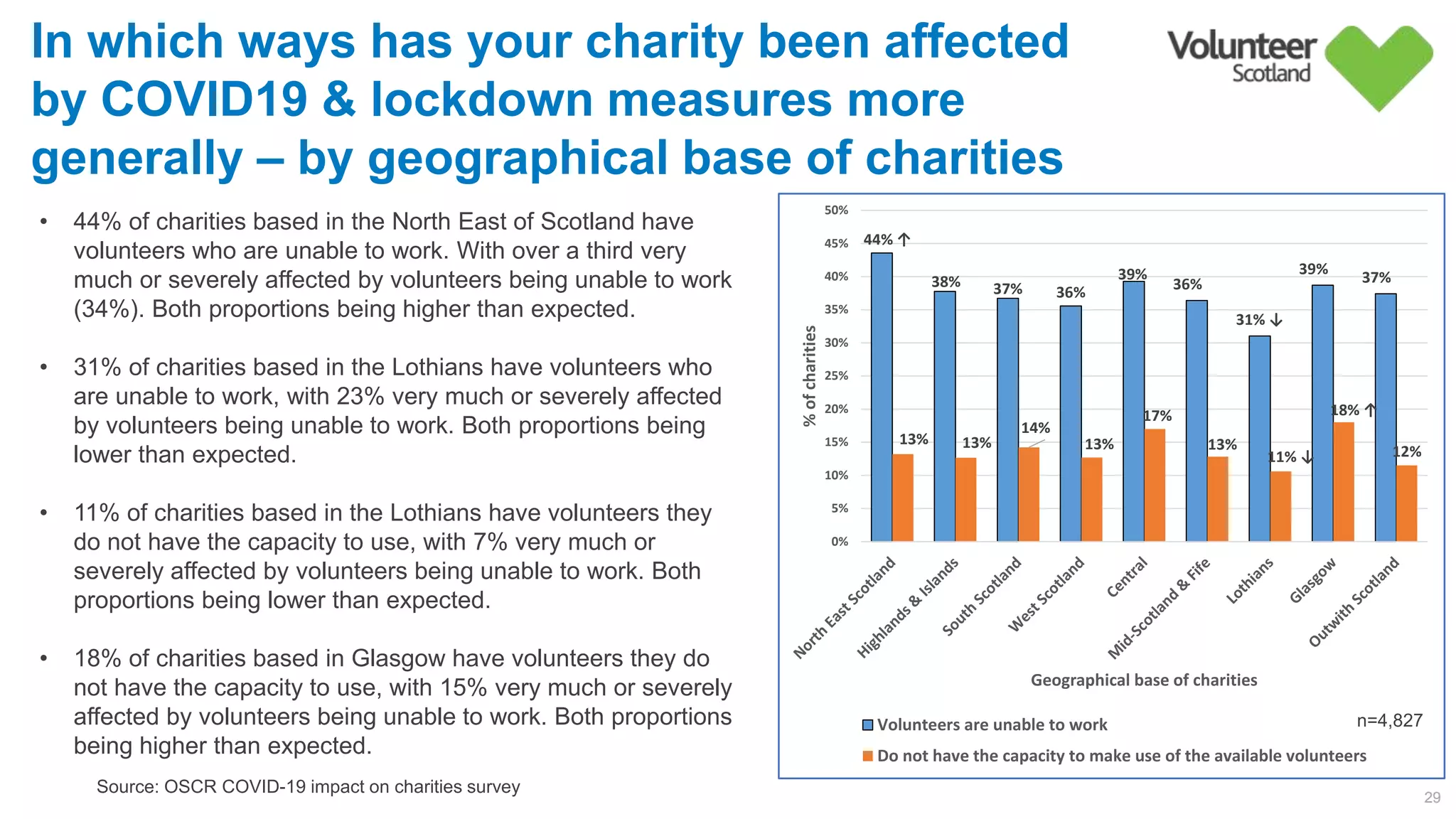
• 44% of charities based in the North East of Scotland have
volunteers who are unable to work. With over a third very
much or severely affected by volunteers being unable to work
(34%). Both proportions being higher than expected.
• 31% of charities based in the Lothians have volunteers who
are unable to work, with 23% very much or severely affected
by volunteers being unable to work. Both proportions being
lower than expected.
• 11% of charities based in the Lothians have volunteers they
do not have the capacity to use, with 7% very much or
severely affected by volunteers being unable to work. Both
proportions being lower than expected.
• 18% of charities based in Glasgow have volunteers they do
not have the capacity to use, with 15% very much or severely
affected by volunteers being unable to work. Both proportions
being higher than expected.
n=4,827
47% ↑
45% ↑
38%        
18% ↑ 18% ↑
13%        
0%
5%
10%
15%
20%
25%
30%
35%
40%
45%
50%
Contracts (NET) Grants (NET) Others (NET)
%ofcharities
Main sourse of income of charities
Volunteers are unable to work
Do not have the capacity to make use of the available volunteers
30
Source: OSCR COVID-19 impact on charities survey
In which ways has your charity been affected by
COVID19 & lockdown measures more generally
– by main source of charities' income
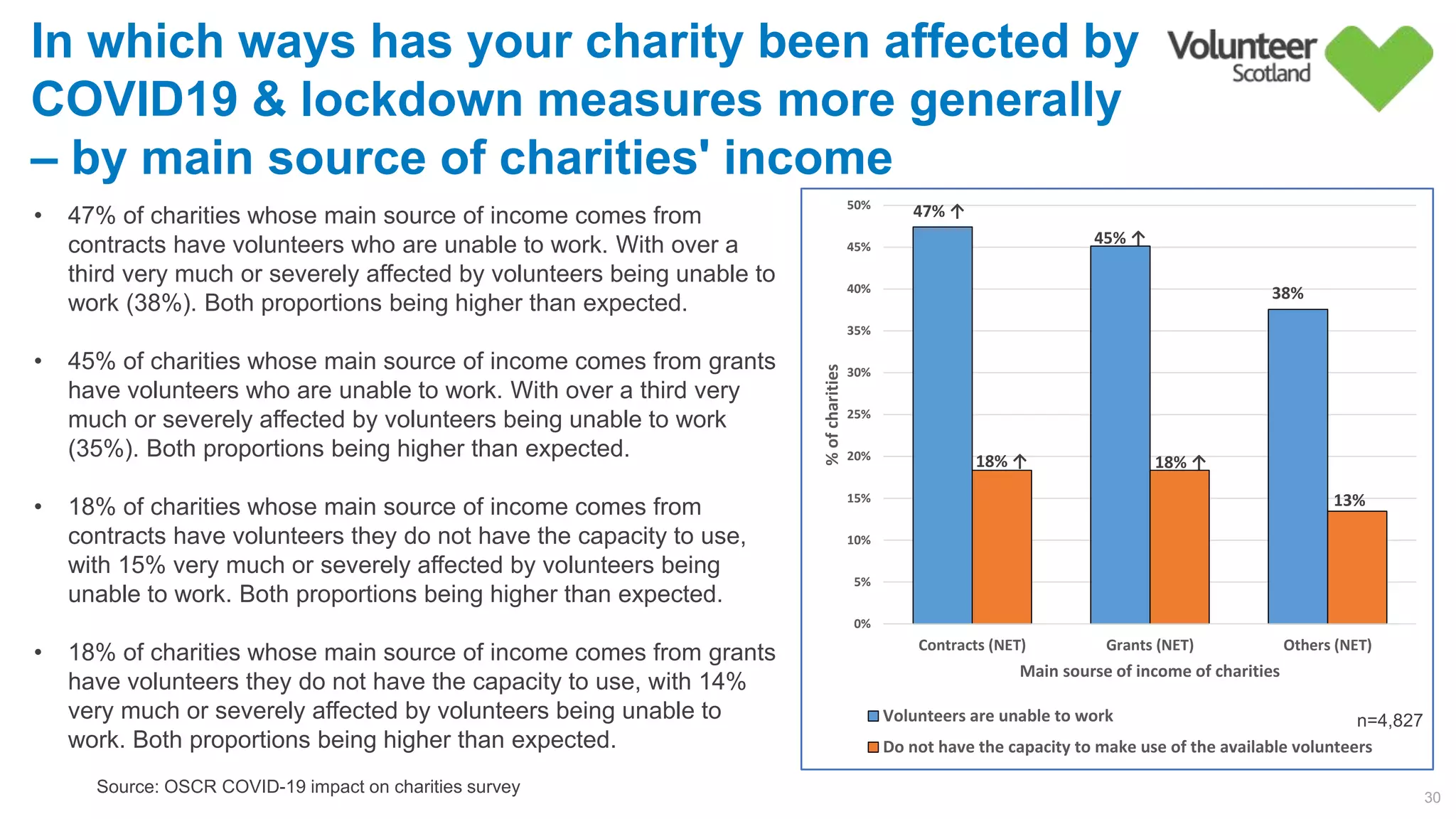
• 47% of charities whose main source of income comes from
contracts have volunteers who are unable to work. With over a
third very much or severely affected by volunteers being unable to
work (38%). Both proportions being higher than expected.
• 45% of charities whose main source of income comes from grants
have volunteers who are unable to work. With over a third very
much or severely affected by volunteers being unable to work
(35%). Both proportions being higher than expected.
• 18% of charities whose main source of income comes from
contracts have volunteers they do not have the capacity to use,
with 15% very much or severely affected by volunteers being
unable to work. Both proportions being higher than expected.
• 18% of charities whose main source of income comes from grants
have volunteers they do not have the capacity to use, with 14%
very much or severely affected by volunteers being unable to
work. Both proportions being higher than expected.
n=4,827
38%        
42% ↑
32% ↓ 30% ↓
27% ↓
13%        
17% ↑
15%        
11%        
9%        
0%        
5%        
10%        
15%        
20%        
25%        
30%        
35%        
40%        
45%        
A local
community or
small number
of local
communities
Regionally
within
Scotland
Nationally,
across
Scotland
Nationally,
across the UK
Internationally
(outside the
UK)
%ofcharities
Scale of charities
Volunteers are unable to work
Do not have the capacity to make use of the available volunteers
31Source: OSCR COVID-19 impact on charities survey
In which ways has your charity been affected
by COVID19 & lockdown measures more
generally – by geographical scale of charity
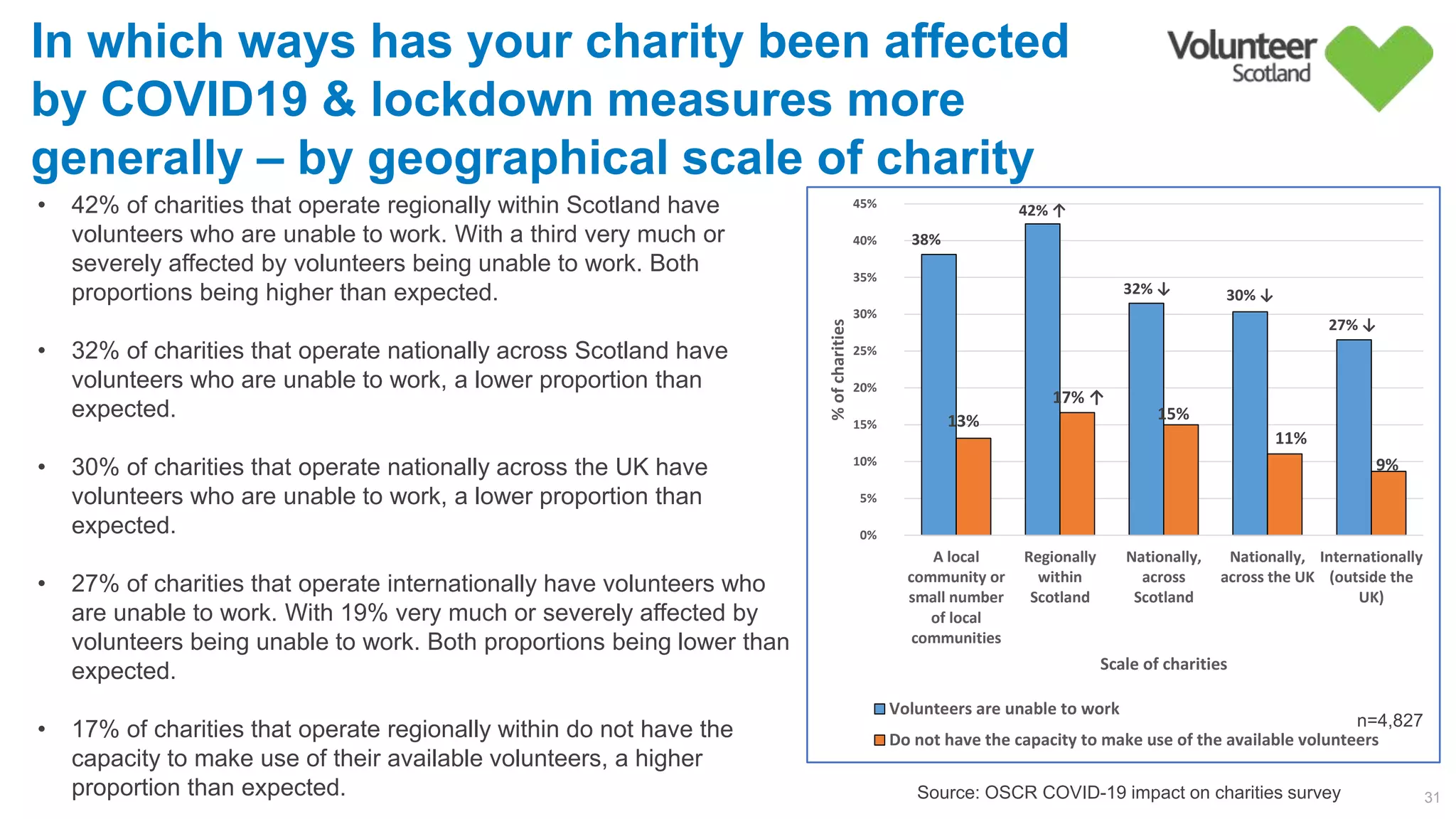
• 42% of charities that operate regionally within Scotland have
volunteers who are unable to work. With a third very much or
severely affected by volunteers being unable to work. Both
proportions being higher than expected.
• 32% of charities that operate nationally across Scotland have
volunteers who are unable to work, a lower proportion than
expected.
• 30% of charities that operate nationally across the UK have
volunteers who are unable to work, a lower proportion than
expected.
• 27% of charities that operate internationally have volunteers who
are unable to work. With 19% very much or severely affected by
volunteers being unable to work. Both proportions being lower than
expected.
• 17% of charities that operate regionally within do not have the
capacity to make use of their available volunteers, a higher
proportion than expected.
n=4,827
34% ↓
42% ↑
40%        
11% ↓
17% ↑
15%        
0%
5%
10%
15%
20%
25%
30%
35%
40%
45%
None 1-10 11+
%ofcharities
Paid staff members
Volunteers are unable to work
Do not have the capacity to make use of the available volunteers
32
Source: OSCR COVID-19 impact on charities survey
In which ways has your charity been affected
by COVID19 & lockdown measures more
generally – by number of paid staff
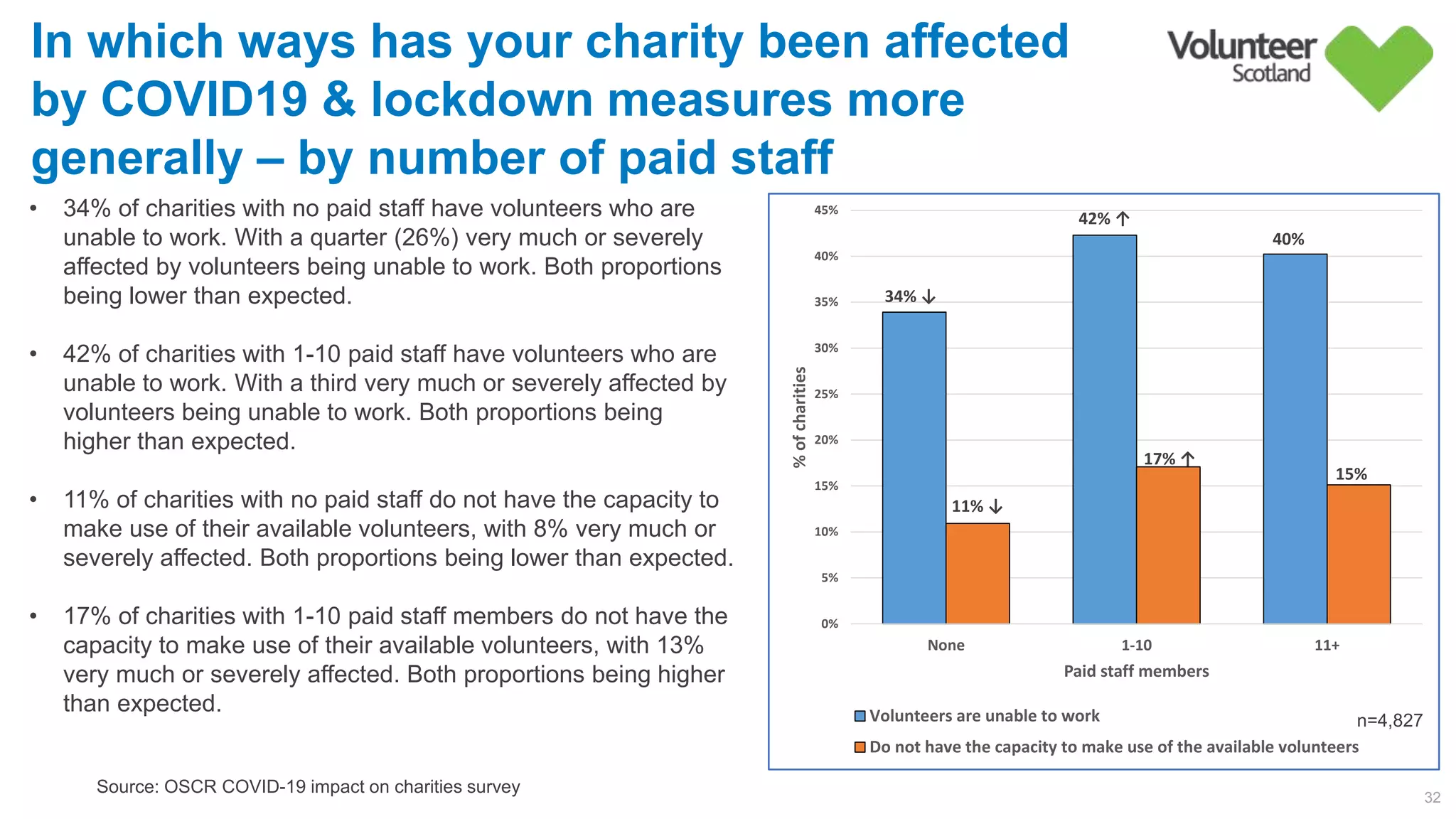
• 34% of charities with no paid staff have volunteers who are
unable to work. With a quarter (26%) very much or severely
affected by volunteers being unable to work. Both proportions
being lower than expected.
• 42% of charities with 1-10 paid staff have volunteers who are
unable to work. With a third very much or severely affected by
volunteers being unable to work. Both proportions being
higher than expected.
• 11% of charities with no paid staff do not have the capacity to
make use of their available volunteers, with 8% very much or
severely affected. Both proportions being lower than expected.
• 17% of charities with 1-10 paid staff members do not have the
capacity to make use of their available volunteers, with 13%
very much or severely affected. Both proportions being higher
than expected.
n=4,827
49% ↑
36%        
22% ↓
20% ↑
13%        
6% ↓
0%
10%
20%
30%
40%
50%
60%
Critical at some point in
the next 12 months
Some threat across the
next 12 months, but never
critical
No threat across the next
12 months
%ofcharities
Financial threat within the next 12 months
Volunteers are unable to work
Do not have the capacity to make use of the available volunteers
33
Source: OSCR COVID-19 impact on charities survey
In which ways has your charity been affected by
COVID19 & lockdown measures more generally
– by financial threat within next 12 months
n=4,827
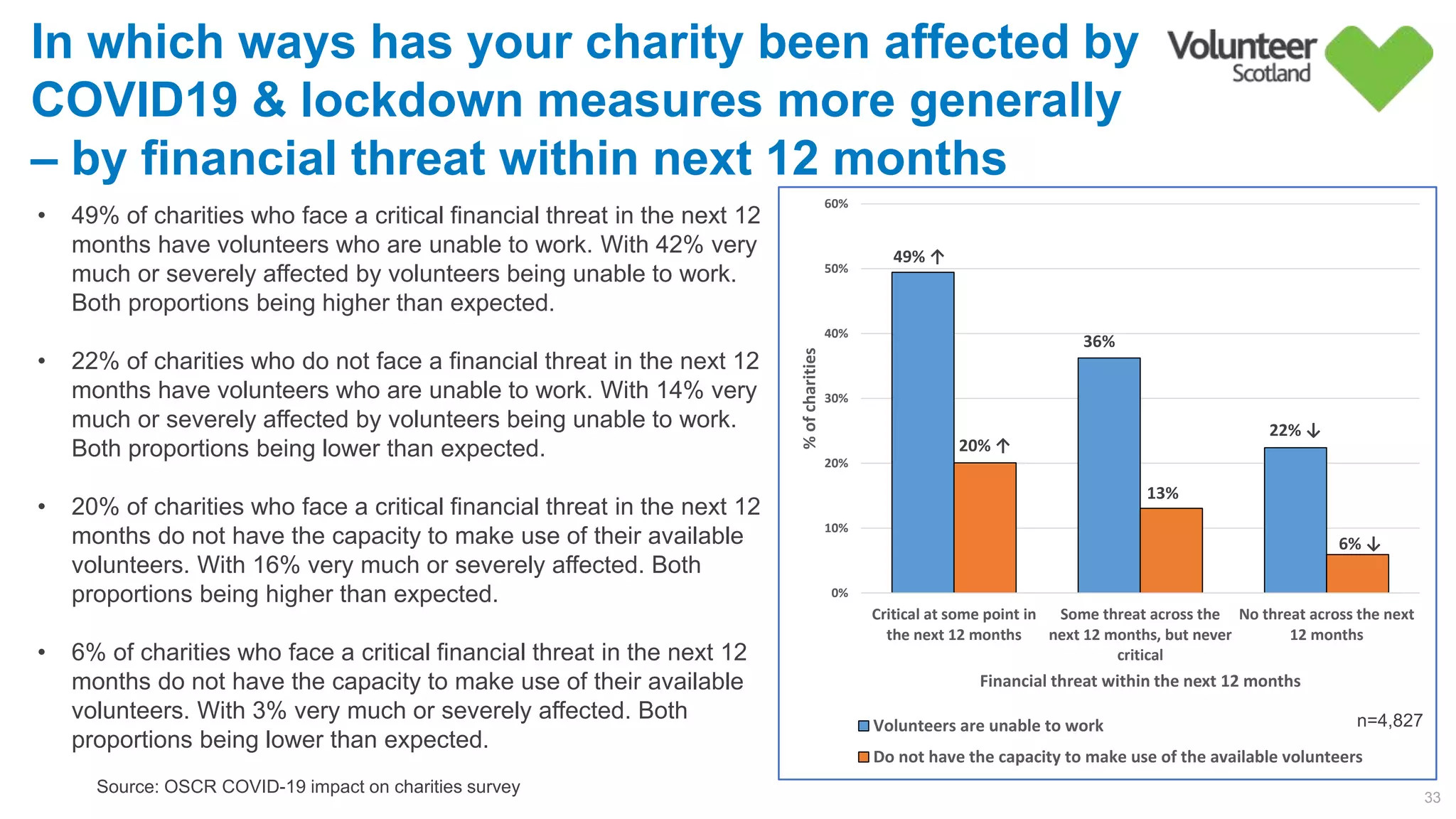
• 49% of charities who face a critical financial threat in the next 12
months have volunteers who are unable to work. With 42% very
much or severely affected by volunteers being unable to work.
Both proportions being higher than expected.
• 22% of charities who do not face a financial threat in the next 12
months have volunteers who are unable to work. With 14% very
much or severely affected by volunteers being unable to work.
Both proportions being lower than expected.
• 20% of charities who face a critical financial threat in the next 12
months do not have the capacity to make use of their available
volunteers. With 16% very much or severely affected. Both
proportions being higher than expected.
• 6% of charities who face a critical financial threat in the next 12
months do not have the capacity to make use of their available
volunteers. With 3% very much or severely affected. Both
proportions being lower than expected.
43% ↑
45% ↑
37%        
46% ↑
38%        
18% ↑
15%         14%        
20% ↑
13%        
0%
5%
10%
15%
20%
25%
30%
35%
40%
45%
50%
Housing and
Community
(NET)
Social care
(NET)
Leisure and
Culture (NET)
Health (NET) Others (NET)
%ofcharities
Charities Sector
Volunteers are unable to work
Do not have the capacity to make use of the available volunteers
34
Source: OSCR COVID-19 impact on charities survey
In which ways has your charity been affected by
COVID19 & lockdown measures more generally
– by grouped charity sectors
n=4,827
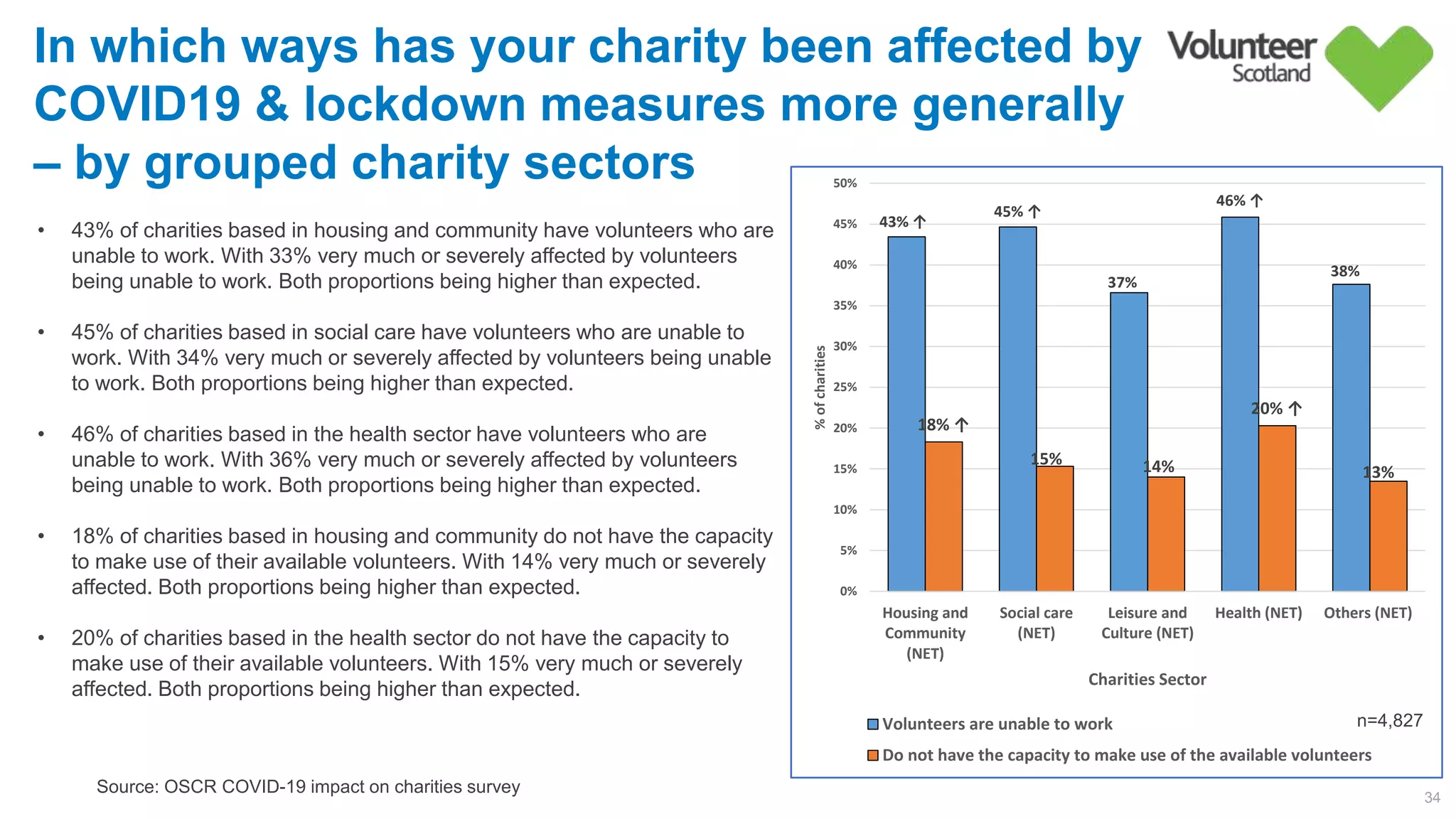
• 43% of charities based in housing and community have volunteers who are
unable to work. With 33% very much or severely affected by volunteers
being unable to work. Both proportions being higher than expected.
• 45% of charities based in social care have volunteers who are unable to
work. With 34% very much or severely affected by volunteers being unable
to work. Both proportions being higher than expected.
• 46% of charities based in the health sector have volunteers who are
unable to work. With 36% very much or severely affected by volunteers
being unable to work. Both proportions being higher than expected.
• 18% of charities based in housing and community do not have the capacity
to make use of their available volunteers. With 14% very much or severely
affected. Both proportions being higher than expected.
• 20% of charities based in the health sector do not have the capacity to
make use of their available volunteers. With 15% very much or severely
affected. Both proportions being higher than expected.
35
Source: OSCR COVID-19 impact on charities survey
In which ways has your charity been affected by
COVID19 & lockdown measures more generally –
by individual charity sectors
n=4,827
Sector Volunteers are
unable to work
Very much or
severely affected
by volunteers
unable to work
Do not have the
capacity to make use
of the available
volunteers
Very much or
severely affected
by not having the
capacity to make
use of available
volunteers
Housing 35%         30%         18%         16%        
Social care - Children and families 43% ↑ 33% ↑ 16%         12%        
Social care - Young people 47% ↑ 36% ↑ 19% ↑ 15% ↑
Social care - People with disabilities 51% ↑ 40% ↑ 18% ↑ 14% ↑
Social care – older people 48% ↑ 36% ↑ 14%         11%        
Culture and arts 32% ↓ 25% ↓ 13%         10%        
Sports and recreation 41% ↑ 31%         15%         11%        
Health 43% ↑ 35% ↑ 18% ↑ 13% ↑
Mental health 50% ↑ 39% ↑ 24% ↑ 17% ↑
Education and research 36%         27%         14%         10%        
Community development (including
employability and training)
45% ↑ 33% ↑ 19% ↑ 14% ↑
Grant giving, philanthropy and
funding
22% ↓ 14% ↓ 6% ↓ 4% ↓
Environment and animals 49% ↑ 36% ↑ 18% ↑ 12%        
Advocacy, minorities, rights and law 41%         35%         26% ↑ 17%        
Umbrella body 38%         30%         14%         10%        
Religion and belief 39%         28%         13%         10%        
Other (Please say) 38%         30%         14%         11%        
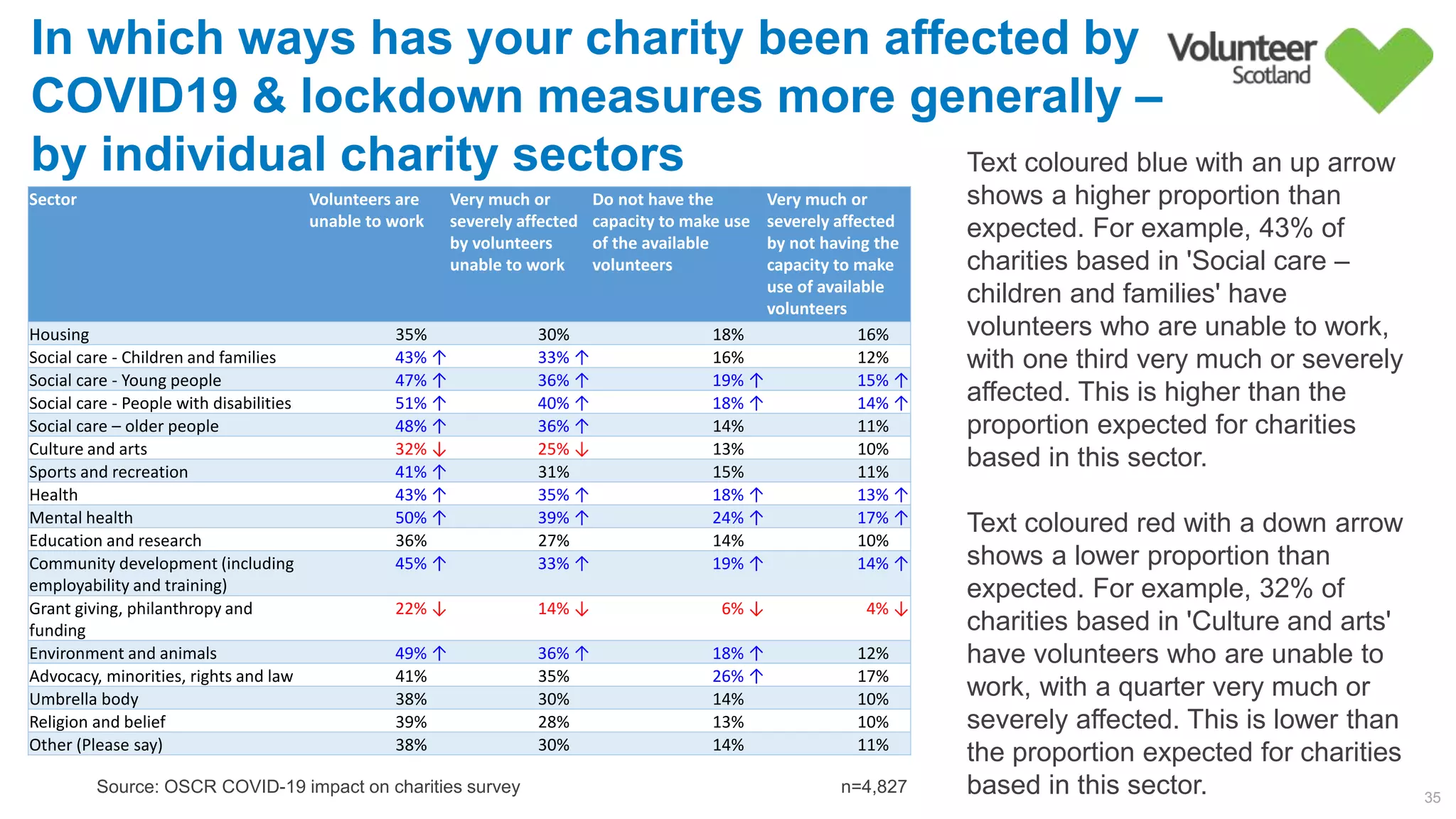
Text coloured blue with an up arrow
shows a higher proportion than
expected. For example, 43% of
charities based in 'Social care –
children and families' have
volunteers who are unable to work,
with one third very much or severely
affected. This is higher than the
proportion expected for charities
based in this sector.
Text coloured red with a down arrow
shows a lower proportion than
expected. For example, 32% of
charities based in 'Culture and arts'
have volunteers who are unable to
work, with a quarter very much or
severely affected. This is lower than
the proportion expected for charities
based in this sector.
Charities' responses to COVID-19
37
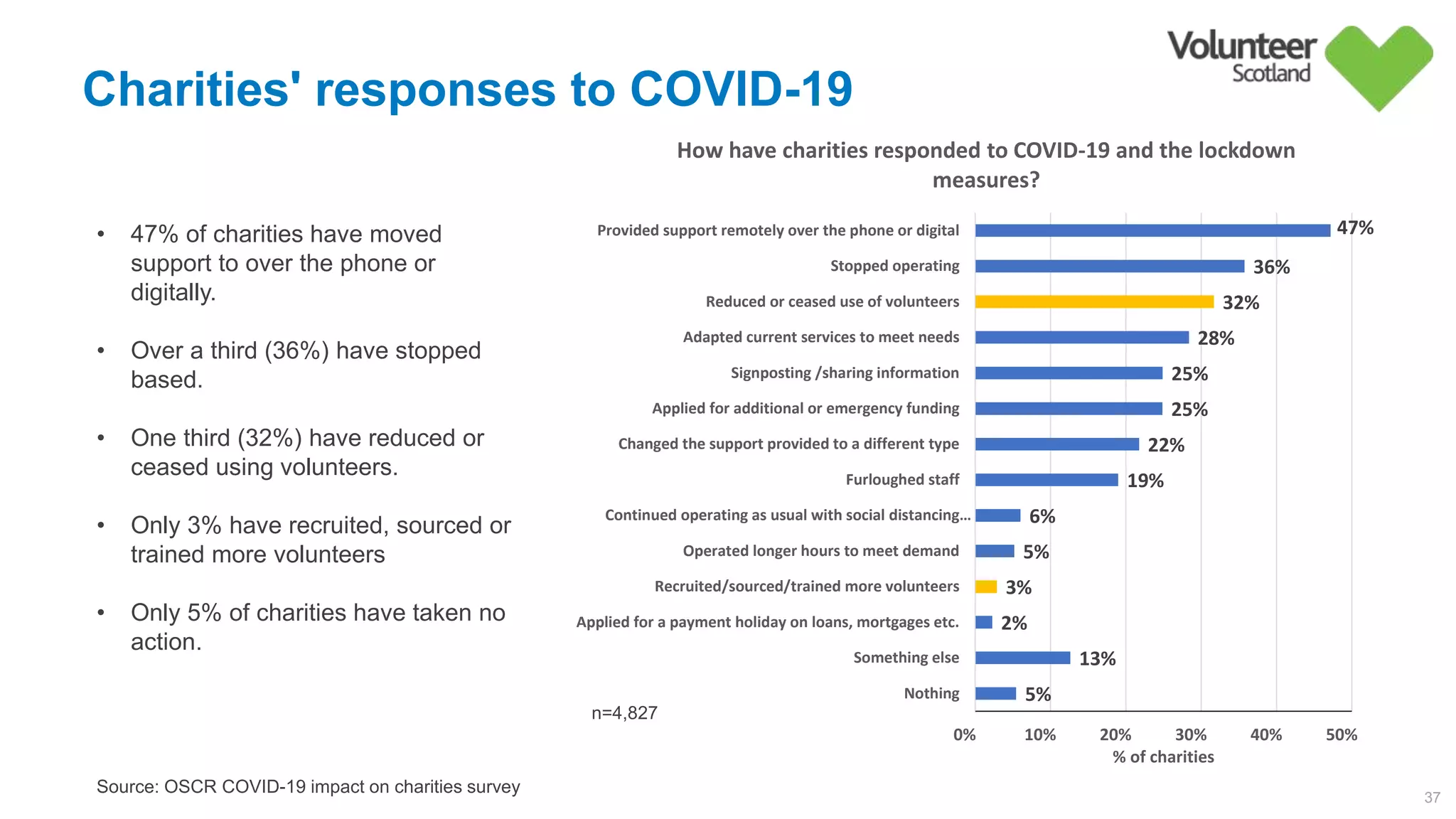
• 47% of charities have moved
support to over the phone or
digitally.
• Over a third (36%) have stopped
based.
• One third (32%) have reduced or
ceased using volunteers.
• Only 3% have recruited, sourced or
trained more volunteers
• Only 5% of charities have taken no
action.
n=4,827
Source: OSCR COVID-19 impact on charities survey
5%        
13%        
2%        
3%        
5%        
6%        
19%        
22%        
25%        
25%        
28%        
32%        
36%        
47%        
0%         10%         20%         30%         40%         50%        
Nothing
Something else
Applied for a payment holiday on loans, mortgages etc.
Recruited/sourced/trained more volunteers
Operated longer hours to meet demand
Continued operating as usual with social distancing…
Furloughed staff
Changed the support provided to a different type
Applied for additional or emergency funding
Signposting /sharing information
Adapted current services to meet needs
Reduced or ceased use of volunteers
Stopped operating
Provided support remotely over the phone or digital
% of charities
How have charities responded to COVID-19 and the lockdown
measures?
33%        
5% ↑
31%        
5% ↑
34%        
4%        
30%        
3%        
34%        
2%        
30%        
2% ↓
0%        
5%        
10%        
15%        
20%        
25%        
30%        
35%        
40%        
Reduced or ceased use of volunteers Recruited/sourced/trained more volunteers
%ofcharities
Less than a year 1-3 years 4-10 years 11-25 years 26-50 years More than 50 years
38
Source: OSCR COVID-19 impact on charities survey
In what ways, if any, has your charity responded to
COVID-19 & lockdown measures – by age of charity
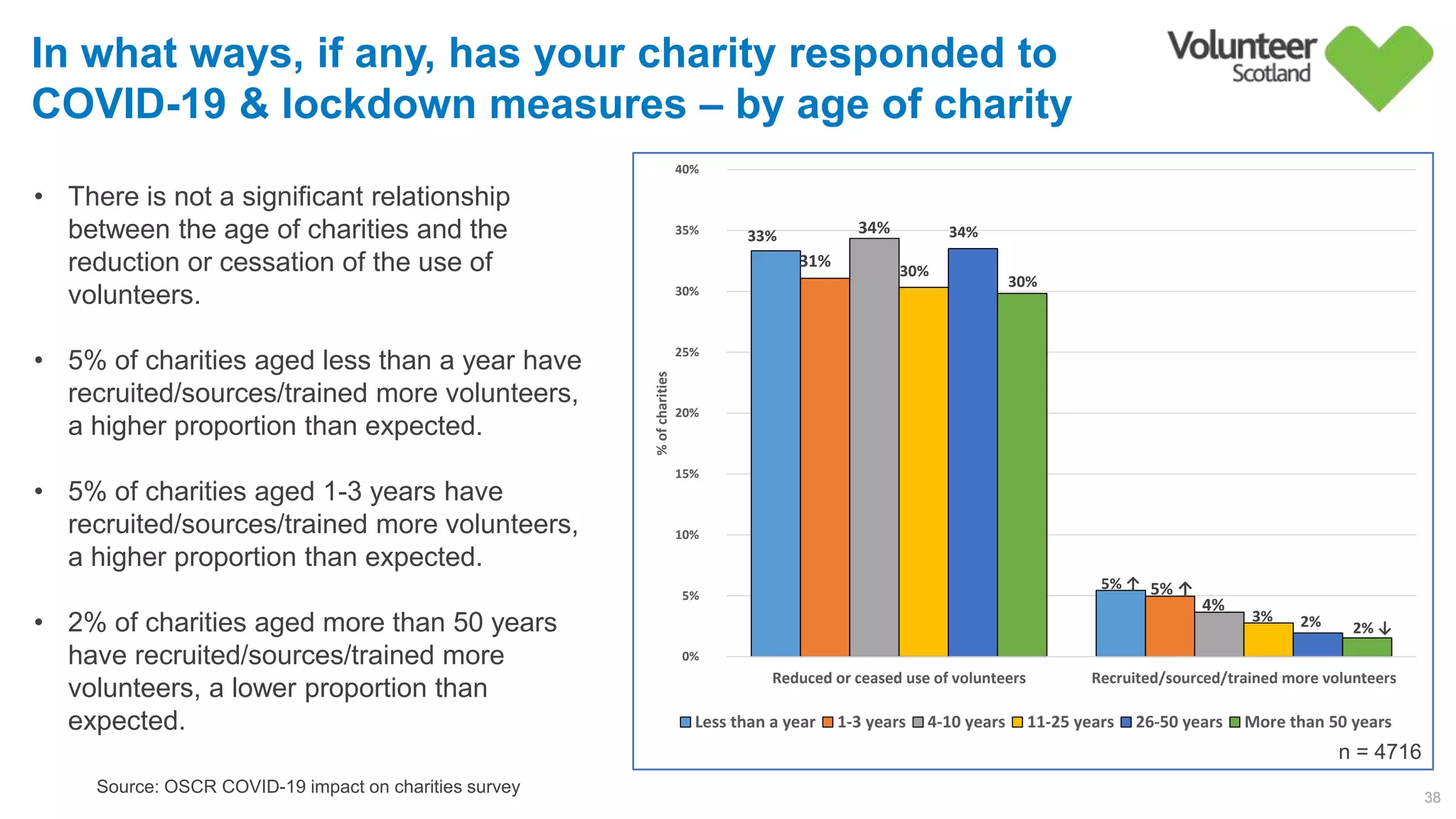
• There is not a significant relationship
between the age of charities and the
reduction or cessation of the use of
volunteers.
• 5% of charities aged less than a year have
recruited/sources/trained more volunteers,
a higher proportion than expected.
• 5% of charities aged 1-3 years have
recruited/sources/trained more volunteers,
a higher proportion than expected.
• 2% of charities aged more than 50 years
have recruited/sources/trained more
volunteers, a lower proportion than
expected.
n = 4716
23% ↓
0% ↓
24% ↓
1% ↓
30%        
2%        
35% ↑
3%        
39% ↑
5% ↑
0%
5%
10%
15%
20%
25%
30%
35%
40%
45%
Reduced or ceased use of volunteers Recruited/sourced/trained more volunteers
%ofcharities
Under £2,000 £2,001 to £10,000 £10,001 to £25,000 £25,001 to £100,000 £100,001+
39
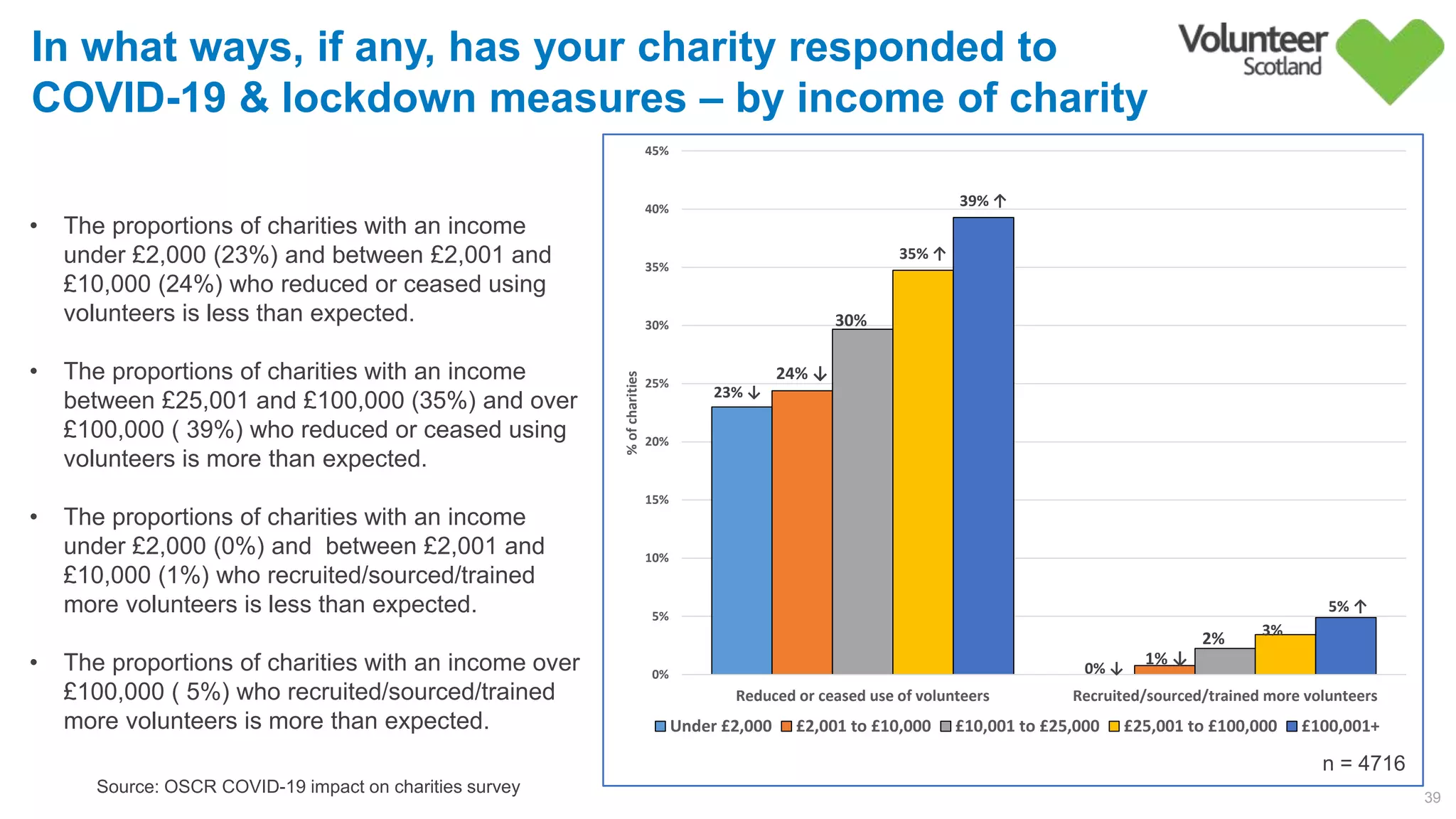
• The proportions of charities with an income
under £2,000 (23%) and between £2,001 and
£10,000 (24%) who reduced or ceased using
volunteers is less than expected.
• The proportions of charities with an income
between £25,001 and £100,000 (35%) and over
£100,000 ( 39%) who reduced or ceased using
volunteers is more than expected.
• The proportions of charities with an income
under £2,000 (0%) and between £2,001 and
£10,000 (1%) who recruited/sourced/trained
more volunteers is less than expected.
• The proportions of charities with an income over
£100,000 ( 5%) who recruited/sourced/trained
more volunteers is more than expected.
Source: OSCR COVID-19 impact on charities survey
In what ways, if any, has your charity responded to
COVID-19 & lockdown measures – by income of charity
n = 4716
34%        
32%        
33%        
30%        
32%        
31%        
27% ↓
37% ↑
30%        
1%        
3%         3%        
3%        
4%        
2%         2%        
4%         4%        
0%        
5%        
10%        
15%        
20%        
25%        
30%        
35%        
40%        
%ofcharities
Geographical base of charities
Reduced or ceased use of volunteers Recruited/sourced/trained more volunteers
40
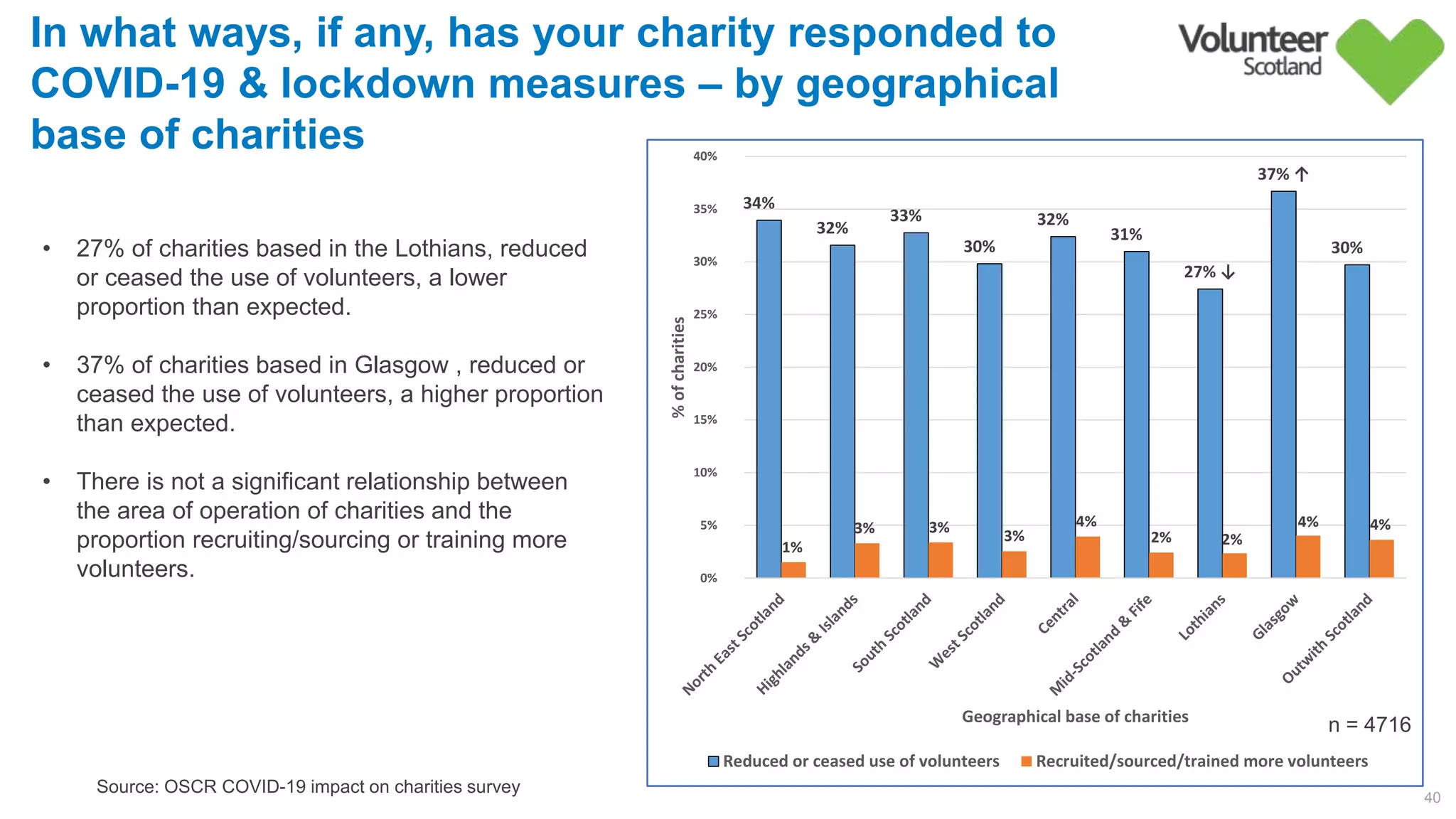
• 27% of charities based in the Lothians, reduced
or ceased the use of volunteers, a lower
proportion than expected.
• 37% of charities based in Glasgow , reduced or
ceased the use of volunteers, a higher proportion
than expected.
• There is not a significant relationship between
the area of operation of charities and the
proportion recruiting/sourcing or training more
volunteers.
Source: OSCR COVID-19 impact on charities survey
In what ways, if any, has your charity responded to
COVID-19 & lockdown measures – by geographical
base of charities
n = 4716
43% ↑
5% ↑
41% ↑
5% ↑
32%        
3%        
0%
5%
10%
15%
20%
25%
30%
35%
40%
45%
50%
Reduced or ceased use of volunteers Recruited/sourced/trained more volunteers%ofcharities
Contracts (NET) Grants (NET) Others (NET)
41
Source: OSCR COVID-19 impact on charities survey
In what ways, if any, has your charity responded to
COVID-19 & lockdown measures – by main sources
of income
n = 4716
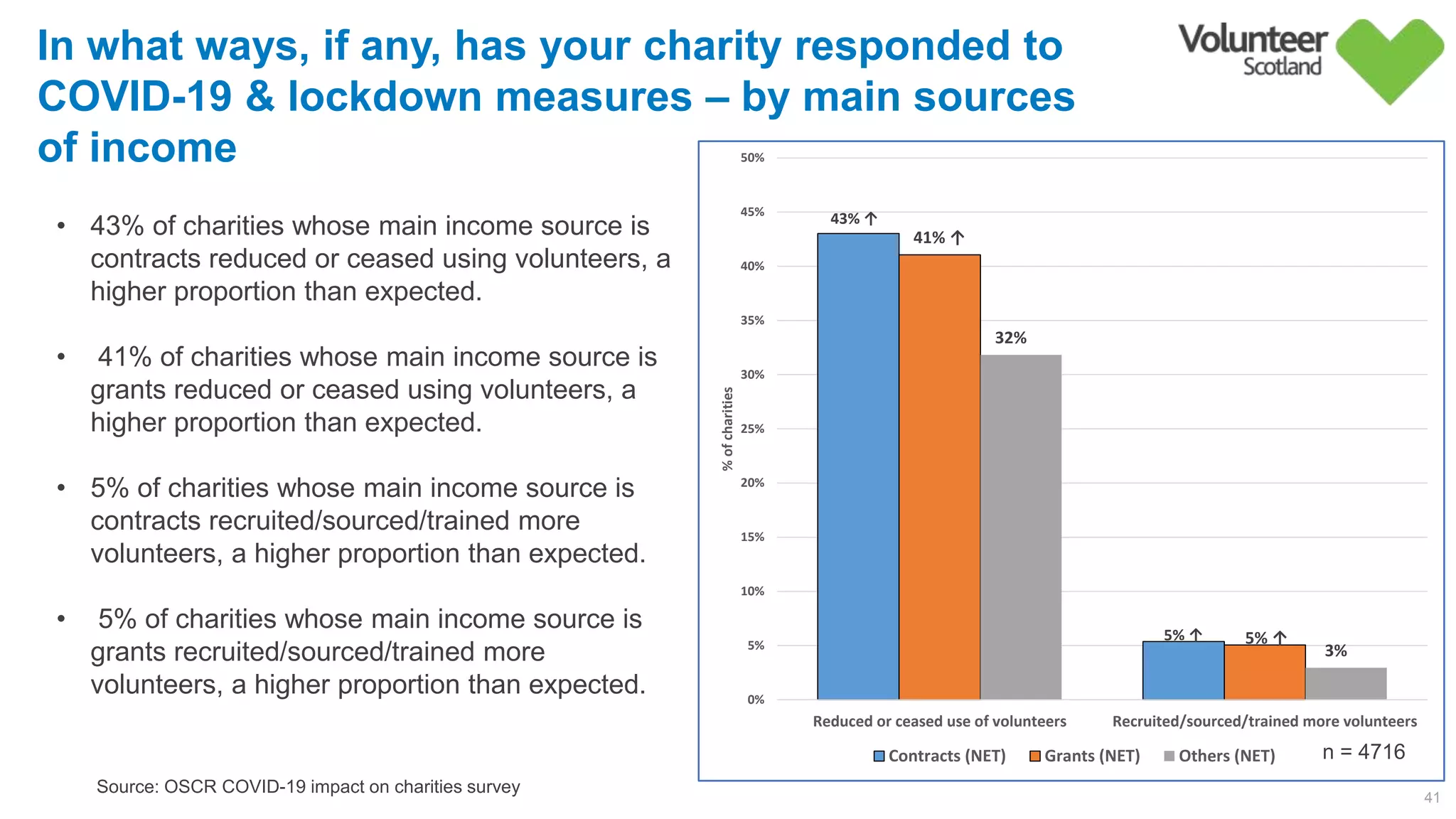
• 43% of charities whose main income source is
contracts reduced or ceased using volunteers, a
higher proportion than expected.
• 41% of charities whose main income source is
grants reduced or ceased using volunteers, a
higher proportion than expected.
• 5% of charities whose main income source is
contracts recruited/sourced/trained more
volunteers, a higher proportion than expected.
• 5% of charities whose main income source is
grants recruited/sourced/trained more
volunteers, a higher proportion than expected.
32%        
3%        
38% ↑
3%        
26% ↓
2%        
28%        
2%        
25%        
1%        
0%        
5%        
10%        
15%        
20%        
25%        
30%        
35%        
40%        
Reduced or ceased use of volunteers Recruited/sourced/trained more
volunteers
%ofcharities
A local community or small number of local communities
Regionally within Scotland
Nationally, across Scotland
Nationally, across the UK
Internationally (outside the UK)
42
Source: OSCR COVID-19 impact on charities survey
In what ways, if any, has your charity responded to
COVID-19 & lockdown measures – by geographical
scale of charity
n = 4716
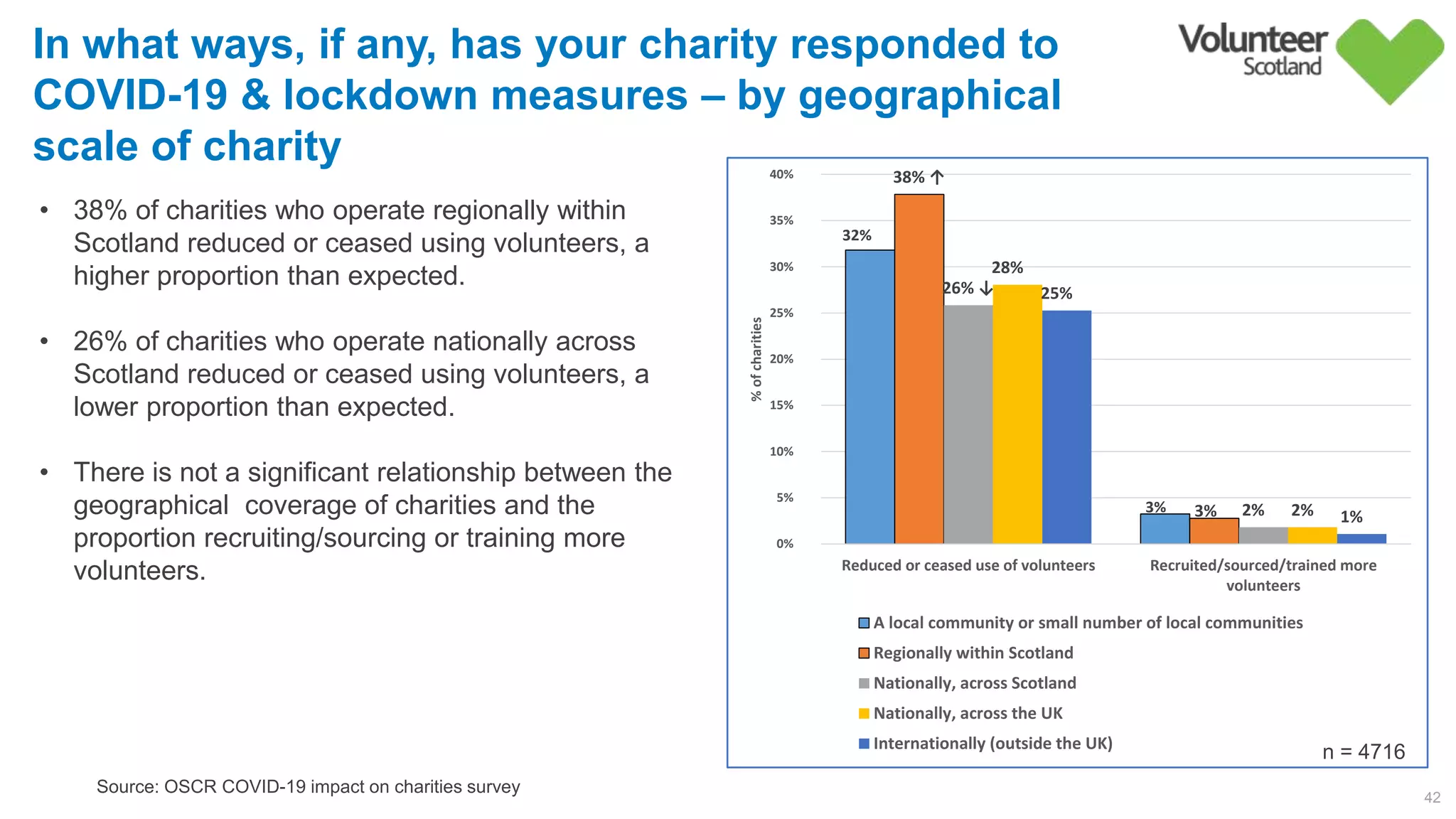
• 38% of charities who operate regionally within
Scotland reduced or ceased using volunteers, a
higher proportion than expected.
• 26% of charities who operate nationally across
Scotland reduced or ceased using volunteers, a
lower proportion than expected.
• There is not a significant relationship between the
geographical coverage of charities and the
proportion recruiting/sourcing or training more
volunteers.
28% ↓
2% ↓
37% ↑
4% ↑
36%        
4%        
0%
5%
10%
15%
20%
25%
30%
35%
40%
Reduced or ceased use of volunteers Recruited/sourced/trained more
volunteers
%ofcharities
None 1-10 11+
43
Source: OSCR COVID-19 impact on charities survey
In what ways, if any, has your charity responded to
COVID-19 & lockdown measures – by number of paid
staff
n = 4716
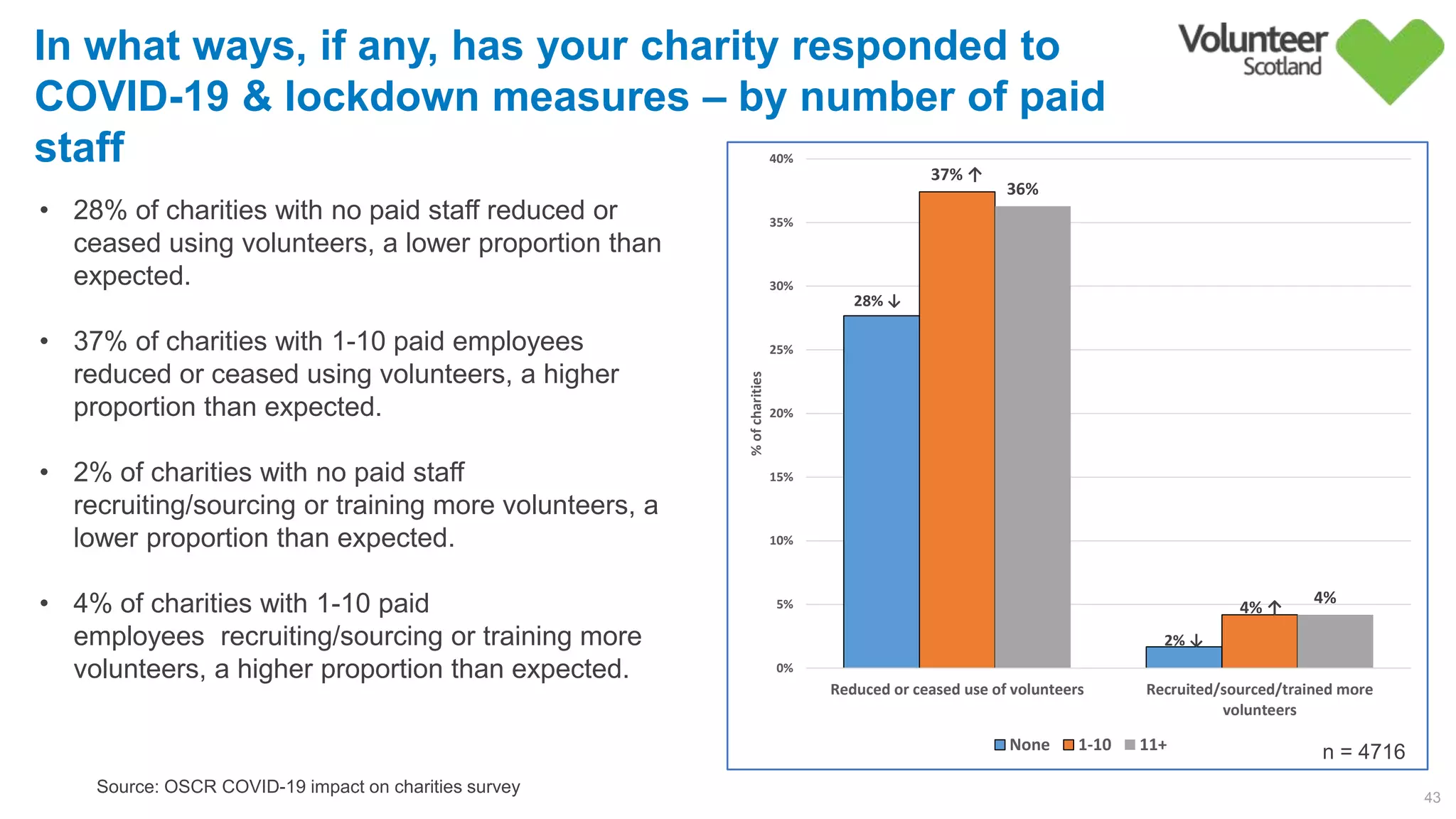
• 28% of charities with no paid staff reduced or
ceased using volunteers, a lower proportion than
expected.
• 37% of charities with 1-10 paid employees
reduced or ceased using volunteers, a higher
proportion than expected.
• 2% of charities with no paid staff
recruiting/sourcing or training more volunteers, a
lower proportion than expected.
• 4% of charities with 1-10 paid
employees recruiting/sourcing or training more
volunteers, a higher proportion than expected.
43% ↑
3%        
30% ↓
3%        
20% ↓
2%        
0%
5%
10%
15%
20%
25%
30%
35%
40%
45%
50%
Reduced or ceased use of volunteers Recruited/sourced/trained more volunteers
%ofcharities
Critical at some point in the next 12 months
Some threat across the next 12 months, but never critical
No threat across the next 12 months
44
Source: OSCR COVID-19 impact on charities survey
In what ways, if any, has your charity responded to
COVID-19 & lockdown measures – by financial threat in
next 12 months
n = 4716
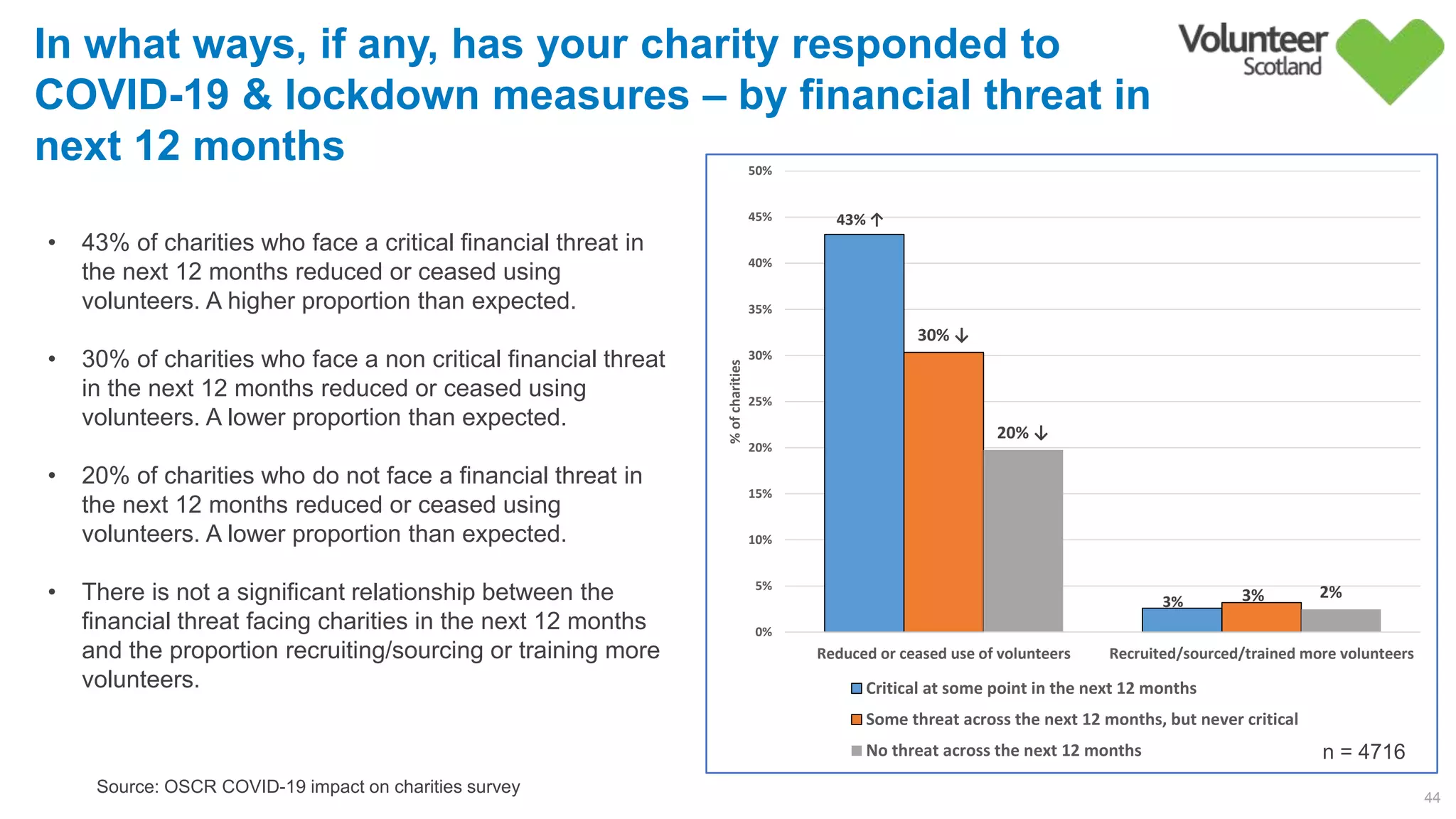
• 43% of charities who face a critical financial threat in
the next 12 months reduced or ceased using
volunteers. A higher proportion than expected.
• 30% of charities who face a non critical financial threat
in the next 12 months reduced or ceased using
volunteers. A lower proportion than expected.
• 20% of charities who do not face a financial threat in
the next 12 months reduced or ceased using
volunteers. A lower proportion than expected.
• There is not a significant relationship between the
financial threat facing charities in the next 12 months
and the proportion recruiting/sourcing or training more
volunteers.
38% ↑
8% ↑
36% ↑
5% ↑
33%        
2% ↓
39% ↑
5% ↑
32%        
2%        
0%
5%
10%
15%
20%
25%
30%
35%
40%
45%
Reduced or ceased use of volunteers Recruited/sourced/trained more volunteers
%ofcharities
Housing and Community (NET) Social care (NET)
Leisure and Culture (NET) Health (NET)
Others (NET)
45
Source: OSCR COVID-19 impact on charities survey
In what ways, if any, has your charity responded to
COVID-19 & lockdown measures – by grouped charity
sectors
n = 4716
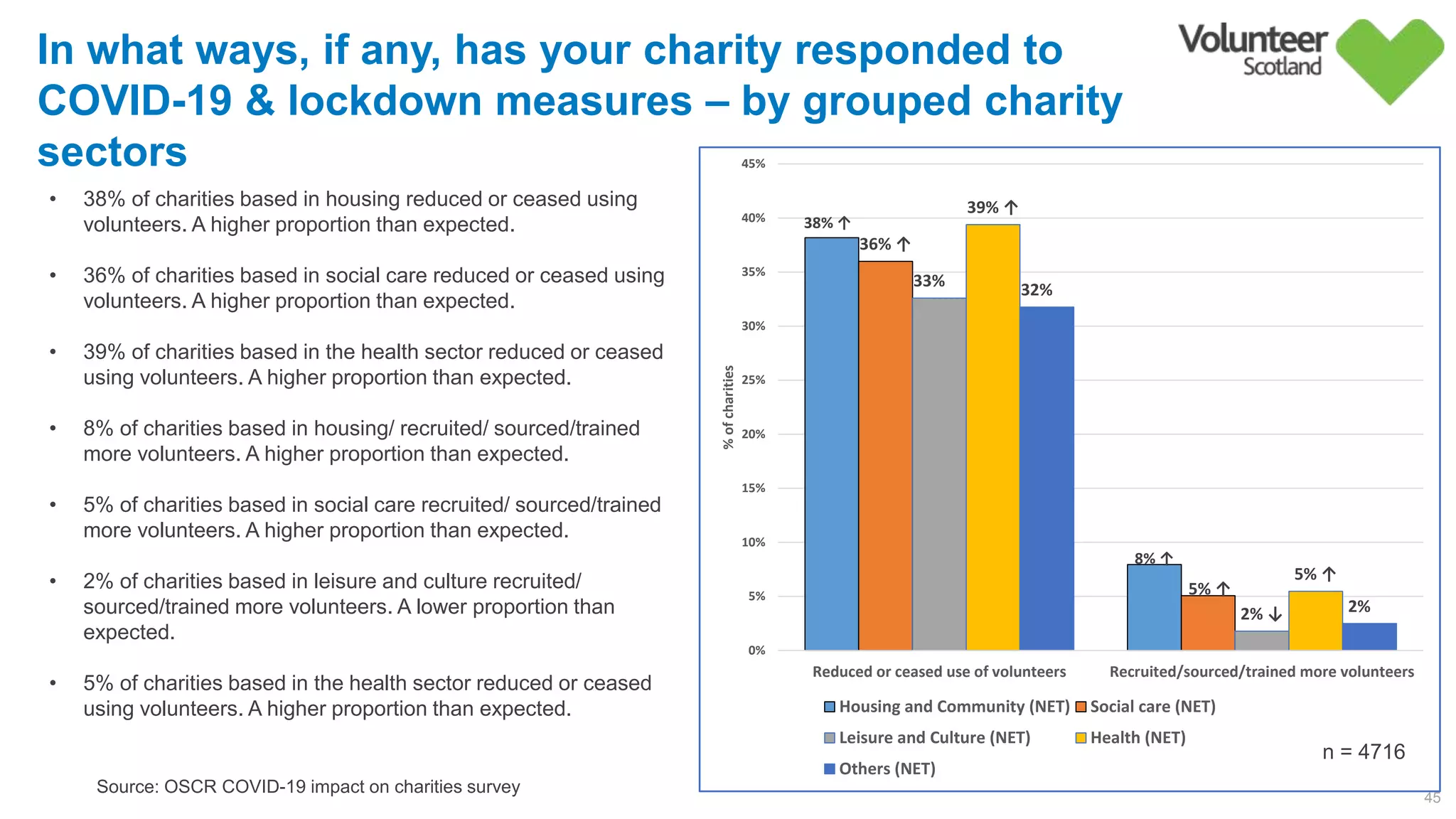
• 38% of charities based in housing reduced or ceased using
volunteers. A higher proportion than expected.
• 36% of charities based in social care reduced or ceased using
volunteers. A higher proportion than expected.
• 39% of charities based in the health sector reduced or ceased
using volunteers. A higher proportion than expected.
• 8% of charities based in housing/ recruited/ sourced/trained
more volunteers. A higher proportion than expected.
• 5% of charities based in social care recruited/ sourced/trained
more volunteers. A higher proportion than expected.
• 2% of charities based in leisure and culture recruited/
sourced/trained more volunteers. A lower proportion than
expected.
• 5% of charities based in the health sector reduced or ceased
using volunteers. A higher proportion than expected.
46
Source: OSCR COVID-19 impact on charities survey
In what ways, if any has your charity responded to
COVID-19 & lockdown measures – by individual charity
sectors
n = 4716
Sector
Reduced or ceased use of
volunteers
Recruited/sourced/trained
more volunteers
Housing 31%         9% ↑
Social care - Children and
families
35%         6% ↑
Social care - Young people 41% ↑ 6% ↑
Social care - People with
disabilities
44% ↑ 6% ↑
Social care – older people 36% ↑ 8% ↑
Culture and arts 29%         2%        
Sports and recreation 37% ↑ 2%        
Health 38% ↑ 6% ↑
Mental health 43% ↑ 6% ↑
Education and research 31%         3%        
Community development
(including employability and
training)
39% ↑ 8% ↑
Grant giving, philanthropy and
funding
19% ↓ 4%        
Environment and animals 50% ↑ 2%        
Advocacy, minorities, rights
and law
38%         5%        
Umbrella body 33%         9% ↑
Religion and belief 32%         2%        
Other (Please say) 31%         3%        
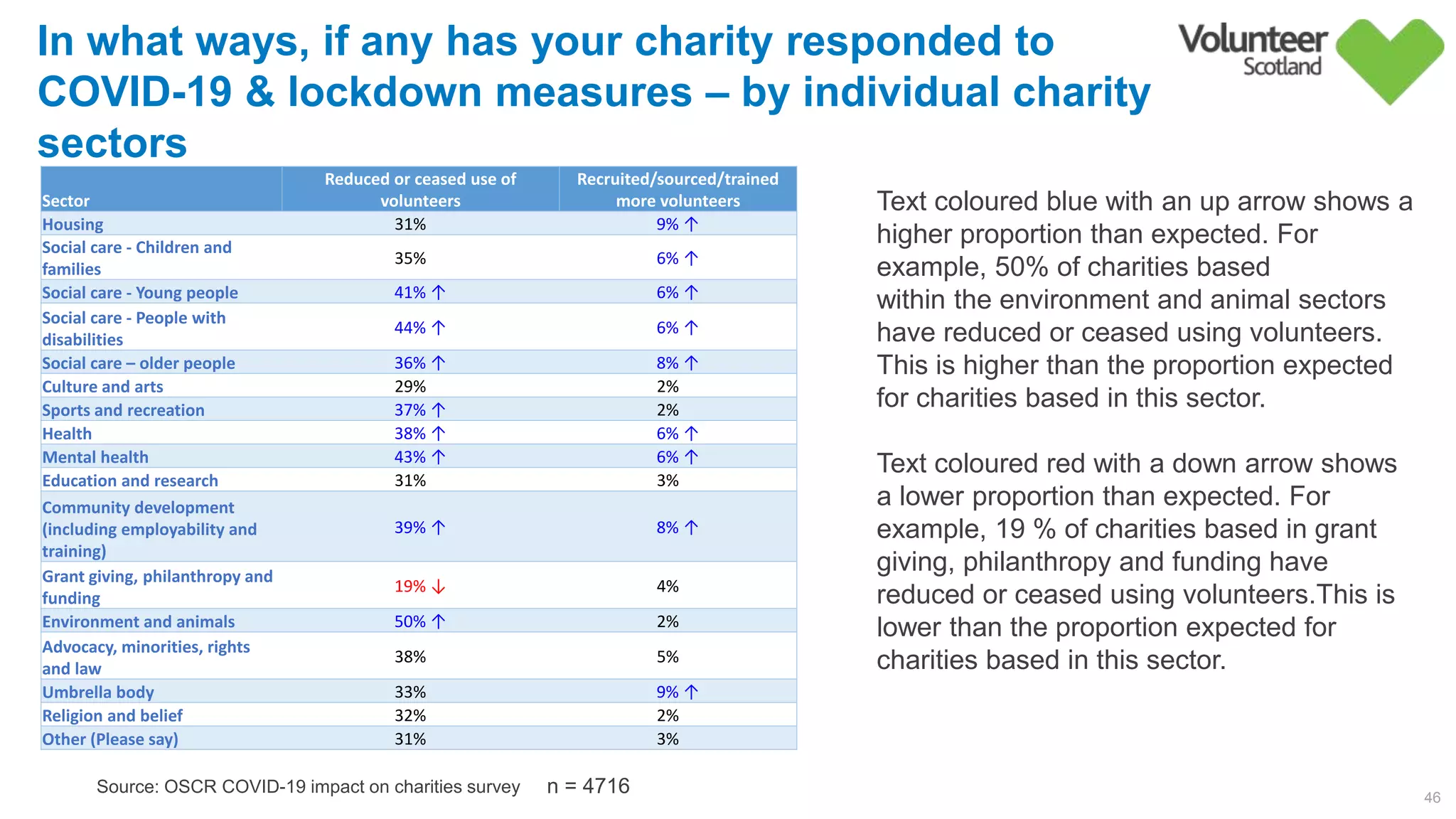
Text coloured blue with an up arrow shows a
higher proportion than expected. For
example, 50% of charities based
within the environment and animal sectors
have reduced or ceased using volunteers.
This is higher than the proportion expected
for charities based in this sector.
Text coloured red with a down arrow shows
a lower proportion than expected. For
example, 19 % of charities based in grant
giving, philanthropy and funding have
reduced or ceased using volunteers.This is
lower than the proportion expected for
charities based in this sector.
Impact of COVID-19 on the number
of volunteers engaged with
charities
48
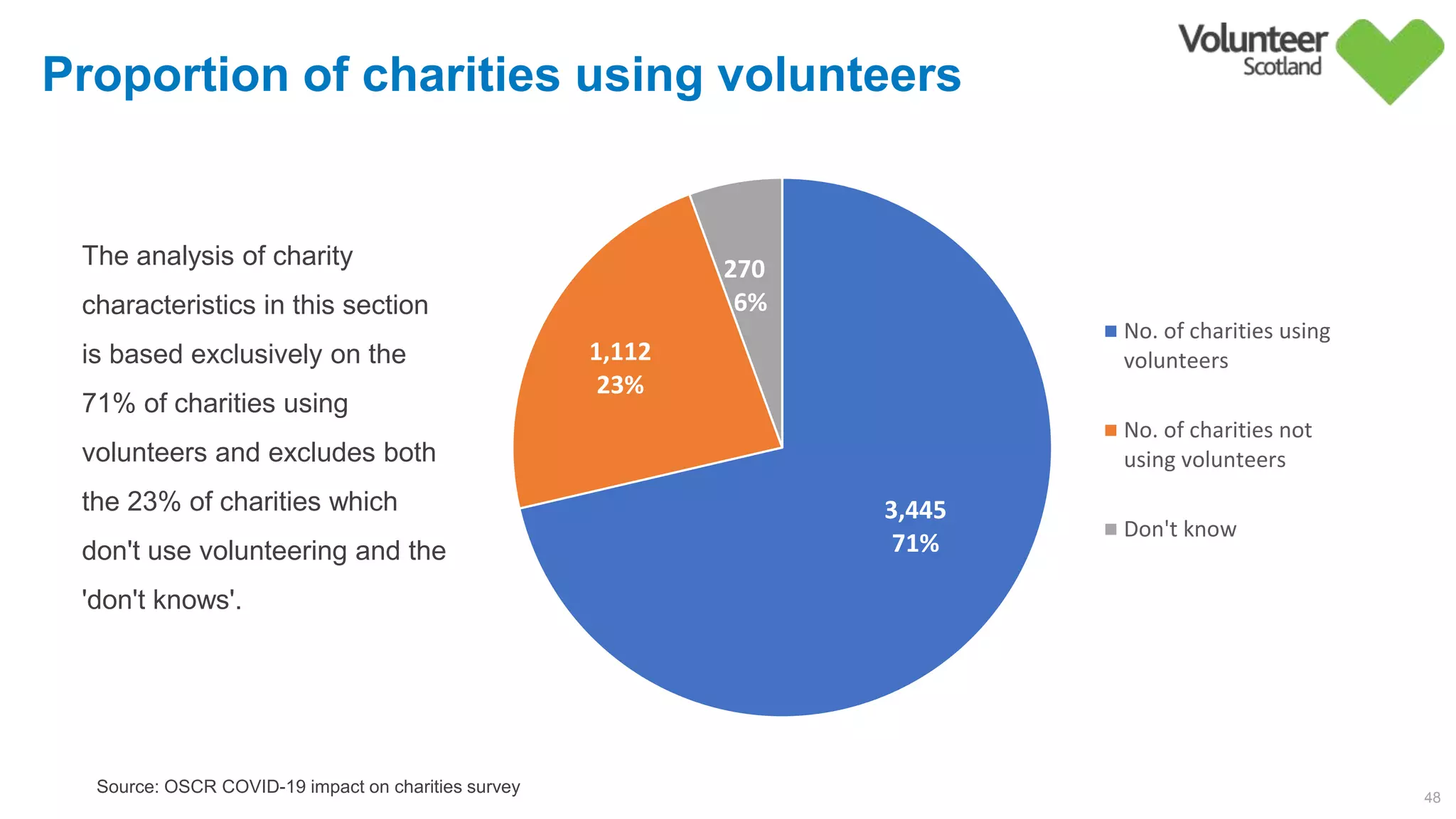
The analysis of charity
characteristics in this section
is based exclusively on the
71% of charities using
volunteers and excludes both
the 23% of charities which
don't use volunteering and the
'don't knows'.
Source: OSCR COVID-19 impact on charities survey
Proportion of charities using volunteers
3,445
71%
1,112
23%
270
6%
No. of charities using
volunteers
No. of charities not
using volunteers
Don't know
49
Source: OSCR COVID-19 impact on charities survey
Impact of COVID-19 on the number of volunteers
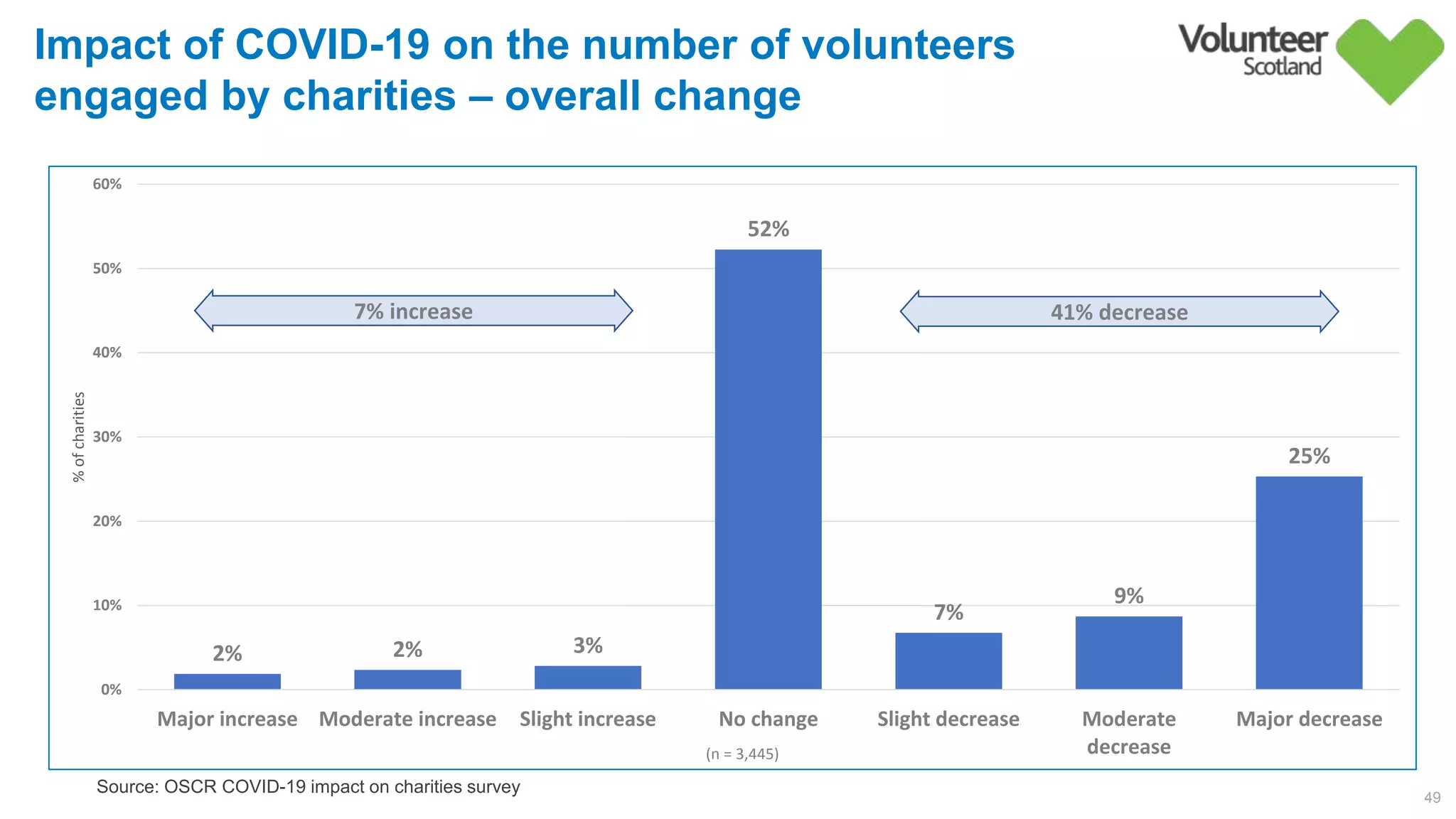
engaged by charities – overall change
2% 2% 3%
52%
7%
9%
25%
0%
10%
20%
30%
40%
50%
60%
Major increase Moderate increase Slight increase No change Slight decrease Moderate
decrease
Major decrease
%ofcharities
(n = 3,445)
7% increase 41% decrease
50
Source: OSCR COVID-19 impact on charities survey
Impact of COVID-19 on the number of volunteers
engaged with charities – by age of charity
0%        
10%        
20%        
30%        
40%        
50%        
60%        
Major
increase
Moderate
increase
Slight
increase
No change Slight
decrease
Moderate
decrease
Major
decrease%ofScottishcharitieswithvolunteers
Change in volunteer numbers (March - May 2020)
Less than a year 1-3 years 4-10 years
11-25 years 26-50 years More than 50 years
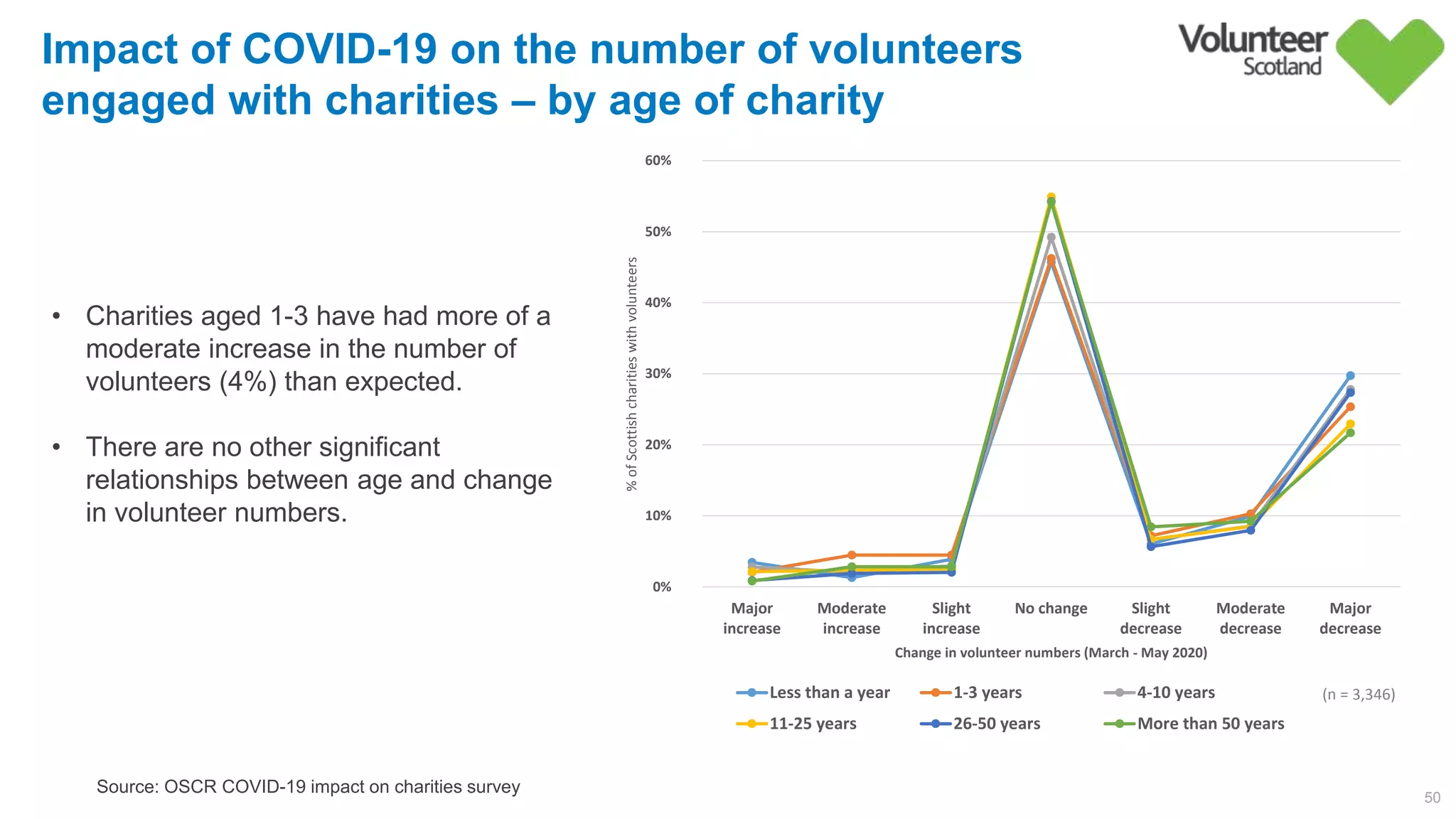
• Charities aged 1-3 have had more of a
moderate increase in the number of
volunteers (4%) than expected.
• There are no other significant
relationships between age and change
in volunteer numbers.
(n = 3,346)
51
Source: OSCR COVID-19 impact on charities survey
Impact of COVID-19 on the number of volunteers
engaged with charities – by income of charity
0%
10%
20%
30%
40%
50%
60%
70%
80%
Major
increase
Moderate
increase
Slight
increase
No change Slight
decrease
Moderate
decrease
Major
decrease
%ofcharitieswithvolunteers
Change in volunteer numbers (March - May 2020)
Under £2,000 £2,001 to £10,000 £10,001 to £25,000
£25,001 to £100,000 £100,001+ (n = 3,147)
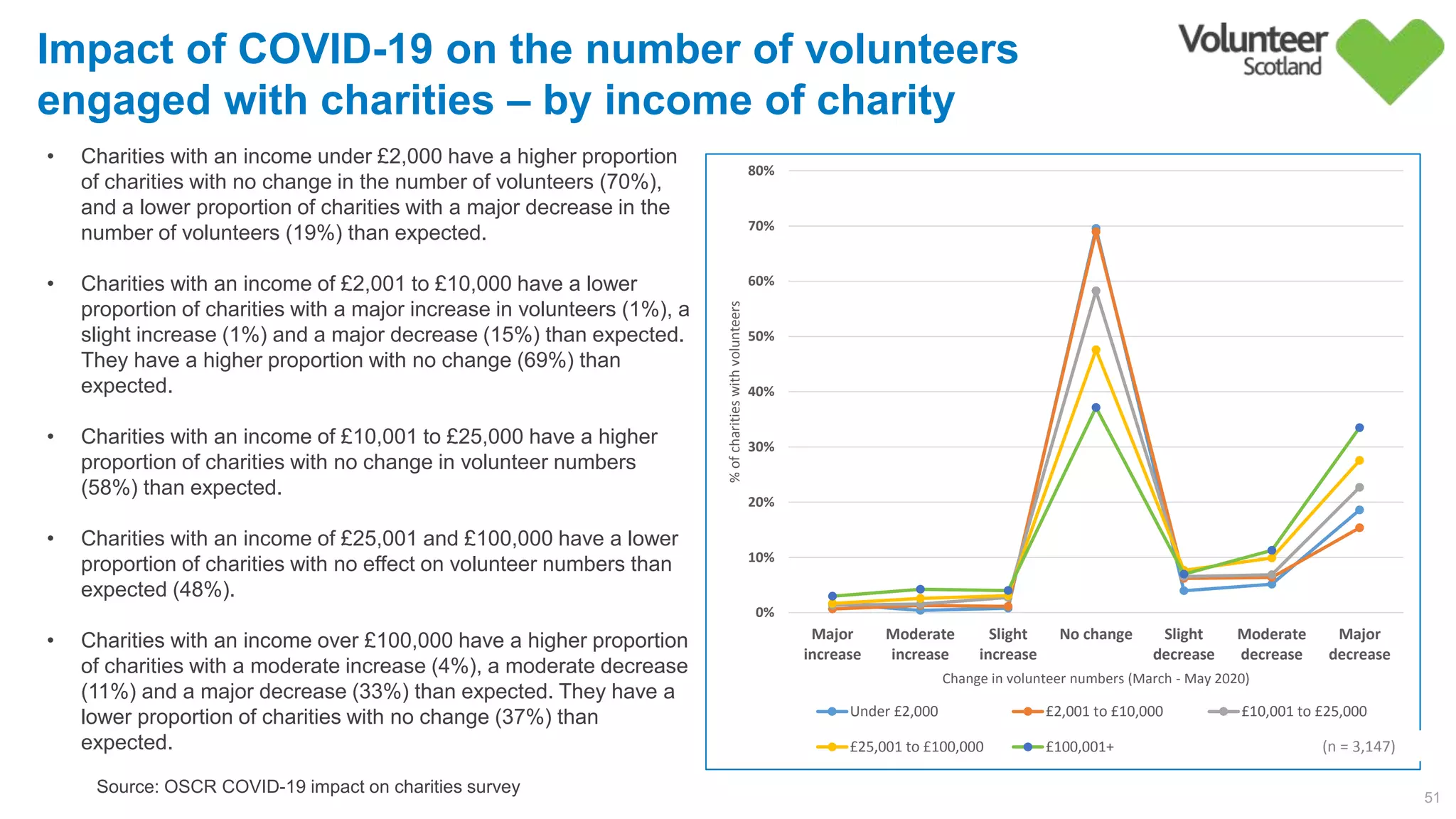
• Charities with an income under £2,000 have a higher proportion
of charities with no change in the number of volunteers (70%),
and a lower proportion of charities with a major decrease in the
number of volunteers (19%) than expected.
• Charities with an income of £2,001 to £10,000 have a lower
proportion of charities with a major increase in volunteers (1%), a
slight increase (1%) and a major decrease (15%) than expected.
They have a higher proportion with no change (69%) than
expected.
• Charities with an income of £10,001 to £25,000 have a higher
proportion of charities with no change in volunteer numbers
(58%) than expected.
• Charities with an income of £25,001 and £100,000 have a lower
proportion of charities with no effect on volunteer numbers than
expected (48%).
• Charities with an income over £100,000 have a higher proportion
of charities with a moderate increase (4%), a moderate decrease
(11%) and a major decrease (33%) than expected. They have a
lower proportion of charities with no change (37%) than
expected.
52
Source: OSCR COVID-19 impact on charities survey
Impact of COVID-19 on the number of volunteers
engaged with charities – by geographical base of
charities
0%
10%
20%
30%
40%
50%
60%
70%
80%
90%
100%
%ofcharitieswithvolunteers
Major increase Moderate increase Slight increase
No change Slight decrease Moderate decrease
Major decrease
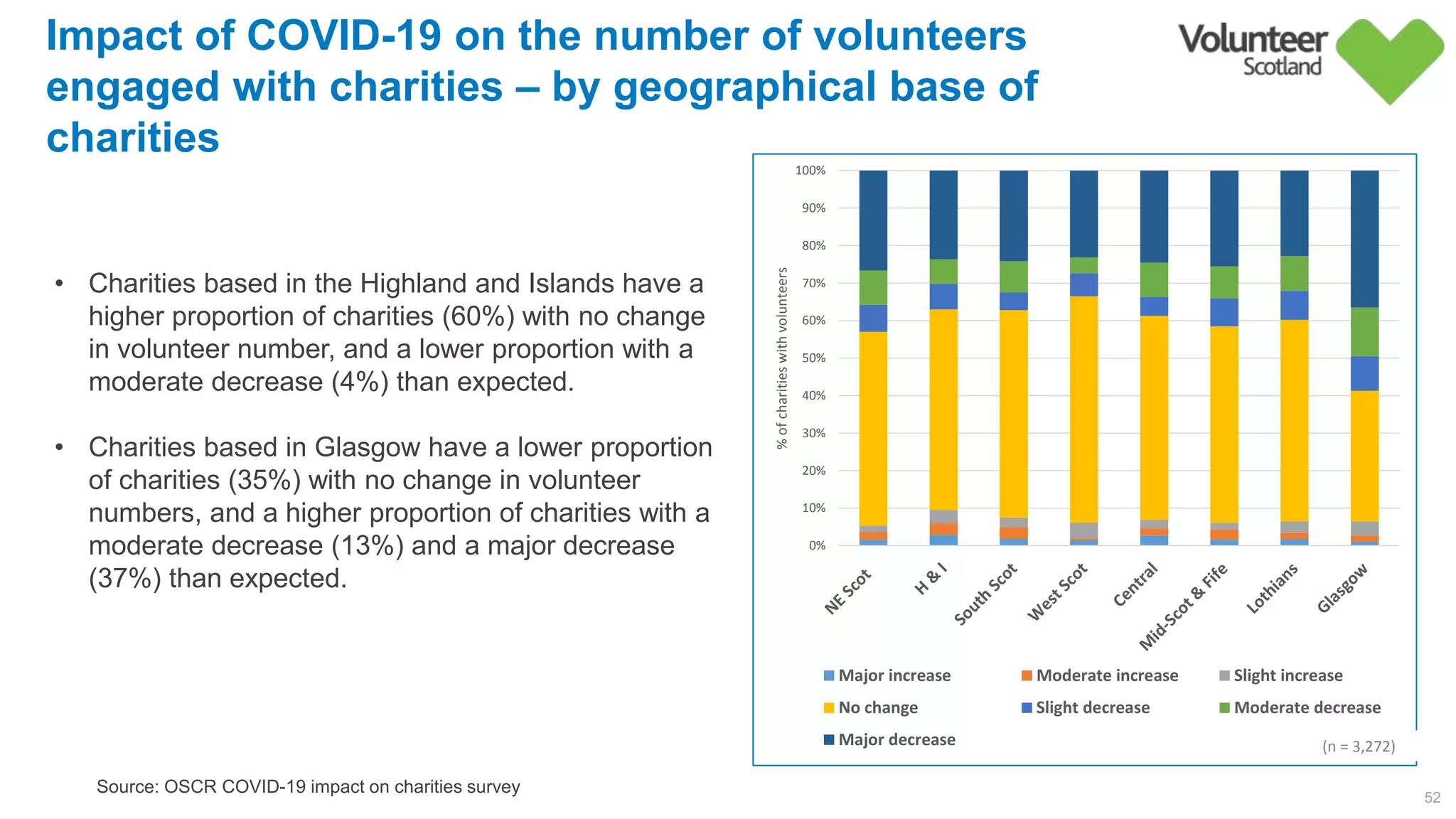
• Charities based in the Highland and Islands have a
higher proportion of charities (60%) with no change
in volunteer number, and a lower proportion with a
moderate decrease (4%) than expected.
• Charities based in Glasgow have a lower proportion
of charities (35%) with no change in volunteer
numbers, and a higher proportion of charities with a
moderate decrease (13%) and a major decrease
(37%) than expected.
(n = 3,272)
53
Source: OSCR COVID-19 impact on charities survey
Impact of COVID-19 on the number of volunteers
engaged with charities – by main source of income
0%
5%
10%
15%
20%
25%
30%
35%
40%
45%
50%
55%
Major
increase
Moderate
increase
Slight
increase
No change Slight
decrease
Moderate
decrease
Major
decrease
%ofcharitieswithvolunteers
Contracts (NET) Grants (NET) Others (NET)
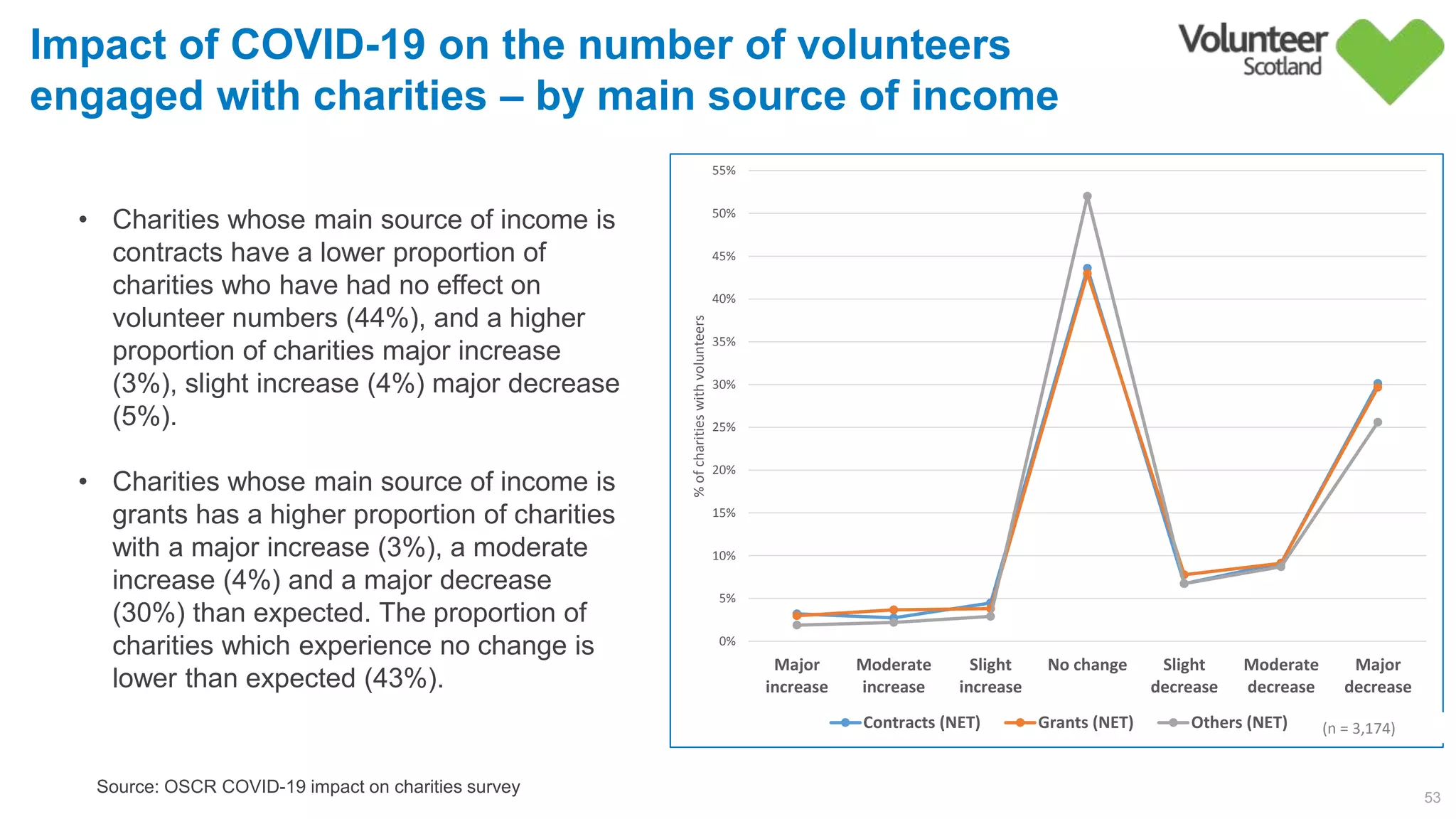
• Charities whose main source of income is
contracts have a lower proportion of
charities who have had no effect on
volunteer numbers (44%), and a higher
proportion of charities major increase
(3%), slight increase (4%) major decrease
(5%).
• Charities whose main source of income is
grants has a higher proportion of charities
with a major increase (3%), a moderate
increase (4%) and a major decrease
(30%) than expected. The proportion of
charities which experience no change is
lower than expected (43%).
(n = 3,174)
54
Source: OSCR COVID-19 impact on charities survey
Impact of COVID-19 on the number of volunteers
engaged with charities – by geographical scale of
charity
0%
10%
20%
30%
40%
50%
60%
Increase No change Decrease
%ofcharitieswithvolunteers
Local community(ies) Regionally in Scotland
Nationally across Scotland Nationally across UK
Internationally
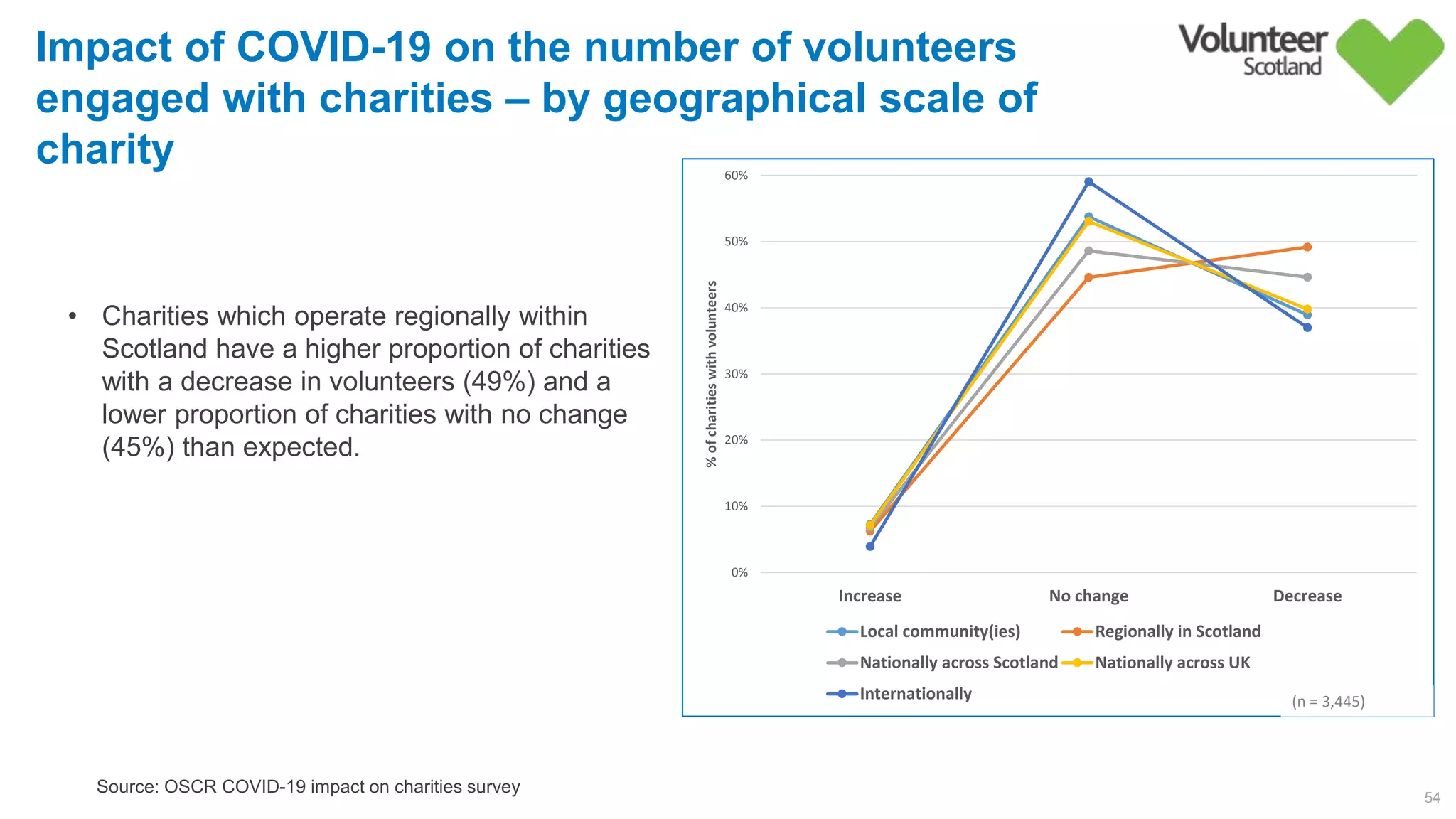
• Charities which operate regionally within
Scotland have a higher proportion of charities
with a decrease in volunteers (49%) and a
lower proportion of charities with no change
(45%) than expected.
(n = 3,445)
55
Source: OSCR COVID-19 impact on charities survey
Impact of COVID-19 on the number of volunteers
engaged with charities – by number of paid staff
0%
10%
20%
30%
40%
50%
60%
70%
Major
increase
Moderate
increase
Slight
increase
No change Slight
decrease
Moderate
decrease
Major
decrease
%ofcharitieswithvolunteers
None 1 - 10 11+
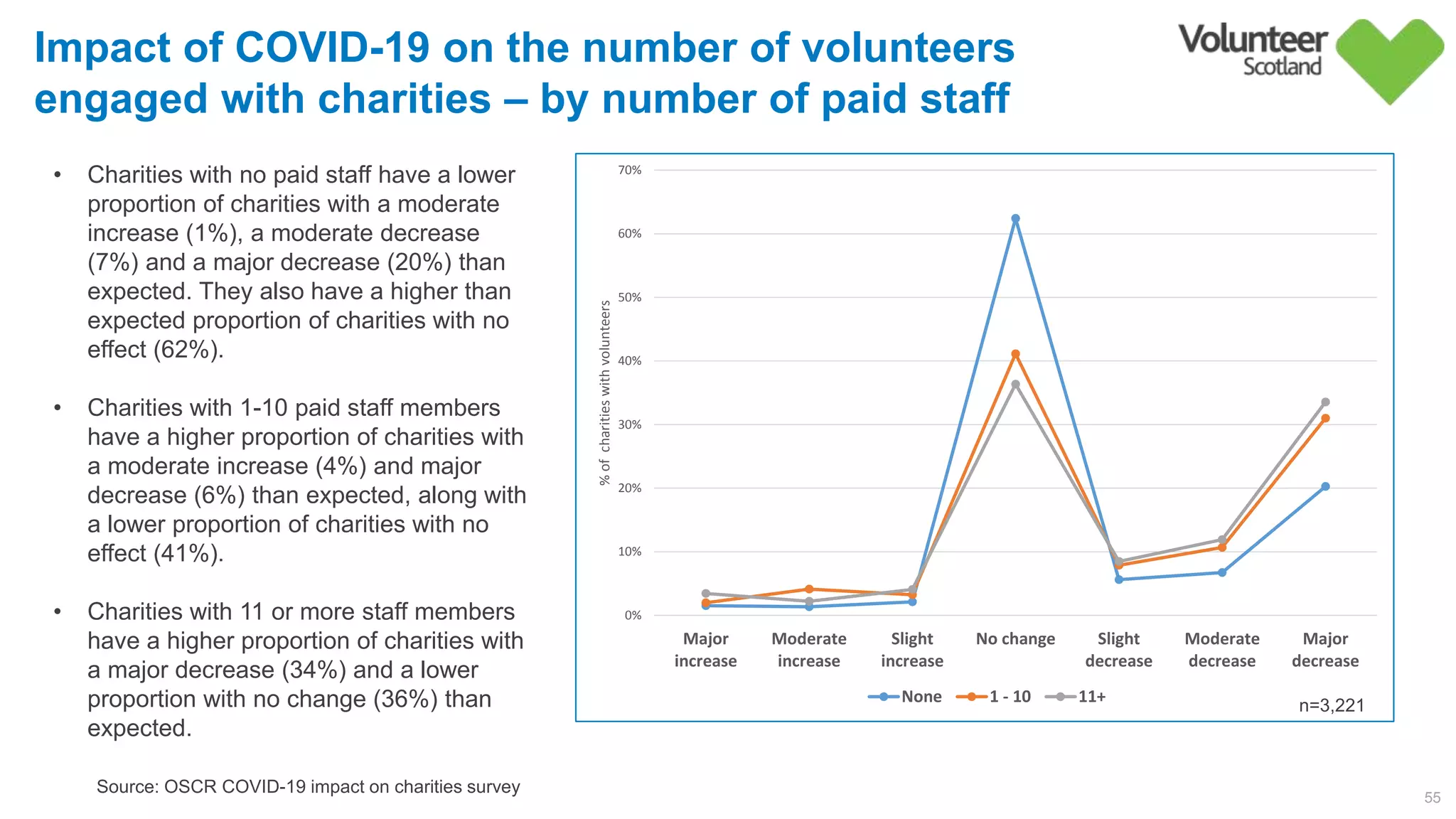
• Charities with no paid staff have a lower
proportion of charities with a moderate
increase (1%), a moderate decrease
(7%) and a major decrease (20%) than
expected. They also have a higher than
expected proportion of charities with no
effect (62%).
• Charities with 1-10 paid staff members
have a higher proportion of charities with
a moderate increase (4%) and major
decrease (6%) than expected, along with
a lower proportion of charities with no
effect (41%).
• Charities with 11 or more staff members
have a higher proportion of charities with
a major decrease (34%) and a lower
proportion with no change (36%) than
expected.
n=3,221
56
Source: OSCR COVID-19 impact on charities survey
Impact of COVID-19 on the number of volunteers
engaged with charities – by financial threat within next
12 months
0%
10%
20%
30%
40%
50%
60%
70%
80%
Major
increase
Moderate
increase
Slight
increase
No change Slight
decrease
Moderate
decrease
Major
decrease
%ofcharitieswithvolunteers
Critical at some point in the next 12 months
Some threat across the next 12 months, but never critical
No threat across the next 12 months
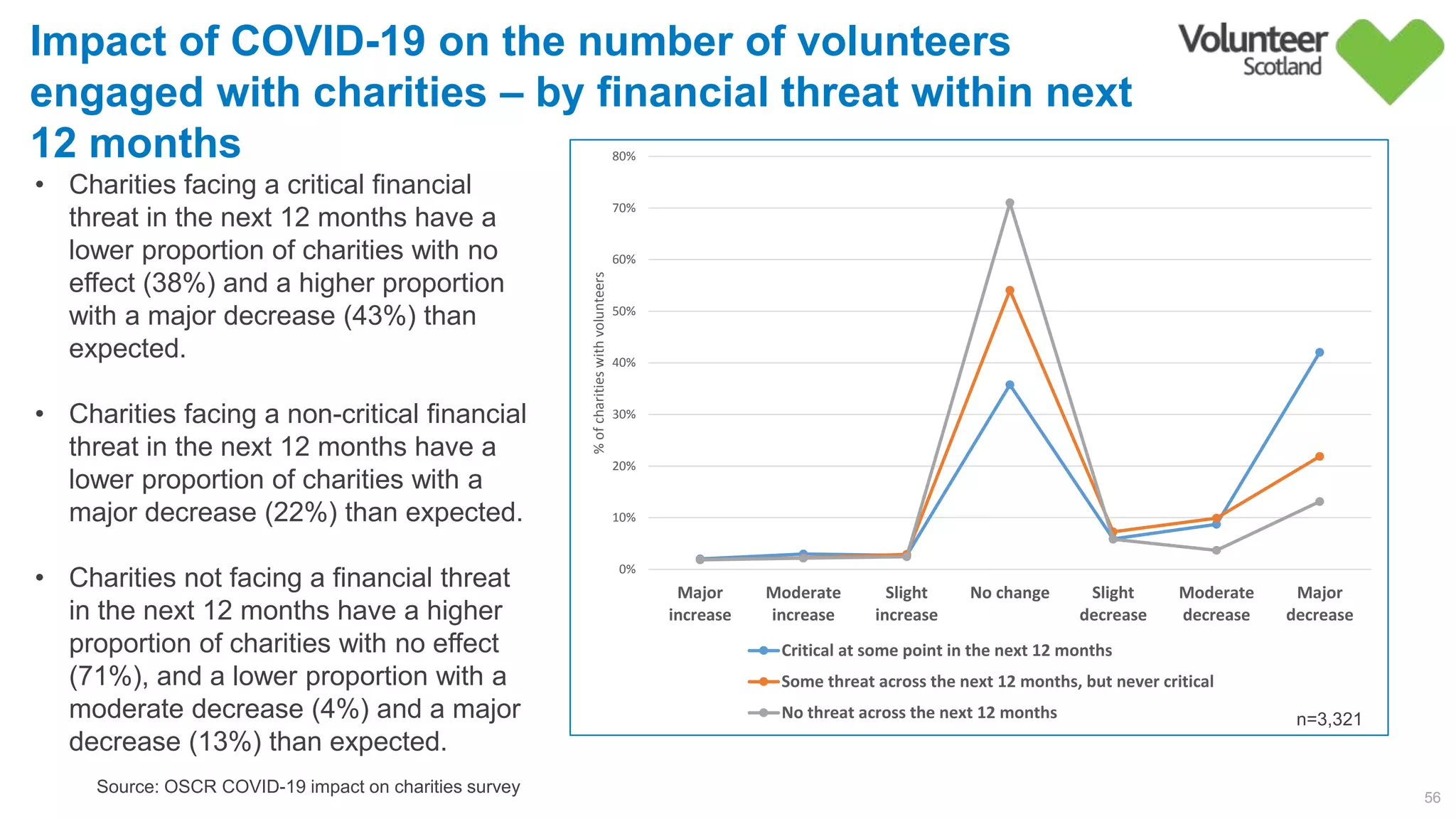
• Charities facing a critical financial
threat in the next 12 months have a
lower proportion of charities with no
effect (38%) and a higher proportion
with a major decrease (43%) than
expected.
• Charities facing a non-critical financial
threat in the next 12 months have a
lower proportion of charities with a
major decrease (22%) than expected.
• Charities not facing a financial threat
in the next 12 months have a higher
proportion of charities with no effect
(71%), and a lower proportion with a
moderate decrease (4%) and a major
decrease (13%) than expected.
n=3,321
57
Source: OSCR COVID-19 impact on charities survey
Impact of COVID-19 on the number of volunteers
engaged with charities – by grouped charity sectors
16%
9%
5%
10% 7%
39%
45% 55% 43% 53%
45% 45%
41%
47%
40%
0%
10%
20%
30%
40%
50%
60%
70%
80%
90%
100%
Housing and
Community
(NET)
Social care
(NET)
Leisure and
Culture
(NET)
Health (NET)Others (NET)
%ofScottishcharitieswithvolunteers
Increase No Change Decrease
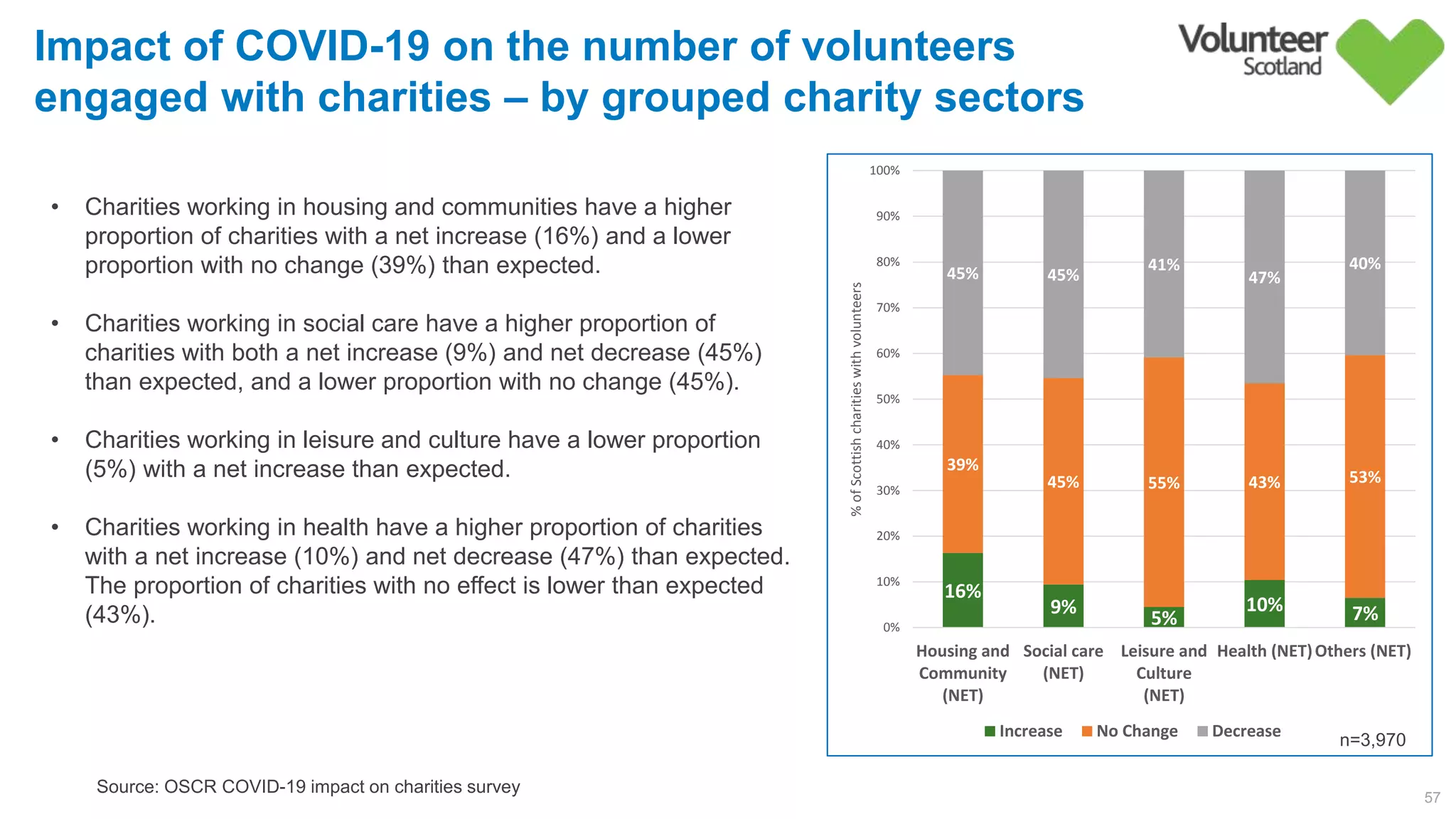
• Charities working in housing and communities have a higher
proportion of charities with a net increase (16%) and a lower
proportion with no change (39%) than expected.
• Charities working in social care have a higher proportion of
charities with both a net increase (9%) and net decrease (45%)
than expected, and a lower proportion with no change (45%).
• Charities working in leisure and culture have a lower proportion
(5%) with a net increase than expected.
• Charities working in health have a higher proportion of charities
with a net increase (10%) and net decrease (47%) than expected.
The proportion of charities with no effect is lower than expected
(43%).
n=3,970
58
Source: OSCR COVID-19 impact on charities survey
Impact of COVID-19 on the number of volunteers
engaged with charities – by individual charity sector
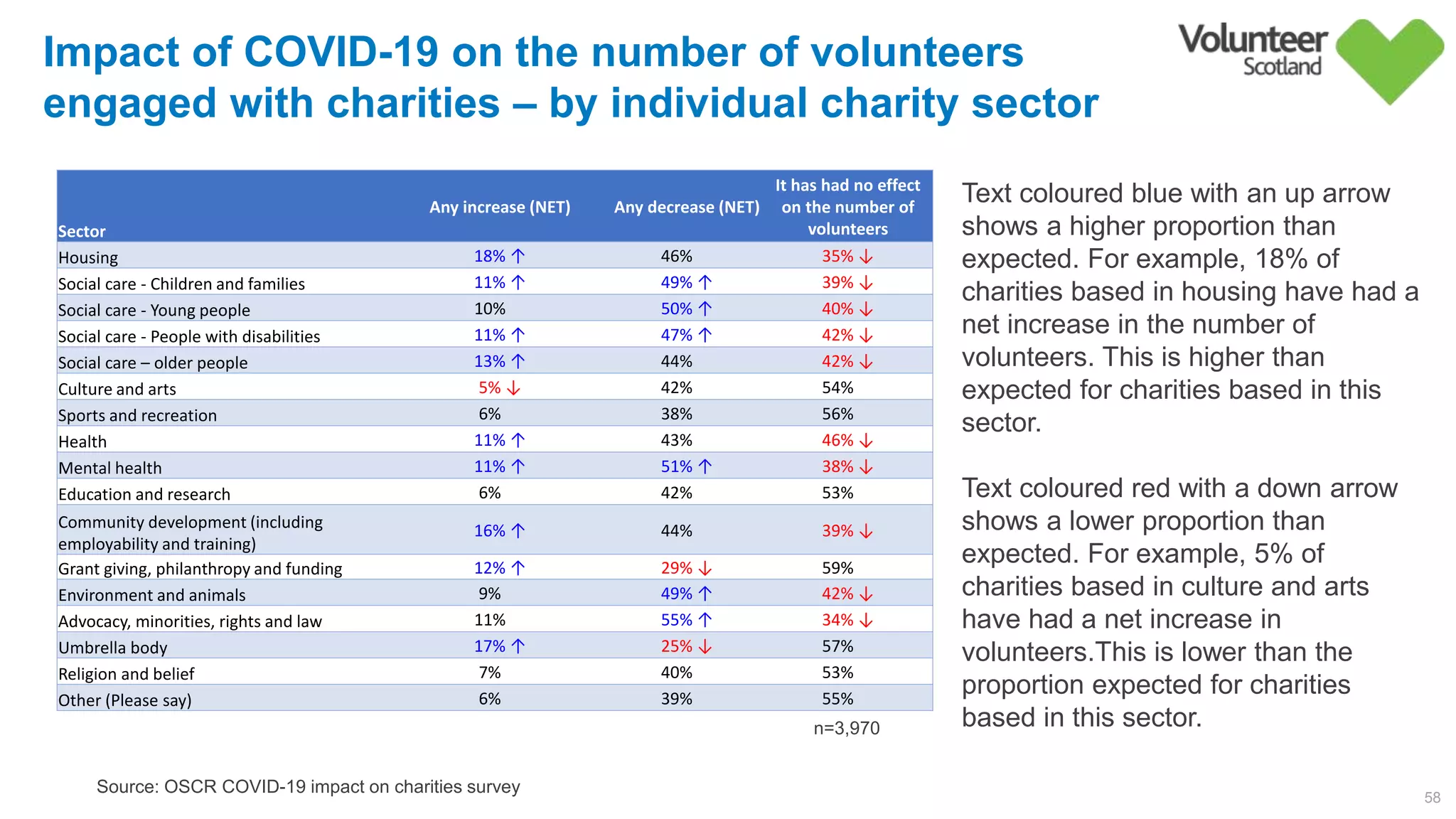
Sector
Any increase (NET) Any decrease (NET)
It has had no effect
on the number of
volunteers
Housing 18% ↑ 46%         35% ↓
Social care - Children and families 11% ↑ 49% ↑ 39% ↓
Social care - Young people 10%         50% ↑ 40% ↓
Social care - People with disabilities 11% ↑ 47% ↑ 42% ↓
Social care – older people 13% ↑ 44%         42% ↓
Culture and arts 5% ↓ 42%         54%        
Sports and recreation 6%         38%         56%        
Health 11% ↑ 43%         46% ↓
Mental health 11% ↑ 51% ↑ 38% ↓
Education and research 6%         42%         53%        
Community development (including
employability and training)
16% ↑ 44%         39% ↓
Grant giving, philanthropy and funding 12% ↑ 29% ↓ 59%        
Environment and animals 9%         49% ↑ 42% ↓
Advocacy, minorities, rights and law 11%         55% ↑ 34% ↓
Umbrella body 17% ↑ 25% ↓ 57%        
Religion and belief 7%         40%         53%        
Other (Please say) 6%         39%         55%        
Text coloured blue with an up arrow
shows a higher proportion than
expected. For example, 18% of
charities based in housing have had a
net increase in the number of
volunteers. This is higher than
expected for charities based in this
sector.
Text coloured red with a down arrow
shows a lower proportion than
expected. For example, 5% of
charities based in culture and arts
have had a net increase in
volunteers.This is lower than the
proportion expected for charities
based in this sector.n=3,970
Increased need for mental
health and wellbeing
support for staff,
volunteers, beneficiaries or
charity trustees
60
Source: OSCR COVID-19 impact on charities survey
Increased need for mental health and wellbeing
support for staff, volunteers, beneficiaries or
charity trustees
n=4,827
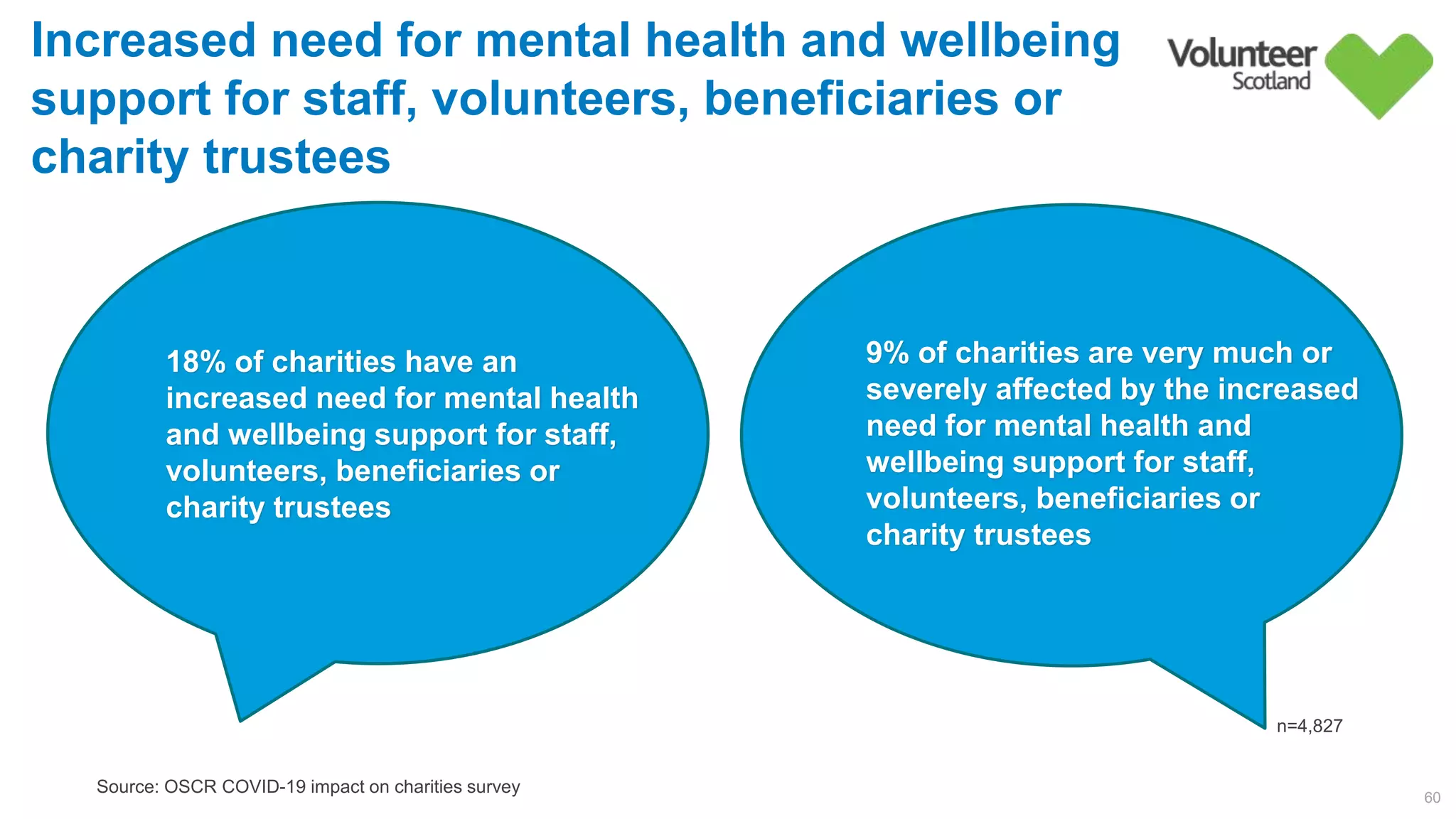
18% of charities have an
increased need for mental health
and wellbeing support for staff,
volunteers, beneficiaries or
charity trustees
9% of charities are very much or
severely affected by the increased
need for mental health and
wellbeing support for staff,
volunteers, beneficiaries or
charity trustees
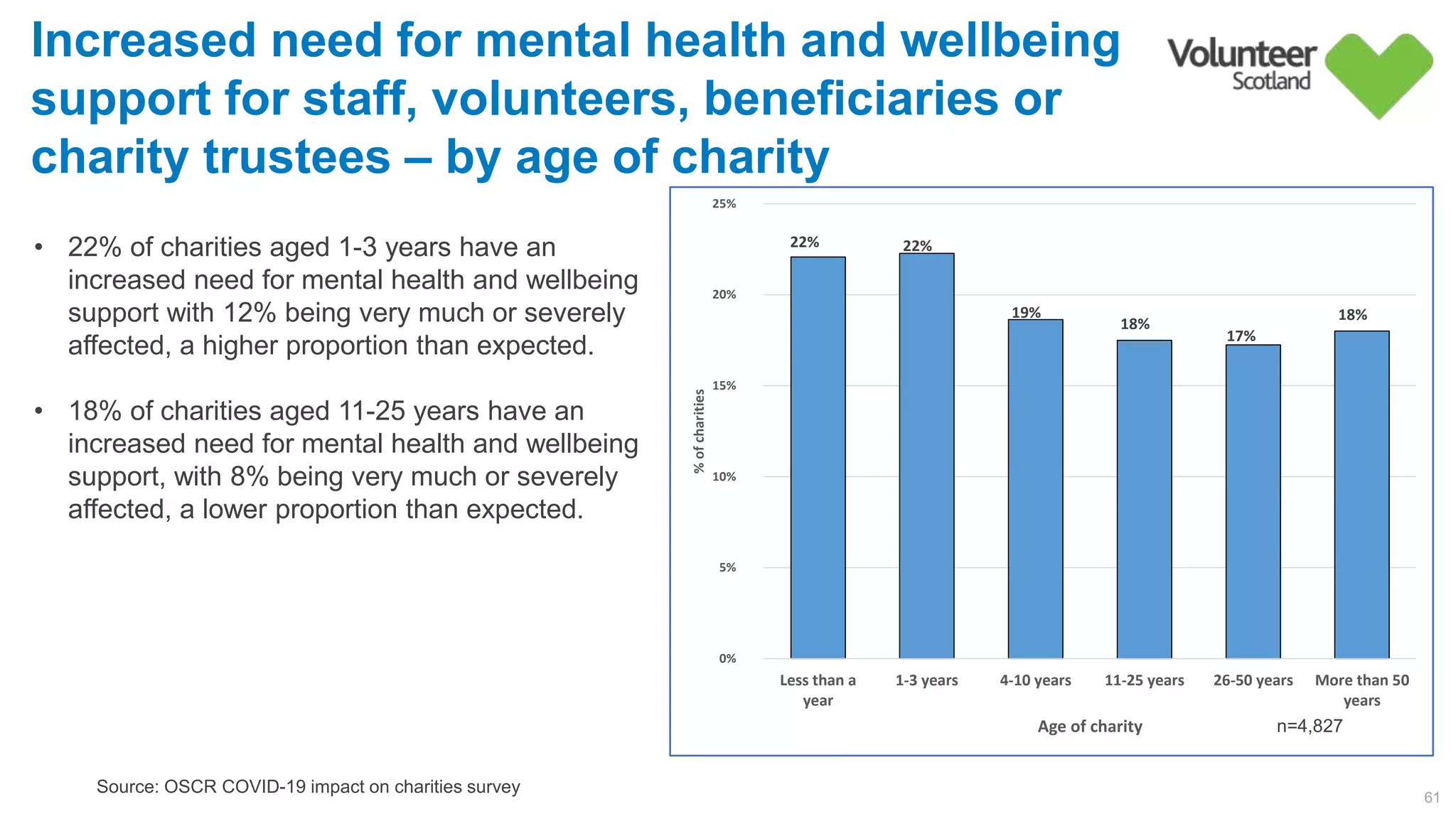
22%         22%        
19%        
18%        
17%        
18%        
0%        
5%        
10%        
15%        
20%        
25%        
Less than a
year
1-3 years 4-10 years 11-25 years 26-50 years More than 50
years%ofcharities
Age of charity
61
Source: OSCR COVID-19 impact on charities survey
Increased need for mental health and wellbeing
support for staff, volunteers, beneficiaries or
charity trustees – by age of charity
• 22% of charities aged 1-3 years have an
increased need for mental health and wellbeing
support with 12% being very much or severely
affected, a higher proportion than expected.
• 18% of charities aged 11-25 years have an
increased need for mental health and wellbeing
support, with 8% being very much or severely
affected, a lower proportion than expected.
n=4,827
5% ↓ 5% ↓
11% ↓
17%        
39% ↑
0% ↓
5% ↓
10% ↓
15% ↓
20% ↓
25% ↓
30% ↓
35% ↓
40% ↓
45% ↓
Under £2,000 £2,001 to
£10,000
£10,001 to
£25,000
£25,001 to
£100,000
£100,001+
%ofcharities
Income of charities
62
Source: OSCR COVID-19 impact on charities survey
Increased need for mental health and wellbeing
support for staff, volunteers, beneficiaries or
charity trustees – by income of charity
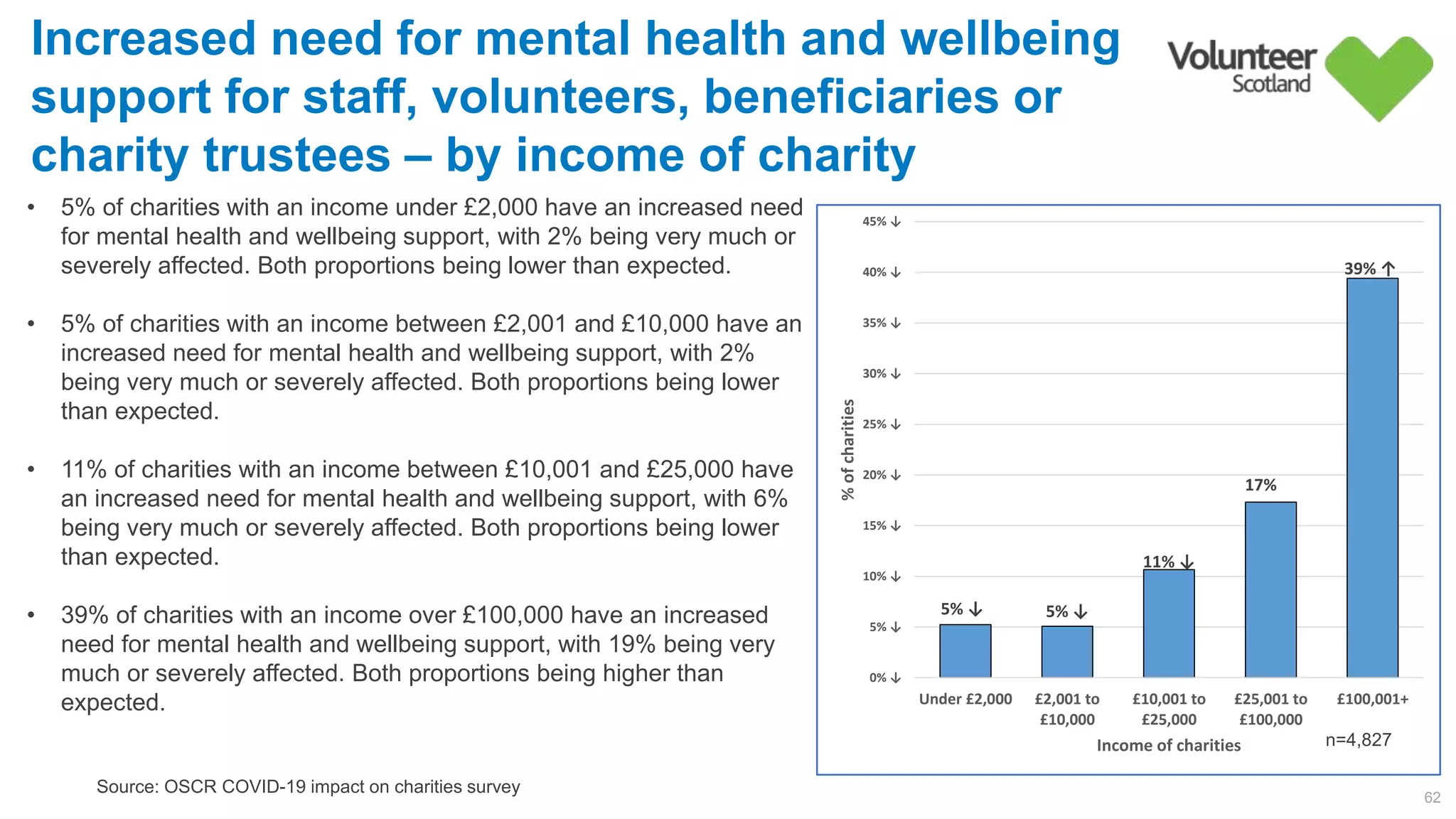
• 5% of charities with an income under £2,000 have an increased need
for mental health and wellbeing support, with 2% being very much or
severely affected. Both proportions being lower than expected.
• 5% of charities with an income between £2,001 and £10,000 have an
increased need for mental health and wellbeing support, with 2%
being very much or severely affected. Both proportions being lower
than expected.
• 11% of charities with an income between £10,001 and £25,000 have
an increased need for mental health and wellbeing support, with 6%
being very much or severely affected. Both proportions being lower
than expected.
• 39% of charities with an income over £100,000 have an increased
need for mental health and wellbeing support, with 19% being very
much or severely affected. Both proportions being higher than
expected.
n=4,827
15%        15% ↓
13% ↓
13% ↓
20%        
15% ↓
24% ↑
31% ↑
36% ↑
0%        
5%        
10%        
15%        
20%        
25%        
30%        
35%        
40%        
%ofcharities
Geographical base of charities
63
Source: OSCR COVID-19 impact on charities survey
Increased need for mental health and wellbeing
support for staff, volunteers, beneficiaries or charity
trustees – by geographical base of charities
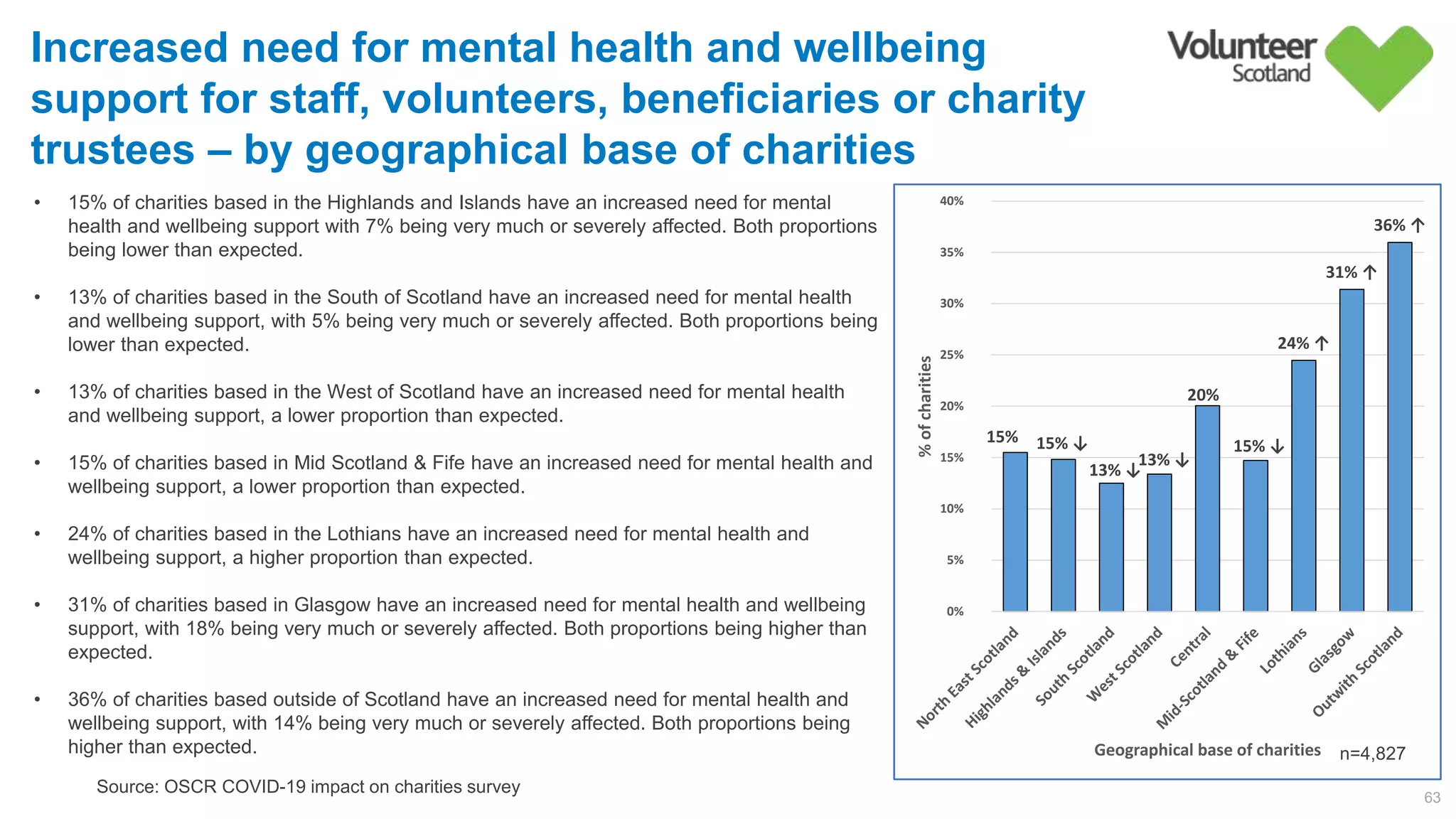
• 15% of charities based in the Highlands and Islands have an increased need for mental
health and wellbeing support with 7% being very much or severely affected. Both proportions
being lower than expected.
• 13% of charities based in the South of Scotland have an increased need for mental health
and wellbeing support, with 5% being very much or severely affected. Both proportions being
lower than expected.
• 13% of charities based in the West of Scotland have an increased need for mental health
and wellbeing support, a lower proportion than expected.
• 15% of charities based in Mid Scotland & Fife have an increased need for mental health and
wellbeing support, a lower proportion than expected.
• 24% of charities based in the Lothians have an increased need for mental health and
wellbeing support, a higher proportion than expected.
• 31% of charities based in Glasgow have an increased need for mental health and wellbeing
support, with 18% being very much or severely affected. Both proportions being higher than
expected.
• 36% of charities based outside of Scotland have an increased need for mental health and
wellbeing support, with 14% being very much or severely affected. Both proportions being
higher than expected. n=4,827
30% ↑ 30% ↑
18% ↓
0%
5%
10%
15%
20%
25%
30%
35%
Contracts (NET) Grants (NET) Others (NET)
%ofcharities Main source of income of charities
64
Source: OSCR COVID-19 impact on charities survey
Increased need for mental health and wellbeing
support for staff, volunteers, beneficiaries or
charity trustees – by main source of income
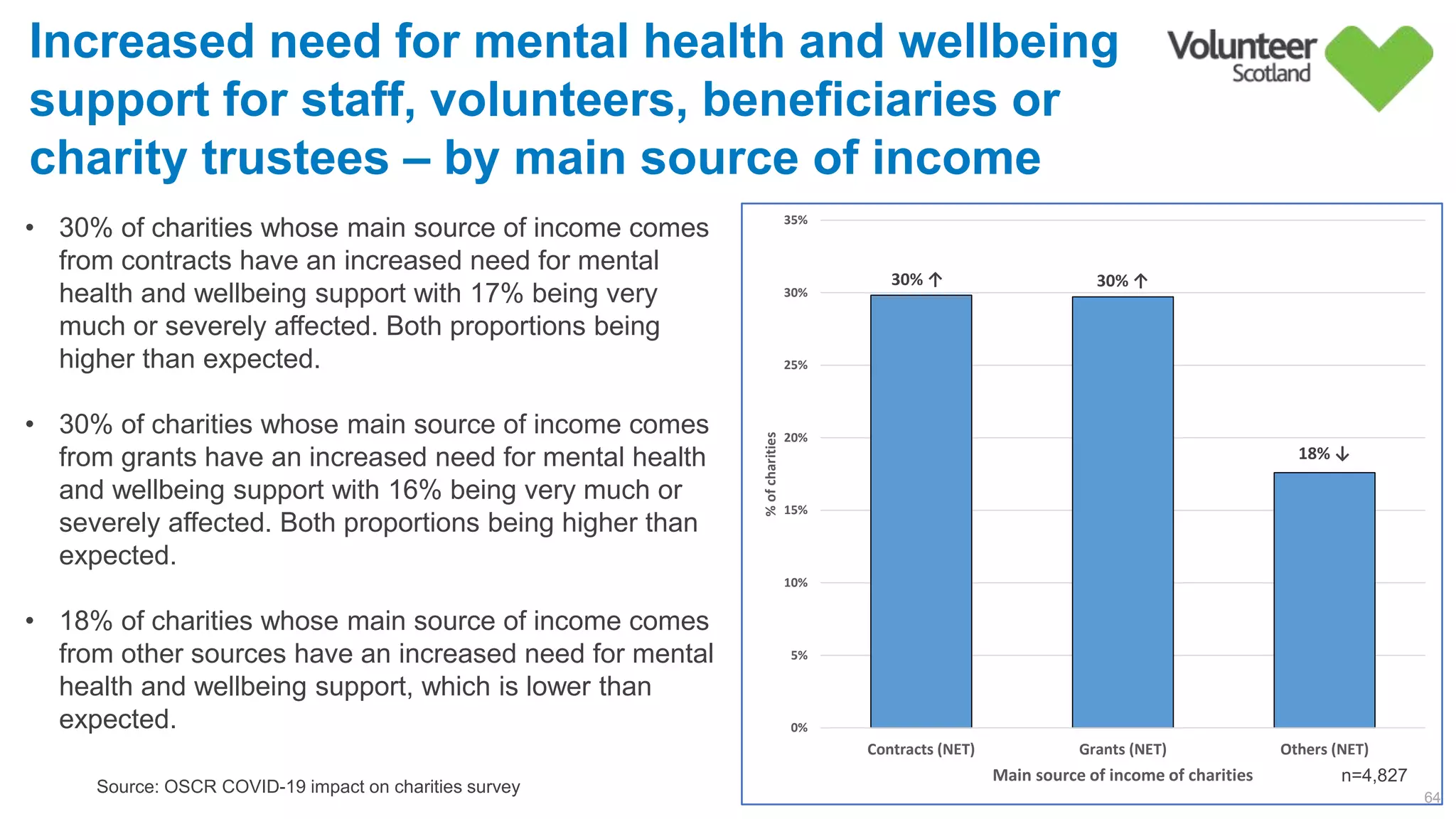
• 30% of charities whose main source of income comes
from contracts have an increased need for mental
health and wellbeing support with 17% being very
much or severely affected. Both proportions being
higher than expected.
• 30% of charities whose main source of income comes
from grants have an increased need for mental health
and wellbeing support with 16% being very much or
severely affected. Both proportions being higher than
expected.
• 18% of charities whose main source of income comes
from other sources have an increased need for mental
health and wellbeing support, which is lower than
expected.
n=4,827
15% ↓
27% ↑
30% ↑
23%        
13%        
0%
5%
10%
15%
20%
25%
30%
35%
A local
community or
small number of
local
communities
Regionally
within Scotland
Nationally,
across Scotland
Nationally,
across the UK
Internationally
(outside the UK)
%ofcharities
Geographic sale 0f charity
65
Source: OSCR COVID-19 impact on charities survey
Increased need for mental health and wellbeing
support for staff, volunteers, beneficiaries or charity
trustees – by geographical scale of charity
n=4,827
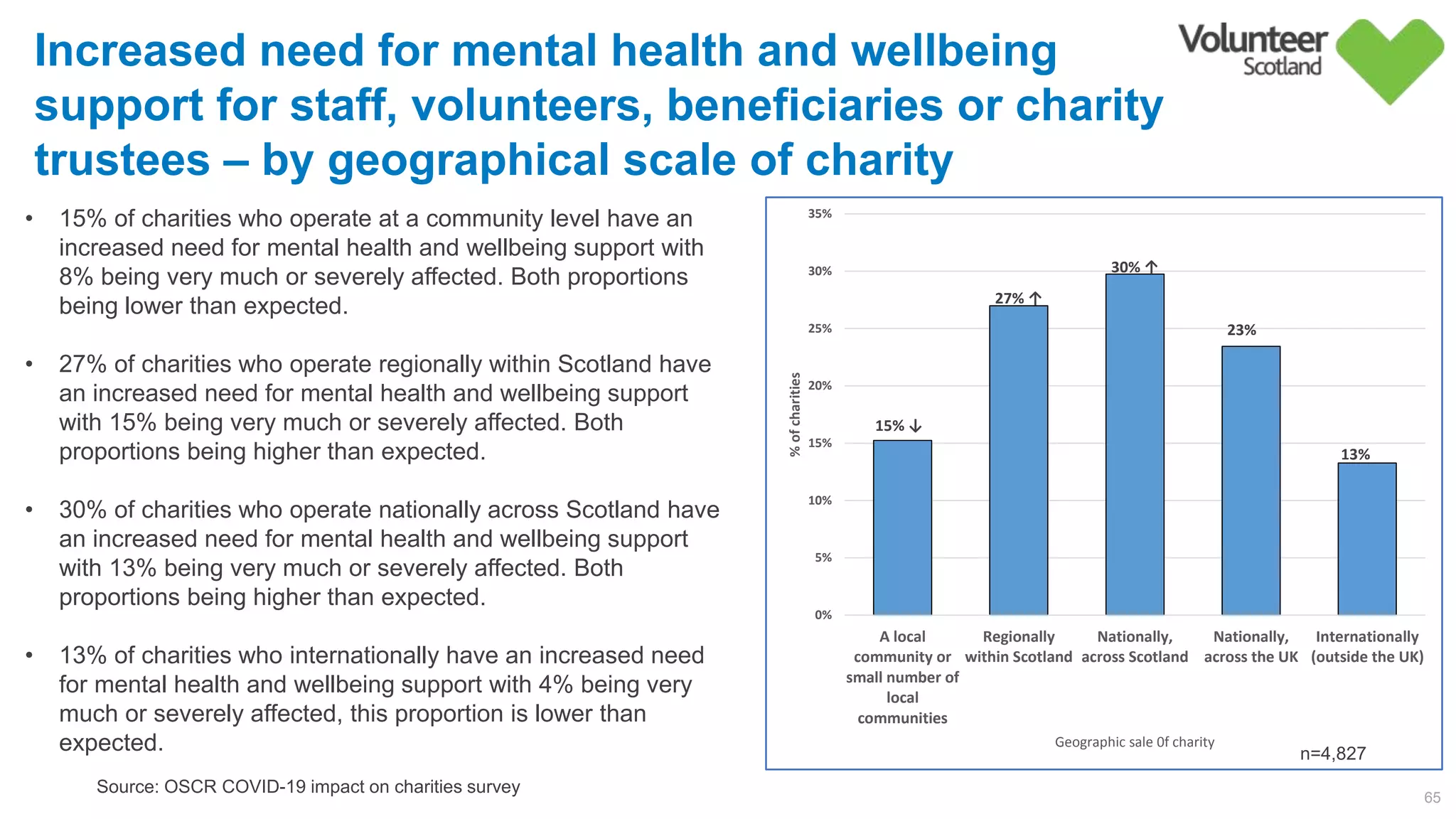
• 15% of charities who operate at a community level have an
increased need for mental health and wellbeing support with
8% being very much or severely affected. Both proportions
being lower than expected.
• 27% of charities who operate regionally within Scotland have
an increased need for mental health and wellbeing support
with 15% being very much or severely affected. Both
proportions being higher than expected.
• 30% of charities who operate nationally across Scotland have
an increased need for mental health and wellbeing support
with 13% being very much or severely affected. Both
proportions being higher than expected.
• 13% of charities who internationally have an increased need
for mental health and wellbeing support with 4% being very
much or severely affected, this proportion is lower than
expected.
7% ↓
26% ↑
55% ↑
0% ↓
10% ↓
20% ↓
30% ↓
40% ↓
50% ↓
60% ↓
None 1-10 11+
%ofcharities
Paid staff members
66
Source: OSCR COVID-19 impact on charities survey
Increased need for mental health and wellbeing
support for staff, volunteers, beneficiaries or
charity trustees – by number of paid staff
n=4,827
• 7% of charities with no paid staff have an increased
need for mental health and wellbeing support with 4%
being very much or severely affected. Both proportions
being lower than expected.
• 26% of charities with 1-10 staff members have an
increased need for mental health and wellbeing support
with 13% being very much or severely affected. Both
proportions being higher than expected.
• 55% of charities with 11 or more paid staff members
have an increased need for mental health and
wellbeing support with 26% being very much or
severely affected. Both proportions being higher than
expected.
67
Source: OSCR COVID-19 impact on charities survey
Increased need for mental health and wellbeing
support for staff, volunteers, beneficiaries or
charity trustees – by financial threat within next
12 months
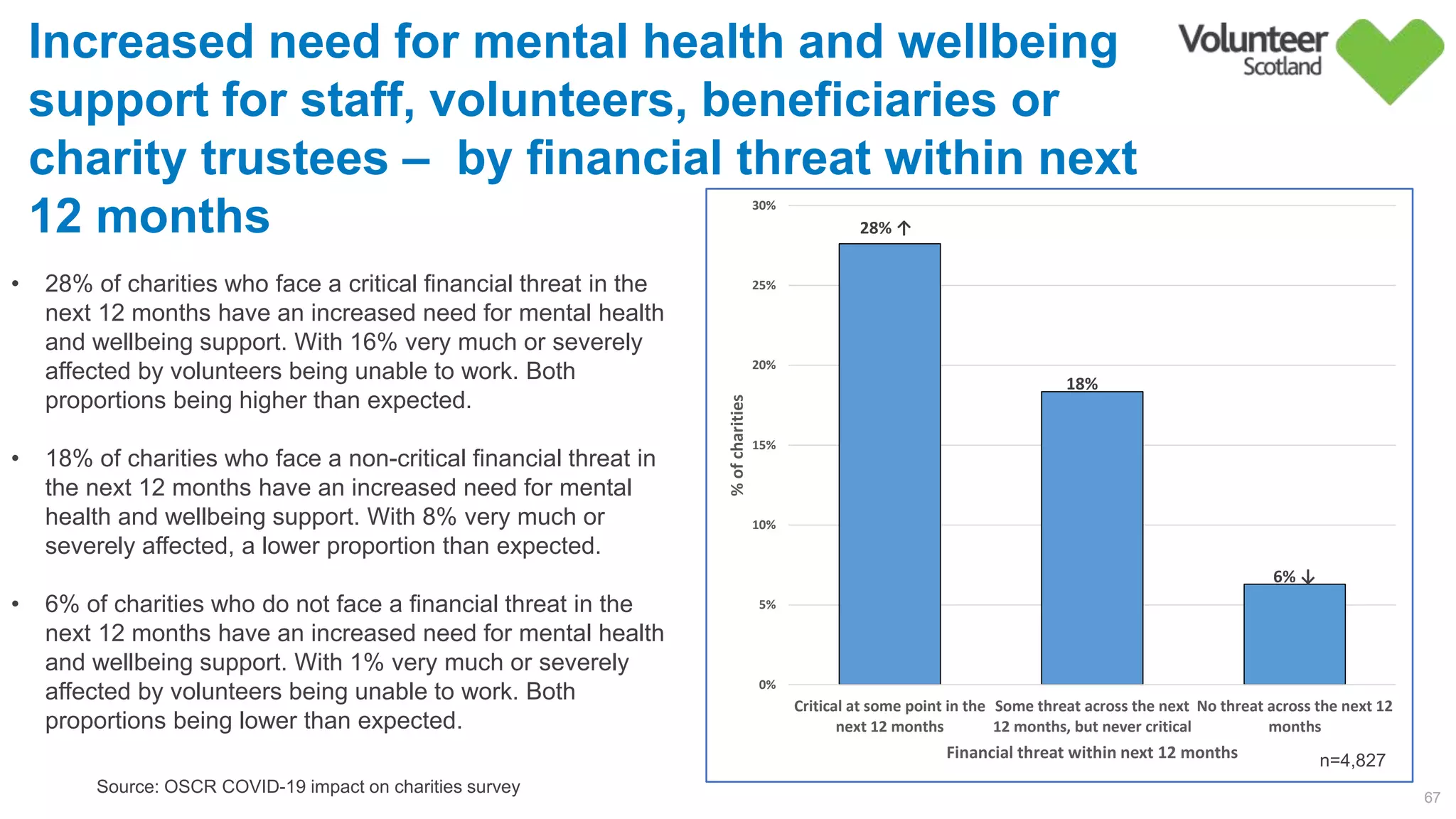
• 28% of charities who face a critical financial threat in the
next 12 months have an increased need for mental health
and wellbeing support. With 16% very much or severely
affected by volunteers being unable to work. Both
proportions being higher than expected.
• 18% of charities who face a non-critical financial threat in
the next 12 months have an increased need for mental
health and wellbeing support. With 8% very much or
severely affected, a lower proportion than expected.
• 6% of charities who do not face a financial threat in the
next 12 months have an increased need for mental health
and wellbeing support. With 1% very much or severely
affected by volunteers being unable to work. Both
proportions being lower than expected.
28% ↑
18%        
6% ↓
0%
5%
10%
15%
20%
25%
30%
Critical at some point in the
next 12 months
Some threat across the next
12 months, but never critical
No threat across the next 12
months
%ofcharities
Financial threat within next 12 months n=4,827
34% ↑
30% ↑
13% ↓
35% ↑
17% ↓
0%
5%
10%
15%
20%
25%
30%
35%
40%
Housing and
Community
Social care Leisure and
Culture
Health Others
%ofcharities Charities sector
68
Source: OSCR COVID-19 impact on charities survey
Increased need for mental health and wellbeing
support for staff, volunteers, beneficiaries or
charity trustees – by grouped charity sectors
n=4,827
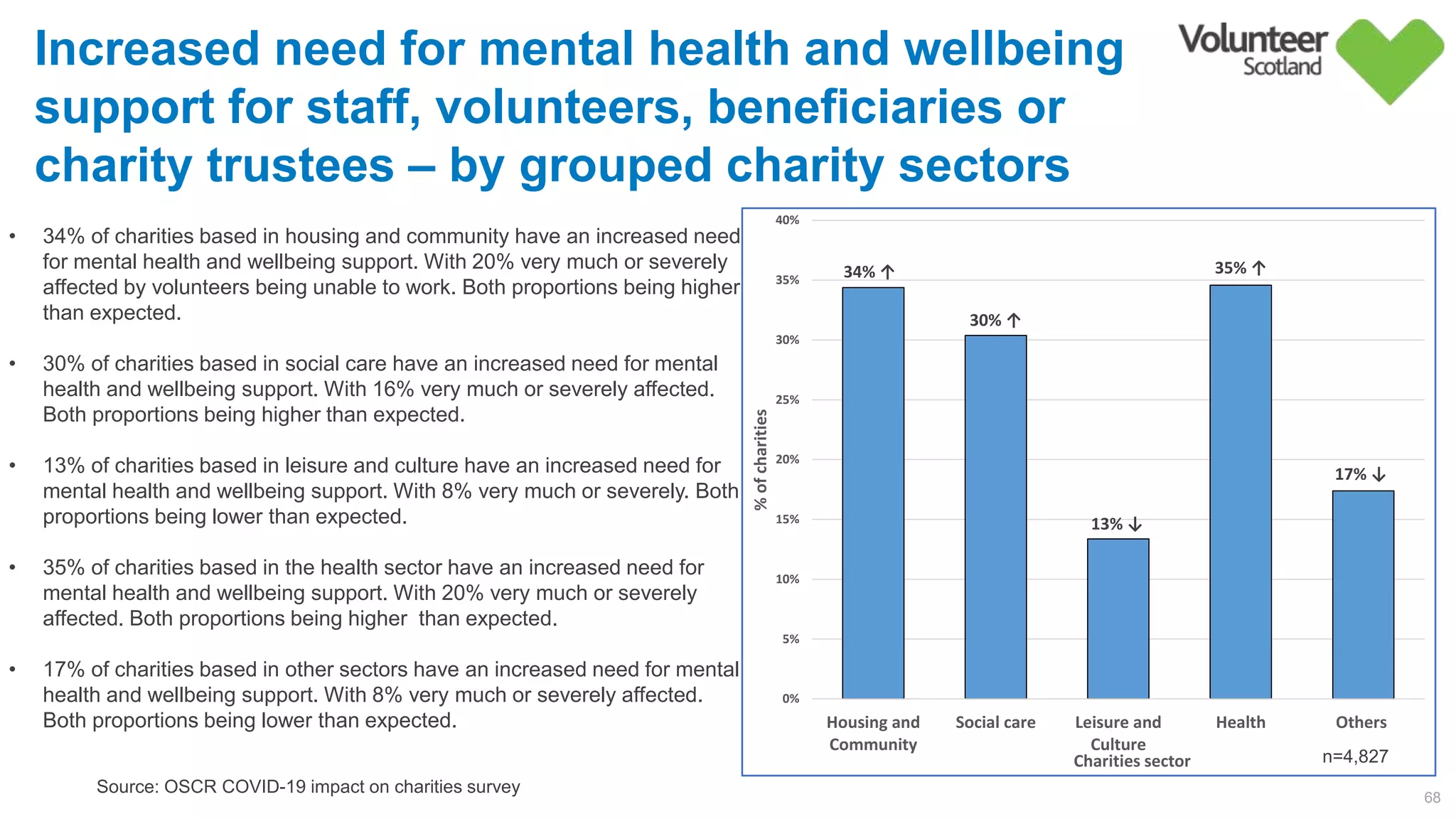
• 34% of charities based in housing and community have an increased need
for mental health and wellbeing support. With 20% very much or severely
affected by volunteers being unable to work. Both proportions being higher
than expected.
• 30% of charities based in social care have an increased need for mental
health and wellbeing support. With 16% very much or severely affected.
Both proportions being higher than expected.
• 13% of charities based in leisure and culture have an increased need for
mental health and wellbeing support. With 8% very much or severely. Both
proportions being lower than expected.
• 35% of charities based in the health sector have an increased need for
mental health and wellbeing support. With 20% very much or severely
affected. Both proportions being higher than expected.
• 17% of charities based in other sectors have an increased need for mental
health and wellbeing support. With 8% very much or severely affected.
Both proportions being lower than expected.
69Source: OSCR COVID-19 impact on charities survey
Increased need for mental health and wellbeing
support for staff, volunteers, beneficiaries or
charity trustees – by individual charity sectors
n=4,827
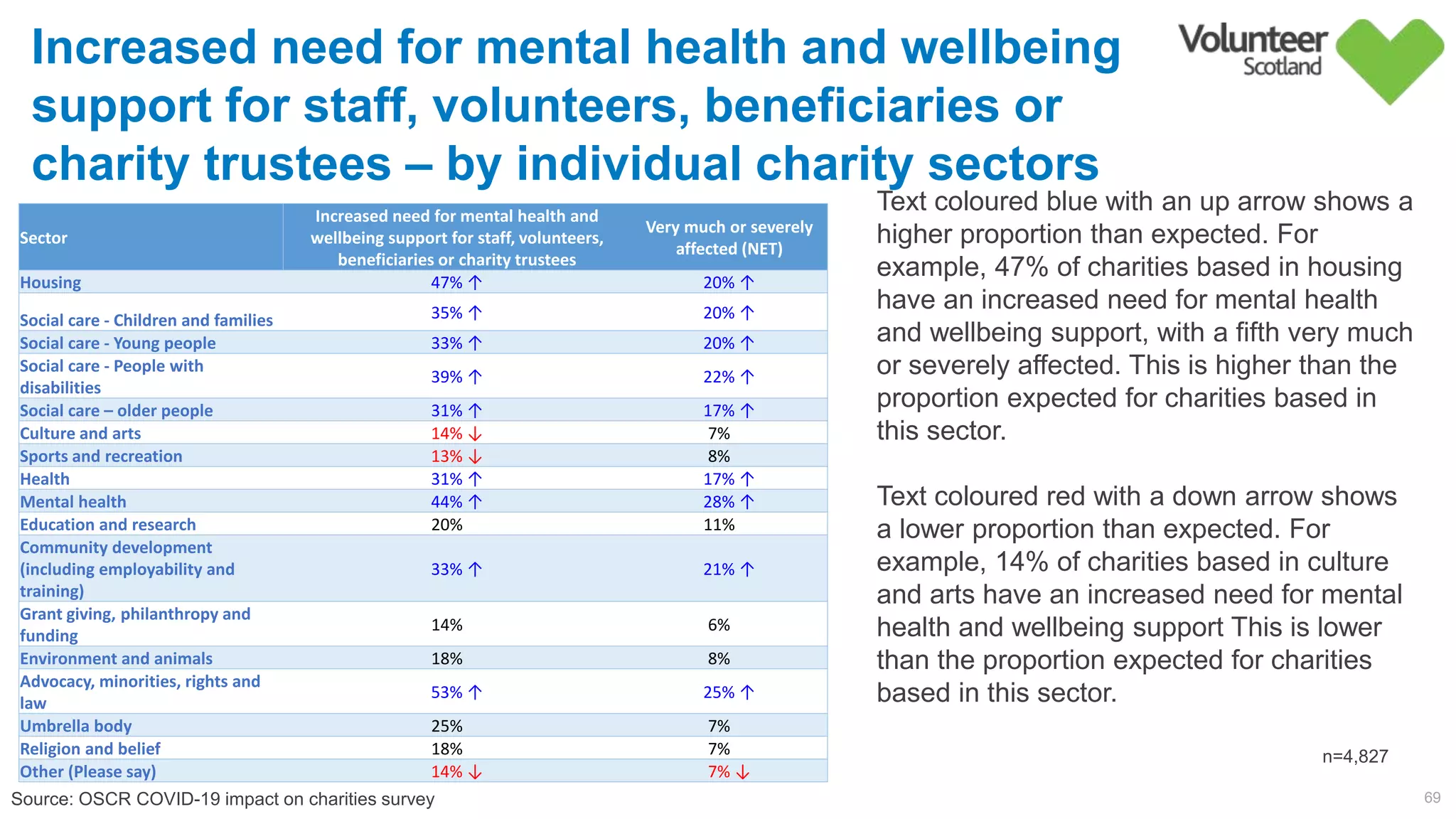
Sector
Increased need for mental health and
wellbeing support for staff, volunteers,
beneficiaries or charity trustees
Very much or severely
affected (NET)
Housing 47% ↑ 20% ↑
Social care - Children and families 35% ↑ 20% ↑
Social care - Young people 33% ↑ 20% ↑
Social care - People with
disabilities
39% ↑ 22% ↑
Social care – older people 31% ↑ 17% ↑
Culture and arts 14% ↓ 7%        
Sports and recreation 13% ↓ 8%        
Health 31% ↑ 17% ↑
Mental health 44% ↑ 28% ↑
Education and research 20%         11%        
Community development
(including employability and
training)
33% ↑ 21% ↑
Grant giving, philanthropy and
funding
14%         6%        
Environment and animals 18%         8%        
Advocacy, minorities, rights and
law
53% ↑ 25% ↑
Umbrella body 25%         7%        
Religion and belief 18%         7%        
Other (Please say) 14% ↓ 7% ↓
Text coloured blue with an up arrow shows a
higher proportion than expected. For
example, 47% of charities based in housing
have an increased need for mental health
and wellbeing support, with a fifth very much
or severely affected. This is higher than the
proportion expected for charities based in
this sector.
Text coloured red with a down arrow shows
a lower proportion than expected. For
example, 14% of charities based in culture
and arts have an increased need for mental
health and wellbeing support This is lower
than the proportion expected for charities
based in this sector.
Looking to the future: Non-funding
support that has OR would help
charities
Non-funding support that has OR would
help charities
71
25%        
14%        
15%        
17%        
19%        
20%        
25%        
45%        
46%        
51%        
0%         10%         20%         30%         40%         50%         60%        
None of these
Support or training on volunteer issues
Support or training on staffing issues
Support or training on remote leadership
Maintaining momentum on current policy
and government business unrelated to…
Technical support and training for working
remotely
Staff, charity trustee and volunteer wellbeing
resources
Flexibility in filing or reporting deadlines
More guidance on how charities should
continue during the pandemic
Information and advice on the financial
support charities can claim
% of charities
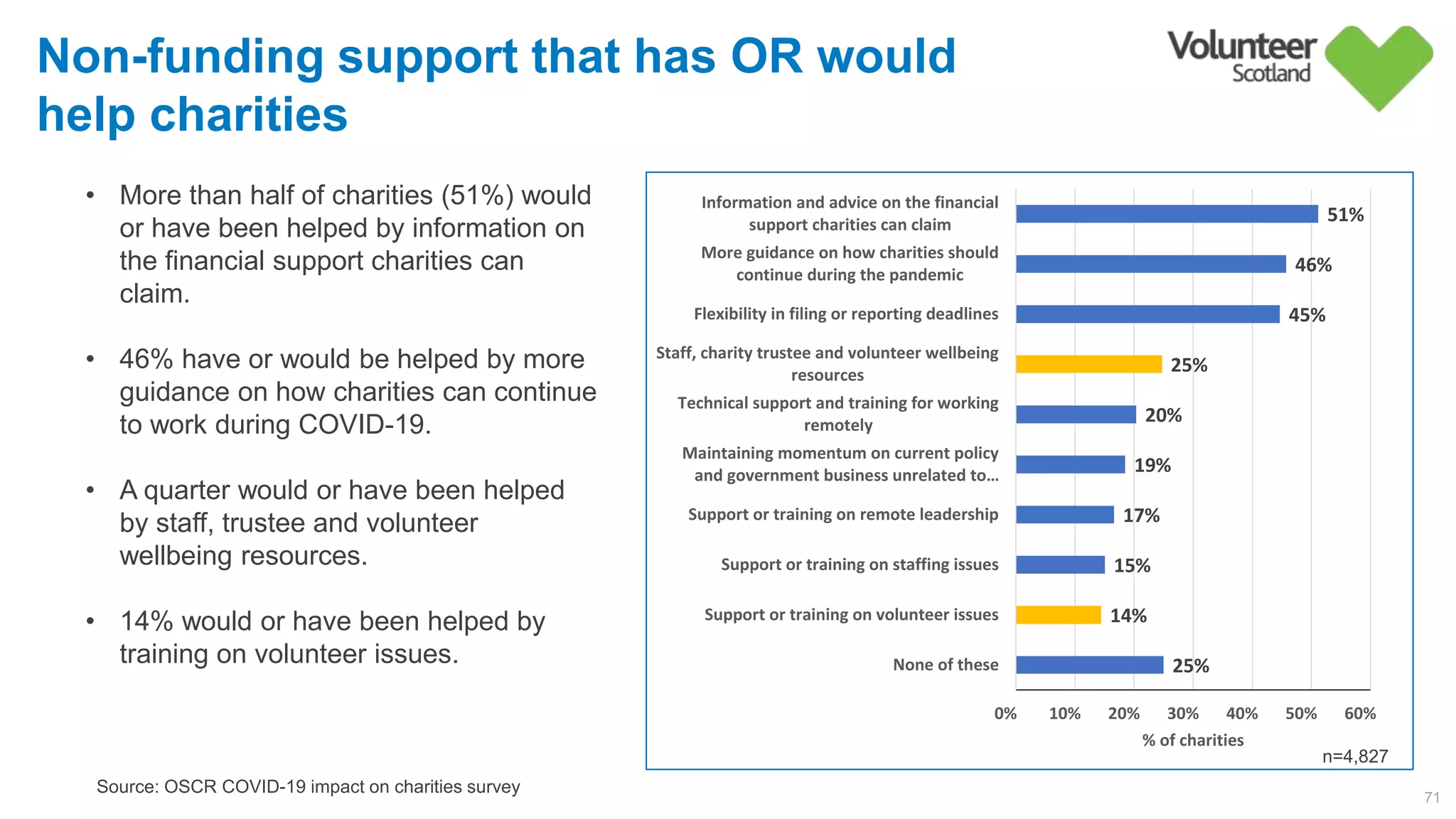
• More than half of charities (51%) would
or have been helped by information on
the financial support charities can
claim.
• 46% have or would be helped by more
guidance on how charities can continue
to work during COVID-19.
• A quarter would or have been helped
by staff, trustee and volunteer
wellbeing resources.
• 14% would or have been helped by
training on volunteer issues.
Source: OSCR COVID-19 impact on charities survey
n=4,827
23% ↑
35% ↑
25% ↑
32% ↑
16%        
27%        
13% ↓
23%        
14%        
23%        
8% ↓
19% ↓
0%
5%
10%
15%
20%
25%
30%
35%
40%
Support or training on volunteer issues Staff, charity trustee and volunteer wellbeing
resources
%ofcharities Less than a year 1-3 years 4-10 years
11-25 years 26-50 years More than 50 years
Non-funding support that has OR would help
charities – by age of charity
72
Source: OSCR COVID-19 impact on charities survey
n=4,827
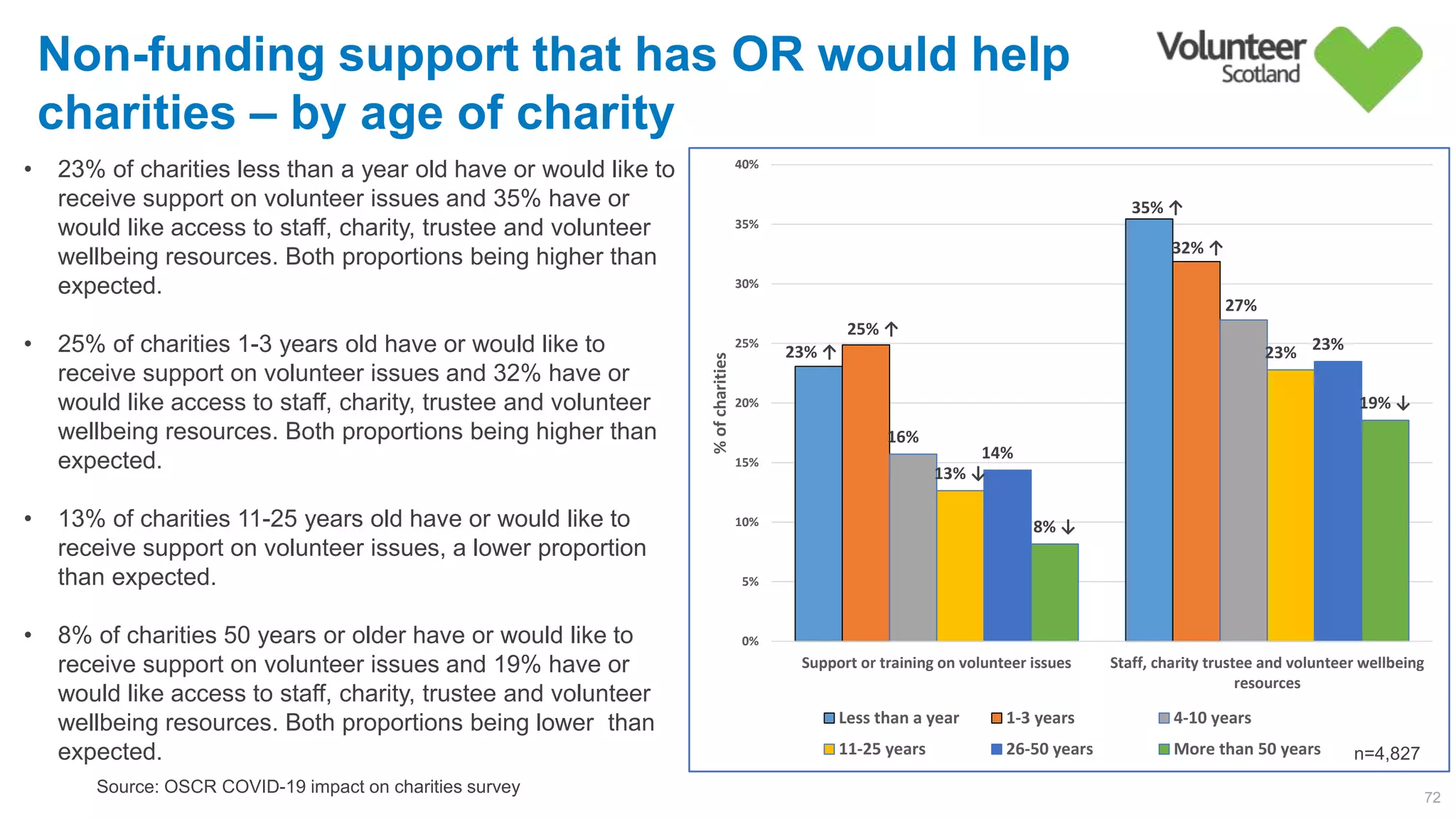
• 23% of charities less than a year old have or would like to
receive support on volunteer issues and 35% have or
would like access to staff, charity, trustee and volunteer
wellbeing resources. Both proportions being higher than
expected.
• 25% of charities 1-3 years old have or would like to
receive support on volunteer issues and 32% have or
would like access to staff, charity, trustee and volunteer
wellbeing resources. Both proportions being higher than
expected.
• 13% of charities 11-25 years old have or would like to
receive support on volunteer issues, a lower proportion
than expected.
• 8% of charities 50 years or older have or would like to
receive support on volunteer issues and 19% have or
would like access to staff, charity, trustee and volunteer
wellbeing resources. Both proportions being lower than
expected.
8% ↓
11% ↓
8% ↓
11% ↓
12% ↓
18% ↓
13%        
22% ↓
24% ↑
45% ↑
0%
5%
10%
15%
20%
25%
30%
35%
40%
45%
50%
Support or training on volunteer issues Staff, charity trustee and volunteer wellbeing
resources
%ofcharities
Under £2,000 £2,001 to £10,000 £10,001 to £25,000
£25,001 to £100,000 £100,001+
Non-funding support that has OR would help
charities– by income of charity
73
Source: OSCR COVID-19 impact on charities survey
n=4,827
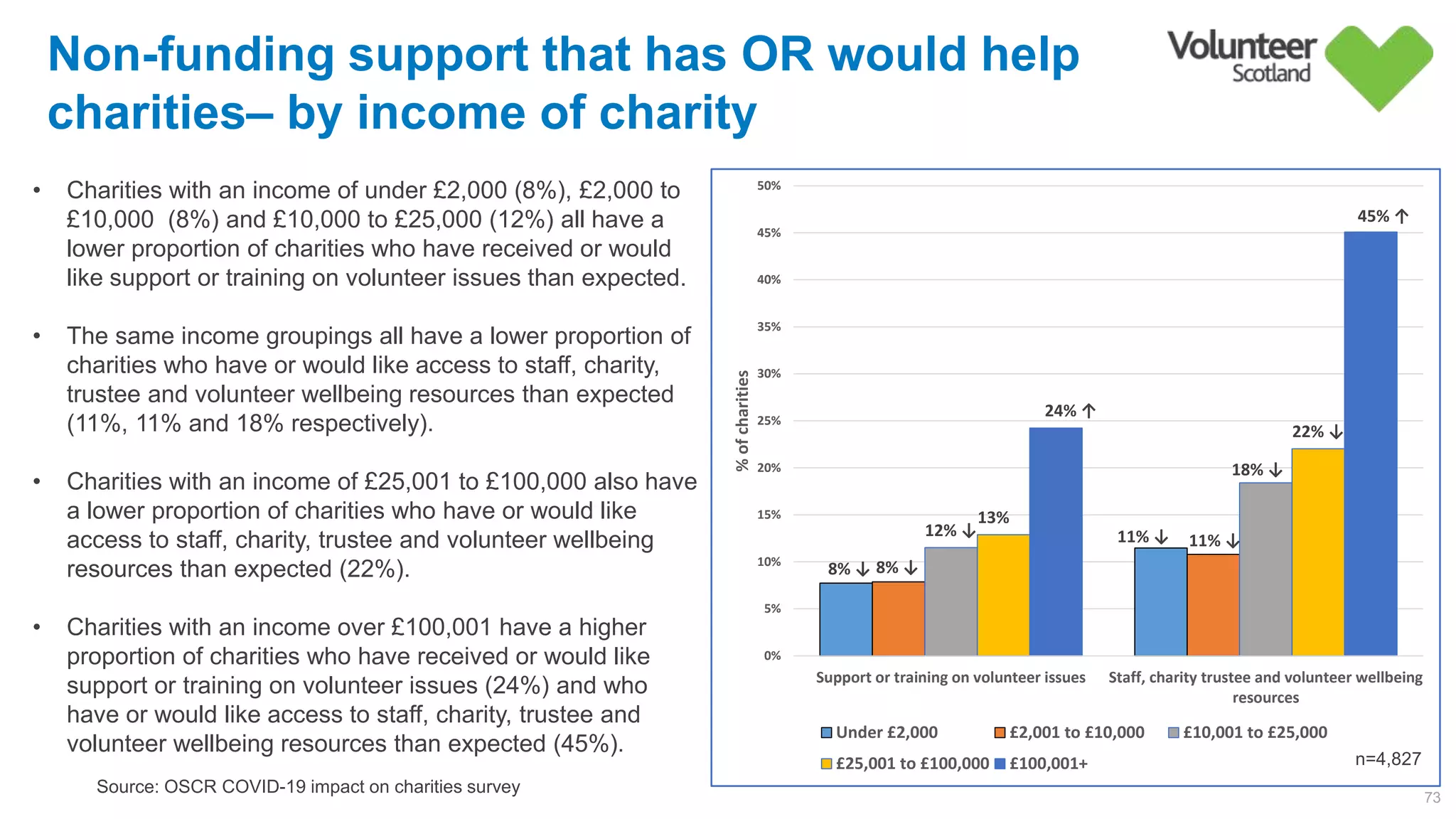
• Charities with an income of under £2,000 (8%), £2,000 to
£10,000 (8%) and £10,000 to £25,000 (12%) all have a
lower proportion of charities who have received or would
like support or training on volunteer issues than expected.
• The same income groupings all have a lower proportion of
charities who have or would like access to staff, charity,
trustee and volunteer wellbeing resources than expected
(11%, 11% and 18% respectively).
• Charities with an income of £25,001 to £100,000 also have
a lower proportion of charities who have or would like
access to staff, charity, trustee and volunteer wellbeing
resources than expected (22%).
• Charities with an income over £100,001 have a higher
proportion of charities who have received or would like
support or training on volunteer issues (24%) and who
have or would like access to staff, charity, trustee and
volunteer wellbeing resources than expected (45%).
14%         14%         13%        
13%         14%         13%        
14%        
20% ↑
19%        
23%        
21% ↓ 20% ↓ 20%        
28%        
20% ↓
29% ↑
39% ↑
35% ↑
0%        
5%        
10%        
15%        
20%        
25%        
30%        
35%        
40%        
45%        
%ofcharities
Support or training on volunteer issues
Staff, charity trustee and volunteer wellbeing resources
Non-funding support that has OR would help
charities– by geographical base of charities
74
Source: OSCR COVID-19 impact on charities survey
n=4,827
• Charities based in Glasgow have a higher proportion of
charities who have received or would like support or
training on volunteer issues than expected (20%).
• Charities based in the Highland and Islands, South
Scotland and mid-Scotland & Fife have a lower proportion
of charities who have or would like access to staff, charity,
trustee and volunteer wellbeing resources than expected
(21%, 20% and 20% respectively).
• Charities based in the Lothians, Glasgow and outside
Scotland have a higher proportion of charities who have or
would like access to staff, charity, trustee and volunteer
wellbeing resources than expected (29%, 39% and 35%
respectively).
25% ↑
24% ↑
14%        
39% ↑ 40% ↑
24% ↓
0%
5%
10%
15%
20%
25%
30%
35%
40%
45%
Contracts (NET) Grants (NET) Others (NET)
%ofcharities
Support or training on volunteer issues
Staff, charity trustee and volunteer wellbeing resources
Non-funding support that has OR would help
charities– Charities main source of income
75
Source: OSCR COVID-19 impact on charities survey
n=4,827
• Charities whose main source of income are contracts
(25%) and grants (24%) both have a higher proportion
of charities who have received or would like support or
training on volunteer issues than expected.
• The charities with the same main income sources have
a higher proportion of charities who have or would
access to staff, charity, trustee and volunteer wellbeing
resources than expected (39% and 40% respectively).
• Charities who have other main income sources have a
lower proportion of charities who have or would access
to staff, charity, trustee and volunteer wellbeing
resources than expected (24%).
13% ↓
22% ↓
21% ↑
33% ↑
17%        
33% ↑
13%        
28%        
8% ↓
18% ↓
0%
5%
10%
15%
20%
25%
30%
35%
Support or training on volunteer issues Staff, charity trustee and volunteer
wellbeing resources
%ofcharities
A local community or small number of local communities
Regionally within Scotland
Nationally, across Scotland
Nationally, across the UK
Internationally (outside the UK)
Non-funding support that has OR would help
charities – by geographical scale of charity
76
Source: OSCR COVID-19 impact on charities survey
n=4,827
• Charities who operate at a local community level (13%) and
internationally (8%) both have a lower proportion of charities
who have received or would like support or training on
volunteer issues than expected.
• Charities in based in these areas also have a lower
proportion of charities who have or would like access to staff,
charity, trustee and volunteer wellbeing resources than
expected (22% and 18% respectively).
• Charities who operate regionally within Scotland have a
higher proportion of charities who have received or would like
support or training on volunteer issues than expected (21%)
and a higher proportion of charities who have or would
like access to staff, charity, trustee and volunteer wellbeing
resources than expected (33%).
• Charities who operate nationally across Scotland also have a
higher proportion of charities who have or would access to
staff, charity, trustee and volunteer wellbeing resources than
expected (33%).
9% ↓
14% ↓
18% ↑
32% ↑
27% ↑
56% ↑
0%
10%
20%
30%
40%
50%
60%
Support or training on volunteer issues Staff, charity trustee and volunteer
wellbeing resources
%ofcharities None 1-10 11+
Non-funding support that has OR would help
charities– by number of paid staff
77
Source: OSCR COVID-19 impact on charities survey
n=4,827
• Charities with no paid staff have a lower proportion of
charities who have received or would like support or training
on volunteer issues than expected (9%) and a lower
proportion of charities who have or would like access to staff,
charity, trustee and volunteer wellbeing resources than
expected (14%).
• Charities who have 1-10 and 11 or more paid staff
members have a higher proportion of charities who have
received or would like support or training on volunteer issues
than expected (18% and 27% respectively) and a higher
proportion of charities who have or would like access to staff,
charity, trustee and volunteer wellbeing resources than
expected (32% and 56% respectively).
22% ↑
38% ↑
14%        
24%        
5% ↓
7% ↓
0%
5%
10%
15%
20%
25%
30%
35%
40%
Support or training on volunteer issues Staff, charity trustee and volunteer wellbeing
resources
%ofcharities
Critical at some point in the next 12 months
Some threat across the next 12 months, but never critical
No threat across the next 12 months
Non-funding support that has OR would help
charities– by financial threat in next 12 months
78
Source: OSCR COVID-19 impact on charities survey
n=4,827
• Charities who face a critical financial threat within the next 12
months have a higher proportion of charities who have
received or would like support or training on volunteer issues
than expected (22%) and a higher proportion of charities who
have or would like access to staff, charity, trustee and
volunteer wellbeing resources than expected (38%).
• Charities who don’t face a financial threat within the next 12
months have a lower proportion of charities who have
received or would like support or training on volunteer issues
than expected (5%) and a lower proportion of charities who
have or would like access to staff, charity, trustee and
volunteer wellbeing resources than expected (7%).
28% ↑
42% ↑
22% ↑
36% ↑
14%        
23% ↓23% ↑
40% ↑
13% ↓
23% ↓
0%
5%
10%
15%
20%
25%
30%
35%
40%
45%
Support or training on volunteer issues Staff, charity trustee and volunteer
wellbeing resources
%ofcharities
Housing and Community (NET) Social care (NET)
Leisure and Culture (NET) Health (NET)
Others (NET)
Non-funding support that has OR would help
charities– by grouped charity sectors
79
Source: OSCR COVID-19 impact on charities survey
n=4,827
• Charities based in housing and communities, social care
and health have a higher proportion of charities who have
received or would like support or training on volunteer
issues than expected (28%, 22% and 23% respectively)
and a higher proportion of charities who have or would
like access to staff, charity, trustee and volunteer wellbeing
resources than expected (42%, 36% and 40%
respectively)
• Charities who operate in other areas have a lower
proportion of charities who have received or would like
support or training on volunteer issues than expected
(13%) and a lower proportion of charities who have or
would like access to staff, charity, trustee and volunteer
wellbeing resources than expected (23%).
• Charities based in leisure and culture have a lower
proportion of charities who have or would like access to
staff, charity, trustee and volunteer wellbeing resources
than expected (23%).
Non-funding support that has OR would help
charities– by individual charity sector
80
Source: OSCR COVID-19 impact on charities survey
n=4,827
Sector
Support or training
on volunteer issues
Staff, charity trustee and
volunteer wellbeing resources
Housing 25% ↑ 45% ↑
Social care - Children and families 27% ↑ 40% ↑
Social care - Young people 26% ↑ 40% ↑
Social care - People with disabilities 27% ↑ 42% ↑
Social care – older people 20% ↑ 32% ↑
Culture and arts 13%         22% ↓
Sports and recreation 14%         24%        
Health 21% ↑ 37% ↑
Mental health 27% ↑ 45% ↑
Education and research 15%         28% ↑
Community development (including
employability and training)
29% ↑ 43% ↑
Grant giving, philanthropy and funding 10%         23%        
Environment and animals 21% ↑ 30% ↑
Advocacy, minorities, rights and law 32% ↑ 57% ↑
Umbrella body 17%         37% ↑
Religion and belief 8% ↓ 18% ↓
Other (Please say) 14%         22%        
Text coloured blue with an up arrow shows a
higher proportion than expected. For
example, 25% of charities based in housing
have or would like support or training on
volunteer issues. This is higher than
expected for charities based in this sector.
Text coloured red with a down arrow shows
a lower proportion than expected. For
example, 8% of charities based in religion
and belief have or would like support or
training on volunteer issues.This is lower
than the proportion expected for charities
based in this sector.

OSCR VS Full Presentation 2020

  • 1.
    Impact of COVID-19 onCharities in Scotland Full presentation of volunteering data from OSCR's 'Impact of COVID-19 on Scottish charities' survey September 2020
  • 2.
    Sections 2 • Research scope,structure and methodology • Summary of key findings • Profile of charities surveyed • Understanding the wider business context • Impact of COVID-19 on charities' volunteering • Charities' responses to COVID-19 • Impact of COVID-19 on the number of volunteers • Need for mental health and wellbeing support • Non-funding support that has or would help charities Link to the national 'OSCR COVID-19 impact on charities survey' results: https://www.oscr.org.uk/about-charities/surveys/
  • 3.
  • 4.
    OSCR's COVID-19 impacton charities survey 4 • Objective – ‘To gain a deeper understanding of the impact of COVID-19 and subsequent lockdown measures on charities in Scotland. • Method – online survey conducted by 'Breaking Blue' on behalf of OSCR during 5th to 15th May 2020. Link to Questionnaire • Response – 4,827 responses from a large number and representative cross-section of registered Scottish charities. • Acknowledgement – Volunteer Scotland would like to thank OSCR for providing access to their data. Link to the national 'OSCR COVID-19 impact on charities survey' results: https://www.oscr.org.uk/about-charities/surveys/
  • 5.
    Structure of VolunteerScotland's analysis Impact on volunteering Impact on organisations Understanding the wider business context Implications For recovery & post-recovery 5
  • 6.
    Methodology – Analysisof statistical significance 6 • To test whether a sub-category (e.g. charities who have been established for 1-3 years ) has a statistically significant relationship with a survey question (e.g. volunteers are unable to work) Z tests are used. • For a Z test a null and alternate hypothesis are stated • Null hypothesis – The same proportion of charities who have been established for 1-3 years have volunteers unable to work as the proportion of charities overall. • Alternate hypothesis – The proportion of charities who have been established for 1-3 years have a different proportion of charities unable to work than charities overall. • A test statistic (p value) is calculated and compared to the critical P value (0.05 for this analysis) to confirm if the null or alternate hypothesis is true. This allows a conclusion to be made with 95% confidence. • For example • 37% of all charities have volunteers unable to work compared to 43% of charities who have been established for 1-3 years. The Z test shows that this difference is statistically significant. • Throughout the presentation statistically significant results are presented on the charts with a where the relationship is statistically significant, and the proportion is higher than the overall proportion and a where the relationship is statistically significant and the proportion is lower than the overall proportion. • For the example above the results would be presented on the chart as those established for 1-3 years 43% , and in the text as a higher proportion than expected.
  • 7.
    Methodology – Terminology 7 Definitionof 'Net' categories • In some questions similar response categories have been aggregated by OSCR to give an overall result and this is referred to as 'Net' in the text and charts. • For example, the survey asks respondents whether they have used different types of grants such as local government grants, Scottish Government grants and other public sector grants. The results are combined to give the proportion of charities that receive any of these grants and this is labelled as 'Grants (Net)'. Aggregating impact response categories • For some survey questions such as 'How has your charity been affected by COVID-19 & lockdown measures more generally?' there is a second follow up question that asks how severely the measures have affected charities. • For example – charities that 'Do not have the capacity to make use of the available volunteers' are asked to state how significantly this has affected them on a five-point scale: not affected, very slightly affected, moderately affected, very much affected and severely affected. For analysis in this presentation we have reported the aggregated data for ‘very much or severely affected’. This data is not presented in chart format but can be accessed at https://www.oscr.org.uk/about-charities/surveys/.
  • 8.
  • 9.
    Impact of COVID-19on charities' operations and financial sustainability 9 Curtailment of activities (% of charities) • 78% - planned work/events postponed or cancelled • 42% - disruption of support or services to beneficiaries - • 39% - all charity operations suspended Financial impacts (% of charities) • 51% - lost income from fundraising • 42% - lost income from trading and other sources Impactduringlockdown Longer term financial impact: June 2020 – May 2021 • 85% of charities facing a financial threat in the next 12 months:  65% - some threat but never critical  20% - critical at some point in the next 12 months
  • 10.
    Impact of COVID-19on charities' volunteers during lockdown 10 • 78% of charities curtailing activities • 51% of charities have lost income from fundraising • Charities' long-term viability under threat – 20% critical Business pressures Volunteering constraints Charities' response Impact on volunteer numbers • In 37% of charities volunteers are unable to work • 13% of charities do not have the capacity to utilise current volunteers • 32% of charities have reduced or ceased the use of volunteers • Only 3% of charities have recruited, sourced or trained more volunteers • 42% of charities have decreased volunteer numbers (25% a 'major decrease') • 52% no change • 7% have increased volunteer numbers
  • 11.
    Analysis of COVID-19'svolunteering impacts by charities' characteristics 11 • The adverse impacts of COVID-19 on charities' volunteering vary significantly due to:  Charity income – the higher the charity's income the greater the adverse impact  Source of income – charities dependent on contracts and grant income are more adversely affected  No. of paid staff – charities with paid staff are more adversely affected than those with no paid staff  Geographic area – charities based regionally in Scotland are more adversely affected  Main office location – charities based in Glasgow are more adversely affected  Financial threat – charities facing a critical financial threat are more adversely affected • These differential impacts are consistent across each of the three main volunteering indicators:  Charities where volunteers are unable to work  Charities that have reduced or ceased the use of their volunteers (evidence for this indicator is presented on the next slide)  The change in volunteer numbers during lockdown
  • 12.
    Reduced or ceaseduse of volunteers by charities' characteristics 12 Income % of charities < £2k 23% £10k - 25k 30% > £100k 39% Source of Income % of charities Contracts 43% Grants 41% Other 32% No. of paid staff % of charities None 28% 1 - 10 37% > 10 36% Geographic service area % of charities Regional 38% Local 32% National 26% Financial threat % of charities Critical 43% Some threat 30% No threat 20% Location of main office % of charities Glasgow 37% NE Scotland 34% Lothians 27%
  • 13.
    Health and wellbeingimpact of COVID-19 on volunteers during lockdown 13 18% of charities have an increased need for mental health and wellbeing support for staff, volunteers, beneficiaries or charity trustees 9% of charities are very much or severely affected by the increased need for mental health and wellbeing support for staff, volunteers, beneficiaries or charity trustees
  • 14.
    Non-funding support thathas OR would help charities 14 25%         14%         15%         17%         19%         20%         25%         45%         46%         51%         0%         10%         20%         30%         40%         50%         60%         None of these Support or training on volunteer issues Support or training on staffing issues Support or training on remote leadership Maintaining momentum on current policy and government business unrelated to… Technical support and training for working remotely Staff, charity trustee and volunteer wellbeing resources Flexibility in filing or reporting deadlines More guidance on how charities should continue during the pandemic Information and advice on the financial support charities can claim % of charities • 25% of charities would or have used staff, charity trustee and volunteer wellbeing resources (the fourth most frequently cited category). • 14% would or have been helped by training on volunteer issues. • The variation in the use/need for this volunteer support by charity characteristics follows the same trends as for the impacts of COVID-19 on their volunteering. • Needs are higher for charities with higher income, dependence on grant/contract income, paid staff, a regional service area, Glasgow based and facing a critical financial threat. Source: OSCR COVID-19 impact on charities survey n=4,827
  • 15.
  • 16.
    Profile of charitiessurveyed – by number of staff and volunteers 16 54%         31%         6%         2%         1%         6%         Paid members of staff None 1-10 11-50 51 -250 251 + Don’t know / Missing 23%         42%         26%         5%         2%        2%         Number of volunteers None 1-10 11-50 51 -250 251+ Don’t know n= 4,827 Link to the national OSCR COVID-19 impact on charities survey results: https://www.oscr.org.uk/about-charities/surveys/ Further information on Scotland's charity population can be found at https://scvo.org.uk/policy/sector-stats n= 4,827
  • 17.
    Profile of charitiessurveyed – by age and income 17 Link to the national OSCR COVID-19 impact on charities survey results: https://www.oscr.org.uk/about-charities/surveys/ Further information on Scotland's charity population can be found at https://scvo.org.uk/policy/sector-stats [CELLRANGE] 6%         [CELLRANGE] 8%         [CELLRANGE] 18%         [CELLRANGE] 29%         [CELLRANGE] 21%         [CELLRANGE] 15%         [CELLRANGE] 3%         Age of Charity 8%         19%         17%         24%         16%         2%         5%         8%         0%         5%         10%         15%         20%         25%         Under £2,000 £2,001 to £10,000 £10,001 to £25,000 £25,001 to £100,000 £100,001 - £500,000 £500,001 - £1m £1m + Don’t know / Missing %ofcharities Income of charities n= 4,827n= 4,827
  • 18.
    18 13%         17%         16%        6%         7%         13%         14%         9%         3%         0%         2%         4%         6%         8%         10%         12%         14%         16%         18%         20%         %ofcharities 2% of charities did not respond to the question Link to the national OSCR COVID-19 impact on charities survey results: https://www.oscr.org.uk/about-charities/surveys/ Further information on Scotland's charity population can be found at https://scvo.org.uk/policy/sector-stats n= 4,827 n= 4,827 Profile of charities surveyed – by location of main office This map shows the proportion of charities by local authority area. Where charities are based in more than one local authority, the location of its main office is recorded. This chart shows the same information grouped into larger geographical areas. For analysis within this presentation the regional profiles are referred to as the 'geographical base' of the charity. Local authority map Regional profile
  • 19.
    Profile of charitiessurveyed – by income source and geographic scale 19 16%         34%         91%         3%         0%         10%         20%         30%         40%         50%         60%         70%         80%         90%         100%         Contracts (NET) Grants (NET) Others (NET) Don't know %ofcharities Main sources of income 68%         14%         8%         6%         4%         0%         10%         20%         30%         40%         50%         60%         70%         80%         A local community or small number of local communities Regionally within Scotland Nationally, across Scotland Nationally, across the UK Internationally (outside the UK) %ofcharities Geographical scale of charity Link to the national OSCR COVID-19 impact on charities survey results: https://www.oscr.org.uk/about-charities/surveys/ Further information on Scotland's charity population can be found at https://scvo.org.uk/policy/sector-stats n= 4,827 n= 4,827
  • 20.
    Profile of charitiessurveyed – by sector 20 2%         2%         2%         5%         8%         10%         10%         11%         11%         12%         12%         14%         17%         17%         18%         20%         21%         0%         5%         10%         15%         20%         25%         Umbrella body Advocacy, minorities, rights and law Housing Grant giving, philanthropy and funding Environment and animals Social care - Young people Social care - People with disabilities Social care - Children and families Mental health Social care – older people Community development… Health Education and research Sports and recreation Other (Please say) Culture and arts Religion and belief % of charities Sector of Charity 14%         19%         24%         33%         61%         0%         10%         20%         30%         40%         50%         60%         70%         Housing and Community (NET) Health (NET) Social care (NET) Leisure and Culture (NET) Others (NET) % of charities Sector of Charity (Combined categories) n= 4,827 Link to the national OSCR COVID-19 impact on charities survey results: https://www.oscr.org.uk/about-charities/surveys/ Further information on Scotland's charity population can be found at https://scvo.org.uk/policy/sector-stats n= 4,827
  • 21.
    Impact of COVID-19 Understandingthe wider business context
  • 22.
    Impact of COVID-19on Charities Summary 22 • The biggest impact to charities is on staff and administration, with 96% of charities impacted. • 92% of charities report an impact to service delivery and 75% a financial impact. • All of which have a significant impact on volunteering within the charity sector. 75%         92%         96%         0%         10%         20%         30%         40%         50%         60%         70%         80%         90%         100%         Impact on Finances Impact on Services Impact on staffing and administration %ofcharities In which of the following ways, if any, has your charity been affected by COVID-19 and the lockdown measures more generally? Source: OSCR COVID-19 impact on charities survey n=4,827
  • 23.
    Impact of COVID-19on Charities Specific impacts 23 30%         33%         34%         36%         37%         39%         42%         42%         51%         78%         0%        10%        20%        30%        40%        50%        60%        70%        80%        90%         Short-term risk (within next 6 months) to charity reserves Long-term risk to charity reserves Charity trustees struggling to meet or discuss matters Unable to hold an AGM Volunteers are unable to work All charity operations suspended Lost income from trading and other sources (not fundraising) Disruption of support or services to beneficiaries Lost income from fundraising Planned work / events postponed or cancelled % of charities In which of the following ways, if any, has your charity been affected by COVID-19 and the lockdown measures more generally - Ten most common impacts • More than three quarters (78%) of charities have postponed or cancelled work / events due to COVID-19. • Over a third of charities (35%) volunteers have been unable to work during COVID-19. • Financially: • 51% of charities have lost income from fundraising. • 42% have lost income from trading and other sources. • How much of a risk to charities financial position are the lower incomes due to COVID-19 over the next 12months? n=4,827 Source: OSCR COVID-19 impact on charities survey
  • 24.
    Impact of COVID-19on financial position 24 • 85% of charities face a financial threat within the next 12 months. • For a fifth of charities the financial threat will be critical. • Only 11% don’t anticipate a financial threat in the next 12 months. 20%         65%         11%         4%         Financial threat within the next 12 months (% of charities) Critical at some point in the next 12 months Some threat across the next 12 months, but never critical No threat across the next 12 months Don't know Source: OSCR COVID-19 impact on charities survey n=4,827
  • 25.
    Impact of COVID-19on charities' volunteering
  • 26.
    13%         37% 0%        10%         20%         30%         40%         Do not have the capacity to make use of the available volunteers Volunteers are unable to work % of charities In what ways has your charity been affected by COVID-19 generally 26 • 37% of charities' volunteers are unable to work reflecting the problems of social distancing, reduced operations, etc. • 13% of charities do not have the capacity to utilize their current volunteers. n=4,827 Source: OSCR COVID-19 impact on charities survey In which ways has your charity been affected by COVID19 & lockdown measures more generally?
  • 27.
    27 Source: OSCR COVID-19impact on charities survey In which ways has your charity been affected by COVID19 & lockdown measures more generally – by age of charity • 43% of volunteers who volunteer with charities aged 1-3 years are unable to work, a higher proportion than the charity average of 37%. This difference is statistically significant. • There are no statistically significant differences in the proportion of charities who do not have the capacity to make use of their available volunteers based on the age of the charity, 39%         43% ↑ 40%         35%         37%         36%         16%         16%         16%         12%         13%         13%         0%         5%         10%         15%         20%         25%         30%         35%         40%         45%         Less than a year 1-3 years 4-10 years 11-25 years 26-50 years More than 50 years %ofcharities Age of charity Volunteers are unable to work Do not have the capacity to make use of the available volunteers n=4,827
  • 28.
    32%         29% ↓ 35%        40% ↑ 43% ↑ 10%         9% ↓ 11%         16% ↑ 17% ↑ 0%         5%         10%         15%         20%         25%         30%         35%         40%         45%         50%         Under £2,000 £2,001 to £10,000 £10,001 to £25,000 £25,001 to £100,000 £100,001+ %ofcharities Income of charities Volunteers are unable to work Do not have the capacity to make use of the available volunteers 28 • Less than a third (29%) of charities with an income of £2,001 to £10,000 have volunteers who are unable to work. Less than a quarter (21%) are very much or severely affected by volunteers being unable to work, both proportions being lower than expected. • 40% of charities with an income of £25,001 -£100,000 have volunteers who are unable to work. 32% are very much or severely affected by volunteers being unable to work. Both proportions being higher than expected. • 43% of charities with an income of over £100,001 have volunteers who are unable to work, with a third very much or severely affected by volunteers being unable to work, both proportions being higher than expected. • 9% of charities with an income of £2,001 to £10,000 do not have the capacity to make use of their volunteers, with 7% very much or severely affected by volunteers being unable to work, both proportions being lower than expected. • 16% of charities with an income of £25,001 to £100,000 do not have the capacity to make use of their volunteers, higher than expected. • 17% of charities with an income over £100,001 do not have the capacity to make use of their volunteers with 12% very much or severely affected by volunteers being unable to work, both proportions being higher than expected Source: OSCR COVID-19 impact on charities survey In which ways has your charity been affected by COVID19 & lockdown measures more generally – by income of charity n=4,827
  • 29.
    44% ↑ 38%        37%         36%         39%         36%         31% ↓ 39%         37%         13%         13%         14%         13%         17%         13%         11% ↓ 18% ↑ 12%         0% 5% 10% 15% 20% 25% 30% 35% 40% 45% 50% %ofcharities Geographical base of charities Volunteers are unable to work Do not have the capacity to make use of the available volunteers 29 Source: OSCR COVID-19 impact on charities survey In which ways has your charity been affected by COVID19 & lockdown measures more generally – by geographical base of charities • 44% of charities based in the North East of Scotland have volunteers who are unable to work. With over a third very much or severely affected by volunteers being unable to work (34%). Both proportions being higher than expected. • 31% of charities based in the Lothians have volunteers who are unable to work, with 23% very much or severely affected by volunteers being unable to work. Both proportions being lower than expected. • 11% of charities based in the Lothians have volunteers they do not have the capacity to use, with 7% very much or severely affected by volunteers being unable to work. Both proportions being lower than expected. • 18% of charities based in Glasgow have volunteers they do not have the capacity to use, with 15% very much or severely affected by volunteers being unable to work. Both proportions being higher than expected. n=4,827
  • 30.
    47% ↑ 45% ↑ 38%        18% ↑ 18% ↑ 13%         0% 5% 10% 15% 20% 25% 30% 35% 40% 45% 50% Contracts (NET) Grants (NET) Others (NET) %ofcharities Main sourse of income of charities Volunteers are unable to work Do not have the capacity to make use of the available volunteers 30 Source: OSCR COVID-19 impact on charities survey In which ways has your charity been affected by COVID19 & lockdown measures more generally – by main source of charities' income • 47% of charities whose main source of income comes from contracts have volunteers who are unable to work. With over a third very much or severely affected by volunteers being unable to work (38%). Both proportions being higher than expected. • 45% of charities whose main source of income comes from grants have volunteers who are unable to work. With over a third very much or severely affected by volunteers being unable to work (35%). Both proportions being higher than expected. • 18% of charities whose main source of income comes from contracts have volunteers they do not have the capacity to use, with 15% very much or severely affected by volunteers being unable to work. Both proportions being higher than expected. • 18% of charities whose main source of income comes from grants have volunteers they do not have the capacity to use, with 14% very much or severely affected by volunteers being unable to work. Both proportions being higher than expected. n=4,827
  • 31.
    38%         42% ↑ 32%↓ 30% ↓ 27% ↓ 13%         17% ↑ 15%         11%         9%         0%         5%         10%         15%         20%         25%         30%         35%         40%         45%         A local community or small number of local communities Regionally within Scotland Nationally, across Scotland Nationally, across the UK Internationally (outside the UK) %ofcharities Scale of charities Volunteers are unable to work Do not have the capacity to make use of the available volunteers 31Source: OSCR COVID-19 impact on charities survey In which ways has your charity been affected by COVID19 & lockdown measures more generally – by geographical scale of charity • 42% of charities that operate regionally within Scotland have volunteers who are unable to work. With a third very much or severely affected by volunteers being unable to work. Both proportions being higher than expected. • 32% of charities that operate nationally across Scotland have volunteers who are unable to work, a lower proportion than expected. • 30% of charities that operate nationally across the UK have volunteers who are unable to work, a lower proportion than expected. • 27% of charities that operate internationally have volunteers who are unable to work. With 19% very much or severely affected by volunteers being unable to work. Both proportions being lower than expected. • 17% of charities that operate regionally within do not have the capacity to make use of their available volunteers, a higher proportion than expected. n=4,827
  • 32.
    34% ↓ 42% ↑ 40%        11% ↓ 17% ↑ 15%         0% 5% 10% 15% 20% 25% 30% 35% 40% 45% None 1-10 11+ %ofcharities Paid staff members Volunteers are unable to work Do not have the capacity to make use of the available volunteers 32 Source: OSCR COVID-19 impact on charities survey In which ways has your charity been affected by COVID19 & lockdown measures more generally – by number of paid staff • 34% of charities with no paid staff have volunteers who are unable to work. With a quarter (26%) very much or severely affected by volunteers being unable to work. Both proportions being lower than expected. • 42% of charities with 1-10 paid staff have volunteers who are unable to work. With a third very much or severely affected by volunteers being unable to work. Both proportions being higher than expected. • 11% of charities with no paid staff do not have the capacity to make use of their available volunteers, with 8% very much or severely affected. Both proportions being lower than expected. • 17% of charities with 1-10 paid staff members do not have the capacity to make use of their available volunteers, with 13% very much or severely affected. Both proportions being higher than expected. n=4,827
  • 33.
    49% ↑ 36%         22%↓ 20% ↑ 13%         6% ↓ 0% 10% 20% 30% 40% 50% 60% Critical at some point in the next 12 months Some threat across the next 12 months, but never critical No threat across the next 12 months %ofcharities Financial threat within the next 12 months Volunteers are unable to work Do not have the capacity to make use of the available volunteers 33 Source: OSCR COVID-19 impact on charities survey In which ways has your charity been affected by COVID19 & lockdown measures more generally – by financial threat within next 12 months n=4,827 • 49% of charities who face a critical financial threat in the next 12 months have volunteers who are unable to work. With 42% very much or severely affected by volunteers being unable to work. Both proportions being higher than expected. • 22% of charities who do not face a financial threat in the next 12 months have volunteers who are unable to work. With 14% very much or severely affected by volunteers being unable to work. Both proportions being lower than expected. • 20% of charities who face a critical financial threat in the next 12 months do not have the capacity to make use of their available volunteers. With 16% very much or severely affected. Both proportions being higher than expected. • 6% of charities who face a critical financial threat in the next 12 months do not have the capacity to make use of their available volunteers. With 3% very much or severely affected. Both proportions being lower than expected.
  • 34.
    43% ↑ 45% ↑ 37%        46% ↑ 38%         18% ↑ 15%         14%         20% ↑ 13%         0% 5% 10% 15% 20% 25% 30% 35% 40% 45% 50% Housing and Community (NET) Social care (NET) Leisure and Culture (NET) Health (NET) Others (NET) %ofcharities Charities Sector Volunteers are unable to work Do not have the capacity to make use of the available volunteers 34 Source: OSCR COVID-19 impact on charities survey In which ways has your charity been affected by COVID19 & lockdown measures more generally – by grouped charity sectors n=4,827 • 43% of charities based in housing and community have volunteers who are unable to work. With 33% very much or severely affected by volunteers being unable to work. Both proportions being higher than expected. • 45% of charities based in social care have volunteers who are unable to work. With 34% very much or severely affected by volunteers being unable to work. Both proportions being higher than expected. • 46% of charities based in the health sector have volunteers who are unable to work. With 36% very much or severely affected by volunteers being unable to work. Both proportions being higher than expected. • 18% of charities based in housing and community do not have the capacity to make use of their available volunteers. With 14% very much or severely affected. Both proportions being higher than expected. • 20% of charities based in the health sector do not have the capacity to make use of their available volunteers. With 15% very much or severely affected. Both proportions being higher than expected.
  • 35.
    35 Source: OSCR COVID-19impact on charities survey In which ways has your charity been affected by COVID19 & lockdown measures more generally – by individual charity sectors n=4,827 Sector Volunteers are unable to work Very much or severely affected by volunteers unable to work Do not have the capacity to make use of the available volunteers Very much or severely affected by not having the capacity to make use of available volunteers Housing 35%         30%         18%         16%         Social care - Children and families 43% ↑ 33% ↑ 16%         12%         Social care - Young people 47% ↑ 36% ↑ 19% ↑ 15% ↑ Social care - People with disabilities 51% ↑ 40% ↑ 18% ↑ 14% ↑ Social care – older people 48% ↑ 36% ↑ 14%         11%         Culture and arts 32% ↓ 25% ↓ 13%         10%         Sports and recreation 41% ↑ 31%         15%         11%         Health 43% ↑ 35% ↑ 18% ↑ 13% ↑ Mental health 50% ↑ 39% ↑ 24% ↑ 17% ↑ Education and research 36%         27%         14%         10%         Community development (including employability and training) 45% ↑ 33% ↑ 19% ↑ 14% ↑ Grant giving, philanthropy and funding 22% ↓ 14% ↓ 6% ↓ 4% ↓ Environment and animals 49% ↑ 36% ↑ 18% ↑ 12%         Advocacy, minorities, rights and law 41%         35%         26% ↑ 17%         Umbrella body 38%         30%         14%         10%         Religion and belief 39%         28%         13%         10%         Other (Please say) 38%         30%         14%         11%         Text coloured blue with an up arrow shows a higher proportion than expected. For example, 43% of charities based in 'Social care – children and families' have volunteers who are unable to work, with one third very much or severely affected. This is higher than the proportion expected for charities based in this sector. Text coloured red with a down arrow shows a lower proportion than expected. For example, 32% of charities based in 'Culture and arts' have volunteers who are unable to work, with a quarter very much or severely affected. This is lower than the proportion expected for charities based in this sector.
  • 36.
  • 37.
    Charities' responses toCOVID-19 37 • 47% of charities have moved support to over the phone or digitally. • Over a third (36%) have stopped based. • One third (32%) have reduced or ceased using volunteers. • Only 3% have recruited, sourced or trained more volunteers • Only 5% of charities have taken no action. n=4,827 Source: OSCR COVID-19 impact on charities survey 5%         13%         2%         3%         5%         6%         19%         22%         25%         25%         28%         32%         36%         47%         0%         10%         20%         30%         40%         50%         Nothing Something else Applied for a payment holiday on loans, mortgages etc. Recruited/sourced/trained more volunteers Operated longer hours to meet demand Continued operating as usual with social distancing… Furloughed staff Changed the support provided to a different type Applied for additional or emergency funding Signposting /sharing information Adapted current services to meet needs Reduced or ceased use of volunteers Stopped operating Provided support remotely over the phone or digital % of charities How have charities responded to COVID-19 and the lockdown measures?
  • 38.
    33%         5% ↑ 31%        5% ↑ 34%         4%         30%         3%         34%         2%         30%         2% ↓ 0%         5%         10%         15%         20%         25%         30%         35%         40%         Reduced or ceased use of volunteers Recruited/sourced/trained more volunteers %ofcharities Less than a year 1-3 years 4-10 years 11-25 years 26-50 years More than 50 years 38 Source: OSCR COVID-19 impact on charities survey In what ways, if any, has your charity responded to COVID-19 & lockdown measures – by age of charity • There is not a significant relationship between the age of charities and the reduction or cessation of the use of volunteers. • 5% of charities aged less than a year have recruited/sources/trained more volunteers, a higher proportion than expected. • 5% of charities aged 1-3 years have recruited/sources/trained more volunteers, a higher proportion than expected. • 2% of charities aged more than 50 years have recruited/sources/trained more volunteers, a lower proportion than expected. n = 4716
  • 39.
    23% ↓ 0% ↓ 24%↓ 1% ↓ 30%         2%         35% ↑ 3%         39% ↑ 5% ↑ 0% 5% 10% 15% 20% 25% 30% 35% 40% 45% Reduced or ceased use of volunteers Recruited/sourced/trained more volunteers %ofcharities Under £2,000 £2,001 to £10,000 £10,001 to £25,000 £25,001 to £100,000 £100,001+ 39 • The proportions of charities with an income under £2,000 (23%) and between £2,001 and £10,000 (24%) who reduced or ceased using volunteers is less than expected. • The proportions of charities with an income between £25,001 and £100,000 (35%) and over £100,000 ( 39%) who reduced or ceased using volunteers is more than expected. • The proportions of charities with an income under £2,000 (0%) and between £2,001 and £10,000 (1%) who recruited/sourced/trained more volunteers is less than expected. • The proportions of charities with an income over £100,000 ( 5%) who recruited/sourced/trained more volunteers is more than expected. Source: OSCR COVID-19 impact on charities survey In what ways, if any, has your charity responded to COVID-19 & lockdown measures – by income of charity n = 4716
  • 40.
    34%         32%         33%        30%         32%         31%         27% ↓ 37% ↑ 30%         1%         3%         3%         3%         4%         2%         2%         4%         4%         0%         5%         10%         15%         20%         25%         30%         35%         40%         %ofcharities Geographical base of charities Reduced or ceased use of volunteers Recruited/sourced/trained more volunteers 40 • 27% of charities based in the Lothians, reduced or ceased the use of volunteers, a lower proportion than expected. • 37% of charities based in Glasgow , reduced or ceased the use of volunteers, a higher proportion than expected. • There is not a significant relationship between the area of operation of charities and the proportion recruiting/sourcing or training more volunteers. Source: OSCR COVID-19 impact on charities survey In what ways, if any, has your charity responded to COVID-19 & lockdown measures – by geographical base of charities n = 4716
  • 41.
    43% ↑ 5% ↑ 41%↑ 5% ↑ 32%         3%         0% 5% 10% 15% 20% 25% 30% 35% 40% 45% 50% Reduced or ceased use of volunteers Recruited/sourced/trained more volunteers%ofcharities Contracts (NET) Grants (NET) Others (NET) 41 Source: OSCR COVID-19 impact on charities survey In what ways, if any, has your charity responded to COVID-19 & lockdown measures – by main sources of income n = 4716 • 43% of charities whose main income source is contracts reduced or ceased using volunteers, a higher proportion than expected. • 41% of charities whose main income source is grants reduced or ceased using volunteers, a higher proportion than expected. • 5% of charities whose main income source is contracts recruited/sourced/trained more volunteers, a higher proportion than expected. • 5% of charities whose main income source is grants recruited/sourced/trained more volunteers, a higher proportion than expected.
  • 42.
    32%         3%         38%↑ 3%         26% ↓ 2%         28%         2%         25%         1%         0%         5%         10%         15%         20%         25%         30%         35%         40%         Reduced or ceased use of volunteers Recruited/sourced/trained more volunteers %ofcharities A local community or small number of local communities Regionally within Scotland Nationally, across Scotland Nationally, across the UK Internationally (outside the UK) 42 Source: OSCR COVID-19 impact on charities survey In what ways, if any, has your charity responded to COVID-19 & lockdown measures – by geographical scale of charity n = 4716 • 38% of charities who operate regionally within Scotland reduced or ceased using volunteers, a higher proportion than expected. • 26% of charities who operate nationally across Scotland reduced or ceased using volunteers, a lower proportion than expected. • There is not a significant relationship between the geographical coverage of charities and the proportion recruiting/sourcing or training more volunteers.
  • 43.
    28% ↓ 2% ↓ 37%↑ 4% ↑ 36%         4%         0% 5% 10% 15% 20% 25% 30% 35% 40% Reduced or ceased use of volunteers Recruited/sourced/trained more volunteers %ofcharities None 1-10 11+ 43 Source: OSCR COVID-19 impact on charities survey In what ways, if any, has your charity responded to COVID-19 & lockdown measures – by number of paid staff n = 4716 • 28% of charities with no paid staff reduced or ceased using volunteers, a lower proportion than expected. • 37% of charities with 1-10 paid employees reduced or ceased using volunteers, a higher proportion than expected. • 2% of charities with no paid staff recruiting/sourcing or training more volunteers, a lower proportion than expected. • 4% of charities with 1-10 paid employees recruiting/sourcing or training more volunteers, a higher proportion than expected.
  • 44.
    43% ↑ 3%         30%↓ 3%         20% ↓ 2%         0% 5% 10% 15% 20% 25% 30% 35% 40% 45% 50% Reduced or ceased use of volunteers Recruited/sourced/trained more volunteers %ofcharities Critical at some point in the next 12 months Some threat across the next 12 months, but never critical No threat across the next 12 months 44 Source: OSCR COVID-19 impact on charities survey In what ways, if any, has your charity responded to COVID-19 & lockdown measures – by financial threat in next 12 months n = 4716 • 43% of charities who face a critical financial threat in the next 12 months reduced or ceased using volunteers. A higher proportion than expected. • 30% of charities who face a non critical financial threat in the next 12 months reduced or ceased using volunteers. A lower proportion than expected. • 20% of charities who do not face a financial threat in the next 12 months reduced or ceased using volunteers. A lower proportion than expected. • There is not a significant relationship between the financial threat facing charities in the next 12 months and the proportion recruiting/sourcing or training more volunteers.
  • 45.
    38% ↑ 8% ↑ 36%↑ 5% ↑ 33%         2% ↓ 39% ↑ 5% ↑ 32%         2%         0% 5% 10% 15% 20% 25% 30% 35% 40% 45% Reduced or ceased use of volunteers Recruited/sourced/trained more volunteers %ofcharities Housing and Community (NET) Social care (NET) Leisure and Culture (NET) Health (NET) Others (NET) 45 Source: OSCR COVID-19 impact on charities survey In what ways, if any, has your charity responded to COVID-19 & lockdown measures – by grouped charity sectors n = 4716 • 38% of charities based in housing reduced or ceased using volunteers. A higher proportion than expected. • 36% of charities based in social care reduced or ceased using volunteers. A higher proportion than expected. • 39% of charities based in the health sector reduced or ceased using volunteers. A higher proportion than expected. • 8% of charities based in housing/ recruited/ sourced/trained more volunteers. A higher proportion than expected. • 5% of charities based in social care recruited/ sourced/trained more volunteers. A higher proportion than expected. • 2% of charities based in leisure and culture recruited/ sourced/trained more volunteers. A lower proportion than expected. • 5% of charities based in the health sector reduced or ceased using volunteers. A higher proportion than expected.
  • 46.
    46 Source: OSCR COVID-19impact on charities survey In what ways, if any has your charity responded to COVID-19 & lockdown measures – by individual charity sectors n = 4716 Sector Reduced or ceased use of volunteers Recruited/sourced/trained more volunteers Housing 31%         9% ↑ Social care - Children and families 35%         6% ↑ Social care - Young people 41% ↑ 6% ↑ Social care - People with disabilities 44% ↑ 6% ↑ Social care – older people 36% ↑ 8% ↑ Culture and arts 29%         2%         Sports and recreation 37% ↑ 2%         Health 38% ↑ 6% ↑ Mental health 43% ↑ 6% ↑ Education and research 31%         3%         Community development (including employability and training) 39% ↑ 8% ↑ Grant giving, philanthropy and funding 19% ↓ 4%         Environment and animals 50% ↑ 2%         Advocacy, minorities, rights and law 38%         5%         Umbrella body 33%         9% ↑ Religion and belief 32%         2%         Other (Please say) 31%         3%         Text coloured blue with an up arrow shows a higher proportion than expected. For example, 50% of charities based within the environment and animal sectors have reduced or ceased using volunteers. This is higher than the proportion expected for charities based in this sector. Text coloured red with a down arrow shows a lower proportion than expected. For example, 19 % of charities based in grant giving, philanthropy and funding have reduced or ceased using volunteers.This is lower than the proportion expected for charities based in this sector.
  • 47.
    Impact of COVID-19on the number of volunteers engaged with charities
  • 48.
    48 The analysis ofcharity characteristics in this section is based exclusively on the 71% of charities using volunteers and excludes both the 23% of charities which don't use volunteering and the 'don't knows'. Source: OSCR COVID-19 impact on charities survey Proportion of charities using volunteers 3,445 71% 1,112 23% 270 6% No. of charities using volunteers No. of charities not using volunteers Don't know
  • 49.
    49 Source: OSCR COVID-19impact on charities survey Impact of COVID-19 on the number of volunteers engaged by charities – overall change 2% 2% 3% 52% 7% 9% 25% 0% 10% 20% 30% 40% 50% 60% Major increase Moderate increase Slight increase No change Slight decrease Moderate decrease Major decrease %ofcharities (n = 3,445) 7% increase 41% decrease
  • 50.
    50 Source: OSCR COVID-19impact on charities survey Impact of COVID-19 on the number of volunteers engaged with charities – by age of charity 0%         10%         20%         30%         40%         50%         60%         Major increase Moderate increase Slight increase No change Slight decrease Moderate decrease Major decrease%ofScottishcharitieswithvolunteers Change in volunteer numbers (March - May 2020) Less than a year 1-3 years 4-10 years 11-25 years 26-50 years More than 50 years • Charities aged 1-3 have had more of a moderate increase in the number of volunteers (4%) than expected. • There are no other significant relationships between age and change in volunteer numbers. (n = 3,346)
  • 51.
    51 Source: OSCR COVID-19impact on charities survey Impact of COVID-19 on the number of volunteers engaged with charities – by income of charity 0% 10% 20% 30% 40% 50% 60% 70% 80% Major increase Moderate increase Slight increase No change Slight decrease Moderate decrease Major decrease %ofcharitieswithvolunteers Change in volunteer numbers (March - May 2020) Under £2,000 £2,001 to £10,000 £10,001 to £25,000 £25,001 to £100,000 £100,001+ (n = 3,147) • Charities with an income under £2,000 have a higher proportion of charities with no change in the number of volunteers (70%), and a lower proportion of charities with a major decrease in the number of volunteers (19%) than expected. • Charities with an income of £2,001 to £10,000 have a lower proportion of charities with a major increase in volunteers (1%), a slight increase (1%) and a major decrease (15%) than expected. They have a higher proportion with no change (69%) than expected. • Charities with an income of £10,001 to £25,000 have a higher proportion of charities with no change in volunteer numbers (58%) than expected. • Charities with an income of £25,001 and £100,000 have a lower proportion of charities with no effect on volunteer numbers than expected (48%). • Charities with an income over £100,000 have a higher proportion of charities with a moderate increase (4%), a moderate decrease (11%) and a major decrease (33%) than expected. They have a lower proportion of charities with no change (37%) than expected.
  • 52.
    52 Source: OSCR COVID-19impact on charities survey Impact of COVID-19 on the number of volunteers engaged with charities – by geographical base of charities 0% 10% 20% 30% 40% 50% 60% 70% 80% 90% 100% %ofcharitieswithvolunteers Major increase Moderate increase Slight increase No change Slight decrease Moderate decrease Major decrease • Charities based in the Highland and Islands have a higher proportion of charities (60%) with no change in volunteer number, and a lower proportion with a moderate decrease (4%) than expected. • Charities based in Glasgow have a lower proportion of charities (35%) with no change in volunteer numbers, and a higher proportion of charities with a moderate decrease (13%) and a major decrease (37%) than expected. (n = 3,272)
  • 53.
    53 Source: OSCR COVID-19impact on charities survey Impact of COVID-19 on the number of volunteers engaged with charities – by main source of income 0% 5% 10% 15% 20% 25% 30% 35% 40% 45% 50% 55% Major increase Moderate increase Slight increase No change Slight decrease Moderate decrease Major decrease %ofcharitieswithvolunteers Contracts (NET) Grants (NET) Others (NET) • Charities whose main source of income is contracts have a lower proportion of charities who have had no effect on volunteer numbers (44%), and a higher proportion of charities major increase (3%), slight increase (4%) major decrease (5%). • Charities whose main source of income is grants has a higher proportion of charities with a major increase (3%), a moderate increase (4%) and a major decrease (30%) than expected. The proportion of charities which experience no change is lower than expected (43%). (n = 3,174)
  • 54.
    54 Source: OSCR COVID-19impact on charities survey Impact of COVID-19 on the number of volunteers engaged with charities – by geographical scale of charity 0% 10% 20% 30% 40% 50% 60% Increase No change Decrease %ofcharitieswithvolunteers Local community(ies) Regionally in Scotland Nationally across Scotland Nationally across UK Internationally • Charities which operate regionally within Scotland have a higher proportion of charities with a decrease in volunteers (49%) and a lower proportion of charities with no change (45%) than expected. (n = 3,445)
  • 55.
    55 Source: OSCR COVID-19impact on charities survey Impact of COVID-19 on the number of volunteers engaged with charities – by number of paid staff 0% 10% 20% 30% 40% 50% 60% 70% Major increase Moderate increase Slight increase No change Slight decrease Moderate decrease Major decrease %ofcharitieswithvolunteers None 1 - 10 11+ • Charities with no paid staff have a lower proportion of charities with a moderate increase (1%), a moderate decrease (7%) and a major decrease (20%) than expected. They also have a higher than expected proportion of charities with no effect (62%). • Charities with 1-10 paid staff members have a higher proportion of charities with a moderate increase (4%) and major decrease (6%) than expected, along with a lower proportion of charities with no effect (41%). • Charities with 11 or more staff members have a higher proportion of charities with a major decrease (34%) and a lower proportion with no change (36%) than expected. n=3,221
  • 56.
    56 Source: OSCR COVID-19impact on charities survey Impact of COVID-19 on the number of volunteers engaged with charities – by financial threat within next 12 months 0% 10% 20% 30% 40% 50% 60% 70% 80% Major increase Moderate increase Slight increase No change Slight decrease Moderate decrease Major decrease %ofcharitieswithvolunteers Critical at some point in the next 12 months Some threat across the next 12 months, but never critical No threat across the next 12 months • Charities facing a critical financial threat in the next 12 months have a lower proportion of charities with no effect (38%) and a higher proportion with a major decrease (43%) than expected. • Charities facing a non-critical financial threat in the next 12 months have a lower proportion of charities with a major decrease (22%) than expected. • Charities not facing a financial threat in the next 12 months have a higher proportion of charities with no effect (71%), and a lower proportion with a moderate decrease (4%) and a major decrease (13%) than expected. n=3,321
  • 57.
    57 Source: OSCR COVID-19impact on charities survey Impact of COVID-19 on the number of volunteers engaged with charities – by grouped charity sectors 16% 9% 5% 10% 7% 39% 45% 55% 43% 53% 45% 45% 41% 47% 40% 0% 10% 20% 30% 40% 50% 60% 70% 80% 90% 100% Housing and Community (NET) Social care (NET) Leisure and Culture (NET) Health (NET)Others (NET) %ofScottishcharitieswithvolunteers Increase No Change Decrease • Charities working in housing and communities have a higher proportion of charities with a net increase (16%) and a lower proportion with no change (39%) than expected. • Charities working in social care have a higher proportion of charities with both a net increase (9%) and net decrease (45%) than expected, and a lower proportion with no change (45%). • Charities working in leisure and culture have a lower proportion (5%) with a net increase than expected. • Charities working in health have a higher proportion of charities with a net increase (10%) and net decrease (47%) than expected. The proportion of charities with no effect is lower than expected (43%). n=3,970
  • 58.
    58 Source: OSCR COVID-19impact on charities survey Impact of COVID-19 on the number of volunteers engaged with charities – by individual charity sector Sector Any increase (NET) Any decrease (NET) It has had no effect on the number of volunteers Housing 18% ↑ 46%         35% ↓ Social care - Children and families 11% ↑ 49% ↑ 39% ↓ Social care - Young people 10%         50% ↑ 40% ↓ Social care - People with disabilities 11% ↑ 47% ↑ 42% ↓ Social care – older people 13% ↑ 44%         42% ↓ Culture and arts 5% ↓ 42%         54%         Sports and recreation 6%         38%         56%         Health 11% ↑ 43%         46% ↓ Mental health 11% ↑ 51% ↑ 38% ↓ Education and research 6%         42%         53%         Community development (including employability and training) 16% ↑ 44%         39% ↓ Grant giving, philanthropy and funding 12% ↑ 29% ↓ 59%         Environment and animals 9%         49% ↑ 42% ↓ Advocacy, minorities, rights and law 11%         55% ↑ 34% ↓ Umbrella body 17% ↑ 25% ↓ 57%         Religion and belief 7%         40%         53%         Other (Please say) 6%         39%         55%         Text coloured blue with an up arrow shows a higher proportion than expected. For example, 18% of charities based in housing have had a net increase in the number of volunteers. This is higher than expected for charities based in this sector. Text coloured red with a down arrow shows a lower proportion than expected. For example, 5% of charities based in culture and arts have had a net increase in volunteers.This is lower than the proportion expected for charities based in this sector.n=3,970
  • 59.
    Increased need formental health and wellbeing support for staff, volunteers, beneficiaries or charity trustees
  • 60.
    60 Source: OSCR COVID-19impact on charities survey Increased need for mental health and wellbeing support for staff, volunteers, beneficiaries or charity trustees n=4,827 18% of charities have an increased need for mental health and wellbeing support for staff, volunteers, beneficiaries or charity trustees 9% of charities are very much or severely affected by the increased need for mental health and wellbeing support for staff, volunteers, beneficiaries or charity trustees
  • 61.
    22%         22%        19%         18%         17%         18%         0%         5%         10%         15%         20%         25%         Less than a year 1-3 years 4-10 years 11-25 years 26-50 years More than 50 years%ofcharities Age of charity 61 Source: OSCR COVID-19 impact on charities survey Increased need for mental health and wellbeing support for staff, volunteers, beneficiaries or charity trustees – by age of charity • 22% of charities aged 1-3 years have an increased need for mental health and wellbeing support with 12% being very much or severely affected, a higher proportion than expected. • 18% of charities aged 11-25 years have an increased need for mental health and wellbeing support, with 8% being very much or severely affected, a lower proportion than expected. n=4,827
  • 62.
    5% ↓ 5%↓ 11% ↓ 17%         39% ↑ 0% ↓ 5% ↓ 10% ↓ 15% ↓ 20% ↓ 25% ↓ 30% ↓ 35% ↓ 40% ↓ 45% ↓ Under £2,000 £2,001 to £10,000 £10,001 to £25,000 £25,001 to £100,000 £100,001+ %ofcharities Income of charities 62 Source: OSCR COVID-19 impact on charities survey Increased need for mental health and wellbeing support for staff, volunteers, beneficiaries or charity trustees – by income of charity • 5% of charities with an income under £2,000 have an increased need for mental health and wellbeing support, with 2% being very much or severely affected. Both proportions being lower than expected. • 5% of charities with an income between £2,001 and £10,000 have an increased need for mental health and wellbeing support, with 2% being very much or severely affected. Both proportions being lower than expected. • 11% of charities with an income between £10,001 and £25,000 have an increased need for mental health and wellbeing support, with 6% being very much or severely affected. Both proportions being lower than expected. • 39% of charities with an income over £100,000 have an increased need for mental health and wellbeing support, with 19% being very much or severely affected. Both proportions being higher than expected. n=4,827
  • 63.
    15%        15% ↓ 13%↓ 13% ↓ 20%         15% ↓ 24% ↑ 31% ↑ 36% ↑ 0%         5%         10%         15%         20%         25%         30%         35%         40%         %ofcharities Geographical base of charities 63 Source: OSCR COVID-19 impact on charities survey Increased need for mental health and wellbeing support for staff, volunteers, beneficiaries or charity trustees – by geographical base of charities • 15% of charities based in the Highlands and Islands have an increased need for mental health and wellbeing support with 7% being very much or severely affected. Both proportions being lower than expected. • 13% of charities based in the South of Scotland have an increased need for mental health and wellbeing support, with 5% being very much or severely affected. Both proportions being lower than expected. • 13% of charities based in the West of Scotland have an increased need for mental health and wellbeing support, a lower proportion than expected. • 15% of charities based in Mid Scotland & Fife have an increased need for mental health and wellbeing support, a lower proportion than expected. • 24% of charities based in the Lothians have an increased need for mental health and wellbeing support, a higher proportion than expected. • 31% of charities based in Glasgow have an increased need for mental health and wellbeing support, with 18% being very much or severely affected. Both proportions being higher than expected. • 36% of charities based outside of Scotland have an increased need for mental health and wellbeing support, with 14% being very much or severely affected. Both proportions being higher than expected. n=4,827
  • 64.
    30% ↑ 30%↑ 18% ↓ 0% 5% 10% 15% 20% 25% 30% 35% Contracts (NET) Grants (NET) Others (NET) %ofcharities Main source of income of charities 64 Source: OSCR COVID-19 impact on charities survey Increased need for mental health and wellbeing support for staff, volunteers, beneficiaries or charity trustees – by main source of income • 30% of charities whose main source of income comes from contracts have an increased need for mental health and wellbeing support with 17% being very much or severely affected. Both proportions being higher than expected. • 30% of charities whose main source of income comes from grants have an increased need for mental health and wellbeing support with 16% being very much or severely affected. Both proportions being higher than expected. • 18% of charities whose main source of income comes from other sources have an increased need for mental health and wellbeing support, which is lower than expected. n=4,827
  • 65.
    15% ↓ 27% ↑ 30%↑ 23%         13%         0% 5% 10% 15% 20% 25% 30% 35% A local community or small number of local communities Regionally within Scotland Nationally, across Scotland Nationally, across the UK Internationally (outside the UK) %ofcharities Geographic sale 0f charity 65 Source: OSCR COVID-19 impact on charities survey Increased need for mental health and wellbeing support for staff, volunteers, beneficiaries or charity trustees – by geographical scale of charity n=4,827 • 15% of charities who operate at a community level have an increased need for mental health and wellbeing support with 8% being very much or severely affected. Both proportions being lower than expected. • 27% of charities who operate regionally within Scotland have an increased need for mental health and wellbeing support with 15% being very much or severely affected. Both proportions being higher than expected. • 30% of charities who operate nationally across Scotland have an increased need for mental health and wellbeing support with 13% being very much or severely affected. Both proportions being higher than expected. • 13% of charities who internationally have an increased need for mental health and wellbeing support with 4% being very much or severely affected, this proportion is lower than expected.
  • 66.
    7% ↓ 26% ↑ 55%↑ 0% ↓ 10% ↓ 20% ↓ 30% ↓ 40% ↓ 50% ↓ 60% ↓ None 1-10 11+ %ofcharities Paid staff members 66 Source: OSCR COVID-19 impact on charities survey Increased need for mental health and wellbeing support for staff, volunteers, beneficiaries or charity trustees – by number of paid staff n=4,827 • 7% of charities with no paid staff have an increased need for mental health and wellbeing support with 4% being very much or severely affected. Both proportions being lower than expected. • 26% of charities with 1-10 staff members have an increased need for mental health and wellbeing support with 13% being very much or severely affected. Both proportions being higher than expected. • 55% of charities with 11 or more paid staff members have an increased need for mental health and wellbeing support with 26% being very much or severely affected. Both proportions being higher than expected.
  • 67.
    67 Source: OSCR COVID-19impact on charities survey Increased need for mental health and wellbeing support for staff, volunteers, beneficiaries or charity trustees – by financial threat within next 12 months • 28% of charities who face a critical financial threat in the next 12 months have an increased need for mental health and wellbeing support. With 16% very much or severely affected by volunteers being unable to work. Both proportions being higher than expected. • 18% of charities who face a non-critical financial threat in the next 12 months have an increased need for mental health and wellbeing support. With 8% very much or severely affected, a lower proportion than expected. • 6% of charities who do not face a financial threat in the next 12 months have an increased need for mental health and wellbeing support. With 1% very much or severely affected by volunteers being unable to work. Both proportions being lower than expected. 28% ↑ 18%         6% ↓ 0% 5% 10% 15% 20% 25% 30% Critical at some point in the next 12 months Some threat across the next 12 months, but never critical No threat across the next 12 months %ofcharities Financial threat within next 12 months n=4,827
  • 68.
    34% ↑ 30% ↑ 13%↓ 35% ↑ 17% ↓ 0% 5% 10% 15% 20% 25% 30% 35% 40% Housing and Community Social care Leisure and Culture Health Others %ofcharities Charities sector 68 Source: OSCR COVID-19 impact on charities survey Increased need for mental health and wellbeing support for staff, volunteers, beneficiaries or charity trustees – by grouped charity sectors n=4,827 • 34% of charities based in housing and community have an increased need for mental health and wellbeing support. With 20% very much or severely affected by volunteers being unable to work. Both proportions being higher than expected. • 30% of charities based in social care have an increased need for mental health and wellbeing support. With 16% very much or severely affected. Both proportions being higher than expected. • 13% of charities based in leisure and culture have an increased need for mental health and wellbeing support. With 8% very much or severely. Both proportions being lower than expected. • 35% of charities based in the health sector have an increased need for mental health and wellbeing support. With 20% very much or severely affected. Both proportions being higher than expected. • 17% of charities based in other sectors have an increased need for mental health and wellbeing support. With 8% very much or severely affected. Both proportions being lower than expected.
  • 69.
    69Source: OSCR COVID-19impact on charities survey Increased need for mental health and wellbeing support for staff, volunteers, beneficiaries or charity trustees – by individual charity sectors n=4,827 Sector Increased need for mental health and wellbeing support for staff, volunteers, beneficiaries or charity trustees Very much or severely affected (NET) Housing 47% ↑ 20% ↑ Social care - Children and families 35% ↑ 20% ↑ Social care - Young people 33% ↑ 20% ↑ Social care - People with disabilities 39% ↑ 22% ↑ Social care – older people 31% ↑ 17% ↑ Culture and arts 14% ↓ 7%         Sports and recreation 13% ↓ 8%         Health 31% ↑ 17% ↑ Mental health 44% ↑ 28% ↑ Education and research 20%         11%         Community development (including employability and training) 33% ↑ 21% ↑ Grant giving, philanthropy and funding 14%         6%         Environment and animals 18%         8%         Advocacy, minorities, rights and law 53% ↑ 25% ↑ Umbrella body 25%         7%         Religion and belief 18%         7%         Other (Please say) 14% ↓ 7% ↓ Text coloured blue with an up arrow shows a higher proportion than expected. For example, 47% of charities based in housing have an increased need for mental health and wellbeing support, with a fifth very much or severely affected. This is higher than the proportion expected for charities based in this sector. Text coloured red with a down arrow shows a lower proportion than expected. For example, 14% of charities based in culture and arts have an increased need for mental health and wellbeing support This is lower than the proportion expected for charities based in this sector.
  • 70.
    Looking to thefuture: Non-funding support that has OR would help charities
  • 71.
    Non-funding support thathas OR would help charities 71 25%         14%         15%         17%         19%         20%         25%         45%         46%         51%         0%         10%         20%         30%         40%         50%         60%         None of these Support or training on volunteer issues Support or training on staffing issues Support or training on remote leadership Maintaining momentum on current policy and government business unrelated to… Technical support and training for working remotely Staff, charity trustee and volunteer wellbeing resources Flexibility in filing or reporting deadlines More guidance on how charities should continue during the pandemic Information and advice on the financial support charities can claim % of charities • More than half of charities (51%) would or have been helped by information on the financial support charities can claim. • 46% have or would be helped by more guidance on how charities can continue to work during COVID-19. • A quarter would or have been helped by staff, trustee and volunteer wellbeing resources. • 14% would or have been helped by training on volunteer issues. Source: OSCR COVID-19 impact on charities survey n=4,827
  • 72.
    23% ↑ 35% ↑ 25%↑ 32% ↑ 16%         27%         13% ↓ 23%         14%         23%         8% ↓ 19% ↓ 0% 5% 10% 15% 20% 25% 30% 35% 40% Support or training on volunteer issues Staff, charity trustee and volunteer wellbeing resources %ofcharities Less than a year 1-3 years 4-10 years 11-25 years 26-50 years More than 50 years Non-funding support that has OR would help charities – by age of charity 72 Source: OSCR COVID-19 impact on charities survey n=4,827 • 23% of charities less than a year old have or would like to receive support on volunteer issues and 35% have or would like access to staff, charity, trustee and volunteer wellbeing resources. Both proportions being higher than expected. • 25% of charities 1-3 years old have or would like to receive support on volunteer issues and 32% have or would like access to staff, charity, trustee and volunteer wellbeing resources. Both proportions being higher than expected. • 13% of charities 11-25 years old have or would like to receive support on volunteer issues, a lower proportion than expected. • 8% of charities 50 years or older have or would like to receive support on volunteer issues and 19% have or would like access to staff, charity, trustee and volunteer wellbeing resources. Both proportions being lower than expected.
  • 73.
    8% ↓ 11% ↓ 8%↓ 11% ↓ 12% ↓ 18% ↓ 13%         22% ↓ 24% ↑ 45% ↑ 0% 5% 10% 15% 20% 25% 30% 35% 40% 45% 50% Support or training on volunteer issues Staff, charity trustee and volunteer wellbeing resources %ofcharities Under £2,000 £2,001 to £10,000 £10,001 to £25,000 £25,001 to £100,000 £100,001+ Non-funding support that has OR would help charities– by income of charity 73 Source: OSCR COVID-19 impact on charities survey n=4,827 • Charities with an income of under £2,000 (8%), £2,000 to £10,000 (8%) and £10,000 to £25,000 (12%) all have a lower proportion of charities who have received or would like support or training on volunteer issues than expected. • The same income groupings all have a lower proportion of charities who have or would like access to staff, charity, trustee and volunteer wellbeing resources than expected (11%, 11% and 18% respectively). • Charities with an income of £25,001 to £100,000 also have a lower proportion of charities who have or would like access to staff, charity, trustee and volunteer wellbeing resources than expected (22%). • Charities with an income over £100,001 have a higher proportion of charities who have received or would like support or training on volunteer issues (24%) and who have or would like access to staff, charity, trustee and volunteer wellbeing resources than expected (45%).
  • 74.
    14%         14%        13%         13%         14%         13%         14%         20% ↑ 19%         23%         21% ↓ 20% ↓ 20%         28%         20% ↓ 29% ↑ 39% ↑ 35% ↑ 0%         5%         10%         15%         20%         25%         30%         35%         40%         45%         %ofcharities Support or training on volunteer issues Staff, charity trustee and volunteer wellbeing resources Non-funding support that has OR would help charities– by geographical base of charities 74 Source: OSCR COVID-19 impact on charities survey n=4,827 • Charities based in Glasgow have a higher proportion of charities who have received or would like support or training on volunteer issues than expected (20%). • Charities based in the Highland and Islands, South Scotland and mid-Scotland & Fife have a lower proportion of charities who have or would like access to staff, charity, trustee and volunteer wellbeing resources than expected (21%, 20% and 20% respectively). • Charities based in the Lothians, Glasgow and outside Scotland have a higher proportion of charities who have or would like access to staff, charity, trustee and volunteer wellbeing resources than expected (29%, 39% and 35% respectively).
  • 75.
    25% ↑ 24% ↑ 14%        39% ↑ 40% ↑ 24% ↓ 0% 5% 10% 15% 20% 25% 30% 35% 40% 45% Contracts (NET) Grants (NET) Others (NET) %ofcharities Support or training on volunteer issues Staff, charity trustee and volunteer wellbeing resources Non-funding support that has OR would help charities– Charities main source of income 75 Source: OSCR COVID-19 impact on charities survey n=4,827 • Charities whose main source of income are contracts (25%) and grants (24%) both have a higher proportion of charities who have received or would like support or training on volunteer issues than expected. • The charities with the same main income sources have a higher proportion of charities who have or would access to staff, charity, trustee and volunteer wellbeing resources than expected (39% and 40% respectively). • Charities who have other main income sources have a lower proportion of charities who have or would access to staff, charity, trustee and volunteer wellbeing resources than expected (24%).
  • 76.
    13% ↓ 22% ↓ 21%↑ 33% ↑ 17%         33% ↑ 13%         28%         8% ↓ 18% ↓ 0% 5% 10% 15% 20% 25% 30% 35% Support or training on volunteer issues Staff, charity trustee and volunteer wellbeing resources %ofcharities A local community or small number of local communities Regionally within Scotland Nationally, across Scotland Nationally, across the UK Internationally (outside the UK) Non-funding support that has OR would help charities – by geographical scale of charity 76 Source: OSCR COVID-19 impact on charities survey n=4,827 • Charities who operate at a local community level (13%) and internationally (8%) both have a lower proportion of charities who have received or would like support or training on volunteer issues than expected. • Charities in based in these areas also have a lower proportion of charities who have or would like access to staff, charity, trustee and volunteer wellbeing resources than expected (22% and 18% respectively). • Charities who operate regionally within Scotland have a higher proportion of charities who have received or would like support or training on volunteer issues than expected (21%) and a higher proportion of charities who have or would like access to staff, charity, trustee and volunteer wellbeing resources than expected (33%). • Charities who operate nationally across Scotland also have a higher proportion of charities who have or would access to staff, charity, trustee and volunteer wellbeing resources than expected (33%).
  • 77.
    9% ↓ 14% ↓ 18%↑ 32% ↑ 27% ↑ 56% ↑ 0% 10% 20% 30% 40% 50% 60% Support or training on volunteer issues Staff, charity trustee and volunteer wellbeing resources %ofcharities None 1-10 11+ Non-funding support that has OR would help charities– by number of paid staff 77 Source: OSCR COVID-19 impact on charities survey n=4,827 • Charities with no paid staff have a lower proportion of charities who have received or would like support or training on volunteer issues than expected (9%) and a lower proportion of charities who have or would like access to staff, charity, trustee and volunteer wellbeing resources than expected (14%). • Charities who have 1-10 and 11 or more paid staff members have a higher proportion of charities who have received or would like support or training on volunteer issues than expected (18% and 27% respectively) and a higher proportion of charities who have or would like access to staff, charity, trustee and volunteer wellbeing resources than expected (32% and 56% respectively).
  • 78.
    22% ↑ 38% ↑ 14%        24%         5% ↓ 7% ↓ 0% 5% 10% 15% 20% 25% 30% 35% 40% Support or training on volunteer issues Staff, charity trustee and volunteer wellbeing resources %ofcharities Critical at some point in the next 12 months Some threat across the next 12 months, but never critical No threat across the next 12 months Non-funding support that has OR would help charities– by financial threat in next 12 months 78 Source: OSCR COVID-19 impact on charities survey n=4,827 • Charities who face a critical financial threat within the next 12 months have a higher proportion of charities who have received or would like support or training on volunteer issues than expected (22%) and a higher proportion of charities who have or would like access to staff, charity, trustee and volunteer wellbeing resources than expected (38%). • Charities who don’t face a financial threat within the next 12 months have a lower proportion of charities who have received or would like support or training on volunteer issues than expected (5%) and a lower proportion of charities who have or would like access to staff, charity, trustee and volunteer wellbeing resources than expected (7%).
  • 79.
    28% ↑ 42% ↑ 22%↑ 36% ↑ 14%         23% ↓23% ↑ 40% ↑ 13% ↓ 23% ↓ 0% 5% 10% 15% 20% 25% 30% 35% 40% 45% Support or training on volunteer issues Staff, charity trustee and volunteer wellbeing resources %ofcharities Housing and Community (NET) Social care (NET) Leisure and Culture (NET) Health (NET) Others (NET) Non-funding support that has OR would help charities– by grouped charity sectors 79 Source: OSCR COVID-19 impact on charities survey n=4,827 • Charities based in housing and communities, social care and health have a higher proportion of charities who have received or would like support or training on volunteer issues than expected (28%, 22% and 23% respectively) and a higher proportion of charities who have or would like access to staff, charity, trustee and volunteer wellbeing resources than expected (42%, 36% and 40% respectively) • Charities who operate in other areas have a lower proportion of charities who have received or would like support or training on volunteer issues than expected (13%) and a lower proportion of charities who have or would like access to staff, charity, trustee and volunteer wellbeing resources than expected (23%). • Charities based in leisure and culture have a lower proportion of charities who have or would like access to staff, charity, trustee and volunteer wellbeing resources than expected (23%).
  • 80.
    Non-funding support thathas OR would help charities– by individual charity sector 80 Source: OSCR COVID-19 impact on charities survey n=4,827 Sector Support or training on volunteer issues Staff, charity trustee and volunteer wellbeing resources Housing 25% ↑ 45% ↑ Social care - Children and families 27% ↑ 40% ↑ Social care - Young people 26% ↑ 40% ↑ Social care - People with disabilities 27% ↑ 42% ↑ Social care – older people 20% ↑ 32% ↑ Culture and arts 13%         22% ↓ Sports and recreation 14%         24%         Health 21% ↑ 37% ↑ Mental health 27% ↑ 45% ↑ Education and research 15%         28% ↑ Community development (including employability and training) 29% ↑ 43% ↑ Grant giving, philanthropy and funding 10%         23%         Environment and animals 21% ↑ 30% ↑ Advocacy, minorities, rights and law 32% ↑ 57% ↑ Umbrella body 17%         37% ↑ Religion and belief 8% ↓ 18% ↓ Other (Please say) 14%         22%         Text coloured blue with an up arrow shows a higher proportion than expected. For example, 25% of charities based in housing have or would like support or training on volunteer issues. This is higher than expected for charities based in this sector. Text coloured red with a down arrow shows a lower proportion than expected. For example, 8% of charities based in religion and belief have or would like support or training on volunteer issues.This is lower than the proportion expected for charities based in this sector.