CHAMP EVALUATION 
Year One Report 
Heather McKay 
Director 
Education and Employment Research Center 
School of Management and Labor Relations
Who is EERC? 
Education and Employment Research Center 
School of Management and Labor Relations Rutgers 
We conduct research and evaluation on workforce development 
and education issues. 
Related Projects: 
• COETC Evaluation 
• CHEO Evaluation 
• Colorado Sectors Project Evaluation 
• Lumina Foundation project on linking Higher Education and 
the Workforce System
CHAMP 
The Colorado Helps Advanced Manufacturing Program (CHAMP) 
was created to increase the number of manufacturing degrees and 
certificates that align with the industry’s competencies and skills 
and to establish a pipeline of highly qualified advanced 
manufacturing workers. CHAMP goals are: 
• Build off Colorado’s existing and emerging manufacturing sector 
partnerships and career pathway work to develop employer driven 
curriculum 
• Use technology to accelerate training and reach a broad audience 
• Redesign the current Colorado Community College System model for credit 
for prior learning to accelerate certification 
• Develop stackable and latticed certificate with agreements between 
participating community colleges and Metropolitan State University of 
Denver
Evaluation 
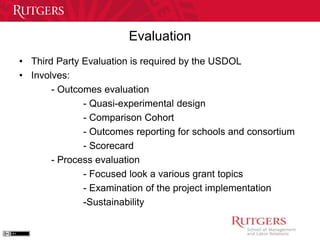
• Third Party Evaluation is required by the USDOL 
• Involves: 
- Outcomes evaluation 
- Quasi-experimental design 
- Comparison Cohort 
- Outcomes reporting for schools and consortium 
- Scorecard 
- Process evaluation 
- Focused look a various grant topics 
- Examination of the project implementation 
-Sustainability
Year One Report 
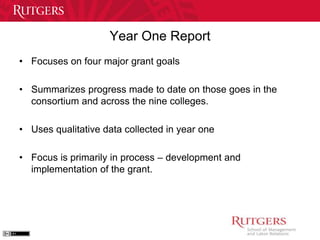
• Focuses on four major grant goals 
• Summarizes progress made to date on those goes in the 
consortium and across the nine colleges. 
• Uses qualitative data collected in year one 
• Focus is primarily in process – development and 
implementation of the grant.
Methods 
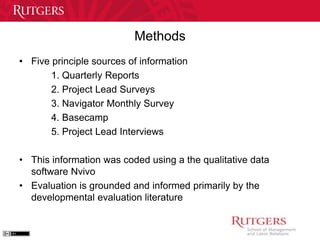
• Five principle sources of information 
1. Quarterly Reports 
2. Project Lead Surveys 
3. Navigator Monthly Survey 
4. Basecamp 
5. Project Lead Interviews 
• This information was coded using a the qualitative data 
software Nvivo 
• Evaluation is grounded and informed primarily by the 
developmental evaluation literature
Outline 
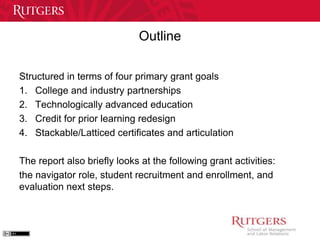
Structured in terms of four primary grant goals 
1. College and industry partnerships 
2. Technologically advanced education 
3. Credit for prior learning redesign 
4. Stackable/Latticed certificates and articulation 
The report also briefly looks at the following grant activities: 
the navigator role, student recruitment and enrollment, and 
evaluation next steps.
Goal 1: College and Industry Partnerships 
• Achieving this goal means close collaboration between 
colleges and industry 
• Consortium colleges have relationship with 30 plus industry 
partners 
• Schools are engaging partners differently
Goal 1: What has been done? 
• PPCC and RRCC have both had equipment donated from 
industry partners 
• FRCC involved industry in the hiring of their Employer 
Outreach Coordinator. 
- increased industry buy-in 
- fostered active engagement with that coordinator and 
the navigator 
• FRCC also enlisted the help of industry to layout their new 
Advanced Technology Center
Goal 1: What else? 
• PCC developed a strong relationship with the local workforce 
center – this led to ties with industry ie. visits to employers 
• PCC reports that this has led to a better understanding of 
hiring requirements and skills needed on the shop floor. 
• MSU has also visited business sites and included industry 
partners in advisory meetings 
• There are varying results across the consortium in terms of 
curriculum review and advising.
Goal 1: How do they work together? 
• FRCC has quarterly meetings with partners 
• LCC has industry representatives on the faculty 
• RRCC uses their advisory committee 
• Results from these collaborations include the incorporation of 
soft skills materials in most curricula. EGTC and PCC have 
paid particular attention to this.
Goal 1: Challenges to Date 
• Some have struggled to identify industry partners 
• Aims wants to build representation from different types of 
employers in the field. 
• Advisory committee meetings are not always well attended – 
for variety of reasons – time, company size etc. 
• Engagement is better when employers see a benefit 
• New equipment has helped some colleges to get better 
engagement
Goal 2: Technologically Advanced Education 
• Advanced manufacturing relies on technology 
• Colleges planned on renovations and technology purchases 
• But…this planning takes time and not all the colleges were 
able to do all this quickly. 
- RRCC facility renovation and equipment purchases 
full installation March 2015 
- CCD started on old equipment – will transfer to the new 
in January 2015
Goal 2: Course Redesign 
• Reviews in year one of curricula yielded: 
- 267 courses needed to be redesigned or created 
• Process set-up for redesign and timelines 
• Some curricula is done 
• Some curricula is still in process 
• Delays include equipment, renovation, integrating industry 
standards 
• As of June 2014, 125 courses were left to be redesigned
Goal 2: Other Topics 
• Open Educational Resources 
• Online and hybrid coursework 
• MOOCs
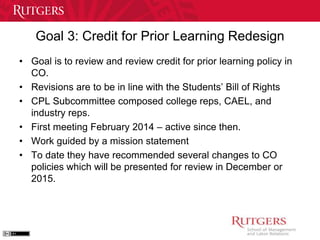
Goal 3: Credit for Prior Learning Redesign 
• Goal is to review and review credit for prior learning policy in 
CO. 
• Revisions are to be in line with the Students’ Bill of Rights 
• CPL Subcommittee composed college reps, CAEL, and 
industry reps. 
• First meeting February 2014 – active since then. 
• Work guided by a mission statement 
• To date they have recommended several changes to CO 
policies which will be presented for review in December or 
2015.
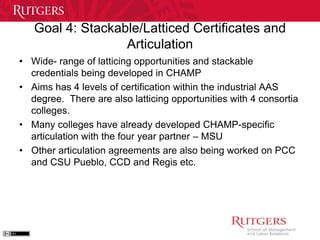
Goal 4: Stackable/Latticed Certificates and 
Articulation 
• Wide- range of latticing opportunities and stackable 
credentials being developed in CHAMP 
• Aims has 4 levels of certification within the industrial AAS 
degree. There are also latticing opportunities with 4 consortia 
colleges. 
• Many colleges have already developed CHAMP-specific 
articulation with the four year partner – MSU 
• Other articulation agreements are also being worked on PCC 
and CSU Pueblo, CCD and Regis etc.
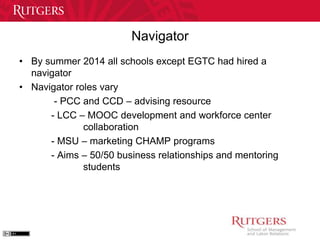
Navigator 
• By summer 2014 all schools except EGTC had hired a 
navigator 
• Navigator roles vary 
- PCC and CCD – advising resource 
- LCC – MOOC development and workforce center 
collaboration 
- MSU – marketing CHAMP programs 
- Aims – 50/50 business relationships and mentoring 
students
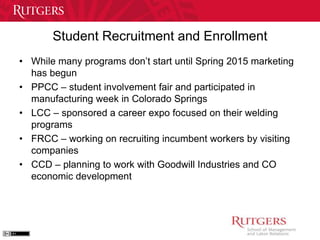
Student Recruitment and Enrollment 
• While many programs don’t start until Spring 2015 marketing 
has begun 
• PPCC – student involvement fair and participated in 
manufacturing week in Colorado Springs 
• LCC – sponsored a career expo focused on their welding 
programs 
• FRCC – working on recruiting incumbent workers by visiting 
companies 
• CCD – planning to work with Goodwill Industries and CO 
economic development
Evaluation Next Steps 
• Completed Navigator interviews this week 
• Focus group with Career Map team today 
• Interviewing committees next – CPL 
• Starting in Spring – collect program data 
• Site Visits – Fall 2015 
• Case studies and topic briefs will come in year 2
Website and Contact Information 
You can find – contact information, staff information, and reports 
from past projects and the Year 1 Report at: 
http://smlr.rutgers.edu/eerc 
My Contact Information: 
Heather A. McKay 
hmckay@work.Rutgers.edu 
848-445-4735 
THANK YOU!
CC BY License and Attribution 
This Workforce Solution CHAMP MOOC Development by Heather A. 
McKay is licensed under a Creative Commons Attribution 4.0 International 
License. Permissions beyond the scope of this license may be available 
at www.cccs.edu. 
This workforce product was funded by a grant awarded by the U.S. Department of 
Labor’s Employment and Training Administration. The product was created by the 
grantee and does not necessarily reflect the official position of the U.S. Department of 
Labor. The U.S. Department of Labor makes no guarantees, warranties, or assurances 
of any kind, express or implied, with respect to such information, including any 
information on linked sites and including, but not limited to, accuracy of the information 
or its completeness, timeliness, usefulness, adequacy, continued availability, or 
ownership.

Champ Year 1 Rutgers Report Presentation

  • 1.
    CHAMP EVALUATION YearOne Report Heather McKay Director Education and Employment Research Center School of Management and Labor Relations
  • 2.
    Who is EERC? Education and Employment Research Center School of Management and Labor Relations Rutgers We conduct research and evaluation on workforce development and education issues. Related Projects: • COETC Evaluation • CHEO Evaluation • Colorado Sectors Project Evaluation • Lumina Foundation project on linking Higher Education and the Workforce System
  • 3.
    CHAMP The ColoradoHelps Advanced Manufacturing Program (CHAMP) was created to increase the number of manufacturing degrees and certificates that align with the industry’s competencies and skills and to establish a pipeline of highly qualified advanced manufacturing workers. CHAMP goals are: • Build off Colorado’s existing and emerging manufacturing sector partnerships and career pathway work to develop employer driven curriculum • Use technology to accelerate training and reach a broad audience • Redesign the current Colorado Community College System model for credit for prior learning to accelerate certification • Develop stackable and latticed certificate with agreements between participating community colleges and Metropolitan State University of Denver
  • 4.
    Evaluation • ThirdParty Evaluation is required by the USDOL • Involves: - Outcomes evaluation - Quasi-experimental design - Comparison Cohort - Outcomes reporting for schools and consortium - Scorecard - Process evaluation - Focused look a various grant topics - Examination of the project implementation -Sustainability
  • 5.
    Year One Report • Focuses on four major grant goals • Summarizes progress made to date on those goes in the consortium and across the nine colleges. • Uses qualitative data collected in year one • Focus is primarily in process – development and implementation of the grant.
  • 6.
    Methods • Fiveprinciple sources of information 1. Quarterly Reports 2. Project Lead Surveys 3. Navigator Monthly Survey 4. Basecamp 5. Project Lead Interviews • This information was coded using a the qualitative data software Nvivo • Evaluation is grounded and informed primarily by the developmental evaluation literature
  • 7.
    Outline Structured interms of four primary grant goals 1. College and industry partnerships 2. Technologically advanced education 3. Credit for prior learning redesign 4. Stackable/Latticed certificates and articulation The report also briefly looks at the following grant activities: the navigator role, student recruitment and enrollment, and evaluation next steps.
  • 8.
    Goal 1: Collegeand Industry Partnerships • Achieving this goal means close collaboration between colleges and industry • Consortium colleges have relationship with 30 plus industry partners • Schools are engaging partners differently
  • 9.
    Goal 1: Whathas been done? • PPCC and RRCC have both had equipment donated from industry partners • FRCC involved industry in the hiring of their Employer Outreach Coordinator. - increased industry buy-in - fostered active engagement with that coordinator and the navigator • FRCC also enlisted the help of industry to layout their new Advanced Technology Center
  • 10.
    Goal 1: Whatelse? • PCC developed a strong relationship with the local workforce center – this led to ties with industry ie. visits to employers • PCC reports that this has led to a better understanding of hiring requirements and skills needed on the shop floor. • MSU has also visited business sites and included industry partners in advisory meetings • There are varying results across the consortium in terms of curriculum review and advising.
  • 11.
    Goal 1: Howdo they work together? • FRCC has quarterly meetings with partners • LCC has industry representatives on the faculty • RRCC uses their advisory committee • Results from these collaborations include the incorporation of soft skills materials in most curricula. EGTC and PCC have paid particular attention to this.
  • 12.
    Goal 1: Challengesto Date • Some have struggled to identify industry partners • Aims wants to build representation from different types of employers in the field. • Advisory committee meetings are not always well attended – for variety of reasons – time, company size etc. • Engagement is better when employers see a benefit • New equipment has helped some colleges to get better engagement
  • 13.
    Goal 2: TechnologicallyAdvanced Education • Advanced manufacturing relies on technology • Colleges planned on renovations and technology purchases • But…this planning takes time and not all the colleges were able to do all this quickly. - RRCC facility renovation and equipment purchases full installation March 2015 - CCD started on old equipment – will transfer to the new in January 2015
  • 14.
    Goal 2: CourseRedesign • Reviews in year one of curricula yielded: - 267 courses needed to be redesigned or created • Process set-up for redesign and timelines • Some curricula is done • Some curricula is still in process • Delays include equipment, renovation, integrating industry standards • As of June 2014, 125 courses were left to be redesigned
  • 15.
    Goal 2: OtherTopics • Open Educational Resources • Online and hybrid coursework • MOOCs
  • 16.
    Goal 3: Creditfor Prior Learning Redesign • Goal is to review and review credit for prior learning policy in CO. • Revisions are to be in line with the Students’ Bill of Rights • CPL Subcommittee composed college reps, CAEL, and industry reps. • First meeting February 2014 – active since then. • Work guided by a mission statement • To date they have recommended several changes to CO policies which will be presented for review in December or 2015.
  • 17.
    Goal 4: Stackable/LatticedCertificates and Articulation • Wide- range of latticing opportunities and stackable credentials being developed in CHAMP • Aims has 4 levels of certification within the industrial AAS degree. There are also latticing opportunities with 4 consortia colleges. • Many colleges have already developed CHAMP-specific articulation with the four year partner – MSU • Other articulation agreements are also being worked on PCC and CSU Pueblo, CCD and Regis etc.
  • 18.
    Navigator • Bysummer 2014 all schools except EGTC had hired a navigator • Navigator roles vary - PCC and CCD – advising resource - LCC – MOOC development and workforce center collaboration - MSU – marketing CHAMP programs - Aims – 50/50 business relationships and mentoring students
  • 19.
    Student Recruitment andEnrollment • While many programs don’t start until Spring 2015 marketing has begun • PPCC – student involvement fair and participated in manufacturing week in Colorado Springs • LCC – sponsored a career expo focused on their welding programs • FRCC – working on recruiting incumbent workers by visiting companies • CCD – planning to work with Goodwill Industries and CO economic development
  • 20.
    Evaluation Next Steps • Completed Navigator interviews this week • Focus group with Career Map team today • Interviewing committees next – CPL • Starting in Spring – collect program data • Site Visits – Fall 2015 • Case studies and topic briefs will come in year 2
  • 21.
    Website and ContactInformation You can find – contact information, staff information, and reports from past projects and the Year 1 Report at: http://smlr.rutgers.edu/eerc My Contact Information: Heather A. McKay hmckay@work.Rutgers.edu 848-445-4735 THANK YOU!
  • 22.
    CC BY Licenseand Attribution This Workforce Solution CHAMP MOOC Development by Heather A. McKay is licensed under a Creative Commons Attribution 4.0 International License. Permissions beyond the scope of this license may be available at www.cccs.edu. This workforce product was funded by a grant awarded by the U.S. Department of Labor’s Employment and Training Administration. The product was created by the grantee and does not necessarily reflect the official position of the U.S. Department of Labor. The U.S. Department of Labor makes no guarantees, warranties, or assurances of any kind, express or implied, with respect to such information, including any information on linked sites and including, but not limited to, accuracy of the information or its completeness, timeliness, usefulness, adequacy, continued availability, or ownership.