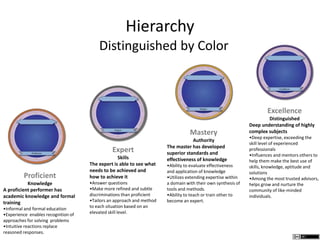
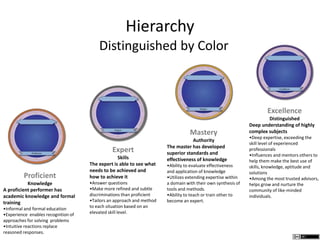
Hierarchy
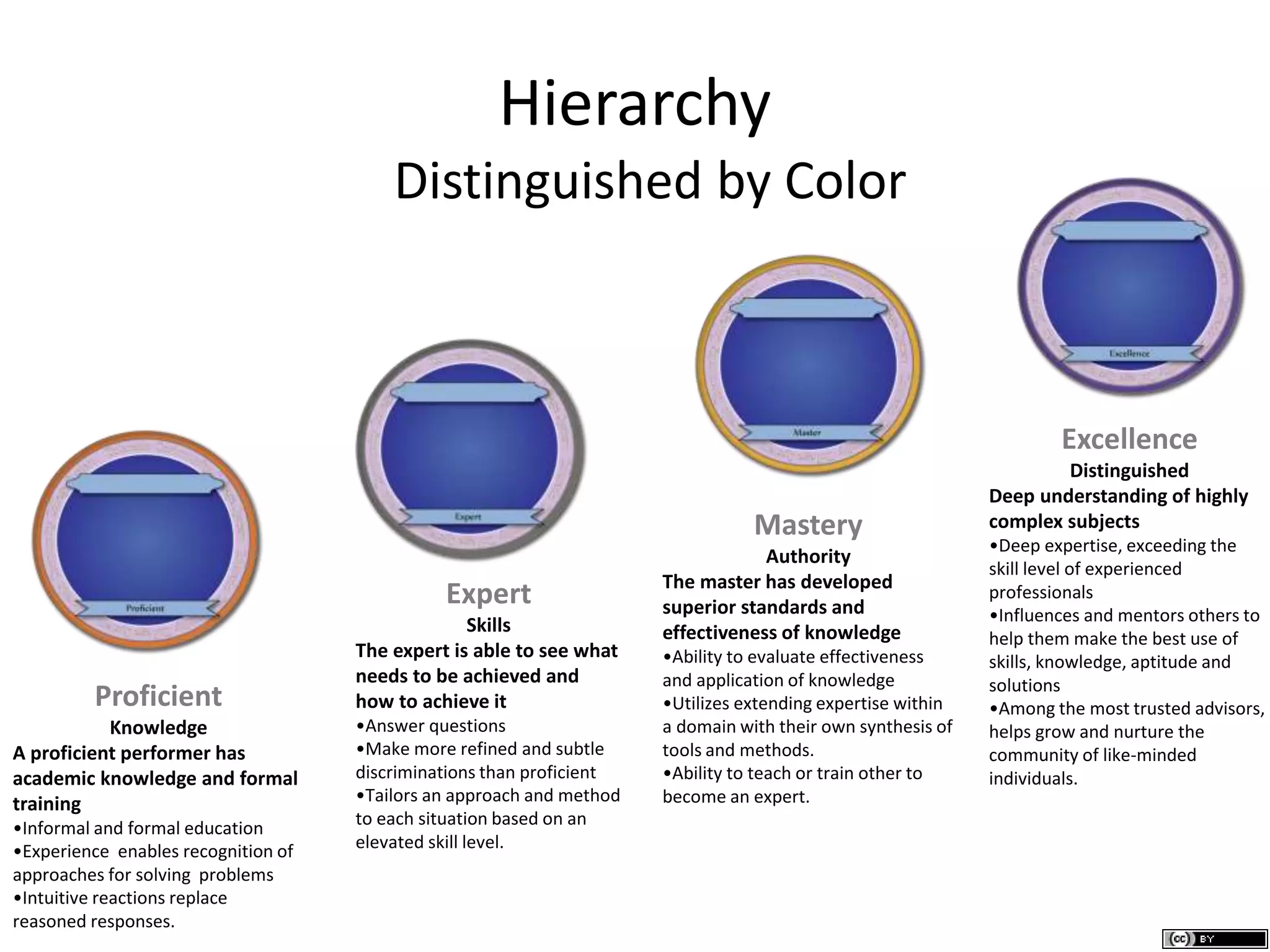
Distinguished by Color
Proficient
Knowledge
A proficient performer has
academic knowledge and formal
training
•Informal and formal education
•Experience enables recognition of
approaches for solving problems
•Intuitive reactions replace
reasoned responses.
Expert
Skills
The expert is able to see what
needs to be achieved and
how to achieve it
•Answer questions
•Make more refined and subtle
discriminations than proficient
•Tailors an approach and method
to each situation based on an
elevated skill level.
Mastery
Authority
The master has developed
superior standards and
effectiveness of knowledge
•Ability to evaluate effectiveness
and application of knowledge
•Utilizes extending expertise within
a domain with their own synthesis of
tools and methods.
•Ability to teach or train other to
become an expert.
Excellence
Distinguished
Deep understanding of highly
complex subjects
•Deep expertise, exceeding the
skill level of experienced
professionals
•Influences and mentors others to
help them make the best use of
skills, knowledge, aptitude and
solutions
•Among the most trusted advisors,
helps grow and nurture the
community of like-minded
individuals.
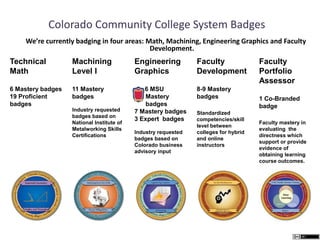
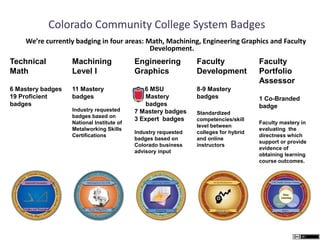
Colorado Community College System Badges
We’re currently badging in four areas: Math, Machining, Engineering Graphics and Faculty
Development.
Technical
Math
6 Mastery badges
19 Proficient
badges
Machining
Level I
11 Mastery
badges
Industry requested
badges based on
National Institute of
Metalworking Skills
Certifications
Engineering
Graphics
6 MSU
Mastery
badges
7 Mastery badges
3 Expert badges
Industry requested
badges based on
Colorado business
advisory input
Faculty
Development
8-9 Mastery
badges
Standardized
competencies/skill
level between
colleges for hybrid
and online
instructors
Faculty
Portfolio
Assessor
1 Co-Branded
badge
Faculty mastery in
evaluating the
directness which
support or provide
evidence of
obtaining learning
course outcomes.
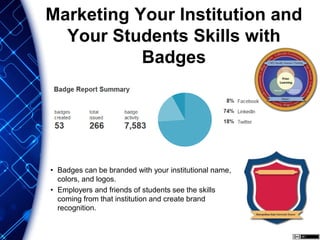
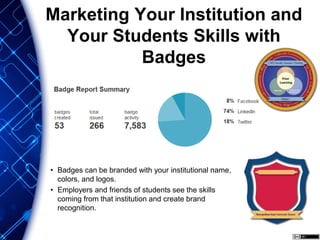
Marketing Your Institution and
Your Students Skills with
Badges
• Badges can be branded with your institutional name,
colors, and logos.
• Employers and friends of students see the skills
coming from that institution and create brand
recognition.
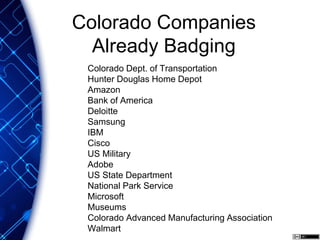
Colorado Companies
Already Badging
Colorado Dept. of Transportation
Hunter Douglas Home Depot
Amazon
Bank of America
Deloitte
Samsung
IBM
Cisco
US Military
Adobe
US State Department
National Park Service
Microsoft
Museums
Colorado Advanced Manufacturing Association
Walmart
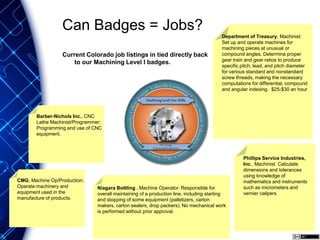
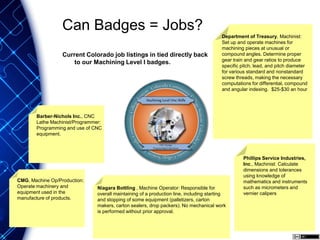
Can Badges = Jobs?
Current Colorado job listings in tied directly back
to our Machining Level I badges.
Department of Treasury, Machinist:
Set up and operate machines for
machining pieces at unusual or
compound angles. Determine proper
gear train and gear ratios to produce
specific pitch, lead, and pitch diameter
for various standard and nonstandard
screw threads, making the necessary
computations for differential, compound
and angular indexing. $25-$30 an hour
CMG, Machine Op/Production:
Operate machinery and
equipment used in the
manufacture of products.
Phillips Service Industries,
Inc., Machinist: Calculate
dimensions and tolerances
using knowledge of
mathematics and instruments
such as micrometers and
vernier calipers
Barber-Nichols Inc., CNC
Lathe Machinist/Programmer:
Programming and use of CNC
equipment.
Niagara Bottling , Machine Operator: Responsible for
overall maintaining of a production line, including starting
and stopping of some equipment (palletizers, carton
makers, carton sealers, drop packers). No mechanical work
is performed without prior approval.
Badges and Hiring
• Students need to be coached to post badges and
skills to LinkedIn and Facebook so recruiters can
search for them.
• Keep track of the number of hours a student spends on a
specific machine, and the name of the machine.
• Students need to be sure to include job description
keywords on their resume’s and profiles.
• CCCS CHAMP ID team will do outreach to
staffing agencies and hiring managers. to
raise competency based badge awareness
The Legitimacy of Badges & Micro-
credentials in Higher Education and
Today’s Workplace
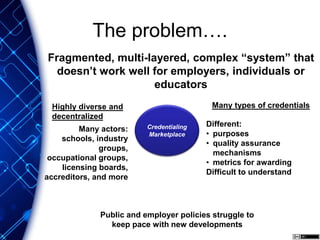
Credentialing
Marketplace
Many types of credentials
Fragmented, multi-layered, complex “system” that
doesn’t work well for employers, individuals or
educators
Highly diverse and
decentralized
Many actors:
schools, industry
groups,
occupational groups,
licensing boards,
accreditors, and more
Different:
• purposes
• quality assurance
mechanisms
• metrics for awarding
Difficult to understand
Public and employer policies struggle to
keep pace with new developments
The problem….
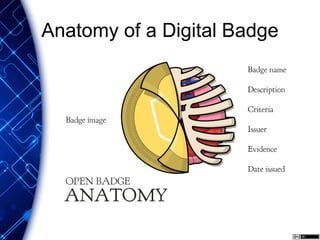
Anatomy of a Digital Badge
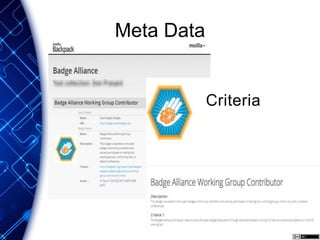
Meta Data
Criteria
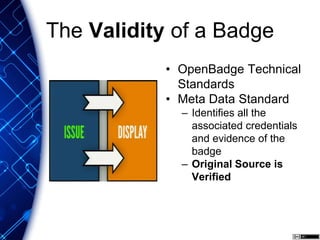
The Validity of a Badge
• OpenBadge Technical
Standards
• Meta Data Standard
– Identifies all the
associated credentials
and evidence of the
badge
– Original Source is
Verified
Digital badge value
“currency” is based on
recognition of the value of
demonstrated mastery
Successful badge initiatives have a
common factor: badges issued or
accepted tied to a specific standard or
competency with evidence of micro-
learning valued in the workforce
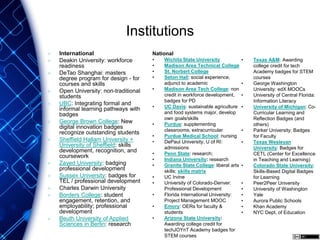
Institutions
National
• Wichita State University
• Madison Area Technical College
• St. Norbert College
• Seton Hall: social experience,
adjunct to academic
• Madison Area Tech College: non
credit in workforce development,
badges for PD
• UC Davis: sustainable agriculture
and food systems major, develop
own goals/skills
• Purdue: supplementing
classrooms, extracurricular
• Purdue Medical School: nursing
• DePaul University, U of RI:
admissions
• Penn State: research;
• Indiana University: research
• Granite State College: liberal arts
skills; skills matrix
• UC Irvine
• University of Colorado-Denver:
Professional Development
• Florida International University:
Project Management MOOC
• Emory: OERs for faculty &
students
• Arizona State University:
Awarding college credit for
techJOYnT Academy badges for
STEM courses
• Texas A&M: Awarding
college credit for tech
Academy badges for STEM
courses
• George Washington
University: edX MOOCs
• University of Central Florida:
Information Literacy
• University of Michigan: Co-
Curricular Learning and
Reflection Badges (and
others)
• Parker University: Badges
for Faculty
• Texas Wesleyan
University: Badges for
CETL (Center for Excellence
in Teaching and Learning)
• Colorado State University:
Skills-Based Digital Badges
for Learning
• Peer2Peer University
• University of Washington
• Yale
• Aurora Public Schools
• Khan Academy
• NYC Dept. of Education
 International
 Deakin University: workforce
readiness
 DeTao Shanghai: masters
degree program for design - for
courses and skills
 Open University: non-traditional
students
 UBC: Integrating formal and
informal learning pathways with
badges
 George Brown College: New
digital innovation badges
recognize outstanding students
 Sheffield Hallam University +
University of Sheffield: skills
development, recognition, and
coursework
 Zayed University: badging
professional development
 Sussex University: badges for
TEL / professional development
 Charles Darwin University
 Borders College: student
engagement, retention, and
employability; professional
development
 Beuth University of Applied
Sciences in Berlin: research
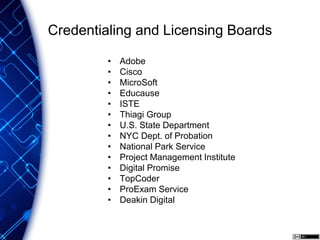
Credentialing and Licensing Boards
• Adobe
• Cisco
• MicroSoft
• Educause
• ISTE
• Thiagi Group
• U.S. State Department
• NYC Dept. of Probation
• National Park Service
• Project Management Institute
• Digital Promise
• TopCoder
• ProExam Service
• Deakin Digital
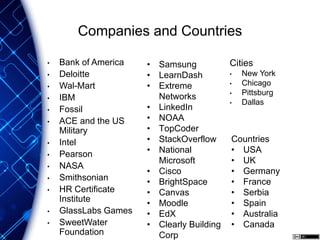
Companies and Countries
• Samsung
• LearnDash
• Extreme
Networks
• LinkedIn
• NOAA
• TopCoder
• StackOverflow
• National
Microsoft
• Cisco
• BrightSpace
• Canvas
• Moodle
• EdX
• Clearly Building
Corp
Countries
• USA
• UK
• Germany
• France
• Serbia
• Spain
• Australia
• Canada
Cities
• New York
• Chicago
• Pittsburg
• Dallas
• Bank of America
• Deloitte
• Wal-Mart
• IBM
• Fossil
• ACE and the US
Military
• Intel
• Pearson
• NASA
• Smithsonian
• HR Certificate
Institute
• GlassLabs Games
• SweetWater
Foundation
Colorado Companies
Already Badging
Colorado Dept. of Transportation
Hunter Douglas Home Depot
Amazon
Bank of America
Deloitte
Samsung
IBM
Cisco
US Military
Adobe
US State Department
National Park Service
Microsoft
Museums
Colorado Advanced Manufacturing Association
Walmart
Badges Can Be Used for…..
• matching job requirements with applicant skills and abilities
• onboarding (mapping orientation paths)
• team building and internal resourcing (micro-assignments)
• regulated compliance training (e.g. health and safety) clear
training/development paths
• recognizing/aggregating training sourced externally
• bridge building between learning providers and employment
requirements
• managing your employees better (performance management,
talent management tool)
• better initial 'fit' - "I know I/you have the skills to do this job"
• reduction of churn rate/turnover at specific positions
Transparency of learning
• Competencies at a granular level
• Link what knowledge to what a badge earner “can
do”
Portability
• Follows the learner through a life long learning
pathway
• Data can be verified and certified by badge
consumer
Why does Colorado Workforce need
more transparent credentials?
Identified Competencies that are Learner Focused,
Community Centered and Industry Driven
CCCS’s Vision…..
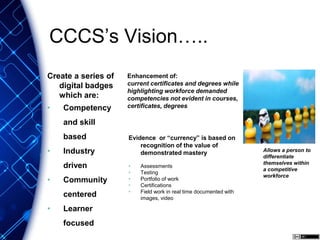
Create a series of
digital badges
which are:
• Competency
and skill
based
• Industry
driven
• Community
centered
• Learner
focused
Allows a person to
differentiate
themselves within
a competitive
workforce
Enhancement of:
current certificates and degrees while
highlighting workforce demanded
competencies not evident in courses,
certificates, degrees
Evidence or “currency” is based on
recognition of the value of
demonstrated mastery
• Assessments
• Testing
• Portfolio of work
• Certifications
• Field work in real time documented with
images, video
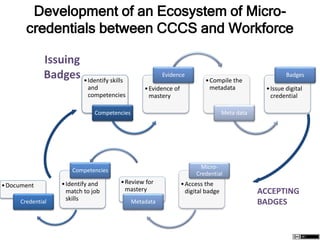
Development of an Ecosystem of Micro-
credentials between CCCS and Workforce
•Document
Credential
•Identify and
match to job
skills
Competencies
•Review for
mastery
Metadata
•Access the
digital badge
Micro-
Credential
•Identify skills
and
competencies
Competencies
•Evidence of
mastery
Evidence
•Compile the
metadata
Meta data
•Issue digital
credential
Badges
Issuing
Badges
ACCEPTING
BADGES
Hierarchy
Distinguished by Color
Proficient
Knowledge
A proficient performer has
academic knowledge and formal
training
•Informal and formal education
•Experience enables recognition of
approaches for solving problems
•Intuitive reactions replace
reasoned responses.
Expert
Skills
The expert is able to see what
needs to be achieved and
how to achieve it
•Answer questions
•Make more refined and subtle
discriminations than proficient
•Tailors an approach and method
to each situation based on an
elevated skill level.
Mastery
Authority
The master has developed
superior standards and
effectiveness of knowledge
•Ability to evaluate effectiveness
and application of knowledge
•Utilizes extending expertise within
a domain with their own synthesis of
tools and methods.
•Ability to teach or train other to
become an expert.
Excellence
Distinguished
Deep understanding of highly
complex subjects
•Deep expertise, exceeding the
skill level of experienced
professionals
•Influences and mentors others to
help them make the best use of
skills, knowledge, aptitude and
solutions
•Among the most trusted advisors,
helps grow and nurture the
community of like-minded
individuals.
Colorado Community College System Badges
We’re currently badging in four areas: Math, Machining, Engineering Graphics and Faculty
Development.
Technical
Math
6 Mastery badges
19 Proficient
badges
Machining
Level I
11 Mastery
badges
Industry requested
badges based on
National Institute of
Metalworking Skills
Certifications
Engineering
Graphics
6 MSU
Mastery
badges
7 Mastery badges
3 Expert badges
Industry requested
badges based on
Colorado business
advisory input
Faculty
Development
8-9 Mastery
badges
Standardized
competencies/skill
level between
colleges for hybrid
and online
instructors
Faculty
Portfolio
Assessor
1 Co-Branded
badge
Faculty mastery in
evaluating the
directness which
support or provide
evidence of
obtaining learning
course outcomes.
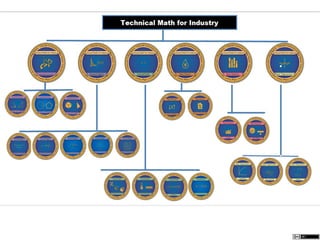
Technical Math for Industry
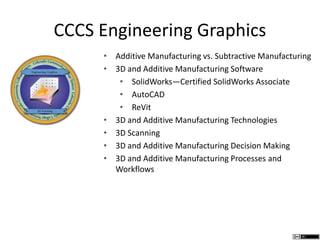
CCCS Engineering Graphics
• Additive Manufacturing vs. Subtractive Manufacturing
• 3D and Additive Manufacturing Software
• SolidWorks—Certified SolidWorks Associate
• AutoCAD
• ReVit
• 3D and Additive Manufacturing Technologies
• 3D Scanning
• 3D and Additive Manufacturing Decision Making
• 3D and Additive Manufacturing Processes and
Workflows
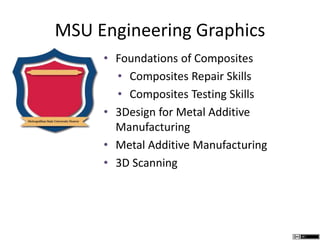
MSU Engineering Graphics
• Foundations of Composites
• Composites Repair Skills
• Composites Testing Skills
• 3Design for Metal Additive
Manufacturing
• Metal Additive Manufacturing
• 3D Scanning
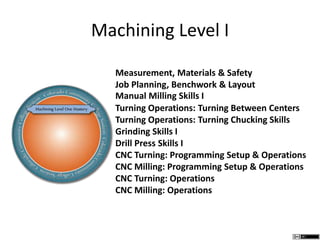
Machining Level I
Measurement, Materials & Safety
Job Planning, Benchwork & Layout
Manual Milling Skills I
Turning Operations: Turning Between Centers
Turning Operations: Turning Chucking Skills
Grinding Skills I
Drill Press Skills I
CNC Turning: Programming Setup & Operations
CNC Milling: Programming Setup & Operations
CNC Turning: Operations
CNC Milling: Operations
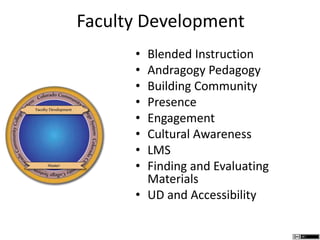
Faculty Development
• Blended Instruction
• Andragogy Pedagogy
• Building Community
• Presence
• Engagement
• Cultural Awareness
• LMS
• Finding and Evaluating
Materials
• UD and Accessibility
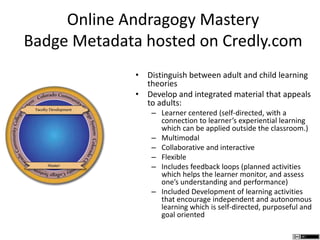
Online Andragogy Mastery
Badge Metadata hosted on Credly.com
• Distinguish between adult and child learning
theories
• Develop and integrated material that appeals
to adults:
– Learner centered (self-directed, with a
connection to learner’s experiential learning
which can be applied outside the classroom.)
– Multimodal
– Collaborative and interactive
– Flexible
– Includes feedback loops (planned activities
which helps the learner monitor, and assess
one’s understanding and performance)
– Included Development of learning activities
that encourage independent and autonomous
learning which is self-directed, purposeful and
goal oriented
Questions????
IN THE REAL
WORLD……
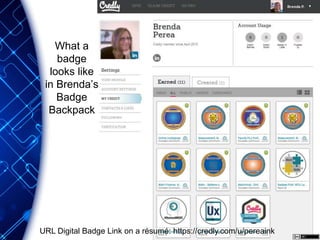
Badges
What a
badge
looks like
in Brenda’s
Badge
Backpack
URL Digital Badge Link on a résumé: https://credly.com/u/pereaink
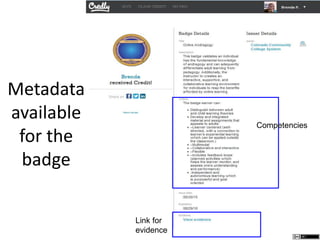
Metadata
available
for the
badge
Competencies
Link for
evidence
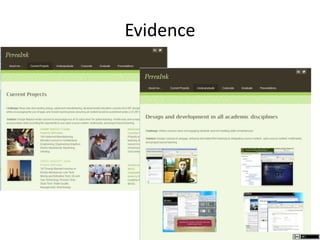
Evidence
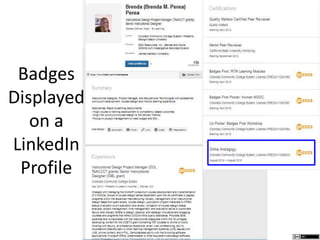
Badges
Displayed
on a
LinkedIn
Profile
Badges and Hiring
• Students need to be coached to post badges and
skills to LinkedIn and Facebook so recruiters can
search for them.
• Keep track of the number of hours a student spends on a
specific machine, and the name of the machine.
• Students need to be sure to include job description
keywords on their resume’s and profiles.
• CCCS CHAMP ID team will do outreach to
staffing agencies and hiring managers. to
raise competency based badge awareness
Marketing Your Institution and
Your Students Skills with
Badges
• Badges can be branded with your institutional name,
colors, and logos.
• Employers and friends of students see the skills
coming from that institution and create brand
recognition.
Can Badges = Jobs?
Current Colorado job listings in tied directly back
to our Machining Level I badges.
Department of Treasury, Machinist:
Set up and operate machines for
machining pieces at unusual or
compound angles. Determine proper
gear train and gear ratios to produce
specific pitch, lead, and pitch diameter
for various standard and nonstandard
screw threads, making the necessary
computations for differential, compound
and angular indexing. $25-$30 an hour
CMG, Machine Op/Production:
Operate machinery and
equipment used in the
manufacture of products.
Phillips Service Industries,
Inc., Machinist: Calculate
dimensions and tolerances
using knowledge of
mathematics and instruments
such as micrometers and
vernier calipers
Barber-Nichols Inc., CNC
Lathe Machinist/Programmer:
Programming and use of CNC
equipment.
Niagara Bottling , Machine Operator: Responsible for
overall maintaining of a production line, including starting
and stopping of some equipment (palletizers, carton
makers, carton sealers, drop packers). No mechanical work
is performed without prior approval.
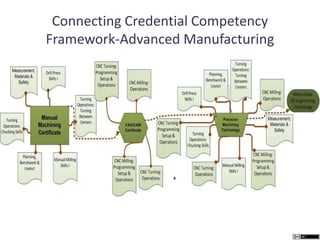
Connecting Credential Competency
Framework-Advanced Manufacturing
Creative Commons Attribution
Workforce Development presentation by Brenda M. Perea is licensed
under a Creative Commons Attribution 4.0 International License.
Permissions beyond the scope of this license may be available
at CCCS.edu/CHAMP.
This workforce solution was funded by a grant awarded by the U.S.
Department of Labor’s Employment and Training Administration. The
solution was created by the grantee and does not necessarily reflect the
official position of the U.S. Department of Labor. The Department of Labor
makes no guarantees, warranties, or assurances of any kind, express or
implied, with respect to such information, including any information on
linked sites, and including, but not limited to accuracy of the information or
its completeness, timeliness, usefulness, adequacy, continued availability
or ownership.

Champ project leads june 2016

  • 1.
    Hierarchy Distinguished by Color Proficient Knowledge Aproficient performer has academic knowledge and formal training •Informal and formal education •Experience enables recognition of approaches for solving problems •Intuitive reactions replace reasoned responses. Expert Skills The expert is able to see what needs to be achieved and how to achieve it •Answer questions •Make more refined and subtle discriminations than proficient •Tailors an approach and method to each situation based on an elevated skill level. Mastery Authority The master has developed superior standards and effectiveness of knowledge •Ability to evaluate effectiveness and application of knowledge •Utilizes extending expertise within a domain with their own synthesis of tools and methods. •Ability to teach or train other to become an expert. Excellence Distinguished Deep understanding of highly complex subjects •Deep expertise, exceeding the skill level of experienced professionals •Influences and mentors others to help them make the best use of skills, knowledge, aptitude and solutions •Among the most trusted advisors, helps grow and nurture the community of like-minded individuals.
  • 2.
    Colorado Community CollegeSystem Badges We’re currently badging in four areas: Math, Machining, Engineering Graphics and Faculty Development. Technical Math 6 Mastery badges 19 Proficient badges Machining Level I 11 Mastery badges Industry requested badges based on National Institute of Metalworking Skills Certifications Engineering Graphics 6 MSU Mastery badges 7 Mastery badges 3 Expert badges Industry requested badges based on Colorado business advisory input Faculty Development 8-9 Mastery badges Standardized competencies/skill level between colleges for hybrid and online instructors Faculty Portfolio Assessor 1 Co-Branded badge Faculty mastery in evaluating the directness which support or provide evidence of obtaining learning course outcomes.
  • 3.
    Marketing Your Institutionand Your Students Skills with Badges • Badges can be branded with your institutional name, colors, and logos. • Employers and friends of students see the skills coming from that institution and create brand recognition.
  • 4.
    Colorado Companies Already Badging ColoradoDept. of Transportation Hunter Douglas Home Depot Amazon Bank of America Deloitte Samsung IBM Cisco US Military Adobe US State Department National Park Service Microsoft Museums Colorado Advanced Manufacturing Association Walmart
  • 5.
    Can Badges =Jobs? Current Colorado job listings in tied directly back to our Machining Level I badges. Department of Treasury, Machinist: Set up and operate machines for machining pieces at unusual or compound angles. Determine proper gear train and gear ratios to produce specific pitch, lead, and pitch diameter for various standard and nonstandard screw threads, making the necessary computations for differential, compound and angular indexing. $25-$30 an hour CMG, Machine Op/Production: Operate machinery and equipment used in the manufacture of products. Phillips Service Industries, Inc., Machinist: Calculate dimensions and tolerances using knowledge of mathematics and instruments such as micrometers and vernier calipers Barber-Nichols Inc., CNC Lathe Machinist/Programmer: Programming and use of CNC equipment. Niagara Bottling , Machine Operator: Responsible for overall maintaining of a production line, including starting and stopping of some equipment (palletizers, carton makers, carton sealers, drop packers). No mechanical work is performed without prior approval.
  • 6.
    Badges and Hiring •Students need to be coached to post badges and skills to LinkedIn and Facebook so recruiters can search for them. • Keep track of the number of hours a student spends on a specific machine, and the name of the machine. • Students need to be sure to include job description keywords on their resume’s and profiles. • CCCS CHAMP ID team will do outreach to staffing agencies and hiring managers. to raise competency based badge awareness
  • 7.
    The Legitimacy ofBadges & Micro- credentials in Higher Education and Today’s Workplace
  • 8.
    Credentialing Marketplace Many types ofcredentials Fragmented, multi-layered, complex “system” that doesn’t work well for employers, individuals or educators Highly diverse and decentralized Many actors: schools, industry groups, occupational groups, licensing boards, accreditors, and more Different: • purposes • quality assurance mechanisms • metrics for awarding Difficult to understand Public and employer policies struggle to keep pace with new developments The problem….
  • 9.
    Anatomy of aDigital Badge
  • 10.
  • 11.
    The Validity ofa Badge • OpenBadge Technical Standards • Meta Data Standard – Identifies all the associated credentials and evidence of the badge – Original Source is Verified
  • 12.
    Digital badge value “currency”is based on recognition of the value of demonstrated mastery Successful badge initiatives have a common factor: badges issued or accepted tied to a specific standard or competency with evidence of micro- learning valued in the workforce
  • 13.
    Institutions National • Wichita StateUniversity • Madison Area Technical College • St. Norbert College • Seton Hall: social experience, adjunct to academic • Madison Area Tech College: non credit in workforce development, badges for PD • UC Davis: sustainable agriculture and food systems major, develop own goals/skills • Purdue: supplementing classrooms, extracurricular • Purdue Medical School: nursing • DePaul University, U of RI: admissions • Penn State: research; • Indiana University: research • Granite State College: liberal arts skills; skills matrix • UC Irvine • University of Colorado-Denver: Professional Development • Florida International University: Project Management MOOC • Emory: OERs for faculty & students • Arizona State University: Awarding college credit for techJOYnT Academy badges for STEM courses • Texas A&M: Awarding college credit for tech Academy badges for STEM courses • George Washington University: edX MOOCs • University of Central Florida: Information Literacy • University of Michigan: Co- Curricular Learning and Reflection Badges (and others) • Parker University: Badges for Faculty • Texas Wesleyan University: Badges for CETL (Center for Excellence in Teaching and Learning) • Colorado State University: Skills-Based Digital Badges for Learning • Peer2Peer University • University of Washington • Yale • Aurora Public Schools • Khan Academy • NYC Dept. of Education  International  Deakin University: workforce readiness  DeTao Shanghai: masters degree program for design - for courses and skills  Open University: non-traditional students  UBC: Integrating formal and informal learning pathways with badges  George Brown College: New digital innovation badges recognize outstanding students  Sheffield Hallam University + University of Sheffield: skills development, recognition, and coursework  Zayed University: badging professional development  Sussex University: badges for TEL / professional development  Charles Darwin University  Borders College: student engagement, retention, and employability; professional development  Beuth University of Applied Sciences in Berlin: research
  • 14.
    Credentialing and LicensingBoards • Adobe • Cisco • MicroSoft • Educause • ISTE • Thiagi Group • U.S. State Department • NYC Dept. of Probation • National Park Service • Project Management Institute • Digital Promise • TopCoder • ProExam Service • Deakin Digital
  • 15.
    Companies and Countries •Samsung • LearnDash • Extreme Networks • LinkedIn • NOAA • TopCoder • StackOverflow • National Microsoft • Cisco • BrightSpace • Canvas • Moodle • EdX • Clearly Building Corp Countries • USA • UK • Germany • France • Serbia • Spain • Australia • Canada Cities • New York • Chicago • Pittsburg • Dallas • Bank of America • Deloitte • Wal-Mart • IBM • Fossil • ACE and the US Military • Intel • Pearson • NASA • Smithsonian • HR Certificate Institute • GlassLabs Games • SweetWater Foundation
  • 16.
    Colorado Companies Already Badging ColoradoDept. of Transportation Hunter Douglas Home Depot Amazon Bank of America Deloitte Samsung IBM Cisco US Military Adobe US State Department National Park Service Microsoft Museums Colorado Advanced Manufacturing Association Walmart
  • 17.
    Badges Can BeUsed for….. • matching job requirements with applicant skills and abilities • onboarding (mapping orientation paths) • team building and internal resourcing (micro-assignments) • regulated compliance training (e.g. health and safety) clear training/development paths • recognizing/aggregating training sourced externally • bridge building between learning providers and employment requirements • managing your employees better (performance management, talent management tool) • better initial 'fit' - "I know I/you have the skills to do this job" • reduction of churn rate/turnover at specific positions
  • 18.
    Transparency of learning •Competencies at a granular level • Link what knowledge to what a badge earner “can do” Portability • Follows the learner through a life long learning pathway • Data can be verified and certified by badge consumer Why does Colorado Workforce need more transparent credentials? Identified Competencies that are Learner Focused, Community Centered and Industry Driven
  • 19.
    CCCS’s Vision….. Create aseries of digital badges which are: • Competency and skill based • Industry driven • Community centered • Learner focused Allows a person to differentiate themselves within a competitive workforce Enhancement of: current certificates and degrees while highlighting workforce demanded competencies not evident in courses, certificates, degrees Evidence or “currency” is based on recognition of the value of demonstrated mastery • Assessments • Testing • Portfolio of work • Certifications • Field work in real time documented with images, video
  • 20.
    Development of anEcosystem of Micro- credentials between CCCS and Workforce •Document Credential •Identify and match to job skills Competencies •Review for mastery Metadata •Access the digital badge Micro- Credential •Identify skills and competencies Competencies •Evidence of mastery Evidence •Compile the metadata Meta data •Issue digital credential Badges Issuing Badges ACCEPTING BADGES
  • 21.
    Hierarchy Distinguished by Color Proficient Knowledge Aproficient performer has academic knowledge and formal training •Informal and formal education •Experience enables recognition of approaches for solving problems •Intuitive reactions replace reasoned responses. Expert Skills The expert is able to see what needs to be achieved and how to achieve it •Answer questions •Make more refined and subtle discriminations than proficient •Tailors an approach and method to each situation based on an elevated skill level. Mastery Authority The master has developed superior standards and effectiveness of knowledge •Ability to evaluate effectiveness and application of knowledge •Utilizes extending expertise within a domain with their own synthesis of tools and methods. •Ability to teach or train other to become an expert. Excellence Distinguished Deep understanding of highly complex subjects •Deep expertise, exceeding the skill level of experienced professionals •Influences and mentors others to help them make the best use of skills, knowledge, aptitude and solutions •Among the most trusted advisors, helps grow and nurture the community of like-minded individuals.
  • 22.
    Colorado Community CollegeSystem Badges We’re currently badging in four areas: Math, Machining, Engineering Graphics and Faculty Development. Technical Math 6 Mastery badges 19 Proficient badges Machining Level I 11 Mastery badges Industry requested badges based on National Institute of Metalworking Skills Certifications Engineering Graphics 6 MSU Mastery badges 7 Mastery badges 3 Expert badges Industry requested badges based on Colorado business advisory input Faculty Development 8-9 Mastery badges Standardized competencies/skill level between colleges for hybrid and online instructors Faculty Portfolio Assessor 1 Co-Branded badge Faculty mastery in evaluating the directness which support or provide evidence of obtaining learning course outcomes.
  • 23.
  • 24.
    CCCS Engineering Graphics •Additive Manufacturing vs. Subtractive Manufacturing • 3D and Additive Manufacturing Software • SolidWorks—Certified SolidWorks Associate • AutoCAD • ReVit • 3D and Additive Manufacturing Technologies • 3D Scanning • 3D and Additive Manufacturing Decision Making • 3D and Additive Manufacturing Processes and Workflows
  • 25.
    MSU Engineering Graphics •Foundations of Composites • Composites Repair Skills • Composites Testing Skills • 3Design for Metal Additive Manufacturing • Metal Additive Manufacturing • 3D Scanning
  • 26.
    Machining Level I Measurement,Materials & Safety Job Planning, Benchwork & Layout Manual Milling Skills I Turning Operations: Turning Between Centers Turning Operations: Turning Chucking Skills Grinding Skills I Drill Press Skills I CNC Turning: Programming Setup & Operations CNC Milling: Programming Setup & Operations CNC Turning: Operations CNC Milling: Operations
  • 27.
    Faculty Development • BlendedInstruction • Andragogy Pedagogy • Building Community • Presence • Engagement • Cultural Awareness • LMS • Finding and Evaluating Materials • UD and Accessibility
  • 28.
    Online Andragogy Mastery BadgeMetadata hosted on Credly.com • Distinguish between adult and child learning theories • Develop and integrated material that appeals to adults: – Learner centered (self-directed, with a connection to learner’s experiential learning which can be applied outside the classroom.) – Multimodal – Collaborative and interactive – Flexible – Includes feedback loops (planned activities which helps the learner monitor, and assess one’s understanding and performance) – Included Development of learning activities that encourage independent and autonomous learning which is self-directed, purposeful and goal oriented
  • 29.
  • 30.
  • 31.
    What a badge looks like inBrenda’s Badge Backpack URL Digital Badge Link on a résumé: https://credly.com/u/pereaink
  • 32.
  • 33.
  • 34.
  • 35.
    Badges and Hiring •Students need to be coached to post badges and skills to LinkedIn and Facebook so recruiters can search for them. • Keep track of the number of hours a student spends on a specific machine, and the name of the machine. • Students need to be sure to include job description keywords on their resume’s and profiles. • CCCS CHAMP ID team will do outreach to staffing agencies and hiring managers. to raise competency based badge awareness
  • 36.
    Marketing Your Institutionand Your Students Skills with Badges • Badges can be branded with your institutional name, colors, and logos. • Employers and friends of students see the skills coming from that institution and create brand recognition.
  • 37.
    Can Badges =Jobs? Current Colorado job listings in tied directly back to our Machining Level I badges. Department of Treasury, Machinist: Set up and operate machines for machining pieces at unusual or compound angles. Determine proper gear train and gear ratios to produce specific pitch, lead, and pitch diameter for various standard and nonstandard screw threads, making the necessary computations for differential, compound and angular indexing. $25-$30 an hour CMG, Machine Op/Production: Operate machinery and equipment used in the manufacture of products. Phillips Service Industries, Inc., Machinist: Calculate dimensions and tolerances using knowledge of mathematics and instruments such as micrometers and vernier calipers Barber-Nichols Inc., CNC Lathe Machinist/Programmer: Programming and use of CNC equipment. Niagara Bottling , Machine Operator: Responsible for overall maintaining of a production line, including starting and stopping of some equipment (palletizers, carton makers, carton sealers, drop packers). No mechanical work is performed without prior approval.
  • 38.
  • 39.
    Creative Commons Attribution WorkforceDevelopment presentation by Brenda M. Perea is licensed under a Creative Commons Attribution 4.0 International License. Permissions beyond the scope of this license may be available at CCCS.edu/CHAMP. This workforce solution was funded by a grant awarded by the U.S. Department of Labor’s Employment and Training Administration. The solution was created by the grantee and does not necessarily reflect the official position of the U.S. Department of Labor. The Department of Labor makes no guarantees, warranties, or assurances of any kind, express or implied, with respect to such information, including any information on linked sites, and including, but not limited to accuracy of the information or its completeness, timeliness, usefulness, adequacy, continued availability or ownership.

Editor's Notes

  • #2 CCCS Badge Classes: Four emblems for “resume worthy” achievements Proficient--Knowledge A proficient performer has academic knowledge and formal training Informal and formal education Experience making situation discriminations that enables recognition of approaches for solving the problems At this badge class, intuitive reactions replace reasoned responses. Expert--Skills The expert is able to see what needs to be achieved and how to achieve it Answer questions Make more refined and subtle discriminations than proficient Tailors an approach and method to each situation based on an elevated skill level Master--Authority The master has developed superior standards and effectiveness of knowledge Ability to evaluate effectiveness and application of knowledge Utilizes extending expertise within a domain with their own synthesis of tools and methods. Ability to teach or train other to become an expert Excellence--Distinguished Deep understanding of highly complex subjects Deep expertise, exceeding the skill level of experienced professionals Influences and mentors others to help them make the best use of skills, knowledge, aptitude and solutions Among the most trusted advisors, helps grow and nurture the community of like-minded individuals.
  • #3 Colorado Community College System Badges We’re currently badging in four areas: Math, Machining, Engineering Graphics and Faculty Development. Technical Math 6 Mastery badges 19 Proficient badges Machining Level I 11 Mastery badges– Industry requested badges based on National Institute of Metalworking Skills Certifications Engineering Graphics 7 MSU Mastery badges 7 Mastery badges 3 Expert badges Industry requested badges based on Colorado business advisory input Faculty Development 8-9 Mastery badges Standardized competencies and skill level between colleges to ensure a mastery skill level for instructors teaching online and hybrid courses
  • #4 CAEL Colors used in CAEL Badge, MSU colors used in MSU Badge, the shape mirrors their shield and contains the college name. As of May 15, 2016 255 Badges have been issued and viewed via Social Media 6,802 times.
  • #6 Can Badges equal jobs…..here Demand for verified skills and credentials is on the rise. The publication eCampus News (Dec. 10, 2015) reported that currently 1 in 4 adults have an alternative credential of some sort, and those adults with digital certifications generally receive six times as many profile views on social media job sites such as LinkedIn. Additionally, eCampus observes that the availability of alternative credentials will double over the next five years with 400 institutions reportedly having competency-based digital badge programs in development, bringing the total to about 750 in five years. are some examples of how
  • #9 We know that the range of students served by our educational system and the range of their needs for credentials is greater than ever. Many of today’s postsecondary students no longer conform to a traditional profile of the newly minted high school graduate in pursuit o a 2/4 year degree. Today’s marketplace for education credentials is highly fragmented ranging from badges and industry-based certifications to two- and four-year degrees and beyond. It’s a complex, multi-layered ecosystem that presents major challenges for students, employers, workers and policymakers. Individuals encounter too many dead ends as they work to gain the skills and credentials they need to advance. Employers have lost trust in credentials as they seek the skilled employees they need to compete globally. Policymakers at all levels are unsure about how to protect users and assure quality education and credentials in an increasingly diversified learning environment. In short, the credentialing world is confusing, at times even chaotic. To enhance the utility of credentials and reduce costs borne by individuals and employers, we need a common language – a unified analytic framework that helps stakeholders compare the value and suitability of different types of credentials. Connecting Credentials uses competencies – what the learner knows and is able to do – as common reference points to help understand and compare levels of knowledge, skills and abilities that underlie degrees, certificates, industry certifications, licenses, apprenticeships, badges and other credentials. Competencies are understood both in industry and academia and can be applied in multiple contexts, making them a powerful unifying way to examine credentials. The Framework is intended to connect the dots among diverse credentials by using common language to describe what recipients of each credential should know and be able to do. This would help clarify the meaning of credentials, make them easier to compare, and make it possible to translate the learning gained from one credential toward securing another.
  • #10 The anatomy of the micro-credential digital badge is the meta-data. The value is in the zeros and ones or Metadata. One advantage to badges over a traditional college transcript or degree is that rather than having just implicit meaning, digital badges have EXPLICIT meaning , if you are uncertain of the value of the badge you can find out the: Criteria Context AND the evidence of learning that has occurred So anyone who looks at that badge has the same information.
  • #11 Clicking on the digital badge brings up this type of Meta Data display. Contains information on: Badge Name URL Description URL to Criteria for earning badge Date issued The criteria like takes you to what the assessment and/or criteria used to by the issuer of the badge to determine how someone earns the badge Quick way for a college (SME) to assess crosswalk for PLA Quick way for employer determine if badge represents needed skill
  • #12 Examples of such management processes might include the development of clear definitions of competencies, mechanisms that test students and verify identity, processes that demonstrate evidence of skills attained, capacities for easy management of badges with interfaces that are easily viewable and storable, and systems that track digital badges earned. Standards are emerging to make badges more relevant for the receiver of the badge and the employer who wants to know what specific skills a prospective employee has
  • #13 Demonstrating mastery can be shown through Assessments Portfolio of work Certifications Field work
  • #14 Institutions and companies using Badges Purdue University Penn State Indiana University UC Davis UC Irvine Colorado State University University of Colorado-Denver George Washington University Michigan State University of Washington Aurora Public Schools Khan Academy City of New York City of Chicago City of Pittsburg City of Dallas GlassLabsGames SweetWater Foundation Bank of America Deloitte Wal-Mart IBM Fossil ACE and the US Military Samsung LearnDash Extreme Networks LinkedIn NOAA TopCoder National Manufacturing Institute Microsoft Cisco Intel Pearson NASA Smithsonian HR Certificate Institute BrightSpace Canvas Moodle EdX UK Germany France Serbia Spain Australia Canada
  • #15 Institutions and companies using Badges Purdue University Penn State Indiana University UC Davis UC Irvine Colorado State University University of Colorado-Denver George Washington University Michigan State University of Washington Aurora Public Schools Khan Academy City of New York City of Chicago City of Pittsburg City of Dallas GlassLabsGames SweetWater Foundation Bank of America Deloitte Wal-Mart IBM Fossil ACE and the US Military Samsung LearnDash Extreme Networks LinkedIn NOAA TopCoder National Manufacturing Institute Microsoft Cisco Intel Pearson NASA Smithsonian HR Certificate Institute BrightSpace Canvas Moodle EdX UK Germany France Serbia Spain Australia Canada
  • #16 Institutions and companies using Badges Purdue University Penn State Indiana University UC Davis UC Irvine Colorado State University University of Colorado-Denver George Washington University Michigan State University of Washington Aurora Public Schools Khan Academy City of New York City of Chicago City of Pittsburg City of Dallas GlassLabsGames SweetWater Foundation Bank of America Deloitte Wal-Mart IBM Fossil ACE and the US Military Samsung LearnDash Extreme Networks LinkedIn NOAA TopCoder National Manufacturing Institute Microsoft Cisco Intel Pearson NASA Smithsonian HR Certificate Institute BrightSpace Canvas Moodle EdX UK Germany France Serbia Spain Australia Canada
  • #19 Why does CCCS need those Stinkin’ Badges? Identified Competencies that are Learner Focused, Community Centered and Industry Driven Provides transparency of learning Competencies at a granular level Link what knowledge to what a badge earner “can do” Allows portability Follows the learner through a life long learning pathway Data can be verified and certified by badge consumer
  • #20 Earlier this year, the Parchment Summit on Innovating Academic Credentials convened leaders from higher education, business, philanthropy and technology to explore the transformative potential of technology in extending the reach and meaning of academic credentials. Anthony P. Carnevale, director of the Georgetown University Center on Education and the Workforce opened the day’s discussion by saying "Our current credentialing system is too fragmented. The many credentials out there—including certificates, licenses, college degrees, industry-based certifications, even apprenticeships—all have labor market value. We need a transparent and comprehensive system for tracking their economic value.” Parchment Chief Executive Officer Matthew Pittinsky stated that “employers are asking for better insight into the discrete competencies and skills that make up today’s academic credentials (and that) around the country, colleges and universities are beginning to reimagine how we convey the experiences and learnings that make up the degree. By taking a new approach to academic credentials, students are able to better map those to new educational and job opportunities."
  • #21 Two processes for developing and using badges Issuing badges Who is the audience? Accepting badges What do they represent?
  • #22 CCCS Badge Classes: Four emblems for “resume worthy” achievements Proficient--Knowledge A proficient performer has academic knowledge and formal training Informal and formal education Experience making situation discriminations that enables recognition of approaches for solving the problems At this badge class, intuitive reactions replace reasoned responses. Expert--Skills The expert is able to see what needs to be achieved and how to achieve it Answer questions Make more refined and subtle discriminations than proficient Tailors an approach and method to each situation based on an elevated skill level Master--Authority The master has developed superior standards and effectiveness of knowledge Ability to evaluate effectiveness and application of knowledge Utilizes extending expertise within a domain with their own synthesis of tools and methods. Ability to teach or train other to become an expert Excellence--Distinguished Deep understanding of highly complex subjects Deep expertise, exceeding the skill level of experienced professionals Influences and mentors others to help them make the best use of skills, knowledge, aptitude and solutions Among the most trusted advisors, helps grow and nurture the community of like-minded individuals.
  • #23 Colorado Community College System Badges We’re currently badging in four areas: Math, Machining, Engineering Graphics and Faculty Development. Technical Math 6 Mastery badges 19 Proficient badges Machining Level I 11 Mastery badges– Industry requested badges based on National Institute of Metalworking Skills Certifications Engineering Graphics 7 MSU Mastery badges 7 Mastery badges 3 Expert badges Industry requested badges based on Colorado business advisory input Faculty Development 8-9 Mastery badges Standardized competencies and skill level between colleges to ensure a mastery skill level for instructors teaching online and hybrid courses
  • #33 Demand for verified skills and credentials is on the rise. The publication eCampus News (Dec. 10, 2015) reported that currently 1 in 4 adults have an alternative credential of some sort, and those adults with digital certifications generally receive six times as many profile views on social media job sites such as LinkedIn. Additionally, eCampus observes that the availability of alternative credentials will double over the next five years with 400 institutions reportedly having competency-based digital badge programs in development, bringing the total to about 750 in five years.
  • #35 Demand for verified skills and credentials is on the rise. The publication eCampus News (Dec. 10, 2015) reported that currently 1 in 4 adults have an alternative credential of some sort, and those adults with digital certifications generally receive six times as many profile views on social media job sites such as LinkedIn. Additionally, eCampus observes that the availability of alternative credentials will double over the next five years with 400 institutions reportedly having competency-based digital badge programs in development, bringing the total to about 750 in five years.
  • #37 CAEL Colors used in CAEL Badge, MSU colors used in MSU Badge, the shape mirrors their shield and contains the college name. As of May 15, 2016 255 Badges have been issued and viewed via Social Media 6,802 times.
  • #38 Can Badges equal jobs…..here Demand for verified skills and credentials is on the rise. The publication eCampus News (Dec. 10, 2015) reported that currently 1 in 4 adults have an alternative credential of some sort, and those adults with digital certifications generally receive six times as many profile views on social media job sites such as LinkedIn. Additionally, eCampus observes that the availability of alternative credentials will double over the next five years with 400 institutions reportedly having competency-based digital badge programs in development, bringing the total to about 750 in five years. are some examples of how
  • #39 Connecting Credential Competency Framework Adv. Manuf. 6 badges in Manual machining certificate, 4 additional badges in CAD/CAM certificate, all 11 badges in the AAS Precision Machining Technology which then can be articulated to MSU BS Engineering Techology
  • #40  Creative Commons Attribution Workforce Development presentation by Brenda M. Perea is licensed under a Creative Commons Attribution 4.0 International License. Permissions beyond the scope of this license may be available at https://www.cccs.edu/partnering-for-success/trade-adjustment-assistance/taa-champ/. This workforce solution was funded by a grant awarded by the U.S. Department of Labor’s Employment and Training Administration. The solution was created by the grantee and does not necessarily reflect the official position of the U.S. Department of Labor. The Department of Labor makes no guarantees, warranties, or assurances of any kind, express or implied, with respect to such information, including any information on linked sites, and including, but not limited to accuracy of the information or its completeness, timeliness, usefulness, adequacy, continued availability or ownership.