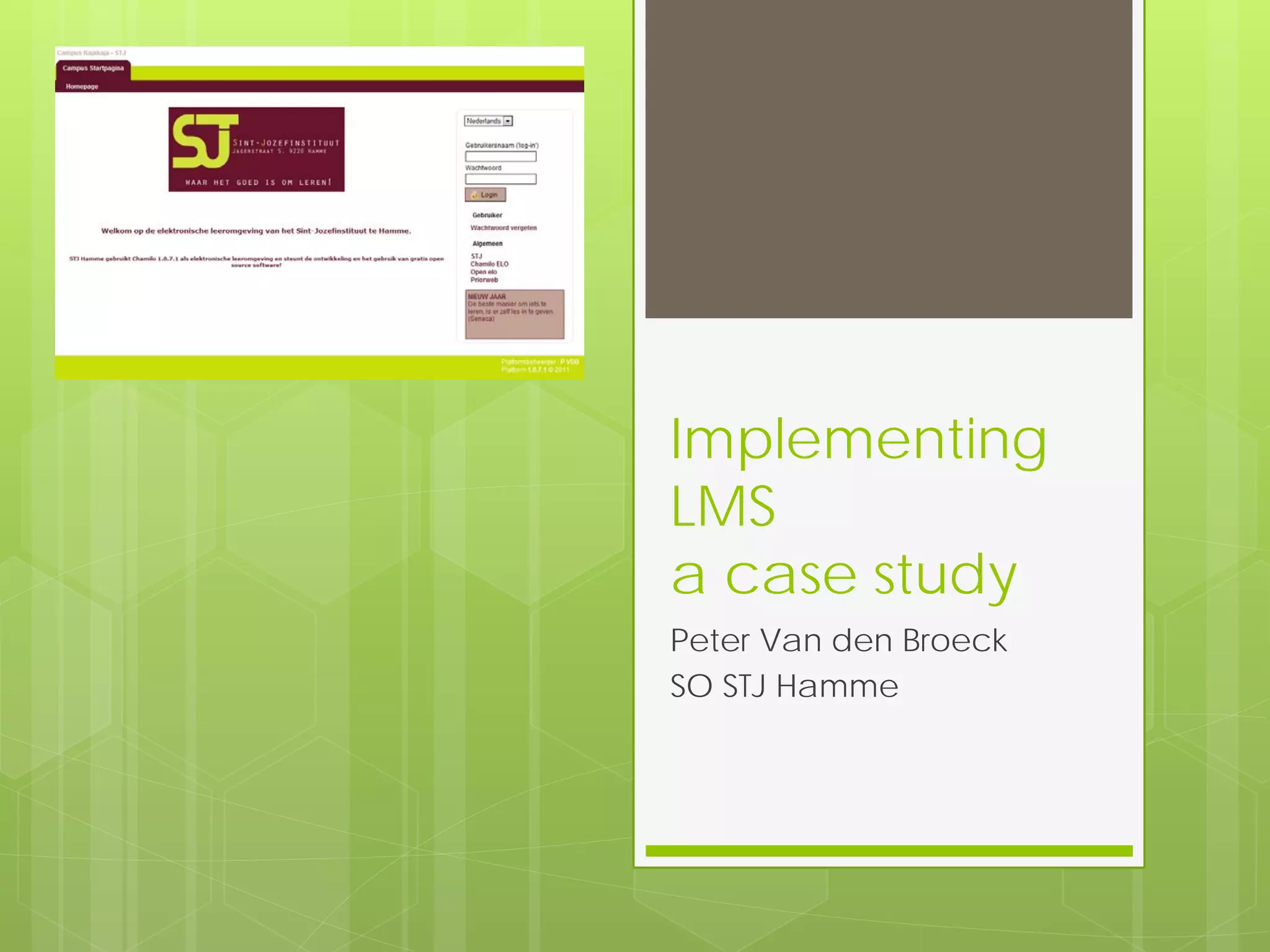
Implementing
LMS
a case study
Peter Van den Broeck
SO STJ Hamme
Peter Van den Broeck
 English/ Dutch Teacher
 Masters Degree Languages
 No IT-qualifications
 Platform manager of Kajakaja
 Kajakaja.be – Chamilo 1.8.7.1 with
  campus Plugin
STJ Hamme
 Secondary  school – years 3 to 6
  (vocational 7)
 ASO – technical – vocational
 364 students
 61 teachers


 Using   LMS since 2006
First steps…
 Introduction
             in April 2006
 Stephen Hargreaves – Working with
  Webquests
 Making a choice: Dokeos or Moodle
 Why D0ke0s?
     Expertise (trainee from HoWest – AUGent)
     Simple and clear layout
     (Partly) Belgian based – language support
      100%
Jura – Project D0ke0s

   Subdomain     schoolwebsite
   40 students
   1 teacher
   Positive experience
       Student motivation
       Participation community (wiki-tool pcool)
Level 1 – Sep 2006
 Separate  domain – hosted environment
  (kajakaja)
 Account for every student / teacher
 Choice of use was with teacher (no-
  obligation)
 5 teachers in 8 classes
 LIMITED SUCCESS
First push – Jan 2007
 Introduction   of ‘Mededelingen’ for
  teachers
     Weekly update
     All school related forms for download
     announcements
 Result:
        +30 passive users (teachers)
 PRACTICAL USE
Second push – Mar 2007
   Update to 1.8.x
   Series of hands-on sessions for interested
    teachers
   Results:
       5 -> 20 teachers who use courses for students
       60% of students have a login
       Math dpt starts its own cross curricular course
   DOWNSIDE: Flashy Fileserver
Some setbacks – Sep 2007
 AUGent     partnership project
     Free dokeos platform
     Centralized management
     Helpdesk
     Left the program after 14 days
 Failurein update to 1.8.4 -> reinstall from
  scratch
 Relaunch 3rd week of September
     Bad practice: teachers hand out account
      details
     Problems -> less teachers rely on platform
      hence less students get their account details
Revenge at hand – Jan 2008
  Introduction   ‘ leerlingenmededelingen’
  All students get login through administation
  Initiation by IT-teachers
  End Jan 95% have logged in at least once
  Stable active teacher usage 40%
  BUT: Flashy Fileserver, only 2 teachers use
   other modules
  Motivational setback: no real progress in 1,5
   years
Land ahoi – Mar 2008
 Campus     Plugin – Ludwig Theunis
 Amazing Tool
 Installation of 2nd testing Platform
     Test with selected group
 May: decision to implement -> total
  cleanup
 June: mandatory sessions to introduce
  new platform
Kajakaja 2.0 – Sep 2008
 Dokeos 1.8.5 + Campus Plugin
 New features:
    Timetable
    Journal based on timetable
    Students listings
    Reservations tool
A better way?
 Personalised   letters 1st day of school +
  mini-manual
 Voluntary school journal
 Mandatory for reservations
 Timetable changes: consult the platform
 AMAZING: by half Sep
    96% of students
    99% of teachers
STS – Jan 2009
 Student Tracking System
 Mandatory
 Learning disorders – Results – Behaviour
 RESULT
     More teachers become ‘active users’
     Links – documents – announcements
     Most popular: Journal - Listings
Open evaluation
 Positive   perception
 More up than down
 Split in IT and LMS
 STS is sole source information
 DOWN: first student hack
Year 2 2.0 – Sep 2009
 Same  procedures
 Active Day 3 of school year
 Massive course growth (DEPT courses)
 DOWN: 1 course -> several courses
 CLB Login
Jan – May 2010
 New   headmaster:
    Former Dokeos Platform Admin
    New blood
    Go Chamilo decision
    Limit course creation
    Cleanup
On hold – Sep 2010
 Start   schoolyear: Dokeos 186 + Campus
  1.4
     Mandatory school journal
     Precreated courses
     DB stability problems in webhosting (21.000
      tables)
 Oct   2010:
     decision migrate to VPS
     Decision upgrade to Chamilo
The move – Dec 2010
 Move   Dokeos 186 to VPS
    Problem: DB of 21.000 tables
    Rights management (webhosting sucks)
 Upgrade    to Chamilo
    Stable!
    Database bugs:
      Course  list
      Within courses
Chamilo – Jan 2011
 Introduction Jan 3rd
 Positive response to overall system
 Negative response
     Social network (exclusion)
     Currently unused again
IT admin – Mar 2011
 Added    new function
    Single tracking system for IT errors
    Positive response
Back to the future
 Downside      in usage:
     Fileserver
     Administrative platform
 Plans
       Hands  on session for different modules
       Online testing experiments
       Learning paths
Future for Chamilo
 Hopeful developments 2.0
 Plugin Code: integrated in full project
 More config options for Social network
 Mobile version
Question Time

Chamilo users day

  • 1.
    Implementing LMS a case study PeterVan den Broeck SO STJ Hamme
  • 2.
    Peter Van denBroeck  English/ Dutch Teacher  Masters Degree Languages  No IT-qualifications  Platform manager of Kajakaja  Kajakaja.be – Chamilo 1.8.7.1 with campus Plugin
  • 3.
    STJ Hamme  Secondary school – years 3 to 6 (vocational 7)  ASO – technical – vocational  364 students  61 teachers  Using LMS since 2006
  • 4.
    First steps…  Introduction in April 2006  Stephen Hargreaves – Working with Webquests  Making a choice: Dokeos or Moodle  Why D0ke0s?  Expertise (trainee from HoWest – AUGent)  Simple and clear layout  (Partly) Belgian based – language support 100%
  • 5.
    Jura – ProjectD0ke0s  Subdomain schoolwebsite  40 students  1 teacher  Positive experience  Student motivation  Participation community (wiki-tool pcool)
  • 6.
    Level 1 –Sep 2006  Separate domain – hosted environment (kajakaja)  Account for every student / teacher  Choice of use was with teacher (no- obligation)  5 teachers in 8 classes  LIMITED SUCCESS
  • 7.
    First push –Jan 2007  Introduction of ‘Mededelingen’ for teachers  Weekly update  All school related forms for download  announcements  Result: +30 passive users (teachers)  PRACTICAL USE
  • 8.
    Second push –Mar 2007  Update to 1.8.x  Series of hands-on sessions for interested teachers  Results:  5 -> 20 teachers who use courses for students  60% of students have a login  Math dpt starts its own cross curricular course  DOWNSIDE: Flashy Fileserver
  • 9.
    Some setbacks –Sep 2007  AUGent partnership project  Free dokeos platform  Centralized management  Helpdesk  Left the program after 14 days  Failurein update to 1.8.4 -> reinstall from scratch  Relaunch 3rd week of September  Bad practice: teachers hand out account details  Problems -> less teachers rely on platform hence less students get their account details
  • 10.
    Revenge at hand– Jan 2008  Introduction ‘ leerlingenmededelingen’  All students get login through administation  Initiation by IT-teachers  End Jan 95% have logged in at least once  Stable active teacher usage 40%  BUT: Flashy Fileserver, only 2 teachers use other modules  Motivational setback: no real progress in 1,5 years
  • 11.
    Land ahoi –Mar 2008  Campus Plugin – Ludwig Theunis  Amazing Tool  Installation of 2nd testing Platform  Test with selected group  May: decision to implement -> total cleanup  June: mandatory sessions to introduce new platform
  • 12.
    Kajakaja 2.0 –Sep 2008  Dokeos 1.8.5 + Campus Plugin  New features:  Timetable  Journal based on timetable  Students listings  Reservations tool
  • 13.
    A better way? Personalised letters 1st day of school + mini-manual  Voluntary school journal  Mandatory for reservations  Timetable changes: consult the platform  AMAZING: by half Sep  96% of students  99% of teachers
  • 14.
    STS – Jan2009  Student Tracking System  Mandatory  Learning disorders – Results – Behaviour  RESULT  More teachers become ‘active users’  Links – documents – announcements  Most popular: Journal - Listings
  • 15.
    Open evaluation  Positive perception  More up than down  Split in IT and LMS  STS is sole source information  DOWN: first student hack
  • 16.
    Year 2 2.0– Sep 2009  Same procedures  Active Day 3 of school year  Massive course growth (DEPT courses)  DOWN: 1 course -> several courses  CLB Login
  • 17.
    Jan – May2010  New headmaster:  Former Dokeos Platform Admin  New blood  Go Chamilo decision  Limit course creation  Cleanup
  • 18.
    On hold –Sep 2010  Start schoolyear: Dokeos 186 + Campus 1.4  Mandatory school journal  Precreated courses  DB stability problems in webhosting (21.000 tables)  Oct 2010:  decision migrate to VPS  Decision upgrade to Chamilo
  • 19.
    The move –Dec 2010  Move Dokeos 186 to VPS  Problem: DB of 21.000 tables  Rights management (webhosting sucks)  Upgrade to Chamilo  Stable!  Database bugs:  Course list  Within courses
  • 20.
    Chamilo – Jan2011  Introduction Jan 3rd  Positive response to overall system  Negative response  Social network (exclusion)  Currently unused again
  • 21.
    IT admin –Mar 2011  Added new function  Single tracking system for IT errors  Positive response
  • 22.
    Back to thefuture  Downside in usage:  Fileserver  Administrative platform  Plans  Hands on session for different modules  Online testing experiments  Learning paths
  • 23.
    Future for Chamilo Hopeful developments 2.0  Plugin Code: integrated in full project  More config options for Social network  Mobile version
  • 24.