Processing Phosphates
Experts in process design and material
processing for over 65 years.
Challenges in
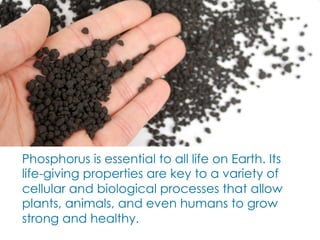
Phosphorus is essential to all life on Earth. Its
life-giving properties are key to a variety of
cellular and biological processes that allow
plants, animals, and even humans to grow
strong and healthy.
Just as with any mineral, phosphates can
present challenges during processing,
requiring careful planning and preparation
to ensure process efficiency and prolong
equipment life.
Just as with any mineral, phosphates can
present challenges during processing,
requiring careful planning and preparation
to ensure process efficiency and prolong
equipment life.
The following covers some of the key issues
processors face when working with
phosphates.
Material
Characteristics
Abrasiveness
Depending on what form they’re in,
phosphates can be anywhere from
mildly to extremely abrasive.
Abrasiveness
Depending on what form they’re in,
phosphates can be anywhere from
mildly to extremely abrasive.
Abrasiveness can pose problems to
unprotected equipment. Equipment
should be designed with this in mind.
Dusty
Phosphate products can also be
dusty, making for difficult handling.
This is especially true of phosphate
rock upon drying.  
Dusty
Phosphate products can also be
dusty, making for difficult handling.
This is especially true of phosphate
rock upon drying.
These fines are commonly collected in
a baghouse. And while difficult to
handle, the agglomeration of fines
offers opportunity to more easily
reintroduce fines to the process.
 
Corrosiveness
Corrosive agents are commonly added
during the production of phosphate
products.
Corrosiveness
Corrosive agents are commonly added
during the production of phosphate
products.
Phosphoric acid, the base of many
phosphate products, is highly corrosive.
Corrosiveness
Corrosive agents are commonly added
during the production of phosphate
products.
Phosphoric acid, the base of many
phosphate products, is highly corrosive.
Specialty alloys and linings on equipment
are often necessary to protect against
corrosion.
Clumping
Phosphate products can also be prone
to clumping and causing buildup, which
can clog equipment.
Clumping
Phosphate products can also be prone
to clumping and causing buildup, which
can clog equipment.
Modifications can be made to
counteract clumping, such as the
addition of knocking systems to
rotary dryers.
Variability
Phosphate deposits are extremely
diverse. From one deposit to the next,
and even within the same deposit,
phosphate ore differs greatly in makeup.
Variability
Phosphate deposits are extremely
diverse. From one deposit to the next,
and even within the same deposit,
phosphate ore differs greatly in makeup.
This means that a one-size-fits-all
approach to processing often does not fit
within the phosphates industry.
Contamination
Phosphate rock is sometimes found in the
presence of organics, rendering it
contaminated. As-is, the phosphate rock
is low value and not usable for many
applications.
Contamination
Phosphate rock is sometimes found in the
presence of organics, rendering it
contaminated. As-is, the phosphate rock
is low value and not usable for many
applications.
However, the phosphate ore can be
“upgraded” through calcination in a
rotary kiln.
Combatting Phosphate
Challenges
While challenges in phosphate processing
do exist, there are ways to combat them…
Testing
Feasibility/Pilot testing procedures are
often both necessary and desirable
when working with phosphates.
Testing helps to work out process
variables, providing a recipe for process
scale-up and equipment design.
From troubleshooting or improving an
existing process, to developing a new
process or product, testing is valuable in
all applications.
From troubleshooting or improving an
existing process, to developing a new
process or product, testing is valuable in
all applications.
Testing helps to minimize surprises after
scale-up by gathering important data
and gaining a familiarity with the unique
sample at hand.
This is especially true when upgrading
phosphate ore through calcination.
This is especially true when upgrading
phosphate ore through calcination.
Because phosphate deposits vary so
significantly, the time and temperature
profiles required to remove the organic
components often differ as well.
This is especially true when upgrading
phosphate ore through calcination.
Because phosphate deposits vary so
significantly, the time and temperature
profiles required to remove the organic
components often differ as well.
Testing in batch and pilot kilns allows for
these profiles to be developed in a test
environment.
High Quality Equipment
It may sound simple, but high quality
equipment is essential in maintaining
process efficiency and prolonging
equipment life.
High Quality Equipment
It may sound simple, but high quality
equipment is essential in maintaining
process efficiency and prolonging
equipment life.
For best results, equipment should be
designed around the unique
characteristics of the specific phosphate
material to be processed.
Conclusion
Although phosphates can present a number
of challenges to processors, they can be
overcome through careful planning and
preparation, including thorough testing, and
high quality equipment designed around
the sample at hand.
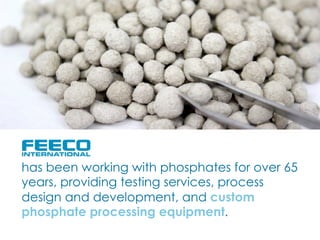
has been working with phosphates for over 65
years, providing testing services, process
design and development, and custom
phosphate processing equipment.
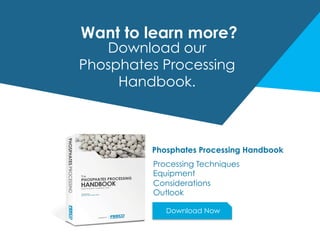
Want to learn more?
Download our
Phosphates Processing
Handbook.
Phosphates Processing Handbook
Processing Techniques
Equipment
Considerations
Outlook
Download Now

Challenges in Processing Phosphates

  • 1.
    Processing Phosphates Experts inprocess design and material processing for over 65 years. Challenges in
  • 2.
    Phosphorus is essentialto all life on Earth. Its life-giving properties are key to a variety of cellular and biological processes that allow plants, animals, and even humans to grow strong and healthy.
  • 3.
    Just as withany mineral, phosphates can present challenges during processing, requiring careful planning and preparation to ensure process efficiency and prolong equipment life.
  • 4.
    Just as withany mineral, phosphates can present challenges during processing, requiring careful planning and preparation to ensure process efficiency and prolong equipment life. The following covers some of the key issues processors face when working with phosphates.
  • 5.
  • 6.
    Abrasiveness Depending on whatform they’re in, phosphates can be anywhere from mildly to extremely abrasive.
  • 7.
    Abrasiveness Depending on whatform they’re in, phosphates can be anywhere from mildly to extremely abrasive. Abrasiveness can pose problems to unprotected equipment. Equipment should be designed with this in mind.
  • 8.
    Dusty Phosphate products canalso be dusty, making for difficult handling. This is especially true of phosphate rock upon drying.  
  • 9.
    Dusty Phosphate products canalso be dusty, making for difficult handling. This is especially true of phosphate rock upon drying. These fines are commonly collected in a baghouse. And while difficult to handle, the agglomeration of fines offers opportunity to more easily reintroduce fines to the process.  
  • 10.
    Corrosiveness Corrosive agents arecommonly added during the production of phosphate products.
  • 11.
    Corrosiveness Corrosive agents arecommonly added during the production of phosphate products. Phosphoric acid, the base of many phosphate products, is highly corrosive.
  • 12.
    Corrosiveness Corrosive agents arecommonly added during the production of phosphate products. Phosphoric acid, the base of many phosphate products, is highly corrosive. Specialty alloys and linings on equipment are often necessary to protect against corrosion.
  • 13.
    Clumping Phosphate products canalso be prone to clumping and causing buildup, which can clog equipment.
  • 14.
    Clumping Phosphate products canalso be prone to clumping and causing buildup, which can clog equipment. Modifications can be made to counteract clumping, such as the addition of knocking systems to rotary dryers.
  • 15.
    Variability Phosphate deposits areextremely diverse. From one deposit to the next, and even within the same deposit, phosphate ore differs greatly in makeup.
  • 16.
    Variability Phosphate deposits areextremely diverse. From one deposit to the next, and even within the same deposit, phosphate ore differs greatly in makeup. This means that a one-size-fits-all approach to processing often does not fit within the phosphates industry.
  • 17.
    Contamination Phosphate rock issometimes found in the presence of organics, rendering it contaminated. As-is, the phosphate rock is low value and not usable for many applications.
  • 18.
    Contamination Phosphate rock issometimes found in the presence of organics, rendering it contaminated. As-is, the phosphate rock is low value and not usable for many applications. However, the phosphate ore can be “upgraded” through calcination in a rotary kiln.
  • 19.
  • 20.
    While challenges inphosphate processing do exist, there are ways to combat them…
  • 21.
    Testing Feasibility/Pilot testing proceduresare often both necessary and desirable when working with phosphates. Testing helps to work out process variables, providing a recipe for process scale-up and equipment design.
  • 22.
    From troubleshooting orimproving an existing process, to developing a new process or product, testing is valuable in all applications.
  • 23.
    From troubleshooting orimproving an existing process, to developing a new process or product, testing is valuable in all applications. Testing helps to minimize surprises after scale-up by gathering important data and gaining a familiarity with the unique sample at hand.
  • 24.
    This is especiallytrue when upgrading phosphate ore through calcination.
  • 25.
    This is especiallytrue when upgrading phosphate ore through calcination. Because phosphate deposits vary so significantly, the time and temperature profiles required to remove the organic components often differ as well.
  • 26.
    This is especiallytrue when upgrading phosphate ore through calcination. Because phosphate deposits vary so significantly, the time and temperature profiles required to remove the organic components often differ as well. Testing in batch and pilot kilns allows for these profiles to be developed in a test environment.
  • 27.
    High Quality Equipment Itmay sound simple, but high quality equipment is essential in maintaining process efficiency and prolonging equipment life.
  • 28.
    High Quality Equipment Itmay sound simple, but high quality equipment is essential in maintaining process efficiency and prolonging equipment life. For best results, equipment should be designed around the unique characteristics of the specific phosphate material to be processed.
  • 29.
    Conclusion Although phosphates canpresent a number of challenges to processors, they can be overcome through careful planning and preparation, including thorough testing, and high quality equipment designed around the sample at hand.
  • 30.
    has been workingwith phosphates for over 65 years, providing testing services, process design and development, and custom phosphate processing equipment.
  • 31.
    Want to learnmore? Download our Phosphates Processing Handbook. Phosphates Processing Handbook Processing Techniques Equipment Considerations Outlook Download Now