

Challenges for our health
The Nurses Association of Jamaica (UK)
20th
October 2007
Cashain David
Ujima Health & Social Care
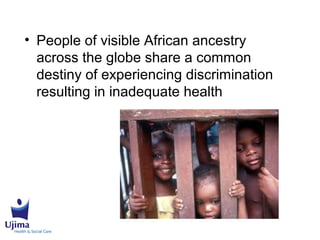
• People of visible African ancestry
across the globe share a common
destiny of experiencing discrimination
resulting in inadequate health
Images from the Diaspora
“Diaspora” is a biblical concept
traditionally employed to describe
the forced dispersion of Jews
amongst the Gentiles
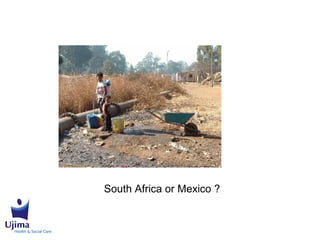
South Africa or Mexico ?
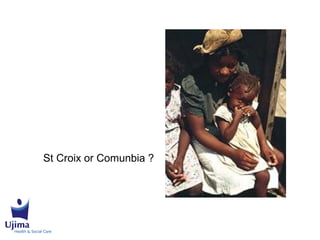
St Croix or Comunbia ?
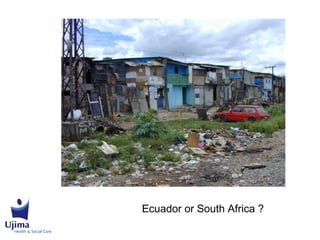
Ecuador or South Africa ?
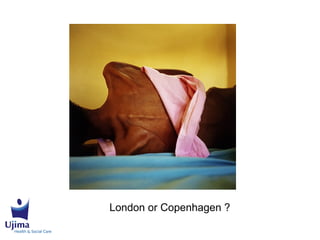
London or Copenhagen ?
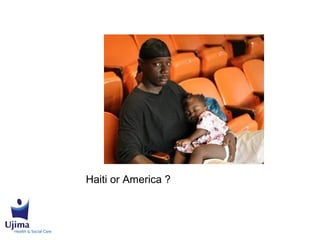
Haiti or America ?
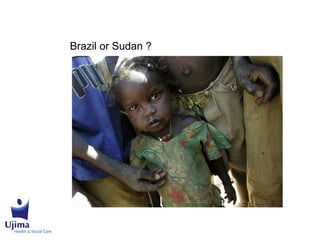
Brazil or Sudan ?
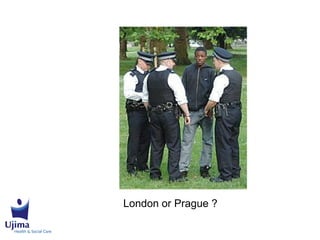
London or Prague ?
Italy or Grenada ?
A repeating pattern
• Black Americans are still more likely to
be poorer than whites
• Black people in UK live in the poorest
areas
• Afro-Ecuadorians live in dire poverty
• Brazil’s Black populations concentrated
in largely urban areas (Favelas)
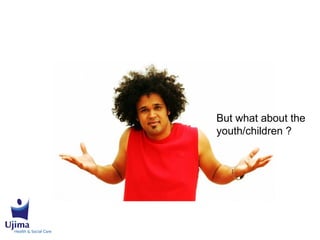
But what about the
youth/children ?
‘The threat to children and children’s
(health) is not video violence, but lack of
culture among role models in society’
Bengt Gorransson, Swedish Minister for Culture, 1982
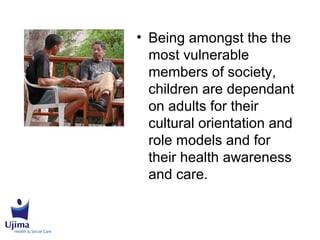
• Being amongst the the
most vulnerable
members of society,
children are dependant
on adults for their
cultural orientation and
role models and for
their health awareness
and care.
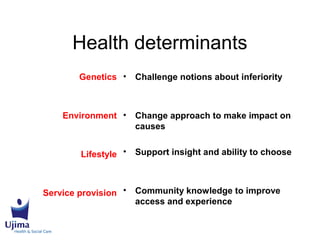
Health determinants
Genetics
Environment
Lifestyle
Service provision
• Challenge notions about inferiority
• Change approach to make impact on
causes
• Support insight and ability to choose
• Community knowledge to improve
access and experience
So what can we
do ?
If you want your eggs to
hatch, sit on them yourself.
Haitian proverb
12 pointers to health Black life
•Clinicians / Practitioners
•Commissioning / planning
•Parents and members of the
community
Haki Madhabuti
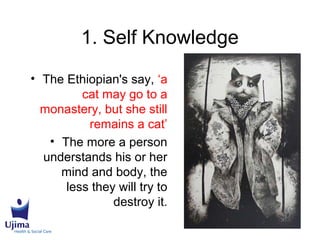
1. Self Knowledge
• The Ethiopian's say, ‘a
cat may go to a
monastery, but she still
remains a cat’
• The more a person
understands his or her
mind and body, the
less they will try to
destroy it.
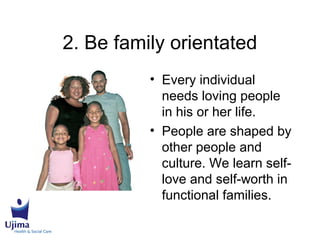
2. Be family orientated
• Every individual
needs loving people
in his or her life.
• People are shaped by
other people and
culture. We learn self-
love and self-worth in
functional families.
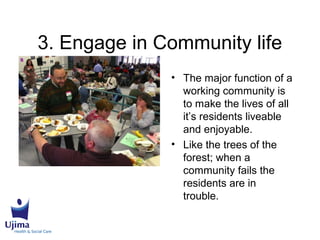
3. Engage in Community life
• The major function of a
working community is
to make the lives of all
it’s residents liveable
and enjoyable.
• Like the trees of the
forest; when a
community fails the
residents are in
trouble.
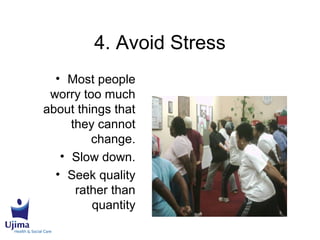
4. Avoid Stress
• Most people
worry too much
about things that
they cannot
change.
• Slow down.
• Seek quality
rather than
quantity
5. Develop critical thinking
• It has become easier to
believe than think.
• people who think
critically about the world
are doers, problem
solvers.
• They are always looking
for better answers.
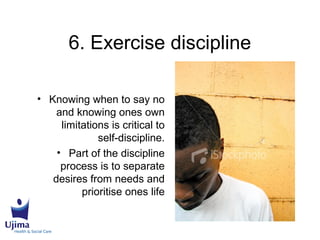
6. Exercise discipline
• Knowing when to say no
and knowing ones own
limitations is critical to
self-discipline.
• Part of the discipline
process is to separate
desires from needs and
prioritise ones life
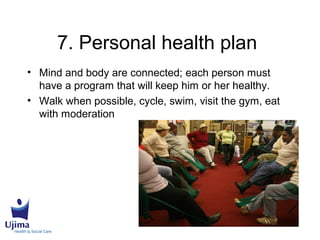
7. Personal health plan
• Mind and body are connected; each person must
have a program that will keep him or her healthy.
• Walk when possible, cycle, swim, visit the gym, eat
with moderation
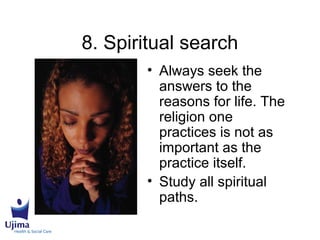
8. Spiritual search
• Always seek the
answers to the
reasons for life. The
religion one
practices is not as
important as the
practice itself.
• Study all spiritual
paths.
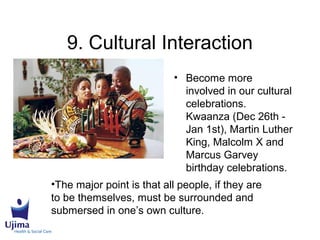
9. Cultural Interaction
• Become more
involved in our cultural
celebrations.
Kwaanza (Dec 26th -
Jan 1st), Martin Luther
King, Malcolm X and
Marcus Garvey
birthday celebrations.
•The major point is that all people, if they are
to be themselves, must be surrounded and
submersed in one’s own culture.
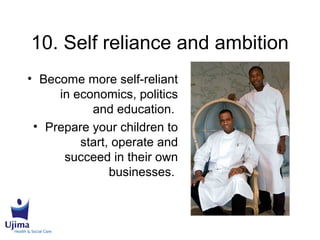
10. Self reliance and ambition
• Become more self-reliant
in economics, politics
and education.
• Prepare your children to
start, operate and
succeed in their own
businesses.
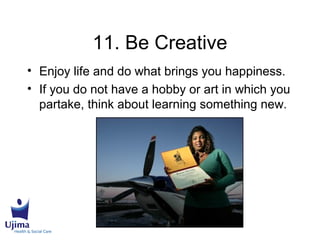
11. Be Creative
• Enjoy life and do what brings you happiness.
• If you do not have a hobby or art in which you
partake, think about learning something new.
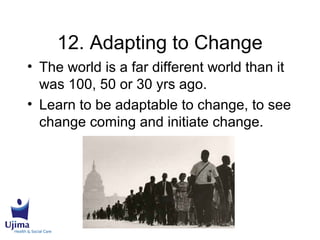
12. Adapting to Change
• The world is a far different world than it
was 100, 50 or 30 yrs ago.
• Learn to be adaptable to change, to see
change coming and initiate change.
Thank you
cashain.david@ujima.org.
uk
http://www.ujimagroup.org.uk/

Challenges for our health

  • 1.
    Challenges for ourhealth The Nurses Association of Jamaica (UK) 20th October 2007 Cashain David Ujima Health & Social Care
  • 2.
    • People ofvisible African ancestry across the globe share a common destiny of experiencing discrimination resulting in inadequate health
  • 3.
    Images from theDiaspora “Diaspora” is a biblical concept traditionally employed to describe the forced dispersion of Jews amongst the Gentiles
  • 4.
  • 5.
    St Croix orComunbia ?
  • 6.
  • 7.
  • 8.
  • 9.
  • 10.
  • 11.
  • 12.
    A repeating pattern •Black Americans are still more likely to be poorer than whites • Black people in UK live in the poorest areas • Afro-Ecuadorians live in dire poverty • Brazil’s Black populations concentrated in largely urban areas (Favelas)
  • 13.
    But what aboutthe youth/children ?
  • 14.
    ‘The threat tochildren and children’s (health) is not video violence, but lack of culture among role models in society’ Bengt Gorransson, Swedish Minister for Culture, 1982
  • 15.
    • Being amongstthe the most vulnerable members of society, children are dependant on adults for their cultural orientation and role models and for their health awareness and care.
  • 16.
    Health determinants Genetics Environment Lifestyle Service provision •Challenge notions about inferiority • Change approach to make impact on causes • Support insight and ability to choose • Community knowledge to improve access and experience
  • 17.
    So what canwe do ?
  • 18.
    If you wantyour eggs to hatch, sit on them yourself. Haitian proverb
  • 19.
    12 pointers tohealth Black life •Clinicians / Practitioners •Commissioning / planning •Parents and members of the community Haki Madhabuti
  • 20.
    1. Self Knowledge •The Ethiopian's say, ‘a cat may go to a monastery, but she still remains a cat’ • The more a person understands his or her mind and body, the less they will try to destroy it.
  • 21.
    2. Be familyorientated • Every individual needs loving people in his or her life. • People are shaped by other people and culture. We learn self- love and self-worth in functional families.
  • 22.
    3. Engage inCommunity life • The major function of a working community is to make the lives of all it’s residents liveable and enjoyable. • Like the trees of the forest; when a community fails the residents are in trouble.
  • 23.
    4. Avoid Stress •Most people worry too much about things that they cannot change. • Slow down. • Seek quality rather than quantity
  • 24.
    5. Develop criticalthinking • It has become easier to believe than think. • people who think critically about the world are doers, problem solvers. • They are always looking for better answers.
  • 25.
    6. Exercise discipline •Knowing when to say no and knowing ones own limitations is critical to self-discipline. • Part of the discipline process is to separate desires from needs and prioritise ones life
  • 26.
    7. Personal healthplan • Mind and body are connected; each person must have a program that will keep him or her healthy. • Walk when possible, cycle, swim, visit the gym, eat with moderation
  • 27.
    8. Spiritual search •Always seek the answers to the reasons for life. The religion one practices is not as important as the practice itself. • Study all spiritual paths.
  • 28.
    9. Cultural Interaction •Become more involved in our cultural celebrations. Kwaanza (Dec 26th - Jan 1st), Martin Luther King, Malcolm X and Marcus Garvey birthday celebrations. •The major point is that all people, if they are to be themselves, must be surrounded and submersed in one’s own culture.
  • 29.
    10. Self relianceand ambition • Become more self-reliant in economics, politics and education. • Prepare your children to start, operate and succeed in their own businesses.
  • 30.
    11. Be Creative •Enjoy life and do what brings you happiness. • If you do not have a hobby or art in which you partake, think about learning something new.
  • 31.
    12. Adapting toChange • The world is a far different world than it was 100, 50 or 30 yrs ago. • Learn to be adaptable to change, to see change coming and initiate change.
  • 32.