LEARNING
TOGETHER IN SEA
TO SKY
“For over a century, the central goals of Canada’s Aboriginal policy were to
eliminate Aboriginal governments; ignore Aboriginal rights; terminate the
Treaties; and, through a process of assimilation, cause Aboriginal peoples to
cease to exist as distinct legal, social, cultural, religious, and racial entities in
Canada. The establishment and operation of residential schools were a central
element of this policy, which can best be described as “cultural genocide.””
Honouring the Truth, Reconciling the Future
Summary of the Final Report of the Truth and Reconciliation Commission Canada
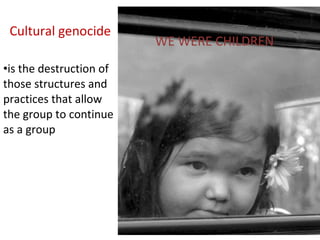
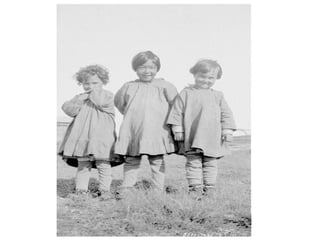
WE WERE CHILDREN
Cultural genocide
•is the destruction of
those structures and
practices that allow
the group to continue
as a group
A BRIEF HISTORY OF FIRST NATIONS COLONIZATION AND IMPACTS
10 000 years ago- Aboriginal Peoples lived in BC, among them myriad bands and
tribes, each with their own rich cultural and spiritual practices, and different
languages. Despite a traumatic recent history, these bands and nations remain an
active part of the BC landscape.
Colonization:
Mid 1700’s- 1763 – European explorers arrive and begin to establish claims
1820- King George III recognizes Aboriginal rights and title to land through the
Royal Proclamation. However, the new settlers are given
permission to colonize and purchase First Nations lands.
1830- Industrial and residential school system opened and run by Christian
churches Indian Reservation System created reserves set
aside for “Indians” to live on. Both the residential school systems and reserve
systems are created with the intention to civilize and Christianize Indians.
1867- Indian Act is created as a policy that focuses on the assimilation of
Aboriginals into society. The Enfranchisement Act of 1867
1923- Aboriginal children are legally enforced to attend residential and industrial
schools. Children are forced to renounce their language, cultural practices and
beliefs, and any connection to Aboriginal way of life.
1927- Indian Act is revised to ban any Indian political organization or financing
without government approval. The revision also legally
bans Aboriginal spiritual and cultural ceremonies and activities.
1951- Ban on Aboriginal ceremonies lifted
1960- Aboriginal men can vote in federal elections
1982- Government affirmation of Aboriginal land and treaty rights
1996- Royal Commission on Aboriginal Peoples (examination of historical and
contemporary aboriginal & European relations. Last Indian Residential School in
Canada closed (in BC last one closed in 1984).
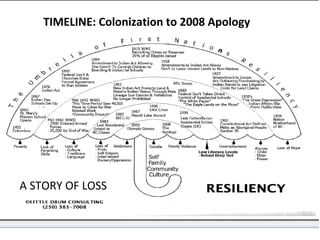
TIMELINE: Colonization to 2008 Apology
A STORY OF LOSS
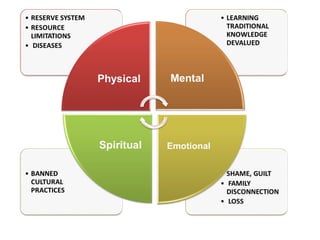
IMPACTS
Physical
• Reserve system created resource limitation
• Diseases and alcohol were introduced creating health and
addiction issues
• Communities became childless-segregation and isolation
• Appearance changed (clothing, hair)
• Change to “nuclear” family dwellings
(opposed to communal living)
• Rampant physical and sexual abuse in residential schools
Emotional
• Traditional values changed- language changed
• Family disconnection
• Shame and guilt for being “savages” i.e. not civilized
• Feelings of not belonging, depression, anger
• Life purpose lost
Mental
• Approach to learning changed- residential schools
• Governance structure changed (no political voice)
• Traditional knowledge discouraged and devalued
• Family roles changed,
• Family history and connections lost
Spiritual
• Banned ceremonies, feasts, dancing
• Christian beliefs and values imposed
• Separation from each other and the land
• Prayer became secret or Christian
• Loss of traditional cultural understanding,
beliefs, knowledge
ONGOING IMPACTS
•As a result, First Nations communities have a higher rate
ofsuicide (6 X higher than mainstream society)
•Addictions, health problems, diabetes (3 X higher)
•Unemployment, illiteracy, high school drop out
(63 % do not graduate)
•Domestic abuse, violence and sexual abuse
(3-6 X higher).
While continuing to live through the impacts of trauma,
Aboriginal people endure racism, external and internalized
oppression, which contributes to further alienation.
This information was gathered from the following websites and publications:
http://www.wherearethechildren.ca
http://www.irsss.ca
“Working With First Nations Communities” Workshop Manual. Hulitan Social Services. www.hulitan.com
•This act gave legal power to the Canadian government to
control the lives of First Nations (& Inuit)
•The Indian Act refers to First Nations people as “Indians” to this
day
•Metis were not recognized as a distinct group of people, and
therefore had no provisions under this act
The Indian Act 1876
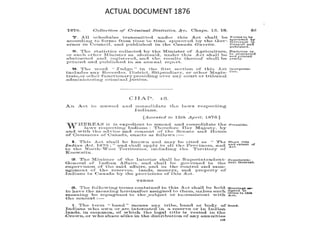
ACTUAL DOCUMENT 1876
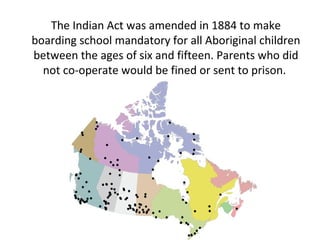
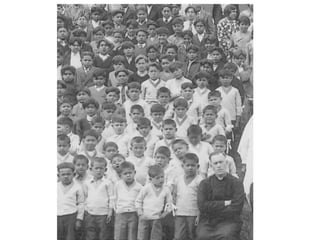
The Indian Act was amended in 1884 to make
boarding school mandatory for all Aboriginal children
between the ages of six and fifteen. Parents who did
not co-operate would be fined or sent to prison.
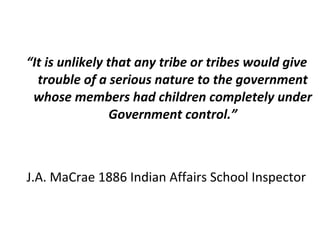
“It is unlikely that any tribe or tribes would give
trouble of a serious nature to the government
whose members had children completely under
Government control.”
J.A. MaCrae 1886 Indian Affairs School Inspector
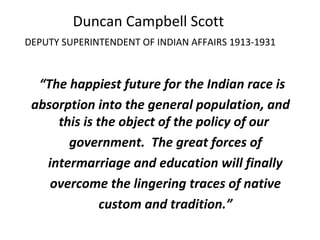
“The happiest future for the Indian race is
absorption into the general population, and
this is the object of the policy of our
government. The great forces of
intermarriage and education will finally
overcome the lingering traces of native
custom and tradition.”
Duncan Campbell Scott
DEPUTY SUPERINTENDENT OF INDIAN AFFAIRS 1913-1931
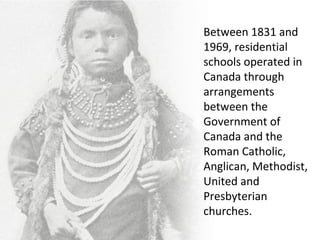
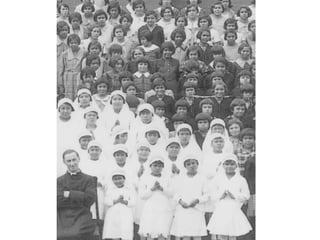
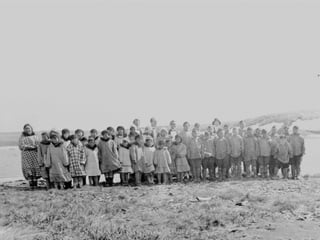
Between 1831 and
1969, residential
schools operated in
Canada through
arrangements
between the
Government of
Canada and the
Roman Catholic,
Anglican, Methodist,
United and
Presbyterian
churches.
.
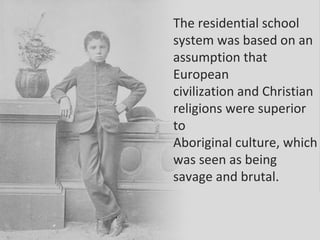
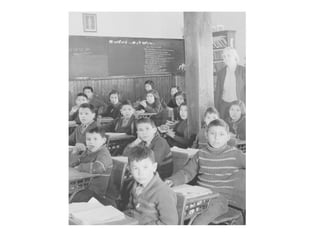
The residential school
system was based on an
assumption that
European
civilization and Christian
religions were superior
to
Aboriginal culture, which
was seen as being
savage and brutal.
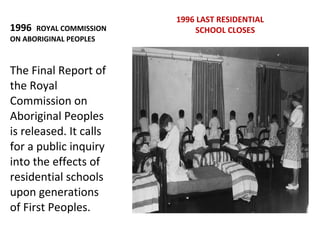
1996 LAST RESIDENTIAL
SCHOOL CLOSES1996 ROYAL COMMISSION
ON ABORIGINAL PEOPLES
The Final Report of
the Royal
Commission on
Aboriginal Peoples
is released. It calls
for a public inquiry
into the effects of
residential schools
upon generations
of First Peoples.
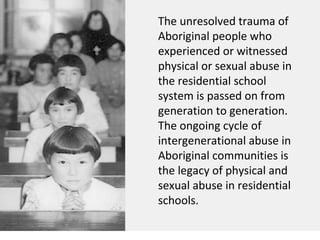
The unresolved trauma of
Aboriginal people who
experienced or witnessed
physical or sexual abuse in
the residential school
system is passed on from
generation to generation.
The ongoing cycle of
intergenerational abuse in
Aboriginal communities is
the legacy of physical and
sexual abuse in residential
schools.
.
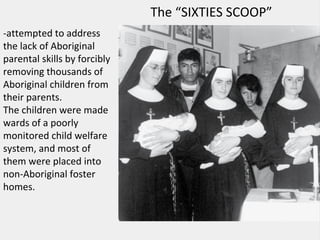
-attempted to address
the lack of Aboriginal
parental skills by forcibly
removing thousands of
Aboriginal children from
their parents.
The children were made
wards of a poorly
monitored child welfare
system, and most of
them were placed into
non-Aboriginal foster
homes.
The “SIXTIES SCOOP”
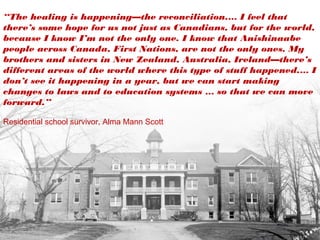
“The healing is happening—the reconciliation.… I feel that
there’s some hope for us not just as Canadians, but for the world,
because I know I’m not the only one. I know that Anishinaabe
people across Canada, First Nations, are not the only ones. My
brothers and sisters in New Zealand, Australia, Ireland—there’s
different areas of the world where this type of stuff happened.… I
don’t see it happening in a year, but we can start making
changes to laws and to education systems … so that we can move
forward.”
Residential school survivor, Alma Mann Scott
Reconciliation
Reconciliation is about establishing and
maintaining a mutually respectful
relationship between Aboriginal and non-
Aboriginal peoples in this country. In order
for that to happen, there has to be
awareness of the past, acknowledgement
of the harm that has been inflicted,
atonement for the causes, and action to
change behaviour.
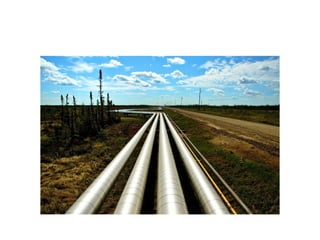
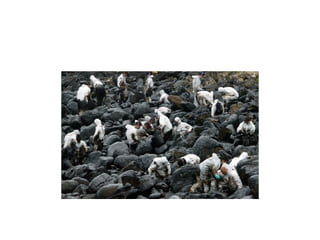
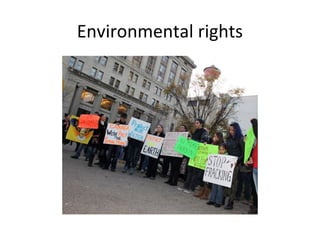
Environmental rights
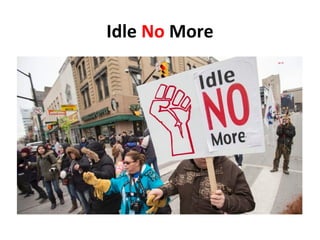
Idle No More
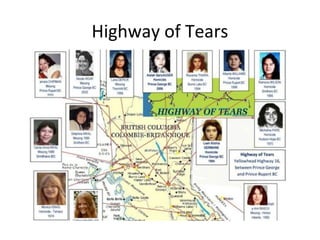
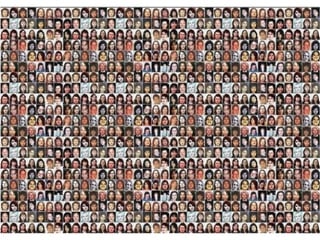
Highway of Tears
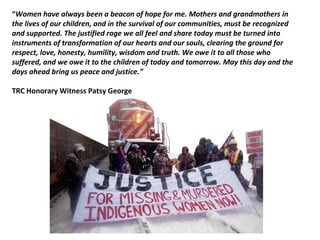
“Women have always been a beacon of hope for me. Mothers and grandmothers in
the lives of our children, and in the survival of our communities, must be recognized
and supported. The justified rage we all feel and share today must be turned into
instruments of transformation of our hearts and our souls, clearing the ground for
respect, love, honesty, humility, wisdom and truth. We owe it to all those who
suffered, and we owe it to the children of today and tomorrow. May this day and the
days ahead bring us peace and justice.”
TRC Honorary Witness Patsy George
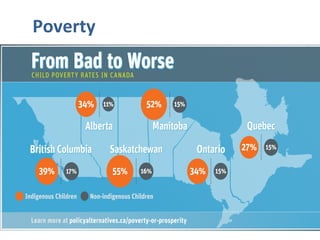
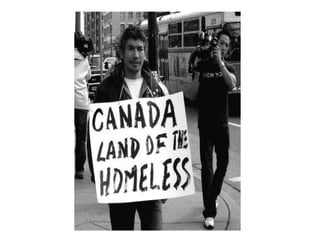
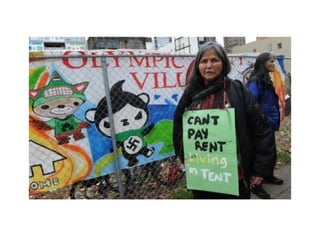
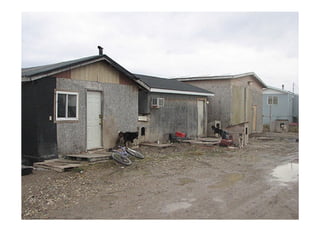
Poverty
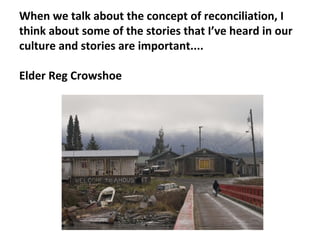
When we talk about the concept of reconciliation, I
think about some of the stories that I’ve heard in our
culture and stories are important....
Elder Reg Crowshoe
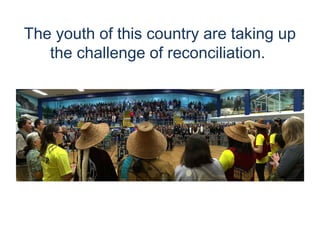
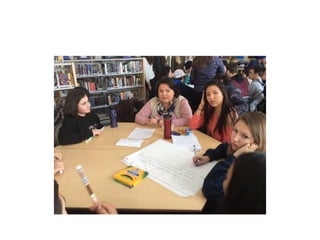
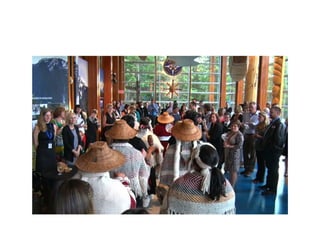
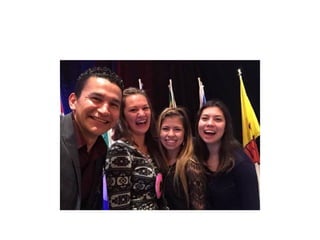
The youth of this country are taking up
the challenge of reconciliation.
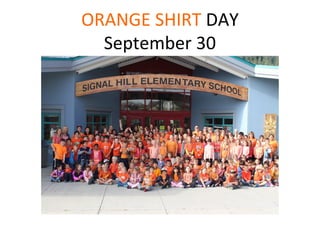
ORANGE SHIRT DAY
September 30
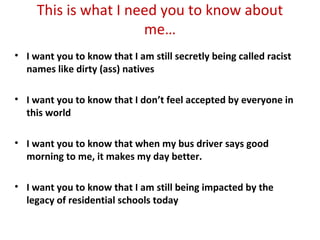
This is what I need you to know about
me…
• I want you to know that I am still secretly being called racist
names like dirty (ass) natives
• I want you to know that I don’t feel accepted by everyone in
this world
• I want you to know that when my bus driver says good
morning to me, it makes my day better.
• I want you to know that I am still being impacted by the
legacy of residential schools today
This is what I want you to know about me….
•I want you to know that I don’t feel safe riding the bus
•I want you to know that I can’t afford school events
•I want you to know that I don’t like to be put on the spot and
forced to speak up in class
•I want you to know that residential school survivors pass on
their anger and sorrow to their kids
•I want you to know that I hide my sadness from everyone at
school everyday

SD48 Implementation Day 2015

  • 1.
    LEARNING TOGETHER IN SEA TOSKY “For over a century, the central goals of Canada’s Aboriginal policy were to eliminate Aboriginal governments; ignore Aboriginal rights; terminate the Treaties; and, through a process of assimilation, cause Aboriginal peoples to cease to exist as distinct legal, social, cultural, religious, and racial entities in Canada. The establishment and operation of residential schools were a central element of this policy, which can best be described as “cultural genocide.”” Honouring the Truth, Reconciling the Future Summary of the Final Report of the Truth and Reconciliation Commission Canada
  • 2.
    WE WERE CHILDREN Culturalgenocide •is the destruction of those structures and practices that allow the group to continue as a group
  • 3.
    A BRIEF HISTORYOF FIRST NATIONS COLONIZATION AND IMPACTS 10 000 years ago- Aboriginal Peoples lived in BC, among them myriad bands and tribes, each with their own rich cultural and spiritual practices, and different languages. Despite a traumatic recent history, these bands and nations remain an active part of the BC landscape. Colonization: Mid 1700’s- 1763 – European explorers arrive and begin to establish claims 1820- King George III recognizes Aboriginal rights and title to land through the Royal Proclamation. However, the new settlers are given permission to colonize and purchase First Nations lands. 1830- Industrial and residential school system opened and run by Christian churches Indian Reservation System created reserves set aside for “Indians” to live on. Both the residential school systems and reserve systems are created with the intention to civilize and Christianize Indians. 1867- Indian Act is created as a policy that focuses on the assimilation of Aboriginals into society. The Enfranchisement Act of 1867
  • 4.
    1923- Aboriginal childrenare legally enforced to attend residential and industrial schools. Children are forced to renounce their language, cultural practices and beliefs, and any connection to Aboriginal way of life. 1927- Indian Act is revised to ban any Indian political organization or financing without government approval. The revision also legally bans Aboriginal spiritual and cultural ceremonies and activities. 1951- Ban on Aboriginal ceremonies lifted 1960- Aboriginal men can vote in federal elections 1982- Government affirmation of Aboriginal land and treaty rights 1996- Royal Commission on Aboriginal Peoples (examination of historical and contemporary aboriginal & European relations. Last Indian Residential School in Canada closed (in BC last one closed in 1984).
  • 5.
    TIMELINE: Colonization to2008 Apology A STORY OF LOSS
  • 7.
    IMPACTS Physical • Reserve systemcreated resource limitation • Diseases and alcohol were introduced creating health and addiction issues • Communities became childless-segregation and isolation • Appearance changed (clothing, hair) • Change to “nuclear” family dwellings (opposed to communal living) • Rampant physical and sexual abuse in residential schools Emotional • Traditional values changed- language changed • Family disconnection • Shame and guilt for being “savages” i.e. not civilized • Feelings of not belonging, depression, anger • Life purpose lost
  • 8.
    Mental • Approach tolearning changed- residential schools • Governance structure changed (no political voice) • Traditional knowledge discouraged and devalued • Family roles changed, • Family history and connections lost Spiritual • Banned ceremonies, feasts, dancing • Christian beliefs and values imposed • Separation from each other and the land • Prayer became secret or Christian • Loss of traditional cultural understanding, beliefs, knowledge
  • 9.
    ONGOING IMPACTS •As aresult, First Nations communities have a higher rate ofsuicide (6 X higher than mainstream society) •Addictions, health problems, diabetes (3 X higher) •Unemployment, illiteracy, high school drop out (63 % do not graduate) •Domestic abuse, violence and sexual abuse (3-6 X higher). While continuing to live through the impacts of trauma, Aboriginal people endure racism, external and internalized oppression, which contributes to further alienation. This information was gathered from the following websites and publications: http://www.wherearethechildren.ca http://www.irsss.ca “Working With First Nations Communities” Workshop Manual. Hulitan Social Services. www.hulitan.com
  • 10.
    •This act gavelegal power to the Canadian government to control the lives of First Nations (& Inuit) •The Indian Act refers to First Nations people as “Indians” to this day •Metis were not recognized as a distinct group of people, and therefore had no provisions under this act The Indian Act 1876
  • 11.
  • 12.
    The Indian Actwas amended in 1884 to make boarding school mandatory for all Aboriginal children between the ages of six and fifteen. Parents who did not co-operate would be fined or sent to prison.
  • 13.
    “It is unlikelythat any tribe or tribes would give trouble of a serious nature to the government whose members had children completely under Government control.” J.A. MaCrae 1886 Indian Affairs School Inspector
  • 14.
    “The happiest futurefor the Indian race is absorption into the general population, and this is the object of the policy of our government. The great forces of intermarriage and education will finally overcome the lingering traces of native custom and tradition.” Duncan Campbell Scott DEPUTY SUPERINTENDENT OF INDIAN AFFAIRS 1913-1931
  • 15.
    Between 1831 and 1969,residential schools operated in Canada through arrangements between the Government of Canada and the Roman Catholic, Anglican, Methodist, United and Presbyterian churches.
  • 16.
    . The residential school systemwas based on an assumption that European civilization and Christian religions were superior to Aboriginal culture, which was seen as being savage and brutal.
  • 18.
    1996 LAST RESIDENTIAL SCHOOLCLOSES1996 ROYAL COMMISSION ON ABORIGINAL PEOPLES The Final Report of the Royal Commission on Aboriginal Peoples is released. It calls for a public inquiry into the effects of residential schools upon generations of First Peoples.
  • 19.
    The unresolved traumaof Aboriginal people who experienced or witnessed physical or sexual abuse in the residential school system is passed on from generation to generation. The ongoing cycle of intergenerational abuse in Aboriginal communities is the legacy of physical and sexual abuse in residential schools.
  • 22.
  • 24.
    -attempted to address thelack of Aboriginal parental skills by forcibly removing thousands of Aboriginal children from their parents. The children were made wards of a poorly monitored child welfare system, and most of them were placed into non-Aboriginal foster homes. The “SIXTIES SCOOP”
  • 25.
    “The healing ishappening—the reconciliation.… I feel that there’s some hope for us not just as Canadians, but for the world, because I know I’m not the only one. I know that Anishinaabe people across Canada, First Nations, are not the only ones. My brothers and sisters in New Zealand, Australia, Ireland—there’s different areas of the world where this type of stuff happened.… I don’t see it happening in a year, but we can start making changes to laws and to education systems … so that we can move forward.” Residential school survivor, Alma Mann Scott
  • 26.
    Reconciliation Reconciliation is aboutestablishing and maintaining a mutually respectful relationship between Aboriginal and non- Aboriginal peoples in this country. In order for that to happen, there has to be awareness of the past, acknowledgement of the harm that has been inflicted, atonement for the causes, and action to change behaviour.
  • 30.
  • 31.
  • 32.
  • 33.
    “Women have alwaysbeen a beacon of hope for me. Mothers and grandmothers in the lives of our children, and in the survival of our communities, must be recognized and supported. The justified rage we all feel and share today must be turned into instruments of transformation of our hearts and our souls, clearing the ground for respect, love, honesty, humility, wisdom and truth. We owe it to all those who suffered, and we owe it to the children of today and tomorrow. May this day and the days ahead bring us peace and justice.” TRC Honorary Witness Patsy George
  • 35.
  • 39.
    When we talkabout the concept of reconciliation, I think about some of the stories that I’ve heard in our culture and stories are important.... Elder Reg Crowshoe
  • 40.
    The youth ofthis country are taking up the challenge of reconciliation.
  • 47.
  • 48.
    This is whatI need you to know about me… • I want you to know that I am still secretly being called racist names like dirty (ass) natives • I want you to know that I don’t feel accepted by everyone in this world • I want you to know that when my bus driver says good morning to me, it makes my day better. • I want you to know that I am still being impacted by the legacy of residential schools today
  • 49.
    This is whatI want you to know about me…. •I want you to know that I don’t feel safe riding the bus •I want you to know that I can’t afford school events •I want you to know that I don’t like to be put on the spot and forced to speak up in class •I want you to know that residential school survivors pass on their anger and sorrow to their kids •I want you to know that I hide my sadness from everyone at school everyday

Editor's Notes

  • #16 1620-1629: First missionary-operated boarding school Quebec City 1620-1629 under auspices of Récollets an order of Franciscans who took in boys for their seminary. Referenced in J.R. Miller’s Shingwauk’s Vision. 1892: Federal Government and churches enter into formal partnership in the operation of Indian Schools Regina Industrial School – considered by some “one of the most successful schools in Canadian west.” Controversial - Debates in House of Commons – opposition criticized spending on schools. Minister argues schools never intended to “turn Indian pupils out to complete with whites.” Eventual shift from skilled trades to agricultural training and housekeeping. Debates in the house include various archival documents. The quote “the schools never intended to turn Indian pupils out to compete with whites” can be found in a memorandum to the Deputy Superintendent General dated October 3, 1904 – Indian Affairs (RG10, vol. 6001, File 1-1-1, part 1school files) (as cited in Deiter 1999). Deiter, Constance. (1999). From Our Mothers' Arms: The Intergenerational Impact of Residential Schools in Saskatchewan. Toronto: United Church Publishing House.   Eleanor Brass (1989) p. 8 “In 1895 a printing office was opened at the school and an instructor engaged for four months, after which two boys who had had previous experience in typesetting took complete charge. The school started a newspaper, a twelve-page semi-monthly, which had five hundred subscribers that year and fifty exchanges in the United States and Canada. Two boys from the printing office later worked for the Regina Standard and the Regina Leader while one became an editor for a Chicago newspaper.” Brass, E. (1987). I Walk in Two Worlds. Calgary: Glenbow Museum.
  • #17 Government of Canada (1920:63). Report of the Special Committee of the House of Commons examining the Indian Act amendments of 1920 (Duncan Campbell Scott testimony on 30 March 1920). Library and Archives Canada, RG10, volume 6810, file 470-2-3, part 7. 1844 Bagot Commission report – recommends agriculture-based boarding schools, situated far from parental influence
  • #24 1857: Gradual Civilization Act called for “All Indians to be civilized” 1876: Indian Act established right to govern over Aboriginal peoples Homestead Act set treaty-making process in motion in the west Education – A treaty obligation Government funding of Aboriginal education is a legal obligation negotiated in Treaty. Aboriginal people wanted access to education for their children, to afford them the opportunity to participate in mainstream society. 1879: Nicholas Flood Davin met with U.S. Dept of Indian Affairs to learn about “aggressive assimilation” policy. Davin report recommends industrial boarding schools situated far from reserves. Began Industrial School System
  • #26 Since 1971, Blue Quills First Nations College (BQFNC) has been a locally controlled Indigenous education centre serving the academic and training needs of people of all cultures, encouraging everyone to experience studying in a unique socio-cultural and academic environment. As an Indigenous non-profit educational institution, a prime objective is to promote a sense of pride in Indigenous heritage and reclaim traditional knowledge and practices. Blue Quills is governed by seven appointed Board members, each representing one of the seven local First Nations communities: Beaver Lake, Cold Lake, Frog Lake, Whitefish Lake, Heart Lake, Kehewin, and Saddle Lake, plus one Elder from the Saddle Lake First Nation. These communities represent almost 17,500 people. http://www.bluequills.ca/our_history.htm On April 1st, 1969 the government assumed complete administrative control over Gordon’s School and all remaining Anglican support staff were transferred to federal payroll. As a result of building additions made in recent years, and the difficulty in placing residential students in elementary day schools (native or municipal), Gordon’s continued to serve as a residential school until 1996, when it was finally closed by Ottawa and torn down. 1996 Government closes student hostel at Gordon’s and main building is demolished. Compiled by General Synod Archives, September 23, 2008. http://www.anglican.ca/relationships/trc/histories/gordons-school-punnichy/