CHALLENGE OF COMPLEXITY: 
RETHINKING APPROACHES 
Dahle Suggett
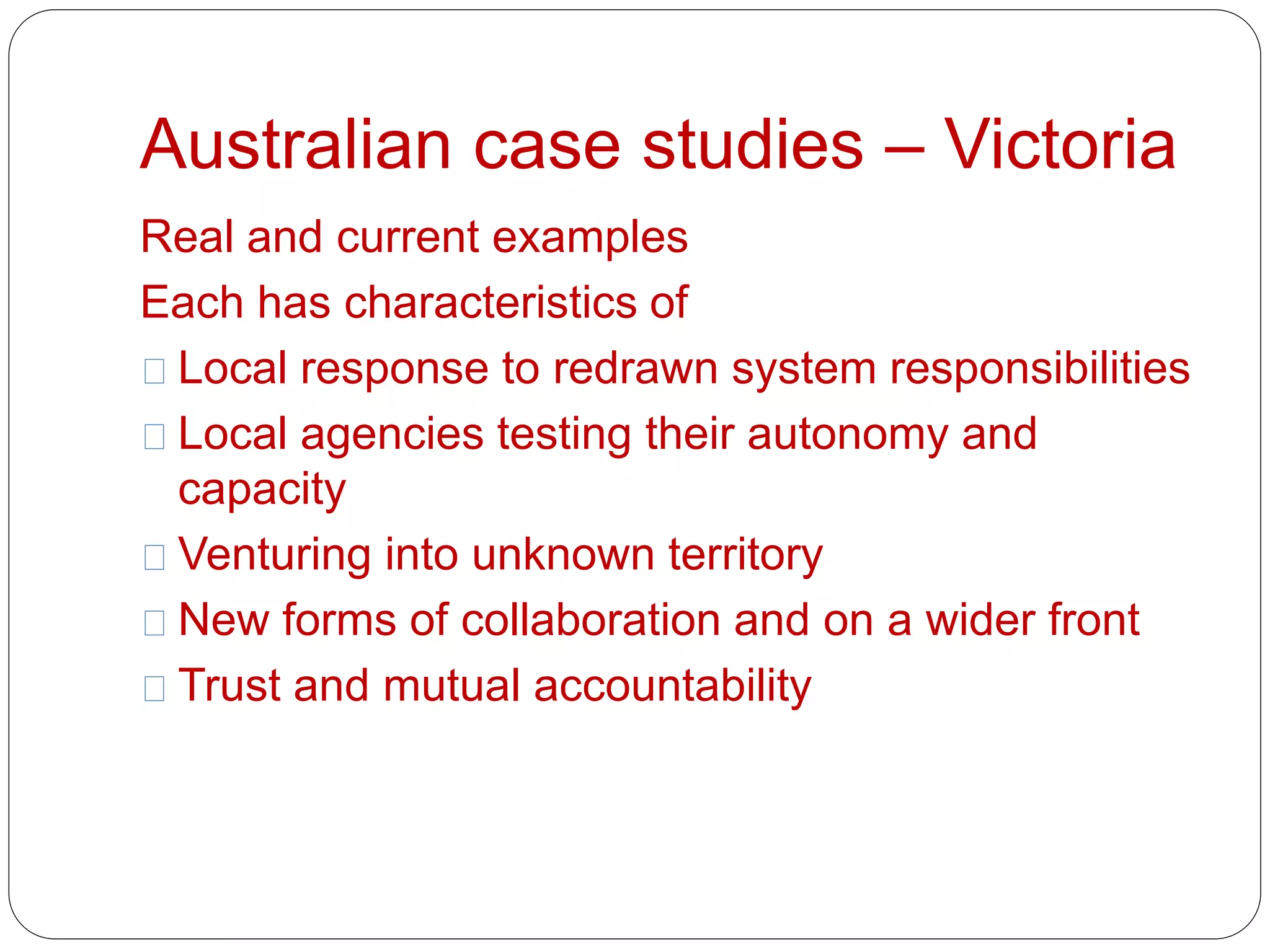
Australian case studies – Victoria 
Real and current examples 
Each has characteristics of 
Local response to redrawn system responsibilities 
Local agencies testing their autonomy and 
capacity 
Venturing into unknown territory 
New forms of collaboration and on a wider front 
Trust and mutual accountability
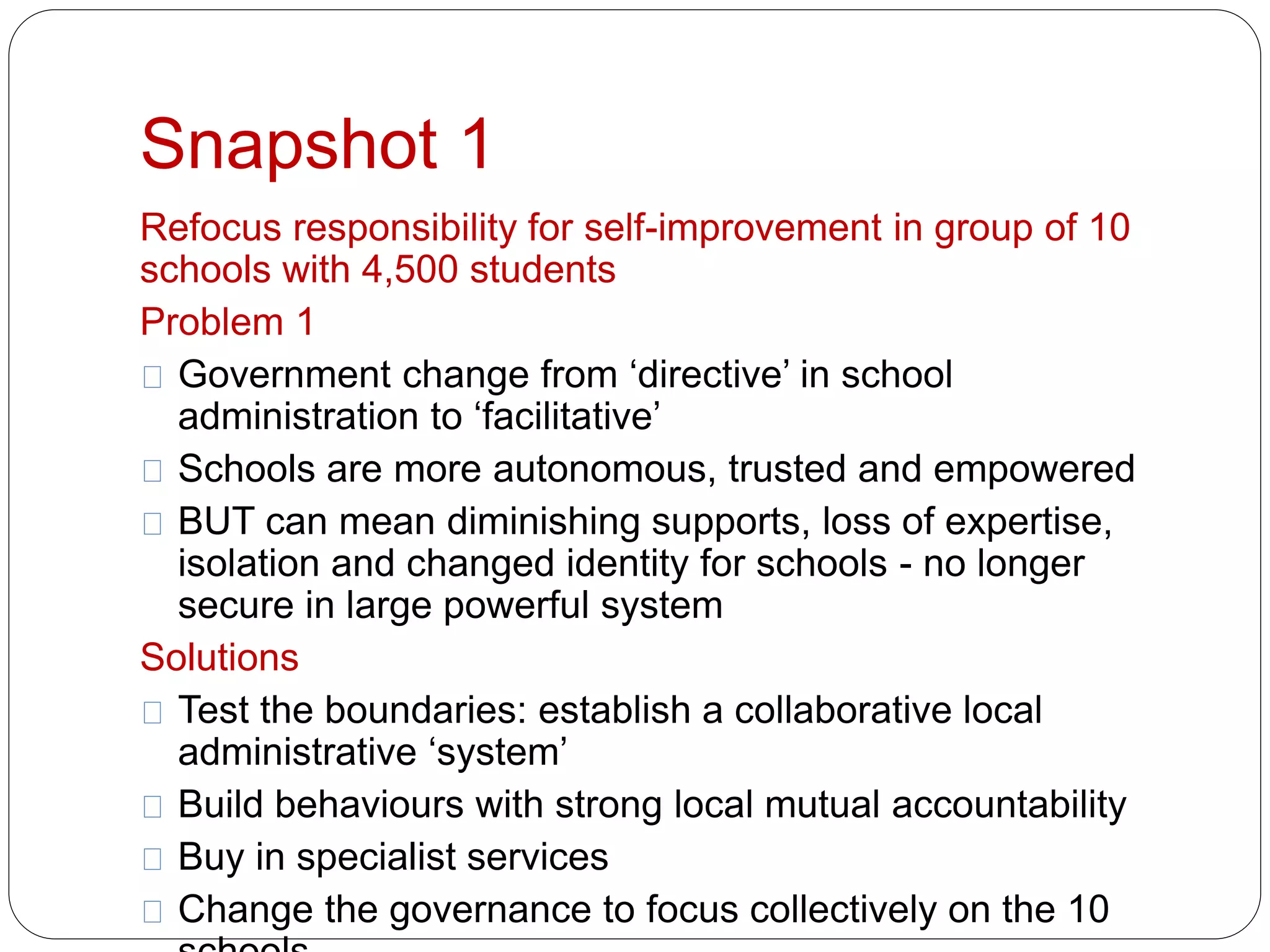
Snapshot 1 
Refocus responsibility for self-improvement in group of 10 
schools with 4,500 students 
Problem 1 
Government change from ‘directive’ in school 
administration to ‘facilitative’ 
Schools are more autonomous, trusted and empowered 
BUT can mean diminishing supports, loss of expertise, 
isolation and changed identity for schools - no longer 
secure in large powerful system 
Solutions 
Test the boundaries: establish a collaborative local 
administrative ‘system’ 
Build behaviours with strong local mutual accountability 
Buy in specialist services 
Change the governance to focus collectively on the 10 
schools
Snapshot 2 
Relationships and trust at the centre of building a school’s capacity to 
respond to new arrivals and refugees across 54 nationalities 
Problem 2 
School overwhelmed by learning challenges faced by their students 
Families with different cultural expectations of schools, language 
barriers, minimal pre-school experience 
Families in need – economic and social 
But, who is there to help? Confusion about access to local services; 
locus of responsibility - role of school versus welfare agencies 
Solutions 
Recast the school as the centre for driving solutions – what can we do? 
Deepened relationships with families – from knowing their families to 
establishing relationships and being trusted; school as conduit to 
families and solutions 
And, adopted a rigorous negotiation with other agencies on their role 
and contribution
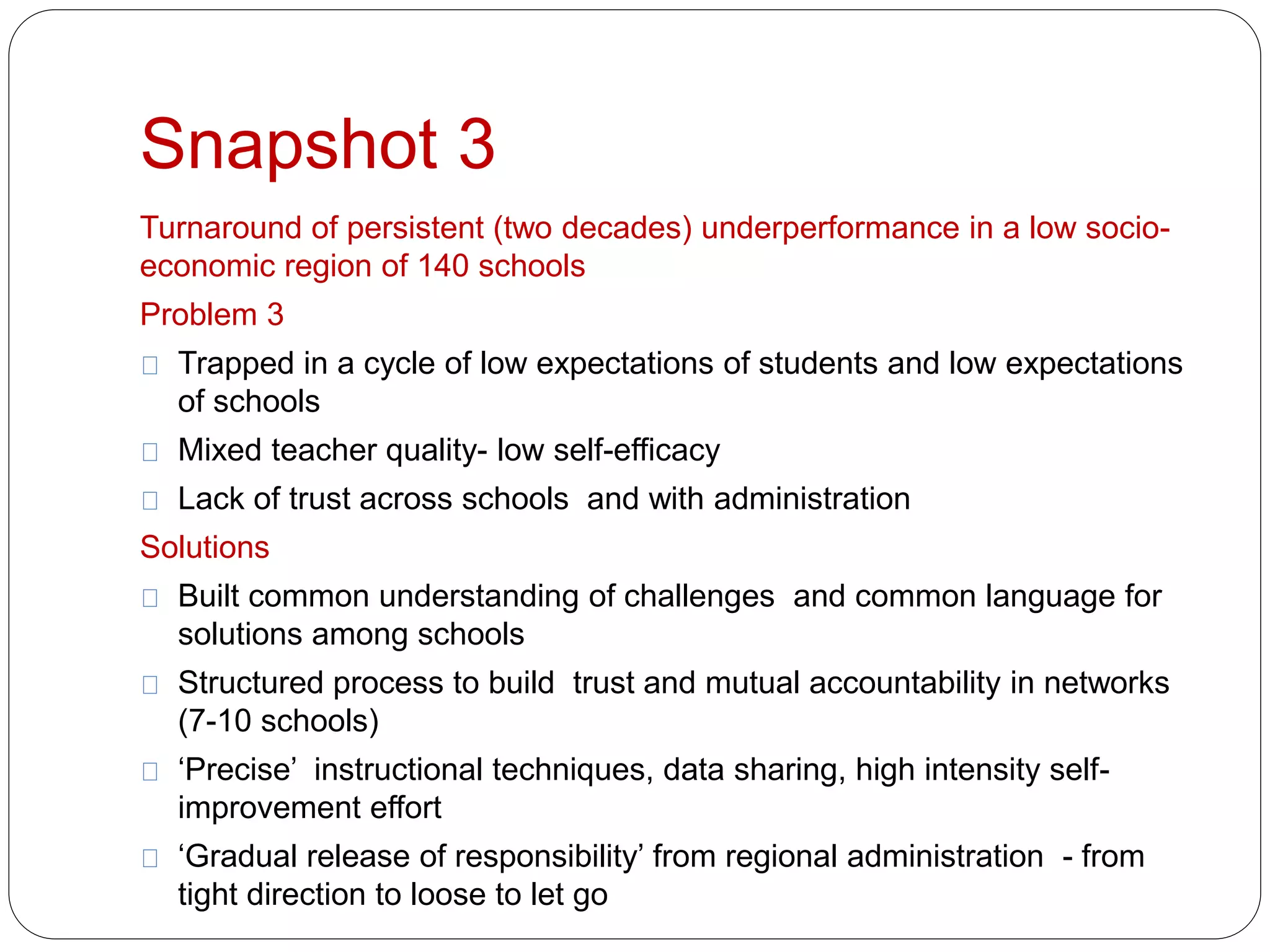
Snapshot 3 
Turnaround of persistent (two decades) underperformance in a low socio-economic 
region of 140 schools 
Problem 3 
Trapped in a cycle of low expectations of students and low expectations 
of schools 
Mixed teacher quality- low self-efficacy 
Lack of trust across schools and with administration 
Solutions 
Built common understanding of challenges and common language for 
solutions among schools 
Structured process to build trust and mutual accountability in networks 
(7-10 schools) 
‘Precise’ instructional techniques, data sharing, high intensity self-improvement 
effort 
‘Gradual release of responsibility’ from regional administration - from 
tight direction to loose to let go
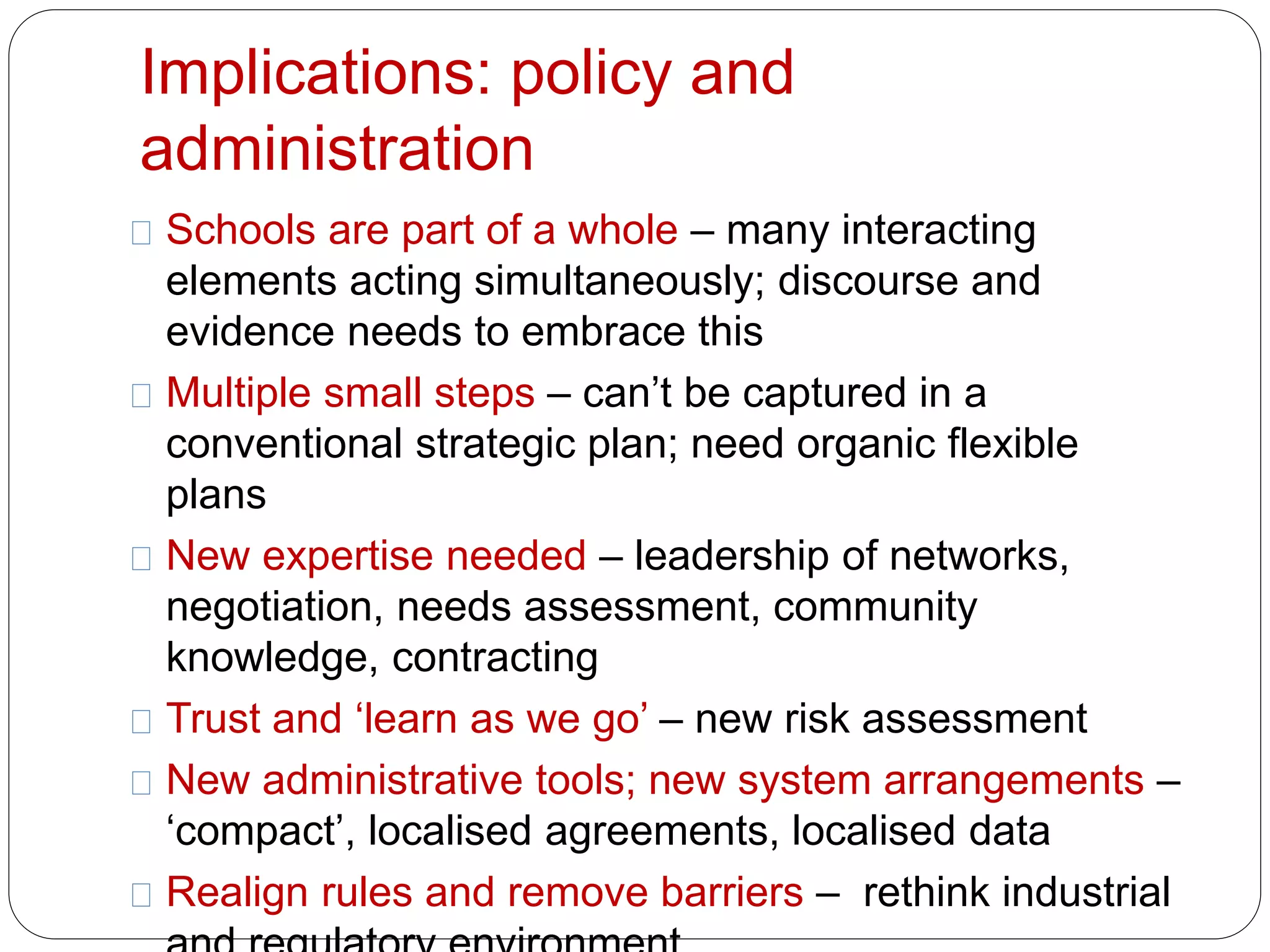
Implications: policy and 
administration 
Schools are part of a whole – many interacting 
elements acting simultaneously; discourse and 
evidence needs to embrace this 
Multiple small steps – can’t be captured in a 
conventional strategic plan; need organic flexible 
plans 
New expertise needed – leadership of networks, 
negotiation, needs assessment, community 
knowledge, contracting 
Trust and ‘learn as we go’ – new risk assessment 
New administrative tools; new system arrangements – 
‘compact’, localised agreements, localised data 
Realign rules and remove barriers – rethink industrial 
and regulatory environment

Challenge of complexity - rethinking approaches

  • 1.
    CHALLENGE OF COMPLEXITY: RETHINKING APPROACHES Dahle Suggett
  • 2.
    Australian case studies– Victoria Real and current examples Each has characteristics of Local response to redrawn system responsibilities Local agencies testing their autonomy and capacity Venturing into unknown territory New forms of collaboration and on a wider front Trust and mutual accountability
  • 3.
    Snapshot 1 Refocusresponsibility for self-improvement in group of 10 schools with 4,500 students Problem 1 Government change from ‘directive’ in school administration to ‘facilitative’ Schools are more autonomous, trusted and empowered BUT can mean diminishing supports, loss of expertise, isolation and changed identity for schools - no longer secure in large powerful system Solutions Test the boundaries: establish a collaborative local administrative ‘system’ Build behaviours with strong local mutual accountability Buy in specialist services Change the governance to focus collectively on the 10 schools
  • 4.
    Snapshot 2 Relationshipsand trust at the centre of building a school’s capacity to respond to new arrivals and refugees across 54 nationalities Problem 2 School overwhelmed by learning challenges faced by their students Families with different cultural expectations of schools, language barriers, minimal pre-school experience Families in need – economic and social But, who is there to help? Confusion about access to local services; locus of responsibility - role of school versus welfare agencies Solutions Recast the school as the centre for driving solutions – what can we do? Deepened relationships with families – from knowing their families to establishing relationships and being trusted; school as conduit to families and solutions And, adopted a rigorous negotiation with other agencies on their role and contribution
  • 5.
    Snapshot 3 Turnaroundof persistent (two decades) underperformance in a low socio-economic region of 140 schools Problem 3 Trapped in a cycle of low expectations of students and low expectations of schools Mixed teacher quality- low self-efficacy Lack of trust across schools and with administration Solutions Built common understanding of challenges and common language for solutions among schools Structured process to build trust and mutual accountability in networks (7-10 schools) ‘Precise’ instructional techniques, data sharing, high intensity self-improvement effort ‘Gradual release of responsibility’ from regional administration - from tight direction to loose to let go
  • 6.
    Implications: policy and administration Schools are part of a whole – many interacting elements acting simultaneously; discourse and evidence needs to embrace this Multiple small steps – can’t be captured in a conventional strategic plan; need organic flexible plans New expertise needed – leadership of networks, negotiation, needs assessment, community knowledge, contracting Trust and ‘learn as we go’ – new risk assessment New administrative tools; new system arrangements – ‘compact’, localised agreements, localised data Realign rules and remove barriers – rethink industrial and regulatory environment