Tailor made education for each child  “ from a project based approach to sustainable decentralized reality”  a consultancy challenge in Amsterdam and Utrecht Ady Hoitink  Gerard van den Hoven ICSEI, January 2011, Cyprus
Central question What does consultancy practice learn us about how to improve inter0rganisational collaboration… … To give the best opportunity to each and every child?
Aims ‘passend onderwijs’ Multi agency collaboration in Amsterdam/Utrecht No waiting lists or children left at home  Personalised education Differentiated classroom practice Less special education  Budget control and transparency Less bureaucracy /easier access for parents and regular schools to special arrangements
The changed context School boards are obliged to: Collaborate with other school boards in regional alliances Set agreements with (alliances of) special schools and social services. Distribute b udgets for personalised arrangements together, via the regional alliance (‘samenwerkingsverbanden’) Fact: Alliances since 1992 (primary education) and 1998 (secondary education) are still loosely coupled organisational networks.
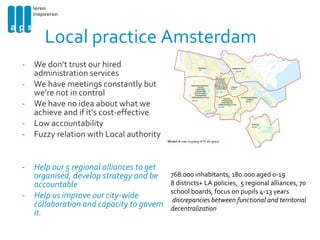
Local practice Amsterdam We don’t trust our hired administration services We have meetings constantly but we’re not in control We have no idea about what we achieve and if it’s cost-effective Low accountability Fuzzy relation with Local authority Help our 5 regional alliances to get organised, develop strategy and be accountable Help us improve our city-wide collaboration and capacity to govern it. 768.000 inhabitants, 180.000 aged 0-19  8 districts+ LA policies,  5 regional alliances, 70 school boards, focus on pupils 4-13 years discrepancies between functional and territorial decentralization
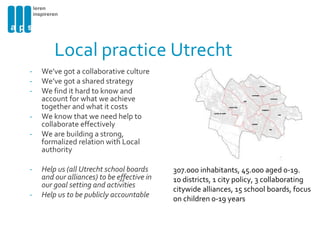
Local practice Utrecht We’ve got a collaborative culture We’ve got a shared strategy We find it hard to know and account for what we achieve together and what it costs We know that we need help to collaborate effectively We are building a strong, formalized relation with Local authority Help us (all Utrecht school boards and our alliances) to be effective in our goal setting and activities Help us to be publicly accountable 307.000 inhabitants, 45.000 aged 0-19.  10 districts, 1 city policy, 3 collaborating citywide alliances, 15 school boards, focus on children 0-19 years
Our observations in Amsterdam Mainly producing activity in the policy cycle (plan, check) Each issue can be discussed anywhere  School boards feel they are competitors An open minded and vulnerable attitude is “not done” Kind, civilized, reasonable, and erudite behaviour  Administrative gossip, power games Board member discontinuity in meetings, changing administrators, no staff or ‘hands and brains’ Few follow up and monitoring actions to identify implementation results  Few use of knowledge ‘what works’ Lack of concerted action to challenge segregation and improve the quality of education
Our observations in Amsterdam 2 Reactive conduct is dominant; pro active conduct necessary “ Activity traps” throughout the whole system: arranging day to day futilities instead of visionary governing in strategic perspective Weak relation with the rather strong Jong Amsterdam agenda ‘ What’s good for us or the local primary education sector?” Highly political culture, structure oriented Leadership vacuum Diseased network, lack of vital space Consultant as a temporary advisor
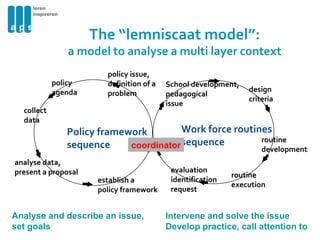
The “lemniscaat model”: a model to analyse a multi layer context School development,  pedagogical issue design criteria routine  development routine  execution evaluation identification request policy issue, definition of a problem policy agenda collect data analyse data, present a proposal establish a policy framework coordinator Analyse and describe an issue,  set goals Intervene and solve the issue Develop practice, call attention to Policy framework sequence Work force routines  sequence
Our observations in Utrecht Strong and open relationships, high trust Focus on ‘what works’ Mainly producing (tuned) activities in the working force routines sequence Friendly, direct, (self-)critical behaviour More activity-oriented than goal-oriented Clear relation with the rather weak Utrecht Educational Agenda and Utrecht Youth Agenda
Our observations in Utrecht 2 Few follow up and monitoring actions to identify  implementation results  Weak implementation power, quality ‘hands and brains’ is good, but quantity and coordination is not. ‘ What’s good for the children in our city (with respect to our institutional interests)“ Developping professional culture, activity oriented Healthy network, vital space Implementation vacuum Consultant as a 2-year project manager: free actor
Improvements Amsterdam Bring together the two cycles. Provide for leadership (other coordinators, stronger positions) Develop common purpose (social impact) Invite practicioners to influence strategy Develop longterm strategic processes Develop strategy-focused administrative processes (P&C cycle)
Improvements Amsterdam 2 Develop professional culture and use interorganisational learning of practitioners as a central activity Develop professional culture and use inter organisational learning of practitioners as a central activity Develop communication activities between policy and practice cycles Consultancy Dilemma: we are as good as the commission we’ve got
Improvements Utrecht Translate common purpose into intelligent goals (social impact) Strengthen implementation power by commissioning leaders and multi-staff Strengthen planning & control, monitoring and accountability Strengthen communication about policy, practice and lessons learned. Consultancy challenge: to stay a free actor and create vital space
Lessons learned Model of ‘lemniscate’ helps people to reflect on their multi-level, multi-actor context Helpful methaphors: healthy or diseased network, vital space, free actor  (dr. E. Wielinga) We need to: Relate to reality and goals for the future  constantly Reflect decisively  on culture (political vs professional) Help boards focus on (new) leadership  roles and qualities Know  and work with  the specific local context very well Choose interventions that help common purpose realize and grow high trust between collaborating leaders and practicioners
Courageous consultant: Unhealthy situation:  make us better!  Consultant must constantly search for permission to influence f.e. leadership or practice cycle) Healthy situation:  make us improve ourselves!   Consultant must enable vital space, and never stop using the permission to act freely throughout the system

2011 Jan 5 Presentatie Cyprus Def

  • 1.
    Tailor made educationfor each child “ from a project based approach to sustainable decentralized reality” a consultancy challenge in Amsterdam and Utrecht Ady Hoitink Gerard van den Hoven ICSEI, January 2011, Cyprus
  • 2.
    Central question Whatdoes consultancy practice learn us about how to improve inter0rganisational collaboration… … To give the best opportunity to each and every child?
  • 3.
    Aims ‘passend onderwijs’Multi agency collaboration in Amsterdam/Utrecht No waiting lists or children left at home Personalised education Differentiated classroom practice Less special education Budget control and transparency Less bureaucracy /easier access for parents and regular schools to special arrangements
  • 4.
    The changed contextSchool boards are obliged to: Collaborate with other school boards in regional alliances Set agreements with (alliances of) special schools and social services. Distribute b udgets for personalised arrangements together, via the regional alliance (‘samenwerkingsverbanden’) Fact: Alliances since 1992 (primary education) and 1998 (secondary education) are still loosely coupled organisational networks.
  • 5.
    Local practice AmsterdamWe don’t trust our hired administration services We have meetings constantly but we’re not in control We have no idea about what we achieve and if it’s cost-effective Low accountability Fuzzy relation with Local authority Help our 5 regional alliances to get organised, develop strategy and be accountable Help us improve our city-wide collaboration and capacity to govern it. 768.000 inhabitants, 180.000 aged 0-19 8 districts+ LA policies, 5 regional alliances, 70 school boards, focus on pupils 4-13 years discrepancies between functional and territorial decentralization
  • 6.
    Local practice UtrechtWe’ve got a collaborative culture We’ve got a shared strategy We find it hard to know and account for what we achieve together and what it costs We know that we need help to collaborate effectively We are building a strong, formalized relation with Local authority Help us (all Utrecht school boards and our alliances) to be effective in our goal setting and activities Help us to be publicly accountable 307.000 inhabitants, 45.000 aged 0-19. 10 districts, 1 city policy, 3 collaborating citywide alliances, 15 school boards, focus on children 0-19 years
  • 7.
    Our observations inAmsterdam Mainly producing activity in the policy cycle (plan, check) Each issue can be discussed anywhere School boards feel they are competitors An open minded and vulnerable attitude is “not done” Kind, civilized, reasonable, and erudite behaviour Administrative gossip, power games Board member discontinuity in meetings, changing administrators, no staff or ‘hands and brains’ Few follow up and monitoring actions to identify implementation results Few use of knowledge ‘what works’ Lack of concerted action to challenge segregation and improve the quality of education
  • 8.
    Our observations inAmsterdam 2 Reactive conduct is dominant; pro active conduct necessary “ Activity traps” throughout the whole system: arranging day to day futilities instead of visionary governing in strategic perspective Weak relation with the rather strong Jong Amsterdam agenda ‘ What’s good for us or the local primary education sector?” Highly political culture, structure oriented Leadership vacuum Diseased network, lack of vital space Consultant as a temporary advisor
  • 9.
    The “lemniscaat model”:a model to analyse a multi layer context School development, pedagogical issue design criteria routine development routine execution evaluation identification request policy issue, definition of a problem policy agenda collect data analyse data, present a proposal establish a policy framework coordinator Analyse and describe an issue, set goals Intervene and solve the issue Develop practice, call attention to Policy framework sequence Work force routines sequence
  • 10.
    Our observations inUtrecht Strong and open relationships, high trust Focus on ‘what works’ Mainly producing (tuned) activities in the working force routines sequence Friendly, direct, (self-)critical behaviour More activity-oriented than goal-oriented Clear relation with the rather weak Utrecht Educational Agenda and Utrecht Youth Agenda
  • 11.
    Our observations inUtrecht 2 Few follow up and monitoring actions to identify implementation results Weak implementation power, quality ‘hands and brains’ is good, but quantity and coordination is not. ‘ What’s good for the children in our city (with respect to our institutional interests)“ Developping professional culture, activity oriented Healthy network, vital space Implementation vacuum Consultant as a 2-year project manager: free actor
  • 12.
    Improvements Amsterdam Bringtogether the two cycles. Provide for leadership (other coordinators, stronger positions) Develop common purpose (social impact) Invite practicioners to influence strategy Develop longterm strategic processes Develop strategy-focused administrative processes (P&C cycle)
  • 13.
    Improvements Amsterdam 2Develop professional culture and use interorganisational learning of practitioners as a central activity Develop professional culture and use inter organisational learning of practitioners as a central activity Develop communication activities between policy and practice cycles Consultancy Dilemma: we are as good as the commission we’ve got
  • 14.
    Improvements Utrecht Translatecommon purpose into intelligent goals (social impact) Strengthen implementation power by commissioning leaders and multi-staff Strengthen planning & control, monitoring and accountability Strengthen communication about policy, practice and lessons learned. Consultancy challenge: to stay a free actor and create vital space
  • 15.
    Lessons learned Modelof ‘lemniscate’ helps people to reflect on their multi-level, multi-actor context Helpful methaphors: healthy or diseased network, vital space, free actor (dr. E. Wielinga) We need to: Relate to reality and goals for the future constantly Reflect decisively on culture (political vs professional) Help boards focus on (new) leadership roles and qualities Know and work with the specific local context very well Choose interventions that help common purpose realize and grow high trust between collaborating leaders and practicioners
  • 16.
    Courageous consultant: Unhealthysituation: make us better! Consultant must constantly search for permission to influence f.e. leadership or practice cycle) Healthy situation: make us improve ourselves! Consultant must enable vital space, and never stop using the permission to act freely throughout the system