Shared responsibility in accountability
M. Ehren
m.ehren@ucl.ac.uk
16 October 2016
OECD, Brussels
www.ioe.ac.uk/lcll
Background to shared responsibility
Changing education systems:
- Decentralization
- Increased autonomy
- Increased network governance: linking different
stakeholder organizations around a public policy
purpose and a set of joint goals
Examples
The purpose of shared responsibility:
• Addressing failing ‘command and control’ types of
regulation
• Acknowledging that no singe actor can regulate
effectively
• Creating conditions for responsiveness
Shared responsibility and accountability
• Inherent contradiction?
• Regulation and accountability need to adapt to local
context and create the conditions in which schools
effectively steer themselves
Shifting from monocentric to polycentric approaches
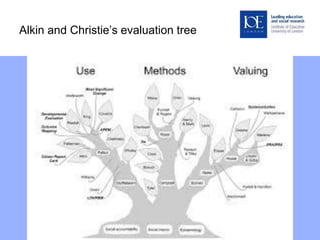
Alkin and Christie’s evaluation tree
Methodology
• Collection and analysis of empirical data for the study
and judgment of particular aspects of social life.
• Theorists in this branch: Campbell, Scriven, Stake
(positivist, objectivist), Weiss, Pawson, Tilley (theory-
driven evaluations), etc.
Changes: from monocentric to polycentric:
• Who defines standards and criteria and methods for
evaluation?
• What is the object of evaluation?
Methodology
Monocentric Polycentric
Top down, standardized
approach to evaluate single
schools, aimed at predicting
and explaining school
quality
Bottom-up, context-specific
approach to evaluate (schools
in) networks, aimed at
validating, interpreting,
understanding quality of
context-specific approaches
and solutions
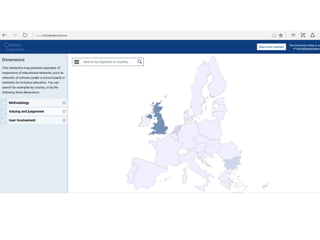
Examples methodology
• NI/West Belfast: area-based inspections informed by
network targets and self-evaluation
• England: formal consultations on inspection frameworks
• The Netherlands: round tables with (representatives of)
all stakeholders to discuss and develop inspection
frameworks, and pilot test frameworks
• Scotland: place-based scrutiny, scoping exercise to
inform data collection around one central question: what
is it like to live and learn in this community? Developing
questions for inquiry with local community
• England: soft intelligence of Regional Schools
Commissioners and local head teacher boards
Valuing/judgement
the making of value judgments about the quality of some
object, situation or process
Theorists in this branch: Levin, Lincoln and Guba, Eisner,
Scriven
Scriven describes different approaches: pass-fail
judgement, comparison of similar entities, goal-free (using
a qualitative approach to describe events, reactions and
interactions)
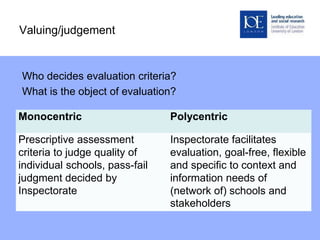
Valuing/judgement
Who decides evaluation criteria?
What is the object of evaluation?
Monocentric Polycentric
Prescriptive assessment
criteria to judge quality of
individual schools, pass-fail
judgment decided by
Inspectorate
Inspectorate facilitates
evaluation, goal-free, flexible
and specific to context and
information needs of
(network of) schools and
stakeholders
Examples valuing/judgement
• NI/West Belfast: reports highlight strengths and
weaknesses of the network and percentage of ALCs
targets met
• Scotland: map the attainment of strategic objectives for
the area against the different subgroups and sub-
communities
• Sharing responsibility in judgment is counterintuitive to
the position of many Inspectorates
Use (user involvement and consequences)
use of evaluation findings, recognizing the importance of
involving stakeholders when determining the evaluation
questions to gather useful information.
Theorists on this branch: Patton, Stufflebeam, Chelimskey,
Wholey and others
In an inspection context: also interventions to motivate
improvement/compliance (e.g. rewards, sanctions)
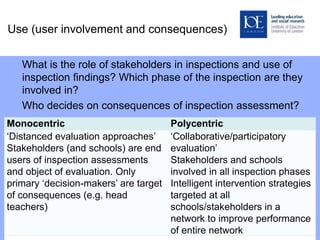
Use (user involvement and consequences)
What is the role of stakeholders in inspections and use of
inspection findings? Which phase of the inspection are they
involved in?
Who decides on consequences of inspection assessment?
Monocentric Polycentric
‘Distanced evaluation approaches’
Stakeholders (and schools) are end
users of inspection assessments
and object of evaluation. Only
primary ‘decision-makers’ are target
of consequences (e.g. head
teachers)
‘Collaborative/participatory
evaluation’
Stakeholders and schools
involved in all inspection phases
Intelligent intervention strategies
targeted at all
schools/stakeholders in a
network to improve performance
of entire network
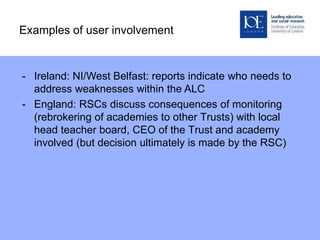
Examples of user involvement
- Ireland: NI/West Belfast: reports indicate who needs to
address weaknesses within the ALC
- England: RSCs discuss consequences of monitoring
(rebrokering of academies to other Trusts) with local
head teacher board, CEO of the Trust and academy
involved (but decision ultimately is made by the RSC)
www.schoolinspections.eu
Shared Responsibility in Accountability

Shared Responsibility in Accountability

  • 1.
    Shared responsibility inaccountability M. Ehren m.ehren@ucl.ac.uk 16 October 2016 OECD, Brussels www.ioe.ac.uk/lcll
  • 2.
    Background to sharedresponsibility Changing education systems: - Decentralization - Increased autonomy - Increased network governance: linking different stakeholder organizations around a public policy purpose and a set of joint goals
  • 3.
  • 4.
    The purpose ofshared responsibility: • Addressing failing ‘command and control’ types of regulation • Acknowledging that no singe actor can regulate effectively • Creating conditions for responsiveness
  • 5.
    Shared responsibility andaccountability • Inherent contradiction? • Regulation and accountability need to adapt to local context and create the conditions in which schools effectively steer themselves Shifting from monocentric to polycentric approaches
  • 6.
    Alkin and Christie’sevaluation tree
  • 7.
    Methodology • Collection andanalysis of empirical data for the study and judgment of particular aspects of social life. • Theorists in this branch: Campbell, Scriven, Stake (positivist, objectivist), Weiss, Pawson, Tilley (theory- driven evaluations), etc. Changes: from monocentric to polycentric: • Who defines standards and criteria and methods for evaluation? • What is the object of evaluation?
  • 8.
    Methodology Monocentric Polycentric Top down,standardized approach to evaluate single schools, aimed at predicting and explaining school quality Bottom-up, context-specific approach to evaluate (schools in) networks, aimed at validating, interpreting, understanding quality of context-specific approaches and solutions
  • 9.
    Examples methodology • NI/WestBelfast: area-based inspections informed by network targets and self-evaluation • England: formal consultations on inspection frameworks • The Netherlands: round tables with (representatives of) all stakeholders to discuss and develop inspection frameworks, and pilot test frameworks • Scotland: place-based scrutiny, scoping exercise to inform data collection around one central question: what is it like to live and learn in this community? Developing questions for inquiry with local community • England: soft intelligence of Regional Schools Commissioners and local head teacher boards
  • 10.
    Valuing/judgement the making ofvalue judgments about the quality of some object, situation or process Theorists in this branch: Levin, Lincoln and Guba, Eisner, Scriven Scriven describes different approaches: pass-fail judgement, comparison of similar entities, goal-free (using a qualitative approach to describe events, reactions and interactions)
  • 11.
    Valuing/judgement Who decides evaluationcriteria? What is the object of evaluation? Monocentric Polycentric Prescriptive assessment criteria to judge quality of individual schools, pass-fail judgment decided by Inspectorate Inspectorate facilitates evaluation, goal-free, flexible and specific to context and information needs of (network of) schools and stakeholders
  • 12.
    Examples valuing/judgement • NI/WestBelfast: reports highlight strengths and weaknesses of the network and percentage of ALCs targets met • Scotland: map the attainment of strategic objectives for the area against the different subgroups and sub- communities • Sharing responsibility in judgment is counterintuitive to the position of many Inspectorates
  • 13.
    Use (user involvementand consequences) use of evaluation findings, recognizing the importance of involving stakeholders when determining the evaluation questions to gather useful information. Theorists on this branch: Patton, Stufflebeam, Chelimskey, Wholey and others In an inspection context: also interventions to motivate improvement/compliance (e.g. rewards, sanctions)
  • 14.
    Use (user involvementand consequences) What is the role of stakeholders in inspections and use of inspection findings? Which phase of the inspection are they involved in? Who decides on consequences of inspection assessment? Monocentric Polycentric ‘Distanced evaluation approaches’ Stakeholders (and schools) are end users of inspection assessments and object of evaluation. Only primary ‘decision-makers’ are target of consequences (e.g. head teachers) ‘Collaborative/participatory evaluation’ Stakeholders and schools involved in all inspection phases Intelligent intervention strategies targeted at all schools/stakeholders in a network to improve performance of entire network
  • 15.
    Examples of userinvolvement - Ireland: NI/West Belfast: reports indicate who needs to address weaknesses within the ALC - England: RSCs discuss consequences of monitoring (rebrokering of academies to other Trusts) with local head teacher board, CEO of the Trust and academy involved (but decision ultimately is made by the RSC)
  • 16.