PROJECT BRIEF
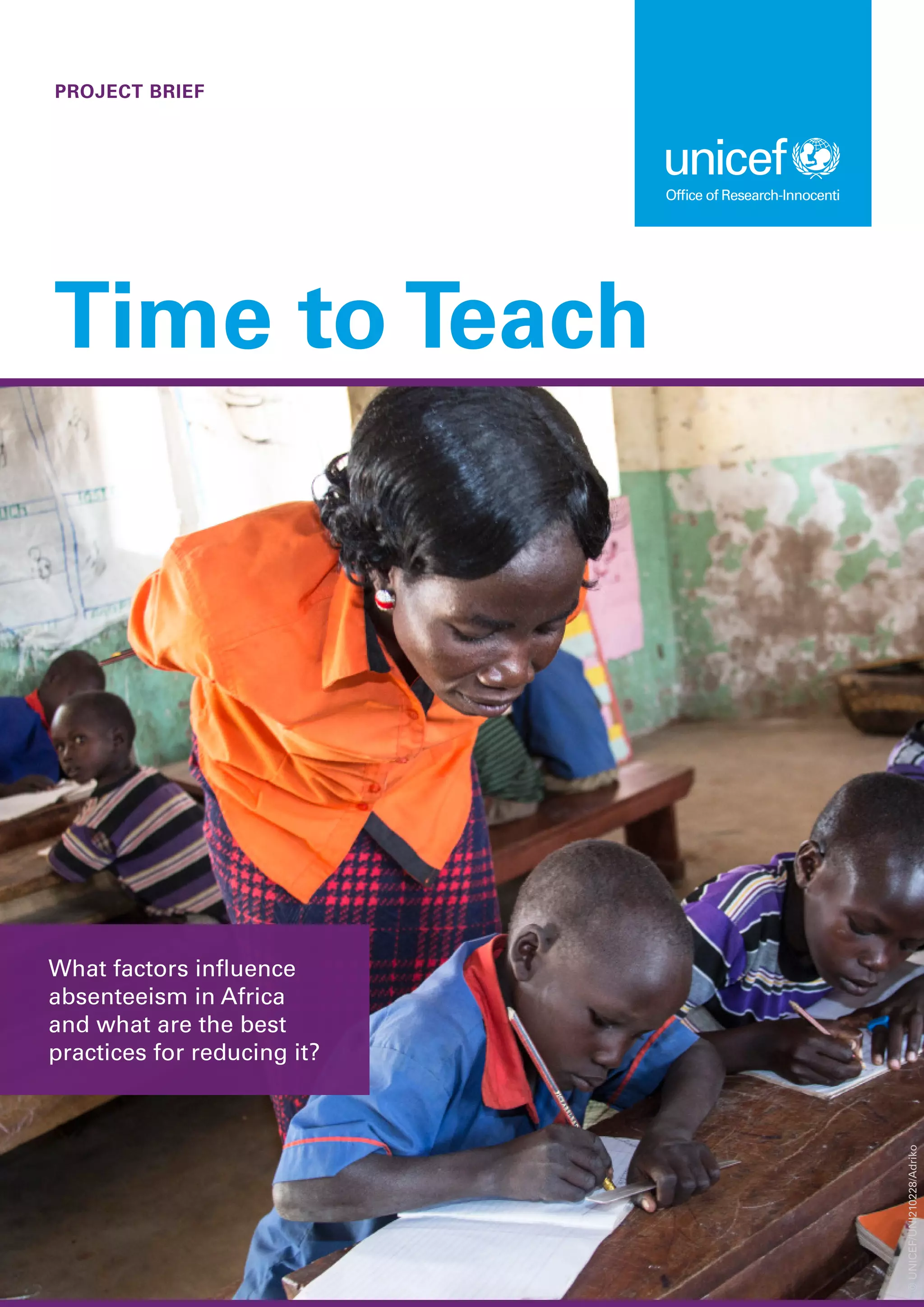
Time to Teach
What factors influence
absenteeism in Africa
and what are the best
practices for reducing it?
©
UNICEF/UNI210228/Adriko
Overview
Fifty-three per cent of children in low- and middle-
income countries are ‘learning poor’: they cannot
read and understand a simple text by the end of
primary school age. If we look at sub-Saharan Africa,
the rate balloons to 87 per cent.
Teachers attending lessons and spending quality
time on task is a critical prerequisite to learning.
In sub-Saharan Africa, teacher absenteeism ranges
from 15 to 45 per cent.Teacher absenteeism and
reduced time on task wastes valuable financial
resources, short-changes students and is one of
the most challenging obstacles on the path toward
achieving global targets in education.
While data is widely available, the evidence base
on how policies and practices can influence teacher
attendance remains scant.
ThisTime toTeach study strengthens the evidence
base on primary and secondary school teacher
absenteeism and provides critical insights into the
factors that drive all forms of teacher absenteeism.
It also examines how factors vary across countries,
school types, gender of teacher and other teacher
characteristics.
The research is undertaken in the Comoros; Kenya;
Mozambique; Rwanda, Puntland, State of Somalia;
South Sudan;Tanzania (mainland and Zanzibar);
Uganda;The Gambia; Ghana; Niger; Nigeria; Liberia;
Togo; Mauritania; Cote d’ Ivoire; Gabon; Guinea;
Guinea Bissau; and Morocco.
Approach
TheTime toTeach study moves beyond the
conventional definition of teacher attendance to
include other, subtler forms of teacher attendance,
like being punctual, being in the classroom (while
in school) and teaching when in the classroom.
The study draws from national, system-wide,
qualitative data collections, school observations
and a quantitative survey of more than 5,000
teachers working in 450 purposively selected
schools. Qualitative data were collected through
semi-structured interviews with education officials,
community representatives, head teachers and
teachers and focus group discussions with approxi-
mately 2,000 students.
Goal
The objectives of the study are to identify factors
that affect schoolteacher attendance and time
on task in the countries covered.The study also
compares determinants of teacher attendance in
different national settings and highlights promising
practices for improving teacher attendance and time
on task.
Project Highlights
PROJECT BRIEF
Contact Info
Despina Karamperidou
Education Research Specialist
dkaramperidou@unicef.org
Following the 2020 synthesis report on
East and Southern Africa and related
country studies, the research is now
under expansion in 10 countries in West
and Central Africa and Morocco. Country
studies will be produced and high-level
policy discussions will be organized with
participating national governments with
the aim of reforming policy and related
implementation to better support teachers
and reduce rates of teacher absenteeism
and diversion from time on task in the
classroom.
Matt Brossard
Chief, Education
mbrossard@unicef.org
Main Partners
Foreign, Commonwealth and Development Office
(FCDO); MasterCard Foundation (MCF); Bill and
Melinda Gates Foundation (BMGF); UNICEF Eastern
and Southern Africa (ESARO); UNICEF West and
Central Africa (WCARO), UNICEF Country offices and
the Governments of Italy and Norway.
Spogmai Akseer
Consultant
sakseer@unicef.org
Ximena Bethsabe Jativa Sierra
Consultant
xjativa@unicef.org

Time to teach — Project brief

  • 1.
    PROJECT BRIEF Time toTeach What factors influence absenteeism in Africa and what are the best practices for reducing it? © UNICEF/UNI210228/Adriko
  • 2.
    Overview Fifty-three per centof children in low- and middle- income countries are ‘learning poor’: they cannot read and understand a simple text by the end of primary school age. If we look at sub-Saharan Africa, the rate balloons to 87 per cent. Teachers attending lessons and spending quality time on task is a critical prerequisite to learning. In sub-Saharan Africa, teacher absenteeism ranges from 15 to 45 per cent.Teacher absenteeism and reduced time on task wastes valuable financial resources, short-changes students and is one of the most challenging obstacles on the path toward achieving global targets in education. While data is widely available, the evidence base on how policies and practices can influence teacher attendance remains scant. ThisTime toTeach study strengthens the evidence base on primary and secondary school teacher absenteeism and provides critical insights into the factors that drive all forms of teacher absenteeism. It also examines how factors vary across countries, school types, gender of teacher and other teacher characteristics. The research is undertaken in the Comoros; Kenya; Mozambique; Rwanda, Puntland, State of Somalia; South Sudan;Tanzania (mainland and Zanzibar); Uganda;The Gambia; Ghana; Niger; Nigeria; Liberia; Togo; Mauritania; Cote d’ Ivoire; Gabon; Guinea; Guinea Bissau; and Morocco. Approach TheTime toTeach study moves beyond the conventional definition of teacher attendance to include other, subtler forms of teacher attendance, like being punctual, being in the classroom (while in school) and teaching when in the classroom. The study draws from national, system-wide, qualitative data collections, school observations and a quantitative survey of more than 5,000 teachers working in 450 purposively selected schools. Qualitative data were collected through semi-structured interviews with education officials, community representatives, head teachers and teachers and focus group discussions with approxi- mately 2,000 students. Goal The objectives of the study are to identify factors that affect schoolteacher attendance and time on task in the countries covered.The study also compares determinants of teacher attendance in different national settings and highlights promising practices for improving teacher attendance and time on task. Project Highlights PROJECT BRIEF Contact Info Despina Karamperidou Education Research Specialist dkaramperidou@unicef.org Following the 2020 synthesis report on East and Southern Africa and related country studies, the research is now under expansion in 10 countries in West and Central Africa and Morocco. Country studies will be produced and high-level policy discussions will be organized with participating national governments with the aim of reforming policy and related implementation to better support teachers and reduce rates of teacher absenteeism and diversion from time on task in the classroom. Matt Brossard Chief, Education mbrossard@unicef.org Main Partners Foreign, Commonwealth and Development Office (FCDO); MasterCard Foundation (MCF); Bill and Melinda Gates Foundation (BMGF); UNICEF Eastern and Southern Africa (ESARO); UNICEF West and Central Africa (WCARO), UNICEF Country offices and the Governments of Italy and Norway. Spogmai Akseer Consultant sakseer@unicef.org Ximena Bethsabe Jativa Sierra Consultant xjativa@unicef.org