By
Trevor Bennett
 The chain rule basically deals with functions
within a function. There is a strong
relationship between them. If you consider
the links on a chain, one link overlaps the
other.
 If there is a change to either the inside or
outside link it affect the relationship between
them.
 I believe so far that you have covered
derivatives of functions. For example y =f(x)
and dy/dx = f’(x).
 But now considertwo functions f(x) and g(x).
We will loo at a function within a function.
 For instance y = f(g(x)). So then what is y’?
 The chain rule is what is applied!!
 If y = f(g(x))
 y’= f ’(g(x)) . g’(x) OR

 Alternatively
 You can let u = g(x) and so it becomes
 y(u)
 And then to determine y’, we get
 y’ = dy/dx = dy/du * du/dx.
 It can also be written as
 y’ = dy/dx = du/dx * dy/du
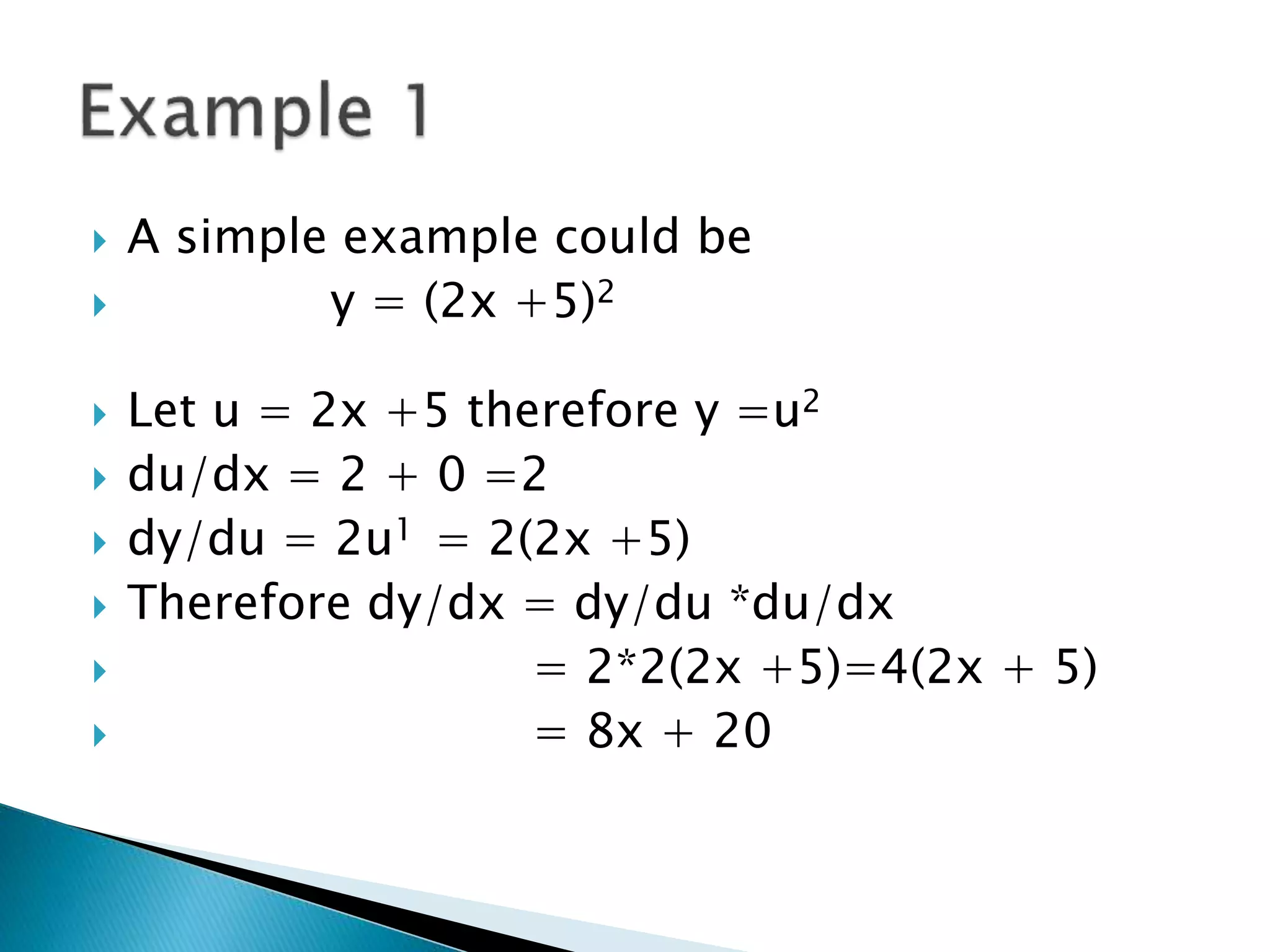
 A simple example could be
 y = (2x +5)2
 Let u = 2x +5 therefore y =u2
 du/dx = 2 + 0 =2
 dy/du = 2u1 = 2(2x +5)
 Therefore dy/dx = dy/du *du/dx
 = 2*2(2x +5)=4(2x + 5)
 = 8x + 20
 y = 5/(3x-5)3
 y’ = 5(3x-5)-3
 y’ =-3*5(3x-5)-4 *(3)
 y’ =-45(3x-5)-4
 y’ =-45/(3x-5)4

 y = sin(x7)

 y’ = 7x6*cos(x7)
Chain rule

Chain rule

  • 1.
  • 2.
     The chainrule basically deals with functions within a function. There is a strong relationship between them. If you consider the links on a chain, one link overlaps the other.  If there is a change to either the inside or outside link it affect the relationship between them.
  • 3.
     I believeso far that you have covered derivatives of functions. For example y =f(x) and dy/dx = f’(x).  But now considertwo functions f(x) and g(x). We will loo at a function within a function.  For instance y = f(g(x)). So then what is y’?  The chain rule is what is applied!!
  • 4.
     If y= f(g(x))  y’= f ’(g(x)) . g’(x) OR   Alternatively  You can let u = g(x) and so it becomes  y(u)  And then to determine y’, we get  y’ = dy/dx = dy/du * du/dx.
  • 5.
     It canalso be written as  y’ = dy/dx = du/dx * dy/du
  • 6.
     A simpleexample could be  y = (2x +5)2  Let u = 2x +5 therefore y =u2  du/dx = 2 + 0 =2  dy/du = 2u1 = 2(2x +5)  Therefore dy/dx = dy/du *du/dx  = 2*2(2x +5)=4(2x + 5)  = 8x + 20
  • 7.
     y =5/(3x-5)3  y’ = 5(3x-5)-3  y’ =-3*5(3x-5)-4 *(3)  y’ =-45(3x-5)-4  y’ =-45/(3x-5)4
  • 8.
      y =sin(x7)   y’ = 7x6*cos(x7)