Chapter 10
Pricing: Understanding and
Capturing Customer Value
Copyright © 2018 Pearson Education Ltd. All Rights Reserved.
10-1 Answer the question “What is a price?” and discuss the importance of pricing
in today’s fast-changing environment.
10-2 Identify the three major pricing strategies and discuss the importance of
understanding customer-value perceptions, company costs, and
competitor strategies when setting prices.
10-3 Identify and define the other important external and internal factors
affecting a firm’s pricing decisions.
Learning Objectives
Copyright © 2018 Pearson Education Ltd. All Rights Reserved.
What Is a Price
?
Price is the amount of money charged for a product or service.
It is the total of all the values that consumers give up in order
to gain the benefits of having or using a product or service
.
Price is the only element in the marketing mix that produces revenue;
all other elements represent costs.
Price is also one of the most flexible marketing mix elements; prices can be changed
quickly. Smart managers treat pricing as a key strategic tool for creating customer
value and building customer relationships
.
4
Understanding Pricing
• Pricing in a digital world
 Get immediate sellers price comparisons
 Check prices at the point of purchase
 Set your price and make it meet the
customer's expectations
 Monitor customer behavior & provide offers
 Give customers access to special prices
 Negotiate prices online or even in personally
5
Understanding Pricing
• Understanding Pricing
Price is not just a number. It comes in many forms and performs many
functions. Rent, tuition, wages, fees, rates, and commissions are all the
price you pay for some good or service. Price also has many
components. If you buy a new car, the sticker price may be adjusted by
Discounts and dealer incentives.
Copyright © 2018 Pearson Education Ltd. All Rights Reserved.
Major Pricing Strategies
Customer Value-Based Pricing
• Pricing decisions are complex and must take into account many factors
—the company, the customers, the competition, and the marketing
environment. Marketers know their pricing decisions must also be
regular with the firm’s marketing strategy and its target market.
Copyright © 2018 Pearson Education Ltd. All Rights Reserved.
Major Pricing Strategies
Copyright © 2018 Pearson Education Ltd. All Rights Reserved.
Major Pricing Strategies
Customer Value-Based Pricing
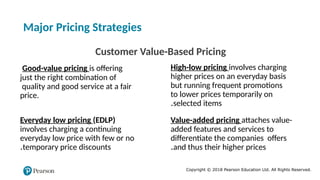
Good-value pricing is offering
just the right combination of
quality and good service at a fair
price.
Everyday low pricing (EDLP)
involves charging a continuing
everyday low price with few or no
temporary price discounts
.
High-low pricing involves charging
higher prices on an everyday basis
but running frequent promotions
to lower prices temporarily on
selected items
.
Value-added pricing attaches value-
added features and services to
differentiate the companies offers
and thus their higher prices
.
This value created by the product, distribution, and promotion elements
of the marketing will be known as the product’s Value To the
Customer (VTC).
Steps to Estimate the Value to the Customer
1. Identify the price of the competing product that the customer views
as the best substitute. This is the reference value.
2. Identify all factors that differentiate your product from this competing
product. These are the differentiating factors.
Estimating the Value to the Customer
Example: A homeowner has asked a local real property agent for advise on
the price he should set for his house. The real property agent notes
that the only comparable house in the neighborhood that is currently
for sale is asking $350,000. both houses are on a hill that overlooks a
beautiful lake, but the owner’s house is forty feet farther up the hill
than the comparable house. The agent guess that, in this area,
customers will pay an additional $10,000 for a house for each ten
added feet of elevation related with the house’s location. The owner’s
house an old-fashioned kitchen, but the sellers of the comparable
house have just spent $24,000 to remodel their kitchen.
What is the selling price that the real property agent should
recommend?
Estimating the Value to the Customer
Copyright © 2018 Pearson Education Ltd. All Rights Reserved.
Major Pricing Strategies
Cost-Based Pricing
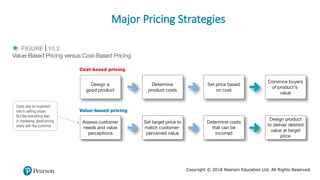
Cost-based pricing sets prices based
on the costs for producing,
distributing, and selling the product
plus a fair rate of return for effort and
risk
.
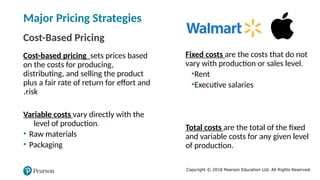
Fixed costs are the costs that do not
vary with production or sales level.
•Rent
•Executive salaries
Variable costs vary directly with the
level of production.
• Raw materials
• Packaging
Total costs are the total of the fixed
and variable costs for any given level
of production.
Copyright © 2018 Pearson Education Ltd. All Rights Reserved.
Marketing argument
Is the Right Price a Fair Price?
Take a position: Prices should reflect the value that
consumers are willing to pay.
Copyright © 2018 Pearson Education Ltd. All Rights Reserved.
Major Pricing Strategies
Competition-Based Pricing
Competition-based pricing is setting prices based
on competitors’ strategies, costs, prices, and market
offerings
.
Copyright © 2018 Pearson Education Ltd. All Rights Reserved.
Other Internal and External Considerations
Affecting Price Decisions
Comprehensive Marketing Strategy, Objectives, and Mix
Price decisions must be coordinated with product
design, distribution, and promotion decisions to form a
regular and effective mixed marketing program.
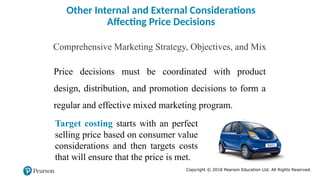
Target costing starts with an perfect
selling price based on consumer value
considerations and then targets costs
that will ensure that the price is met.
Copyright © 2018 Pearson Education Ltd. All Rights Reserved.
Other Internal and External Considerations
Affecting Price Decisions
Organizational Considerations
• Who should set prices?
• Who can influence prices?
Copyright © 2018 Pearson Education Ltd. All Rights Reserved.
• How companies price
– Small companies: boss
– Large companies: Department /product line managers
• How companies should price
– Understanding of consumer pricing psychology
– a systematic approach to setting, adapting, and changing
prices
Who should set prices?
Copyright © 2018 Pearson Education Ltd. All Rights Reserved.
• Possible Consumer Reference Prices
“Fair Price” (what consumers feel the product should cost)
• • Typical or regular Price
• • Last Price Paid
• • price or the maximum most consumers would pay)
• • Lower-price or the minimum most consumers would pay)
• • Competitor Prices
• • Expected Future Price
• • Usual Discounted Price
Reference prices
Copyright © 2018 Pearson Education Ltd. All Rights Reserved.
• Price-Quality Conclusion Many consumers use price as an
indicator of quality. Image pricing is especially effective with
ego-sensitive products such as perfumes, expensive cars, and
designer clothing. A $100 bottle of perfume might contain $10
worth of scent, but gift givers pay $100 to communicate their
high regard for the receiver.
Price-quality conclusion
Copyright © 2018 Pearson Education Ltd. All Rights Reserved.
• Price endings Many sellers believe prices should end in an odd or
singular number. Customers perceive an item priced at $299 to be in
the $200 rather than the $300 range, Price encoding in this fashion is
important Another explanation for the popularity of “9” endings is
that they suggest a discount or bargain, so if a company wants a high-
price image, it should probably avoid the odd-ending.
Price Endings
Copyright © 2018 Pearson Education Ltd. All Rights Reserved.
• One study showed that demand actually increased by 30%
when the price of a dress raise from $34 to $39 but was
unchanged when it raise from $34 to $44.26 Prices that end
with 0 are also popular.
Price Endings
Copyright © 2018 Pearson Education Ltd. All Rights Reserved.
• Each price will lead to a different level of demand and have
a different impact on a company’s marketing objectives. The
higher price, the lower demand.
Determining Demand
Copyright © 2018 Pearson Education Ltd. All Rights Reserved.
Other Considerations Affecting Price Decisions
The Market and Demand
Before setting prices, the marketer must understand the relationship
between price and demand for its products
.
Copyright © 2018 Pearson Education Ltd. All Rights Reserved.
• Generally, customers whom they are less price sensitive to low-cost
items or items they buy infrequently. They are also less price sensitive
when (1) there are few or no substitutes or competitors; (2) they do
not easily notice the higher price; (3) they are slow to change their
buying habits; (4) they think the higher prices are justified; and (5)
price is only a small part of the total cost of obtaining, operating, and
servicing the product over its lifetime.
Price sensitivity
Copyright © 2018 Pearson Education Ltd. All Rights Reserved.
• The product is more special.
• Buyers are less aware of substitutes.
• Buyers cannot easily compare the quality of substitutes.
• The expenses is a little part of the buyer’s total income.
• The expenses is small compared to the total cost of the end product.
• Part of the cost is hold out by another party.
•The product is assumed to have more quality, prestige, or
exclusiveness.
Factors that reduce price sensitivity
Copyright © 2018 Pearson Education Ltd. All Rights Reserved.
• Of course, companies prefer customers who are less price-
sensitive.
Price sensitivity
Copyright © 2018 Pearson Education Ltd. All Rights Reserved.
• Firm must take competitors’ costs, prices, &
reactions into account
Analyzing Competitors’ Prices
Copyright © 2018 Pearson Education Ltd. All Rights Reserved.
• The Company should first consider the nearest competitor’s price. If
the firm’s offer features not offered by the nearest competitor, their
worth to the customer should be evaluated, If the competitor’s offer
some features not offered by the firm, their worth to the customer
should be evaluated and remove from the firm’s price. Now the firm
can decide whether it can charge more, the same, or less than the
competitor. But competitors can change their prices in reaction to the
price set by the firm.
Analyzing Competitors’ Prices
Copyright © 2018 Pearson Education Ltd. All Rights Reserved.
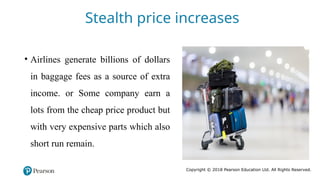
• Airlines generate billions of dollars
in baggage fees as a source of extra
income. or Some company earn a
lots from the cheap price product but
with very expensive parts which also
short run remain.
Stealth price increases
Copyright © 2018 Pearson Education Ltd. All Rights Reserved.
1. Discount: A price reduction to buyers who pay bills
immediately. A regular example is which means payment is
due within 30 days and the buyer can deduct 2 percent by
paying within 10 days.
Price discounts and allowances
Copyright © 2018 Pearson Education Ltd. All Rights Reserved.
2. Quantity Discount: A price reduction to those who buy large
volumes. Quantity discounts must be offered equally to all customers
3. Seasonal Discount: A price reduction to those who buy goods or
services out of season. Hotels, and airlines offer seasonal discounts in
slow selling periods.
Price discounts and allowances

التسويق الحديد الجديث الالقبلغلت لبتل .pptx

  • 1.
    Chapter 10 Pricing: Understandingand Capturing Customer Value
  • 2.
    Copyright © 2018Pearson Education Ltd. All Rights Reserved. 10-1 Answer the question “What is a price?” and discuss the importance of pricing in today’s fast-changing environment. 10-2 Identify the three major pricing strategies and discuss the importance of understanding customer-value perceptions, company costs, and competitor strategies when setting prices. 10-3 Identify and define the other important external and internal factors affecting a firm’s pricing decisions. Learning Objectives
  • 3.
    Copyright © 2018Pearson Education Ltd. All Rights Reserved. What Is a Price ? Price is the amount of money charged for a product or service. It is the total of all the values that consumers give up in order to gain the benefits of having or using a product or service . Price is the only element in the marketing mix that produces revenue; all other elements represent costs. Price is also one of the most flexible marketing mix elements; prices can be changed quickly. Smart managers treat pricing as a key strategic tool for creating customer value and building customer relationships .
  • 4.
    4 Understanding Pricing • Pricingin a digital world  Get immediate sellers price comparisons  Check prices at the point of purchase  Set your price and make it meet the customer's expectations  Monitor customer behavior & provide offers  Give customers access to special prices  Negotiate prices online or even in personally
  • 5.
    5 Understanding Pricing • UnderstandingPricing Price is not just a number. It comes in many forms and performs many functions. Rent, tuition, wages, fees, rates, and commissions are all the price you pay for some good or service. Price also has many components. If you buy a new car, the sticker price may be adjusted by Discounts and dealer incentives.
  • 6.
    Copyright © 2018Pearson Education Ltd. All Rights Reserved. Major Pricing Strategies Customer Value-Based Pricing • Pricing decisions are complex and must take into account many factors —the company, the customers, the competition, and the marketing environment. Marketers know their pricing decisions must also be regular with the firm’s marketing strategy and its target market.
  • 7.
    Copyright © 2018Pearson Education Ltd. All Rights Reserved. Major Pricing Strategies
  • 8.
    Copyright © 2018Pearson Education Ltd. All Rights Reserved. Major Pricing Strategies Customer Value-Based Pricing Good-value pricing is offering just the right combination of quality and good service at a fair price. Everyday low pricing (EDLP) involves charging a continuing everyday low price with few or no temporary price discounts . High-low pricing involves charging higher prices on an everyday basis but running frequent promotions to lower prices temporarily on selected items . Value-added pricing attaches value- added features and services to differentiate the companies offers and thus their higher prices .
  • 9.
    This value createdby the product, distribution, and promotion elements of the marketing will be known as the product’s Value To the Customer (VTC). Steps to Estimate the Value to the Customer 1. Identify the price of the competing product that the customer views as the best substitute. This is the reference value. 2. Identify all factors that differentiate your product from this competing product. These are the differentiating factors. Estimating the Value to the Customer
  • 10.
    Example: A homeownerhas asked a local real property agent for advise on the price he should set for his house. The real property agent notes that the only comparable house in the neighborhood that is currently for sale is asking $350,000. both houses are on a hill that overlooks a beautiful lake, but the owner’s house is forty feet farther up the hill than the comparable house. The agent guess that, in this area, customers will pay an additional $10,000 for a house for each ten added feet of elevation related with the house’s location. The owner’s house an old-fashioned kitchen, but the sellers of the comparable house have just spent $24,000 to remodel their kitchen. What is the selling price that the real property agent should recommend? Estimating the Value to the Customer
  • 11.
    Copyright © 2018Pearson Education Ltd. All Rights Reserved. Major Pricing Strategies Cost-Based Pricing Cost-based pricing sets prices based on the costs for producing, distributing, and selling the product plus a fair rate of return for effort and risk . Fixed costs are the costs that do not vary with production or sales level. •Rent •Executive salaries Variable costs vary directly with the level of production. • Raw materials • Packaging Total costs are the total of the fixed and variable costs for any given level of production.
  • 12.
    Copyright © 2018Pearson Education Ltd. All Rights Reserved. Marketing argument Is the Right Price a Fair Price? Take a position: Prices should reflect the value that consumers are willing to pay.
  • 13.
    Copyright © 2018Pearson Education Ltd. All Rights Reserved. Major Pricing Strategies Competition-Based Pricing Competition-based pricing is setting prices based on competitors’ strategies, costs, prices, and market offerings .
  • 14.
    Copyright © 2018Pearson Education Ltd. All Rights Reserved. Other Internal and External Considerations Affecting Price Decisions Comprehensive Marketing Strategy, Objectives, and Mix Price decisions must be coordinated with product design, distribution, and promotion decisions to form a regular and effective mixed marketing program. Target costing starts with an perfect selling price based on consumer value considerations and then targets costs that will ensure that the price is met.
  • 15.
    Copyright © 2018Pearson Education Ltd. All Rights Reserved. Other Internal and External Considerations Affecting Price Decisions Organizational Considerations • Who should set prices? • Who can influence prices?
  • 16.
    Copyright © 2018Pearson Education Ltd. All Rights Reserved. • How companies price – Small companies: boss – Large companies: Department /product line managers • How companies should price – Understanding of consumer pricing psychology – a systematic approach to setting, adapting, and changing prices Who should set prices?
  • 17.
    Copyright © 2018Pearson Education Ltd. All Rights Reserved. • Possible Consumer Reference Prices “Fair Price” (what consumers feel the product should cost) • • Typical or regular Price • • Last Price Paid • • price or the maximum most consumers would pay) • • Lower-price or the minimum most consumers would pay) • • Competitor Prices • • Expected Future Price • • Usual Discounted Price Reference prices
  • 18.
    Copyright © 2018Pearson Education Ltd. All Rights Reserved. • Price-Quality Conclusion Many consumers use price as an indicator of quality. Image pricing is especially effective with ego-sensitive products such as perfumes, expensive cars, and designer clothing. A $100 bottle of perfume might contain $10 worth of scent, but gift givers pay $100 to communicate their high regard for the receiver. Price-quality conclusion
  • 19.
    Copyright © 2018Pearson Education Ltd. All Rights Reserved. • Price endings Many sellers believe prices should end in an odd or singular number. Customers perceive an item priced at $299 to be in the $200 rather than the $300 range, Price encoding in this fashion is important Another explanation for the popularity of “9” endings is that they suggest a discount or bargain, so if a company wants a high- price image, it should probably avoid the odd-ending. Price Endings
  • 20.
    Copyright © 2018Pearson Education Ltd. All Rights Reserved. • One study showed that demand actually increased by 30% when the price of a dress raise from $34 to $39 but was unchanged when it raise from $34 to $44.26 Prices that end with 0 are also popular. Price Endings
  • 21.
    Copyright © 2018Pearson Education Ltd. All Rights Reserved. • Each price will lead to a different level of demand and have a different impact on a company’s marketing objectives. The higher price, the lower demand. Determining Demand
  • 22.
    Copyright © 2018Pearson Education Ltd. All Rights Reserved. Other Considerations Affecting Price Decisions The Market and Demand Before setting prices, the marketer must understand the relationship between price and demand for its products .
  • 23.
    Copyright © 2018Pearson Education Ltd. All Rights Reserved. • Generally, customers whom they are less price sensitive to low-cost items or items they buy infrequently. They are also less price sensitive when (1) there are few or no substitutes or competitors; (2) they do not easily notice the higher price; (3) they are slow to change their buying habits; (4) they think the higher prices are justified; and (5) price is only a small part of the total cost of obtaining, operating, and servicing the product over its lifetime. Price sensitivity
  • 24.
    Copyright © 2018Pearson Education Ltd. All Rights Reserved. • The product is more special. • Buyers are less aware of substitutes. • Buyers cannot easily compare the quality of substitutes. • The expenses is a little part of the buyer’s total income. • The expenses is small compared to the total cost of the end product. • Part of the cost is hold out by another party. •The product is assumed to have more quality, prestige, or exclusiveness. Factors that reduce price sensitivity
  • 25.
    Copyright © 2018Pearson Education Ltd. All Rights Reserved. • Of course, companies prefer customers who are less price- sensitive. Price sensitivity
  • 26.
    Copyright © 2018Pearson Education Ltd. All Rights Reserved. • Firm must take competitors’ costs, prices, & reactions into account Analyzing Competitors’ Prices
  • 27.
    Copyright © 2018Pearson Education Ltd. All Rights Reserved. • The Company should first consider the nearest competitor’s price. If the firm’s offer features not offered by the nearest competitor, their worth to the customer should be evaluated, If the competitor’s offer some features not offered by the firm, their worth to the customer should be evaluated and remove from the firm’s price. Now the firm can decide whether it can charge more, the same, or less than the competitor. But competitors can change their prices in reaction to the price set by the firm. Analyzing Competitors’ Prices
  • 28.
    Copyright © 2018Pearson Education Ltd. All Rights Reserved. • Airlines generate billions of dollars in baggage fees as a source of extra income. or Some company earn a lots from the cheap price product but with very expensive parts which also short run remain. Stealth price increases
  • 29.
    Copyright © 2018Pearson Education Ltd. All Rights Reserved. 1. Discount: A price reduction to buyers who pay bills immediately. A regular example is which means payment is due within 30 days and the buyer can deduct 2 percent by paying within 10 days. Price discounts and allowances
  • 30.
    Copyright © 2018Pearson Education Ltd. All Rights Reserved. 2. Quantity Discount: A price reduction to those who buy large volumes. Quantity discounts must be offered equally to all customers 3. Seasonal Discount: A price reduction to those who buy goods or services out of season. Hotels, and airlines offer seasonal discounts in slow selling periods. Price discounts and allowances

Editor's Notes

  • #3 Discussion Question How does a company like Starbucks price their products? This will lead to a good overview of the chapter as students will most likely focus on customers, costs and competitors. Historically, price has been the major factor affecting buyer choice. In recent decades, however, nonprice factors have gained increasing importance. Even so, price remains one of the most important elements that determines a firm’s market share and profitability. In the narrowest sense, price is the amount of money charged for a product or a service. More broadly, price is the sum of all the values that customers give up to gain the benefits of having or using a product or service
  • #6  Customer Value-Based Pricing In the end, the customer will decide whether a product’s price is right. Pricing decisions, like other marketing mix decisions, must start with customer value. Effective customer-oriented pricing involves understanding how much value consumers place on the benefits they receive from the product and setting a price that captures that value. Figure 10.2 (shown on the next slide) compares value-based pricing with cost-based pricing. Although costs are an important consideration in setting prices, cost-based pricing is often product driven and sets a price that covers costs plus a target profit. Marketing must then convince buyers that the product’s value at that price justifies its purchase. If the price turns out to be too high, the company must settle for lower markups or lower sales, both resulting in disappointing profits Customer value-based pricing uses buyers’ perceptions of value as the key to pricing. Value-based pricing means that the marketer cannot design a product and marketing program and then set the price.
  • #7 Figure 10.2: Value-Based Pricing vs. Cost-Based Pricing
  • #8 The Great Recession of 2008 to 2009 caused a fundamental and lasting shift in consumer attitudes toward price and quality. In response, many companies have changed their pricing approaches to bring them in line with changing economic conditions and consumer price perceptions. More and more, marketers have adopted the strategy of good-value pricing—offering the right combination of quality and good service at a fair price. In many cases, this has involved introducing less-expensive versions of established brand name products or new lower-price lines. In other cases, good-value pricing has involved redesigning existing brands to offer more quality for a given price or the same quality for less. Some companies even succeed by offering less value but at very low prices. Value-based pricing doesn’t mean simply charging what customers want to pay or setting low prices to meet competition. Instead, many companies adopt value-added pricing strategies rather than cut prices to match competitors. For example, even as frugal consumer spending habits linger, some movie theater chains are adding amenities and charging more rather than cutting services to maintain lower admission prices. Good-value pricing: ALDI keeps costs low so that it can offer customers “impressively high quality at impossibly low prices” every day. Department stores such as Sears and Macy’s practice high-low pricing by having frequent sale days, early-bird savings, and bonus earnings for store credit-card holders.
  • #11 Whereas customer-value perceptions set the price ceiling, costs set the floor for the price that the company can charge. Some companies, such as Walmart or Southwest Airlines, work to become the low-cost producers in their industries. Companies with lower costs can set lower prices that result in smaller margins but greater sales and profits. However, other companies—such as Apple, BMW, and Steinway—intentionally pay higher costs so that they can add value and claim higher prices and margins. Fixed costs (also known as overhead) are costs that do not vary with production or sales level. Variable costs vary directly with the level of production. Each PC produced by HP involves a cost of computer chips, wires, plastic, packaging, and other inputs. Although these costs tend to be the same for each unit produced, they are called variable costs because the total varies directly with the number of units produced. Management wants to charge a price that will at least cover the total production costs at a given level of production. The company must watch its costs carefully. If it costs the company more than its competitors to produce and sell a similar product, the company will need to charge a higher price or make less profit, putting it at a competitive disadvantage.
  • #13 Pricing versus competitors: Caterpillar dominates the heavy equipment industry despite charging premium prices. Customers believe that Caterpillar gives them a lot more value for the price over the lifetime of its machines. Competition-based pricing involves setting prices based on competitors’ strategies, costs, prices, and market offerings. Consumers will base their judgments of a product’s value on the prices that competitors charge for similar products. In assessing competitors’ pricing strategies, the company should ask: How does the company’s market offering compare with competitors’ offerings in terms of customer value? How strong are current competitors and what are their current pricing strategies?
  • #22 As noted earlier, good pricing starts with an understanding of how customers’ perceptions of value affect the prices they are willing to pay. Both consumer and industrial buyers balance the price of a product or service against the benefits of owning it. We now take a deeper look at the price-demand relationship and how it varies for different types of markets. We then discuss methods for analyzing the price-demand relationship. Discussion Question Discuss how the Internet has changed pricing competition? Under pure competition, the market consists of many buyers and sellers trading in a uniform commodity, such as wheat, copper, or financial securities. No single buyer or seller has much effect on the going market price. Thus, sellers in these markets do not spend much time on marketing strategy. Under monopolistic competition, the market consists of many buyers and sellers who trade over a range of prices because sellers can differentiate their offers to buyers. Under oligopolistic competition, the market consists of only a few large sellers. For example, only four companies—Verizon, AT&T, Sprint, and T-Mobile—control more than 90 percent of the U.S. wireless service provider market. Each seller is alert and responsive to competitors’ pricing strategies and marketing moves. In a pure monopoly, the market is dominated by one seller. The seller may be a government monopoly (the U.S. Postal Service), a private regulated monopoly (a power company), or a private unregulated monopoly (De Beers and diamonds). Pricing is handled differently in each case.