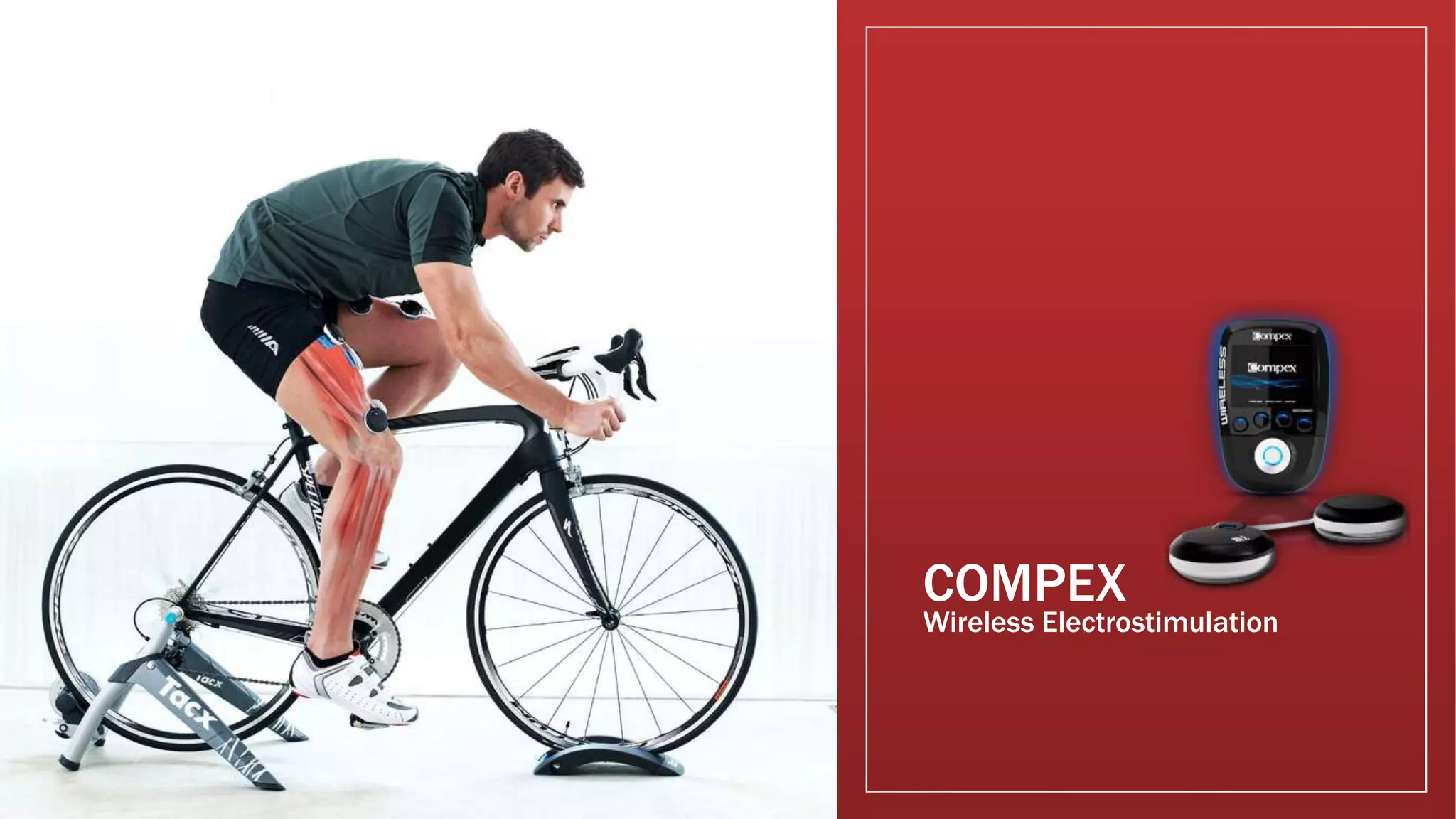


COMPEX
Wireless Electrostimulation
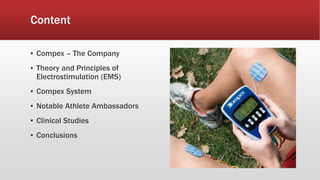
Content
▪ Compex – The Company
▪ Theory and Principles of
Electrostimulation (EMS)
▪ Compex System
▪ Notable Athlete Ambassadors
▪ Clinical Studies
▪ Conclusions
Compex – The Company
▪ A Swiss Based Company founded in
the 1980’s
▪ Developed a niche for electrotherapy
products
▪ Health
▪ Clinical treatments of Orthopedic and/or
Neurology
▪ Rehabilitation
▪ Training
▪ Part of DJO Global, Inc.
▪ Global provider of high-quality,
orthopedic devices
▪ Products used for rehabilitation, pain
management and physical therapy.
Theory and Principles of Electrostimulation (EMS)
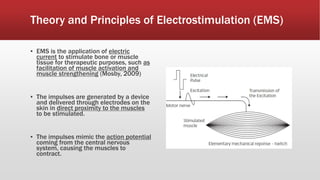
▪ EMS is the application of electric
current to stimulate bone or muscle
tissue for therapeutic purposes, such as
facilitation of muscle activation and
muscle strengthening (Mosby, 2009)
▪ The impulses are generated by a device
and delivered through electrodes on the
skin in direct proximity to the muscles
to be stimulated.
▪ The impulses mimic the action potential
coming from the central nervous
system, causing the muscles to
contract.
Theory and Principles of Electrostimulation (EMS)
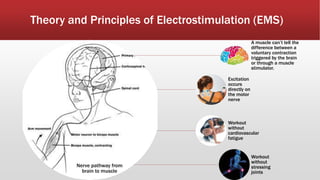
Nerve pathway from
brain to muscle
A muscle can’t tell the
difference between a
voluntary contraction
triggered by the brain
or through a muscle
stimulator.
Excitation
occurs
directly on
the motor
nerve
Workout
without
cardiovascular
fatigue
Workout
without
stressing
joints
Theory and Principles of Electrostimulation (EMS)
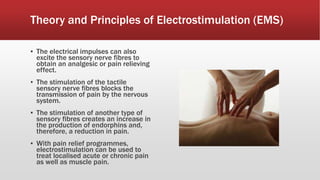
▪ The electrical impulses can also
excite the sensory nerve fibres to
obtain an analgesic or pain relieving
effect.
▪ The stimulation of the tactile
sensory nerve fibres blocks the
transmission of pain by the nervous
system.
▪ The stimulation of another type of
sensory fibres creates an increase in
the production of endorphins and,
therefore, a reduction in pain.
▪ With pain relief programmes,
electrostimulation can be used to
treat localised acute or chronic pain
as well as muscle pain.
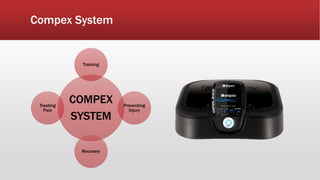
Compex System
COMPEX
SYSTEM
Training
Preventing
Injury
Recovery
Treating
Pain
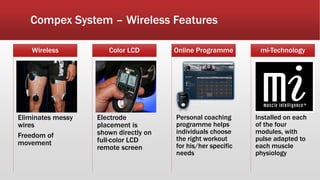
Compex System – Wireless Features
Eliminates messy
wires
Freedom of
movement
Wireless
Electrode
placement is
shown directly on
full-color LCD
remote screen
Color LCD
Personal coaching
programme helps
individuals choose
the right workout
for his/her specific
needs
Online Programme
Installed on each
of the four
modules, with
pulse adapted to
each muscle
physiology
mi-Technology
Notable Athlete Ambassadors
Mark Cavendish
•Professional Cyclist
Chris McCormack
•Professional Triathlete
Kilian Jornet
•Professional Endurance
Athlete and Ski Mountaineer
Sebastian Chaigneau
•Professional Trail Runner
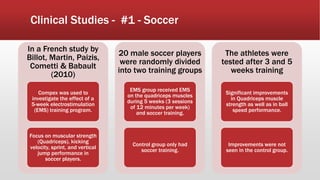
Clinical Studies - #1 - Soccer
In a French study by
Billot, Martin, Paizis,
Cometti & Babault
(2010)
Compex was used to
investigate the effect of a
5-week electrostimulation
(EMS) training program.
Focus on muscular strength
(Quadriceps), kicking
velocity, sprint, and vertical
jump performance in
soccer players.
20 male soccer players
were randomly divided
into two training groups
EMS group received EMS
on the quadriceps muscles
during 5 weeks (3 sessions
of 12 minutes per week)
and soccer training.
Control group only had
soccer training.
The athletes were
tested after 3 and 5
weeks training
Significant improvements
in Quadriceps muscle
strength as well as in ball
speed performance.
Improvements were not
seen in the control group.
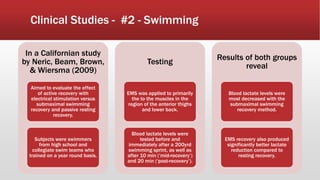
Clinical Studies - #2 - Swimming
In a Californian study
by Neric, Beam, Brown,
& Wiersma (2009)
Aimed to evaluate the effect
of active recovery with
electrical stimulation versus
submaximal swimming
recovery and passive resting
recovery.
Subjects were swimmers
from high school and
collegiate swim teams who
trained on a year round basis.
Testing
EMS was applied to primarily
the to the muscles in the
region of the anterior thighs
and lower back.
Blood lactate levels were
tested before and
immediately after a 200yrd
swimming sprint, as well as
after 10 min (‘mid-recovery’)
and 20 min (‘post-recovery’).
Results of both groups
reveal
Blood lactate levels were
most decreased with the
submaximal swimming
recovery method.
EMS recovery also produced
significantly better lactate
reduction compared to
resting recovery.
Clinical Studies - Effectiveness
▪ Study #1 - Improved strength
and performance in healthy
individuals and athletes
▪ It can also infuse variability into the
training program, which might
enhance the motivation of some
players.
▪ Recommended use for injured
athletes to attenuate or eliminate
detraining effects.
▪ Study #2 - Enhanced muscle
recovery
▪ Using EMS to reduce muscle and
blood lactate when athlete has
limited access to other active recovery
modalities (e.g. pool, stationary bike
or opportunities to run or walk)
▪ Using EMS to produce muscle
contractions while otherwise resting
may be of benefit in helping reduce
muscle and blood lactate before
subsequent performance.
Conclusions
▪ EMS is intended to complement a workout
routine, not replace it.
▪ Just as vitamins are intended to supplement a
good diet
▪ Compex Systems work in conjunction with a
traditional training regiment to help competitive
athletes achieve the highest level of
performance possible.
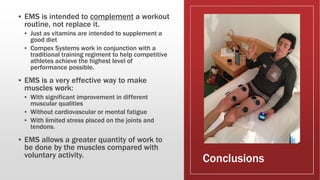
▪ EMS is a very effective way to make
muscles work:
▪ With significant improvement in different
muscular qualities
▪ Without cardiovascular or mental fatigue
▪ With limited stress placed on the joints and
tendons.
▪ EMS allows a greater quantity of work to
be done by the muscles compared with
voluntary activity.
References
▪ electrostimulation. (n.d.) Mosby's Medical Dictionary, 8th edition.
(2009). Retrieved February 18 2013 from http://medical-
dictionary.thefreedictionary.com/electrostimulation
▪ Billot, M., Martin, A., Paizis, C., Cometti, C., & Babault, N. (2010).
Effects of an electrostimulation training program on strength,
jumping, and kicking capacities in soccer players. J Strength Cond
Res, 24(5), 1407-1413. doi: 10.1519/JSC.0b013e3181d43790
▪ Neric, F. B., Beam, W. C., Brown, L. E., & Wiersma, L. D. (2009).
Comparison of swim recovery and muscle stimulation on lactate
removal after sprint swimming. J Strength Cond Res, 23(9), 2560-
2567. doi: 10.1519/JSC.0b013e3181bc1b7a

Compex Neuromuscular Stimulator

  • 1.
  • 2.
    Content ▪ Compex –The Company ▪ Theory and Principles of Electrostimulation (EMS) ▪ Compex System ▪ Notable Athlete Ambassadors ▪ Clinical Studies ▪ Conclusions
  • 3.
    Compex – TheCompany ▪ A Swiss Based Company founded in the 1980’s ▪ Developed a niche for electrotherapy products ▪ Health ▪ Clinical treatments of Orthopedic and/or Neurology ▪ Rehabilitation ▪ Training ▪ Part of DJO Global, Inc. ▪ Global provider of high-quality, orthopedic devices ▪ Products used for rehabilitation, pain management and physical therapy.
  • 4.
    Theory and Principlesof Electrostimulation (EMS) ▪ EMS is the application of electric current to stimulate bone or muscle tissue for therapeutic purposes, such as facilitation of muscle activation and muscle strengthening (Mosby, 2009) ▪ The impulses are generated by a device and delivered through electrodes on the skin in direct proximity to the muscles to be stimulated. ▪ The impulses mimic the action potential coming from the central nervous system, causing the muscles to contract.
  • 5.
    Theory and Principlesof Electrostimulation (EMS) Nerve pathway from brain to muscle A muscle can’t tell the difference between a voluntary contraction triggered by the brain or through a muscle stimulator. Excitation occurs directly on the motor nerve Workout without cardiovascular fatigue Workout without stressing joints
  • 6.
    Theory and Principlesof Electrostimulation (EMS) ▪ The electrical impulses can also excite the sensory nerve fibres to obtain an analgesic or pain relieving effect. ▪ The stimulation of the tactile sensory nerve fibres blocks the transmission of pain by the nervous system. ▪ The stimulation of another type of sensory fibres creates an increase in the production of endorphins and, therefore, a reduction in pain. ▪ With pain relief programmes, electrostimulation can be used to treat localised acute or chronic pain as well as muscle pain.
  • 7.
  • 8.
    Compex System –Wireless Features Eliminates messy wires Freedom of movement Wireless Electrode placement is shown directly on full-color LCD remote screen Color LCD Personal coaching programme helps individuals choose the right workout for his/her specific needs Online Programme Installed on each of the four modules, with pulse adapted to each muscle physiology mi-Technology
  • 9.
    Notable Athlete Ambassadors MarkCavendish •Professional Cyclist Chris McCormack •Professional Triathlete Kilian Jornet •Professional Endurance Athlete and Ski Mountaineer Sebastian Chaigneau •Professional Trail Runner
  • 10.
    Clinical Studies -#1 - Soccer In a French study by Billot, Martin, Paizis, Cometti & Babault (2010) Compex was used to investigate the effect of a 5-week electrostimulation (EMS) training program. Focus on muscular strength (Quadriceps), kicking velocity, sprint, and vertical jump performance in soccer players. 20 male soccer players were randomly divided into two training groups EMS group received EMS on the quadriceps muscles during 5 weeks (3 sessions of 12 minutes per week) and soccer training. Control group only had soccer training. The athletes were tested after 3 and 5 weeks training Significant improvements in Quadriceps muscle strength as well as in ball speed performance. Improvements were not seen in the control group.
  • 11.
    Clinical Studies -#2 - Swimming In a Californian study by Neric, Beam, Brown, & Wiersma (2009) Aimed to evaluate the effect of active recovery with electrical stimulation versus submaximal swimming recovery and passive resting recovery. Subjects were swimmers from high school and collegiate swim teams who trained on a year round basis. Testing EMS was applied to primarily the to the muscles in the region of the anterior thighs and lower back. Blood lactate levels were tested before and immediately after a 200yrd swimming sprint, as well as after 10 min (‘mid-recovery’) and 20 min (‘post-recovery’). Results of both groups reveal Blood lactate levels were most decreased with the submaximal swimming recovery method. EMS recovery also produced significantly better lactate reduction compared to resting recovery.
  • 12.
    Clinical Studies -Effectiveness ▪ Study #1 - Improved strength and performance in healthy individuals and athletes ▪ It can also infuse variability into the training program, which might enhance the motivation of some players. ▪ Recommended use for injured athletes to attenuate or eliminate detraining effects. ▪ Study #2 - Enhanced muscle recovery ▪ Using EMS to reduce muscle and blood lactate when athlete has limited access to other active recovery modalities (e.g. pool, stationary bike or opportunities to run or walk) ▪ Using EMS to produce muscle contractions while otherwise resting may be of benefit in helping reduce muscle and blood lactate before subsequent performance.
  • 13.
    Conclusions ▪ EMS isintended to complement a workout routine, not replace it. ▪ Just as vitamins are intended to supplement a good diet ▪ Compex Systems work in conjunction with a traditional training regiment to help competitive athletes achieve the highest level of performance possible. ▪ EMS is a very effective way to make muscles work: ▪ With significant improvement in different muscular qualities ▪ Without cardiovascular or mental fatigue ▪ With limited stress placed on the joints and tendons. ▪ EMS allows a greater quantity of work to be done by the muscles compared with voluntary activity.
  • 14.
    References ▪ electrostimulation. (n.d.)Mosby's Medical Dictionary, 8th edition. (2009). Retrieved February 18 2013 from http://medical- dictionary.thefreedictionary.com/electrostimulation ▪ Billot, M., Martin, A., Paizis, C., Cometti, C., & Babault, N. (2010). Effects of an electrostimulation training program on strength, jumping, and kicking capacities in soccer players. J Strength Cond Res, 24(5), 1407-1413. doi: 10.1519/JSC.0b013e3181d43790 ▪ Neric, F. B., Beam, W. C., Brown, L. E., & Wiersma, L. D. (2009). Comparison of swim recovery and muscle stimulation on lactate removal after sprint swimming. J Strength Cond Res, 23(9), 2560- 2567. doi: 10.1519/JSC.0b013e3181bc1b7a